Tag Archives: framing

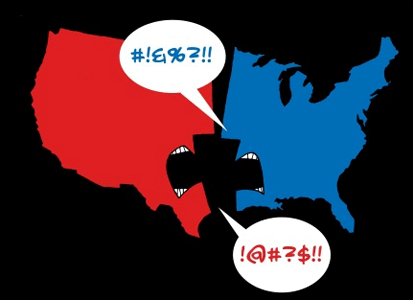
How Understanding Should Liberals Be?

In a polarized world, it’s tempting and satisfying to think: My side is right and the other side is wrong. We represent truth, justice, and all that is good; they represent lies, corruption, and all that is evil. So the most direct way to improve the world is for Us to kick the crap out of Them.

As a liberal, though, I sometimes find it just as tempting (and satisfying in a different way) to think: No one has a monopoly on Truth; there are wise and good people on all sides. Democracy doesn’t work without compromise, and for any conflict there’s usually a higher Truth that transcends both poles. So it’s important for the wise and good people on all sides to stay in dialog and work towards understanding and consensus. Only then can we achieve the kind of win/win solutions that move humanity forward.

On one path, anger and self-righteousness provide energy and direction. On the other, identification with the yet-to-be-discovered wisdom of the future yields a softer (but perhaps more lasting) determination.

Each attitude (if I’m being really honest) offers its own kind of ego boost. In one, I’m superior to those stupid and corrupt conservatives; in the other I’m superior to everyone who hasn’t been to the mountaintop and seen my vision – or at least the vision that I plan to see when I get to the mountaintop.

In the blogosphere, kick-the-crap-out-of-them liberals and find-the-higher-truth liberals have their own polarization, which often manifests in bitter fights between idealists and pragmatists. So in this post, I’m doing what any good meta-liberal would do: I’m searching for the higher truth that transcends the conflict between crap-kicking liberals and conflict-transcending liberals.

The text for my sermon is Jonathan Haidt’s recent book The Righteous Mind: Why Good People Are Divided by Politics and Religion. Obviously, Haidt hails from the conflict-transcending tribe. He describes himself as a life-long liberal from academia, but living among the common people in India opened his eyes to the worthiness of conservative values like in-group loyalty and respect for authority, and the data he has collected since convinces him that there is wisdom on both sides.

Now if only all the wise and good people could transcend polarization and get into dialog.

Not so fast. If Haidt had completely convinced me, I would write a polemic about how conflict-transcending liberals need to kick the crap out of the crap-kicking liberals who poison the dialog that we otherwise could be having with wise and good conservatives.

But I also read Charles Blow’s post in February, showing that compromise itself is a liberal value conservatives don’t share. In poll after poll, Democrats say their leaders should compromise to get something done, while Republicans say their leaders should stick to conservative principles.

Given that difference, the path of least resistance is for Democrats to compromise and Republicans to move ever further to the right. So the Heritage Foundation’s conservative alternative to HillaryCare begets ObamaCare, which Heritage now denounces as an unconstitutional Marxist plot to take over the economy.

I sometimes imagine inviting the Ricks (Santorum and Warren) to a dialog aimed at finding a truth that transcends both my secularism and their Christianity. It’s a non-starter. To the Ricks, the very idea of a truth transcending Christianity is Satanic. Even liberal Christianity might be Satanic.

Worse, you can’t negotiate with Wisdom and Goodness when Lies and Corruption are in the driver’s seat. Think about climate change: The “controversy” over global warming comes not from the laboratories of dissident scientists, but from the board rooms of Exxon-Mobil and Koch Energy.

Corporations are sociopaths; they aren’t influenced by arguments about truth and goodness. So whatever evidence emerges, fossil-fuel companies (and their PR firms, lobbyists, and senators) will challenge the scientific consensus on global warming until they’ve sold the last trainload of coal to the last power plant to run the last air conditioner.

How do you find common ground with that? Don’t we just have to win?

Haidt’s case. Armored with appropriate skepticism, then, let’s look at what Haidt has to say.

Haidt has very artfully organized his book to illustrate his own principles. He believes people first react to an idea intuitively, and only then engage their rational minds to justify their reaction. So Haidt knows that if he turns people off on page 1, none of the evidence he offers later will get a fair hearing. So instead he engagingly tells the story of how he got to his conclusions while saving the conclusions themselves until the end.

He offers (and supports with data) a model of how this all-powerful moral intuition works: Humans have evolved to ‘taste’ six different moral ‘flavors’. Four are easy to describe:

  • Care/harm. Don’t hurt the innocent, especially if they’re cute and helpless.
  • Loyalty/betrayal. Don’t break your agreements or sabotage the team.
  • Authority/subversion. Don’t get uppity and disrespect your betters.
  • Sanctity/degradation. Don’t break your community’s fundamental taboos.

Haidt spells out the emotions these flavors evoke – violations of sanctity evoke disgust, for example, while violations of loyalty evoke rage – and how these responses (even the ones that contradict others) might have evolved.

Originally fairness was a fifth flavor, but eventually he realized that this word is used ambiguously for two different flavors.

  • Liberty/oppression. Nobody is inherently better than anybody else. Example: Count each person’s vote equally.
  • Fairness/cheating. Rewards should be proportional to contributions. Example: People who worker harder should make more money.

The punch line is that liberal moral arguments focus on Care and Liberty, while conservatives season their arguments with all six flavors. (Again, there’s supporting data.)

Politically, Haidt’s book has two big takeaways for liberals: (1) We should learn how to appeal to a wider palate. (2) Conservatives aren’t evil, they just taste different flavors of morality.

Not so fast, part II. I can buy (1), but I’ve got problems with (2). First, I taste those other flavors, I’m just deeply ambivalent about them, because I understand how they can serve evil purposes as easily as good: Being a team player and respecting authority can be bad (say, when you’re in Nazi Germany). Sanctity provides the ugh-factor that justifies oppression of out-groups like homosexuals. Distributing rewards proportionately to contributions can hide an unequal distribution of the opportunities to contribute.

I love a good strong salty taste, but it makes me worry about the value of what I’m eating.

Second, go back to my Exxon-Mobil example: Corporations don’t taste any flavors of morality, they just know how to manipulate the people who do. Fry up some pink slime, add a bunch of salt, and it tastes great!

How understanding do I want to be? But now I’m leaning too far over in the crap-kicking direction. I promised some transcendence. So here’s how much of Haidt I take to heart:

First, liberals need to distinguish what we’re fighting for from who we’re fighting with.

That dittohead friend from high school or the cousin who forwards right-wing viral emails – you probably already realize that they’re not bad people. If you can stand to talk politics at all with them, Haidt has a lot to tell you: You’re never going to convince them by yelling your liberal values back at them. To be convincing, you need to understand what flavor of morality they find in the positions they’re taking, echo that value to the extent you honestly can, and then detach it from the case at hand while you add liberal flavors to the stew.

But lies are poison, no matter how they’re flavored. You can cut some slack for the woman in the next cubicle who tells you Obama is a Kenyan. But you can’t cut any slack for the lie itself. “Why do you believe that?” invites dialog, but “You might be right” just surrenders.

And that TV-talking-head that a Koch-Brothers astroturf group pays to lie for them? He’s evil. Don’t waste your compassion trying to understand anything deeper about him than his paycheck.

Compromise on proposals, not principles. There’s nothing wrong with supporting the best proposal you can pass, even if the other side also manages to get some of its agenda in as well. That’s how democracy works.

For example, the 15th Amendment guaranteed black men the right to vote. Some feminists opposed it, because it should have given women the right to vote as well.

In principle, they were right: It should have. But I’m glad the 15th Amendment passsed, especially since the 19th Amendment eventually followed.

But no post-Civil-War liberal should have said, “It’s good that the 15th Amendment doesn’t apply to women.” Pass as much as you can, but never surrender your intention to come back for more.

Liberal/conservative isn’t symmetric. Haidt is right that six-flavor conservatism has an inherent advantage over two-flavor liberalism. We just don’t have as many ways to provoke a knee-jerk response. That’s why conservatism corrolates with low-effort thought.

That’s also why we can’t just invert the knee-jerk arguments of the right. The correct response to “Black people are bad” isn’t “White people are bad.” “America is always right” shouldn’t lead to “America is always wrong.”

Our side needs nuance. We need to engage thought rather than shut it down.

In particular, we need nuance when we respond to books like The Righteous Mind. The proper response to “Conservatives are good people” isn’t “Conservatives are bad people.” It’s “In what cases and what ways are conservatives good, and how can we engage them there without betraying our own values?”

Jobs, Hobbies, and Reflections on a Viral Post

Last week I wrote Rich People Don’t Have Jobs to point out one of the most important distinctions in American life: the one that separates the people who work out of necessity from the people who either don’t work or work purely for personal satisfaction.

Usually, a distinction that basic corresponds to a pair of one-syllable words: young/old, boy/girl, rich/poor, black/white, smart/dumb, gay/straight, and so on. People like to talk about important categories, so they give them nice short names.

But what happens when there’s a distinction people don’t talk about? Then the words are longer and sound like scientific classifications. When I was young, nobody was supposed to talk about men who love men or women who love women, so they were homosexuals rather than heterosexuals. I first heard the word gay (in that sense) in the 70s, right about the time it became OK to talk about gays.

You know you’ve really hit a taboo subject when you can’t think of a word at all. Picture Freud laboriously searching his dictionary, looking for the word that describes a boy’s lust for his mother. Sorry, Sigmund, you’ll have to coin oedipal yourself.

That’s where I was. I’m not as creative with mythology as Freud, but I suppose I could have hyphenated something: necessity-workers and satisfaction-workers, say. It would have sounded sociological, an academic distinction rather than something people butt their heads against every day.

The other approach is to be outrageous. Gay was outrageous, back when it was coined. It made boys smirk at the idea of donning “gay apparel” at Christmas, or Fred and Barney having “a gay old time” down in Bedrock. A lot of people hated the homosexual community’s appropriation of a perfectly good one-syllable word – as if homosexuality were something people should want to talk about, as if English should reconfigure itself to make those conversations easier.

I decided to be outrageous. So I called work-you-do-out-of-necessity a job and work-you-do-for-satisfaction a hobby. “Rich people don’t have jobs,” I said, “they have hobbies.”

I heard from a lot of people who hated it. (And others who loved it.) Many wanted to talk about the words rather than what they represented. Some accused me of saying that rich people don’t work. (I didn’t.) Or of denigrating well-to-do “hobbyists”. (Why anyone would feel denigrated to be classed with Warren Buffett and Tiger Woods escapes me.) There were the usual write-offs of “class warfare”. Some of the wilder comments I saw were by Facebook friends of my article-sharing Facebook friends. (One thought the point of my post was to beatify my mother and demonize Ann Romney.)

Here’s what I think is going on: America is in denial about inequality and class. It’s fine to talk (occasionally) about rich and poor, but only as a difference of degree. The one has a new BMW and the other an old junker, but they both get where they’re going. The one eats at a four-star restaurant while the other has a bag lunch, but they both eat.

What’s taboo is to suggest that there’s something qualitatively different about living with money. We’re fine with the idea that a concierge doctor will come out to see a billionaire while a waitress goes to the emergency room — a little more convenience, that’s what money gives you a right to expect. But it’s taboo to suggest that the billionaire will live in situations where the waitress will die.

If we don’t talk about those qualitative differences, though, the conversation gets distorted. Inevitably it tilts towards justifying the privileges of the rich, because they appear to be so much better at life than the working poor.

Take the situation I focused on: the necessity-driven working-class housewife versus the wealthy stay-at-home mom. Picture how each might cook for her family. All day, the less affluent one has been juggling the laundry, the chauffeuring, and the baby-minding. Running out of time, she combines the left-over hamburger from last night’s tacos with a jar of Ragu and serves a spaghetti good enough to keep body and soul together for another day.

Meanwhile the wealthy woman sends her cook home early, shops for fresh organic ingredients, and then spends all afternoon in the kitchen trying out what she’s been learning in her Italian cuisine class. The meal she produces is better in every way: tastier, healthier, more artfully presented. Proud of her achievement, she is a more pleasant dinner companion than the harried working-class mom.

If you imagine that the two women are doing the same thing, then you’re forced to conclude that the rich woman is doing it better. Not only is her product of higher quality, it’s superior for virtuous reasons: She devoted more time, searched for better ingredients, and applied more expert knowledge.

It’s that way across the board. If you imagine that necessity-driven families and surplus-enjoying families are doing the same things, it’s obvious that (on the whole) the richer families do them better. Once you accept that frame, you’ll be driven to the conclusion that wealthier families are just superior at doing the stuff life is made of. From there it’s a short jump to the conclusion that each family gets the life it deserves.

But they’re not doing the same things. In America, class differences are qualitative, not just quantitative. Rich and poor lead different lives.

College students who spend the summer manning a cash register or an assembly line are not doing the same things as the middle-aged people they work next to. Living on ramen while you finish your MBA is not the same as living on ramen from now on. Scrimping to save for your Caribbean vacation is not the same as scrimping to pay off what you owe the dentist. The “jobs” of CEOs who choose not to retire to the Hamptons (yet) bear no resemblance to the jobs their secretaries and salesmen do.

The fundamental difference between the classes in America is not the difference between steak and hamburger. It’s the difference between choice and necessity, between striving for fulfillment and striving for survival.

We need qualitatively different words to express those differences. Jobs and hobbies — not perfect, maybe, but better than any alternatives I can think of.

Student Debt: The New Involuntary Servitude

From colonial times, enterprising Americans have used a tried-and-true method to enslave immigrants: You find desperate people in some other country and offer to pay their passage. When they get here, they owe you and they have no jobs. But that’s OK because they can work off their debt in your mines or sweatshops or brothels. Naturally, you set the wages in those places, you control the cost of living, you keep track of the interest on the debt. And somehow (no matter how long or hard they work) the debt never clears.

Now picture the professional class as a destination and college as the way lower-class young people immigrate into it. See the resemblance?

IOU $1 trillion. In March the Consumer Financial Protection Bureau reported that student debt now tops $1 trillion. This happened because (through a decades-long process) the Powers That Be decided things should be this way.

Half a century ago, in-state tuition was zero in the University of California system and negligible at most other state universities, but the Powers pushed the state legislatures to cut university support and raise tuition. At the federal level, the agreement that ended last summer’s budget showdown significantly cut Pell grants, and here’s the latest idea:

The plan proposed by Ryan (R-Wis.), who chairs the House Budget Committee, would chop away at Pell grant eligibility, thereby reducing total Pell grants by about $200 billion over the next decade; allow the interest rate for federally subsidized Stafford loans to double; end student loan interest subsidies for those still in school; and make Pell spending discretionary — instead of mandatory — allowing further cuts down the line.

Put it all together, and even a student who works part-time and attends a second-rate state university can easily graduate owing over $100,000.

Welcome to the professional class, kid. Just don’t expect to keep any of the money you make. And I almost forgot to mention: We’ve let public transportation go to hell, so you’ll need to buy a car. (Here’s another loan.) We’re letting public schools fail, so if you have kids and want them to stay in the professional class, you’ll need to send them to private schools (Here’s another loan.) And we’re going to toss that national-health-care idea out on its ear, but don’t worry, if you get sick you can put it on your Visa.

Oh, and since you’re so far in debt, you can’t be choosy about what you do. I know you had thoughts about making the world a better place and yadda, yadda, yadda, but you’re in debt. So screw all that stuff about ideals and morals. You need money, so you have to do whatever Corporate America wants and thank them for letting you do it.

The justifying half-truths. Anyone who objects to this new form of involuntary servitude is bound to hear the usual collection of half-truths: Nobody’s forcing you to borrow that money. Nobody owes you a living. And (David Graeber wrote a whole book about this one): People have to pay their debts.

All these statements are true in some other context, and that’s what makes them so dangerous.

It’s not just the rich who say these things. They’ve pounded those ideas into everyone’s head for so long that the indebted young grads even repeat them to each other. A few weeks ago I participated in a Facebook conversation about the proposed Student Loan Forgiveness Act. A recent graduate made what sounded like a very common-sense comment:

we all agreed to the terms of these contracts, and now we have to pay back what we borrowed. You can’t just have free money. We all knew what we were signing up for, nobody forced us to borrow $100,000 and go to college.

Half-truth 1: Choices. Here’s the thing about choices: The you-made-your-choice argument doesn’t have any moral force if all your options were bad.

Say you’re a bright kid whose parents have no money. You can do what exactly? Take your chances in the unskilled job market, where wages will always be low and jobs disappear at the whim of the 1%? Join the Army and hope you don’t have to kill anybody who’s innocent or die in a war you don’t believe in? Or you can try college and start your life massively in debt, with no guarantee that the skill you bought will still be marketable by the time you have it.

Did I miss the good choice? What were today’s debt-to-the-eyeballs 20-somethings supposed to do?

Half-truth 2: Owing a living. But of course, that’s not something Society needs to worry about, because “Society doesn’t owe anybody a living.”

Yes it does. Not in the peel-me-a-grape sense, but in the sense that everybody has a right to what Pope John Paul II called “a seat at the Great Workbench”. (Don’t tell anybody, but Karl Marx had the same idea and called it “access to the means of production.”)

I’ve explained this at length elsewhere, but let me summarize here: The private property system is a tremendously efficient way to organize production, but it’s based on a fundamental injustice (in religous terms, an original sin). We’ve all grown up with that injustice, so we take it as the natural state. It isn’t.

Morally, every child comes into the world with an equal claim to the world’s natural riches and to the intellectual legacy of the human race. For many, being born with a special claim to a small portion of the Earth instead of a vague claim to a share in all of it is a good deal. But if you’re born without property, it’s not a good deal.

It also was not a deal you consented to. Other people seized title to the Earth before you were born. Fait accompli. Tough luck.

The way modern society repays a child for the usurpation of its inheritance is to give it access to the means of production in other ways: by maintaining a broad-based economy with many opportunities, and by providing education to allow it to take its place in that economy. With that repayment, a private-property system once again becomes a good deal. “We may have stolen your inheritance, but we have no practical way to give it back, so we offer you something we think you’ll like better.”

That’s the deal we’re reneging on when we make education an expensive luxury. Instead, property owners usurp the inheritance of the unborn, then bind them into the servitude of debt.

Half-truth 3: Debt. No matter how we got here, though, we can’t let the students off the hook because “People have to pay their debts.” The book-length answer to that half-truth is David Graeber’s Debt: The First 5,000 Years.

The quote from that book that sums it up best:

There is no better way to justify relations founded on violence, to make such relations seem moral, than by reframing them in the language of debt — above all, because it makes it seem that it’s the victim who’s doing something wrong.

Think the reference to “violence” is over the top? Then go claim your share of the world and see how long it takes the police to show up.

Summing up. Working-class kids who borrowed money to go to college should be let off the hook. They had no good alternatives, and Society put them in that situation by usurping their equal claim to the World. Now they’re in debt slavery.

We need to free them. And stop the process that enslaved them.

Property vs. Freedom

If you strip it down to its essence, the battle over SOPA/PIPA is Property vs. Freedom: the media companies want to defend their intellectual property, while Internet-users want to defend their freedom.

You won’t often hear it characterized that way in the corporate media, though, because Property and Freedom are supposed to be inseparable, like Love and Marriage. Sing it, Frank:

This I tell you, brother:
You can’t have one without the other.

Or, as Ron Paul more prosaically put it in 2004:

The rights of all private property owners … must be respected if we are to maintain a free society.

Simply saying the phrase “Property vs. Freedom” marks you as some kind of extreme Leftist. All right-thinking people know that Property can’t possibly oppose Freedom.

Last summer I wrote Six True Things Politicians Can’t Say. Well, here’s another one: The relationship between Property and Freedom is highly contentious. (On second thought, the Love-and-Marriage parallel isn’t that bad.)

Get off my lawn. Why is that relationship so contentious? It’s simple: The essence of Property is the right to tell people to get off your lawn, and to sic the police on them if they don’t. If you can’t do that, it’s not really your lawn.

So naturally Property increases Freedom for the owner. Once you have the right to sic the police on trespassers, your lawn becomes available for cookouts, gardening, minimally supervised children, and all sorts of other expressions of freedom.

But look at it from the other side. What if you’re constantly being forced off other people’s lawns and own no property you can retreat to? How free is that?

Free to be Jim Crow. Now read the Ron Paul quote in its full context. On the 40th anniversary of the Civil Rights Act of 1964 (Wikipedia entry, text of bill), which banned racial discrimination in “any place of public accommodation” (like the Woolworth’s lunch counter in Greensboro) and in hiring, Paul portrayed the law in this light:

The Civil Rights Act of 1964 gave the federal government unprecedented power over the hiring, employee relations, and customer service practices of every business in the country. The result was a massive violation of the rights of private property and contract, which are the bedrocks of free society.

In other words, business owners lost some of their right to tell black people to get off their lawns. Definitely it was a diminishment of Property. But was Paul right that it was a net loss of Freedom, or did the freedom gained by blacks more than make up for the freedom lost by businesses?

Why is it your lawn anyway? Post-slavery America may look like an exceptional case, but actually it was just a particularly egregious example of a general rule: Never in the history of humankind has private property been fairly distributed. By the time American blacks stopped being property themselves, all the good stuff was already owned by whites.

Welcome to Freedom, suckers! Now get off my lawn.

One standard pro-property response to this point is that in a free economy property tends to move to the people who earn it through hard work and ingenuity, so mal-distributions even out over time. Maybe the newly-freed slaves did get a raw deal, but that was a long time ago. According to this point of view, by now their great-great-grandchildren must be pretty much where they deserve to be.

But far from an exception, the race problem is a convenient color-coding that makes the general historical pattern easier to see. Michael Hudson described that pattern like this:

The tendency for debts to grow faster than the population’s ability to pay has been a basic constant throughout all recorded history. Debts mount up exponentially, absorbing the surplus and reducing much of the population to the equivalent of debt peonage.

In other words, the typical trend is not for things to even out after a few generations, but for unfair distributions of property to get moreso. Sing it, Billie:

Them that’s got shall have.
Them that’s not shall lose.

The only exception I can think of is post-World-War-II America and Europe, where property tended for decades to become more evenly distributed. But far from the natural workings of a free economy, that outcome required inheritance taxes, progressive income taxes, public education, laws to break up monopolies and protect unions, a significant social safety net, and many other government interventions.

Freedom and public property. America’s two greatest symbols of freedom are the Cowboy and the Indian, both of whom own little, but live in a vast public common where they can hunt in the forests, drink in the streams, and swim in the lakes without worrying about ownership.

Contrast that freedom with economic blogger Noah Smith‘s account of downtown Tokyo.

there are relatively few free city parks. Many green spaces are private and gated off (admission is usually around $5). … outside your house or office, there is basically nowhere to sit down that will not cost you a little bit of money. Public buildings generally have no drinking fountains; you must buy or bring your own water. Free wireless? Good luck finding that!

Does all this private property make me feel free? Absolutely not! Quite the opposite – the lack of a “commons” makes me feel constrained.

To me the lesson is clear: For all but the fabulously wealthy, freedom is maximized by balancing public and private property. It’s nice to have your own lawn, but public property you can’t be chased off of — roads, parks, sidewalks — is even more important. It’s also nice to have public access to water and sanitation, and not to be at the proprietor’s mercy whenever you enter a store, restaurant, or theater.

Intellectual property. Applying that logic to intellectual property gets you to the kind of public/private balance we used to have: Copyrights and patents grant creators and inventors valuable temporary rights, while producing a rich public common allowing fair use of recent creations. And since everything eventually becomes public, a balanced copyright law increases the value of the public domain by encouraging the creation of works that otherwise might be impractical.

Protests of SOPA and PIPA make no sense until you understand that we have lost that balance.

Consider how the music-downloading problem arose: By controlling distribution, media corporations inserted themselves as toll-collectors between creators and users. You’d pay $20 for a CD you could easily copy for $1, knowing that precious little of the difference made it back to the artist. Napster-users had few moral scruples against “stealing” music because the system was already amoral. (Call it the Leverage Principle: “The rich and powerful take what they want. We steal it back for you.”)

Also, endless copyrights have dammed the flow of material into the public domain. When Walt Disney created Mickey Mouse in 1928, he was granted a 28-year copyright with the prospect of renewing for another 28 years. Evidently, the prospect of Mickey entering the public domain in 1984 didn’t deter Walt from creating him.

But every time that expiration date approaches, the Disney Corporation leans on Congress to extend the length of existing copyrights. Tom Bell illustrates how copyrights lengthen as Mickey ages.

Unless corporate money loses its primacy in our political system, nothing created after 1928 will ever enter the public domain. Unlike Mickey, the vast majority of that cultural treasure-trove will be orphan works that no one has the right to use. (For a book-length treatment of these issues, see The Public Domain, which the author has graciously put in the public domain.)

As Lawrence Lessig has pointed out, extending an existing copyright does nothing to promote creativity or otherwise advance the public interest:

No matter what the US Congress does with current law, George Gershwin is not going to produce anything more.

In short, the Infosphere is slouching towards Tokyo. Gradually the public common is shrinking towards the day when almost everything of value will be corporately owned.

SOPA/PIPA. The Stop Online Piracy Act in the House and the equivalent Protect Intellectual Property Act in the Senate are two more corporate attempts to buy laws that serve the private interest but not the public interest. (Interestingly, Politico covers the SOPA protests as a battle between Hollywood and Silicon Valley, as if the public were not involved.)

These laws would make search engines, internet-service providers, and other middlemen responsible for blocking access to web sites that copyright-holders claim are pirating their works. Since they bear no comparable responsibility for defending fair use, their safest course will be to block any site Disney or Time-Warner complains about.

Consider the quotes and images in this article. Traditionally, they would be considered fair use. But what if somebody complains? Is WordPress really going to pay a lawyer to read this article and write an opinion? Or are they just going to shut the Weekly Sift down?

The protests worked, for now. Websites like Wikipedia went dark on Wednesday to protest SOPA/PIPA, and a massive public response forced many lawmakers to change their positions.

But it’s naive to think that’s the end of the story. Corporate money is relentless. When public outrage dies down, we’ll soon see the basic ideas of SOPA/PIPA back in some other form.

In addition to protests, we need a fundamental rethinking of intellectual property. As long as we’re just talking about theft and how to prevent it, we’re missing the point. The right question is how we restore the public/private balance to intellectual property.

We need intellectual property lines that are widely seen as legitimate. When we have that, the problems of trespassing and theft will become much, much smaller and easier to police.

Eliminate the Work Penalty

Like clockwork every four years, Republican presidential candidates propose to “simplify” the income tax by replacing it with a “flat” tax — an income tax where all income is taxed at the same rate.

As I’ll explain below, a flat tax doesn’t simplify anything, but progressives could respond with a proposal that would: Eliminate the work penalty. Don’t tax dividends and capital gains separately from wages or at a lower maximum rate. Treat all income the same.

Fake simplification. Here’s what’s wrong with the idea that a flat tax is simple. An income tax has two parts:

  1. defining what income is
  2. saying how much tax a person at each income level pays.

If you’ve ever filled out your own tax return, you know that the complicated part is (1). Once you know your taxable income, you just look up your tax on a table.

But a flat tax only changes (2), so it doesn’t make your life simpler at all, and it doesn’t shrink the “three million words of the current tax code” that Rick Perry rails about. It slightly simplifies the formula the IRS uses to compute the tax tables, but that’s about it.

The only purpose a flat tax serves is to cut taxes for rich people and raise them for everyone else. “Simplification” is a just ruse to sell the change to people who aren’t rich.

Deductions. Now, sometimes a flat-tax proposal is coupled with eliminating a bunch of deductions. Depending on how it’s implemented, that could simplify both your tax return and the tax code. And it might or might not be a good idea, depending on which deductions get eliminated and whether or not the corresponding tax expenditures are replaced with subsidies.

But that part has nothing to do with flattening the tax. If getting rid of a bunch of deductions is a good idea, we could do that while continuing to tax the rich at a higher rate than the poor or the middle class. The two ideas are unrelated.

The Work Penalty. However, there is a way progressives can steal the tax-simplification issue, and simultaneously put the plutocrats on defense: We could propose eliminating what Andrew Tobias has aptly called “the work penalty”.

Currently, if your money makes any sizable amount of money for you through dividends and capital gains, you fill out a way-too-complicated worksheet in the instructions for Schedule D. (Check out page D-10.) That’s because we don’t really have one income tax system, we have two: One for people who make money by working, and a different one for people who make money by having money.

Guess which system has the lower rates?

For the last several years, tax rates on wages have started at 10%, jumped to 15% when a single wage-earner’s taxable income got over $8,500, gone up to 25% at $34,500, and kept rising from there to max out at 35%.

Meanwhile, the tax rate on qualifying dividends and capital gains is capped at 15%. So (because of how tax-brackets work) a wage-earner whose taxable income tops $38,750 ends up paying a higher tax rate than an idle billionaire whose income is all dividends and capital gains.

That’s a work penalty. If you work, you pay more than if you had acquired the same amount of money by being idly rich.

Herman Cain’s 9-9-9 plan would make the work penalty bigger by not taxing capital gains at all. Cain would tax dividends at the same rate as wages, but this is mostly a ruse, because corporations would stop paying dividends. Instead, they’d use their excess cash to buy back stock, which raises their stock price and so converts taxable dividends into tax-free capital gains.

Making tax simplification a liberal issue. The work penalty is the reason that Warren Buffett pays a lower tax rate than his secretary. President Obama has proposed to fix this by adding a new Buffett Rule to the tax code: a higher minimum tax rate for people whose income is higher than $1 million a year, however they acquire it.

But rather than tack on an extra rule, why not go for the heart of the beast? Eliminate the work penalty. Treat all income the same.

If we made this proposal revenue neutral, tax rates on wages could go down. (Whether we need more revenue in general should be debated separately.) The tax booklet would get slimmer. The income tax would get conceptually simpler, and the Schedule D worksheet would go away. Plus, it would eliminate all the games that make astronomical CEO and hedge-fund manager wages look like capital gains. It’s a win all around, unless you make a lot of money off your money and pay somebody else to do your taxes.

And the framing is tremendous. The work penalty captures the part of the Occupy Wall Street message that most resonates with the general public: the feeling that the rich have special privileges. (Robert Reich’s tax proposals address the work penalty, but he buries it at the end of his article, not realizing the power of the idea.)

It also follows the pattern of the marriage penalty, a concept the Right has put a lot of effort into publicizing. (Marriage and work are both traditional American values that don’t deserve to be treated badly by the tax code.) It associates liberals with working people and conservatives with the idle rich. It steals the tax simplification and tax reform memes from conservatives.

And finally, it’s just the right thing to do. Income is income. There’s no moral justification for favoring the idle rich over people with jobs.

Barack, Can We Talk?

It’s me. I’m here in the Democratic base. It’s been a little testy between your people and my people lately, and I’m concerned that things might get out of hand. Worse, I worry that you don’t understand why.

It’s not that we don’t understand how government works, or that democracy runs on compromise. And it’s not that we thought you were some kind of messiah, who could turn the country around just by pointing in a new direction. (That slam on us was originally a Republican talking point, remember?)

Let me try to explain how it looks from our point of view.

You know I wouldn’t use George W. Bush as an example unless I were desperate, right? Well, in 2005 Bush went all out promoting his Social Security privatization plan. Bankruptcy, personal accounts, blah, blah, blah.

The country hated it. So what did Bush do next? He could have decided that (having put so much effort into raising the issue) he had to “get something done”. That would require Democratic support, so he could have adopted a Democratic idea, like extending Social Security taxes to all wages rather than just the first $100K or so.

And then he could have sold the “compromise” package to the public by adopting Democratic rhetoric — maybe by pointing out how well the wealthiest Americans had done over the past 20 years, and how this bill was just asking them to “give something back” for all the benefits the American economy had given them.

Can’t picture it, can you? Me either — and that’s the point. Dumb as he was, President Bush understood two important things:

  • The Republican Party stands for something. You can’t take any old idea and call it “Republican” without screwing up the brand.
  • The political struggle isn’t just about writing laws, it’s about defining reality. Republican success rests on a collection of public misconceptions and faulty frames. As long as the public believes that stuff, they win.

Brands. Every Republican candidate starts every campaign with an advantage: All he has to do is say “Joe Shmoe, conservative Republican” and everybody knows who he is and what he stands for. Low taxes, less regulation, militarism, traditional social values — love that image or hate it, we all recognize it.

Democrats, on the other hand, have to establish themselves. That takes time and money, and it makes us vulnerable to mud-slinging and swift-boating.

Branding has to start at the top, and Democratic leaders haven’t been up to the job for decades now. Every time a Democratic president sounds like he’s making up his mind on the fly, we’re that much further away from having an effective Democratic brand.

Reality. Listen to the Republican presidential candidates: Global warming isn’t real. Spending cuts create jobs. Rich people are job creators. The unemployed are lazy. Unions hurt working people. Government can’t create jobs. All government spending is waste. The minimum wage is too high. The stimulus failed. Protecting the environment is a luxury we can’t afford. Roads, schools, and parks are luxuries we can’t afford. Medical care for the old and poor is a luxury we can’t afford.

That’s the sound of reality being defined. When we take on issues one at a time, we fight on a terrain Republicans have been shaping for decades. That’s why Bush never adopted Democratic rhetoric, and why it kills us when Republican rhetoric comes out of your mouth.

What we need from our Democratic president isn’t just a few more dollars for infrastructure or the unemployed, we need a defense of reality.

Compromising without fighting. Sure, Congress needs to pass budgets, and you have to compromise with Republicans to do that. But again and again, the Republicans remain faithful to their vision and you come out of the compromise owning the package. If the result turns out to be inadequate in some way, the public thinks the alternative is to do what the Republicans wanted.

Look at health care: Every real Democrat knows that the right answer is single-payer. It works in Europe. It’s cheaper and delivers better care. Sure, you couldn’t have gotten that through Congress. I know. I understand. But because you never proposed it, Democrats had no platform for talking about it. The compromise that came out of Congress is now ObamaCare (even though it’s based on the Mitt Romney/Heritage Foundation plan in Massachusetts), and the only alternative the public knows about is the Republican do-nothing plan.

Look at the stimulus. Liberal economists said it needed to be bigger and have less tax cuts. But because you never proposed that, the compromise that came out of Congress is the Obama stimulus. Here’s what Paul Krugman predicted in March, 2009:

It’s September 2009, the unemployment rate has passed 9 percent, and despite the early round of stimulus spending it’s still headed up. Mr. Obama finally concedes that a bigger stimulus is needed.

But he can’t get his new plan through Congress because approval for his economic policies has plummeted, partly because his policies are seen to have failed, partly because job-creation policies are conflated in the public mind with deeply unpopular bank bailouts. And as a result, the recession rages on, unchecked.

The problem is not that you compromise, it’s that you compromise without fighting. The public never sees the liberal alternative, so whatever passes becomes the leftmost edge of the possible.

Repeating false rhetoric. The reality-battlefield that we’re losing worst on is economics.

To you and me, it’s obvious that the economy has a demand problem: Businesses aren’t hiring because they have no customers. Give them a tax break, let them endanger their workers or dump more chemicals in the groundwater — and they still won’t have any customers, so they still won’t hire.

In these situations, government needs to create demand by spending. We have unemployed people, work that needs doing (bridges to rebuild, an electric grid that badly needs an upgrade), and investors willing to lend the government money at interest rates lower than inflation. It’s a no-brainer: Borrow the money to hire the people to do the work.

You know why we can’t mobilize public support behind that program? Because conservatives have convinced large chunks of the public to frame the problem wrong. The worst frame out there is the government/family analogy: Families have to cut back in hard times, so government should have to cut back too.

You know that’s nutty. Just like Joseph told Pharaoh, government has to save when everyone else is spending and spend when everyone else is saving. So why do you say things like this?

Families across this country understand what it takes to manage a budget. Well, it’s time Washington acted as responsibly as our families do.

And why did you frame the debt-ceiling negotiations purely in deficit-reduction terms, as if job-creation wasn’t an issue?

Another false Republican frame is that businesses aren’t hiring because they lack “confidence”. They then link doubt to debt, and so justify the crazy idea that we can create jobs by cutting spending. This kind of nonsense needs to be called out at every turn.

Instead, a White House spokesman

repeatedly said that deficit-reduction was crucial in generating economic confidence. Confidence—he repeated this word many times.

What Democrats need from you. We need you to be a reality warrior. We need you and your whole administration to resist false Republican frames and never to lose sight of Democratic ideals, even when there is no clear path to implementing them.

If you have to compromise for the good of the country, compromise. But Republicans can’t make you adopt their rhetoric, no matter how many seats they have in Congress. Hold them responsible for their part of every compromise — by refusing to stop talking about what you would do if they would let you.

Don’t embrace the compromises, because that lets Republicans make their trade-offs for free: Every bit of deficit reduction costs jobs. Make them own that.

Talk about this: Full employment. Single-payer health care. Clean energy. Racial justice. Carbon reduction. Smart electric grid. Efficient mass transit. Education and opportunity for everyone.

Maybe we don’t see how to implement it all right now, but we should never lose sight of it. If not this year, next year. If not this decade, next decade. Don’t tell us we can’t.

Yes we can.