[I haven’t done an Expand Your Vocabulary post in several years, but “the Dual State” merits one. We should all become fluent in its use.]
It’s commonplace these days to compare the Trump regime’s behavior to what the Nazis did in Germany in the early-to-mid 1930s. (Comparisons to the Final Solution Germany of the 1940s are still over the top. We are not fighting a world war while maintaining a network of death camps.) But here’s a Nazi-era idea that doesn’t get nearly the attention it deserves. Aziz Huq was telling us about it in The Atlantic back in March, referencing a book Ernst Fraenkel wrote after escaping Germany in 1938. (You can read it online for free.)
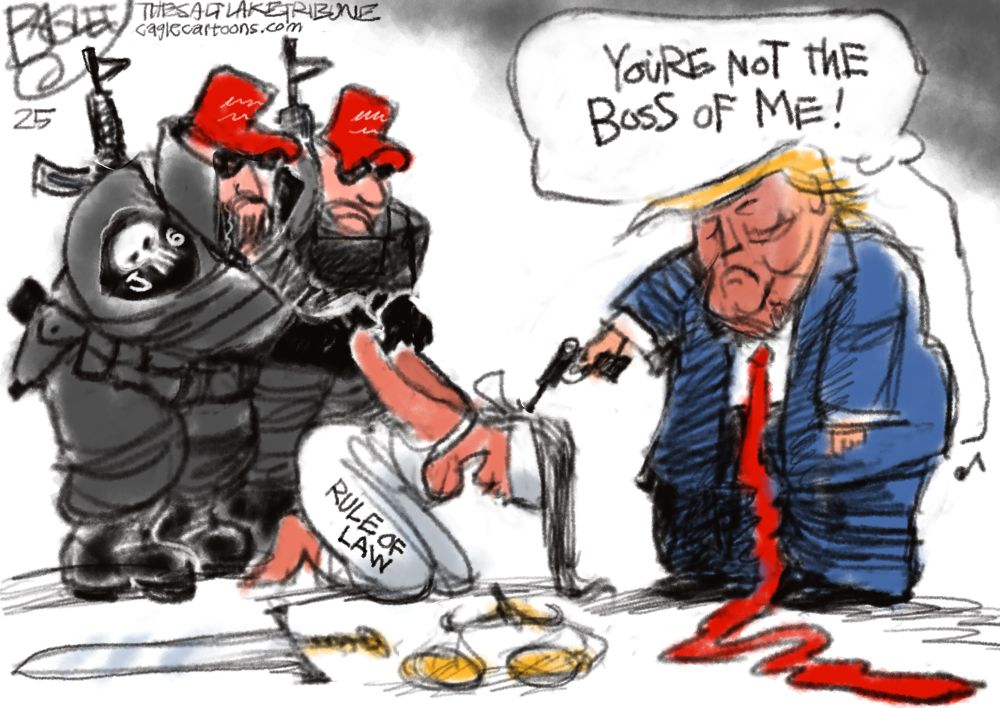
As Fraenkel explained it, a lawless dictatorship does not arise simply by snuffing out the ordinary legal system of rules, procedures, and precedents. To the contrary, that system—which he called the “normative state”—remains in place while dictatorial power spreads across society. What happens, Fraenkel explained, is insidious. Rather than completely eliminating the normative state, the Nazi regime slowly created a parallel zone in which “unlimited arbitrariness and violence unchecked by any legal guarantees” reigned freely. In this domain, which Fraenkel called the “prerogative state,” ordinary law didn’t apply. … In this prerogative state, judges and other legal actors deferred to the racist hierarchies and ruthless expediencies of the Nazi regime.
The key here is that this prerogative state does not immediately and completely overrun the normative state. Rather, Fraenkel argued, dictatorships create a lawless zone that runs alongside the normative state. The two states cohabit uneasily and unstably. On any given day, people or cases could be jerked out of the normative state and into the prerogative one.
This week in the NYT, David French applied this idea to what we’re seeing in Minneapolis.
It’s the continued existence of the normative state that lulls a population to sleep. It makes you discount the warnings of others. “Surely,” you say to yourself, “things aren’t that bad. My life is pretty much what it was.”
But the prerogative state is always sitting there on the other side of the veil, and you never know when you might cross over into it.
One of the most heartbreaking aspects of the ICE agent’s video of the fatal encounter between Renee Good and ICE is that it’s plain that Good thinks she’s still in the normative state. She has no idea of the peril she’s in.
She seems relaxed. She even seems to have told the agent that she’s not mad at him. In the normative state, your life almost never depends on immediate and unconditional compliance with police commands.
But she wasn’t in the normative state. She had crossed over the border to the prerogative state, and in that state you can be shot dead recklessly, irresponsibly and perhaps even illegally, and no one will pay the price.
For the vast majority of Americans, everyday life goes on: You do your job, come home to your family, do your chores, run your errands, watch your favorite TV shows — nothing significant has changed in the year since Trump regained the presidency. It’s easy to imagine that nothing will change, and that the people who try to get you alarmed are all suffering from the “Trump Derangement Syndrome” you hear so much about.
Meanwhile, the prerogative state grows. Maybe it hasn’t arrived in your city yet. Maybe the friends you know who are affected by it did something to draw its attention. But your life goes on normally, until it doesn’t.
Pam Bondi’s disrespect of the Senate is only one example of a larger principle.
If you watched Pam Bondi’s testimony before the Senate Judiciary Committee Tuesday, you saw a number of things:
an embarrassing performance aimed at impressing Donald Trump rather than the Senate or the American people.
several damaging confessions implicit in her refusal to answer simple questions.
an unprecedented level of disrespect for elected officials, and for Congress’ constitutional duty to oversee the Executive branch.
But if you took a step back, there was also something larger to see: an example of one of the key principles of fascism.
Previous American administrations, and democratic governments elsewhere in the world, have sometimes had contentious relationships with opposition parties or with the press. But I can think of no other example where those relationships devolved into such open hostility and disrespect as Bondi showed to Democratic senators, or as Trump regularly shows to the press.
The reason for this is simple and goes to the heart of the democratic project: Each of the three — the President, Congress, and the press — represents the People in a different way. Yes, the People elect the President, but they also elect representatives to Congress. And by choosing who they read or watch or otherwise pay attention to, the People informally anoint journalists to raise questions they are unable to raise themselves.
Previous administrations have understood this. So while their officials and spokespeople might banter with Congress or the press, while they might dodge some questions, spin their way out of others, and sometimes launch into long filibustering answers that made questioners give up, there was always some minimum level of decorum. To berate the questioners or insult them also insulted the American People that they represent.
But fascist regimes work according to a different principle: The Leader exists in a state of mystical identity with the Nation and its People. Guardian columnist and Princeton professor Jan-Werner Müller saw the writing on the wall after Trump’s first inaugural in 2017:
All populists oppose “the people” to a corrupt, self-serving elite the way Trump did. But not everyone who criticizes the powerful is a populist. What really distinguishes the populist is his claim that he and only he represents the real people. As Trump explained, because he now controls the executive, the people control the government. By implication, all opposition is illegitimate – if you oppose Trump, you oppose the people.
In particular, no one can adversarially question the Leader on behalf of the People, because the Leader IS the People.
This mindset is very obvious when Trump holds a press conference, and nearly as obvious when his press secretary Karoline Leavitt does: In the regime’s mind, the reporters represent no one but themselves. Trump is doing them a favor to speak to them at all, and that privilege can be revoked for the most trivial of reasons (as when AP got thrown out of the Oval Office press pool for refusing to accede to Trump’s demand to change the name of the Gulf of Mexico).
The same principle was at work in Bondi’s testimony. Previous department heads have shown at least a nominal respect for the congressional committees tasked with overseeing them, for the simple reason that the senators and representatives are elected officials and the department heads are not.
But Bondi’s performance took place inside a very different frame. Democratic senators like Dick Durbin or Sheldon Whitehouse may have gone through the technical procedure we call “elections”, but they do not in any way represent the People. Bondi directly represents Donald Trump himself, and Trump IS the People. So respect should flow from the senators to her, and not the other way around. (The Republican senators in the room seemed to understand this.)
This attitude was unfortunate for the People, because Democrats on the Committee actually did a good job asking questions that I think a lot of Americans would like to hear answered:
Those pictures of topless young women sitting on Trump’s lap — the ones Michael Wolfe says Jeffrey Epstein kept in a safe — did the FBI find them or not?
Why did Bondi tell Fox News that the Epstein client list was on her desk for review, and then soon afterwards say that no such list exists?
Trump supporters may see those as “gotcha” questions, but that depends on what the answers are. If Bondi could simply say “No such pictures have been found and we have no reason to believe any exist”, or “Our office was ready to indict Comey before the Truth Social post”, or “The story about agents flagging Trump’s name in the Epstein files is false” — where’s the gotcha? She might have followed any of those answers with “Thank you for giving me the opportunity to clear that up.”
In other words: If Bondi had good answers to those questions, Republicans should have asked them. But she didn’t and they didn’t.
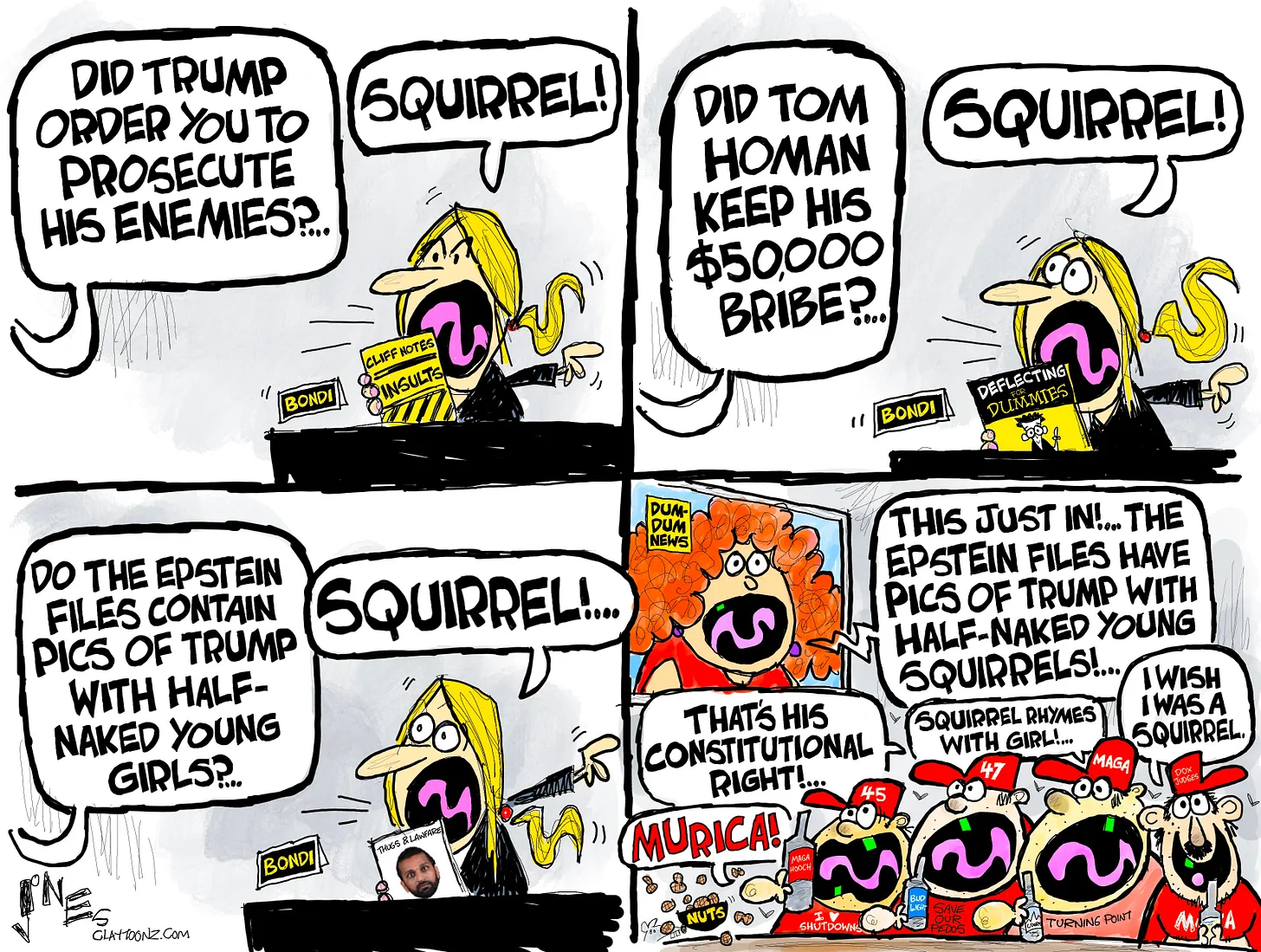
Instead of answers, Bondi came armed with a binder of opposition research, so that whenever a senator posed a difficult question, she could counterattack with an accusation. She attacked several Democratic senators for taking money from an Epstein associate, or of not caring about corruption when Biden was president; called Adam Schiff a “failed lawyer” who should apologize to Trump; accused Dick Durbin of not caring about the safety of Illinois, and so on.
Some of her attacks were taken from the fever-swamps of Fox News and may or may not have any basis in reality. But beyond that, they did nothing to answer those excellent questions.
Probably the only person who enjoyed this performance was Donald Trump, who always loves to see his people insult his enemies. (Rick Wilson compared Bondi’s testimony to a faked orgasm: “loud, theatrical, sweaty, and meant to trick just one man into keeping her around by flattering his ego.”) But any smart Republican had to realize that it did their cause no good: By dodging the questions, Bondi all but admitted that the only true answers are bad: Trump is in the Epstein files, the photos do exist, Comey’s prosecution was motivated by Trump’s malice rather than evidence of wrongdoing, Homan kept the money, and so on.
I mean, if somebody accuses you of something and you can say “no”, don’t you say “no”? You can get all offended and angry about it in your next sentence, but you do say “no”.
Bondi, who was under oath and subject to lying-to-Congress charges should the Department of Justice ever start enforcing the law again, did not say “no”.
Speaker Mike Johnson and other congressional Republicans have provided another example of the fascist identification of the Leader with the Nation. They refer to the No Kings protests planned for October 18 as “hate America” rallies. In their fascist worldview, Trump is America. You can’t protest against Trump unless you hate America.
Examples of rising fascist tendencies easily draw attention and produce fear for the future. But much less attention gets focused on the deeper question: Why is this happening now? Fascism has never been completely stamped out, but for decades it was a fringe phenomenon. By and large, losing parties admitted their defeats, tacked back to the center, and tried to regain majority support rather than disenfranchise the voters who rejected them. Elected officials distanced themselves from violence, treason, and blatantly corrupt allies.
What changed? It can’t just be the fault of one bad leader. How, for example, could Donald Trump or Vladimir Putin be causing a drift towards fascism in Europe or South America or India or Israel?
The post-war “miracle”. For both Haque and Brin, the key question isn’t why fascism is rising now, but how it got pushed to the fringe for decades after World War II. Haque explains it like this:
Consider the founding of modern Europe. Its entire idea was to prevent the far right ever rising again. Modern Europe, rebuilt in the ashes of the war, did something remarkable, that led to what later observers like me would call the European Miracle. It took the relatively small amount of investment that America gave it — which was all it had — and used that in a way that was fundamentally new in human history. Instead of spending it on arms, or giving it to elites, it used it rewrite constitutions which guaranteed everything from healthcare to education to transport as basic, fundamental, universal rights.
This was the point of Keynes’ magisterial insight into why the War had happened.Germans, declining into sudden poverty, destabilized by debt, had undergone a political implosion. Economic ruin had had political consequences. The consequences of “the peace” as Keynes said — the peace of World War I, which had been designed to keep Germany impoverished. Fascism erupted as a result. And so after the Second World War, Europe did something bold, unprecedented, and remarkable in all of human history — it offered its citizens these cutting edge social contracts, rich in rights for all, built institutions to enact them, from pension systems to high speed trains, and then formed a political union on top of that, to make sure that peace, this time, remained.
Fascism, in Haque’s view, is a political technique for gathering up the misery of the masses and focusing it on scapegoats rather than solutions. The primary promise of the fascist leader is revenge, which will solve the problems of his followers through some magical process of subtraction rather than addition. Throwing rocks through the windows of Jewish businesses or preventing trans kids from getting gender-affirming care will somehow make your own life better. Break up the families of migrants seeking asylum, and somehow your own inability to care for your sick wife or send your children to college will not hurt so much.
America and England both had fascist movements in the 1930s, but they didn’t catch on like Germany’s. Maybe that was because — even in the depths of the Depression — neither country had Germany-level misery. Neither country experienced quite the sense of failure and loss of hope that made Hitler seem like a compelling way forward.
But Brin points to something else that happened in 1930s America: the New Deal, which confounded Karl Marx’ prediction of ever-increasing dominance by wealthy capitalists, inevitably leading to a revolutionary explosion.
Karl Marx never imagined that scions of wealth – Franklin Delano Roosevelt and his circle – would be persuaded to buy off the workers, by leveling the field and inviting them to share in a strong Middle Class, whose children would then (as recommended by Adam Smith) be able to compete fairly with scions of the rich.
It was a stunning (if way-incomplete) act of intelligence and resilience that changed America’s path and thus the world’s.
Brin, recalling the lessons of Isaac Asimov’s Foundation series, invokes the Seldon Paradox: “Accurate psychohistorical predictions, once made known, set into effect psychohistorical forces that falsify the prediction.”In this case, American plutocrats like “that smart crook, Joseph Kennedy” took Marx’ predictions seriously and tried to head them off. Brin quotes Kennedy: “I’d rather be taxed half my wealth so the poor and workers are calm and happy than lose it all to revolution.”
Kennedy’s view was far from universal among the American rich, but it did split the forces of plutocracy, enabling the creation of an American safety net.
Post-war Europe took the lesson further, as Haque describes:
What do Europeans enjoy, still, even though it’s teetering now, that Americans don’t? All those rich, sophisticated social contracts, one supposes, which guarantee them everything from high speed transport to cutting edge healthcare.
But there’s more than that. All that creates — or did for a very long time — a feeling that doesn’t exist in America. A sense of community. A kind of peace, which you can readily see in the absence of gun massacres in Europe, even though, yes, there are guns, if not quite so many. Stronger social bonds and ties — Europeans still have friends, and in America, friendship itself has become a luxury. All that matters.
The short description of what Europe achieved is public happiness.
Fascism is born of rage, fear, despair, which drives people into the arms of demagogues, who blame all those woes on hated subhumans, “others” — and so the truest antidote we know of to all that is human happiness itself.
Revenge, not hope. That observation explains one of the great mysteries of current American politics: why the GOP has no governing program. The party has a clear constituency: the non-college White working class, particularly in rural areas. So why are there no plans to do anything for them?
Think about it: expanding Medicaid to save not just the families of the working poor, but rural hospital systems as well; bringing broadband internet to rural areas; raising the minimum wage; shoring up community colleges — those are all Democratic goals that Republicans do their best to block.
It’s not that Republicans have no proposals. The red-state legislatures they control are buzzing with activity: loosening gun laws, taking away women’s bodily autonomy, banning accurate accounts of racism from schools, defunding libraries, and making trans youth invisible, just to name a few.
But how exactly does that help anybody?
Or take that frequent Trump claim that “They’re not after me, they’re after you. I’m just in the way.” Who is after you? How did Trump ever stand in their way? Even a sympathetic NY Post columnist has no answer for that. He spins conspiracy theories of how the Deep State has been out to get Trump from the beginning, but what does any of that have to do with the “you” in Trump’s statement?
What Trump offered “you” was revenge. Those people you hate: the Muslims, the queers, the immigrants, the Blacks, the educated “elite”, and so on. He demeaned them, insulted them, made them suffer. He “owned the libs” and made them hopping mad in ways that you never could have managed on your own..
But he never did anything to improve your life, because that was never the point. It would, in fact, have been counterproductive, because MAGAism needs your misery. If you felt more secure, more hopeful, more capable of dealing with a changing world, then you wouldn’t need revenge any more. And you wouldn’t need Trump.
Beyond the Seldon Paradox. So what happened to public happiness? Now we bounce back to Brin, who quotes a corollary to the Seldon Paradox: After people adjust to dire predictions and cause them to fail, the next generation stops taking the predictions seriously. And then they come true.
In other words, what we are seeing now… a massive, worldwide oligarchic putsch to discredit the very same Rooseveltean social compact that saved their caste and allowed them to become rich… but that led to them surrounding themselves with sycophants who murmur flattering notions of inherent superiority and dreams of harems. Would-be lords, never allowing themselves to realize that yacht has sailed.
In other words: Marx? Who listens to Marx any more? All his nonsense predictions turned out to be laughably false.
So sometime in the 1970s, the plutocratic counter-revolution began. One turning point was the infamous Powell Memo, written in 1971 by future Supreme Court Justice Lewis Powell for the U.S. Chamber of Commerce. The American system of free enterprise, he wrote, was under broad attack from socialist thinkers, and business leaders had been responding with “appeasement, ineptitude and ignoring the problem”. Powell outlined a multi-faceted program to create a new intellectual climate in America, one more favorable to corporate power and the influence of big money.
Within ten years, Ronald Reagan was president, and the United States had embarked on an era of ever-lower taxes on the rich, restrictions on corporate regulation, and union-busting.
And that was the end of the great American middle class. From 1940 through 1980, income growth among the rich had lagged behind the larger public, but after the Reagan Revolution it rapidly made up the difference.
Then and now. A decline in human happiness and hope can lead to a Marxist revolution. (That was one possibility in Weimar Germany as well.) But it also creates opportunities for fascist scapegoating.
So if you don’t feel as successful as your parents were at the same age, and you see even worse prospects waiting for your children, whose fault is that? Maybe it’s the Jews. Maybe it’s the November criminals who stabbed your valiant German soldiers in the back at Versailles. Maybe it’s the decadent culture of big cities like Berlin: the gays, the transvestites, the young people dancing to that African “monkey music” from America.
If only we had a leader strong enough to make them pay.
See the resemblance?
Lessons. So where does that leave us? What lessons can we draw? One lesson is to keep our own resentment tightly focused on the people who deserve it. Working class Americans who see little hope for their children are not our enemies, even if they vote for our enemies. We shouldn’t want revenge on them, we should want them to have better prospects, so that they lose their own need for revenge.
Us against Them is the fascist conversation. We can’t let ourselves be drawn into it.
Our salvation will not come through their misery. Quite the reverse. If we are to be saved, it will have to be through happiness — everyone’s happiness.
And if we’re lucky, maybe some rebel faction of smart plutocrats will come to see the same thing.
[1] Some want to argue about whether to call this worldwide movement “fascism”. I’ve explained why I do, but if you’d rather reserve the word for Hitler, Mussolini, et al, that’s fine. Trump, Orban, and Bolsonaro are certainly not identical to Hitler, Mussolini, and Franco, but I would say that 20th-century fascism differs in some particulars from 21st-century fascism, not that they are completely different animals.
The important thing is that the lack of a word doesn’t lead to an inability to discuss the phenomenon, in the fashion of Orwell’s Newspeak. Simply referring to Trump, Orban, Bolsonaro, Modi, et al as “authoritarians” (as Tom Nichols does) is not nearly specific enough. Any general who stages a successful coup is an authoritarian. But an anti-democratic movement that anoints one segment of the citizenry as the “real” or “true” citizens, and scapegoats the “unreal” or “false” citizens as the cause of all the nation’s problems, justifying discrimination and even violence against them — that’s something more than just “authoritarianism”.
In short, I’d be content to use some other word to carry on a discussion with someone who wants Hitler to be unique. But that word has to capture the full evil of the phenomenon, without diluting it by including anyone who finds democratic governance inefficient.


 The Weekly Sift