
For weeks I’ve been promising a review of The Nerd Reich by Gil Durán. Now that it comes time to deliver, I find I have more of a commentary than a full review. You can find wide-ranging interviews with Durán here and here.
The central character the book follows is Peter Thiel, a billionaire who is notable for several reasons:
- He co-founded not just PayPal but also Palantir, which has enormous government contracts involving surveillance.
- Thiel is not just powerful himself, he is also influential: Durán attributes to Bloomberg the observation that “sixteen men connected to Thiel and his companies now hold positions of power in the Trump administration”.
- Most importantly, J. D. Vance is essentially a Thiel creation. Thiel found him as a student, shepherded his career in venture capital, and then funded his race for the Senate. [1]
The important thing to know about Thiel’s vision is that he seems not to appreciate that the world of 1990s cyberpunk novels is a dystopia. In Neal Stephenson’s Snow Crash, just to give one example, government exists but has largely become obsolete, with its services mostly privatized by franchised corporations. Local jails have turned into franchises of a corporation called “The Klink”. Another franchise operation, Mr. Lee’s Greater Hong Kong, is made up of gated communities in which you can buy citizenship.
Apparently, Snow Crash and various other cyberpunk classics are not dystopias to Thiel. Making government obsolete and expanding corporate power to usurp government has been his vision since he first read the 1999 nonfiction book The Sovereign Individual. [2]
He was also influenced by Balaji Srinivasan’s notion of a “network state”, which Srinivasan’s book defines as
a highly aligned online community with a capacity for collective action that crowdfunds territory around the world and eventually gains diplomatic recognition from pre-existing states.
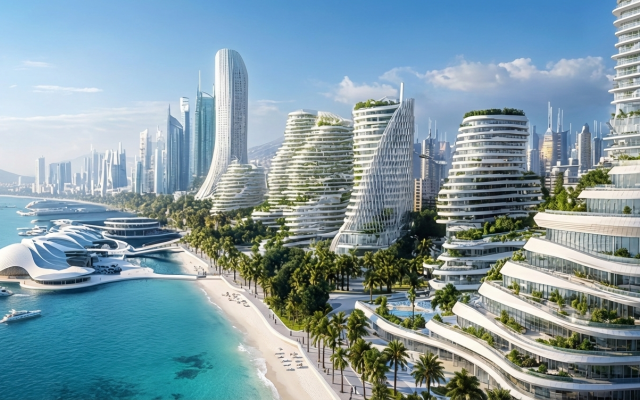
Mr. Lee’s Greater Hong Kong, in other words. Thiel is part of a broader community of tech visionaries and entrepreneurs like Elon Musk. Plans for a new frontier, new city, new country, or new colony run throughout their thinking, pulling together examples that otherwise seem to have nothing to do with each other, like Musk’s Mars colony, the California Forever planned city, Jared Kushner’s “New Gaza”, plans to develop Greenland after the US takes it over, seasteading operations, and many others. The point is to find a place that is either empty or populated (like Gaza) with people whose rights can be neglected, and then to build whatever a tech lord dreams, controlling it much like a company town from America’s Gilded Age. As diverse as they seem, they are all “network states”.
Crypto-currency, of course, is a key part of this vision, because it privatizes the management of money.
Taking powers away from government can sound good in an anarchistic sort of way. But the powers typically don’t go away, they just get lodged in some organization where the average citizen has no voice or influence. That’s a good thing to Thiel, who has opined “I no longer believe that freedom and democracy are compatible.” An article in SFL Media that claims this quote is “misunderstood” provides a more nuanced explanation:
True breakthroughs, from PayPal to SpaceX to Palantir, require continuity beyond election cycles. Thiel has seen firsthand how visionary projects can take decades to mature. Political instability and constant electoral turnover, he argues, kill innovation before it can bear fruit. For this reason, he insists that innovators and technocrats need protection from the volatility of democracy, creating islands of stability where the future can be built without interference.
The author apparently thinks this is less scary.
It’s worth considering Thiel’s point of view in the context of the current debate over artificial intelligence. I understand the fear that the electorate cannot be trusted to make wise choices among potential futures. But who should be trusted instead? Thiel? Musk? Sam Altman? Anybody rich enough to buy their own island, like Jeffrey Epstein? Will the future they build serve everyone’s interests, or just their own?
To the tech elite, the answer to those questions is obvious: They truly are an elite, and deserve consideration that no one else gets. This is why so many of the tech lords flirt with eugenics: Musk so far has had 14 kids with four women — trying, he says, to “set a good example”.
if each successive generation of smart people has fewer kids, that’s probably bad.
He worries about population decline, even as world population is still growing.
Musk, however, acts as though we’re already in a state of decline, which suggests he’s more concerned with the growth rate of particular segments of the population than the population as a whole — as his concern about the procreation of “smart” people suggests.
This is perhaps the most dangerous aspect of the massive wealth a few individuals have acquired through technology: It’s not just that they have disproportionate wealth and power, but that their ascension has convinced them that they are superior beings. They saw opportunities that no one else did, and had the nerve to let their bets ride when anyone else would have cashed out. So of course their current vision of the future is correct. The rest of us should just get out of their way. They are the players in this game, we are just NPCs (non-player characters, i.e., the characters in a computer game who are created and managed by the algorithm, and are not actually real.)
More than anything, this is why they have no sense of noblesse oblige. They do not consider themselves lucky, or as people who happened to be in the right place at the right time. They do not look at the poor and think “There but for the grace of God …”. They are superior, and the world is better off with them running it.
[1] If you wonder “Why J. D. Vance?”, you’re not grasping a major piece of Thiel’s worldview. He is fundamentally a venture capitalist. As such, he invests in lots and lots of wild schemes, understanding that most of them will go bust. The point, though, is to find the one that becomes the next big thing. A VC may lose hundreds of small bets. But if one turns out to be the next Apple or Amazon, he’s a big winner.
Same thing with people. We don’t know how many young men (and maybe a few women) Thiel invested in. Dozens or even hundreds of them might amount to nothing. But if Vance becomes president and is still under Thiel’s thumb, it’s all been worthwhile.
[2] A few recent events become clearer when viewed through Durán’s lens.
DOGE, for example, appears to me (and most people now, I think) as a massive blunder. Musk’s acolytes fired a lot of people and broke a lot of government systems, in the end probably increasing the very government waste they were supposed to eliminate. But that’s only if you take Musk’s stated intentions at face value. What if, instead, you view breaking government systems — not saving money — as the goal? Then DOGE was a great success. Breaking government, however you do it, moves the world closer to the cyberpunk dystopia the tech lords want.

