Tag Archives: climate

Policies to Make the Planet Hotter

You may think that Trump’s policies are just indifferent to climate change. You would be wrong.


Not so long ago, conventional wisdom said that an administration should focus on one goal at a time. In order to get significant changes through Congress, it was necessary to shepherd public opinion, which would fail to coalesce if you pursued too many initiatives at once.

So if you had wanted the Obama administration to pursue green taxes or a cap-and-trade plan for CO2 emissions, you were out of luck: His priority was ObamaCare, and by the time he got around to climate change, he had lost his majority in Congress.

But things don’t work that way any more, largely because Trump barely needs Congress. If you rule by executive order rather than legislation, use the full power the Supreme Court has granted the unitary executive, don’t worry too much about the letter of the law, and dare the courts to stop you, you don’t need public support. And across the board, Trump doesn’t have it.
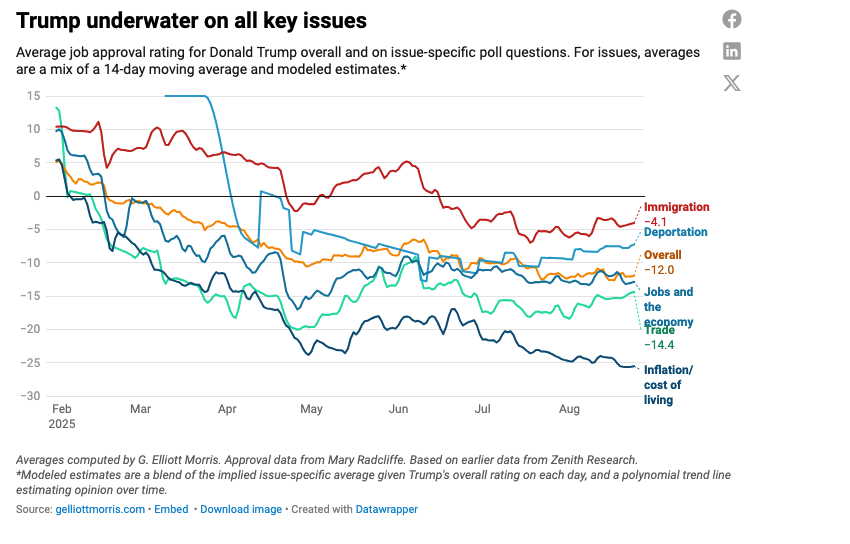
In fact, the shoe is on the other foot: It’s the opposition that needs public support to try to stop what Trump is doing. The more things he does at once, the more scattered the opposition gets. And our news cycle tends to fragment issues, making the larger picture harder to grasp.

Nowhere is this more apparent than with regard to climate change and CO2 emissions. You may have heard individual reports about how this offshore wind project was cancelled or those EV subsidies phased out. If you have heard enough such stories, you may have pieced together a general impression that the Trump administration is indifferent to climate change.

But the actual situation is far worse. Across the board, the administration has targeted any effort to take action to reduce CO2 emissions. Worse, the US government is now actively promoting fossil fuels, even in situations where the free market would make a more sustainable choice.

The Trump administration is not indifferent to climate change. It is working hard to make it worse.

Electrification

Fundamentally, the strategy for dealing with climate change has two pieces: electrify everything, and then produce electricity without burning fossil fuels. The Trump administration has attacked both sides of this plan.

Electric vehicles. The so-called “Big Beautiful Bill” cuts off virtually all subsidies for electric vehicles by the end of this fiscal year, September 30. That’s not just the tax credit for purchasing an EV, but also subsidies for electrifying commercial fleets and installing charging stations.

EVs are a natural fit for fleets of vehicles that have a defined territory and return to base every night, like postal delivery trucks. The Biden administration planned to use such government fleets to jump-start the larger EV market.

But under Trump, EVs have become no-nos within the federal government. Not only are federal agencies not installing any charging stations or buying new EVs, they’re ripping out brand-new charging stations and selling off EVs at a loss. All-in-all, de-electrifying the federal vehicle fleet could cost as much as $1 billion.

Think about that: The government is not just reassessing future EV purchases and deciding they are too expensive. That would be a suspicious calculation, but at least a plausible one. In fact, though, it is spending money to get rid of the EVs and EV infrastructure it has.

Sustainable electrical generation. Trump has long had an animus against wind power, going back at least to 2012, when he thought offshore wind turbines marred the view from his Aberdeenshire golf course. Since then, he has been a font of anti-wind disinformation, charging that wind turbines not only kill large numbers of birds, but that offshore wind farms are driving whales crazy and causing them to beach themselves and die. (The birds claim is exaggerated — birds do run into turbine blades occasionally, but a 2009 study concluded that wind farms kill far fewer birds per kilowatt hour than fossil fuel plants. The connection to whale deaths is entirely imaginary.)

Trump’s Big Beautiful Bill terminated a variety of subsidies for sustainable energy, wind and solar alike. But his administration is actively anti-sustainable-power. The Interior Department has created new bureaucratic requirements for wind or solar projects on federal land, and just this week halted work on a wind farm offshore from Rhode Island. The project was scheduled to begin delivering power to Rhode Island and Connecticut homes in 2026.

The order to stop work on the Revolution Wind project is the latest move by the Trump administration targeting the country’s renewable energy industry. President Trump, a longtime critic of the wind industry, in January issued a moratorium on new development of offshore wind projects. The Internal Revenue Service recently put out new guidance that makes it harder for companies building wind and solar projects to qualify for federal tax incentives. And the Commerce Department is investigating whether imports of wind turbines and their components threaten national security.

Wednesday Trump posted to Truth Social:

Any State that has built and relied on WINDMILLS and SOLAR for power are seeing RECORD BREAKING INCREASES IN ELECTRICITY AND ENERGY COSTS. THE SCAM OF THE CENTURY! We will not approve wind or farmer destroying Solar. The days of stupidity are over in the USA!!! MAGA

End-to-end, this post is nutty. Electricity costs are rising because of demand, especially demand for computation related to AI and cryptocurrency mining. The Sustainability By Numbers blog ran the state-by-state numbers and found no correlation, positive or negative, between sustainable energy and prices.
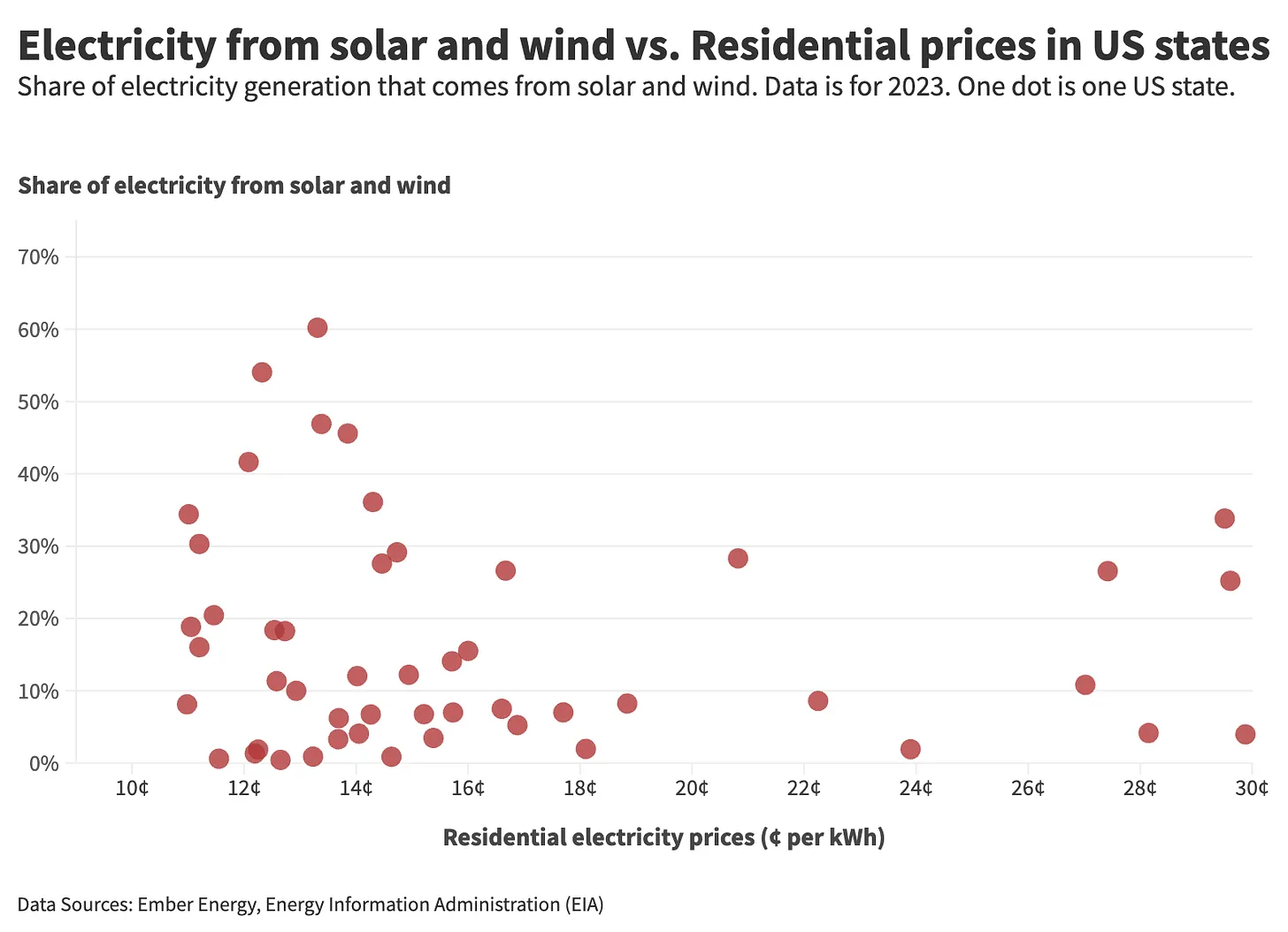
Besides, just take a step back and think this through from economic first principles: Adding supply is not going to raise costs.

Meanwhile, farmers love their windmills and solar installations. The payments give them a source of income that isn’t affected by the usual hazards of drought, insects, or fungus.

Equally nutty is a Trump post that “STUPID AND UGLY WINDMILLS ARE KILLING NEW JERSEY”. NJ.com fact-checks: New Jersey’s offshore wind project has already been cancelled before coming online, and the state barely has any windmills.

Even worse than the specific projects being cancelled is the chill this sends across the industry. If you are a utility looking for additional generating capacity, wind and solar now entail a political risk that is hard to work into your calculations. If you make a success out of sustainable energy, you are making Trump look bad. He may come after you.

Conservation. One way to partially mitigate the increased demand from AI and crypto — both of which Trump favors — is to use less electricity to power our household appliances. This effort has been going on since the days of Bush Sr., and its flagship has been the Energy Star program. Energy Star certification has helped consumers identify appliances that use less electricity, saving them $500 billion in their utility bills.

Funding for Energy Star was zeroed out in Trump’s original Big Beautiful Bill proposal, but Congress seems to have put it back. Whether or not this money will actually be spent is another question, one that probably depends on what the Supreme Court says about Trump’s previous attempts to impound funds.

Drill, Baby, Drill

While the Big Beautiful Bill was zeroing out subsidies for EVs and sustainable energy, it was increasing subsidies for fossil fuel production. The Union of Concerned Scientists’ Equation blog lists the benefits and estimates the cost to the taxpayers at $80 billion over the next ten years.

But this week’s most outrageous energy story concerned a coal-fired utility plant in Michigan. Coal is probably the dirtiest form of energy in common use, but the Trump administration loves it.

Donald Trump has made several unusual moves to elongate the era of coal, such as giving the industry exemptions from pollution rules. But the gambit to keep one Michigan coal-fired power station running has been extraordinary – by forcing it to remain open even against the wishes of its operator.

The hulking JH Campbell power plant, which since 1962 has sat a few hundred yards from the sand dunes at the edge of Lake Michigan, was just eight days away from a long-planned closure in May when Trump’s Department of Energy issued an emergency order that it remain open for a further 90 days.

On Wednesday, the administration intervened again to extend this order even further, prolonging the lifetime of the coal plant another 90 days, meaning it will keep running until November – six months after it was due to close.

This order, like so many of the questionable things Trump has done, is justified by a mythical “state of emergency” that he can see but no one else can. The Energy Department says the local electrical grid will be strained by the loss of this plant, but the operating utility doesn’t think so. While it’s not unusual for a utility to seek permission to extend the life of a coal plant that violates pollution standards, extending the life of a plant the operator wants to close is virtually unheard of.

So far, 71 coal plants, along with dozens of other chemical, copper smelting and other polluting facilities, have received “pollution passes” from the Trump administration according to a tally by the Environmental Defense Fund, allowing greater emissions of airborne toxins linked to an array of health problems. Coal is, despite Trump’s claims, the dirtiest of all fossil fuels and the leading source of planet-heating pollution.
Information

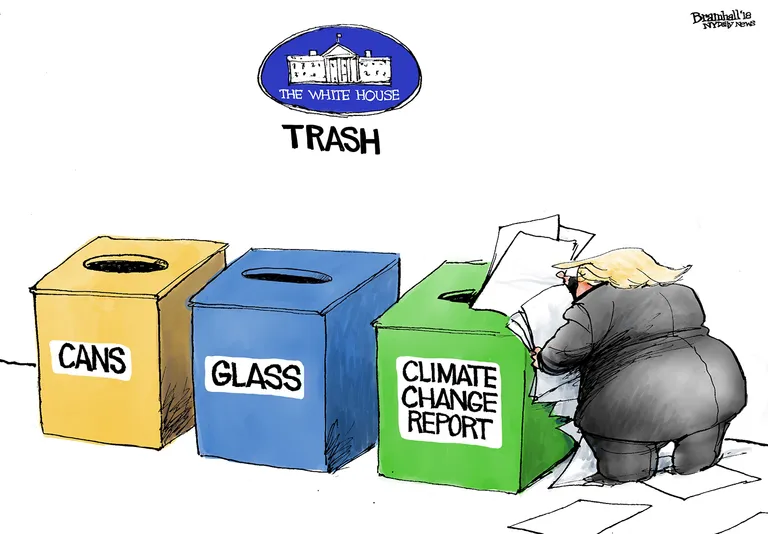
If you want to assess the current state of the planet and its climate, the federal government does not want to help you.

In accordance with the Global Change Research Act of 1990, the federal government has produced a National Climate Assessment every four years.

The sprawling report is the most influential source of information about how climate change affects the United States.

The National Climate Assessment is widely used by teachers, city planners, farmers, judges and regular citizens looking for answers to common questions such as how quickly sea levels are rising near American cities and how to deal with wildfire smoke exposure. The most recent edition had a searchable atlas that allowed anyone to learn about the current and future effects of global warming in their specific town or state.

Sadly, though, the federal web site that hosts the report has been taken offline. Work on the next report has been halted and the contract to produce it cancelled. It’s up in the air whether any report at all will appear when the next one is due in 2027. Perhaps some fossil-fuel industry think tank will produce one. DoE recently published a climate-change-denying report by five fringe scientists.

The attack on the USGCRP and national climate assessment did not come as a surprise. In the Heritage Foundation’s far-right policy blueprint Project 2025, Russ Vought – now Trump’s head of the office and management and budget – called to end the USGCRP or fill it with pro-oil industry members.

Past climate assessments have been removed from government websites so they can be “updated” to better represent the administration’s anti-scientific views.

“We’re reviewing them, and we will come out with updated reports on those and with comments on those reports,” [Energy Secretary Chris] Wright told CNN’s Kaitlan Collins in an interview on “The Source.”

Wright dismissed the past reports, saying “they weren’t fair in broad-based assessments of climate change.”

OK, that change involves assessment and dissemination of new climate info. But what about gathering it in the first place?

President Donald Trump’s budget request for fiscal year 2026 includes no money for the Orbiting Carbon Observatories, which can precisely show where carbon dioxide is being emitted and absorbed and how well crops are growing.

One of the observatories is a satellite launched in 2014, and the other was attached to the International Space Station in 2019. The two systems are

more sensitive and accurate than any other systems in the world, operating or planned, and a “national asset” that should be saved, said David Crisp, a retired NASA scientist who led their development. They helped scientists discover, for example, that the Amazon rain forest emits more carbon dioxide than it absorbs, while boreal forests in Canada, Russia and places where permafrost is melting absorb more than they emit, Crisp said. They also can detect the “glow” of photosynthesis in plants, which helps monitor drought and predict food shortages that can lead to civil unrest and famine, he said.

The OCO instruments in the space station might just be turned off, while the satellite could be “brought down”, i.e., allowed to burn up in the atmosphere. Needless to say, launching a replacement satellite (assuming the US government ever cares about climate again) will be far more expensive than just maintaining the one already in orbit.

Why make this very wasteful decision?

NASA said in an emailed statement Wednesday that the missions were “beyond their prime mission” and being terminated “to align with the President’s agenda and budget priorities.”

The Trump EPA is also taking steps to make it harder for a future administration to undo its damage. It is trying to reverse a 2009 finding that CO2 is a pollutant that it can regulate under the Clean Energy Act.

The endangerment finding is the basis for rules regulating climate pollution from coal and gas-fired power plants, car and truck exhaust and methane from the oil and gas industry.

Now, the Trump EPA is arguing that the endangerment finding was a mistake and overstepped the EPA’s statutory power. Daren Bakst, director of the Center for Energy and Environment at the Competitive Enterprise Institute, comments:

If the EPA finds the 2009 endangerment finding is no longer applicable, Bakst says that “would preclude future greenhouse gas regulations.” And he says “it should be easy to repeal existing rules that are predicated on the 2009 finding.”

Foreign policy

The administration is not just seeking to burn more fossil fuels at home, it’s also pushing fossil-fuel exports overseas. For example, the recent trade deal announced between the US and the EU stipulated that the EU buy $750 billion of US energy exports — primarily fossil fuels — over the next three years. Trump got this benefit for US energy companies by threatening Europe with crippling tariffs.

In June, the NYT contrasted the energy styles of the world’s two great powers, the US and China. The Chinese are investing heavily in sustainable energy and leading the world in exports of sustainable-energy technology.

While China is dominating clean energy industries, from patented technologies to essential raw materials, the Trump administration is using the formidable clout of the world’s biggest economy to keep American oil and gas flowing.

In a full reversal from the Biden administration’s effort to pivot the American economy away from fossil fuels, the Trump White House is opening up public lands and federal waters for new drilling, fast-tracking permits for pipelines and pressuring other countries to buy American fuels as a way of avoiding tariffs.

Washington is essentially pursuing a strong-arm energy strategy, both at home and abroad with allies and friends. It’s premised on the idea that the modern world is already designed around these fuels, and the United States has them in abundance, so exporting them benefits the American economy even if solar energy is cleaner and often cheaper.

This month, the International Energy Agency predicted something the Trump administration did not want to hear:

Lately, the I.E.A.’s influential forecasts have suggested that global demand for oil and gas could peak by the end of the decade as electric-vehicle sales grow and the cost of solar panels and battery storage plummets.

The US responded in a typical Trumpian fashion, by threatening the messenger.

Chris Wright, Mr. Trump’s energy secretary and a former fracking executive, has called the agency’s projections of peak oil demand “nonsensical” and has said the United States could withdraw from the global organization if it doesn’t change the way it operates. House Republicans have said the agency is publishing “politicized information to support climate policy advocacy” and have threatened to withhold U.S. funding.

In short, I don’t know what other conclusion to draw: The Trump administration is trying to make climate change worse. I could speculate about why, but that seems like a distraction. The What is more important than the Why. The Trump administration is trying to make climate change worse.
This summer’s weather is a turning point

You don’t have to be a statistician to notice that something is off in this year’s weather. That could change the whole national debate.


It’s been a tough few weeks for weather, as Atlantic’s Jacob Stern summarizes:

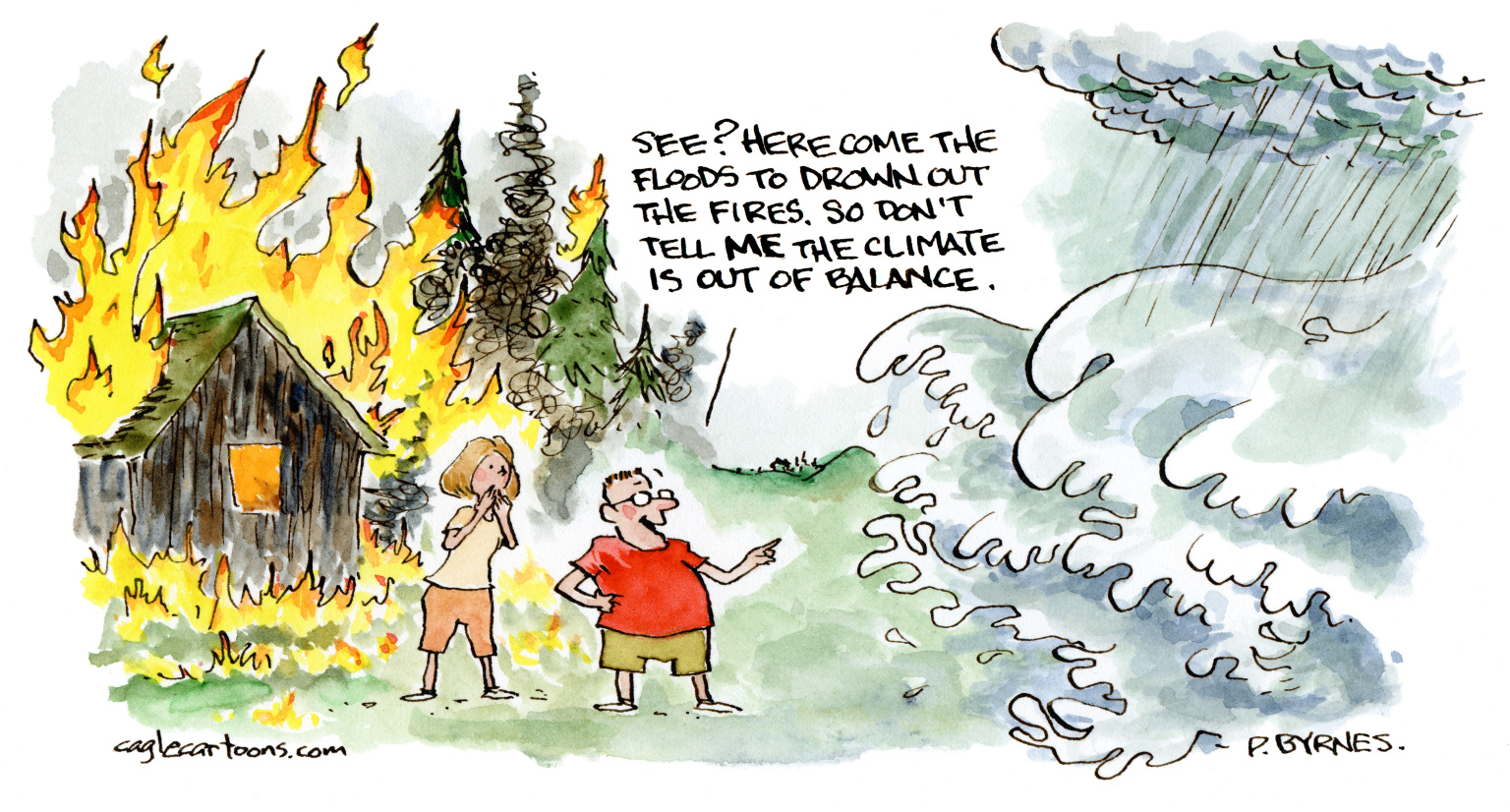
It’s getting hard to keep track of all the overlapping climate disasters. In Phoenix, Arizona, the temperature has broken 110 degrees for nearly two weeks running. The waters off the Florida coast are approaching hot-tub hot, and before long, marine heat waves may cover half the world’s oceans. Up north, Canada’s worst wildfire season on record burns on and continues to suffocate American cities with sporadic smoke, which may not clear for good until October. In the Northeast, floods have put towns underwater, erased entire roadways, and left train tracks eerily suspended 100 feet in the air. Also, the sea ice in Antarctica—which should be expanding rapidly right now, because, remember, it’s winter down there—may be losing mass.

Over the last ten or twenty years, we’ve gotten used to a certain pattern of debate about problematic weather.

For most people, the significance of these blips of bad news is hard to sort out, because both sides have ways of fitting such events into their favored narrative: Either “The clock is continuing to tick down towards a climate apocalypse”, or “Environmentalists keep trying to scare us, but life goes on.”

Trying to break through that endless back-and-forth leads scientifically-minded people to apply statistics: Yes, there have always been natural disasters, but not this often. For example, what used to be a hundred-year flood now comes once a decade, or maybe even sooner.

But statistics can’t solve the public-perception problem, because the people who need to be convinced are precisely the not-scientifically-minded folks, the ones who distrust “experts” and especially distrust mathematical models and other ways of measuring things that they couldn’t have come up with on their own.

In general, non-scientists are only impressed by a statistic if they were already paying attention to it before the latest event. You can see this phenomenon in non-political arenas like sports. In 1998, for example, baseball fans everywhere were fixated on Mark McGwire and Sammy Sosa’s chase after the Ruth/Maris single-season home run record. That’s because every baseball fan already knew that Babe Ruth had hit 60 home runs in 1927 and Roger Maris hit 61 playing a longer season in 1961. McGwire and Sosa were racing towards a finish line that had been marked out for decades.

By contrast, look at the season Aaron Judge had last year: By some accounts, it may be the best season a hitter has ever had. But to make that claim, you have to cite advanced statistical measures that most fans have never heard of and could not calculate for themselves: WAR, OPS+, RV+ and so on. So while every fan recognizes that Judge’s 2022 was a really good year — his 62 home runs surpassed Maris’ 61, which was still the record for the American League — it lacked the drama of 1998, and the best-ever arguments feel like something cooked up after the fact.

Same thing for global average temperature, which looks headed for a new record this year, breaking the one set in 2016 and nearly equaled in 2020. Ordinary people can put thermometers on their porches and measure temperature here and now, but they can’t measure and can’t check global average temperature, which is compiled through a complex statistical process. Sure, somebody like NOAA or NASA may claim it’s setting a record, but other people claim those numbers are cooked up, and that NOAA is “just another deep state bureaucracy with a political agenda“, so who’s to say?

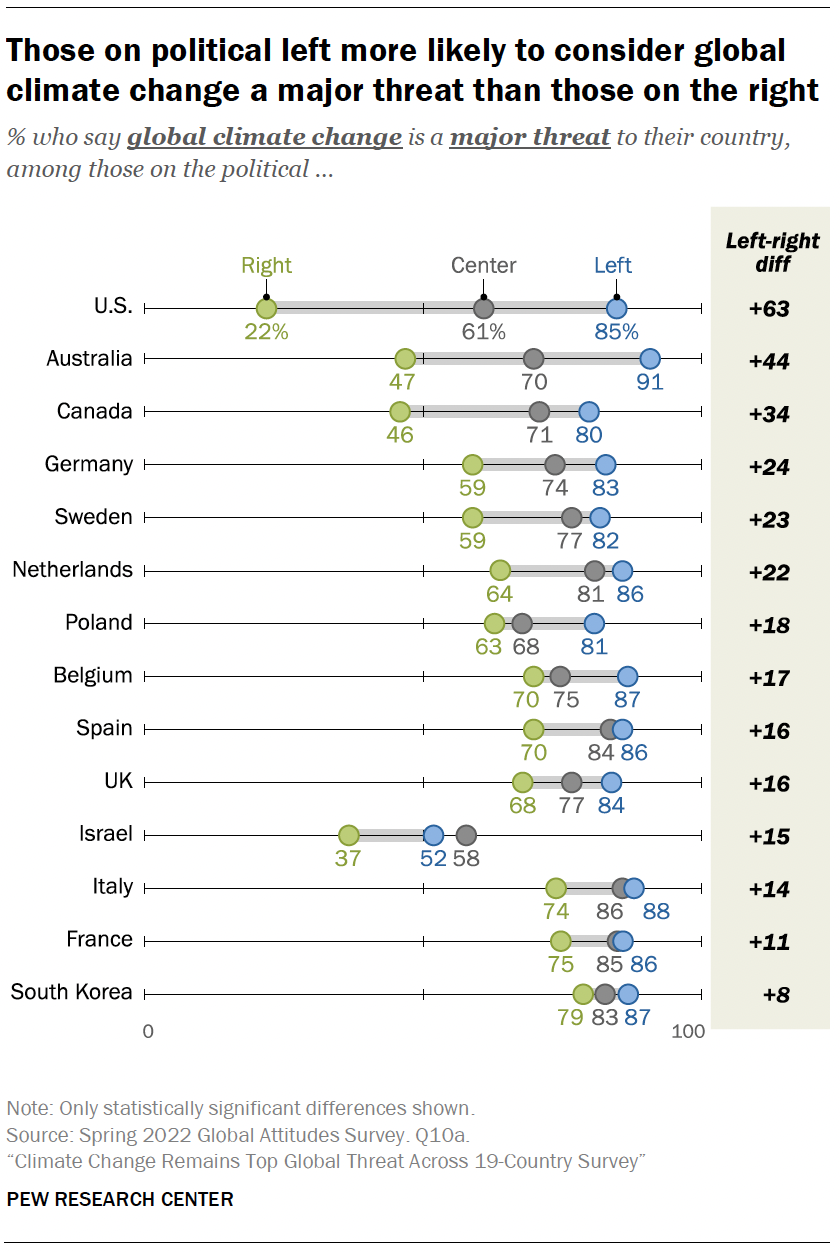
The result is that American public opinion on climate change displays the same left/right split that you’ll see on more values-based issues like abortion or affirmative action. As the chart below (from Pew Research) shows, the US is unusual in this regard. In South Korea, climate change is barely a partisan issue at all, and a right-leaning voter in the UK is three times more likely to consider climate change a “major threat” than his American cousin. (If you can explain what’s going on in Israel, where left-leaning voters worry about the climate less than anywhere else in the world, leave a comment.)

This summer’s combination of disasters is an opportunity to break out of this left/right pattern. When one disaster starts before the previous one ends, and record-setting heat in Florida and Texas competes for headlines with unprecedented floods in Vermont and Pennsylvania, we’re in new territory. You don’t need any statistics or expert analysis to recognize that the weather never used to do stuff like this. “Bad things didn’t used to happen this often” is a statistical claim. But “Bad things didn’t used to happen all at once” is something ordinary people can verify through our own experience.

Whatever their political loyalties, just about all Americans must know in their hearts that something is seriously wrong, and that the kinds of predictions that got labeled as “alarmist” or “fear-mongering” a few years ago are starting to come true. We’re no longer talking about projections of problems our grandchildren will face. We’re looking at what’s happening here and now.

Environmental activists and their allied politicians (who are almost all Democrats) need to run with that perception. In the past, the burden has been on them to use expert analysis to explain away the average American’s impression that life was continuing more-or-less normally. But going forward, the tables will have turned: It will be climate deniers who will need to make complicated arguments to explain away the public’s perceived reality.

Going forward, the role of long-term climate models will also change. The point won’t be to make apathetic people worry about the future. Instead, the models will explain to people who are already worried that things are only going to get worse until we make major changes.

Americans also know in their hearts that in the long run it’s more cost effective to prevent disasters than to clean up after them. Yes, it will require substantial investment to convert our economy to renewable energy, to modernize the electrical grid, and shift our consumption patterns away from fossil-fuel intensive products. But those investments will not only create jobs in the present, they’ll save money overall.

And the long-term models will also play another role: As sweeping changes get proposed, we’ll need expert analysis telling the public “This can work.” The models that have been carrying messages of despair could also carry messages of hope.

Can conservatives be allies against climate change?

They’ve given us a lot of reasons to be skeptical.
But we’re surrendering to hopelessness if we assume bad faith.


A week ago Friday, the NYT published an essay I’m still puzzling over: Bret Stephens — a Times columnist whose hiring I have always attributed to the newspaper’s affirmative-action-for-conservatives policy — wrote “Yes, Greenland’s Ice is Melting, But …“. Reading it raised a question in my mind: “Yes, conservative minds are changing, but … can they ever change enough to make them real allies?”

Anybody who has been watching this topic has seen the pattern. Over the last decade or so, conservatives who aren’t willing to deny reality completely have staged a retreat worthy of a great general, slowly falling back from one line of defense to the next. The major defense lines, as I remember them (and still run into them from time to time), look like this:

Most frustrating of all are the people who shift back and forth from between defensive positions. One day they’re admitting greenhouse gas emissions are changing the climate, and the next day it’s all a hoax again. But whatever line of defense they choose, the conclusion is always the same: Do nothing. It’s the wrong time, or the wrong tactic, or we’ll never get China and India to cooperate, or something. There’s always something.

So it’s easy to get cynical, and to assume that any conservative who briefly seems to be talking sense about the climate is doing so in bad faith. Their new understanding, whatever it is, is just the next line of defense against doing anything substantive to avert the looming disaster.

But here’s the problem with that cynicism. The people who are already convinced drastic action is necessary aren’t a big enough voting bloc to carry out drastic action.

Occasionally I’ll see polls that indicate otherwise, but those numbers are deceiving: Many will tell a pollster they support climate-change action, but then will be protesting in the streets as soon as a carbon tax makes gas prices rise or their heating bills go up. (See, for example, the “yellow vests” in France.)

So if we’re actually going to tackle this problem, we need converts — real ones who understand that sacrifices need to be made if we’re going to save future generations from much worse prospects. From there it follows that we need to welcome converts, rather than give them the third degree to make sure they’re serious enough.

What’s more, lots of people aren’t going to change their minds all at once. Road-to-Damascus conversions do happen, but they’re rare. Many who come to see the reality of the climate challenge are going to see it in stages. So while that bulleted list above may be a line of successive defenses for bad-faith pseudo-converts, it can also be a road of progress for good-faith real converts. Is your it’s-all-a-hoax cousin now admitting that temperatures are going up? Rejoice! It’s a step.

I understand that it’s frustrating as hell to stand on the deck of the Titanic and try to stay calm while people tell you it’s not time to lower the life boats yet. But if you’re not able to lower the lifeboats by yourself, what else can you do? You need to meet these people where they are and coax them into doing the right thing. That may be time-consuming and time may be short, but if there’s not a more direct path …

And that brings me back to Bret Stephens. There are lots of reasons to be cynical here. “Yes, Greenland’s Ice is Melting, But …” is laid out like a new line of defense, with the “but” seeming to lead to “we still shouldn’t do anything”. And that’s kinda-sorta where most of the essay goes. His argument is structured as a series of buts: Yes, Greenland’s ice is melting,

  • but we need to recognize clean energy’s limitations
  • but we’ve gotten better at mitigating climate disasters
  • but we need to accept economic growth as a benefit
  • but we need solutions that align with human nature
  • but we need to avoid alarmist activism
  • but the market, not the state, will solve the problem

Sounds terrible, right? I mean, alarmist is one of those right-wing boogyman words, like woke or socialist. It doesn’t have any objective definition, it’s just a pejorative that conservatives throw at people who say things they don’t want to hear. Human nature is another much-abused term, strongly related to the idea that anything I object to is “unnatural”. And greenhouse-gas emission, like all pollution, is a classic example of a market externality, a cost the market can’t see because it’s primarily borne by someone other than buyers and sellers. Markets won’t address externalities unless government restructures transactions to make the cost visible (say, by creating an artificial cost through taxation). So even a “market” solution will not be the market acting instead of the state, it will be the market acting in concert with the state.

But even after all that, Stephens concludes with a point that’s not a “but” at all.

  • The conservative movement needs to set an example for its children and prepare for the future.

A problem for the future is, by its very nature, a moral one. A conservative movement that claims to care about what we owe the future has the twin responsibility of setting an example for its children and at the same time preparing for that future. The same prudential logic that applies to personal finances, business decisions, Social Security, the federal debt or other risks to financial solvency should dictate thoughtful policies when it comes to climate.

So in other words, Stephens writes a litany of but-this and but-that, but comes around to the conclusion that we have to do something.

That conclusion made me reevaluate who all the yes-buts were for. What if they’re there not to provide further lines of defense against action, but to reassure conservatives that he’s still one of them? As in: I still believe in markets and growth, and I still look skeptically at big government programs, but I also think we have to do something about climate change. I haven’t drunk the woke liberal new-world-order kool-aid, but I think we have to do something about climate change.

Conservative media has created a caricature of climate-change activists as wild-eyed religious fanatics who support one-world socialist dictatorship, hate technology, want to take us back to the Dark Ages, and don’t care if a few billion people have to starve to death while we’re getting there.

Stephens is writing largely for folks who have bought that propaganda, so he can’t just announce that he’s become one of Them now. If he’s going to bring any part of this fan-base with him, he has to write something like this essay — as if facing reality about the climate without going insane is some brand-new position he just discovered, and you can join him there without also joining AOC, who presumably is off on some other island out there somewhere.

So what can he teach me? Respect. As I said above, I don’t think Stephens’ essay was written with me in mind, so a lot of his points don’t say much to me. But I do learn a few things.

The first noteworthy nugget is how this whole adventure started: Back in 2017, Stephens wrote a climate-change-skeptical column, which a lot of scientists denounced. One of them was oceanographer John Englander of the Rising Seas Institute.

Two years later, on a visit to New York, he wrote me out of the blue and asked to meet. Unlike most of my detractors, his note was so cordial that it seemed churlish to say no. We met the next day.

Englander is a trim, affable and eloquent man of 72 who once ran the Cousteau Society and reminds me of a bearded Patrick Stewart, albeit with an American accent. His pitch was simple: The coastline we have taken for granted for thousands of years of human history changed rapidly in the past on account of natural forces — and would soon be changing rapidly and disastrously by man-made ones. A trip to Greenland, which holds one-eighth of the world’s ice on land (most of the rest is in Antarctica) would show me just how drastic those changes have been. Would I join him?

Again, it seemed churlish to say no (though the pandemic would delay my trip by two years). More to the point, if my main objection to the climate activists was my impression of their overweening certitude, didn’t it behoove me to check my own? Where — except in the risk of changing my mind — was the harm in testing my views?

In other words, Englander made an assumption of good faith. He reached out not with insults or claims of authority, but simply said “Come and see for yourself.”

Now, most of us are not in a position to take people to Greenland. But we can approach them in a manner that offers them an opportunity to be their best selves.

That approach defuses precisely the propaganda I pointed to above. If you and I are real people, then we might have a discussion where real ideas get exchanged. But if we’re two caricatures, that’s not going to happen. So it’s important to break the frame in both directions: I’m not casting a negative image on the other person from the outset, and (because I’m aware of the caricature in their head) I’m not invoking their negative image of people like me.

Lesson 2: risk. The conservative caricature of a climate-change activist is “alarmist” — someone running around saying “We’re all gonna die!” And yes, there are a few such people; drawing undue attention to them is one way that Fox News supports the caricature. Stephens ends up restating the risk for himself:

Talk of an imminent climate catastrophe is probably misleading, at least in the way most people understand “imminent.” A continual drumbeat of alarm may do more to exhaust voters than it will to rouse them. A more accurate description of the challenge might be a “potentially imminent tipping point,” meaning the worst consequences of climate change can still be far off but the end of our ability to reverse them is drawing near. Again, the metaphor of cancer — never safe to ignore and always better to deal with at Stage 2 than at Stage 4 — can be helpful.

I’m not sure who he thinks will find this description new — certainly not most climate scientists. And how is it inappropriate to sound the alarm about a “potentially imminent tipping point” or a stage-2 cancer?

But the key point here is to recognize that people are bad at thinking about distant but high-impact risks. Stephens addresses this problem by consulting the kind of risk-assessor conservatives respect: a hedge-fund manager. That’s not where I would have gone, but he ends up getting good advice.

“If you face something that is potentially existential,” he explained, “existential for nations, even for life as we know it, even if you thought the risk is, say, 5 percent, you’d want to hedge against it.”

How?

“One thing we try to do,” he said, “is we buy protection when it’s really inexpensive, even when we think we may well not need it.” The forces contributing to climate change, he noted, echoing Englander, “might be irreversible sooner than the damage from climate change has become fully apparent. You can’t say it’s far off and wait when, if you had acted sooner, you might have dealt with it better and at less cost. We have to act now.”

Lesson 3: Purity. When you frame something as a moral problem, one temptation is to “Go and sin no more.” In other words, we’ve been harming the environment, so from this day forward we should fight against anything that harms the environment.

But there’s a problem with that: Any form of drastic climate action is going to have environmental side-effects, not all of them good. One example Stephens cites is mining: If we’re going to switch to electric cars, we’re going to need a lot more rare-earth minerals for batteries. All that mining is going to have some negative consequences, especially local ones in the mining communities.

Similarly, hydro-electric dams produce power without carbon emissions, but they also change the eco-systems of the dammed rivers. Nuclear power plants produce zero-carbon power, but leave us with a thousands-of-years waste-management problem. If regulated properly to minimize methane leaks, fracking can produce a fuel that still emits carbon, but less of it than coal.

None of those are sin-no-more solutions. They’re paths into the future that trade some environmental damages off against other environmental damages.

And this is where conservatives who actually want to solve the problem can play a role. Because while markets suck at sinning no more, if they’re properly regulated they can be good at trading some kinds of risks and harms off against others.

Purity makes for good slogans. But actual solutions are going to involve trade-offs. We’re going to have to make judgments about how much pain the public is willing to accept at any given moment, and to work as efficiently as possible within that pain-budget.

So is he serious? Maybe, maybe not. But I think we have to hope that he is, and that he is blazing a trail for some larger number of conservatives who don’t want their grandchildren to remember them as villains. The kind of action we want requires a bigger consensus than we have. So we need to gather converts wherever we can find them.

A Week When Congress Mattered

Three important bills and what happened to them.


Most of the time in America, it’s hard to believe that the Founders intended Congress to be the center of our government. Today, our political conversation spends weeks at a time focused on what the Supreme Court did or might do, what the President did or might do, or how one of them will respond to the other’s latest move.

But wait — isn’t there a third branch? What ever happened to it?

When we talk about Congress at all, it’s usually because they’re investigating some scandal or pseudo-scandal in the executive branch. Or because the Senate is confirming a new judge. Or Congress is the backdrop where the Fed chair makes headlines by commenting on the economy or interest rates.

Of course, members of Congress can become a topic of discussion if they tweet something outrageous or share a platform with Nazis or embarrass our country in some other way. When Republicans control one house or the other, Congress occasionally manufactures a news-making event out of nothing: a government shutdown or a debt-ceiling crisis. The world would be puttering along just fine if Congress weren’t standing on an important life-line and threatening to shoot itself in the foot.

Every now and then, congressional coverage is about legislation, but the bill in question is only symbolic: The House may be voting to codify Roe (i.e. respond to the Supreme Court) or ban assault weapons or protect voting rights (again, in response to the Supreme Court letting states violate rights previously established), but its members rest secure in the knowledge that a Senate filibuster will prevent any of that from becoming law. The point isn’t to accomplish something for the country, but to get one party or the other on the record, so that their votes can be issues in the next election.

In short, we’re used to viewing Congress through a veil of Shakespearean cynicism: Its doings may be full of sound and fury, but ultimately they signify nothing.

To the country’s great surprise, though, this week was different: Congress was in the headlines for three pieces of legislation, all of which matter to people in the non-political world and stand a real chance of becoming law: One bill passed and is on President Biden’s desk. One bill that looked like a slam-dunk failed. And one that seemed dead came back to life.


The bill that Congress passed is the CHIPS Act, which subsidizes American high-tech manufacturing in an attempt to bring the semiconductor industry back to the United States. (Currently, the US imports its most advanced computer chips from Taiwan, a supply chain that China might be able to interrupt.) Promoted as a move to stay competitive with China, the bill spends $52 billion directly, and also includes a tax credit for certain kinds of investments.

The bill is aimed at the future, and won’t do much to solve the immediate chip shortage, which is hampering a variety of American industries. Vox summarizes:

The bulk of the CHIPS Act is a $39 billion fund that will subsidize companies that expand or build new semiconductor manufacturing facilities in the US. The Commerce Department will determine which companies receive the funding, which will be disbursed over five years. More than $10 billion is allocated to semiconductor research, and there’s also some support for workforce development and collaboration with other countries. The bill also includes an extensive investment tax credit that could be worth an additional $24 billion.


https://claytoonz.com/2022/07/30/toast-our-troops/

The bill that unexpectedly failed was PACT. The point of this bill is to expand VA care to veterans whose illnesses may have been caused by exposure to toxic fumes from burn pits during foreign deployments. Wikipedia says:

Burn pits were used as a waste disposal method by the United States Armed Forces during the Gulf War, the Kosovo War, the War in Afghanistan, and the Iraq War, but have since been terminated due to the toxic fumes that posed health risks to nearby soldiers. Currently, the Department of Veterans Affairs (VA) requires veterans to prove that their illness is directly related to burn pits.

From 2007 to 2020, the VA denied 78 percent of disability claims by veterans that were alleged to have been caused by burn pits. The Honoring our PACT Act would remove the requirement that veterans prove that burn pits caused their illness and retroactively pay veterans who did not receive care for their illnesses after claiming disability caused by burn pits. The Congressional Budget Office estimated the cost of the Act would be $300 billion from 2022 to 2032.

This was supposed to be a done deal. The House passed the bill in March. With only minor changes, the Senate passed the bill 84-14 in June. It then went back to the House, where “technical problems were discovered in the language of the bill”. The House made the needed technical changes and passed the bill again. Because the bill wasn’t identical to the one the Senate passed, it went back to the Senate, where passage should have been a formality. But instead Republicans blocked it.

“Why?” you might ask. Well, for reasons that have nothing to do with the bill itself, but rather with the other two bills. Democrats intend to avoid the Senate filibuster by passing the third bill, the Inflation Reduction Act (see below), via reconciliation. They can do that without any Republican votes, if they get all 50 Democratic votes. (That’s why an individual Democrat like Joe Manchin or Kyrsten Sinema has so much power.)

Passing a bill without Republican votes is a horrible miscarriage of democracy — at least if you listen to Republicans. (Of course, they passed the Trump tax cuts via reconciliation, and tried to repeal ObamaCare via reconciliation, both without the votes of any Democratic senators. But that’s fine, because that was them. When Democrats do it, it’s unthinkably awful.)

As usual when Republicans aren’t getting their way, they took hostages. McConnell promised that there would be no bipartisan CHIPS Act if Democrats went ahead with a reconciliation bill. 17 Republican senators apparently believe that the CHIPS Act is good for America — that’s why they voted for it. But they were willing to torpedo something good for America if Democrats didn’t do what they wanted. (God forbid senators should just vote for what they think is good and against what they think is bad.)

But when Joe Manchin blew up what was left of the reconciliation bill two weeks ago, Republicans decided they didn’t need a hostage any more. So the CHIPS bill passed.

And then Manchin and Schumer announced they had come to an agreement. Someone had to be punished for tricking Mitch McConnell (who is always such a straight shooter himself, right?), and the only whipping boy at hand was PACT. So McConnell blocked it. (For technical reasons, PACT doesn’t qualify as a reconciliation bill, so 41 Republican votes was enough to stop it.)

Veterans were outraged, as they should be. Veterans’ healthcare shouldn’t be collateral damage in a dispute that has nothing to do with them. Nothing should, but especially not that. (Various Republicans have given a variety of bogus reasons for blocking the bill. But nothing that they’re talking about has changed since the same senators supported the bill in June.)

Fortunately, veterans have a celebrity speaking up for them: Jon Stewart, who has been championing these sorts of issues for a long time. (Before PACT, he nagged Congress until it fully funded the September 11 Victims Compensation Fund for first responders whose health problems traced back to working in the ruins of the Twin Towers.)

Partly due to Stewart’s ability to draw attention and channel outrage, the optics of this are terrible for Republicans, especially with the fall elections approaching. So I expect them to come back from the August recess looking to fix their blunder. I hope Chuck Schumer just takes the win and gets this done.


The bill that came back from the dead was the Inflation Reduction Act, a smaller and re-jiggered version of President Biden’s Build Back Better plan.

Build Back Better started out as a massive $3.5 trillion initiative that addressed a wide range of issues, from tax policy to healthcare to infrastructure to immigration to climate change. No Republican in Congress has ever supported it, so from the beginning, the only way to pass it was to get almost every Democrat in the House to support it, and then to squeeze it to fit the arcane rules of the reconciliation process in the Senate. If that happened, then Democrats could pass it if all 50 Democratic senators supported it and Vice President Harris broke the tie.

That need for unanimity gives every Democratic senator a veto. Most Democrats have seen the bill as a chance to prove to reluctant voters (especially young voters) that Democratic control of Congress actually matters, and that important things can get done if you vote. (Conversely, the best weapon Republicans have to suppress the youth vote in the midterm elections is “It doesn’t matter. Congress never accomplishes anything anyway.”) So they’ve been easy to convince. All along, though, Kyrsten Sinema of Arizona and Joe Manchin of West Virginia have been more difficult.

Most of the attention has gone to Manchin, who represents a state that Donald Trump carried more than 2-to-1 in 2020. So Manchin wins his elections almost entirely on his own, rather than because he represents the Democratic Party. When he runs again in 2024, “He saved Joe Biden’s agenda” is likely to appear in an attack ad against him, rather than an ad in his favor. So he has been understandably careful about what he agrees to.

(On the Left, I often see people attributing his position to corruption, to having coal industry donors, and to having coal interests himself. Similarly, the Senate’s inability to pass significant climate legislation gets attributed to “the Democrats” not really wanting to do so, because of donors and whatnot. I don’t see any reason to go there. Manchin represents a poor state with substantial fossil fuel resources. He needs to get votes from people who are skeptical about climate change, and are particularly skeptical that the Democratic Party wants to solve their problems. And “the Democrats” haven’t been able to pass a bill because they need 50 people to be unanimous, which is hard. Remember when the Republicans tried to repeal ObamaCare? They had 52 senators, but they couldn’t get 50 of them to agree on any particular proposal.)

https://www.realtriv.com/sellouts.html

For a year and a half, Manchin has been hard to please. The bill kept getting whittled down to fit what he claimed to want, but the goalposts would always move again before an agreement got made. (In his defense, the issue that he said he was worried about — inflation — kept turning out to be worse than previously anticipated.) Two weeks ago, it looked like he had ended any hope of getting a bill done in this session of Congress. And if Democrats lose either house of Congress in the fall, as seems likely (especially if they can’t generate more accomplishments to run on), it might be a long time before they’ll get another shot.

From the beginning, I’ve been debating whether Manchin was serious, or was just stringing President Biden along. (Moderate Republicans played a similar game with President Obama about ObamaCare. They kept hinting that their votes were available, but then never getting to Yes.) If he was serious, I figured, then eventually he would agree to something. Two weeks ago, I concluded that he was not serious and had never been serious.

But then Wednesday, Manchin and Majority Leader Chuck Schumer announced an agreement, which they dubbed the Inflation Control Act. Vox sums up what the bill includes:

  • $739 billion in revenue increases and $433 in new spending, leaving more than $300 billion for deficit reduction over ten years.
  • $370 billion of the spending addresses climate change. Most of the money goes for renewable energy and electric vehicles. The bill also includes a new penalty to discourage methane leaks.
  • The cap on the cost of ObamaCare insurance policies (adopted as part of Covid legislation in 2021) is extended for another three years.
  • Medicare is finally allowed to save money by negotiating the price of at least some drugs.
  • The IRS will get more money to help it catch rich people who cheat on their taxes.
  • Loopholes will close so that corporations pay at least a 15% tax rate.

The wild card in this is the other renegade Democrat, Kyrsten Sinema. She’s the last veto standing, and she might use that power to either get something that she wants or to scuttle the deal entirely. We should find out this week.

Will the Great Salt Lake stay great?

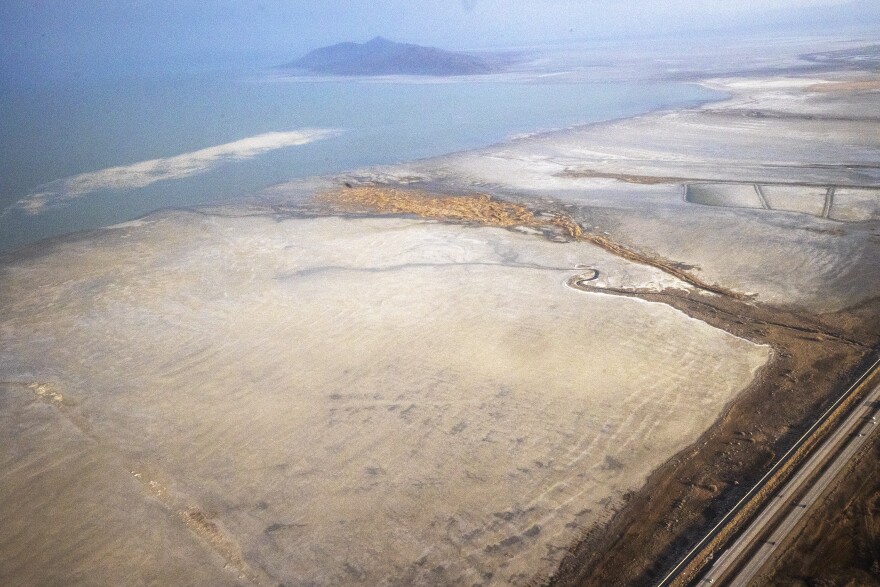
https://www.kuer.org/health-science-environment/2022-06-20/toxic-dust-warnings-might-be-our-future-as-the-great-salt-lake-shrivels-up

If we can’t save one lake, how will we save the planet?


We all think we know why it’s so hard to motivate our fellow Americans to meet the threat of climate change:

  • The danger seems distant, as if we still had a lot of time to react.
  • The problem seems abstract: So what if statisticians claim the average day is a degree or two warmer than it would have been a few decades ago? Why is that such a big deal? Maybe the computer models are wrong and the projections of disaster are just scaremongering.
  • Such disasters as we’re already seeing — hurricanes, droughts, fires, heat waves — don’t come clearly marked “brought to you by climate change”. Similar things have happened in the past, so maybe these would have happened anyway.
  • Because climate change is global, it’s hard to connect our own actions to the outcome. If we make sacrifices, but the Chinese and Indians don’t, they’ll get an advantage on us and all the bad things will happen anyway. As Marco Rubio put it when he was running for president in 2015: “America is not a planet.

But what if we faced an environmental disaster where none of those factors came into play? Something entirely within our borders, where the changes were visible to the naked eye, and the looming catastrophe obvious. Something clearly connected to current policies, and addressable by changing those policies.

We’d be all over that, wouldn’t we?

Well, apparently not.

Not quite two weeks ago, the New York Times reported that a combination of climate change, over-population, and profligate water use is killing the Great Salt Lake.

Last summer, the water level in the Great Salt Lake reached its lowest point on record, and it’s likely to fall further this year. The lake’s surface area, which covered about 3,300 square miles in the late 1980s, has since shrunk to less than 1,000, according to the U.S. Geological Survey.

The salt content in the part of the lake closest to Salt Lake City used to fluctuate between 9-12%, according to Bonnie Baxter, a biology professor at Westminster College. But as the water in the lake drops, its salt content has increased. If it reaches 17% — something Baxter says will happen this summer — the algae in the water will struggle, threatening the brine shrimp that consume it.

Algae and brine shrimp are the bottom of a food chain. Migratory birds who rely on the lake as a resting spot in their otherwise perilous desert crossing would go next.

While the ecosystem hasn’t collapsed yet, Baxter said, “we’re at the precipice. It’s terrifying.”

Worse, the exposed former lake bed could soon endanger humans in nearby Salt Lake City:

The lake bed contains high levels of arsenic and as more of it becomes exposed, windstorms carry that arsenic into the lungs of nearby residents, who make up three-quarters of Utah’s population. …

The soil contains arsenic, antimony, copper, zirconium and other dangerous heavy metals, much of it residue from mining activity in the region. Most of the exposed soil is still protected by a hard crust. But as wind erodes the crust over time, those contaminants become airborne.

Part of the problem is climate change, with all the complicating factors I listed above. (More of the mountain snowpack is evaporating rather than melting to feed the rivers that feed the lake.) But another big part of it isn’t: Population growth is diverting water from the rivers before it can reach the lake.

So policy changes at the state and local levels could do a lot to mitigate the problem: Water rates could go up, and future development could be discouraged.

Of major U.S. cities, Salt Lake has among the lowest per-gallon water rates, according to a 2017 federal report. It also consumes more water for residential use than other desert cities — 96 gallons per person per day last year, compared with 78 in Tucson, Arizona, and 77 in Los Angeles. … Homes around Salt Lake boast lush, forest-green lawns, despite the drought. And not always by choice.

In the suburb of Bluffdale, when Elie El kessrwany stopped watering his lawn in response to the drought, his homeowners’ association threatened to fine him. “I was trying to do the right thing for my community,” he said.

State Rep. Robert Spendlove, a Republican, introduced a bill this year that would have blocked communities from requiring homeowners to maintain lawns. He said local governments lobbied against the bill, which failed.

In the state legislative session that ended in March, lawmakers approved other measures that start to address the crisis. They funded a study of water needs, made it easier to buy and sell water rights, and required cities and towns to include water in their long-term planning. But lawmakers rejected proposals that would have had an immediate impact, such as requiring water-efficient sinks and showers in new homes or increasing the price of water.

In short, the legislature did nothing that might ask for sacrifices from individual citizens. If Utahans are still asleep to the problem — even though they can go look at the shrinking lake for themselves — the state’s political leaders are afraid to wake them up.

https://theweek.com/political-satire/1014485/the-real-price-of-gas

But they’re bound to notice eventually. The NYT article compares the Great Salt Lake to the cautionary tale of Owens Lake in California, which dried up when water feeding it was diverted to Los Angeles early in the 20th century.

On what used to be the shore of what used to be Owens Lake is what’s left of the town of Keeler. When the lake still existed, Keeler was a boom town. Today it consists of an abandoned school, an abandoned train station, a long-closed general store, a post office that’s open from 10 a.m. to noon, and about 50 remaining residents who value their space, and have lots of it.

Like Paul Krugman, I was surprised the NYT article didn’t mention a much bigger disaster: the Aral Sea in Central Asia, which was once the fourth-largest inland body of water in the world. In the 1960s, the Soviet Union irrigated much of the surrounding area in an attempt to become a major cotton exporter. With so much water evaporating in fields rather than flowing into the sea, the Aral’s ecosystem collapsed.

The Aral Sea has seen the surface area decline by 90%, and had its volume decrease by 85%, an amount equal to Lake Erie and Lake Ontario combined. The sea level has dropped by over 30 m in many places, leaving fishing boats stranded 100 kilometers from any shore. What was once the bottom of the lake has become a new desert, abandoned fishing boats listing in the sand, scoured by toxic dust storms. Ramshackle towns perch on vanished shorelines, while the population languishes in poverty and high rates of cancer, tuberculosis, digestive disorders and anemia. It’s like a scene from a post-apocalyptic movie, yet it is all too depressingly real.

Krugman makes a even more depressing point about the Great Salt Lake:

what I found really scary about the report is what the lack of an effective response to the lake’s crisis says about our ability to respond to the larger, indeed existential, threat of climate change.

The factors that make it hard to marshal the will to fight climate change globally don’t apply here. The retreat of the Great Salt Lake is a visible local problem that could spiral into disaster in the very near future. Action to prevent that disaster could be taken locally, by restricting water usage and new development.

So this should be easy: A threatened region should be accepting modest sacrifices, some barely more than inconveniences, to avert a disaster just around the corner. But it doesn’t seem to be happening.

And if we can’t save the Great Salt Lake, what chance do we have of saving the planet?

A similar pattern is replicating across the West in the face of a multi-year drought.

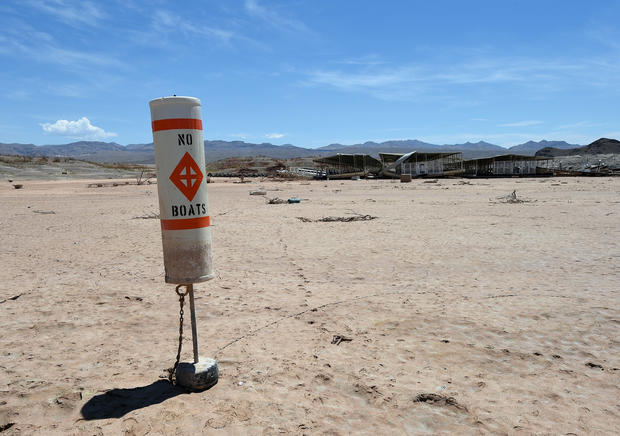
Lake Mead, which was created in the 1930s when the Hoover Dam was built across the Colorado River, is currently lower than at any time in its history. Lake Powell, also on the Colorado, is currently so low that the Glen Canyon Dam’s electrical generation has been cut back.

A former marina on Lake Mead. https://www.cbsnews.com/pictures/drought-dries-up-lake-mead/24/

Again, climate change combined with rapid population growth is the problem, perhaps exacerbated by the illusion created by the 20th century, which was wetter than normal in most of the American West.

The West is where the rubber meets the road in terms of America confronting climate change. The environmental problems are local, visible, and immediate, and local solutions to those problems are available. If it’s not politically feasible to restrict water usage and curb development, the whole region is, as Grant Piper puts it, sleepwalking towards disaster.

Climate Change is Here

https://theweek.com/science/1002139/melting-space-needle

When it’s 116 in Portland and 108 in Seattle, something is wrong.


For a long time, you could only see global warming if you knew what you were looking for. It wasn’t something that announced itself in your everyday experience.

Wherever you might live, it continued to be warmer in the day and cooler at night, hotter in summer and colder in winter — the same as it ever was. Whether summers had been hotter or winters colder years ago was a topic for old people’s boring stories about the Blizzard of ’78 or the Drought of ’54.

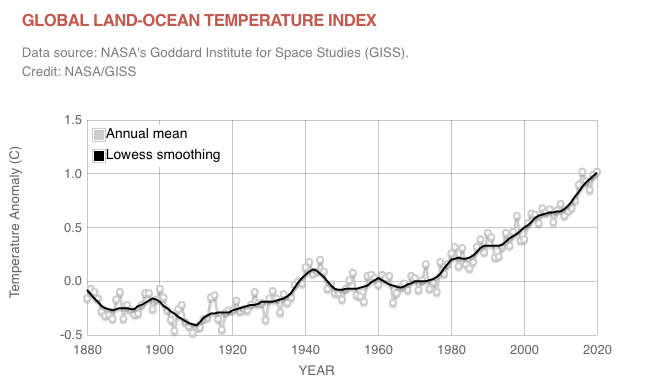
You had to be a statistician — or trust statisticians whose work you couldn’t check — to get any coherent view of the trends in global temperature. Think of the millions of measurements, and thousands of adjustments to those measurements, necessary to produce a graph like the one below. Who made those measurements? Who compiled those statistics? Why should you trust them? If you had the resources and the will, you could find your own way to parse the data so that it said something different. Why shouldn’t you do that, or decide to trust somebody who did, rather than trust NASA or NOAA or some international consortium of scientists?

The situation was even worse if you tried to look to the future, because then you were dealing with computer models. What were they assuming? Who did the programming? Again, the graphs looked very impressive and scary. But if you didn’t want to believe them — and who did, really? — nobody could make you.

And without predictions decades into the future, climate change was no big deal. Maybe it was already a degree or two hotter than in your grandparents’ day, but so what? Life went on, people adjusted. The climate was always changing.

What it came down to, for a lot of Americans, was one more example of people with advanced degrees telling them what to do. And that might be fine if they were telling you to do something you want to do — like get a good night’s sleep, or spend more time in the sunlight. And it’s even OK if their advice is unpleasant, but matches your common sense — compound interest means you should start saving for retirement when you’re young, smoking isn’t good for you. But here the eggheads were telling you to stop driving and flying and running the air conditioner, or even to close down the mines your town depended on, the one that had employed your family for generations. And the evidence was all stuff you couldn’t touch: Look at this graph and don’t ask too many questions about how I made it, or else the world will be a hellscape after we’re all dead.

Americans already had religions based on things they couldn’t see that made threats and promises after death. They didn’t need another one.

And then visible things started to happen, maybe, sort of.

Right around the time Hurricane Katrina mauled New Orleans in 2005, you might think you were starting to see climate change in anomalous weather events. But what is “anomalous”, really? When Superstorm Sandy hit New York City in 2012, we all had a gut feeling that hurricanes aren’t supposed to go that far north. But weird weather events have been happening forever. What about the Great New England Hurricane of 1938?

The Midwestern floods of 2019 were so intense, and so close to previous major floods, that they drove the phrase “hundred-year flood” out of our vocabulary. Nobody knows what a hundred-year flood is any more. And sure, that’s strange, but is it proof? Maybe we’re just in some kind of weird flood cycle.

We got used to these kinds of arguments, to the point that they became almost ritualized: The weather would do something incredible — a big wildfire, an intense hurricane season, or a heat wave in Siberia — and somebody would immediately say: “See? Climate change.” But then somebody else would say, “You can’t really say that about one event. It could just be bad luck.” Then either people would start yelling at each other, or the conversation would bog down in the technicalities of probability — neither of which accomplished anything. Everybody continued to believe whatever they had started out believing.

The series of weird weather events should have chipped away at climate-change-deniers’ skepticism, but in fact it did the opposite. Once you’ve explained away Katrina and Sandy, it gets easier, not harder, to shrug off Harvey and Irma and Maria all happening the same year. The weather gets weird sometimes; that doesn’t mean the world is ending.

Even so, last year’s western wildfires were a little hard to account for. Not only were they record-breaking in terms of acreage and cost, but Portland suburbs had to be evacuated, Seattle had an air-quality emergency, and the smoke gave me colorful sunsets all the way out here in Massachusetts. And only a few months before, Australia had record-breaking fires of its own.

For decades, climate-change deniers have derided activists as “scare mongers” who made “apocalyptic” predictions. But you know what? Those fires in Australia looked pretty apocalyptic.

Smoke-choked Sydney in December, 2019

Still, people pointed to multiple possible causes for wildfires: over-development, say, or power lines. President Trump blamed bad forest management, echoing absurd suggestions he had made about raking in 2018.

Wade Crowfoot, California’s secretary for natural resources, pressed Mr. Trump more bluntly. “If we ignore that science and sort of put our head in the sand and think it’s all about vegetation management, we’re not going to succeed together protecting Californians,” he told the president.

This time, Mr. Trump rejected the premise. “It’ll start getting cooler,” he insisted. “You just watch.”

“I wish science agreed with you,” Mr. Crowfoot replied.

“Well, I don’t think science knows, actually,” Mr. Trump retorted, maintaining a tense grin.

Well, it’s a year later now, and guess what? It’s not getting cooler.

Monday, it was 116 in Portland, Oregon, beating the previous all-time record (set in 1965 and 1981) by nine degrees. The heat wave covered the entire Northwest: 108 in Seattle, 109 in Spokane, 116 in Walla Walla, and 117 in Pendleton. Strangest of all was the small town of Lytton, British Columbia, where the heat wave peaked at 121 degrees, an all-time record for the nation of Canada.

121 in Canada. That’s not right.

Heat and drought have set the stage for another bad wildfire season, and it’s already starting in Canada and Washington and Oregon and Idaho and California. On the other side of the country, the Atlantic is already up to its fifth named storm of the season, Elsa. We’ve never gotten to E this fast before, and the previous record was set last year.

It’s happening. Global warming is here. It’s not just statistics and computer models any more. You can see it. You have to work not to see it.

That doesn’t mean things go straight to hell from here. The western heat wave finally broke. Today’s predicted high in Portland is 86. Next winter, it will get cold in lots of places, and if some oil-financed politician wants to bring a snowball to the floor of the Senate, he’ll be able to find one. “Damn,” one cold person will say to another, “we could use a little of that global warming about now.”

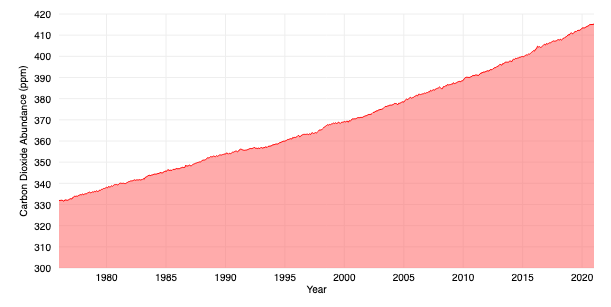
And while the quantity of carbon dioxide in the atmosphere will continue to go up every single year, not every year will be hotter than the previous one. 2016 and 2020 were the hottest years on record, but so far 2021 isn’t quite so bad, at least not globally. Fossil fuel spokesmen, including the politicians the oil companies pay for, will tell you that means it’s all over. Global warming ended in 2020, they’ll say, just like they said it ended in 1998.

https://www.climate.gov/news-features/understanding-climate/climate-change-atmospheric-carbon-dioxide

Don’t believe them. Believe what you can see.

For a long time, believing what the scientists said about the climate required trusting in the invisible, and the future horrors they predicted seemed too far away to take seriously.

Not any more. Global warming is here. It’s visible. It was 116 in Portland Monday.

That’s not right.

Blowing Smoke About Clouds

Last week an International Business Times article stopped me short: “Alarmists Got it Wrong, Humans Not Responsible for Climate Change: CERN“.

“Wow,” I thought. “CERN. Not some Exxon/Koch-funded stooge. CERN, where the real scientists are. There’s the CERN logo right in the article. I’d better read this and rethink my opinion on climate change.”

I read the article and I learned a lot. But not about science, about propaganda.

Occasionally you need to know some science to spot the BS in a newspaper science article, but most of the time you just need some common sense. Start with: Does the content of the article justify the headline?

Not this time. The article discusses new research about cloud formation that CERN scientists recently published in Nature (another one of the biggest names in science). But nobody at CERN is quoted saying, “Humans aren’t responsible for climate change.”

In fact, the article doesn’t quote anybody from CERN (or Nature). Who are their sources, then? Lawrence Solomon, David Whitehouse, and Nigel Calder. If you’re just skimming, you might assume at least one of them represents CERN, but they don’t.

Who are they? In the Age of Google, that’s an easy question.

So a more accurate headline would be: “Global-Warming Skeptics Claim New CERN Research Vindicates Them”.

Well, of course they claim that. But then any real journalist would have to ask: Does it?

Journalism — even journalism about rocket science — is not rocket science: Punch “CERN cloud experiment results” into Google, and in seconds you’ll be looking at the CERN press release and its supporting press briefing. Spend a few minutes chasing links, and you’ll see the lead author of the Nature article (Jasper Kirkby) quoted in Scientific ComputingLive Science, and — oh, look at this! — Nature News, which is put out by the same people who publish Nature.

So it isn’t hard to find sources closer to the action than Solomon, Whitehouse, and Calder. Do any of them say “Humans are not responsible for climate change”?

No.

So what is this experiment and what does it really show?

CERN made a cloud chamber that simulates Earth’s atmosphere, and tried to figure out where atmospheric aerosols — tiny particles that cloud droplets form around — come from. They discovered that previous theories only accounted for a small fraction of the aerosols observed in the atmosphere. They could account for more when they added cosmic rays to their simulation, but they still couldn’t form a complete theory.

The CERN press release quotes Kirkby:

It was a big surprise to find that aerosol formation in the lower atmosphere isn’t due to sulphuric acid, water and ammonia alone. Now it’s vitally important to discover which additional vapours are involved, whether they are largely natural or of human origin, and how they influence clouds.

The press briefing concludes:

This 
result 
leaves 
open
 the 
possibility 
that 
cosmic 
rays
 could 
also
 influence
 climate. 
However, 
it 
is 
premature 
to
 conclude 
that cosmic
 rays 
have 
a
 significant 
influence
 on
 climate 
until 
the additional 
nucleating
 vapours 
have 
been 
identified, 
their
 ion
 enhancement 
measured, 
and 
the 
ultimate
 effects
 on
 clouds 
have 
been confirmed.

Nothing in the press release quantifies this possibility. Kirkby told Nature News: “At the moment, [our research] actually says nothing about a possible cosmic-ray effect on clouds and climate, but it’s a very important first step.”

Live Science also talked to Kirkby:

The research doesn’t call into question the basic science of greenhouse gas warming, Kirkby emphasized, but rather refines one facet of the research. … “It’s part of the jigsaw puzzle, and you could say it adds to the understanding of the big picture,” he said. “But it in no way disproves the other pieces.”

None of that stops Solomon from claiming (in the Financial Post — again published with no comment from the actual researchers) that

The science is now all-but-settled on global warming, convincing new evidence demonstrates, but Al Gore, the IPCC and other global warming doomsayers won’t be celebrating. The new findings point to cosmic rays and the sun — not human activities — as the dominant controller of climate on Earth.

Discover’s Bad Astronomy blog responds:

There’s only one problem: that’s completely wrong. In reality the study shows nothing of the sort.

BA goes on to explain why you shouldn’t expect any future research to support Solomon either:

The problem here is two fold: there doesn’t appear to be a large variation in Earth’s temperatures with solar activity, and also that temperatures are rising extremely rapidly in the past 100 years, when solar activity has been relatively normal.

So, who do you think the conservative media outlets go with: science publications that have done the legwork and talked to the CERN researchers, or a long-time global-warming denier who makes unsupported claims in an opinion piece in a financial newspaper?

Do you have to ask?

Fox Business Channel’s Tobin Smith:

We can report tonight the science of climate change is now all but settled. Yes friends and neighbors, and the global warming alarmists have been dealt a wee bit of a blow, right? CERN, C-E-R-N, one of the world’s largest and most prestigious centers for scientific research, has concluded that it’s the sun’s rays, not human activity, which controls the earth’s climate. Now, that, of course, is horrible news for the greenies who’ve used, you know, for years questionable science to justify more and more regulations against fossil fuels like coal and oil, all the while arguing for more and more for the renewable energy sources they just love so dearly. So are the greens prepared to back down now that the science has proved them wrong?

Media Matters collects similar statements from CBN, the Washington Times, and Investor’s Business Daily — all clearly repeating Solomon’s interpretation rather than CERN’s.

So this is what you need to hijack the well-deserved prestige of a research organization like CERN and a journal like Nature:

  • three zero-credibility cranks to “interpret” the research by making stuff up,
  • two newspapers willing to ignore anybody connected to the research, and instead source their articles to the cranks,
  • an echo chamber of news outlets willing to accept the first two papers as reliable sources, do no independent checking, and instead let false claims grow in the telling,
  • opinion leaders in the echo chamber who shift the onus away from the cranks onto their opponents: What’s wrong with those greenies, that they still hold out now that they’ve been proven wrong?

Result? Rank-and-file conservatives hear the same message from multiple directions. When they confidently tell their friends and  co-workers that CERN has proved Al Gore wrong, people who get their news from the New York Times know nothing about it — because an accurate assessment of these tentative results was not deemed sufficiently newsworthy.

And the conservative nods knowingly: It’s that liberal media, constantly suppressing anything that doesn’t fit its biased worldview.