

The author of Dopesick goes back to her small Ohio home town and wonders: Could a troubled teen do today what she did decades ago? Maybe. But the hurdles to jump are higher now.
In the Broadway musical A Little Night Music, a minor character sings a poignant song about hope and hopelessness in the serving class. In “The Miller’s Son“, the verses argue with the chorus, as a kitchen maid alternately dreams of a better life and realizes that the only pleasures available to her are momentary ones that lead nowhere.
Her opening thought is that “I shall marry the miller’s son, pin my hat on a nice piece of property.” Each verse lets the fantasy run a little wilder: “I shall marry the businessman, five fat babies and lots of security”, and then “I shall marry the Prince of Wales, pearls and servants and dressing for festivals.” Of course, if the pleasures of the moment lead to a pregnancy, none of that is possible. But was it ever possible? She ends by bitterly repeating “I shall marry the miller’s son”, recognizing that for her such a match is no more likely than the Prince of Wales.
Beth Macy is 60-something now. She came from a poor family with an alcoholic father in the small town of Urbana, Ohio. She studied hard in school and was a good if unspectacular student. She went to college on a Pell Grant, became a journalist, and (eventually) an author of several best-selling books — one of which, Dopesick, about how corporate greed led to an opioid crisis in small-town America, was made into an Emmy-winning miniseries.
Her life, from one point of view, is the quintessential American rags-to-riches story we like to tell children: Work hard, don’t give up, and you can make something of yourself, no matter how unlikely that may seem at the moment. Abe Lincoln went from a log cabin to the White House; you can too.
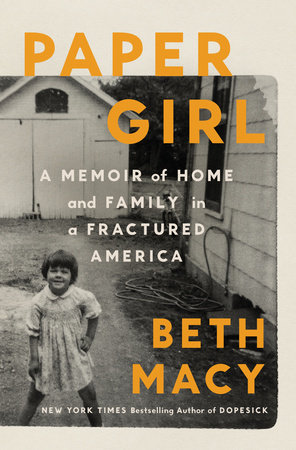
But in her new book Paper Girl, Macy goes back to Urbana and (over a period of years) interviews everyone from her relatives to troubled high school students to the mayor. The main question on her mind: Is the path that she walked still open today? Along the way she learns a lot about hopelessness in the White working class, its turn to the political right, and political polarization in general.
Getting a degree. The quick answer to Macy’s original question is: The path is still open, but much narrower and more treacherous than it was in her day.
She follows several of Urbana’s young people who grew up in difficult circumstances, and runs into the same story again and again: They have the talent and ambition to get out of poverty and possibly make it in the wider world, teacher and other mentors are rooting for them, but something comes up. Juggling a job, school, and ongoing family trauma gets to be too much. Or some close relative needs care and has no one else to provide it. Or maybe it’s something as simple as a car repair they have no money to cover; the fifty miles to the state university turns into an insurmountable obstacle.
Almost as bad as the immediate problems is the fatalism they lead to: Of course something would come up. People don’t actually walk the path to education or training and a secure future any more. It was never in the cards for them to marry the miller’s son.
What reminded me of “The Miller’s Son” was how the get-educated path can sound just as improbable as the make-the-NBA or become-a-rap-star path. People have done it, but could you do it? Is it worth making sacrifices (and asking others to make sacrifices for you) to keep that dream alive?
Politics. So what changed between the 1970s and 80s and the 2020s? Part of it is political: As a society, we stopped investing in education. When Macy got her Pell grant, it was a free ticket to college, but it no longer is. Once, Pell grants were how we made real the promise of America, and we told ourselves (truthfully) that a college grad’s increased lifetime earnings would lead to income tax payments that more than reimbursed the government for its generosity. But during the miserly years of the Reagan revolution (and Clinton’s ratification of much of that course change), poor young people in college became just another kind of welfare queen.
And as federal support was drying up, colleges themselves have gotten more expensive, largely because states pay a much smaller part of the costs of their state university systems. Financial aid shifted from grants to loans, so that a graduate might start a career with six-figure debts. And if you didn’t graduate — if, say, something came up that knocked you out of college — you’d have almost as much debt but not the degree to help you pay it off.
Piling on further, the degree itself is not worth as much in the job market. Even a STEM degree might not help you if the job market is looking for some other kind of STEM degree the year you graduate. (For example, the freshmen who chose a computer science major four years ago may not have realized they’d have to compete with AI algorithms for entry-level jobs.)
I’m not sure anybody is asking this question, but they should: What kind of program would it take to make the promise of America real today?
Family. Macy quickly notices the symptoms that students’ lives have changed: High school graduation rates are down. Attendance is down. Ohio’s liberalized homeschooling laws make even those numbers look better than they actually are, as parents who can’t get their children to school and are sick of dealing with truant officers sign a paper saying their child is being homeschooled. No one checks that the child is actually getting an education.
Meanwhile, public schools are losing funds to Ohio’s private-school voucher program, which makes private schools less expensive for the well-off without truly making them accessible to the poor.
Of course, homeschooling only works if home is working. And here we run into the opioid crisis Macy chronicled in Dopesick. She tells stories of teens who either couchsurf or are homeless through high school, because one parent is a drug addict and the other is in jail. It’s hard to say whether there is more sexual abuse than in Macy’s teen years, but there is certainly a lot of it. Paying attention to trigonometry or Shakespeare is probably not at the forefront of many students’ minds.
Many teachers, counselors, and coaches try to step into the breach, but it’s too much for them. A gay man who runs a teen center wrangled a grant out of the state, but couldn’t get the local government to sign off on it because of homophobic fears that he was “recruiting” teens into the gay lifestyle.
Community. In Macy’s day, Urbana was a more integrated community, at least in the sense of class. One way she coped with her dysfunctional family was by spending a lot of time with friends whose families were thriving. But increasingly, Urbana is siloed into the haves and have-nots.
Urbana is basically the country club and the ghetto, and neither group has any idea that the other group exists.
So a present-day Beth Macy may not know about those thriving families or be invited into their homes. She might not hear friends’ professional-class dreams and wonder “Why not me?”
A journalist herself, who began her career writing features about local characters for local newspapers, Macy sees great significance in the decline of local journalism: Urbana’s main local news outlets are Facebook pages and advertising sheets that publish press releases rather than news stories. How do Urbana’s people hear about folks unlike themselves? How do they find out about events happening outside their silo?
The results are twofold: On the one hand, Urbana’s citizens have lost their town as a source of identity, causing them to seek identity in politics or religion. On the other, they have lost a sense of their fellow citizens as Us, and have a corresponding willingness to accept conspiracy theories about Them.
Polarization. Urbana, and in particular its working-class population, is among the victims of globalization. The family business that once was the town’s major employer was long ago sold off, and most of its jobs have gone overseas. When Bill Clinton was pushing NAFTA and similar once-Republican free-trade policies, the promise was that new jobs would replace the old jobs, and that the overall benefit to the American economy would allow us to invest in retraining the displaced workers.
That never worked out. The new jobs weren’t where they needed to be, and the retraining rarely prepared the displaced workers adequately. Most of them wound up working in places like WalMart and never regaining the financial stability the old jobs had offered. Many found ways to retire early or claim disability.
So when Trump tells such people that they’ve been forgotten, he’s not wrong. Much of what he tells them after that is false; the Haitians in nearby Springfield were never eating the local dogs and cats. But having seen them and offered at least some explanation of their situation gets him in the door. When he offers to deport the immigrants who are “stealing their jobs”, that’s at least a plan of some sort.
Now connect that with the sense of hopelessness in the young people: They can’t hope to get the jobs their parents or grandparents had. Getting post-high-school training and going on to land the good jobs that still exist — that seems like a pipe dream, not a realistic plan. Parents can’t look forward to their children having a better life than they did.
One of the questions “Make America Great Again” always raises is “When was the great age that ‘again’ promises to restore?” The obvious answers raise issues of racism and sexism: Was America great during Jim Crow? Was it great when women couldn’t get a credit card without their husbands’ signature? When gays had to be in the closet? When?
And yes, MAGA has always been tainted by a background scent of bigotry. But fundamentally, “again” appeals to the feeling among White working-class families that Americans like them used to have hope. Those dim memories make them feel entitled to hope, and to recognize that they don’t have it now.
Someone must have taken it from them.
That’s the opening that Q-Anon and other conspiracy theories exploit. Macy recounts many conversations with relatives or high school friends who have bought some form of conspiracy theory. When Macy tries to offer facts, she is told “You can’t trust the media.” And she replies “But I am the media.” If this provokes any cognitive dissonance in people who ought to trust her, it’s not enough.
That disconnect is, I think, typical of the college/non-college divide. If you went to college, and even moreso if you went to graduate school, you have a sense of the accessibility of expertise. I may not know Anthony Fauci, for example, but I know biologists who understand infectious diseases. There was a point in my life where I could have gone into biology or climate science or a discipline at the center of some other alleged conspiracy. When would the conspirators have read me in? Why don’t my friends ever tell me about such moments?
But if you didn’t go to college, those disciplines may seem so distant that literally anything could be happening there.
Privilege. I think I also understand now why the MAGA working class is so hostile to any “woke” talk about White privilege or male privilege. Again, racism and sexism probably play some role, but maybe not the main role.
It’s always been the habit or ruling classes to rob Peter to pay Paul. If a ruling class has a debt, chances are it will steal from someone else to pay it, like the United States taking Liberia to offer to freed slaves. I mean, God forbid that those who profited from slavery should shoulder the cost!
Integration of public schools followed a similar pattern: Well-to-do Whites thrust that social experiment onto working-class Whites, while either moving to upscale suburbs or sending their own children to private schools.
So if recognition of privilege takes hold, who will be asked to pay the debt owed to the un-privileged groups? White or male MAGAts anticipate being handed the bill themselves, and not being able to pass it on to the billionaires. And they’re probably not wrong.
How to win them back? For too long, Democrats have tried to depend on Truth to win out: Climate change is real. Privilege exists. Immigrants benefit the economy. Cutting rich people’s taxes never works out for those who aren’t rich. And so on.
What we miss is that Truth will not win out if the Truth is hopeless. If the Truth is: “You’re screwed. Try to get used to it”, that Truth will not win elections for us, even if the other party offers transparent nonsense.
We need to recognize the hopeless parts of America and begin speaking to them. We need to begin offering plans for them and their children and their communities to have futures they can believe in.

 The Weekly Sift