Tag Archives: Biden administration

Joe Biden is good at governing

The peaceful resolution of the debt-ceiling confrontation is the latest example of a pattern: Unlike his predecessor, President Biden doesn’t brag and exaggerate. He just gets stuff done.


Saturday, President Biden signed a bill that suspends the debt ceiling for the rest of his presidency, ending a crisis that threatened to cause a global economic catastrophe. I’ve explained previously why the debt ceiling shouldn’t exist at all, so I’d have been happier if it were eliminated completely. But by pushing the next crisis off until at least 2025, Biden has ensured that the American people will have a chance to remove Republicans from the levers of power before they can hold the US economy hostage again.

How we got here. Some kind of debt-ceiling showdown became likely last November when the 2022 elections gave Republicans a narrow majority in the House. It seemed almost certain in January when Kevin McCarthy had to make big concessions and promises to the far-right “Freedom” Caucus in order to become Speaker. [1]

This left Biden in a tricky position. On the one hand, he didn’t want to pay ransom (in the form of budget cuts and policy concessions) to McCarthy in response to what was basically a terrorist threat. [2] On the other, the Republican House majority has a legitimate role to play in working out future budgets. So Biden did need to negotiate with McCarthy, he just didn’t want to negotiate over this. Above all, he didn’t want to pay ransom in exchange for a debt-ceiling increase that would run out before the end of his term, setting up a second ransom payment later. [3]

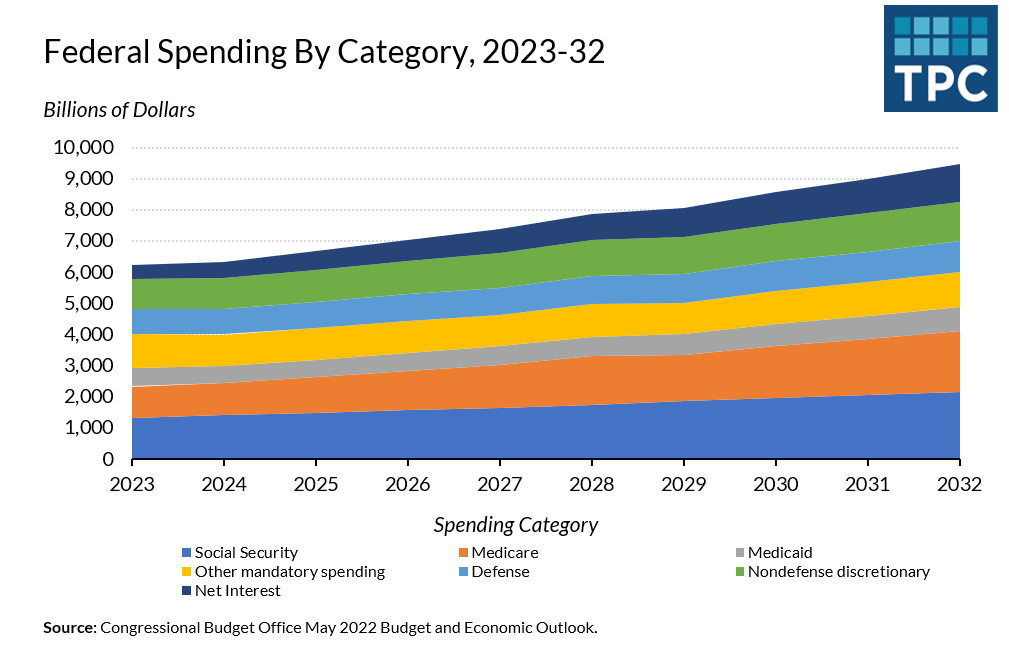
The political implications of the federal budget are also tricky: Polls regularly show that the American people believe the federal government spends too much. But they also dislike cuts to the big-ticket programs the government spends almost all the money on — Social Security, Medicare, Medicaid, and defense — as well as many other programs. [4] So politically, the ideal position is to demand spending cuts in general without totaling up the numbers or targeting any specific programs.

Biden began fencing McCarthy in almost immediately. During his state of the union address in February, he baited Republicans into yelling out against his claim that they wanted to cut Social Security and Medicare. Rather than argue, Biden deftly accepted their nationally televised pledge not to make such cuts. “As we all apparently agree, Social Security and Medicare is off the books now, right?”

Biden’s second tactic was to insist that McCarthy put his demands on paper and prove that his caucus supported them. After all, Biden could hardly be expected to compromise with House Republicans if they couldn’t compromise among themselves.

This almost worked, but in April, by a 217-215 vote, McCarthy managed to get House approval of a bill to extend the debt ceiling until March, 2024, while rolling federal spending back to 2022 levels and imposing a 1% per year cap on total spending growth, which would be less than inflation. [5]

But while McCarthy succeeded in the task Biden had set him, the bill gave Democrats a target to shoot at. The White House responded by listing programs that Republicans hadn’t exempted from cuts. McCarthy’s bill would

strip away health care services for veterans, cut access to Meals on Wheels, eliminate health care coverage for millions of Americans and ship manufacturing jobs overseas.

Immediately, Republicans started backpedaling: Veterans benefits were also off the table, and probably defense as well.

Then Biden and McCarthy started negotiating directly. Biden had a clear strategy:

In pursuit of an agreement, the Biden team was willing to give Republicans victory after victory on political talking points, which they realized Mr. McCarthy needed to sell the bill to his conference. … But in the details of the text and the many side deals that accompanied it, the Biden team wanted to win on substance.

The result was an agreement that in essence paid no ransom for the debt ceiling; it was more-or-less the deal that might have been expected from a pure budget negotiation after a clean debt-ceiling increase. Vox summarizes:

Neither party got everything it wanted. Domestic spending will effectively be held at something close to the status quo in nominal terms, which means a cut when accounting for inflation. It’s still at a much higher level than Republicans wanted, and lower than Democrats would have preferred (though they do not see the cuts as devastating).

On a set of other policy issues where Republicans made big demands, Democrats granted only some limited concessions — for instance, on work requirements for some food stamp recipients, and on agreeing to restart student loan repayments in August, the latter of which the Biden administration had already said they’d do.

Don’t crow. Biden understood that bragging about his negotiating success wouldn’t help.

“[O]ne of the things that I hear some of you guys saying is, ‘Why doesn’t Biden say what a good deal it is?’” President Joe Biden said to reporters yesterday afternoon before leaving the White House on the Marine One helicopter. “Why would Biden say what a good deal it is before the vote? You think that’s going to help me get it passed? No. That’s why you guys don’t bargain very well.”

After the bill had made it through both the House and Senate, but before he signed it, Biden did make a statement [video, transcript]. In it he did two things: outlined what was good about this agreement,

We averted an economic crisis, an economic collapse. We’re cutting spending and bringing the deficits down at the same time. We’re protecting important priorities, from Social Security, to Medicare, to Medicaid, to veterans, to our transformational investments in infrastructure and clean energy.

and shared credit for it.

I want to commend Senator — Speaker McCarthy. You know, he and I, we — and our teams — we were able to get along and get things done. We were straightforward with one another, completely honest with one another, and respectful with one another. Both sides operated in good faith. Both sides kept their word.

And I also want to commend other congressional leaders: House Minority Leader Jeffries, Senate Majority Leader Schumer, Senate Minority Leader McConnell. They acted responsibly and put the good of the country ahead of politics.

The final vote in both chambers was overwhelming, far more bar- — bipartisan than anyone thought was possible.

I am reminded of a famous Harry Truman quote: “It is amazing what you can accomplish if you do not care who gets the credit.”

The mess he inherited. The one negative consequence of Biden’s refusal to tout himself (as President I-Alone-Can-Fix-It ceaselessly did, often by lying) is that he doesn’t get nearly enough credit for a remarkable economic performance.

On Inauguration Day, the country was bottoming out from the disruption of the Covid pandemic. Unemployment was at 6.3% and many businesses were still closed, many schools were holding classes remotely, the FY2020 budget deficit was a record $3.1 trillion, and more than 23 thousand Americans were dying of Covid every week.

Today, unemployment stands at 3.7%, with more Americans working than ever before. The FY 2023 deficit is coming in around $1.5 trillion, and weekly Covid deaths are down to 2,216.

The cost of creating 12 million jobs has been inflation, which the Federal Reserve has countered by raising interest rates from barely above zero to 5%, which has inflation falling from a peak of 9.1% a year ago to 4.9% last month. Ordinarily, that would lead to a recession, but it increasingly looks like the Fed and the Biden administration may engineer a soft landing for the economy.

Some kind of recovery was probably inevitable. Unemployment was going to drop as businesses reopened, and Covid deaths were going to drop as people got vaccinated. But the speed and smoothness of the recovery has been amazing, and Biden’s policies have a lot to do with that.

Partisan and bipartisan accomplishments. Biden has never had the big congressional majorities President Obama enjoyed in his first two years, or that LBJ and FDR had in their transformational eras. And yet he has gotten a lot done, finding bipartisan support for bills like infrastructure, the CHIPS Act, and the debt ceiling, but not being afraid to push bills like his Covid stimulus plan and the Inflation Reduction Act through on party-line votes (which required all fifty of the Democratic votes in the Senate).

In an era when everyone says Washington is broken, Joe Biden has made it work better than many presidents with much more support in Congress.

On the world stage, Biden has deftly repaired the NATO alliance Trump had left frayed, and mobilized it to help Ukraine defend itself against the Russian invasion.

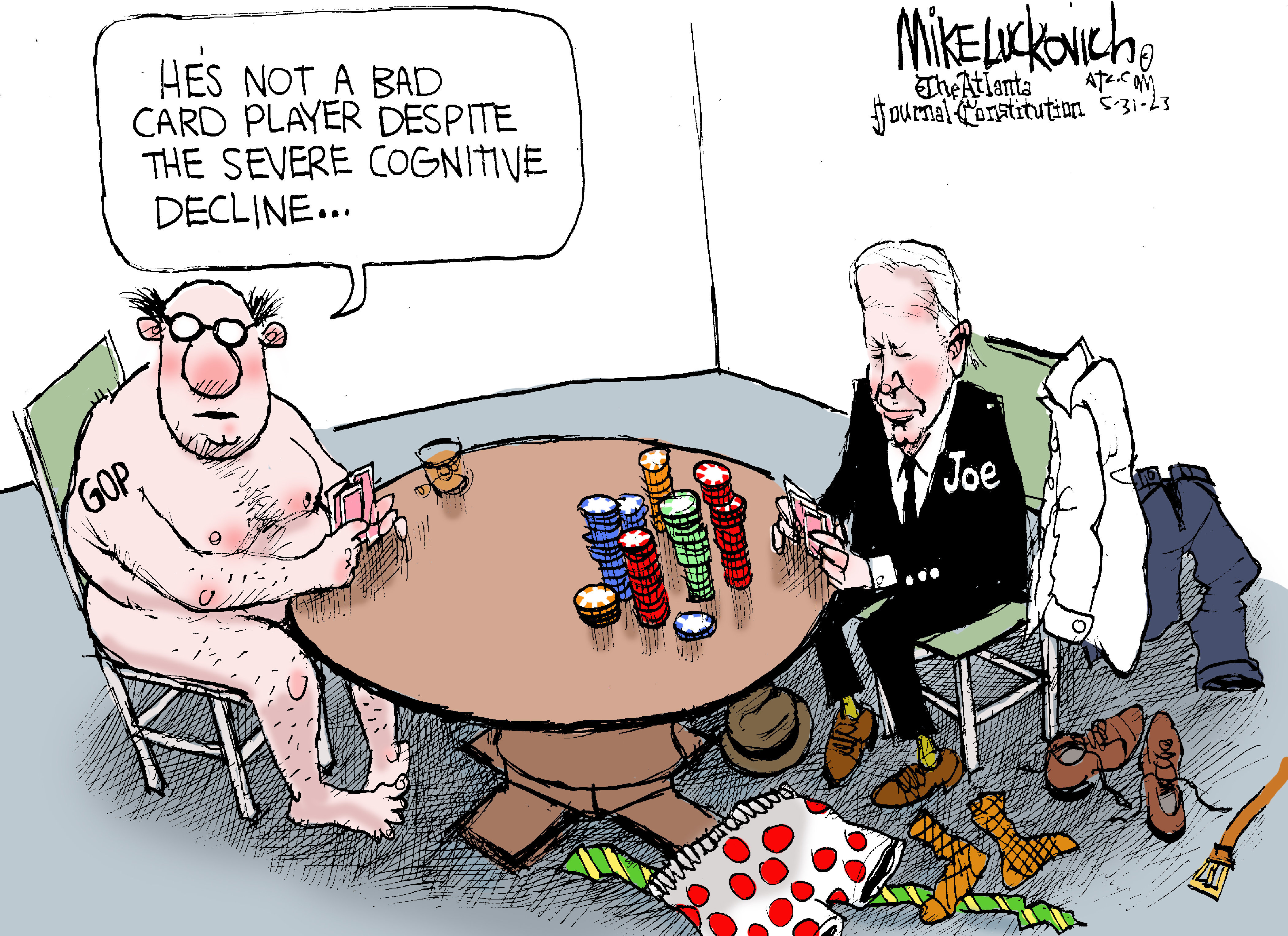
Age? Biden’s age, combined with a lifelong stutter that often causes him to stumble over words, has made him vulnerable to being smeared as senile. Fox News hosts often reference Biden’s “dementia” as if it were an established fact. Last summer, Tucker Carlson said this on the air:

Everybody watching, everyone in the media, that would include Barack Obama’s former advisers, is now in agreement that Joe Biden is senile and cannot govern the United States.

And yet, whenever Biden needs to perform, he does. At the state of the union address, he didn’t just mumble through a teleprompter speech, he engaged the audience and recognized when his Republican hecklers had dug themselves a hole he could take advantage of. He baited the likes of Lauren Boebert and Marjorie Taylor Greene, and then sprung a trap on them.

That’s quite a trick for a dementia sufferer.

House Freedom Caucus member Nancy Mace of South Carolina inadvertently called attention to the contradictions in Republican talking points when she responded to the debt ceiling deal by saying: “Republicans got outsmarted by a President who can’t find his pants.”

We don’t know for sure whether Biden was wearing pants during the 90-minute phone call with McCarthy that firmed up the debt-ceiling deal. But if “everybody watching” is honest with themselves and looks at the record of accomplishment over the last 2 1/2 years, I think they’ll have to admit that somebody in the Biden administration is pretty sharp. My best guess is that it’s Joe Biden.
Contrast with The Former Guy. Starting with his pre-presidential best-seller The Art of the Deal, Donald Trump has always touted himself as a great negotiator, and has made amazing claims about what his deal-making prowess can accomplish in the presidency. He’s still doing it today, claiming that he can settle the Ukraine War in “one day, 24 hours” and negotiate a compromise on abortion “so that people are happy“.

His actual record in deal-making, though, is full of failure. He tore up Obama’s nuclear deal with Iran, claiming that once sanctions were reimposed, Iran’s leaders “are going to want to make a new and lasting deal.” But that deal never emerged, and today Iran is on a path to getting nuclear weapons.

He said he would get North Korea to give up its nuclear weapons (and even claimed Kim Jong Un had agreed), but that never happened either.

When he pulled the US out of the Paris Climate Accords, he said he’d negotiate “something that we can do that’s much better than the Paris Accord. And I think the people of our country will be thrilled, and I think then the people of the world will be thrilled.” That also never happened.

Biden’s bipartisan infrastructure bill represents success in an area where Trump repeatedly failed. The Trump administration’s many attempts to declare an “infrastructure week” eventually became a joke. Even when his party controlled Congress, he couldn’t make a deal.

Likewise, his promise to repeal-and-replace ObamaCare fell apart despite unified Republican control of Congress, because Trump couldn’t lead his party to agree on a replacement plan. (During the 2016 campaign, he claimed to have a plan that would “save $’s and have much better healthcare!” During his four years in office, he never revealed it.) Democrats were willing to give him $25 billion to build his wall (another major 2016 campaign promise) in exchange for a path to citizenship for the Dreamers, but Trump couldn’t take “yes” for an answer.

Even the few deals he got done amounted to far less than he claimed. The agreement that ended his costly trade war with China did not result in the $200 billion in sales it was supposed to. The deal that replaced NAFTA was mostly just NAFTA, plus some concessions the Obama administration had already gotten during the TPP negotiations.

Trump’s lousy deal-making ability comes down to two shortcomings

  • His zero-sum worldview leaves no room for a win/win outcome. He can only win if the other guy loses.
  • His playbook only has one tactic: Make big demands, and then keep ratcheting up the pressure until his opponent gives in. This works fine if he holds all the cards, but in any more equal situation the other side eventually walks away.

2024. If we really do have a Biden/Trump rematch in 2024, it will be a test of the American electorate: Can a majority of voters tell the difference between hype and reality? Will they vote for a guy who puffs himself up and makes exaggerated claims of accomplishments he didn’t achieve and abilities he doesn’t have? Or will they recognize the guy who has been working hard for them and getting results?

If we can’t make that choice correctly, then I would claim it’s the American public that has suffered a severe cognitive decline.


[1] As Politico wrote at the time:

The emerging agreement also addresses the looming need to raise the debt ceiling indirectly, declining to commit conservatives to supporting any hike without other budgetary austerity they have insisted on.

[2] When I use loaded terms like hostage, ransom, and terrorist, I feel obligated to explain why they’re justified.

In a negotiation, it’s normal and acceptable to threaten actions the other side won’t like if they don’t give you what you want. What tips that tactic over into hostage-taking is if you’re threatening actions that nobody wants and nobody benefits from.

That’s what happens when kidnappers threaten to kill their hostage, or a terrorist threatens to blow up the plane he’s on. Killing the hostage doesn’t benefit the kidnappers in any way, but they’re counting on the hostage’s loved ones to dislike that option even more than they do.

Same thing here. Sending the United States into default wouldn’t accomplish any purpose for Republicans, and would in fact harm the constituents they represent. But they assume that Biden and the Democrats like that option even less than they do.

[3] If Biden is reelected, he’ll face the debt ceiling again in 2025. But by then, McCarthy may no longer be speaker.

[4] If you force voters to resolve this contradiction, they’ll usually grossly exaggerate the amount of money the government spends on something they don’t like, such as foreign aid, or subsidies for art they find offensive, or welfare payments to able-bodied adults who don’t want to work. In truth, you could zero out these kinds of payments without making much of a dent in the budget deficit.

[5] The narrowness of his margin is why McCarthy can’t let the House expel indicted fraudster George Santos. If Santos had been expelled and replaced by a Democrat, McCarthy’s bill would have failed.

Choose your enemies well

Biden’s State of the Union wasn’t pretty.
But it probably accomplished more than any SOTU in my lifetime.


This year’s State of the Union was a lesson in the difference between strategy and tactics. President Obama’s SOTUs, like all his speeches, were tactically outstanding. Watching him deliver them was like watching a gifted athlete in his prime. His voice perfectly pitched, his phrases perfectly timed, Obama raised emotion, evoked idealism, and occasionally managed to communicate an idea that was supposed to be too nuanced for this medium. If you had supported him, or even just identified with him as your president after he was elected, you felt pride: This is the man who leads my country.

Joe Biden will never be able to do that. Having struggled his whole life to overcome a childhood stutter, he will always look on a major speech as something to get through rather than an opportunity to shine. After more than half a century in politics, he still sometimes stumbles over his written text, puts emphasis on the wrong words, and races through sentences he ought to drive home.

But that cloud’s silver lining is an aura of authenticity: Biden must be telling it like it is, because he doesn’t have the artistry to lead us astray. Trump is glib and audacious enough to pitch any kind of snake oil, but Biden would never be able to get those words out. It’s already hard enough for him to tell you something he thinks is true.

Tuesday’s speech was vintage Biden. It was too long. His voice was not engaging. And I could easily picture his speechwriter grimacing as the President ruined well-crafted lines that must have looked so good on the computer screen.

And yet, Biden knew his audience, knew his opponents in the room, and delivered a speech that was strategically brilliant. He occupied a strong defensive position and invited his opponents to attack him there, knowing that they would be unable to resist. As Sun Tzu put it:

If your opponent is of choleric temper, seek to irritate him. Pretend to be weak, that he may grow arrogant.

The sound base of Biden’s speech is that he had a good story to tell: record low unemployment, lower drug prices, bipartisan support to rebuild America in ways Trump had promised but never delivered, bringing manufacturing jobs back, the first new gun regulations in decades, NATO reunited against Russian aggression, bipartisan support for research that helps our technology companies compete with China, and a minimum tax to prevent trillion-dollar corporations from paying nothing. He even had good news to tell about the negative parts of the picture: Inflation, the deficit, and Covid are all trending in the right direction.

But rather than unleash a Trump-style brag about his “yuge” accomplishments, Biden was more than willing to share the credit with Republicans.

Folks, as you all know, we used to be number one in the world in infrastructure. We’ve sunk to 13th in the world. The United States of America — 13th in the world in infrastructure, modern infrastructure.

But now we’re coming back because we came together and passed the Bipartisan Infrastructure Law — the largest investment in infrastructure since President Eisenhower’s Interstate Highway System. …

And I mean this sincerely: I want to thank my Republican friends who voted for the law. And my Republican friends who voted against it as well — but I’m still — I still get asked to fund the projects in those districts as well, but don’t worry. I promised I’d be a President for all Americans. We’ll fund these projects. And I’ll see you at the groundbreaking.

He then looked forward, with plans to address everyday problems large numbers of Americans face: protect Social Security and Medicare, end junk fees and surprise medical bills, restore the child tax credit, help seniors stay in their homes, reduce student debt, and move forward in ways that unite us rather than divide us. Here’s how he presented the often-divisive issue of police reform:

We all want the same thing: neighborhoods free of violence, law enforcement who earns the community’s trust. Just as every cop, when they pin on that badge in the morning, has a right to be able to go home at night, so does everybody else out there. Our children have a right to come home safely.

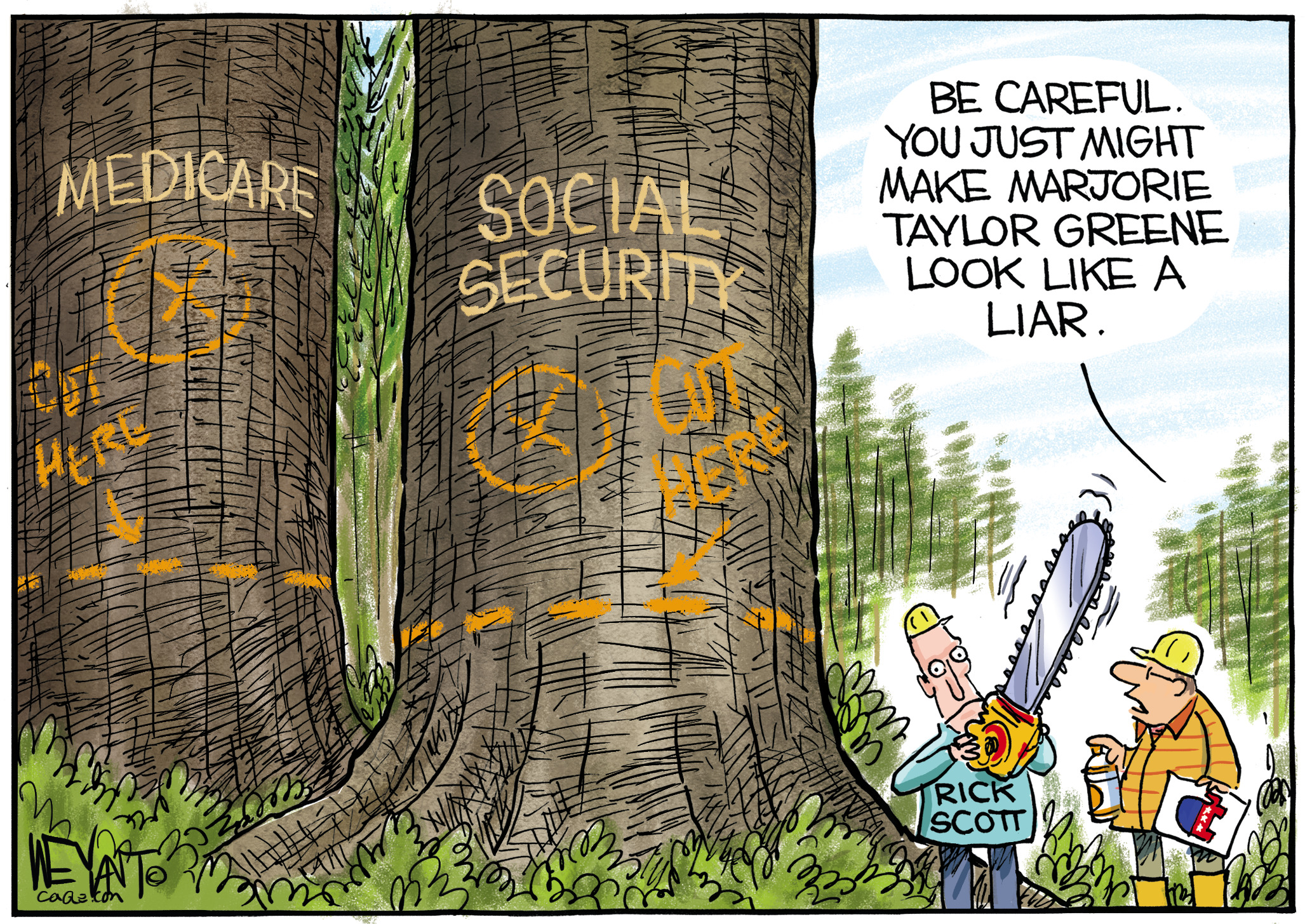
But getting back to Sun Tzu: It’s one thing to occupy a position you can easily defend. The real trick, though, is to get your opponent to attack you there. Biden managed that by pointing to a true fact most Republicans would like American people to ignore: Rick Scott’s proposal to sunset all government programs every five years, which he presented in a glossy brochure last year when he was chair of the National Republican Senatorial Committee. Biden pointed out an obvious consequence of Scott’s plan:

Instead of making the wealthy pay their fair share, some Republicans — some Republicans want Medicare and Social Security to sunset.

That set off a storm of protest from the Republican side, which Biden accepted at face value and made sure the American people took note of: In spite of what they’ve said many times in the past, Republicans don’t want to cut Social Security and Medicare.

Folks — so, folks, as we all apparently agree, Social Security and Medicare is off the — off the books now, right? They’re not to be touched?

All right. All right. We got unanimity! Social Security and Medicare are a lifeline for millions of seniors. Americans have to pay into them from the very first paycheck they’ve started.

So, tonight, let’s all agree — and we apparently are — let’s stand up for seniors. Stand up and show them we will not cut Social Security. We will not cut Medicare.

Popular as that position might be, though, it’s still impossible to square with a goal most Republicans are unwilling to give up on: They can’t achieve a balanced budget without tax increases if entitlement programs are off the table. [1]

But no matter how they protested on national TV Tuesday night, apparently some of them still do want to make cuts. Here’s Senator Mike Round (R-SD) on CNN yesterday. (I’m quoting at length to be as fair to him as possible.)

I kind of look at Social Security the way I would at the Department of Defense and our defense spending. We’re never going to not fund defense. But at the same time, every single year we look at how we can make it better. And think it’s about time that we start talking about Social Security and making it better. We’ve got 11 years before we actually see cuts start to happen to people that are on Social Security. It can be very responsible for us to do everything we can to make those funding programs now and the plans right now so that we don’t run out of money in Social Security, and that it continues to provide all the benefits that it does today. Simply looking away from it and pretending like there’s no problem with Social Security is not an appropriate or responsible thing to do. So I guess my preference would be: Let’s start managing it.

That is the line I expect to hear more often as the budget/debt-ceiling battle heats up: It’s completely impossible to make even the richest Americans pay more tax (as Biden proposes), so the trust funds will have to run out of money. [See note 1 again.] When that happens, benefit cuts are coming whether anyone wants them or not. Let’s accept, then, that cuts are inevitable and make it better by managing those cuts — so that billionaires can go on paying lower tax rates than truck drivers and nurses. (They won’t say that last part out loud.)

So that’s the significant policy achievement of Biden’s speech: He got Republicans to paint themselves into a corner on an issue the voters care about.

But there was also a significant political achievement: Biden stage-managed a bit of theater that framed his administration and his Republican opposition in the terms he wants.

Throughout the speech, Biden himself was calm and even generous. He thanked Republicans for their contribution to the bipartisan bills passed these last two years. [2] And he invited further cooperation

To my Republican friends, if we could work together in the last Congress, there’s no reason we can’t work together and find consensus on important things in this Congress as well.

I think — folks, you all are just as informed as I am, but I think the people sent us a clear message: Fighting for the sake of fighting, power for the sake of power, conflict for the sake of conflict gets us nowhere.

That’s always been my vision of our country, and I know it’s many of yours: to restore the soul of this nation; to rebuild the backbone of America, America’s middle class; and to unite the country.

When Republicans responded to parts of his speech with catcalls and angry yells of “Liar!”, Biden took it in stride: They were enraged, he was not. And if they no longer held the views he had just (correctly, and with documentation) attributed to some of them, then he was happy to accept their agreement: “I enjoy conversion,” he said. [3]

The theatrical aspect of the SOTU made something clear to the American people: If there’s a problem with incivility and extremism in Washington, it’s a one-sided problem. Marjorie Taylor Greene and the rest of the shouters made a mockery of the Republican SOTU response, in which new Arkansas governor and former Trump press secretary Sarah Huckabee Sanders said:

The choice is between normal or crazy.

Anybody who had been watching what happened in the House chamber had no doubt that this is true. But Sanders has clearly chosen Team Crazy, not Team Normal. And while Biden hoped for unity with “my Republican friends”, Sanders fanned division and doubled down on Trump-style trolling.

President Biden and I don’t have a lot in common. I’m for freedom. He’s for government control. At 40, I’m the youngest governor in the country. At 80, he’s the oldest president in American history.  I’m the first woman to lead my state. He’s the first man to surrender his presidency to a woke mob that can’t even tell you what a woman is.

And she painted conservatives as the innocent victims of that “woke mob”.

We are under attack in a left-wing culture war we didn’t start and never wanted to fight. Every day, we are told that we must partake in their rituals, salute their flags, and worship their false idols…all while big government colludes with Big Tech to strip away the most American thing there is—your freedom of speech.

Definitely, if I’m ever offered 15 minutes of national TV time, I’m going to use it to complain that I don’t have freedom of speech.

What has happened here is that President Biden has stolen a trick from Trump, but implemented it in a cleverer way. Whenever the news cycle is going against Trump, he picks a fight with someone his base is inclined to hate: the Squad, or Colin Kaepernick, or LeBron James. The content of the fight doesn’t matter, and it doesn’t matter that Trump’s attack is usually unprovoked. Trump just knows that a fight between him and AOC plays well to his base. (Ron DeSantis is doing the same thing now: It doesn’t matter that he’s totally in the wrong about Black history or banning LGBTQ books. DeSantis vs. Black or gay or trans activists is a good look for him as he gets ready for the 2024 Republican primaries.)

So Biden comes out of the SOTU with Marjorie Taylor Greene yelling “Liar!” at him for saying something true and reasonable that she didn’t like. It’s a good look for him — not just in front of the progressive base, but in front of the American people.


[1] A point sometimes made by this blog’s commenters is that Social Security and Medicare have their own taxes and trust funds, and so are not technically part of the deficit. However, current estimates say that the Social Security trust fund runs out of money in 2035, and Medicare runs dry in 2028. If there are no tax increases by then — something Republicans always assume — either benefits are cut at that point or money to pay for them has to come out of the general fund.

Budget bills are only binding on the current year, but they typically project ten years ahead. A perennial Republican goal is to pass a budget bill that sees the annual deficit go away in the final year the 10-year window. So while the problem with Social Security is still over Congress’ horizon, the projected Medicare shortfall is relevant.

[2] There’s actually quite a list.

You know, we’re often told that Democrats and Republicans can’t work together. But over the past two years, we proved the cynics and naysayers wrong.

Yes, we disagreed plenty. And yes, there were times when Democrats went alone.

But time and again, Democrats and Republicans came together. Came together to defend a stronger and safer Europe. You came together to pass one in a once-in-a-generation infrastructure law building bridges connecting our nation and our people. We came together to pass one the most significant laws ever helping victims exposed to toxic burn pits.

And in fact, I signed over 300 bipartisan pieces of legislation since becoming President, from reauthorizing the Violence Against Women Act to the Electoral Count Reform Act, the Respect for Marriage Act that protects the right to marry the person you love.

[3] An aside: This back-and-forth, where Biden interacted with his opponents off-the-cuff — and ate their lunch in the process — should permanently put to rest all the nonsensical claims that Biden has dementia and is just reading words off a screen.

Beware of Bad Faith

Good-faith opposition has goals of its own, and is willing to give something up to achieve them. Bad-faith opposition has pretexts for saying No.


Back in 2009 … Twelve years ago, Americans unhappy with the recent election would soon begin organizing themselves to oppose the new Obama administration.

One of those organizations was a loose coalition of groups that eventually would call itself the Tea Party. It described itself as principled and politically independent: Neither Republicans nor Democrats, Tea Partiers were as upset with the excesses of the Bush administration as with Obama’s proposals. They opposed government spending and debt, supported liberty, revered the vision of the Founding Fathers, and wanted government to observe more strictly the limits on its power inherent in the Constitution. They viewed social-conservative wedge issues like abortion and gay marriage as distractions from their core mission: Stop the deficit spending that economists of the left and right alike said was necessary to get out of the Great Recession. Prevent the government takeover of healthcare Obama was proposing.

Another opposition group was the Oath Keepers. Ex-military folks, particularly those in law enforcement, recalled their oath to protect America “from all enemies foreign and domestic”. The new president, they implied (or sometimes said openly), was such an enemy, and they encouraged each other to resist gun confiscation and other unconstitutional orders that they were sure he would soon issue.

The media took groups like these at face value, but we now know their self-descriptions were bullshit. Some of the rank-and-file might have believed the hype, but at the top the Tea Party was a Republican rebranding effort coordinated nationally through FreedomWorks and funded by the Koch brothers. Once in office, the Tea Party Republicans (Ted Cruz and Mark Meadows, for example) became staunch culture warriors.

Eventually the movement morphed into the Trump campaign, and all its so-called “principles” were forgotten. If Trump wanted to keep the Obama economic expansion going by running a massive deficit, that was just dandy. When his masked federal police started scooping people up off the streets in Portland, the self-proclaimed defenders of liberty cheered. None of them, it turned out, really cared about the Emoluments Clause, or what the Founders would think about a President channeling millions of taxpayer dollars into his own businesses. If Trump wanted to usurp Congress’ power of the purse to build his wall, so be it.

Oath Keepers followed a similar trajectory. They continued to oppose Obama, even though the unconstitutional orders never came. And when Trump began to disregard laws of all sorts, they shrugged. If his effort to stay in office in defiance of the voters comes to armed revolt against the constitutional order, we know which side they’ll be on. Fundamentally, they’re not freedom fighters, they’re brownshirts.

Meanwhile in Congress, Republican leaders were already plotting their scorched-earth resistance to Obama on the night of his inauguration. Recall the situation: The economy was losing 800,000 jobs a month. The banks were insolvent. The auto industry was one of many headed for bankruptcy. No one could be sure whether this economic freefall would eventually turn out better or worse than the Great Depression. And in the midst of this unfolding disaster, their top priority was to prevent the new president from accomplishing anything. Talk-radio giant Rush Limbaugh said in public what Paul Ryan and Kevin McCarthy were saying behind closed doors: “I want him to fail.

As his administration unfolded, no compromise Obama could offer would ever be good enough. He based his healthcare plan on the one Mitt Romney passed when he was governor of Massachusetts — and Romney denounced it. John McCain voted against the McCain-Liebermann climate change bill. Obama offended large chunks of his own party by offering Social Security and Medicare cuts as part of a “grand bargain” to control the deficit Republicans were so worried about: They not only rejected it, but got rid of John Boehner for considering it.

Did we learn anything? So now here we are, 12 years later, nearing the start of a new Democratic administration. What should Joe Biden learn from this history? Josh Marshall suggests this:

This to me is the greatest negative lesson of the Obama era: the willing engagement of good faith with bad faith in which bad faith is, by definition, always the winner.

He points to ObamaCare, where

the White House spent about a year in a vain effort to convince some bipartisan senate “gang” to agree on a bipartisan plan. It was all one laborious, pitiful game of Lucy and her yanked away football, only played out with 60 and 70 and 80-something men. The actual bill was significantly watered down and enough time was wasted that Ted Kennedy’s illness, death and the subsequent special election to replace him in the Senate almost derailed the whole thing.

Republicans pocketed the time wasted and the concessions granted, walked away without providing any votes in support and then ran against Democrats for passing legislation on party line votes.

It’s already clear that Republicans are gearing up to run the same play again, this time against a smaller Democratic House majority and with either a Republican Senate majority or a 50/50 Senate. Suddenly, after a four-year bout of amnesia, Republicans have remembered that the national debt will bring down the Republic. After years of claiming that they hadn’t read the latest racist or fascist Trump tweet, they proclaim that Neera Tanden’s tweets disqualify her from being OMB director. Unmoved by video of Trump bragging about grabbing women by the pussy — and testimony from two dozen women that this was more than just talk — they are horrified that Biden’s Deputy Chief of Staff would say this:

The president-elect was able to connect with people over this sense of unity. In the primary, people would mock him, like, “You think you can work with Republicans?” I’m not saying they’re not a bunch of fuckers. Mitch McConnell is terrible. But this sense that you couldn’t wish for that, you couldn’t wish for this bipartisan ideal? He rejected that. From start to finish, he set out with this idea that unity was possible, that together we are stronger, that we, as a country, need healing, and our politics needs that too.

Jen O’Malley Dillon’s realistic assessment of what Biden faces met with this response:

“Biden Campaign Manager called us “Fers” !!!” wrote White House Press Secretary Kayleigh McEnany on Twitter. “She can try to walk back, but this says volumes about her boss who calls for “unity” while shouting that we are “assaulting democracy:” They think we are deplorable, irredeemable “Fers”. SICK!!”

Meanwhile, they’ve already started going after Biden’s family. Not just his son Hunter — that was predictable — but also his wife Jill, who has the audacity to be proud of the doctorate she earned. Not only did The Wall Street Journal attack her, but National Review followed up by calling her dissertation “garbage” — undoubtedly the first time NR has assessed an education dissertation. [1]

What passes as a “concession” from Republicans these days is when they choose to recognize reality. Mitch McConnell, for example, has finally conceded — after five weeks — that Joe Biden is the president-elect. Much of the GOP congressional delegation — including both senators facing runoffs in Georgia — isn’t willing to go that far yet. They are continuing to coddle Trump’s delusions of victory, even as he talks about holding onto power by declaring martial law and his supporters turn violent.

To sum up: Biden violates the “unity” he calls for if any of his people point out that Republicans have consistently operated in bad faith, or that Trump’s attempted coup is indeed an attack on democracy. The GOP’s side of the bargain seems to be that Republican congressional leaders have not personally committed any acts of violence yet. If sufficiently placated, they may eventually recognize that Biden is indeed president. It’s questionable whether they will provide the slightest help in digging the country out of the hole Trump has left it in.

Responses. How should Biden respond to this situation? On the one hand he is right when he says that the country needs to heal its partisan division and move forward together. On the other, if he accepts responsibility for Republicans’ refusal to play any part in that vision, they will keep moving the goalposts away as he approaches them.

As I wrote last week, Democrats should continue trying to understand the legitimate grievances and goals of Trump voters. There are 74 million of them, and many of them are having a tough time these days. In spite of what we’ve seen these last four years, Biden’s pledge to be the president of all the people is the minimum Americans should expect from their leader.

At the same time, he should not wait for GOP leaders to get on board, because they will keep him waiting merely for the sake of delay. David Roberts is right: Biden should do everything he can as fast as he can do it.

Biden’s best chance is to try to overwhelm the system the way Trump did, by doing so much that it’s impossible to make any one thing into a lasting story. He should launch so many simultaneous reforms that there’s no time for right-wing media to make up lies about all of them or for the Supreme Court to hear them all. He should ignore bad-faith attacks and stay relentlessly on message about what’s gotten done and what’s getting done next. He should, at every juncture, get caught trying to make government work better for ordinary people.

As Josh Marshall sums up:

Should Biden be open to bipartisan compromise? Absolutely. The door should be open. But it would be a grave mistake to spend any time coaxing anyone to come through it. We’ve played that game enough. Biden should always be willing to talk but not to delay. … The answer is for Democrats to use the political power they gain to make as much positive change as possible, using every legitimate lever at their disposal. Getting sucked into Republican mind games is time wasting and destructive.

Marshall asks the rest of us to “take the pledge” not to engage Republicans in bad-faith discussions or “treat them as meaningful or serious”. If John Cornyn wants to claim “transparency” as a non-negotiable ideal — after four years of backing Trump’s total obfuscation — let him. But in no way should anyone else treat this as a serious statement of principle.

What is good faith? This raises a significant question: How can we tell the difference between good-faith opposition and bad-faith opposition?

There’s a simple answer to that question: Good-faith opposition has policy goals of its own and makes credible counter-proposals. Bad-faith opposition tells you what it can’t support, but not what it can. When you drop something they can’t support, they shift their opposition to something else.

We should have seen that in the ObamaCare debate back in 2009-2010. Republicans frequently objected to something-or-other in the then-current version of the bill: They couldn’t support a public option, for example, or they wanted reform of malpractice torts to be part of the package. But through it all, no major Republican, not even the supposedly “moderate” senators like Susan Collins, ever said, “If you add this and take out that, I’ll vote for it.”

For years afterwards, pundits would claim that a deal was available if Obama had been willing to budge on tort reform or death panels or something else. But no one has ever been able to point to an actual Republican who made such an offer. The Republican “alternative” bill simply did not take the problem of the uninsured seriously: A CBO analysis of their plan predicted the number of uninsured Americans would continue to rise, to 52 million by 2019.

When Republicans did finally control all the levers of power, they never assembled a healthcare plan. Or a climate plan or an infrastructure plan or an immigration plan or much of anything else.

Something similar happened with Covid relief: The Democratic House passed the HEROES Act in May. Mitch McConnell not only didn’t bring that bill to the Senate floor, he didn’t bring any other bill either. If he had passed something, the differences might have been worked out months ago in a House/Senate conference committee, the way Congresses had dealt with disagreements for generations (until recent years). Instead, we have another last-minute deal that has to pass on an emergency basis.

As Steve Benen noted in his book The Imposters, Republicans are in a post-policy era. They want to hold power, and they want to do things that will help them hold power. But beyond that, there really is nothing they want. Biden can’t compromise with them on policy, because Republican policy positions are just placeholders that allow them to fight battles against liberal goals.

Republican voters, on the other hand, are living actual lives. They want to find jobs that pay a decent wage, survive temporary periods of joblessness, educate their children, retire when they get old, be cared for when they get sick, drive on roads, eat safe food, be protected from violence, and so on. Biden should absolutely reach out to them, because they’re Americans and he’ll be the American president.

As for Republican leaders, though, he should tell them what he wants to do, and see if they have a counter-proposal. If they don’t, to hell with them.


[1] As a Ph.D. myself, I have an opinion about this: The issue shouldn’t be whether or not you call yourself “doctor”, but when you do it. As a pure honorific title, as Dr. Jill Biden uses it, I have no objection. And in the context of the community college where she teaches, she has every right to distinguish herself from instructors who don’t have doctorates.

A far more important issue arises when people use their doctorates to claim expertise they don’t have, which I have never heard Dr. Biden do. I don’t call myself “Dr. Muder” on this blog, for example, because my doctorate in mathematics should not lend authority to my political views. I also don’t use my title when I speak in churches, because my religious opinions are not rooted in mathematics. (This practice annoyed my Dad, who was proud to have a doctor in the family and wanted everybody to know it.)

You know who has violated this principle most egregiously in recent months? Scott Atlas, when he abused his M.D. to claim authority for his crazy notions about the pandemic. His specialty is radiology, which has nothing to do with viruses or public health. So if you saw “Dr. Scott Atlas” and imagined that his opinions about the pandemic deserved more respect than any other interested citizen’s — he fooled you.

As far as I know, the WSJ and National Review have not objected to that example of credential abuse.