
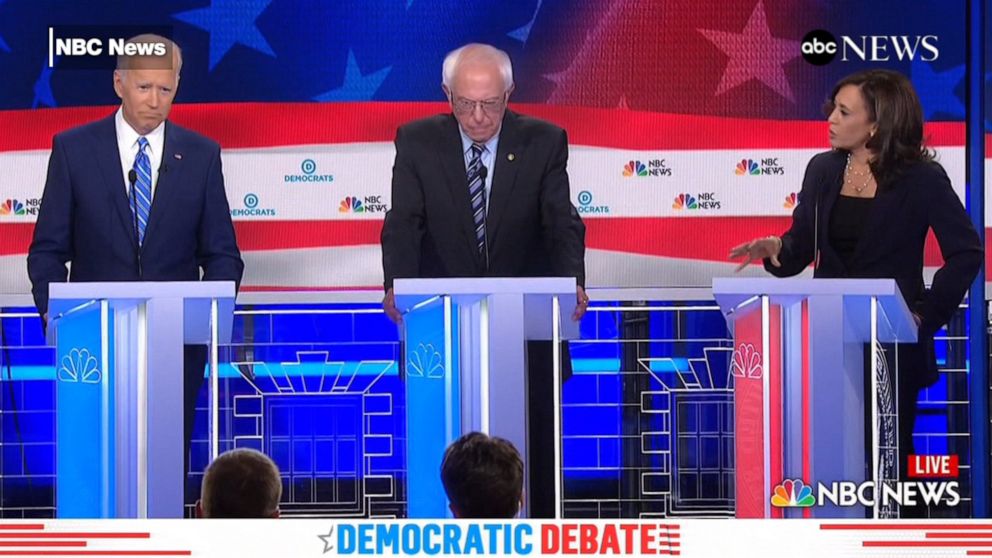
 This week, 20 Democratic presidential candidates participated in nationally televised debates in Miami: ten on Wednesday and ten on Thursday. In all, the candidates were on stage for four hours. Watch/read for yourself: Night 1 video, Night 1 transcript, Night 2 video, Night 2 transcript.
The Democratic Party was the real winner. Ratings were excellent. With occasional exceptions, the candidates were all well-spoken and their remarks had substance [1], though they did talk over each other too much on Thursday. They also all stayed within shouting distance of the truth. The AP fact-checking column on the first night sounds like quibbling: Beto O’Rourke, for example, said the Trump tax cut will cost $2 trillion, when the official estimate is only $1.5 trillion. The checker admitted that the debate featured “a smattering of missteps … but no whoppers”. CNN’s fact-check of the second night covered just about all the claims that sounded suspicious; a great many of them produced the comment “This is true.”
By contrast, any five minutes of a Trump speech will include several whoppers.
Some pundits criticized the candidates for not going after Trump more (especially on the first night), but I liked that. Trump tries to paint Democrats as just Trump-haters, rather than as thoughtful people with a different (i.e. morally defensible) vision of what America is and where it should go. The first round of debates didn’t fit inside that frame. Trump tweeted “BORING!” during the first night, probably because the conversation was about America rather than about him.
What I was looking for. Pollsters like to raise the question: “Which is more important, finding a candidate who agrees with you or one who can beat Trump?” To me, at this point, that seems like a false choice, because we don’t know who can beat Trump yet.
The conventional wisdom says that Trump has abandoned a lot of traditional Republican values, so there should be a large bucket of moderate Republican and Independent voters who Democrats could flip with the right candidate and policies. (David Brooks claims to be one.) The 2018 results seemed to confirm that, as moderate Democratic candidates flipped House seats in a lot of suburban districts. (538 calls these the Romney/Clinton districts.) Presumably they got votes from educated professionals (often women) who used to consider themselves Republicans.
On the other hand, consider this point Pete Buttigieg made to CNN’s Don Lemon on Friday:
If we were sitting here in 2007 saying let’s find somebody so electable, so palatable, so easy for swing voters to get comfortable with that he can carry Indiana for Democrats. I’m not sure people would have said Obama.
But Obama did carry Indiana, which Al Gore, John Kerry, and Hillary Clinton never managed to do. So I think it’s easy to imagine that we know more than we actually do about how 2020 will play out. People will tell you that Democrats are surrendering Ohio or Iowa or somesuch state if they nominate a progressive like Warren or a non-white like Harris or Castro. But who really knows?
There are polls, of course. One recent poll had Biden beating Trump by 13 points, Sanders winning by 9, Harris 8, Warren 7, and Buttigieg 5. But all that could change really fast. (Just a month before the election, Hillary was ahead of Trump by 14 points in one head-to-head poll.) Most Americans have never thought seriously about a Buttigieg/Trump or Harris/Trump match-up, so why should we believe that the opinions they express now mean anything?
That’s why I watched the debates thinking about more than just who I agree with. I was also trying to figure out who is good at this game. Who can handle the back-and-forth of debating? Which candidates can make people listen to them and take them seriously? Who has a vision that, if people do listen to it, they’ll find compelling?
Nothing in Obama’s 2007 resume picked him out as the guy who could carry Indiana or come within a whisker of taking North Carolina. But if you saw him speak to a crowd or debate his rivals, it was obvious that he could play this game.
What the candidates needed to do. Going into the debates, candidates fell into three general categories:
- ones you know well: Biden, Sanders, and (to a lesser extent) Warren
- ones you’ve heard of if you’ve been paying attention: Harris, Buttigieg, Booker, Klobuchar, O’Rourke, and maybe a few others
- ones whose names you might recognize in print (maybe), but you probably couldn’t come up with if you saw their pictures.
Success meant different things in each category.
- Category 3 candidates just needed to get on the map. They’re racing to become relevant before their seed money runs out. If they said something that made you google them, they succeeded.
- Category 2 candidates needed to prove they belong on stage with the well-known candidates. A category-2 candidate can play a somewhat longer game than a category-3 candidate. If you came away thinking “I could see that person as President”, that was a successful performance.
- Category 1 candidates had a chance to complete the sale. If you were already leaning towards one of them, a good performance could cement your support, and possibly upgrade you from a silent supporter to a donor or volunteer. They needed to reinforce your prior ideas about their virtues, avoid a major gaffe, and put your doubts to rest.
Several candidates “won”. When you look at things that way, you realize that it was possible for many people to “win” the debate simultaneously. [2] My impression was that among the category-3 candidates, the big winner was Julián Castro. People were definitely not talking about him before the debate, and afterward they were. I think Tulsi Gabbard made her rep by taking out Tim Ryan on Afghanistan. [3] (I think Ryan is toast.) I thought Eric Swalwell’s pass-the-torch theme fell flat. (As Marco Rubio discovered in 2016, you don’t get credit for your youth if you don’t have any new ideas. And “We need new ideas” is not a new idea.) None the moderate candidates really broke out, but some (Bennet, say) might have positioned themselves to claim the center lane if Biden collapses.
In category 2, Kamala Harris was the big winner, with Cory Booker also having a good night. On Thursday, Kamala went toe-to-toe with front-runner Joe Biden and scored. The night before, Booker looked generally solid and impressive.
I feel like Amy Klobuchar and Pete Buttigieg lived to fight another day. Neither was a star, but both looked like substantial candidates. (Buttigieg had an issue to face — the police shooting in South Bend — and he did it forthrightly.) Beto O’Rourke, on the other hand, amplified people’s doubts rather than quelling them.
I hesitate to comment at all on Kirsten Gillibrand, because watching her evokes a sexist response that I can’t seem to turn off. She may be saying something perfectly presidential, but she always looks and sounds like a lightweight to me. I don’t know if it’s the dumb-blond stereotype or what, but I have to keep reminding myself to listen to her and judge her fairly. (None of the other female candidates strike me this way, and I have no idea whether other men share this reaction to Gillibrand.)
In category 1, Biden had to have lost ground. He avoided any fatal gaffes, and I wouldn’t be surprised if he is still the leader in the next round of polls (which should appear in a few days), but if you had doubts about him before, you have more doubts now. Meanwhile, Bernie was Bernie. If you liked him before, you still like him now, but I doubt he convinced many new people.
Elizabeth Warren hadn’t been seen on this kind of stage before, so she had the most to prove; and I think she did. She still needs to learn some debate-craft (like look at the camera — not the moderator — when the question is being read). But she was poised and well-spoken. Her signature virtues of commitment and authenticity came through well. If you went in thinking “I like Warren’s ideas, but I don’t know … ” she might have made a believer out of you.
Here’s some snap-polling from 538 and Morning Consult. The interviews were done immediately after the debate, so I don’t think they captured the full effect, which doesn’t hit until people start comparing notes with each other.

Black candidates and black voters. A similar dynamic is playing out for both Harris and Booker, who are the black candidates in the race. One of the big questions is where the black electorate — which makes up a substantial portion of the Democratic primary electorate, and is an actual majority of Democrats in most southern states — is going to settle.
Historically, blacks have been “conservative” voters in the sense that they are slow to change their loyalties. If they feel that they have a relationship with a candidate, they tend to stick by him or her rather than go for the fresh face making big promises. (Unsurprisingly, Mayor Pete has essentially zero black support so far.) Everyone remembers how much black support Barack Obama eventually had, but forgets that most of those supporters arrived fairly late — mainly after his Iowa victory proved that white people would vote for him.
At this point in 2007, Hillary Clinton was getting a lot of black support in the polls, just as Joe Biden is now. Bernie Sanders couldn’t pry that support away from her, and blacks in South Carolina and the subsequent southern primaries saved Clinton’s candidacy after Sanders’ early win in New Hampshire.
Prior to this week’s debates, an Economist/YouGov poll (Question 46) had Biden with 39% of the black vote, compared to Harris with 5% and Booker with 4%. Clearly, black voters weren’t just looking to see if there was a black candidate in the race. I suspect they are paying special attention to Harris and Booker, but they’ll have to be convinced to move away from Biden.
I’ll be watching the next set of polls to see if the debate convinced them. In particular, Harris’ jab — that Biden was opposing busing at a time when Harris herself was being bused — looked very effective. (Of course, I’m a white guy judging this from the outside.) Biden’s response — that he only opposed busing imposed by the federal government, not community-generated plans like the one Harris benefited from — was unconvincing to anybody who knows the history. Federal intervention was necessary precisely because so many communities resisted school integration. Many communities integrated “voluntarily” only out of fear that the federal government might take the decision out of their hands.
Who can play this game? Which of these people can I picture doing well in a campaign against Trump? [4] The candidates that impressed me in those terms were Harris [5] and Warren. I think either one would look good next to Trump: Warren is a truth-teller where Trump is a bullshitter. Harris is a bulldog prosecutor who will make her points and won’t be distracted. Both of them have an authentic toughness that will show up Trump’s phony bluster.
In a purely physical sense, I think Cory Booker would look good against Trump. At 6’2″, Booker is shorter than Trump’s claimed height (6’3″) but taller than Trump is in reality. (I see something symbolic in that.) Booker is younger and fitter than Trump, and makes a more imposing physical presence. (Trump would not stalk Booker on the debate stage the way he stalked Clinton, lest Booker turn and face him. It’s a simian thing.) He also radiates a dignity that would contrast well with Trump’s sleaziness.
That said, everyone should remember that it’s still early. Recall the 2012 Republican race: Mitt Romney was the early front-runner, but a series of candidates-of-the-week had their moments and briefly passed him: Rick Perry, Herman Cain, Newt Gingrich, and Rick Santorum. But Romney ultimately was nominated. The same thing could happen with Biden this year.
[1] Author Marianne Williamson stood out as the least “presidential” in the field, making a number of statements that sounded more New-Agey than Democratic. Like this from her closing statement:
So, Mr. President, if you’re listening, I want you to hear me please. You have harnessed fear for political purposes and only love can cast that out. So, I sir, I have a feeling you know what you’re doing. I’m going to harness love for political purposes. I will meet you on that field and, sir, love will win.
But even she had some important things to say about policy. For example, she identified one reason why Americans spend so much on health care: the unhealthy diet pushed on us by Big Agriculture and subsidized by the US government.
What we need to talk about is why so many Americans have unnecessary chronic illnesses so many more compared to other countries and that gets back into not just the big Pharma, not just health insurance companies, it has to do with chemical policies, it has to do with environmental policies, it has to do with food policies, it has to do with drug policies.
If you want that message in more traditional academic terms, check out this report from the Union of Concerned Scientists.
[2] Friday, Rachel Maddow made the case that each of the 20 candidates had some particular moment they could point to with pride and build on going forward. Not sure I would go that far.
[3] During the debate I kept asking myself: “Wait. Why don’t I like Tulsi Gabbard?” Then I did some googling and remembered: She’s Putin’s favorite Democrat, probably because she likes to downplay the significance of Russia’s interference in the 2016 election.
Since Gabbard announced her intention to run on Jan. 11, there have been at least 20 Gabbard stories on three major Moscow-based English-language websites affiliated with or supportive of the Russian government: RT, the Russian-owned TV outlet; Sputnik News, a radio outlet; and Russia Insider, a blog that experts say closely follows the Kremlin line. The CIA has called RT and Sputnik part of “Russia’s state-run propaganda machine.” …
Coverage of other Democratic presidential hopefuls in pro-Kremlin media has been for the most part perfunctory, limited to candidates’ announcements or summaries of their relative prospects.
A Truthdig article defending her against the Putin’s-favorite charge included this paragraph:
Gabbard’s run for president invites any number of legitimate criticisms. Her past jeremiads against “radical Islam” have reportedly earned the praise of Steve Bannon, and she has professed a curious admiration for India’s Hindu right; the LGBT community remains leery of her candidacy despite her support for the Employment Non-Discrimination Act and the repeal of the Defense of Marriage Act; meanwhile, her anti-interventionism can appear “shot through with a pernicious nationalism,” as Branko Marcetic observes in Jacobin.
[4] People are way too quick to jump to the question: “How will he or she do in a debate against Trump?” I wouldn’t be at all surprised if Trump decided not to debate. He’d have some BS reason for chickening out — like his reasons for not talking to Bob Mueller (even though he claimed he wanted to) — and his followers would take whatever-it-was as The Truth.
[5] Prior to the debate, I hadn’t been impressed with Harris, despite all the political insiders who seemed very impressed. In her CNN town hall in April, she seemed tentative. Way too many questions got a non-commital answer like “We need to have that conversation.” At the time, she didn’t look like the right candidate to rally the country against Trump.
This week she did look like that candidate. We’ll see if that transformation holds.

 If socialism means buying things collectively through the government, then your local fire department is socialist, and so are the national parks and the interstate highways. Who doesn’t like them? On the other hand, if socialism means buying everything collectively, so that we eat in big government cafeterias rather than in our own kitchens and dining rooms, that would be a lot less popular. So which is it?

/cdn.vox-cdn.com/uploads/chorus_image/image/58388775/619309888.jpg.0.jpg)

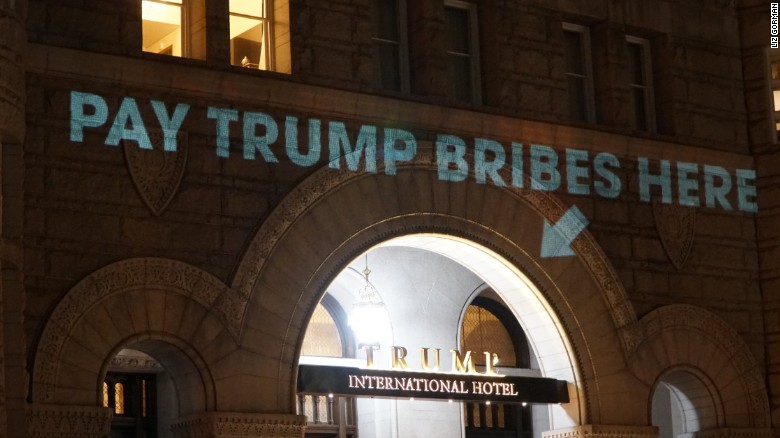
 There’s a good reason for that narrow range: Unlike all previous presidents (at least since World War II; I’m kind of hazy on the presidents before FDR), Trump continues to serve up the rhetoric his base wants to hear, and doesn’t even try to speak to the nation as a whole. Most of the things he says are easily recognized as false or nonsensical as soon as you leave the Fox News bubble. (The Washington Post fact-checker estimates that during 2018 Trump averaged
 Answer — the same way he did in 2016. Eezy-peezy: Rile up your third of the country so that they’re sure to vote (and depress the rest of it so that they’re not), making them maybe 40% of the electorate. Get another 6% to hold their nose and vote for you because they’re scared of your opponent. Encourage (maybe with some social-media help from Russia) 5% or so to vote for third-party candidates who have no chance to take any of your states. (Howard Schultz has
  Don’t help him. The most important thing Democrats can do is to avoid slandering their front-runners. We need to make sure that candidates have answers for any serious questions that are bound to come up eventually, but attacks on a candidate’s fundamental honesty and decency shouldn’t be tossed around lightly.

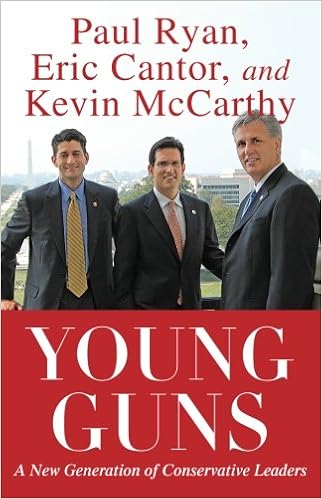 When Paul Ryan came to Congress, he was a “young gun”; his youth was evidence of how extraordinary he must be, to get so far so fast. But AOC’s youth just points to her being a lightweight, because there’s no female equivalent of a “young gun”.

 The Weekly Sift