Gas stoves, freedom, and the politics of distraction

Don’t worry about your Social Security, medical care, or bodily autonomy.
Instead, focus your attention on gas stoves, light bulbs, X-boxes, M&Ms,
and the Democrats’ quest to achieve “Soviet America”.


After narrowly winning a House majority by running against inflation and crime (and paying the price whenever they ran a candidate focused on election denial and other MAGA issues), the GOP has begun laying out its agenda for the 118th Congress: not inflation and crime. Instead, it’s gearing up to force a debt-ceiling crisis in order to extort long-term cuts in Social Security and Medicare out of President Biden and Senate Democrats. In addition, it’s getting revenge on Democrats and on government officials who investigated the crimes of President Trump.

When a party defies public opinion like this, they need to wave around a lot of shiny objects to keep their voters distracted.

Cooking with gas. This month’s shiniest object has been: Democrats are coming for your gas stove!

Gas stoves do cause some problems. They’ve been linked to increased incidence of asthma, especially in children. (This conclusion is debatable, but I believe it because I started noticing some mild bronchial irritation after I moved to an apartment with a gas stove — which I otherwise like. So for the last few months I’ve been wearing a mask when I cook, running the exhaust fan at higher levels, and making smaller dishes in the electric toaster oven. It seems to help.)

And then there’s climate change. Long term, the best plan for minimizing carbon emissions is to electrify everything and then generate as much electricity as possible without burning fossil fuels. Fortunately, new induction cooktops and ranges have a lot of advantages, so switching from gas to electric doesn’t have to be a hardship. (That said, while I might try out a portable induction burner, I’m not buying new stove any time soon. The path of least resistance is to make do with what’s already here.)

In short, there are good long-term reasons for America as a whole to shift away from gas stoves. But are the Kitchen Police coming to rip your (or my) gas stove out of the wall? No. No one has even been proposing that they should.

What really happened. January 9, in an interview with Bloomberg News (behind a paywall), Richard Trumka Jr, who is one of the commissioners on the Consumer Product Safety Commission, noted the hazards associated with gas stoves and suggested strengthening safety regulations on new stoves.

This is not a new or strange idea. In December, a letter 20 Democratic members of Congress wrote to the CPSC suggested several such regulations, such as mandating range hoods with exhaust fans, and tightening standards on methane leakage when the stove is off. Notably, they did not suggest a ban.

In his Bloomberg interview, Trumka considered the possibility that if yet-to-be-done research proves that yet-to-be-written safety regulations are insufficient, new gas stoves could be taken off the market: “Products that can’t be made safe can be banned.” In a responsible article, a statement like would be qualified by noting where the CPSC is in its process. Back in December Trumka said CPSC was about to start looking at gas-stove regulations.

Richard Trumka Jr., a commissioner on the Consumer Product Safety Commission (CPSC), said during a virtual webinar on Wednesday that the commission will put out a formal request by March for information on hazards associated with gas stoves and possible solutions. 

“This public request for information is the first step in what could be a long journey toward regulating gas stoves,” he said. 

But instead of providing that context, Bloomberg chose to ignore the “long journey” to regulation and headlined the January interview as “US Safety Agency to Consider Ban on Gas Stoves Amid Health Fears“. The next day NBC went with “Ban new gas stoves, a federal safety commissioner proposes“, and the game of telephone was on. By that evening, Fox News was summarizing like this:

News that the Biden administration may soon ban gas stoves set off Twitter on Monday.

Manufacturing outrage. Republican politicians were quick to jump into the telephone game. Remember: These aren’t just random internet trolls. These are public officials with staff that could fact-check things if their bosses wanted them to.

“Don’t tread on Florida, and don’t mess with gas stoves!” tweeted Florida Gov. Ron DeSantis (R) last week in response to comments from a member of the federal Consumer Product Safety Commission (CPSC) that a ban might one day be possible given health concerns about the stoves.“God. Guns. Gas stoves,” tweeted Rep. Jim Jordan (R-Ohio), while Sen. Ted Cruz (R-Texas) listed banning gas stoves as being among policies that he described as “Democrat authoritarian impulses.”

Texas Congressman Ronny Jackson (you remember, the guy who was known around the White House as “the candy man” when he was President Trump’s doctor) saw DeSantis’ Gadsden flag reference and raised him a molon labe.

I’ll NEVER give up my gas stove. If the maniacs in the White House come for my stove, they can pry it from my cold dead hands. COME AND TAKE IT!!

And because its viewers presumably weren’t steamed enough yet, Fox informed them that stoves are just the beginning.

“There’s bad news for almost every room in the house,” Ben Lieberman, a senior fellow at the Competitive Enterprise Institute, told Fox News Digital in an interview. … “If advanced appliances make sense for consumers, they would sell themselves without mandates,” Lieberman told Fox News Digital. “I think that’s a good rule of thumb with very, very few exceptions.

That’s because the broader interests of society never conflict with motives on the individual level, at least in the conservative fantasyland.

Then someone found a 2020 photo of Jill Biden sauteing spinach over a gas stove. Hypocrisy! (Because the Bidens should have remodeled their kitchen in anticipation of CPSC starting to look into regulating new gas stoves 2 1/2 years later.)

The Washington Free Beacon then found eight additional Democrats who have “used a kitchen appliance they want to ban you from owning”. (When they get to John Fetterman, they note that “Exposure to carbon monoxide can put otherwise healthy adults at an increased risk of stroke”. So, you know, he had it coming.)

“Rules for me but not for thee,” Ted Cruz tweeted. He probably cribbed that line from Ron DeSantis’ communications aide Christina Pushaw, who had tweeted the same photo a few hours earlier:

Biden will ban gas stoves for normal people. Not for elites. This is Soviet America: Rules for thee, not for me.

So this is how far ahead of the facts Republicans got: Still unformulated safety regulations for new gas stoves became a looming ban on all gas stoves (plus other appliances), which will be implemented unfairly. Because — you know — Democrats are like that.

Setting the record straight is “caving”. Biden administration officials (including Biden himself) then clarified: There isn’t (and never was) a proposal to ban gas stoves. The CSPC chair issued a statement denying a ban was in the works and reiterating the timetable for starting the regulatory process:

Research indicates that emissions from gas stoves can be hazardous, and the CPSC is looking for ways to reduce related indoor air quality hazards. But to be clear, I am not looking to ban gas stoves and the CPSC has no proceeding to do so. … [L]ater this spring, we will be asking the public to provide us with information about gas stove emissions and potential solutions for reducing any associated risks. 

In typical fashion, Fox News could not possibly admit that it had gotten its viewers outraged about nothing, so instead it framed the clarification by saying that the Biden administration had “reversed course” and “caved” to public outrage.

It’s kind of like when dogs bark at passing cars, and then feel good about themselves for chasing the cars away.

Subsequent outrages. You know what else conservatives are upset about? X-boxes. Microsoft is making them “the first carbon-aware consoles“, via software updates that would allow users to schedule future updates at times when the most sustainable electricity is available, or to change settings to use less energy in general. Fox News Radio host Jimmy Failla explained Microsoft’s sinister motive:

We understand what this is. It’s not that it’s actually going to offset emissions, okay—the level of reduction is infinitesimal. But they’re trying to recruit your kids into climate politics at an earlier age; make them climate conscious now.

And Fox & Friends host Ainsley Earhardt agreed. “You’re right. They’re going after the children.”

But it isn’t all outrage at Fox. There is at least some cause for celebration: Tucker Carlson has won his war against the M&M spokescandies. The Mars Wrigley Corporation announced its surrender last Monday.

The freedom narrative. The Hill explains the larger Republican strategy:

“It’s your stove, it’s your lightbulb, and those are consumer issues and economic issues, they’re also culture war issues,” said Republican strategist Doug Heye, referring to another flashpoint in incandescent versus LED bulbs. 

“It’s part of how Republicans feel that Democrats are targeting parts of Americans’ everyday lives,” Heye added. …

This is not the first time that Republicans have sought to attack Democrats on policies related to household items. During his rallies, then-President Trump railed against showers and toilets that did not have enough water pressure, as well as against energy-efficient light bulbs.  Some have gone even further, claiming that the administration is coming after red meat, which the administration described as a “fabrication.” …

[Republican strategist Keith Naughton] said he doesn’t think any individual issue is “Earth-shaking,” but pieced together they can form a larger narrative, namely that Democrats are “never going to stop until there’s somebody in your home monitoring everything you do.”

But Amanda Marcotte points out that the freedom/control narrative may work better if you reverse the parties.

Republicans do face a real conundrum. On one hand, conservatism is fundamentally a puritanical ideology. On the other hand, being a bunch of joy-killers tends to be unpopular. So they’re always looking for chances to flip the script, to pretend that it’s the left that is out to destroy your good time. So we get these fake culture war controversies in which the right pretends to be under assault by a “nanny state.”

Of course, when you look past all the hand-waving about “freedom,” it becomes clear that very little of what they wish to protect is actually fun at all. Indoor smoking, being a Nazi on Twitter, and dying of COVID-19 because you wouldn’t get vaccinated are all technically freedoms, but only in the most pathetic sense. They don’t resemble the actual freedoms most people want, such as the right to read what you want or have sex the way you like, which are under assault from Republicans.

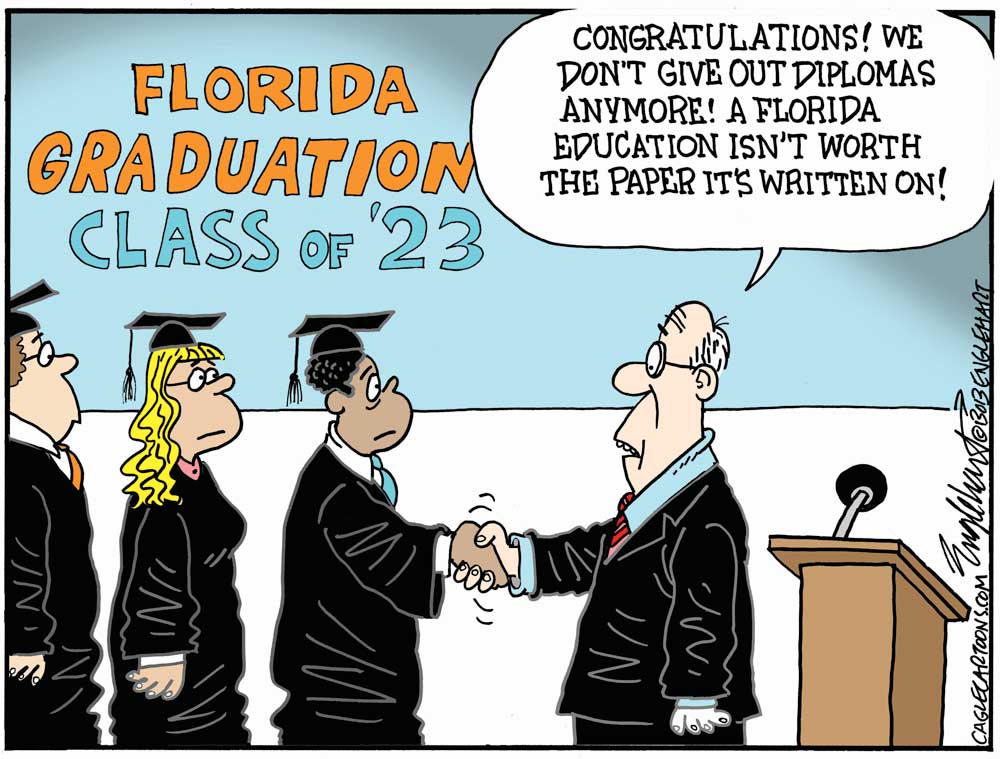
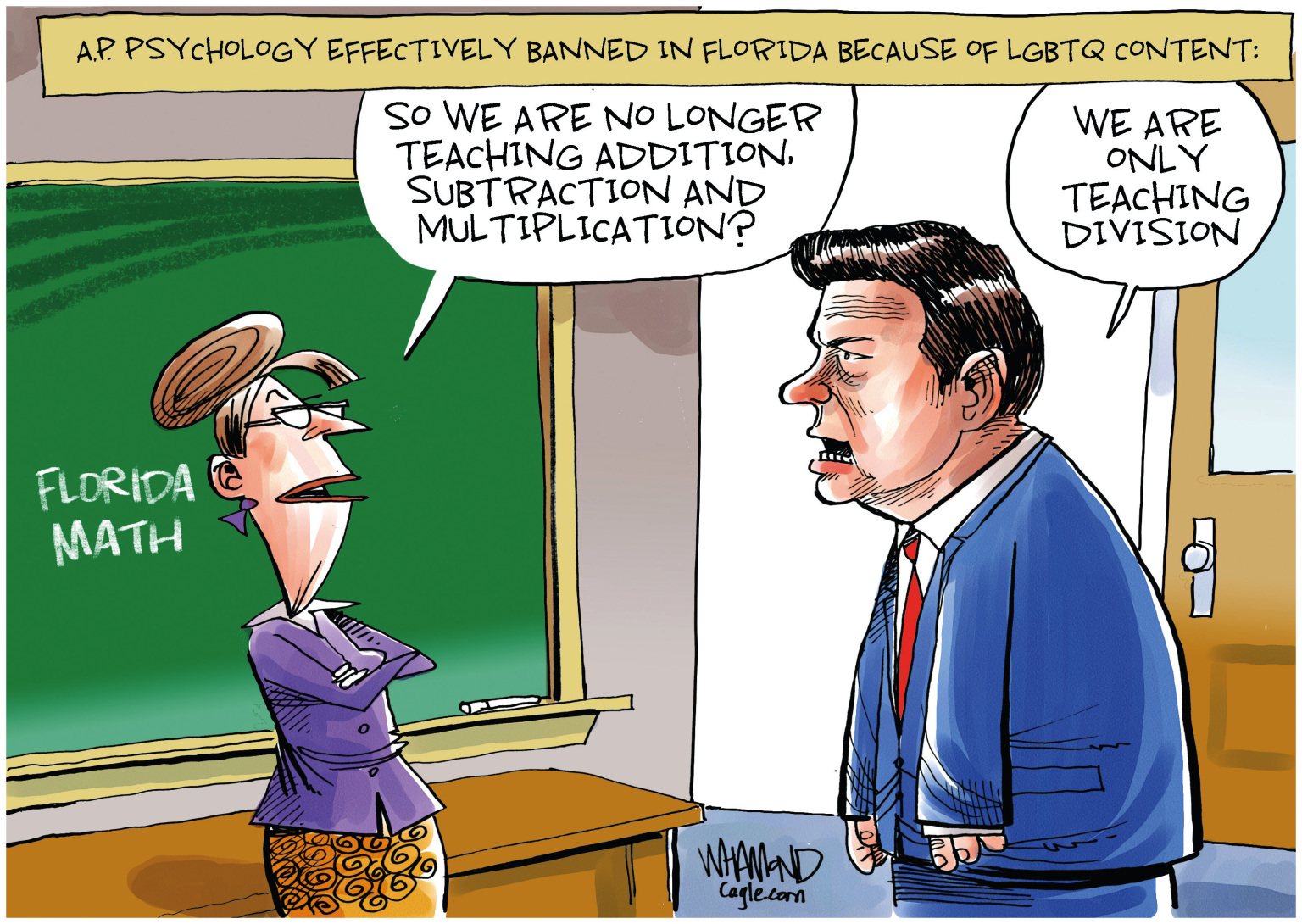
So if you want your child to get advanced-placement credit in African-American studies, too bad for you: The content of the course violates the official ideology of Commissar DeSantis, so the “Free State of Florida” won’t allow it. Ditto for wanting to encourage your kid to read: In order to comply with new state laws, Manatee County has ordered teachers to remove all books from their classrooms until they can be “vetted” for compliance. (Compliance doesn’t sound like a freedom-word to me.) Because, as we all know, unvetted books are dangerous. Better ten children should grow up illiterate than one child read about the existence of gay people, or that Black people have not always been treated well in America. And if you’re a corporation or baseball team that wants to take a position contrary to the DeSantis regime, well, you better watch out.

In another free state, Oklahoma, you are free to run over protesters with your car, but if you want to be free to protest without getting run over, that’s dicier. (The law says nobody can run over you intentionally, but in practice intent is hard to prove.)

No state has yet criminalized crossing state lines to get an abortion, but

The Thomas More Society, a conservative legal organization, is drafting model legislation for state lawmakers that would allow private citizens to sue anyone who helps a resident of a state that has banned abortion from terminating a pregnancy outside of that state. The draft language will borrow from the novel legal strategy behind a Texas abortion ban enacted last year in which private citizens were empowered to enforce the law through civil litigation.

Last summer Republicans filibustered a bill that would protect the right to travel for an abortion. And as for whether you can receive abortion-inducing drugs by mail, that still needs to be worked out in court. It hangs on interpreting the Comstock Act of 1873, which no court has looked at since 1973, when the Roe decision made it irrelevant. But since Dobbs overturned Roe, it’s relevant again.

If you want to own weapons of war and carry them with you to the supermarket, Republicans will protect your freedom (at least if you’re White). But if you would rather walk freely through large crowds without worrying about snipers, you should probably be a Democrat.

In short, which party represents “freedom” to you very much depends on the kinds of things you want to do.

The debunking dilemma. When the point of raising an issue is distraction, it’s hard to know how to respond. If you take time to debunk the nonsense (as I just did and tempted you into spending time on), aren’t you just taking the bait?

It’s a conundrum. President Trump may have been a dim bulb in a lot of ways, but he was brilliant at manipulating public attention. One of his favorite tricks, whenever the news cycle was turning against him, was to pick a fight with some Black celebrity like LeBron James. (Legendary NBA coach Gregg Popovich was actually a much more outspoken Trump critic. But he’s White, so arguing with him wouldn’t serve Trump’s purposes.) The more outrageous and/or racist he got, the better at seizing attention and directing it back to the Trump-against-uppity-Black-people frame that plays well to his base.

Ron DeSantis’s AP African American Studies ban is basically the same trick. It puts him back in the headlines and fills the airwaves with Black people criticizing him. In some sense it barely matters that he deserves the criticism: Arguing with Black (or gay or trans) people is a good look for him as he seeks the Republican nomination in 2024.

So how do you cover that? Call attention to it, which DeSantis wants, or ignore it and let an injustice pass without comment?

My compromise, as you can deduce from this post, is to dip into these dark wells occasionally without letting them dominate my attention. And when I do, I try not to lose sight of what I’m being distracted from.

The Monday Morning Teaser

It’s been three weeks since the last weekly summary, so today I’ll be going a bit wild. I guess that’s a good sign: Time off is supposed to be rejuvenating.

There are two featured posts this week (and two other ideas that I pushed off to next week, not to mention a couple fairly long notes in the summary). One is about the Biden-is-coming-for-your-gas-stove panic on the right, which I’m using as an example of a larger phenomenon: When your legislative agenda flies in the face of public opinion, you need phony issues to keep people distracted.

And if gas stoves don’t grab you, what about Microsoft’s new X-box software “recruiting” your child into climate awareness? Or the sinister implications of the personalities chosen for M&M’s spokescandies (who have now been shelved)? That’s all much more important than protecting Social Security or the credit rating of the United States, not to mention issues like voting rights, abortion rights, or climate change.

The article should post a little after 9 EST.

The second featured post looks at Democrats’ problems in rural and small-town America, spinning off of an article about rural rage by Thomas Edsell, and incorporating some subsequent comments by Paul Krugman. It boils down to: What do you do when people have genuine problems, but the way they frame those problems is based in myths? Debunking those myths seems essential to addressing the real problems, but in the meantime you frame yourself as an enemy.

Let’s predict that for around 11.

Then there’s the summary, which has three weeks of backlogged news. There’s all the craziness of the new House majority, all the disturbing video we’ve been exposed to lately (Tyre Nichols’ murder, the Paul Pelosi attack, …), waiting for the Georgia grand jury report and/or indictments of Trump and his henchmen, Pence joining the classified-documents bru-ha-ha, China’s population decline, Ukraine getting tanks, a Trump-connected Russian oligarch paying off a key FBI agent, gender identity in public schools, the DeSantis regime’s propaganda efforts, and a bunch more stuff.

I apologize for the length — I’m stretching the idea of “summary” this week — and remind you that you are free to skip around.

But don’t forget to vote for your favorite Minnesota snowplow names.

The summary should appear maybe 1ish.

A few observations on Biden’s documents

We don’t know anything all that bad yet.
But there’s still a lot we don’t know. Let’s wait and see.


So far, I’ve seen very few people frame this story properly. The popular choices seem to be: it’s a nothingburger, or it’s just like Trump’s documents scandal. In my mind, the proper framing is that we don’t know how bad this is yet, but it’s being investigated, and before long we will know.

Obviously, there are major differences between Biden’s document problem and Trump’s. The main one is that Biden’s people immediately turned the documents in and seem to have cooperated with the investigation in every way. Probably Biden never would have been caught otherwise. Trump, on the other hand, has done everything he could to deny and obstruct, including having his lawyer sign a false statement of subpoena compliance affirming that all classified material had been turned over, when in fact it hadn’t been.

Here the facts-as-we-know-them so far: Something like 20-30 classified documents have been found in two locations: the office Biden used during the Trump administration at the Penn Biden Center for Diplomacy in D.C., and Biden’s home in Delaware. The Penn documents were found on November 2, and the ones at the Biden home on various days between December 2 and January 20. The original documents were found by Biden’s own people, and the most recent ones were found by an FBI search that Biden agreed to voluntarily. Assuming the FBI search was thorough, they’ve probably recovered all the documents now.

The response of Biden and his people suggests the mishandling of documents is due to innocent carelessness, but there’s still a lot we (and the special prosecutor) don’t know:

  • how the documents got there,
  • whether Biden himself mishandled the documents or people working for him did,
  • what’s in the documents,
  • whether the mishandling resulted in classified information leaking to enemies of the United States,
  • whether any pattern in the documents suggests that Biden kept them intentionally.

Nothing we know so far suggests that these questions have sinister answers, but we don’t know for sure yet. They should be investigated, and they are being investigated.


The general public has a poor understanding of the rules about handling classified documents and how violations are typically handled. (This became an issue during the Hillary Clinton email investigation, which I wrote about at length at the time. Everything I said then has held up pretty well.)

I’ll pass along my experience from working at a defense contractor and having a top-secret clearance back in the 80s and early 90s. First, the government and the contractors do take this stuff very seriously, but given that millions of people are handling millions of classified documents, violations are happening all the time. Most of them are simple and harmless, like somebody leaving a secret document in a desk drawer overnight rather than locking it up in a safe, like you’re supposed to do.

Not every violation is a federal case. I was never cited for a violation myself, but I heard about people who were. Typically, a careless violation would get you an unpleasant meeting with your boss and somebody from the security department, as well as a note in your file that would speak badly the next time you were considered for a promotion or a raise.

A series of careless violations might get you fired — nobody I knew personally ever was — but people would only be charged with a crime if they were intentionally stealing documents. (That’s why the apparent differences in the Trump and Biden situations matter.)


The Trump and Biden incidents may be linked politically, but they are not at all linked legally. Assuming the Biden investigation doesn’t turn up anything more than carelessness (which, I emphasize again, we don’t know yet) it would be completely reasonable if Trump gets charged with multiple crimes and Biden doesn’t.

Let me make an analogy: Suppose an object in my apartment turns out to have been taken in some burglary. I might have gotten this item innocently; maybe I bought it at a second-hand store. Or I might have some level of guilt; maybe I bought from somebody I knew was shady, or maybe I was involved in the burglary myself. Police should investigate and charge or not charge me accordingly.

Meanwhile, police in a different state find something from an unrelated burglary in somebody else’s home. They also will investigate and charge or not charge the other guy. But those charging decisions are not linked in any way.

That’s how it should be here. The two special prosecutors should do their jobs independently, and the decisions they make should depend on the facts they find in their own particular investigations, without reference to the other investigation. That’s what the rule of law demands, and what I will expect until I get some indication otherwise.

People who assume that this will not happen — say, that Trump can’t be charged now that Biden has an incident with a surface similarity — are implicitly buying Trump’s claim that the investigations into his possible crimes are fundamentally political. Personally, I don’t buy that claim, and I think that reporters and pundits who do base their analysis on such an assumption should say so openly.


There is one important sense in which the cases are not similarly politically: Biden is a politician, while Trump is the leader of a personality cult.

That’s why I can be so calm about a special prosecutor investigating Biden: If he did something wrong, he should face appropriate consequences. I’m fine with that. If the special prosecutor does does unexpectedly turn up something sinister, I’m sure Kamala Harris will be a fine president.

For a large number of Republicans, on the other hand, Trump is not just someone they voted for. He’s their lord and savior, and seeing him in jail would be an unimaginable horror.


Finally, the press coverage of Biden’s documents has been abysmal. In his “Breaking the News” blog (which I subscribe to, but I think you’ll be able to follow the link even if you don’t), James Fallows talks about a variety of recent framing issues, including the Biden documents.

But as a matter of journalistic practice, I think our colleagues need to recognize our enormous responsibility and “agency” about what becomes an issue or controversy. “Raises questions,” “suggests a narrative,” “creates obstacles”—these aren’t like tornados or wildfires, things that occur on their own and we just report on. They are judgments reporters and editors make, “frames” they choose to present. And can choose not to.

The whole article is worth a read.

The Monday Morning Teaser

I wasn’t going to do a Sift today, but I was jotting down some notes about the Biden document controversy and realized they had turned into a more-or-less complete set of thoughts. So I’ll be posting that soon rather than saving it for next week.

But there won’t be a weekly summary this week.

Another thing I think I’ll put out there is a link to what I did with my time off: I gave a Zoom talk in the lecture series at Pennswood Village, a Quaker-inspired retirement home in Newtown, PA.

The talk is called “Whatever Happened to the Citizen Journalist? the mixed results of the internet news revolution“. It’s about how the Cronkite Era of news turned into the current era, the role played by amateur journalists like me, and how things didn’t always turn out the way we intended.

If you’re a regular reader of this blog, the talk provides a certain amount of Weekly Sift philosophy and history that doesn’t come up week-to-week, including the fact that in April I’ll mark the 20th anniversary of the first political article I posted online.

Obstacles

NO SIFT FOR THE NEXT TWO WEEKS. The next new articles will appear on January 30.

If we let everybody in the boat, if we row in the same cadence together, there is no obstacle this body can overcome for this nation.

Speaker Kevin McCarthy

This week’s featured post is “The Debt Ceiling: a (p)review“.

This morning I’m wondering what’s happening in Brazil

Yesterday afternoon, supporters of Brazil’s defeated former president Jair Bolsonaro occupied the National Congress, Planalto Palace, and Supreme Court in Brazilia. Congress and the Court are not in session and President Lula was elsewhere, so there is no hostage crisis.

This morning, I’m seeing claims that government forces have restored order and that government offices will open. Hundreds of rioters have been arrested. (As in our January 6 riot, the rioters were taking selfies and posting video, so they should be pretty easy to find and convict.)

Ever since Bolsonaro lost the a runoff election October 30, his supporters have been urging the Army to intervene, which it hasn’t done. Lula took office on January 1. This attack appears to be a more extreme plea to the Army, which is still not responding to it. I’m seeing claims that some police or other officials may have helped the rioters.

Supreme Court Justice Alexandre de Moraes ordered the immediate suspension of the governor of Brasília for 90 days, accusing him and the district’s head of public security of abetting the unprecedented attack on the country’s capital.

Bolsonaro himself is in Florida, where he went instead of attending Lula’s inauguration. Like Trump, he claims that his defeat was not a fair election. It looks like Bolsonaro’s most extreme supporters were victims of the same kind of reality distortion that QAnon brought to January 6. BBC quotes a Brazilian teacher of history and sociology:

They just get information from WhatsApp and Bolsonaro’s social media, so they are really disconnected from reality.

They believed that Bolsonaro would win the election easily, it did not happen, and then when Lula was elected, they believed that it would happen militarily, a coup d’etat, and Bolsonaro would become dictator of Brazil.

This is still breaking news, which I don’t have the resources to cover. Among the major news services, BBC seems to me to have the best coverage. If you want to sort through unvetted reports, search social media for #Brazil.

meanwhile, everybody has been talking about the Speaker election

It took all week and 15 ballots, but Kevin McCarthy is finally Speaker of the House. The 15th ballot wasn’t complete until early Saturday morning, and then the newly elected congresspeople could finally be sworn in.

This afternoon we’ll see whether McCarthy has the votes to pass his rules package, which includes the concessions he made to the MAGA holdouts.

Democrat Katie Porter brought a good book for the occasion.


One benefit of listening to the various speaker-nomination speeches is getting to hear what the parties (or factions with the GOP) think their best talking points are. I was struck by two of McCarthy’s nominators — Steve Scalise and Kat Cammack — mentioning fentanyl overdoses as if this were a partisan issue. I mean, are Democrats for fentanyl overdoses?

Well, no. In a nutshell, Republicans try to turn every issue into the southern border. Crime is a border issue because immigrants are criminals. (They’re not, other than the one possible offense of crossing the border illegally.) Disease is a border issue because immigrants carry disease. (They don’t.) Fentanyl addiction is a border issue in the same way: It’s an excuse to militarize the border and maybe build Trump’s wall. Beyond that, it’s not clear Republicans have any interest in the problem, which is fundamentally a public-health issue, not a border-control issue.

Some Republicans go full-conspiracy-theory on the subject. Here’s J. D. Vance last April:

If you wanted to kill a bunch of MAGA voters in the middle of the heartland, how better than to target them and their kids with this deadly fentanyl? And, man, it does look intentional.


After McCarthy’s election, he gave a speech and then Democratic leader Hakeem Jeffries gave a speech. I think it’s safe to say that Jeffries outdid McCarthy: He used an acrostic technique that goes back the Psalms: One line for each letter of the alphabet.

He starts playing with the alphabet subtly at around the 8 minute mark, envisioning a country that “Provides for the Poor, Works for Working families …”. Around 13 minutes he pledges to the new Republican majority that Democrats will “try to find common ground whenever and wherever possible on behalf of the American people”. But he also pledges that Democrats “will never compromise our principles”.

What principles? That’s where the alphabetic litany starts: “House Democrats will always put American values over Autocracy, Benevolence over Bigotry, the Constitution over the Cult” … all the way to “Zealous representation over Zero-sum confrontation”.

And McCarthy? Well, just before the end he made a Freudian slip:

If we let everybody in the boat, if we row in the same cadence together, there is no obstacle this body can overcome for this nation.

I think your speechwriter wrote “can’t”, Kevin. But in this House, your version is probably more accurate.

Imagine Biden making that gaffe. Fox would spend the next week citing it as evidence of dementia.


McCarthy also repeated a promise he often made during the fall campaign:

Our very first bill will repeal the funding for 87,000 new IRS agents. You see, we believe government should be to help you, not go after you.

I’m afraid this first bill really will set the tone for McCarthy’s House, because it’s based on a lie: There is no funding to hire 87,000 new IRS agents, and the new resources the Inflation Reduction Act does send to the IRS don’t target middle-class Americans.

I’ve criticized the decision to release Trump’s tax returns to the public — he should do that, not Congress — but I do have to admit that nothing better illustrates the IRS’s need for more funding. Wealthy tax cheats like Trump know that if they make a big enough tangle of their finances, the IRS won’t be able to put enough auditors on the case to sort it out.

And that’s why McCarthy wants the funding repealed: If he represents anybody, he represents wealthy people who cheat on their taxes. That’s his base.


Michelle Goldberg commented on Marjorie Taylor Greene’s exasperation at the far-right Republicans who wouldn’t get in line behind McCarthy:

It was the embodiment of the Twitter meme: “‘I never thought leopards would eat MY face,’ sobs woman who voted for the Leopards Eating People’s Faces Party.”


Conservative commentator Noah Rothman argues that the chaotic nature of the speaker-election process and the insurgent demands for a weaker speakership is evidence against the charge that the GOP — and especially its MAGA/Freedom Caucus wing — is the “authoritarian” party.

He’s missing a key point: Fascists love weak governance when they are out of power. Any power center they don’t control should have its powers severely limited … until they do control it. Then, the sky’s the limit.

Case in point: Under Biden or Obama, presidential executive orders are tyranny, and presidential emergency powers are the worst tyranny of all. But in 2019, Andy Biggs urged President Trump to fund his border wall by declaring an emergency, usurping Congress’ power of the purse. (Trump did so.) Unchecked presidential power is wonderful if it’s his president.

Ditto for the Supreme Court. Judicial activism was horrible when the Court’s majority was liberal. But now that the Court is firmly in conservative hands, right-wing leaders no longer make “principled” denunciations of judicial activism.

Same thing here. Biggs was the first Republican to challenge McCarthy’s bid for speakership, and is a key member of the group trying to limit the speaker’s power. But that’s only because his faction represents a small percentage of the Republican caucus and has no chance to elect one of its own as speaker. If the tables ever turn, though, they’ll be looking for a very strong speaker indeed.

The lesson here is that authoritarians are not all the same, and in particular that fascists are not monarchists. Monarchists seek order; they believe that somebody needs to be in charge, and so they tend to fall in line behind the new king, whoever it turns out to be. But fascists seek power; they believe they should be in charge. So they’re for chaos when they’re out of power and order after they gain power. Any power center they can’t control should be weak. But power centers they do control should be strong.

and the debt ceiling

The featured post discusses the debt-ceiling standoff that is coming in the summer, and what the speaker election portends for it.

and the second anniversary of the insurrection

Friday, President Biden marked the second anniversary of the 1-6 insurrection by giving medals to 14 people who stood in the way of Trump’s attempt to stay in power after losing the 2020 election.

The group included law enforcement officers, current and former politicians and election workers who were targeted with threats following the 2020 presidential contest. Three of the medals were awarded posthumously to officers who had defended the Capitol on Jan. 6, 2021, and died afterward by injuries or by suicide.


I heard one commentator (I believe after a conversation with Nancy Pelosi) point out that if this were a presidential inauguration year, a January 6 riot wouldn’t be necessary. Because the House still had no speaker on January 6, it would have been incapable of counting electoral votes. What would happen next is anybody’s guess.


Elon Musk celebrated January 6 by restoring the Twitter account of one of the top conspirators, retired General Michael Flynn.


The Fulton County special grand jury investigating Trump’s attempt to interfere with the 2020 presidential election in Georgia has completed its work. Apparently, that means it has written a report that either does or doesn’t recommend indictments. The grand jury had no authority to indict on its own.

At the moment I don’t know whether any indictments have been recommended. This is breaking news this morning, so consult other sources.

and the pandemic

Covid appears to having another surge. Case numbers are mostly flat and hard to interpret, but everything else is increasing. Deaths are now over 500 per day again, after dipping into the 200s in early December. Hospitalizations and ICU cases are also up.

A scary article from BBC: An official in China’s Henan province says that 90% of the population — about 88.5 million people — have had Covid.

Mr Kan did not specify a timeline for when all the infections happened – but as China’s previous zero-Covid policy kept cases to a minimum, it’s likely the vast majority of Henan’s infections occurred in the past few weeks.

In late December, nearly half of the passengers on two flights from China to Milan tested positive.

and the economy

It’s hard to know how to interpret economic statistics during a time when the Fed is trying to fight inflation. Usually, it’s great news that the economy is creating jobs and wages are rising — which is what Friday’s jobs report showed: The economy added 223K jobs in December and unemployment matched its pre-pandemic low of 3.5%.

But the Fed’s inflation-fighting policy is to slow the economy with higher interest rates, so more jobs just means they’ll increase rates further until the slowdown takes effect.

and you also might be interested in …

Jim Jordan will chair the new House select committee to investigate “the weaponization of the federal government”, i.e. the investigation of Trump and his co-conspirators, like Jim Jordan.

This follows in the footsteps of the failed Durham investigation, and will probably proceed in much the same way: with great fanfare about the devastating evidence it is about to uncover, which will be greatly underwhelming when it appears.

Other than giving Fox News something to talk about, the main point of the Jordan committee will be to harass anyone who has had the effrontery to investigate Republicans, and to intimidate anyone who might do so in the future. A second goal will be to screw up any Trump prosecution.

It will be interesting to see if members of the January 6 Committee (now dissolved) will cooperate with Jordan. After all, Jordan defied a subpoena from them; why should they testify for him?

It’s also worth pointing out that Democrats don’t do this. Nobody was ever punished for all those bogus Benghazi investigations.


President Zelenskyy’s New Year message was as good a piece of wartime messaging as I can think of. I’m inspired, and I’m not even Ukrainian.


Police killings in the US were up in 2022. At least 1176 Americans were killed by police, up from 1145 in 2021. The 2022 total is a new record, according to Mapping Police Violence, which began keeping track of police killings in 2013.

On TV, police kill violent criminals in self defense or to keep them from killing someone else. But that’s not the typical case.

In 2022, 132 killings (11%) were cases in which no offense was alleged; 104 cases (9%) were mental health or welfare checks; 98 (8%) involved traffic violations; and 207 (18%) involved other allegations of nonviolent offenses. There were also 93 cases (8%) involving claims of a domestic disturbance and 128 (11%) where the person was allegedly seen with a weapon. Only 370 (31%) involved a potentially more serious situation, with an alleged violent crime.

I looked for something to compare these numbers to. In the 2019-2020 fiscal year, Australia set a record with 16 police shooting deaths. The US has about 13 times Australia’s population, so the Australian number looks comparable to 208 American deaths, or less than 1/5 of our total. Canadian police killed 36 people in 2020, which would be comparable to 312 Americans, or less than 1/3 our total.

Iceland — a bit larger than 1/1000th the size of the US — has had only one police killing in its history, which happened in 2013. At the US rate it would have about one a year.

I typically hear two explanations for the US’s high rate of police killings: American police are trained to have a “warrior mindset” (most other countries’ police aren’t), and American police are responding to a more dangerous environment, i.e. anyone they encounter might have a gun. In other words: An increased risk of being killed by police is one of the prices we pay for America’s high level of gun ownership.

For police, the huge number of guns in America also means that every single call is treated as if someone involved could be armed — and that an otherwise nonviolent wellness check, mental health call, or traffic stop could turn into a deadly encounter. US law generally allows police to use force because they merely perceive a threat, and the many firearms in civilian hands give police officers a reason to believe they’re in danger.


In other gun news, the federal ban on bump stocks was struck down by a federal appeals court.

Bump stocks are devices that allow a semi-automatic weapon to function like an automatic one, shooting a series of bullets on one trigger-pull. They were banned by the Trump administration after one was used in a mass shooting in Las Vegas that killed 58 people.


I’m still not interested in the British royal family.


Jackson, Mississippi is having another water crisis. The Guardian attributes the problems to “an aging and underfunded system that routinely fails to withstand extreme cold”. All 33 of Jackson’s public schools stayed closed Thursday and Friday (when they were supposed to return from Christmas break) due to low water pressure.

and let’s close with something sweet

Here’s a teacher’s story from 2018:

One of my first graders lost his mom 2 years ago as did I. On Wednesday he gave me a handwritten card saying both of our moms are angels together. Through tears, I tell him I’m having trouble reading it. He says to me, “Just sound it out.” 💕

The Debt Ceiling: a (p)review

The chaos surrounding the Speaker vote may be a preview of a far more consequential vote this summer.


As the House of Representatives endured round after round of voting for a new speaker, most of America probably didn’t take the turmoil all that seriously. It was just Congress being dysfunctional again, and we knew already that the next speaker would be a Republican. Obviously, Kevin McCarthy cared which Republican it would be. But why should we care?

The answer to that question is simple: The battle for the speakership probably doesn’t matter much in itself, but it’s a preview of future votes that will matter. Electing a speaker was the first of a handful of must-do items every Congress faces. The others — appropriating money to keep the government functioning and giving the Treasury permission to borrow money to pay the country’s bills — have very real consequences.

If the speakership was this difficult to decide, what’s going to happen when the other must-do items come up?

In each of those cases, the House is one of the three powers that need to agree; the Senate and the President are the others. So over the next two years, Kevin McCarthy, Chuck Schumer, and Joe Biden will occasionally have to go into a room and come out with an agreement they all support. That agreement will then need to get majorities in both the House and Senate.

Otherwise bad things will happen.

McCarthy’s precarious hold on the speakership makes him a difficult negotiating partner: If he recognizes that he represents only 1/3 of the power in the room and makes realistic compromises, he might well be deposed when he takes that agreement back to the Republican caucus that elected him. And whatever he agrees to, he may not be able to deliver the votes to pass it.

The upshot is that the other must-do items on Congress’ agenda may not get done, or may face lengthy delays. The two possible consequences of that inaction are a government shutdown and a debt-ceiling crisis.

Government shutdowns are a nuisance. Hitting the debt ceiling would be a disaster. There have been a number of government shutdowns over the years, including a 35-day shutdown just four years ago (when President Trump backed out of an agreement that didn’t include funding for his border wall). So most Americans have at least a vague understanding of what happens: The mail still gets delivered and Social Security checks go out, but hundreds of thousands of other government workers go home, creating work-backlogs that ultimately cost billions to resolve.

It’s a nuisance and a waste, but the country survives it.

But Americans have a much shakier understanding of a debt-ceiling violation, which has never happened. Twice — in 2011 and 2013 — a Republican Congress played chicken with President Obama over the debt ceiling, but disaster was avoided both times. (The debt ceiling was increased three times under President Trump, including once in 2019 after Democrats took control of the House.)

The main thing you need to understand about hitting the debt ceiling is that it would be a much bigger deal than a government shutdown, and would create havoc in both the US and the world economy.

What the debt ceiling is. The debt ceiling (or debt limit) is a legal cap on the amount of money the United States can borrow. It was established in 1917, and is a relic from an era when Congress didn’t have a budgeting process anything like the current one.

The current process is that Congress passes a budget with spending and revenue targets, and then passes individual appropriation bills within that framework. You might think that passing a budget with a deficit would automatically authorize borrowing to fill the gap, but it doesn’t. Having passed those bills, Congress can then refuse to raise the debt limit, creating a contradiction in the laws.

Other countries don’t do this. Only the US and Denmark have a debt ceiling, and Denmark’s political parties never play chicken with it.

Fundamentally, the US debt limit is just a dumb idea. Remember the various Star Trek episodes where the Enterprise’s self-destruct option played a role? The captain (and maybe some other officers) would have to go through a detailed authorization process to start the clock counting down. Our debt ceiling is like a self-destruct process that works the other way: Self-destruct will engage automatically unless the officers regularly go through some complicated process to stop it.

Arguably, Democrats should have abolished the debt limit while they had control of Congress, or at least raised it far enough to keep the issue at bay for another two years. The recent omnibus spending bill would have been the place to do it, but it was hard enough getting Mitch McConnell’s cooperation as it was.

The politics of the debt ceiling. For almost a century, debt ceiling debates were political theater without any real drama. It was an opportunity for the party out of power to bemoan the country’s fiscal health, and members of each house would cast symbolic votes against raising the ceiling. (Senator Barack Obama made such a speech and cast such a vote in 2006.) But everybody knew the bill had to pass, and it always did.

Occasionally other measures would get tacked onto a bill to raise the debt ceiling. In the 1980s and 1990s, a series of reforms to Congress’ budgeting process were added, like the Budget Reform Act of 1990. These were process bills (with bipartisan support) that made it more difficult to pass unbalanced budgets in the future. They did not directly raise taxes or cut spending.

That changed after the Tea Party wave election of 2010. In both 2011 and 2013, Republicans used the threat of breaching the debt ceiling to try to extort severe spending cuts out of President Obama.

Where is the debt ceiling now? The current ceiling (set in December, 2021) is a little less than $31.4 trillion, and the current debt is getting close to that number. There are certain accounting games (which I don’t understand) that the Treasury can play around the margins, but the best guesses are that if nothing is done, the limit will be reached sometime this summer.

What that means is that the Treasury will only be able to sell new bonds as old bonds come due. It will not be legal to sell bonds to pay for the government’s new financial obligations, like interest payments or salaries or Social Security benefits.

Recent annual deficits have been running at around $1 trillion (after peaking at $3.1 trillion in fiscal 2020, the last full year of the Trump administration). So assuming the economy perked along nicely in every other way, a post-debt-ceiling government would have to find $80-100 billion in cuts every month — and probably a lot more than that, because the economy would NOT perk along nicely, resulting in decreased revenues and increased obligations.

Think about the position that would put the Biden administration in: US law limits the revenue it can collect and obligates it to make certain payments (like Social Security benefits, salaries for our soldiers, and interest payments to bond holders). But if those numbers don’t balance and it is forbidden to borrow, there is no legal path for the administration to take. The laws contradict each other, so whatever he does, President Biden will be violating his constitutional duty to “take care that the Laws be faithfully executed”.

The US Treasury will be like a family that has to decide which bills to pay after they cash a paycheck. (“Is the WalMart payroll tax payment in yet? Oh, good, we can reimburse a few of those hospitals that have been taking care of Medicare patients.”)

The main effect on the world economy would result from no one knowing what US Treasury bonds are really worth. (Will the interest be paid? What happens when the principal comes due?) Banks around the world keep their reserves in US bonds, so many of them could become insolvent, starting a banking crisis. No one can predict how far that effect would snowball, as a bankruptcy here makes somebody else insolvent, leading to a new bankruptcy there.

Would Biden have any legal options? Maybe. Many possibilities were discussed in 2011 and 2013, but they’re all of the play-stupid-games, win-stupid-prizes variety. (Paul Krugman expressed this sentiment in more sophisticated Princeton-professor terms: “Outrageous behavior demands extraordinary responses.”)

One proposal that sounds like a joke, but was seriously discussed in 2013 was the trillion-dollar-coin. Apparently, a loophole in the law allows the Treasury to create platinum coins of any value.

The Secretary may mint and issue platinum bullion coins and proof platinum coins in accordance with such specifications, designs, varieties, quantities, denominations, and inscriptions as the Secretary, in the Secretary’s discretion, may prescribe from time to time.

The intent was to allow the Treasury to make occasional commemorative coins for collectors. But desperate times …

So in this scenario, the Treasury mints a single trillion-dollar coin, which it then takes to a Federal Reserve bank and deposits in the government’s account. Presto! There is now money to meet the government’s obligations.

The general opinion of both the Obama and Biden administrations was/is that such a scheme is beneath the dignity of the United States. But you never know.

But if that’s what it takes …” There’s a school of thought that says hitting the debt ceiling is the lesser evil: Our steadily increasing debt is unsustainable, and if a crash into the debt ceiling forces the government to only spend what it takes in, that’s all to the good.

That debt’s unsustainability is debatable. (Japan’s national debt is two-and-a-quarter years’ GDP, and they show no signs of collapse. The US debt is one-and-a-quarter years’ GDP.) The important thing to note here is that Congress could balance the budget whenever it wants, by raising taxes and/or cutting spending. That happened at the end of the Clinton administration, so it’s not impossible.

The reason a balanced budget doesn’t happen is that the voters don’t really want it to. Balanced budget is a phrase that polls well, but when you get down to the details, people don’t want to pay higher taxes or give up their health insurance to make it happen. And while it’s not hard to find the occasional $600 hammer or bridge-to-nowhere in the federal budget, you’re not going to find a trillion dollars of that stuff, year after year.

Also, it’s hard to take Republican deficit hawks seriously when they ignored the deficit completely during the Trump years, and instead passed a budget-busting tax cut for corporations and the rich. (One thing I can guarantee you: If there’s a debt-ceiling or government-shutdown crisis sometime in the next two years, Republicans will say that tax increases are off the table.)

But suppose you are the rare good-faith Republican deficit hawk who is not just trying to create an artificial crisis for a Democratic president. What should you do? Convince the voters. You should try to build a popular majority around the idea of a balanced budget — a real balanced budget, with numbers backed by actual taxing and spending policies, and not just the words “balanced budget”. Then your popular majority could elect a House, Senate, and president to implement your balanced budget (which Republicans definitely did not do the last time they controlled all the levers of power).

What you shouldn’t do is stand over the self-destruct button and threaten to press it unless you get your way. That’s not democracy. That’s hostage-taking. It’s terrorism.

Hostage-taking? Terrorism? Really? Hostage-taking and terrorism are pejorative terms that are nothing more than insults if they’re not defined. So here’s what I mean by them: hostage-taking is a negotiating tactic based on threats rather than positive offers; in particular, the hostage-taker threatens to do something that does not benefit him or her, and usually claims that s/he does not want to do it.

So when a kidnapper asks for ransom to give your daughter back, at some level that looks like a trade: money for your daughter. But it’s not a positive offer, because the kidnapper is only offering to restore what he took away. The proposed final deal is that the kidnapper gets money, and (at best) you get back to square one, minus the money.

The alternative to the ransom is that the kidnapper will kill your daughter, which he claims he doesn’t want to do. (“I’m not a monster. I don’t enjoy killing little girls.”) So neither of you wants the kill-the-girl option, but the kidnapper is counting on the fact that you are so desperate to avoid it that you’ll do anything else instead.

Terrorism is a political tactic: the attempt to gain a political advantage through threats of destruction.

In the case of the debt ceiling, it’s instructive to read Republican speeches from previous debt-ceiling crises. In 2013, for example, John Boehner acknowledged that the US was on the path to defaulting on its debt if the ceiling wasn’t raised, and acknowledged on another occasion that “Yes, allowing America to default would be irresponsible.” But Republicans didn’t frame this looming disaster as a common peril that they and President Obama should work together to avoid. Instead, Obama should pay for their cooperation by making concessions without getting anything in return. According to Ted Cruz:

Republicans were looking for three things before raising the debt ceiling: a significant structural plan to reduce government spending, no new taxes, and measures to “mitigate the harm from Obamacare.”

So Obama should scrap his signature program while agreeing to spending cuts Republicans wanted, with no indication of any priority Republicans might compromise on. The upshot was just: “Do what we want, or the country gets it.”

Next summer’s crisis. A new hostage-taking crisis was in the background of this week’s speaker election. Nearly all the 20 Republican holdouts who blocked Kevin McCarthy’s election for 14 ballots were also supporters of the January 6 insurrection, and are now gearing up for debt-ceiling battle. They were terrorists two years ago, and they’re terrorists now.

McCarthy critic Rep. Ralph Norman (R-S.C.) said he wanted McCarthy to devise a debt-limit deal suitable to fiscal conservatives. “Is he willing to shut the government down rather than raise the debt ceiling? That’s a non-negotiable item.”

We can only hope that Norman and other Republican congressmen understand the difference between a government shutdown and a debt default, or that they will pay attention when someone explains it to them.

CNN reported being told by anti-McCarthy holdout Scott Perry that he had gotten a promise from McCarthy that he would oppose a clean debt-ceiling increase, i.e., one with no ransom demands. The procedural concessions McCarthy has made mean that he can be recalled as speaker if he doesn’t negotiate a high enough ransom. Jonathan Chait doubts that any amount of ransom will be enough.

Imagine a Republican Speaker — any Republican Speaker — figuring out a ransom that almost the entire caucus could agree on. The intraparty dynamics virtually guarantee that anything a Republican leader could agree to would immediately be seen on the far right as too little. All is to say that even if you think Biden ought to negotiate a debt-ceiling-ransom demand, it’s now a practical impossibility.

What the government spends money on. Like balanced budget, the phrase spending cuts tends to poll well in the abstract. There’s a widespread feeling — especially on the right, but also in the electorate at large — that the government spends too much money.

The problem is that most people who feel that way don’t have a clear notion of what the government spends money on. They imagine a budget full of foreign aid, welfare payments to people who don’t want to work, and boondoggle projects that don’t serve any purpose.

If you look at where the money actually goes, though, it’s clear that you can’t make a sizeable dent in federal spending without cutting health care, pensions, or defense. As the population ages, an ever-increasing amount of money will get spent on Social Security and Medicare.

When you understand the reality of federal spending, you see that any serious balance-the-budget deal that doesn’t include major tax increases will have to make significant cuts in Social Security and Medicare. And the Republicans have never run on that platform. “Cut Social Security and Medicare so that the rich can keep the Trump tax cuts” is an absolutely suicidal political platform. That’s why the only way to implement it is through terrorism. They’ll never get there through the democratic process.

The best-case scenario. The main power of the Speaker is to control what comes up for a vote in the House. But there is a way around it: a discharge petition. If a majority of the House members sign a petition to bring a bill to the floor, the Speaker has to allow a vote on it.

Republican Rep. Brian Fitzpatrick suggested that a discharge petition might be how the debt ceiling gets raised. It would only take five Republicans and all the Democrats to make that happen.

The problem, though, is similar to the problem of impeaching Trump a few years ago: The Republicans who signed such a petition would be marked for primary challenges and probably voted out.

Are there still five Republicans in Congress with that kind of courage? We may find out.

The Monday Morning Teaser

So Brazil is having its own January 6. I don’t do breaking news on this blog, so you might want to check BBC or some other news source to see what’s happening.

The news this week was dominated by the House failing to elect a speaker for 14 ballots before Kevin McCarthy finally got through on the 15th. That was all very dramatic and historic, but not of any direct significance to the typical American.

The importance of that battle is more what it portends about future must-pass legislation. The House allowed itself to be frozen in place for four days. Fortunately, no crisis arose that required it to take action. (What if this had happened in 2021, when the House needed to join the Senate in counting electoral votes?)

The same people who blocked McCarthy for 14 ballots also want to block any increase in the debt ceiling, which needs to happen by this summer. It’s not clear yet what deals McCarthy made with them, but the signs all point to another debt-ceiling crisis like we had in 2011 and 2013. In case you’ve forgotten what that all entails, I’ll be posting “The Debt Ceiling: a (p)review”. It should be out before 10 EST.

I haven’t decided yet whether the various aspects of the speaker battle belong in a second featured post or will be incorporated in the weekly summary. If there is a separate post, it should be out 11ish. The summary will also include the January 6 anniversary, Biden’s trip to the border, the December jobs report, a pandemic update, a new water crisis in Jackson, a new record for police killings, and a few other things. It should be out between noon and 1.

Conclusions

One of the main conclusions of 2022 is that unpunished evil returns with even greater evil.

Kira Rudik, member of the Ukrainian Parliament

This week’s featured post is “Partying Like It’s 1942“.

This week everybody was talking about 2022

In the featured post, I raise a possibility (not a certainty) that I find intriguing: Hinge years, when bad trends turn around, look a lot like 2022. They’re scary to live through, because horrible possibilities are constantly looming. But again and again, the worst doesn’t happen.

In 2022 we dodged a lot of bullets: Ukraine didn’t fall, NATO didn’t collapse, and MAGA candidates didn’t sweep the midterms. Early in the year, a lot of people imagined it might end with Trump triumphant: in firm control of the GOP, 1-6 in the rearview mirror, the 2024 nomination his for the taking, and election-denying secretaries of state ready to hand him a victory whether the voters want him or not.

Before good things can start happening, bad things need to stop happening. A lot of bad things didn’t happen in 2022.


TPM awarded its annual Golden Dukes, which celebrate the cartoonishly corrupt and incompetent in American politics. This year’s winners:

Best Scandal, General Interest: Donald Trump, for the Mar-a-Lago documents

Best Scandal, Local Venue: the Patriot Front, for delivering themselves to the cops in a UHaul

Meritorious Achievement in the Crazy: Herschel Walker, for his vampire vs. werewolf speech

Most Cringe Campaign Ad/Meme: Dr. Oz, for his crudités

Most Convoluted Conspiracy Theory: Marjorie Taylor Greene, for Jewish space lasers*

Soon-to-be-forgotten Hero: Madison Cawthorne.

*I know: Jewish space lasers started in 2018, but she did have some tiff about it this year as well. And Lauren Boebert brought it up again. But really Italygate should have won in this category.

and Title 42

Title 42 is a 1944 law that lets the government to keep people from entering the US during a public health emergency. The Trump administration invoked it in March, 2020 to expel migrants at the southern border. The Biden administration has been trying to end the policy since May, but has been blocked by the courts. This week, the Supreme Court issued a stay, keeping Title 42 in effect until it can rule on a case it won’t even hear until February, and probably won’t rule on until June.

What’s embarrassing and infuriating about this whole story is the bad faith. Trump invoked this Covid emergency at a time when he was denying the seriousness of the pandemic in every other way. The point wasn’t to protect the country from Covid, which was already here and wasn’t any more prevalent among immigrants than among any other group. The pandemic was just a pretext for keeping immigrants out of the country.

Similarly today, the states that are trying to enter this case are the ones that have had the fewest Covid restrictions. They’re not trying to protect public health; they just don’t want immigrants.

And the Court’s majority is acting in bad faith as well, as Ian Millhiser explains on Vox. When the conservative majority likes the current administration’s policy (as it usually did when Trump was president), it acts swiftly to remove obstacles in the lower courts. When it doesn’t (as in the current case), it drags its feet and leaves obstacles in place.

In 2021, Trump-appointed Justice Amy Coney Barrett delivered a speech at the University of Louisville’s McConnell Center (named for Senate Republican leader Mitch McConnell), in which she announced that her goal was “to convince you that this court is not comprised of a bunch of partisan hacks.” But if that is truly her goal, she and her colleagues might want to consider applying the same scheduling rules to cases brought by Republicans that her Court applies to cases brought by Democrats.

and 1-6 Committee Transcripts

This week was characterized by document dumps bigger than any one person could possibly process. Let us agree to forgive each other for not reading all the 1-6 Committee’s interview transcripts or six years of Trump’s tax returns.

The main thing that has come through for me is that the Committee was very selective about what it included in its public hearings. If it had just wanted to tell outrageous stories, it had plenty that it didn’t use: Mark Meadows burning documents, for example.

and Trump’s taxes

I continue to be of two minds about this. Obviously, Trump should have released his taxes voluntarily long ago, as all other presidential candidates have since Nixon, and as he often promised to do. It is now clear that his excuses for not releasing them were lies.

I’m still not comfortable with a House committee releasing these documents on a party-line vote. As DoJ (I hope) gets ready to indict Trump, I want to be able to argue that everything done against him has been done in the public interest, and not for political advantage. In spite of the protests of MAGA Republicans, I believe the January 6 Committee’s actions can be defended on those grounds. Ditto for the FBI’s search of Mar-a-Lago.

Here, though, I’m not sure. The political point-scoring is obvious: He claims to be rich and a genius businessman, but he reported huge losses to the IRS that in many years resulted in him paying less tax than you did. Taxpayers who can’t afford complicated tax-avoidance schemes should be angry. Also: His income has come mainly from selling off properties inherited from his father; his own ventures have usually resulted in losses. He looks more like a clueless rich kid than like a brilliant businessman.

There is a public-interest angle, but it’s more subtle. Clearly the IRS has dropped the ball on auditing him, even though they are supposed to audit the president’s taxes every year. Exactly one auditor was assigned to his complicated return, and none of the audits have been completed. Somebody needs to figure out the IRS just lacks resources, or if it was succumbing to political interference.

A lot of things in his returns look suspicious, but they need to be investigated by someone who can demand to see receipts. We in the general public can just shake our heads and wonder.

and you also might be interested in …

Tomorrow we’ll find out whether Kevin McCarthy has the votes to become speaker. If he doesn’t, we’re in the land of political novels, because there hasn’t been a multi-ballot speaker election since 1923. Maybe that’s something we need to do every hundred years.

George Mason Professor Steven Pearlstein suggests that a bipartisan coalition pick a compromise speaker from outside the House. It’s part of a wonderful fantasy in which centrists depolarize Congress and try to do things the voters want done. I don’t believe in it for a second, but I enjoy picturing it.


Deaths this week: Pelé, Pope Benedict, and Barbara Walters. They were too late to make the annual Sgt. Pepper tribute to people lost during the year by Chris Barker.


The best account I’ve seen of Southwest Airlines’ recent problems is in the Seat 31B blog. Basically, Southwest tries to keep fares low and profits high by using its assets “efficiently”, which means that there’s no slack if anything goes wrong. It also has an antiquated IT system.

The only real way they have to [handle this situation] (because of the way they operate and their limited IT capabilities) is to stop for an entire day and set to work inventorying their assets and crews and then build out entirely new trips for everyone.


When I watch Republicans in Congress defend Trump, I often wonder whether they really believe what they’re saying. Elise Stefanik clearly doesn’t. The NYT has a fascinating piece about her “conversion” from a young moderate to self-described “ultra MAGA” member of the House GOP leadership. She made a career move, not an ideological reassessment; it’s actually not clear whether she has any political philosophy at all. I can’t remember who I heard describe her as a “House of Cards” character, but it fits.


I’ve been enjoying the images that my Facebook friends create using the new AI art tools. But I’ve also been wondering about the dark possibilities.

Cartoonist Sarah Anderson describes how disturbing it is to see strangers easily hijack your style and use it for purposes you would never approve. Her cartoons are on the internet, so they were included in AI training sets (for which she received no compensation). Now you can start making an imitation Sarah Anderson cartoon — expressing your views, not hers — by using her name as a prompt.


Speaking of online cartoons, have you read SMBC by Zach Weinersmith?


Paul Krugman has been analyzing Tesla, whose stock fell 65% in 2022 and is still selling at a lofty 35 times earnings. In his first column, he sticks with financial prospects, arguing that Tesla stock never deserved its high growth premium, because it lacks the “network externalities” of successful past tech growth stocks like Microsoft or Apple.

Decoding that: As Microsoft and Apple products became more popular, users got locked in. So if you have a bunch of iPhone apps, your next phone is probably also going to be an iPhone, even if you’re replacing your phone during a period when competing phones are better or cheaper or cooler. Ditto for your company’s Microsoft software.

That’s why, once they hit it big, Microsoft and Apple became profit-generating machines that justified the high prices their stocks had traded at in earlier years: Their products stay on top even through periods where they don’t deserve to, and the difficulty of switching induces users to pay near-monopoly prices.

But Tesla has nothing like that going for it. Maybe Tesla cars are better/cooler right now, so maybe you’ll buy one if you can afford it. But that kind of advantage is fleeting, and once it’s gone, nothing will stop you from buying something else the next time you need a car. So Tesla stock should be valued more according to its current or near-future earnings than by projected far-future earnings that may or may not manifest.

In his second Tesla column, Krugman looks at the likely effects of Elon Musk’s recent behavior. Using a variety of indirect measurements, he argues that Teslas are bought mainly by Democrats. (Counties with large Trump majorities, for example, have very few Tesla registrations.) Consequently,

Musk’s public embrace of MAGA conspiracy theories is an almost inconceivably bad marketing move, practically designed to alienate his main buyers.

Speaking purely for myself, I am considering buying an electric car in the next year or two, and Tesla used to be an attractive possibility. Now, a Tesla would have to be much, much better than competing alternatives to overcome the Musk stigma.


An NYT article on the failure of election-denier secretary-of-state candidates pointed to a difference in money:

A significant factor in the imbalance was Mr. Trump, who vocally promoted election denier candidates in Republican secretary of state primaries but put almost none of his money where his mouth was. Save America PAC, his leadership PAC, spent only $10,000 of its $100 million-plus war chest on secretary of state candidates who made it into the general election. A spinoff super PAC, MAGA, Inc., chose to spend money on races for Senate instead.

But even the spending on Senate races was a small percentage of his full war chest.

Here’s what I suspect: Trump has sucked up a significant portion of Republican fund-raising, but as a grift. Even money that his PACs apparently spend on candidates somehow finds its way back to the Trump Organization. (Quartz noticed this pattern back in 2015.) That creates friction for GOP candidates across the board.


It’s not new, but The New Yorker just pointed me to a 2018 article in which Molly Ringwald looks back at her breakout hits Pretty in Pink and The Breakfast Club.

I imagine that everyone in my generation (60-something) has had the experience of re-watching something we loved when we were younger and reflecting on how horrible parts of it are by current standards. I’m sure it’s even more complicated when you helped make the thing in question.

Ringwald does a good job of giving the past its due without excusing its flaws, and recognizing that the good and bad do not cancel each other out. That’s a complex attitude that we would all do well to master, particularly as we look back on American history.

Ringwald is focusing on adolescents and especially girls, but she describes a pattern that applies to Blacks, gays, and all sorts of groups that have had to struggle for recognition: First you’re invisible, then you’re a token, then you’re a stereotype, and then (maybe, eventually) you start to be seen as a person. With all its problems, each stage is an advance over the previous stage.

and let’s close with a countdown

As a teen-ager, I used to listen to AM radio on New Years Eve as they counted down the top songs of the year. What would be #1? I’ve been hooked on countdowns ever since (though I don’t do song-countdowns any more because I wouldn’t recognize most of them).

I still appreciate good humor and satire, though. So here’s McSweeney’s countdown of its most-read articles of 2022. My favorite is #4: “Selected Negative Teaching Evaluations of Jesus Christ“, which includes the comment: “Only got the job because his dad is important.”

Partying like it’s 1942

2022 included a lot of suffering and loss.
But if recent trends continue, we might look back on it as a turning point.


In his six-volume history of World War II, Winston Churchill named the fourth volume — the one that covered 1942 — The Hinge of Fate. To the people living through 1942, I doubt it looked all that wonderful. But from the perspective of the Allies’ eventual victory, it was the year when everything turned around.

There’s reason to hope we might look back on 2022 that way, someday.

2022 was a year when the bottom did not fall out. It tempted us to imagine many horrible outcomes, which then did not come to pass. It was a year of dodged bullets.

That’s what a hinge year looks like.

At the end of 1941, it would have been easy to imagine a total Axis victory. Hitler had overwhelmed Western Europe and conquered the Balkans. Now German troops were just outside Moscow, and he seemed on the verge of driving the British out of Egypt. Japan had crippled the US Navy at Pearl Harbor, and its troops were advancing throughout Southeast Asia. Both Singapore and the Philippines would fall in the first half of 1942.

But 1942 began with Russia’s winter campaign inflicting enormous casualties on the Nazi forces. In May and June the US Navy had defensive victories in the Coral Sea and at Midway. In July, the British stopped Rommel’s advance at El Alamein. By the end of 1942 the battle of Stalingrad, which the Soviets would win decisively in early 1943, had begun.

On New Years Day in 1943, I doubt a lot of Americans believed they were on a glide path to victory. If we had lost the battles of Coral Sea and Midway, Australia and Hawaii might have fallen. Stalingrad was still in doubt. Rommel might regroup and start advancing again. Only in retrospect, when the dodged bullets of 1942 led to a string of victories in 1943-45, did 1942 look like a hinge year. But that’s how historians think of it now.

Now think about 2022. A year ago, Russian troops were massing around Ukraine, Covid had developed its new Omicron variant, and pundits were predicting a 2010/1994-style red wave in the fall elections. Worse than the simple prospect of a Republican Congress, backers of Trump’s big lie were running for secretary of state in all the purple states, setting up the possibility of a better-organized coup in 2024. Trump himself had survived the brief spasm of Republican conscience after January 6, and was firmly in control of the party again. A House committee was investigating January 6, but no one knew what it was finding. By the time it told the public anything, would people still care? And even if it uncovered evidence against Trump, did Merrick Garland have the balls to do anything about it? Like Trump, Jair Bolsonaro was running for a second term in Brazil. As we know from the previous examples of Hungary and India, the second term is when fascism consolidates.

Democracy, both at home and overseas, was losing.

Ukraine. In February, Russia opened a full invasion of Ukraine, with the announced intention of ending the fiction of Ukrainian statehood. The Ukrainians seemed outmanned and outgunned. This vision seemed very plausible:

Consider the following scenario: the front lines are in shambles, the army has been defeated, the road to Kyiv is clear, and the West imposes more sanctions but refuses to go to war. In Ukraine’s capital city, riots erupt in large numbers. Protesters call on the government to step down. Armed groups storm government buildings throughout the country as riots swiftly turn violent. President Zelensky, along with a portion of the pro-Western elite, resigns and departs the country. A transitional administration is built around a simple agenda: sign an immediate ceasefire with Russia (or with whomever Russia chooses, such as the Donetsk or Luhansk People’s Republic) under any circumstances, and organize a constituent assembly election.

President Biden wanted to help the Ukrainians, but would NATO follow his lead? NATO’s unity of purpose and trust in American leadership had decayed badly during the Trump years, when the American president had openly wondered whether newer NATO members like Montenegro were worth defending, and seemed to hold Vladimir Putin in much higher regard than any democratic leader.

So where would NATO be, after Ukraine fell? Perhaps it would splinter, leaving its more exposed members (like the Baltic republics) open to Russia bullying.

Miss Ukraine Universe, “Warrior of Light”

None of that happened.

Instead, national independence turned out to mean a great deal to Ukrainians, who rallied around President Zelenskyy as a Churchillian figure. President Biden did a masterful job reuniting NATO around its original purpose of stopping Russian aggression. Finland and Sweden have applied for NATO membership.

The Russian military proved not to be the efficient machine everyone had imagined. It suffered from weak morale, bad planning, and poor equipment. In the north, its forces have been thrown back completely. In the west and south, they have been retreating since summer.

But hinge years are not victorious romps. All this has come at tremendous cost.

For the US, that cost has been almost entirely financial: In 2022 we spent $23 billion on military aid for Ukraine and an additional $25 billion in non-military aid. The recently passed FY 2023 omnibus spending bill included an additional $45 billion. Sanctions on Russian oil and gas undoubtedly have contributed to our inflation, but US troops are not dying and missiles are not falling on American cities.

The direct suffering is being borne by Ukrainians. Casualty estimates are unreliable, but both civilian and military deaths are likely in the tens of thousands. Nearly 8 million Ukrainians (out of a pre-war 41 million, not counting Crimea) are estimated to have fled the country. As of September, one independent estimate of damage to Ukraine’s infrastructure was $127 billion. The same group claimed GDP had fallen by 45%. (Numbers like these came to mind when I read a tweet from Fox News contributor Tomi Lahren objecting to the Ukraine aid in the omnibus bill: “No more money to Ukraine!!! We can’t fight this war for you for eternity!!!”) Our complaints about gas prices must amuse Ukrainian civilians, who — even if they aren’t currently hearing explosions — frequently lose electric power and have trouble staying warm.

But, as the cliche goes, you should see the other guy. Official Russian casualty numbers are either nonexistent or inaccurate, but BBC/Mediazona have compiled a list (by name) of 10,000 Russians soldiers who have died. A complete death list would undoubtedly be much larger, with the CIA estimating 15,000 Russian deaths already by last summer. Joint Chiefs Chairman Mark Milley recently estimated Russia had suffered over 100,000 soldiers either killed or wounded. Other sources claim the loss of 3000 tanks, hundreds of planes and helicopters, and 16 boats and ships, including the flagship of its Black Sea fleet, the Moskva.

The blow to Russian prestige has been enormous, and Putin’s ability to intimidate other countries — including the other former Soviet republics — has diminished considerably. Whether all this losing has weakened Putin’s grip on power in Russia itself is hard to judge from the outside. But one indication of internal dissension is the incredible number of oligarchs who have died mysteriously since the war began. Hundreds of thousands of Russians have left the country, either to avoid military service, escape political repression, or perhaps just because they don’t like how things are going more generally.

The 1-6 Committee. On January 7, 2021, and for a week or two afterward, American political leaders of both parties were united in their horror over January 6: Watching Trump supporters violently attack the Capitol, threaten to hang Vice President Pence, and search House offices looking for Speaker Pelosi was too much to stomach, even for Republicans.

But then they saw their base standing by Trump, so they came around. By the time of the impeachment vote in February — which could have disqualified Trump from holding any future office — Mitch McConnell was trying to have it both ways: Trump was “practically and morally responsible” for January 6, but McConnell wouldn’t vote to convict.

Before long, Trump was firmly back in control of the Republican Party, and the official position of the GOP was that nothing about January 6 needed investigating. They blocked a bipartisan commission, tried to bluff Nancy Pelosi into accepting co-conspirator Jim Jordan on the House Select Committee, and boycotted the committee after Pelosi refused.

Nothing to see, just let it go.

The Department of Justice also seemed inclined to let it go. While pursing hundreds of cases against the individuals who invaded the Capitol, DoJ was showing little interest in the planners, or the larger coup plot the riot was part of.

Since the Committee’s hearings began in June, many Democrats have lamented their inability to break through to the Trump base: If you thought at the time that the riot was an appropriate response to a stolen election, you probably still do.

But the hearings kept the issue alive for the other 2/3rds of the country, including a small but decisive slice of the Republican vote in November that supported establishment Republicans like Gov. Chris Sununu in New Hampshire, but couldn’t vote for a Trumpist election-denier like Don Bolduc in the Senate race. Across the country, pro-coup governor and secretary of state candidates went down to defeat, often in states that elected other Republicans.

In the lame-duck session after the election, Congress passed a reform of the Electoral Count Act, to make Trump’s shenanigans harder next time. Merrick Garland named a special prosecutor to pursue Trump’s legal liability.

It’s not justice — yet. But running out the clock has not worked for Trump. No one who wants him to face a jury feels threatened by the questions “Why are you still hanging onto that? Why can’t you just move on?” That’s what the 1-6 Committee accomplished.

Additionally, the midterm voters weakened the entire MAGA movement. Post-election analysis identified a “Trump tax” that might have cost MAGA candidates as much as 7% of the vote. The 2024 Republican nomination now looks likely to be a donnybrook. (Anyone who thinks a MAGA-without-Trump candidate like Ron DeSantis is the only alternative should consult with President Rick Perry. A lot can still happen.)

Making democracy work. In his first year, President Biden managed to get two important bills through Congress: the American Rescue Plan (to tackle the Covid crisis) and a bipartisan infrastructure bill. Those were both major accomplishments, given the Democrats’ slim House majority and a 50-50 Senate that included recalcitrant Democrats like Joe Manchin and Kyrsten Sinema.

But surely in a midterm election year, Congress would grind to a halt. We’ve been accustomed to gridlock for many years, even in Congresses with far larger majorities. Of course it would be back.

It wasn’t. In addition to the aforementioned reform of the Electoral Count Act, Congress passed its first significant anti-climate-change bill, the Inflation Reduction Act. Also, the bipartisan CHIPS Act (which invests in the American semiconductor industry), the Respect for Marriage Act (protecting same-sex and interracial marriages against future Supreme Court decisions), and the first gun control legislation in decades.

One explanation for November’s disappearing red wave is that Democrats in Congress had a popular record to run on. The public wants our government to work. (Another explanation is that voters rallied against the Supreme Court, which took away American women’s right to bodily autonomy. As in Ukraine, big costs have been paid.)

As we enter 2023, expert speculation expects apocalyptic showdowns between the new Republican majority in the House and the Democratic Senate and White House, with major unnecessary crises and no substantive legislation. We’ll see if that happens, and if it does, we’ll see how the public reacts. The American people want this all to work.

The world. On Sunday, Brazil had a peaceful transfer of power, with Lula replacing Bolsonaro. The voters of Brazil (narrowly) decided they didn’t want fascism, and the much-rumored Bolsonaro coup never came to pass.

Elsewhere, it’s the authoritarian governments that seem to be facing the most unrest. Protests continue in Iran, despite a government crackdown that includes executions. The Chinese government backed down on its zero-Covid policies in the face of protests. Putin is increasingly isolated in Russia.

The world did not decisively reject authoritarianism and fascism in 2022. (The right-wing coalition that returned Netanyahu to power in Israel is worrisome.) But the global drift away from democracy was checked. Around the world, bullets are being dodged.

A hinge year depends on what happens next. 1942 was “the hinge of fate” in World War II because of what happened the next three years. On New Years 1943, it wasn’t obvious that the Soviets would win at Stalingrad, or that Axis advances elsewhere wouldn’t resume at any moment.

The same thing holds for 2022. We might someday look back on it as the year when everything turned around. But will we? That depends on 2023 and 2024.

The Monday Morning Teaser

Happy New Year, everybody. This week, news outlets of all kinds focused on what kind of year 2022 was and what we might expect for 2023.

As you know, I am skeptical about the value of pundit speculation. I believe our political discussions spend way too much time predicting what might happen next, and most of us are not all that good at it. So my comments on the future are usually of the open-ended variety: More things can happen than we currently imagine.

But I do have an opinion on what kind of year 2022 was, or at least, how we might eventually look back on it. 2022 was a year that invited us to imagine horrible outcomes, and then to rejoice that the worst of them didn’t happen: Putin didn’t conquer Ukraine, NATO didn’t fracture, Congress didn’t logjam, Republicans didn’t sweep the midterms, January 6 wasn’t forgotten, Trump’s election-deniers won’t be overseeing the 2024 elections, and Trump himself is going to have a hard time getting nominated in 2024, much less elected.

In short, 2022 was a year of dodged bullets. If 2022 was a good year, it wasn’t an I-won-a-pony kind of good. It was more like finding out that you don’t have cancer.

But here’s the thing about dodged-bullet years: If the next few years are good, someday everyone will look back on the dodged bullets as the moments when it all turned around.

One case in point is 1942. I suspect 1942 was kind of a grim year to live through. 1940-41 had been terrible years for the Allies in World War II, and 1942 presented all kinds of possibilities for everything to go down the drain. But all year, the worst kept not happening. The Great Defeat was always looming, but it never arrived. By the end of the year, the Axis advances had been checked on all fronts, setting up the sweeping rollbacks of 1943-45.

So in retrospect, to historians who know how it all came out, 1942 was a very good year indeed, the year when it all turned around.

2022 could be like that, eventually. We just need to make some good things happen in 2023 and 2024.

I’ll spell that out in more detail in the featured post, “Partying Like It’s 1942”, which should be out shortly. That will be followed by the weekly summary, which will link to other people’s 2022 assessments (and pay little attention to their predictions). I’ll also discuss the Title 42 mess at the border and in the Supreme Court, notable recent deaths, the barrage of information from the 1-6 Committee, Trump’s taxes, and a few other things, closing with the most popular articles of the year from the humor magazine McSweeney’s. Some of those notes are still kind of rough, so the summary probably won’t get out before noon.