Patterns of Stereotypes

The orthodox theory holds that a public opinion constitutes a moral judgment on a group of facts. The theory I am suggesting is that, in the present state of education, a public opinion is primarily a moralized and codified version of the facts. I am arguing that the pattern of stereotypes at the center of our codes largely determines what group of facts we shall see, and in what light we shall see them

– Walter Lippmann, Public Opinion (1921)

This week’s featured post is “Monkey-wrenching the Regulations that Protect Our Lives“.

This week everybody was talking about Iowa and New Hampshire
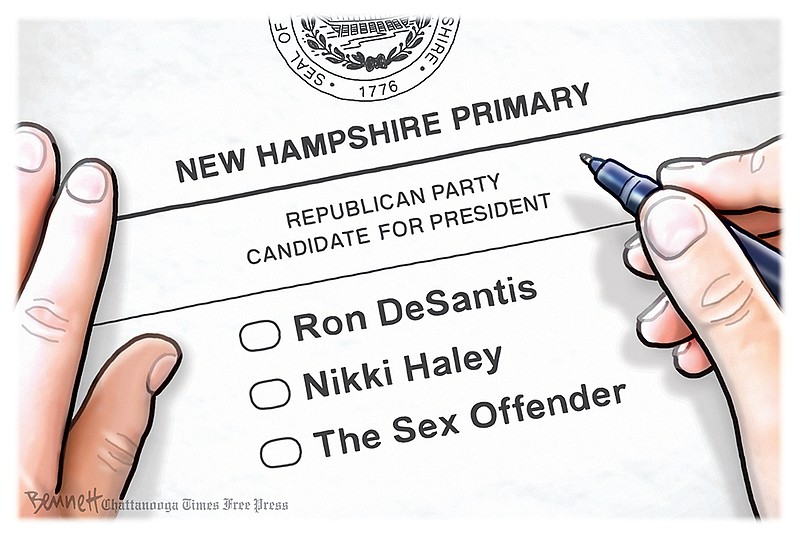
The Iowa caucuses happened last Monday, with Donald Trump getting a little over 50% of the Republican vote. How you interpret that depends on how you frame Trump’s role in the GOP. If you think of him as a presidential candidate among other presidential candidates, it’s a very strong result; he has more support than all his rivals combined. But if you frame him as the incumbent leader of the party, it’s a rather weak result. Imagine, for example, how the press will cover Biden if a Democratic primary is held somewhere, and he barely clears 50%.

In any case, nobody should attach too much importance to the result, because we’re talking about very few people. Just 110K Iowa Republicans turned out, out of 752K registered Republicans statewide and over 2 million total registered voters. That was down from 187K Republican caucus voters in 2016.

Last week I said that if DeSantis finished third in Iowa, he should drop out. He finished second, and dropped out yesterday anyway. His withdrawal doesn’t seem all that consequential because he didn’t have a lot of support anyway (that’s why he’s dropping out), and it’s not clear which way his voters will go. If they supported DeSantis because they liked Trump’s policies but realize that the man himself is a threat to democracy, they’ll go to Haley. But if they just wanted a younger Trump, they’ll go to Trump.

I would interpret the Iowa result this way: If you were hoping for the Republican Party to reject Trump on their own, you need to accept that it’s not going to happen.

We should see that confirmed tomorrow in New Hampshire: Trump is leading in the polls, but New Hampshire is a tricky state to predict, as Barack Obama discovered in 2016. So while a Haley victory isn’t likely, it is possible.

But even that outcome wouldn’t lead to a broader Trump defeat. NH is ideal terrain for Haley, and many Biden-leaning independents may cross over to vote for her. But that’s not a winning formula going forward.

There really is only one scenario where a NH loss leads to Trump’s undoing, and that depends on him: Everybody will be watching him, so if he responds to an unexpected loss with a racist, sexist, and generally unhinged temper tantrum, even Republicans might begin to wonder about his sanity.


Speaking in Concord, NH on Friday, Trump mixed up Nancy Pelosi and Nikki Haley, claiming that Haley was in charge of security on January 6. (His usual lie assigns that role to Pelosi.) But we’re supposed to worry about Biden’s mental acuity.


The other Trump news is all legal: The second E. Jean Carroll defamation trial got underway. The judge, following proper legal procedure, is not letting Trump re-argue something already decided by a previous jury: that Trump really did sexually assault Carroll.

Trump’s “defense”, if you want to call it that, is to replay the greatest hits of toxic masculinity. A standard claim to throw at rape victims is “Didn’t you actually enjoy it?” Well, CNN’s Joey Jackson summarized the Trump attorney’s opening statement: You weren’t injured by Trump’s defamation, you benefited from it.

It was sort of like hey, listen, be thankful Trump made you famous, right? The reality is that what do we have to do with social media and mean tweets that you get on social media. If you take on a person apt to be the president, guess what? You’re in the position you want to be. You’re on TV all the time. Emotional pain and damages, what are you talking about?

When Trump was in the courtroom, he kept muttering and commenting loud enough for the jury to hear, until the judge threatened to remove him. On the campaign trail and on social media, he keeps repeating the remarks that the previous jury had determined were defamatory.

Trump’s behavior underlines the need for substantial punitive damages, over and above Carroll’s emotional suffering and loss of reputation. The point of punitive damages is to make the defamation stop, which the $5 million original award has failed to accomplish.


In addition to the Carroll trial, we’re awaiting the judge’s decision in the NY state fraud trial. We’re also waiting for an appeals court to rule on Trump’s claim of presidential immunity, and for the Supreme Court to hear arguments about whether the 14th Amendment disqualifies him from being president again.
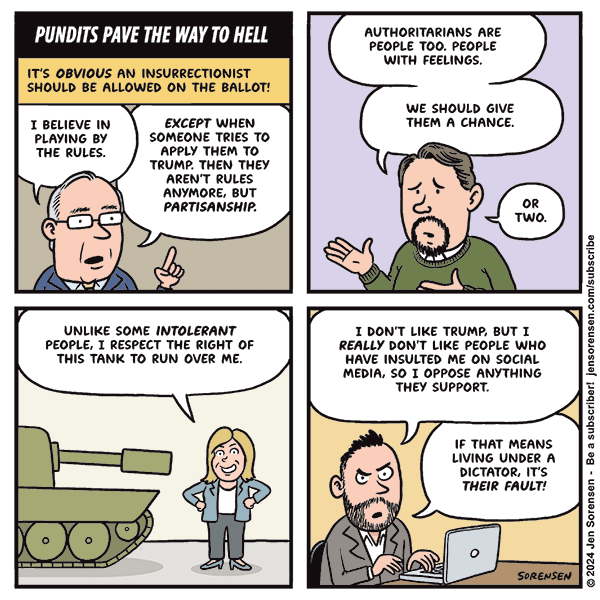

This moment in the Trump trials reminds me of the period between the passage of the Affordable Care Act in 2010 and the first ObamaCare insurance policies in 2014. The program was deeply unpopular then, basically because Republicans could say whatever they wanted about “death panels” or whatever, and ordinary people didn’t have any experience that could prove them wrong. Today, though, if you talk about repealing ObamaCare, millions of people understand that they would lose their health insurance. At its nadir in late 2013, only 33% of Americans had a favorable opinion of ObamaCare, while 59% do now.

Similarly, today everybody knows that Trump has been indicted, but since the cases haven’t gone to trial (largely due to Trump’s stalling tactics), he can say whatever he wants about the evidence, the prosecutors, and the judges.

If you live in the Fox News echo chamber, you’ve heard Trump’s claims, but you know nothing about the seriousness of the crimes he’s accused of or the strength of the evidence against him. It’s all just a witchhunt, a “weaponization” of the Justice Department and the legal system. He didn’t do anything wrong. If he did do something wrong, everybody does it. And if everybody doesn’t do it, there would still be “bedlam” if he were ever held to account.

But despite Trump’s stalling, at least one case is likely to go to trial before the election, and probably result in a conviction. That will be harder to spin away.

BTW: Think about that stalling. If Trump really believed that he had done nothing wrong and the indictments were all a coordinated political witchhunt, he’d be eager to go to trial so he could poke holes in the flimsy evidence against him. When a jury found him innocent after some minimal deliberation, he could crow about being vindicated. But in the real world, Trump knows he’s guilty and that the government has the goods on him, so stalling until he’s president again (and has the tools to obstruct justice) is his best bet.

and the Gaza War

The shock of the October 7 attacks by Hamas welded together a lot of people with divergent views. In Israel, a unity government was formed, a startling departure from recent years when Netanyahu has hung on by finding allies to cobble together narrow majorities in the Knesset, and a new election is needed every year or two. The Biden administration also signed on to the coalition, and has stood with Israel whenever it has been challenged in the UN and elsewhere.

But this week we began to see cracks in that coalition. Netanyahu is increasingly hostile to the Biden administration, and Israel’s internal political divisions are re-emerging.

The war is increasingly becoming a slog, which is causing the world to forget Israel’s October 7 suffering and focus instead on the humanitarian catastrophe in Gaza. Meanwhile, military operations are failing to find and rescue the hostages, and the goal of eradicating Hamas seems ever more distant. Polls indicate that Netanyahu’s goose is cooked once elections are held, which the government doesn’t want to hold during wartime. And that makes critics wonder how committed the prime minister is to ending the war.

and something you probably didn’t know you should care about

Probably the words “Chevron doctrine” make your eyes glaze over. But they shouldn’t. In the featured post, I try to explain why the Supreme Court’s looming revision of Chevron means that six corporate-tool foxes are about the seize control of the agencies that regulate all of America’s hen houses.

and you also might be interested in …

This week’s hopeful take on climate change comes from Chris Hayes’ interview with climate journalist Robinson Meyer. Near the end of the interview, Meyer talks about about lowering carbon emissions sector by sector:

We used to think the power sector was really, really hard. The power sector was the biggest source of [carbon] emissions in the US. Then cheap wind and solar happened (and we switched from coal to natural gas) and very rapidly power emissions fell.

And then … transportation became the most polluting sector of the US economy. But what’s about to happen in the next few years [as EV prices drop] is that transportation’s about to fall to second place, and industry will be the most polluting sector of the economy.

And what I suspect will happen is, just as happened with the power sector and the transportation sector, is that once industry is the most polluting sector of the economy, and people really start to focus on it, we’re going to see all these easy-to-abate emissions, that we just haven’t really noticed yet. And we’re going to get rid of them really quickly. And so, to some degree steel, chemicals, [agriculture], these are huge, challenging problems. On the other hand, they’re challenging problems because we just haven’t paid attention to them yet.


Meanwhile, there’s one fossil-fuel-reducing project that has bipartisan support: ethanol made from corn. If only it weren’t such a bad idea. If, rather than fueling internal-combustion-engine cars with ethanol, we charged EVs with solar energy, one acre of solar panels could power as much transportation as 100 acres of corn. At least that’s what 200 science faculty at 31 Iowa colleges and universities think.


Reportedly, climate change is “on the back burner” for the plutocratic overlords at Davos this year. Also, they’re sanguine about Trump regaining power and continuing to cut their taxes and deregulate their businesses. I’m reminded of Krupp and I. G. Farben in the early 1930s.

“Everyone on this stage is committed to a future of net-zero income tax payments.”

Did you hear that Biden has decriminalized crime? That’s one of the many things you don’t know because you don’t watch Fox News. Fortunately, Kat Abu does.

and let’s close with something fake

When you work hard to get things right and not be fooled by misinformation, once in a while it feels good to revel in complete fraud. Kueez.com has collected viral photos that weren’t all they appeared to be. Some are amusing, some are head-shaking, and others are laugh-out-loud funny. Probably my favorite is a water-surrounded rock and a castle getting photoshopped together.

The actual rock is in Thailand and the castle in Germany, but the combination has the single quality all successful misinformation must have: You look at it and you want it to be real.

Monkeywrenching the Regulations that Protect Our Lives

The Supreme Court’s attempt to scuttle the Chevron Doctrine is part of a much larger program.


Over the last few weeks, Court-watchers have been trying to sound the alarm about the prospect of scuttling what had (until recently) been a fairly arcane bit of legal interpretation: the Chevron Doctrine. Lawyers understand how important it is (the Court has applied it in over 100 cases in the last 40 years), but it’s tough to get the general public to pay attention, much less to be up in arms about its possible demise. But there actually are good reasons to be up in arms.

A fairly standard thing to do at this point would be to tell you what the Chevron Doctrine is and where it comes from. I’ll eventually get around to doing that — click the link if you really can’t wait — but I’d rather have you keep reading for a few more paragraphs before you bookmark this page with the idea of getting back to it when you have more time.

Blood money. So instead I’ll back up a few levels and start with the underlying problem: In a complex modern economy, there are countless ways for corporations to make money by killing people. They can kill their customers by selling products that will crash them into trucks or suck them out of airliners or cause heart attacks or give customers cancer or salmonella or some other disease. They can kill their employees with unsafe workplaces. They can kill their neighbors by pumping poisons into the air or water. As AI catches on, products may start killing people and we won’t even know why.

Sometimes corporations very consciously make the money-for-lives tradeoff, as the tobacco companies did for decades, and as the gun manufacturers are still doing. But sometimes they just don’t know, at least at first. They have a product, they make money off of it, customers seem happy with it, so why look any deeper than that? Diacetyl makes microwave popcorn taste more buttery — what’s not to like?

As individuals, we’re more or less helpless to protect ourselves. No one has the time or the expertise to analyze every single thing they use or come into contact with. That’s why we rely on government regulation, agencies like the FDA, EPA, FSIS, and others, to protect our lives. (Other agencies, like the SEC and the FDIC, protect our money from the kinds of scams that were endemic prior to the New Deal.)

Government regulators get their power from two sources: Congress and the President. Congress creates the agencies, defines their missions, and funds them each year. Meanwhile, the President appoints the people who set the policies to accomplish those missions. Ultimately, Congress and the President get their power from the voters.

But here’s the problem: The marketplace moves much faster than our political system. New products, new drugs, new food additives, new pollutants, and so forth appear every week. Imagine the dystopia we’d be living in if Congress, which strains to pass basic legislation to keep the government’s doors open, had to pass a new law to regulate each one.

Well, you may not have to imagine much longer, because the Supreme Court’s conservative majority seems hellbent on taking us there.

Delegated power. The way the regulatory system currently works is that Congress passes a few foundational laws that give the agencies abstract goals, and then lets the agencies hire experts who figure out how to pursue those goals.

A typical example is the Clean Air Act. The CAA was first passed in 1963 and then overhauled in 1970. It established air quality standards (NAAQS) for a few well-known pollutants like carbon monoxide, sulfur dioxide, and lead, but then it defined a general category of “hazardous air pollutants” (HAPs) made up of other gases and particulates that “threaten human health and welfare”. It tasked the EPA with making and maintaining a list of HAPs and creating emission regulations for controlling them.

Hold that in your mind for a minute: In passing the CAA, Congress banned or controlled substances that the members of Congress had never even heard of. That’s how the regulatory system works.

That’s a lot of delegated power, particularly power over corporations that don’t like being controlled. And yes, their wealth does give the companies opportunities to influence the system — say by bribing or otherwise inducing congresspeople to give them various exemptions, or by letting regulators know they can have cushy jobs after they leave government if they behave themselves — but it’s never enough.

What corporations would really like to do is monkey-wrench the regulatory system in general. And the best way to do that is to interrupt the flow of delegated power from Congress to the agencies: Make Congress pass a new law every time there’s some new thing to regulate. In a Congress where even saving lives can be a partisan issue, and where a bunch of small-state senators can lock things up with a filibuster, even the most obvious new regulations can be stalled indefinitely or watered down to nothing.

So the basic strategy for restoring corporations’ ability to profit by killing people has two pieces

  • Logjam Congress.
  • Prevent Congress from delegating its regulatory power to anybody else.

A three-pronged attack. With the second part of that plan in mind, corporate money begat the Federalist Society, and the Federalist Society (with the assistance of presidents who lost the popular vote and Senate “majorities” that don’t represent a majority of voters) begat the six conservative justices on the Supreme Court. Since gaining control of the Court, those justices have been working hard to fulfill the mission their corporate masters assigned them.

The most direct idea for keeping Congress from empowering regulatory agencies is known as the Nondelegation Principle: basically, that Congress can’t, as a matter of constitutional principle, delegate power that is inherently legislative. Some version of this idea is necessary, because otherwise Congress could authorize the president to be a dictator and then go home. But since 1928 delegation has been considered OK if Congress provided an “intelligible principle” for the agency to follow (like protecting human health and welfare from air pollutants).

But in a dissent in the Gundy case in 2019, Justice Gorsuch proposed a much stricter limit: Agencies can only “fill in the details” of laws, and can’t do something sweeping like, say, compile a list of dangerous pollutants to regulate. Fortunately, he didn’t get the majority to go along with him on that. But he’s still working on it, and the composition of the Court has changed since then. Expect to hear more about nondelegation sometime soon.

A second idea for reining in regulatory agencies is the Major Questions Doctrine, which the Court has created out of whole cloth over the last 25 years. Major Questions is a response to something that happens fairly often: Circumstances change in such a way that a provision in a law that seemed relatively minor at the time it was passed ends up granting an agency significant power. Major Questions allows the Court to say, “No, no, no. The law may say that, but Congress didn’t really mean it. If they’d intended to delegate such a large power, they’d have said so explicitly.”

So, for example, the Obama administration EPA decided that (due to the previously unforeseen problems of climate change), the Clean Air Act gave it the power to regulate carbon dioxide emissions from power plants. The Court nixed that in West Virginia v EPA. Carbon emissions, it said, are so central to the workings of our economy that (regardless of the text of the CAA) Congress would never have delegated that power without an explicit statement.

Now, there are four major objections to the Major Questions Doctrine:

  • The Constitution never mentions it.
  • The Court has never clearly defined what a “major question” is, so it has given itself permission to interfere (or not) whenever it feels like it.
  • The law says what it says, even if Congress didn’t foresee all the possible applications.
  • If Congress really didn’t intend to delegate that much power, it could pass a law to take power back. (But of course, that puts the logjam-Congress shoe on the other foot.)

One recent use of Major Questions was to torpedo OSHA’s rules about large employers vaccinating their workers against Covid. Yes, OSHA’s mission is to protect workers from unsafe working conditions, and yes, working next to an unvaccinated person during an epidemic is unsafe, but … Congress couldn’t really have intended that, could it?

One thing you’ll notice about Major Questions: It allows the Court to substitute its own judgment for both the plain reading of the law and for an agency’s interpretation of that law. And that brings us (finally) to the Chevron Doctrine.

Chevron. Back in the Reagan administration, all the ideological arrows pointed in the other direction: Reagan’s appointees were conservative, while judges tended to be liberal. In particular, the EPA was run by Justice Gorsuch’s mom, Anne Gorsuch.

Anne’s EPA had drastically limited its interpretation of what a “source” of pollution meant under the CAA. Previously, just about any change that introduced new pollution was considered a new source, and required EPA approval. But the new interpretation said that, say, an entire factory or power plant was the source of pollution, and could be substantially reconstructed without triggering EPA supervision.

The Natural Resources Defense Council sued to try to block something Chevron was building, but the Court ruled in Chevron’s favor by creating the Chevron Doctrine: When some part of a law is ambiguous, a court should defer to the interpretation of a regulating agency rather than impose its own interpretation of what Congress really meant. An agency couldn’t make up a ridiculous interpretation, but as long as its reading was plausible, the courts should yield to it. (An eye-glazingly detailed history of the Chevron case is in this interview between David Roberts and Dvid Doniger.)

But remember: the ideological arrows were pointing in the opposite direction from today, so Chevron was a conservative principle that was championed by conservative justices like Anton Scalia. The arguments he made were the same ones liberals are making today: Agencies have technical expertise that courts can’t compete with, and (because they ultimately get their power from Congress and the President), they’re closer to the voters than judges are. So Chevron is not just prudent, it’s democratic.

This kind of humility is sometimes called judicial restraint. For many many years, it was the hallmark of conservative jurisprudence: Activist liberal judges should restrain themselves, because they’re not as smart as they think they are, and because it’s undemocratic to remove issues from the political process.

But now conservatives have control of the courts, so humility is out the window. Apparently, judicial restraint was never actually a conservative principle, it was just a rhetorical device to keep liberal judges in check. Activist conservative judges, on the other hand, should have free rein to do whatever they want.

So Chevron has to go. The Court is using two fairly obscure cases (involving fees paid by the fishing industry to the National Marine Fisheries Service) to tee up an attack on Chevron. No one knows exactly what the ruling will say yet, but the questions the justices were posing during oral arguments point at a complete revision of Chevron that could make the Supreme Court also the Supreme Regulator; whether any given agency was interpreting its authorizing legislation properly would be for the Court to determine.

The practical implications of sinking Chevron could be enormous: Literally thousands of cases have been decided on that basis in the last 40 years, and any of them could come up for a rehearing. Plus, literally every regulation on the books will become a legal battleground, with the Supreme Court’s six conservative justices being the ultimate deciders.

In short, a committee made up of six foxes is about to take over the regulation of every chicken coop in the country.

The Monday Morning Teaser

So the Iowa caucuses happened, and the New Hampshire primary is tomorrow. Ordinarily, this is one of the hottest periods of the political calendar, but this year it’s kind of a sideshow, because Biden and Trump each seem to be steaming towards an inevitable rematch. There are tea leaves to be read about how much enthusiasm Democrats have for Biden and what segments of the GOP might turn against Trump in the general election, but it doesn’t look like the results are going to say anything about the two parties’ nominations. Even if Haley pulls an upset tomorrow, the most interesting question will be Trump’s response: Will he have such an extreme temper tantrum (at a moment when everybody is watching) that it will raise doubts about his fitness for office in some of his previously unshakeable supporters ?

The Gaza War continues, with enormous suffering for the people of Gaza and with rising frustration from Israelis whose main goal is to get the hostages back. Cracks are starting to form in the unity government, as well as cracks in US support for Israel.

The thing I’m going to focus on this week, though, is far less sexy than elections or wars: The Supreme Court seems to be on the verge of reversing a long-standing legal principle called the Chevron Doctrine. Discussions of Chevron quickly turn into arcane legalese and people tune out, so the challenge is to explain not just what’s happening, but why you should care enough to learn the details. At the risk of sounding alarmist, this is the two-line explanation I’ve come up with: You know how government regulations keep corporations from making more money by killing people like you? Well, the Court is about to screw that up.

That screwing-up is part of a decades-long program that involves a couple of other arcane bits of legalese: the nondelegation principle and the major questions doctrine. I’ll unpack all that in “Monkey-wrenching the Regulations that Protect Our Lives”, which should appear around 10 EST.

The weekly summary will look at Iowa and New Hampshire, all the stuff we’re waiting for in the Trump trials, and the Gaza War, then give you a hopeful quote about climate change from the editor of Heatmap News, before closing with a very convincing photo of a place that doesn’t actually exist, but should. I’ll try to get that out by noon.

Love and Justice

Now, we got to get this thing right. What is needed is a realization that power without love is reckless and abusive, and that love without power is sentimental and anemic. Power at its best, power at its best is love implementing the demands of justice, and justice at its best is love correcting everything that stands against love. And this is what we must see as we move on.

– Martin Luther King
Where Do We Go From Here?” (1967)

This week’s featured post is “The Corruption of the Evangelical Movement“, which is my review of Tim Alberta’s The Kingdom, the Power and the Glory.

This week everybody was talking about the Yemen attacks

Thursday, the US and the UK, supported by a number of other allies, launched air attacks on the Houthi rebels in Yemen. If you responded to that news by asking “The Who rebels Where?”, I sympathize. Yemen is a pretty much godforsaken place south of Saudi Arabia, where the Red Sea turns a corner and becomes the Gulf of Aden. You probably don’t own anything imported from Yemen. It has few resources, it’s running out of water, and its people are desperately poor.

Yemen also has a civil war that’s been going since 2014, because no matter how poor a nation is, it can always afford more guns. There’s a Sunni government backed by the Saudis, and the Shia Houthi rebels are backed by Iran. The Economist reports:

The UN estimates that 223,000 people have died from hunger and lack of medical care since the war began. 80% of the population now lives in poverty.

Last week I talked about terrorist strategy, where sometimes it makes sense to provoke someone much stronger than you in hopes that their over-reaction will win you international sympathy and new recruits. That seems to be what is happening here. The US doesn’t want to get involved in the Yemen war, where there really are no good guys. But for weeks the Houthis have been using Iran-supplied drones and missiles to attack ships in the Red Sea, which is one of the world’s busiest and most important trade routes. (More geography: The Suez canal sits at the other end of the Red Sea, so the Red Sea is the most efficient way for ships to pass between Europe and India or East Asia. It’s also how oil tankers from the Persian Gulf get to Europe.)

The Houthi attacks were starting to have a significant effect on world trade, so the Biden administration felt like it had to do something.

But the attacks are unlikely to end the Houthi rebellion, or even to deter it much. The Houthis have already endured much worse at the hands of the Saudis. At best, we have destroyed a chunk of their offensive capacity, so their attacks on shipping will have to die down until Iran can resupply them. The Economist again:

Conflict with the West could have other benefits for them. Their supposed blockade of Israel has already won them new admiration across the Arab world, tapping into pro-Palestinian sentiment at a time when Arab states are feckless bystanders to the war in Gaza. Being targeted by America, while anti-Americanism is running high because of Mr Biden’s support for Israel, will add to their popularity.

and the looming government shutdown

The observation that those who don’t learn from history are doomed to repeat it is attributed to Santayana, and the underlying idea goes back to Cicero. Usually when we quote that, we’re talking about things that happened decades or centuries ago, but in the current situation “history” is what happened in September and November, which we are now repeating.

The short version is that Republicans have a small majority (down to two seats now) in the House, while Democrats control the Senate and the White House. In order for the government to spend money (which it needs to do to keep the doors open), all three have to agree. MAGA radicals in the House believe that this position should allow them to dictate large cuts in federal spending (which are popular in the abstract, but unpopular when implemented). Democrats disagree, believing that the public will blame Republicans for any pain caused by a government shutdown. So they’re not inclined to roll over and accept the MAGA-demanded cuts, which probably can’t even pass the House.

In September, Speaker McCarthy saw this reality and negotiated a continuing resolution which more-or-less left federal spending intact until November. That act of rationality could not be allowed to stand, so MAGA Republicans forced McCarthy out. After much turmoil, he was replaced by Speaker Mike Johnson, whose conservative bona fides are much stronger than McCarthy’s were.

But reality is reality, so Johnson had to make a similar deal in November, cutting the federal-spending can into two pieces and kicking them to different points on the calendar. The first can comes up Friday, and reality still has not changed.

Last night, Johnson and Senate Majority Leader Chuck Schumer released the text of a continuing resolution that would kick both cans into March. The House “Freedom” Caucus is outraged again, but what it will do is unclear.

and the Trump trials

Trial season is gearing up, and it’s hard to tell the players without a program. Closing arguments in New York State’s civil fraud trial against the Trump Organization happened last week. It’s a bench trial, so now we’re waiting on the judge rather than a jury. Judge Engoron has already issued a summary judgment that the Trumps committed fraud, so the trial was largely to assess damages.

Engoron will consider whether to grant the attorney general’s request to fine Trump $370 million, ban him from the state’s real estate industry for life and bar him from serving as the officer or director of a New York corporation.

Engoron knows Trump is looking for grounds to appeal, so he will be very careful in how he justifies his judgment. Observers are predicting a decision in “weeks” rather than days or months.


The second E. Jean Carroll defamation trial starts tomorrow. Basically, Carroll says Trump raped her in a department store dressing room in 1995. Trump met those charges (in a book Carroll wrote) with insults, so Carroll sued him for defamation. The statute of limitations had passed for accusing him of the original assault, but New York changed the law in 2022. So she sued for damages from the assault and for insults he made after he left office. She won a $5 million settlement, which Trump is appealing.

Now the original defamation suit is coming to trial, having been delayed by all sorts of wrangling about when presidents can be sued. The judge is refusing to let Trump relitigate issues resolved in the first trial, such as whether the assault happened and whether his comments were defamatory.


We’re waiting for a federal appeals court to weigh in on whether presidential immunity prevents the government from trying Trump on January 6 charges. They are unlikely to agree with Trump on this, but how exactly they refute his claim of immunity will be important. Also important: how long they take to rule and how much time they allow for an appeal to the Supreme Court.


The Supreme Court has agreed to review the Colorado Supreme Court’s decision that Trump is disqualified from the presidency by the insurrection clause of the 14th Amendment. Oral arguments are scheduled for February 8. It’s hard to imagine this Court kicking Trump off the ballot, but it’s not clear how exactly they’ll get around the text of the 14th Amendment.


Meanwhile, Trump threatens “bedlam” if court decisions don’t go his way. And Judge Engoron suffered a bomb threat at his home. Judge Tanya Chutkan was the victim of a “swatting” incident, in which a false emergency call sent armed police to her home.

Elected Republicans almost universally ignore all this. It’s just become accepted that Trump will goad on his violent supporters, and that crossing Trump will entail physical risk. It’s the modern version of the Nazi brownshirts.

but I wrote about the Evangelical heresy of Christian Nationalism

Or, more precisely, Tim Alberta wrote about it, and I reviewed his book.

and you also might be interested in …

The Iowa Caucuses are tonight. I can’t remember the last time these were a smaller deal. Democrats aren’t having one, and Trump will obviously win the Republican caucuses. The only suspense is whether Nikki Haley can finish second. If she does, Ron DeSantis should drop out.


The Hunter Biden circus continues. Wednesday, the House Oversight Committee debated citing Hunter Biden for contempt because he refused a subpoena to be interviewed behind closed doors and insisted on testifying in public. Who should show up for this hearing but Hunter himself?

The debate went forward, underlining what a farce it all is. Republicans would say that the American people deserve answers from Hunter, and Democrats would respond: “There he is. Let’s ask him”, which the Republicans would refuse to do.

I’m adding this Oversight Committee Democrat, Texas Congresswoman Jasmine Crockett, to my list of politicians I would pay money to hear. Watch this clip from Wednesday night’s Chris Hayes show.

Friday, Hunter announced he would appear for non-public testimony.


South Africa has brought a genocide case against Israel to the International Court of Justice in The Hague, and is seeking an immediate order to stop the military campaign in Gaza.

A decision on South Africa’s request for so-called provisional measures will probably take weeks. The full case is likely to last years.

Vox explains:

Under international humanitarian law, proving allegations of genocide is incredibly difficult. And even if South Africa does prove that Israel is committing genocide — or that it is failing to prosecute incitement to genocide or prevent genocide from occurring — ICJ decisions aren’t necessarily easy to enforce. But these initial arguments aren’t yet entering that complicated territory.Instead, they’re about whether the ICJ will issue a preliminary order for Israel to stop its onslaught in Gaza immediately; the court will rule on that issue after hearing arguments from South Africa and Israel Thursday and Friday. Though Israel could ignore that ruling if it’s issued, it could make Israel’s allies less inclined to support the war.

Despite the difficulties, NYT contributor Megan Stack says the charges deserve serious consideration.

The word “genocide” rings loudly in our imagination. We think of Rwanda, Bosnia, the Armenians, the Trail of Tears and, of course, the Holocaust. I have heard many people balk at the suggestion that Gaza could be experiencing genocide. The Holocaust, after all, wiped out over 60 percent of European Jews. Israel’s war — instigated, no less, by the murder of Jews — has killed about 1 percent of the Palestinians in Gaza. One percent is terrible, of course, but genocide?

Under the genocide convention, though, the term describes an intent to wipe out a defined group of people and taking steps to achieve that end. There is no threshold of death, or proportion of death, that must be reached. It is possible to kill a relatively small number of people, but still commit an act of genocide.


Saturday, the people of Taiwan shrugged off Chinese threats and elected another president from the Democratic Progressive Party.

The result shows voters backing the DPP’s view that Taiwan is a de facto sovereign nation that should bolster defenses against China’s threats and deepen relations with fellow democratic countries, even if that means economic punishment or military intimidation by Beijing.

It is also a further snub to eight years of increasingly strongarm tactics towards Taiwan under Xi who has vowed that the island’s eventual “reunification” with the mainland is “a historical inevitability”.


The New Yorker lays out the case that a Texas woman died because of that state’s abortion laws. This case gets to the heart of how tricky life-of-the-mother exceptions really are.

Yeniifer Alvarez was an uninsured woman living in a part of central Texas without good health care, particularly prenatal care. She was overweight, diabetic, and had a history of pulmonary edema “in which the lungs fill with fluid, that strains the heart and can be fatal”.

Her pregnancy was obviously risky, and a wealthier or better-insured woman would have been under constant observation. In a state with different laws, a precautionary abortion might have been performed, under the theory that the risks were too high. When the crisis came, it took too long to get her to a hospital capable of handling her case, and she died in an ambulance.

Life-of-the-mother exceptions in abortion laws tend to assume binary choices: She gets the abortion or she dies. The less solid notion of unacceptable risk just doesn’t enter the picture.


Here’s Kat Abu’s weekly recap of Fox News.


Josh Marshall makes an unpopular point that I happen to agree with: Bad as the execution looked at the time, Biden was right to get us out of Afghanistan.


I made a New Year’s resolution to highlight more positive news about the climate and efforts to cut carbon emissions. In that vein, the Dutch company Elysian is trying to develop the first practical electric airliner. Previous electrical plane designs have carried few passengers relatively small distances, but Elysian is picturing a 90-seat plane that can go nearly 500 miles on a charge.

For comparison, New York to Boston and New York to D.C. are each a little over 200 miles.


The New York Times Magazine raises an interesting question: Could an engineering project divert warm-water flows away from a Greenland glacier and prevent it from sliding into the ocean and melting? If that idea is feasible, how big an expense would it justify?

and let’s close with something adorable

The young of just about any species can be cute. But baby rhinos? Yes, baby rhinos.

The Corruption of the Evangelical Movement

Tim Alberta indicts the religion he grew up in, but ends on a hopeful note. How convincing is that?


In the news sources I follow, Tim Alberta and his new book The Kingdom, the Power, and the Glory: American Evangelicals in an age of extremism have been everywhere lately. As of yesterday, it was the #1 best seller in Amazon’s “Christian Church history” category. The book’s web page boosts it as a “New York Times Bestseller, one of Barack Obama’s Favorite Books of the Year, and an Air Mail best book of the year.” An excerpt — the book’s prologue, in which Alberta reminisces about his Evangelical-preacher father and describes how his father’s flock assailed Alberta for his politics when he returned to the megachurch his father founded for his father’s funeral — has appeared in The Atlantic. He’s been interviewed on numerous MSNBC shows, including The 11th Hour. Michelle Goldberg wrote a column about his book, though I can’t find any clue that she read all the way to the end.

So chances are you’ve heard about Alberta, and maybe you know the thesis of his book: He surveys how right-wing politics has taken over the Evangelical movement, which today is often more about Trump than about Jesus, and whose Promised Land is not Heaven, but an America re-dominated by Christian leaders (who are probably White, male, and Republican, and definitely straight). Christianity, whose “kingdom is not of this world“, has been corrupted by a very worldly American nationalism.

What is special about Alberta’s perspective is that he critiques Evangelicalism from the inside. The fundamental problem he sees in Christian Nationalism isn’t that it violates the Constitution or opposes democracy or goes down the rabbit holes of absurd conspiracy theories, but that it is a heresy. Worshiping America (or Trump) is a form of idolatry. Jesus, in Alberta’s view, would have us change the world by channeling God’s love, not by promoting an angry, fearful, hateful brand of politics. God is eternal, and He cares little about nations, which come and go. (Galatians 3:28 says “There is neither Jew nor Greek, there is neither bond nor free, there is neither male nor female: for ye are all one in Christ Jesus.”)

Access. Alberta’s book demonstrates a level of access that I find hard to imagine. Some of the most famous — and most outrageous — characters in American Christianity sit down with him and share their unguarded (or barely guarded) thoughts.

  • Robert Jeffress (the Dallas megachurch pastor who was key in bringing Evangelicals to Trump in 2016 and in defending his worst excesses) discussed his post-1/6 doubts about how far he went to promote Trump. “I had that internal conversation with myself — and with God, too — about, you know, when do you cross the line? When does the mission get compromised?” Alberta pushed on that a little and Jeffress confessed, “I think it can be [compromised]. I think it even was, these last few years.” (Jeffress is back in the Trump fold now.)
  • Greg Locke, the Tennessee preacher whose church mushroomed when he defied public-health restrictions to stay open during the pandemic, and instead turned his church into a center of anti-vax, anti-liberal, and anti-government conspiracy theories, tells Alberta, “I’ve grown. … Are there times that it’s been perceived that I cared more about the kingdom of earth than the kingdom of heaven? Probably. And that was probably my fault. I probably shot myself in the foot and got a little too animated about things.” (Maybe he meant it.)
  • On election day 2022, Alberta had breakfast with the Christian Coalition founder Ralph Reed, who predicted a big night for Senate candidate Herschel Walker.
  • He reports numerous conversations with Russell Moore, a central character in the right/left struggles of the Southern Baptist Convention. And with Jerry Falwell Jr., who was pushed out as president of Liberty University under a cloud of scandal.

It goes on like that. List everybody you wish you could talk to about these issues, and Alberta talked to them. They appear to have taken his questions seriously rather than stiff-arming him as part of the liberal media. People who usually take a double-down, show-no-weakness attitude towards probing questions seem to have wanted Alberta to understand them and their points of view.

What point of view? Because we so seldom get our questions answered, people like me have a hard time piecing together how Evangelicals look at themselves and come to their (to me) bizarre-looking political positions. As best I can piece it together now, the logical order goes like this: Over the last 50 years or so, American culture has either de-emphasized or outright rejected many conservative Christian ideas about morality. So now abortion, homosexuality, interracial marriage, same-sex marriage, pre- and extra-marital sex, and even (in some communities) transsexuality are all OK. Evangelicals see this creep of standards as moving primarily against them, rather than in favor of previously oppressed groups like, say, gays. So they extrapolate forward to a society where they will be persecuted the way the early Christians were by Rome. When churches were closed during the pandemic — along with theaters, sporting events, and any other place where crowds typically assemble — they took it personally, as the first act of a liberal Deep State that is eager to shut them down.

This interpretation and this fear looks paranoid to me. (After all, I’m pretty liberal and I never run into anybody who is eager to shut down churches permanently and persecute their members. The suggestion just never comes up.) So I have no idea who in particular they should be afraid of. But it’s very real to them, which is why many of them have a we-are-facing-the-apocalypse mindset. Preachers and politicians have promoted this fear, preyed on it, and taken advantage of it. The result is a sense of desperation, a willingness to believe ridiculous conspiracy theories, and an eagerness approve some very un-Christ-like tactics.

That result looks to Alberta like a profound loss of faith in the message of Jesus, who said “Love your enemies and pray for those who persecute you, that you may be children of your Father in heaven.” Instead, Evangelicals find themselves looking for someone more badass than Jesus, which is what they like about Trump.

Structure. Alberta’s book is made up of three parts: The Kingdom is his tour of Evangelical churches, where he talks to the Trumpiest pastors he can find, as well as to pastors who are struggling not to lose their churches to this Christian Nationalist movement. One such church is Cornerstone Evangelical Presbyterian Church in Brighton, Michigan, which was founded by Alberta’s father and is where Tim grew up. In Chapter 1 we meet his father’s hand-picked successor, Chris Winans, who isn’t willing to endorse right-wing politics from the pulpit, and so is watching his membership plummet. But in Chapter 7 we meet Bill Bolin, whose Floodgate church in the same town is riding the right-wing wave — stolen election, vaccine horror stories, looming Christian persecution — to grow and prosper.

Part II, The Power, focuses on politicians and political operatives who are harnessing Christian Nationalism, people like the fake historian David Barton, Ralph Reed, and Charlie Kirk of Turning Point USA. Alberta attends a session of Michael Flynn’s ReAwaken America tour, which is like a tent revival for QAnon types. But he also talks to an apostate of the religion-meets-rightwing-politics movement: Cal Thomas, who anticipated much of what ultimately went wrong in his 1999 book Blinded By Might.

Part III, The Glory, is the hopeful part of the book, which I found unconvincing. He focuses on people who have survived the right-wing wave, including a return to Winans at Cornerstone, who over a period of years has rebuilt the church’s membership while keeping his message Christian rather than nationalist. Activists who want the Southern Baptist Convention to address its sex-abuse issue win a vote, and then beat back a right-wing counterrevolution. Jerry Falwell Jr. gets ousted at Liberty University, and is replaced by people who maybe maybe will start to take LU’s stated mission seriously. Stuff like that.

In the final chapter, one of the book’s sympathetic characters, LU Professor Nick Olson, delivers this optimistic vision of a revitalized Christian church:

I think the first step is reimagining the Christian worldview. And that means replacing our dominant metaphor — culture war — with something different. That’s been the running theme for evangelicals: we’re always embattled, always fighting back. But what if we laid down our defense mechanisms? What if we reframed our relationship to creation, to our neighbors, to our enemies, in ways that are more closely aligned to the Sermon on the Mount? What if we were willing to lay down our power and our status to love others, even if that comes at cost to ourselves?

Good luck with that, Nick. It’s a beautiful thought, but the currents still seem to me to be running in the other direction.

My response. In his hopeful Part III, I think Alberta underestimates how deep the structural problems in Christianity run, a case I made in a 2022 post “How did Christianity become so toxic?“.

In my experience, the style of motivated reasoning we see in the Trumpist movement (where, for example, Bill Clinton’s sexual excesses were disqualifying, but Donald Trump’s as-bad-or-worse actions are just part of his charm) began a long time ago. The willingness of Christians to deny facts, to seize on any useful misrepresentation, and to apply more favorable standards to people on their own side — I was running into this back in the 70s when fundamentalists argued against evolution, and probably it had been going on for decades before that.

Over time, anti-evolution became a template for denying anything conservative Christians didn’t want to believe: global warming, the effectiveness of vaccines, anything. The nonsense put out by the anti-abortion movement — that six-week-old fetuses have a heartbeat, 15-week fetuses feel pain, abortion can cause breast cancer, and so on — is unkillable, because conservative Christians live in a world where facts and science don’t matter. If some argument advances your position, then it must be true. Standing against this kind of nonsense means that you have turned against your faith.

Any serious attempt to clean this all up and teach sound reasoning will cost Evangelicals things they value far more than the truth. They’ll have to admit that the Earth has been around far longer than a few thousand years, that the diversity of human languages must have started much earlier than the Tower of Babel, that there never was a worldwide flood, and so on. They’ll have to account for obvious contradictions in the Bible. (The clearest, I think, is between the two genealogies of Jesus in Matthew and Luke. It’s not just a matter of the names being different; they don’t have the same number of generations between David and Jesus.)

They won’t have to give up on the teachings of Jesus, but they’ll be left with a faith far more complicated than “that old time religion” they want to believe in.

Above all else, Evangelicals believe the things they want to believe. So it’s not going to happen — which means that even if the Trumpist heresy ultimately fails, there will soon be another one, because the tools to build one are so widely distributed and easy to use.

And then there’s the propensity to invent paranoid conspiracy theories. This is baked into the theology at a very deep level: There is a Devil, who represents ultimate evil and has human minions to work his will.

When rational people confront a conspiracy theory, the unraveling usually begins with one question: Who would do all this and why? But Evangelical theology provides a ready-made answer: The Devil and his minions would do this because they’re evil. The diverse pieces of the conspiracy may have no apparent contact with each other, but they share inspiration from a being not of this world. If in addition you allow them occasional acts of supernatural power, then there’s no conspiracy you can’t rationalize.

The paranoid part comes from the fact that Devil’s primary goal is to destroy the One True Church and persecute its followers. You may belong to the biggest, richest, most powerful religion on the planet, and your pastor may meet regularly with the President of the United States, but it doesn’t matter. Some powerful entity is trying to persecute you, and you will never be safe from him.

This is not to say that all Evangelicals are necessarily paranoid and captured by false narratives that they cannot examine rationally. But the DNA of their faith makes them vulnerable to paranoia and false narratives. If they understood that fact, they could guard against those traps and call each other back when they fall down those rabbit holes. But the vulnerability that their faith builds into their thinking processes is the very first thing they are driven to deny.


POSTSCRIPT

After reading the comments, I feel like I should post some general remarks about my attitude toward religion.

I am not, in general, against religion. I belong to a church myself, albeit a Unitarian Universalist church, which some people would say is not really a religion. (I disagree.)

There are obvious social advantages in belonging to a church: In our atomized society, we usually only meet people in specific roles, and it’s hard to form the kind of relationships where the whole of my life is involved in the whole of somebody else’s life. In a church, you not only meet a person, you may also meet the person’s spouse, kids, possibly parents, and some of their friends. Deeper conversations about what we’re each trying to do with our lives and what’s stopping us from doing it — they don’t violate our roles, the way they might in another setting.

But beyond the social, a weekly church service is a way to regularly remind myself, and for a community of people to remind each other, that we want to be better than this. Overall American culture places such importance on money, status, fame, career success, and so on. It can be hard to remember that life should be about more than that.

At its best, religion can posit what a better world looks like: a place where everyone is treated with respect, where people care about each other too much to let them fall through society’s cracks, where we aspire to find truth and beauty, and where everyone has a chance to become their best self. It’s valuable to know that this vision is not just some crazy idea I dreamed up, but that a community of people shares it.

So far I haven’t said anything about God, because traditional notions of God don’t play a big role in my thinking. I sometimes describe myself as a “functional atheist”. If you have a vision of God that is meaningful for you and helps you be a better person, I won’t try to talk you out of it. I may even use your God-language in our conversations, if it helps get an idea across. But “this is what God wants me to do” usually doesn’t come up when I’m trying to make decisions in my own life.

That said, I have an appreciation of even theistic religion. If a religious community has its vision of a better world right (or even close to right), the idea that God wants this for us can be powerful. If a religion motivates its believers to do the hard work of improving the world, I’m not eager to change their minds.

Now, obviously, a lot of religion isn’t like that. Communities of people can get together each week to justify being their worst selves, or to share a vision of a world where large parts of humanity are made to suffer. I’m not defending that. I just don’t think that religion necessarily has to turn out that way.

The Monday Morning Teaser

A lot happened this week. US forces attacked rebels in Yemen, a country I doubt many Americans could find on a map or distinguish from a list of made-up countries. It all has something to do with the Gaza War, our regional rivalry with Iran, and shipping in the Red Sea, so it’s not a situation Biden can easily explain to the American people.

A partial government shutdown is scheduled for Friday, unless Congress passes another continuing resolution. It doesn’t look like anyone learned anything from the last two brushes with a shutdown in September and November. Speaker Johnson is in more-or-less the same position Speaker McCarthy was in September, and is doing more-or-less the same things that caused MAGA extremists to kick him out.

The Gaza War continues, but there’s a new wrinkle in the politics: South Africa has gone to the International Court of Justice and accused Israel of anti-Palestinian genocide. If that Court would happen to rule against Israel, it has few mechanisms for enforcing its judgment. But it would be a huge propaganda blow against both Israel and its supporters in the Biden administration.

The Trump trials continue. The civil fraud trial in New York wrapped up, and we await a decision from the judge. (It’s a bench trial, so there’s no jury.) The second E. Jean Carroll defamation trial starts tomorrow. The first trial (at which Carroll was awarded $5 million in a judgment Trump is appealing) was about statements he made about her after leaving office. This is about statements he made while he was president; the case was slowed down by his claims of presidential immunity. Meanwhile, we await a federal appeals court’s decision on whether Trump’s presidential immunity will derail the federal case against him for his January 6 conspiracy.

But the featured post this week is my review of Tim Alberta’s new book The Kingdom, the Power, and the Glory, which critiques the Trump take-over of the Evangelical movement from the inside. That should be out before 9 EST. The weekly summary will cover everything else, and I’ll try to get it out by noon.

Endings and Beginnings

Wherever law ends, tyranny begins.

John Locke
Two Treatises on Government (1689)

This week’s featured posts are Catching Up on Donald Trump and Catching Up on the Gaza War.

This week everybody was talking about disqualifying Trump

That, and a bunch of other Trump news, is covered in one featured post. Something I forgot to mention in that post was Trump’s weird rant against magnets.

On the subject of magnetic elevators, Trump said, “Think of it, magnets. Now all I know about magnets is this, give me a glass of water, let me drop it on the magnets, that’s the end of the magnets.

In the inspiring words of the Insane Clown Posse: “Fuckin’ magnets, how do they work?”

But, you know, it’s Biden whose mind we are supposed to worry about.

and the Gaza War

which is covered in the other featured post.

and January 6

In the immediate aftermath of Trump’s failed coup, the GOP establishment and conservative commentariat almost universally recognized 1-6 for what it was: un-American, over the line, terrorism, etc. Over the last three years, they have completely changed their tune. Rep. Elise Stefanik, chair of the House Republican conference, is typical: Sunday she referred to those who have been tried, convicted, and sentenced for crimes committed on January 6 as “hostages“.

I believe we’re seeing the weaponization of the federal government against not just President Trump, but we’re seeing it against conservatives.

She refused to commit to certifying the 2024 election.

We will see if this is a legal and valid election. What we’re seeing so far is that Democrats are so desperate they’re trying to remove President Trump from the ballot.

Of course, President Trump will only be removed from ballots if the conservative majority on the Supreme Court finds that the Constitution disqualifies him. “Democrats” can do nothing on their own.

and 2023 becoming 2024

2023 was another great year for jobs. The economy added 2.7 million jobs during the year, bringing the 2-year total to 7.5 million new jobs. The unemployment rate held steady at 3.7% in December, and has stayed below 4% for 23 consecutive months. The Trump administration’s longest streak below 4% was 13 months.


The Economist combined “inflation, inflation breadth, GDP, jobs, and stock market performance” into a single index to rank 35 “mostly rich” countries’ economic performance in 2023. The US came in third, behind Greece and South Korea, and I might quibble about ranking us that low: Greece’s advantage is mainly in its stock market, which was up 44% compared to the US’ 4.3% gain.


https://www.climate.gov/news-features/understanding-climate/climate-change-global-temperature

2023 was the hottest year on record by a wide margin, as global warming teamed up with an unusually strong El Nino. As anyone who follows sports knows, that’s how records get set: a trend gets topped off by special factors. (For example, Barry Bonds’ 73 home runs in 2001 was the best season of the best hitter in the home-run-happy steroid era. Between 1998 and 2001, three hitters posted six seasons of 63+ home runs, a figure no one else has reached before or since.)

The El Nino is expected to continue into this year, so 2024 could be equally hot or hotter. But it might not be, and by 2025 we can expect some regression to the mean. (In other words: Outliers are typically followed by something less outlying. For example, Shaquille O’Neal is 7’1″, but his son is only 6’10” — tall, but not as tall as Dad.) What that would mean in this case is that 2024 or 2025 will be hot, probably hotter than the average of 2018-2022, but probably not as hot as 2023. When we look back from 2030 or so, the upward trend will continue to be clear, but 2023 will probably stick up above the trend line.

1998 was a year like that: significantly hotter than any year before, but also hotter than several years after. And you know what we saw? Climate-change-denying authors writing that global warming ended in 1998. You can guess what they did: If you start your graph at 1998, it looks like global average temperature goes sideways for several years. (The two graphs here aren’t tracking precisely the same things, so they don’t perfectly match up.)

Warming trend? What warming trend?

So don’t be fooled over the next few years if you see articles claiming that the danger has passed, because global warming peaked in 2023 or 2024. It won’t have passed; the trend will just be catching up to a year with some special circumstances.


Kat Abu, who watches Fox News so we don’t have to, announced her Fox News predictions for 2024. A few highlights:

  • Greg Gutfeld is going to say the N-word.
  • If Trump is found guilty of anything this year, Sean Hannity will start his show with the words “Today, all of America was found guilty.”
  • A host will overtly call for the assassination of Joe Biden.

and Governor DeWine’s veto

On December 18, the Ohio legislature passed a Substitute House Bill 68, which included this:

Sec. 3129.02. (A) A physician shall not knowingly do any of the following: (1) Perform gender reassignment surgery on a minor individual; (2) Prescribe a cross-sex hormone or puberty-blocking drug for a minor individual for the purpose of assisting the minor individual with gender transition; (3) Engage in conduct that aids or abets in the practices described in division (A)(1) or (2) of this section, provided that this section may not be construed to impose liability on any speech protected by federal or state law. …

Sec. 3129.05. (A) Any violation of section 3129.02, section 3129.03, or section 3129.06 of the Revised Code shall be considered unprofessional conduct and subject to discipline by the applicable professional licensing board.

So, Ohio doctors who provided gender-affirming care for minors (with or without parental consent) would lose their licenses.

On December 30, Governor DeWine, a Republican, announced that he was vetoing this bill. He said:

Were I to sign Substitute House Bill 68 or were Substitute House Bill 68 to become law, Ohio would be saying that the State, that the government, knows what is best medically for a child rather than the two people who love that child the most, the parents.

In other words, the people who are actually involved in the specific case should make the decision, not the government. I wonder when DeWine or any other Republicans will grasp that this is also a reason to oppose abortion bans at any number of weeks. In some particular cases, you may not agree with the decision made by the people on the ground, but on the whole they’ll do better than the legislature.

and you also might be interested in …

the sad story of a public library in upstate New York. When the library scheduled a Drag Queen Story Hour, protests erupted, and the event was never held. You might think the anti-LGBTQ side would say, “Yay, we won!” and be happy. But no. Next they went after all the queer-themed books in the library. They harassed the librarians until they resigned. Several trustees also resigned (leaving the board without a quorum to hire new staff), and the library has been closed for four months.

As so often happens, the minister leading the anti-library charge accuses the librarians of pushing an “agenda” on the town, when in fact he is the one pushing an agenda. The librarians saw their mission as serving everyone in the town, while the minister wants the library to serve people only to the extent that they are like him.


Wednesday, the quack doctor that Ron DeSantis made Florida’s surgeon general called for a halt on the use of mRNA Covid vaccines (like Moderna’s and Pfizer’ vaccine’s), because of the claim that such vaccines can contaminate a recipient’s DNA. If you’re curious, Scientific American explains the alleged risk and why it’s not worth worrying about.


The first American moon mission since 1972 launched this morning. It’s supposed to land on the Moon on February 23. There are no astronauts, though.


Carbon offsets can be kind of an iffy thing. The credits that get bought to offset carbon emissions are often from, as Grist puts it, “distant and questionable” projects. But there is at least one offset program Grist likes: the Alaska Carbon Reduction Fund, which offsets emissions from local eco-tourism by paying for Juneau residents to replace fossil-fuel-powered furnaces with electric heat pumps.


Another environmental development worth watching: JAC Motors, a Chinese automaker backed by Volkswagen, as about to launch an EV with sodium-ion rather than lithium-ion batteries. Mining lithium is one of the major environmental trade-offs of EVs.


January 1 is a typical time for new laws to take effect. This year,

Twenty-two states and more than three dozen cities and counties increased their minimum wages in January, providing a boost to millions of the country’s lowest-paid workers.

The increases will bump wages for about 9.9 million workers, according to an analysis from the Economic Policy Institute (EPI), a Washington-based think tank.

Washington state has the highest minimum: $16.28 per hour. Just about the entire South has stuck with the federal minimum of $7.25. We can think of this as an almost-controlled experiment. Eastern Washington sits right next to the Idaho panhandle, where $7.25 is still the standard.

and let’s close with something cold

Over the weekend, my town had its first real snow of the year. So in honor of the beauty of winter, here’s a contest-winning photo.

Catching Up on the Gaza War

Back in 2004, before The Weekly Sift existed, I wrote a piece on DailyKos called “Terrorist Strategy 101: a quiz“. Laid out in a Q&A format, the purpose of that piece was to get people thinking differently about terrorism and anti-terrorist strategy. Its main point was that if you are a pro-X violent extremist, your primary obstacle is not the popularity of the radical anti-X position.

Quite the opposite, in fact. If you’re a violent extremist, the main obstacle to your success is the apathetic middle. Most people just want to get on with their lives, and if you give them half a chance, they’ll work out some compromise that makes you irrelevant. Your first priority, then, is to radicalize the center. “Invert the bell curve” was the way I put it. Rather than most people being the middle, you need most people to be at the extremes.

Strangely enough, your supposed enemies, the anti-X violent extremists, are in exactly the same position. So the best way things could work out for both of you is a series of tit-for-tat atrocities that produce too much collateral damage for the public to ignore. If the attacks and counter-attacks go on long enough, the center becomes untenable and the bell curve inverts. “The anti-X extremists are monsters who only understand force,” you say. “We won’t be safe until we kill them all, regardless of the innocent people who get in the way.”

And of course, after you end up killing a bunch of those innocent people, the anti-X extremists get to say the same thing about you.

History is full of examples. In Weimar Germany, you had to be a Communist because only they were tough enough to stop the Nazis. Or you had to be a Nazi, because only they were tough enough to stop the Communists. (Social Democrats? Give me a break. What are those wimps going to do?) Around the time TS101 was written, President Bush was justifying torture because he had to prevent another 9-11, and Al Qaeda was recruiting based on what Bush’s people were doing in Abu Ghraib and Guantanamo.

Israel/Palestine wasn’t the main focus of that article, but it did come up.

That’s why extremists come in pairs: Caesar and Pompey, the Nazis and the Communists, Sharon and Arafat, Bush and Bin Laden. Each side needs a demonic opposite in order to galvanize its supporters.

Naive observers frequently decry the apparent counter-productivity of extremist attacks. Don’t the leaders of Hamas understand that every suicide bombing makes the Israelis that much more determined not to give the Palestinians a state? Don’t they realize that the Israeli government will strike back even harder, and inflict even more suffering on the Palestinian people? Of course they do; they’re not idiots. The Israeli response is exactly what they’re counting on. More airstrikes, more repression, more poverty — fewer opportunities for normal life to get in the way of the Great Struggle.

And that brings us to the October 7 attacks. Even a casual observer had to realize that the attacks didn’t make a lot of military sense. The Israeli army was barely touched, but Hamas went after a music festival, a few kibbutzes, and some other convenient villages. They didn’t capture key generals or government officials, but instead they killed a bunch of random Israelis and took a number of ordinary folks as hostages. The Israeli military had overwhelming superiority before the attacks, and it had overwhelming superiority after.

The attack was on another level entirely, and corresponds to terrorism in its most literal sense. The point was to evoke many Israelis’ worst nightmare: the fear that they can never be safe, and that they can’t protect their loved ones. Taking Prime Minister Netanyahu’s daughter wouldn’t have served that purpose nearly so well as grabbing the children of people no one had ever heard of. You may not be special, but they aren’t either. What makes your children different?

Everyone knew that Israel could and probably would retaliate with overwhelming force. And that was the point. Over the last few years, the Arab world had been starting to forget about the Palestinians. Leaders like Saudi Arabia’s MBS were beginning to see Israel less as the Great Boogeyman and more as a potential trade partner and/or ally against Iran. More and more Arab leaders were starting to see the Palestinian problem as a nuisance, something to be contained rather than solved. So Palestinians needed the Great Jewish Boogeyman to reappear on the world stage.

Now, I’m not the only person who understands this strategy. The Israeli government has some pretty smart people in it, so they must have grasped what was happening. NYT columnist Thomas Friedman (whom I seldom agree with) raised the perfect question on October 10:

What do my worst enemies want me to do — and how can I do just the opposite?

Pretty clearly, Hamas wanted Israel to do more or less what it has done: charge into Gaza and kill a bunch of innocent people (in addition to a bunch of really horrible Hamas terrorists). AP reports:

Israel’s campaign in Gaza has killed more than 22,400 people, more than two-thirds of them women and children, according to the Health Ministry in the Hamas-run territory. The ministry’s count does not differentiate between civilians and combatants. … Much of northern Gaza, which troops invaded two months ago, has been flattened beyond recognition. … Some 85% of Gaza’s 2.3 million people have been driven from their homes and squeezed into smaller slivers of the territory. Israel’s siege of the territory has caused a humanitarian crisis, with a quarter of the population starving because not enough supplies are entering, according to the U.N. At the same time, airstrikes and shelling across Gaza continue to destroy houses, burying families taking shelter inside.

Take that, MBS! How are your negotiations with Israel going now? And you Palestinian or Israeli moderates, who still hope for peace and a two-state solution — have you persuaded anybody lately?

Now, it’s easy to be judgmental about this, and to a certain extent we should be. But we also need to appreciate just how hard Friedman’s advice is to follow. If gunmen had invaded your home, killed your spouse and carried off your children, and if you had the power to destroy everything in your path as you tried to get the children back, how restrained would you be? How open would you be to “reasonable” advice?

What needed to happen after 10-7 was some delicate combination of sticks and carrots whose restraint probably would have infuriated a big chunk of the Israeli public. Yes, Hamas can no longer be allowed to govern Gaza, and those holding Israeli hostages need to be tracked down. But Palestinians also have to be offered some kind of hope for a revitalized peace process. Otherwise, their choice is between being slowly strangled by ever-expanding Israeli settlements, and going out in a blaze of glory. The choice to become a terrorist is usually made in late adolescence, when a blaze of glory can be very appealing.

The New Yorker’s Isaac Chotiner interviewed Palestinian political analyst Ibrahim Dalalsha, who analyzed things this way:

Hamas in Gaza is three things: You have Hamas, the government, that was basically governing Gaza until October 7th. You have Hamas, the military wing, which is roughly thirty or forty thousand gunmen. And then you have Hamas as a political organization, which some politicians refer to as ideology. I think getting rid of the first—and saying, “Hamas will never govern Gaza again”—would have been a measurable and achievable goal. But the Israeli government instead went about it holistically, saying, “We will eliminate anything that has to do with Hamas or stands for Hamas.” It forgot that a political organization like Hamas has public support because Hamas stands up when Israelis apply collective punishment and discriminate against an entire population. By going against the entire Palestinian population, both in the West Bank and Gaza, they pushed all Palestinians to one side.

Now, why would Israel’s government do that? For a mixture of reasons, I imagine: Some leaders are probably as possessed by rage as anybody else; they’ve been hurt and they want to hurt somebody back. Some cynically recognize public anger as a force they can channel to raise their political power (and in Netanyahu’s case, stay out of jail). And some constitute the Israeli mirror-image of Hamas. (Remember, violent extremists come in pairs.) Just as Hamas wants to banish Jews “from the river to the sea”, they want to ethnically cleanse Palestinians from the same region.

They’re not going to do that by making peace. They need to keep the pot stirring until the bell curve completely collapses and a majority of Israelis see ethnic cleansing as the only answer. Two of them, Israel’s finance minister Bezalel Smotrich and national defense minister Itamar Ben Gvir, more-or-less said that recently.

each suggested the war in Gaza could result in the resettlement of the Palestinian people.

Smotrich told reporters Monday that the solution to the war was “to encourage the voluntary migration of Gaza’s residents to countries that will agree to take in the refugees,” The Times of Israel reported.

Ben Gvir echoed similar sentiments, telling reporters Monday that the war offers an “opportunity to concentrate on encouraging the migration of the residents of Gaza,” according to the outlet.

“We cannot withdraw from any territory we are in in the Gaza Strip. Not only do I not rule out Jewish settlement there, I believe it is also an important thing,” Ben Gvir said.

A US State Department spokesman commented:

We have been told repeatedly and consistently by the Government of Israel, including by the Prime Minister, that such statements do not reflect the policy of the Israeli government.

Maybe so. But nonetheless members of the cabinet are making such statements in public. So we know those ideas are being discussed within the government. Palestinians know it too. And that makes the job of Hamas recruiters so, so much easier.

Catching up on Donald Trump

As always, a lot of news during the last three weeks centered on Donald Trump. The main themes were

  • whether the 14th Amendment bans him from holding office again,
  • the partial report on the millions he received from foreign governments while he was president
  • mainstream media still hasn’t figured out how to cover Trump
  • campaign odds and ends

Let’s take those in order.

The disqualification argument. So far, Trump has been ruled off the primary ballot in two states: Colorado and Maine. The Colorado Supreme Court ruled him ineligible, as did the Maine Secretary of State. Trump is appealing those rulings and the Supreme Court will ultimately have to decide whether he is qualified to be president again. They plan to hear arguments in February.

The basis of his disqualification is Section 3 of the 14th Amendment, which reads:

No person shall be a Senator or Representative in Congress, or elector of President and Vice President, or hold any office, civil or military, under the United States, or under any state, who, having previously taken an oath, as a member of Congress, or as an officer of the United States, or as a member of any state legislature, or as an executive or judicial officer of any state, to support the Constitution of the United States, shall have engaged in insurrection or rebellion against the same, or given aid or comfort to the enemies thereof. But Congress may by a vote of two-thirds of each House, remove such disability.

The key legal questions to answer are:

  • Does the attack on the Capitol on January 6, 2021 qualify as an “insurrection”?
  • Did then-President Trump “engage” in this insurrection or “give aid and comfort” to the people who did?
  • Since the presidential oath does not include the word “support”, but does give the president the (arguably stronger) obligation to “preserve, protect, and defend the Constitution”, is an insurrectionist president disqualified?
  • Since the 14th Amendment does not specifically name the president, is the presidency covered by “any office … under the United States”?
  • What kind of legal process is needed to enforce disqualification? Both Colorado and Maine held evidentiary hearings where Trump was allowed to produce evidence that he is qualified. Is that good enough?

When I first heard the disqualification theory raised by retired Judge Michael Luttig and Harvard Law Professor Lawrence Tribe in an Atlantic article in August, I was ambivalent about it, largely because I wasn’t sure what the people who wrote, passed, and ratified the 14th Amendment intended insurrection to mean. All I would say then was:

disqualification is a serious question, and our legal system owes the country a serious answer.

Since then, both the Colorado Supreme Court’s decision and the Maine Secretary of State’s statement have addressed the legal questions with some fairly convincing arguments. The historical context of the term insurrection — remember, conservatives on the Supreme Court claim to be originalists — has been well covered by Ilya Somin, and covered in eye-glazing detail by Mark Graber. So my current opinion is that January 6 was an insurrection, so Trump is not legally qualified to be president again.

I am still open to hearing convincing arguments in the other direction. But what I don’t want to hear are political arguments about whether disqualifying Trump or attempting to disqualify him is a wise course for the nation or for Democrats to take.

Trump frames all the legal proceedings against him — the indictments, the defamation suits, the challenges to his qualifications for office — as political. When we calculate the political advantages and disadvantages of those actions, we validate that frame.

But whether or not the Constitution bans him from holding office again is a question of law, not politics. The whole point of including things in the Constitution is to take them out of politics. If constitutional provisions are subject to politics, then all the rights the Constitution supposedly gives us are up for grabs. Your right to do any particular thing will depend not on the Constitution, but on whether your action is politically popular.

Those who argue that “the people should decide” whether Trump should return to power are advocating that we ignore the Constitution. We didn’t let the people decide whether Barack Obama should be elected to a third term in 2016, when he would probably have beaten Trump. But instead, Obama and the Democratic Party accepted that the 22nd Amendment disqualified him, independent of how much support he had.

Another bad argument is that disqualifying Trump will lead to Republicans trying to disqualify Democratic candidates. This is something we hear constantly: Democrats shouldn’t use a process in good faith because it will inspire Republicans to use the same process in bad faith. (That’s what we’re seeing now with the attempt to impeach Biden as a tit-for-tat response to the Trump impeachments. They can’t even formulate a charge, much less support one with evidence comparable to the evidence against Trump.) If Republicans have legitimate constitutional grounds to disqualify current or future Democratic candidates, they should go for it and let the courts sort it out. But courts are not going to be impressed by “they did it to us” as grounds for disqualification.

The worst argument of all is that disqualifying Trump will anger his supporters, who might respond with an even larger insurrection than January 6. Timothy Snyder, who has written books about how fascist movements take power, calls this a “pitchfork ruling

How does the rule of law become something else? First comes the acceptance that one person is not subject to the rule of law, for whatever bad reason — that he was in office; that he has violent supporters; that he is charismatic; that we are cowards. Once that move is made, once that hole is opened, the person so sanctified as a Leader has been empowered to change the regime itself, and will predictably try to do so.

In short, I think disqualification is a legal question that deserves a legal answer. Personally, I don’t believe the Supreme Court will disqualify Trump. But I’m eager to find out how they will come to that conclusion: Will they find a plausible argument qualifying him, or will they simply make up an excuse to avoid doing something they don’t want to do? I have often accused the conservative justices of invoking originalism in bad faith, as sophistry that justifies whatever their prior opinions were. They have a chance to prove me wrong here.

Jay Kuo covers the current state of other Trump legal cases, including the second E. Jean Carroll defamation case, which starts a week from tomorrow. Final arguments in the New York civil fraud case, where the state has upped its ask to $370 million, start on Thursday.

Foreign emoluments. From the beginning of his administration — and maybe throughout his entire life — Donald Trump’s attitude towards his legal obligations has been: “Make me.” If a law has no effective enforcement mechanism, he sees no reason to follow it.

During his administration, that attitude showed up in many areas, such as the Hatch Act, which “prohibit[s] federal employees from using their official authority or influence for the purpose of interfering with or affecting elections”. A report issued in November, 2021 by the Office of the Special Counsel found repeated violations of the Hatch Act by 13 Trump administration officials.

[W]ith respect to an administration’s senior-most officials—whom only the president can discipline for violating the Hatch Act—the Hatch Act is only as effective in ensuring a depoliticized federal workforce as the president decides it will be. Where, as happened in the Trump administration, the White House chooses to ignore the Hatch Act’s requirements, there is currently no mechanism for holding senior administration officials accountable for violating the law.

Thursday, we found out about another example of Trump administration lawlessness: violations of the Foreign Emoluments Clause of the Constitution, which prohibits US public officials from accepting “any present, Emolument, Office, or Title, of any kind whatever, from any King, Prince, or foreign State” … “without the Consent of Congress”.

With respect to the President, the Foreign Emoluments Clause is enforced only the impeachment. So a lawless president who can count on the unflinching support of 34 senators can violate it to his heart’s content, which apparently Trump did.

A partial account of the money Trump took from foreign governments while president — at least $7.8 million from China, Saudi Arabia, and others — is the subject of a new report “White House for Sale: How Princes, Prime Ministers, and Premiers paid off President Trump“, written by the Democrats on the House Oversight Committee. The story of how this report came to exist, and why it isn’t the complete accounting we might hope for, is as interesting as the report itself.

At the very beginning of his administration, ethics experts recommended that Trump divest his business interests, particularly the ones that had foreign customers and clients. He refused to do so, and instead made an arrangement for his two adult sons, Don Jr. and Eric, to manage the Trump Organization in his absence, while he retained ownership and ultimate control. So foreign governments could do business that benefited the President (like owning a floor of Trump Tower or running up a big bill at a Trump hotel), the President could know about that business, and the President might subsequently take actions that furthered the interests of those foreign governments (like shielding MBS from the consequences of murdering Jamal Khashoggi).

When the House Oversight Committee (controlled by the House’s Democratic majority from 2019-2023) began investigating his foreign emoluments, Trump fought them at every turn, refusing to turn over documents and fighting subpoenas served to his accounting firm (Mazars) all the way to the Supreme Court. The Court ruled in the Committee’s favor in 2020, and Trump continued to try to limit the scope of the subpoenas in lower courts until an agreement was reached in September, 2022.

This agreement remained in effect only until March 2023, by which time Republicans had regained control of the House. New Oversight Chair James Comer then released Mazars from the agreement and ended the full committee’s investigation. So ultimately, only a fraction of the subpoenaed documents were turned over, only a fraction of Trump’s foreign emoluments were revealed, and the report was issued by the committee’s Democrats alone.

All this raises a question Comer and the Republicans have never answered: Why shouldn’t the public know about the profits Trump made from foreign governments?

This question is particularly appropriate given Comer’s focus on Hunter Biden’s foreign dealings, which he hopes someday to tie to President Biden, but so far has not. Why is it important to determine whether Biden has profited from foreign governments like China, when we already know for a fact that Trump did, and Comer does not care?

Media coverage. Thursday, AP wrote a headline outrageous in its false equivalence: “One attack, two interpretations: Biden and Trump both make the Jan. 6 riot a political rallying cry“. James Fallows commented with this parody:

Abraham Lincoln, Jefferson Davis: Two leaders, two traditions; both making the South’s “peculiar institution” a rallying cry.

Josh Marshall added:

Some headlines, you should look at yourself as a journalist and think I should stop being a journalist.

CNN’s Phil Mattingly responds as a journalist should:

There aren’t in fact two interpretations here. There is what happened, and then there are lies.

AP isn’t alone here. A big chunk of the mainstream media is still covering Trump the way it did in 2016: He says something false, Biden says something true, and the headline is “Two interpretations”. Journalists hate to “take a side”, but a higher priority should be to follow the truth. If the truth has taken a side, you have to follow it.


Promoting this kind of false equivalence is going to be a main thrust of the Trump campaign, and I was disappointed to see George Will — not normally a Trump puppet — echo it. “A Constitution-flouting ‘authoritarian’ is already in the White House” he wrote on Wednesday, citing Biden’s naming as acting head of the National Highway Traffic Safety Administration a woman whom he had been unable to get confirmed by the Senate, as if this were somehow comparable to Trump’s attempt to overturn the 2020 election or his plan to invoke the Insurrection Act on Day 1.

Other odds and ends. On the campaign trail, Trump has adjusted the famous “Are you better off than you were four years ago?” line that Ronald Reagan used against Jimmy Carter in 1980. Instead, he’s asking if you’re better off than you were five years ago. Apparently, his disastrous 2020 doesn’t count. (If you include 2020, Trump’s four-year job-creation total is negative. The economy lost 2.9 million jobs while he was in office.)

Now, I see the logic in giving Trump a mulligan for Covid-related job losses. (Up to a point. One reason the pandemic hit us as hard as it did was that Trump tried to happy-talk the virus away in the early months, and pushed disinformation about “cures” the whole time. Estimates vary wildly, but it’s easy to justify the claim that the cost of his mismanagement in lives-lost runs into the hundreds of thousands.) But if you give Trump a pandemic jobs mulligan, you also have to give Biden a post-pandemic inflation mulligan. Both the unemployment and the inflation were worldwide phenomena that were driven by external forces. As a Biden supporter, I don’t claim Biden would have created jobs during 2020. But Trump supporters almost universally assert — based on nothing — that Trump would have controlled inflation in 2022-23.

In general, dropping Trump’s fourth year down the memory hole allows him to ignore what crappy shape the country was in when the failure of his coup forced him to hand it over to Biden. And once you’ve ignored that fact, Biden’s performance in office doesn’t look nearly as impressive as it has actually been.


Who could have guessed that the Civil War would turn out to be an issue in the Republican primary campaign? It started a few weeks ago with Nikki Haley’s strange inability to say the word “slavery” when some New Hampshire voter at a post-Christmas town hall meeting asked her about the cause of the war. After suffering a day of ridicule, she backtracked and said, “Of course the Civil War was about slavery.” But the damage was done.

Republicans used to ridicule Democrats about “political correctness” when they’d use some strange circumlocution to avoid saying something that would offend part of their base, or appeared not to know what the currently acceptable terminology was. But now the shoe is on the other foot. White supremacists and Confederate apologists are a key part of the Republican base, and candidates have to speak carefully to avoid offending them by hinting, say, that the Confederates were the bad guys in the Civil War. It’s a weird turn of events for the Party of Lincoln, but here we are.

Anyway, Trump got into the act Saturday, saying that he could have avoided the Civil War through “negotiation”. Now this is laughable in one way and downright hilarious in another. The suggestion of negotiation is itself laughable, because Americans as skilled as Henry Clay and Daniel Webster tried to negotiate the slavery issue, continuing efforts that had been going on since the Continental Congress assembled the Declaration of Independence. But slavery was at the center of Southern identity and was “a positive good” according to John Calhoun. All along, the South was clear that it would go to war rather than give up its slaves. Lincoln came into office offering to let Southern states keep their slaves, but to ban slavery only in the western territories. But that wasn’t good enough for the South. So what offer does Trump imagine they would have accepted?

CNN’s Dean Obeidallah looks at Trump’s record of praising Confederates and pandering to White supremacists, and asks a more interesting question:

The question for me is not whether Lincoln could have made a deal that would have made the slave-owning states happy enough to remain in the Union. What I wonder about is which side would’ve Trump sided with in the Civil War: The Confederacy or the United States of America? The track record of a president facing accusations of attempting his own insurrection, which he of course denies, would seem to readily answer that question.

What’s hilarious is the idea that Trump could have negotiated this. If we learned anything during his four years in office, it’s that Trump can’t negotiate anything. North Korea still has nukes, China is still running a huge trade surplus, ObamaCare hasn’t been replaced, he never got out of Afghanistan, he never got the “better deal” he claimed his rejection of the Iran nuclear agreement and the Paris climate accords would lead to, and the Dreamers still have no legal status, just to name a few issues that his mythical deal-making skill was supposed to take care of.

Trump played a great deal-maker on TV. But he’s a terrible deal-maker in reality.


Thursday, a shooter killed one student and wounded several other people, including the principal, at Perry HIgh School in Perry, Iowa. Friday night at a campaign rally in Sioux City Donald Trump said, “It’s just horrible – so surprising to see it here. But we have to get over it. We have to move forward.”

In the immediate aftermath of a shooting, pro-gun people usually claim that it’s “too soon” to discuss doing something about America’s gun problem, or that using public sorrow and anger to promote solutions is “politicizing tragedy”. But in Trump’s new rhetoric, the very idea that something could be done is taken away. Somebody’s kid died needlessly? Get over it.

I did some googling to see how Fox News covered this quote, but I came up empty. Imagine the channel’s 24/7 focus if Biden had said something half this clueless.

The Monday Morning Teaser

I’m back, after my first real two-week vacation in a long time. I didn’t give a talk or preach a sermon somewhere. I just drove down the east coast to spend Christmas with friends in Florida, and then drove back to New England for New Years. I’ve been watching alligators, reading novels, and working on my Chinese cooking. My greatest accomplishment has been a wokful of dan-dan noodles.

But now I’m back, and the world has generated three weeks of news. My plan is to spend this week’s articles catching up, and to wait (mostly) until next week to implement any new plans or insights. (My main resolution is to devote more time to hopeful things people are doing, particularly with regard to the climate.) Because the main news of the last three weeks has centered on the topics that were wearing me down when I left: Donald Trump and the Gaza War. (The Colorado Supreme Court’s ruling to take Trump off the ballot was literally the day after the last Weekly Sift.)

So this is a clean-out-the-backlog week. The first featured post “Catching Up on Donald Trump” will look at the 14th-Amendment disqualification issue, the House Democrats’ report partially accounting for the millions Trump took from foreign governments while he was president, and a few other odds and ends. I’m hoping to get it out around 9 EST.

The second featured post will be “Catching Up on the Gaza War”. Here, I’ll be trying to make up for two months of closing my eyes and hoping for the best. (In retrospect, I really needed that vacation.) Obviously, the best isn’t happening, so it’s time to back up and reframe — starting with a post I wrote for Daily Kos before the Sift existed, “Terrorist Strategy 101”. I’ll try to get something out by 11 — either the whole thing or a Part One that I’ll continue next week.

The weekly summary will include some 2023-becomes-2024 links, a look at Governor DeWine’s surprising veto of Ohio’s anti-trans law, continuing good news on the economy, and few other things. I’ll try to get that out between noon and one.