The Monday Morning Teaser

After one presumptive nominee for president gets convicted of felonies, you might expect to hear talk about one of the summer’s political conventions choosing someone else. What you wouldn’t expect, though, is that it’s the other party having that discussion.

So far it doesn’t seem to be a serious discussion: The Democratic Convention is going to renominate President Biden without significant opposition. Nonetheless, this week we went through yet another round of Democrats and left-leaning pundits fretting about Biden’s age and poll numbers, and speculating about alternatives.

Republicans never seem to suffer from this kind of self-doubt. During the primaries, nobody cared that polls consistently showed Nikki Haley running much better against Biden than Trump did. Now, Trump is a convicted felon in New York, and only his political clout has delayed his three other trials long enough to avoid pre-election convictions for even-more-serious federal and Georgia felonies. But prominent Republicans have wasted no time lining up behind their criminal leader, and even Larry Hogan’s tepid plea to “respect the verdict and the legal process” has all but gotten him run out of the party.

In this week’s featured post, I’ll explain why it’s time for all these anxiety-driven can’t-we-dump-Biden conversations to stop. Hoping for another candidate was a totally appropriate fantasy a year ago, but at this point there’s only one scenario that avoids a second Trump term and the threat of fascism it poses: re-elect Biden. We need to get focused on that project, which means boosting Biden rather than tearing him down.

Democracies fall to fascism when the non-fascist opposition fails to unite until it’s too late. Let’s not do that.

That post, “To stop fascism, unite around the old guy”, is just about done and should be out soon.

The weekly summary has a bunch of other stuff to cover: Israel’s costly raid to recover hostages, the ceasefire proposal, Alito’s flag story falls apart, Biden’s new border policy, Hunter’s trial, and a few other things, plus a book about the anti-CRT campaign in one Texas suburb. That should be out around noon EDT.

Dividends of Democracy

This trial could never have happened in the countries Trump admires. No
one can hold Xi, Putin, Orban, Erdogan, Lukashenko, or any other of
these vile strongmen accountable. This is why we invest in democracy and
work to uphold it when it is being attacked.

Ruth Ben-Ghiat

This week’s featured posts is “Trump is Guilty“.

This week everybody was talking about the Trump verdict

I cover that in the featured post. There are a few common questions I didn’t get to.

Can Trump continue running for president now that he’s a felon? Yes. There’s precedent: In 1920, Socialist candidate Eugene Debs got a million votes for president while he was in prison. He was serving a 10-year sentence for an anti-World-War-I speech he gave in 1917, which the government claimed violated the Espionage Act.

Could he take office? I don’t see why not. The Constitution‘s list of qualifications for the presidency is pretty short and says nothing about being a criminal. (The Founders certainly imagined the possibility of a criminal getting elected president — hence the provision of impeachment — but I doubt they pictured someone whose criminality was already known getting elected.)

No Person except a natural born Citizen, or a Citizen of the United States, at the time of the Adoption of this Constitution, shall be eligible to the Office of President; neither shall any Person be eligible to that Office who shall not have attained to the Age of thirty five Years, and been fourteen Years a Resident within the United States.

Could this actually help him? These days, MAGA folks tend towards confident bluster and Democrats tend towards doom-saying, so people from both sides are likely to predict that conviction will give Trump a boost. But I doubt it. If Trump getting convicted makes you like him more, you were probably already voting for him.

About half the country didn’t expect him to get convicted, and those are the people to watch. Particularly important are the folks who hadn’t been paying a lot of attention to the Trump trials. To a lot of them, I imagine this had been sounding like the usual political attacks: something opponents say that never comes to anything, like the Biden impeachment effort in the House. This actually arrived at a conviction, which makes it a bit different. It also should make people re-evaluate the other charges against Trump: Maybe they’re true too.

In particular, the idea that Blacks will be more attracted to Trump now that he’s a felon seems based on a stereotypic and demeaning view of Black people.


Yesterday on Meet the Press, House Minority Leader Hakeem Jeffries was asked a simple question and (in contrast to Republicans asked about the Trump verdict) gave a simple answer.

PETER ALEXANDER: Congressman Jeffries, Donald Trump’s attorney, as you’ve certainly heard, said that they will appeal the verdict. If it is overturned on appeal, will you accept that result?

REP. HAKEEM JEFFRIES: Yes.

and Justice Alito

To no one’s surprise, Justice Alito announced in a letter to Senators Durbin and Whitehouse that he will not recuse himself from January 6 related cases. He responded to both of the recently-revealed flag incidents by putting the responsibility on his wife (“My wife is fond of flying flags. I am not.”) and claiming that

A reasonable person who is not motivated by political or ideological considerations or a desire to affect the outcome of Supreme Court cases would conclude that this event does not meet the applicable standard for recusal.

Josh Marshall comments:

This is not how federal ethics guidelines work. They make very clear that the appearance of a conflict of interest or impropriety, for these purposes, counts as much as actual ones. They also make clear that the actions of a spouse count toward creating such appearances even though, certainly in the early 21st century, a judge can’t dictate a spouse’s actions. The ethics guidelines specifically deal with the spouse issue. And they say “it’s my spouse, not me” isn’t a defense. … Alito is a smart guy. He knows this.

So while Alito’s wife has every right to express her political views, even treasonous ones, her actions have consequences for her husband. Alito is refusing to accept those consequences. (Imagine the outcry if Justice Jackson drove to court displaying a Black Lives Matter bumper sticker, and then said, “It’s my husband’s car.”)

In addition, Marshall notes, Alito has now told multiple versions of the flag story, at least some of which must be lies. In responding to the controversy, he sought out a friendly reporter at a partisan venue (Fox News) — something a politician might do, but a justice shouldn’t.

Alito’s reaction to this controversy has been sullen, defensive, mendacious and overtly partisan. Those are all total nonstarters for how a justice is supposed to conduct himself or herself. He does it because he’s corrupt and he’s confident in his impunity.

In an idealistic vision of the judiciary, recusal is not that big a deal: Your responsibility to rule impartially passes to the other justices, who presumably are also impartial. But this clearly is not Alito’s vision: He is a member of a political faction, and it is important that he be there to deliver his vote.

and other legal news

A federal judge just struck down a New Hampshire law that comes out of the same conservative flurry that gave us Florida’s Don’t-Say-Gay and Stop-WOKE laws.

New Hampshire prohibited public employees, including public school teachers, from promoting “divisive concepts” related to race or gender. A parent who felt the law had been violated could sue, and offending teachers could lose their licenses to teach in the state.

In April 2022, a New Hampshire parent complained that Alison O’Brien, a high school social studies teacher, violated the divisive concepts law by showing two videos — “Formation” by Beyoncé and “This is America” by Childish Gambino — as part of a unit on the Harlem Renaissance. … The parent who complained claimed the music videos were “offensive,” too focused “on the oppression of just one group,” and “not a balanced view of history.”

Fortunately, a federal judge has objected.

[District Judge Paul J.] Barbadoro, citing the experience of O’Brien and other teachers, ruled that the law was unconstitutionally vague. The law represents “viewpoint-based restrictions on speech” but does not “provide either fair warning to educators of what they prohibit or sufficient standards for law enforcement to prevent arbitrary and discriminatory enforcement.” As such, it violates the due process protections of the 14th Amendment.


Since May 21, Trump has been claiming that when the FBI searched Mar-a-Lago in August, 2022, they were really there to assassinate him, a claim Politifact has rated as a pants-on-fire lie.

Special Counsel Jack Smith is concerned about the danger this and similar lies pose to the FBI agents involved in the search, some of whom would be witnesses in the Mar-a-Lago documents trial, assuming Judge Cannon ever allows that trial to take place. (The process Smith worries about is called stochastic terrorism, which Wikipedia defines as “when a political or media figure publicly demonizes a person or group in a way that inspires supporters of the figure to commit a violent act against the target of the communication”.)

Last week, Smith filed a motion asking Cannon to amend Trump’s terms of release, to prevent him from making this claim. Cannon denied that motion on procedural grounds. Smith has now refiled it in a way that satisfies Cannon’s objections.

Predictably, Cannon is slow-walking the motion.


Another Trump-appointed judge is slow-walking Steven Bannon’s prison sentence. Bannon has been convicted of contempt of Congress and sentenced to four months in prison. He was released pending his appeal, which has now been rejected. But the judge still hasn’t ordered him to report to prison.

and two thought-provoking articles

Rick Perlstein is the leading historian of the modern conservative movement, from Barry Goldwater to (so far) Ronald Reagan. He has an article in The American Prospect that is interesting both for its ideas and for what it says about the current political mood.

The interesting idea concerns the question: Why does conservatism keep getting worse? There could be a long discussion about what “worse” means in this context, but intuitively you already know: Barry Goldwater lost graciously. Dick Nixon’s administration was a mixture of good and bad. (For example, he signed the Clean Air Act.) Ronald Reagan generally maintained a high level of decorum. George W. Bush tried to avoid a post-9-11 pogrom against American Muslims. And so on. I’ve had many moments when I looked at something Trump was doing and wished I had one of those past conservative leaders back.

Perlstein thinks the reason is something he calls “the authoritarian rachet”.

Its axioms are that the basic thing conservatism promises to its adherents, a return of society to a prelapsarian state, is impossible; but that this impossible thing, in the logic of conservatism, is also imperative to achieve, lest civilization collapse, and good people suffer a kind of living death.

So each time conservatives win, they nonetheless fail, because the impossible things don’t happen. (Donald Trump did not bring back the “great again” era of the 1950s or the 1920s or whenever you thought America was greatest.) So the next time conservatism gains power, it will have to try even harder.

This is why I now describe the history of conservatism as a ratchet. It must always move in an invariably more authoritarian direction, with no possible end point but an apocalyptic one.

Just listen to any recent Donald Trump speech: The redemptive promises he makes are more insanely fantastical with each passing day. Imagine the disappointment their serial failures will bring in their wake, which can never redound on him. (Conservatism never fails …) They must instead be blamed on the Enemy.

Which is us.

That is why another Trump term—or the potential insurgency after a Trump defeat—may be traumatic beyond our poor powers to imagine it.

But Perlstein’s article is also about his personal depression, which he claims is brought on by the Left, not the Right: Perlstein is frustrated by his inability to convince progressives to put aside their very real differences with Biden in order to avoid the catastrophe of a second (and necessarily worse) Trump administration.

What it comes down to, I guess, is this. If I of all people can’t convince people on the left to fight right-wing authoritarians who consider them veritable Untermenschen, then what the hell have I been wasting half my life on this work for?


The other article I want to call your attention to is Cory Doctorow’s “A Major Defeat for Technofeudalism” from last fall. (It sometimes takes a while for me to notice things.)

Ostensibly, he’s writing about patent trolls, the people who claim ownership of basic technological ideas that nobody else had thought to patent, and then harass anybody who uses those ideas, looking for royalty payments. But the article is more interesting for its theoretical framing: Doctorow calls attention to a piece of the class struggle we ordinarily don’t think about: not the battle between capital and labor, but the battle between two factions in the ruling class: capitalists and rentiers.

Basically, capitalists make money by producing things to sell at a profit, while rentiers make money by owning things they can charge rent on. What defines feudalism, for Doctorow, is the domination of society by rentiers.

Perversely, even as capitalism replaces feudalism, capitalists aspire to become rentiers. They want to achieve a monopoly or near-monopoly position in some market that allows them to charge what is essentially rent.

In his new book Technofeudalism: What Killed Capitalism, the economist Yanis Varoufakis argues that a new form of capital, “cloud capital,” has taken over the real economy, allowing a small number of feudal companies to insert themselves between capitalists and their customers. Amazon takes 45–51 percent out of every dollar its sellers generate, Google and Apple take 30 cents out of every dollar an app maker generates.

and you also might be interested in …

If you’ve been worrying about the “weaponization” of the Justice Department by Democrats against Republicans, Hunter Biden’s trial began today. Like Trump, he also will have his future decided by a jury.

The bribery trial of Democratic Senator Bob Menendez is ongoing.

DoJ seems to be focused on people who break the law, not on Republicans or Democrats.


Seven Negro leagues operated between 1920 and 1948. As became apparent after Jackie Robinson broke the color barrier in major league baseball in 1947, the players in those leagues were quite good. This week major league baseball recognized this fact by including players from these Negro leagues in the official statistics.

The biggest impact will be on the all-time-best lists. For example, Josh Gibson (.372) now replaces Ty Cobb (.367) at the top of the all-time career batting average list.

For most of us, this rectifies a longstanding injustice. But if you’re a white supremacist, it’s one more example of America being taken away from you. You can be offended on behalf of Ty Cobb, and resent that what you learned as a kid is now obsolete.


Basketball great Bill Walton died. The most interesting tribute came from his friend and rival Kareem Abdul-Jabbar. Walton’s place on the list of great players is hard to pin down, because he played at a very high level for a very short time before injuries brought him down. You could put him in the top 10 or leave him out of the top 50.

and let’s close with something deep

A surprising number of impressive sculptures are under water. Some sank there, like those from the lost Egyptian city of Heracleion. Others, though, like this statue of Poseidon’s wife Amphitrite, were intentionally placed where only divers can see them.

Trump is Guilty

Twelve ordinary Americans reviewed documents, listened to witnesses, and concluded beyond a reasonable doubt that Trump is guilty of 34 felonies. His defenders almost entirely avoid disputing the facts of the case, but argue instead that he should get away with those crimes.


Among the four indictments of Donald Trump, the Manhattan case brought by District Attorney Alan Bragg was supposed to be the weakest. [1] Up to this point, though, the three “stronger” indictments have all been sidelined by the partisan Republican majority on the Supreme Court, accusations against the prosecutor in Georgia, and the tactics of a trial judge Trump appointed himself, despite her lack of qualifications. None of the hold-ups in these trials points to any weakness in the evidence against him.

An innocent man running for office should want to clear his name before the election, but Trump has used every device at hand to delay his trials until after the election (when, if he wins, he will gain new powers to obstruct justice). But Trump lacked any leverage for delaying the Manhattan trial: Because it’s a state trial, the Supreme Court had no grounds to stop it; because New York is a blue state, no state officials got in the way; and the judge overseeing the case was not indebted to Trump.

So the trial was held. It was a fair trial. Trump had been indicted not by President Biden or the Department of Justice, but by a grand jury of New York citizens. He exercised a defendant’s usual right to participate in selecting the trial jury. His lawyers were allowed to cross-examine the witnesses against him, to introduce relevant evidence in his defense, to file motions, to object to prosecution questions and witness statements, to call witnesses of their own, and to give a summation to the jury. The judge ruled on those motions and objections, sometimes favoring the prosecution and sometimes favoring the defense. Trump himself had the right to testify, but chose not to. The jury was instructed that they should acquit if they found any reasonable doubt about his guilt.

In short, Trump received every consideration the American justice system grants to defendants. In certain ways, he was treated much better than most other criminal defendants: Just about anyone else would have been jailed after 11 violations of the judge’s orders, but Trump was not.

Outside the courtroom, the world frequently bent under the gravity of his political power. The chairs of three House committee tried to intimidate his prosecutor (despite Congress having no oversight role in regard to state prosecutors), and at least one is still trying. Members of Congress, all the way up to the Speaker himself, have come to New York to repeat Trump’s accusations, as a way of circumventing the judge’s gag order.

The jury found Trump guilty. This means that (after considering all the evidence) they were convinced beyond a reasonable doubt that the following facts are true: Trump had sex with a porn star, had his fixer buy her silence to keep voters in the 2016 election from finding out, reimbursed his fixer, and cooked the books of the Trump Organization to hide those payments from election regulators.

Those are no longer mere accusations or “alleged” facts. They have been established in a court of law.

If nothing else results from this conviction (see the discussion of jail time below), it should call attention to the seriousness of the shenanigans delaying the other trials. [2] The charges Trump faces are quite real, and the evidence against him is convincing. In each case, the public interest demands a trial.

The response. Rational people might begin to have second thoughts about supporting a candidate convicted of felonies, but that is not how the Republican Party works these days. With very rare exceptions, Republicans doubled down on their Trump support, choosing instead to attack the American justice system.

[T]he entire American political and legal system is controlled by Biden and Democrats: a banana republic, not a democracy worthy of its name. A range of leading Republicans — from House Majority Steve Scalise to Texas Gov. Greg Abbott to rising Senate stars Josh Hawley and J.D. Vance — have all said basically the same thing.

At this point, you might be wondering: Is any of this surprising? Trump always claims he’s the victim of a conspiracy, and Republicans always end up backing whatever Trump says.

But that’s precisely the problem. The current Republican party is so hostile to the foundations of the American political system that they can be counted on to attack the possibility of a fair Trump trial. Either Trump should be able to do whatever he wants with no accountability, or it’s proof that the entire edifice of American law and politics is rotten.

Looking forward, Speaker Johnson called on the Supreme Court to intervene, opining that justices that he “knows personally” were upset by the trial’s outcome, and would want to “set this straight”.

What exactly needs to be “set straight” is almost never spelled out. I have heard and read a lot of outrage from the MAGA cult, but few of them care to argue the facts of the case. They just think Trump should get away with it. They attack the judge, the jury, the prosecutor, and the Biden administration (which played no apparent role in this trial). They argue that Trump should never have been prosecuted (which is a strange thing to argue after the jury returns a guilty verdict [3]), or that an appeals court should overturn the verdict on some technical grounds.

But they don’t argue that Trump didn’t do exactly what the indictment says he did.

The most troubling response to the verdict are the threats of violence. So far, the jurors have remained anonymous, but Trump supporters online are doing their best to deduce who the jurors might have been. Both Judge Merchan and District Attorney Alan Bragg will have to watch their backs for years to come.

Of course, Trump could make a magnanimous public statement urging his followers not to harm the jurors and other people involved in the case. But don’t be silly. MAGA is a violent movement, and Trump likes it that way.

Will he go to jail? No time soon, and almost certainly not before the election (unless Judge Merchan gives him a few days of jail time for contempt of court).

Trump will be sentenced on July 11, and all options are open. Felony falsification of business records is a Class E felony in New York, the lowest category. The maximum sentence is four years. Theoretically, he could get four years for each of the 34 convictions, but since the offenses are so similar it seems likely he would serve the sentences concurrently.

Experts disagree about whether jail is a likely sentence at all. The majority of first-time Class E felons aren’t sentenced to jail, but some are. In his favor is that this is his first conviction and he is 77 years old. Working against him is the seriousness of the conspiracy (it may have decided the 2016 election), his complete lack of remorse, his repeated violations of the judge’s orders, his threats of revenge, and his history of civil fraud judgments. It’s not clear to me whether the judge can take into account his other felony indictments.

I can only laugh when Trump defenders say that he is unlikely to re-offend. Trump will almost certainly re-offend if he is not in jail. And Jay Kuo makes a good point:

If you think famous, wealthy people who are first-time offenders cannot be sentenced to prison for covering up a crime, Martha Stewart would like a word.

I’m betting that some form of incarceration will be part of the sentence, maybe tailored for his convenience, like weekends in jail or house arrest. Almost as humiliating would be community service, which in New York typically means wearing an orange jumpsuit and picking up litter in a park or near a highway.

Whatever Trump’s sentence, it will almost certainly be suspended pending his appeal, which probably won’t be decided until after the election. If he wins the election, he probably can’t be imprisoned until he leaves office, which is yet another motive for him never to leave office (which I already don’t expect him to do voluntarily).

If he loses the election, on the other hand, his other trials will eventually start, and I predict he will be convicted of some other felony before this felony can be wiped off his record. After all, those are the “stronger” cases.


People too young to remember President Nixon’s Watergate scandal might not recognize the cartoon at the top of this post, but it was iconic in its day. It came from Gary Trudeau’s Doonesbury comic, which ran daily in most newspapers. The full strip is here, along with some commentary. In 2017, Trudeau updated the comic in response to the Trump/Russia scandal (which remains unresolved).

Trudeau’s latest comment on Trump is here.

[1] However, I did tell you back in April that “The Manhattan case against Trump is stronger than I expected“.

From a evidentiary point of view, the Mar-a-Lago documents indictment is probably the strongest. After his term ended, Trump had no right to possess classified documents. When the government asked for him to return the documents he had taken, he said he didn’t have them. Then the FBI searched Mar-a-Lago and found them. There’s no innocent explanation for that set of facts.

That case also involves various things Trump did to try to obstruct the investigation, but the core of the charge is the simple description in the previous paragraph. A jury will have no trouble understanding it, if the Trump-appointed judge ever allows a trial to happen.

[2] It should particularly call attention to the delaying tactics of this corrupt Supreme Court. Both Clarence Thomas and Sam Alito are compromised, and according to the rules governing any other federal court, should recuse themselves from any January 6 related cases. But they have not.

The public especially deserves to know what role these compromised judges have played in the Court’s decision to hear Trump’s absurd immunity claim, which has been convincingly rejected at all lower levels. If their votes were decisive in the Court’s decision to take the case (thereby delaying Trump’s federal trials by many months, probably past the election) that’s a grave and highly consequential injustice.

[3] Usually, the sign that a case shouldn’t have been brought to trial is that the jury doesn’t find the prosecution’s case convincing.

For example, when Bill Barr was Trump’s attorney general, he appointed John Durham as special prosecutor, and charged him with proving Trump’s conspiracy theory about the nefarious origins of the Mueller investigation. Trump claimed Durham would uncover “the crime of the century” and “treason at the highest level”.

Two jury trials came out of this effort, both fairly minor indictments of fairly minor figures: Michael Sussman and Igor Danchenko were charged with lying to the FBI. Both were unanimously acquitted by juries that only needed a day or two to reach agreement. The supposed authors of the conspiracy — Hillary Clinton, Barack Obama, or somebody (I could never figure it out exactly) — were never charged with anything.

That’s what it looks like when a case is undertaken for purely political purposes by a weaponized Justice Department and charges should never have been brought.

The Monday Morning Teaser

The main story this week is obvious: “Trump is Guilty”. That post will be out shortly. The gist: In all the yelling about Trump’s conviction, nobody is really disputing the essence of the case: He banged a porn star, had his fixer pay her off before the voters could find out, and then cooked the books to hide the payment from election monitors. Those aren’t just “alleged” any more; they’re established facts. They’ll continue to be established facts even if some legal technicality keeps him out of prison.

The weekly summary will cover Justice Alito’s predictable refusal to recuse himself from Trump cases, where he is anything but impartial. Mexico elected its first female and first Jewish president. A New Hampshire law similar to Florida’s Don’t-Say-Gay has been blocked as unconstitutionally vague. Rick Perlstein and Cory Doctorow wrote articles you should read. And the Negro Leagues are finally recognized in the official baseball statistics.

That should be out around noon.

Venues

Trump’s refusal to take the stand encapsulates the MAGA approach to politics. Since the 2020 presidential election, he and his surrogates have made repeated accusations and statements about how the system is rigged against them and alleged there is evidence that proves them right. Crucially, they make those arguments only in front of television cameras or on podcasts and radio. They refuse to make them under oath in a court of law, where there are penalties for lying. 

Heather Cox Richardson

This week’s featured post is “Alito’s Flags Aren’t the Worst of It“, concerning the Supreme Court’s ruling (with Alito writing the majority opinion) in a racial gerrymanding case.

This week everybody was talking about Alito’s flags

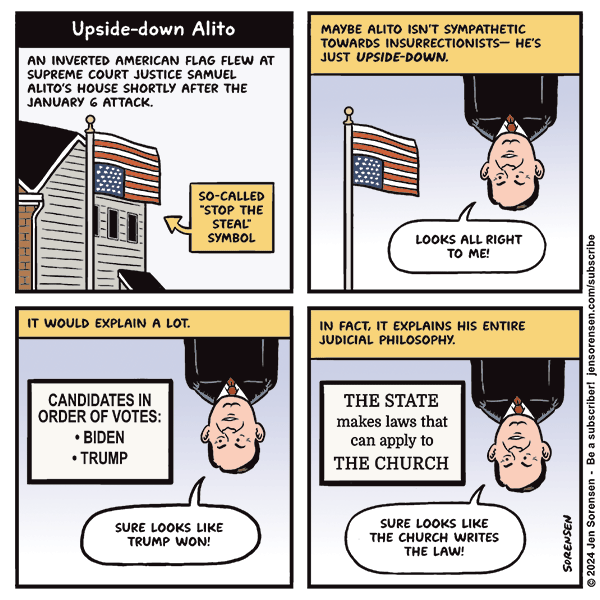
It all started last week, when the NYT revealed that an upside-down American flag flew over Supreme Court Justice Samuel Alito’s home in Virginia for several days between the January 6 insurrection and Biden’s inauguration. An upside-down flag is a traditional distress symbol, and was used by the “stop the steal” movement that believed Biden’s 2020 win was illegitimate. Alito blamed the flag on his wife, whom he said was responding to some kind of dispute with the neighbors. (He provided no further details, and also said that the dog ate his homework.)

Then Wednesday the NYT reported that a second insurrectionist flag, the Appeal To Heaven flag sometimes associated with Christian nationalism, flew over the Alitos’ vacation home on the Jersey shore in July, August, and September of 2023. (It’s not clear whether it flew continuously or sporadically.) This flag was also carried by January 6 insurrectionists.

Since its creation during the American Revolution, the flag has carried a message of defiance: The phrase “appeal to heaven” comes from the 17th-century philosopher John Locke, who wrote of a responsibility to rebel, even use violence, to overthrow unjust rule. “It’s a paraphrase for trial by arms,” Anthony Grafton, a historian at Princeton University, said in an interview. “The main point is that there’s no appeal, there’s no one else you can ask for help or a judgment.”

According to the Supreme Court’s own Code of Conduct, which it released last November to demonstrate it was not completely lawless following revelations of Clarence Thomas’ corruption,

A Justice should disqualify himself or herself in a proceeding in which the Justice’s impartiality might reasonably be questioned, that is, where an unbiased and reasonable person who is aware of all relevant circumstances would doubt that the Justice could fairly discharge his or her duties.

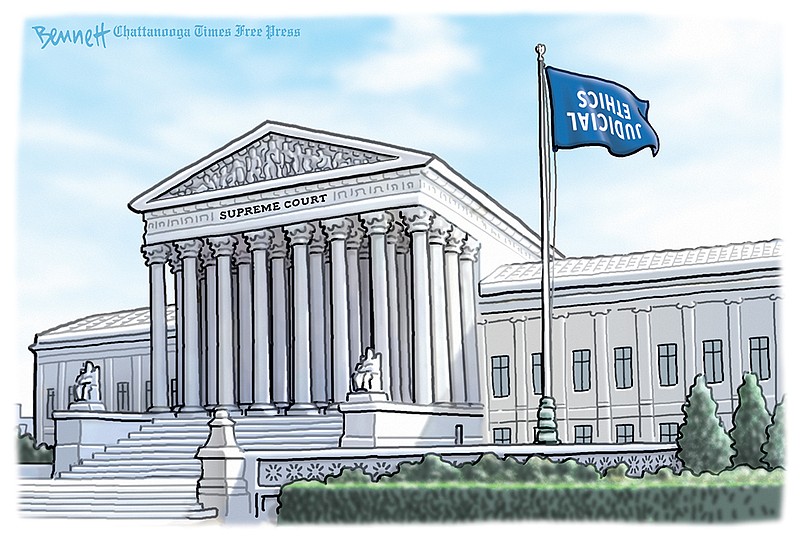
The Court is currently hearing a number of cases related to January 6, and has already ruled that states cannot remove Trump from their ballots on 14th-Amendment participating-in-an-insurrection grounds. Alito’s impartiality “might reasonably be questioned” by “an unbiased and reasonable person” in all these cases. But of course he will not recuse himself and Chief Justice Roberts will not demand that he do so, because in practice the Court has no code of conduct and does not recognize any judicial ethics.

Likewise Congress will not solve the problem. The filibuster will prevent the Senate from passing any binding code for the Court, and Republicans would never participate in an impeachment. I agree with Joyce Vance, that the only conceivably effective response needs to come from the voters:

This one, as I’ve written, is up to us, and to investing in the political cycle. Don’t despair, vote! … If you want a Congress that will pass ethics reform for the Supreme Court, as difficult of an endeavor as it may be to craft rules that will pass constitutional muster, then vote for people who will go on record as supporting it.

It’s unlikely we’ll get a majority large enough to impeach Alito or Thomas. But if it becomes clear that their in-your-face defiance of all constraints is a drag on the Republican Party, partisan interests may start to rein them in.

and international courts v Israel

This week, international courts made two moves against Israel. Last Monday International Criminal Court Prosecutor Karim Kahn sought arrest warrants for leaders of both Hamas and Israel.

Hamas leader Yahya Sinwar and two others are accused of various crimes associated with October 7, including the killings of several hundred Israeli civilians, taking hostages, rape, and so on.

Israeli Prime Minister Benjamin Netanyahu and Minister of Defense Yoav Gallant are accused of starvation of civilians as a method of warfare, intentionally directing attacks against a civilian population, and other related offenses.

Judges of the ICC have not yet approved the warrants. If they are approved, they may not have much effect beyond their influence on international opinion. Neither set of leaders is likely to surrender itself, and the ICC commands no military force able to bring them in.

President Biden denounced the prosecutor’s move:

The ICC prosecutor’s application for arrest warrants against Israeli leaders is outrageous. And let me be clear: whatever this prosecutor might imply, there is no equivalence — none — between Israel and Hamas. We will always stand with Israel against threats to its security.


Friday, the International Court of Justice

ordered Israel to “[i]mmediately halt its military offensive, and any other action in the Rafah Governorate, which may inflict on the Palestinian group in Gaza conditions of life that could bring about its physical destruction in whole or in part.”

The Court also ordered Israel to open the Rafah crossing, to allow United Nations fact-finders to enter Gaza, and to report to the Court within one month regarding its compliance with the Court’s orders. The Court also reaffirmed its prior orders and reiterated its call for the immediate and unconditional release of all hostages held by Hamas and other armed groups.

Again, the international court has little ability to enforce this order, but it may have some effect on popular opinion around the world.


If you’re like me, you may not have previously realized the the ICC and the ICJ are separate entities. Both are located in The Hague. The difference seems to be that the ICC prosecutes individuals, while the ICJ adjudicates disputes among nations.


Another diplomatic blow to Israel: Spain, Ireland, and Norway will formally recognize a Palestinian state tomorrow.

and the Trump trials

Both sides have now rested their cases. The judge declared a break so that summations and jury instructions could occur without interruption by the holiday weekend. Summations begin tomorrow, and the jury should be ready to deliberate later this week.

What they will do is anyone’s guess. An outright acquittal seems unlikely, given the strength of the prosecution’s case. But to prevent a conviction the defense only needs to convince one juror. That juror doesn’t even have to believe Trump is innocent, just that the case against him hasn’t been proved beyond reasonable doubt.


To no one’s surprise, Trump himself did not testify, despite saying many times that he would.

He would have been better off not offering a defense at all. It would have looked like a power move: The government hasn’t proved its case, so we have nothing to answer.

Instead, the defense called one technical witness and then Robert Costello, who was a disaster. Not only was Costello disrespectful of Judge Merchan, leading the judge to clear the courtroom to tell Costello how close he was to a contempt of court ruling, but his presence allowed the prosecution to introduce emails Costello wrote that captured just how mob-like TrumpWorld is.

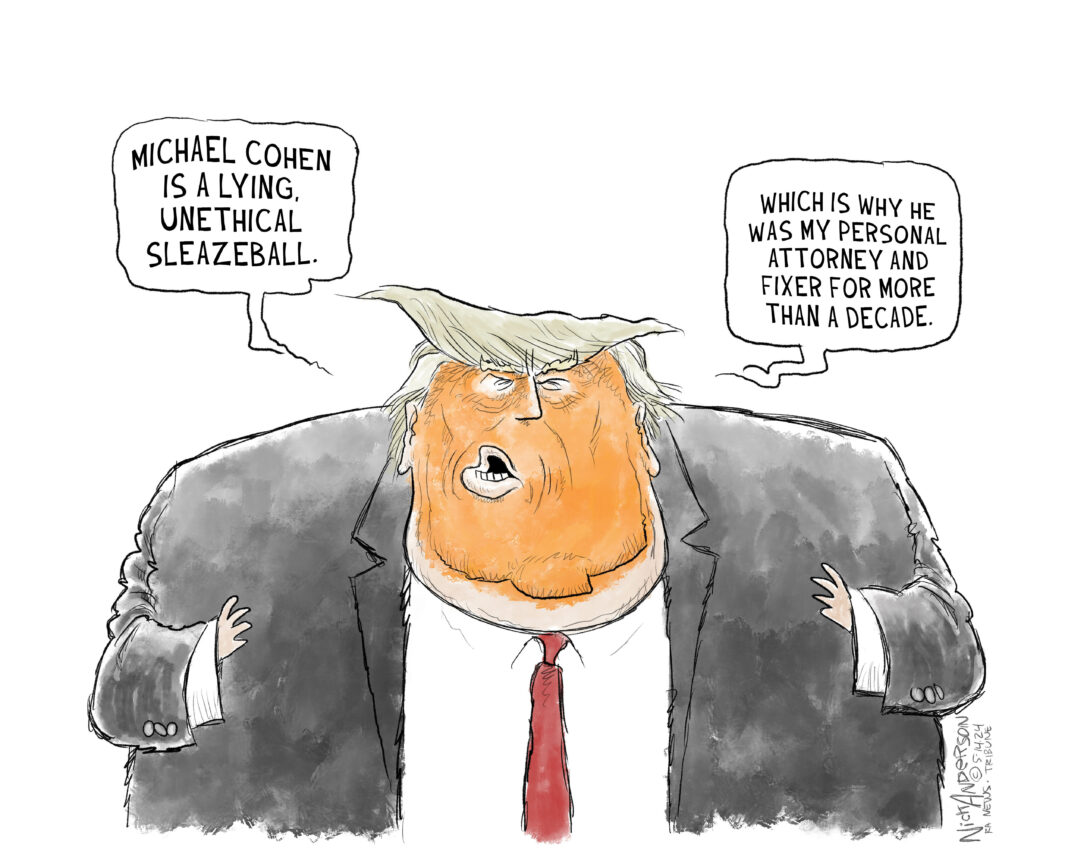
Emails between Costello and Cohen were read aloud to leave the indelible memory in the minds of the jurors that Trump and Giuliani were conspiring with Costello to make sure Cohen didn’t cooperate with the government. There is even an email from Costello to Cohen saying, “Rudy said this communication channel must be maintained…sleep well tonight, you have friends in high places,” and one from Costello to his law partner saying, “Our issue is to get Cohen on the right page without giving the appearance that we are following instructions from Giuliani or the President,” (which they clearly were.) When Cohen didn’t sign on with him right away he told his law partner Cohen was “slow-playing us and the President…What should I say to this asshole? He’s playing with the most powerful man on the planet.” Didn’t he know who he was messing with?

Costello was supposed to undermine Michael Cohen’s credibility, but I suspect he enhanced it. The defense was trying to make Cohen look like a thug, but they overshot and made everyone connected with Trump look like a thug.

and Trump’s assassination claim

At some point years ago, “Trump lies” stopped being a headline; it happens every day, so it’s not news. But this week included a lie so brazen and so outrageous that it deserves attention.

In a fundraising email responding to right-wing media reports that offered a distorted reading of a newly-unsealed court filing in Trump’s classified documents case, Trump falsely claimed Biden was “locked & loaded ready to take me out” when the FBI searched Mar-a-Lago in August of 2022.

In a separate post on his Truth Social platform Tuesday evening, Trump further said he was “shown Reports” that Biden’s DOJ “AUTHORIZED THE FBI TO USE DEADLY (LETHAL) FORCE” in their search of the property for classified documents.

So what’s real? FBI search warrants have boilerplate language that is actually about limiting lethal force:

law enforcement officers of the Department of Justice may use deadly force only when necessary, that is, when the officer has a reasonable belief that the subject of such force poses an imminent danger of death or serious physical injury to the officer or to another person.

In a court filing in the Mar-a-Lago case, Trump’s lawyers left out the “only”, leaving “may use deadly force when necessary”. That document recently got unsealed, and Trump conspiracy theorists jumped on it online, eventually leading Marjorie Taylor Greene and Fox News hosts like Jesse Watters and Jeanine Pirro to start discussing the “assassination plot” like it was a real thing, including imagining shoot-outs with the Secret Service. From there the wild story got back around the Trump, who pushed it for all it was worth. It’s not clear whether he realized that he started the misperception himself.

In reality, it has been known since the day it happened that the FBI had coordinated with the Secret Service and timed the raid so that Trump would be out of town. Trump knows this. MTG knows this. Jesse Watters and Jeanine Pirro know it.


Jack Smith has responded to this incident by noting the possible danger the rumor poses to FBI agents involved in the raid, who could be witnesses in Trump’s Mar-a-Lago trial, if Judge Cannon ever allows it to happen. He has asked Cannon to modify Trump’s terms of release “to make clear that he may not make statements that pose a significant, imminent, and foreseeable danger to law enforcement agents participating in the investigation and prosecution of this case.”

I can’t imagine the boot-licking Judge Cannon acknowledging that Trump lied or that his violent supporters predictably threaten the people his rhetoric targets. But she’ll have to respond somehow.

and you also might be interested in …

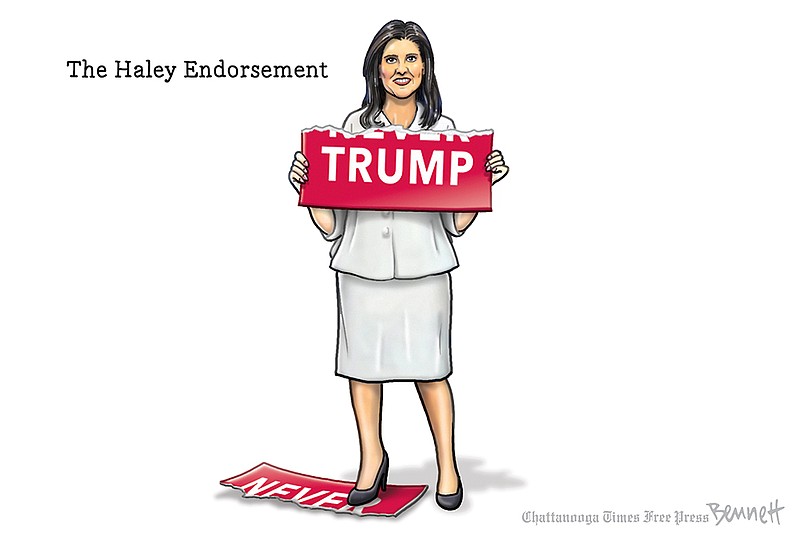
I can’t say I’m surprised that Nikki Haley has finally said that she’s voting for Trump. Did she previously say a lot of bad things about the Great Man? Join the club. Mitch McConnell, Kevin McCarthy, Ron DeSantis — they all said bad things about him before abasing themselves to kiss the ring.

But the people who think Haley is now in the running to be Trump’s VP are crazy. Trump’s VP has to satisfy these conditions:

  • You can’t outshine the boss. (That eliminates not just Haley, but MTG and Vivek as well.)
  • You can’t have your own following independent of the boss. (So: not DeSantis or Haley.)
  • You have to be willing to commit treason for Trump. (He’s not making the Mike Pence mistake again.)
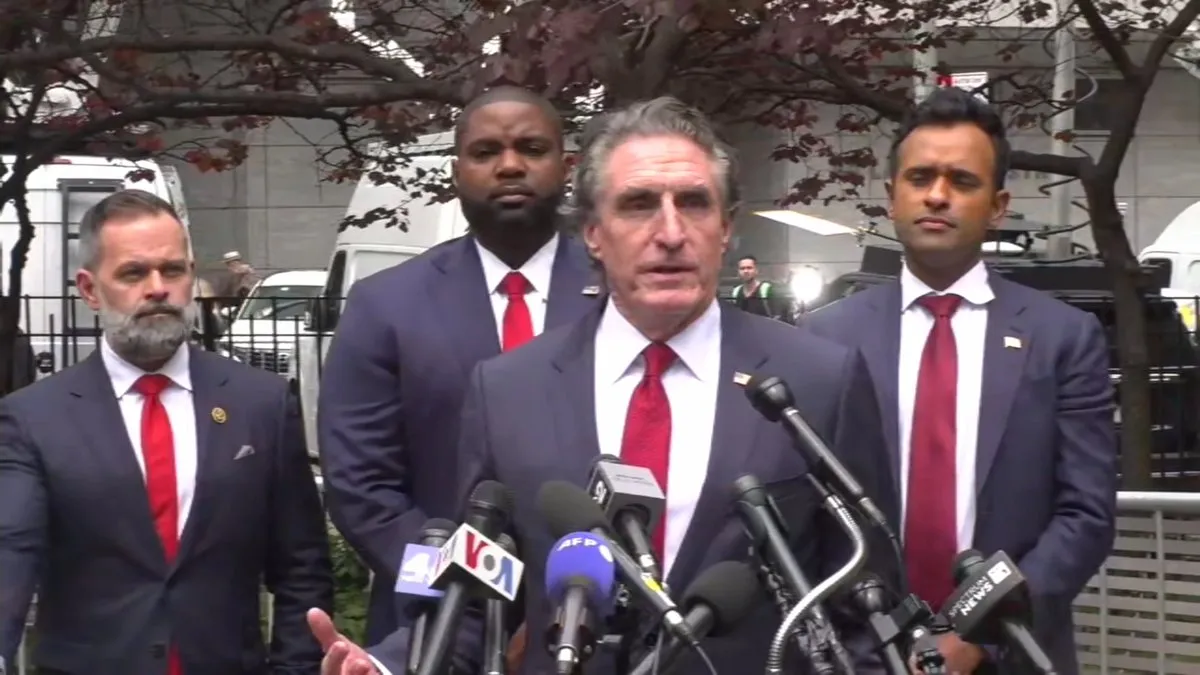
  • You must be willing to repeat whatever claim the boss makes, no matter how absurd or counterfactual. (That’s why so many VP wannabees showed up at Trump’s courtroom wearing matching suits and red ties.)

Just to remind us that there’s no situation so good that a person can’t screw it up, former NFL star Antonio Brown, who earned $80 million during his 12-year career, has filed for bankruptcy.


If you were worried at all about Amy Klobuchar’s ability to hang onto her Senate seat in Minnesota, you can stop. Republicans looks set to nominate an absolute loon.


Cory Doctorow says that “AIs and self-driving cars are the new jetpacks”. It turns out that there was never any reason to think Jetson-style jetpacks were feasible.

In a terrific new 99 Percent Invisible episode, Chris Berube tracks the history of all those jetpacks we saw on TV for decades, and reveals that they were all the same jetpack, flown by just one guy, who risked his life every time he went up in it. The jetpack in question — technically a “rocket belt” — was built in the 1960s by Wendell Moore at the Bell Aircraft Corporation, with funding from the DoD. The Bell rocket belt used concentrated hydrogen peroxide as fuel, which burned at temperatures in excess of 1,000′. The rocket belt had a maximum flight time of just 21 seconds.

But Moore was a great showman, and got it into our heads that jetpacks were an inevitable part of the future — to the point that many people my age lament “Where are our jetpacks? We were promised jetpacks.”

Doctorow explains how the same kind of hucksterism is happening today with self-driving cars and AI in general. Big things are always just a year or two away, and if the impressive demo videos are mostly fake, they’re not lies, they’re “premature truths”.

and let’s close with something thought-provoking

If you’re looking for blogs to read, let me suggest Jess Piper’s “The View from Rural Missouri“. She has that rare touch for telling personal stories that capture something larger. Two posts to get you started: “Losing My Religion“, about how she drifted away from her Evangelical upbringing, and “Daddy Died a MAGA” about how the right-wing echo chamber turned her father into someone she couldn’t recognize.

Alito’s Flags Aren’t the Worst of It

While we were watching the flags, Alito wrote a decision that greenlights racial gerrymanders and opens a door for Jim Crow to come back.


Samuel Alito has long been my least favorite Supreme Court justice, even before his anti-American-democracy flags (which I’ll cover in the weekly summary post that will follow this one), and even before he wrote the Dobbs decision. You might think I just dislike him because his judicial philosophy is different from mine, but I don’t think that’s it. You see, I’m not convinced he has a judicial philosophy.

What makes Alito a frustrating judge for me is that his rulings seem to have nothing to do with the law. In just about any case, you can predict Alito’s opinion by asking three simple questions:

  • Does one outcome favor the Republican Party?
  • Does one outcome favor the Catholic Church?
  • Does one outcome favor the Haves over the Have-Nots?

If the answer to any of those questions is “yes”, that’s where Alito will come down. You can safely make that prediction without knowing anything about the facts of the case or the relevant laws. All the stuff people argue about in law school is irrelevant.

Other justices will sometimes surprise. Even bought-and-paid-for Clarence Thomas has a few legal hobby horses that occasionally cause him to take a position I wouldn’t have expected. But as best I can tell, Alito has none. He has partisan commitments and he votes to support them; end of story.

Whenever I read an Alito opinion, I’m reminded of a distinction that occurs in religion, between theology and apologetics. Theology attempts to ascertain truths about God, but apologetics develops convincing arguments to defend prior religious beliefs. The two often resemble each other: When Thomas Aquinas claims to prove the existence of God through reason, is he nailing down something previously in doubt (theology), or is he evangelizing to rational people who otherwise might not believe in God (apologetics)? It can be hard to tell.

Similarly, Alito’s written opinions often resemble legal reasoning. He cites precedents, makes deductions, and in general constructs arguments that lead to conclusions. But the arguments appear to have nothing to do with how he reached those conclusions. Instead, they give a gloss of legality to Alito’s prior convictions.

The Dobbs decision is an obvious example: Ostensibly, Alito argues that

Our nation’s historical understanding of ordered liberty does not prevent the people’s elected representatives from deciding how abortion should be regulated.

The Dobbs opinion is one long history lesson justifying that claim. But its history is carefully edited, and Alito does not address the points made in an amicus brief by actual historians. [1] He appears to have no interest in history beyond how it might justify fulfilling the Catholic goal of overturning Roe v Wade.

This week gave us another example, whose importance is in danger of being lost in the controversy over Alito’s flags: He wrote the majority opinion in Alexander v South Carolina NAACP, a decision that Vox’ Ian Milhiser calls “a love letter to gerrymandering“. This decision gives states a green light to engage in all manner of racial gerrymandering; the practice is still technically unconstitutional, but under the standards of Alexander, it becomes nearly impossible to establish in court.

Gerrymandering. Let’s review a little: Gerrymandering means drawing the lines of electoral districts so that your side can win a decisive majority in some legislative body with only a minority of actual votes. There are numerous examples of this happening in state legislatures and even in the U.S. Congress. In extreme examples, a near-50/50 state can wind up with a legislative supermajority for one party. (Basically, you pack all of the other party’s voters into a few districts, which they win with 90% majorities. Then you distribute your voters so that you have reliable 55-45 wins in the other districts.)

On paper, gerrymandering is a cross-partisan problem, and there are states where Democrats gerrymander. But Democrats have tried to ban the practice, and on the whole it favors Republicans, whose rural voters are already more distributed geographically, and who have less shame generally about subverting democracy.

Not that many years ago, optimists thought partisan gerrymandering might get banned by the courts as a violation of basic democratic principles. That hope went out the window in the 2019 Rucho decision, where Chief Justice Roberts declared partisan gerrymanding “nonjusticiable”, meaning that whatever damage the practice might do to democracy, courts have no power to stop it.

But racial gerrymandering, where you draw lines to diminish the voting power of some racial minority, is still considered a violation of the 14th Amendment. The problem is how to tell the difference when a racial minority has predictable voting patterns. If South Carolina moves voters from one congressional district to another, how do we know whether they’re being moved because they’re Black (unconstitutional) or because they’re Democrats (nonjusticiable)?

The Alexander case. Here’s how Alito makes that determination in the current case:

The Constitution entrusts state legislatures with the primary responsibility for drawing congressional districts, and redistricting is an inescapably political enterprise. Legislators are almost always aware of the political ramifications of the maps they adopt, and claims that a map is unconstitutional because it was drawn to achieve a partisan end are not justiciable in federal court. Thus, as far as the Federal Constitution is concerned, a legislature may pursue partisan ends when it engages in redistricting. By contrast, if a legislature gives race a predominant role in redistricting decisions, the resulting map is subjected to strict scrutiny and may be held unconstitutional.

These doctrinal lines collide when race and partisan preference are highly correlated. We have navigated this tension by endorsing two related propositions. First, a party challenging a map’s constitutionality must disentangle race and politics if it wishes to prove that the legislature was motivated by race as opposed to partisanship. Second, in assessing a legislature’s work, we start with a presumption that the legislature acted in good faith.

In Alexander, Alito’s assumption of the legislature’s good faith bulldozes all evidence to the contrary. In particular, it bulldozes the deference higher courts are supposed to give to the factual findings of lower courts. In Alexander, a three-judge panel held a trial where they listened to witnesses and compiled a record that runs thousands of pages. That panel concluded unanimously that South Carolina’s gerrymander was motivated by race.

On appeal, higher courts are supposed to accept such judgments unless there is a clear error in the record. (The reason for this is simple: The appellate judges can read the record, but they didn’t hear the testimony. They have no basis for rejecting the lower-court judges’ conclusions about who was or wasn’t telling the truth.) But Alito rejects the lower-court findings because the three-judge panel made the “clear error” of not giving him the finding he wanted. They should have accepted South Carolina’s claims that race was not the motive if there was any possibility that it might be true.

Justice Kagan’s dissent shreds this argument, and concludes:

What a message to send to state legislators and mapmakers about racial gerrymandering. For reasons I’ve addressed, those actors will often have an incentive to use race as a proxy to achieve partisan ends.
And occasionally they might want to straight-up suppress the electoral influence of minority voters. Go right ahead, this Court says to States today. Go ahead, though you have no recognized justification for using race, such as to comply with statutes ensuring equal voting rights. Go ahead, though you are (at best) using race as a short-cut to bring about partisan gains—to elect more Republicans in one case, more Democrats in another. It will be easy enough to cover your tracks in the end: Just raise a “possibility” of non-race-based decision-making, and it will be “dispositive.” And so this “odious” practice of sorting citizens, built on racial generalizations and exploiting racial divisions, will continue.

Disrespect for precedent. Kagan also points out that the Court heard a nearly identical case in 2017: Cooper v Harris. In that case, Alito made a nearly identical argument, but he lost 5-3, and the lower court’s rejection of North Carolina’s map was upheld.

Cases like that are supposed to be binding precedents, but this Court no longer respects precedent, so it reached the opposite conclusion in this case.

What changed since 2017? Were new laws or constitutional amendments passed? Did we learn something new about gerrymandering that called previous conclusions into question?

Not at all. As with Dobbs, the only thing that has changed is the composition of the Court. With the addition of the Trump justices, the three dissenters in Cooper have become the majority. Kagan writes:

Today, for all practical purposes, the Cooper dissent becomes the law.

Going forward. As with Dobbs, the arguments in the decision have much broader implications. When you read Alito’s opinion, it’s easy to forget that the Court’s precedents against racist laws come out of an ugly history. Ignoring this history, Alito expresses great sympathy for state officials who might find themselves accused of racism

[W]hen a federal court finds that race drove a legislature’s districting decisions, it is declaring that the legislature engaged in “offensive and demeaning” conduct that “bears an uncomfortable resemblance to political apartheid.” We should not be quick to hurl such accusations at the political branches.

But you will search Alito’s opinion in vain to find any expression of sympathy for the victims of racism. It’s as if racism exists only as an “accusation”, something disreputably used to stain the reputations of White people, who deserve our “presumption of good faith”.

Kagan calls out Alito’s message to legislatures that want to gerrymander away the electoral power of non-White voters: “Go ahead.” But the Alexander decision is even bigger than that. It says “Go ahead” to any legislative attempt to reestablish Jim Crow. If legislatures just avoid announcing their racist intentions openly, if they create plausible cover stories for laws that disadvantage racial minorities, the Supreme Court will “start with a presumption that the legislature acted in good faith” and be quick to dismiss any evidence to the contrary.


[1] The historians’ brief begins:

When the United States was founded and for many subsequent decades, Americans relied on the English common law. The common law did not regulate abortion in early pregnancy. Indeed, the common law did not even recognize abortion as occurring at that stage. That is because the common law did not legally acknowledge a fetus as existing separately from a pregnant woman until the woman felt fetal movement, called “quickening,” which could occur as late as the 25th week of pregnancy.

The Monday Morning Teaser

Like most people who follow the news, I spent much of the week thinking about Supreme Court Justice Samuel Alito, who (for reasons I’ll explain in the featured post) has long been my least favorite justice. (I suppose one sign that you might be a news nerd is that you have a least favorite Supreme Court justice.)

Alito made headlines this week because we found out that an insurrectionist flag flew over a second Alito home. This led to a lot of calls for him to recuse himself from any cases concerning January 6, which he obviously will not do, in keeping with the well-established grade-school principle of “Make me.” I’ll cover all that in the weekly summary.

But what struck me is a decision the Supreme Court released this week in which Alito wrote the majority opinion: Alexander v South Carolina NAACP. In this decision, the Court gives its approval to a congressional map that a lower court said was an illegal racial gerrymander. But (as with Alito’s abortion opinion in Dobbs), the implications go much further: Under the logic laid out in Alexander, just about any racial gerrymander is OK, as long as you don’t say it out loud. Going forward, any racist legislator who wants to pass a new round of Jim Crow laws should know that he’ll get a sympathetic hearing at the Supreme Court.

This week’s featured post centers on Alexander and its larger implications. It’s called “Alito’s Flags Aren’t the Worst of It”, and it should appear shortly.

That leaves the weekly summary a lot to cover: the flags, the International Criminal Court targeting Israel, the Manhattan Trump trial, Trump’s crazy charge that the FBI tried to kill him (and Jack Smith’s response), Nikki Haley endorsing Trump, Memorial Day, and a few other things.

In addition to the newsy stuff, I found some more general articles worth your attention, like Cory Doctorow’s comparison of AI to jetpacks, and a thoughtful woman’s blog from rural Missouri. I’ll try to get that out by noon, but it’s a holiday, so the schedule might slip.

Not the End

The cabinet, the prime minister, they signal to the Shin Bet that if a Jew is killed, that’s terrible. If an Arab is killed, that’s not good, but it’s not the end of the world.

– former Shin Bet head Ami Ayalon
quoted in “The Unpunished: How Extremists Took Over Israel

This week’s featured posts are “Wide Right: that kicker’s commencement speech” and “Two Significant Articles about Israel“.

This week everybody was talking about Israel and the Palestinians

That’s the subject of one featured post.

and the Trump trial moving towards its conclusion

I’m resisting the urge to write about the trial at length, because there’s one big thing we all want to know right now, and we can’t know it yet: What is the jury making of Michael Cohen’s testimony? I could speculate, I could link to other people’s speculations, or I could cast a hexagram from the I Ching, but in the end there’s nothing worth saying. We won’t know what the jury thinks until it produces a verdict.

Cohen is not quite done testifying yet. Today marks the third day of the defense’s cross-examination and Cohen’s fifth day on the stand altogether. Given how long it’s been since Cohen’s original testimony, the prosecution will probably want to question him in a redirect.

Cohen is the prosecution’s last witness, and the defense has been cagey about who it might call. Maybe Trump? Maybe no one? The burden of proof-beyond-reasonable-doubt is on the prosecution, so the defense could simply rest its case and claim that the burden has not been met. There’s no guessing how long the summation presentations to the jury will take, but we’re probably looking at the trial finishing either this week or next.

One major task for the prosecution’s summation will be to emphasize just how few points of its case rely on Cohen, and how unlikely all the alternative explanations are.

For example, without Cohen we already know that the payoff to Stormy Daniels happened and that Trump CFO Allen Weisselberg agreed to a plan for covertly reimbursing Cohen for fronting this payment. (We know the reimbursement was covert because Cohen was repaid double the amount he had paid Daniels in order to account for taxes. But taxes are unnecessary for a reimbursement. Only that fact that the reimbursement was hidden as “legal fees” accounts for the doubling.) Multiple witnesses have established that Trump was worried about Daniels’ story getting out, and that his worry centered on the election rather than on personal considerations (like Melania’s reaction). Multiple witnesses attest that nothing happened in the Trump empire without Trump’s personal approval.

Only Cohen’s testimony puts Trump in the room when the decisions were made. But if you disbelieve him on this point, what’s the alternative story? That Cohen paid Daniels $130K of his own money without Trump’s knowledge, that Weisselberg and Cohen fooled Trump with the reimbursement scheme, and that Trump signed $35K monthly checks to Cohen for a year without knowing what he was paying Cohen for. Really?


Various Republicans hoping for Trump’s favor have shown up at the courthouse looking like the Dear Leader’s mini-mes. And they wonder why we call it a cult.

Trump continues to be embarrassed that he hasn’t been able to get protesters to show up outside the courthouse, so he falsely claims that police are keeping them away.

and Alito’s insurrection flag

I’m not sure why it took more than three years for this to come out, but an upside-down American flag — the symbol of the pro-Trump Stop the Steal movement — flew over Justice Alito’s home for several days in the weeks following the January 6 insurrection.

Alito’s response to the revelation was ridiculous: His wife did it, in connection with some kind of dispute with the neighbors.

Alito’s statement is notable because, as the Times reporter Michael Barbaro pointed out, it does not deny that the flag was flown in solidarity with the insurrectionists. It also does not disavow the insurrectionist claim that the 2020 election was stolen, and it does not condemn the Trump-directed attempt to overthrow the constitutional order that Alito has sworn an oath to uphold.

Alito is the second justice whose behavior — sorry, sorry, his wife’s behavior — casts doubt on his ability to be impartial to cases involving January 6. (Clarence Thomas’ wife was actively pushing the false story of a stolen election in the lead-up to January 6.)

That raises the most important issue here, which is that Alito and Thomas sit on the nation’s highest court and are poised to rule on matters related to Trump’s attempts to unlawfully hold on to power. In one case, they already have—deciding that the Constitution’s ban on insurrectionists holding office does not disqualify Trump from running for president. The Court is set to rule on a challenge to a federal law used to prosecute the January 6 rioters, and in another case about Trump’s claim that former presidents have “absolute immunity” to prosecution for crimes committed as “official acts” in office. The 6–3 right-wing majority has made its partisan lean unmistakable. But there is still a difference between an ideologically conservative, or even partisan, Court and one with sitting justices whose worldview is so deranged by fanaticism that they would prefer the end of constitutional government to a president from the rival party.

An ethical judge would recuse himself from these cases. But when we’re talking about Alito and Thomas, the good ship Judicial Ethics sailed a long time ago.

and presidential debates

After a back-and-forth of taunts, it looks like there will be two presidential debates. The first is June 15 on CNN, moderated by Jake Tapper and Dana Bash. The second is September 10 on ABC, with moderators not named yet. Both debates will be open to candidates polling at least 15% among likely voters in four national polls. Whether RFK Jr. and his brain-worm will meet that standard remains to be seen.


I continue to be mystified by the negative coverage Biden’s presidential campaign is getting. Trump is currently ahead by less than 1% in the RealClearPolitics polling average, which looks pretty close to even to me. Several polls either have Biden ahead or see the race as tied. And yet Ezra Klein is examining “Why Biden is Losing“. If you just read headlines and don’t bother with the article “Biden is losing” is the only message you’ll get.

Josh Marshall discusses a related issue in “Is Biden in ‘Denial’ about the polls?” Biden, Marshall says, believes the polls don’t show his true strength for a number of reasons. But is that “denial” really?

The factual questions here aren’t terribly complicated and they’re not really the reason I note this article or write this post. Most polls currently show Biden just behind Trump in a tight race. Others show him either tied or just ahead. And there is a theory of the election that those polls, with a greater emphasis on high propensity voters and the concentrating effect of the final months of the campaign, will put Biden on top in November. I’ve tried to air these different arguments here in the Editors’ Blog. You can believe one or the other.

He attributes this pervasive pessimism to a psychological difference between Republicans and Democrats:

If a race is at all close, Republicans think they’re winning, or at least say they think they’re winning. Democrats are the reverse. And if they’re demonstrably winning, they worry that they’re not winning by enough or should be winning by more.

I have my own reasons to believe the polls will swing towards Biden as the election gets closer: Various voting blocs that have been Democratic in recent elections are down on Biden for one reason or another, like Gaza, and are not really thinking about Trump at all. But will young voters really let Big Oil elect a pro-fossil-fuel president? Do pro-Palestinian voters think Trump will be better for them? Do Hispanics really want to see their cousins rounded up in detention camps? I think a lot of those disaffected Democrats will eventually come home.

It doesn’t have to be all of them. I mean, we’re talking about covering a 1% gap.


Trump teased a third-term possibility in a speech to the NRA. In the same speech, a teleprompter malfunction had him completely stymied.

and that kicker’s commencement speech

See one of the featured posts.

and you also might be interested in …

The president of Iran has died in a helicopter crash. Maybe it was bad weather. Maybe it was that Iran’s helicopter fleet has a hard time getting parts, given American sanctions. Maybe it was foul play by either foreign interests or domestic rivals. Too soon to tell.


Governor Abbott pardoned a guy in prison for murdering a Black Lives Matter protester. One of the featured posts discusses how crimes by Israeli settlers against Palestinians have been routinely ignored by the authorities. Well, we have the same pattern here: If you agree with Abbott and kill somebody who disagrees with Abbott, that’s not really murder in Texas.

There’s a strong Nazi parallel here. In the early days of Hitler’s rule, the police were not nearly as scary as they eventually became. But the Brownshirts — non-government Nazi thugs — could do whatever they wanted and the police would look the other way.


A fascinating article in yesterday’s NYT about conservative Christian parents trying to create space in their lives for their transgender children.


The problem with basing a political movement on fiction is that once people get elected they get confronted with reality. Courtney Gore won a school board seat in Texas, pledging to stop the national campaign to indoctrinate children with progressive messages on sex, gender, and race. Once in office, she looked hard for such indoctrination, and didn’t find it. So she changed her mind.


The UAW’s effort to unionize Southern auto plants hit a pothole: The Mercedes plant in Alabama said no. This follows a UAW victory at a Volkswagen plant in Tennessee.

and let’s close with something peaceful

It turns out there’s a whole genre of videos showing natural beauty accompanied by relaxing music. This one focuses on Norway. I haven’t watched the whole thing — who has the time to get THAT relaxed? — but it looks fabulous.

Two significant articles about Israel

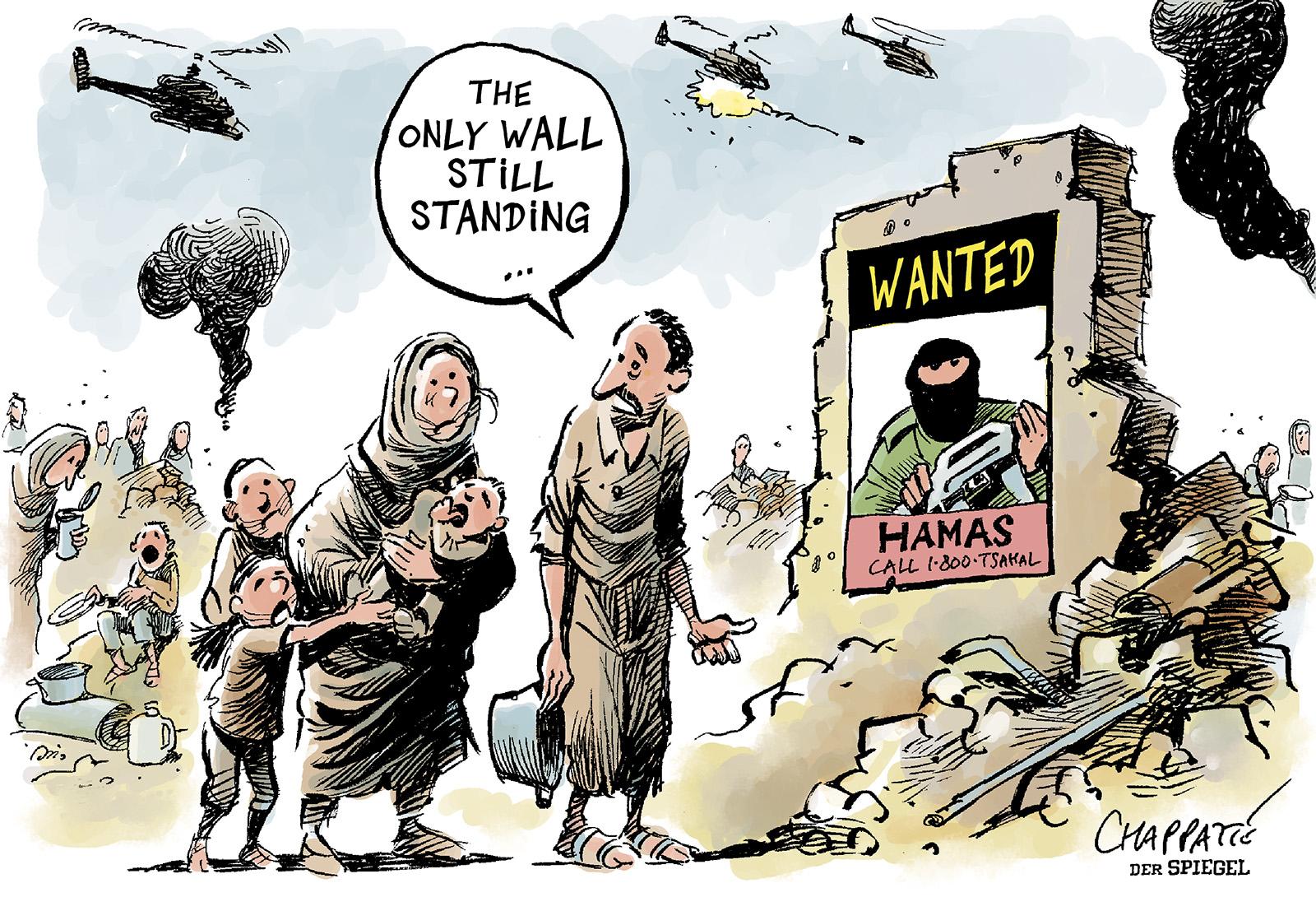
This week saw the publication of two major articles about Israel, one concerning its recent policies in Gaza and the other a long-term look at the official tolerance of settler terrorism in the West Bank. “The Israeli Defense Establishment Revolts Against Netanyahu” by Yair Rosenberg in The Atlantic, describes the conflict within Israel about Netanyahu’s strategy in Gaza. “The Unpunished: How Extremists Took Over Israel” by Ronen Bergman and Mark Mazzetti in the New York Times goes back decades to tell the story of right-wing extremists in Israel who established illegal settlements in the West Bank, terrorized Palestinians, and eventually became a threat to Israeli democracy itself.

Let’s take them in that order.

The central issue of the defense establishment’s “revolt” (which has been entirely verbal so far) is the same issue that divides Israeli Prime Minister Netanyahu from President Biden: What’s the plan for Gaza’s future? Netanyahu has committed himself to nothing beyond Hamas’ total defeat, which itself is only defined vaguely. (As I explained last week, I see Hamas primarily as the idea among Palestinians that peace with Israel is impossible. If that idea is not defeated — which no purely military operation can do — a new insurgent force can reconstitute around it no matter how many fighters Israel kills or captures.)

The lack of a long-term plan for Gaza becomes a military issue because there is no post-Hamas successor government to keep Hamas from reappearing in areas that the Israeli Defense Force (IDF) has cleared. Consequently, soldiers have had to return to “cleared” areas two and even three times since October.

Wednesday, Defense Minister Yoav Gallant went on TV to protest his own government’s policy (or lack of policy):

Already in October, on the night of [the start of] our military maneuver [into Gaza], the defense establishment presented its war plan to the Cabinet, stating that it will be necessary to destroy Hamas battalions, while simultaneously working to establish a local, non-hostile Palestinian governing alternative.

Since October, I have been raising this issue consistently in the Cabinet, and have received no response.

The end of the military campaign must come together with political action. The “day after Hamas” will only be achieved with Palestinian entities taking control of Gaza, accompanied by international actors, establishing a governing alternative to Hamas’s rule. This, above all, is an interest of the State of Israel.

Unfortunately, this issue was not raised for debate. And worse, no alternative was brought up in its place.

Gallant alluded to the multiple long-term defense challenges Israel faces, including confrontation with Iran and its allies in Lebanon. Being bogged down endlessly in Gaza, he claimed, would sap the country’s ability to deal with those challenges. But absent a political solution for governing Gaza, he sees no alternative.

Then he threw down his gauntlet:

I will not agree to the establishment of Israeli military rule in Gaza. Israel must not establish civilian rule in Gaza.

The responsibility to dismantle Hamas and to retain full freedom of operation in the Gaza Strip rests on the defense establishment and the IDF, yet it depends on the creation of a governing alternative in Gaza, which rests on the shoulders of the Israeli government and all its various bodies.

Its implementation will shape Israel’s security for decades ahead.

I call on Prime Minister Benjamin Netanyahu to make a decision and declare that Israel will not establish civilian control over the Gaza Strip, that Israel will not establish military governance in the Gaza Strip, and that a governing alternative to Hamas in the Gaza Strip will be raised immediately.

Rosenberg explains why Netanyahu won’t do that:

Netanyahu cannot publicly commit to a postwar plan for Gaza that includes Palestinians, because the day-after plan of his far-right partners is to get rid of those Palestinians.

Yesterday, standing at a lectern emblazoned with the words settlement in Gaza will bring security, the far-right minister Itamar Ben-Gvir told a rally of thousands that the only way to defeat Hamas is to “return home” to Gaza and encourage “voluntary emigration” of its Palestinian population—a euphemism for ethnic cleansing. “Tell them,” Ben-Gvir declared, “‘Go to your homes, go to your countries. This is ours now and forever.’” Shlomo Karhi, a hard-right member of Netanyahu’s faction, offered similar sentiments. “In order to preserve the security achievements for which so many of our troops gave up their lives,” he said, “we must settle Gaza, with security forces and with settlers.”

Rosenberg quotes polls saying that most Israelis reject this solution, and that Gallant is far more popular than either Netanyahu or his right-wing allies. Another popular figure, war cabinet minister Benny Gantz, joined the rebellion this weekend, threatening to resign if Netanyahu has not brought the war to some kind of conclusion by June 8, which according to the BBC would include “the establishment of a multinational civilian administration”


Back in the 80s — in my memory it’s earlier than that, but the book wasn’t written until 1980 — I remember spinning a paperback rack in a department store and finding They Must Go by Meir Kahane. I didn’t buy it, but I read enough to realize what it was: a plea for Israel to ethnically cleanse Palestinians from the lands it controlled. At the time, I had no idea anyone in Israel was seriously imagining such a thing. But Kahane was the founder of a movement that has continued and grown, and is now a significant force in Israeli politics.

The Unpunished: How Extremists Took Over Israel” by Ronen Bergman and Mark Mazzetti tells the story of that movement and related right-wing politics, going back to 1975 when the Israeli government decided not to remove the first illegal settlement in the West Bank.

The long arc of harassment, assault and murder of Palestinians by Jewish settlers is twinned with a shadow history, one of silence, avoidance and abetment by Israeli officials. For many of those officials, it is Palestinian terrorism that most threatens Israel. But in interviews with more than 100 people — current and former officers of the Israeli military, the National Israeli Police and the Shin Bet domestic security service; high-ranking Israeli political officials, including four former prime ministers; Palestinian leaders and activists; Israeli human rights lawyers; American officials charged with supporting the Israeli-Palestinian partnership — we found a different and perhaps even more destabilizing threat. A long history of crime without punishment, many of those officials now say, threatens not only Palestinians living in the occupied territories but also the State of Israel itself.

Events usually presented in American media as one-off lone-wolf incidents — terrorist bombings targeting West Bank mayors, two armed attacks on the Dome of the Rock mosque (in 1982 and 1994), the assassination of Prime Minister Yitzhak Rabin, and several others — are lined up and connected. Again and again, the Israeli government seems to be at war with itself: It convicts perpetrators and then pardons them, it declares settlements illegal and then funds them, it produces reports of pro-settler corruption and then buries them.

By now, individuals with deep ties to this terrorist movement are inside the government, including Itamar Ben-Gvir and Bezalel Smotrich, who sit in Netanyahu’s cabinet.

To me as an American, the situation in the West Bank is reminiscent of the South during Reconstruction, when the KKK was not an official part of government, but had many allies that would wink and nod at its crimes. The article begins and ends with Palestinians from the village of Khirbet Zanuta whose homes have been destroyed, and who go to the Israeli Supreme Court hoping to get the law to protect them.

A tiny Palestinian community, some 150 people perched on a windswept hill in the West Bank near Hebron, it had long faced threats from the Jewish settlers who had steadily encircled it. But occasional harassment and vandalism, in the days after the Oct. 7 Hamas attack, escalated into beatings and murder threats. The villagers made appeal after appeal to the Israeli police and to the ever-present Israeli military, but their calls for protection went largely unheeded, and the attacks continued with no consequences. So one day the villagers packed what they could, loaded their families into trucks and disappeared.

Who bulldozed the village after that is a matter of dispute. The Israeli Army says it was the settlers; a senior Israeli police officer says it was the army. Either way, soon after the villagers left, little remained of Khirbet Zanuta besides the ruins of a clinic and an elementary school.

Perhaps this kind of treatment will lead to another intifada, but maybe that’s the point.

Ehud Olmert, the former Israeli prime minister, said he believes that many members of the ultraright in Israel “want war.” They “want intifada,” he says, “because it is the ultimate proof that there is no way of making peace with the Palestinians and there is only one way forward — to destroy them.”

Wide Right: that kicker’s commencement speech

Let’s not do to Harrison Butker what Trump did to Colin Kaepernick.


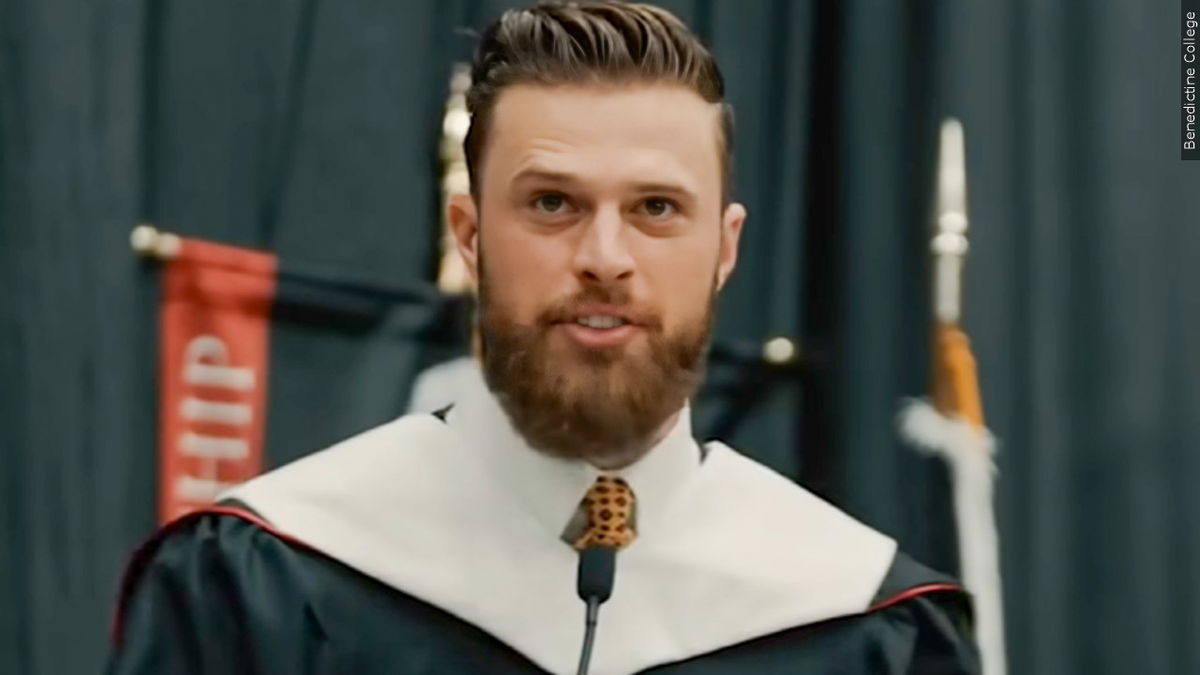
As you’ve no doubt already heard, last Saturday a football player (Kansas City Chief kicker Harrison Butker) gave the commencement address at Benedictine College in Atchison, Kansas. Much has been said and written about this speech, and there’s a petition asking the Chiefs to “dismiss Harrison Butker immediately for his inappropriate conduct”. Last I heard, more than 200K people had signed.

I try to know what I’m talking about before I write, so I watched the full speech on YouTube. (You can also read a transcript.) It’s a very traditional Catholic talk, including a lengthy endorsement of the Latin mass, so if you feel wounded by a Catholic upbringing (as many people I know do), you shouldn’t torture yourself with it.

That said, I would not sign the petition, because taking away someone’s livelihood is a big deal and should be reserved for more serious offenses.

Here’s what I think should happen: People who disagree with Butker and find themselves at a game where he takes the field should feel free to boo loudly. If you have access to any public platform, from your own TV show to a window-facing whiteboard, it would also be appropriate to make fun of him mercilessly. (Here’s an example to get you started.) I don’t know if he endorses any products, but if he does you can boycott them. All those actions just exercise the same freedoms he claims for himself.

So far, the Chiefs have said nothing and the NFL has distanced itself from his message without threatening any sanctions. That, again, is their right.

Of course, this response is nothing like what happened to Colin Kaepernick, whose NFL career ended prematurely after he knelt during the national anthem to protest racism. (Kaepernick’s unofficial shunning by teams who needed quarterbacks accorded with then-President Trump’s demand to “get that son of a bitch off the field.“) That gross injustice should not be forgotten — and in fact this is a good time to remember it — but dealing out a similar injustice to Butker will not right that wrong.

Anyway, here’s why I think Butker should not be punished beyond verbal humiliation: Benedictine College is a Catholic college that in recent years has moved to embrace traditional Catholic teachings and values. Students presumably choose to go there at least partially for that reason (though not all the graduates approved of Butker’s speech, and neither did the Benedictine Sisters associated with the College who said: “We reject a narrow definition of what it means to be Catholic”). Butker told the graduates, in essence, that they should feel good about what their school stands for. Places like Benedictine, he said, “are showing the world how an ordered, Christ-centered existence is the recipe for success.”

I have a lot of tolerance for religious groups making their case positively, as in “This is what we’re doing and it works for us. You should try it.” For the most part, that’s what the Benedictine College leadership seemed to be looking for and what Butker provided. At the end, he got a standing ovation.

Of course, Butker’s speech also included a lot annoyed me, beginning with his fairly snide remarks about “bad policies and poor leadership” during “the Covid fiasco”, which he seemed (without naming names) to attribute to Anthony Fauci but not Donald Trump (whose negligence is implicated in the deaths of hundreds of thousands of Americans). He talked about the importance of Catholics “staying in their lane”, but did not seem to do so when he criticized unnamed bishops. He denounced the “tyranny of diversity, equity, and inclusion”, and referred to “the deadly sin sort of pride that has an entire month dedicated to it”, i.e. gay pride.

He also spoke for his wife, telling “the ladies” what she “would” say about her choice to embrace her vocation as a homemaker rather than pursue her dream of having a career. For all I know he may be totally right about her lack of regret, but couldn’t he have asked her directly and then quoted her exact words, rather than ask himself and imagine her response? I was left to wonder (perhaps unfairly) how many opinions Mrs. Butker is allowed to have.

Mainly, though, he did what defenders of tradition so often do: justify a system in which he himself is privileged. Billionaires extol the virtues of low taxes, white Supreme Court justices tell us why laws protecting non-Whites are no longer needed, and Butker explains that

As men, we set the tone of the culture, and when that is absent, disorder, dysfunction, and chaos set in.

Yes, we men are being totally selfless when we demand to set the tone of the culture. We only do it so that society will be spared the chaos that would inevitably ensue if our God-given authority were ever questioned.

You’re welcome, ladies.