NO SIFT NEXT WEEK. THE NEXT NEW ARTICLES WILL APPEAR ON MARCH 10.
Whoever is winning at the moment will always seem to be invincible.
– George Orwell
“Second Thoughts on James Burnham” (1946)
In order to understand the title of this post and its relationship to the quote, you need to know why ancient Greek statues of Nike, the goddess of victory, had wings: During a battle, birdlike Victory might flit back and forth from one side to the other before landing.
This week’s featured post is “How Things Stand“, my evaluation of the current state of Trump’s attempt to overturn American democracy.
This week everybody was talking about Musk’s chaotic attack on the federal workforce

Elon may have reached the limit of his power this weekend, as other players within the Trump administration began to resist his usurpations of their domains. Saturday, Musk tweeted on X that all federal workers would soon receive an email “requesting to understand what they got done last week. Failure to respond will be taken as a resignation.”
That was followed by an all-government-employee email from hr@opm.gov, an account Musk created specifically to broadcast to the whole federal workforce.
[Subject Line] What did you do last week?
Please reply to this email with approx. 5 bullets of what you accomplished last week and cc your manager.
Please do not send any classified information, links, or attachments.
Deadline is this Monday at 11:59pmEST.
A number of Trump-administration cabinet secretaries did not take this well. Picture it: You’re supposed to be in charge of a department, but somebody from outside your chain-of-command contacts your employees asking for progress reports and threatening their jobs. Presumably he thinks that he (and not you) is going to evaluate their performance. And what if you had something more urgent for your people to be doing on Monday?
So several people who are not Trump-administration dissidents (in any way) pushed back.
Newly confirmed FBI Director Kash Patel told his staff in a separate email later on Saturday that they should “pause any responses”. “FBI personnel may have received an email from OPM requesting information,” Patel wrote in a message obtained by CBS News.”The FBI, through the Office of the Director, is in charge of all of our review processes, and will conduct reviews in accordance with the FBI procedures.”
The state department sent a similar message, saying leadership would respond on behalf of the agency. “No employee is obligated to report their activities outside of their Department chain of command,” an email from Tibor Nagy, acting undersecretary [of State] for management, said.
The Pentagon told its staff: “When and if required, the Department will coordinate responses to the email you have received from OPM.”
From Wired today:
Federal employees at the Department of Housing and Urban Development (HUD) were greeted this morning by television sets at the agency’s Washington, DC headquarters playing what appears to be an AI-generated video of President Donald Trump kissing the feet of Elon Musk, accompanied by the words: “LONG LIVE THE REAL KING.”
A person at HUD headquarters on Monday morning shared a video with WIRED showing the scene playing out on a loop on a TV screen inside the Robert C. Weaver Federal Building. The source, who was granted anonymity over fears of repercussions, says that workers at the building had to manually turn off each TV in order to stop the video playing.
Just for a moment, and for the sake of argument, Paul Krugman takes seriously the notion that government should run like a business. And then he looks at the list of alleged costs DOGE claims to have saved the taxpayers. It doesn’t add up to anywhere near the “$55 billion” Elon claims, but that’s not the worst of it. At one point it mistakes an $8 million contract for an $8 billion contract.
Now, imagine that a publicly held company were to release a statement about its earnings that was riddled with major errors — with all the errors going in the same direction, making the company’s earnings look better than they are. What would you conclude? The answer, surely, would be to suspect that the company’s business is going very badly, but that top executives are trying desperately to hide the bad news while they sell off their own shares and possibly loot the company through sweetheart deals and so on.
and Ukraine

In case you didn’t think it could get any worse, just this morning the US voted with Russia and against our NATO allies against a UN resolution marking the three-year anniversary of the Ukraine War by condemning Russia’s invasion of Ukraine.
Back in 2016, Hillary Clinton said Trump would be Putin’s puppet. And so he is.
Tuesday night, Trump firmly came down on Vladimir Putin’s side in the Ukraine War. He made a number of false claims that echo Russian propaganda, including implying that Ukraine started the war
“I’m very disappointed, I hear that they’re upset about not having a seat [at the talks],” Trump told reporters at his Mar-a-Lago resort in Florida when asked about the Ukrainian reaction. The US president said a “half baked” negotiator could have secured a settlement years ago “without the loss of much land”.
“Today I heard, ‘oh, well, we weren’t invited.’ Well, you’ve been there for three years … You should have never started it. You could have made a deal,” he said.
and that Zelenskyy (but not Putin) is a dictator. The Kyiv Independent explains the electoral situation: Zelenskyy was elected to a five-year term as president in 2019 with 73% of the vote. After the Russian invasion in 2022, martial law was declared. The elections previously scheduled for 2024 were not held due to the government’s inability to establish safe voting conditions in the whole country. (The UK’s Prime Minister Keir Starmer has pointed out that Britain also suspended elections during World War II.)
Trump’s claim that Zelenskyy has a 4% approval rating was a typical Trump statistic: based on nothing. Kyiv International Institute of Sociology estimates Zelenskyy’s approval rating at 57%, far higher than Trump’s.
The Trump administration has been negotiating with Russia about the Ukraine War, but without Ukraine or Europe at the table. Statements by various people in the administration — J. D. Vance, Pete Hegseth — imply that Trump has already given in to many of Putin’s demands: Russia gains Ukrainian territory, the US commits no peacekeeping troops to Ukraine, Ukraine does not join NATO, etc. Meanwhile, Trump has been demanding Ukraine sign over half its mineral wealth to the US in exchange for past support, with no future American guarantees or responsibilities.
Trump’s embrace of a foreign dictator and previous enemy of the United States has not been sitting well with many congressional Republicans, who have pushed back against Trump’s false claims without directly criticizing Trump.
“Putin started this war. Putin committed war crimes. Putin is the dictator who murdered his opponents. The EU nations have contributed more to Ukraine. Zelensky polls over 50%,” Rep. Don Bacon (R-Neb.), a GOP Ukraine supporter, posted on social media, tackling several arguments made by Trump over the past day without naming the president. “Ukraine wants to be part of the West, Putin hates the West. I don’t accept George Orwell’s doublethink.”

and the military firings
Friday, Trump fired two members of the Joint Chiefs — the Black guy and the woman. The JCS will return to being a White men’s club, as God intended. He also fired the top lawyers of all three military services. (These are the people who are supposed to tell military leadership: “You can’t do that, it’s illegal.”)
JCS Chair and four-star General C.Q. Brown (a.k.a. the Black guy) is going to be replaced by a three-star general Trump is bringing out of retirement. Heather Cox Richardson writes:
In place of Brown, Trump has said he will nominate Air Force Lieutenant General John Dan Caine, who goes by the nickname “Razin”—as in “Razin Caine”—to be the next chairman of the Joint Chiefs of Staff. … Caine has held none of the assignments that are required for elevation to this position. His military biography says he was a career F-16 pilot who served on active duty and in the National Guard. Before he retired, he was the associate director for military affairs at the CIA. The law prohibits the elevation of someone at his level to chairman of the Joint Chiefs of Staff unless the president waives the law because “such action is necessary in the national interest.”
But of course it is Brown who is denigrated as a “DEI hire”, not the White man replacing him whose only qualification is his absolute loyalty to Trump.
and the tax/budget negotiations
The Senate has passed a budget plan different from the one the House hopes to vote on tomorrow. A budget outline has no direct effect — no money is appropriated — but it’s necessary to pass one before the reconciliation procedure can become available to circumvent Senate filibusters.
The fact that Republicans haven’t formed a common plan yet — and that the Senate went ahead and voted on its version even though Trump prefers the House plan — indicates that this might be a difficult negotiation.
Republicans got no Democratic votes for their plan, but Rand Paul crossed over to vote against it.
The Republican margin in the House is so narrow that if just two Republicans cross over and Democrats stay united, no bill can pass.
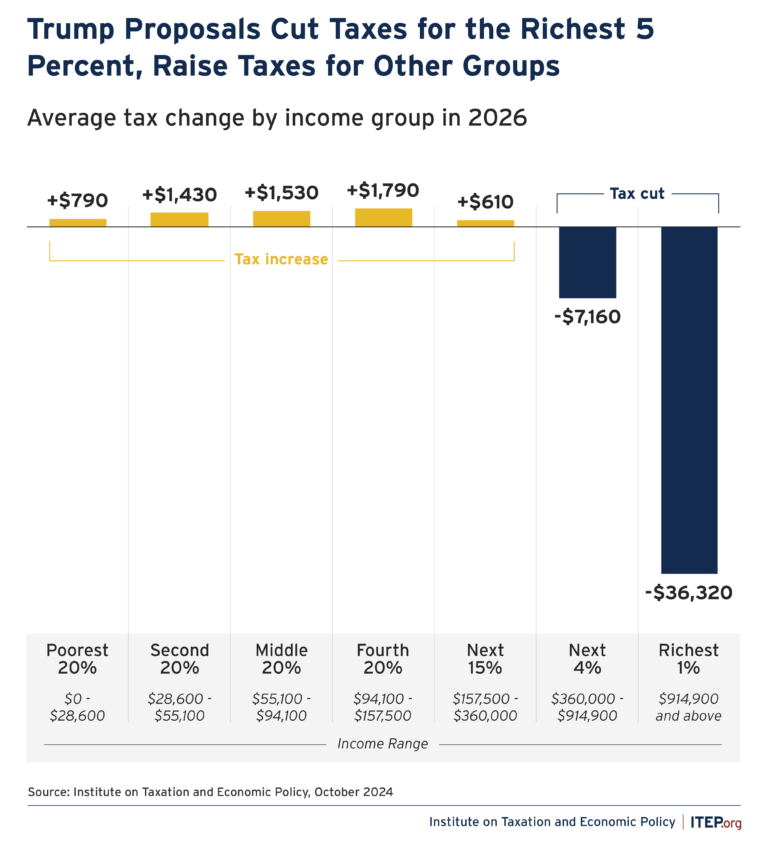
I know basically nothing about the Institute on Taxation and Economic Policy, which claims to be non-partisan and has a board of directors full of academic types. So hold the following analysis lightly.
ITEP looked at the Trump proposals as we know them so far, including his stated (but not yet fully implemented) proposals about tariffs. ITEP models tariffs as taxes eventually paid by consumers, which is what most economists expect to happen.
If you do that, you get these conclusions about how Trump’s proposals will affect taxpayers at various income levels.
but I want to back up and take a larger view
The featured post takes a broad look at how the autocracy vs. democracy struggle is going.
and you also might be interested in …
LawDork points out that even cases that look like wins for the Trump administration are actually worth fighting, because the administration is forced to put its position on the record, and may even make commitments to the judge about how it will interpret certain parts of the policy in question. Even if a lawsuit fails, it shows the administration that someone is watching what they do.
Germany’s governing party, the Social Democrats, suffered a crushing defeat Sunday in Germany’s parliamentary elections, winning only 16% of the vote. Its allies, the Green Party, added 12%.
The leading party was the conservative Christian Democrats with 29%, so the next chancellor will likely be the CDU’s Friedrich Merz. This is not a big deal in itself, since the CDU isn’t all that conservative by American standards. Long-time chancellor Angela Merkel was a Christian Democrat, and the party hasn’t changed all that much in the meantime.
The big news, though was the performance of the neo-Nazi Alliance for Germany (AfD), which got 21%, about double its performance in the previous elections in 2021. AfD was endorsed by American fascists J. D. Vance and Elon Musk.
Trump hailed the election’s outcome. “Much like the USA, the people of Germany got tired of the no-common-sense agenda, especially on energy and immigration,” he wrote in a post on Truth Social. “This is a great day for Germany.”
In addition to local German issues, the new government will play a central role in charting a course forward for Europe in the face of a rising Russian threat and an unreliable ally in America.
Merz struck a blunt tone, saying Trump had made it “clear that [his] government is fairly indifferent to Europe’s fate” and that Germany would have to wait to see “whether we will still be able to speak about Nato in its current form” when the alliance meets for its next summit in June.
“For me, the absolute priority will be to strengthen Europe as quickly as possible so that, step by step, we can really achieve independence from the USA” in defense matters.
and let’s close with something that belongs in your vocabulary
Megan Herbert is a cartoonist with a Substack blog. In a recent piece, a wife calls her husband over to the window because he urgently needs to see something whose nature isn’t revealed until the last panel: It’s a beauty emergency.