Maybe it’s not surprising that conservative candidates would overestimate the conservatism of their districts; we all want to believe that our ideas are popular, and it’s human nature to hang around with people who agree with you. But strikingly, even liberal candidates overestimate the popularity of conservative views.
The results are summed up in these two graphs:
They’re a little hard to read, but gist is that if you ask politicians how much support universal health care or same-sex marriage has in their district, and then compare that result to polls of actual voters, conservative politicians underestimate the public’s support for these liberal proposals by about 20 points — approximately, the authors note, the difference between California and Alabama. And liberal politicians underestimate by a smaller, but still significant, margin.
Most politicians appear to believe they are representing constituents who are considerably different than their actual constituents.
This happens despite the fact that polling has become ubiquitous and relatively cheap compared to other campaign expenses.
in an era when correctly ascertaining district opinion would represent little burden for most politicians, American politicians appear to operate under massive misperceptions about their constituents’ demands that they make little effort to correct.
The authors also tested a fairly extreme conservative proposal: “Abolish all federal welfare programs.” Nationally, only about 13% agree with this statement. But conservative politicians, on average, think almost 40% of Americans agree, while liberal politicians imagine that 25% do.
Maybe this generalized myopia explains why universal background checks on gun buyers are hard to pass, even though polls consistently show 70-90% of the public supports them. A background-check proposal may not pass in Minnesota, despite a local poll showing 72% public support. (79% favor the idea in Washington state and 90% in Ohio.) A Republican Minnesota legislator simply knows that such a result can’t be true.
“There is a lot of opposition,” said Cornish. “I think the survey is bogus. If you have legislators who believe that 70 or 80 percent were in favor of this, you would think they would vote for it.”
The authors didn’t investigate the cause of this pro-conservative perception bias, attributing it mostly to political mythology like Richard Nixon’s “silent majority”. But Salon’s David Sirota wonders if politicians are in fact answering a different question: Maybe they’re not estimating public opinion in their districts as a whole, but support among the people they actually represent — the wealthy. Being wealthy themselves, most politicians enter politics “unfamiliar with their constituencies”. Then things get worse.
Ensconced in a bubble of conservative-minded corporate lobbyists and mega-donors, they come to wrongly assume that what passes for a mainstream position in that bubble somehow represents a consensus position in the larger world.
The electoral process, of course, is supposed to be the panacea – it is supposed to pop that bubble and force a connection between the representative and the represented. However, because getting elected to office is now less about town meetings than about buying expensive television ads, even the campaign process fails to familiarize politicians with rank-and-file voters.
In almost every instance, senators appear to be considerably more responsive to the opinions of affluent constituents than to the opinions of middle-class constituents, while the opinions of constituents in the bottom third of the income distribution have no apparent statistical effect on their senators’ roll call votes. Disparities in representation are especially pronounced for Republican senators, who were more than twice as responsive as Democratic senators to the ideological views of affluent constituents.
Maybe that’s why liberal politicians’ assessment of their constituents’ views are somewhat more accurate, if also skewed: Liberal politicians aren’t any more perceptive than conservative ones, they’re just slightly less responsive to the wealthy.
This week has two featured articles, and they’re both more-or-less done, so they should come out fairly soon. The first, “Who Do Representatives Represent?” looks at a fascinating discovery by political scientists: liberal and conservative politicians alike think their districts are more conservative than they really are. Following David Sirota’s lead and bringing in an important research result from 2005, I raise this possibility: Maybe those politicians are accurately estimating the views of the constituents they actually represent — the rich.
The second featured article “What Bubbles Look Like From the Inside” asks how you could tell if you were living in a propaganda bubble. Atlantic’s Conor Friedersdorf has the right test: Are the people you listen to preparing you for what really happens? Or are you constantly adjusting to big surprises — like Obama’s re-election? Now that ten years have passed, let’s take a look back at the Iraq invasion.
None the supposedly “big” stories this week caught my imagination, probably because I never really cared one way or the other about Hugo Chavez. But the week produced its fair share of shorter notes and interesting human-interest stories.
[Political economy] does not treat the whole of man’s nature as modified by the social state, nor of the whole conduct of man in society. It is concerned with him solely as a being who desires to possess wealth, and who is capable of judging the comparative efficacy of means for obtaining that end.
In life, we take chances on one another. We trust, and we behave in trustworthy ways. Not always; not with everyone. But much more often than the cynical and unflattering views of human nature and interaction would predict. And when we do, it turns out that we thrive; at the least we do better than when we do not trust anyone.
This week everybody was talking about the Voting Rights Act
The Supreme Court heard arguments Wednesday about whether to strike down one of the bill’s key sections. There’s a fairly narrow legal point at issue, but the arguments about that point set off much wider arguments about racism, voter suppression, and federalism.
A little history you may already know: After the Civil War, the 15th Amendment was added to the Constitution. It’s short and to the point:
Section 1. The right of citizens of the United States to vote shall not be denied or abridged by the United States or by any State on account of race, color, or previous condition of servitude.
Section 2. The Congress shall have power to enforce this article by appropriate legislation.
That worked for a while, but then the southern states figured out how to circumvent it via the Jim Crow laws, which set up a variety of procedural hurdles that white-supremacist local officials could use to keep blacks from voting.
In the mid-20th century, the Supreme Court started overturning discriminatory laws, but it couldn’t keep up with white-supremacist legislatures. That’s why the Voting Rights Act of 1965 contained Section 5: States or towns with a history of voter suppression (explained well here and pictured in red on the map) would need prior federal approval before they changed their voting procedures. In the pre-clearance hearing, they’d have to establish that the change would not have the effect of disenfranchising minority voters.
Just last year, Texas’ Voter ID law was blocked because the people who did not already have the mandated ID were disproportionately Hispanic, and the IDs were harder to get in parts of the state where many Hispanics lived.
Everybody recognizes that it’s an extreme step for the federal government to treat some states differently from others. But the 15th Amendment empowers to Congress to enforce the right to vote “by appropriate legislation”. The argument is over what’s appropriate.
In the past, the Court has found the VRA appropriate, given the problem it was trying to solve. However, John Roberts has never liked the VRA and clearly believes it isn’t appropriate any more: Now that blacks in the South vote — sometimes in higher percentages than whites — he clearly believes they can protect their right to vote through the ordinary channels that protects minorities in other states. He asked:
is it the government’s submission that the citizens in the South are more racist than citizens in the North?
My personal answer would have been “Well, duh.” But Roberts apparently believes this is a crushing point.
His attack is part of a larger strategy: On the surface it may look like you could solve Roberts’ problem by extending Section 5 to cover the whole country. But then Roberts could question Section 5 as too broad: How can it be appropriate to interfere in the affairs of states that don’t have a history of disenfranchisement? (He made precisely that argument when he was in the Reagan administration.)
The race/party relationship is particularly pronounced in the South. In Alabama, for example, Romney won 84% of the white vote and Obama 95% of the black.
and the Violence Against Women Act
which passed the House and will be re-authorized as law. I can guess what you’re thinking: “Seriously? This is what a victory looks like these days?” I mean, women also managed to keep the right to vote (in spite of the National Review) and to own property without their husbands’ approval. Pop the champagne!
The VAWA didn’t used to be controversial, for the obvious reason that nobody (in public, at least) is for violence against women. It was last reauthorized in 2005 without a lot of fanfare and signed by that notorious leftist George W. Bush. The Senate passed it this time 78-22 — the 22 all being white male Republicans — but then it got hung up in the House. House Republicans objected to three new provisions: extending the domestic violence protections in the law to same-sex couples, giving temporary visas to battered immigrant women who entered the country illegally, and letting courts on Native American reservations try rape cases.
I haven’t been able to fathom whether opposition was based on substantive objections, or just reactions against buzzwords: illegal immigrants! lesbians! Indians judging white people! (That was a weird one: Senator Grassley really said “on an Indian reservation, [a jury is] going to be made up of Indians, right? So the non-Indian doesn’t get a fair trial.” I don’t know whether anybody asked him if a Native American can get a fair trial from a white jury.)
Ordinarily, Speaker Boehner won’t let a bill come to the floor unless a majority of the Republican caucus supports it — that’s called the Hastert Rule — but I think he realized that the Tea Party lemmings were headed for a cliff on this one, so he arranged for the Senate bill to get a vote after the Republican alternative failed. All 199 Democrats and 87 Republicans voted for the Senate bill, with 138 Republicans against.
But we should be talking about Detroit’s emergency manager
Think of it as the municipal equivalent of being sold into slavery to pay your debts.
Under Michigan’s emergency manager law (which existed before Governor Snyder, but got much more draconian during his administration), if a city or town gets into sufficiently difficult financial shape, the governor can appoint an emergency manager whose powers supersede ordinary politics. The elected officials become empty suits, contracts with the unions don’t count any more, the manager can sell parks or other municipal properties to whomever for whatever he can get.
It has happened to several small-to-medium-sized Michigan cities before, but now the state is taking over the big enchilada, Detroit.
The voters rejected the law by referendum in November, but the legislature just passed it again — with a clever gimmick that shields it from repeal by referendum. Add in gerrymandered state legislature districts, and the law becomes virtually voter-proof.
Everyone should be paying attention, because this is one scenario for the death of democracy: Well-to-do people move to suburbs and gated communities, leaving the poor behind in a city with a crippled tax base. The state cuts aid for local things like schools and waits for a recession to put the city in financial trouble. Then the state takes it over and throws out the elected officials.
Indiana has passed its own emergency manager law. (Indiana’s emergency managers can void union contracts to resolve financial problems, but they can’t raise taxes.) Other Republican-controlled states may follow.
and the larger implications of Justice Scalia’s “racial entitlement” remark
which ThinkProgress’ Ian Millhiser explained. In the oral arguments on the Voting Rights Act (see above), Justice Scalia brushed off the wide majorities (98-0 in the Senate) that reauthorized the VRA in 2006 by saying
Whenever a society adopts racial entitlements, it is very difficult to get out of them through the normal political processes.
(Millhiser has the longer version.) I’m sure you can fill in your own objection to the idea that voting is a “racial entitlement”. But the subtext of his statement is that legislators who secretly disapprove of the VRA nonetheless vote for it because they are intimidated by the threat of being accused of racism. (Conservatives often complain about the power and unfairness of accusations of racism, as if this were a bigger problem than racism itself.)
He knows it’s offensive. He knows he’s going to get a gasp from the court room, which he got. And he loves it. He’s like the guy on your blog comment thread who is using the N-word — “Oh did I make you mad? Did I make you mad? Did I make you mad?” — he’s like that.
But Millhiser’s interpretation is more sinister. One justification for abandoning judicial restraint is that the political process is broken. In such a case, the judge views himself as the last line of defense against injustice. In that context, Scalia’s logic plugs into some other popular notions on the Right, namely Romney’s 47% and the idea that Obama bought the election by giving out favors to “the takers” in society.
Millhiser’s analysis:
it’s not hard to predict how a judge who agrees with both Romney’s view of welfare and Scalia’s view of when judges must destroy democracy in order to save it would react to the modern welfare state. With his racial entitlement comment, Scalia offered a constitutional theory that would allow movement conservatives to strike down the entire American safety net.
To me, it’s interesting where Scalia doesn’t see a broken political system unable to reverse injustice. He favors unlimited corporate political spending and rejects attempts to overrule entrenched corporate entitlements, like the essentially infinite copyright that Disney has on Mickey Mouse.
Mark Hurst pictures Google Glass as a giant step down the road to universal surveillance.
I know that Congressman-Gohmert-said-something-stupid could be a weekly feature, but this stood out:
Slavery and abortion are the two most horrendous things this country has done but when you think about the immorality of wild, lavish spending on our generation and forcing future generations to do without essentials just so we can live lavishly now, it’s pretty immoral.
I suppose if you accept the unBiblical and very-very-weird theological idea that fertilized eggs have souls, abortion could be in a class with slavery. But the debt?
First, I question whether any purely monetary event could be as immoral as slavery (or the Native American genocide, which Gohmert seems to have forgotten). And second, I go back to Warren Mosler’s point: All the goods and services produced in the future will be consumed in the future. Our grandchildren will not be sending stuff back in time to pay for our “lavish” lifestyle, any more than we are sending stuff back to 1944 to pay for World War II.
And finally, if lavish living were the problem, the obvious solution would focus on those living lavishly: the rich. Instead, Gohmert’s party wants to cut food stamps.
Oh, and one more thing: If we’re really worrying about future generations, shouldn’t we focus on global warming instead? In a true fiscal emergency, a future government could renounce its debt. But it can’t renounce its atmosphere.
You know those arguments we have about guns? We could have people study those questions and report back to us. Oh wait — we started to do that and the NRA made us stop.
Noted fake-historian David Barton is branching out. He used to lie about the Founders and religion. Now he’s lying about the Founders and guns.
A number of insightful recent books and articles point out various pieces of the following picture:
People are fascinating bundles of benevolence and selfishness.
A well-designed market can channel people’s selfish tendencies into actions which, in the aggregate, achieve beneficial social ends.
Our economic theory models markets, not people, so only human selfishness is relevant. Homo economicusis entirely selfish.
Because the conditions that nurture benevolence are invisible to market theory, an “optimized” market system may inadvertently poison benevolence. In other words, market theory may create the perfectly selfish people it postulates.
For-profit corporations are artificial entities designed for the market. Consequently, they are defined to be the perfectly selfish, totally profit-driven players market theory postulates.
“Good management” means training each employee to internalize the values of the corporation.
Top managers are valued for their ability to “make the tough decisions”. In other words, they eliminate all human values other than profit from their decision process.
Increasingly, all the rewards of the corporate system flow to those at the top.
Put all that together, and you see that we have created a system that trains us to be bastards, and rewards us according to how well we have managed to stamp out our benevolence.
When you put it that way, it sounds kind of crazy, doesn’t it?
Let’s start with the upside of this vision: If our economic system is making us into worse people than we would otherwise be, then we could be better people and live in a nicer world if we just stopped making ourselves worse. This is not the utopian vision of the “new Soviet man“, a society-centered being who will spontaneously appear (for the first time in human history) after the revolution. It’s the far more modest observation that human beings have benevolent as well as selfish tendencies, and that creative system-builders could figure out ways to make use of human benevolence and nurture it.
That’s the uplifting message of The Penguin and the Leviathan by Yochai Benkler. Benkler says that through most of history, big cooperative projects only happened through “the Leviathan” — the state, exercising top-down power to make people play their parts. (Picture slaves dragging blocks to build the pyramids.) With capitalism comes the alternative of “the Invisible Hand” — the market, in which many individual decisions can add up to something big. (Think about how we wound up with lots of personal computers rather than the “big iron” IBM originally offered.)
Most of our political debate is about the Leviathan vs. the Invisible Hand: Will we get things done through government or by manipulating the incentives of the market?
Anarchists have long claimed that another choice is possible: voluntary cooperation. But until recently, it was hard to find examples on scales larger than a barn-raising.
Then came the open-source movement, which Benkler identifies with the Penguin, the logo of the open-source Linux computer operating system. The Internet grew up together with a host of open-source projects created and maintained by volunteers: Linux, Apache, Mozilla, and eventually Wikipedia. Each in its own way defeated corporate-sponsored for-profit competitors. (Some, like Linux, eventually drew in corporate support, but on their own terms. IBM pays employees to contribute to Linux, but IBM still can’t own Linux.)
Benkler doesn’t claim that we could live in a complete open-source utopia; only that the principles that make open-source projects work have unexplored potential. Many people in our society are starved for opportunities to express their inventiveness, skill, and creativity in ways that do not pay them money, but win them the admiration of a peer group that shares their values. Similar motivations could complement monetary incentives more broadly.
He reviews much of the recent research into cooperation, reaching this conclusion:
In hundreds of studies, conducted in numerous disciplines across dozens of societies, a basic pattern emerges. In any given experiment, a large minority of people (about 30 percent) behave as though they really are selfish, as the mainstream commonly assumes. But here is the rub: Fully half of all people systematically, significantly and predictably behave cooperatively. … In practically no human society examined under controlled conditions have the majority of people consistently behaved selfishly.
The bulk of the book explores non-internet examples of how these principles play out in Japanese management, in community policing, in politics, and elsewhere. He concludes by offering principles for “growing a penguin” — designing a system that nurtures cooperation rather than incentivizing selfishness.
One of Benkler’s political examples — the get-out-the-vote strategy of the Obama campaign — is examined in more detail in The Victory Lab by Sasha Issenberg. It turns out that who people vote for may be determined by self-interest, but whether they vote isn’t. Nobody really believes their single vote will decide the election, so purely selfish people will stay home and pursue their other interests. The most effective method of motivating marginal voters, it turns out, is to appeal positively to their civic pride, while subtly reminding them that their non-voting will be a matter of public record. In laboratory experiments, this pride/guilt combination is more effective than paying people to vote.
Staying positive for a bit longer, Jane McGonigal’s Reality is Broken, which I have reviewed before, finds that online gamers hunger for the chance to be a respected member of a questing community. She reports that many gamers feel their online persona is a better person than they are in their offline jobs and relationships. Like Benkler, she examines ways that the design principles of games could be used to encourage cooperative and altruistic behavior in real life.
Now let’s look at the negative side, starting with a book that walks the line between seriousness and tongue-in-cheek humor: Assholes, a theory by Aaron James. A sociopath is someone who lacks any moral core, but uses other people’s moral scruples to gain an advantage over them. An asshole, according to James, is different: He has a moral sense, but his moral vision comes with an unassailable sense of entitlement. So, for example, he understands perfectly why other people should wait their turn in a line, and is honestly incensed when they don’t. But he also feels — not occasionally, but constantly — that his special situation or status entitles him to cut to the front.
Like Benkler, James recognizes that most people aren’t assholes. (If they were, there would be no lines. We’d all just shove our way to the front.) But late in the book he considers whether a society can reach a tipping point, where there are so many assholes that the rest of us are driven to behave like assholes just to avoid constant exploitation.
From there he considers how capitalism can devolve into asshole capitalism. Suppose some social change causes the system to send
a powerful entitlement message, for instance, that having ever more is one’s moral right, even when it comes at a cost to others. As asshole thinking and culture spread and take hold, the asshole-dampening systems that used to keep assholery in check become overwhelmed. Parents start preparing their kids for an asshole economy, the law is increasingly compromised, the political system is increasingly captured, and so on. As some switch sides while others withdraw, cooperative people find it more difficult to uphold the practices and institutions needed for capitalism to do right by its own values. … Society becomes awash with people who are defensively unwilling to accept the burdens of cooperative life, out of a righteous sense that they deserve ever more.
James applies this model to various countries and concludes: “Japan is fine, Italy already qualifies as an asshole capitalist system, and the United States is in trouble.” (One symptom of Italy’s trouble: Even Silvio Berlusconi’s supporters understood that he was an asshole. Nobody cared.)
And that brings us to Gus DiZerega’s blog post Capitalism vs. the Market. In some ways this belongs to the same genre as my own Why I Am Not a Libertarian — insights that begin with a critique of a simplistically appealing libertarian worldview. DiZerega views the fundamental libertarian error as upholding corporate capitalism because markets are good. DiZerega agrees that markets are good, but corporate capitalism is something else entirely.
Markets, he says, are ways that producers and consumers send each other signals about supply and demand. The market doesn’t tell you what you should do, just what it will cost you. For example, the slave market won’t tell you whether or not you should free your slave, just how much money you’ll be passing up if you do.
But in corporate capitalism the market usurps the decisions once made by humans.
To succeed in managing a capitalist institution a person must always try and buy for the lowest price and sell for the highest before any other value enters in. Any corporate CEO allowing other values to trump this principle will see his or her decisions reflected in lower share prices. If these prices are much affected the corporation risks the likelihood of being taken over in an unfriendly acquisition, its management ousted, and financial values once again elevated above all others. In other words, as a system of economic organization capitalism defends itself against richer human values by penalizing and expelling people who to some degree put them ahead of profit when making economic decisions.
In theory corporations are owned by people. But in practice you cannot remove your capital from a corporation. All you can do is sell your shares to someone else. By selling, you disassociate yourself from practices you may consider immoral, but you do nothing to end them. Think of slavery again: You can free your slave, even if it lowers your net worth. But if instead you own shares in Rent-a-Slave, Inc., all you can do is give or sell those shares to someone else. No slaves are freed when you do.
So if I don’t want to profit by addicting people to drugs that kill them, I can sell my shares in tobacco companies. But the tobacco companies themselves roll on. To the extent that they are profitable, the new owner of my shares will make money and gain power in society. Even individually, power accrues to people who have no values beyond profit.
The libertarian ideal is of people who are free to live by their own values, trading with each other without coercion.
Capitalism is different. It is the gradual overwhelming and destruction of all values that are not instrumental. … Once capitalism exists non-instrumental values are actively selected against, and receive little opportunity for expression. Human beings become profit centers for corporations, and nothing more. … Capitalism cannot distinguish love from prostitution.
I wish DiZerega had said “corporate capitalism” rather than just capitalism, but otherwise I agree. As I put forward two years ago in Corporations Are Sociopaths, we have created entities that embody all of our worst traits. James and DiZerega are pointing out what then happens to us and our society when those created entities are allowed to dominate.
I’m running behind today. This week’s featured article, “Nobody Likes the New Capitalist Man”, will pull together observations from a number of recent books and articles about selfishness and cooperation, focusing on what it’s doing to us to live inside an economic theory that says we’re totally selfish. It should be out by 11 or so.
The weekly summary talks about the Voting Rights Act, the Violence Against Women Act, and the fact the Detroit is about to become a dictatorship — and it’s all legal.
If governments cannot be led to understand the ideas presented here, then their citizens may be denied vital health, education, and other benefits because they appear to be unaffordable, when in fact they are not.
This week everybody was talking about the sequester …
… which I admit has gotten tedious. We’ve had so many of these artificial crises.
Oversimplifying only slightly, let’s review: Since the summer of 2011, Snidely Whiplash (the Republican majority in the House) has been trying to provoke the final showdown with Dudley Do-Right (President Obama) by tying Nell (the American economy) to the railroad tracks. Dudley showed up, but the fight keeps taking longer than either expected. So they keep agreeing to move Nell further and further down the tracks to give themselves more time.
At the end of each episode, they’re still fighting, the train is coming, Nell is struggling … but it gets harder and harder to take the whole melodrama seriously.
What the Republicans have been demanding since Episode 1 is spending cuts. OK, the sequester delivers spending cuts. But they’re really stupid spending cuts, so the Republicans are trying to convince everybody that it’s all President Obama’s fault. For some reason, few people are buying that line.
You might wonder why we need to keep having these artificial crises. Simple: so far the deficit isn’t causing any real problems. For four years now, Obama’s critics have been predicting inflation, high interest rates, a crash in the dollar, and “bankruptcy” because nobody would buy our bonds any more. If any of that were happening, nobody would have to gin up an artificial crisis.
Second, people who want to cut spending keep running into Truth #1 from my Six True Things Politicians Can’t Say: Most government money is well spent. For decades they’ve been building the myth that the government budget is this vast rat hole that consumes money and helps nobody. That makes for great rhetoric, but runs you into trouble when somebody wants you to cut some real waste, because the waste just isn’t there: Even the politically disastrous Ryan Budget had a whole bunch of blank spaces in it where the real cuts happened.
So instead we’ve wound up with across-the-board cuts. The idea is that if the CDC is spending billions of dollars, there must be waste in there somewhere. And the best alternative the Republicans have come up with is to give President Obama the power to specify the cuts instead.
Republicans giving Obama more power? Anything is better than having to take responsibility for foolish cuts.
but I wrote about Baumol’s cost disease
In a very interesting book, elderly economist William Baumol explains why long-term increases in government spending may not be the problem everyone seems to think it is. My review of his book is in What if there’s no spending problem?
The Cruz/McCarthy comparison started because of Cruz’s innuendo-laden attacks on Defense Secretary nominee Chuck Hagel. National Review delivered a characteristically mature I’m-not-but-what-are-you response:
Senator Cruz has ably and aggressively executed his duty as a United States senator to advise on and consent to a nominee to the momentous post of civilian head of the United States military. He has not, as Senator McCarthy was reputed to have done, slandered an honorable man by cavalierly associating him with an odious and politically radioactive “ism.” But we can think of some Senate Democrats and cable-TV hosts who have.
[Notice the “reputed to have done”. These days it’s controversial on the Right whether McCarthyism is anything to be ashamed of. Maybe Tailgunner Joe was just a maligned patriot.]
Jane Mayer of the New Yorker then pointed out that it’s not just this one incident. Cruz has a history of McCarthyism, most overtly in a 2010 speech he gave to the Koch-funded Americans for Prosperity, when he claimed that 12 members of the Harvard Law School faculty “would say they were Marxists who believed in the Communists overthrowing the United States government.” Like McCarthy’s 57 Communists in the State Department, Cruz’s 12 seemed to be a number plucked out of the air, based on nothing.
Rachel Maddow covered this extensively Friday, and did something conservatives practically never do when they throw words like Marxist, socialist, and communist at President Obama — she defined her terms.
McCarthyism isn’t just a generic term for boorish behavior, for boorish right-wing behavior even. McCarthyism is a particular thing. It is making outlandish scandalous allegations against people in public life, and distracting from the fact that you have no evidence to back up those allegations by making the allegations really specific, which makes it seem like they must be coming from some factual basis, when in fact you are just making it up. After making the allegation publicly in a big showboaty way, you then demand that the person against whom you have made this allegation clear his name.
It’s not name-calling when you define the term in a precise and historically appropriate way, and then establish that it applies. At that point it’s just categorization: Cruz practices McCarthyism.
A Cruz spokeswoman answered Mayer’s article — not to Mayer, of course, or to Maddow, but to Glenn Beck’s The Blaze (which sees McCarthyism only as “a reference to Sen. Joseph McCarthy’s notorious and aggressive pursuit of Communists in the 1950s.” As if the problem was that Cruz is pursuing Harvard Law School communists too aggressively.)
Senator Cruz’s substantive point was absolutely correct: in the mid-1990s, the Harvard Law School faculty included numerous self-described proponents of ‘critical legal studies’ — a school of thought explicitly derived from Marxism – and they far outnumbered Republicans.
So they had ideas “derived from Marxism”. But what about “the Communists overthrowing the United States government”? The Blaze makes this excuse for Cruz:
It’s not clear precisely what kind of Communist “overthrow” Cruz said the professors supported — an actual physical takeover or, given the academic setting, a kind of intellectual one with an emphasis on ideas.
So HLS professors had legal theories that reminded Cruz of Marx, and they were hoping those ideas would be adopted if enough people in our democracy came to support them. And so Cruz was totally justified in saying that they were “Marxists who believed in the Communists overthrowing the United States government.”
It’s hard to know what to do with the level of crazy that slithers just below the surface of the gun debate. It’s wild enough that the NRA’s Wayne LaPierre can’t talk about universal background checks (which the NRA used to support) without jumping straight to gun confiscation, which no one seems to be proposing, as best I can tell. (I haven’t even run into liberals fantasizing behind the scenes about gun confiscation. As best I can tell, there is no constituency for it.)
But then you run into discussions like this one on the Talk to Solomon Show on the Conservative Political Network. Here, gun confiscation is just the first step in a long series of speculations that seem to be based on nothing, leading up to a race war. The confiscation order is supposed to turn gun-owning white patriots into criminals who can then be killed in a series of Ruby-Ridge-like incidents. And here’s the ultimate phase of Obama’s fiendish plan:
I believe they will put together a racial force to go against an opposite race resistance, basically a black force to go against a white resistance, and then they will claim anyone resisting the black force they are doing it because they are racist.
A federal force of armed blacks is coming for your guns, and you’ll be called a racist if you resist. And you’re imagining this because … why, exactly?
This is a real challenge for democracy, I think. What can you do when one side just refuses to debate anything that’s actually being proposed?
The same people who will tell you that separation-of-church-and-state is bogus will also tell you that teaching kids yoga violates separation-of-church-and-state.
The Onion explains a great mystery: Chinese hackers have been been vandalizing the Drudge Report for 15 years.
“They make the whole site look like garbage, they publish all this incendiary trash, and meanwhile I have to sit here with my name on this thing—it kills me,” said the popular blogger
I would have made sure this report got out in time for Valentine’s Day:
Bottlenose dolphins call out the specific names of loved ones when they become separated, a study finds.
In These Times calls attention to the perennial problem of wage theft: What if your employer just doesn’t pay your wages?
One of the ways that we’ve been cutting “wasteful government spending” and “job-killing regulation” in recent decades is to severely cut back — or even eliminate entirely — the government offices a short-changed worker can complain to. Whatever you may think about President Obama’s proposal to raise the minimum wage, it’s not going to mean much if an employer can just refuse to pay.
Conservative blogs often post a graph more-or-less like the one below, which I got from the blog of Keith Hennessy, who is currently at the Stanford Business School and used to be Director of the National Economic Council under George W. Bush. (So: not somebody I usually agree with, but probably not a dummy either.) He claims that the numbers were computed for him by Bush’s Office of Management and Budget in 2007. (So: probably not a fabrication.)
It looks bad. Taxes as a percentage of GDP have stayed in a relatively narrow band since World War II, only occasionally peaking over 20%. But starting in about 2016, spending as a percentage of GDP starts to take off, reaching the incredible level of 40% by 2080 with no end in sight.
The typical liberal response to this, which I have given myself, is not that graphs like this are wrong, but that they hide the real problem: Government spending goes out of control because healthcare costs go out of control. But just capping what the government spends on Medicare and Medicaid (i.e., the Ryan plan) doesn’t fix anything. If healthcare costs are unsustainable, then what does it matter whether we’re paying those costs through government, through private insurance, or out of our pockets? Personally, it’s all the same to me whether I go broke paying taxes, paying health insurance premiums, or paying my doctor.
So a liberal would rather imitate the countries who already get better healthcare for less money than we do and increase the government’s role, ideally with a single-payer system.
Summing up: Liberals and conservatives agree that we have a long-term problem, but they argue about what kind of problem: a government spending problem or a healthcare cost problem.
Recently I ran into a potentially game-changing question: What if there is no problem? In other words, instead of being trapped in the dismal liberal/conservative argument about which apocalypse we’re headed towards, what if we’re actually not headed towards an apocalypse at all?
Baumol is an economist who is most famous for identifying Baumol’s Cost Disease in the 1960s. His observation is that although the economy as a whole becomes more productive with the advance of technology, not all sectors progress equally, and some don’t improve their productivity at all. For example, a 21st-century farmer feeds far more people than a 19th-century farmer. Likewise, a worker at a modern shoe factory makes more shoes than a 19th-century cobbler. But it still takes four talented musicians to perform a Beethoven string quartet, and they don’t do it any faster than they did in Beethoven’s day. String quartets have not seen a productivity increase.
The economic consensus of the 1960s said that wages were tied to productivity. If that were true, then classical musicians would have seen their incomes crash relative to farmers and shoemakers, who would by now be vastly wealthier than the lowly performers of the New York Philharmonic or the Boston Pops.
In fact that didn’t happen, because in the long run the labor market has a supply side as well as a demand side, the result being that every profession has to pay enough to induce talented people to make whatever sacrifices are necessary to enter that profession. But something has to give somewhere, so we see the productivity difference as inflation: The price of a New York Philharmonic ticket is going to rise much faster than the cost of a loaf of bread or a pair of shoes.
So Baumol’s observation is that industries with a large component of personal service are not going to increase their productivity as fast as the rest of the economy, and as a result those industries are going to see higher inflation than the economy as a whole. Year-by-year those higher inflation rates might just be a nuisance, but over time exponential growth works its dark magic: If two products each cost $1 today, but one is subject to a 2% inflation rate and the other 10%, in 100 years the low-inflation product costs $7.25 and the high-inflation product costs $13,781.
Health care. Health care has a high component of personal service. It does not have high productivity growth.
Now this part gets a little tricky, because we all know how much medical technology has improved over the decades. But the improvement is almost entirely on the outcome side rather than the productivity side. Adrian Peterson could tear up his knee and be better than ever the next season, where half a century before Gale Sayers was never the same. But the amount of attention patients need from doctors and nurses has not gone down. Health professionals are doing better for their patients, but they are not processing more of them faster.
And most of us wouldn’t want them to. If you heard that one local hospital had one nurse for every five patients and another “more productive” hospital had one nurse for every 50, which would you choose for your surgery? If one doctor sees 30 patients in an hour of clinic time and another doctor only six, which would you pick as your PCP?
So back in the 1960s, Baumol looked at this situation and concluded that medical inflation was here to stay. Not because doctors are greedy or health insurance companies are evil or socialized medicine is inefficient, but just from the nature of health care. While other factors undoubtedly matter, the exponential growth would happen anyway.
This is borne out by the inability of any country to tame medical inflation. France, for example, is often held up as a model healthcare system. But its costs are also rising exponentially.
Government spending. And it isn’t just health care. Government services in general tend to be in what Baumol calls “the stagnant sector” — not due to bureaucratic waste or the power of public-sector unions, but because the services themselves require one-on-one attention.
In education, we call productivity by another name: students per teacher. But nobody wants his third-grader in a 150-student lecture hall. Everybody’s happy when an hour of labor builds more cars or mines more copper. But it’s not necessarily a good thing if social workers, public defenders, parole officers, or cops on the beat handle more cases faster.
So Baumol predicts that over time government spending will rise as a percentage of the economy.
But we can afford it. So far this is just a different spin on Hennessy’s graph. But here’s the difference: In Baumol’s model, government spending isn’t crowding out everything else. As a society, we aren’t doing without manufactured goods because health care is soaking up all our money; we’re just using less of our labor to produce the manufactured goods we want.
Despite their ever increasing costs, stagnant-sector services will never become unaffordable to society. This is because the economy’s constantly growing productivity simultaneously increases the community’s overall purchasing power. … If governments cannot be led to understand the ideas presented here, then their citizens may be denied vital health, education, and other benefits because they appear to be unaffordable, when in fact they are not.
In other words, even though orchestra tickets cost more now than in the 1800s, it’s ridiculous to claim that past societies could afford orchestras and our far richer society can’t.
Think about food. America’s Farmers estimates that an American farmer today feeds 155 people. By contrast, in colonial times a farm family barely did more than feed itself. Imagine going back to colonial times and telling people that by 2013 the non-farm part of the economy would grow so much that it would force a single farmer to feed 155 people! They would undoubtedly picture some cancerous expansion in the non-farm economy that could only be checked by mass starvation.
But that’s not what happened. The non-farm economy came to dominate GDP, but we’re not starving. That 1 farmer is providing his 155 eaters with too many calories, not too few.
This conclusion — that our descendants will likely be able to afford more health care and education as well as more of all the other goods and services they consume — may seem strikingly implausible … if health-care costs continue to increase by the rate they have in the recent past, they will rise from 15 percent of the average person’s total income in 2005 to 62 percent by 2105. This is surely mind-boggling. It means that our great-grandchildren in the year 2105 will have only a little less than forty cents out of every dollar they earn or otherwise receive to spend on everything besides health care — food, clothing, vacations, entertainment, and even education! Yet as this book will show, this prospect is not nearly as bad as it sounds.
There are many possible objections to Baumol’s argument. (I wonder how it’s affected by the way that wages in general have come unstuck from productivity.) But here’s the message that I take from his book: When someone presents a graph like Hennessy’s and acts like the conclusion is obvious — say, that government spending can’t reach 40% of GDP by 2080, and so some catastrophe will have to intervene before that point — don’t buy it without a more compelling explanation.
The economy of 2080 or 2105 will be different from today’s in many, many ways. Maybe current trends will persist until then or maybe they won’t. But you can’t conclude anything from the mere fact that some statistic from the far future looks implausible.
The far future is going to look implausible to us, if we manage to survive long enough to see it. That’s the one prediction I have complete confidence in.
This week’s featured article will be a look at William Baumol’s recent book The Cost Disease, which presents a unique point of view on the country’s long-term fiscal problem: It may not be a problem.
In other words, what if the exponential growth in medical expenses that drives the long-term exponential growth in government spending is just the ordinary course of affairs in an economy with growing productivity? What if medical spending isn’t squeezing out other consumption, but instead our ability to make everything else with less labor is leaving more space in our economy for health care?
Also worth attention this week: The resemblance between Ted Cruz and Joe McCarthy might be more than just a trick of the camera angle. Why there’s no White History Month. Fascinating new stuff about dolphin communication. The NRA thinks it has found a wedge issue. And you have no idea just how far out there the discussions on right-wing talk radio are getting.
This week everybody was talking about the State of the Union
It was a good speech (text and video here) that has been well covered elsewhere. Immigration reform and gun control were already on the national agenda, but President Obama also made some new proposals:
Do something about climate change. Ideally, Congress would pass something like the old McCain-Lieberman cap-and-trade bill. “But if Congress won’t act soon to protect future generations, I will.” Grist suggests that threat/promise is empty, but David Roberts lists things Obama could do.
Preschool available to all. The research behind early education is impressive. In the Perry Preschool study, “123 African Americans born in poverty and at high risk of failing in school” were randomly divided into two groups; one got an intensive pre-kindergarten program at ages 3 and 4, and the other didn’t. The groups have been followed (so far) until age 40.
(More details in this Chris Hayes segment.) If that’s any measure of what can be accomplished, then making the program available to anybody who wants it — especially at-risk kids from poor families — is a no-brainer. Independent of any improvements to the kids’ life experience, the government might ultimately save money by spending less on them (for prisons, welfare, unemployment …) over their lifetimes.
Raise the minimum wage from $7.25 to $9 and index it to inflation. Obama framed this as a moral issue:
a family with two kids that earns the minimum wage still lives below the poverty line. That’s wrong.
Republicans mostly responded with economic arguments: Raising the minimum wage would kill jobs and cause inflation. The inflation claim effect isn’t that worrisome, because minimum-wage work is a vanishingly small part of the cost of production of most products, and the price of many products has little to do with the cost of production anyway.
Whether the proposal would kill jobs depends on why people are making minimum wage. If it’s because an hour of their labor adds only $7.25 to their employer’s output, then employers will fire them rather raise them to $9. On the other hand, if they produce more than $9 of value, but they make $7.25 because they are powerless people competing against a large pool of other powerless people for whatever jobs they can get, then businesses will just suck it up and pay them more.
A nonpartisan commission to improve the voting experience in America. This was either a too-timid response to a serious problem or an attack on the sovereignty of the states (who have a God-given right to make people in minority neighborhoods wait as long they want) depending on who you listen to.
and the unresponsive responses …
Tea Party Republican Marco Rubio gave the Republican response (text, video), and Tea Party Republican Rand Paul gave the Tea Party response (text, video). The main thing I learned was that Republican still live in a bubble.
Instead of responding to the President’s actual speech, Rubio and Paul continued the Clint Eastwood tradition of debating an Obama only Republicans can see. Apparently, the invisible President Obama denounced the free enterprise system and called for government to take over the economy, so Republicans were proud of Rubio’s and Paul’s able defense of the American way of life. But if you live outside the Republican bubble and watched the visible President, you had to wonder what the hell they were talking about.
Marco, I can’t let this lie pass:
In fact, a major cause of our recent downturn was a housing crisis created by reckless government policies.
In actual fact, no, unless you mean reckless de-regulation of Wall Street, which I think is the opposite of what you’re trying to imply. The Barney-Frank-did-it version of the financial collapse is some of that “math you do as a Republican to make yourself feel better.” No one can stop Republicans from blaming regulation for a crisis brought on by de-regulation, but they can’t make it true no matter how many times they repeat it.
And that’s what’s really wrong in GOP-land: They’ve never come to terms with the failures of the Bush administration. (Also they haven’t understood the young voter or embraced 21st-century technology, as Robert Draper pointed out in the NYT Magazine this week.)
When Democrats got clobbered in 1980, 1984, and 1988, they did some genuine soul-searching and decided they had to overcome the big-government mindset of LBJ’s Great Society. They had to own up to the stagflation of the Carter years and get past the Vietnam Syndrome that made the electorate unwilling to trust a Democrat as commander-in-chief. The result was President Clinton’s move to the center in the 1990s, his announcement that “the era of big government is over“, welfare reform, fiscal seriousness that eventually led to a budget surplus, and Senators Kerry, Clinton, and Biden voting to authorize the Iraq War.
Whether you agree with that shift or not, it was real and had consequences. So far, GOP reform isn’t and doesn’t. Nothing in Rubio’s speech (or Romney’s campaign) would have been out of place in the Bush administration. Hell, Republicans still listen to Dick Cheney.
Voters can’t forgive them if they won’t repent.
but I want to talk about evolution …
In honor of Charles Darwin’s birthday (last Tuesday), I thought I’d address the swing voters to whom creationist arguments sound sort of reasonable. Evolution/Creation for Non-Eggheads.
and food …
Fascinating Supreme Court case about Monsanto’s ability to control its seeds. Legally, genetically engineered seeds are treated like software. They’re sold with a licensing agreement that prevents farmers from using their harvest for next year’s seeds. Growing one seed into many seeds — as farmers have done since dawn of agriculture — is like making your own copies of copyrighted software.
But Monsanto’s Roundup-ready soybeans now dominate the market to such an extent that if you buy a random truckload of soybeans from a grain elevator, chances are most of them are Roundup-ready. A 300-acre farmer did that, and planted the beans he bought. Monsanto is suing him.
As I’ve occasionally pointed out before, our food system has gotten really crazy. A new book Foodopoly describes it as an hourglass: lots of farmers at one end and lots of eaters at the other, but between them a narrow bottleneck controlled by a few big corporations. Increasingly, corporations make the major decisions and people are powerless.
Genetic engineering is a good case in point. Chances are you never decided to start eating Monsanto’s genetically engineered grains; maybe you don’t even realize you do. But most corn seed is Monsanto’s now, which means most high-fructose corn syrup is GE. And HFCS is in everything.
Farmers are controlled on one side by seed corporations, who are closing off all other ways to get seeds. On the other side, the market for farm crops is controlled by big suppliers who serve big retailers like WalMart and McDonalds. They impose their standards on the farmers, who have no alternative buyers. This is a detailed example of the general monopsony problem described in Barry Lynn’s Cornered.
This kind of thing was just what I was hoping for when Elizabeth Warren ran for the Senate. She’s not rude or abusive. She’s not a Joe McCarthy-like bully. But she’s got a good question to ask and she’s going to stick with it.
You’ve got to wonder if the NRA is even trying to win elections any more. Maybe the whole point is to pander to the tiny slice of the population that buys lots and lots of guns. In an op-ed for the Daily Caller (fact-checked by Joe Nocera), Wayne LaPierre presents a personal arsenal as the only rational response to the looming collapse of America into post-apocalyptic barbarism.
Nobody knows if or when the fiscal collapse will come, but if the country is broke, there likely won’t be enough money to pay for police protection. And the American people know it.
Hurricanes. Tornadoes. Riots. Terrorists. Gangs. Lone criminals. These are perils we are sure to face—not just maybe. It’s not paranoia to buy a gun. It’s survival.
Don’t forget the zombies, Wayne.
Slate explains why pro-gun people keep saying that bats and hammers kill more people than guns (as a Georgia congressman did after the State of the Union). A long time ago someone made the true point that in America bats and hammers kill more people than AK-47s. (That would probably change if every Little Leaguer carried an AK-47 or they became a standard part of every home toolkit, but never mind.) Exaggeration took over from there, and since fact-checking is a liberal conspiracy, this absurd claim is now a permanent part of the public discussion.
The folks at Saturday Morning Breakfast Comics understand that S&M might be a little different after you’ve had ten years to figure out what really tortures your spouse.
During Winter Storm Nemo, Brian Maffitt pointed a movie projector out the window and projected “The Lorax” onto the falling snow. He added music and got something that isn’t recognizable as Dr. Seuss, but it’s beautiful and peaceful in that log-burning-in-the-fireplace way.
Every year I use Darwin’s birthday (last Tuesday) as an excuse to check in on the creation/evolution issue and the debate over what to teach in public schools. That pot is always simmering, so whenever you choose to pay attention something is bound to be happening somewhere. But it gets dull really quickly, because both sides repeat themselves a lot. Checking once a year is about right.
This year I watched PBS documentary “The Revisionaries” about the battle over curriculum standards in Texas. (You can watch it for free on the PBS web site until Feb. 28.) As always, I was impressed by how well the creationist side pitches its arguments to the general public. “Teach both sides,” they say. “Teach the controversy. Teach the strengths and weaknesses of evolution.” It sounds so fair and reasonable — nothing at all like the stereotype of the crazy fundamentalist radical.
Then the scientists come on, and they look and sound exactly like their stereotype. You can tell they’re trying to be nice and non-threatening, but whatever they’re saying, the main thing that comes through is that they’re smart and they know better than you. It’s hard not to be reminded of all the other “experts” who are constantly explaining why everything you do is completely wrong: You eat wrong, you exercise wrong, you like the wrong kind of music, you watch the wrong kinds of movies and TV shows — everything you do is bad, and you should listen to them to learn how to do it right.
Most of all, you raise your kids wrong. When you let the kids do what they want, that’s wrong, but when you force them to do what you want, that’s wrong too. You talk to them wrong, you discipline them wrong — it goes on and on. And sure, you realize you aren’t the greatest human being who ever lived, but you do OK and your kids seem to be doing OK, so you wonder what you’d see if you walked into the experts’ houses and looked at their kids (if they have any). Are they better, really?
Sure, the evolution scientists are a different kind of expert entirely, but they look and sound exactly the same. You know you shouldn’t judge a book by its cover, but the look-and-feel thing is hard to get past. Watching them, all you can think is: “What do they want really? And why? Can’t they just come out and say that?” But they don’t. So when preachers tell you that the scientists want to destroy religion and convert everybody to atheism — well, at least that’s an answer.
I’ve lived a bunch of my life between the world of scientists and the world of ordinary people. I grew up in a small town in the Midwest and spent a lot of afternoons helping my Dad on the farm. I went to a Lutheran grade school where we memorized Bible passages every night and had to recite them in the morning. (We definitely did not learn evolution. I started picking that up in the public high school.) But I was born with a knack for math and went on to get a bunch of degrees. I’m not an evolutionary biologist, but I can hang with them when they let their hair down and not seem out of place.
Let me see if I can translate how this discussion looks to a university biologist or a high school biology teacher.
Politicians are telling them how to do their job. I’m guessing you can appreciate how that feels. They’ve devoted their lives to studying biology, figuring out how it all fits together, and coming up with ways to teach that knowledge to other people. And then a legislature or a school board or Congress wants to stick a hand up their backsides and turn them into puppets who repeat whatever they’re supposed to say.
You know how you feel when people who don’t know your kids tell you how to raise your kids? Well, people who don’t know their subject are telling them how to teach their subject. It pisses them off.
One of the reasons they so often look phony is that emotional outbursts aren’t valued in scientific discussions. In science, you’re supposed to be reasonable all the time, even when you’re really pissed off. So they can’t let on how they really feel. Instead, all that anger gets channeled into a biting cleverness that can be really, really annoying.
Why evolution is important to them. I’m sure they think they answer this question all the time, but it never comes out in the language ordinary people speak, so let me see if I can explain it better.
Have you ever listened to six-year-old boys describe a movie they’ve just seen? They remember all of it — probably more than you would if you saw it. Their young brains are sponges that soak up detail. But when they talk about it, those details come back out in some stream of consciousness that you can’t possibly understand if you haven’t seen the movie yourself. That’s because they haven’t learned yet what a plot is, or how use a plot to organize a whole bunch of facts into a story that people can understand and think about together.
Well, evolution is the plot of biology. By now, we know so much about cells and animals and environments and so forth that no one could possibly deal with it as a long list of details. You couldn’t learn it, you couldn’t teach it, you couldn’t even think about it, no matter how smart you are. But evolution arranges all that in a structure that people can learn and teach and think about. Even if evolution had turned out not to be true, biologists would still want to learn it as a memory device. It’s that useful.
Now, the obvious question is: Couldn’t creation or design become the plot of biology? It more-or-less was 200 years ago. And sure, we have a lot more details to organize now than we did then, but maybe biologists could make all that new knowledge fit somehow. So rather than saying “Giraffes evolved long necks because being able to eat leaves higher in the canopy gave them a survival advantage”, we could say “God designed giraffes with long necks because he knew they’d need to eat leaves high in the canopy.”
What’s wrong with that?
The first answer you’re likely to get from a biologist is that it wouldn’t work, because of things like your appendix. (It’s hard to make sense of the human appendix from a design point of view, because it doesn’t do anything useful. It makes sense from an evolutionary point of view, though, because similar organs serve a purpose in the digestive systems of animals we’re related to, and evolution works slowly, so it hasn’t been useless long enough to evolve away.)
But the better answer is: Who knows? Maybe there is some way to tie all our biological knowledge together in a design-oriented plot. But nobody has done it. Whether some design-oriented plot for biology could work or not, it doesn’t exist now. It’s like talking about whether solar power could someday supply all our needs. Maybe. But that doesn’t help me if I want to flip on a light now.
So if, today, you want to learn or teach or think about the full range of what we know about biology, evolution is all you’ve got. You either use it or you give up.
Creationist textbooks are facades. Biology teachers know that K-12 students in China, India, Europe, and Japan are learning real science, not fantasies about approaches to science that maybe could work someday (but don’t work now and probably won’t work ever). So they wonder: How are American kids going to compete if we’re wasting their time like that?
Creationists can hide this state of affairs from the general public by writing design-oriented grade school and high school textbooks. But those textbooks are like the facade of Dodge City on the set of Gunsmoke. You’re supposed to think a whole town is back there, but it isn’t. What you can see is pretty much all there is.
Similarly, that creationist high-school textbook looks like the beginning of a complete design-oriented biological education. But in fact students who finish it are pretty close to the end of the line. If they get interested in biology and want to go further, they’ll have to start over in college and learn evolution. That’s not because colleges censor design, it’s because there isn’t much more design-oriented biology to learn.
I know that’s hard to believe, but you don’t have to take my word for it. Go listen to a creationist lecture. I predict they won’t tell you much of anything about creationist biology. Instead, they’ll spend all their time criticizing evolution. That’s because they don’t have anything else to present. Creationists are also using evolution to organize their thinking; they’re just against it rather than for it.
And that’s not going to change anytime soon, because creationists are not even trying to develop their theory. The budgets of creationist think-tanks like the Discovery Institute are almost entirely devoted to politics and public relations, with barely anything for research.
Creationists cheat. If putting up that kind of facade seems like cheating, well, creationists cheat in a lot of other ways too. Many of those reasonable-sounding arguments are just word games designed to confuse people.
Like: “Evolution is a theory, not a fact.” Sounds convincing, doesn’t it? Even scientists talk about “the theory of evolution”, right?
Of course, scientists also talk about “the theory of gravity” and “the theory of the solar system”. The word theory has a specialized meaning in science that has nothing to do with uncertainty. Gravity isn’t doubtful just because we have a theory about it.
That kind of trickery is not exceptional, it’s typical. Creationist arguments are full of untruths, half-truths, and word games — and the arguments keep circulating no matter how many times the fallacies get exposed.
Which is another reason why scientists get tied up in emotional knots at these public hearings. Very often the folks presenting some totally bogus argument are mothers who have an honest religious faith and are very genuinely concerned about their kids’ education. But it’s hard to see how the people who invent and popularize these arguments — the folks at the Discovery Institute, say — can be anything other than con-men who know better.
Scientists don’t know how to deal with that. The whole culture of science (going back to the 1600s) is based on arguing in good faith and assuming that your opponent is doing the same. A scientist who gets caught cheating is finished. There’s no rehabilitation process, you’re just done being a scientist. But dishonest creationist arguments live forever, and the people who invent them are not even embarrassed.
We’ve been through this already. Now let’s talk about what’s wrong with “teaching the controversy”. When biologists refuse to “teach both sides” or “teach the controversy”, it sounds like they’ve made evolution into some kind of unquestionable dogma, like the Trinity or the divine inspiration of the Bible is in some religions.
Everybody knows that scientific theories are wrong sometimes, and history is full of controversies when one theory challenges another. (The most famous one is the Copernican Revolution, when a Sun-centered theory of the planets replaced and Earth-centered theory.) When scientists won’t “teach the controversy” of evolution, they seem to be denying this history and to be hypocrites about the whole process of science.
What most people don’t realize is that there was a creation/evolution controversy in science, but it has been over for a long time. Scientists argued vociferously about evolution in the 1800s. By the 20th century the fact of evolution was widely accepted, but scientists continued to argue over the mechanism (i.e. natural selection) until mid-century, when the modern evolutionary synthesis came together. Just about all the scientific questions raised by creationists today were asked and answered generations ago.
Here’s an example: “Evolution can’t explain a complex organ like the eye.” Evolutionists run into that claim all the time, but in fact the basic framework of how the eye evolved was laid out more than half a century ago. If you’ve got two-and-a-half minutes, here’s the simple version.
The creation/evolution argument continues today not because new evidence raises new questions about evolution, but because people don’t want to believe answers that conflict with their religion. That is a religious controversy, not a scientific one. And if enough people want to impose their religion on the rest of us, they can create a political controversy or a legal controversy. But you can’t create a scientific controversy just by refusing believe something you don’t want to believe.
So by all means let’s teach the creation/evolution controversy in a history of science course, or in a course on religion, politics, or law. But it doesn’t belong in a biology class.
What’s different about evolution? And now we come to the most recent creationist political strategy (the one portrayed in The Revisionists): demanding that textbooks and curricula teach the “strengths and weaknesses” of evolutionary theory.
Again, that is well constructed to make scientists look bad. What kind of dogmatist would refuse to let students learn about the weaknesses of his ideas? What’s he afraid of?
But a better question to ask at this point is: Why are we just talking about evolution? Why do the textbook stickers warn students to have “an open mind” just about evolution? Shouldn’t they also “critically consider” the “strengths and weaknesses“of theories like the solar system? the atom? continental drift?
What’s special about evolution?
Only this: Evolution conflicts with a popular religion. Otherwise, it’s like the germ theory of disease, electrical circuit theory, or any other scientific theory. (The solar system used to conflict with popular religion, but it no longer does.)
So again, this is dressed up like a conversation about science, but it’s really about religion. There’s no scientific reason to pick evolution out for special scrutiny.
What’s wrong with that? Some creationists are very open and honest about wanting to impose their views on the public through the public schools. In a democracy, the religion of the majority tends to become the religion of the government, and public resources are used to promote it.
I think the Founders looked at what had been happening in England since the Reformation — religious factions squabbling to get control of the government — and they wrote the First Amendment specifically to prevent that from happening here.
But that issue takes us into textbook history standards, and a whole other set of things people want or don’t want to believe. Maybe I’ll save that topic for James Madison‘s birthday in March.


 That’s the uplifting message of
  One of Benkler’s political examples — the get-out-the-vote strategy of the Obama campaign — is examined in more detail in
  Staying positive for a bit longer, Jane McGonigal’s
  Like Benkler, James recognizes that most people aren’t assholes. (If they were, there would be no lines. We’d all just shove our way to the front.) But late in the book he considers whether a society can reach a tipping point, where there are so many assholes that the rest of us are driven to behave like assholes just to avoid constant exploitation.
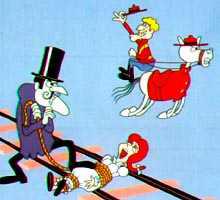 Oversimplifying only slightly, let’s review: Since the summer of 2011, Snidely Whiplash (the Republican majority in the House) has been trying to provoke the final showdown with Dudley Do-Right (President Obama) by tying Nell (the American economy) to the railroad tracks. Dudley showed up, but the fight keeps taking longer than either expected. So they keep agreeing to move Nell further and further down the tracks to give themselves more time.


 As I’ve occasionally pointed out

