The 2016 Stump Speeches: Ben Carson

Dr. Carson is the calm and authoritative voice of conservative truthiness.


[This article is part of a series on the speeches of 2016 presidential candidates.]

More than even Donald Trump, Ben Carson’s appeal — and he has appeal; numerous recent polls have him second to Trump both nationally and in key states — derives from not being a politician. When he talks, he does not seem to be giving a speech. If a typical politician sounds like a minister preaching on Sunday, Carson sounds like the same minister chatting with his Bible-study class on Wednesday evening. It is easy to imagine him in his previous life as a pediatric neurosurgeon, describing a particularly difficult case to a roomful of colleagues.

A second piece of his appeal is his life story: He came out of poverty, got an education, and reached the top levels of a challenging profession. Other candidates may talk about the struggles of their parents or grandparents to achieve the American dream, but Carson can point to his own rise out of poverty. (He doesn’t harp on it, though, because in the conservative circles where he travels, his story is already well known.) He is black and clearly must have experienced some racism in his life, but he projects no bitterness about it. America has been good to him, and he is grateful.

In the same way that his life embodies the American dream, his candidacy embodies a common conservative dream: that we don’t need policy experts or even political parties, we just need to turn our government over to good people with common sense. Carson expressed it like this in his announcement speech [video, transcript]

We have to get the right people in place. We need, not only to take the executive branch in 2016, and when I say we, I’m not talking Republicans – I’m talking about anybody who has common sense, you know. We have to have another wave election and bring in people with common sense, who actually love our nation and are willing to work for our nation and are more concerned about the next generation than the next election. That’s what’s going to help us. [1]

More than any other candidate, Carson communicates the truthiness of the conservative movement. [2] He has a Reaganesque ability to sound convincing while saying wild things that conservatives know in their hearts must be true, even if they aren’t.

Outline of the speech. [video, transcript] Carson announced his candidacy on May 4. He begins by introducing his wife and children, and then makes his low-key announcement.

Now, I have introduced my family. You say, well who are you? I’ll tell you. I’m Ben Carson, and I’m a candidate for President of the United States.

He then starts telling his mother’s story, as evidence that “America is a place of dreams” and in refutation of “a lot of people” who “are down on our nation”. Carson’s mother married his father at 13 to escape her family. But her husband turned out to be a bigamist, so they got divorced, leaving her as a single mother with a third-grade education. She worked as a domestic and they lived with relatives in a Boston tenement.

Boarded up windows and doors, sirens, gangs, murders. Both of our older cousins, who we adored, were killed.

But she after consulting God (“She asked God for wisdom. And you know what? You don’t have to have a Ph.D. to talk to God. You just have to have faith. And God gave her the wisdom.”), she instilled good values in Ben and his brother, and they succeeded.

From his mother’s desire to stay off welfare, he segues into a discussion of how welfare creates dependency.

there are many people who are critical of me because they say Carson wants to get rid of all the safety nets and welfare programs, even though he must’ve benefited from them. This is a blatant lie. I have no desire to get rid of safety nets for people who need them. I have a strong desire to get rid of programs that create dependency in able-bodied people. And we’re not doing people a favor when we pat them on the head and say, there, there, you poor little thing, we’re going to take care of all you needs; you don’t have to worry about anything.

And a denunciation of socialism.

You know who else says stuff like that? Socialists. … They say it’ll be a utopia and nobody will have to worry. The problem is all of those societies end up looking the same, with a small group of elites at the top controlling everything, a rapidly diminishing middle class, and a vastly expanded dependent class. [3]

Which is not what America was intended to be.

And I’m not an anti-government person by any stretch of the imagination. I think the government, as described in our Constitution, is wonderful. But, now we’ve gone far beyond what our Constitution describes, and we’ve begun to just allow it to expand based on what the political class wants, because they like to increase their power and their dominion over the people, and I think it’s time for the people to rise up and take the government back.

The “political class” is the villain of Carson’s story. [4]

I’ll tell you a secret. The political class comes from both parties and it comes from all over the place.

He paints an idealized picture of early America.

You’ve got to remember it was the can-do attitude that allowed this nation to rise so quickly. Because we had people who didn’t stop when there was an obstacle. That’s how those early settlers were able to move from one sea to the other sea across a rugged and hostile terrain. [5]

That can-do attitude contrasts with the timidity of today’s Americans, who are intimidated by political correctness.

We’ve allowed the purveyors of division to become rampant in our society and to create friction and fear in our society. People are afraid to stand up for what they believe in because they don’t want to be called a name. They don’t want an IRS audit. They don’t want their jobs messed with or their families messed with. But isn’t it time for us to think about the people who came before us? … We dare not soil their efforts by being timid now and not standing up for what we believe.

Belying his humble tone, Carson presents himself as the kind of brave man we need.

I’m not politically correct, and I’m probably never going to be politically correct because I’m not a politician. I don’t want to be a politician, because, politicians do what is politically expedient, and I want to do what is right. We have to think about that once again in our country.

When he talks about fixing the economy, he starts with the national debt:

You need to know who your representatives are. And you need to know how they voted, not how they said they voted. And if they voted to keep raising that debt ceiling, to keep compromising the future of our children and our grandchildren, you need to throw them out of office. [6]

He attributes to “economists” the view that:

when the debt to GDP ratio reaches 90%, at that point economic slowdown is inevitable. [7]

He goes on to talk about how “the most dynamic economic engine the world has ever known” won’t work “when we wrap it in chains and fetters of regulations” and “when you have high taxation rates”. The only specific policies he mentions involve cutting corporate taxes: He wants to cut the corporate tax rate, and have an even cheaper rate to induce companies to repatriate profits held overseas (though he doesn’t specify either rate). He then closes by coming back to the notion that expertise is not necessary:

The real pedigree that we need to help to heal this country, to revive this country: Someone who believes in our Constitution and is willing to put it on the top shelf. Someone who believes in their fellow man and loves this nation and is compassionate. Somebody who believes in what we have learned since we were in kindergarten. And that is, that we are one nation, under God, indivisible with liberty and justice for all.

The myth of America. Whenever American history comes up in Carson’s speech, it’s the kind of history most Americans want to believe, rather than the kind that actually happened. I’ve already mention the “can-do attitude” that built America without needing to steal Indian land or enslave African workers.

He talks about freedom of the press like this:

You know, the media, the press, is the only business in America that is protected by our Constitution. You have to ask yourself a question. Why were they the only ones protected? It was because our founders envisioned a press that was on the side of the people, not a press that was on the side of the Democrats or the Republicans or the Federalists or the Anti-Federalists.

Again, it would be nice to think so. But  pamphlets were the main method of debate in early America, and “freedom of the press” meant nothing more to the Founders than the right to own a press yourself or hire somebody who could print your pamphlets. It did not refer to an institution of “the Press” as we think of it today. And such newspapers as existed in the early days of the Republic were more partisan than the present New York Times or Wall Street Journal, not less. (Wikipedia: “Nearly all weekly and daily papers were party organs until the early 20th century.”)

The idea that journalism should be a profession with professional standards of public responsibility really starts in the 1920s with Walter Lippmann.

Social truthiness. Carson’s race and up-from-the-ghetto life lend authenticity to a number of social myths conservatives like to believe. For example, his explanation of the Baltimore riots is not that anybody actually cared about Freddy Gray or police abusing their power in the black community; poor blacks just saw an opportunity to go wild and take stuff.

This past couple of weeks, there’s been a great deal of turmoil in Baltimore – where I spent 36 years of my life. … The real issue here is that people are losing hope and they don’t feel that life is going to be good for them no matter what happens. So when an opportunity comes to loot, to riot, to get mine, they take it.

And government anti-poverty programs just create dependency.

My mother was out working extraordinarily hard. Two, sometimes three, jobs at a time, as a domestic. Trying to stay off of welfare. And the reason for that was she noticed that most of the people she saw go on welfare never came off of it. And she didn’t want to be dependent. … I have a strong desire to get rid of programs that create dependency in able-bodied people. [8]

In Carson’s idealized American past, federal programs weren’t necessary, and they wouldn’t be necessary now if we recovered traditional values.

There were many communities that were separated from other communities by hundreds of miles, but they thrived. Why did they thrive? Because people were willing to work together, to work with each other. If a farmer got injured, everybody else harvested his crops. If somebody got killed, everybody else pitched in to take care of their families. That’s who we are. We, Americans, we take care of each other.

But we should do it as individuals, not through the government. And people who don’t succeed? It’s their own fault: If they’re not disabled, they must be lazy or stupid.

You don’t have to be dependent on the good graces of somebody else. You can do it on your own if you have a normal brain and you’re willing to work and you’re willing to have that can-do attitude.

People focusing on racial issues aren’t exposing problems, they’re creating problems.

We’ve allowed the purveyors of division to become rampant in our society and to create friction and fear in our society.

What we need instead is colorblindness. In an interview after touring Ferguson this week, he said:

A lot of people perceive everything through racial eyes, but my point is that we don’t have to do that. What we have to do instead is to begin to see people as people. [9]

Conspiracy theory dog whistles. A lot has been made of Carson’s ability to rise in the polls without getting the kind of media attention that has fueled Donald Trump’s candidacy. But this ignores the extent to which Carson is a darling of the alternative conservative media: talk radio, evangelical conferences, and web-based empires like Alex Jones and Newsmax.

Carson’s speeches are littered with references that the alternative-conservative-media audience will recognize and regard as established facts, when they are nothing of the kind. For example, that the IRS is being used to persecute conservatives:

People are afraid to stand up for what they believe in because they don’t want to be called a name. They don’t want an IRS audit.

On Planned Parenthood (which isn’t mentioned in the announcement speech) Carson has said:

I know who Margaret Sanger is, and I know that she believed in eugenics, and that she was not particularly enamored with black people. And one of the reasons that you find most of their clinics in black neighborhoods is so that you can find a way to control that population.

That’s debunked here and in more detail here. (I never knew that one of those “racist” Sanger quotes floating around the internet was originally said by W.E.B. Du Bois.) And he has totally bought the claim that Planned Parenthood is “harvesting” and “selling” baby parts.

Thanks largely to Glenn Beck, Saul Alinsky (who has been dead for 43 years) has become famous as the grand strategist of the Great Liberal Conspiracy, and Rules for Radicals as important as Chairman Mao’s little red book. (Take any bad thing and use it in a sentence with “Saul Alinsky” and “George Soros” and you’re halfway to a right-wing conspiracy theory.) So Carson says:

You have to recognize that one of the rules in Saul Alinsky’s Rules for Radicals, is you make the majority believe that what they believe is no longer relevant and no intelligent person thinks that way and the way you believe is the only way intelligent people believe. And that way they’ll keep silent. Because I’ll tell you something. They don’t care if you don’t believe what they believe, as long as you keep your mouth shut.

Is anything like that true? If you google “Saul Alinsky” and look for recent references, they’re almost all from conservative sources, because he’s actually not that important in liberal discourse. Half of liberals have never heard of him, and to the rest of us Rules is one of those books we think we ought to get around to reading someday, but never do.

Consequently, people like Carson can attribute anything they want to Alinsky, and who’s going to say they’re wrong? Well, I guess I am: Fact-checking Carson gave me one last push to read Rules for Radicals. (It’s short, flows well, and you can find it free on the internet.) It doesn’t contain anything resembling the rule Carson mentions. Whether he got his “rule” from some fabricator like Beck or made it up himself I can’t say. But Alinsky’s book is all about how to get powerless people to speak up, not shut up. (The subtext is Alinsky’s disgust with the late-60s student radicals, whose rhetoric was designed to shock and piss off blue-collar workers rather than make common cause with them against the establishment.)

Conclusion. In tone and manner, Ben Carson is the anti-Trump — calm and collected, not aggressive or even particularly animated most of the time. He avoids conflict, even when baited by an expert like Trump.

But in many other ways, he’s a Trump alternative: an outsider brought in to fix our broken government; appealing to “common sense” rather than expertise in law, economics, foreign policy, the military, or any other relevant field; almost completely lacking specific proposals [10]; and free to say what white conservatives think ought to be true, unencumbered by actual facts.


[1] What I find amazing in that quote is the “actually” — as if it would be remarkable to find in our government people whose love for our country is genuine. But this is a common belief in conservative circles. In February, a poll asked Republicans whether President Obama loves America. By a 69%-11% margin, they said no.

[2] Truthiness, defined by Wikipedia as

a quality characterizing a “truth” that a person making an argument or assertion claims to know intuitively “from the gut” or because it “feels right” without regard to evidence, logic, intellectual examination, or facts.

was coined by Stephen Colbert in one of his show’s most memorable segments.

Face it folks, we are a divided nation. Not between Democrats and Republicans, or conservatives and liberals, or tops and bottoms. No. We are divided between those who think with their head and those who know with their heart.

[3] If you compare the United States to actual socialist countries like Denmark or Sweden, Carson has it exactly backwards. A person born poor under Scandinavian socialism has a far better chance of achieving prosperity than a poor American — the exact opposite of what you’d expect if America were the land of opportunity and socialism trapped people in a “dependent class”.

And “a small group of elites” dominating “a rapidly diminishing middle class”? That’s us, not them.

[4] “The political class” is an interesting spin that allows Carson to be pro-business and pro-wealth while sounding populist. “Politicians” have betrayed us, but Carson never discusses who they’ve betrayed us to. So his proposals — a flat tax, lower corporate taxes, less regulation, a tax holiday for repatriating overseas profits — all further the interests of what Bernie Sanders calls “the billionaire class”.

[5] I find this passage particularly odd. First, because Carson’s focus on the “can-do attitude” obliterates the role of slave labor and land stolen from the Native Americans in building this country. And second, because “we” are the heroic “early settlers”. Carson identifies with them, and not with his slave ancestors, who were driven like cattle across that “rugged and hostile terrain”.

[6] Note the focus on the debt ceiling, as if we could solve the problem of rising government debt by simply outlawing it. (His web page promotes a similar gimmick, a balanced budget amendment that he doesn’t bother to state. It’s an amendment that will balance the budget; what else do you need to know?)

Business Insider‘s Henry Blodgett has a clear explanation of what happens if we don’t raise the debt ceiling:

On that date, if the debt ceiling has not been raised, the United States will begin to default on payments that it is legally obligated to make, payments that Congress has already promised that we will make. … The Treasury will only be able to pay about 60% of the bills that are owed. In relatively short order, therefore, the United States will stiff about 40% of the people and companies it owes money to.

… To not raise the debt ceiling is to say that it is totally okay to stiff people and companies we owe money to–and, more importantly, to actually stiff them. This is astoundingly reckless and irresponsible behavior (not to mention illegal).

Apparently, refusing to pay bills you have already run up constitutes doing “what is right”.

If you honestly think that the national debt is our country’s worst problem — I don’t — then you need to talk about the budget, which Carson has not done. You need to specify which spending you’re going to cut, where the revenue is going to come from, and how the math works out. That’s the hard work of governing, which Carson has shown no interest in.

[7] Actually that’s a single team of two economists, they didn’t really say “inevitable”, and their results depended on a spreadsheet error that was exposed over two years ago. Economist Dean Baker summarizes:

When the error is corrected, there is nothing resembling the growth falloff cliff associated with a 90 percent debt-to-GDP ratio that had been the main takeaway from the initial paper.

[8] Notice he says only that she was “trying” to stay off welfare, not that she did stay off it, or that he didn’t benefit from other government programs. We know that his family received food stamps and that he got free glasses from a government program. What additional government help Carson or his mother received is conjecture.

So his life story could be told with the exact opposite spin: Government help kept his family from falling through the cracks of society, giving him the chance to work hard, get an education (at public schools), and succeed.

[9] So the situation is a little like kindergarten, when a kid would say shit or fuck. You couldn’t report that to the teacher because then you’d have to say the word yourself.

Similarly, if racists are mistreating people of a different race, how would you even notice that unless you are making racial distinctions yourself? Being truly colorblind means not just that you don’t treat people of different races differently, but that you can’t see racism at all.

[10] Looking around Carson’s web site reminds me of Ezra Klein’s comment about Mitt Romney in 2012: that he had presented “simulacra of policy proposals”, avoiding any details that would allow outside experts to analyze them. But Carson makes Romney look like a wonk. His issue-focused pages each contain about one relevant buzz-phrase that hints at Carson’s intentions.

On the health care page, that phrase is “health savings accounts”. (And that’s his field; he’s a doctor!) His tax system would be “fairer, simpler, and more equitable“. Here, at least, he has given a few more details in speeches: At the first debate, he endorsed “tithing”, which seemed to be a reference to a flat tax. Elsewhere, he elaborated: He does want a flat tax, one that applies even to the poorest people, because “we all need to have skin in the game“.

In order to raise the same revenue as the current system, he believes the flat rate would need to be “between 10 and 15 percent”. That range is an indication of how much thought he has put into this: If you make $50,000 a year, will you pay $5,000? $7,500? More if Carson’s assumptions — whatever they are — prove too optimistic? He doesn’t know.


The Monday Morning Teaser

This week the Sift’s 2016 speech series gets to Ben Carson, who might be the most interesting of the Republican candidates. Without much attention from the mainstream media (but plenty of attention from conservative and Christian talk radio), he has moved into a solid second place in the polls behind Donald Trump. Like some 21st-century revision of the famous Teddy Roosevelt dictum, he speaks softly but says wild things. He embodies the conservative fantasy that government doesn’t require any special knowledge or skill, but only common sense and a good heart. If Trump implodes, he might be the one to pick up the pieces.

The Carson article should be out around 9 EDT. The weekly summary will discuss the Iran deal’s survival in the Senate, the 9-11 anniversary, Mitch McConnell’s attempt to sabotage the Paris climate summit, the Jeb! tax plan, and Kim Davis’ prospects for staying out of jail. It should appear around 11.

Where to Begin

It is painful to accept fully the simple fact that one begins from where one is, that one must break free of the web of illusions one spins about life. Most of us view the world not as it is but as we would like it to be.

— Saul Alinsky, Rules for Radicals (1971)

This week’s featured posts are “Is Kim Davis a Martyr?” and “Damned Lies and Employment Statistics“.

This week everybody was talking about that clerk in Kentucky

which I cover in “Is Kim Davis a Martyr?” Meanwhile, a liberal Christian imagines having the same kind of “religious freedom” conservative Christians claim.

and a big mountain

Republicans (except the ones in Alaska) are up in arms that President Obama has recognized Alaska’s name for its tallest mountain, which was also the mountain’s traditional name prior to colonization by Europeans. This shows just how irrational the urge to condemn whatever Obama does has gotten.

and refugees in Europe

Vox does its usual good job of providing context. One thing I’ll add is that those fleeing the Syrian civil war are giving us a preview of coming events. As climate change continues and sea levels rise, millions will be forced to migrate, most of them poor people who have no obvious place to go.

and another good-but-unspectacular jobs report

According to the Bureau of Labor Statistics, the economy added 173,000 jobs in August, dropping the unemployment rate to 5.1%. As usual, this led to a chorus of denials that things are really that good, which I examine in “Damned Lies and Employment Statistics“.

and backlash against Black Lives Matter

Inside the conservative news bubble, two events are all it takes to establish a narrative. And here they are:

The Houston sheriff connected the two, and it was off to the races. Sean Hannity and Bill O’Reilly were quick to join the chorus. And then there’s a whole subterranean layer of conservative media most liberals don’t even know about, like Infowars.

So now, as far as your crazy uncle is concerned, it’s an established fact that BLM is a hate group that advocates assassinating cops: He’s heard the chant and he can name the deputy. So even if no further events fit that narrative, we’ll continue hearing it for years.


Not that it matters to the conservative narrative, but here’s what an actual BLM activist, Shaun King, has to say:

Both the official Black Lives Matter organization, its representatives, and its loosely connected friends and partners actually have real agendas, real goals, real plans, and none of them, explicit or inferred, has ever suggested violence against police.

… Twelve-year-old Tamir Rice was killed by police nine months ago and police and prosecutors claim to still be investigating, but days after a criminal kills a white officer, the sheriff is already making declarative statements about motive and inspiration. The double standard is thick.


This cartoon gets to the heart of what’s wrong with the “all lives matter” response: The implication is that there’s nothing special about the lack of value American society puts on black lives. Analogously, imagine that a girl goes missing, and her mother makes a request at her church that people pray for the safety of her child. And then someone else stands up and says dismissively, “We should pray for the safety of all children.”

More clueless yet are the people pushing the “Blue Lives Matter” meme. Consider, for example, the recent shooting of a policeman in Fox Lake, Illinois. The response to that shooting — national news updates, a manhunt involving hundreds of people — is the virtual definition of what it means for a life to matter.

Compare that to the initial response to Trayvon Martin’s death: Police believed the shooter’s story, gave him back his gun, and let him go home. Black teen-agers get shot every day; what’s the big deal?

After protests and news coverage forced local officials to begin taking Trayvon’s death seriously, he was as much on trial as his killer. A large portion of our news media wanted to focus on whether he was a thug, whether he might have been on drugs, what he did to deserve to be shot, and so on.

That doesn’t happen when a police officer dies. We don’t have a national conversation about whether the victim was a dirty cop or what past mistakes he might have made. We don’t concoct speculative scenarios to justify the shooting, and make the officer’s family prove them wrong. Not that we should, but cop deaths are the gold standard for what it means for a life to matter. What if the lives of young black men mattered like that?


A South Carolina policeman recently got a one-year-house-arrest plea deal for killing a middle-aged black father. What’s that say about the relative value of their lives?


It’s worthwhile for white people to spend some time thinking about how whiteness affects their relationship with the police. Here are 20 specific ways.

and you also might be interested in …

The Iran deal is going to survive Congress. 37 senators have announced support for it so far, with four Democrats still undecided. If all four support it, a congressional rejection of the deal can be filibustered and won’t pass. But if it does pass, the 34 senators would be enough to sustain President Obama’s veto.


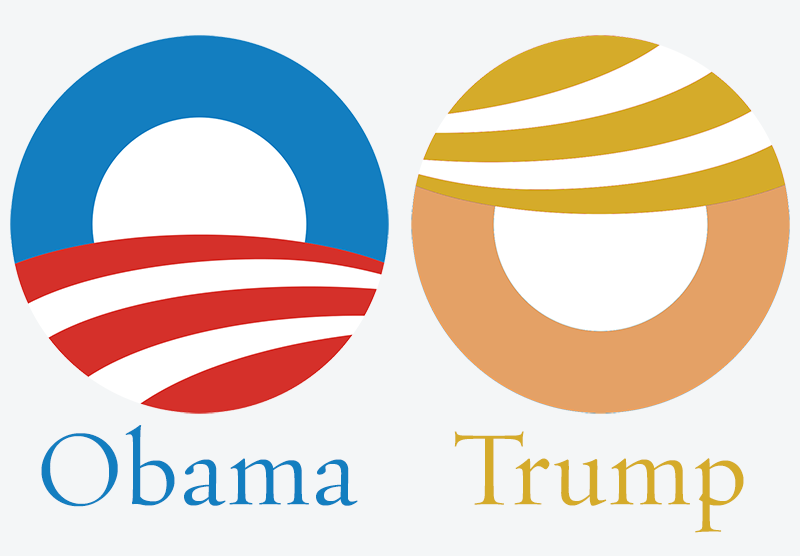
Matthew Gordon suggests a simple color-and-orientation change to make Obama’s logo work for Trump.


The saga continues in the Tea Party Utopia that is Governor Brownback’s Kansas:

Ever since the state Supreme Court in 2014 ordered the legislature to increase funding for education, Governor Sam Brownback and his allies in Topeka have sought to wrest power over appointments from the Supreme Court and make it easier to replace judges.

The legislature tried to strong-arm the judicial branch like this:

The judicial budget includes a self-destruct button that would wipe out all funding for the state courts if any court halts the 2014 law reducing the Supreme Court’s authority or finds it unconstitutional.

What could possibly go wrong? Well, last week a judge did strike down the law. The ruling is on hold pending appeal, so for now the Kansas courts remain open. Meanwhile, Kansas continues to have real problems, in addition to the ones created by the dysfunction of its government.


John Oliver reports on the joys of lying about history.


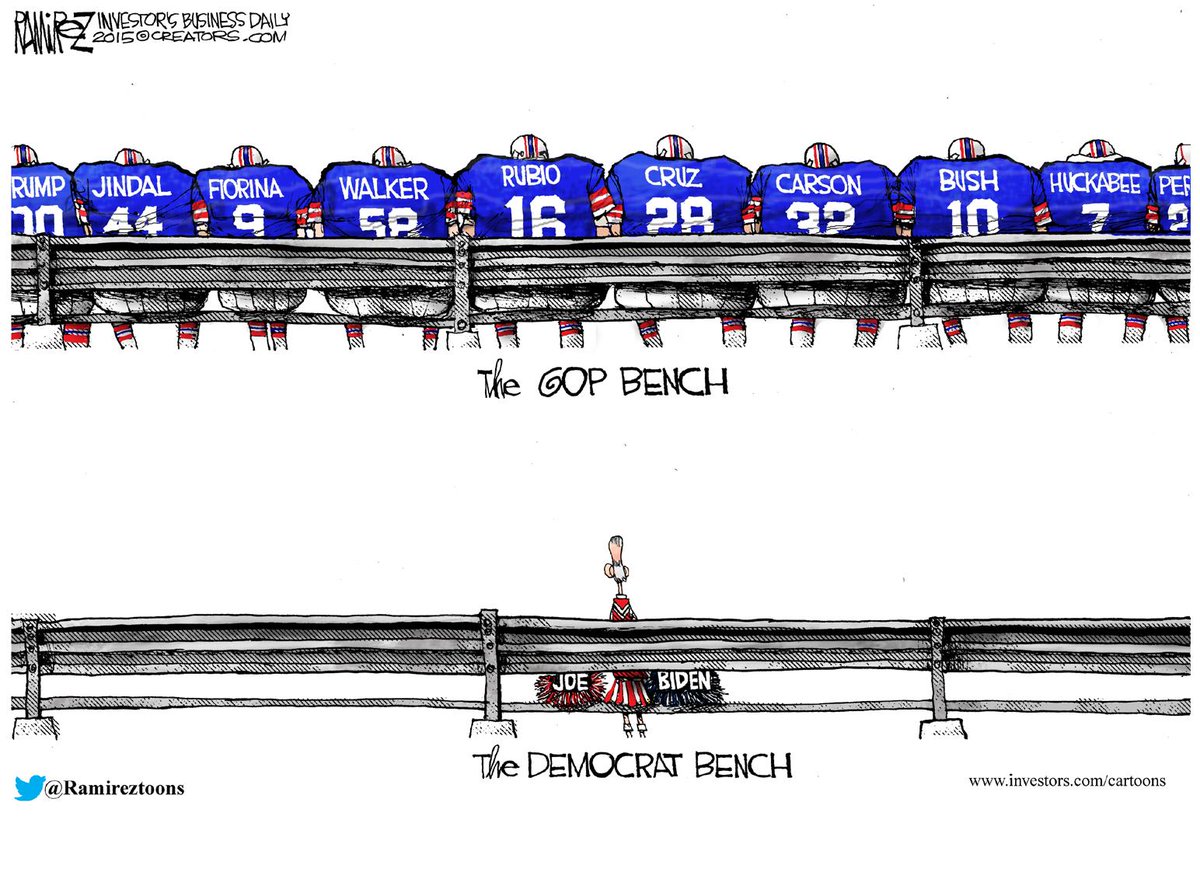
This is where Republicans have gotten: For a long time, they were bragging about their “deep bench” of 2016 candidates, as in this cartoon from just a month ago.

Now, some are looking to Mitt Romney to save the Party.

and let’s close with something I should have realized on my own

Willy Wonka must be one of the re-generations of Dr. Who. I mean, the Great Glass Elevator should have tipped me off: How many people have little boxes that can take them into space?

Damned Lies and Employment Statistics

Yes, some “real” unemployment rate is roughly double the official 5.1%. But there’s nothing sinister about that, and the job market really is gradually improving.


Some 19th-century wit — maybe British Prime Minister Benjamin Disraeli or American humorist Mark Twain or somebody else — once said that there are “lies, damned lies, and statistics“.

This week the Bureau of Labor Statistics issued its monthly jobs report, in which it asserted that the economy added a good-but-unspectacular 173,000 jobs in August, bringing the unemployment rate down to 5.1%, the lowest it’s been since early in the Great Recession of 2007-2009.

As happens every month, a number of pundits and politicians then blew a lot of hot air about how these numbers hide the “real” unemployment rate, which is much higher than 5.1%. Some even made it sound as if an evil government conspiracy is trying to fool the public into thinking things are getting better when they’re actually getting worse. Ben Carson expressed this idea in May:

What you have to know is that you can make the unemployment rate anything you want it to be, based on what numbers you include and what numbers you exclude.

Well, pretty much whatever you want to include or exclude, the BLS tracks that too, and publishes it for everybody to see. The wonks at the BLS refer to the “official” unemployment rate as U-3, but they also keep track of  U-4, U-5, and U-6, each of which defines unemployed more broadly than the previous U. U-4 includes people who would like a job, but are too discouraged to look for one; U-5 adds people who want a job, but haven’t looked recently for some other reason; and U-6 adds people who are working part-time when they would rather work full-time.

U-6 is what people (like the conservative Washington Examiner and liberal Bernie Sanders) are pointing to when they say the “real” unemployment rate is 10.3%. And that’s perfectly reasonable thing to say: 10.3% of potential workers wish they could work full-time, but haven’t found jobs that let them do so.

What isn’t reasonable is the conspiratorial that’s-what-they-want-you-to-think attitude that Carson and others are promoting. For example, The Daily Caller quoted Sanders’ comment accurately, and then inaccurately claimed: “That dose of reality is like a wet blanket on President Obama’s recent claims that the economy is improving.” It was nothing of the sort.

You see, the 10.3% U-6 number wasn’t smuggled out of the BLS by some whistle-blower; it was published in the same report as the 5.1% U-3 number. And while 10.3% unemployment sounds a whole lot worse than 5.1%, in the context of similar measurements taken over time, it tells the same story: The job market has been getting consistently better since very early in President Obama’s administration.*

unemployment2This graph (constructed with tools at Macrotrends), shows U-3, U-5, and U-6 over the last ten years. All three measures of unemployment bottom out in March, 2007; climb sharply to a peak October, 2009 (nine months into the Obama administration), and then decline to a level that is still a bit above the March, 2007 low.**

So U-3 is 5.1%, down from a peak of 10.1% but still not at the 4.4% pre-recession low. And U-6 is 10.3%, down from a peak of 17.4% but still not at its 8.0% pre-recession low. The two stats tell the same story.

But if you really want to make the slow-but-steady economic uptrend sound like smoke and mirrors, you selectively quote another stat openly published by the BLS: the labor participation rate, the percentage of people over 16 who are either working or looking for work.

The LPR has been going down throughout the Obama administration and now stands at 62.6%. So Carson, Paul Ryan, and other Republicans like to point to it as proof that things have actually been getting worse.

The problem with using the LPR as a measure of economic health is that good news can drive it down too, as people who have some economic slack choose not to work: older people retire, younger ones stay in school, couples let one spouse focus on raising the children, and so on.

If you just show a graph of the plunging LPR during the Obama administration, it looks like something must be going horribly wrong. But you see a different pattern if you take a longer view.

This half-century graph makes it apparent that the major trends in LPR don’t have a lot to do with the ups and downs of the business cycle. Otherwise, you’d have to conclude that the 1960s were some economic hellscape, rather than the relative good times they actually were.

What you’re mainly seeing in that big hump-in-the-graph is the life cycle of the Baby Boom generation, added to the effect of middle-class women entering (and staying in) the job market through the 1970s and 1980s. That Boomer-retirement trend is affected on the margins by the economy (as 60-somethings decide whether to retire this year or next year), but barring some catastrophe that keeps 80-year-olds looking for work in large numbers, the LPR should continue its downward trend for years to come, independent of who is president or what policies they implement.

So yes, there are some damned lies going around in the guise of statistics. But the notion that the economy and job market have been slowly getting better for the last six years is not one of them.


* If you really want to get wonky about this, we’re talking about the difference between a quantity that varies with time and its first derivative. Slightly less wonky: the difference between the raw total and the trend.

As far as I’ve noticed, Sanders has been using these numbers responsibly, to claim that the economy still needs a lot of jobs, and so could use the massive infrastructure project he has proposed. I haven’t exhaustively searched his speeches, but I haven’t seen him question the reality of the upward trend in the job market.

** It’s arguable that the 2007 low isn’t a fair comparison, since a lot of those jobs depended on the soon-to-pop real estate bubble.

Is Kim Davis a Martyr?

Thursday, the story of the Kentucky county clerk who refused to issue marriage licenses (now that same-sex couples can marry) reached its inevitable conclusion. Having been turned away by the Supreme Court, Davis was out of legal options for delaying the moment of truth: She had to either obey a court order to issue marriage licenses, including licenses to same-sex couples, or be in contempt of court.

She chose contempt and has been jailed, while her office has begun issuing licenses in her absence. Federal Judge David Bunning had the lesser option of fining her, but concluded (correctly, I think) that fines would simply delay the resolution of the case: Davis would not pay them and would continue showing contempt for the court’s order, forcing Bunning to jail her at some later date.

Response. Presidential candidates courting the religious-right vote immediately began characterizing Davis as a martyr for her beliefs. Ted Cruz issued a statement beginning with this line:

Today, judicial lawlessness crossed into judicial tyranny. Today, for the first time ever, the government arrested a Christian woman for living according to her faith.

Mike Huckabee compared Davis to Abraham Lincoln, who “disregarded the Dred Scott 1857 decision that said black people aren’t fully human.” [1] He also tweeted that “Kim Davis in federal custody removes all doubts about the criminalization of Christianity in this country”, and is planning a rally tomorrow outside the jail where she’s being held. (Some other Republican candidates have been less supportive. Lindsey Graham has been the most blunt: “As a public official, comply with the law or resign.”)

Other voices on the right portray Davis in larger-than-life terms. RedState.com founder Erick Erickson sees her case as a harbinger of civil war. Conservative Review‘s Daniel Horowitz casts Davis as this era’s Rosa Parks, and Steve Deace wants her to run for president. (Critics compare her to a different character in the civil rights movement: George Wallace standing in the doorway of the University of Alabama, unsuccessfully trying to block integration.)

Martyrdom. The Christian tradition is rich with martyr stories, going all the way back to the stoning of Stephen and the imprisonment of Paul in the New Testament. In the Lutheran school I attended through eighth grade, we were sometimes asked to imagine facing a choice between denying our faith and punishment or death. (I have heard similar stories from Catholics.) Like Muslim suicide bombers, we were promised glories in Heaven that would more than compensate for any earthly suffering.

But is that what’s happening here? Does Kim Davis deserve the enthusiastic admiration of conservative Christians, and even the grudging respect of those who disagree with the stand she’s taking? Or is she undermining the rule of law and usurping the powers of her office to implement her personal religious agenda? [2]

What the judge said. Before deciding that question, it’s worthwhile to examine the court order she’s defying. In that order, Judge Bunning considers Davis’ arguments and explains why he is rejecting them.

Davis argues that by signing a license for a same-sex marriage, she would be expressing approval of such marriages, which her religion denies. Bunning counters:

The form does not require the county clerk to condone or endorse same-sex marriage on religious or moral grounds. It simply asks the county clerk to certify that the information provided is accurate and that the couple is qualified to marry under Kentucky law. Davis’ religious convictions have no bearing on this purely legal inquiry.

(Let me amplify that a little: Marriage-under-the-law and marriage-in-the-eyes-of-God have always been two different concepts. No one is asking Davis to affirm that same-sex marriages are valid in the eyes of God.)

A footnote spells out what the legal qualifications are:

A couple is “legally qualified” to marry if both individuals are over the age of eighteen, mentally competent, unrelated to each other and currently unmarried.

Davis also protests on free-speech grounds, claiming that an order that she sign the license form is compelled speech banned by the First Amendment. Bunning disagrees:

Because her speech (in the form of her refusal to issue marriage licenses) is a product of her official duties, it likely is not entitled to First Amendment protection.

In support of this view, he quotes a precedent from 1971:

When a citizen enters government service, the citizen by necessity must accept certain limitations on his or her freedom.

And Bunning does not see a violation of the First Amendment’s free-exercise-of-religion guarantee:

Davis remains free to practice her Apostolic Christian beliefs. She may continue to attend church twice a week, participate in Bible Study and minister to female inmates at the Rowan County Jail. She is even free to believe that marriage is a union between one man and one woman, as many Americans do. However, her religious convictions cannot excuse her from performing the duties that she took an oath to perform as Rowan County Clerk.

Bunning does not mention this quote, but the principle goes back to an 1892 decision in which Oliver Wendell Holmes ruled against a policeman fired for something he said:

The petitioner may have a constitutional right to talk politics, but he has no constitutional right to be a policeman.

Davis is perfectly free to practice her religion in her personal life, but when she assumes the role of a public official, she has to act according to law. [3]

Cashing in? Hypocrisy? It’s a safe bet that St. Paul’s imprisonment wasn’t part of his grand plan to become a celebrity and get rich. But Dan Savage has been making this prediction since Davis first hit the headlines:

No one is stating the obvious: this isn’t about Kim Davis standing up for her supposed principles—proof in a moment—it’s about Kim Davis cashing in. There’s a big pile of sweet, sweet bigot money out there waiting for her. If the owners of a pizza parlor could raise a million dollars just by threatening not to cater the gay wedding no one asked them to cater… just imagine how much of that sweet, sweet bigot money Kim Davis is going to rake in. I’m sure Kim Davis is already imagining it.

In an interview on MSNBC, Savage spelled it out:

She will have written for her a ghost-written book, she will go on the lecture circuit, and she’ll never have to do an honest day’s work again.

Savage’s “proof in a moment” is a reference to Davis’ own checkered marital history: She’s been married four times and divorced three times, a practice which (unlike homosexuality) is explicitly condemned by Jesus in the Gospels.

Ad hoc purity. I have a more general complaint than hypocrisy, one that applies not just to government officials like Davis, but also to the baker [4] and florist who have been claiming persecution when they are not allowed to discriminate against same-sex couples: Their position relies on two principles, and one of them they just made up for this purpose.

The first principle is the one right-wing Christians always want to focus on: Homosexuality is sinful. Whether or not the rest of us agree, it’s incontestable that they believe it and have for a long, long time.

But since no one is asking them to commit homosexual acts, that principle by itself doesn’t create an issue. Their position requires a second principle: Christians should live according to a standard of purity that doesn’t allow them to involve themselves in other people’s sins.

Kim Davis has to imagine a pretty broad purity zone around herself, if verifying that two men are “over the age of eighteen, mentally competent, unrelated to each other and currently unmarried” involves her in the sin of their homosexuality. And the bakers who won’t sell a cake to a same-sex wedding reception — giving them no connection whatsoever to the actual marriage ceremony — must have an even broader purity zone.

Religious purity.

Now, there are religious people who try to live their lives according to extremely high standards of purity (like the Jain monks who wear masks so as not to kill any tiny insects they might otherwise breath in). But that does not include any of the right-wing Christians who are claiming persecution. Their Christian practice did not require an expanded purity zone until now, and even now it only applies to situations that involve gays.

For example, apparently the clerks who gave Kim Davis her marriage licenses didn’t balk at the fact that (according to Jesus) some of those marriages were adulterous. I’ll bet she didn’t have any trouble renting a hall or buying flowers or cakes. Even the most conservative Christians simply didn’t care about this kind of purity before same-sex marriage became legal, and still don’t care about it in any other context.

Here’s what that says to me: This isn’t about religion, not when it depends on a “sincerely held belief” that was invented solely for this purpose. So either it’s about personal animus against gays, or it’s about protesting the politics of same-sex marriage. Neither is the kind of moral or constitutional issue that Kim Davis’ defenders want to make it.


[1] I’m not sure which act of Lincoln’s Huckabee is referring to, and I suspect he doesn’t know either. Dred Scott laid out some general principles about slavery before Lincoln was elected, but what specifically did the Supreme Court order Lincoln to do? How did he defy that order?


[2] As satirized in this image and this story from The Onion. I suspect conservative Christians are picturing a world in which only conservative Christian public officials have the right to bend their duties around their religion. But a friend suggested this example, which corresponds pretty well to the Davis case: What if a Jewish meat inspector decides that his religious convictions require him to reject all pork? I’ve also seen this example: What if an official refuses to issue hunting and fishing licenses, because he takes “Thou shalt not kill” literally?

Some of the Kim Davis satire doesn’t have a political point, it’s just funny. For more humor, check out the hijacked #FreeKimDavis tag on Twitter.

[3] A common complaint by conservative pundits is that liberals are fine with liberal officials ignoring laws. President Obama’s recent executive orders on immigration are a frequently cited example. But there are some significant differences between the two cases, as becomes clear when you compare the justifications.

Obama’s action is justified in a memo from the Justice Department’s Office of Legal Counsel (which I summarized at the time). Unlike Davis, the OLC memo never appeals to an authority higher than the law.

Instead, the memo outlines the executive branch’s strategy for handling the impossible situation Congress has created: The law would deport 11.3 million undocumented immigrants, but Congress has provided funding for dealing with only a tiny fraction of that number. Consequently, the administration must prioritize whom to deport.

When a court disagreed with the administration’s reasoning and issued an injunction against parts of the order, the administration stopped implementing it — except for one mix-up, which is being rectified without the judge needing to fine or jail anyone for contempt.

[4] As Dan Savage might have predicted, the bakers have made out like bandits. In the United States, being persecuted as a Christian is extremely profitable.

The Monday Morning Teaser

Of course I had to write about Kim Davis, the Kentucky county clerk who was jailed for contempt of court when she refused to issue marriage licenses to same-sex couples. Religion, gay rights, the law, competing ways of framing the same event — a bunch of the topics I care about intersect in that story. Expect “Is Kim Davis a Martyr?” to appear around 9 EDT.

And what better time than Labor Day to write a somewhat wonky article on employment statistics? So, the monthly employment report just came out, saying that the unemployment rate fell to 5.1%. Meanwhile, people to both the right and left of the Obama administration claim that the “real” unemployment rate is double that: 10.3%. Where does that number come from, what does it mean, and does it undermine the administration’s things-are-getting-better talking point? (Spoiler: No, it doesn’t.) Expect “Damned Lies and Employment Statistics” around ten or so.

Also in the weekly summary: Denali, the backlash against Black Lives Matter, refugees in Europe, and startling new theory about the origins of Willy Wonka. (I mean, wasn’t that elevator a dead giveaway? Who else has a magical little box that can go into space?) That should be out before noon.

What Goes Around

Conservative media and Fox News in particular have spent years – decades, if you count talk radio – training their audiences to believe that exhortations against sexism and racism are nothing but the “political correctness” police trying to kill your good time. … You can’t tell people, day in and day out, that nothing is more fun than putting some mouthy broad in her place and then get upset when they continue to think it’s fun, even when the mouthy broad is one of yours.

— Amanda Marcotte “Why Fox News’ Defense of Megyn Kelly is Going to Backfire

This week’s featured articles are “Hey, Nerds! Politics is a System. Figure it out.” and “Protesting in Your Dreams“.

This week everybody was talking about Hurricane Katrina

which hit New Orleans ten years ago Saturday. A bunch of interesting retrospectives have appeared.

Slate posted “The Myths of Katrina“, including the notion that “no one could have predicted” what happened. In fact, the gist of the disaster appeared in a local newspaper article three years earlier: the levee failures, and what would happen next:

Amid this maelstrom, the estimated 200,000 or more people left behind in an evacuation will be struggling to survive. Some will be housed at the Superdome, the designated shelter in New Orleans for people too sick or infirm to leave the city. Others will end up in last-minute emergency refuges that will offer minimal safety. But many will simply be on their own, in homes or looking for high ground.

… Hundreds of thousands would be left homeless, and it would take months to dry out the area and begin to make it livable. But there wouldn’t be much for residents to come home to. The local economy would be in ruins

The anniversary is an ambivalent moment. New Orleans is a viable city again, so that’s worth celebrating. But the recovery has been uneven, with upscale neighborhoods rebuilding quickly and many poorer areas still full of abandoned homes.

The new New Orleans is a smaller, somewhat wealthier, and definitely whiter city; about 100,000 of its black Katrina-refugees never returned. As 538 elucidates, these losses were concentrated among middle-income and upper-income blacks, particularly the young professionals. Among whites it’s the reverse: young white professionals and entrepreneurs are flocking in. Jacobin comments about one gentrifying neighborhood:

The declining poverty rate does not speak to some miraculous redistribution of wealth to working-class families, but rather to their forced exit amid a corresponding influx of high-income residents.

and another shooting

This one happened on live television.

With every new shooting, we go through the motions of trying to put gun control back on the agenda. But (as Dan Hodges summed up in a tweet) Newtown really kicked the life out of that movement. If massacres of white professional-class school children are acceptable, requiring not even a smidgen of change, it’s hard to raise energy to try again.

If you do decide to try again, Vox has collected data for you and presented it well. Two things stood out for me:

  • We’re averaging about one mass shooting (i.e., 4+ victims) per day. So if the aftermath of a mass shooting is not an appropriate time to talk about gun control (because that would “politicize tragedy”), then there will never be an appropriate time.
  • States with a lot of guns have about the same number of suicides-by-other-means as states with fewer guns, but quadruple the number of firearm-suicides. It’s hard to escape the conclusion that guns cause suicides. Remember that the next time you think about buying a gun. Someday you’ll be depressed, and you’ll know that gun is sitting there.

and 2016

A second poll confirms that Bernie Sanders really is ahead in New Hampshire. Another poll suggests he’s making serious gains in Iowa.


I’m getting increasingly annoyed at the media coverage of both Sanders and Clinton.

You know which 2016 candidate is consistently drawing the biggest crowds? Not Donald Trump, Bernie Sanders. (BTW, Sanders beats Trump 45%-37% in a head-to-head match-up. So which one is the more serious candidate?)

And yet Bernie’s ability to draw a crowd is not news. Whether Trump’s recent rally in Alabama was bigger or smaller than Sanders’ rallies Portland and Los Angeles is open to interpretation. (Some estimates of Trump’s crowd were marginally larger than Sanders’.) But what’s not open to interpretation is the coverage: The news networks hyped Trump’s rally before it happened and treated it like a major event afterwards. But the sizes of Sanders’ crowds, when they get mentioned at all, are presented as weird little factoids.

When Sanders gets encouraging poll numbers, like the recent NH and Iowa ones I just mentioned, nobody says, “Wow! People really like this guy.” Nobody focuses on what he’s saying or why it’s inspiring so much enthusiasm. Instead, the story is about Clinton’s weakness: Democrats are so dissatisfied with Hillary that even Bernie Sanders might beat her in New Hampshire and Iowa.

And that brings me to the Clinton coverage, which has been even worse. The only stories you hear about Clinton consist of something-might-be-wrong-somewhere speculation about her emails. And yet, if you stick to the facts, it’s hard to justify the claim that anything actually is wrong. I’ve had a hard time finding a clear statement of what might be wrong, or a clear accusation whose truth or falsehood could be established. Quite likely this is Benghazi or Filegate or Vince Foster all over again.

I don’t see the media applying this maybe-something-somewhere-might-turn-out-to-be-bad standard to any other candidate. Rick Perry is under indictment. Scott Walker had an election-fraud investigation quashed under questionable circumstances by Wisconsin’s partisan Supreme Court. Like Clinton, Jeb Bush used a private email account while governor, and decided for himself which emails to release to the public. Marco Rubio has received “hundreds of thousands of dollars” of personal assistance from a billionaire he’s done political favors for.

Is any of that getting Clinton-style coverage? Coverage based on imagining what might turn out to be wrong (if new incriminating evidence somehow appears) rather than restricting attention to what we actually know? I’m not saying those stories should get that kind of attention, but why is the Clinton-email story getting it?


Frank Bruni explores the mystery of why Donald Trump seems to be the choice of the GOP’s Evangelical Christian wing:

Let me get this straight. If I want the admiration and blessings of the most flamboyant, judgmental Christians in America, I should marry three times, do a queasy-making amount of sexual boasting, verbally degrade women, talk trash about pretty much everyone else while I’m at it, encourage gamblers to hemorrhage their savings in casinos bearing my name and crow incessantly about how much money I’ve amassed?

Has anybody seen a camel pass through the eye of a needle lately? That would explain it. Crooks and Liars compares Trump’s indifference to religion in his own life to Dick Cheney’s draft-dodging:

Right-wingers … don’t really care about whether a candidate or elected official has lived in accordance with their values. What they want is a candidate or elected official who will use their values (or, frankly, use anything) as a club to beat the people they don’t like — Democrats, liberals, immigrants, Muslims.


A standard applause line at Trump rallies is when he says the Bible is his favorite book, but when pressed in an interview to pick out one or two favorite verses, he had no answer. In her recent interview with Trump, Sarah Palin referred to this as a “gotcha” question — I suppose because you can’t expect a good Christian to remember phrases like “the 23rd Psalm” or “the Sermon on the Mount” off the top of his head.


Trump hasn’t produced any TV ads yet. (Whether or not he’ll spend the serious money necessary to buy TV time is my main criterion for determining whether he’s seriously running for president or just using his campaign to build his brand.) So Jimmy Kimmel made one for him:

Kimmel satirizes of the vagueness of Trump’s message, but that’s precisely what makes it dangerous: Trump’s vaguely targeted anger allows his audiences to imagine him railing against whatever makes them angry. Hence the calls of “white power” from his Alabama supporters.

The New Yorker has more:

On June 28th, twelve days after Trump’s announcement, the Daily Stormer, America’s most popular neo-Nazi news site, endorsed him for President: “Trump is willing to say what most Americans think: it’s time to deport these people.” The Daily Stormer urged white men to “vote for the first time in our lives for the one man who actually represents our interests.” …

Jared Taylor, the editor of American Renaissance, a white-nationalist magazine and Web site based in Oakton, Virginia, told me, in regard to Trump, “I’m sure he would repudiate any association with people like me, but his support comes from people who are more like me than he might like to admit.”

Trump also has earned the support of David Duke and various other white nationalists. He hasn’t sought their endorsements, but he doesn’t have to. He’s angry at a lot of the same people they hate. The exact why doesn’t matter.

Another implication of vagueness is even scarier: Without a lot of specific policy ideas, or a coherent political philosophy, or a political viewpoint expressed consistently through the years, the Trump campaign by default becomes a cult of personality. Trump’s America will be “great again” not because of any specific thing it will do, but because of him. Our greatness will follow from the greatness of our leader.

I think that’s why words like fascist are starting to crop up, and comparisons to Europe’s far-right movements.

and you also might be interested in …

When talking about the poor, it helps to have data about who they are.


Here’s the scariest thing I saw this week.

A front page contributor on Red State comments:

There is no vocal advocate of Donald Trump’s GOP candidacy in 2016 that would tell you this publically, but I’ll bet $20 that a significant plurality of Trump’s backers feel what the women in this Youtube video below feel on a daily basis. They would only demur because they are sick and tired of being accused of racism for feeling the way they feel.


and let’s close with some reassurance

Whatever you did this week, you didn’t screw up this badly.

Protesting in Your Dreams

Ben Carson knows exactly what BLM should be doing.


The biggest obstacle a protest movement faces isn’t resistance from people on the other side. Quite the opposite: One purpose of protest actions is to make your opponents come out of the shadows and demonstrate the previously hidden power dynamics that hold the status quo in place.

So when Sheriff Clark deputized all the adult white males of Dallas County and met protest marchers on the Edmund Pettus Bridge in Selma, he didn’t break the Civil Rights movement, he made it. He showed the world that the relationship between the races in Alabama was predicated on officially sanctioned white violence.

Clark didn’t know it, but he was following the script Martin Luther King had laid out two years earlier in his “Letter from a Birmingham Jail“:

Nonviolent direct action seeks to create such a crisis and foster such a tension that a community which has constantly refused to negotiate is forced to confront the issue. It seeks so to dramatize the issue that it can no longer be ignored.

Drama needs a villain, and Clark had unwittingly signed up for the role.

So if people like Sheriff Clark and Bull Connor are not an activist movement’s biggest obstacle, what is? The people who say, “I agree with your goals, but you’re doing it all wrong.” They compare an actual social-action movement, one that is organizing in the real world and doing things, to their own fantasy movement, which they are not lifting a finger to make real. So what their criticism actually promotes is not a competing real-world program of action, but a passivity that says: “Not this. Not here. Not now.”

In MLK’s day, the criticism centered on timing: Wasn’t King pushing for too much too fast, without giving his white moderate allies time to take the smaller, more deliberate actions that seemed reasonable to them? His Birmingham-jail letter answered:

I must confess that over the past few years I have been gravely disappointed with the white moderate. I have almost reached the regrettable conclusion that the Negro’s great stumbling block in his stride toward freedom is not the White Citizen’s Counciler or the Ku Klux Klanner, but the white moderate, who is more devoted to “order” than to justice; who prefers a negative peace which is the absence of tension to a positive peace which is the presence of justice; who constantly says: “I agree with you in the goal you seek, but I cannot agree with your methods of direct action”; who paternalistically believes he can set the timetable for another man’s freedom; who lives by a mythical concept of time and who constantly advises the Negro to wait for a “more convenient season.”

This is the proper context for reading Ben Carson’s recent op-ed in USA Today: “#BlackLivesMatter misfire“. Carson’s objection to the BLM protests isn’t time, it’s target. But his message is otherwise very much the same as the pseudo-sympathetic moderates who bedeviled King: Not this.

Carson’s fantasy protest movement (which he is not lifting a finger to make real) would find a better target than police violence against blacks.

The notion that some lives might matter less than others is meant to enrage. That anger is distracting us from what matters most. We’re right to be angry, but we have to stay smart.

Of course, the protesters are right that racial policing issues exist and some rotten policemen took actions that killed innocent people. Those actions were inexcusable and they should be prosecuted to deter such acts in the future.

But unjust treatment from police did not fill our inner cities with people who face growing hopelessness. Young men and women can’t find jobs. Parents don’t have the skills to compete in a modern job market. Far too many families are torn and tattered by self-inflicted wounds. Violence often walks alongside people who have given up hope.

He goes on to list some better targets for protest: school boards that don’t educate black children, entertainment corporations that glamorize black thuggery, city governments that tolerate unsafe black neighborhoods, crack houses in black neighborhoods, and the two major political parties.

And you know something? There’s no point in arguing with him about those targets, because they’d all be good. In the same way that Carson can say “the protesters are right” about racial policing issues, I can likewise support his fantasy protesters.

But you know who is perfectly positioned to start such protests in the real world? Ben Carson. He is a presidential candidate with a considerable following — second to Donald Trump in a lot of recent Republican presidential polls. TV crews and newspaper reporters follow him wherever he goes. They’re just waiting for him to make some actual news.

Imagine if Carson had closed his op-ed by announcing a march on Baltimore’s city hall or a sit-in in front of the Chicago Board of Education. Unlike most BLM leaders, Carson could absolutely guarantee coverage on all major TV networks. Pundits all over the country would talk about his demands and the problems they addressed.

Who knows? If Carson is right in his criticism of BLM, if they have legitimate grievances but are misguided tactically, then his better-targeted protests might change the whole national conversation. He might make BLM irrelevant by drawing bigger crowds, raising more energy, and having a more direct impact.

Or consider one of the other things he says needs to be done:

Finally, we need to go over to the Republican Party. We need to tell them they have ignored us for too long. They need to invite us in and listen to us.

But Ben: You just appeared in a Republican presidential debate that 28 million people watched on TV! The GOP invited you in and they were listening to you. Why didn’t you raise any racial issues then?

Imagine if Carson had used his closing statement to call out the Republican Party for ignoring the black community and minimizing its issues — exactly what he says needs to be done. That clip would have been replayed on every news network in the country. It might even have taken Donald Trump out of the headlines for a day or two.

But he didn’t do that.

Here’s the point Carson’s op-ed glides over: There’s room for more than one protest in the world. Nobody has given BLM the monopoly on expressing black frustration or fighting for social justice, so nobody has to stop BLM before starting a rival movement. Just because one group picks one set of targets doesn’t stop another group from picking different ones.

Anybody who thinks he has a better way to promote change and racial justice is perfectly free to go that way. If you think BLM is doing it wrong, then go out and do it right.

If that’s really what you want to do.

But what if your purpose is to support the status quo, and maybe to gain the gratitude of the Powers That Be by helping derail and delegitimize the only effective action that’s currently happening? Then you should do what Ben Carson is doing: Fantasize about protest movements that could be happening, but aren’t.

Because that’s one thing the Powers That Be can always count on: Fantasy protests never change anything.

Hey, Nerds! Politics is a System. Figure it out.

What 20th-century high school taught me about 21st-century politics.


I’m even older than David Roberts (who recently posted the very important article “Tech nerds are smart. But they can’t seem to get their heads around politics.“), so I also grew up in the days before nerds became cool.

Let’s just be friends, R2.

In the popular action dramas of my youth, nerds were never the heroes. We had no equivalent of, say, Neo from The Matrix or Hiro Hamada from Big Hero 6. At best, the heroes we were offered were jocks open-minded enough to tolerate the occasional nerdy associate or sidekick, like 007’s Q or Captain Kirk’s Spock. (Nerds particularly loved Spock’s Vulcan nerve pinch, because he knocked people out by knowing stuff about physiology rather than decking them with a right cross.) Even in the defining nerd-fanboy film of my college years, the jockiest character (Han Solo) was a hunky action hero while the nerdiest (R2D2) was a beeping blinking machine. No matter how many times he saved the day, was there ever a chance R2 would get the girl?

20th-century high-school nerds. One thing I remember clearly about the uncool nerd subculture of my youth: We were bitter about our unpopularity. We returned the disdain of high-school society with interest, and saw its social system as a scummy, irrational thing. Figuring out its rules and mastering its processes was beneath us, no matter how much we wished we could enjoy its fruits (or at least stop being its victims).

So we told ourselves and each other that it wasn’t a system at all. There was nothing to know about how to dress or make conversation, no reason to map the social structure or look for possible points of entry, nothing to gain from identifying and cultivating potential allies.

We weren’t just un-strategic about the society around us, we were anti-strategic. If you had taken 16-year-old me aside and tried to explain how things worked and how they could work to my advantage (if I mastered the appropriate skills), I would have argued with you: High school society represented pure irrationality. That fact was the only thing worth knowing about it. Imagining otherwise wasn’t a necessary pre-condition to figuring stuff out, it was surrender. I’d be opening my pristine mind to corrupting nonsense.

21st-century nerds and politics. I have it on good authority that high school isn’t that way any more, at least in the professional-class suburbs. I’ve watched a math geek and a dungeon master go through public high school. Each has had a diverse group of friends — i.e., not just the chess club — and girl friends whose attractiveness to non-nerds went well beyond any aspiration of mine at that age. (There must have been jocks who wanted to go out with these young women, but couldn’t raise their interest.)

Despite that progress, though, Roberts’ article points to an arena where the familiar patterns of my youth still apply: politics.

The text for Roberts’ sermon is the nerdy Wait But Why blog of Harvard-educated Tim Urban, particularly a 26K-word post about the history of cars and energy and climate change that Urban wrote at the request of arch-nerd Elon Musk, the founder of Tesla. Climate change is Roberts’ bailiwick (I’ve often quoted from climate-change articles he wrote for Grist before moving to Vox), so he read Urban’s long post with great interest, and mostly approved.

Except for one thing: politics. Urban expresses a disdain for politics that is common, not just among the current generation of nerds, but among young people in general:

I’m not political because nothing could ever possibly be more annoying than American politics. I think both parties have good points, both also have a bunch of dumb people saying dumb things, and I want nothing to do with it. So I approached this post—like I try to with every post—from a standpoint of rationality and what I think makes sense.

Roberts comments:

Indeed, politics is one area where the general science/tech nerd ethos has not exactly covered itself in glory (I’m looking at you, Larry Lessig). And it’s a shame, because if tech nerds want to change the world — as they say with numbing frequency that they do — they need to figure out politics, the same way they’re figuring out solar power or artificial intelligence, in a ground-up, no-preconceptions kind of way. They need to develop that tree trunk knowledge that enables them to contextualize new political information. Currently, they lack a good tree trunk, as Urban’s post demonstrates.

Unexamined frames. Instead, presumably because he wants “nothing to do” with politics, Urban doesn’t look too hard at his basic political frames, like this one:

Here, Republicans and Democrats are symmetrically distributed around a rational center, with mirror-image crazy zones at the extreme left and right. If you picture the political spectrum this way, then it’s obvious what you hope for: Rational moderates on each side should get together, reject their crazy compatriots, and construct a reasonable compromise around known realities and theories supported by evidence. The fact that this almost never happens just emphasizes how irrational politicians are, and why nerds like Urban want nothing to do with them.

Roberts points out the embedded assumption:

That vision of the political spectrum implies that one is partisan precisely in proportion to one’s distance from rational thinking. It defines partisanship as irrationality, as blind, lemming-like behavior, the opposite of approaching things “from a standpoint of rationality and what I think makes sense.”

He offers a counter-narrative: In current American politics, the center isn’t defined by shared rationality, but by money and power. As a result, when we do have the kind of bipartisanship Urban would like to see, it’s not rational, it’s corporate. He illustrates with climate change:

The right-wing base has a coherent position on climate change: It’s a hoax, so we shouldn’t do anything about it. The left-wing base has a coherent position: It’s happening, so we should do something about it. The “centrist” position, shared by conservative Democrats and the few remaining moderate Republicans, is that it’s happening but we shouldn’t do anything about it. That’s not centrist in any meaningful ideological sense; instead, like most areas of overlap between the parties, it is corporatist.

The ones talking about ambitious policy to address climate change are mostly out in what Urban has labeled crazy zones.

Two asymmetric parties. Political-science research — there really is such a thing — has shown that the two parties are not mirror images, but “different beasts entirely”. Republicans are united by ideology (or abstract principles, if you prefer a less pejorative formulation), while the Democratic Party is a coalition of groups each of which centers on a particular issue and its corresponding policies — immigration reform with a path to citizenship, Blacks Lives Matter, feminism, the environment. Democrats represent growing urban-centered demographics that can be discouraged from voting and gerrymandered out of full representation in the House, while Republicans are mostly older, better-off whites who are no longer numerous enough to control the presidency (if Democratic constituencies vote).

So that’s where American politics stands today: on one side, a radicalized, highly ideological demographic threatened with losing its place of privilege in society, politically activated and locked into the House; on the other side, a demographically and ideologically heterogeneous coalition of interest groups big enough to reliably win the presidency and occasionally the Senate. For now, it’s gridlock.

Roberts illustrates with a policy that Urban thinks is so sensible that it should appeal across the political spectrum: a revenue-neutral carbon tax that fights global warming without shifting money from the private sector to the public sector. Roberts characterizes Urban’s expectation as “political naiveté” resulting from envisioning politics “as a kind of ideological grid, with certain sweet spots where all of both sides’ criteria are met.”

It ignores the fact that the GOP is not a policy checklist but a highly activated, ideological demographic that views Democrats as engaged in a project to fundamentally reshape America along European socialist lines. A coalition that will trust Democratic promises of revenue neutrality about as far as it can throw them. A coalition of which virtually every member has signed a pledge never to support any new tax, ever.

Who’s crazy now? If Urban wants to further the goals he espouses, he needs a better understanding of where he is:

Urban supports what Musk is trying to do, which is accelerate a transition away from fossil fuels. As it happens, out of America’s two major political parties, about a half of one of them supports that undertaking. That half a party is concentrated on the Democratic Party’s left flank, over in Urban’s crazy zone. Turns out he’s in that crazy zone too, but he doesn’t realize it.

Use your powers for good. Roberts closes with a plea for nerds to direct their nerdly powers of intellectual hyper-focus towards politics:

There is no subject more ripe for the dissection of an obsessive nerd than American politics. It is ridden with myths and outdated conventional wisdom. And the kind of people who read Wait But Why are among those most in need of tree trunk knowledge of politics.

Nerds want to make the world better, but they cannot do so without allies in the public sector. They should roll up their sleeves, hold their noses, and try to get a better sense of the complicated web of historical, economic, and demographic trends that have shaped American public life. Only when they understand politics, and figure out how to make it work better, will all their dreams find their way into the real world.

I’ll amplify that with my own perspective: The biggest weakness of the nerd mindset is a tendency to fall in love with a vision of how the world ought to work, and (from that Olympian height) to pass negative judgment on the world as it is. Once you do that, you’ve cut yourself off from constructive action and made yourself powerless. Having decided that the World-That-Is is not worth understanding, you will never learn its rules or master its mechanisms.

When my generation of nerds did that with the social system of high school, it didn’t work out well for us. If the current generation of nerds cops a similar attitude towards politics, it won’t work out well for them either — or for a world that desperately needs well-intentioned people who can understand and organize complex systems.

The Monday Morning Teaser

This week I’ll have two featured posts.

One adds a little of my own experience and insight to a great article David Roberts wrote this week about tech nerds and their alternating disdain and naiveté towards politics. His article is “Tech nerds are smart. But they can’t seem to get their heads around politics.” Mine is “Hey, Nerds! Politics is a System. Figure it Out.” Nerds have respect for facts and a way of getting their heads around complex systems — two things the world needs a lot of right now. They just can’t seem to grasp that politics is exactly the kind of system that deserves their hyper-focused attention.

Ben Carson’s critique of Black Lives Matter inspired the second featured article, which I’m calling “Protesting in Your Dreams”. I find it fascinating how the people who aren’t actually protesting anything always think they know best. The Powers That Be love it when the fantasies of people on the sidelines draw public concern away from the protests that are actually happening.

The weekly summary still needs a quote and a name. It covers the Katrina anniversary, this week’s horrifying shooting on live TV, my disgust with the coverage both Sanders and Clinton are getting, and the dangerous vagueness in Trump’s message, before closing with a mistake that will put your various screw-ups in perspective.

The nerds article should be out sometime in the next hour, and the Carson article by 10 EDT. The weekly summary should appear about 11.