So Clear

A mathematical theory is not to be considered complete until you have made it so clear that you can explain it to the first man whom you meet on the street.

– David Hilbert

This week’s featured post is “Instead of Dumbing Down“. It’s basically my explanation of how to explain things.

This week everybody was talking about the Commander in Chief Forum

This was supposed to be a preview of the presidential debates, with Clinton and Trump appearing on the same stage, one right after the other, and fielding questions from the same audience (military veterans on the aircraft carrier Intrepid, anchored in New York harbor) and moderator (Matt Lauer). If you missed it, you can watch the full video or read the transcript.

It’s not obvious whether either candidate “won” the Forum, but the clear losers were Matt Lauer and the country. Each of the two interviews was terrible in its own way. Lauer opened Hillary’s interview with a softball: “What is the most important characteristic that a commander-in-chief can possess?” But when her answer (steadiness) didn’t give him the segue he wanted, Lauer badgered her into repeating the word judgment, which is the Trump-campaign codeword for a long list of stuff. That gave him his transition into a long discussion of her emails, leaving only a little time to talk about ISIS, and none at all for Russia, China, NATO, and a lot of other important matters.

Trump’s interview consisted almost entirely of softballs, like “What kind of things are you reading as you prepare for the day in two months where you might be elected the next president of the United States?” When Trump repeated his predictable and easily refutable lie about being “totally against the war in Iraq”, Lauer moved on without comment.


Josh Marshall believes that Lauer actually did Trump some damage by not challenging him:

he was a sort of Trump whisperer, nudging Trump on to expand on his ridiculous points. At various points he simply let Trump be Trump. And that turned out to be really bad for Trump.

He drew Trump into gobbledygook about his plan for fighting ISIS (which he either has had all along or is going to ask the generals for or is going to combine the two plans or something), into fawning over Vladimir Putin, into saying that rape in the military comes from putting “men and women together”, into expressing his distrust of our current generals, into saying that we should have taken Iraq’s oil, and so on.


Trump’s valentine to Putin — “he’s been a leader, far more than our president has been a leader”, admiration for his high approval rating (in a country where criticizing him can get you killed), and his “very strong control over a country” — was subsequently echoed by Mike Pence and the Twitter followers of GOP public-opinion expert Frank Luntz.

Slate’s Joshua Keating brings in the disturbing context:

Today’s Russia is a place where government officials are corrupt, life expectancy remains stubbornly low, young soldiers are sent to die in wars their government won’t even acknowledge, opposition politicians and critical journalists are murdered or arrested in alarming numbers, LGBTQ people are subject to state-sanctioned violence, and entire regions are run as the personal fiefdoms of despotic warlords.


Trump’s evidence that he was against the Iraq War from the beginning (March, 2003) was an Esquire interview from August, 2004, as opposed to the interview before the war where he supported an invasion. But even to Esquire, he doesn’t say what he would have done or not done, he just criticizes how the invasion has turned out. As National Review pointed out back in February:

In keeping with his penchant for playing all sides of every game, Donald Trump was silent on Iraq right up to the moment at which it turned nasty. He must not be allowed to pretend otherwise.

It’s important to realize just how bizarre his re-remembering of history has been. In a Republican debate, he spun a wild fantasy about a delegation that came from the White House to “silence” him, because his criticism of the upcoming invasion was getting so much publicity in stories that no one can find now.


Combined with the continued tightening of the polls, the Forum “shocked and horrified” Jonathan Chait, who “had not taken seriously the possibility that Donald Trump could win the presidency” until witnessing this failure of journalism.

John Amato, though, wonders if the ultimate effect will be positive: The moderators of the debates must have been watching, and one hopes they will be trying not to make the same mistakes. This could be part of another turning: The Washington Post finally admits that “The Hillary Clinton Email Story is Out of Control“.

In fact, Ms. Clinton’s emails have endured much more scrutiny than an ordinary person’s would have, and the criminal case against her was so thin that charging her would have been to treat her very differently. Ironically, even as the email issue consumed so much precious airtime, several pieces of news reported Wednesday should have taken some steam out of the story. …

Imagine how history would judge today’s Americans if, looking back at this election, the record showed that voters empowered a dangerous man because of . . . a minor email scandal. There is no equivalence between Ms. Clinton’s wrongs and Mr. Trump’s manifest unfitness for office.

For what it’s worth, the tightening in the polls may already have turned: Nate Silver’s polls-plus model had its tightest spread on September 7, and has eased slightly since then.

and Hillary’s health

Sunday, Clinton left a 9-11 anniversary event and had to be helped into an SUV; she looked like she was about to collapse. Later in the day, she was walking down a sidewalk, waving to people, and answering reporter’s questions, saying she felt “great”. Her doctor reports that she has been suffering from pneumonia, and got dehydrated.

The open question is how much mainstream cover this will give to all the wild conspiracy theories that have been spun about her health, including everything from seizures to brain damage.

and the “basket of deplorables”

At a fund-raiser Friday, Clinton separated Trump supporters into two baskets, which basically are the ones Democrats should be reaching out to and the ones we can’t reach out to.

You know, just to be grossly generalistic, you could put half of Trump’s supporters into what I call the basket of deplorables. They’re racist, sexist, homophobic, xenophobic, Islamaphobic — you name it. And unfortunately there are people like that. And he has lifted them up. He has given voice to their websites that used to only have 11,000 people – now have 11 million. He tweets and retweets their offensive, hateful, mean-spirited rhetoric. Now some of these folks, they are irredeemable, but thankfully they are not America. But the other basket–and I know this because I see friends from all over America here–I see friends from Florida and Georgia and South Carolina and Texas–as well as, you know, New York and California–but that other basket of people are people who feel that the government has let them down, the economy has let them down, nobody cares about them, nobody worries about what happens to their lives and their futures, and they’re just desperate for change. It doesn’t really even matter where it comes from. They don’t buy everything he says, but he seems to hold out some hope that their lives will be different. They won’t wake up and see their jobs disappear, lose a kid to heroin, feel like they’re in a dead end. Those are people we have to understand and empathize with as well.

Trump’s people are trying to turn this into a gaffe comparable to Mitt Romney’s 47% speech, but I’m not seeing it. The “deplorable” group — the racists, sexists, homophobes, xenophobes, and Islamophobes — is she wrong that they’re deplorable? Is she wrong that they’re united behind Trump, and that he is moving their rhetoric into the mainstream?

and the Kaepernick protest spreads

This weekend opened the NFL football regular season, and a number of players demonstrated in one way or another during the national anthem, by kneeling, raising fists, linking arms as a group, and so on. There’s no telling where this goes from here. In the meantime, I’ll yield the floor to the Liberal Redneck.

but there was good news from North Dakota

The Keystone XL Pipeline (rejected by the Obama administration last November) got all the headlines, but it’s far from the only pipeline project. More recently, Native American groups have united to fight the Dakota Access Pipeline in North Dakota. Friday, it looked like they had lost, when a court rejected the request for an injunction stopping the project. But within hours, the Obama administration stepped in with a temporary halt until the Army Corps of Engineers could reevaluate.

and let’s close with something adorable

Sometimes a lullaby just works.

Instead of Dumbing Down

If you think the way to communicate with less-educated people is to dumb down your ideas, you’ve been misinformed.


The commenters on last week’s post about Trump voters made me proud. They were almost uniformly civil and thoughtful. They fixed some of my mistakes, and added worthwhile points of their own. But that post also sparked a few discussions on social media, and there I ran into one of my least favorite phrases: dumb down.

It’s a simple notion, and I’m sure you’ve come across it before: The ideas in my brain are just too big for yours, so if we’re going to have a conversation about them, I’ll need to dumb them down, i.e., shrink my thoughts to the size of your brain. What I end up saying will sound stupid to me, and probably won’t quite be true, but that’s your fault, not mine. You should be smarter.

I just said it in as offensive a way as I could, because that’s how I hear it. The term only makes sense inside a frame that I find arrogant and disrespectful. Explaining things can be hard, but in my experience the problem is rarely that people are just too stupid to understand.

There are a handful of exceptional circumstances where the term is appropriate. I’m not sure I’ve ever had a conversation about quantum mechanics that wasn’t dumbed down to a certain extent, often because I was the one who couldn’t have participated otherwise. And if I had to explain the thesis that got me my math Ph.D., we’d be here a long time. (Given how long ago that was, I’m not sure I could still do it.) But not much that happens in the public arena is quantum mechanics or algebraic geometry. The information that you need to take an informed position on a political issue is just not that complicated.

I don’t know whether you’ve noticed — if I did my job perfectly, most of you wouldn’t — but The Weekly Sift is accessible to people at a wide range of educational levels. I know that some kids of my friends read it, probably because they want to understand what their parents are talking about. I don’t quiz them for comprehension, but the questions I get tell me that high school (and sometimes even middle school) students are following the discussion well enough that they keep reading. Maintaining that accessibility hasn’t stopped me from talking about why it’s so hard to see your own privilege, the difference between bigotry and hatred, how the Fed creates money, how liberal reporters can wind up slanting the news in a conservative direction, and a bunch of other fairly complex topics.

Explaining things to people who don’t have the same background you do can be challenging. But if you can’t do it, that’s not entirely your audience’s fault.

My writing style and overall attitude about explaining things was strongly influenced by somebody you probably wouldn’t guess: sports geek Bill James, who is now recognized as the godfather of modern baseball statistics. Back in the 1970s and 80s, he published a book-length Baseball Abstract that would come out every year about the time spring training started. On the surface, the Abstracts were about all the usual spring-training topics: players, teams, and their prospects for the coming year. But woven through that project were all kinds of new ideas about how you figured out who was better than who, and why certain perennial baseball debates actually had objective answers. Along the way, he ended up explaining a lot of statistical and sometimes even epistemological ideas. But most of his readers probably didn’t realize they were getting an education in anything but baseball; they just wanted to know whether a home-run hitter like Mike Schmidt was more or less valuable than a high-batting-average hitter like Pete Rose. (Answer: more.)

But if he needed anything more complicated than a graphing calculator, he’d explain it, sometimes so seamlessly that if you did have the background, you had to take a step back to realize what he’d done. (OMG! He just explained standard deviation, what a mathematical model is, or the difference between uncertainty and risk.) Most of the time, any junior-high student who could read and cared enough about baseball could follow what he was doing. (Mythbusters played a similar role for a more recent generation. Viewers learned that if you have proper scientific technique, you can answer questions rather than just argue about them.)

What James understood is that communicating an idea from one mind to another is more about caring than about IQ or college degrees. The Abstracts worked because James and his readers all cared about baseball. James cared enough to explain things and his readers cared enough to understand them.

When you can’t explain something to somebody, it’s usually not because their brains are too small. More likely, it’s either that

  • you haven’t grounded the conversation in something they care about, so as soon as things get difficult they don’t bother to follow you, or
  • you haven’t won their trust; they don’t believe that you know something valuable and want to communicate it.

Dumbing down doesn’t solve either of those problems. If I don’t know why I should care about, say, systemic racism, then I’m certainly not going to care about a dumbed-down version of systemic racism. And if your dumbed-down explanation comes wrapped in a superior and condescending attitude, then I’m even less likely to trust that you want me to understand something real and true.

Conversely, educational miracles happen when motivation changes. Kids who are flunking Introductory French pick up the language pretty quickly if they get stuck in the French countryside for a few months. During World War II, people with the most unlikely backgrounds acquired all sorts of skills, because the government suddenly needed to teach them and they saw good reasons to learn. (Abstractly, you may not care how diesel engines work, but if your tank breaks down and the enemy is drawing closer, you’re going to want to get it moving again.)

That’s why the first step in explaining is understanding — not just understanding the idea you want to communicate, but understanding the people you want to receive it. Why should they care? Where in their lives does their lack of understanding screw them up, or screw up people they care about? What mysteries that they already wonder about would be solved if they grasped what you want to tell them? How would the knowledge you are offering give them power in situations where they currently feel helpless, or confidence in situations where they feel vulnerable? [An aside: That’s usually the angle to take on racism. A lot of whites believe that not being viewed as racist involves learning an endless list of rules that are constantly changing, so they feel vulnerable whenever they deal with non-whites in any context. If racism is actually simpler than that, and you can explain to them how to navigate those waters safely and confidently, you have something valuable to offer.]

It’s really hard to answer those questions if you can’t make yourself care about the people you’re talking to. If you just think of them as evil or stupid, and you can’t imagine that they have any motives you can empathize with, well, guess what? All your explanations are going to sound like aggressions against them. You want them to understand how evil and stupid they are. News flash: They don’t want to understand that, and you can’t make them. (Remember Sun Tzu: “The worst strategy of all is to besiege walled cities.”)

Once you have a why you can move on to a how: The idea is probably not going to fit into their worldview the same way it fits into yours. They have different experiences and know different things. They may be ignorant of something that is key to how you think about the idea, but so what? Everybody is ignorant about something. Do they really need to adopt your entire worldview to grasp this single point?

The particular bias of educated people is that we rely too much on our vocabularies, and think that other people can’t grasp an idea until they learn all the words we use when we think about it. (Goethe: “When an idea is wanting, a word can always be found to take its place.”) Academic papers usually start by defining a bunch of terms, and only eventually get around to showing what they’re good for. But good popular explanations often turn that around: Through examples, metaphors, and stories, you put an idea in someone’s head, then tell them what it’s called. (Once people see the use of an idea, they’re usually grateful to find out that it has a name.)

In general, it’s a symptom of immature understanding to believe that some bit of knowledge can only be approached via the path I used to learn it. People who fully understand something can approach it from any direction. There are a bunch of Einstein quotes about this, most of them apocryphal. But this one from the great German mathematician David Hilbert (from the generation just before Einstein) is genuine: “A mathematical theory is not to be considered complete until you have made it so clear that you can explain it to the first man whom you meet on the street.”

As a graduate student, I remember hearing this (possibly also apocryphal) quote from a nameless professor trying to cover a difficult concept: “I explained it to the class, and no one understood it. So I explained it again, and still no one understood it. Finally, I explained it a third time, and this time I understood it.”

So that’s what I suggest as an alternative to dumbing down: See if you can care about your listeners or readers enough to understand why they should want to know this and what direction they can approach it from. Then work on your own understanding of the subject until you grasp it well enough to approach from that direction yourself. In the short term, that may not be as satisfying as ridiculing their stupidity, but in the long term I think it works better.

The Monday Morning Teaser

In some of the social-network conversations sparked by last week’s post on Trump voters, particularly the less-educated Trump voters, one of my least-favorite terms came up: dumb down. Educated people are afraid that if they have to talk to less-educated people, they’ll have to say stupid things, because those are the only sentences people without masters degrees can understand.

This always sets me off for two reasons: (1) I grew up in the working class, so I know first-hand that people who were happy to escape high school with a diploma (or maybe even without) are not stupid. (2) In all my various careers — mathematics, computer software, and now writing about politics and religion — I’ve been a popularizer. So when something complicated needs to be communicated or explained, I see that as a challenge, not a reason to start ranting about how stupid people are. If I can’t explain something to someone, I need to take responsibility for my role in that failure, not just blame it all on them.

So that led to this week’s featured post “Instead of Dumbing Down”. It should be out around 9 EDT.

The weekly summary covers the travesty of the Commander-in-Chief Forum, where Matt Lauer grilled Hillary on her emails and cut short her comments on ISIS, then tossed softball questions to Trump and didn’t follow up when he repeated his predictable lie about opposing the Iraq War. Hillary’s health became a genuine issue rather than a manufactured one, now that she’s been diagnosed with pneumonia. The Kaepernick protest spread. The Dakota Access Pipeline is on hold. And I’m still trying to decide whether I want the cute closing or the NSFW one. That should be out around noon.

Sure Signs

Official acceptance is the one unmistakable symptom that salvation is beaten again, and is the one surest sign of fatal misunderstanding, and is the kiss of Judas.

– James Agee, Let Us Now Praise Famous Men (1939)

This week’s featured post is “Trump Voters: Where they’re coming from, where they’re going”

This week everybody was talking about the tightening polls … or not

It’s been a weird week to read political horse-race articles. On the one hand, a series of polls painted the presidential race as much closer than it was a few weeks ago, and one — the USC/LA Times poll that has consistently been the poll most favorable to Trump — even had Trump leading.

Simultaneously, I’m still seeing predictions of a Clinton landslide, or of a Republican “wipe-out” in the Senate, or even Democrats retaking the House.

What I think is going on is a confluence of several factors:

  • Clinton made the strategic decision to spend August building up her campaign in ways other than making public appearances. So she raised an incredible $143 million in August and continued to prepare an impressive get-out-the-vote infrastructure, both areas where she has a big advantage over Trump. But her voice all but vanished from the news shows.
  • To the extent that she got news coverage, it was all about nebulous pseudo-scandals (more about that below). None of the stories identified any specific wrong-doing, but they contributed to an atmosphere of suspicion. Meanwhile, what seem to me to be far more serious questions about Trump — did he bribe that state attorney general or not? — go virtually uncovered.
  • Trump managed to have it both ways on a number of issues, appearing to both soften and remain steadfast. I doubt that is sustainable.

I think Clinton continues to have a significant advantage, but the tightening polls makes it more likely that Trump will maneuver his way out of the debates. When he was far behind, the debates looked like his only chance to turn things around. But I find it unlikely that he will do well one-on-one against Clinton, because she knows her stuff and he doesn’t. If he thinks he has a non-debate path to victory, he might find some excuse to skip them.

What Clinton really needs now is a positive turn, one that draws attention to her agenda and how it will help working people. I keep hearing Republicans say that Trump loses if the election is about him, but Clinton loses if the election is about her. I think there’s a third path: Clinton wins if the election is about the country.

and Trump’s Mexico trip

He talked nicely to the Mexicans while he was there, then came back here and gave a hard-line speech.

So far, he’s managed to create a fog around what he would really do about immigration, other than build a fabulously expensive wall that Mexico really will not pay for, and which will not solve the immigration problem.

Sometimes he’s just talking about deporting undocumented criminals, and “working with” the rest at some point in the future — which is not far off from what President Obama is doing now. At other times he throws around numbers like 2 million deportations, which bear no resemblance to the actual number of criminals, unless you think all 11 million are criminals just for being here.


On the cost of the wall, BBC observes:

The 650 miles of fencing already put up has cost the government more than $7 billion, and none of it could be described, even charitably, as impenetrable, physical, tall, powerful, or beautiful.

It also doesn’t cover the most difficult or remote terrain, where construction costs would be much higher. Recasting the existing fence as a wall, then adding 1000 miles more of it, would cost much, much more. (An engineer estimated $17 billion just for materials, excluding the cost of design, machinery, labor, or maintenance.)


The Hill makes an interesting point I haven’t heard anywhere else: One reason we haven’t had attacks by terrorists coming over the Mexican border is that Mexican and U.S. intelligence services are working together. If President Trump would alienate the Mexican government, that cooperation might go away.


One of Trump’s regular themes is to highlight examples of violent crimes committed by undocumented immigrants and talk about the lives would be saved if we got rid of them. As many people have pointed out, the problem with this line of thought is that undocumented immigrants as a group commit fewer violent crimes than the rest of us.

I think pundits have been missing the obvious conclusion to draw from these facts: We should deport everybody, all 325 million residents of the United States. That would reduce crime within our borders to zero. Think of how many lives such a total-deportation policy would save.

and media coverage

A few big issues are interweaving, and I should probably do a long post on them soon. This CNN panel discussion is a good place to start:

A long time ago, Jay Rosen outlined the problems of the media’s habits of campaign coverage, particularly its desire to “balance” stories by making them fit a both-sides-do-it, he-said-she-said narrative.

So you wind up with what Soledad O’Brien describes in this video: Clinton gives a detailed, well-reasoned speech outlining how Trump has invited white supremacists into the mainstream of American politics, and Trump calls Clinton “a bigot” without any supporting evidence whatsoever. The day’s coverage is about how the candidates “traded charges” of racism, as if both statements are of equal merit.

Even worse this week was how hard major news outlets worked to find some sinister new story in the Clinton Foundation (when there just wasn’t one), or in the release of the FBI’s report on Clinton’s email use (which Kevin Drum thinks “almost completely” vindicates her), all the while ignoring much more serious sets of facts about Trump: He gave a $25,000 contribution to the Florida attorney general, who then dropped an investigation of fraud complaints against Trump University. (Worse, the money came from his foundation, which cannot legally make political contributions, which then lied about it in its reports. Trump paid a penalty to the IRS for that violation.) Also, Trump Model Management illegally used foreign models on tourist visas, something Melania Trump has also been accused of.

and still Colin Kaepernick

One point I’ve seen in several places this week: When black protests disrupted neighborhoods in Ferguson, Baltimore, and Milwaukee, and especially when they turned violent, the chorus from the Right was that this was not an appropriate way for activists to make their point. But now that someone has found a completely silent, non-violent way to protest, that’s not appropriate either. So what is the right way to make the point that racism is still with us and something needs to be done about it?

This discussion underlines the point I was making last year in “Why BLM Protesters Can’t Behave“: If you ever find yourself protesting something, and the Powers That Be pat you on the head and say, “Well done, that’s the right way to protest” you can be 100% certain that you are wasting your time. Whatever you’re doing will have no effect. As James Agee wrote nearly 80 years ago:

Every fury on earth has been absorbed, in time, as art, or as religion, or as authority in one form or another. The deadliest blow the enemy of the human soul can strike is to do fury honor. Swift, Blake, Beethoven, Christ, Joyce, Kafka, name me a one who has not been thus castrated. Official acceptance is the one unmistakable symptom that salvation is beaten again, and is the one surest sign of fatal misunderstanding, and is the kiss of Judas.


A few people asked the same question I raised last week: Why do we sing the national anthem at sports events anyway? Mental Floss‘ Matt Soniak did the research:

After America’s entrance into World War I, Major League Baseball games often featured patriotic rituals, such as players marching in formation during pregame military drills and bands playing patriotic songs. During the seventh-inning stretch of game one of the 1918 World Series, the band erupted into “The Star-Spangled Banner.”…

After the war (and after the song was made the national anthem by a congressional resolution in 1931), the song continued to be played at baseball games, but only on special occasions like opening day, national holidays and World Series games.

During World War II, baseball games again became venues for large-scale displays of patriotism, and technological advances in public address systems allowed songs to be played without a band. “The Star-Spangled Banner” was played before games throughout the course of the war, and by the time the war was over, the pregame singing of the national anthem had become cemented as a baseball ritual, after which it spread to other sports.

Vox‘ Zack Beauchamp points out that it isn’t Kaepernick who is bringing politics into football; the NFL is already doing that by playing the anthem in the first place.

Inserting the national anthem into sports events can never be “apolitical,” because patriotism isn’t apolitical. Remember, bringing politics into the event was explicitly the point back in World War I and II — they were trying to drum up support for a war effort.

He also comments that honoring America isn’t the point any more, if it ever was; branding the NFL as patriotic is the point. The anthem-singing ritual doesn’t promote patriotism, it exploits patriotism.

and you might also be interested in

Positive trends don’t get as much press as signs of the Apocalypse, but this one should:

There are 42 percent fewer teen births now than just seven years ago. In 2007, 4.2 percent of teenage girls in the United States gave birth. In 2014, the rate was 2.4 percent.

The reason seems to be increased use of contraceptives during a period in which teen sexual activity remained fairly constant. Abortion rates are also down.

This is an area in which liberals and conservatives made diametrically opposed predictions, and the liberal one came true. Liberals have argued that getting teens to use contraceptives would lead to fewer pregnancies and fewer abortions. Conservatives argued we should teach teens to say no to sex, and that teaching them about contraceptives would encourage teen sex and perversely lead to more pregnancies and more abortions.

I have long argued that the real reason social conservatives oppose abortion isn’t because they really believe zygotes have souls, but because they’re against female promiscuity, which God punishes via unwanted pregnancies. As it becomes clearer and clearer that effective contraception prevents abortions, teaching kids about contraception would seem to be a moral imperative for anyone who believes abortion is murder, even if it does circumvent the penalty for the comparatively minor sin of promiscuity. But I have yet to meet a social conservative willing to follow that logic.


Back to signs of the Apocalypse: Hermine is unlike any storm we’ve seen in modern times. Not that it’s the strongest or most destructive, it’s just weird. It’s an ex-hurricane that might soon be a hurricane again, even though in any other year it would be too far north to pick up new strength. In the meantime it’s sort of like a nor’easter, which is supposed to be a different kind of storm. And it’s expected to sit in one spot in the Atlantic for about a week.


The Roger Ailes story got seedier and more sensational: Gretchen Carlson will get an 8-figure settlement because she had been taping her interactions with Ailes for more than a year.


Great report on how ISIS uses the “deep web” for propaganda.


That Stanford swimmer convicted of assault with attempt to rape, the one whose six-month sentence seemed so outrageously light three months ago — he’s free. He got out early for good behavior.

This case is depressing for a lot of reasons. Rape and sexual assault are usually hard charges to prove, because often the physical evidence could be explained by consensual sex and there aren’t any corroborating witnesses. (In cases like this, where the woman was unconscious or nearly unconscious, even she may not be a convincing witness.) But this one time justice got lucky: Two good samaritans interrupted the crime, captured the guy, delivered him to police, and testified at the trial. So unlike the majority of guys who do things like this, he got tried and convicted … and served three months. I’m sure that totally ruined his summer.

When a type of criminal is hard to catch or convict, the law can maintain deterrence by increasing penalties. (“You may think you’ll get away with this, but if you’re wrong …”) That’s why, for example, horse-stealing was a hanging offense in the old West. But if you’re unlikely to get convicted, and even if you do you’ll barely be punished, what kind of deterrence is that?


A training video for dealing with white fragility in the workplace. Do your white employees and co-workers face the trauma of being called racists just because they do something racist? Or the embarrassment of seeing evidence of their white privilege? Some simple understanding and compassion from non-whites could prevent this suffering.

and let’s close with a reminder that spelling is important

Trump voters: Where they’re coming from, where they’re going

Long-term, is there anything progressives can do to cool them off or win them back?


The most fascinating character of the 2016 election cycle isn’t Donald Trump, it’s the voter who has identified with Trump and stuck with him in defiance of all previous conventional wisdom. Again and again during the Republican primary campaign, Trump said and did things that in any other cycle would have been career-destroying gaffes. And whenever his opponents waited for the resulting wave of voter anger and shame to wash him away, his popularity grew.

That tactic has been less successful in the general-election campaign: Trump’s Judge Curiel and Captain Khan attacks both hurt him, and while the double-digit lead Hillary Clinton built after the conventions has receded, she still seems to be ahead. But even this outcome, if it holds, leaves many progressive bewildered: How can 40-45% of the electorate imagine turning the country over to an inexperienced, unstable, hateful, and — let’s be blunt about it — ignorant man? What can they possibly be thinking?

So the most interesting question of 2016 is not what to do about Trump, because the answer is obvious: beat him. If he loses, he will probably be too old and too disgraced to trouble us again in 2020 or beyond. But the voters he has awakened and given a political identity will still be here. Particularly if they buy into Trump’s ego-saving excuses about skewed polls and voter fraud, or if he starts an alt-right Trump News to continue pandering to their worst fears, they may come out of a 2016 defeat more alienated, more angry, and perhaps more violent than before. (If the country is so far gone that voting no longer works, what’s left but guns?)

Obviously, not everybody in that 40-45% sees themselves as part of a Trump movement. Many are simply Paul Ryan Republicans who can’t face another four years of Democratic rule, with all that would mean for the Supreme Court, taxes, regulations, and other long-term issues. Many voters of all stripes are disgusted with their general-election choices, and will happily line up behind someone completely different in the next cycle.

But what if 10-20% are enthusiastic Trump supporters and will be looking for another Trump-like candidate in 2020? (After all, somebody is showing up at his rallies and cheering wildly. Crowd size and enthusiasm may not be reliable predictors of victory — just ask Bernie Sanders — but they do mean something.) If they are sufficiently alienated and angry, and if they include (and make excuses for) an even smaller violent element, 10% is more than enough to destabilize a democracy.

So who are they? What do they want? Do they have legitimate grievances the rest of us can or should respond to? And if we do respond, is there any hope of soothing their anger and welcoming them back into more orthodox political channels?

Who are they? Non-college whites. A lot of good work has been done on this question, painting their portrait in both statistics and narratives.

In the primaries, the core of Trump’s support came from whites without college degrees. Look at the exit polls from the Ohio Republican Primary, the only one won by John Kasich. Overall, Kasich beat Trump and Ted Cruz 47%-36%-13%. Those results were virtually the same across both genders and all age groups. The Republican electorate was overwhelmingly white (94%), but although Trump did worse among non-whites (28% rather than 36%), the finishing order was still Kasich-Trump-Cruz.

Hidden in that apparent homogeneity, though, were two very different Republican Parties having two very different primaries. Among those who never attended college, Trump beat Kasich 47%-34%. They tied 41%-41% among Republicans who had taken some college courses but not graduated. Those with bachelor’s degrees went for Kasich 52%-31%, and among those with postgraduate degrees it was no contest at all: Kasich beat Trump 60%-25%.

That educational divide preceded Trump, and was already apparent in a Pew Research survey conducted over a year ago. On many issues, college Republicans were split, while non-college Republicans were united. For example: asked whether immigrants strengthen or burden the country, college Republicans narrowly said strengthen, 44%-42; non-college Republicans decisively said burden 62%-26%. Other questions created night-and-day differences. Was South Carolina right to remove the Confederate flag from its statehouse grounds? College Republicans said yes 56%-37%; non-college Republicans said no 57%-36%. College Republicans liked elected officials who make compromises, 52%-46%; non-college Republicans preferred those who stick to their positions, 64%-33%.

If Trump does lose to Clinton, it will probably be because of his inability to hold college-educated whites, who Mitt Romney won by 6% in 2012.

Who are they? Not who you think. The Washington Post published a lengthy summary of an even longer report from Gallup, based on 87,000 interviews. The gist was that common stereotypes of Trump voters are false: They’re not poor whites who have lost their jobs to Mexican immigrants or Chinese competition.

According to this new analysis, those who view Trump favorably have not been disproportionately affected by foreign trade or immigration, compared with people with unfavorable views of the Republican presidential nominee. The results suggest that his supporters, on average, do not have lower incomes than other Americans, nor are they more likely to be unemployed.

Yet while Trump’s supporters might be comparatively well off themselves, they come from places where their neighbors endure other forms of hardship. In their communities, white residents are dying younger, and it is harder for young people who grow up poor to get ahead.

They also don’t live in neighborhoods that are being overrun by immigrants.

Although Trump voters tend to be the most skeptical about immigration, they are also the least likely to actually encounter an immigrant in their neighborhood. …

[Jonathan] Rothwell [the Gallup economist in charge of the survey] finds that people who live in places with many Hispanic residents or places close to the Mexican border, tend not to favor Trump — relative to otherwise similar Americans and to otherwise similar white Republicans.

Among those who are similar in terms of income, education and other factors, those who view Trump favorably are more likely to be found in white enclaves — racially isolated Zip codes where the amount of diversity is lower than in surrounding areas.

In other words, when they cheer his attacks on immigrants and foreigners, Trump’s supporters are reacting not so much to their own experiences as to the experiences they imagine people like them are having. They are not poor, but worry that their children will be. They are susceptible to absurdly negative stereotypes of immigrants because they don’t know any actual immigrants. They live in communities disproportionately afflicted with health problems related to despair: depression, substance abuse, and suicide — even if they are not depressed, addicted, or suicidal themselves.

Their “deep story”. In the current issue of Mother Jones, Berkeley sociologist Arlie Russell Hochschild reports on her five-year study of Tea Party supporters in Louisiana. (The article gives us a taste of her new book, Strangers in Their Own Land.)

When I asked people what politics meant to them, they often answered by telling me what they believed (“I believe in freedom”) or who they’d vote for (“I was for Ted Cruz, but now I’m voting Trump”). But running beneath such beliefs like an underwater spring was what I’ve come to think of as a deep story. The deep story was a feels-as-if-it’s-true story, stripped of facts and judgments, that reflected the feelings underpinning opinions and votes. It was a story of unfairness and anxiety, stagnation and slippage—a story in which shame was the companion to need.

To Hochschild, this underlying narrative explains the attraction of otherwise baseless conspiracy theories like Obama’s Muslim faith, government plots to confiscate guns, and so on. People believe such things not because the objective evidence is compelling, but because they are looking for stories that externalize their inner experience. [1]

What the people I interviewed were drawn to was not necessarily the particulars of these theories. It was the deep story underlying them — an account of life as it feels to them. Some such account underlies all beliefs, right or left, I think. The deep story of the right goes like this:

You are patiently standing in the middle of a long line stretching toward the horizon, where the American Dream awaits. But as you wait, you see people cutting in line ahead of you. Many of these line-cutters are black — beneficiaries of affirmative action or welfare. Some are career-driven women pushing into jobs they never had before. Then you see immigrants, Mexicans, Somalis, the Syrian refugees yet to come. As you wait in this unmoving line, you’re being asked to feel sorry for them all. You have a good heart. But who is deciding who you should feel compassion for? Then you see President Barack Hussein Obama waving the line-cutters forward. He’s on their side. In fact, isn’t he a line-cutter too? How did this fatherless black guy pay for Harvard? [2] As you wait your turn, Obama is using the money in your pocket to help the line-cutters. He and his liberal backers have removed the shame from taking. The government has become an instrument for redistributing your money to the undeserving. It’s not your government anymore; it’s theirs.

I checked this distillation with those I interviewed to see if this version of the deep story rang true. Some altered it a bit (“the line-waiters form a new line”) or emphasized a particular point (those in back are paying for the line-cutters). But all of them agreed it was their story. One man said, “I live your analogy.” Another said, “You read my mind.”

Political correctness. To college-educated liberals, one of the most mysterious aspects of right-wing discourse is the rage against political correctness, as if it were a problem on the scale of illegal drugs or the lack of good jobs. To liberals, PC is just a way of talking that shows respect for people and groups that have traditionally been disrespected. So if adult females in the workplace want to be called women rather than girls, or if I have to learn how to use words like cisgender and transgender, it doesn’t seem like that big a sacrifice. I grew up saying that hard bargainers jew people down, but decades ago I learned that Jews don’t like that expression, so I dropped it. It just didn’t seem like that much to ask of me.

So how does this attempt at courtesy become an issue of such portent that it is “ruining our country” (as Ben Carson put it)? Why do white working-class men need a Trump to defend them from this terrible scourge?

Melinda Selmys of the blog Catholic Authenticity proposes an answer.

My tentative hypothesis, which I think is probably true in at least some cases, is that the objection to political correctness is not actually so much a knee-jerk defense of racist or sexist attitudes as it is an inarticulate objection to classism.

Classism is problematic, in that every intelligent person on the left knows that it is bad, bad, very bad – but none the less, leftist discourse is constantly, profoundly classist. Discussions of how to end oppression, including the oppression of poor, marginalized, and less educated people, are routinely carried on in language that can’t even [be] parsed by someone with a high-school reading level. As a theoretical category of social problem, the poor and underprivileged are given great respect. But when an actual person who can’t spell very well, speaks in a regional dialect from a lower-class area, and can’t express himself very articulately tries to argue that he also needs protection from oppression, he’s often dismissed as an “entitled” white man who doesn’t understand the systemic barriers endured by marginalized groups.

Let me illustrate with an analogy: Imagine you’ve recently moved to a foreign country, and no matter how hard you try, you just can’t get the language right. Your accent is awful, your nouns have the wrong genders (inanimate objects have genders?), your verbs the wrong tenses, and whenever you try to use an idiom, you end up saying something ridiculous. [3] The natives might respond to your mistakes in a variety of ways.

  1. They can ignore your screw-up and respond as if you had correctly expressed what you obviously mean.
  2. They can correct you politely, and then respond to what you mean.
  3. They can correct you sharply, as if you are an idiot child, and refuse to acknowledge your meaning until you can manage to express it properly.
  4. They can ridicule you for saying something so stupid.
  5. They can put the worst possible construction on what you say, and use that interpretation to reinforce their negative stereotype of visiting Americans, i.e., that we’re all assholes who constantly insult them and then try to wriggle out of the situation by lying about our command of their language.

If you experience a lot of 1 and 2, you’re likely to see the natives as patient and kind. If 3 and 4, you’ll be wary of them and inclined to shut up even when you have something worth saying. (Later, you’ll resent feeling muzzled. You’re every bit as smart as these people, and you’d run rings around them if they had to speak English.) If 5, you’ll probably conclude that they are the assholes; they know perfectly well what you mean, but they’re misconstruing you for their own hostile purposes.

Most working-class white Americans are — let’s be clear about this — native speakers of American English, so the analogy isn’t perfect. But serious political discussion in this country is dominated by professional-class people who use language in a college-educated way. The talking heads on TV, the columnists in newspapers, and almost all our politicians are college-educated people who sound like college-educated people. [4] Even the ones who don’t — James Carville comes to mind — often seem to be doing a man-of-the-people shtick rather than just talking.

So when a working-class person talks politics, professional-class people tacitly assume the discussion should happen in their language and be judged by their standards. [5] And the worker’s “mistakes” are often slapped down hard: Either he is an idiot who should shut up and let smarter people talk, or his ignorance of the currently approved vocabulary shows that he is some kind of reprehensible person: a racist, a sexist, a homophobe.

So it should be no surprise that a lot of working-class whites (or even professional-class whites whose degree is in a technical field rather than a liberal art) cheer when Donald Trump bullies and insults the people they feel have bullied and insulted them.

What can we do with this? Understanding someone doesn’t mean you have to give in to them, and often you just can’t. For example, politically correct language was invented for a good reason: Traditional ways of speaking can institutionalize traditional injustices. (Who would you rather have running your department: a man or a girl?)

Also, the way the world feels to a group of people, as compelling as it may seem to them, is not necessarily how the world is. Your deep story might embed assumptions that are unfair or untrue. Hochschild’s line-cutting metaphor, for example, contains an assumption of entitlement: I was in line first. And (as Hochschild explains), a lot of the “advantage” of the line-cutters comes from the self-imposed restrictions of the line-standers: They find it dishonorable to take government hand-outs like food stamps or welfare, even when they qualify. So they face a choice between dishonor and falling behind people who don’t share their scruples. That sucks for them, but it’s really not the fault of blacks or refugees or career-driven women.

If we can’t just agree with Trump voters, we still can do somethings with these insights:

  • Look for legitimate grievances where we can make common cause with them.
  • Frame our proposals and arguments so as not to alienate them unnecessarily.
  • Disrupt right-wing attempts to manipulate them.

So, for example, working-class whites who live in dead-end communities (like factory or mining towns after the factories and mines close) have a real problem we should be able to sympathize with. But since climate change and cheap natural gas are real, we can’t just bring back the coal industry and the mining jobs that it used to provide. And if “making America great again” means recreating the manufacturing economy of the 1950s, we can’t do that either. But we need to recognize that our current low-growth, low-opportunity economy is creating a real sense of hopelessness — and not just for inner-city non-whites.

Trump capitalizes on that white hopelessness by offering scapegoats: Immigrants and foreigners and the other line-cutters have taken all the opportunities, and that’s why you (and your children) don’t have any. Liberals have our own story to tell here, and we need to tell it loudly, putting aside our fear of offending rich donors: You have so few opportunities because wealth has gotten over-concentrated at the top. America has had decent (if unspectacular) economic growth for seven years now, but it all flows up the pyramid, not down to people who get paid by the hour. When working people have money, they spend it and create jobs for other working people. But past a certain point, money at the top just stays at the top. The 1% may want you to identify with them, and to think of their taxes as your taxes, but you really have more in common with black and immigrant workers than with the Kochs and Waltons.

The problem isn’t that late-comers are cutting the line, it’s that the people already seated have shut the doors.

When we design government programs, whenever possible those programs should change the landscape, rather than require people to form new relationships with government and ask it for help. When I went to a state university in the 1970s, for example, I benefited tremendously from subsidies that were invisible to me. My parents paid the price the university charged, not noticing or caring that it was artificially low. That’s how we should make college affordable again, rather than by asking “needy” students to prove that they qualify for government help. I freely and guiltlessly use public parks and libraries and highways because they belong to all of us; it would feel completely different if I had to apply for government aid to defray the cost of membership in private systems.

We can focus our attacks on the demagogues and propagandists who create right-wing conspiracy theories, rather than the low-information voters who believe them. The believers need our instruction, not our ridicule.

And finally, we can listen to the Trump voter’s concerns with more forbearance, even the ones we see as misstated, self-serving, or based on misconceptions. To the extent that our verbal or analytic abilities are superior, we could help them refine what is legitimate in their complaint and express it accurately, rather than humiliate or stereotype them.

I realize this forbearance can turn into what is called tone policing — making oppressed groups tiptoe around the too-easily-offended sensibilities of their oppressors, sometimes to the point that they have to apologize for noticing their own oppression. [6] But I suspect that what most annoys a Trump voter isn’t the black or woman or immigrant who asks for better treatment; it’s the fellow white or man or native speaker of English who is holier-than-thou because of his newly discovered PC superiority to the unwashed masses who still use the bigoted old words.

So I close with this modest suggestion: If you are confronting non-PC talk as an ally of traditionally oppressed groups rather than as a victim of oppression, dial down your outrage. Correct the speaker lightly, and give a generous construction to what he probably meant. Explain rather than reprimand. Remember: Even if whiteness or masculinity give them other advantages, people who sound like hicks, have limited vocabularies, and never got the benefit of a liberal education are also a despised class. They need allies too.


[1] If you’ve ever known someone with full-blown paranoia or depression, or experienced it yourself, you’ve seen how outward-projection-of-inner-reality works.

The fundamental fact of a paranoid’s inner life is a feeling of danger. Fleshing out the details of the plot against him is actually a soothing experience, because if the danger is out there somewhere, then it might be managed somehow. So he can’t accept your argument that his delusion is baseless and he is actually safe. Even if you convinced him, he would need to uncover a different threat, because he is in danger. That’s the one sure thing he knows.

Depression follows a similar pattern: The depressed person knows that he sucks and his life is hopeless, and so he constantly generates narratives that elaborate on that knowledge. If you argue down one story, he’ll just have to find another.

Same thing with politics: You mean Obama isn’t a Muslim? Well, he must be a Communist then.

[2] Probably the same way J. D. Vance (the similarly father-abandoned white-working-class author of Hillbilly Elegy) paid for Yale. In his book, Vance discusses how surprised he was to discover that if you can get accepted and qualify for financial aid, a rich school like Yale will probably cost you less than a run-of-the-mill university. One disadvantage of growing up surrounded by non-college-educated people is that quite possibly no one will tell you this, so you won’t bother to apply.

[3] One of my friends tells the story of a Russian, who at the end of a big meal proudly showed off his command of English by announcing that he was “completely fed up”.

[4] Going to college at Michigan State didn’t just teach me things, it changed my accent. The Midwest, where I grew up, has two white accents: an educated one that is the model for TV announcers, and a rural/working-class one that resembles lower-class Southern or Appalachian accents, and shows up in a lot of country-western songs. I suspect that Trent Lott, who grew up as a sharecropper’s son but speaks in the educated Southern accent now, had a similar undergraduate experience at the University of Mississippi.

[5] That’s what classism is: the assumption that the manners and habits of your class define what is right and proper.

[6] The Daria theme song either expresses or satirizes such tip-toeing:

Excuse me. Excuse me.
I’ve got to be direct.
If I’m wrong, please correct.
You’re standing on my neck.

The Monday Morning Teaser

You know who the most intriguing character of the 2016 election cycle is? To me, it’s not Donald Trump, it’s the voter who identifies with him and sticks by him no matter what he says or does. Who are these people? What could they possibly be thinking? What do they want? If Trump loses, do his enthusiastic crowds dissipate like smoke, or do they go to somebody else (maybe somebody worse) in 2020?

A lot of interesting work has been done on who they are and what motivates them. Some of it is statistical, locating them demographically and socio-economically, and some is personal, involving years of deep listening (starting before they realized they were Trump voters) to grasp their worldview and the sources of their frustration. The featured post, “Trump Voters: Where they’re coming from, where they’re going”, collects and summarizes what is known, and ruminates on what progressives should do with this knowledge. That’s just about done and should be out around 8 EDT.

The weekly summary discusses the tightening polls, the media’s strange fascination with “raising questions” about Clinton but not Trump, the continuing debate about Colin Kaepernick and the national anthem, the North Dakota pipeline protests, good trends in teen pregnancies, how odd a storm Hermine is, and some other things, before closing with a lesson in the importance of correct spelling. It should be out around 11.

Outrageous Empathy

What now strikes me most about trigger warnings is how small a request they are, in proportion to the backlash they incite. What is it about about this entirely free gesture of empathy that makes people so outraged?

– Kat Stoeffel, “Why I Stopped Rolling My Eyes at Trigger Warnings“

This week’s featured posts are “Academic Freedom and Institutional Power at My Old School” about the University of Chicago’s denunciation of trigger warnings and its affirmation of “controversial” speakers;  and “About the Foundation“, which makes the case that the “scandal” of the Clinton Foundation has a lot less substance than you might think.

This week everybody was talking about immigration

Donald Trump appears to have finally found ten seconds to think about his immigration proposals. Wow, deporting 11 million people would be tough to do, wouldn’t it? Who knew? (Well, just about everybody Trump debated in the primaries, to name a dozen or so.) Maybe he’s rethinking it. Or maybe not. Watch this space.

You know who should be paying attention to this? Not just the people who voted for Trump in a primary because they wanted 11 million brown people rounded up and tossed out on their ears, but also the mainstream Republicans who were placated when Trump said he would appoint Supreme Court justices from a list of judges with sound conservative credentials. When it gets to be decision time, that promise won’t mean anything either.


Slate‘s Jamelle Bouie makes an even stronger statement about Trump “outreach” to black voters than I did last week: It’s really a dog whistle to white supremacists.

and trigger warnings

The University of Chicago, where I did my graduate work in the late 70s and early 80s, made the news this week when the Dean of Students sent a somewhat adversarial welcome-letter to the incoming freshman class, warning them not to expect any safe spaces on campus.

This whole notion of academic freedom threatened by over-sensitive students, who want to be educated without ever being challenged, and of brave U of C administrators standing up to them, is bogus. I challenge the Dean’s underlying assumptions and relate some of my own experiences in “Academic Freedom and Institutional Power at My Old School“.

and the national anthem

49er quarterback Colin Kaepernick has kind of a complicated racial heritage: He’s a mixed race child (African/European) who was adopted and raised by white parents alongside their white children. In my judgment, he could pass for a white guy with a good tan.

Footballwise, he’s a huge talent whose career has been relatively disappointing so far, kind of like Robert Griffin III or Cam Newton until he broke out last year. Five years from now, he could be in the Super Bowl or he could be selling insurance somewhere.

But none of that is why he made headlines this week. Friday night, before a preseason game against the Green Bay Packers, he refused to stand for the national anthem. Unlike Olympic gymnast Gabby Douglas, who raised a furor by failing to appear sufficiently focused and respectful while the anthem played during a medal-award ceremony, Kaepernick actually intended to protest, saying afterward:

I am not going to stand up to show pride in a flag for a country that oppresses black people and people of color.

This aroused a bunch of anger against him, like fans burning his jersey. It’s a fundamentally convoluted response: We hate this guy for speaking his mind because Freedom.

I doubt Kaepernick’s disapproval will induce America to change its ways with regard to race, but maybe it will start a much-needed discussion about “The Star-Spangled Banner” and the flag-worshipping rituals at sporting events.

To my mind, beginning a sporting contest with the anthem (or with two anthems if a U.S.-based team plays one from Toronto or Vancouver) is a strange practice we would never start today if it weren’t already traditional. We don’t begin movies or plays or concerts with the national anthem, so why sports? There’s nothing particularly patriotic about playing or watching sports. And if some terrorists or revolutionaries want to take time off from their plotting to root for the Cubs, I don’t see the harm.

Personally, I stand respectfully when the anthem is played before a Nashua Silver Knights baseball game, but I’m doing it to avoid calling attention to myself, and I resent being forced to make a political statement before I can watch the game.

The Kaepernick controversy has also sparked some discussion about the anthem itself, particularly these lines from its third verse

No refuge could save the hireling and slave
From the terror of flight or the gloom of the grave

which refer to the fact that the British encouraged American slaves to run away during the War of 1812, when the anthem was written. But Francis Scott Key is cheered by the fact that a lot of them died anyway. Go, USA!

Maybe we could just play ball, and skip all this nonsense.

and you might also be interested in

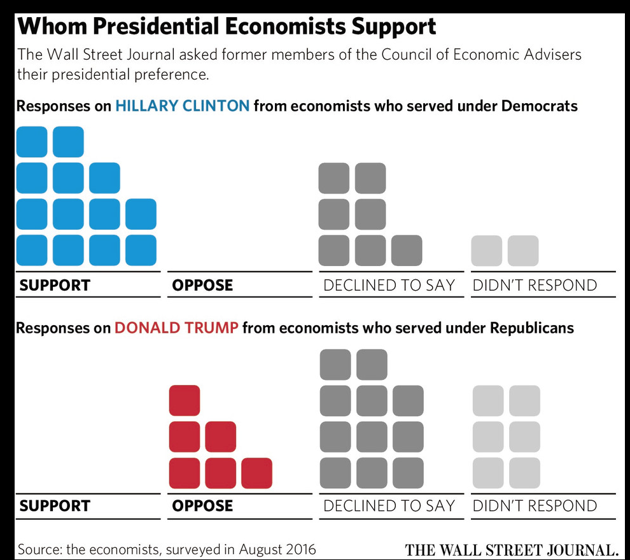
Incredibly, the WSJ could find no living member of any president’s Council of Economic Advisers who supports Trump.


Last week’s discussion of private prisons caused one of the commenters to point out an amazing article “My Four Months as a Private Prison Guard“, which appeared a few months ago in Mother Jones. It’s long and horrifying, but well worth the time and discomfort.

The article is a combination of an expose with a personalized Stanford prison experiment. Being a guard really does start to change the writer.

The other thing that comes through is the complete absence of any notion of rehabilitation. Literally no one in the story cares about the prisoners as people, or about returning them to society.


In Newsweek Kurt Eichenwald explores “Donald Trump’s God Problem“. Though more accurately, the problem doesn’t belong to Trump, it belongs to the evangelical leaders — like James Dobson   — who not only support Trump, but who claim that their support is based on their Christianity.

The primary issue here is the credibility of evangelicalism, particularly as it relates to politics. For years, there has been a logic to the evangelists’ support of the Republican Party: Both held similar views on most social issues, and there was more public discussion by conservative candidates about how faith informed their policies. This year, that is not true. Instead, you have a man whose positions on important social issues have changed, whose faith is obviously shallow and who seems to know nothing about even the basics of evangelicalism, Christianity or the Bible. Mr. Dobson, if Donald Trump represents Christian values, those values mean nothing. By endorsing him, evangelists are creating the image that what matters to them is political influence, not the word of God.

Eichenwald could just as validly be addressing Jerry Falwell Jr., who called Trump “God’s man to lead our great nation at this crucial crossroads in our history” and hallucinated “I’ve seen a man who honors his fiduciary responsibilities through his corporations.” Or the lesser known but still influential theologian Wayne Grudem, who promotes Trump not as the lesser of evils, but as “a morally good choice” (setting off Amy Gannett, who I linked to two weeks ago).

I would argue that these power-corrupted leaders are not just “creating the image” that politics drives them, they are exposing the truth about themselves: Conservative politics is now a demonic spirit that possesses the body of evangelical Christianity. It needs to be cast out.


Van Jones explains the incarceration problem very simply and directly:

A lot of times people say, “If you don’t want to do the time, don’t do the crime.” Really? Have you ever committed a crime? You’ve got more people who are doing drugs on college campuses, in yacht clubs, country clubs — we all know that’s going on. But the SWAT team never shows up there. The SWAT team shows up in the housing projects, where you’ve got poorer people doing fewer drugs, and those people go to prison.

But think about it: What if one of the times when you were breaking the law, when you had something illegal in your pocket, in your car, at your party, the police had kicked in those doors. Would you want to be known for the rest of your life based on what happened that night? That is what is happening to millions of people.

If rich folks kids get in trouble, they go to rehab. Poor folks kids get in trouble, they go to prison.

and let’s close with a time trip

Take a flight over Rome during the reign of Constantine.

About the Foundation

Somehow, we have a pay-for-play scandal without either pay or play.


[You can think of this article as a sequel to “About Those Emails“.]

Most of the articles about the possible conflicts-of-interest involving Hillary Clinton and the Clinton Foundation dive right in to some set of details: Somebody wrote an email to somebody else, and then something did (or did not) happen, maybe (or maybe not) because of some other consideration.

But before we go there, it’s worthwhile to take a step back and observe how bizarre this whole controversy is: It’s being billed as a pay-for-play scandal, but two essential items are missing:

  • pay: No one has yet postulated any credible mechanism by which money from the Clinton Foundation gets back to the Clintons. A considerable sum ($4.3 million, according to The Washington Post) has flowed from the Clintons to the Foundation, but nothing in the other direction.
  • play: There are no specific examples of a Foundation donor receiving some inappropriate government concession [1], and no examples of someone who was denied something, then contributed to the Foundation and got it.

None of the Clintons — not even Chelsea — draws a salary from the Foundation or gets reimbursed for expenses. The Foundation doesn’t own mansions the Clintons live in or fleets of cars or planes to take them places. It doesn’t fund their political campaigns or buy their books or pay them speaking fees. It just does charitable work, spending a remarkable 88% of its money on programs and only 12% on overhead.

So trying to bribe Hillary Clinton by giving money to the Clinton Foundation is a lot like trying to bribe the mayor of your town by giving money to the local United Way drive, or to the hospital that has a wing named for his family. You can hope that the mayor hears about your donation and thinks good thoughts about you, but you’re not paying him off in any meaningful sense.

On the “play” side of the so-called scandal, two recent developments have been presented by the media as raising suspicions, when it’s not clear why they should: State Department emails released by a conservative organization, and an analysis of Hillary Clinton’s schedule as Secretary of State by the Associated Press.

Paul Waldman of the WaPo’s Plum Line blog summarizes what we learned from the emails:

Judicial Watch, an organization that has been pursuing Clinton for many years, has released a trove of emails it obtained through Freedom of Information Act requests, emails that supposedly show how donors to the Clinton Foundation got special access, and presumably special favors, from Clinton while she was at State.

The only problem is that the emails in question reveal nothing of the sort. What they actually reveal is that a few foundation donors wanted access, but didn’t actually get it.

Judicial Watch presumably highlighted the worst examples it could find, and came up with these (summarized  by Waldman):

  • A sports executive who had donated to the foundation wanted to arrange for a visa for a British soccer player to visit the United States; he was having trouble getting one because of a criminal conviction. [Top Clinton assistant Huma] Abedin said she’d look into it, but there’s no evidence she did anything and the player didn’t get his visa.
  • Bono, who had donated to the foundation, wanted to have some kind of arrangement whereby upcoming U2 concerts would be broadcast to the International Space Station. Abedin was puzzled by this request, and nothing was ever done about it.
  • The Crown Prince of Bahrain, whose country had donated to the foundation, wanted to meet with Clinton on a visit to Washington. Abedin responded to Band that the Bahrainis had already made that request through normal diplomatic channels. The two did end up meeting.

Unless you find it unusual or inappropriate for a Secretary of State to meet with the crown prince of an important ally in the Middle East, there’s literally nothing to see here.

Then we get to the AP article.

At least 85 of 154 people from private interests who met or had phone conversations scheduled with Clinton while she led the State Department donated to her family charity or pledged commitments to its international programs, according to a review of State Department calendars released so far to The Associated Press.

That sounds really damning. I mean, 85 out of 154 is more than half. But there’s a problem with AP’s whole project. By limiting themselves to counting “people from private interests”, AP right at the start eliminates the vast majority of Clinton’s meetings, which are necessarily with people in the U.S. government or foreign governments. If you look at her whole schedule, those 85 donors are not 85 out of 154, they’re 85 out of well over a thousand.

And who are they? As Matt Yglesias points out, all the specific examples AP comes up with seem to be people the Secretary of State ought to be meeting with: Nobel Prize winners, people running charitable operations in foreign countries, and so on. Yglesias acknowledges the potential for sinister conflicts of interest when the State Department dealt with Clinton Foundation donors, but says the real story is that a major news organization invested a lot of time in this story and didn’t find anything.

Conceivably, there still might be a scandal here, among the people Clinton didn’t meet with: You could imagine equally deserving people who didn’t get through the door because they weren’t Foundation donors. But again, AP does not produce examples. If they looked for such people, they appear not to have found any.

There’s just nothing here. That’s the story. [AP reporters] Braun and Sullivan looked into it, and as best they can tell, she’s clean.

… The real news here ought to be just the opposite [of a scandal]: Donors to the Clinton Foundation may believe they are buying Hillary Clinton’s political allegiance, but the reality is that they are not. I wouldn’t be surprised if there is someone, somewhere whom Clinton met with whom she wouldn’t have met with had that person not been a Clinton donor of some kind. But what we know is that despite very intensive media scrutiny of the Clinton Foundation, we don’t have hard evidence of any kind of corrupt activity. That’s the story.

So let’s summarize: While Hillary was Secretary of State, rich and influential people gave money to the Clinton Foundation. That money went off to plant trees in Malawi or install solar panels in Haiti or construct playgrounds in Los Angeles, and in no way made it back to Bill, Hillary, or Chelsea Clinton. In exchange for your contribution, you could call up Huma Abedin and ask for the State Department to do you a favor, but as best anybody can tell, unless you had that service coming anyway you wouldn’t get it. Or you could ask to meet with Secretary Clinton, but unless you had legitimate State Department business to discuss with her, you wouldn’t get in.

That’s the pay-for-play scandal.


[1] The example that sticks in everybody’s mind is the one involving Russian interests buying Canadian uranium mines. For complicated reasons, the U.S. State Department had to sign off on that deal, along with nine other government agencies that weren’t under Clinton’s control. People interested in the sale donated large sums to the Clinton Foundation — mostly well before the sale was negotiated — and the sale went through.

That sequence of events sounded suspicious when Peter Schweizer called attention to it in his book Clinton Cash,  and over the last year and a half a lot of effort has gone into trying to make something out of it. But no one has been able to add anything substantive to the story; the juiciest details in the book turned out not to be true, and the author eventually admitted that he had no direct evidence of wrongdoing. Paul Waldman summarizes everything that was known about this as of April, 2015, and PolitiFact discussed it this June. I don’t know of any developments since.

Academic Freedom and Institutional Power at My Old School

The University of Chicago, where I did my graduate work in the late 1970s and early 80s, doesn’t make headlines all that often. It’s been a top academic institution for more than a century, but hasn’t had a great sports team since Coach Amos Alonzo Stagg was pushed out the door in 1932. The most famous thing that ever happened there — Enrico Fermi’s self-sustaining nuclear fission reaction in December, 1942 — was secret at the time. [1] And despite the occasional law lecturer like Barack Obama or econ professor like Milton Friedman who wanders into the public eye, the bulk of Chicago’s faculty does research far too esoteric to draw any reaction from the mass culture.

But like a disguised celebrity who succeeds in attending a public event without being recognized, the U of C community takes a perverse sort of pride in its relative obscurity: History will notice us, so CNN doesn’t have to.

Nonetheless, the University caused a buzz this week because of an unusual welcome letter the Dean of Students sent to the incoming freshman class. The letter made the Chicago experience sound more like boot camp than a nurturing environment where young people can find themselves and achieve intellectual maturity. The Dean warned his new flock that the rigorous academic debate they will hear “may challenge you and even cause discomfort”, and that the U of C

does not support so-called “trigger warnings,” we do not cancel invited speakers because their topics might prove controversial, and we do not approve the creation of intellectual “safe spaces” where individuals can retreat from ideas and perspectives at odds with their own.

The letter received a wave of acclaim from the sorts of elders who think the younger generation has gone soft, [2] or who wring their hands and clutch their pearls about “political correctness”. Like much of the discussion of political correctness, the Dean’s letter struck me as disingenuous. Academic freedom is not the simple issue Dean Ellison is making it out to be, and he is not necessarily on the side of the angels.

To begin with, he pulls together two issues — trigger warnings and controversies over invited speakers — that are related only through the false frame he has constructed for them. In neither case is the alleged over-sensitivity of today’s students the real issue. Most of the commentary on this has focused on trigger warnings (and I’ll get to that), but I think I’ll start with controversial speakers, because I have some history there.

Controversial speakers. The Dean’s statement that “we do not cancel invited speakers because their topics might prove controversial” took me back to the only protest I participated in during my years at Chicago: In 1979 a substantial segment of the student body was outraged when the University decided to give a prestigious award (for “outstanding contributions to international understanding”) to Robert McNamara, one of the con-men who had sold the American public the idea that we were winning the Vietnam War. The anti-McNamara demonstration was a true 60s flashback; Chicago cops dragged people away by their throats and everything. (I was on the sidelines and escaped unharmed.)

Nearly four decades later, I remain convinced that we were right and the University was wrong. By mingling Chicago’s prestige with McNamara’s toxic legacy, the administration was failing in its duty to protect the University’s reputation. And this absolutely was the student’s business, since we were working and paying to attach that reputation to our names.

That’s typical of the “controversial speaker” flaps that are still happening today. They’re not about limiting free speech or protecting over-sensitive students from upsetting ideas. They’re about administrators misusing (and hence endangering) their universities’ prestige.

So, for example, when faculty and student protests got former Secretary of State Condoleezza Rice to back out of speaking at the 2014 Rutgers commencement, the issue wasn’t that a conservative speaker might say something liberal students would find upsetting. The issue was that “commencement speaker” is a position of honor; a university implicitly presents the speaker as a role model for its graduates. Many in the Rutgers community found it inappropriate to honor someone who promoted the deceptions that started the disastrous Iraq War and collaborated in the Bush administration’s torture regime. Rather than expecting honors from universities like Rutgers, Secretary Rice should be happy that she’s not on trial at The Hague.

Appropriate gatekeeping. A university is not and should not be a podium from which all ideas are proclaimed equally. When a university presents speakers in some official context — at commencement, in named lectures, as course presenters, and elsewhere — it legitimizes their message. The university doesn’t necessarily endorse that message as truth, but it does say that the speaker deserves attention and presents a point of view that an educated person should be familiar with.

So while, for example, it could be entirely appropriate for a political science department to host Ben Carson so that he could discuss his experiences running for office, it would be malpractice for a history department to invite him to present his belief that the Biblical Joseph built Egypt’s pyramids to store grain. There are many academically legitimate theories about the pyramids, but that is not one of them.

The Tattooed Professor offers an edgier example:

To move from the hypothetical to the real, the Virginia Tech students who protested their university’s invitation to Charles Murray to deliver a lecture weren’t some sort of intellectual gestapo, they were members of a community calling out other members’ violation of the community’s ethos. Murray is a racist charlatan who’s made a career out of pseudoscientific social darwinist assertions that certain “races” are inherently inferior to others. To bring him to campus is to tell segments of your student community that, according to the ideas the university is endorsing by inviting Murray, they don’t belong there. This isn’t a violation of academic freedom. It’s an upholding of scientific standards and the norms of educated discourse — you know, the type of stuff that colleges and universities are supposed to stand for, right?

Especially in the internet era, when any kind of wild notion can gain a wide audience and corporate money can create an imposing facade of intellectual authority, this gatekeeping role is an important part of a university’s mission. For example, universities should promote a well-informed and wide-ranging debate about President Obama’s anti-terrorism policies, but not about whether he is secretly a Muslim in league with our enemies. A university that legitimizes baseless conspiracy theories diverts attention from topics that need and deserve it.

The major threat to universities’ ability to perform this function honestly comes not from students below, but from administrators above. Like political candidates, universities face a constant temptation to bend to the will of their funders, and the Koch Brothers and other billionaires are working hard to buy academic legitimacy for ideas that could not compete on their intellectual merit. Like big-name journalists, university presidents can also be corrupted by their exposure to power; once you get accepted into the social world of cabinet secretaries and corporate CEOs, their point of view takes on an authority it does not deserve.

Student protest is a counterweight to this executive corruption, and students should be commended, not condemned, for keeping watch on who their universities honor and which ideas they legitimize. To the extent that Dean Ellison’s letter intimidates students into shutting up, or emboldens other administrators to ignore students’ views, it undermines the mission of a true university.

Trigger warnings. This is not a new controversy, and a very good defense of trigger warnings appeared in New York Magazine in 2014. First, Kat Stoeffel explains the history:

They were popularized in the feminist blogosphere, to warn participants of the self-designated safe spaces about stories involving rape, abuse, or self-harm that might induce flashbacks to their own past traumas

From there the concept expanded to blog posts about racism and various other isms, until eventually they started showing up in university course descriptions. Stoeffel describes how she initially rolled her eyes at the whole idea, but has since changed her mind.

Why should trigger warnings bother me? Like many of trigger warnings’ loudest opponents, I have noticed, I have no firsthand experience with rape or racial discrimination or cissexism. And a few words at the beginning of an article (or on a seminar syllabus) are no skin off my un-traumatized nose.

In fact, what now strikes me most about trigger warnings is how small a request they are, in proportion to the backlash they incite. What is it about about this entirely free gesture of empathy that makes people so outraged? In their distress, critics have entirely overlooked an important distinction: Oberlin students aren’t trying to get out of reading Mrs. Dalloway because they’re special, sensitive snowflakes, or even get it removed from syllabi. They just want a three-word note on the syllabus giving them a heads-up that it addresses suicide. If that’s all it takes for instructors to prevent the shock it could cause a student who has been suicidal, it is, to me, a no-brainer.

Erika Price describes how this works from both an instructor’s and a reader’s point of view.

It is impossible for a professor or teacher to anticipate every student’s triggers, and frankly, I’ve never met a student who was demanding or entitled about having their specific triggers tagged in advance. What I have encountered, numerous times, are students who have a trauma history or a mental illness that involves triggers, who are only willing to gently and quietly request trigger warnings after I have made my pro-TW stance abundantly clear. These requests have always been polite and reasonable, and have never involved scrubbing my syllabus clean of challenging material.

… Because I am a rape survivor with trauma triggers, I know firsthand that the experience of using trigger warnings completely contradicts the anti-TW stereotype. I am not a soft-willed, petulant baby. I am a battle-tested, iron-willed survivor who has faced far more personal horror than any anti-TW demagogue could. I do not use TW’s to “protect myself” from writing that challenges me intellectually. I read writing by people I disagree with on a daily basis, for both academic and personal enrichment; my use of trigger warnings to sometimes avoid rape- and stalking-related content is utterly irrelevant to that. And the use of trigger warnings does not make me weak. Trigger warnings empower me by allowing me to customize my reading-about-rape experience. I get to choose when and how I present myself with upsetting or triggering content. This makes it easier for me to do so regularly. [3] And for the record, when I am faced with triggering material, I am not a trembling, weeping wreck, fuck you very much.

Like anything else, the idea can be misapplied. [4] But we don’t abandon the whole notion of product-safety liability just because people sometimes sue for trivial reasons. By rejecting the trigger-warning notion wholesale, Dean Ellison is short-circuiting a potentially fruitful academic discussion: What kind of consideration do individual students have a right to expect, and when are they imposing too much on the group? By declaring this whole debate illegitimate literally from Day One, it is Dean Ellison who is retreating from ideas and perspectives at odds with his own. He “wins” not by marshaling a better argument, but by invoking his institutional power: ME DEAN. YOU STUDENT.

Safe spaces. I think this part of the discussion borders on the ridiculous. Nobody lives 24/7 in an environment of unfettered academic critique. Nor is that a goal anyone should aspire to.

I hope every student finds a safe space somewhere and retreats to it when under stress. Even if it’s just a friend’s dorm room or some remote corner of the library stacks that no one else seems to know about, everybody should have one. And if students collectively decide to create a limited space where, say, no one is going to tell you that rape victims had it coming, I don’t see the harm.

Ali Barthwell nailed it:

Imagine you’re inviting a friend over to your house and before they say yes, you go “Oh, by the way, I have a dog in case you’re allergic.” THAT’S a trigger warning.

Imagine your friend says they do have a dog allergy so you agree to keep your dog out of your living room and vacuum everything so there’s no dander. THAT’s a safe space.

That’s what you assholes are against.

Trauma and empathy. Every life contains some amount of trauma, which really ought to give us all empathy for people who have been through worse.

Twenty years ago, I accompanied my wife to a doctor’s appointment, where we heard an unexpectedly bad diagnosis. For a time, I was convinced that I would spend the next two years or so watching her slide into a painful death. (That didn’t happen; she’s fine.) Afterwards it was lunchtime, so we stopped at a Mexican restaurant we used to go to occasionally. It was the only time since childhood when I literally could not stop crying.

I’ve never been back to that restaurant. It’s not their fault, and I imagine their food is still good. But there are other Mexican restaurants where I don’t have to remember crying my eyes out in public, so I go to them instead. If you’re ever going out to lunch with me and innocently suggest that restaurant, I’ll politely nudge you somewhere else. Indulge me; it’s not that big an ask.

Most of us — even if we were never raped or held hostage by terrorists or forced to watch our parents’ murder — can recall some lesser trauma. And I suspect a lot of us have some place we don’t go or thing we don’t do or product we stay away from. Maybe we could all pluck up our courage and confront those limitations, but most of us don’t. Life is too short and courage too limited to spend it so freely.

Whatever traumatic moment you can remember, imagine somebody who went through something ten times worse. If they’re not asking you for much, maybe you could indulge them. That’s all this controversy is about.


[1] Funny story related to that: Decades before I came to Chicago, Eckhart Hall, which houses the Mathematics Department, was a Manhattan Project building. As a math teaching assistant I had an office in the basement, and for several years I spent about as much time down there as a troll spends in his cave. After I got my degree, I was packing up my books when workmen came in to grind off and repatch hotspots in the floor and walls, because the government had just tightened the standards for allowable background radiation. “Now you tell me,” I said.

[2] By any objective standard (other than maybe background radiation) the current generation of students has it much harder than mine did. Most of them will leave school with a vast amount of debt, and will enter a far more uncertain job market. Older folks should be looking for ways to make their lives easier, not harder.

[3] There’s an analogy here from the history of commerce: The insurance industry did not grow because ship captains became more fearful. Quite the opposite, the protection provided by insurance allowed captains to become more adventurous.

[4] Another resemblance to the political correctness debate is the high urban-legend factor. Everybody knows somebody who knows somebody who read about a really outrageous example of a demand for a trigger warning (that for some reason could not be answered by a simple “no”). But when you go looking for verifiable examples of real damage to academic freedom, the pickings are pretty slim.

The one example that keeps showing up, Jeannie Suk Gerson’s discussion of teaching rape law at Harvard, seems to me to be as much about faculty laziness as student sensitivity. Gerson concludes:

If the topic of sexual assault were to leave the law-school classroom, it would be a tremendous loss — above all to victims of sexual assault.

Yes it would. But are “cover the topic insensitively” and “drop it” really the only options? I discussed a similar excluded-middle thought pattern with regard to policing in “Rich Lowry’s False Choice“.

The Monday Morning Teaser

It’s a rare week when my memories of the University of Chicago have anything to do with the news. In a perverse way, U of C revels in its obscurity, like the cool bar that the posers haven’t found yet. Whenever somebody confuses it with the University of Illinois or places it up the lakefront near Northwestern, a real Chicago grad smiles; we know the inside joke and they don’t.

So it was disconcerting to find Chicago at the center of this week’s big culture-war argument: The Dean of Students sent out a letter to “welcome” the new freshmen by telling them the University wasn’t going to coddle them with trigger warnings and safe spaces and canceling “controversial” speakers. The whole campus is an intellectually unsafe space, so you’d better buck up and get used to it, Bubbles.

Basically, this is the Dean posturing for conservative alumni in hopes of getting more money out of them, and (to use the high academic vocabulary I picked up at Chicago), it’s a load of crap. I’ll explain in this week’s first featured post “Academic Freedom and Institutional Power at My Old School”. Along the way, I’ll reminisce about the only demonstration I participated in at Chicago, when we protested against the University giving a “humanitarian” award to Vietnam War architect Robert McNamara. We protesting students were right, the administration was wrong, and that’s usually how these things go. The biggest corrupting force in a great university is the administration’s lust for contributions and its temptation to cozy up to the powerful, not the over-sensitivity of the student body.

That post just needs some editing and should be out before 9 EDT.

The second featured post is a debunking of the “pay-for-play scandal” at the Clinton Foundation. (Except for the complete absence of either pay or play, the story totally works.) That will be “About the Foundation”, which I think of as a sequel to “About Those Emails“, which I wrote in June. Expect it around 10.

The weekly summary will try (and fail) to make sense of Trump’s new stance on immigration. I’ll be keeping it short because of the length of the featured posts, but I’ll also get around to the 49ers quarterback’s protest, and a few other things. I’ll predict that for noon.