Friday, a 35-year-old yearbook photo of Virginia’s Governor Ralph Northam exploded across the internet. The picture shows two men, one in blackface and the other wearing a KKK hood, on Northam’s page in the 1984 yearbook of the Eastern Virginia Medical School, where he was a student. Northam apologized for the photo, without saying which of the figures was him. Later, he said neither was, but that he had worn blackface to imitate Michael Jackson in a dance contest around the same time.
Immediately, there were calls for him to resign the governorship he won in 2017. By the weekend, they were coming from all the major Virginia Democrats, including Senators Kaine and Warner. So far, Northam has refused to resign, but he still may.
I admit to being torn about this. My initial reaction wasn’t that this was a resign-immediately offense. But being so out of step with most other Democrats makes me acutely aware of the limitations of my point of view. This is a moment where I am very conscious of being white. The photo wasn’t intended to offend me, so it’s easy for me to say, “It was a long time ago. Let’s accept his apology and move on.”
I’m also conscious of being old. I remember Senator Robert Byrd of West Virginia, who served in the Senate from 1959 until his death in 2010. Byrd was a member of the Democratic leadership in the Senate: majority leader from 1987-1989, and President pro Tempore of the Senate (next in line for the presidency after the Speaker of the House) from 2003-2007. In short, he was not some shameful figure the Democratic Party hid in the attic.
Byrd hadn’t just taken a photo dressed up as KKK (or next to somebody dressed up as KKK). In his youth, he actually was KKK.
In the early 1940s, Byrd recruited 150 of his friends and associates to create a new chapter of the Ku Klux Klan in Sophia, West Virginia.
How was that possible? Well, he changed.
In his last autobiography, Byrd explained that he was a KKK member because he “was sorely afflicted with tunnel vision—a jejune and immature outlook—seeing only what I wanted to see because I thought the Klan could provide an outlet for my talents and ambitions.” Byrd also said in 2005, “I know now I was wrong. Intolerance had no place in America. I apologized a thousand times … and I don’t mind apologizing over and over again. I can’t erase what happened.”
When he died, civil-rights hero Congressman John Lewis wrote a tribute calling Byrd “a true statesman“.
Not so long ago, change of that magnitude could be accepted. Late in his career, even famous segregationist George Wallace changed.
In the late 1970s, Wallace announced that he was a born-again Christian and apologized to black civil rights leaders for his past actions as a segregationist. He said that while he had once sought power and glory, he realized he needed to seek love and forgiveness. In 1979, Wallace said of his stand in the schoolhouse door: “I was wrong. Those days are over, and they ought to be over.” He publicly asked for forgiveness from blacks.
Now, it’s entirely possible that Wallace hadn’t changed at all: Maybe he had been an opportunist as a segregationist, and he was still an opportunist when he asked for forgiveness. The difference may not have been anything that happened in Wallace’s conscience, but the fact that by the late 1970s blacks were voting in large numbers. I don’t think we’ll ever really know.
And perhaps the people who accepted these sorts of conversions were also simply being pragmatic: In the Alabama and West Virginia of the late 20th century, just about every white person had some kind of racist past. A party that was too pure to reclaim them would give up any possibility of being a majority.
Maybe we’re past all that now. Maybe we can throw out all the whites who have any racism in their past, and still hope for a majority. Maybe we can also throw out all the men who have ever done anything sexist, and all the straights who have a history of homophobia. Maybe America has changed so much that a party of people who don’t need any forgiveness can be a majority now.
But I have to confess, I have my doubts about that.
I worry that we’re playing into Trump’s hands when we drum Ralph Northam out of the Democratic Party. As I interpret it, Trump’s message to wavering whites and men and straights goes something like this:
You’re never going to be pure enough to satisfy the liberals. So you might as well wear your MAGA hat and fly your Confederate flag, because no matter what you do, there’s never going to be a place for you on the other side.
I’m open to the idea that Ralph Northam can’t be governor any more. Virginians seem to be saying that, and ultimately it’s their decision. I also like the idea that there’s a clear difference between the parties: Democrats would never let a man become president who brags about his sexual assaults while claiming that his accusers are too unattractive to be worth assaulting.
But as we watch Northam leave the public stage, as I suspect he will, I hope that doesn’t end the discussion. We need to think hard about where the limits of forgiveness are and how one seeks it.
Because I don’t think we’re ever going to find enough pure people to form a majority.
Trump was angry that his intelligence chiefs had contradicted him on TV, until he convinced himself that it just hadn’t happened.
This week a bizarre drama played out. On Tuesday, the chiefs of the major intelligence agencies (CIA, FBI, NSA, DIA, and NGA, along with their overseer, Director of National Intelligence Dan Coats) appeared before the Senate Intelligence Committee in an open hearing that was televised live and accompanied by a 42-page report. The chiefs were all careful not to draw this conclusion in so many words, but the inescapable message of their testimony was that the world they see bears little resemblance to the one President Trump tweets about.
In the world where the intelligence chiefs live, the major threats the US faces come from Russia and China, who “are more aligned than at any point since the mid-1950s”. The security of our elections is a major vulnerability, and other hostile countries are learning from Russia’s interference in 2016. North Korea is not denuclearizing and isn’t likely to. ISIS hasn’t been eliminated. Iran hasn’t violated the nuclear agreement President Obama negotiated. And (as the NYT noted) the threat Trump shut down the government to oppose barely registers.
Notably missing in the written review was evidence that would support building a wall on the southwestern border; the first mention of Mexico and drug cartels was published nearly halfway through the report — following a range of more pressing threats.
The senators on the committee — including Chairman Richard Burr and other well-known Republicans like Marco Rubio — likewise seemed uninterested the so-called “national emergency” on our southern border. Each member of the committee had five minutes for questions. None asked the intelligence chiefs to comment on the need for a border wall.
Trump reacted with anger and belittlement on Wednesday, tweeting that the intelligence chiefs were “extremely passive and naive” and “wrong”; he suggested that they “should go back to school“. His reaction raised a question that I don’t think has ever been answered: If Trump’s superior knowledge isn’t coming from the intelligence services, where does it come from? Does he just know, like an oracle, or does he have access to some more reliable source, like maybe Fox & Friends.
But by Thursday, it was all good again: Trump was now comfortable in the knowledge that the testimony we all saw didn’t really happen.
Just concluded a great meeting with my Intel team in the Oval Office who told me that what they said on Tuesday at the Senate Hearing was mischaracterized by the media – and we are very much in agreement on Iran, ISIS, North Korea, etc. Their testimony was distorted [by the] press. I would suggest you read the COMPLETE testimony from Tuesday. A false narrative is so bad for our Country. I value our intelligence community. Happily, we had a very good meeting, and we are all on the same page!
Think about how backwards this all is. If any of the intelligence chiefs actually had been misquoted or taken out of context by the media, you might expect the complaint to come from them, or perhaps from their agency’s spokesperson. Such a statement might point to a quote in the media, and then give a more accurate or more complete quote from the hearing’s transcript. Or if the quote had been accurate and the chief had simply misspoken, the agency could make a clearer statement of its actual assessment.
None of that happened. Instead, Trump simply announced that there had been no contradiction, blamed the media, and claimed without evidence that “the COMPLETE testimony” backed him up. He knows, of course, that no one in his base (and few people in general) will watch two-and-a-half hours of video to check up on him. To the MAGA-hatters, the incident is just another Trump-said/media-said conflict. The ultimate truth about it is unknowable, so they will take Trump at his word.
But if you do want to take Trump’s advice and watch the whole testimony, you can do it here or here. I have, and so has Vox’ Alex Ward, who characterized Trump’s tweet as a lie and summarized the major places where Tuesday’s testimony contradicted him. Even more damaging that the verbal testimony is the accompanying report, prepared under DNI Coats’ byline. You might imagine that even the director of an intelligence agency might mess up an answer to an unanticipated question. But written reports are drawn up carefully, weighing each word and phrase. Here are a few quotes (with the original emphasis):
On North Korea:
Pyongyang has not conducted any nuclear-capable missile or nuclear tests in more than a year, has declared its support for the denuclearization of the Korean Peninsula, and has reversibly dismantled portions of its WMD infrastructure. However, we continue to assess that North Korea is unlikely to give up all of its nuclear weapons and production capabilities, even as it seeks to negotiate partial denuclearization steps to obtain key US and international concessions. North Korean leaders view nuclear arms as critical to regime survival, according to official statements and regime-controlled media.
In his oral testimony, Director General Robert Ashley of the DIA said: “The capabilities and threats that existed a year ago are still there.” This directly contradicted Trump’s tweet that “There is no longer a Nuclear Threat from North Korea.”
Iran:
We continue to assess that Iran is not currently undertaking the key nuclear weapons-development activities we judge necessary to produce a nuclear device.
ISIS:
ISIS still commands thousands of fighters in Iraq and Syria, and it maintains eight branches, more than a dozen networks, and thousands of dispersed supporters around the world, despite significant leadership and territorial losses. The group will exploit any reduction in [counter-terrorism] pressure to strengthen its clandestine presence and accelerate rebuilding key capabilities,such as media production and external operations. ISIS very likely will continue to pursue external attacks from Iraq and Syria against regional and Western adversaries, including the United States. … ISIS remains a terrorist and insurgent threat and will seek to exploit Sunni grievances with Baghdad and societal instability to eventually regain Iraqi territory against Iraqi security forces that are stretched thin.
Climate change:
Global environmental and ecological degradation, as well as climate change, are likely to fuel competition for resources, economic distress, and social discontent through 2019 and beyond. Climate hazards such as extreme weather, higher temperatures, droughts, floods, wildfires, storms, sea level rise, soil degradation, and acidifying oceans are intensifying, threatening infrastructure, health, and water and food security. Irreversible damage to ecosystems and habitats will undermine the economic benefits they provide, worsened by air, soil, water, and marine pollution
Iraq:
Iraq is facing an increasingly disenchanted public. The underlying political and economic factors that facilitated the rise of ISIS persist, and Iraqi Shia militias’ attempts to further entrench their role in the state increase the threat to US personnel.
As president, Trump has every right to make foreign policy decisions as he sees fit, and he’s not required to listen to what the US intelligence community tells him. Intelligence is meant to help him and his advisers make the smartest, best-informed decisions possible based on the facts. If Trump chooses to completely disregard those facts and make foreign policy decisions based solely on his gut instincts, that’s his prerogative.
But that doesn’t support his claim that the media willfully mischaracterized what his top spies said. What the intelligence community effectively showed, knowingly or not, is that Trump’s foreign policy isn’t based in reality. Trump’s scapegoating the media, in this case, won’t change that.
The news that I found most amazing this week was the drama of the intelligence chiefs. Tuesday, the heads of the major US intelligence agencies testified before the Senate Intelligence Committee, and directly contradicted many statements by their boss, President Trump. Wednesday, Trump angrily tweeted about how “naive” and “wrong” they were. But by Thursday he was happy again, having convinced himself that the media made up the whole conflict. The hearing had been televised live and the video is still available online, but never mind that. Who are you going to believe: Trump or your lying eyes?
I’ll discuss that in the featured post “Another Week in the Post-Truth Administration”. It should be out shortly.
The weekly summary covers the budget negotiations (mainly by urging you to ignore what everyone else is saying about them), this week’s extreme weather, Governor Northam’s photo, what national emergency declarations are really for, Venezuela, and a few other things. Then I’ll close with video about a strange whistle-language that is still used in the mountains of Turkey. That should be out before noon.
This week everybody was talking about the end of the shutdown
The featured posts look at the shutdown from two perspectives: One is news-oriented; it summarizes the events and looks ahead to the possibilities. The other takes a more long-term view: If extortionist tactics are considered legitimate, eventually democracy will unravel. Someday a leader will point to the chaos of a shut-down government and blame not the other party, but democracy itself. He’ll offer to make it all go away, and people will listen.
It’s minor in the long run, but Nancy Pelosi won her staredown with Trump regarding the State of the Union. I like the way Amanda Marcotte summed it up:
Typical. A woman offers a soft no. The man pretends not to understand her and presses his case. And she is forced to resort to a forceful no.
and Roger Stone’s indictment
The indictment itself is here, and a good summary of what it means is at Lawfare. The essence of the 7-count indictment doesn’t concern what Stone did, but how he lied about what he did, both to Congress and to investigators. Also, he tried to influence other witnesses, including telling one to “do a Frank Pentangeli”. (Pentangeli is a character in The Godfather II who claims not to remember anything when it comes time to testify before Congress.)
Trump defenders are once again claiming that an indictment for anything other than conspiracy with the Russians shows that Mueller doesn’t have evidence of conspiracy with the Russians. But that doesn’t follow logically, and they still have no answer to the question: Why did so many of Trump’s people feel that they had to lie about their Russian contacts, even in situations where lying was illegal?
but I’m fascinated to see what’s making it into the public discussion
Maybe I’ll write about this more next week. (There was already so much to cover this week.) But I’m being amazed at the ideas that are being talked about lately.
Last Monday, the head of the flight attendants union called for a general strike to end the government shutdown. The general strike — when workers of all kinds stop working, rather than just workers at a particular place or in a particular industry — is a tactic seldom mentioned these days. But it makes a certain amount of sense as a response to a government shutdown. That speech (as best I can tell) didn’t make the NYT or the WaPo, but Atlantic mentioned it. Teen Vogue gave its readers a primer on the whole idea of a general strike.
And this week, Elizabeth Warren came out with an “ultra-millionaire” tax that is on wealth rather than income. Net worth higher than $50 million would be taxed at 2%, and over a billion at 3%.
Not so long ago, all these ideas would have been dismissed and ignored by the mainstream media.
and you also might be interested in …
The US and the Taliban have announced agreement on a framework for peace in Afghanistan. The pieces are that the Taliban will not allow its territory to be used as a staging ground for terrorists, the US will withdraw its troops, and the Taliban will begin negotiating directly with the Afghan government amid a general ceasefire.
A framework is a long way from actual peace, as we have seen with North Korea. But this is hopeful.
Slate’s Mark Joseph Stern foresees a consequence of Brett Kavanaugh replacing Anthony Kennedy on the Supreme Court (and indirectly of Neil Gorsuch taking the seat that should have gone to Merrick Garland): Concealed carry of firearms may soon be legal everywhere.
The immediate case before the Court simply asks that the right to a handgun in the home be extended to a right to transport a firearm between homes. But a national right to concealed carry or even open carry may be the ultimate result. Once you have a constitutional right to possess a gun outside of your home, it’s hard to come up with any obvious boundary.
Russell Baker died at the age of 93. People under, say, 40 may not remember him (except possibly as a host of Masterpiece Theatre), but he was a long-time New York Times columnist who won two Pulitzers, one for his columns and one for the story of his Depression-era childhood, Growing Up.
I haven’t read Growing Up since shortly after it came out in 1983, but I imagine it would hold up well. In the introduction Baker explains why he wrote it: His mother had just died, and as she faded to the point where she couldn’t converse any more, he thought about all the questions he would still like to ask. Then he thought about his own children, and how they probably wouldn’t be curious about his life until it was too late to ask him about it. He wrote Growing Up in anticipation of their future curiosity. The book is full of memorable characters, including Uncle Harold, whose engaging stories of family history were often interrupted by his wife yelling from another room: “Harold, quit telling those lies!”
From the beginning, the government of the United States has been founded on compromise. The Constitutional Convention created the House to give big states their due power and the Senate to protect the small states. Slave states wanted their representation in Congress to reflect their whole population, slave and free, while free states wanted representation determined only by free residents. They settled on counting 3/5 of the slave population.
Through the early 19th century, a series of compromises held the Union together: You can have Missouri as a state if we can have Maine. We’ll start a Bank of the United States, but with a charter that will need to be renewed. (It wasn’t.) Henry Clay was known as the Great Compromiser. It was a compliment, not an insult.
That pattern continued into the 20th century: Your district wants a bridge, mine wants a dam; let’s do both. Urban liberals want to fund food stamps, while rural conservatives want farm subsidies; let’s combine them into one bill.
That’s how American democracy is supposed to work: Different parts of the country may be rivals, but they’re not enemies, so win/win solutions are possible. Along the way, we discover things that just about everybody wants: safety from invaders and criminals, not letting poor people die in the streets, security in old age, good schools, effective responses to epidemics, and so on. So you fund the things that everybody wants, and you make deals on the rest. If I want your support for something you don’t care about, I’ll offer to support something you do care about too.
But something changed in American politics after the Gingrich Revolution of 1994, and it got worse after the Tea Party wave of 2010: Republicans began to adopt extortion tactics. Rather than offer quid pro quo deals to Democrats, they began packaging demands and threats: If you don’t give me what I want, I’ll do something that nobody wants. I’ll shut down the government, I’ll run us into the debt ceiling. I’ll sabotage the nation’s credit rating. Coast Guard families will be going to food banks. The FBI won’t be able to pay its informants. Air travel, going to the national parks, or even just eating food will get riskier. Then you’ll see how serious I am and understand that you have to give me what I want.
Gingrich ultimately changed his stripes; he and President Clinton worked out any number of compromises, as President Reagan and Speaker O’Neil had a decade before. They controlled spending at the same time that they raised taxes, and guess what happened? The deficit went away.
But extortion tactics were never officially renounced, and over the last decade Republicans have gone back to considering them a legitimate option. To get ObamaCare passed, President Obama needed a House majority and 60 votes in the Senate. But Republicans tried to extort a Democratic Senate and President into repeal as soon as they controlled only one house of Congress. (It’s worthwhile to try to picture the reverse situation, because it’s so hard to imagine: Picture Obama taking office in 2009 and threatening to leave our troops in Iraq stranded and unsupplied unless Congress passed his health care plan.)
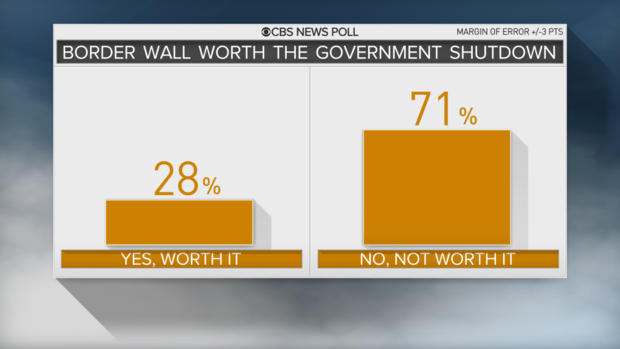
And now President Trump (who was elected with 46% of the vote and has never had an approval rating over 50%) is trying to extort funding for his unpopular wall.
Partisan extortionists usually try to cloud the issue, but the difference between extortion tactics and ordinary politics is not at all hard to see. Extortion arguments have a don’t-make-me-do-this quality similar to kidnappers’ ransom demands. It isn’t that anybody wants the government shut down, it’s that one side is willing to do it to get what it wants. It’s also not hard to tell which side is extorting: Look at the issue in question and ask yourself who wants it. During the recent shutdown, the central issue was the Wall, and Trump wanted it. He wasn’t willing to make a positive offer to Democrats, so instead he threatened them with a government shutdown. The media’s popular two-sides-bickering narrative wasn’t remotely accurate: Trump was extorting, and Pelosi was resisting extortion.
Democracy can’t go on like this forever. Eventually, some leader will get elected on an openly anti-democratic platform, arguing that our constitutional system is too cumbersome to work any more. Once he gets into office, he’ll provoke an extortion crisis as a way of proving his point: How can we support a system of government that allows stuff like this to happen? Are we willing to stand by while the country falls apart, or do we want the leader to declare a national emergency, abolish Congress, and make things work again?
The way out of that scenario is for the public to re-establish the norm that extortion is not legitimate. The right way to make change is to assemble a majority, and any leader who offers a short-cut around that process — even to get something we think we want — deserves our scorn.
Friday night, Trump released his 800,000 hostages without getting anything for them. Zero. He signed exactly the same deal that was on the table back in December: Keep the government funded at its previous level for a few weeks while an immigration/border-security compromise gets negotiated.
The fact that it came out that way is extremely important. Giving him anything, even just the “pro-rated down payment on the Wall” he had demanded on Thursday, would invite regular government shutdowns for the rest of his term. Every time some budget bill needed to be signed, Trump could say, “No. I want more or I’ll shut down the government again.”
By holding the line until things really started to get bad, Speaker Pelosi stood by the important principle of not paying ransom. If Trump wants something from the Democrats, he can offer them something positive in exchange. (That’s how politics is supposed to work in America.) But he’s not going to get concessions just by threatening to hurt people or hurt the country.
Why now? If the same deal has been available since Day Zero, why did it happen on Day 35? There were two precipitating causes: the test votes the Senate held on Thursday, which showed Republican unity beginning to crack, and the 82-minute ground stop Friday morning at New York’s LaGuardia Airport due to air traffic controllers not coming in to keep working without pay, which caused delays that rippled across the country. This was widely interpreted (correctly, I think) as a warning sign from a system about to break down.
The Senate voted on two proposals Thursday, and neither got the 60 votes necessary to proceed. But Trump’s preferred outcome ($5.7 for the Wall, plus other restrictions on immigration and asylum) got 50 votes, with one Democratic crossover (Joe Manchin of West Virginia), while the Democrats’ proposal (open the government temporarily without additional provisions) got 52 votes, with six Republican crossovers: Lamar Alexander (Tenn.), Susan Collins (Maine), Cory Gardner (Colo.), Johnny Isakson (Ga.), Lisa Murkowski (Alaska), and Mitt Romney (Utah). (And at least a few of the Republicans who stuck by Trump were not happy.) According to the Washington Post, this outcome surprised Trump, because Jared Kushner had assured him that Democrats were about to start defecting.
But pointing to the Senate as a cause just shifts the question to another level: Why Day 35? Why did Mitch McConnell finally allow the Senate to vote on something, and why did Republican senators start to break ranks?
The LaGuardia ground stop was part of a nationwide pattern: As government workers faced losing a second paycheck, warning lights were flashing and systems were beginning to fail.
The FBI Agents Association put out a report listing the effects the shutdown was having on law enforcement. Perhaps the most egregious example: The FBI agents investigating the MS-13 gang (that Trump so often features in his anti-immigrant speeches demanding a wall) were unable to pay a translator to communicate with their informants. The Commandant of the Coast Guard tweeted:
I find it unacceptable that @USCG members must rely on food pantries & donations to get through day-to-day life.
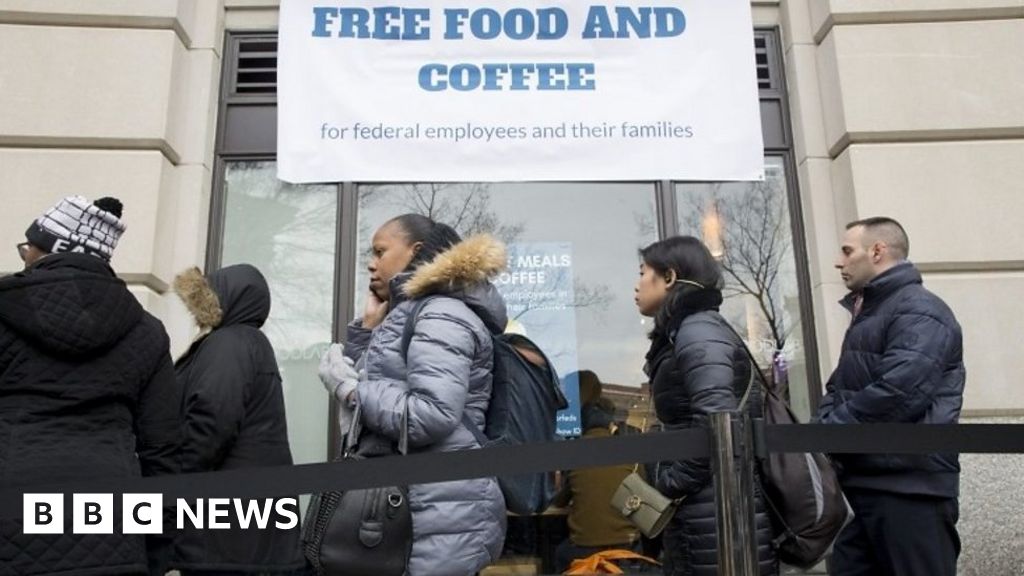
What made this growing pressure worse for Republicans was the repeated insensitivity and tone-deafness expressed by plutocratic Trump administration officials, who are clueless about the half the country that lives paycheck-to-paycheck. Chief economic advisor Larry Kudlow described federal employees forced to choose between working without pay and losing their jobs as “volunteers”. Commerce Secretary Wilbur Ross couldn’t understand why federal workers would go to food banks when they could take out loans. And Trump himself spun Ross’ comment into a fantasy about compassionate grocers who “know the people, they been dealing with them for years, and they work along.” Perhaps extrapolating from his own experience owing hundreds of millions to Deutsche Bank, he claimed that banks too would “work along” with missed mortgage payments.
Now what? The spending bill just lasts for three weeks, at which point the whole standoff could start again. In an effort to claim he hadn’t lost to Pelosi, Trump threatened as much:
This was in no way a concession. It was taking care of millions of people who were getting badly hurt by the Shutdown with the understanding that in 21 days, if no deal is done, it’s off to the races!
But it’s hard to see Republicans in Congress standing by him for another shutdown. Mitch McConnell didn’t want this shutdown and certainly doesn’t want another one. (He is fond of saying, “There’s no education in the second kick of a mule.”) And ultimately, he holds the high card over Trump: If he works out a deal with Democrats and Trump vetoes it, McConnell could sway enough Republicans to override that veto. The thought of 2/3rds of the Senate voting against him on anything should be terrifying to a president who could well face impeachment before the end of his term.
So what will happen in the next three weeks? Ezra Klein lays out four possibilities:
A grand bargain on immigration takes the issue off the table for the near future.
Pelosi, Schumer, and McConnell reach no deal and the government shuts down again.
No immigration/wall deal, but there’s no shutdown, and Trump seeks to build his Wall without Congress by declaring a national emergency.
No immigration/wall deal, but no national emergency.
I foresee a lesser bargain, similar to what Lindsey Graham and Dick Durbin have already worked out: Democrats have already signaled that they’re willing to offer more money for border security, but they think the Great Wall of Trump is a stupid waste. (Not that it matters, but reality is on their side here; the Wall is a stupid waste. Republicans know this, which is why they didn’t fund it when they had the majority in both houses.) A number of Republicans (including even Trump, at times) have said they don’t want to deport the DACA people, whose cause gets a lot of sympathy from Americans in general.
The question is how much funding for how much DACA protection. Here, I think the failure of the shutdown pushes the needle towards Democrats. This is what I picture:
DACA recipients get permanent legal status, with a path to citizenship left vague. Democrats can promise to eventually get them citizenship, while Republicans can deny this will ever happen.
Border security gets the $5.7 billion Trump was asking for, but mostly for technology at ports of entry and more immigration judges.
Rules for legal immigration change a bit, but Congress reaffirms support for the United States’ treaty obligations under the Convention Relating to the Status of Refugees, which Trump has been ignoring.
Some small number of additional barriers on the border are authorized, which Democrats will be able to claim is not Trump’s Wall, but Republicans can claim is a step toward Trump’s Wall.
Finally, I hope Democrats insist that a study be done to produce something that until now has never existed: an actual design for a sea-to-sea border wall, with a realistic cost estimate and expert estimates of its effects on illegal immigration, drug smuggling, violent crime, and the environment. The era of wild claims has to end.
Trump may or may not try to build his wall without Congress by declaring a national emergency, but I doubt it will get him anywhere. (Truman wasn’t able to seize the steel industry, and that was during wartime.) Whatever he wants that declaration to accomplish will be tied up in court for the rest of his term. The point of declaring a national emergency, I believe, is mainly to con Trump’s base into thinking that he didn’t really lose.
While I don’t think it will be effective in building a wall, declaring a bogus emergency breaks another norm that protects democracy. Down the road, it could cost us dearly: A leader’s abuse of emergency powers is a common way for democracies to become autocracies.
After looking like it would never end, the government shutdown suddenly ended. I’m planning two featured posts about that. The first is newsy. It collects how the shutdown ended, and what’s likely to happen next. (I will be amazed if the government shuts down again in three weeks. If it does, I expect Trump’s support in the Senate to crumble very quickly.) That’s nearly done and should be out before 9 EST.
The second is more of an opinion piece about how these extortionist tactics need to end. The Founders pictured Congress working as their own Constitutional Convention had worked: by compromise, where you assemble majority support by giving a lot of people part of what they want. For the last ten years, though, Republicans have recognized extortion as a legitimate tactic: If they don’t get what they want, they’ll do something nobody wants, like shut down the government or let it hit the debt limit. The point of those tactics has been to try to push through something that doesn’t have majority support, like repealing ObamaCare or building a wall.
I don’t think there’s any way to make such tactics illegal, though ideas for preventing future shutdowns are floating around. But we need to restore the idea that they’re illegitimate; the public needs to understand that anybody who proposes such a thing is fundamentally opposed to American democracy.
I hope to get that post out by 11. The weekly summary also has Roger Stone’s indictment to talk about, as well as the peace framework for Afghanistan, the UK’s continuing Brexit crisis, proposals for new taxes on the rich, and a few other things. Let’s imagine getting that posted between noon and 1.
The fight over whether Trump should be removed from office is already raging, and distorting everything it touches. Activists are radicalizing in opposition to a president they regard as dangerous. Within the government, unelected bureaucrats who believe the president is acting unlawfully are disregarding his orders, or working to subvert his agenda. By denying the debate its proper outlet, Congress has succeeded only in intensifying its pressures.
For about 24 hours, it looked like we were headed there sooner rather than later. BuzzFeed apparently had a scoop that showed Trump to be guilty of the same sort of crime that brought down Nixon. Then the Special Counsel’s Office released a cryptic statement casting doubt on that article. The featured post examines where that leaves us.
I never said there was no collusion between the campaign, or between people in the campaign. I have no idea. I said “the President of the United States”. There is not a single bit of evidence the president of the United States committed the only crime you can commit here, conspired with the Russians to hack the DNC.
So the denial is down to this: The President himself wasn’t personally involved in hacking the DNC. They used to claim that the whole Mueller investigation was a witch hunt. Now they’re just denying that Trump was responsible for one particular act of witchcraft.
and Brexit
The March 29 deadline for the United Kingdom to leave the European Union keeps getting closer, but Parliament is no closer to approving a plan for what happens then. If March 29 arrives without any action from Parliament, the UK faces what is called a “hard Brexit“: The European Union views it as a foreign country with hardly any special privileges. For example, thousands of flights between British and European airports might have to be cancelled. UK citizens could only come into the EU if they had at least six months left on their passports.
Prime Minister May’s plan for Brexit got crushed in Parliament, 432-202, with opposition both from pro-EU MPs and from those who don’t think her planned break with the EU is sharp enough. She’s expected to present her Plan B today, but moves in either direction may lose as many votes as they gain.
The EU’s highest court has ruled that the UK can unilaterally cancel Brexit and stay in the EU on the same terms as before. But it’s not clear that plan could pass Parliament either.
Lesson for the future: Never hold a referendum where the choices are (1) something as specific as staying in the EU under the current agreement, and (2) a vague “do something else”. A more rational process would have been to authorize the PM to negotiate a leave-the-EU agreement, without making any commitment to go through with that plan until it went up for a referendum against staying in the EU under the current agreement. Two choices, equally specific.
and the shutdown
Four weeks into the shutdown, Trump made his first offer to Democrats. (Up until then, he’d issued nothing but demands.) The offer isn’t much: In exchange for $5.7 billion for his Wall,
participants in the DACA and Temporary Protected Status programs get three more years of protection from deportation. These deportations are already on hold until court cases play out, so it’s not clear how much of an improvement three years is over whatever will happen anyway.
an additional $800 million would go to humanitarian services at the border.
Trump would allow Central American minors to apply for asylum without leaving their home countries, at the cost of making them easier to deport if they come here.
These are all examples of Trump partially undoing damage he has caused since taking office. Trump is the one who announced the end of DACA and removed hundreds of thousands of refugees from TPS. His family-separation and zero-tolerance policies created the humanitarian crisis on the border. And Central American minors only lost the ability to apply for asylum from home when Trump cancelled an Obama program.
So basically, he’s just offering to sell back a bunch of hostages he has taken, with the option to take them again if he gets re-elected. A real concession would be something that moved the ball from where it was when he took office, like offering DACA recipients some kind of permanent legal status. (I am undecided about whether such a concession would be enough to make a deal. But at least it would be a concession.)
Meanwhile, Democrats are making their own offer: more money to do border security right, rather than build a giant monument to xenophobia and racism. The next open-the-government bill in the House will include more money for ports-of-entry (where illegal drugs really come in), and to hire more immigration judges (to drive the case backlog down). Offering asylum to those in danger in their home countries, after all, is a treaty commitment backed by our own laws (laws which the President is sworn to faithfully uphold). If the length of the processing backlog is creating problems, let’s address that directly.
The basic problem is that Trump is living in his own reality. He thinks keeping the government closed gives him leverage, and that he should be able to extort some real price to open it again. Democrats, meanwhile, see Trump’s poll numbers falling and don’t understand why they should pay to make that stop.
Trump has complained that he’ll “look foolish” if he ends the shutdown without getting anything for it. But he WAS foolish. He can’t expect Democrats to cover that up for him.
The humanitarian crisis at the border didn’t just happen, it was planned. NBC News reports:
Trump administration officials weighed speeding up the deportation of migrant children by denying them their legal right to asylum hearings after separating them from their parents, according to comments on a late 2017 draft of what became the administration’s family separation policy obtained by NBC News.
The draft also shows officials wanted to specifically target parents in migrant families for increased prosecutions, contradicting the administration’s previous statements. In June, Department of Homeland Security Secretary Kirstjen Nielsen said the administration did “not have a policy of separating families at the border” but was simply enforcing existing law.
I think Nancy Pelosi’s suggestion that Trump delay the State of the Union (which is traditionally delivered in the House chamber) was brilliant. Trump is unmoved by the strains on the country that his shutdown is producing, but if he has to forgo his biggest TV extravaganza of the year, that hits him where he lives.
and more people running for president
Kamala Harris and Kirsten Gillibrand are in. Along with Tulsi Gabbard and Elizabeth Warren, that makes more women candidates than any party has ever fielded. It will be interesting to see what difference that makes in the process.
In 2016, Hillary Clinton and Carly Fiorina were each “the woman” in their party’s race. In some symbolic sense, they were women entering a men’s club, so how the men would treat them was up in the air. When Trump made sexist comments about Fiorina’s looks, for example, no other women were in a position to call him on it. But when the numbers are more equal, men may not get away with the same behavior.
It will also be harder to use sexist stereotypes while implying that they refer to something specific about a particular candidate. If there’s just one woman in a race, maybe she really does dress funny or have a screechy voice or disappoint in some other way that coincidentally matches a stereotype. But if all the women are counted out for reasons like that, it’ll be pretty clear what’s going on.
but we should be talking about Martin Luther King this weekend
The group outnumbered us and enclosed our small group, chanting ‘build the wall’ and other trumpisms. The group was clearly looking for ANY opportunity to get violent and they consistently infringed upon our space, inching closer and closer, bumping into us and daring us to get physical. They surrounded us, screaming, cajoling, and mocking the elder singer with intentionally disrespectful dancing and attempting to chant/sing louder than him.
Then a much longer video became available, and conservative media started claiming it vindicated the Covington kids. It’s an easy claim to make, because who’s going to watch two hours of video to check you?
I haven’t. But here’s the impression I’m getting from people who have. A handful of Black Hebrew Israelites, the kind of street preachers who like to bait passers-by into debates, started baiting the Covington Catholic kids “using aggressive, provocative and sometimes offensive language to engage, as they usually do.”
The kids could have walked away, which is what most people do when street preachers try to engage them. But instead they responded with their own hostility. This is where the Native American elder, Nathan Phillips, entered the scene. He was on the Capitol Mall for an indigenous people’s rally, and thought the Covington kids were about to get violent against he Black Hebrew Israelites, who they greatly outnumbered. So he walked into the space between the two groups, trying to drum and sing them apart.
Phillips then tried to get to the steps of the Lincoln Memorial, so he could do his song from the top, but the kids blocked his way. That’s where the viral video starts.
and you also might be interested in …
Of all the ways that Trump has profited off his presidency, the most obviously illegal has been the Trump International Hotel in Washington DC. The hotel is housed in the Old Post Office, which is owned by the federal government and managed by the General Services Administration. The Trump Organization’s lease with the government says
No member or delegate to Congress, or elected official of the Government of the United States or the Government of the District of Columbia, shall be admitted to any share or part of this Lease, or to any benefit that may arise therefrom
Also, the Hotel does business with foreign governments (even moreso now that dealing with the Hotel is a way of bribing the President), which raises the issue of the Constitution’s emoluments clause.
No Title of Nobility shall be granted by the United States: And no Person holding any Office of Profit or Trust under them, shall, without the Consent of the Congress, accept of any present, Emolument, Office, or Title, of any kind whatever, from any King, Prince, or foreign State.
Those both seem pretty clear, but in March, 2017 the GSA ruled that its new boss could continue to benefit from the lease, without regard to the emoluments issue. This is literally the definition of self-dealing: As head of the government, Trump was overseeing the lease that he was holding as a private businessman.
This week the GSA inspector general issued a report on this decision. The IG doesn’t get into a legal analysis of either issue, but makes it clear that GSA didn’t even consider the constitutional issue. (The word “punted” comes up.)
the decision to exclude the emoluments issues from GSA’s consideration of the lease was improper because GSA, like all government agencies, has an obligation to uphold and enforce the Constitution
The report ends by making recommendations about future leases. Apparently the IG expects the current issues to play out in the courts.
A clear example of why the Trump International Hotel shouldn’t be owned by the President came up Wednesday. T-Mobile had a big merger deal brewing with Sprint, and it needed approval from the administration. So what did it do? It had its executives repeatedly stay at the Trump International.
These visits highlight a stark reality in Washington, unprecedented in modern American history. Trump the president works at 1600 Pennsylvania Ave. Trump the businessman owns a hotel at 1100 Pennsylvania.
Countries, interest groups and companies such as T-Mobile — whose future will be shaped by the administration’s choices — are free to stop at both, and to pay the president’s company while also meeting with officials in his government. Such visits raise questions about whether patronizing Trump’s private business is viewed as a way to influence public policy, critics said.
Vicious cycle: climate change plays a key role in a wave of destructive fires in California. Responsibility for the fires sends Pacific Gas & Electric into bankruptcy. In bankruptcy, it can renegotiate the terms of contracts it signed with providers of renewable energy, possibly sending them into bankruptcy, and making climate change worse.
Republicans in Congress have just noticed that Rep. Steve King from Iowa is a racist. I wonder how long it will take them to figure out that Trump shares the same views? Trevor Noah makes fun of just how apparent King’s racism has been for many years.
I can’t believe we’re all talking about a Gillette ad. This one.
First off, I can’t see what there is here for anybody to get upset about. Whoopi Goldberg on The View summed up the message as “Don’t be a jerk”, which is pretty much the way I saw it.
And second, I’m never going to be a Gillette fan anyway, for reasons I outlined in a 2012 article “What Shaving Taught Me About Capitalism“. For generations, Gillette has used its advertising moxie and market power to drive up the cost of shaving. I think if a young man learns how to use either an old-fashioned double-edged safety razor or an even more old-fashioned straight razor, within a week or two he won’t be cutting himself any more, and he’ll save many thousands of dollars over his lifetime. Or he could skip the whole thing and grow a beard as soon as he could.
So I think it’s ridiculous to boycott Gillette over a commercial that tells you not to be a jerk. But I couldn’t boycott the company if I wanted to, because I stopped buying their products a long time ago.
President Donald Trump directed his longtime attorney Michael Cohen to lie to Congress about negotiations to build a Trump Tower in Moscow, according to two federal law enforcement officials involved in an investigation of the matter.
The accusation seemed especially strong, because it supposedly rested on much more than just Cohen’s word.
The special counsel’s office learned about Trump’s directive for Cohen to lie to Congress through interviews with multiple witnesses from the Trump Organization and internal company emails, text messages, and a cache of other documents. Cohen then acknowledged those instructions during his interviews with that office.
For most of Friday, the media buzzed with the implications. The Washington Post’s Greg Sargent compared this moment to the appearance of the tapes that brought down Richard Nixon.
if BuzzFeed’s stunning new report is true, we could be looking at a real inflection point in this whole story
Others referred to the report as a “game-changer”, the first easily-grasped-by-the-public evidence that Trump had committed a significant crime. Former Watergate prosecutor Jill Wine-Banks told Lawrence O’Donnell:
This is exactly the Watergate model. … This should be enough. … Even the Republican Senate is going to have to say, “We’ve been had.”
And then Friday night the Special Counsel’s office, which hardly ever comments on any news report, released this statement:
BuzzFeed’s description of specific statements to the Special Counsel’s Office, and characterization of documents and testimony obtained by this office, regarding Michael Cohen’s Congressional testimony are not accurate
That’s not the money quote from a longer statement; that’s the whole thing. But what does it mean? It asserts the existence of inaccuracies, but doesn’t say what they are. And it doesn’t even hint at what the actual truth might be. As best I can tell, it does two things:
It monkey-wrenches the drive to a quick impeachment.
It keeps us all in suspense about what Bob Mueller’s office will eventually report.
Reading the tea leaves. For its part, BuzzFeed rechecked its sources and didn’t back down. Editor Ben Smith responded:
We stand by our reporting and the sources who informed it, and we urge the Special Counsel to make clear what he’s disputing,
That’s the big question: Is the whole story “inaccurate”, or just some small detail? And what was it about this story that made Mueller’s office decide it needed to comment?
On Rachel Maddow’s show Friday night, several good insights pointed in opposite directions. Rachel herself related the would-be scoop to an earlier puzzle: Why was Michael Cohen charged with lying to Congress to begin with? He had already pleaded guilty to multiple felonies, and the Special Counsel didn’t ask for any additional jail time for Cohen. So why was that worth everybody’s time?
The Buzzfeed story, Maddow observed, offered an answer to that question: The charge against Cohen sets up a later charge against someone else, presumably Trump. If you’re going to accuse Trump of suborning perjury, it helps if you’ve already established that there was a perjury.
She then talked to Michael Isikoff, one of the top reporters on this beat. Isikoff said the original BuzzFeed article was full of “red flags” that should have made us all cautious. It contained no details about when or how Trump gave Cohen his instructions. What texts and emails could the article have been referring to, when Trump himself doesn’t write texts or emails? Cohen’s guilty plea had offered him a perfect opportunity to implicate Trump, and he didn’t.
Former U.S. Attorney Chuck Rosenberg, who has worked with Mueller, tried to read the tea leaves of the Special Counsel statement, and came up with a very narrow interpretation:
The Mueller team is pushing back on aspects of the Buzzfeed story. But I think in the main, what you can glean from their December 7 sentencing [of Michael Cohen] memorandum is that the core of the Buzzfeed story is accurate.
People familiar with the matter said the special counsel’s office meant the statement to be a denial of the central theses of the BuzzFeed story — particularly those that referenced what Cohen had told the special counsel, and what evidence the special counsel had gathered.
The New Yorker’s Ronan Farrow offers an in-between perspective. First, BuzzFeed took a bigger chance on its reporting than he was willing to take.
I can’t speak to Buzzfeed’s sourcing, but, for what it’s worth, I declined to run with parts of the narrative they conveyed based on a source central to the story repeatedly disputing the idea that Trump directly issued orders of that kind.
Note that the general thrust of Cohen lying to Congress “in accordance with” or “to support and advance” Trump’s agenda (per Cohen’s legal memo) is not in dispute. The source disputed the further, more specific idea that Trump issued—and memorialized—repeated direct instructions.
This is consistent with numerous reports that The Trump Organization works like a Mafia family: The Boss indicates what he wants to happen without leaving specific instructions that can be quoted in court. (Not “Kill that guy”, but “Take care of the situation” or “I think you know what to do”.) Cohen may well have known what Trump wanted done without being able to point to any specific instructions. There might well be “supporting documents”, but of an indirect sort (i.e., Trump Organization people trying to coordinate their stories) rather than written directives from Trump himself.
One of the more interesting speculations is that the conflicting sources are in rival offices: the SCO on the one hand and the Southern District of New York US Attorney on the other.
Impeachment. To me, this whole incident underlines a point that Yoni Appelbaum makes in the current issue of The Atlantic, in an article written before the BuzzFeed article: America needs a formal, dignified, judicious impeachment process, rather than what’s happening now.
The investigation of Trump’s possible crimes, and the corresponding destructive effects on our democracy, should be happening in public view, not behind closed doors at the Special Counsel’s Office, or through anonymous sources in the press.
For decades, we have been talking about the expanding power of the Imperial Presidency, and what should be done about it, if anything. But just as important is the Shrinking Congress.
The fight over whether Trump should be removed from office is already raging, and distorting everything it touches. Activists are radicalizing in opposition to a president they regard as dangerous. Within the government, unelected bureaucrats who believe the president is acting unlawfully are disregarding his orders, or working to subvert his agenda. By denying the debate its proper outlet, Congress has succeeded only in intensifying its pressures. And by declining to tackle the question head-on, it has deprived itself of its primary means of reining in the chief executive.
Is the continuance of the Trump administration dangerous to democracy? That question needs an open debate, with the relevant information made public and the relevant witnesses questioned where everyone can hear them. We shouldn’t be waiting for Bob Mueller to save us, and in the meantime debating over whose anonymous sources really know what they’re talking about.
For a day there, it looked like impeachment would start sooner rather than later: Buzzfeed reported that Trump had directed Michael Cohen to lie to Congress, which is pretty close to what Nixon was impeached for. Then the Special Counsel’s Office put out a cryptic denial, leaving everybody uncertain about what it all meant. Was the Buzzfeed report mostly true, but with some minor inaccuracies? Was it a complete hoax? Who could say?
Maximal uncertainty was probably what the SCO was shooting for, and they achieved it. I’ll try to sort out the divergent tea-leaf readings in the featured post, “The Scoop That Wasn’t”. I’ll try to get that out by 10:30 EST, but if it slips it will probably slip all the way to noon.
In the weekly summary, there’s shutdown news, but nothing that heralds a solution. Brexit continues to flounder; as I said a few weeks ago, all possible conclusions seem unlikely. (I’m reminded of a pregame show where a commentator joked, “I don’t think either of these teams can win this game.”) I can’t help commenting on the MAGA-hat-wearing teens who harassed the Native American elder on the Capitol Mall. An inspector general says the GSA screwed up when it overlooked the constitutional issues in Trump’s ownership of the Trump International Hotel. And that Gillette ad. And I’m in the deep-freeze here in New England, so I’ll be looking for a closing that makes winter seem funny. That’s probably out by 1.





 The Weekly Sift