Category Archives: Weekly summaries

Each week, a short post that links to the other posts of the week.

Plugging In

How often, or on what system, the Thought Police plugged in on any individual wire was guesswork. It was even conceivable that they watched everybody all the time. But at any rate they could plug in your wire whenever they wanted to.

— George Orwell, 1984

They quite literally can watch your ideas form as you type.

Edward Snowden, NSA whistleblower

This week everybody was talking about the surveillance state

In a series of revelations made through The Guardian and The Washington Post, whistleblower Edward Snowden exposed how the NSA collects information on everyone, even people who have no connection to terrorism and have not done anything to raise suspicion.

In PRISM and Privacy, I collect links to the key articles and discuss how to think about them. (My conclusions are more radical than you probably expect.) But whether you click through to that or not, you should watch this 12-minute interview Glen Greenwald did with Snowden in Hong Kong on Thursday.

and Republican reform

Last Monday, the College Republicans told their party how it needs to change if it’s going to appeal to young voters. They wrote an insightful report, but I doubt the GOP will be able to follow their advice. I put the details in a separate article, Smart Kids.

and you also might be interested in …

Tennessee is one of several Republican-dominated states that are refusing federal money to expand Medicaid as part of the Affordable Care Act. Their substitute program can only be explained by The Daily Show.


Another front on which corporate personhood has been advancing for decades: Corporations claim First Amendment rights in situations that don’t look anything like free-speech cases.


Isn’t it interesting that — at the precise moment in our history when inequality is skyrocketing, when corporate profits are rising and wages shrinking — we have a corporate-funded movement that blames the failures of our inner-city public schools on lazy teachers and their unions?


I learned journalism on my high school newspaper. That makes me a dinosaur, because high-school papers are going extinct.


Speaking of high school, The Atlantic’s Ta-Nehisi Coates wrote a fabulous article explaining why he was such a bad student. When he speaks to students now

I try to get them to think of education not as something that pleases their teachers, but as a ticket out into a world so grand and stunning that it defies their imagination. My belief is that, if I can get them to understand the “why?” of education, then the effort and hard work and long study hours will come after.

Coates is largely self-educated in adulthood. The problem wasn’t that he was lazy or stupid.

I recall sitting in my seventh-grade French class repeating over and over “Il fait froidIl fait chaud.” Why was I learning French? Who did I know that spoke French? Where is France? Do they even really talk like this? Well, yeah, they kinda do. I figured that out at 37. And now I find myself clutching flashcards, repeating “Il fait froid. Il fait chaud.”

He believes poor black kids in inner-city schools want to be rappers or athletes (and work pretty hard at it sometimes) because that’s the only kind of wonder they get to see. If they understood education as a way to open up more wonder, they might work pretty hard at that too.


Remember the guy at CPAC from the White Students Union? The guy who wondered why Frederick Douglass would need to forgive his owner for “giving him shelter and food”?

What if you were his fiction-writing professor, like Ben Warner? Warner’s article in Salon is a meditation on the ambiguities of remaining in human relationship with people despite their politics, despite your inability to influence them.

Finally, it doesn’t get any cooler than …

a treehouse made of mirrors.

Submission

I’ll start with you, Erick. What makes you dominant and me submissive?

Megyn Kelly, to fellow Fox News pundit Erick Erickson

This week everybody was talking about “breadwinner Moms”

A Pew study about … well, it’s hard to say exactly what it’s about, as I outline in Category Error — the problem with that “breadwinner mom” study  … anyway, it set off a hilariously neanderthal discussion by this all-male panel on Fox Business Channel.

which prompted this on-air butt-kicking by Fox News’ Megyn Kelly.

Fox’s Greta Van Susteren wasn’t directly stereotyped (because her bio doesn’t mention any children), but she wasn’t buying it either:

Have these men lost their minds? (and these are my colleagues??!! oh brother… maybe I need to have a little chat with them) (next thing they will have a segment to discuss eliminating women’s right to vote?)

But rather than poke fun at Fox-pundit ignorance, I’d rather ask one of my favorite questions: Why are we having this discussion?

I think it’s because Pew threw together groups of people whose combination produces a big eye-catching number and a scary graph, but who really don’t belong together. Pew then gave its new category a catchy-but-inaccurate name that contributed to the term becoming a stereotype.

The media then had an ignorant, stereotype-driven discussion because what else could it do? Pundits who paid attention to the full diversity of the category and restricted themselves to true statements — they had nothing interesting to say.

and “court packing”

The D. C. Court of Appeals is the second-most-important American court after the Supreme Court. It had a conservative majority until President Obama finally got a nominee Sri Srinivasan confirmed last month. Now it’s 4-4. But there are three other vacancies, and rumor has it that the administration is planning to submit three nominations at once — a strategy Jonathan Chait calls “obstruct this“. If Senate Republicans try to block all three, that would make a clear case for the Senate to end the filibuster on presidential nominations once and for all.

Hilariously, Senator Grassley referred to this possibility as “packing the court” a phrase that points back to an FDR proposal to change the Constitution. Somehow, a president using his constitutional power to nominate candidates to fill vacancies is equivalent to a constitutional amendment.

The longer version of the Republican argument is that the D.C. Appeals Court’s workload doesn’t justify full staffing. But the Constitution provides a proper way to address that concern: Congress establishes all courts inferior to the Supreme Court and can change their size if it so chooses. But of course, you need a majority to do something like that, and Republicans don’t have one. This is one more example of their anti-democracy, rule-from-the-minority tactics.

Dylan Matthews provides everything you need to know about the situation.

and saving the world by making lots of money

Dylan Matthews’ Join Wall Street, Save the World started a lot of discussion. The article describes the earn-to-give path, where young people aim for high-paying careers, with the goal of living simply and giving a lot of money to organizations that save lives.

I’ve got a whole range of short reactions:

  • I’m not going to criticize anybody who is making a serious attempt to save the world.
  • The argument about whether this path is better or worse than choosing a career that helps people directly is misguided. People should do what they’re good at and what makes sense to them. Anything else invites frustration and burnout.
  • A related path is the one I’m on: Make money to fund yourself doing something you think needs doing. My two main talents are in mathematics and writing. I saved a lot of the money I made as a mathematician so I could retire early and try to raise the public consciousness through writing.
  • Praiseworthy as it is, charity is no substitute for social justice. Charity mitigates the injustice of the system, but doesn’t change the system. Tolstoy’s What Then Must We Do? begins with his attempt to use his income as a Russian aristocrat to help the poor of one Moscow neighborhood. But his failures convince him that the underlying structure of the Russian economy is too corrupt for this to work. Our situation is different, but the challenge he raises deserves attention.
  • If you’re going to join the corporate power structure to do good, you need to be careful that you don’t do more evil in your job than your money can undo. If you make your money writing climate-denial propaganda, I don’t care who you give it to.
  • Earn-to-give is a tough path to follow, because of the constant temptation to spend the money on yourself. I’m curious what the young people in the article will do if they have kids; it’s very hard to say no to the put-my-kid-on-the-path-to-Harvard temptation, which can eat as much money as you can throw at it.
  • If you’re going to pull this off, you’ll need a high degree of self-awareness and a well-tuned bullshit detector, because you’re always one rationalization away from screwing it all up.

But I wrote about how to route your money around corporations

Not perfectly, of course. The economy is so dominated by corporations that you really can’t avoid them if you’re going to lead anything like a normal life. But probably you can avoid them a lot better than you do. I list my suggestions in Starve the Corporate Beast.

and you also might be interested in …

Modern Success interviewed Noam Chomsky. Some noteworthy observations:

  • He identified himself as an anarchist, and then defined anarchism like this: “It assumes that the burden of proof for anyone in a position of power and authority lies on them.  … And if they can’t justify that authority and power and control, which is the usual case, then the authority ought to be dismantled and replaced by something more free and just.”
  • He differentiates anarchism from libertarianism: “what’s called libertarian in the United States … permits a very high level of authority and domination but in the hands of private power: so private power should be unleashed to do whatever it likes.  The assumption is that by some kind of magic, concentrated private power will lead to a more free and just society.”
  • “commercial advertising is fundamentally an effort to undermine markets.  We should recognize that.  If you’ve taken an economics course, you know that markets are supposed to be based on informed consumers making rational choices.  You take a look at the first ad you see on television and ask yourself … is that it’s purpose?  No it’s not.  It’s to create uninformed consumers making irrational choices.  And these same institutions run political campaigns.  It’s pretty much the same: you have to undermine democracy by trying to get uninformed people to make irrational choices.”

We got a wake-up call about genetically modified organisms (a.k.a. Frankenfood) when

the United States government disclosed this week that a strain of genetically engineered wheat that was never approved for sale was found growing in an Oregon field.

The wheat itself is probably no big deal in public-health terms. (Monsanto engineered it to resist its Roundup herbicide, and we’re already growing and consuming vast amounts of Roundup-ready corn and soybeans. So most likely it’s either harmless or the harm has already been done.)

The disturbing aspect of this story is that Monsanto says it stopped testing this wheat strain in 2004. So how did it wind up in an open field? Where else is it growing? And if that seed escaped the laboratory and got into the wild, what else could escape?

This event raises a worry that even Monsanto, the U.S. government, and other GMOs-are-harmless believers have to take seriously: If laboratory strains can’t be controlled, U.S. grain exports in general could become suspect.

Congratulations!


The headline says that a majority oppose Obamacare. But if you look deeper, an even bigger majority wants at least Obamacare.


Two Oregon bakeries assert that their Christian values won’t let them make wedding cakes for same-sex couples, and that it violates their religious freedom to make them serve that part of the public. But a local news organization had its reporters call in to order cakes for other kinds of celebrations — for divorces, out-of-wedlock births, and so on. Strangely, Christian values didn’t come into play.


Pro Publica puts some context around the IRS scandal.


Joe Muto was a liberal mole inside Fox News.


Bye-bye, Michele Bachman. Humorists of all kinds will miss you.


A convicted felon contradicts the NRA: Illegal guns are not really that easy to get.


Peter Rollins, author of the new book The Idolatry of God, shares his unusual take on Christianity.

Staying in Bounds

We must define our effort not as a boundless “global war on terror,” but rather as a series of persistent, targeted efforts to dismantle specific networks of violent extremists that threaten America. …  As our fight enters a new phase, America’s legitimate claim of self-defense cannot be the end of the discussion.  To say a military tactic is legal, or even effective, is not to say it is wise or moral in every instance. For the same human progress that gives us the technology to strike half a world away also demands the discipline to constrain that power — or risk abusing it. 

— President Obama, Thursday at the National Defense University

This week everybody was talking about the Oklahoma tornado

I assume you already know the basics, which have gotten 24/7 coverage.

A side issue is whether or not we can blame global warming. In general, as the planet warms there is more heat in the ocean and more moisture in the atmosphere, creating the potential for more violent storms. However, from year-to-year or even decade-to-decade, the tornadoes in one particular area are subject to a lot of other factors.

So, for example, the U.S. had unusually few tornadoes in 2012, probably because of the drought in Tornado Alley. Did climate change cause the altered precipitation patterns that created the drought? Maybe, but we’re getting a little speculative now. (I’m always suspicious when both too much and too little of something — i.e., tornadoes — produce the same explanation.)

I know that conservatives claim global warming is refuted whenever some town gets late-season snow. So it sucks to feel obligated to stick to facts and reason. But as Grist’s Susie Cagle puts it:

the science on tornadoes and climate change isn’t clear enough to OMFG about it just yet.

Here’s my rule of thumb: Am I willing to accept the validity of this measurement if it turns against my favored theory in the future? In other words: If for the next year or two the number and severity of tornadoes in Oklahoma goes down again, will I feel like global warming is refuted? My answer is no, which means I shouldn’t put too much stock in the global-warming/tornado connection now.

On the other hand, I would reconsider if the Earth had a genuinely cold year — colder than the 100-year average — with no obvious event like a major volcano to explain it. So when April turned out to be the 338th consecutive month with an average global temperature above the 20th-century average, I thought that was significant. In other words: If you’re 28 or younger, you’ve never experienced a globally cool month.

and President Obama’s speech

Thursday at the National Defense University, President Obama recognized that American democracy can’t survive an endless global war. I summarize in “This War Must End”.

and the IRS

As no trail to the White House emerges and the scandal hinges on how the regulations define 501(c)(3)s and 501(c)(4)s, you have to wonder: What Happens to a Scandal With Boring Details? Prediction: The mainstream media will lose interest, but the conservative media will invent whatever exciting details it needs to keep its audience aroused.

and the I-5 bridge collapse in Washington

The cartoon is actually a reaction to the 2007 bridge collapse in Minneapolis, but nothing has really changed. Which bridge will go down next? New York Magazine suggests that it could be one of the busiest bridges in the Northeast: the Tappan Zee.

Since no one died this time, I don’t think I can be accused of “politicizing the tragedy” to point out that President Obama’s American Jobs Act of 2011 included $50 billion for infrastructure improvements. It could not overcome a Republican filibuster. The proposal has been back every year since, and is now part of Obama’s 2014 budget proposal.

It’s entirely legit for Republicans to wonder how the necessary work will be paid for, but it’s not legit to just block Obama’s proposal. If Republicans don’t offer an alternative infrastructure plan, then their plan is to keep watching our bridges fall down.

and atheism

I can’t remember a week where atheism popped up in so many stories.

Wednesday, Pope Francis raised eyebrows (and hopes, maybe) by seeming to say that atheists can go to the Heaven they don’t believe in:

The Lord has redeemed all of us, all of us, with the Blood of Christ: all of us, not just Catholics. Everyone! ‘Father, the atheists?’ Even the atheists. Everyone!

Then Father Thomas Rosica — quoted on CNN’s Belief Blog as a “Vatican spokesman” in a post that countless other articles linked to — seemed to take it all back, saying that Pope Francis’ homilies speak to the typical Catholic as a “pastor and preacher”, not “in the context of a theological faculty or academy”, and that the Pope had “no intention of provoking a theological debate on the nature of salvation”. Rosica reiterated that

Catholics believe that it is only in Jesus Christ that this salvation is conferred, and through Christianity and the one Church that it must be mediated to all people.

Fine, except … Rosica wasn’t writing as a Vatican spokesman and didn’t claim to be. He was an official spokesman during the transition from Benedict to Francis, but Wikipedia says “He completed his service upon the election and inauguration of Petrine Ministry of Pope Francis.” So although Rosica probably understands the Pope’s mind far better than I do, in this case his opinion is just his opinion. [BTW: Need I mention how disappointed I am that CNN didn’t get this right? It’s not hard.]


Tuesday, Representative Juan Mendez delivered a secular humanist invocation to begin a session of the Arizona legislature.

I would like to ask that you not bow your heads. I would like to ask that you take a moment to look around the room at all of the men and women here, in this moment, sharing together this extraordinary experience of being alive and of dedicating ourselves to working toward improving the lives of the people in our state.

Wednesday, another legislator said, “That’s not a prayer” and led the legislature in a second daily Christian prayer as “repentance” for the previous day. That display of Christian supremacism led third member to object:

I want to remind the House and my colleagues and everybody here that several of us here are not Christianized. I’m a traditional Navajo, so I stand here every day and participate in prayers … This is the United States, this is America, and we all represent different people … and you need to respect that. Your God is no more powerful than my God. We all come from the same creator.


Most striking of all was the viral video where CNN’s Wolf Blitzer described Rebecca Vitsmun (an Oklahoma tornado survivor) as “blessed” and pushed her to “thank the Lord” for her and her baby escaping harm, prompting her to confess “I’m actually an atheist.” She was very gracious and dignified about it: “I don’t blame anyone for thanking the Lord.”

The Oklahoma Freethought Convention is selling “I’m actually an atheist” t-shirts. Proceeds will help Vitsmun rebuild her home.

Blitzer’s clumsy interview points out the amount of religious propaganda we take for granted whenever natural disaster strikes. (Funny how nobody on TV ever says, “The randomness of this destruction reinforces my belief that sometimes stuff just happens and you can’t take it personally.”) Slate’s Mark Joseph Stein called out the tunnel vision in ABC’s reporting of the “miracle ending” at Briarwood school, where no children died.

The families and friends of the seven children who died at Plaza Towers would not consider this ending really all that miraculous.

Which reminds me of something Bertrand Russell wrote in 1943:

God’s mercies are curiously selective. Toplady, the author of “Rock of Ages,” moved from one vicarage to another; a week after the move, the vicarage he had formerly occupied burnt down, with great loss to the new vicar. Thereupon Toplady thanked God; but what the new vicar did is not known.

and you also might be interested in …

Last week I talked about how Jonathan Karl’s dishonest journalism on Benghazi briefly made it look like there really was a White House cover-up. It turns out we should have seen that coming. Two years ago, Fairness and Accuracy in Reporting (FAIR) had him pegged as a “right-wing mole at ABC News“. He comes out of the same conservative program that gave us Ann Coulter, Dinesh D’Souza, Michelle Malkin, Rich Lowry and Laura Ingraham.


Words you never thought you’d read here: Go, Jan Brewer.


This “shocking news” about ObamaCare is good news: The California exchanges are offering healthcare policies for less money than expected.


Tuesday, Apple CEO Tim Cook testified to a Senate committee about the tricks that allow his company to make many billions of dollars and pay very little tax in the U.S. or anywhere else. The business-news blog Quartz has a good summary of the problems in corporate tax law and how Apple abuses them.

Corporations and their political sock puppets often make the case for a “tax holiday” that would allow companies to bring overseas profits to the U.S. at a lower tax rate. It’s worth noting that a lot of this money is “overseas” only in some theoretical tax-law sense. Quartz reports: “Most of the $102 billion Apple is keeping ‘overseas’ is in US banks.”


After a British soldier was hacked to death in London Wednesday, Glenn Greenwald raised this question: Is there any reasonable definition of the word terrorism that includes this act, but not U.S. drone strikes in places like Pakistan or Yemen?

Can it really be the case that when western nations continuously kill Muslim civilians, that’s not “terrorism”, but when Muslims kill western soldiers, that is terrorism? … Once you declare that the “entire globe is a battlefield” (which includes London) and that any “combatant” (defined as broadly as possible) is fair game to be killed – as the US has done – then how can the killing of a solider of a nation engaged in that war, horrific though it is, possibly be “terrorism”?


What could be cooler than a solar airplane?

This Nasty Phase

[This is coming out two days late due to a glitch I still don’t understand.]

I believe in humanity. We are an incredible species. We’re still just a child creature, we’re still being nasty to each other. And all children go through those phases. We’re growing up, we’re moving into adolescence now. When we grow up – man, we’re going to be something!

Gene Roddenberry

This week everybody was talking about scandals and pseudo-scandals

As the week went on, though, the scandals mostly fell apart — particularly after it came out that Republicans had faked the “White House emails” that led to ABC’s big scoop.

I summarize the current state of the Benghazi, IRS, and AP stories — and explain why Republicans feel compelled to manufacture these pseudo-scandals —  in Blow Smoke, Yell Fire.

Oh, and I forgot to cover UmbrellaGate.

and Angelina Jolie

If you’d told me last week that Angelina Jolie’s breasts would be front-page news, I’d have pictured a very different scenario. But Tuesday she announced in the New York Times that she had chosen to have a preventive double mastectomy, replacing both of her (apparently healthy) breasts with implants to reduce her risk of breast cancer.

Jolie’s situation is unusual: Her mother died of ovarian cancer at 56, and genetic tests showed a defective BRCA1 gene that is associated with high risk of both breast cancer and ovarian cancer. Still, her decision was a Rorschach test that produced strong reactions of all types, especially among women. (A good collection of links is here.)

Many were strongly supportive and appreciated the fact that Jolie had put a public face on a difficult issue. I was reminded of Magic Johnson’s announcement in 1991 that he had HIV. It’s easy to either ignore a medical problem or demonize the people who have it, until it hits someone you know. Celebrities play the role of someone-you-know for an entire society.

Some people reacted negatively. For people who are generally suspicious of the medical establishment, Jolie’s story is a Minority-Report-style nightmare, where drastic actions are taken based on predictions whose accuracy is unknowable. M.D. Daniela Drake describes her own experience.

Now I know why patients are so mad at us. This is supposed to be patient-centered care. But it feels more like system-centered care: the medical equivalent of a car wash. I’m told incomplete and inaccurate information to shuttle me toward surgery; and I’m not being listened to.

I came to discuss nutrition, exercise and close follow-up.

I’m told to get my breasts removed—the sooner the better.

The other issue this cast a light on is gene patents: Even if you think you might be in Jolie’s situation, getting the genetic test will probably cost about $3000, and insurance often doesn’t cover it. Why is it so expensive? Because Myriad Genetics “owns” the BRCA-1 and BRCA-2 genes. It doesn’t just own the testing procedure; it has a patent on the genes themselves. Even a company that came up with a different test couldn’t market it. If that seems weird, that’s probably because it is weird. The Supreme Court is supposed to hear a case about that soon, though it’s hard to imagine the Roberts Court ruling against any form of property.

[Full disclosure: My wife is a breast cancer survivor whose mother died of breast cancer. She recently had the same genetic test as Jolie, which our insurance covered. If it had come out badly — it didn’t — she would have faced a similar choice.]

and the new Star Trek movie

OK, maybe my definition of “everybody” is skewed. Still, lots of people who ordinarily write about other things were writing about Into Darkness, the second step in the J. J. Abrams reboot of the Trek movie franchise. I haven’t seen it yet, but the reactions from people who have center on two themes:

It’s interesting that the serious-fan discontent is coalescing around Abrams’ second film, but I think I know why: For the first, fans were just glad the reboot was happening. They/we wanted the original characters back, but the original actors were too old to carry on. Plus, the reboot’s plot necessarily was about how to get the band back together without trapping them in a narrative universe where all possible suspense is killed by what we already know about the Federation’s future. Mission accomplished well enough to justify a new series of movies. Fine.

But the second movie has to answer the question: What are you going to do with the freedom the new timeline grants? All the challenges faced in the old timeline — Klingons, Romulans, Q, the Borg, the Ferengi, etc. — are still out there somewhere. That invites a long background meditation on fate: What has to turn out the way it did the first time, and what could change? Or we could forget all that and have a lot of starship chase scenes and shoot-outs with phasers.

Which raises the question: What is Star Trek about, really? Matt Yglesias (who usually doesn’t write about this kind of thing) sees the heart of the franchise in the optimistic liberal values of the mid-20th century: envisioning a future where humanity gets past its tribal struggles, overcomes scarcity, and devotes its most powerful starship to seeking knowledge and helping other species rather than aggrandizing its wealth and power. Star Trek celebrates the kind of courage you need to hang in an uncertain situation and not shoot, while waiting for a peaceful solution to emerge.

Bad Astronomy’s Phil Plait sums up:

At its best [Star Trek] was a deeply thoughtful mythology about ourselves and our conflicts, an allegory of our modern problems and flaws of humanity—war, greed, bigotry, narcissism—and how we overcome them, told as science fiction. That’s why we’re still telling these stories nearly 50 years later.

This movie wasn’t any of that.

NYT’s A. O. Scott seems to agree:

it’s hard to emerge from “Into Darkness” without a feeling of disappointment, even betrayal. Maybe it is too late to lament the militarization of “Star Trek,” but in his pursuit of blockbuster currency, Mr. Abrams has sacrificed a lot of its idiosyncrasy and, worse, the large-spirited humanism that sustained it.

Atlantic’s Christopher Orr sees the surrender of Star Trek’s “deliberative, technology-obsessed, and science fictive” values to “visceral, imbued with mysticism, and space operatic” Star Wars values. (Abrams is the current custodian of both movie franchises.)

Salon’s Andrew O’Hehir recalls Abrams complaining that previous Star Treks were “too philosophical” and accounts for Into Darkness like this:

the Abrams “Star Trek” movies feel as if they didn’t just depict an alternate universe but were created in one – a universe in which the original “Star Trek” was an action-adventure Marvel Comics title rather than a geeky, Enlightenment-saturated 1960s TV series. … There’s absolutely nothing wrong with “Star Trek Into Darkness” – once you understand it as a generic comic-book-style summer flick faintly inspired by some half-forgotten boomer culture thing.

He fantasizes “that those in charge of the ‘Star Trek’ universe could have entrusted its rebirth to someone who actually liked it.

But hey, Into Darkness will probably make money, and that’s what counts. I think the Ferengi have a rule about that.

and you also might be interested in …

If Europe is proving that austerity economics doesn’t work, Japan is an interesting test case in the opposite direction. The Abe government has decided to stimulate its way out of the country’s decades-long funk, debt be damned.

Japan’s national debt is approaching 245% of GDP, more than double the U.S. ratio and considerably higher than even the famous bad example of Greece. The government has announced its intention to create inflation; it’s goal is 2% per year, reversing the current deflation. To do that it is prepared to double the money supply.

If the deficit hawks know anything about how the world works, Japan should crash and burn. Conversely, if it doesn’t, the Paul Ryans know nothing about how the world works.


Filibuster reform is being discussed again, as Harry Reid is admitting privately that he made a mistake in not pushing it harder at the beginning of this Congress.

It isn’t just the unprecedented number of filibusters that is causing this, but the broader ambitions behind them. In the past, both parties have at times filibustered nominees that they had some personal objection to: the nominee was too extreme, too acerbic, or had some scandal in his or her past.

During the Obama years, though, Republicans have been using the filibuster as part of a global strategy to monkey-wrench parts of the government they don’t like. No one has ever done that before.

For example, Republicans have blocked Richard Cordray’s nomination as head of the Consumer Financial Protection Bureau — not because they have uncovered something questionable about him, but because they don’t think the CFPB should exist. As a post on Senator Shelby’s web site put it in 2011: “44 Republican U.S. Senators today sent a letter to President Obama stating that they will not confirm any nominee, regardless of party affiliation, to be the Director of the new Consumer Financial Protection Bureau (CFPB) absent structural changes”. The stalemate has continued ever since.

Now the monkey-wrenching threatens to shut down the National Labor Relations Board. Legally, the NLRB can’t function without a quorum, and unless some of Obama’s nominees are confirmed it won’t have one when the next member’s term expires in August. So come August, it will be open season on workers’ rights, because the federal government will be out of the picture. You don’t have to change the law if you can shut down the enforcement agency.


Nurses explain the healthcare law in 90 seconds.


Four political scientists did an interesting study about the causes of political polarization. Their research survey describes the polarization process like this:

People are often unaware of their own ignorance (Kruger & Dunning, 1999), they seek out information that supports their current preferences (Nickerson, 1998), they process new information in biased ways that strengthen their current preferences (Lord, Ross & Lepper, 1979), they affiliate with other people having similar preferences (Lazarsfeld & Merton, 1954), and they assume that others’ views are as extreme as their own (Van Boven, Judd, & Sherman, 2012).

Then they did a series of experiments and found that people’s certainty about policy proposals goes up after they’re asked to give reasons why they hold their position, but goes down after they’re asked to explain how the underlying proposals are supposed to work.

Across three studies we show that people have unjustified confidence in their mechanistic understanding of policies. Attempting to generate a mechanistic explanation undermines this illusion of understanding and leads to more moderate positions.

And they suggest:

that political debate might be more productive if partisans first engage in substantive and mechanistic discussion of policies before engaging in the more customary discussion of preferences and positions.

This matches my experience during 29 years of marriage: We’re more likely to come to consensus on where to take a vacation if we first imagine what we would do in a variety of places, and only later express preferences.


To follow up on last week’s discussion of Syria, I found this map at Wikipedia. Red is Assad/Alawite/Shia controlled. Green is rebel/Sunni. Beige is Kurdish.


Since we’re already talking Star Trek, here’s a polarizing graphic:

Magical Deliverance

 The statement that God won’t allow us to ruin our planet sweeps aside ethics, responsibilities, consequences, duties, even awareness. It comforts us with the anodyne assumption that—no matter what we do—some undefined presence will, through some undefined measure, make things right, clean up our mess. That is seeking magical deliverance from our troubles, not divine guidance through our troubles. So is God really here just to tidy up after our sins and follies, to immunize us from their consequence?

Senator Sheldon Whitehouse, 5-8-2013

This week everybody was talking about the Cleveland captives

Last Monday, Amanda Berry, Georgina “Gina” DeJesus, and Michelle Knight were rescued from their 9-to-11-year captivity after Berry escaped and contacted police. The story has been all over the news ever since (to the undoubted consternation of Republican Congressman Darrell Issa, who saw his mega-hyped Benghazi hearings upstaged).

Perversely, when a story gets this much coverage it’s hard to keep track of the facts. Coverage focuses on whatever new detail has just come out, seldom taking a step back to put it all in context for the non-obsessed viewer. The 24-hour news channels feel that they have to keep covering the story or lose viewers, so rather than endlessly repeat the few known facts, they fill the air with speculation. As a result, it’s easy to lose what-actually-happened inside the cloud of what-at-some-point-looked-like-it-might-have-happened.

I rely on Wikipedia to sort it out. We’re not used to thinking of “encyclopedia” and “current events” at the same time, but Wikipedia ends up doing exactly what you need: telling the whole story from the beginning, while constantly updating it with the latest details.

A sub-genre of the Cleveland-kidnapping articles are personal reflections about why stories of captivity and sex-slavery are so arresting, both in real life and in fiction. Slate’s Emily Bazelon expresses just how disempowering this dark fascination can be.

These ordeals are our gothic horror stories, our Bluebeards come to life. I fight my own obsession with them because it fills me with morbid fear and not much else. … [The Silence of the Lambs] terrified me so much that I turned down a summer job I’d wanted as a caretaker on a stretch of the Appalachian Trail. Suddenly I couldn’t handle the idea of being alone and exposed.

What particularly disturbs Bazelon is the thought of being tamed, of reaching the point where you cooperate with your captor. She recommends the novel Room by Emma Donoghue. Being older and male, I flash back to the related horror of John Fowles’ The Collector, where insane fantasies gradually come to seem like plans any guy might carry out if he had the opportunity.

and whether to intervene in Syria

The situation in Syria just keeps getting worse. NATO commander Admiral James Stavridis estimates the number of killed around 100,000, with 1.4 million refugees leaving Syria and another million displaced within the country. That’s from an original population around 22.5 million (just slightly less than Iraq).

What started out as a revolution against a secular dictator has little by little turned into a religious war. The Assad government has never been particularly devout, but the Assad family is from the Alawite branch of Shia, which lives mainly in the coastal areas north of Lebanon. Alawites are 12% of a majority-Sunni country that also has a sizable Christian minority (13%). Alawites dominate Assad’s secret police, and the revolution’s initial support came largely from the inland Sunni areas.

Worse, the war is starting to look like Al Qaeda vs. Hezbollah, as the roles of the primary Sunni and Shia terrorist groups keep growing. The Guardian reports that “entire units [of the rebel Free Syrian Army] have gone over to [Al Qaeda-linked] Jabhat al-Nusra”.

“Fighters are heading to al-Nusra because of its Islamic doctrine, sincerity, good funding and advanced weapons,” said Abu Islam of the FSA’s al-Tawhid brigade in Aleppo. “My colleague who was fighting with the FSA’s Ahrar Suriya asked me: ‘I’m fighting with Ahrar Suriya brigade, but I want to know if I get killed in a battle, am I going to be considered as a martyr or not?’ It did not take him long to quit FSA and join al-Nusra. He asked for a sniper rifle and got one immediately.”

Meanwhile, Hezbollah’s long-rumored involvement in the defense of the Assad regime is getting more explicit. Which is why Admiral Stavridis asks: “Who do you arm? And what happens to those weapons afterward?”

As reports increase that Assad is either using or planning to use chemical weapons, the pressure for the United States to intervene is growing. But Russia is Assad’s main backer, and China also blocks a UN resolution that an anti-Assad international coalition might gather around. So at best this would be another coalition-of-the-willing, not a true international police action.

I don’t pretend to know how things should play out, but I keep thinking of what General Petraeus said about Iraq in 2003: “Tell me how this ends.” American hawks have a bizarre tendency to think of war as a stabilizing force, when history shows the exact opposite. I’m plenty convinced that the situation in Syria is bad; what I’m waiting to hear is how American intervention makes it better.

Here’s Admiral Stavridis’ assessment:

We do have a fairly recent situation that’s somewhat similar to Syria, and that does not fill me with optimism: The Balkans in the 1990s. If you look at Yugoslavia — a nation that was constructed of different ethnic and religious groups. Tito departs the scene, and the region goes through a 10-year process throughout the 1990s. Several million are pushed across borders, requiring the intervention of tens of thousands of Western and Russian troops to bring the situation under control. I think that might be where Syria is headed.

but I wrote about Benghazi

I’ve been ignoring Benghazi, because as best I can tell there’s no there there. Like most things that turn out badly, you can look back and find bad planning, you can wish it had played out differently, and you can find examples of people spinning in hope that they won’t get blamed. But it has turned into yet another episode in the GOP’s Captain Ahab quest for The Scandal That Brings Down Obama. Just like Solyndra and Fast&Furious before it, Benghazi can’t carry that weight.

In Benghazi Hearings: Congress as Reality TV, I compare Republicans’ handling of Benghazi with Democrats’ treatment of 9-11, where there were plenty of conspiracy theories they could have winked at, but didn’t. I speculate about why: Democrats didn’t want to pander to a minority, because it takes a majority to win elections. But Republicans calculate differently, because their party has been taken over by the Conservative Entertainment Complex. A third of the country is a losing voter-block, but it makes one hell of an audience.

and you also might be interested in …

The death total in the collapse factory complex at Bangladesh has reached 1127 as the search for survivors ends. What I said last week here — that we need to act politically as citizens and not just individually as consumers — gets expanded and elaborated in an article I wrote for UU World.


Wednesday, Senator Whitehouse did something more liberals should do: He used religious rhetoric to denounce religion-based global-warming denial.

So why then, when we ignore His plain natural laws, when we ignore the obvious conclusions to be drawn by our God-given intellect and reason, why then would God, the tidy-up God, drop in and spare us?  Why would He allow an innocent child to burn its hand when it touches the hot stove, but protect us from this lesson?  Why would He allow a badly engineered bridge or building to fall, killing innocent people, but protect us from this mistake? Why would He allow cholera to kill in epidemics, until we figure out that the well water is contaminated?  The Earth’s natural laws and our capacity to divine them are God’s great gift to us, allowing us to learn, and build great things, and cure disease.  But God’s gift to us of a planet with natural laws and natural order has, as an integral part of that gift, consequences.

And he closed by pointing out where the real opposition to protecting the planet comes from:

We need to face up to the fact that there is only one leg on which climate denial stands: money.  The polluters give and spend money to create false doubt.  The polluters give and spend money to buy political influence.  The polluters give and spend money to keep polluting.  That’s it.  That’s it.  Not truth, not science, not economics, not safety, not policy, and certainly not religion, nor morality.  Nothing supports climate denial.  Nothing except money.


Meanwhile in the Halls of Mammon, the Wall Street Journal published Harrison Schmitt and William Happer’s “In Defense of Carbon Dioxide“. Unprecedented-in-human-history levels of atmospheric CO2, they tell us, “will benefit the increasing population on the planet by increasing agricultural productivity.”

So who are these guys? Botanists? Climate scientists? Specialists in global agriculture? No. One is a geologist and the other a physicist, and neither has done research in any field relevant to the claims they’re making. But the WSJ sees fit not to mention their most illuminating credentials: Both are connected to think tanks that get funding from the oil industry.

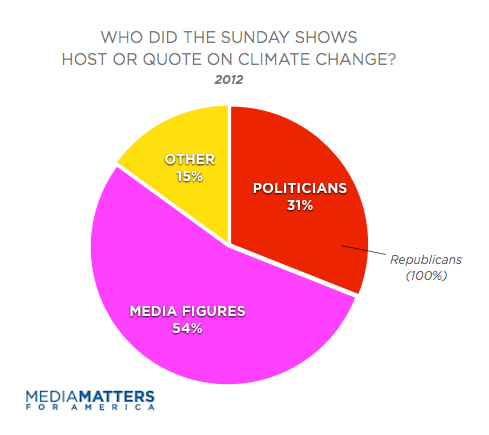
Media Matters debunks their article in detail, including this graphic from the Union of Concerned Scientists.


Conservatives hate it when anyone implies they’re racists, but then they go and do stuff like this: The Heritage Foundation hired a new Ph.D. with a racist thesis, ignored his posting on white nationalist web sites, and made him a co-author on their study denouncing immigration reform.


Kevin Drum (extensively quoting Jonathan Bernstein — a political scientist not to be confused with economist Jared Bernstein) notes the “hack gap” between liberal and conservative economists. There are plenty of bogus correlation-implies-causation points liberals could be making that are comparable to the discredited Reinhart/Rogoff debt-kills-growth argument. For example: Medical costs have been slowing since ObamaCare was passed.

You don’t read stories like “Economist: ObamaCare Already Cutting Health Costs” in the newspaper, though, because liberal economists don’t bend that way. (The recession is the biggest reason for slowing healthcare inflation, and beyond that something is going on that we don’t understand yet.) But conservative economists do. Hence the apparent respectability of austerity economics despite the complete lack of evidence that it has anything to do with reality.


Speaking of austerity, the Washington Post showed its conservative economic bias in an article last Monday. The article reports (correctly) that revenue is up and spending is down, so the government won’t hit its debt limit until October — months later than originally predicted.

That might seem like good news, but it is unraveling Republican plans to force a budget deal before Congress takes its August break.

Say what? A smaller deficit is bad because it’s “unraveling Republican plans”?


If you’re up for some intellectual heavy lifting, Corey Robin’s article in The Nation about the relationship between Nietzsche and the Austrian school of free-market economists (Hayek, Von Mises) is very illuminating.

I had never thought much about whether the economic concept of “value” is connected to the moral concept of “values”, or what the will-to-power has to do with economic power. But the connections are fascinating.


Christian parents of 6th-graders who attend a public school in Arkansas are canceling the official class graduation ceremony (and holding an unofficial one in a church) because they’ve been informed that they can’t do what they did last year: open and close the ceremony with prayer.

In a classic example of privileged distress, the parents have managed to turn things around so that they are the persecuted ones. They’re not being exclusive; they’ve invited everyone to their Christian graduation ceremony. Says one parent: “We’re not trying to be pushy or ugly to anybody, we just want them to know there is a God who loves them. … We just want to take a stand for God because we felt like our rights were taken away.”

To everyone else, it’s obvious that the “right … taken away” from the Arkansas Christian parents is actually a special privilege that no other religious group in America has ever had: the option to insert their religious messages into government-sponsored programs. (I’m sure a lot of Buddhists and atheists also have some uplifting thought that they “just want people to know” and would like the government to provide a platform for.) American Christians are privileged, not persecuted; but their privileges are shrinking, so it feels like persecution to them.


I started with one sermon, so I’ll end with another one: Astronauts explain “the Overview Effect“, the way your point of view changes after you’ve seen the Big Blue Ball from space.

Enough

Three things are never satisfied. Yea, four say not “It is enough”:
the grave, and the barren womb, and the earth that is not filled with water, and the fire.

— Proverbs 30: 15-16

This week everybody was talking about industrial accidents

The death toll from the factory collapse in Bangladesh keeps rising, now at 650.

All week, liberal web sites have been full of socially-conscious shopping tips about what brands may or may not be involved in corner-cutting third-world factories like the ones that ordered their workers back into a building whose walls were cracking. But that’s a band-aid at best.

The fundamental problem here is that workers have no power. Without their jobs they’d be so desperately poor that going back into a crumbling factory seems less risky than standing up to their bosses. As long as that is true, all the incentives in the capitalist system work to circumvent the consciences of shoppers. The most “efficient” way for the system to deal with the current situation is not to improve safety, but to fool socially conscious consumers into thinking something is being done. The system will keep working on that “efficient” solution until it figures out a way to do it, because that’s where the money is.

Just ask Walmart, whose greenwashing campaign is working great for the corporate image, even if it isn’t doing much for the environment.

So sure, change your buying patterns in whatever way seems appropriate. But if you’re doing that instead of pushing for worker rights, the corporate power structure thanks you.

Oh, and in case you think this is just a third-world problem, don’t forget about the fertilizer factory explosion in West, Texas. We hear so much about the costs of government regulation, but the costs of non-regulation are even higher.

and Jason Collins

Basketball player Jason Collins became the first active professional athlete in a major American sport to announce he is gay. His article in Sports Illustrated talks about the pressure of hiding a major area of your life not just from the public, but from teammates as well.

Collins is a 12-season NBA veteran who has never been a star and seldom starts, but consistently fills a role a lot of teams need: a 7-footer who can come off the bench and provide defense and rebounding when your starting big guys are in foul trouble or need a rest. He played for the Celtics and Wizards last season and is currently a free agent. He is in his declining years as an athlete, but Nate Silver’s comparisons to similar players in the past indicates there was a somewhat better than 50-50 chance he would have a job next season before his announcement. (So whether he gets signed next year is not necessarily proof of either prejudice or favoritism.)

Comparisons to Jackie Robinson are appropriate in some ways but not others. Robinson was a uniquely talented athlete whose statistics (compiled over only half a career, since he was kept out of the majors until age 28) could have put him in the Hall of Fame even without his off-the-field significance. Obviously, Collins is not in that class. And I’m sure Robinson would have had an easier time if he could have played 12 years in the majors and then announced he was black.

Still, Collins’ announcement required courage. (Anyone who thinks it didn’t needs to explain why no one has done it before.) He has made himself a symbol. Like Robinson, Collins will be cheered and booed for what he is, not who he is.

Some commenters clearly resent the fact that Collins is being cheered by many. There’s an intentional cluelessness in Ben Shapiro’s tweet: “So Jason Collins is a hero because he’s gay?” What’s striking, though, is the way such views are being rejected in neutral forums. Check out the comments on this anti-Collins editorial by a small-town Illinois sports editor.

Naturally, this popular rejection of bigotry is being spun as some kind of unfair discrimination against bigots. There’s a name for that: privileged distress.

But the biggest significance of Collins’ announcement (and the generally positive response) is on the many closeted gay athletes in high school and college, like the one profiled by Sunday by the Portland Press Herald.

But I wrote about sustainable economics

I reviewed the recent book Enough is Enough in Prosperity Without Growth?

and you also might be interested in …

The observatory at the top of Mauna Loa in Hawaii is recording atmospheric carbon dioxide approaching 400 parts per million “for the first time in human history“. The graph tells the story.

This re-emphasizes a point I’ve made before: When someone says they don’t believe in global warming, or don’t believe humans cause it, ask them which part of the argument they doubt. Here are the steps:

  1. Burning fossil fuels releases carbon dioxide into the atmosphere. (Duh.)
  2. The concentration of carbon dioxide in the atmosphere has been going up more-or-less continuously since the Industrial Age got rolling. (That’s this graph.)
  3. Atmospheric carbon dioxide warms the Earth through a greenhouse effect. (Infra-red radiation that would ordinarily dissipate into outer space gets reflected back to the planet surface.)

Given these rising carbon levels, which we can measure directly, global warming is what a rational person would expect. The argument against it needs to be a little stronger than just “maybe something else will happen”.


The public got its first look at the George W. Bush Library this week. I had been hearing about the Decision Point Theater game, where visitors supposedly hear the kind of advice Bush got at some key point in his administration, then get to make a decision. Now we finally see what that looks like.

You know what it looks like? The whole Bush administration. The single thing most typical of Bush was his shameless spin — rhetoric that made you think of one thing, but then if you challenged it as a lie, his people would explain that it was true because of something else entirely. So Saddam “supported international terrorist organizations” — which was supposed to make you think he was helping Al Qaeda plan the next 9-11. But if you pushed back you’d hear about connections to Hamas or Abu Nidal, not Al Qaeda or Bin Laden. They’d talk about Al Qaeda affiliates “operating in Iraq”, but if you pushed you’d find they were talking about a Kurdish zone Saddam had lost control of. And so on.

Bush is still spinning in exactly the same ways. Rachel Maddow shows clips from the DPT section on invading Iraq, calls BS on it, and then comments:

The case to invade Iraq was not “mistaken”. The case to invade Iraq was cooked up. It was a hoax perpetrated on the American people. And they are still cooking it up, right now.


Here’s one of those polls that makes you wonder if people really believe what they say. By a 44%-31% margin, Republicans agree with the statement “In the next few years, an armed rebellion might be necessary to protect our liberties.” (Democrats disagree 61%-18%.)

If I actually believed that, I think I’d be doing more than just stockpiling assault rifles. (After all, the government has tanks and planes.) I’d for sure have my escape route out of the country planned and a stash of money at my planned destination. Are people really doing that kind of stuff? In large numbers? Or has answering polls become part of some big fantasy game?


If there’s anyplace in America that might need an armed rebellion to maintain democracy, it’s North Carolina. The Republican leadership in the legislature is so intent on getting rid of the state’s renewable energy program that they declared victory in a voice vote and refused requests to have votes actually counted.


Mitch McConnell is catching on to this social-media thing. If your campaign video is getting as many hits as you want, you can buy the extra hits.


I often find myself telling non-religious people that right-wing Christians really aren’t as bad as they think. Well, the science education at Blue Ridge Christian Academy in South Carolina is worse than you think.


It’s been a heavy week. Let’s end with some entertainment:

Immune to Evidence

Our political polarization and dysfunctional public debate is largely driven by convictions and worldviews immune to contrary evidence and expertise.

— Tom Allen, Dangerous Convictions (2013)

This week everybody was talking about the Tsarnaev brothers, Chechens, and Muslims

One measure of prejudice is how easily an individual can be reduced to a group stereotype, so that he shares the collective guilt of his people and passes his guilt on to them.

I’m old enough to remember the 1980s, when the Irish Republican Army was one of the most feared terrorist groups on the planet. (An engineering conference I attended in Brighton was originally slated for the Grand Hotel before the IRA blew it up. You can get the flavor of the times by watching the classic 1980 film “The Long Good Friday” in which an English gangster learns that the ordinary rules of gang war don’t apply when you cross the IRA.)

Know what I don’t remember? Public discussions about whether the Irish are terrorists by nature or Catholicism is a religion of violence. (I’d love to hear Irish Catholic Bill O’Reilly respond to those questions.) That’s the measure of our prejudice against Muslims and Chechens, or perhaps of the privilege our society accords Catholics and the Irish.

In fact, many of the loudest Islamophobic politicians today winked and nodded at IRA fund-raising in the US then. Anti-Muslim Congressman Peter King went even further, speaking at a pro-IRA rally in 1982.

Right-wing Christians have committed acts of terror in the US, such as the assassination of Dr. George Tiller in Kansas. (I call this terror rather than just murder, because the point wasn’t merely to kill Tiller, but to intimidate any doctor who might think about replacing him.) Tiller’s murderer is revered as a hero by the Army of God. If they were the only Christian group you ever read about in the newspapers, what would you think of Christianity?

The measure of Christian privilege in America is that Christians and Christian churches don’t have to comment on such crimes unless they want to. But the Cambridge mosque the Tsarnaev brothers had a tangential connection with did feel obligated to issue a denunciation of the bombing. Even so, no matter how often such denunciations happen, American Islamophobes won’t hear them and will claim Muslims “remain silent“.

As a native-born white American male, I never have to worry that somebody might hold Adam Lanza or Jared Loughner or Don Blankenship against me, or wonder why I haven’t denounced their crimes loudly enough. That’s the measure of my privilege: Unlike Muslims or Chechens, I have the right to be judged as an individual; I can’t be reduced to the stereotype of my group.


Interesting finding from sociologist Robert Putnam (of Bowling Alone fame): Religious beliefs are not correlated with public-spirited virtues like generosity, but commitments to a religious community are. The people to worry about are not the members of the Islamic Society of Boston, but the intensely committed believers (of any faith) who are unsocialized by a church, synagogue, mosque, or whatever institution draws people of that faith together.


John Cassidy imagines how the public discussion would be different if the Tsarnaevs had used assault rifles rather than bombs.

which led to a discussion of conspiracy theories

many of which have been inspired by the Boston bombing.

Rachel Maddow did a great piece about the mainstreaming of right-wing conspiracy theories. Stuff that responsible conservative leaders would have ostracized a generation ago (as William F. Buckley and Barry Goldwater ostracized the John Birch Society in the 1960s) is now getting the hearing it doesn’t deserve. What used to be “crazy” is becoming merely “controversial”.

Steve Benen points out:

This just doesn’t happen on the left. This is not to say there aren’t wacky left-wing conspiracy theorists — there are, and some of them send me strange emails — but we just don’t see prominent, center-left media professionals trumpet such silliness or Democratic members of Congress racing to take the nonsense seriously.

It’s hard to know what to do with crazy theories like Boston-was-a-false-flag-operation or Obama-protected-the-Saudi-bomber. Arguing against them in some way validates that they’re worth arguing about — that the theory is controversial, not crazy. As you undoubtedly know if you have a friend who sends you such stuff, it’s easy to get sucked into the details of bizarre theories, and the conspiracy theorists love it when you do. Whatever psychological need conspiracy theories fill, nothing scratches that itch better than arguing obscure details with a doubter.

Conspiracy theories attract because they make life more interesting; they let the theorist be an insider, superior to the sheep who accept conventional views; they simplify the bewildering complexity of events and are strangely reassuring — better to believe the world is controlled by an evil conspiracy than face the fact that it’s out of control altogether.

So when Uncle Dave sends you that link to some talking-head “proving” something ridiculous, your response (if any) should be boring and not provide any opportunity for him to demonstrate his superior knowledge. Here’s what I suggest: Return a link to this video of a talking head making sense about conspiracy theories in general.

Send the same link every time: This is my response. I’m going to keep giving the same answer as long as you keep making the same mistake, no matter how many different ways you make it.

Make sure he realizes you wasted no time at all figuring out how to address the unique issues raised by this particular theory. Be repetitive. Be boring. Don’t scratch the itch.

But I wrote about the dysfunctionality of Congress

Or rather, former Maine Congressman Tom Allen did, and I reviewed his book.

We also heard a lot about the George W. Bush legacy

The new Bush Library opened in Dallas Thursday. And so began a predictable attempt by conservatives to whitewash the memory of one of the worst presidents of all time.

I don’t have to list and refute all their arguments, because Alex Seitz-Wald already did on Salon. And wruckusgroink on Daily Kos asked the right question: What if (instead of all the incompetent and evil things he did), President Bush had done nothing? What if he had just put the government on cruise control with the peace-and-prosperity policies Clinton had in place? “All Bush had to do was NOTHING to have a successful presidency.”

On the idea that historians will eventually give President Bush more credit (as they have Truman and to a lesser extent LBJ and Nixon), I stand by what I wrote as Bush was leaving office:

What happens when historians re-evaluate a president? Picture the events of a presidency as weights on a two-pan scale: a success pan and a failure pan. Even with the advantage of hindsight, an event seldom jumps from one pan to the other. Bad things stay bad; good things stay good. All that changes is our estimate of how much the events weigh.

… Now picture future historians re-assessing W. The weights may grow or shrink, but they’re not going to jump from one pan to the other. Nobody’s going to conclude that, in retrospect, Bush handled Hurricane Katrina well, or that he really did capture Bin Laden. Ignoring terrorism until 9/11 and turning a $200-billion surplus into a $1.2 trillion deficit are never going to seem like deft moves. The lies he told to start the Iraq War will not to stand to his credit, no matter what awaits in Baghdad’s unforeseeable future. Torture and illegal wiretaps are always going to stain Bush’s record, just as the Japanese internment stains FDR’s and the Palmer raids stain Wilson’s.

That’s the failure pan. So what NATOs, Marshall Plans, Berlin Airlifts, China breakthroughs, or Voting Rights Acts sit in Bush’s success pan? What accomplishments can future historians re-weigh to shift the balance in his favor?

I don’t see any likely candidates. That’s why I expect Bush to wind up more like Herbert Hoover than Harry Truman.

So far, that prediction is holding up. But I will admit to being surprised by this: The post-Bush Republican Party has gone so far off the deep end that W doesn’t seem nearly as radical as he did at the time.

In other Bush-related news, the Constitution Project’s bipartisan report on detainee treatment after 9-11 came out. “The most important  or notable finding of this panel is that it is indisputable that the United States engaged in the practice of torture.”

and you also might be interested in …

Having spent the last several years watching the final decline of both of my parents, I can testify that this is a very important article: If this was a pill, you’d do anything to get it by Ezra Klein.

An experimental Medicare program in Pennsylvania does something radically low-tech: It identifies old people with chronic illnesses and sends a nurse to visit them once a week. The nurse answers questions, straightens out confusions about medications, notices if the patient suddenly looks worse, and so forth. The goal is to catch problems before they require hospitalization, because spending time in the hospital is bad for chronically ill old people. The program’s architect says:

Being in the hospital for three days or five days sets them back to a point where they’ll never regain what they were. That’s where the scales tip. That’s where people end up needing a nursing home.

Turns out, the program works, as proved by randomized trials over more than a dozen years. The patients are healthier, stay out of the hospital, and so cost less for Medicare to cover — even after paying the nurse. If you’ve spent any time with chronically ill people in their 80s, none of this should surprise you.

So is Medicare taking the program national? No, they’re shutting it down in June. Says one expert:

There is a bias in medicine against talking to people and for cutting, scanning and chopping into them. If this was a pill or or a machine with these results it would be front-page news in the Wall Street Journal.


The Daily Show’s John Oliver was at his best in this segment, in which he compares the Australian politicians willing to implement gun control even at the cost of their careers to American politicians whose definition of “success” fails to mention the public good.

“Never again,” he says, “will a political career end in a senseless act of meaningful legislation.”


BP lied twice about the 2010 Gulf of Mexico spill: It claimed the spill was about 1/10th of its actual size, and it told the clean-up workers that the dispersant they were exposed to was safe. Now we have the safety manual they were supposed to distribute, but didn’t.


The NYT Magazine’s “Our Feel-Good War on Breast Cancer” points out an inconvenient truth: Raising “awareness” isn’t actually moving us any closer to a cure.


Poor Todd Akin has had to relive his “legitimate rape” comment over and over again. It must be tough to have such a traumatic experience and then wonder for the rest of your life if you might have avoided it somehow. If only our society had more compassion for people who suffer through things like that.


In addition to Afghanistan and Iraq, President Obama may be winding down another war: the war on drugs. “While law enforcement will always play a vital role in protecting our communities from drug-related crime and violence, we simply cannot incarcerate our way out of the drug problem.”

The White House report calls for prevention through education. Let’s hope that means accurate education, rather than the anti-drug propaganda I remember from high school. Here’s what I learned from my high school drug programs: Adults would spout any kind of BS to get me to do what they wanted. That lesson stuck with me.


The Oscar-winning documentary Inside Job (about Wall Street’s role in creating the housing bubble that started the Great Recession) is available for free on YouTube. In HD, no less. Based on Charles Ferguson’s outstanding book Predator Nation, narrated by Matt Damon, free on your computer right now — what’s not to like?

The Bangladesh disaster and follow-up on the Texas factory explosion will have to wait until next week.

Unaffordable Luxuries

In the immediate wake of great disasters — a flood, a blackout, or an economic collapse — people tend to behave the same way, reverting to a rough-and-ready communism. However briefly, hierarchies and markets and the like become luxuries that no one can afford. 

— David Graeber, Debt: The First 5,000 Years

This week everybody was talking about the Boston Marathon bombing

Living 30 miles from Boston, I had a hard time finding anybody who wanted to talk about anything else.

Here’s my hope for the long-term effect of the Marathon bombing: Maybe this will undo some of 9-11’s impact on the American psyche. That’s the point of this week’s lead article: “Maybe 9-11 Can Be Over Now“.

The way everybody pitched in reminded me of the David Graeber quote at the top of the post. (I reviewed his book in 2011.) In Copley Square and Mass General Hospital, nobody was worrying about how they would get paid. For a few hours it was just “From each according to his ability, to each according to his need.”

The first responders did a great job. The hospitals did a great job. (New Yorker columnist Atul Gawande is both a great writer and a doctor at a Boston hospital, so his account of the symbiosis between systemic planning and individual initiative is particularly insightful.) The police did a great job. (Esquire columnist Charles Pierce is a great writer from Watertown. His account is worth reading too.)

The big corporate media did not do a good job. CNN had that horrible afternoon where it reported an imaginary arrest.

Comedian Andy Borowitz nailed them:

Authorities who have spent the past forty-eight hours combing CNN in the hopes of finding any information whatsoever have called off their search, they confirmed today.

Rupert Murdoch’s New York Post was even worse: It put photos of the wrong suspects on its front page. (Thank God those two guys weren’t lynched.)

Some alternative media did better. TPM assembled a useful chronology of what happened when. And Wikipedia continues to be an under-appreciated resource for staying on top of current events.

There’s been a lot of back-and-forth about whether Dzhokhar Tsarnaev should be read his Miranda rights or whether the public-safety exception applies. ThinkProgress explains the history of the exception pretty well. As I get it, officials would be justified in asking something like “Are there any more bombs out there?” to protect public safety. But if they’re asking questions to build a criminal case, Miranda applies.

A lot of Muslim-haters — people who still probably can’t find Chechnya on a map — have been using this event as a new excuse to hate Muslims. Cartoonist Clay Bennett expresses my point of view:

and the Senate filibuster that defeated the gun bill

The background-check amedment, already watered down from a proposal that has consistently polled at around 90%, failed to get past a Republican filibuster Wednesday.

The New Yorker’s Alex Koppelman wrote about how depressingly unsurprising this was:

it wasn’t just the vote to block Toomey-Manchin that was so disheartening—that a minority of the Senate, representing a minority of Americans, was able to vote down legislation that had been so watered-down as to make it utterly unobjectionable. It wasn’t just that the Republican-controlled House would never have passed the bill, even if there had been sixty votes for background checks in the Senate. It was watching the whole process, realizing again so vividly and on an issue that matters so much, that the people who make the laws for three hundred million people are often cowards or fools or both.

The most blood-boiling thing was Mitch McConnell crowing about his ability to thwart the public will, emphasizing that no compromise had ever been possible. (See photo, posted to Facebook by McConnell.)

And satirist Andy Borowitz was having a good week:

In the halls of the United States Senate, dozens of Senators congratulated themselves today for having what one of them called “the courage and grit to stand up to the overwhelming wishes of the American people.”

and the Texas fertilizer explosion

The owners of the West Fertilizer Company caught a break this week. Yeah, their Texas plant blew up Wednesday, killing at least 14 and injuring hundreds, but it didn’t fit into the terrorism narrative established in Boston on Monday, so hardly anybody paid attention.

Nobody knows yet exactly how the blast happened, but on the surface the situation resembles the Upper Big Branch mine disaster of 2010: insufficient inspections, safety violations, and wrist-slap fines that the company treated as a cost of doing business. Congressman Bennie Thompson:

It seems this manufacturer was willfully off the grid. This facility was known to have chemicals well above the threshold amount to be regulated under the Chemical Facility Anti-Terrorism Standards Act (CFATS), yet we understand that DHS did not even know the plant existed until it blew up.

The Nation’s Richard Kim does an interesting thought experiment: What if we took this kind of violence and innocent death as seriously as we take terrorism?

Let’s imagine that the question—Why?—became so urgent that the nation simply could not rest until it had overdetermined the answers. We’d discover that OSHA hadn’t inspected the plant in 28 years—did this play a role in the disaster? If it’s found that the company that owns the plant, Adair Grain, violated safety regulations, as it had last year at another facility, we might call it criminal negligence and attribute culpability. But would we ascribe ideology? And which ideology would we indict? Deregulation? Austerity? Capitalism? Would we write headlines that say—Officials Seek Motive in Texas Fertilizer Explosion? And could we name “profit” as that motive in the same way that we might name, say, “Islam” as the motive for terrorism? Would we arrest the plant’s owners, deny them their Miranda rights and seek to try them in an extra-legal tribunal outside the Constitution, as Senator Lindsey Graham has suggested we treat US citizen Dzhokhar Tsarnaev?

and the debunking of an influential economics paper

which (believe it or not) you should care about. That’s my second featured article this week: “Why the Austerity Fraud Matters“.

and you also might be interested in …

I have heard from my own high-school-student sources about pro-abstinence assemblies, where outside speakers mix sexual misinformation with conservative religion. So I can’t say I was shocked by the descriptions of the West Virginia assembly that  Katelyn Campbell protested.

Apparently she protested so well that her principal resorted to threats: He said he would call Wellesley College, where Campbell has been accepted to study in the fall, and give her a bad character reference. Campbell refused to be intimidated, and Wellesley appears to be impressed, as they should be.


If you want to discourage something, tax it. So these six states tax poverty.

Buying Civilization

I like to pay taxes. With them I buy civilization.Oliver Wendell Holmes, Jr.

This week everybody was talking about Margaret Thatcher’s life and death

The Iron Lady hasn’t been prime minister since 1990, so you might think the old wounds would have scabbed over by now. Apparently not. After Thatcher’s death was announced, “Ding-Dong the Witch is Dead” went to #1 on iTunes-UK. Not to defend her, but do I have to point out how sexist that is? If she were male, maybe opponents could be satisfied with Elvis Costello’s “Tramp the Dirt Down“.

When her death was falsely reported in 2008 and plans for a 3-million-pound state funeral came out, Scottish comedian Frankie Boyle commented:

For 3 million, they could give everyone in Scotland a shovel, and we would dig a hole so deep that we could hand her over to Satan personally.

To put her impact in American terms, Thatcher was the anti-FDR. By the time she left office, the union-dominated Britain of the 1970s was as hard to remember as the Roaring Twenties were when Roosevelt died in office in 1945.

She inspired the Reagan Revolution in the US, and symbolized the plutocratic and plutolatric trends that today make the US and the UK (plus Italy, for some reason) the rich countries with the greatest inequality and the least economic mobility.

I guess that’s hard to forget.

and taxes

It’s April 15, time for my annual attempt to popularize the term work penalty — the extra tax you pay because you work for a living rather than having money that works for you: How Big Was Your Work Penalty in 2012?

Of course, we can’t tax wealthy heirs, and we can’t tax their dividend or capital gain income because … well, just because. They’re “job creators” or something. There’s a word for this, plutolatry. It usually means “worship of wealth”, but it could also mean “worship of the rich”. I’m looking for ways to work it into conversations, like I did in the previous section.

Another Tax Day point worth making: Americans would save a lot of time and money if the IRS would use the information it has and just mail us a bill. If your tax situation was simple, you could pay the bill and be done with it, but if you wanted to itemize or claim some complicated tax break, you could file a return the way you do now.

Why doesn’t that happen? Two reasons: The tax-prep industry makes money from the current arrangement, so they lobby Congress to keep things the way they are. And anti-tax conservatives want Tax Day to be painful so that the public will resent paying taxes.

and Obama’s budget

which included a proposal to figure the cost-of-living adjustments to Social Security using the stingier chained CPI. I discuss this in Four Things I Know About Social Security. #3 is “Chained CPI is a way to cut Social Security benefits, not a way to measure inflation more accurately.”

and (oddly) a C&W song

For some reason I haven’t fathomed, this week all sorts of people were moved to comment on Brad Paisley’s new song  “Accidental Racist” (performed with black rapper L L Cool J). The song has a why-can’t-we-all-just-get-along theme, but annoys blacks and liberals by (among other things) making a false equivalence between whites judging a black man by his gold-chain bling and blacks not forgiving whites for the iron chains their ancestors wore.

In my terminology, Paisley is expressing privileged distress: His song’s main character (never assume a song is autobiographical) suffers because blacks now feel empowered enough to object to racist crap (like a confederate-flag t-shirt) that he used to get away with. He then imagines that his suffering is comparable to what blacks suffer from racism, so he’s ready to call it even and wipe the slate clean.

The debate basically amounts to: Yeah, the song raises the race issue in a pretty clueless way, but if it were any more clueful, Paisley’s fans wouldn’t listen to it and so wouldn’t be thinking about overcoming racism at all. Half a loaf.

While we’re on the subject of racial cluelessness, Rand Paul spoke at historically black Howard University. Paul treated the Republican Party’s dismal performance among black voters as some of kind of mystery. He reviewed the party’s stellar racial record from Lincoln through the 1950s, and then skipped completely over the last 50 years, when Republicans courted the racist Dixiecrats who were leaving the Democratic Party after it embraced the Civil Rights movement. (Charles Blow filled in that history for Paul. I reviewed it in detail in December.)

Jon Stewart summarized:

You can’t just yada yada yada the last 60 Republican years: “A Republican freed the slaves, gave black people the vote, yada yada yada, and now all blacks vote Democratic. I mean, what the hell?”

Josh Marshall commented on Paul’s shock that his audience already knew the history he was trying to tell them and still wasn’t sold:

When you look at who’s the bamboozled and who’s the bamboozler in this part of the GOP subculture you see that it’s not so clear cut. … The GOP is so deep into its own self-justifying racial alternative reality that there’s some genuine surprise when the claptrap doesn’t survive first contact with actual black people.

and you also might be interested in …

An unplanned consequence of putting armed police in public schools: Incidents that used to send you to the principal’s office now send you to court. The NYT reports:

Joshua, a ninth grader who lives south of Houston, got into a brief fight on a school bus in November after another boy, a security video showed, hit him first. The principal called in the school’s resident sheriff, who wrote them both up for disorderly conduct.

Charges were eventually dismissed, but Joshua had to find a lawyer and miss class for two court appearances. “I thought it was stupid,” he said.


Harvard’s Jal Mehta proposes a really radical change in education policy: Train teachers rigorously and well, and then let them do what they’re paid to do.


Show this to the next person who tells you about “liberal media bias” on climate change.

Number of climate scientists participating in discussion: zero.


Exxon’s pipeline spill in Arkansas is much smaller and less messy than a Keystone XL spill would be. Imagine this in your back yard.


Yet another sad story about a teen rape victim getting hounded by her peers.

You’ve got to wonder if this is finally the right place for a “Just Say No” approach. As we saw in the Steubenville case, a lot of teen guys seem not to realize (at least not until after the fact) that it’s wrong to take advantage of a girl who can’t resist. That’s why I like this video:

No Argument

Straight couples write their own ticket. That’s why they can’t craft an argument to justify excluding same-sex couples from the institution of marriage. It’s not because we want to redefine it. It’s because straight people redefined it to an extent where there’s no argument that can be made to exclude same-sex couples.

— Dan Savage (December 9, 2012)

These last few weeks everybody was talking about same-sex marriage

which was argued before the Supreme Court. (Full transcript and audio at NPR.) More specifically, the Court is considering the constitutionality of the Defense of Marriage Act (which tells the federal government not to recognize same-sex marriages legally performed in the states that allow them) and California’s Proposition 8 (which made same-sex marriage illegal in California by constitutional amendment).

There’s been an element of triumphalism in the liberal coverage of the hearings, as it became clear in the verbal arguments that the pro-DOMA, anti-marriage-equality side is really straining to find any legal-sounding fig leaf to justify its position.*

This lack of a leg to stand on vindicates Massachusetts Chief Justice Margaret Marshall’s ground-breaking opinion in 2003 (the first case I ever blogged about). Marshall wrote that a same-sex marriage ban had “no rational relationship” to any legitimate goal of the state. At the time, conservatives were greatly offended by the implication that they were irrational, but now that they have to spell out that rational relationship, all they can do is huff and puff.

The other reason to feel triumphant is the parade of Democratic politicians flipping to support marriage equality. Arguably, the recent trend started with Joe Biden, who seemed to be pushing President Obama last May. (Obama got on board a few days later.) In the last month, Bill Clinton renounced DOMA, which he signed, and Hillary Clinton has also endorsed marriage equality. Every day or two, a new Democratic senator joined the chorus, until last Monday there were just eight Democratic senators who have not. Wait, make that seven. No, six. Sorry, four: Manchin of West Virginia, Pryor of Arkansas, Landrieu of Louisiana, and Johnson of South Dakota. All are from states Obama lost handily in 2012, and all but Manchin are up for re-election in 2014.

Even the occasional Republican has flipped, like Ohio Senator Rob Portman and Illinois Senator Mark KirkBill O’Reilly now says “The compelling argument is on the side of homosexuals”, and Rush Limbaugh admits that the issue is “lost”.

This is all in line with my post “Everybody will support same-sex marriage by 2030” last May. The trends are clear and politicians of both parties can read them. So Biden jumped before Obama because Obama focused only on the 2012 general election, while Biden was also looking at the 2016 Democratic primaries. Claire McCaskill flipped because she doesn’t run again until 2018, by which time the issue will work in her favor, even in Missouri.

It will be a few elections before that logic takes hold on the Republican side, but by 2030, even Republican candidates for local offices in Alabama won’t take an openly anti-gay position and expect to win on it, just as they don’t take openly racist positions now.

The religious right is not folding, though, and this sets up a libertarian vs. theocrat battle that will probably divide the Republican party for years to come. Libertarians and corporatist Republicans will want to play the issue down to win elections, while theocrats will be looking for an Alamo they can defend to the last man.


*All of which raises the question: What really does motivate opponents of marriage equality?

Well, there’s the obvious “Gay sex is yucky”, which wouldn’t be very compelling in court. Also, “My religion requires me to be a bigot”, which likewise has no legal heft. And there are people who just dislike change in general. But none of that really explains the opponents’ sky-is-falling urgency.

Tiffany Wayne suggests something deeper that I find more likely: Defense of “traditional marriage” is really about defending traditional gender roles. Same-sex marriage is threatening because it frames marriage as a negotiated relationship between equals, not as the divinely mandated submission of a wife/mother to the authority of a husband/father, each of whom has a well defined, divinely mandated role in the household.

I am struck in listening to the opposition to same-sex marriage by the persistent denial that gender is a socially constructed role. This is a “traditional” view of marriage in the sense that it is grounded in “biology is destiny,” or specific roles assigned based on sex. It is an extremely narrow view of “marriage” based on specific roles assigned by sex, rather than marriage as an emotional and physical and social partnership between two individuals.  Most telling, it is a view that denies that heterosexual people can be in egalitarian marriages, or should be. It is a belief in “traditional” marriage as hierarchical. Not as a true partnership of equals, but as a microcosm of society with a power structure that flows from husband to wife to children.

I’m reminded of this exchange between Chris Hayes and Dan Savage last December:

SAVAGE: We only hear that monogamy or children or religion are defining characteristics of marriage when same-sex couples want to marry.

Straight couples write their own ticket. That’s why they can’t craft an argument to justify excluding same-sex couples from the institution of marriage. It’s not because we want to redefine it. It’s because straight people redefined it to an extent where there’s no argument that can be made to exclude same-sex couples.

It is the legal, romantic, hopefully sexual union of two legally autonomous individuals, period, the end. They get to write their own ticket, they get to write their own vows. They can, you know, assume all in their relationship and their marriage, all the typical things people might expect a marriage to be.

HAYES: Or not.

SAVAGE: Or they can write — they can be something very different. Marriage is very subjective and interesting and new. And redefined by straight people.

That is a more compelling reason to oppose marriage equality for same-sex couples: opposition to the equality-within-marriage that is becoming the new norm for straights and gays alike. It also explains why the religious right can’t make its case openly: That argument was already lost years ago.

and Mike Rice

I don’t usually do sports stories here, but the firing of the Rutgers basketball coach turned into something larger when conservative pundits framed Rice’s abusive behavior as “old-fashioned discipline”. What I find weird in the conservative focus on “discipline” is that they always think the people on the bottom need more discipline, never the people at the top. I elaborate in Mike Rice, Sean Hannity, and the Real American Discipline Problem. If you’re talking about bankers, billionaires, and CEOs, then I totally agree: America needs more discipline.

If this article reminds any of you of One Word Turns the Tea Party Around, where I made sense out of Tea Party rhetoric by changing the word government to corporations — yeah, me too.

and North Korea

All kinds of saber-rattling has been coming out of North Korea lately, and there’s a big debate on about whether this is business-as-usual, the new ruler trying to build respect inside his country, a predictable test for the new South Korean president, or something to worry about.

I have never pretended to understand North Korea, so I went looking for people who think they do. Foreign Policy has a worry-but-don’t-panic article. I also found this video dialog between Economist editors to be instructive.

and guns

This Dan Wasserman cartoon pretty well covers it: The Senate looks like it might not even pass the universal background check provision that 90% of the country supports. But substantial new gun laws have gotten through in Connecticut (Sandy Hook) and Colorado (Aurora, Columbine), as well as New York and Maryland.

One thing I think all the NRA-cowed politicians are forgetting: Yes, the wave set off by any particular massacre eventually dissipates, but what about the next one?

That’s why it’s important to bring anti-gun-violence measures to a vote, even if it’s obvious they won’t pass. If Sandy Hook turns out to be the last massacre, great. But if it’s not, and if the next one could have been prevented by the measures being debated now (as Sandy Hook could have been prevented by renewing the assault-weapon ban in 2004), we want a clear record of who was responsible for defeating those measures.

and you also might be interested in …

A serious polling group just polled a bunch of conspiracy theories the mainstream doesn’t usually take seriously. PPP finds that 37% of the public (and a majority of Republicans) think global warming is a hoax. 28% (and 36% of Romney voters) still think Saddam Hussein was involved in 9-11, which 11% of the public believes the government knew about in advance, but allowed to happen. And is Obama the Anti-Christ? 22% of Romney voters say yes.


A lot of people got excited Monday about a bill introduced in the North Carolina legislature to let the state establish a state religion. (See the 19,000 comments on this HuffPost article.) I don’t think it was an April Fool’s joke, but it didn’t matter: By Thursday the NC Speaker of the House said the bill will never come to a vote — so never mind.

Clearly, not enough people have read Cracked.com’s 5 Ways to Spot a Bullshit Political Story in Under 10 Seconds, which I linked to shortly after it came out last year. Way #2 is: “The headline is about a ‘lawmaker’ saying something stupid.” Cracked editor David Wong points out: There are 7,382 state legislators in the U.S.; any group that size is bound to have some whackjobs in it; and any one of them can introduce a bill.

So it would really be newsworthy if some week no crazy-assed bills were proposed.

Rule of thumb: Don’t waste your outrage. Unless your representative is the one embarrassing himself, pay no attention to a crazy-sounding bill in your own state legislature until it has gotten out of committee. Pay no attention to a crazy bill in some other state until it has passed one house.

Homework: The next crazy NC bill, to put a two-year waiting period on divorces. Is it time to get upset or not?


National Review and I have different visions of Wonderland.


The Kentucky legislature just passed a “religious freedom” bill over its governor’s veto. The bill is short, and the key sentence is:

Government shall not substantially burden a person’s freedom of religion. The right to act or refuse to act in a manner motivated by a sincerely held religious belief may not be substantially burdened unless the government proves by clear and convincing evidence that it has a compelling governmental interest in infringing the specific act or refusal to act and has used the least restrictive means to further that interest.

Religious conservatives have been moving in this direction for several years, with bills that allow medical service providers to refuse to provide services that violate their conscience (i.e., druggists can refuse to fill prescriptions for an abortion-inducing drug like RU-486), and with the court case challenging whether health insurance provided by private employers has to provide the contraception coverage mandated by ObamaCare. (As far as I know, no EMT has become a Jehovah’s Witness and refused to give blood transfusions, but I believe he would have that right in Mississippi.)

As much as I dislike this bill, part of me is glad it passed, because I can stop making slippery-slope arguments now that Kentucky has slid all the way to the bottom. Now, if you don’t want to hire women, you can invoke this law and your sincerely held religious belief that a woman’s place is in the home. If you don’t want to serve blacks, invoke this law and your sincere belief that God doesn’t want the races to mix.

Of course, I don’t recommend you try to invoke this law if your sincere beliefs are Muslim or atheist. As we’ve seen in neighboring Tennessee, religious freedom is for Christians — you knew that, right?

But anyway, run free, religious Christian Kentuckians!


This message from “your high-speed internet and cable provider” isn’t safe for work, but it’s funny and true.