Category Archives: Weekly summaries

Each week, a short post that links to the other posts of the week.

Sure Signs

The complete lack of evidence is the surest sign that the conspiracy is working.

— Anonymous (or maybe they just don’t want us to know who said it)

This week’s featured post is “Rating This Week’s Craziness“. It introduces the Weekly Sift’s Crazy Scale, for rating the relative danger posed by the sheer insanity of stories and events that need more than just a debunking.

If you’re wondering what I was up to last week when I didn’t put out a Sift. I was telling a Unitarian Universalist congregation how Universalism provides a religious unification of a bunch of positions that often get dismissed as “politically correct”.

This week everybody was talking about crazy stuff

In addition to the stuff that made it into the featured article, this NYT cartoon summarized a bunch of other crazy-sounding things that are really happening:

and Baltimore

The riots are over and the National Guard is packing up, but Baltimore gave rise to a lot of interesting public discussion (as well as a lot of complete crap).

For one thing, who knew street gangs were this articulate?

The NYT Magazine‘s “Our Demand is Simple: Stop Killing Us” is well worth your time. So is Ta-Nehisi Coates’ “The Clock Didn’t Start With the Riots“, which makes this excellent point:

I read the governor in the New York Times today and he was saying in the paper that—you know, because it’s going to be a big day tomorrow—he was saying “violence will not be tolerated.” And I thought about that as a young man who’s from West Baltimore and grew up in West Baltimore and I thought about how violence was tolerated for all of my life here in West Baltimore. …

I don’t want to come off as if I’m sympathizing or saying that it is necessarily okay, to inflict violence just out of anger, no matter how legitimate that anger is. But I have a problem when you begin the clock with the violence on Tuesday. Because the fact of the matter is that the lives of black people in this city, the lives of black people in this country have been violent for a long time.

There’s a similar problem with all those columns about how street violence is the wrong way to make the point that police violence against already-subdued black men has got to stop. If we call for communities like Baltimore and Ferguson to quiet down, that’s got to be coupled with a commitment to start listening when they speak in softer voices. Otherwise we’re just saying: “Pipe down to make it easier for me to ignore you.”

Larry Wilmore makes this point humorously but effectively in his “Justice for Tamir Rice” piece. Tamar Rice is the 12-year-old who was playing with a toy gun in a public park near his home, when Cleveland police rolled up and killed him within seconds, all of which was captured on video. Cleveland has been peacefully waiting for some kind of resolution in this case for five months. With a Comedy Central lawyer standing over his shoulder to make sure he doesn’t actually call for violence, Wilmore observes that non-confrontation isn’t getting anything done.

There’s a self-fulfilling pattern here: If violence is the only kind of speech you’ll pay attention to, then sooner or later you’ll get violence.

Finally, there are all the white pundits saying or writing something along the lines of: We elected Obama to make race relations better, and they’ve gotten worse. Elspeth Reeve answers that point in The New Republic with “The White Man’s Bargain“. She starts with an NYT report quoting Republican strategist Rick Wilson:

A number of people “crafted this tacit bargain in their heads,” he said, speaking of Mr. Obama’s election. “This is going to be the end of the ugly parts of racial division in American.”

Reeve then raises this question about the “tacit bargain”:

What is being exchanged? Wilson is probably not saying people thought police would stop killing unarmed black kids because Obama was elected. Perhaps instead he is saying people thought black people would stop getting so mad when it happened. What he means is that people (and, let’s say this right here: white people) are eager to pay off the whole legacy-of-slavery-and-systemic-racism tab, to finally settle up and not have to think about social justice anymore. Wasn’t making a black guy president enough?

She goes through the long history of whites making imaginary bargains, which goes all the way back to slavery. She concludes:

What tacit bargainers have always been asking is: Isn’t there something else we can substitute for true equality? The answer is no.

and new presidential candidates

The big political news since the last Sift is that Bernie Sanders is running against Hillary Clinton for the Democratic nomination. So Hillary won’t simply be coronated, and somebody will make the case for real liberalism in this cycle.

I’m trying not to make the Sift all-2016 all-the-time, so I won’t get to Bernie’s announcement speech until next week. My snap reaction is that everybody left of Hillary should be happy that the primary campaign will keep her from drifting too far right. Beyond that, I need to decide how far my enthusiasm for Bernie should go: Will I vote for him in the New Hampshire primary? If do, is that because I’m making a statement or because I want him to get the nomination? If he did get nominated, would he stand a chance in the general election against, say, Jeb Bush or Scott Walker? Give me another week to think it through.

On the Republican side, Ben Carson, Carly Fiorina, and Mike Huckabee all joined the race, which is getting unusually crowded. Rick Santorum announced a date for his announcement: May 27. (I don’t know why he hadn’t previously announced that he was going to announce the date of his announcement. It just came totally out of the blue.)

Again, it will take some time for me to add these candidates to my 2016 speech series. I do have a snap reaction to Carson: I’m not sure he understands his role in the Republican Party, which is to provide cover against accusations of racism, as Herman Cain did in 2012. White audiences can cheer Carson’s aggressive and disrespectful criticisms of President Obama without worrying about being called racists.

But as Obama starts to fade from the scene, that role becomes less important. If Carson wants to stay relevant, he’ll have to move on to providing cover for more general I’m-not-a-racist-but criticisms of the black community. His path forward is to say things about Baltimore that are more extreme than a white candidate can get away with. I’m not sure he realizes he signed up for that.

Fiorina, meanwhile, is well set up to provide the same service for sexist Republicans who need to trash Hillary. She could easily wind up with the VP nomination.


The religious right has Huckabee, Santorum, and Cruz to choose from. But in view of the bad advice God has given his family in the past, it’s Jeb Bush who should be pushed to spell out exactly what role God will play in his administration.

and you also might be interested in …

We’re about six weeks from a Supreme Court decision on King v. Burwell, the suit that might make ObamaCare subsidies illegal in about half the country. Congressional Republicans have written in the WaPo “Republicans have a plan to create a bridge away from Obamacare” so that millions of people would not instantly lose health insurance.

Unfortunately, only one relatively unimportant committee in the Senate and none in the House have held any public hearings about this plan. As for assembling a coalition in the House to pass it — the kind of thing John Boehner has not been particularly good at — there seems to be no motion at all. HuffPost’s Jonathan Cohn says what I’ve been thinking:

the absence of a public effort to match the public rhetoric matters only if Republicans are actually serious about passing a plan. They may not be. Their real goals may be purely cosmetic — to insulate the party from a political backlash should millions of people suddenly lose health insurance and, more immediately, to ease the anxiety of Chief Justice John Roberts and Associate Justice Anthony Kennedy, either of whom might hesitate to issue a ruling with such potentially devastating consequences to so many people.


Two weeks ago, I told you about a poll that showed how sensitive opinions on abortion are to how the question is phrased. (You get a more pro-life response if you phrase the question in terms of abstract right-and-wrong, and a more pro-choice response if you phrase it in terms of women’s rights.) Wednesday, the NYT’s Upshot blog described how poll results about abortion get less polarized as the questions focus on specific cases: Many people who say that abortion should be “illegal in all cases” will nonetheless say it should be legal if the mother will die. Conversely, many people who say it should be “legal in all cases” still think it should be illegal to abort a healthy fetus ready to be born.

That’s the extreme edge of a more general phenomenon: People who think they are diametrically opposed to each other on abortion often agree on a lot of specific cases. Apparently, much of the polarization centers on what comes to mind when you hear the word abortion. Do you think of a promiscuous woman who couldn’t be bothered to use birth control, and now wants to get rid of a problem-free pregnancy rather than offer a healthy baby to a couple who would give it a good life? Or do you think of woman carrying a child for her rapist, or facing serious health issues?

I think the winning choice-leaning argument goes something like this: Every woman, every family, and every pregnancy is different, so ideally the decision to carry a fetus to term would be made by the people involved, and not by a legislature or a court or a bureaucrat. But the decision to abort becomes more morally weighty the longer the fetus develops, so the law should push women to decide promptly, and demand higher levels of justification for later-term abortions.

Sweden seems to have it about right, in my opinion:

The current legislation is the Abortion Act of 1974 (SFS 1974:595). This states that up until the end of the eighteenth week of the pregnancy the choice of an abortion is entirely up to the woman, for any reason whatsoever. After the 18th a woman needs a permission from the National Board of Health and Welfare (Socialstyrelsen) to have an abortion. Permission for these late abortions is usually granted for cases in which the fetus or mother are unhealthy. Abortion is not allowed if the fetus is viable, which generally means that abortions after the 22nd week are not allowed. However, abortions after the 22nd week may be allowed in the rare cases where the fetus can not survive outside the womb even if it is carried to term.

Wikipedia adds:

The issue is largely settled in Sweden and the question of the legality of abortion is not a highly controversial political issue. … Consensus in Sweden is in favour of preventing unwanted pregnancies by the use of birth control and the primary goal is not to lower the amount of abortions, but rather the goal is that all children that are born should be wanted.


In the Republican-controlled Congress, climate-change denial is a two-step dance:

  1. Claim that the science isn’t settled yet, so more research is necessary before we take any action.
  2. Defund that research.

and let’s close with something fantastic

like Key & Peele’s musical trip to Negrotown, where you can wear your hoodie and not get shot.

The Horror

Cruz, Paul and Rubio, all running for President. Hey, I thought I was supposed to write the horror stories.

Stephen King

This week’s featured post is “The New Clinton Allegations: Fog or Smoke?

No Sift next week

I’ve learned I don’t have it in me to do a Sift on Monday if I’ve led a church service on Sunday. Next Sunday I’ll be at the Unitarian Church of Quincy, Illinois (my hometown), talking about “Universalism, Politics, and Evil”. The text of that talk will eventually show up on my religious blog, Free and Responsible Search.

This week everybody was talking about the environment

It was Earth Day, after all, which is a good time to consider how we’re doing. It’s a mixed bag. The disaster scenarios where the average global temperature goes up by 4 degrees or more are still out there. But — in spite of just finishing the hottest March ever — some observers are starting to see evidence of a turn-around.

The best news is the rapid growth of solar and wind energy. They still produce a tiny amount of the world’s power or the United States’ power, but the trend lines look really good. Coupled with the fact that electricity usage in the U.S. has been flat since the popping of the real estate bubble in 2008 — a mixed blessing, because slow economic growth is part of that story — we see charts like his one, in which the U.S.’s non-sustainable power production (in green) has been trending down. (Notice, though, that the vertical scale doesn’t go to zero, so the percentage of solar and wind looks bigger than it actually is.)

TPM is in the middle of a five-part series about these trends, called “The Renewables“. It calls attention to the fact that many of our worst carbon-producers — coal-fired power plants — are wearing out. The wind-and-solar uptick isn’t Mitch McConnell’s imaginary “war on coal”, it’s just the ordinary replacement cycle, where worn-out plants cycle off and the cheapest and most efficient sources are used for new production.

Informed Comment goes out on a speculative limb with this prediction:

future historians may look back on 2015 as the year that the renewable energy ascendancy began, the moment when the world started to move decisively away from its reliance on fossil fuels.


Climate Denial 2.0, as presented by Jeb Bush: Yes, we’re causing global warming, but all we should do about it is keep fracking.

The essence of the position is that curbing carbon emissions involves wrecking the economy, which demonstrates a common fallacy about long-term externalities: If what we’re doing is headed towards a long-term disaster, then it’s not economical. If your economic calculations don’t show that, then you’ve left something out. It’s like saying you can’t afford to change the oil in your car or fix the leak in your house’s roof.

Just to give one example: Humanity has a lot invested in our coastal cities. As sea levels rise, we’ll either have to move those cities or build expensive floodwalls around them (and deal with the costs of disasters that breach those walls, as happened in New Orleans). A truly accurate economic calculation would attach some of those costs to each unit of fossil fuel we burn. If we made those kinds of calculations, we might find that fossil fuels are a very expensive way to get energy.

Another example: the California drought. What if climate change ultimately makes large-scale agriculture infeasible in California, which currently has a bigger farming industry than any other state? What’s the economic cost of that? Where does that figure in Bush’s understanding of what is or isn’t economical?

Still, the upside of Denial 2.0 is the recognition that flat-out denial — the conspiracy of liberal scientists theory — isn’t working any more.


What’s the “greenest” way to read a book, the one that puts the least pressure on the environment? Get it from the library, Grist says. Obviously, if you already have some device that lets you read e-books, downloading and reading additional books on it is greener than buying printed books. In terms of carbon footprint, the break-even point of a dedicated e-book reader vs. printed books that you keep in your personal library (rather than spread the environmental impact by passing them on to other people) is about 20-25 books.

The article leaves out an environmental advantage that I see in my life: The space I save by not storing all those books is one important factor that allows me to stay in an apartment within walking distance of the library. Otherwise I might need a house, with all the environmental costs that involves.


Public transportation has to be part of the conservation picture, but even in big cities there’s a last-mile problem (or maybe a last-few-miles problem): How do you get to public transit, or to where you want to go from where public transit leaves you? With that in mind Slate‘s Seth Stevenson surveyed the current range of motorized devices that you might reasonably carry onto a crowded subway car. He finds a couple of foldable motorized scooters to be both fun and practical.

A little less practical — because it’s so hard to learn — is the Solowheel, which a Grist reporter describes as what you’d get if “a unicycle had sex with a Segway”. It may not be “the future of urban transportation”, but it sure looks fun for the people who master it. You just have to see it.

and a trade deal

The Trans-Pacific Partnership is a 12-nation trade agreement that doesn’t exist in final form yet, though apparently there is a secret draft.  So in spite of the headlines you might be seeing, nobody is being asked to ratify the agreement just yet.

The current issue is whether the Obama administration will get “fast track authority” for the final round of negotiations. This is something past presidents have had for trade agreements like NAFTA. It means that when the treaty is complete, the Senate will have a simple yes-or-no ratification vote and won’t be able to demand changes. Multi-nation trade deals are almost impossible to negotiate if other nations don’t believe we are agreeing to the final text, so not granting such authority virtually kills U.S. participation in the treaty.

Unlike most issues, this isn’t a Democrat vs. Republican thing. Republicans like lowering tariff barriers, and aren’t usually disturbed by the idea that our government might be signing away its ability to regulate multinational corporations. Instead, this battle is between President Obama and Democrats like Elizabeth Warren.

I like to agree with both of those people — Warren somewhat more often than Obama — and the issues involved are complicated, so I’m not going to take a side until I’ve done more research. To get the flavor of the dispute: here’s Warren’s WaPo op-ed from February, and President Obama’s radio address promoting the TPP.

and drones

Thursday, President Obama acknowledged that a drone strike in January against an Al Qaeda compound near the Afghan-Pakistan border unintentionally killed two western hostages, one American and one Italian. In a separate strike, an American citizen believed to be working with Al Qaeda was killed. From the NYT:

Micah Zenko, a scholar at the Council on Foreign Relations and lead author of a 2013 study of drones, said the president’s statement “highlights what we’ve sort of known: that most individuals killed are not on a kill list, and the government does not know their names.”

Mr. Zenko noted that with the new disclosures, a total of eight Americans have been killed in drone strikes. Of those, only one, the American cleric Anwar al-Awlaki, who joined Al Qaeda in Yemen and was killed in 2011, was identified and deliberately targeted. The rest were killed in strikes aimed at other militants, or in so-called signature strikes based on indications that people on the ground were likely with Al Qaeda or allied militant groups.

The incident called attention to the intentional blindness the American public has maintained regarding warfare: As long as our troops aren’t being killed in some country, we pretend we’re not at war there. But a drone strike is an act of war. We’re at war in Pakistan and Yemen and Syria and several other countries.

And I’m sure Obama’s apology to the families of the two hostages has rankled people in those war-torn countries. How many innocent civilians have we killed with drones, but their families didn’t get presidential apologies because they weren’t Americans or Europeans?

and money in our presidential politics

The featured article “The New Clinton Allegations: Smoke or Fog?” focuses on the charges that there was some kind of corruption involving the Clinton Foundation and Hillary Clinton’s decisions as Secretary of State. But this is also a good time to take a look back at the “vast right-wing conspiracy” against Bill Clinton, which turned out to really exist.


We have a result in the Koch Primary: Scott Walker wins. Or at least that was the initial indication; apparently a recount is happening. And recent polls say that Marco Rubio is leading in the Adelson Primary., while other billionaires are backing Ted Cruz and Rick Santorum. If the billionaires can’t find consensus soon, eventually the Republican Party might have to consult some voters.


Included in NRA President Wayne LaPierre’s denunciation of Hillary Clinton was the line “Eight years of one demographically symbolic president is enough.” Because 43 consecutive white male presidents didn’t symbolize anything. If in 2007 some black girl looked at a row of presidential portraits and saw 43 white men, she shouldn’t have read anything into that at all.

That’s privilege in a nutshell: When the privileged group runs things, that’s just normal; it means nothing and is not worth talking about. So when President Reagan appointed Sandra Day O’Connor to the Supreme Court, the headlines were all about the first female justice. But when President Ford appointed the previous justice (John Paul Stevens), nobody remarked on symbolic significance of the 101st consecutive male.


Over at the conservative Weekly Standard, Jay Cost is asking “So What About Money in Politics?” He spends the first half of the article establishing his conservative bona fides: trashing the Clintons, denouncing “identity politics”, accusing liberals of hypocrisy, and making the ridiculous claim that “complaints about Citizens United itself are mostly a red herring”. But ignore that part: It’s ideological boilerplate, similar to the way that Soviet research articles all had to start with a paragraph about how this wonderful breakthrough would have been impossible without the genius of Marx, Lenin, and whoever the current leader happened to be.

Keep reading, because eventually Cost gets around to saying something important:

[Y]ou can’t beat something with nothing. Where is the anti-corruption agenda of the right? Where are the counterparts to the good-government organizations spearheaded by Ralph Nader? Other than the Center for Competitive Politics, helmed by former Federal Election Commission chairman Bradley Smith, and Take Back Our Republic, a new organization founded by those who helped Dave Brat take down Eric Cantor last year, one is hardpressed to think of conservative entities promoting a vision of good government. Conservatives have spent enormous intellectual capital on issues like education, health care, and taxes—but what about corruption? When Democratic pols rail against Citizens United, what reforms can Republicans counter with?

None. And if you want to know why, just look at the Republican presidential nomination process, where everyone is competing to curry favor with the Kochs, Sheldon Adelson, and a handful of other billionaires. This is how the perfectly legal corruption of our political system happens: not through quid-pro-quo deals (where you make a donation and then the Justice Department to drops your antitrust case or something), but through control of the agenda. You can’t get elected without going to the billionaires, and you just can’t tell them that they already have too much power, even if most voters agree with you.

and you also might be interested in …

Fascinating article over at ThinkProgress about a poll Tresa Undem did for Vox about abortion. Polls typically ask people to choose among abstract legal question like: “Abortion should be legal in almost all cases; abortion should be legal in most cases; abortion should be illegal in most cases; or abortion should be illegal in all cases.”

Undem split her sample in two, gave half the usual list of options, and gave the other half the same options rephrased in terms of women’s rights: “Women should have a legal right to a safe and accessible abortion in almost all cases. … Women should not have a legal right to any kind of abortion.”

That simple change made a big difference in the results. The most pro-choice option went from 27% to 38%, while the most pro-life option went from 16% to 11%. The poll goes on to ask more detailed questions, phrasing them to draw the respondent into a woman’s experience rather than picture himself/herself as an abstract rule-maker. The answers show large majorities (70% or so) consistently supporting the idea that once a woman has decided to have an abortion, she shouldn’t be harassed about it or made to jump through unnecessary hoops.

Here’s an example I found striking: “Would you want a woman who has had an abortion to feel shame, or not?” The responses split 67%-26% against shame. I’ll bet if you wrote the woman out of the question — “Is an abortion something to be ashamed of?” — you’d get a different split.


Another interesting result from the same poll: Asking “Do you consider yourself a feminist or not?” gets a resounding No (52%-18%). But asking half the respondents “Do you believe in social, legal, and economic equality of the sexes?” gets a Yes (78%-6%), and asking the other half “Do you believe in equality for women?” garners even more approval (85%-3%).

So apparently more than half the population believes feminism means something else.


Also at Vox, this brilliant visualization of the gradual polarization of Congress. Maybe I’m biased, this doesn’t look to me like a symmetric process; it looks like a red dot solidifies, pulls away from the mass, and then grows.


Sometimes I think I’m getting an exaggerated notion of the shear craziness that’s out there, and then I read a direct quote like this one from former House majority leader Tom Delay:

I think we got off the track when we allowed our government to become a secular government. When we stopped realizing that God created this nation, that he wrote the Constitution, that it’s based on biblical principles.

I would love to know when Delay thinks “we allowed our government to become a secular government”. In actual history, the Founders very intentionally created a secular government by writing the Constitution. The Constitution was virtually unique among the political documents of its day because it didn’t invoke God.


It’s hard to do a better takedown of Bobby Jindal’s NYT op-ed “I’m Holding Firm Against Gay Marriage” than the Human Rights Campaign’s red-pencil markup, which begins by editing the title to: “I’m Losing the Fight Against Marriage Equality”.


A win in the struggle against monopoly: The Comcast merger with Time Warner Cable seems to be off.


Recent stories from Missouri point out that we still have a long way to go on race:

  • Tyrus Byrd will be Parma’s first black mayor and first female mayor, after winning the election 122-84 in a town with 700 residents. Within a week, five of the town’s six police officers had resigned, along with the city attorney, the clerk, and the manager of the water department.
  • A day after a memorial tree for Michael Brown was planted in a Ferguson park, it was cut down by vandals. (And later replaced.)

I’m not sure whether the vandalism counts as a hate crime under the law, but it certainly illustrates the concept of a hate crime: This was not just a crime against a tree or a park; it was an attempt to demoralize Ferguson’s black community and to remind them of their inferior and vulnerable status. It deserves a more serious punishment than ordinary vandalism.


Amy Schumer’s parody of Friday Night Lights connects some dots about the football culture and rape. As the coach says:

How do I get through to you boys that football isn’t about rape? It’s about violently dominating anyone that stands between you and what you want!


It’s not what you do, it’s who you are. Give classified information to unauthorized people, then lie to the FBI about it, and you’ll go to jail. Unless you’re a general, of course.

and let’s close with something fun

like what toddlers are doing when you’re not looking.

Caught In Between

Republicans think I’m too old to be president but not old enough for Social Security.

– a line suggested for Hillary Clinton

This week’s featured posts are “Death, Taxes, and the American Dream” and “The 2016 Stump Speeches: Marco Rubio“.

This week everybody was talking about Social Security

This week Chris Christie walked into one of the most dangerous gaps in politics: Among Republicans, it’s common to raise the specter of Social Security or Medicare going bankrupt soon. That gets you high marks from the Commentariat for being realistic.

But saying what you want to do about that envisioned bankruptcy is another matter. Because once you accept that dogma that no tax can be raised under any circumstances, the only alternative is to make significant cuts in benefits. The more specific you get about those cuts, the less likely anyone is to applaud.

I haven’t read Christie’s plan, but U. S. News summarized it like this:

Christie proposed increasing the retirement age for Social Security to 69, beginning with gradual increases in 2022, as well as raising the early retirement age to 64 from 62, and changing the way cost-of-living increases are calculated for Social Security and other benefit programs, an adjustment that would mean smaller increases in the future.

He’d also increase the Medicare eligibility age gradually to 67 by 2040 — and turn Medicaid into a block grant program to the states, which Republicans have long proposed and critics say could mean reduced benefits over time. … the New Jersey governor also proposed reducing Social Security benefits in the future for retirees earning more than $80,000 a year and eliminating them for those with annual incomes of $200,000 or more.

I have two snap reactions:

  1. There’s a hidden class issue in raising the age limits. If you look at the population as a whole, people are living longer, so it makes sense to gradually raise the ages. But that increase in life expectancy is much smaller for the poor, and to keep working past 65 is much harder if you do manual labor than if you have a desk job.
  2. When you eliminate benefits for those who don’t need them, you’re implicitly turning Social Security and Medicare into welfare programs. The next step is for conservatives to start squeezing those programs the way they squeeze all welfare programs, making those who continue to benefit seem like losers and moochers.

Still, if this plan forces all the other candidates to get specific, that would raise the quality of discussion.

and more about 2016

This week my 2016 speeches series discusses Marco Rubio’s announcement speech on Monday. I stayed serious in that article, so I didn’t get around to mentioning this line from Monday’s Conan O’Brien monologue:

A little fun fact: Marco Rubio’s wife is a former Miami Dolphin cheerleader. In other words, she knows how to generate fake enthusiasm for someone who’s not going to win.


I haven’t included Hillary Clinton’s announcement video in my 2016 Speeches series because there just isn’t enough content there to talk about. It’s well designed, and does a good job of identifying her with Americans who are working towards better things in their lives, but it doesn’t try to answer the basic questions my series is focused on: “Where does America need to go and why am I the person to lead it there?” Presumably she’ll develop a stump speech later on, and then I’ll cover it.

Meanwhile, Hillary’s poll numbers look great: She’s beating Rubio by 14 points nationally, and every other potential Republican opponent by more. The CNN commentary on the poll shows just how far you have to go to spin something against Clinton.

One area where Clinton’s numbers wilt: Only about half of Democratic men (49%) say they would be enthusiastic about having Clinton atop the Democratic ticket, compared with nearly two-thirds of Democratic women (65%).

Think about it: Half the people who are different from you in some key demographic describe themselves as enthusiastic about nominating you for president. And that’s the bad news.

The basic problem all the Republicans face is that they’re either unknown or unpopular. I believe that’s because the Republican worldview is unpopular. Once the public understands what a Republican candidate wants to do, they don’t like him.


I went to a Martin O’Malley event in Nashua (walking distance from my apartment) a couple weeks ago, but I haven’t covered it either. He was speaking to a local Young Democrats meeting. (I do a really bad impersonation of a young Democrat.)

He sounded some basic progressive themes about the destruction of the middle class since the 1970s (i.e., before Reagan took office), and pointed to his own accomplishments as governor of Maryland, but the talk was short and lacked specifics. He didn’t take questions. Like Hillary, he’ll probably flesh out that speech later in the campaign (if he’s really running).

Fun personal facts about O’Malley: He’s a perform-in-public guitar player and led us in singing “This Land is Your Land”. Also, O’Malley is often cited as the model for the Tommy Carcetti character on The Wire. (David Simon says not exactly, but admits O’Malley is one of several inspirations.)

Carcetti is a young white mayor of Baltimore whose ambition ultimately overcomes his idealism. No doubt O’Malley would reject that characterization of his two terms as mayor (1999-2007), which coincidentally overlapped the run of The Wire (2002-2008). Wikipedia says:

During his first mayoral campaign, O’Malley focused on a message of reducing crime. In his first year in office, O’Malley adopted a statistics-based tracking system called CitiStat

which does sound a lot like Carcetti. One persistent theme of The Wire is that statistics-based anything just tempts a bureaucracy to corrupt the data it reports. (When one police detective deduces where the bodies of dozens of missing mobsters must be hidden, his superiors don’t want to look. “You’re talking about raising the murder rate,” one tells him.)


Wednesday, I was at Chris Christie’s town hall meeting in Londonderry (about ten miles down the road). I may get around to describing that in detail in later weeks, but this week I’ll just observe that Christie does an A+ town hall meeting.

A town hall meeting is like an oral exam on public policy, because the candidate can’t predict what people are going to ask. It’s a high-risk situation: If all you know are a few talking points, that quickly becomes obvious, and any mistake you make could be the lead story on the evening news.

But the upside is that if you do a town hall well, the hundreds of people in the room come away far more impressed than if you just gave a good speech. In the 2000 New Hampshire campaign, front-runner George W. Bush avoided town halls (probably because he would have made a fool of himself) while John McCain sometimes did four or five in a day, and was still sharp for the last one. McCain upset Bush in the primary by a wide margin.

Christie’s Londonderry town hall was at a McCain level. (His opening remarks are on YouTube, but that’s the least impressive part. I’m just out of the picture to the left.) He demonstrated a broad and deep understanding of the issues, even to someone like me who disagrees with his answers. He’s nowhere in the polls right now, and I’m not saying he’ll win New Hampshire. But I think he’ll do better than the pundits are predicting.

and you also might be interested in …

Every change is bad for somebody. As solar energy gets cheaper, that’s good for the environment, good for homeowners and businesses, and good for the people who install solar panels.

Who’s it bad for? Utilities. Not only do they sell less power to homes with solar panels, but many states force them to buy the excess power the homes generate on sunny days. They don’t know how to predict the surges, and the transmission system wasn’t built for that.

Don’t get me started on upgrading the electrical grid. That was the project I wanted the Stimulus to focus on in 2009, and it’s even more needed now. But instead we can watch utilities try to use their lobbyists to torpedo the growth of solar.

The NYT article I linked to mentions one small-scale solution: more expensive solar installations that include batteries, so that you can store your own power and don’t rely on the grid buying it from you. One cool two-birds-with-one-stone idea is to repurpose the batteries from worn-out hybrid cars, which there should be more and more of in the coming years.


If you’re wondering what happens in abstinence-based sex education, this Michigan mom (and medical ethics professor) sat in on her son’s class. If anybody in the state legislatures are looking for wastes of tax money, abstinence programs are a place to start.

On the other hand, if you want your kid to get accurate, realistic information about sex and you live anywhere near a Unitarian church, ask if they’ll let him/her into their OWL class. Increasingly, this is what we’re coming to: you have to go to a liberal church to overcome the religion-based crap you learn in the public schools.


The North Carolina legislature is considering destroying two of the universities that define the Research Triangle by mandating a four-courses-a-semester teaching load on all professors at state universities. The head of UNC’s history department told The Daily Tarheel: “There is no major research university in the U.S. that has a four-four teaching load. I think faculty would leave.”

Slate‘s Rebecca Shuman calls the bill: “a “solution’ that could only be proposed by someone who either doesn’t know how research works or hates it.”

Half a century ago, the ideal state university was a world-class institution where tuition was so low (zero at Berkeley until Reagan fixed that “problem”) that any qualified student could afford to go there. Since then, states have been gradually getting out of the great-education-at-low-cost business, slashing their subsidies to the point that tuition at a top state university (not to mention fees and housing) can run more than $16K a year for in-state students and nearly as much as an elite private university for out-of-state students.

It only makes sense that the next step is to get rid of the idea of being a world-class institution. Why do people who can’t afford Yale need a great education anyway? Why do they need professors on the cutting edge, or the chance to work on the frontiers of knowledge? Leave that for the rich kids.


While we’re discussing ways to make the ruling class more hereditary than it already is, this week’s other featured article is “Death, Taxes, and the American Dream“. It’s my response to the House’s attempt to eliminate the estate tax, which already only applies to estates worth more than $5 million.


Here’s how desperate the anti-marriage-equality folks are for a new argument:

A reduction in the opposite-sex marriage rate means an increase in the percentage of women who are unmarried and who, according to all available data, have much higher abortion rates than married women.

and let’s close with something unexpected

Headis. It seems to be a thing in Germany.

Equality on Earth

It is easy to proclaim all souls equal in the sight of God. It is hard to make men equal on earth in the sight of men.

James Baldwin

This week’s featured post is “The 2016 Stump Speeches: Rand Paul“.

This week everybody was talking about another police shooting

The initial report was very familiar: Sure, it was only a stop for a busted taillight, but the subject was a bad guy and he went for the policeman’s weapon. The cop had no choice but to shoot him, and he died in spite of everything the cops did to save him.

Then it turned out that somebody had a video. (Huffington Post imagines the news report we’d be reading otherwise: another justified shooting.) The policeman was in no danger, and after calmly gunning down the fleeing Walter Scott (“like he was trying to kill a deer” as Scott’s father put it), he makes no effort to revive him, but drops the taser Scott had supposedly grabbed next to the body.

So this time, it looks like justice is being done: the cop has been charged with murder. But doesn’t it make you wonder about all the other times a white cop killed a black suspect and there wasn’t a video? (In the last five years, police in South Carolina have fired at people 209 times, resulting in a handful of official charges and no convictions.)

ThinkProgress collects what the local police department said before they knew about the video: It’s eerily similar to what the police have said in a lot of other shootings that ultimately were judged to be justified. The Week concludes: Without the video “he probably would have gotten away with it.”

How many other cops have?

and 2016

After Hillary Clinton announced her candidacy on YouTube yesterday, it’s hard to remember that Rand Paul just announced on Tuesday. But Paul is an interesting candidate that some liberals are tempted to support, given his strong positions on civil liberties. However, Paul also carries a lot of baggage. I try to collect the good and the bad as I annotate his announcement speech.

One thing I will point out about Hillary’s video: Notice how deep into it you have to go before a straight white man shows up.

and the 150th anniversary of Appomattox

I’ve been pleased by how many historians have written anniversary articles agreeing with the point I laid out last summer in “Not a Tea Party, a Confederate Party“: the Civil War didn’t end at Appomattox; the planter aristocracy continued fighting a guerrilla war until the North finally withdrew its troops and let white supremacy resume. See, for example, Gregory Downs’ NYT article “The Dangerous Myth of Appomattox“.

Other articles have supported “Not a Tea Party’s” other main point: that the right-wing surge we are seeing today is a continuation of the Confederate worldview. For example: “Why the Confederacy Lives” by Euan Hague in Politico. And WaPo’s Harold Meyerson writes:

Today’s Republican Party is not just far from being the party of Lincoln: It’s really the party of Jefferson Davis. It suppresses black voting; it opposes federal efforts to mitigate poverty; it objects to federal investment in infrastructure and education just as the antebellum South opposed internal improvements and rejected public education; it scorns compromise. It is nearly all white. It is the lineal descendant of Lee’s army, and the descendants of Grant’s have yet to subdue it.


In “Not a Tea Party, a Confederate Party” I described the Confederacy as a worldview:

The essence of the Confederate worldview is that the democratic process cannot legitimately change the established social order, and so all forms of legal and illegal resistance are justified when it tries. … The Confederate sees a divinely ordained way things are supposed to be, and defends it at all costs. No process, no matter how orderly or democratic, can justify fundamental change.

For a contemporary example of the Confederate mindset at work, listen to a recent interview with Focus on the Family founder James Dobson:

I really believe if what the Supreme Court is about to do [i.e. legalize same-sex marriage nationwide] is carried through with, and it looks like it will be, then we’re going to see a general collapse in the next decade or two. I just am convinced of that. So we need to do everything we can to try to hold it back and to preserve the institution of marriage.

Same-sex marriage has been legal in Massachusetts for nearly a dozen years, and for almost a decade in Canada, with no visible evidence of any ill effects on society. You’ve got to wonder when Dobson and his ilk will start seeing facts and reality rather than their own apocalyptic nightmares. Probably never. If Dobson is still around twenty years from now, I imagine he’ll have rolled his disaster prediction forward to “in the next century or two”.

And what does “do everything we can” mean? Get violent, apparently.

Talk about a Civil War, we could have another one over this.

Because accepting social change is impossible. All forms of legal and illegal resistance are justified.

but I was reading two unrelated books

In the past I’ve reviewed the books Merchants of Doubt and Doubt Is Their Product, which describe the tactics by which corporations keep selling a product long after people start dropping dead from it. I found those to be very radicalizing books, but I doubt that many of my readers managed to finish either one. They’re each a slog, and they’re depressing.

Well, sometimes fiction can get ideas across more effectively than factual reporting (i.e., Uncle Tom’s Cabin). Paolo Bacigalupi is a post-apocalyptic young-adult sci-fi writer, known for The Wind-Up Girl, Ship Breaker and The Drowned Cities. (They’re good.) His new novel The Doubt Factory is set in the present and covers a lot of the same ground as the factual doubt books, but does it with action and characters.

The main character of The Doubt Factory is a high-achieving senior at an exclusive prep school who knows her Dad runs a public relations firm, but has never paid much attention to the specifics. Then she is kidnapped by a skilled gang of teens who have been orphaned by products that her Dad helped keep on the market. They release her, believing they have turned her to their side. But have they?

The plot raises issues about how you know what’s true and where your loyalties should lie. In the background are broader issues of privilege: How much should it bother you if your lifestyle depends on a corrupt system?

As a young-adult novel with political content, The Doubt Factory in a class with Cory Doctorow’s Little Brother and Homeland, which center on surveillance and privacy. In order to follow the story, you need to learn some facts about product safety and the ways corporations manipulate science and the media. But the book is a page-turner; like Doctorow, Bacigalupi never sacrifices the integrity of the story for political polemic.


I finally got around to reading Dallas 1963 by Bill Minutaglio and Steven Davis. It’s a well-researched month-by-month political history of Dallas from January, 1960 to the day JFK was killed.

Not a Kennedy-assassination book per se, it’s more about the rising tide of anti-Kennedy feeling in Dallas that culminates in the assassination. In some ways it resembles the movie Crash, where a swirl of loosely-connected tension seems fated to result in something bad, even if none of the characters can predict what it will be or who will do it. In the end (unless you buy one of the conspiracy theories) it was a left-winger who killed Kennedy, but afterward “Distraught women from all over Dallas are on the phones lines [to police headquarters]. Each one is sobbing, confessing to police that she is certain that it must have been her husband who shot the president.”

The striking thing about Dallas during the Kennedy years is how closely it parallels America as a whole during the Obama years: Instead of Obama, there’s Kennedy. He’s not a “real American” because he’s Catholic rather than black. Where Obama is supposed to be a secret Muslim who’s betraying America with his Iranian nuclear deal, Kennedy is supposedly a secret Communist who is betraying America to the Soviet Union in the Nuclear Test Ban Treaty.

Instead of the billionaire Koch Brothers, 1963 has billionaire H. L. Hunt. Instead of ObamaCare, there’s Medicare, which a Hunt-funded radio program says “would literally make the President of the United States a medical czar with potential life-or-death power over every man, woman, and child in the country.” (It fails in the Senate by two votes; LBJ passes it after Kennedy’s death.)

Rather than Louis Gohmert, Texas of 1963 has Congressman Bruce Alger, who says more-or-less the same things: “Kennedy is operating as chief executive without regard to the rule of law and is, indeed, substituting his own judgment and will for the exercise of the constitutional powers by the Congress and the people.” And right-wing author Dan Smoot echoes: “Kennedy, by Executive Orders which bypass Congress, has already created a body of ‘laws’ to transform our Republic into a dictatorship.”

There’s even an imaginary secret-in-Kennedy’s-past parallel to the Birther theory: a failed secret marriage before Jackie.

I come away with the impression that today’s political controversies really have more to do with right-wing pathologies than with anything President Obama has done. The Right has projected its hate and fear onto Obama the same way it projected onto JFK half a century ago.

Let’s hope Obama lives to tell the tale.


You’ll never catch up: The Oyster Review has its list of the 100 best books of the decade so far. How many books do these people read? I’ve read just six of the 100; at this rate there are 16 more every year.

and you also might be interested in …

Michael Brown’s legacy: Voter turnout in Ferguson’s municipal elections more than doubled, from 12% to 30%. The City Council is now half black.


Senator Tom Cotton of Arkansas says President Obama is exaggerating when he says that scrapping the nuclear deal with Iran risks another Iraq War (only worse, because Iran is three times bigger). An attack against Iran’s nuclear facilities would be simple.

It would be something more along the lines of what President Clinton did in December 1998 during Operation Desert Fox: several days’ air and naval bombing against Iraq’s weapons of mass destruction facilities for exactly the same kind of behavior.

And then Iran will do what? This is the kind of logic we often hear from fans of military action: We’ll hit them, and then that will be the end of it. Cotton is like the guy who has no intention of starting a bar fight, he just wants to punch that other guy in the nose.

Imagine instead that Iran surveys the world, picks out an American vulnerability somewhere, and hits back hard. Won’t Cotton be the first to say that we can’t let this stand and have to hit back harder yet? How many rounds of attack-and-retaliation will have to happen before he decides that only boots-on-the-ground regime change will end this threat?


A tangential thought about the CNN reporter who interviewed rural Georgia florists about whether they’d sell flowers for a same-sex wedding: There’s a class issue the reporter doesn’t see. When you ask professional-class people an abstract question, they usually picture themselves being nicer than they actually are. But working-class people generally imagine they’d be more rule-abiding.

So the florists say they’d have nothing to do with a same-sex wedding, because that’s the set of rules they were brought up with. If an actual same-sex couple came through the door, though, things might turn out differently. “Normally I’m against this kind of thing, but you seem like nice folks.”


Thursday, a Unitarian Universalist woman led a pagan prayer to open a session of the Iowa legislature. Some Christian legislators boycotted, while others turned their back on her.

The invocation is given in full at the Progressive Secular Humanist blog; it’s pretty benign other than calling on “god, goddess, universe, that which is greater than ourselves” rather than just the Christian God.

Don’t be fooled by the Religious Right types who say they just want government to respect religion. They have no respect for anybody else’s religion. They want their religion to dominate.


If you’ve been curious about the Apple Watch, The Verge has it covered.


WaPo’s Dana Milbank collects a number of recent red-state efforts “to dehumanize and even criminalize the poor”. Kansas, for example, has specifically banned the poor from using their benefits on cruise ships. Because, I guess, that was a common problem, and it wasn’t already covered by bans against using benefits out of state.

and let’s close with Mary Poppins

or at least, with Kristen Bell’s version of Mary campaigning for a higher minimum wage.

Sincere Beliefs

I have no doubt that Christian conservatives do feel limited by other people’s rights. There is that saying, “Your rights end where my nose begins.” Christian conservatives are arguing that they should be able to punch you in the nose if that desire to punch you in the nose is sincerely held.

— Amanda Marcotte, How Conservatives Hijacked ‘Religious Freedom’

This week’s featured posts are “The 2016 Stump Speeches: Introducing the Series“, “The 2016 Stump Speeches: Ted Cruz“, and “Religious Freedom: Colorado’s sensible middle way“.

This week everybody was still talking about “religious freedom”

Indiana passed a “clarification” of last week’s “religious freedom” law:

The fix provides that Indiana’s RFRA does not authorize businesses “to refuse to offer or provide services, facilities, use of public accommodation, goods, employment, or housing to any member or members of the general public” on the basis of a list of protected traits that includes “sexual orientation” and “gender identity.” Another provision provides that the state’s RFRA law does not “establish a defense to a civil action or criminal prosecution” brought against someone who engages in such discrimination.

So it rolls back the worst of the new law, but in no case does it do any more than restore the status quo. Arkansas likewise watered down the RFRA it passed last week, though I’m not clear on the details.


I started to do a short explanation of how I think First Amendment rights should balance against gay rights, but it got out of hand so I turned it into its own article.


Bigotry can be profitable! That Indiana pizza shop has collected over $800K in donations, while the Oregon florist that was fined $1K has gotten $85K to help pay it.


CNN’s conversation with several florists in rural Georgia implicitly pointed out one of the holes in conservative Christian theology: They treat homosexuality as a more serious sin than just about anything else, when there’s no Biblical justification for doing so. There are a handful of verses in the Bible against homosexuality, but the idea that it’s worse than other common sins — premarital sex, say — is not Biblical.

and a nuclear deal with Iran

Or at least the framework of a deal that both sides are committed to finishing by the end of June.

Salon’s Jim Newell suggests that any politician who wants to renounce the deal be asked what they’d do next. He lists the realistic options he sees:

(1) sitting around and hoping that some magical unicorns swoop into Iran, topple its regime, and put in place a United States puppet government or (2) bombing Iran.

Rachel Maddow did a good job of summarizing the technical details involved, and why they matter.

Steve Benen discusses the plans in Congress to sabotage the deal.

and a massacre in Kenya

The al-Shabab terrorist group killed 148 people in an attack on a university.

and you also might be interested in …

Thursday will be the 150th anniversary of Lee’s surrender, which effectively ended the Civil War. Brian Beutler makes a modest proposal, which I endorse:

to mark the occasion, the federal government should make two modest changes: It should make April 9 a federal holiday; and it should commit to disavowing or renaming monuments to the Confederacy, and its leaders, that receive direct federal support.


The Bob Menendez corruption case demonstrates the kind of corruption that Justice Kennedy didn’t think would be an issue.


Who’re the oldest “people” in the United States? Corporate people. The oldest ones just turned 129.


11 Atlanta educators were convicted in a plot to raise test scores through cheating. 178 teachers and principals were involved, and 35 were indicted, with most negotiating guilty pleas to lesser charges.

This case exposes an important flaw in the high-stakes-testing approach to education, in which the futures of everyone from students and teachers to mayors and governors ride on test scores. Literally everyone in the system has a motive to cheat, and no one has a motive to catch cheaters. According to the NYT:

Evidence of systemic cheating has emerged in as many as a dozen places across the country, and protests in Chicago, New York City, Seattle, across Texas and elsewhere represent a growing backlash among educators and parents against high-stakes testing.

So if you’re going to do testing right, you need an independent testing bureaucracy, with its own employees and budget. And once you figure in the cost of that, I think the whole scheme might become impractical.


Here’s another Indiana law that should give people pause: After taking drugs to induce a miscarriage, a woman was convicted of “feticide” and sentenced to 20 years.


While we’re all waiting to see if the Supreme Court monkey-wrenches ObamaCare, it just did some serious damage to Medicaid.

and let’s close with a taste of things to come

Comedy Central has announced Jon Stewart’s successor as host of The Daily Show: South African comic Trevor Noah. In spite of some early problems, this could be good:

Discriminating Tastes

The [university’s] policy with respect to intermarriage, the record also clearly establishes, was rooted from the beginning in a belief that is derived from scripture: not that races should not associate, but that races should not intermarry.

— William Ball, lawyer for Bob Jones University,
oral argument of Bob Jones University v. the United States (1982)

This week’s featured post is “2016: Understanding the Republican Process“.

This week everybody was talking about Indiana’s new right-to-discriminate law

I’m tempted to go into detail about what’s in it and why it’s wrong, but it’s basically the same thing Governor Brewer vetoed in Arizona last year, so I’d just be repeating what I wrote then. (If you want details, an Indiana lawyer has blogged a better analysis than I could do.)

What I find most discouraging is my own reaction: The bigots are wearing me down. When Arizona was about to do it, I was outraged. Now it’s just “Oh, not this shit again.” And how the heck am I going to boycott Indiana, when I was never planning to go there anyway?


I include the quote at the top to point out that we’ve heard all these points in favor of religiously-mandated discrimination before. Then it was discrimination against blacks rather than discrimination against gays, but the arguments are exactly the same.


And no, Michele Bachmann’s husband was not refused service at an Indianapolis dress shop because the owner thought he was gay. That clever satire went over the heads of many of its readers. They might have figured it out by looking at other articles on the National Report site, like “Obama’s Executive Amnesty Will Grant Illegals Marijuana Seller Permits“.


Georgia has a similar “religious freedom” bill pending. A few days ago, opponents thought they had it blocked by attaching an amendment that takes the bill’s supporters at their word.

As in Indiana, proponents of Georgia’s bill have tried to argue that it has nothing to do with discrimination. Rep. Mike Jacobs, an LGBT-friendly Republican, decided to test this theory by introducing an amendment that would not allow claims of religious liberty to be used to circumvent state and local nondiscrimination protections. Supporters of the bill, like Rep. Barry Fleming (R), countered that the amendment “will gut the bill.”

So it’s not about discrimination, but taking discrimination out of the law “guts” it.

It’s still possible that the unamended version will be restored and passed.


Big Atlanta-based corporations like Delta and Coke have spoken out against similar Georgia laws in the past, but aren’t making a big deal about this one. ThinkProgress speculates:

Some speculate that lawmakers have intimidated these companies into silence with bills that threaten their business — with Delta serving as the example for others. Still pending in the legislature is a bill (HB 175) that would eliminate Georgia’s tax subsidy on jet fuel, which would primarily hurt Delta. Its sponsor, Rep. Earl Ehrhart (R), makes no secret of the fact that the bill is retribution for Delta CEO Richard Anderson’s recent history of weighing in on public affairs, including last year’s version of RFRA.


It’s fascinating to watch the sleight-of-hand involved in defending so-called “religious freedom” laws, particularly when defenders try to make a parallel to liberal freedom issues, either to point out our obliviousness or our hypocrisy. For example:

Shoebat.com decided to call some 13 prominent pro-gay bakers in a row. Each one denied us the right to have “Gay Marriage Is Wrong” on a cake

But this is explicitly not what the bakery court case was about. As the judge wrote:

There is no doubt that decorating a wedding cake involves considerable skill and artistry. However, the finished product does not necessarily qualify as “speech,” as would saluting a flag, marching in a parade, or displaying a motto. … [The baker] was not asked to apply any message or symbol to the cake, or to construct the cake in any fashion that could be reasonably understood as advocating same-sex marriage. [my emphasis]

Or consider this cartoon:

In what sense are Klansmen analogous to gays, or right-wing Christians analogous to blacks? Have gays been lynching right-wing Christians or burning their churches? Does a fundamentalist baker feel physically threatened when lesbians come into his shop?

And finally, Bob the Baker’s reluctance to make a KKK cake is political, not religious. A religious freedom law doesn’t help.

and a plane crash

Once again, CNN has turned into the Air Disaster Network. Every time I checked CNN this week, they were talking about Germanwings Flight 9525. Somehow, they managed to spend 24 hours a day repeating: It crashed, everybody died, and we think one of the pilots might have crashed it intentionally.

Plane crashes are the junk food of news. They seem important — and they are important to the friends and families of the people who die — but otherwise they don’t affect your life and there’s nothing you can do about them. Beyond the simple announcement that a crash has happened, it’s literally News You Can’t Use.


Zak Cheney-Rice points out that CNN could also speculate about terrorism, if the suspect weren’t white. If he were a brown-skinned Muslim, they’d be talking about little else.

This is not an argument for jumping to conclusions. Nor is it meant to accuse Lubitz of terrorism. On the contrary, it is an argument for holding people who commit mass murder to similar standards, regardless of their race or religion. If one gets to be portrayed as a complex human being, they all should be portrayed as such.

and Bowe Bergdahl

But whenever I scanned through Fox News, they were talking about Bowe Bergdahl, the soldier that President Obama got back from the Taliban in a prisoner exchange last May.

The new development this week was that the Army decided to charge Bergdahl with desertion and “misbehavior before the enemy”. For some reason, this makes the prisoner swap a “fiasco” in the conservative mind. I guess they think we should have let the Taliban keep torturing him.

and Yemen

Iran-backed rebels have taken over the capital, and the Saudis have launched air strikes against them. There’s talk of Saudi or Egyptian troops invading. The Christian Science Monitor has a good summary of the situation, which is complicated to say the least.

It’s tempting to frame this as part of the brewing regional Sunni/Shia war — Iran vs. ISIS in Tikrit is another part — but (as in Syria/Iraq) there are more than two sides. The Sunni government was helping us fight the local branch of Al Qaeda, which is also Sunni. The Shia rebels recently overran the air base we had been using for drone strikes against their enemies.

For those of you who can’t find Yemen on a map (don’t be ashamed, just learn), here’s a map.

You actually know more about Yemen than you think. Historically, it might be where the Biblical Queen of Sheba came from. More recently, its Aden harbor is where the U.S.S. Cole was attacked.

Yemen has been an oil producer, but its fields are near exhaustion. (In 2008, the World Bank predicted Yemen’s oil reserves would run out by 2017. How any government will replace that revenue is a mystery.) It’s a poor country that has been badly governed for a long time, and has a scary water problem that climate change is making worse. (Thomas Friedman went there to film Episode 8 of Years of Living Dangerously.)

In short, it’s one of those tragic situations where people are squabbling over crumbs. The victor in the civil war will just win responsibility for solving intractable problems.

and 2016

Presidential candidates are starting to show up in New Hampshire, but it’s surprisingly hard to track them down. (Ted Cruz’ visit this week didn’t show up on WMUR’s candidate tracker.) We’re at a stage in the campaign where candidates want to talk to groups they expect to support them, and don’t want possibly hostile voters showing up to ask embarrassing questions. (Not that I do that.)


Cruz officially announced his candidacy at Liberty University, the school Jerry Falwell founded. WaPo has the transcript of his speech. Next week I plan to start an intermittent series where I look at candidate stump speeches in detail, starting with that one.

and you also might be interested in …

Most of the opposition to the administration’s negotiations with Iran have hidden behind the fig leaf of the “better deal” Obama could get if he took a firmer stand. So it’s kind of refreshing to see a NeoCon honestly admit that he wants war, as former Bush UN Ambassador John Bolton did in Thursday’s NYT.

Bolton thinks bombing “should be combined with vigorous American support for Iran’s opposition, aimed at regime change in Tehran.” Because that would totally work, just like Dick Cheney’s plan to have the Iraqis greet us as liberators.

In reality, Iranians would react to an attack the way we reacted to 9-11: 90% of them would rally behind the government, while the other 10% would either shut up or get ostracized as unpatriotic. If you want to completely destroy any chance of democratic change in Iraq, do what Bolton wants.


Happy Birthday, ObamaCare. Steve Benen lists ten false predictions its critics made.


Happy trails, Harry Reid.


Two weeks ago I talked about a racist song sung on a fraternity bus. I remarked at the time that the song couldn’t be new, because the brothers in the video know the words. Now we know where they learned them: at an SAE national leadership school four years ago.

SAE also turned up in “The Hunting Ground” as a particularly dangerous frat for a woman to attend a party at. On some campuses, SAE is said to stand for “Sexual Assault Expected”.


In New York City, a crime is more likely to get on TV if the suspect is black.


As a Michigan State alum, I can’t not mention our most unlikely Final Four run ever. No one can strategize against us, because no one can figure out how we’re winning.

and let’s close with a cautionary tale

If you take your girlfriend to the game, keep your eye on the KissCam.

Survival and Democracy

I have not yet heard … a persuasive vision of how Israel survives as a democracy and a Jewish state at peace with its neighbors in the absence of a peace deal with the Palestinians and a two-state solution. Nobody has presented me a credible scenario.

President Barack Obama

This week everybody was talking about Netanyahu’s re-election

What that means is the subject of this week’s featured post “What Just Happened?“. My main take-away from the election is that the problem in Israel isn’t Netanyahu, it’s the electorate.

One of the things I don’t discuss in that article is the early exit polls, which predicted a much closer election. Whenever that happens, suspicious people start charging fraud. In this case, though, it looks like late-and-early voters just voted differently than mid-day voters.

Now, a surge just before polls close is sometimes evidence of a different kind of fraud, but I haven’t seen any supporting evidence for that. In the U.S., you’d be talking about the difference between people who have day jobs and the rest of us. But in Israel, Election Day is a national holiday, so that’s not it.

I wouldn’t jump to conclusions here. If something is actually wrong, Israelis will probably figure it out for themselves.

and debates about the budget

It will be interesting to see whether Republicans in Congress can agree with themselves on next year’s budget; then we can worry about whether Democrats will filibuster or Obama will veto.

The basic political problem of the budget is that Americans grossly overestimate how much the government spends on things they don’t like. So cutting government spending sounds good in the abstract, but the vast majority of federal spending goes for stuff that is widely popular, like defense, Social Security, Medicare, unemployment compensation, and highway construction. A lot of the rest is spent on stuff that is useful and necessary: air traffic control, disaster relief, disease control, food safety, and so on. You may not think about it very often, but as soon as somebody dies of Ebola or a batch of tainted food hits the market, everybody wonders why the government doesn’t have this under control already.

What’s left is mostly spent on poor kids and poor sick people. When it’s made clear what a spending cut will do, in terms of kids going hungry and sick people dying, cutting there isn’t all that popular either.

So if you want to make major cuts, the best way to do it is to hide what you’re cutting. The two main tricks for doing this are the block grant and the magic asterisk. The proposed Republican budget (which achieves balance by 2025) has both.

The magic asterisk is an unspecified $1.1 trillion cut over ten years in “Other Mandatory” spending. The WaPo’s Wonkblog explains:

Other than health care and Social Security, mandatory spending includes a range of programs such as food stamps, disability payments for veterans, the earned income tax credit, and Pell grants for college students. The budget document did not specify which would be cut.

So if you’re a disabled veteran wondering if this means you’re going to be cut off — or anybody else who might be affected — your Republican congressman can assure you: “No, we meant other Other Mandatory spending.” He can say that to everybody.

The problem with magic-asterisk budgeting is that when it comes time to pass an appropriations bill, the Republicans will discover they can’t: They never really agreed on specific spending cuts, they just agreed on the abstract idea of spending cuts.

Block grants just push the sleight-of-hand down to the states. Ezra Klein explains:

A block grant takes money the federal government is already spending on a program and gives it to the states to administer — usually with fewer rules and conditions. That’s it. The hope is that states will use the money more efficiently. But block grants can cost more, cost the same, or cost less than the funding mechanisms they replace. Block grants change how money is spent, not necessarily how much money is spent.

… There’s nothing magic about block grants that makes Medicaid cost $700 billion less; it just sounds better to say you’re going to save money by block-granting Medicaid and food stamps then by cutting hundreds of billions of dollars from Medicaid and food stamps.

The reason these kinds of tricks are necessary is that the federal budget is generally money well spent. If there were trillions budgeted for bridges to nowhere, Republicans wouldn’t have to hide what they’re cutting.

and I finally got around to paying attention to Hillary’s emails

I’ve had trouble getting interested in this story, because I know lots of people in Clinton’s generation who think email is magic. They use their mail app and something happens; they can’t be bothered with what it is. Colin Powell also used a private email account to do business as Secretary of State, because, well, who knows why? He didn’t think his email was broken when he became Secretary, so he didn’t fix it.

Nobody really cares about government email archives unless some other story makes them care. If you’re a Benghazi conspiracy theorist, for example, the fact that there might be a hidden trove of conspiratorial Clinton emails somewhere is a big deal; it keeps your fantasies alive. But none of those people were going to vote for Clinton anyway.

Another reason people might care is if Hillary were running as some squeaky-clean good-government reformer. Then the idea that she might have cut a corner somewhere would spoil the image she’s trying to project. But that image was never going to work anyway, and Clinton surely knew that already.

So there’s the possibility that the email story might feed into some other story later, and that people might care about it then. But until then, it’s no big deal.

What the story does point out, though, is the risk of Democrats putting all their eggs in the Clinton basket so early in the process. If tomorrow Jeb Bush were caught in a tryst with an underage boy, Republicans would shake their heads sadly and move on to the next candidate. But if some scandal or unexpected medical problem put Hillary out of the race, Democrats would be scrambling.

and you also might be interested in …

Alternet points out one thing that’s wrong with our national discussion of education policy: Often nobody in the room is an actual educator. No teachers, no principals, no education researchers, no professors of education — just “individuals from influential right-wing think tanks, with little to no scholarly work or graduate-level degree work in education.”

That’s not just on TV, it’s in fairly highbrow publications like The Economist. So that’s something to keep in mind the next time you watch or read a piece about how our education system needs to be completely re-organized: Is there any reason to believe that these people know what they’re talking about? Are the people presented as “experts” any more knowledgeable than someone you might meet at a bar?


While we’re on the subject, ThinkProgress observes that “Every Claim In This Ted Cruz Statement Is Completely False“. The statement is about the Common Core education standards, which Cruz says he will “repeal every word” of.

When someone asked his office what that could possibly mean, since Common Core is not a law and so can’t be “repealed”, a Cruz spokesperson said:

Common Core is a federally created curriculum that the state’s ‘Race to the Top’ grants are tied to,” offered Catherine Frazier, a spokeswoman for Cruz. “So if the state does not adopt the standards, it gives up the grant money. But since the federal government created this mess, there should be a way to undo it.

And that’s the statement that is completely false. CC is not federally created, it’s not a curriculum, Race to the Top didn’t tie grants to it, and since the grants are almost all spent already anyway, there can’t be any penalty for a state to un-adopt the standards if it wants to.

But if none of the claims are true, they’re all “truthy” to Cruz’s right-wing target audience. So I’m sure he’ll keep repeating them.


Still on education: Remember Dave Brat, the Tea Party insurgent who upset Eric Cantor in a primary? He’s in Congress now, and he says education funding isn’t necessary, because “Socrates trained Plato on a rock.

Aside from just being false — Plato was a aristocrat, and had a lot of expensive teachers before Socrates — Brat’s remark is evidence of a serious problem in his thinking: Are we just trying to train a handful of aristocratic geniuses, or do we want to have an educated society? Or does he think we could hire a Socrates for every child in America? If we could, maybe we could teach them on rocks.


Proof the NFL concussion problem is considered serious: 24-year-old Chris Borland, who was a well-regarded rookie linebacker for the 49ers last season, announced his retirement. He’s had only one concussion, described as “minor”, but: “From what I’ve researched and what I’ve experienced, I don’t think it’s worth the risk.”

He’s worked most of his young life to achieve his dream of playing in the NFL, and now he’s in a position to make millions. But it’s not worth the risk.

and let’s close with a moment of Zen

Dangerous Things

They say a little knowledge is a dangerous thing, but it’s not one half so bad as a lot of ignorance.

Terry Pratchett

This week’s featured post is “The Other Half of American History“, in which I review Edward Baptist’s amazing recent book The Half Has Never Been Told: Slavery and the Making of American Capitalism.

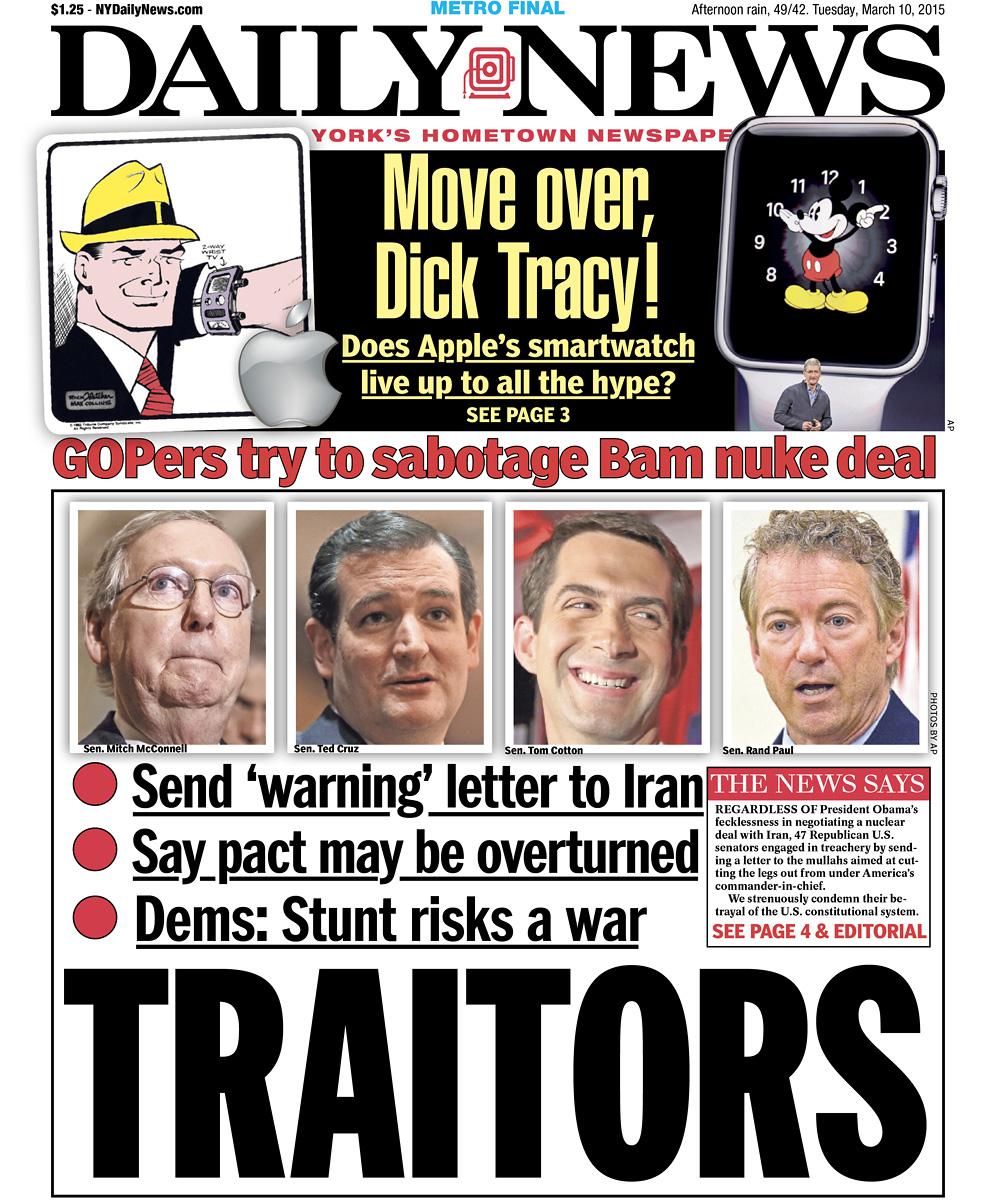
This week everybody was talking about a letter to Iran

Forty-seven Republican senators signed an open letter to the leaders of Iran, advising them on American governance, so that they won’t be fooled into making a peace agreement with our wily President Obama. Exactly why they felt it necessary to advise Iran is not clear. Maybe they’re angling for contracts with the Iranians after they retire from the Senate and achieve their dream of becoming high-rolling lobbyists.

OK, that was snarky of me. It was obvious why they wrote: They want the Iranians to walk away from the proposed deal — the end of negotiations would be “a feature, not a bug” according to the letter’s author — so that we can have another Middle Eastern war, this time with a country three times the size of Iraq and much more spirited. It’ll be great: The Iranian people will greet us as liberators, just like the Iraqis did.

Still too snarky. Conservative WaPo columnist Michael Gerson, while recognizing that the letter had “all the gravity and deliberation of a blog posting” and “raises questions about the Republican majority’s capacity to govern”, tried to put the best face on the 47’s motives and goals: Yes, they want the current negotiations to fail. But

The alternative to a bad nuclear deal is not war; it is strong sanctions and covert actions to limit Iranian capacities until the regime falls (as it came close to doing in 2009) or demonstrates behavior change in a variety of areas.

A more realistic assessment — illustrated by the history of our failure to keep North Korea from getting the bomb — comes from Foreign Policy’s Jeffrey Lewis: The “better deal” in which all of Iran’s centrifuge’s go silent

is a fantasy, a unicorn, the futile pursuit of which ends with a half-assed airstrike against Iran, a region in flames, and eventually an Iranian nuclear weapon. … A Republican administration, if given a chance, would negotiate exactly the same agreement that this administration is negotiating, with all its flaws and shortcomings.  … The outlines of any deal with Iran are largely determined by the relative power of the parties — how advanced Iran’s nuclear programs are, what U.S. military options look like, the vitality of the sanctions regime, etc. — not the personal qualities of the presidents we elect. You can believe that George W. Bush’s flinty gaze would have stared down Hassan Rouhani or that Ali Khamenei will understand that Barack Obama is a transformational figure of historic importance. You can believe those things, but you’d be an idiot.

The idea that the Iranian government might fall soon, or that it came close to falling in 2009, is highly speculative — especially when you put it together with American or Israeli attacks, covert or otherwise. Given the Iranian history of British colonialism and American interference, any direct foreign intervention will cause the Iranian people to rally around their government, the same way Americans rallied around President George W. I-Lost-the-Popular-Vote Bush after 9-11.


The Nation’s William Greider asks the obvious question you seldom hear: What about Israel’s nukes? Israel has never admitted having the bomb, but it is widely believed to have hundreds of nuclear warheads. Nobody knows for sure, because Israel submits to no international inspections.

I asked another friend (a well-informed journalist sympathetic to the Palestinian cause) why reporters don’t talk about the Israeli bomb. “Groupthink,” he said. “It’s almost as though Israel gets a bye from the media.”

The Iranians, he added, have raised the issue of the Israeli bomb many times in the past, but their complaints were generally ignored in the Western press.

The Iranian people may not like the sanctions Iran’s nuclear program has led to, but the premise of the sanctions — that Iran achieving parity with Israel is unthinkable — has to rub them the wrong way. If the Iranian government is seen standing up for the principle that Iran is a nation equal to any other nation, that’s got to raise its popularity, not invite a revolution.


There’s been much online discussion about whether the senators’ letter violates the Logan Act of 1799, which bans Americans from undermining government policy through “correspondence or intercourse with any foreign government or any officer or agent thereof”.

As satisfying as it may be to yell “Treason!” or imagine Mitch McConnell doing a perp walk, HuffPost’s Monica Bauer describes Logan Act talk as “click bait for liberals” rather than a serious matter, and MSNBC’s Lawrence O’Donnell rejects the Act as “unenforceable because it is obviously unconstitutional and absurd on its face”.

I have to agree. The Adams administration had a penchant for restrictions on its citizens’ freedom of speech. The Logan Act is of a piece with the infamous Alien and Sedition Acts. Obama is right not to try to enforce it.


But even if it’s not treason or otherwise illegal, the letter is unpatriotic. The signers hate Obama more than they love America.

There is an underlying separation-of-powers issue about whether this agreement ought to be a treaty and require ratification by the Senate, rather than an executive agreement that does not. But it isn’t the constitutional crisis Republicans like to claim. Presidents of both parties sign executive agreements. They aren’t enforceable by the courts, as a treaty would be under Article VI of the Constitution. But presidents are highly motivated to keep their predecessors’ agreements to maintain the credibility of their own agreements.

By impugning executive agreements in general, Republicans continue down the path towards making the United States ungovernable that I talked about two weeks ago.

The Yalta agreement on the re-organization of Europe after World War II is an example of a far-reaching commitment that was made without Senate ratification. Watching FDR balance the constitutional issues in his post-Yalta message to Congress is instructive: He affirms that the U.N. charter, whose general outlines the Yalta agreement affects, will have to be ratified by the Senate. But other aspects of Yalta are not submitted for ratification.

and reactions in Ferguson

It’s been fascinating to watch Ferguson react to the Justice Department’s scathing assessment of its police and courts (which I described last week). Both the city manager and the police chief have resigned, but the mayor is determined to hang on. He isn’t even convinced the city has a serious problem:

The report stated there was probable cause to believe the police and court routinely violate people’s civil rights. But, Knowles said, “that’s not proof.” He added that “there is probably another side to all of these stories.”

But we don’t know that side yet because it’s so hard for white mayors and policemen to get their stories out in our black-dominated culture, I suppose.


Similarly, National Review assures us that the problem in Ferguson is “predatory government”, not racism. It’s just kind of a coincidence that predatory government happens to show up and be tolerated in a majority-black community with a white power structure.


They charged a guy with shooting two policemen during a protest in Ferguson Thursday. He has a great defense: He claims he was shooting at somebody else.

Notice one key difference between shootings like this and the shootings police do: No major figure is stepping up to say that the victims had it coming.

and a racist frat incident in Oklahoma

University of Oklahoma’s Sigma Alpha Epsilon frat got in deep trouble after a video surfaced of the brothers singing on a bus:

There will never be a nigger SAE.
You can hang them from a tree,
but they’ll never sign with me.
There will never be a nigger SAE.

The guys on the bus seem to know the words, so you’ve got to figure this wasn’t the song’s world premiere. After the video went viral, University President David Boren closed the house and expelled the two students identified as leading the singing.

National SAE back-pedaled as fast as it could, saying it has “zero-tolerance for any kind of discrimination” and claiming that 20% of its national membership is non-Caucasian. It’s also been editing its history page to play down its origin as a Confederate frat. According to an earlier version of the page:

The fraternity had fewer than 400 members when the Civil War began. Of those, 369 went to war for the Confederate States and seven for the Union Army. Seventy-four members of the fraternity lost their lives in the war.

Think Progress lists previous race-related incidents involving SAE, including

In 2009, Valdosta State University in Georgia hosted a community forum on “Heritage, Hate or Fear?” that was inspired by the university’s SAE chapter’s practice of flying a Confederate Flag on its front lawn.

The Oklahoma State University SAE chapter is taking flack for a Confederate flag posted on a member’s wall in such a way as to be visible from the street.

So it sounds to me like this isn’t just two guys. SAE’s Confederate heritage is more than a historical footnote. It’s part of the frat’s “charm” and attracts a certain element.


There’s a side issue here about the media, which gives me an opening to discuss my policy on The Weekly Sift. This CBS/AP article refers to SAE members “engaging in a racist chant” but doesn’t say what the chant was, a practice I’ve noticed on several news outlets. Others refuse to print or say nigger, replacing it with references to “the N-word” or “n****r”.

I first had to decide whether to use nigger in my writing in 2007, when I was still posting as Pericles on Daily Kos. My policy — which applies not just to nigger, but to bitch, faggot, or any other epithet — is to ask myself this question: If I replace the word with a euphemism, who am I protecting?

My 2007 post described the racial atmosphere of my 1960s working-class childhood. Saying something like “We used the N-word” would have protected myself more than the fragile sensibilities of my readers. I mean, Jackie Chan used the N-word in Rush Hour; it was hilarious. But my truth was much starker: We told nigger jokes. Saying anything less would just give my readers room to imagine that what I did really wasn’t that bad.

Same thing here. Describing the video in some oblique way just protects the frat boys. A “racist chant” could be eeny-meeny or some other childish thing where the racism isn’t the point. Describing the incident that way opens the possibility that “racist” might be nothing more than some journalist’s debatable interpretation. So I think you have to print it the way they sang it.

and you also might be interested in …

Rest in peace, Terry Pratchett. Most obituaries highlight his Discworld series, which is tremendously amusing. But my personal favorite Pratchett novel isn’t set on Discworld, it’s Good Omens, his collaboration with Neil Gaiman about the coming of the Antichrist. (Well, there is one Discworld connection: Discworld’s Death character shows up as one of the Four Bikers of the Apocalypse.) Imagine if Left Behind was short, clever, and had a sense of humor.


Israel holds elections tomorrow, and it’s anybody’s guess who will win. It’s a parliamentary system, so we might not know right away. Even if Netanyahu’s party isn’t the top vote-getter, he still might wind up as the leader of a majority coalition.

Paul Krugman points out that internal economics may play a bigger role than the Palestinian or Iranian issues Americans are focused on. He references an amazing statistic:

According to the Bank of Israel, roughly 20 families control companies that account for half the total value of Israel’s stock market.

and let’s close with a moment I’m sorry I missed

As spring approaches, let’s remember that winter hasn’t been all bad. Like this massive snowball fight in downtown Portsmouth, New Hampshire.

Money and Motion

What was the law, when bright shiny money was in sight?
Money make the train go.

— Charley Barbour,
quoted in The American Slave, a Composite Autobiography

This week’s featured post is “Justice in Ferguson“.

This week everybody was talking about Ferguson again

The Justice Department published two reports Wednesday, one about the Michael Brown shooting and the other about the Ferguson Police Department. I discuss them in detail in “Justice in Ferguson“, but the short version is that Darren Wilson’s story is plausible and he shouldn’t be indicted, while the FPD is a predatory institution that needs drastic reform.

and Selma

Tens of thousands of people marched across the Edmund Pettis Bridge in Selma, Alabama to mark the 50th anniversary of the Selma-to-Montgomery marches that led to the passage of the Voting Rights Act.

President Obama’s speech was a marvelous expression of the liberal vision of America.

It’s the idea held by generations of citizens who believed that America is a constant work in progress; who believed that loving this country requires more than singing its praises or avoiding uncomfortable truths. It requires the occasional disruption, the willingness to speak out for what is right, to shake up the status quo. … That’s what it means to love America. That’s what it means to believe in America. That’s what it means when we say America is exceptional. … That’s what America is. Not stock photos or airbrushed history, or feeble attempts to define some of us as more American than others. We respect the past, but we don’t pine for the past. We don’t fear the future; we grab for it. America is not some fragile thing.

Meanwhile (and Obama referred to this) the achievements of fifty years ago are threatened. The Supreme Court has gutted the enforcement provisions of the Voting Rights Act and the Republican Congress continues to refuse to fix it. The hole that the Court blew in the VRA has invited voter suppression of all sorts.

and Netanyahu vs. Iran

The politics of Prime Minister Netanyahu’s speech to Congress has been widely discussed, both here and in Israel. But reading the text, I found myself thinking more about the content: Is he right about Iran?

Some of what he had to say was obviously exaggerated. Like this:

In the Middle East, Iran now dominates four capitals, Baghdad, Damascus, Beirut and Sanaa. And if Iran’s aggression is left unchecked more will surely follow.

Juan Cole examines this claim capital-by-capital, but the gist is that Iran has given material support to factions in local conflicts that it did not start. (In Baghdad, we started it.) Those factions have been successful in varying degrees, but in none of the four cases has there been anything like an Iranian conquest or occupation, nor is there likely to be. Iran is playing the Great Game, just as we are and Israel is.

A more interesting notion lies in the background of Netanyahu’s remarks, and in most neo-con discussion of Iran: the idea that an Iranian bomb would be uniquely horrible, because Iran’s nature as an Islamic Republic makes it immune to the kind of deterrence that kept the Soviet Union in check. In this telling of the story, Iran’s leadership is motivated by an apocalyptic theology that would happily use nukes against Israel and glory in the ensuing end-of-the-world destruction when Israel retaliated with the nukes it has never admitted it has.

Having discussed just two weeks ago how another force in the region — ISIL — is motivated by apocalyptic theology, I can’t just reject this argument as absurd. But is it true? Is Iran essentially a nation-sized suicide bomber?

Other people have studied this question, and the answer seems to be no. Back in 2011, Matthew Duss wrote “The Martyr State Myth” for Foreign Policy.

The “martyr state” myth is based upon two flawed assumptions. First, that the Islamic Republic of Iran has been uniquely willing to endure the deaths of its own citizens in order to achieve its policy goals. Second, that the Iranian Shiite regime’s End Times theology actually induces it to trigger a conflagration.

Quoting previous studies, he finds that Iran’s willingness to sacrifice its citizens pales in comparison to the Soviet and Chinese regimes that were deterred by retaliation, and that claims of the Iranian regime’s desire for martyrdom

are unsupported by anything like evidence, but rather have achieved the status of conventional wisdom simply by repetition.

Former Iranian President Mahmoud Ahmadinejad did like to talk in apocalyptic terms, but he

  • is not president any more
  • didn’t have control of Iranian military policy when he was president
  • was criticized for his apocalypticism by the ruling imams.

By contrast, Iran’s Supreme Leader is in no particular hurry to be Supreme Leader of a pile of rubble.

and the Supreme Court looking at ObamaCare again

The oral arguments in King vs. Burwell have begun. The case hangs on one sentence in the Affordable Care Act, which (if interpreted without reference to anything outside that sentence) would mean that ObamaCare subsidies could only go to people in states that had their own ObamaCare exchanges, rather people living in states whose exchanges were set up by the federal government.

There has been a certain absurdity to the case from the beginning, since there is ample evidence that no one in Congress intended that result. So the plaintiff’s arguments have all been a little like “You didn’t say ‘Simon says’.”

The Obama administration’s counter-argument is that the executive branch has a responsibility to interpret laws in ways that work, rather than in ways that don’t work, so the IRS has acted correctly in interpreting the law as it has. The precedents seem to be on its side, and I don’t believe this case would ever have reached the Supreme Court without a number of activist conservative judges seeking to repeal laws they don’t like.

The big thing we’ve learned from the justices’ questioning is that there is a conservative reason reject the case, hinted at by Justice Kennedy and drawn out further by Justice Sotomayor: Congress may not have had the power to pass the law as the conservative activist judges have been interpreting it, at least not under a conservative interpretation of the relationship between the federal government and the states.

If the law really did only subsidize people on exchanges states set up, that would be a substantial penalty to states that refused to set up their own exchanges. That kind of monetary pressure (to set up state exchanges) was precisely why (when ObamaCare reached the Court in 2012) the Court threw out the provisions of the law that pushed the states to expand Medicaid.

The legal principle Chief Justice Roberts invoked when he cast the deciding vote to save ObamaCare in 2012 was that the courts have to presume that Congress intended to pass laws that are constitutional. So if one interpretation of a law makes it constitutional and another unconstitutional, courts should favor the constitutional interpretation.

and you also might be interested in …

Correction: Last week I identified FBI agents as potential victims of a Homeland Security shutdown. As a commenter pointed out, the FBI isn’t in DHS, it’s in the Department of Justice.

Meanwhile, Speaker Boehner relented and allowed the House to vote on a clean bill to fund DHS through September. It passed, as it would have weeks ago, without any sturm und drang. The problem for Boehner was that his caucus wanted to continue holding the country’s security hostage: Republicans voted against the clean funding bill 167-75.

Vox added this example to its list of “every major crisis or near-crisis that’s been resolved by Boehner giving up on conservatives and passing a bill with Democratic support.”


Next up: the debt limit. Mitch McConnell says it will pass, but he also says:

We’ll figure some way to handle that and hopefully it might carry some other important legislation that we can agree on in connection with it.

In other words, there’s going to be another hostage crisis. You can replace “other important legislation” with “list of demands”.

I could repeat everything I said last week about Republican governance, but I think I’ll just link to it.


Jonathan Waldman in the NYT says “Don’t Kill Keystone XL, Regulate It“.

“Pipelines are the safest way to move oil,” he says, and they could be made better if regulators insisted on the best technology. I have no argument with that. But he takes one thing as given:

[B]locking [the pipeline] won’t actually prevent Canada from extracting its tar sands oil. Ours is an energy-thirsty world, and when demand eventually drives up the price of oil, out it will come.

I’m not willing to grant that. Canada is going to extract some of its tar sands oil. How much it makes sense to extract at a given oil-price depends on transportation costs, which depends on infrastructure like Keystone XL. And alternative fuels are competitive enough to keep the price of oil from going to infinity.


An incident at UCLA has raised discussion about anti-semitism on campus. Anti-semitism in America is a tricky thing to measure and document, because American Jews tend to be above average in many kinds of achievement and representation. It also gets tied up with political opinions about Israel and America’s support of Israel.

I’ve been mostly silent about anti-semitism not because I’ve decided it doesn’t exist or doesn’t matter, but because I don’t have a good handle on it. I’m still thinking and reading, so maybe that will change.


A fifth-grade teacher in Chicago writes a letter of apology to her students before inflicting on them the latest round of standardized tests.

I do not agree that these tests will tell me what I really need to know about you as a learner or as a human being. I do not agree that these tests will make me a better teacher. I do not agree that these tests will improve our schools. I do not agree that you need to sit in front of a computer for over five hours in order for the government to find out what you know and what you can do. I do not agree that you should not have a choice in how you are able to show all of the things that you are capable of doing. I do not agree that in order for the state to know that I am doing my job that you have to suffer through tests that could quite possibly ruin much of the hard work that we have done together in building your confidence this year and in helping you to see yourselves as readers and writers. I do not agree with these tests.

and let’s close with something amusing

I believe no dogs were harmed in the making of “12 Dogs Who Really Didn’t Expect the Snow to Be This Deep“.

Partisans

We are all Republicans, we are all Federalists.

— Thomas Jefferson,
First Inaugural Address (1801)

There is not a liberal America and a conservative America — there is the United States of America.

— Barack Obama
Keynote Address to the Democratic National Convention” (2004)

This week’s featured post is “The Myth of Republican Governance“. The big issues in this week’s summary have all come up (and been discussed in detail) before, so I’m going to linking to a lot of previous Sift articles.

This week everybody was talking about funding Homeland Security

Late Friday night, Congress avoided a shutdown of the Homeland Security Department by passing a one-week continuing resolution. So we get to do the whole thing over again this week.

As in previous shutdown confrontations, the Senate passed a “clean” bill funding DHS for the rest of the fiscal year (through September), without attaching any riders rolling back President Obama’s executive actions on immigration. The Senate bill almost undoubtedly would have passed in the House, ending the crisis, had Speaker Boehner allowed it to come to the floor. According to CNN, doing so might have sparked House conservatives to oust him as Speaker, but National Journal says no.

Conservative rhetoric says they are “defending the Constitution” by trying to reverse President Obama’s “lawless” re-prioritization of  immigration enforcement. In fact, the administration studied the legal limits of executive action and made a strong case that it was staying within them, as I outlined in November. The rhetoric is another example of what I described in “A Conservative-to-English Lexicon“:

Like the Bible, [the Constitution] means whatever conservatives want it to mean, regardless of its actual text.

Conservatives jurisdiction-shopped to find a federal judge who agrees with them, so there is an injunction temporarily halting Obama’s executive actions. Slate‘s Eric Posner gives it “little chance of withstanding appeal“. If conservatives truly believed their rhetoric about constitutionality, they could let the conservative majority on the Supreme Court handle it.

and Net Neutrality

A little over a year ago, the headlines were saying that net neutrality was dead, killed by an appeals-court ruling. If you read the ruling, though, things still seemed up in the air. As I wrote at the time:

The gist of the court ruling is that the FCC has classified cable companies as information-services providers, but that its net-neutrality rules regulate them like telecommunications carriers. So the FCC’s net-neutrality rules can’t stand. But — and this is the observation that snatches victory from the jaws of defeat — it’s totally within the FCC’s current powers and mandate to just reclassify the cable companies.

So net neutrality is dead. But if the FCC wants to revive it, all they have to do is issue new rules.

And that’s what they just did: reclassified internet providers as utilities, like the telephone companies. Now, I don’t want to minimize how courageous that was, given the amount of money and influence Verizon and Comcast have been throwing around. But it was always within the FCC’s power.

So now we have net neutrality rules again, and the same court decision that threw out the old rules defends the new ones. The non-profit Mozilla Foundation celebrates “a major victory for the open web“, and Ezra Klein explains what that means:

and the Keystone Pipeline

President Obama vetoed a bill that would have given the government’s go-ahead to the Keystone Pipeline, but he did it on procedural grounds:

Through this bill, the United States Congress attempts to circumvent longstanding and proven processes for determining whether or not building and operating a cross-border pipeline serves the national interest.

So don’t get excited that Obama has finally taken a stand on the pipeline; he hasn’t. He’s just said it shouldn’t be approved this way.

My position on the pipeline hasn’t changed since I wrote “A Hotter Planet is in the Pipeline” two years ago: We can’t burn all the fossil fuels without doing catastrophic damage to the climate, so some will have to stay in the ground. The tar sands whose product Keystone would transport are good candidates.


The case for Keystone revolves around the number of jobs it would create. Estimates vary, but the important thing to realize is that the vast majority would be temporary construction jobs that might last six months to a year, plus some other jobs for people providing services to those temporary workers (who would probably eat a lot of Big Macs before they moved on). Politifact assessed Van Jones’ claim that the pipeline would provide only 35 permanent jobs, and judged it to be true.

On the other hand, the risk of oil spills and groundwater contamination will be permanent, as well as the environmental damage from the carbon released.


The hardest thing to assess about projects like this are the net effects. For example, in the absence of a pipeline, probably less oil will be recovered from those fields to begin with. (The last oil produced from a field is typically the most expensive; whether it gets pumped out at all depends partly on transportation costs.) That’s how the pipeline relates to leaving oil in the ground.

But the oil that is recovered will be transported some other way. Those other ways have their own environmental downsides, and their own employment upsides. The 35 long-term pipeline jobs might be outweighed by the lost railroad and trucking jobs, making the pipeline a net job destroyer. But it’s also hard to guess how many train-car accidents a pipeline would prevent, and what their environmental impact would be.


In a sane world, you could imagine a deal that allowed everyone to save face: Keystone in exchange for environmental concessions elsewhere. Michael Bloomberg outlines one deal. May Boeve explains why it would be a bad deal. But neither has an answer for the “sane world” problem.

and Netanyahu’s speech

It’s happening today, maybe as you read this. Vox gives the background.

and Bill O’Reilly

Bill O’Reilly’s defining characteristic is his lack of self-awareness. He stands in his yard and throws stones without ever noticing the glass house behind him.

So when NBC’s news anchor Brian Williams got into trouble for telling tall tales about his past reporting experiences, O’Reilly pounced, misrepresenting Williams’ exaggerations as being part of his live reporting, and implying that Williams was reporting falsely for ideological purposes:

When hard news people deceive their viewers and readers to advance a political agenda, that’s when the nation gets hurt.

[To be fair, O’Reilly didn’t make the Williams-is-a-lying-ideologue charge in so many words. He just segued directly from this abstract statement to the Williams scandal, as if the two had something to do with each other.]

Well, it turns out that O’Reilly also tells tall tales about his past reporting. The biggest exaggeration concerns a demonstration in Buenos Aires in 1982, when Argentines were upset by their government’s surrender in the Falklands War. Nobody else considered the demonstrations that big a deal; fellow CBS reporter Eric Engberg described is as “the chummiest riot anyone had ever covered”. But O’Reilly has described Buenos Aires as “a war zone”, and often uses that mischaracterization to justify claiming that he has “been there” in combat. His specific retrospective claims about that day — that police fired live ammunition into the crowd and killed many people — are contradicted by the news coverage at the time and by the accounts of everyone else who was there.

But of course O’Reilly is not going to admit — or even recognize —  that he did anything wrong, or that he did precisely what he condemned Williams for doing. Instead, he claims that evidence supports him (when in fact it does no such thing), and that the issue is not his personal dishonesty, but an attack on all of Fox News because “Fox gives voice to conservatives and traditional people”. That makes it an us-against-them issue, not a Bill-is-a-serial-liar issue, so it calls threats and intimidation against journalists who try to investigate.

And of course Fox News is going to stand by him rather than suspend him as NBC did Williams. Columbia Journalism Review draws the obvious conclusion:

Fox has made clear that it doesn’t see itself bound by the same rules of public accountability it calls on other news organizations to uphold.

And that, in turn, demonstrates an even more general principle: Moral standards are just lower on the Right. To give a second example: Eliot Spitzer’s upward-trending political career ended within days after it came out that he had seen a prostitute. A similar scandal was just a blip for David Vitter, who continued in the Senate and was re-elected. And there is no liberal-media-star parallel to Rush Limbaugh’s drug history.


Once the idea got broached that O’Reilly makes exaggerated claims, other examples have followed: hearing the gunshot when a JFK-assassination witness committed suicide, and seeing the execution-style murders of Salvadoran nuns.

and you also might be interested in …

RIP, Leonard Nimoy. May your legacy live long and prosper.

Also dead this week: Earl Lloyd, basketball’s Jackie Robinson.


Thursday, Senator Inhofe (R-Exxon-Mobil) proved global warming is a myth by throwing a snowball while speaking to the Senate. Vox described it as “the dumbest thing that happened on the Senate floor today” and performed the thankless task of explaining rationally why Inhofe is wrong.

Sometimes these kinds of incidents make me mad, but this time I’m just embarrassed. This is the Senate of the United States of America. My country has put complete idiots in positions of power.


The American Family Association has created a “Bigotry Map” to identify “groups and organizations that openly display bigotry toward the Christian faith.” The icons mark atheist groups, humanist groups, “anti-Christian” groups, and “Homosexual agenda” groups.

This is just a screen capture. The original is much fancier, allowing you to zoom in or out and click on icons to identify the groups closest to you. (I’m right between Lowell Atheists and GLSEN New Hampshire. AFA seem to have missed the Concord Area Humanists; I’m sure my friends on the steering committee will be miffed.)

Friendly Atheist comments:

Not a single one of the atheist/Humanist/LGBT rights groups that I can see on the map have ever supported violent acts or taking away rights from Christians. They’ve always been on the side of tolerance and inclusivity. They want non-Christian beliefs to be treated by the government the same way Christianity is treated, with no group getting special privilege.

This is how desperate right-wing groups are to show the fictional marginalization of Christians. They think criticism is the same as bigotry. They think neutrality is the enemy.

The map is also an example of privileged distress: As a group becomes less dominant and has less power to lord it over others, that slippage feels like persecution. I mean, imagine if the government starts to treat Jesus’ birthday with the same respect it shows to, say, Buddha’s or Krishna’s. What’s next? Death camps?


Evangelist Franklin Graham, Billy’s son, says on Fox News that the White House (along with several unspecified European governments) has been “infiltrated by Muslims”. But he can’t name any.


Every year around this time, Pastor Kenneth Swanson’s 2012 radio rant against buying Girl Scout cookies (because he claims the Scouts promote lesbianism) shows up in my Facebook news feed. This year, it got me wondering what Rev. Swanson has been up to lately.

On Feb. 20, he interviewed Rev. Marion Clark, whose new book The Problem of Good: when the world seems fine without God explores the disturbing conundrum that non-Christians aren’t constantly doing evil, and may even be nice people.

SWANSON: There are a lot of unbelievers — neighbors, co-workers — they’re nice. They’re nice people. How do you explain that, Marion?

CLARK: Well, that was the question that really troubled me. And I’ll say that the problem of good, which you’re talking about, troubled me more than the problem of evil. Evil exists; it’s out there. But what kept tripping me up were my nice neighbors, nice family members, people who — I would hate to say it — were nicer than I was. And yet they were unregenerate. And how could that be?

How indeed? It’s like seeing the inverted image of Greg Epstein’s Good Without God.


Gerrymandering explained:


Male privilege explained:

And a young man explains men’s responsibility for preventing sexual assault.

and let’s close with something funny

Australian comic Jim Jefferies on gun control.