[I haven’t done an Expand Your Vocabulary post in several years, but “the Dual State” merits one. We should all become fluent in its use.]
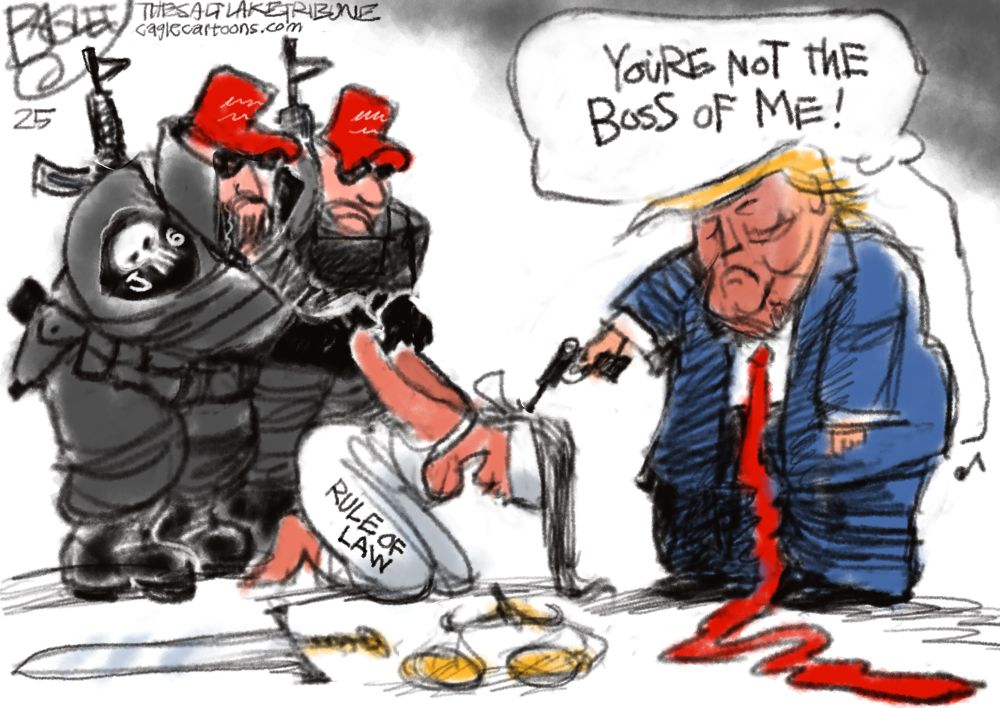
It’s commonplace these days to compare the Trump regime’s behavior to what the Nazis did in Germany in the early-to-mid 1930s. (Comparisons to the Final Solution Germany of the 1940s are still over the top. We are not fighting a world war while maintaining a network of death camps.) But here’s a Nazi-era idea that doesn’t get nearly the attention it deserves. Aziz Huq was telling us about it in The Atlantic back in March, referencing a book Ernst Fraenkel wrote after escaping Germany in 1938. (You can read it online for free.)
As Fraenkel explained it, a lawless dictatorship does not arise simply by snuffing out the ordinary legal system of rules, procedures, and precedents. To the contrary, that system—which he called the “normative state”—remains in place while dictatorial power spreads across society. What happens, Fraenkel explained, is insidious. Rather than completely eliminating the normative state, the Nazi regime slowly created a parallel zone in which “unlimited arbitrariness and violence unchecked by any legal guarantees” reigned freely. In this domain, which Fraenkel called the “prerogative state,” ordinary law didn’t apply. … In this prerogative state, judges and other legal actors deferred to the racist hierarchies and ruthless expediencies of the Nazi regime.
The key here is that this prerogative state does not immediately and completely overrun the normative state. Rather, Fraenkel argued, dictatorships create a lawless zone that runs alongside the normative state. The two states cohabit uneasily and unstably. On any given day, people or cases could be jerked out of the normative state and into the prerogative one.
This week in the NYT, David French applied this idea to what we’re seeing in Minneapolis.
It’s the continued existence of the normative state that lulls a population to sleep. It makes you discount the warnings of others. “Surely,” you say to yourself, “things aren’t that bad. My life is pretty much what it was.”
But the prerogative state is always sitting there on the other side of the veil, and you never know when you might cross over into it.
One of the most heartbreaking aspects of the ICE agent’s video of the fatal encounter between Renee Good and ICE is that it’s plain that Good thinks she’s still in the normative state. She has no idea of the peril she’s in.
She seems relaxed. She even seems to have told the agent that she’s not mad at him. In the normative state, your life almost never depends on immediate and unconditional compliance with police commands.
But she wasn’t in the normative state. She had crossed over the border to the prerogative state, and in that state you can be shot dead recklessly, irresponsibly and perhaps even illegally, and no one will pay the price.
For the vast majority of Americans, everyday life goes on: You do your job, come home to your family, do your chores, run your errands, watch your favorite TV shows — nothing significant has changed in the year since Trump regained the presidency. It’s easy to imagine that nothing will change, and that the people who try to get you alarmed are all suffering from the “Trump Derangement Syndrome” you hear so much about.
Meanwhile, the prerogative state grows. Maybe it hasn’t arrived in your city yet. Maybe the friends you know who are affected by it did something to draw its attention. But your life goes on normally, until it doesn’t.
William Faulkner’s classic story about a lynching, “Dry September“, starts with this paragraph:
Through the bloody September twilight, aftermath of sixty-two rainless days, it had gone like a fire in dry grass: the rumor, the story, whatever it was. Something about Miss Minnie Cooper and a Negro. Attacked, insulted, frightened: none of them, gathered in the barber shop on that Saturday evening where the ceiling fan stirred, without freshening it, the vitiated air, sending back upon them, in recurrent surges of stale pomade and lotion, their own stale breath and odors, knew exactly what had happened.
The beauty of that description is that by the time you get to “knew exactly what had happened”, you’ve forgotten that the subject is “none of them”. That’s how viral public outrage works sometimes: The more the story goes around, the simpler it becomes, until you start to forget how little you actually know.
We’ve had an example of viral public outrage these last two weeks: Something about Jews and genocide, and university presidents being OK with it, or not willing to condemn it, or something. It was horrible, whatever it was. And heads have rolled. Penn’s Liz Magill has already been forced out, while Harvard’s Claudine Gay and MIT’s Sally Kornbluth have managed to hang on. The House has passed a resolution citing statistics about antisemitic incidents on college campuses, “strongly condemning” the three presidents’ testimony as “evasive and dismissive”, and demanding that they all resign. The MIT Israel Alliance went a step further, calling for the resignations not just of the university’s president, but of board members “who support tacitly, or otherwise, the calls for genocide of Jews.”
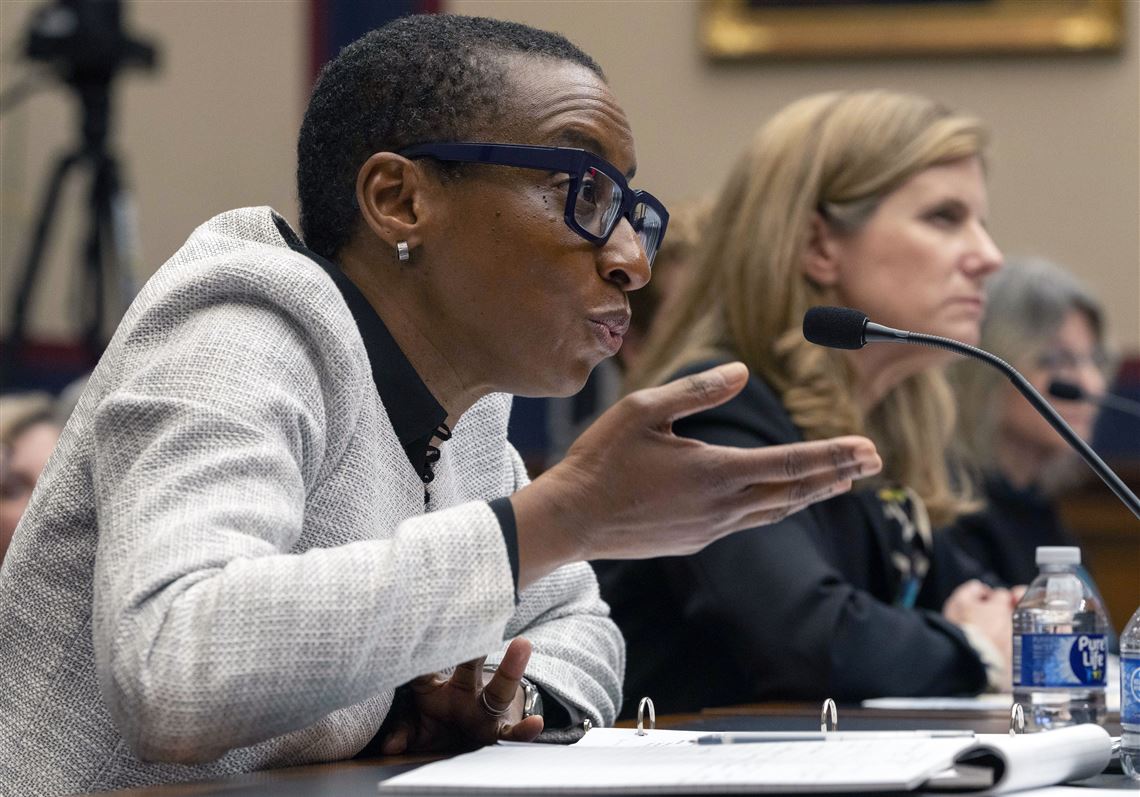
The heart of the issue is a widely circulated video of a three-and-a-half-minute chunk of a five-and-a-half-hour hearing. [The video and transcript of the full hearing is available online. I’ve scanned the transcript, but I confess I have neither watched nor read the whole session. Unless otherwise sourced, the quotes below are from the transcript.] In that clip, Rep. Elise Stefanik (R-NY) badgers all three presidents to answer yes or no about whether “calling for the genocide of Jews” violates their institutions’ harassment policy. All three give similar answers to President Gay:
The rules around bullying and harassment are quite specific. And if the context in which that language is used, amounts to bullying and harassment, then we take — we take action against it.
Again and again, Stefanik rejects the suggestion that the context matters:
Yes or no, calling for the genocide of Jews does not constitute bullying and harassment?
None of the presidents is willing to give that clear yes-or-no, resulting in national outrage at their “lack of moral clarity” (to use Stefanik’s words), and costing at least one of them her job.
So why couldn’t they give that yes-or-no answer? If we’re going to understand what this exchange was really about, we’re going to have to examine — dare I use the word? — context.
Framing the hearing: not antisemitism, wokeness. The hearing was held before the House Committee on Education and the Work Force (which I honestly had never heard of before), chaired by Rep. Virginia Foxx (R-NC).
The first thing to understand about this hearing is that it was only superficially intended to discuss antisemitism. Antisemitism was just a convenient tool to use in the House Republican majority’s larger battle against “wokeness”, particularly as it appears in elite universities, which Republicans see as enemy outposts.
That purpose was announced in the opening statement given by Chair Foxx:
[A]fter the events of the past two months, it is clear that rabid anti-Semitism and the university are two ideas that cannot be cleaved from one another. We must be clear on the ideological dimension of this problem. For years, universities have stoked the flames of an ideology which goes by many names—anti-racism, anti-colonialism, critical race theory, DEI, intersectionality, the list goes on.
This value system taught in universities is absolutely foreign to 99 percent of Americans. It centers the identity on immutable racial and sexual characteristics. It presents a delusion that the color of one’s skin and expression of one’s chromosomes sort society into classes of oppressed and oppressors. And now it is clear that Jews are at the bottom of the totem pole and without protection under this critical theory framework. … Institutional anti-Semitism and hate are among the poison fruits of your institution’s cultures.
The buck for what has happened must stop on the President’s desk, along with the responsibility for making never again true on campus. Do you have the courage to truly confront and condemn the ideology driving anti-Semitism, or will you offer weak, blame shifting excuses and yet another responsibility dodging task force?
So the topic here isn’t really antisemitism, it’s “the ideology driving anti-Semitism”, which is “anti-racism, anti-colonialism, critical race theory, DEI, intersectionality.” As an example of this ideology, Foxx names courses like Harvard’s “Race and Racism in the Making of the United States as a Global Power”, whose title alone is so sinister that its wrongness needs no explanation.
Even the Harvard Divinity School has a page devoted to “Social and Racial Justice.” [1]
This larger focus is why much of the questioning by Republican members is about Blacks, not Jews. Rep Bob Good (R-VA), for example, uses Harvard’s history of affirmative action against it:
We know, of course, that Harvard has a history of dividing people based on race, based on the Supreme Court’s decision and students for Fair Admission versus Harvard.
Ranking Democrat Donald Norcross (NJ) pointed out in his opening statement that Republican interest in antisemitism or any other form of discrimination on campus has been quite selective:
Today we’ll hear from representatives of universities on their efforts to protect students and address discrimination on campus. Of note, this is an opportunity that my Republican colleagues denied us in 2017, when committee Democrats called for a hearing six years ago on campus discrimination, when white supremacists marched through the University of Virginia grounds shouting “Jews will not replace us.” We didn’t — couldn’t get a hearing back then.
And while my colleagues claim to be committed to combating discrimination on campus, they’re also contradictorily and simultaneously stoking culture wars that can be divisive and discriminatory. Moreover, House Republicans are proposing significant cuts to the Department of Education’s offices — Office of Civil Rights, the very office responsible for upholding student civil rights and investigating discrimination claims.
You can’t have it both ways. You can’t call for action then hamstring the agency charged with taking that action to protect students’ civil rights. In stark contrast, the Biden administration has taken an active role in helping institutions protect students as part of the White House’s national strategy to combat anti-Semitism. [2]
So no. They’re not talking about antisemitism because they see antisemitism as a problem. They’re using it as a bludgeon against Academia in general.
Why were the presidents called to testify? So that the committee could beat up on them. The title the committee gave the hearing was “Holding Campus Leaders Accountable and Confronting Antisemitism“. Antisemitism got second billing; humiliating university presidents was the main goal. Foxx’ opening statement was also clear about that:
Today, each of you will have a chance to answer to and atone for the many specific instances of vitriolic, hate-filled antisemitism on your respective campuses that have denied students the safe learning environment they are due. [italics added]
You might imagine calling three distinguished university presidents together in a spirit of real perplexity: How is this happening? What needs to change? But no: They’re not there to give insight; they’re there to atone.
What does it mean to “call for the genocide of Jews”? It’s important to recognize the mismatch between the questioners and the witnesses. The questioners — particularly Stefanik — were there to make particular political points to the nation. The administrators were there to protect their institutions, and so they mostly did not engage when the politicians framed larger political issues. This turned out to be a mistake on their part, and it cost them.
So what exactly counts as “genocide” or a “call for genocide”? In her questioning of President Gay, Stefanik identifies “intifada” with killing Jews in Israel, and “global intifada” with killing Jews everywhere in the world.
And you understand that the use of the term intifada in the context of the Israeli Arab conflict is indeed a call for violent armed resistance against the state of Israel, including violence against civilians and the genocide of Jews. … And there have been multiple marches at Harvard with students chanting quote, “there is only one solution intifada revolution.” and quote, “globalize the intifada.” Is that correct? … So, based upon your testimony, you understand that this call for intifada is to commit genocide against the Jewish people in Israel and globally, correct?
Gay isn’t there to fight the Palestinian/Israeli political battle, and doesn’t want to get pushed into that corner, so she doesn’t dispute Stefanik’s framing (and may not have the background to do so). No one in the room is there to argue the Palestinian case, so the intifada=genocide framing goes unquestioned. But it shouldn’t have. On the liberal Jewish website Forward, Mira Fox does the analysis that no one at the committee hearing felt called to do:
Arabic contains many words for revolts or uprisings, each with a different valence — and often understood differently in the West, and when used in English in ways that don’t capture the words’ full meaning. … Intifada connotes an uprising against an oppressor. But that’s a relatively new meaning for the word, which comes from a verb root meaning “to shake off” or “dust off.” It only acquired its revolutionary implications during the Iraqi Intifada in 1952, a series of strikes and riots protesting the monarchy at the time. In Arabic, [University of Virginia Professor Mohammed] Sawaie said, it is also used to talk about the Arab Spring, and other revolts against oppressive regimes.
… Daniel Lefkowitz, a professor of language and culture in the Middle East at the University of Virginia who lived in Israel for several years in the early 2000s, hypothesized that, for most Palestinians, the word brings up memories of the First Intifada, a largely non-violent Palestinian protest largely involving work stoppages, boycotts and demonstrations.
… But for Israelis, and many Jews, the word brings up memories, instead, of the Second Intifada, a far bloodier Palestinian uprising characterized by suicide bombings on buses and at cafés that killed about 1,000 Israeli civilians.
So it’s important to understand that when American college students call for “intifada”, they might be calling for the indiscriminate killing of Jews, but they might also be calling for resistance (which they might intend to be either violent or non-violent) to Israel’s oppression of Palestinians. Similarly “global intifada” might mean attacks on Jews or Israelis wherever, but it might also mean showing non-violent international support for Palestinian resistance to the Israeli occupation.
It depends on the context.
Similarly, the slogan “From the river to the sea, Palestine will be free.” clearly refers to the whole region between the Mediterranean Sea and the Jordan River, which includes both Israel proper as well as the areas commonly envisioned as a Palestinian state. Wanting that whole region to be “Palestine” might mean ethnically cleansing it of Jews. Or it might refer to what is known as the one-state solution: a multi-ethnic democracy where Palestinians and Jews have equal rights. Rep. Rashida Tlaib (D-MI) sees it as
Naturally, bigots can adopt ambiguous rhetoric in order to give themselves cover, so you can’t always take seriously people’s own explanations of what their slogans mean. (“All lives matter” is a good example. Taken literally, it is uncontroversial, but it is also commonly used by white supremacists to dispute the idea that Black lives matter.) But conversely, contending that you know what other people’s words mean — and they don’t — is a claim of supremacy: your interpretation is the only one that matters.
So what was Stefanik asking? The presidents also made opening statements, and all were clear about several points:
The Hamas attacks on October 7 were wrong and horrible. President Magill: “Let me begin by saying that I, and the University of Pennsylvania, are horrified by and condemn Hamas’s abhorrent terrorist attack on Israel on October 7th. There is no justification—none—for those heinous attacks.”
Antisemitism exists on campus and is unacceptable.President Kornbluth: “Let me repeat what I said in my very first message to campus. In that video, I said, ‘The brutality perpetrated on innocent civilians in Israel by terrorists from Hamas is horrifying. In my opinion, such a deliberate attack on civilians can never be justified.’ I also made clear that students were feeling unsafe ‘because of their Jewish faith, or their ties to Israel’ and said, ‘That should trouble every one of us deeply.’ I have reinforced this message, including in a November 14th campus video. As I said then, ‘Antisemitism is real, and it is rising in the world. We cannot let it poison our community’.”
No student (whether Jew, Muslim, or anything else), should feel unsafe, unwelcome, or intimidated on their own campus.President Gay: “I am deeply troubled by instances of inflammatory rhetoric and division on campus. Individuals are reporting feeling threatened by others in our community. The chilling effect created by these tactics threatens to turn our community of learning and trust into an environment of alienation and fear. Reckless and thoughtless rhetoric—in person and online, on campus and off—is undermining feelings of belonging among members of the Harvard community. Efforts to threaten or intimidate members of our community betray Harvard’s core values.”
The question Stefanik badgered the presidents with, though, was far more specific than whether the Hamas attacks were evil or antisemitism is wrong. She asked specifically about the harassment policies at the universities.
Does calling for the genocide of Jews violate Harvard’s rules on bullying and harassment?
That’s a legal question, and it should surprise no one that the presidents gave legalistic answers, all of which amounted to: It depends.
Their caution was undoubtedly raised by the framing Stefanik had already done: In her view, anyone who chanted or otherwise promoted common pro-Palestinian slogans was calling for genocide against Jews. Once that’s understood, and calling for genocide is defined as harassment, then any student who demonstrated in favor of Palestinian rights is subject to official punishment from their university.
It’s no wonder that the presidents didn’t want to go there.
How should context matter? You might think that a hearing lasting more than five hours would have ample time for everyone to explain themselves. But when a hearing is directed by people who don’t want to hear explanations, time can get away from you.
If someone says “Gaza should be turned into a parking lot” in the Knesset, or at some right-wing political rally, that is indeed a call for genocide. But is it harassment? No. And yet, if the same phrase is shouted in the faces of Palestinians who are marching in their own rally, or if it’s spray-painted on a mosque, then it is.
Now switch out “Gaza” for “Israel.” The same logic holds. If someone says “Israel must be pushed into the sea” in a college political science seminar, that may be a genocidal statement, even an antisemitic one, but it isn’t harassment. But if someone spray-paints it on a synagogue, or shouts it at a group of Jews, that’s harassment.
Michaelson concludes that the pain Jews feel in the aftermath of October 7 is being “exploited by people who do not have our best interests at heart.”
Just look around you. Is it not odd that, if you’re a relatively moderate or liberal American Jew, your current villain is a distinguished university president and your hero is a hard-right rabble-rouser who campaigned for a guy who praised Adolf Hitler? (Carl Paladino, if you want to look it up.) Don’t you see that you’re being played? Our pain is being weaponized as part of a longstanding hard-right attack on institutions of higher education. Do you really think that will be good for the Jews?
Blacks, not Jews. Much of Stefanik’s questioning was not about how Jews are protected by universities, but how Blacks are protected. She began one segment with
Dr. Gay, a Harvard student calling for the mass murder of African Americans is not protected free speech at Harvard, correct?
When Gay didn’t immediately say yes or no, Stefanik cut her off.
That’s a yes-or-no question. Is that correct? Is that OK for students to call for the mass murder of African Americans at Harvard? Is that protected free speech? … And isn’t it true that Harvard previously rescinded multiple offers of admissions for applicants and accepted freshmen for sharing offensive memes, racist statements, sometimes as young as 16 years old? Did Harvard not rescind those offers of admission?
This leads up to questions about what actions Harvard has taken against students who support intifada. (Stefanik knows Gay can’t answer about recent demonstrations because all those cases would be ongoing.) At times it seems like antisemitism is actually a stalking horse for another topic entirely: Not “Why are Palestinians treated so leniently when they intimidate Jews?” but “Why are white supremacists treated so harshly when they intimidate Blacks?”
Divide and conquer. Throughout history, one of the ways ruling minorities have stayed in power has been to turn disadvantaged groups against one another. Today, we can see that most clearly in the way that rural working-class Whites have been turned against Hispanic immigrants and urban Blacks. In this hearing, we see an attempt to drive a wedge between Blacks and Jews, and in particular to turn Jews against Black-led anti-racism programs.
Perhaps the primary distinction that critical theory makes is between privileged groups and underprivileged groups, but American Jews have a foot in both camps. In terms of median income, American Jews are a comparatively wealthy group. On average they have high educational achievement. Blacks and Hispanics can only envy the number of Jews (like President Kornbluth) who have risen to positions of institutional power and influence.
But on the other hand, Jews historically have always been one pogrom away from disaster. [3] Their very success makes them easy to scapegoat and subject to conspiracy theories. The recent increase in antisemitic hate crimes — not just on campus, but throughout America and the world — is very real. [4]
Like Blacks and other underprivileged groups, Jews are vulnerable to collective blame. For example, if you are against Israel’s policy towards Palestinians, it makes perfect sense to demonstrate in front of the Israeli embassy, or some other outpost of the Israeli government. But it makes no sense to demonstrate in front of a Jewish-owned restaurant. Jewishness is an ethnic and religious identity, not membership in a faction.
Victims of antisemitism and other victims of bigotry — like, say, the three young Palestinian men shot in Vermont — could look at each other and gloat: “Now maybe they’ll know what it feels like.” But for the sake of the world, we have to hope that they’ll decide instead to grasp what they have in common.
What can be done? Rep. Foxx has a clear remedy in mind: Jews, and anyone who opposes antisemitism whether they are Jewish or not, need to reject wokeness in all its forms. In particular, universities should have to worry about their government funding until they abandon any attempt to teach about structural racism, white male privilege, LGBTQ rights, or any other woke concept. In short, the US needs to follow the example of Ron DeSantis’ Florida.
In my opinion, though, the resurgence of antisemitism both on campus and in the larger world, together with the simultaneous increase in Islamophobia, anti-Asian hate, and many other forms of bigotry, deserve a better discussion than they got in this manipulative and exploitive hearing.
As so often happens when the Right stokes a controversy, we find ourselves talking about something other than the real problem. [5] As we debate about the attitudes of university presidents, the lived experience of students — Jews and Palestinians alike — who feel unsafe on campus or intimidated out of expressing their political views has faded into the background.
Of course you would expect that university presidents would see education as a key component of a solution here. President Gay in particular promises
a robust program of education and training for students, faculty, and staff on antisemitism and Islamophobia broadly and at Harvard specifically. These educational programs will provide history and context about the roots of certain rhetoric that has been heard on our campus in recent weeks, and its impact on Jewish and Muslim members of our community. The goal is to identify antisemitism and Islamophobia in daily life and interrupt its harmful influence.
But I also think that in this hearing the Right has exploited a hole in much anti-racist literature, which (at least in what I have read, which is a non-trivial but far from comprehensive sample) says little about antisemitism. This isn’t just a failure of inclusion, it overlooks a valuable resource. Antisemitism is perhaps the longest-standing and best-documented manifestation of bigotry. Its history should be a storehouse of examples of key anti-racist concepts, such as structural bigotry and how privilege can be embedded in rules that seem to apply equally to everyone. (Requiring employees of all religions to work on Saturdays but not Sundays, for example. Jews who want to observe their religion’s day of rest can seem to be asking for “special rights”.)
The relationship between Judaism and anti-racism goes way back. Many Jews were important activists in the Civil Rights movement, and Black leaders have often used the symbolism of the Exodus (as when Martin Luther King identified himself with Moses and said he had “been to the mountaintop”). Much of our modern thinking about social justice traces its roots back to the Hebrew prophets.
That history and that commonality is too important to let the Right drive a wedge between the two communities today.
[1] I once sat in on an HDS class and thought about applying, so this hits home: Good heavens! Ministers-in-training are learning about social and racial justice? Maybe liberal professors will assign them to read radical pro-justice texts like the Book of Amos or the Sermon on the Mount. Wake up, America!
[2] Rep. Jamie Raskin (D-MD) isn’t on that committee and so wasn’t at the hearing, but fleshed out similar points in a subsequent tweetstorm, asking Stefanik five yes-or-no questions. He noted Great Replacement Theory’s role in the Pittsburgh synagogue shooting and asked if Stefanik rejected that theory. He also called attention to the antisemitic tropes employed by the Trump campaign and asked if she endorsed his candidacy.
Unsurprisingly, Stefanik dodged Raskin’s questions, and instead answered with a recitation of Trump pro-Israel policies, as if supporting the Netanyahu government were incompatible with antisemitism. In fact, the two positions can go hand-in-hand for ethno-nationalists, who support Jewish supremacy in Israel and White-Christian supremacy in the US. Many in the KKK would argue that Jews should have a homeland in Israel and they should all go there.
[3] For example, many Jews were doing quite well in Weimar Germany, but that didn’t save them when the Nazis came to power.
[4] Similar observations apply Chinese Americans, the so-called “model minority”. Many Chinese are quite successful in America, but during the recent pandemic we saw how easy it was to blame them for spreading “the Kung Flu“.
[5] For example, rather than discuss changing gender roles and how to treat people who don’t identify with either traditional gender, too often we end up discussing largely imaginary problems, like predatory men claiming to be trans so that they can enter women’s bathrooms, or the possibility that the comparatively small number of trans athletes might somehow come to dominate women’s sports.
It takes maybe five minutes to find whatever-it-is on Snopes, and maybe another ten (if you’re trying to be conscientious and not just rejecting unwelcome theories out of hand) to satisfy yourself that it really is a piece of baseless nonsense. [1]
And then what do you do?
If you just move on, no one else benefits from the research you’ve done, and other readers of the thread might think the point actually has some validity. (Although probably not. People who do this once have probably done it dozens of times, and their friends have caught on by now.) But if you respond, then the Trumpist comes back with three more ridiculous claims — the sources you’ve relied on are all part of the Deep State conspiracy, the Sandy Hook parents are really crisis actors, and you’ve ignored the implications of PizzaGate completely — and now you’re in a full-blown argument that has nothing to do with Trump at all. In fact, it has nothing to do with anything, because the whole discussion has veered off into CrazyLand.
And that was the point, wasn’t it? The person you’re arguing with actually doesn’t care about Andrew McCabe’s wife’s run for the legislature or Lisa Page’s text messages or how Vince Foster died or whatever else you’re now talking about. Once there was a discussion about something indefensible Trump was doing, and now there’s a discussion about bullshit. Mission accomplished!
This tactic is sometimes called Whataboutism, but that’s actually a more general term. The Whataboutist is also trying to divert your attention from an uncomfortable present issue onto some tangentially related issue, but there’s a difference: The Whataboutist’s new topic might actually be related and might actually be an issue.
So if you’re talking about Trump’s abuse of women and a Whataboutist brings up Bill Clinton, that’s probably also a bad-faith attempt to change the subject — it’s hard to see why Clinton stories that have been around since the 1990s are more topical than the long series of Trump stories that started coming out after the Access Hollywood tape appeared and may not be done yet — but at least it’s real: There actually was a Monica Lewinsky scandal, even if it has nothing to do with anything today. [2] Similarly, if you’re complaining about how the Trump tax cut blows up the deficit and someone tries to change the subject to the even-larger deficits of Obama’s first couple of years, that’s not just a true fact that a thoughtful person might actually wonder about, there’s even something important to understand about it. (Deficits intended to pull the economy out of a deep recession can be economically responsible. Deficits intended to keep an expansion going past its sell-by date never are.)
But when the topic you get derailed onto has no basis in reality, that trick deserves its own term, and I recently ran across one: Bullshifting. [3]
Bullshifting is a conversational judo move that uses your own outrage against you. Precisely because the suggested topic is so stupid and such a complete waste of your time, it’s hard not to respond. The Bullshifter is mimicking exactly the behavior you have probably fantasized about attacking. He or she is like a bird that pretends to be wounded to draw a predator away from its nest. “I’m so gullible,” s/he seems to be announcing. “I’m such a mindless drone for Alex Jones. I repeat every ridiculous thing Sean Hannity says. Come humiliate me in front of everybody.”
But the predator never catches the bird with the fake-broken wing, and you never successfully humiliate the Bullshifter either. Because Bullshifters argue in bad faith, they can make up whatever facts are necessary to wriggle out of any refutation you come up with. (In a good-faith argument, you can eventually reach mutual agreement on some kind of ground truth that future deductions can build on: Water is wet; granite is heavy. But bad-faith arguments are bottomless.) All that happens is that you get drawn farther and farther away from your original valid point. [4]
So what is the proper response to Bullshifting? When the culprits are people that the rest of your social media universe will recognize as wingnuts without your help, you should just ignore them, as hard as that is. If you feel that you must engage, I recommend that you label the comment rather than respond to it: “Nice attempt to bullshift. But my original point stands: [restate].”
If they respond by raging at you, repeat the loop: Can you ignore? If you can, do. If not, call bullshift and restate.
The first few times you do this, you may need to educate your social-media friends by posting a link to this article or some other explanation of the concept. If you’re lucky, the Bullshifter will leave a nasty comment here rather than on your Facebook wall. You will have successful shifted the shifter.
No need to thank me. It’s a public service of The Weekly Sift.
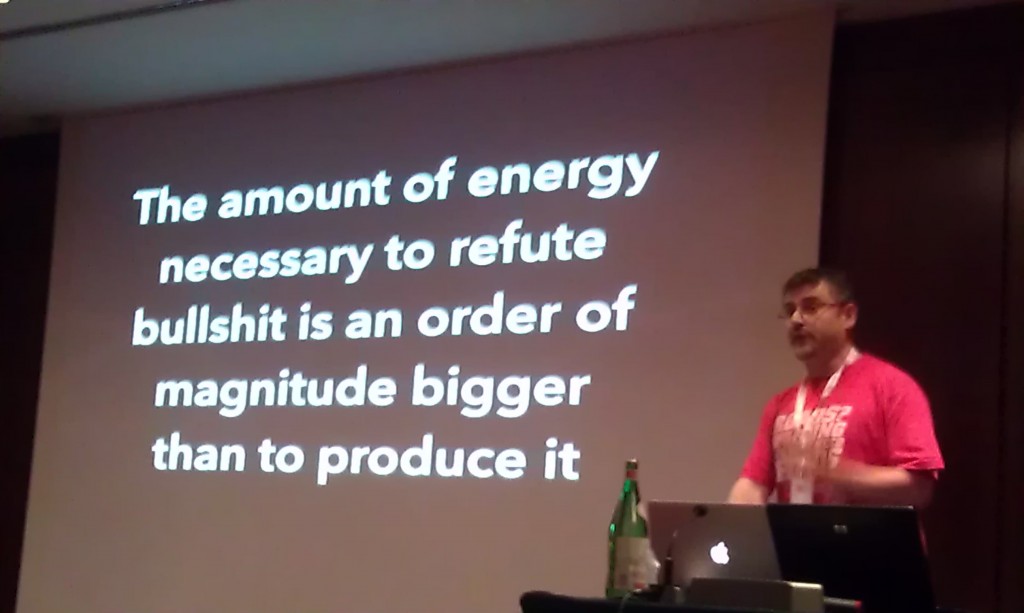
[1] This is an example of Brandolini’s Law: “The amount of energy needed to refute bullshit is an order of magnitude bigger than to produce it.”
[2] When Hillary was running for president, Whataboutists could make some triple-bank-shot argument about why Bill’s misdeeds were relevant. But now that both of the Clintons are private citizens and likely to remain so, there’s really no reason to ever discuss Monica again.
[3] I would credit the coiner if I could determine who it is. If you google it, you’ll find that bullshift also has several other meanings — that’s why I’m having trouble tracking down the origin of this usage — but they’re sufficiently different to avoid confusion.
This meaning of bullshifting derives from the technical meaning of bullshitting, as described in 1986 by Princeton philosopher Harry Frankfurt in his seminal paper “On Bullshit” (which was later expanded into a book).
When an honest man speaks, he says only what he believes to be true; and for the liar, it is correspondingly indispensable that he considers his statements to be false. For the bullshitter, however, all these bets are off: he is neither on the side of the true nor on the side of the false. His eye is not on the facts at all, as the eyes of the honest man and of the liar are, except insofar as they may be pertinent to his interest in getting away with what he says. He does not care whether the things he says describe reality correctly. He just picks them out, or makes them up, to suit his purpose.
So when a used car salesman tells you how conscientiously a car’s former owner maintained it, he is probably bullshitting rather than lying. Quite likely he has no idea what the truth of the matter is and doesn’t care. He just wants to sell you the car.
[Canadian Prime Minister] Trudeau came to see me. He’s a good guy, Justin. He said, “No, no, we have no trade deficit with you, we have none. Donald, please.” Nice guy, good-looking guy, comes in — “Donald, we have no trade deficit.” He’s very proud because everybody else, you know, we’re getting killed. … So, he’s proud. I said, “Wrong, Justin, you do.” I didn’t even know. … I had no idea. I just said, “You’re wrong.”
There’s been a lot of discussion in the media about when to label a false Trump statement as a “lie” rather than to use “demonstrable falsehood” or some other euphemism, none of which seem quite right. The problem is that the most precise characterization of the majority of Trump’s false statements — as well as his true statements and almost every assertion that comes out of his mouth — is “bullshit”, a word that most mainstream publications would rather not use.
[4] Unsurprisingly, the champion Bullshifter is Trump himself. In Helsinki, when he was asked whether he believed American intelligence services (headed by people he appointed himself) or Vladimir Putin, Trump first had to veer off into the “mystery” of the missing DNC server. (As The Daily Beast’s Kevin Poulsen explains, “Trump’s ‘Missing DNC Server’ is Neither Missing Nor a Server“.) Anybody who tries to cover his answer conscientiously first has to wade through the bullshit, which was why Trump spread it in the first place.
Inequality is different this time, because the rich are usurping a different kind of capital.
For a long time, most thinkers in the West accepted poverty as natural. As Jesus said: “The poor you will always have with you.” But by 1754, Jean-Jacques Rousseau was writing an entire discourse on the origin of inequality and blaming it largely on the practice of recognizing land as private property.
The first man who, having enclosed a piece of ground, bethought himself of saying This is mine, and found people simple enough to believe him, was the real founder of civil society. From how many crimes, wars and murders, from how many horrors and misfortunes might not any one have saved mankind, by pulling up the stakes, or filling up the ditch, and crying to his fellows, “Beware of listening to this impostor; you are undone if you once forget that the fruits of the earth belong to us all, and the earth itself to nobody.”
Thomas Paine, who in many ways was the most radical of the American revolutionaries, observed the contrasting example of the Native American tribes — where he found no parallel to European wealth or poverty — and came away with a more nuanced model of the connection between inequality and landed property, which he published in 1797 as Agrarian Justice. He started in much the same place as Rousseau:
The earth in its natural, uncultivated state, was, and ever would have continued to be THE COMMON PROPERTY OF THE HUMAN RACE. In that state every man would have been born to property. He would have been a joint life-proprietor with the rest in the property of the soil, and in all its natural productions, vegetable and animal.
But Paine also recognized that the development of modern agriculture — which he saw as necessary to feed people in the numbers and diversity of activities essential to advanced civilization — required investing a lot of up-front effort: clearing forests of trees and rocks, draining marshlands, and then annually plowing and planting. Who would do all that, if in the end the harvest would belong equally to everybody? He saw private ownership of land as a solution to this problem, but believed it had been implemented badly. What a homesteader deserved to own was his or her improvement on the productivity of the land, not the land itself. If the land a family cleared became more valuable than the forest or marshland they started with, then the homesteaders should own that difference in value, but not the land itself. [1]
Society as a whole, he concluded, deserved a rent on the land in its original state, and he proposed using that income — or an inheritance tax on land, which would not be as clean a solution theoretically, but would be easier to assess and collect — to capitalize the poor.
When a young couple begin the world, the difference is exceedingly great whether they begin with nothing or with fifteen pounds apiece. With this aid they could buy a cow, and implements to cultivate a few acres of land; and instead of becoming burdens upon society … would be put in the way of becoming useful and profitable citizens.
Paine argued this not as charity or even social engineering, but as justice: The practice of privatizing land had usurped the collective inheritance of those born without land, so something had to be done to restore the usurped value.
In one of my favorite talks (I published versions of it here and here), I extended Paine’s idea in multiple directions, including to intellectual property. Just as Paine would buy a young couple a cow and some tools, I proposed helping people launch themselves into a 21st century information economy. Like Paine, I see this as justice, because otherwise the whole benefit of technological advancement accrues only to companies like Apple or Google, reaching the rest of us only through such companies. A fortune like Bill Gates’ arises partly through innovation, effort, and good business judgment, but also by usurping a big chunk of the common inheritance.
Avent. And that brings us to Ryan Avent’s new book, The Wealth of Humans: work, power, and status in the twenty-first century. There are at least two ways to read this book. It fits into the robot-apolcalypse, where-are-the-jobs-of-the-future theme that I have recently discussed here (and less recently here and here). Avent’s title has a double meaning: On the one hand it’s about the wealth humans will produce through the continued advance of technology. But that advance will also result in society having a “wealth” of humans — more than are needed to do the jobs available.
Most books in this genre are by technologists or futurists, and consequently assemble evidence to support a single vision or central prediction. Avent is an economic journalist. (He writes for The Economist.) So he has produced a more balanced analysis, cataloging the forces, trends, and possibilities. It’s well worth reading from that point of view.
But I found Avent’s book more interesting in what it says about inequality and social justice in the current era. What’s different about the 21st century is that technology and globalism have converged to make prosperity depend on a type of capital we’re not used to thinking about: social capital. [2] And from a moral point of view, it’s not at all obvious who should own social capital. Maybe we all should.
What is social capital? Before the Industrial Revolution, capital consisted mainly of land (and slaves, where that was allowed). By the late 19th century, though, the big fortunes revolved around industrial capital: the expensive machines that sat in big factories. The difference between a rich country and a poor one was mainly that people in rich countries could afford to invest in such machinery, which then made them richer. On a national level, industrial capital showed up as government-subsidized railroads and canals and port facilities. (The Erie Canal alone created one of the great 19th-century boom towns: Buffalo.) A country that could afford to make such improvements became more productive and more prosperous.
In the 20th century, the countries that rose to wealth — first Japan and then later Singapore, Taiwan, and South Korea — did so partly through investment in machinery, but also through education. An educated populace could provide the advanced services that made an industrial economy thrive. And so we started talking about human capital, the investments that people and their governments make in acquiring skills, and intellectual capital, the patents, copyrights, and trade secrets that powered a 20th-century giant like IBM.
That may seem like a pretty complete list of the kinds of capital. But now look at today’s most valuable companies: Apple and Google, either of which might become the world’s first trillion-dollar corporation in a year or two. Each owns a small amount of land, no slaves, and virtually no industrial capital; Apple contracts out nearly all of its manufacturing, and a lot of Google’s products are entirely intangible. Both employ brilliant, well-educated people, but not hundreds of billions of dollars worth of them. They have valuable patents, copyrights, trademarks, etc., but again, intellectual property alone doesn’t account for either company’s market value. There’s something in how all those factors fit together that makes Apple and Google what they are.
That’s social capital. Avent describes it like this:
Social capital is individual knowledge that only has value in particular social contexts. An appreciation for property rights, for example, is valueless unless it is held within a community of like-minded people. Likewise, an understanding of the culture of a productive firm is only useful within that firm, where that culture governs behavior. That dependence on a critical mass of minds to function is what distinguishes social capital from human capital.
Social capital has always existed and been a factor of production, but something about the current era, some combination of globalism and technology, has brought it to the fore. Today, a firm strong in social capital — a shared way of approaching problems and taking action that is uniquely suited to a particular market at this moment in history — can acquire all the other factors of production cheaply, making social capital the primary source of its wealth. [3]
Who should own social capital? Right now it’s clear who does own a company’s social capital: the stockholders. But should they? Avent talks about Bill Gates’ $70 billion net worth — created mostly not by his own efforts but by the social organism called Microsoft — and then generalizes:
People, essentially, do not create their own fortunes. They inherit them, come to them through the occupation of some state-protected niche, or, if they are very brilliant and very lucky, through infusing a particular group of men and women with the germ of an idea, which, in time and with just the right environment, allows that group to evolve into an organism suited to the creation of economic value, a very large chunk of which the founder can then capture for himself.
Stockholders — the people who put up the money to acquire the other factors of production — currently get the vast majority of the benefit from a company’s social capital, but it’s not clear why they should. We usually imagine other forms of capital as belonging to whomever would have them if the enterprise broke up: The stockholders would sell off the land and industrial and intellectual capital, while the employees would walk away with the human capital of their experience and education. But the company’s social capital would just vanish, the way that a living organism vanishes if it gets rendered into its constituent chemicals. So, rightfully, who owns it?
Another chunk of social capital resides in nations, which are also social organisms. The very real economic value of the rule of law, voluntary compliance with beneficial but unenforceable norms, shared notions of fairness, trust that others will fulfill their commitments, and general public-spiritedness — in other words, all the cultural stuff that makes a worker or firm or idea more valuable in America or Germany than in Burundi or Yemen — who does it belong to? Who should share in its benefits?
Bargaining power. Avent does not try to sell the conservative fairy tale that the market will allocate benefits appropriately. Under the market, what each party gets out of any collective endeavor depends on its relative bargaining power, not on what it may deserve in some more abstract sense.
Avent proposes this thought experiment: What if automation got to the point where only one human worker was required to produce everything? Naively, you might expect this individual to be tremendously important and very well paid, but that’s probably not what would happen. Everyone in the world who wanted a job would want his job, and even if he had considerable skills, probably in the whole world millions of people would share those skills. So his bargaining power would be essentially zero, and even though in some sense he produced everything, he might end up working for nothing.
Globalization and automation, plus political developments like the decline of unions, have lowered the bargaining power of unskilled workers in rich countries, so they get less money, even though in most cases their productivity has increased. As communication gets cheaper and systems get more intelligent, more and more jobs can be automated or outsourced to countries with lower wages, so the bargaining power of the people in those jobs shrinks. That explains this graph, which I keep coming back to because I think it’s the single most important thing to understand about the American economy today: Hourly wages tracked productivity fairly closely until the 1970s, but have fallen farther and farther behind ever since.
Companies could have afforded to pay more — by now, the productivity is there to support a wage nearly 2 1/2 times higher — but workers haven’t had the bargaining power to demand that money, so they haven’t gotten it. [4]
A similar thing happened early in the Industrial Revolution: Virtually none of the benefits that came from industrial capital were shared with the workers, until they gained bargaining power through political action and unionization. The result is the safety net we have today.
Just as workers’ ability to reap significant benefits from the deployment of industrial capital was in doubt for decades, so we should worry that social capital will not, without significant alterations to the current economic system, generate better economic circumstances for most people.
Who’s in? Who’s out? When you do start sharing social capital, whether within a firm or within a country, you run into the question of who belongs. This is a big part of the contracting-out revolution. The janitors and cafeteria workers at Henry Ford’s plants worked for Henry Ford. But a modern technology corporation is likely to contract for those services. By shrinking down to a core competency, it can reward its workers while keeping a tight rein on who “its workers” are. No need to give stock options or healthcare benefits to receptionists and parking lot attendants if they don’t seem essential to maintaining the company’s social capital.
Things shake out similarly at the national level: The more ordinary Americans succeed in getting a share of the social capital of the United States, the greater the temptation to restrict who can get into the US and qualify for benefits — or to throw out people that many of the rest of us think shouldn’t be here.
Avent would like to see us take the broadest possible view of who’s in:
The question we ask ourselves, knowingly or not, is: With whom do we wish to share society? The easy answer, the habitual answer, is: with those who are like us.
But this answer is bound to lead to trouble, because it is arbitrary, and because it is lazy, and because it is imprecise, in ways that invite social division. There is always some trait or characteristic available which can be used to define someone seemingly like us as not like us.
There is a better answer available: that to be “like us” is to be human. That to be human is to earn the right to share in the wealth generated by the productive social institutions that have evolved and the knowledge that has been generated, to which someone born in a slum in Dhaka is every bit the rightful heir as someone born to great wealth in Palo Alto or Belgravia.
Can it happen? Much of the Avent’s book is depressing, but by the time the Epilogue rolls around he seems almost irrationally optimistic. For 200 pages, he has painted as realistic a picture as he could of the challenges we face, whether economic, technological, social, or political. But as to whether things will ultimately work out, he appears to come around to the idea that they have to, so they will. So he ends with this:
We are entering into a great historical unknown. In all probability, humanity will emerge on the other side, some decades hence, in a world in which people are vastly richer and happier than they are now. With some probability, small but positive, we will not make it at all, or we will arrive on the other side poorer and more miserable. That assessment is not optimism or pessimism. It is just the way things are.
Face to face with the unknown, it is hard to know what to feel or what to do. It is tempting to be afraid. But, faced with this great, powerful, transformative force, we shouldn’t be frightened. We should be generous. We should be as generous as we can be.
[1] The arbitrariness of this becomes clear when you consider mineral rights. If my grandfather homesteaded a plot of land, which in my generation turned out to be in the middle of a oil field, what would that wealth have to do with me that I would deserve to own it?
[2] If the term social capital rings a bell for you, you’re probably remembering Robert Putnam’s Bowling Alone, which appeared as a magazine article in 1995 and was expanded to a book in 2000. But Putnam used the term more metaphorically, expressing a sociological idea in economic terms, rather than as a literal factor of production.
[3] Henry Ford’s company probably also had a lot of social capital, but it was hard to notice behind all those buildings and machines.
[4] Individual employers will tell you that they’d go bankrupt if they had to raise wages 2 1/2 times, and in some sense that’s true: They compete with companies that also pay low wages, and would lose that competition if they paid high wages. But that is simply evidence that workers’ bargaining power is low across entire industries, rather than just in this company or that one.
A news desert is any segment of society so invisible to mainstream media that it’s hard for the desert-dwellers to keep track of what’s going on in their own community.
I picked up this term from Tom Stites of the Banyan Project. It apparently arose like this: Laura Washington described the media’s failure to cover poor urban communities as a communications desert, which the blog Chicago Is the World shortened to news desert.
Supposedly we’re awash in media these days, but if you think the downpour of attention is soaking everybody, you’re in for a metaphor shear. A community in a news desert is in danger of losing its identity, as people lack regular exposure to their common interests. It’s the difference between thinking to yourself that a particular corner seems dangerous, and reading an article about the fatal accidents that have happened there — knowing that everyone else has read it too.
Tom’s Banyan Project is a co-operative attempt to serve the news desert that was created in the 1980s when newspapers stopped covering the working class. Its pilot site will be Haverhill, Mass., a town of 61,000 with no daily local newspaper and no community radio station larger than the 100-milliwatt WHAV.
Neal Stephenson’s 1999 essay In the Beginning Was the Command Linedefines metaphor shear as the sudden realization “that you’ve been living and thinking inside a metaphor that is essentially bogus.” His example is how word-processing’s “document” metaphor fails to prepare you for a system crash or power failure.
Until the moment that it disappears from the screen, the document seems every bit as solid and real as if it had been typed out in ink on paper. But in the next moment, without warning, it is completely and irretrievably gone, as if it had never existed.
Our collective political conversation uses a lot of metaphors: the safety net, the left-center-right spectrum, Munich, surgical strikes, and … well, even the idea that we’re having a collective “conversation”. These figures of speech can be useful simplifications, but they also obscure aspects of the current situation that can suddenly become very important.
Bad metaphors are a particularly serious problem in understanding economics. For example, the idea that the government’s budget is like your household budget. (It would be, if your household could print its own currency and get the Chinese to trade you stuff for it.)
Warren Mosler’s Seven Deadly Innocent Frauds of Economic Policy (my two-part review was here and here) was one big take-down of the metaphor of money as something solid. If you think that way, the U. S. government could “run out” of money. A more accurate metaphor is frequent-flier miles, which Delta will never run out of.
A related bad metaphor is the idea that saving money is like stock-piling goods. It works that way for an individual — putting aside money to buy a car two years from now works even better than buying an extra car now and storing it for two years. But the same idea doesn’t work for society as a whole. (That’s a composition fallacy, which I explained two weeks ago.)
In an agricultural economy, if everyone decides to can more of their vegetables and store them in the basement, the economy hums along normally and the prospect of a winter famine goes down. But if everyone decides to sell their produce now and save the money to buy food this winter, no food is put aside and they have a recession. Setting aside goods and setting aside money are (in the large scale) completely different.
A lot of these bad metaphors come together when we talk about Social Security. Future generations either will or won’t have the ability and the commitment to produce enough goods and services to care for their elders. The size of the number that represents the Social Security Trust Fund has nothing to do with it.
Mosler’s dismissal of this notion is on target:
Let’s look at it this way: 50 years from now when there is one person left working and 300 million retired people (I exaggerate to make the point), that guy is going to be pretty busy since he’ll have to grow all the food, build and maintain all the buildings, do the laundry, take care of all medical needs, produce the TV shows, etc. etc. etc. What we need to do is make sure that those 300 million retired people have the funds to pay him??? I don’t think so!



 [1] This is an example of
  This meaning of bullshifting derives from the technical meaning of bullshitting, as described in 1986 by Princeton philosopher Harry Frankfurt in his seminal paper “

 The Weekly Sift