Author Archives: weeklysift

Doug Muder is a former mathematician who now writes about politics and religion. He is a frequent contributor to UU World.

The Monday Morning Teaser

Weeks like this raise a difficult question for anybody trying to summarize the news: Is Trump’s fascism supposed to distract us from his incompetence and corruption, or is it the other way around? Whatever I lead with, I wonder if I’ve taken the bait and missed the more important story.

The most eye-catching thing this week has been Portland’s resistance to the tear-gassing, stick-wielding secret police Trump has sent to crush dissent. The protests continue to grow, as Moms, Dads, veterans, nurses, and even grandmothers flip the script on our would-be strongman: It is the protesters who now look like America, and Trump’s goons who look like the violent America-haters.

But as the number of Americans dead from coronavirus closes in on 150,000 and Trump’s insistence that the schools have to open collides with his lack of any plan for opening them safely, it’s hard to ignore the incompetence theme. All of the countries we usually compare ourselves to are handling this pandemic, and we’re not.

And it’s hard to go a week without a major corruption story. This week we found out that Trump pushed our ambassador to the United Kingdom to try to get the British Open moved to a golf course Trump owns in Scotland. Supposedly there’s an inspector general’s report on this incident, which is conveniently classified.

But instead, the featured post is something more broadly cultural: After raising the subject of “cancel culture” in the weekly summary two weeks ago — and getting a lot of thoughtful objections from my commenters — I’m back with a longer article, which I haven’t titled yet. That should be out around 11 EDT. This week’s summary will address the fascism/incompetence/corruption trifecta, as well as Senate Republicans’ inability to put together a new stimulus package, the rising Covid-19 death rate, and a few other things, like AOC’s epic evisceration of Ted Yoho on the floor of the House. That should be out around 1.

Rising Up

Listen, I don’t mean to be partisan and all,
but I think that unidentifiable federal agents yanking people off the streets
and throwing them into unmarked vans is bad.

Jared Holt, Right Wing Watch

“Our whole reason for lobbying for looser gun laws and amassing huge personal arsenals of weapons these past years was so that we could ensure the security of a free state and protect the people from an oppressive government. And then it actually happened, and the whole rising up against a tyrannical government thing just totally slipped our minds, which is a little embarrassing,” a sheepish NRA CEO Wayne LaPierre said.

– “NRA Accidentally Forgets to Rise Up Against Tyrannical Government
The Shovel (a satire site)

This week’s featured post is “Who Are Those Guys?

This week everybody was talking about Trump’s secret police

Unidentifiable federal agents working for no agency in particular have been jumping out of unmarked vans and abducting people off the streets in Portland. I’ve gotten used to a lot of things since Trump became president, but this seems like a big deal to me.

I’m fairly proud of the featured post. It’s way long, but it tells the complete story, from the Pentagon’s reluctance to suppress protesters in DC in early June through the creation of federal law enforcement units that are willing to do just that. And for those of you who worry about Trump refusing to leave office after he loses in November, this is a key component of that scenario: I don’t believe the Army would support a coup, but what about these Little Green Men?

and the virus

Things keep getting worse. Last week it was debatable whether or not we had 70,000 new cases in a single day. This week we did it more than once. Deaths continue to rise, peaking at 963 on Friday. I will be surprised if we don’t break 1,000 deaths in a day this week, something that hasn’t happened since June 4.

One model has us hitting 224K deaths by November 1.


When you sort the world coronavirus data by “deaths per million population” the US is currently #10 at 433. We’ll probably eventually pass most of the European countries ahead of us (France, Sweden, Italy Spain, United Kingdom, Belgium), all of whom have done a much better job controlling the virus recently after initially being overwhelmed by it. But Latin American countries behind us (Peru, Brazil, Mexico, Ecuador, Panama) are gaining, and Chile is already #9. So even as things get worse for us, we could move down the list.


A big study from South Korea has answered a number of questions about children’s role in the potential spread of Covid-19. Children under 10 are less likely than adults to spread the virus, but they do spread it. And older children may be even more likely to spread the virus than adults.

Both results should make communities think twice about reopening schools. If you’re somewhere with very few cases — Vermont, say — it might make sense to open schools full-time (with some new rules), test frequently, and see what happens. But in a hotspot like Florida or Texas, it’s crazy.

Meanwhile, Kellyanne Conway dodged a question about whether 14-year-old Baron Trump will attend classes in the fall. “That’s a personal decision,” she said.


Apparently Trump really wasn’t kidding when he said he wanted to “slow the testing down“. As the next stimulus bill is being written in the Senate (the House passed the $3 trillion HEROES Act back in May, but Mitch McConnell has been sitting on it), the White House is objecting to $25 billion to help the states do more testing, as well as an additional $10 billion for the CDC. Trump isn’t fighting with the Democrats here, he’s fighting with Republican senators.

The two political parties are far apart on a number of contentious issues, such as unemployment insurance, but the conflict between Trump administration officials and Senate Republicans on money for testing and other priorities is creating a major complication even before bipartisan negotiations get under way.

Trump’s attacks on testing — which every public-health expert says is basic to controlling the virus — have been getting more and more demented in recent weeks. A week ago he told a reporter: “When you test, you create cases. So we’ve created cases.” He has refused to acknowledge that the leap in the national case-count (from 20,000 a day in early June to 76,403 on Friday) means that the virus is spreading.

In addition to impeding testing, the administration is also seizing control of the data. The Department the Health and Human services sent a memo to hospitals and acute care facilities on July 10:

As of July 15, 2020, hospitals should no longer report the Covid-19 information in this document to the National Healthcare Safety Network site. Please select one of the above methods to use instead.

NHSN is run by the CDC. The replacement methods go directly to HHS. Various critics have claimed that NHSN needs to be improved, but it’s hard to come up with a motive for moving it to HHS, other than to sideline the “Deep State” civil servants at CDC and allow political appointees at HHS to play games with the data. The NYT:

Public health experts have long expressed concerns that the Trump administration is politicizing science and undermining its health experts, in particular the C.D.C.; four of the agency’s former directors, spanning both Republican and Democratic administrations, said as much in an opinion piece published Tuesday in The Washington Post. The data collection shift reinforced those fears.

MSNBC’s Nicole Wallace observed that it is “quite a coincidence” that Trump is trying to control the data at a moment when the data is publicly demonstrating his failure.


Josh Marshall provides a sobering graph: If you look at the daily new cases of Covid-19 in the 49 states other than New York, the curve flattens at about 20,000 per day from early April to mid-June, and then takes off. Without New York, national case-counts never did start going down.


Hundreds of people rallied at the Ohio statehouse Saturday to protest against mask mandates. Ohio doesn’t even have a statewide mandate, but some counties do.

and the economic consequences of the virus

The extended benefits in the CARES Act (that passed in March) will expire at the end of July, less that two weeks from now. Unless Congress acts, some people will lose benefits completely, while others will lose the extra $600 per week the CARES Act provided.

The House passed the next stimulus bill, the HEROES Act, back in May. But Republicans in the Senate have held on to the fantasy that the virus would go away and the economy would have a V-shaped recovery. By the end of July, they imagined, jobs would be plentiful and that extra $600 would just encourage lazy people to stay unemployed.

Now it’s getting down to the wire, and Mitch McConnell still has a lot to negotiate with his own caucus and the White House before he can start dealing with Nancy Pelosi. Paul Krugman comments:

My sense is that Republicans have a delusional view of their own bargaining position. They don’t seem to realize that they, not the Democrats, will be blamed if millions are plunged into penury because relief is delayed; to the extent that they’re willing to act at all, they still imagine that they can extract concessions like a blanket exemption of businesses from pandemic liability.

Maybe the prospect of catastrophe will concentrate Republican minds, but it seems more likely that we’re heading for weeks if not months of extreme financial distress for millions of Americans, distress that will hobble the economy as a whole. This disaster didn’t need to happen; but you can say the same thing about most of what has gone wrong in this country lately.

and John Lewis

Lewis died Friday at the age of 80. He had announced in December that he was suffering from pancreatic cancer. His NYT obituary is a good summary of his long career in the civil rights movement and in Congress.


Testimonials have poured in from all directions. Barack Obama’s ended like this:

It’s fitting that the last time John and I shared a public forum was at a virtual town hall with a gathering of young activists who were helping to lead this summer’s demonstrations in the wake of George Floyd’s death. Afterwards, I spoke to him privately, and he could not have been prouder of their efforts — of a new generation standing up for freedom and equality, a new generation intent on voting and protecting the right to vote, a new generation running for political office. I told him that all those young people — of every race, from every background and gender and sexual orientation — they were his children. They had learned from his example, even if they didn’t know it. They had understood through him what American citizenship requires, even if they had heard of his courage only through history books.

Not many of us get to live to see our own legacy play out in such a meaningful, remarkable way. John Lewis did. And thanks to him, we now all have our marching orders — to keep believing in the possibility of remaking this country we love until it lives up to its full promise.


The most embarrassing testimonial came from Marco Rubio, who posted a picture of himself with Elijah Cummings. I guess old bald black guys all look alike to Marco. The tweet was taken down, but not before Rubio was roundly pilloried.

Truthfully, I’m not sure I could have correctly identified pictures of Lewis and Cummings. But I never met either man, and if I were going to post a photo of myself with one or the other, I’d stop and think about when that photo was taken and what we might have been talking about. Rubio clearly did not, and neither did his staff — which testifies to a certain sloppiness in thought and action.

Follow-up: Apparently Alaska’s Senator Dan Sullivan made the same mistake.


CNN lays out what happens next in Georgia’s 5th congressional district: Lewis had already won renomination, but the Democratic Party can replace his name on the ballot. It has to be done quickly or not at all, so there’s no time for a convention or primary. The state Democratic Party’s executive committee is meeting at noon today to pick a nominee. The district is solidly Democratic, so whomever they pick will probably go to Congress.

As for the remainder of Lewis’ current term, Republican Governor Kemp would have to declare a special election. That may or may not happen in time for Lewis’ replacement to be sworn in before the term ends.

and you also might be interested in …

The  home of a Latina federal judge in Newark was attacked yesterday afternoon. Her 20-year-old son was killed and her husband wounded, but Judge Esther Salas was not hurt. The shooter hasn’t been caught, and no one knows if Salas was the target or if so, why. But I have to wonder if the right-wing diatribes against “liberal judges” will eventually lead to more of this.


Mary Trump telling Rachel Maddow that she has heard Trump use the n-word and anti-semitic slurs got way more attention than I would have given it. It would be more amazing to me if she hadn’t heard him use that kind of language in private settings. I mean, we know he has referred to African nations and Haiti as “shit-hole countries” in front of members of Congress. And we know he has a long history of racism, which he appears to have inherited from his father.


Meanwhile, Tucker Carlson (a man sometimes pitched as the next leader of the Trumpist movement) took a previously unannounced fishing vacation after his top writer, Blake Neff, was caught making racist and sexist social-media posts under a pseudonym. (Apparently he’d been doing it for years.) Neff was the guy who wrote Carlson’s scripts, which Carlson only edited. I have to wonder how much input Neff had into rants like the one where Carlson claimed white supremacy is “not a real problem in America” and “a hoax”.

Carlson’s show, like a lot of Trump’s speeches, specializes in walking the line between deniable racism and undeniable racism. He has become the primary voice of white grievance on television, and white supremacist groups are among his biggest fans. That the guy writing Tucker’s scripts would take his bigotry off the leash anonymously on social media is about as shocking as Trump saying the n-word in private.

After they were exposed, Carlson acknowledged that Neff’s posts were “wrong”. The Bleeding Cool blog then assesses the rest of his statement:

Now for those of you who think Carlson then went on to further criticize Neff, followed by acknowledging that FOX News really wasn’t news and that his show profits from creating and stoking division along racial, ethnic, religious, gender, and sexual orientation lines? Either check your respective prescriptions to make sure you’re taking the right dose or the back of your neck to make sure you’re not an alien pod person. Oh no, the brunt of Carlson’s attempt at “righteous anger” was aimed at this who (wait for it)… would actually take joy in someone who posts racist, sexist, and other offensive messages having to resign from a news program that has heavy, cult-like influence over others. Shocking, right? …

“We should also point out to the ghouls that are beating their chest in triumph at the destruction of a young man that self-righteousness also has its costs,” said Carlson, who clearly sees anyone who has issues with someone who posts racist, sexist, and other offensive messages as being “self-righteous.”

Like a lot of cancel-culture “victims”, Neff hasn’t been “destroyed”. He just lost a job he never should have had in the first place. Now that his name is out there as a white-racist martyr, I’m sure he has a big future on openly racist sites like VDare or American Renaissance.


Trump’s lie that “Biden wants to defund the police” was too much for Fox News’ Chris Wallace to let go by. Wallace in fact caught Trump in a number of lies.


The Trump campaign is a big moneymaker for Donald Trump personally. David Fahrenthold reports:

In just two days, @realdonaldtrump’s campaign pumped $380K into Trump’s private business, in 43 separate payments. Trump Org says this was for a weeklong “donor retreat,” held in early March at Mar-a-Lago. Campaign donations turned into private revenue for POTUS

The Open Secrets web site says that overall $4.1 million has been paid to the Trump Organization by Trump-related political committees, the Republican Party, and the campaigns and PACs of other Republican candidates.

and let’s close with something encouraging

Let’s take a moment to entertain an idea suggested by The Muppets and James Corden. Maybe, even during this pandemic, we really can get by with a little help from our friends.

Who Are Those Guys?

Customs and Border Protection has finally claimed the anonymous federal law enforcement agents who have been abducting people off the streets in Portland. But it still won’t say who they are or exactly what they’re doing.


Often, when the Trump administration is described in totalitarian terms, it’s hyperbole, or at least debatable.

So, for example, describing ICE as a “Gestapo” is hyperbole. They violate civil rights and are out of control in a lot of ways, but comparisons to the Gestapo are overblown. Similarly, there has been debate (yes and no) about whether the detention facilities that hold legal asylum seekers and unauthorized border-crossers qualify as “concentration camps”. (My opinion: Yes, as long as we remember that concentration camps are not always death camps. Concentration camps isolate unpopular and dehumanized groups in harsh conditions outside of public view; death camps target them for extermination. Dachau was a concentration camp when it opened in 1933, but it didn’t become a death camp until much later.)

However, the federal law enforcement agents who have been roaming around Portland this last week are literally “secret police” — no hyperbole, no exaggeration. Their uniforms say POLICE, but do not identify what federal agency they are from or who the individual officers are. They cover their faces, drive unmarked vehicles, and grab people off the street without identifying themselves, their unit, the reason for the arrest, or where they are taking their victims. If right-wing militia groups start putting POLICE patches on their camo uniforms and kidnapping protest leaders, no one will know the difference; neither their appearance nor their behavior will give them away.

So that’s where we are: We’ve crossed one more bridge on the road to fascism, and it’s arguable that we’ve already arrived. Let’s think about how we got here.

Lafayette Square. On June 1, after the peaceful protests of George Floyd’s murder had also spawned looting and property damage in cities across the nation, President Trump called for law enforcement to “dominate the streets“. He urged governors to call in the National Guard, and made the following threat:

“If a city or state refuses to take the actions necessary to defend the life and property of their residents, then I will deploy the United States military and quickly solve the problem for them,” Trump said, referring to himself as “your president of law and order and an ally of all peaceful protesters.”

He said he was already dispatching “thousands and thousands of heavily armed soldiers, military personnel and law enforcement officers” to Washington to stop the violence that has been a feature of the protests here.

While he was speaking, federal law enforcement agents of various stripes attacked peaceful protesters near the White House, pushing them out of Lafayette Square so that Trump could have his infamous hold-up-the-Bible photo op at historic St. John’s Episcopal Church.

Meanwhile, active-duty troops were being deployed to the DC area. Unnamed sources claimed Trump wanted to deploy 10,000 troops. Fortunately, generals and Pentagon civilians all the way up to Defense Secretary Esper pushed back, arguing that suppressing domestic dissent is not the military’s role. (I’m guessing the 10,000-troop story was leaked by a military person who wanted the plan stopped.) In the end, active-duty troops were never used against protesters and were withdrawn, but not before the incident “badly strained relations between Mr. Trump and the military”.

From Trump’s point of view, though, the week had one bright spot. The regular military might be reluctant to take the field against American protesters, but he did identify a force he could use: a motley assortment of armed federal law enforcement agents temporarily commanded by Attorney General Bill Barr.

Few sights from the nation’s protests in recent days have seemed more dystopian than the appearance of rows of heavily-armed riot police around Washington in drab military-style uniforms with no insignia, identifying emblems or name badges. Many of the apparently federal agents have refused to identify which agency they work for.

In the words of Butch Cassidy: “Who are those guys?”

It turns out that the federal government has something like 132,000 law enforcement officers spread out over dozens of agencies in multiple departments. Yahoo News called the roll:

The show of force outside the White House is a task force operation that includes U.S. Secret Service, National Guard, Customs and Border Protection, and U.S. Park Police, … Federal Protective Service, … elite SWAT teams from the Border Patrol and sniper-trained units from ICE have also descended upon Washington. TSA’s air marshals arrived too, and three of the agency’s “VIPR teams,” which have previously faced criticism for not coordinating well with local law enforcement. Eight Coast Guard investigators were deputized by the Department of Justice upon arrival in Washington, though it remains unclear how they are being deployed.

Which raises an obvious question: What kind of rules apply to people from one agency deputized by another? The rules of their home agency? Their temporary commander’s? None? There are all kinds of restrictions, both legal and institutional, on what the President can or can’t do with the military inside our borders. But these guys, apparently, not so much. Through the years, whenever Congress increased the budgets of the Bureau of Prisons or ATF or one of the dozens of other armed law enforcement agencies, who realized they were helping build a 132,000-man Praetorian Guard?

As democracy-threatening as this seemed in June, though, comforting speculation held that DC’s special relationship with the federal government made it unique. (That even became an argument for DC statehood.) Surely these little green men could never be deployed in a state over the objection of its governor.

After all, this is America.

The Portland protests. The George Floyd protests have had remarkable longevity, challenging the conventional wisdom that the Powers That Be can always wait these things out. But nothing lasts forever, and by July 1, even Seattle’s famous CHOP autonomous zone had been reclaimed by local authorities.

In Portland, however, the spirit of resistance is still very much alive. Friday marked the 50th day of protest. OregonLive describes the situation like this:

Portland has experienced weeks of daily protests since the death of George Floyd at the hands of Minnesota police. The largest of them, involving thousands of people chanting and marching for racial justice and police non-violence, have been peaceful.

But almost like clockwork, tensions flare late at night between law enforcement officers stationed at the Justice Center and courthouse and a crowd of 20- and 30-something demonstrators, a small number of whom toss projectiles at police, shine lasers in their eyes or otherwise poke and prod officers to engage.

… Although the Justice Center and federal courthouse are covered with angry graffiti decrying police, evidence of other demonstrations in the city are scarce.

But you get a different sense from local journalist Robert Evans, who has been covering the nightly clashes, which he describes as “as close up to the line as you can get to actual war without live rounds”.

The craziest night so far was July 4, where kids stockpiled thousands of dollars in illegal fireworks. They were in the center of downtown where the bulk of the protests happened around the Justice Center.

It started as drunken party, more or less. At random, cops began shooting into the crowd. Protesters coalesced around the idea of firing commercial-grade fireworks into the Justice Center and Federal Courthouse. You had law enforcement firing rubber bullets, foam bullets, pepper balls and tear gas as crowds circled in around the courthouse firing rockets into the side of the building. That went on for a shocking length of time — there was this running three-hour street battle. I couldn’t tell whose explosions were whose.

Trumpist media and administration spokespeople have been desperate for something to talk about other than Trump’s failure to control the coronavirus pandemic, and so they have seized on “mob rule” as a theme, with Portland as a prime example of a city “under siege”. But OregonLive pushes back against that narrative: “A tour of the town shows otherwise.”

The images that populate national media feeds, however, come almost exclusively from a tiny point of the city: a 12-block area surrounding the Justice Center and federal courthouse. And they occur exclusively during late-night hours in which only a couple hundred or fewer protesters and scores of police officers are out in the city’s coronavirus-hollowed downtown.

Daily life in Portland is greatly restricted by the virus, but is barely affected by the demonstrations. Evans agrees:

One of the things I think people get wrong about this place, though, is that they see the protests and the right-wing coverage and the city is depicted as convulsed and collapsing. It’s just not true. You go three blocks from the center of downtown and life goes on as normal. Where I live, you could go every day and see no real signs of the protests.

Having totally given up on doing anything to combat the virus, though, Trump had to be seen doing something about something. And so he intervened in Portland.

DHS’ little green men. If you get your view of the world through Fox News, you understand that the biggest current threat to the United States and the American way of life is not the virus that has killed nearly 140,000 of us with no end in sight. No, it is the wanton destruction of our historical statues and monuments. Any time I have channel-scanned through the Fox News evening line-up in the last month, that’s what they’ve been talking about.

To combat this scourge, on June 26 President Trump heroically signed the “Executive Order on Protecting American Monuments, Memorials, and Statues and Combating Recent Criminal Violence“. If you read past the polemics all the way to the end, you’ll find this authorization:

Upon the request of the Secretary of the Interior, the Secretary of Homeland Security, or the Administrator of General Services, the Secretary of Defense, the Attorney General, and the Secretary of Homeland Security shall provide, as appropriate and consistent with applicable law, personnel to assist with the protection of Federal monuments, memorials, statues, or property.

He’s talking about the 132,000 federal law enforcement agents, the Little Green Men. And unlike in a riot or a natural disaster where a governor might ask for the help of the National Guard, here one part of the federal government asks another part to send the Little Green Men. The Secretary of Homeland Security, you might notice, is authorized to ask himself for assistance.

As it happens, we don’t have a Secretary of Homeland Security, and haven’t since Trump forced Kirstjen Nielsen to resign in April, 2019 because she “pushed back on his demands to break the law“. Since then we’ve had acting DHS secretaries, because Trump says “I like acting. It gives me more flexibility.” (In fact, Josh Marshall observes that every DHS official who figures in this story is acting: “acting secretary, acting deputy secretary and acting head of CBP. Not one of these men has been confirmed by the Senate to act in this role.” Having avoided confirmation hearings where senators might demand promises or commitments, all three get their authority from and owe their allegiance to no one but Trump.)

So Acting DHS Secretary Chad Wolf responded to Trump’s executive order by creating the Protecting American Communities Task Force (PACT) “a special task force to coordinate Departmental law enforcement agency assets in protecting our nation’s historic monuments, memorials, statues, and federal facilities”. The PACT announcement quotes Wolf: “We won’t stand idly by while violent anarchists and rioters seek not only to vandalize and destroy the symbols of our nation, but to disrupt law and order and sow chaos in our communities.” (“Violent anarchist” is a phrase you’ll hear again. It is to the Trump administration what “terrorist” was to the Bush administration: a term stripped of all its original meanings until it is simply an insult, i.e., “someone we don’t like”.)

Notice the subtle shift: We’re not talking about statues of Andrew Jackson any more, as Trump was when he signed the executive order. We’re talking about “federal facilities” like the Mark Hatfield Courthouse in Portland, the courthouse mentioned above. PACT’s mission also extends beyond “protecting” those facilities to the much more nebulous goal of maintaining “law and order” and fighting “chaos in our communities”. But the Hatfield Courthouse is more than just a center of “chaos”, it is also the scene of a heinous crime: graffiti.

Maybe the Trump administration will stand idly by while American coronavirus deaths once again approach a thousand a day, and maybe it will do nothing when Putin puts bounties on the lives of our soldiers in Afghanistan, but graffiti on a federal courthouse is an affront up with which it will not put.

Send in the Little Green Men.

The federal invasion of Portland. Sometime after the Fourth of July — no one seems to know exactly when, because there wasn’t an announcement — unidentified federal law enforcement agents from no particular agency began battling protesters alongside the Portland police. And they did not just support the local officials, they significantly escalated the violence. Here’s Robert Evans again:

Since the feds got involved with police it’s gotten really brutal. I’d argue we’ve seen more police brutality in the last 50 days from Portland Police Department than anywhere else in the country. It’s brutal but it’s also predictable. There are rhythms to the way police work. It’s become an orchestrated dance with both sides.

There are warnings and kicking people out of the demonstration area. But the feds have deliberately defied the rhythms. Last Saturday [July 11], the crowd was 100 or so. It was very chill — nothing going on beyond the now-normal occupation of the Justice Center. And feds came out grabbing people seemingly at random and beating people with sticks. There was the kid who got shot in the head and his skull was fractured. The federal law enforcement violence is unpredictable violence.

The “kid shot in the head” was Donovan LaBella, and we have the shooting on video. The Oregonian summarized in a tweet:

Video shows nothing suggesting that La Bella, 26, who was standing across the street from the federal courthouse holding a speaker over his head, was a threat to anyone.

What appears to be a tear gas canister bounces in front of him. He kicks at it, bends down to toss it underhanded into the street, and lifts up his speaker again. Then he goes down, apparently struck by a sponge grenade or some other “less lethal” projectile that is never supposed to be aimed at someone’s head. (LaBella’s sister says he’s making a “remarkable recovery“, but the photo of his stitched-up forehead looks pretty gruesome.)

Who shot LaBella? Hard to say. Some unmarked federal agent in camo with a mask on, from some unnamed federal law enforcement agency.

How actions like this protect federal facilities is hard to figure. And then the abductions started.

Unmarked vans. NPR reports:

Federal law enforcement officers have been using unmarked vehicles to drive around downtown Portland and detain protesters since at least Tuesday. Personal accounts and multiple videos posted online show the officers driving up to people, detaining individuals with no explanation about why they are being arrested, and driving off.

To the people being kidnapped arrested, it’s not obvious that their abductors the officers are police at all.

“I see guys in camo,” O’Shea said. “Four or five of them pop out, open the door and it was just like, ‘Oh s**t. I don’t know who you are or what you want with us.'”

See any identifying marks?

And again the question: Who are these guys? As this widely shared video shows, two agents in camo with no label other than POLICE grab somebody off an empty street and throw him into a van. They are repeatedly asked who they are and what they’re doing, but they do not respond.

For hours no one knew who the masked kidnappers were working for. But eventually, Customs and Border Protection took responsibility for that particular “arrest”. (In an interview, though, Acting Deputy Secretary Ken Cuccinelli identified Federal Protective Services as the lead agency; CBP is assisting them.) Their statement is a series of lies wildly inconsistent with the video, or with numerous accounts of similar abductions.

CBP agents had information indicating the person in the video was suspected of assaults against federal agents or destruction of federal property.  Once CBP agents approached the suspect, a large and violent mob moved towards their location.  For everyone’s safety, CBP agents quickly moved the suspect to a safer location for further questioning.  The CBP agents identified themselves and were wearing CBP insignia during the encounter. The names of the agents were not displayed due to recent doxing incidents against law enforcement personnel who serve and protect our country.

In fact, the street is virtually empty. The officers do not identify themselves, and if you can spot any insignia other than POLICE on their uniforms, you’re sharper than I am. I’m also struck by the “suspected of assaults against federal agents OR destruction of federal property”. The “or” suggests that this is a generic explanation rather than the specific reason for this particular arrest. Whoever wrote the statement probably has no more idea why the suspect was arrested than we do.

Robert Evans reports:

I’ve seen them rolling around in the vans and tackling people. My partner has watched them do a few snatch and grabs. The difference is they’re not cops. They go after people like soldiers, where the goal is to be unpredictable.

Acting Secretary Wolf’s justification of the entire operation, which didn’t appear until Thursday, is ridiculous. The phrase “violent anarchists” appears 72 times, along with a list of their “violent” crimes, which mostly consist of tagging the Hatfield Courthouse with graffiti. One “violent anarchist” was caught with a loaded weapon, but there is no report of the weapon being brandished or fired. (Compare to the AR-15 toting conservative protesters at the Michigan State House in May, whom Trump supported by tweeting “LIBERATE MICHIGAN”.)

OregonLive responded:

It’s telling that in Wolf’s extensive listing of incidents over the past several weeks, he neglects to mention the most violent act of these protests – a deputy U.S. marshal’s shooting of Donavan La Bella in the face with an impact munition. … That Wolf would fail to even acknowledge such a severe injury exposes how suspect his definition of “violence” is.

(OL appears to just be guessing who the shooter works for; I don’t believe the Marshals have claimed responsibility.) To repeat: “violent anarchist” has no meaning. It’s just an insult; it tags someone as an enemy.

Remember federalism? One hallmark of the Trump Era is that any principles conservatives used to claim — free trade, standing by allies, fiscal responsibility, the importance of character — have been exposed as hollow. One such relic of the age of principled conservatism is federalism: the doctrine that states share sovereignty with the federal government, and are not just subjects of federal rule.

Under federalism, policing is a state responsibility. In this case, it’s important to bear in mind that no local official asked for the federal government’s help in dealing with the protests. Acting Secretary Wolf did not even make a courtesy call to tell Oregon Governor Kate Brown or Portland Mayor Ted Wheeler what he was planning to do. This whole episode began not with an offer of help, but with Trump’s threat: “If a city or state refuses to take the actions necessary to defend the life and property of their residents, then I will deploy the United States military and quickly solve the problem for them.

That’s how this all came about: Trump and/or Wolf came to the conclusion that Portland was not treating protesters harshly enough, so Wolf asked himself to intervene.

Now that they have had a chance to see what DHS is doing, local officials at all levels have asked the federal agents to leave. Governor Brown tweeted:

This political theater from President Trump has nothing to do with public safety. The President is failing to lead this nation. Now he is deploying federal officers to patrol the streets of Portland in a blatant abuse of power by the federal government. I told Acting Secretary Wolf that the federal government should remove all federal officers from our streets. His response showed me he is on a mission to provoke confrontation for political purposes. He is putting both Oregonians and local law enforcement officers in harm’s way.

And Mayor Wheeler acknowledged the government’s right to protect its buildings, but called for it to pull its agents off the streets:

I have no problem with the federal government and federal officers inside their facilities protecting their facilities. That’s what they do. That’s what they always do. What I have a problem with is them leaving the facilities and going out onto the streets of this community and then escalating an already tense situation like they did the other night.

Subsequently he made a stronger plea:

Their presence is neither wanted nor is it helpful and we’re asking them to leave. In fact, we’re demanding that they leave.

To which Acting Deputy Secretary Cuccinelli responded:

We don’t have any plans to do that. When the violence recedes, then that is when we would look at that. This isn’t intended to be a permanent arrangement, but it will last as long as the violence demands additional support to contend with.

Also:

Oregon Attorney General Ellen Rosenblum filed a federal lawsuit against Homeland Security and its subagencies Friday alleging the federal government had violated Oregonians’ civil rights by seizing and detaining them without probable cause during protests against police brutality in the past week.

Oregon’s senior Senator Ron Wyden:

The Trump administration’s claim that DHS police are needed to enforce the president’s executive order to protect statues is laughable. Terrorizing peaceful protesters and arresting people for graffiti and other nonviolent offenses has nothing to do with securing federal property. My colleagues and I in the Oregon delegation have demanded that these occupying troops leave Portland, demanded answers from the administration and called for an independent investigation. And this week, my fellow senator from Oregon, Jeff Merkley, and I will introduce a measure to require Trump to remove these unwanted forces from our city.

Senator Merkley made his own comment:

Authoritarian governments, not democratic republics, send unmarked authorities after protesters. These Trump/Barr tactics designed to eliminate any accountability are absolutely unacceptable in America, and must end.

As Governor Brown’s tweet indicates, Acting Secretary Wolf has refused to withdraw his Little Green Men. Acting Deputy Secretary Cuccinelli also refused to pull the LGM back to the federal facilities whose protection is the pretext for their presence.

And I fully expect that as long as people continue to be violent and to destroy property that we will attempt to identify those folks. We will pick them up in front of the courthouse. If we spot them elsewhere, we will pick them up elsewhere. And if we have a question about somebody’s identity – like the first example I noted to you – after questioning determine it isn’t someone of interest, then they get released. And that’s standard law enforcement procedure, and it’s going to continue as long as the violence continues.

Results 1. Sometimes when you break the rules, the results will give you an after-the-fact justification: The problem is solved now, so who’s going to complain? But that’s not the case in Portland. Instead, DHS’ authoritarian overreach has drawn increased local attention to the protests and raised local sympathy for the protesters.

While President Trump on Sunday described the unrest in Portland as a national threat involving “anarchists and agitators,” the protests have featured a wide array of demonstrators, many now galvanized by federal officers exemplifying the militarized enforcement that protesters have long denounced. Gatherings over the weekend grew to upward of 1,000 people — the largest crowds in weeks.

Saturday, mothers (some wearing bicycle helmets in case federal agents would decide to club them) formed a human chain between police and demonstrators and chanted: “Feds stay clear. Moms are here.” Sunday night, a similar group of mothers was in fact dispersed with clubs and gas. In the wee hours of Saturday morning, one woman had a creative response to the threat of police violence.

In one extraordinary moment, a woman, completely naked except for a face mask and a hat, strode through the protests and squared up to federal agents and did a series of ballet and yoga moves. The striking moment was captured on social media and the unidentified woman has been dubbed “Naked Athena.”

Police apparently didn’t know what to do next. OregonLive reported:

About 10 minutes after she arrived, the officers left. The woman left soon after without any additional fanfare. “She was incredibly vulnerable,” [Oregonian/OregonLive photographer Dave] Killen said. “It would have been incredibly painful to be shot with any of those munitions with no clothes on.”

One good place to get a play-by-play of the weekend demonstrations is the Twitter feed of journalist Donovan Farley.

On the whole, it’s hard to argue with Governor Brown’s assessment:

It’s simply like adding gasoline to a fire. What’s needed is de-escalation and dialogue. That’s how we solve problems here in the state of Oregon.

Results 2. How you judge results depends on what your goal is. If the goal is to end the nightly conflicts between police and protesters, and to restore “law and order”, then the federal intervention has been an abject failure.

But when has Trump ever tried to end conflict? Trump thrives on conflict. Arguably, it’s in his political interest to make things worse. The violent federal escalation and abuse of civil rights may annoy Oregonians, but Trump was never going to carry Oregon in November anyway. The more interesting question to him is: How is this playing in swing states? Governor Brown has it right:

Trump is looking for a confrontation in Oregon in the hopes of winning political points in Ohio or Iowa.

If Fox News can spin this as the President taking strong action to preserve law and order in a city where Democratic officials are unwilling to get tough with the violent anarchists, that’s all he wants. Even better if his “toughness” takes headlines away from his Covid-19 failure. And the more violence, the more headlines.

In short, he’s doing on the ground what he often does on Twitter: provoking a conflict with somebody his base doesn’t like in order to change the narrative from a story where he’s failing. Violent anarchists and feckless Democratic officials are playing the role usually reserved for black athletes like Colin Kaepernick or LeBron James, or charismatic women of color like AOC or Ilhan Omar.

Judged by that standard, Trump may think his intervention in Portland is going quite well.

Where it goes from here. PACT was not created to be a one-off, so Portland can be thought of as a test, a “dress rehearsal” (as Esquire’s Charles Pierce puts it) for a show that might be taken on the road all over the country. The groundwork is being laid to intervene in Chicago, whose black lesbian mayor has already been tagged a “derelict” by press secretary Kayleigh McEnany. A famously liberal city like San Francisco would also make a good target for Trumpist media. A Reichstag fire won’t be necessary; a few lines of graffiti on some federal building will suffice.

Three things are being tested in Portland:

  • Will the PACT agents do whatever they’re told, heedless of the rights of American citizens?
  • Will Trump get away with this legally, or will federal courts put his secret police under injunction? Will Congress intervene in some way?
  • Will Trump pay a political price, either in the media or by losing the support of the congressional Republicans who kept him in office in spite of the crimes he was impeached for?

The first test is clearly a success: Federal agents are acting like secret police in a classic banana republic, and there have been no signs of defections. No leaks, no scandalous stories attributed to anonymous sources.

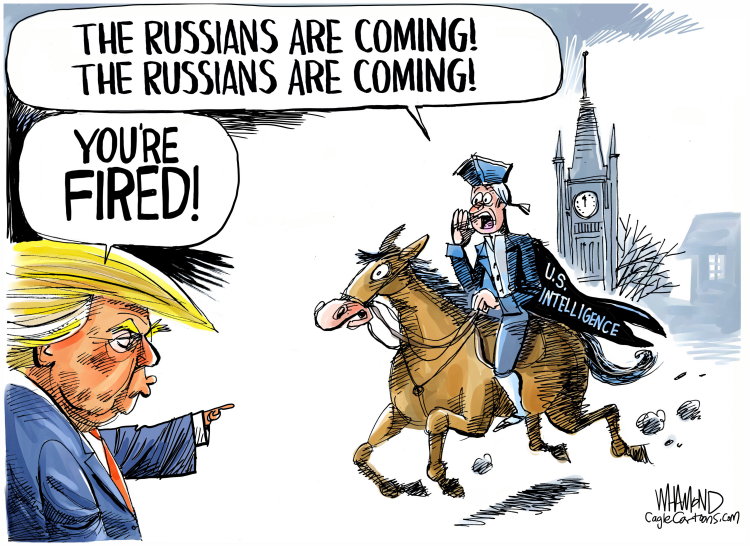
Remarkably, Portland is a second-layer headline in both the New York Times and Washington Post this morning. You’ll find a Portland story if you scroll down, but they’re not calling your attention to it. I’ve also looked for a biting editorial cartoon on the subject and haven’t found one yet. So at the moment Trump is not paying a price in the mainstream media.

Elected Republicans are also ignoring the story, in spite of the traditional conservative principles being violated. (A satire article published after the first appearance of the Little Green Men in DC is being recirculated: “NRA Accidentally Forgets to Rise Up Against Tyrannical Government“.) It remains to be seen whether Democrats in Congress will insert some anti-LGM language into some must-pass appropriations bill, and whether Mitch McConnell will allow it.

Our best hope at the moment is the courts, where I don’t know what to expect. Neither do the folks at the LawFare blog, which is where I’m hoping to find insight before long. LF’s Steve Vladeck closes that article by wondering which would be worse: that the PACT agents are abusing their authority, or that all this is actually legal somehow?

The ultimate threat. As Trump continues to sink in the polls, more and more pundits raise the question: How will he try to cheat in the election? (The question “Will he try to cheat?” has already been answered. That’s what he was impeached for.) Various voter suppression schemes are brewing, and some are already working. Many of us are hard at work imagining scenarios where some combination of Covid-19 and voting by mail create new vote-stealing or vote-suppressing opportunities.

The true nightmare scenario is if he loses the election but refuses to leave office. Or perhaps he constructs some elaborate conspiracy theory in which the outcome of the election is doubtful, and decides to hang on until the doubt can be resolved to his satisfaction, which it never will be. Obviously, he can’t succeed in that plan entirely on his own, and different scenarios require different accomplices: Republicans in Congress, the Supreme Court, and so on.

If any of those play out (and I’m far from convinced they would) we could find ourselves in a true third-world-country situation, where the last line of defense is that the People refuse to accept a stolen election and take to the streets. In a typical third-world situation, the next question is: What does the Army do? An election-stealing President can often survive if the Army is willing to sweep into the major cities and put down protests.

One reason I have not worried too much about these scenarios is that I don’t think our Army would do that. The traditions of non-interference in the political process go all the way back to George Washington, and are very strong.

But Portland raises an additional question: What do the Little Green Men do? Could Trump really call his Praetorian Guard into the streets against the American people?

That too is being tested in Portland.

The Monday Morning Teaser

There will be a Sift this morning. (My wife’s surgery did happen on Thursday. It went well, and her recovery has been faster than we expected. As a result, the physical and psychological demands the situation places on me have been manageable without cancelling the Sift. Thanks to everyone who has expressed concern and wished us well.)

I think there’s even a pretty good Sift this morning. Like most of you (or at least the “you” I imagine), I’ve been wondering what the heck is going on in Portland. Unidentified feds in camo pulling US citizens into unmarked vans and driving off with them — what’s that about? How can they do that? What happens next?

There’s a story to tell here, and I think I’ve pieced it together. It starts with the military’s reluctance to suppress the protests in DC in early June, and the “success” (from Trump’s point of view) of deploying a motley assortment of armed federal agents with no insignia or other ID. At the time, many legal observers thought DC was special; the same thing couldn’t be done in a state without the consent of its governor. But now it is being done.

Based on Trump’s subsequent executive order protecting federal statues and monuments, DHS has put together the Protecting American Communities Task Force (PACT), an inter-agency umbrella for assembling motley assortments of armed federal agents who operate under no particular rules. That’s who’s in Portland. If this works — where “works” means getting away with actions in a blue state that Fox News can make look good to Trump’s base in swing states — we can expect to see PACT’s little green men in the major cities of blue states all over the country. (Chicago or San Francisco, maybe.) And if Trump ultimately does respond to a lost or contested election with force, it won’t be the Army he calls in, because they won’t come. It will be some motley assortment of armed federal agents operating under no particular rules. (There are, believe it or not, 132,000 of them.)

Telling that story has turned into a long article, which I haven’t quite finished yet. But I think it’s worth your time. I should have it out around 10 or 11 EDT.

The weekly summary hasn’t commanded nearly so much of my effort. The virus continues to spread and Trump continues to ignore it. John Lewis died. And a few other things happened, none of which grabbed my attention like video of federal secret police abducting people off the street. The summary should be out by 1.

Suspicious Manners

I conceive that the President ought not to have the power of pardoning, because he may frequently pardon crimes which were advised by himself. It may happen, at some future day, that he will establish a monarchy, and destroy the republic.

George Mason, at the Virginia Ratifying Convention of 1788

There is one security in this case to which gentlemen may not have adverted: if the President be connected, in any suspicious manner, with any person, and there be grounds to believe he will shelter him, the House of Representatives can impeach him; they can remove him if found guilty.

James Madison, responding to Mason

This week’s featured post is “Back to School“. I have an unpredictable week ahead of me, so I’m not sure whether there will be a Sift next week or not.

This week everybody was talking about the Trump Crime Family

I decided not to do a featured post on this, because all the points I would make are already being widely discussed. In all of American history, I can’t come up with a presidential action as blatantly corrupt as Trump commuting Roger Stone’s sentence. (Leave a comment if you want to suggest a rival.) It’s like he’s saying: “Sure, I’m obstructing justice. What are you going to do about it?”

Benjamin Wittes lays it out:

Roger Stone isn’t just Trump’s confidante or friend. According to newly unsealed material in the Mueller Report, he’s also a person who had the power to reveal to investigators that Trump likely lied to Mueller—and to whom Trump publicly dangled rewards if Stone refused to provide Mueller with that information. Now, it seems, the president is making good on that promise.

As Judge Amy Berman put it when she sentenced Stone:

He was not prosecuted, as some have complained, for standing up for the President. He was prosecuted for covering up for the President.

Stone hasn’t exactly been subtle. He talked to Howard Fineman Friday, and Fineman recounted the conversation in Saturday’s New York Times:

“I had 29 or 30 conversations with Trump during the campaign period,” he reminded me. “He knows I was under enormous pressure to turn on him. It would have eased my situation considerably. But I didn’t. They wanted me to play Judas. I refused.”

And so, in the fullness of time — which is to say, about an hour later — the White House made official what Stone already knew: Trump was commuting Stone’s felony convictions for lying to Congress and tampering with witnesses. At 67, Stone would not have to report to a federal pen to serve his allotted 40 months.

Stone’s statement is not hard to interpret: He can testify to something Trump did that a prosecutor would make a deal to learn about — crimes, in other words. Stone deserves his commutation because he didn’t rat out his criminal boss.

Recall the larger plot Stone was part of: Russia hacked Democratic emails, and then sent them to WikiLeaks to be released in a fashion designed to hurt Hillary Clinton’s campaign and help Trump’s. Stone was the connection between WikiLeaks and Trump — not just the Trump campaign, Trump himself. In written testimony to the Mueller investigation, Trump claimed to remember no conversations with Stone about WikiLeaks. If Stone had testified, the President could have been charged with perjury. That’s when Trump began tweeting about how “brave” Stone was and raising speculation about a pardon.

Wittes again:

[T]he commutation means that the story Mueller tells about potential obstruction vis a vis Stone did not end with the activity described by the Mueller Report. It is a continuing pattern of conduct up until the present day.


That’s not all that happened this week on the ending-the-rule-of-law front. On the same day (Friday, of course) that Trump was giving Stone his pay-off for respecting the Trump Family omerta, Consigliere Bill Barr was shutting down another possible source of legal jeopardy: He replaced the US attorney for the Eastern District of New York.

This is the third time Barr has pulled this trick: He previously installed a lackey at the US Attorney’s office in the District of Columbia (who promptly rewrote the Roger Stone sentencing memo and is trying to walk away from the conviction of Mike Flynn), and tried to do the same thing at SDNY. Each time, he started by making the incumbent US attorneys offers they couldn’t refuse: some cushy job elsewhere in the Trump administration. SDNY’s Berman did refuse, and got fired (but did manage to get his deputy to replace him rather than a Barr-bot).

EDNY is not as famous as its neighboring district SDNY, but it does have its finger in the Trump-corruption pie as well. Newsday reports:

Why Barr has been busily ousting U.S. Attorneys in New York City has been a subject of intense debate and speculation. Several criminal probes and prosecutions in Manhattan have rankled as a thorn in the side of the Trump administration, from the campaign-finance crimes of the president’s former fixer Michael Cohen to the impeachment-related allegations against Rudy Giuliani’s former associate Lev Parnas.

As Trump’s Senate trial played out in February, Politico reported that Donoghue had been in charge of vetting and managing all Ukraine-related efforts. His district reportedly had been heading an investigation into Tom Barrack, a Trump confidant who headed the president’s inauguration committee and whose fundraising for that event allegedly caught the scrutiny of federal prosecutors.


Lt. Colonel Alexander Vindman violated omerta by testifying during the impeachment hearings in February. He and his twin brother (who had no connection to the impeachment hearings) were then fired from their jobs at the National Security Council. Wednesday, Vindman announced he is retiring from the military after 21 years, due to what his lawyer called “a campaign of bullying, intimidation, and retaliation” by President Trump.


Meanwhile, the Supreme Court gave Trump a split decision on his tax cases: They rejected his argument that he was completely beyond the reach of the law, but allowed him to run out the clock. It’s extremely unlikely that anyone will get to see his tax returns or other business records until after the election.


Last week I mentioned the Commerce Department’s attempt to delay its inspector general’s report on SharpieGate. Now it’s out, and it makes infuriating reading. To make a long story short: Trump couldn’t admit even a trivial mistake, so Mulvaney pressured Ross who pressured NOAA to put out a statement rebuking National Weather Service forecasters for being right and doing their jobs. The process of putting out that cowardly statement consumed NOAA management’s attention while a actual hurricane was still raging.

Ross delegated the problem to Commerce Dept. Chief of Staff Mike Walsh, who denies he ever told anybody at NOAA their jobs were on the line. However, some of the phone conversations with him happened at 2:30 in the morning, so you might understand how the NOAA folks got that impression.

Reading the report, I kept wishing somebody would defend the NWS forecasters and tell the sycophants in the White House to go fuck themselves. (You want to fire me? If you think this looks bad in the media now, wait until you start firing people over it.) But it never happened.

It’s a small incident, but it explains so much about how the last three years have gone: Defending the President’s fragile ego absorbs so much of the government’s attention that there’s not much left to devote to governing. And precious few people (like Colonel Vindman) are willing to risk their careers to stop it.

and schools

It’s time to decide what school-age children are going to do in the fall. It would be nice if communities could make those decisions based on local conditions, using the best scientific insight available, but this is the Trump Era. If you’re for him, you want schools 100% back to normal, and if you don’t, it must be because you hate him. More in the featured post.


Colleges and universities are a different subject, which I didn’t get to this week. I noticed some developments in the college-sports world, though.

The Ivy League won’t have a football season this year. No Harvard vs. Yale game. An Indiana University sports blogger thinks this won’t start a trend.

The Big Ten and the others will do everything in their power to play football this season, simply because there is so much money involved. They can do what the Ivy League can’t — play games without fans and still make a ton of money because of their television contracts — so that will happen if it’s at all possible.

The Big Ten subsequently announced that it will play only conference games, and has not yet committed even to them.

By limiting competition to other Big Ten institutions, the conference will have the greatest flexibility to adjust its own operations throughout the season and make quick decisions in real-time based on the most current evolving medical advice and the fluid nature of the pandemic.

The main problem right now is getting the teams together for practice when players keep testing positive for Covid-19. Makes you wonder what’s going to happen when all the students show up for fall term.

and the virus surge

Since the surge in Covid-19 cases began around June 8 or so, we’ve experienced the mystery of how cases could surge while deaths kept going down. Two obvious explanations were (1) The newly infected people are younger and so less likely to suffer dire consequences. (2) Hospital treatments, particularly of the most serious cases, are getting better.

Those are probably both factors, but there was a third explanation: the time lag between infection and death. As I heard Chris Hayes put it: “We’re between the lightning and the thunder.”

This week the thunder arrived. The low point in deaths appears to have been 217 on July 5. Two weeks ago I predicted:

[N]ationwide, the new-case curve started rising around June 10. That would suggest deaths will begin rising about July 4.

There have been 4980 deaths in the last seven days, compared to 3334 the seven days before that.

The surge in cases is continuing. Depending on when you start the clock on a day, we either did or didn’t break the 70,000-new-case mark on Friday. That number was around 20,000-per-day in early June.


The Trump administration is now treating Dr. Fauci as if he were a political rival. Anonymous sources at the White House distributed a list of supposedly inaccurate statements Fauci has made, “laid out in the style of a campaign’s opposition research document”. CBS’ Face the Nation has been trying to interview Fauci for three months, but the White House has refused permission for that as well as many other interviews. He no longer briefs Trump or appears in White House briefings for the public.

Fauci has committed the unforgivable sin of refusing to let Trump dictate reality. He has directly contradicted Trump’s ridiculous claim that the recent spike in cases is simply a reflection of more testing, and told 538 “As a country, when you compare us to other countries, I don’t think you can say we’re doing great. I mean, we’re just not.”

Fauci is a civil servant rather than a political appointee, so firing him would be difficult. He could quit, but people close to him say he wants to keep overseeing vaccine development.


There has been a virus outbreak in the Mississippi legislature, leading this embarrassing result:

Gov. Tate Reeves is warning the public to get tested for coronavirus if they have been in contact with a state lawmaker.


Here in Massachusetts, we’re currently doing well, but I worry about complacency. I think the Northeast in general is imagining that we had our outbreak, so the area is immune now. We’ve opened restaurants for indoor dining, which has to be a mistake.

Pittsburgh is a cautionary tale. Allegheny County had zero new cases on June 17, but was back over 200 by July 2.


An economic consequence of the surge is that it has stalled the recovery of the economy. Jobs will come back much more slowly, unemployment is running out, and so far Republicans in Congress are resisting any further stimulus. One expert projects that 20 to 28 million Americans face eviction by September.

and the Supreme Court’s contraception decision

As usual, there was a flurry of end-of-term decisions. In addition to the Trump tax cases mentioned above, the Court issued a 7-2 opinion upholding the Trump administration’s reworking of the religious exemption to ObamaCare contraception mandate. An exemption that the Obama administration originally crafted so that religious organizations that object to birth control wouldn’t have to provide it to their employees has now been stretched to cover any organization — even publicly traded corporations — that claim either a religious or moral objection. What’s more, the Obama administration had a work-around so that the employees would continue to get their birth control covered. The Trump people have thrown that out, with the result that some number of women will now not have contraceptive coverage.

This was just one more step down a wrong path, so I have a hard time criticizing the liberal justices (Kagan and Breyer) who sided with the conservatives. Like Roberts in the Louisiana abortion case last week, Kagan and Breyer had precedents to consider.

The case goes back to a lower court, so it’s still possible that the Trump rule will be thrown out ultimately. But it will be allowed to take effect in the meantime.

Longtime readers know that I am deeply skeptical of all these “conscience” provisions. I think employer-supported health insurance should be like a paycheck: What the employee does with it is none of the employer’s business. Whether somebody works for Little Sisters of the Poor or the Taliban or whoever, their health insurance should cover contraception, and the employer’s moral or religious beliefs should have no bearing on the subject. Again, it’s like a paycheck. If a woman can use her paycheck to buy contraceptives, she should be able to use her health insurance just as freely.

Once you let the employer’s religious or moral values into the picture, though, you’ll never find a place to draw the line. That’s why these cases keep going to the Supreme Court: There’s no clean rule that lower courts can apply unambiguously.

and cancel culture

A large number of well-known people signed “A Letter on Justice and Open Debate” that will appear in Harper’s. Some of the names are quite famous, like Margaret Atwood, Noam Chomsky, and Salman Rushdie, while others are people you will frequently see me quoting in this blog, like Slate’s Dahlia Lithwick and Vox’s Matt Yglesias.

The free exchange of information and ideas, the lifeblood of a liberal society, is daily becoming more constricted. While we have come to expect this on the radical right, censoriousness is also spreading more widely in our culture: an intolerance of opposing views, a vogue for public shaming and ostracism, and the tendency to dissolve complex policy issues in a blinding moral certainty. We uphold the value of robust and even caustic counter-speech from all quarters. But it is now all too common to hear calls for swift and severe retribution in response to perceived transgressions of speech and thought.

While I continue to respect a lot of the signers, I have to say I don’t get it. Maybe I’m just not in plugged into the academic community and don’t appreciate the pressures on campus today. But none of the cases I hear about impress me. For example, NYT opinion-page editor James Bennett resigned (presumably under pressure) after the outcry surrounding his publication of Senator Tom Cotton’s call to use the military to suppress the rioting/protesting after George Floyd’s murder. That seemed like a serious act of bad judgment to me, and was one of a series. (See David Roberts’ article.)

Ta-Nehisi Coates, I think, offers some appropriate perspective:

any sober assessment of this history must conclude that the present objections to cancel culture are not so much concerned with the weapon, as the kind of people who now seek to wield it.

Until recently, cancellation flowed exclusively downward, from the powerful to the powerless. But now, in this era of fallen gatekeepers, where anyone with a Twitter handle or Facebook account can be a publisher, banishment has been ostensibly democratized.

He reminds us of the more serious cancellations that are just part of business-as-usual: Colin Kaepernick got drummed out of the NFL for his views; Christine Blasey Ford got death threats for telling her story. It would be nice to live in a more forgiving world, Coates says, but we would need to construct it from scratch. Just going back to the day when the powerful could be forgiven for whatever they say or do, but the powerless could not, is not that world.

and you also might be interested in …

At long last, the Washington Redskins are going to change their name. The new name hasn’t been announced yet. I’m hoping they pick a name unrelated to Native Americans, rather than just dialing back to something like Warriors or Braves and keeping a Redskin-like logo.

It’s funny what does and doesn’t fly as an athletic team name. Only certain breeds of dogs work (bulldogs or wolves). Insects are OK if they sting (hornets or yellowjackets, but not ants or crickets). The Washington Spies would have an appropriate local flavor, but violates some sort of taboo I can’t put my finger on. The Washington Generals ordinarily would work, but that’s the name of the hapless team the Harlem Globetrotters have been beating up on for decades. I could go for Agents or G-Men. If it were up to me, though, I’d play off the Capitol area’s neo-classical architecture and name the team the Centurions.


Peter Wehner of The Atlantic talks to an unnamed Christian minister about the price Christians have paid for supporting Trump:

“Yes, Hollywood and the media created a decidedly unattractive stereotype of Christians. And Donald Trump fits it perfectly. Made it all seem true. And sadly, I now realize that stereotype is more true than I ever knew. It breaks my heart. In volleyball terms, Hollywood did the set, but Trump was the spike that drove the ball home. He’s everything I’ve been trying to say isn’t what the church is all about. But sadly, maybe it is.”


The only thing worth mentioning about Tucker Carlson’s claim that Tammy Duckworth “hates America” is Duckworth’s response:

They’re doing it because they’re desperate for America’s attention to be on anything other than Donald Trump’s failure to lead our nation, and because they think that Mr. Trump’s electoral prospects will be better if they can turn us against one another. Their goal isn’t to make — or keep — America great. It’s to keep Mr. Trump in power, whatever the cost.

It’s better for Mr. Trump to have you focused on whether an Asian-American woman is sufficiently American than to have you mourning the 130,000 Americans killed by a virus he claimed would disappear in February. It’s better for his campaign to distract Americans with whether a combat veteran is sufficiently patriotic than for people to recall that this failed commander in chief has still apparently done nothing about reports of Russia putting bounties on the heads of American troops in Afghanistan.


The Lincoln Project doesn’t mess around.


When my nephew gave me the insider’s tour of the Tennessee State Capitol a few years ago, we had to pass a bust of KKK founder Nathan Bedford Forrest to get into one of the two chambers of the legislature. It looks like that bust is finally leaving the capitol. The war criminal behind the Fort Pillow massacre will no longer guard that chamber, warning African American legislators that Tennessee will never really be their state.


If you want to understand why the fact-checking model doesn’t work any more, consider this Reuters fact-check: “Metal Strip in Medical Masks is Not a 5G Antenna“.

Fact-checking is based on the idea that the information environment is basically clean, so when there’s a disinformation spill, we can go clean it up. But now the insanity has gotten too dense. There’s no way to play whack-a-mole with this stuff any more.

and let’s close with something violent

Jan Hakon Erichsen destroys things on YouTube. Mostly he destroys silly inanimate things, like balloons or pasta, and does it in ways that are either creative or stupid, depending on your mood at the time you watch. But on days when the world has pissed you off and something needs to pay, an Erichsen video may be just the thing.

Back to School

When schools began closing in March, everyone said it was just for a few weeks. The logic was simple: The virus’ incubation time was two weeks or so; if we all just stayed home through one incubation cycle, everyone already infected would show symptoms, they’d go into quarantine, and the rest of us could get back to our normal lives. When things didn’t go that way, schools were closed for a little longer, and then for the rest of the year. Still, few imagined that it wouldn’t be safe to go back in the fall.

Now it’s mid-July, time (or maybe past time) to start making commitments for the 2020-2021 school year. The virus’ widely anticipated summer lull never arrived. And although the world’s well-governed countries have been getting their epidemics under control, the United States has not been well governed for some while. The experts at the CDC established sensible standards for restarting normal life in stages, but our president pushed the states to ignore them, encouraging lawsuits and even armed protests against governors who tried to follow them. As a result, Covid-19 is still spreading like wildfire in all but a handful of states.

So what do we do with schools in the fall? Several fundamental facts about schools, children, and the virus point in different directions.

  • As a group, compared to the general population, children are less vulnerable to the most serious consequences of Covid-19. The odds that your child will die from catching it at school may not be zero, but they are very low. At the same time, the long-term consequences of a “mild” case are still not well understood.
  • Leaving schools closed also has risks and costs, especially for children whose home life is stressed in some way. Some children live in homes with large indoor and outdoor play spaces, robust internet connections, and extensive book collections; their parents may also work at home and may be well equipped to supervise online learning. Some other children not only lack those advantages, but live in dangerous or abusive homes; before Covid, school was the safest part of their day.
  • Traditional classrooms share a feature that has made meat-processing plants and prisons such fertile ground for Covid-19 to spread: “prolonged close proximity to other[s]”. Worse, strict protocols of masking and social distancing will be hard to enforce in schools; violating them provides an easy way for difficult students to disrupt the classroom.
  • Schools link households that would otherwise have little contact. With schools open, the community becomes a denser network that is easier for the virus to traverse. (For some reason, elementary schools have not been implicated in major outbreaks, but schools for older children have.)
  • Children are not the only ones in the classroom. Many teachers are near retirement age, or have other Covid-19 risk factors. Is it age discrimination, or a violation of the Americans With Disabilities Act, to require teachers in high-risk categories to either endanger themselves or quit? Will teachers unions agree to open schools under conditions that are unsafe for many of their members?

And we are once again going through the familiar pattern: The CDC has established guidelines for opening schools safely, but the president and his education secretary are pushing communities not to follow them, to the point of threatening their federal funding. [1]

we’re very much going to put pressure on governors and everybody else to open the schools, to get them open. And it’s very important. It’s very important for our country. It’s very important for the well-being of the student and the parents. So we’re going to be putting a lot of pressure on: Open your schools in the fall.

The CDC’s advice includes closing schools for extended periods if there is “substantial community transmission” of the virus, and making major adjustments (no field trips, desks six feet apart, students wear masks, staggered scheduling, …) when there is “minimal to moderate community transmission”. The President has pronounced those measures “impractical“, but has offered no alternative plan beyond just opening the school doors and letting the epidemic run its course.

Worse, he has turned school reopening into a test of loyalty. If you’re on his side, you support his alternate reality, where the virus surge is just an artifact of overtesting, 99% of cases are “totally harmless“, and there’s no reason not to fully open all parts of the economy, including the schools — unless, of course, you’re a Democrat trying to hurt his re-election chances.

Corrupt Joe Biden and the Democrats don’t want to open schools in the Fall for political reasons, not for health reasons! They think it will help them in November. Wrong, the people get it! [2]

New York City. A number of school districts have already announced their own plans for the fall. New York City, for example, intends to have students physically present only two or three days a week, cutting the number present on any given day in half. The school-system chancellor said:

We know that we cannot maintain proper physical distancing and have 100% of our students in school buildings five days a week. It’s just geographically, physically not possible. Health and safety requires us to have fewer students in the building at the same time.

This is not nearly good enough for the Trump administration, which wants five full days a week. NYT columnist Michelle Goldberg offers a liberal parent’s view: She agrees, up to a point.

I want schools to open full-time at least as much as Trump does. On Wednesday, New York City announced its plan to send kids back to school part time, and it is a calamity. To accommodate C.D.C. guidelines calling for six feet of distance between desks, students will be able to go to school only one to three days a week. It is not yet clear if schools will be able to ensure that siblings will attend on the same days. Working parents could end up needing full-time child care indefinitely, and there are, as yet, no plans to provide it publicly. …

So far, the results of so-called “remote learning” — a term I dislike, since it presumes that learning is happening — have been terrible for students, especially disadvantaged ones. The fallout for many parents’ financial prospects and mental health is catastrophic. And part-time schooling is likely to significantly amplify educational inequalities that are already enormous. As those who can afford it hire private teachers and tutors, we are rapidly heading toward a system of neo-governesses in which basic schooling becomes a luxury good unattainable for many people outside the 1 percent.

But she also recognizes that Trump’s politicization of the argument has made any rational discussion of reopening plans much harder:

Trump’s interference means that now no departure from the current C.D.C. guidelines will be seen as credible outside of MAGAland. “The recklessness has made people distrust anything that they say because they have downplayed the virus from the beginning,” said [American Federation of Teachers President Randi] Weingarten. … This is a president with negative credibility. The more Trump demands that schools open, the more people who’ve paid close attention to him will fear they all must remain closed.

Florida. As if to prove the point that we should do the opposite of whatever Trump urges, there’s Florida. New York was once the worst-hit state in the nation, but has been doing comparatively well lately. Florida is one of the states currently experiencing the worst outbreaks, but Education Commissioner Richard Corcora is insisting on a full reopening of the state’s schools.

Under the emergency order, all public schools will be required to reopen in August for at least five days a week and to provide the full array of services required by law, including in-person instruction and services for students with special needs.

Governor Ron DeSantis, who got the state into its current mess by following Trump’s advice on early reopening of businesses and bars, compares schools to big box stores.

I’m confident if you can do Home Depot, if you can do Walmart, if you can do these things, we absolutely can do the schools.

This silly pronouncement has received the widespread disrespect it so richly deserves. California Congressman Ted Lieu’s response was one of many:

Did I somehow miss the true Home Depot experience? I didn’t realize Home Depot packed 35 people together in a room for 6 hours a day.

Similarly silly was this Trump tweet:

In Germany, Denmark, Norway, Sweden and many other countries, SCHOOLS ARE OPEN WITH NO PROBLEMS. The Dems think it would be bad for them politically if U.S. schools open before the November Election, but is important for the children & families. May cut off funding if not open!

Yes, let’s compare Florida and Denmark. Florida has a little less than four times the population of Denmark. But in Covid-19’s entire history, Denmark has had 13,000 cases. Florida found 15,000 new cases yesterday. Denmark had 159 new cases in the last week; Florida over 69,000. Safely opening schools in Denmark is a completely different problem than opening them in Florida.

It is absolutely insane for Florida schools to be planning to open five days a week. If this hadn’t become a Trump-loyalty issue, no one would support doing it.

What at least one teacher thinks. If there’s one blog you ought to be reading right now that you’re probably not, I’d say it’s Teacher Life, written by Mrs. Teacher Life. Start with “Nobody Asked Me: A Teacher’s Opinion on School Reopening“, where you’ll find this kind of insight:

Let’s discuss hand washing. If an average class size of kindergartners is 25, then it would take 8.3 minutes for them each to wash their hands for 20 seconds- not too bad you might think. That’s doable- let’s reopen! Unfortunately that does not account for transition time between students at the sink, the student who plays in the bubbles, or splashes another student, or cuts in line, or has to be provided moral support to flush the toilet, because they are scared. It doesn’t account for the fact that only a few students will be allowed in the bathroom at a time and the teacher must monitor whose turn it is to enter and exit the bathroom, and control the hallway behavior, and send the student who just coughed to the “quarantine room” that doesn’t exist BECAUSE THERE ARE NO EXTRA ROOMS. Where are the students in hallway waiting? In line? All together? Six feet apart? No wait, three feet is okay now. Either way, 25 children standing three feet apart is a line over 75 feet long. Who is monitoring this line? Keeping them quiet, reminding them to keep their hands to themselves?

When you take a classroom-level view, you start to see a strange disconnect: Getting schools open is somehow both a top priority and barely an afterthought. On the one hand, it’s absolutely essential, because the economy can’t get back to normal (and the President can’t get re-elected) until parents can go back to work without leaving unsupervised children at home. But on the other hand, if it were actually that important, you’d think some roomful of geniuses would have been convened long ago to work out

  • exactly what conditions need to hold in our communities for it to be safe to reopen schools
  • how we’re going to achieve those conditions (i.e., do we really need to re-open the bars?)
  • how schools are going to function when they do reopen
  • what additional resources they need to function that way.

So, for example, what about that quarantine room Mrs. Teacher Life doesn’t have? Or the bigger classrooms that allow socially distanced desks? Or the extra assistants who supervise those 75-foot lines at the bathroom? Or new desks to replace the tables where children can no longer sit together? Or the extra crayons and scissors and whatnot, now that it’s unsafe for kids to share? Who is going to sub for all the teachers who are quarantined, or who ordinarily would come to work even when they feel sick, but shouldn’t do that now?

If we do find a sub- what germs are they bringing in? Where have they been? If they test positive do all schools they have been subbing at have to quarantine?

If school reopening were really a priority, there would be a plan and there would be money to implement that plan. There isn’t. That’s got to tell you something.


[1] For what it’s worth: I would not take these threats seriously. Trump does not understand how the government works, so he often makes threats he has no idea how to carry out. In this case, attempts to redirect funding approved by Congress would be blocked by the courts, at least until the next presidential term begins in January. If we can vote Trump out, those cuts will never happen.

What he and Education Secretary Betsy DeVos seem to be hinting at is turning federal aid into a voucher that students can use for private schools in areas where public schools are not physically open. (This is what DeVos wanted to do even before the pandemic.) But neither DeVos nor the White House press secretary have been able to explain what legal authority would allow them to do this.

And I know it’s petty, but comparisons between DeVos and Harry Potter’s Delores Umbridge never get old.

[2] I think Trump is the one who doesn’t get it here, probably because he doesn’t understand people who live for others. Parents will accept risks to themselves — going to an unsafe job, for example — if the family needs it. But they have a far lower tolerance for risks to their children. Statistics don’t help here. Once you’ve told parents that their child could die, they’re not going to pay much attention to the exact probabilities.

The Monday Morning Teaser

Back in March, when Ohio was the first state to cancel school, I don’t think a lot of people expected schools around the country to close for the rest of the year. And surely by fall we would have this whole coronavirus thing figured out, as the world’s well-governed countries more-or-less do. Well, now it’s time to make decisions about the next school year, and it’s not at all obvious what to do. And the process is made that much harder, because it can’t just be about the kids now. Trump has made reopening schools a loyalty issue for his cult, so it has to be about him too.

That’s the topic of this week’s featured post “Back to School”, which should be out around 9 EDT or so.

That’s far from all that happened this week. There were also some major new moves in the Trump Crime Family’s assault on the rule of law. Roger Stone got his payoff for not ratting out the Boss, and Consiglieri Bill Barr put out a hit on the Eastern District of New York, where Trump-related investigations might have been brewing, but now presumably are sleeping with the fishes. Lt. Colonel Alexander Vindman, who violated omerta during the impeachment hearings, has been forced out of the military. The Family’s allies on the Supreme Court showed mixed loyalties: They rejected Trump’s claim to be completely above the law, but still his taxes and business records will remain hidden until after the election. Complete victory over the law will have to be a second-term project.

Meanwhile, coronavirus continues to rage out of control. By some counts, the number of new cases surged over 70,000 on Friday, up from 20,000 a few weeks ago. And the months-long decline in deaths ended, as experts had been predicting. The official word in MAGAland is that there is nothing to see here: More testing is turning up more cases, and everyone should go back to normal life as fast as possible.

I feel an obligation to report some good news too: The Washington Redskins are finally changing their name, hopefully to something not racist this time.

Anyway, that’s all in the weekly summary, which should come out around noon or so.

BTW, I don’t know what to predict about next week. My wife is having surgery on Thursday. I could imagine either being completely absorbed in that, or sitting around the hospital with an internet connection and nothing to do but wait and watch her sleep. So the Sift might or might not happen at all next week, and if it does, I can’t guess how much effort will go into it.

The Rich Inheritance

The blessings in which you, this day, rejoice, are not enjoyed in common. The rich inheritance of justice, liberty, prosperity and independence, bequeathed by your fathers, is shared by you, not by me. The sunlight that brought life and healing to you, has brought stripes and death to me. This Fourth of July is yours, not mine. You may rejoice, I must mourn.

– Frederick Douglass “What, to the slave, is the 4th of July?

This week’s featured post is “In the Land of ‘No We Can’t’“.

This week everybody was talking about the virus

The number of new Covid-19 infections surged to new heights this week, going over 57,000 on Friday. Deaths continued on a flat-to-downward path, running between 500-600 a day, but deaths lag infections, so it’s hard to see how that continues.


Tens of thousands of Americans are dead because of Trump’s denial and incompetence. I laid this out in some detail last week, but James Fallows has done it even better in The Atlantic. In addition to being a top-notch journalist and writer, Fallows is an amateur pilot. (The book Our Towns describes his and his wife Deborah’s tour of the kinds of American cities that are hard to get to by commercial flights.)

As an amateur pilot, I can’t help associating the words catastrophic failure with an accident report. The fact is, confronting a pandemic has surprising parallels with the careful coordination and organization that have saved large numbers of lives in air travel.

So he reviews the government’s handling of Covid-19 the way that the National Transportation Safety Board would review an airliner crash: starting way back at the beginning, with how the system was designed, and then looking at how those plans were implemented and what went wrong.

Making a long article short: The Bush administration left a sound pandemic plan after the H5N1 flu of 2005, and the Obama administration updated it after the Ebola outbreak. The early-detection system they put in place worked, but nobody in the Trump administration could be bothered to notice.

By at least late December, signs were beginning to show something seriously amiss—despite foot-dragging, lies, and apparent cover-up on the Chinese side. A different kind of Chinese government might have done a different job, calling for help from the rest of the world and increasing the chances that the coronavirus remained a regional rather than global threat. But other U.S. leaders had dealt with foreign cover-ups, including by China in the early stages of the SARS outbreak in 2002. Washington knew enough, soon enough, in this case to act while there still was time.

… During the Obama administration, the U.S. had negotiated to have its observers stationed in many cities across China, through a program called Predict. But the Trump administration did not fill those positions, including in Wuhan. This meant that no one was on site to learn about, for instance, the unexplained closure on January 1 of the city’s main downtown Huanan Seafood Wholesale Market, a so-called wet market where wild animals, live or already killed, were on sale along with fish and domesticated animals.

When the early warnings started, CDC tried to get observers in.

“CDC asked for access, and was denied it [by the Chinese government],” Ron Klain, who coordinated efforts against the Ebola pandemic during the Obama administration, told me. “In normal circumstances, that request would have gone up the chain, and you would have had senior-level people in the NSC pressing at senior levels. My guess is that it wasn’t pressed in this case because the senior people were Mnuchin and Kudlow, and they had other priorities. … The question isn’t what leverage we had. The point is that we gave up leverage with China to get the trade deal done. That meant that we didn’t put leverage on China’s government. We took their explanations at face value.”

Obama had left a plan, but Trump ignored it.

The Obama playbook, like the Bush report, is chillingly prescient. Its emphasis is on the step-by-step “how to” of the government’s response.

The worldwide pandemic response system was set up to rely on American logistics. But Trump never mobilized it.

When the new coronavirus threat suddenly materialized, American engagement was the signal all other participants were waiting for. But this time it did not come. It was as if air traffic controllers walked away from their stations and said, “The rest of you just work it out for yourselves.”

… The system was primed to act, but the person at the top of the system had to say “Go.” And that person was Donald Trump.

“Here is the way I would put it,” a person who has been involved with the President’s Daily Brief process told me, referring to Trump. “The person behind the desk is the same person you see on TV”—emotional, opinionated, fixed on his own few hobbyhorses and distorted views of reality, unwilling or unable to absorb new information. “In a normal administration, the president would have seen the warnings unfolding from January onward. But this president hadn’t absorbed any of it.” … In a resigned way, the people I spoke with summed up the situation this way: You have a head of government who doesn’t know anything, and doesn’t read anything, and is at the mercy of what he sees on TV.

… The United States still possesses the strongest economy in the world, its military is by far the most powerful, its culture is diverse, and, confronted with the vicissitudes of history, the country has proved resilient. But a veteran of the intelligence world emphasized that the coronavirus era has revealed a sobering reality. “Our system has a single point of failure: an irrational president.” At least in an airplane cockpit, the first officer can grab the controls from a captain who is steering the aircraft toward doom.

So Fallows imagines the conclusion of the NTSB report like this:

There was a flight plan. There was accurate information about what lay ahead. The controllers were ready. The checklists were complete. The aircraft was sound. But the person at the controls was tweeting. Even if the person at the controls had been able to give effective orders, he had laid off people who would carry them out. This was a preventable catastrophe.


Because they were hit hard early in the pandemic, a few EU countries — Belgium, Spain, Italy, Sweden, and France — still have more Covid deaths per capita than the US. (We’re gaining on them, though, and will probably pass France in another month or so.) But most of them — Germany and the other countries on the Baltic Sea stand out — have been doing far better from the beginning. The most valid comparison is the EU as a whole, so I decided to use the Worldometer numbers to do an EU spreadsheet of my own on Saturday morning. Totaling up across all 27 EU countries, they had almost exactly the same number of deaths we do: 133,651 to our 132,112. We’ll probably pass them sometime today, with only about 3/4 of their population.

Not all EU countries report their number of active cases — infected people who have neither died nor recovered — but my guess from the available numbers is that the US has 7 or 8 times as many.


The EU added insult to injury on Wednesday: It started admitting non-essential travelers from many countries, but not Americans. Because we have let the virus get so out of control, Europeans consider Americans to be disease vectors, lumping us in with other virus-ridden countries like Russia and Brazil.


One reason I don’t think Trump will stage a comeback in the polls is that every day it gets harder and harder to deny how totally he has botched the federal response to the pandemic. The well-governed countries are getting through this, while the poorly-governed ones are still floundering. Under Trump, the United States is poorly governed.

Imagine that things go as well as is reasonably possible for Trump between now and the election: The death rate doesn’t shoot up to match the case rate, so we get to November with “only” 200,000 or so dead. Vaccine research goes well, so that we have a viable formula ready, though it won’t go into mass production and wide distribution until spring. We avoided a second lockdown, so the unemployment rate is only 10% or so.

Even in that rosy scenario, it will be undeniable that the rest of the world’s governments handled this much better. So even if by November you think the end of this crisis is in sight, is this really the guy you want in charge for the NEXT crisis?


Controls on the southern border are tightening up — on the Mexican side.

As cases have increased in Southern California, Arizona and Texas, Mexican border states have increasingly come to see the outbreak in the United States as their biggest threat in controlling the epidemic.

Citing no evidence, President Trump has said that the border wall would keep infections from entering the United States from Mexico. But given the soaring U.S. caseload, it is Mexico that has more reason to fear the virus coming across the border.


Conservatives would like to blame the George Floyd protests for the surge in infections, but the data seems not to support that. Reason: Even as the protesters may have been infecting each other, they were also discouraging other people from going out. The net result looks like a wash.


Whether and how to open schools in the fall is a huge topic this summer. Many parents won’t return to work if they have nowhere to send their school-age children. (An NYT opinion piece argues that opening schools should have been the primary goal of every state’s reopening plan. Leaving bars and restaurants closed longer would have been a small price to pay, if the payoff was beating the virus back to a level that allowed schools to open.)

College students and their families may not be willing to take on massive debts for the sake of online classes, and colleges without big endowments may go under for good if they close for a semester. So there’s lots of motivation to open schools at all levels, even without a good plan for doing it safely.

One fly in the ointment: college professors. Many of them are in the endangered over-50 age group, so sending them into classrooms with undergraduates or expecting them to meet individual students in their small offices is a bad idea. They’re smart enough to know that, and they have more power within the system than your average kindergarten teacher.

Expecting college students to follow strict protocols in their dorms, or to stay out of crowded local bars, is foolish. Young adults feel invulnerable anyway, and in this case many of them are.

This week, Iowa health authorities reported case spikes among young adults in its two largest college towns, Ames and Iowa City, after the governor allowed bars to reopen. And on campuses across the country, attempts to bring back football teams for preseason practice have resulted in outbreaks.

More than 130 coronavirus cases have been linked to athletic departments at 28 Division I universities. At Clemson, at least 23 football players and two coaches have been infected. At Arkansas State University, seven athletes across three teams tested positive. And at the University of Houston, the athletic department stopped off-season workouts after an outbreak was discovered.

I know I’m repeating a link from last week, but it really fits here: “A Message from Your University’s Vice President for Magical Thinking“.


And Randy Rainbow has another great video.

and the bounties

The official response to reports that the Russians paid bounties to Taliban fighters for killing Americans is somewhere between “I don’t believe it” and “Nobody told me.” In any case, Trump isn’t going to do anything about it.

Neither explanation holds water. “Nobody told me” is particularly weak, given that Trump oversees the people who didn’t tell him. His excuse for being incompetent as a commander-in-chief is that he’s incompetent as a manager.

“I don’t believe it” is another example of taking Putin’s word for it. We saw this in Helsinki, and we’re seeing it again.

and jobs

The June jobs report came out, and the top line number was good: 4.8 million new jobs, and the unemployment rate dropping to 11.1%. However,  I agree with Slate:

The most important thing to keep in mind about Thursday’s monster jobs report is that it’s a backward-looking window into the moment right before much of the country’s reopening plans went completely to hell.

Probably this is the last piece of good news about the job market we’ll see for some while.

and Trump’s bizarre 4th of July

Because somebody has to keep an eye on them, I get the Trump campaign emails. Saturday this showed up:

We’ll get right to the point – Democrats HATE America.

The Democrats Tweet: Trump has disrespected Native communities time and again. He's attempted to limit their voting rights and blocked critical pandemic relief. Now he's holding a rally glorifying white supremacy at Mount Rushmore – a region once sacred to tribal communities.

They’re attacking President Trump for wanting to celebrate Independence Day at Mount Rushmore – an ICONIC monument that features George Washington, Thomas Jefferson, Teddy Roosevelt, and Abraham Lincoln – as a symbol of white supremacy.

Can you believe it? They truly hate EVERYTHING our great Nation stands for.

I think they misjudged this one, and it’s typical of the way they’re misjudging the electorate in general. The Democrats’ tweet — and the Native American protesters the tweet supports — makes a good point.

What’s more, I think a large majority of Americans would agree that Mount Rushmore isn’t an appropriate spot for a partisan event, and that it’s an abuse of power for the President to order the Navy’s Blue Angels to be the warm-up act for his campaign speech. The mountain and the Navy belong to the nation, not to the President. An iconic national monument is not the place for aggressively divisive political rhetoric like this:

In our schools, our newsrooms, even our corporate boardrooms, there is a new far-left fascism that demands absolute allegiance. If you do not speak its language, perform its rituals, recite its mantras, and follow its commandments, then you will be censored, banished, blacklisted, persecuted, and punished. It’s not going to happen to us. (Applause.)

Make no mistake: this left-wing cultural revolution is designed to overthrow the American Revolution. In so doing, they would destroy the very civilization that rescued billions from poverty, disease, violence, and hunger, and that lifted humanity to new heights of achievement, discovery, and progress.

To make this possible, they are determined to tear down every statue, symbol, and memory of our national heritage.

It’s Trump’s right to smear his enemies this way, if that’s what he wants to do, but at least when Hillary gave her “deplorables” speech, her campaign paid for it. And Obama didn’t order the Blue Angels to perform overhead.


It’s weird that Trump complains about being “censored” — giving no examples, because there are none — when he has very recently tried to prevent John Bolton from publishing his book, and is still trying to stop Mary Trump’s book.

Catherine Rampell itemizes all the ways Trump has tried to censor, bully, and otherwise control people who criticize him.

and the Supreme Court

Last week the decision throwing out the Louisiana abortion law had just come out, and I had no time to look at it. I read it this weekend.

It’s kind of a strange read all around: the plurality opinion of the four liberal justices, the concurrence by Chief Justice Roberts, and the various dissents by the other four conservatives. Everybody is dancing around the fact that everybody knows, but the Court doesn’t want to state openly: Louisiana passed this law in bad faith. The stated reason (protecting women’s health) was totally distinct from the real reason (harassing abortion clinics into closing).

So the question was whether the Court would let that go. The four liberal justices come up with reasons not to, without actually accusing the Louisiana legislature of bad faith. The four conservative justices come up with arguments that give the legislature cover — basically, that it’s too soon to make this decision; the Court should wait until the clinics actually close, and then look at things. And John Roberts says that the Louisiana law is identical to a Texas law the Court threw out four years ago (but then it waited for clinics to close), so the law needs to be applied the same way.

I can’t remember who was making this point, but I think it’s a good one: Roberts’ decision here resembles his decision against the citizenship question on the census: He’s willing to bend the law in a conservative direction, but he hates to look blatantly political and corrupt. So he needs conservatives to show him the respect of sending him better cases.

The Court, in my opinion, is ready to reverse Roe v Wade, or at least to chip it away to nothing. But they need a better excuse than this.


I speculated last week that Roberts had scheduled the more liberal decisions to come out first, to give cover to something outrageous later on. The first political decision came this week: the House won’t get access to documents from the Mueller grand jury.

We’re still waiting for a ruling on Trump’s tax returns.

and Biden’s VP choices

People are making a case for Kamala Harris, Stacy Abrams, Elizabeth Warren, Tammy Duckworth, Val Demings, Susan Rice, Keisha Lance Bottoms, and Michelle Lujan Grisham.

I’m not going to either make a prediction or pick a favorite from that list. Mainly, I’m struck by what a strong list it is.

Biden has said he’ll pick a woman, and there are many reasons for him to lean towards a woman of color. (The only white woman on the list, Elizabeth Warren, is there because she could raise enthusiasm among progressive Democrats who didn’t support Biden in the primaries.) Ordinarily, people worry that such prior restrictions limit the talent pool. But I don’t think that’s a valid complaint here.

Biden has described himself as “a transition candidate“, raising the possibility that he might only want a single term. In that scenario, his VP would be well positioned for a 2024 presidential run.


BTW, lately I’ve been responding to Facebook posts about Biden and the Democrats leading us into “socialism” by quoting Voodoo Pork:

You know how your parents used to call every console a “Nintendo”? That’s how conservatives use the word “socialist” to describe everything to the left of hunting the homeless for sport.

and you also might be interested in …

Caroline Randall Williams writes a powerful statement on the monuments of the Old South: “My Body is a Confederate Monument“.

It is an extraordinary truth of my life that I am biologically more than half white, and yet I have no white people in my genealogy in living memory. No. Voluntary. Whiteness. I am more than half white, and none of it was consensual. White Southern men — my ancestors — took what they wanted from women they did not love, over whom they had extraordinary power, and then failed to claim their children.

Among her white Confederate ancestors are Edmund Pettis, the general and KKK grand dragon whose name adorns the bridge where John Lewis and other civil rights demonstrators were beaten by police on Bloody Sunday in 1965.

You cannot dismiss me as someone who doesn’t understand. You cannot say it wasn’t my family members who fought and died. …

Among the apologists for the Southern cause and for its monuments, there are those who dismiss the hardships of the past. They imagine a world of benevolent masters, and speak with misty eyes of gentility and honor and the land. They deny plantation rape, or explain it away, or question the degree of frequency with which it occurred.

To those people it is my privilege to say, I am proof.


SharpieGate is far from the most serious scandal of the Trump administration, but the very triviality of it speaks volumes.

When Hurricane Dorian was approaching Florida last September, Trump erroneously tweeted that the storm would hit Alabama “harder than anticipated”. In fact, it was not headed to Alabama at all, according to National Weather Service projections, which turned out to be right. The NWS, worried that Alabamans might panic unnecessarily, corrected Trump’s tweet within minutes:

Alabama will NOT see any impacts from Dorian. We repeat, no impacts from Hurricane Dorian will be felt across Alabama.

That’s not a scandal; it’s just a mistake. (And who hasn’t gotten confused by a map or named the wrong state sometime?) But Trump lacks the strength of character to admit even trivial mistakes, and he could not let this subject drop. Ultimately he  “proved” he was right by showing reporters an NWS map that had been crudely doctored with a Sharpie.

That’s petty to an almost clinical degree, but still not a scandal. The true low point of SharpieGate, though, came when NOAA issued a false statement undercutting its own people and supporting the president.

The Birmingham National Weather Service’s Sunday morning tweet spoke in absolute terms that were inconsistent with probabilities from the best forecast products available at the time.

How did that happen? The White House put pressure on Commerce Secretary Wilbur Ross, who reportedly threatened to fire people at NOAA if they didn’t support the president’s false claim. (Ross has denied this.)

So why bring it up now? Well, the Commerce Department inspector general looked into this incident and has written a report. That report has been awaiting release since June 26, when the Commerce Department had 48 hours to mark it up.  But Wednesday, a memo to Secretary Ross from the IG complained that something else is happening:

The final publication of our evaluation has been delayed, thwarted, and effectively estopped by the Department’s refusal to identify specific areas of privilege. Additionally, your staff has refused to engage in any meaningful discussion to identify proposed privilege redactions, indicating that such discussions would not be fruitful. To allow the Department’s all-encompassing and opaque assertion of privilege to stand is to effectively grant the Department a pocket veto over the completion and issuance of final OIG work, which is clearly contrary to the IG Act, OIG independence, and good government.

All this, because Trump couldn’t simply thank the alert people at the NWS for catching his mistake before any harm came of it, as any responsible adult would do.


China has imposed more draconian laws against protest in Hong Kong, and the protesters haven’t figured out how to adjust yet.


A company hand-picked by Trump to build a $1.3 billion chunk of his border wall also built a 3-mile segment on private land as a demonstration project. That segment was built too close to the Rio Grande and only 2.5 feet deep. ProPublica and the Texas Tribune report:

But his showcase piece is showing signs of runoff erosion and, if it’s not fixed, could be in danger of falling into the Rio Grande, according to engineers and hydrologists who reviewed photos of the wall for ProPublica and The Texas Tribune. It never should have been built so close to the river, they say.

Just months after going up, they said, photos reveal a series of gashes and gullies at various points along the structure where rainwater runoff has scoured the sandy loam beneath the foundation.

“When the river rises, it will likely attack those areas where the foundation is exposed, further weakening support of the fence and potentially causing portions … to fall into the Rio Grande,” said Alex Mayer, a civil engineer professor at the University of Texas at El Paso who has done research in the Rio Grande basin.

It’s like the old proverb: A thing that is not worth doing at all is not worth doing well.


I don’t know if this is true, but I hope it is.

Texas Governor Greg Abbott is requiring everyone in Texas to wear a face covering. It’s illegal to carry a gun while wearing a face covering. Texas just unintentionally banned concealed and open carry.

and let’s close with a blast from the past

Recently lots of people have been making fun of Karen, and in particular her sense of entitlement and white privilege. But not many people remember that when she was a teen-ager she used to have her own TV show, and the Beach Boys sang her intro. Back then, she was an alarming, quite disarming, and a really somewhat charming modern girl. Maybe it was obvious then how she would grow up, but I didn’t see it coming.

In the Land of “No We Can’t”

The Trump administration’s surrender to Covid-19 is just a symptom of a larger dysfunction. Whenever a problem calls for collective action, whether that problem is a disease, mass shootings, climate change, economic inequality, out-of-control police, chaotic elections, or systemic racism, Republicans tell us nothing can be done; we just have to live with it. And until we can banish them from positions of power, we do.


In 2008, a young black senator with an odd-sounding name, facing a well-known and well-financed rival with the full backing of his party’s establishment, won the Democratic nomination for president. He went on to a landslide victory in the fall, with large majorities in both houses of Congress riding on his coattails. The slogan he ran on was “Yes We Can”.

Like most effective political slogans — “Make America Great Again” has the same quality — “Yes We Can” meant different things to different people. Most obviously, African Americans heard it as: “Yes we can elect one of our own. We don’t have to pick our leader from a list of white men drawn up by other white men.” But depending on what you were listening for, “Yes We Can” could also mean: “Yes we can reform our healthcare system” or “Yes we can rebuild our infrastructure” or “Yes we can overcome inequality” or “Yes we can do something about climate change” or “Yes we can offer all our children a 21st-century education” or “Yes we can create enough jobs for everybody” or “Yes we can get our troops out of Iraq”.

In all of its interpretations, “Yes We Can” meant that we weren’t stuck. We aren’t doomed to watch our country (or planet) decay — perhaps retaining the freedom to complain about it, but not the power to choose a new course. Instead, we can band together, elect a government that represents our real interests, and focus the power of America on shaping the future we want.

Obama himself put it like this:

When the American people are determined that something is going to happen, then it happens. And if they are disaffected and cynical and fearful, and told that it can’t be done, then it doesn’t. I’m running for president because I want to tell them: Yes We Can.

Yes vs. No. Opposing “Yes We Can” is the Republican belief that government is never the solution, it can only make problems worse. And so, if some nationwide problem keeps you up at night, all you can do is change your individual behavior or circumstances — assuming you can afford to.

If your town’s public schools are poorly funded and badly run, you can move somewhere richer with better schools, or find the money to send your kids to a private school, or quit your job and homeschool. Ditto for infrastructure and public services: If your town can’t afford to fix its potholes or keep the parks open, move somewhere that can. If you don’t want to die in some country you don’t care about, stay out of the Army. If climate change worries you, buy a Prius and recycle. If you can’t find a job, start your own business. Search out better health insurance and pay what it costs. Buy a gun to defend your family, and if you can’t stop imagining a mass shooting at your child’s school, pray.

It’s all up to you. You’re on your own. If you can’t solve it, don’t look at us, because No We Can’t.

Around the world. The dirty secret of “No We Can’t” is that lots of other countries do take collective action, and so they already enjoy the nice things Americans can’t have. Every other first-world country has universal health care; if you get sick, you get the care you need and your family doesn’t go bankrupt. And they provide that health security by spending less of their national wealth on it.

Thursday’s New York Times included a number of compelling graphs showing America’s unique dysfunction. Only in America does increased GDP not lead to increased life expectancy. A smaller share of our economy goes to worker pay. We imprison more people. Our “free market” system provides the most expensive cellphone service in the world.

Just about all the countries of Western Europe and Scandanavia have free college. Little Costa Rica can run itself on sustainable energy for months at a time. China, Japan, and Europe have extensive bullet-train networks. China is building enormous public-infrastructure projects. Finland is beating homelessness and has the best schools in the world. Fourteen other countries offer their residents faster internet than the US does; average download speed in Taiwan or Singapore is more than double ours.

And while we watch our public infrastructure and services decay, other countries give their citizens beautiful presents like the Hovenring bicycle interchange in the Netherlands,

or the Oodi Library in Helsinki, whose library director describes it as “book heaven”.

Imagine proposing marvelous things like that in an American city.

Covid. The most obvious current example of “No We Can’t” is the Trump administration’s surrender to Covid-19, which now we are told we just have to “live with” — unless we get unlucky and die of it. I often criticized George W. Bush’s response to 9-11, but at least he never told us we just had to live with mass terrorist attacks.

Public health is the original us problem. Throughout history, no matter how rich or powerful you might have been, you were in trouble if the people who prepared your feasts or changed your bed linens got the plague. At the margins, there were things you could do individually to try to save yourself, but ultimately the solutions had to come from the public sector: sanitation, pure water sources, untainted food supply chains, quarantines, and other treatment plans that contained diseases before they spread.

No matter how much medical technology advances, that aspect of it hasn’t changed: Public health is a public problem. Nothing you can do on your own is going to find a Covid-19 cure or vaccine. And you can try to be careful, but nobody is completely self-sufficient, so eventually you’re going to deal with other people. If they’re infected, you’ve got a problem. We’re all in this together.

Public-health problems are solved by government action, or they’re not solved at all. Early in the pandemic, we heard stories of governments that got ahead of the spread and took effective action to protect their populations. South Korea has gotten a lot of attention, partly because its first verified case of Covid-19 appeared on the same day ours did: January 20. The Koreans used the full public-health playbook: aggressive testing, quarantining, contact tracing, and public-information campaigns to encourage good hygiene.

It worked, and despite occasional flare-ups, it continues to work. As of yesterday, South Korea had 13,030 total cases of Covid-19 and 283 deaths. Adjusting for population, that would be like the US having around 85,000 cases and 1,800 deaths. Actually, we’ve had 2.9 million cases and 132,000 deaths.

Americans more-or-less sloughed that comparison off. Whatever the Koreans did couldn’t possibly have worked here, because No We Can’t. Through March and April, we ignored South Korea (and Taiwan and New Zealand and even Germany) and instead focused on what was happening in Italy and Spain. Looking down rather than up reassured us. We had it bad, but so did a lot of other places. We weren’t some special loser country.

But now we are.

Europe locked down harder than we did, and its people whined about it less. European political leaders united behind their public health officials, so basic hygiene measures like mask-wearing didn’t become political issues. It shows: Even including Italy and Spain, the EU as a whole, with about a third more people (446 million) than the US, now averages less than 4,000 new cases a day. This week, Arizona (population 7.5 million) has been averaging around 3,600 new cases each day, hitting a peak of 4,877 on Wednesday. The US as a whole hit 50,000 new cases for the first time on July 1, and stayed above that level for four days. (Yesterday was “down” to 43K, but I wonder how much of that was due to fewer tests being done over the holiday weekend.)

In the face of that horrifying comparison, the Trump administration has just decided to move on. His televised daily briefings ended in April, not long after his inject-bleach embarrassment. Since then Trump has talked about the virus only to minimize it, mock Joe Biden for wearing a mask, urge states to ignore the recommendations of his own CDC, and assemble his own supporters In rallies that have all the earmarks of super-spreader events. In highly promoted speeches on Friday and Saturday, Trump neither acknowledged our national failure to contain the virus, nor proposed any plan for the future beyond waiting for a vaccine — which we can’t even be sure is coming at all.

Other nations can beat this virus, but No We Can’t.

The post-policy GOP. The Washington Post columnist Catherine Rampell noticed the pattern, and connected its dots like this:

Much as they gave up on coronavirus containment, U.S. political leaders previously gave up on solving our epidemic of gun violence. And on our high numbers of police-perpetrated killings. Also our high rates of child poverty, uninsurance and carbon emissions. On these and other metrics, the United States fares worse than most if not all other industrialized countries. Yet U.S. officials — from one party in particular — treat these crises as imaginary or unsolvable.

New York Times columnist Paul Krugman had a similar epiphany:

Covid-19 is like climate change: It isn’t the kind of menace the [Republican] party wants to acknowledge.

It’s not that the right is averse to fearmongering. But it doesn’t want you to fear impersonal threats that require an effective policy response, not to mention inconveniences like wearing face masks; it wants you to be afraid of people you can hate — people of a different race or supercilious liberals.

So instead of dealing with Covid-19, Republican leaders and right-wing media figures have tried to make the pandemic into the kind of threat they want to talk about. It’s “kung flu,” foisted on us by villainous Chinese. Or it’s a hoax perpetrated by the “medical deep state,” which is just looking for a way to hurt Trump.

Steve Benen, who writes the companion blog to the Rachel Maddow Show, elaborated on this theme at book length in The Imposters: How Republicans Quit Governing and Seized American Politics. Benen coined the label “post-policy party” to describe the current GOP. His book goes issue by issue, and shows how Republicans have systematically ditched their policy-making apparatus in favor of marketing, with the result that they have plenty of good one-liners, but no programs they’re ready to implement once they take power.

The most obvious example is health care. Republicans have been running against ObamaCare since Obama proposed it in 2009, and Trump has been claiming since 2015 that ObamaCare “can be replaced with something much better for everybody. Let it be for everybody. But much better and much less expensive for people and for the government.” What would that “much better” replacement look like? We still have no idea. “Repeal and Replace” was a nice slogan, but once you’ve heard the slogan, you’ve heard all they have.

That’s true across the board. There are no Republican policies, just slogans.

You can see that in Congress, where the Democratic House passes bills that the Republican Senate never debates. Nothing comes back in the other direction. If the Democratic solutions seemed to liberal to Mitch McConnell, his Senate could amend those bills with Republican solutions and send them back. But there are no Republican solutions, so the bills just sit in Mitch’s in-box.

You can see it in the presidential campaign. Ordinarily, candidates for president are dying to tell you what they want to do in office. (For comparison, here’s the Biden policy page.) But here’s how Trump answered Sean Hannity’s question about the “top priority items” for his second term.

One of the things that will be really great — the word experience is still good, I always say talent is more important than experience, I’ve always said that — but the word experience is a very important word, a very important meaning.

I never did this before, never slept over in Washington. I was in Washington maybe 17 times and all of a sudden I’m the president of the United States, you know the story, riding down Pennsylvania Avenue with our first lady and I say this is great but I didn’t know very many people in Washington, it wasn’t my thing. I was from Manhattan, from New York, and now I know everybody. And I have great people in the administration. You make some mistakes, like an idiot like Bolton, you don’t have to drop bombs on everybody.

What American problems does he hope to address in the second term? None. He’ll grapple with imaginary enemies like Antifa, and “far-left fascism“. He’ll protect our endangered statues of Confederate generals, but not our soldiers in the field. He’ll continue tweeting and preening in front of crowds and playing at being president. But he won’t actually lead us in accomplishing anything, because No We Can’t.

The Republican Party must be removed from all positions of power. Much ink has been spilled lamenting the loss of bipartisanship, and waxing nostalgic about the deals cooked up by Newt Gingrich and Bill Clinton, or Tip O’Neil and Ronald Reagan. Usually this is presented in a pox-on-both-houses tone, as if the two sides were equally intransigent.

Here’s the point that is often lost: You can’t compromise with people who aren’t trying to do anything. If you and I both recognize a problem and each have our own approaches to solving it, chances are good we can work something out. But if I care about climate change and systemic racism but you claim both are hoaxes, or if I want universal health care and you don’t care about healthcare at all, or if you fake concern for the budget deficit when my party is in power, then forget about it the moment you take office, or if I want DACA dreamers to have a path to citizenship, and you won’t say what you want for them … where can we go from there? What can I offer you in exchange for your help with my agenda?

Steven Benen is right: Our two-party system only works when we have two governing parties, two parties that have directions they want to go and policies they think will take us there, two parties that have plans for dealing with the nation’s problems. At the moment we only have one such party, the Democrats. Our political system will be broken until Republicans get serious about governing again.

And they won’t until the electorate forces them to. That means voting them out, up and down the ballot. You don’t have to believe that the Democratic direction is ideal, just recognize that they have a direction. You may wish they would go much farther or faster, but at least they want to move. If we enter 2021 with Biden as president and two Democratic houses of Congress, we can at least try to address our national problems.

But if Republicans are left holding any lever of power at all, we’ll be stuck in the Land of No We Can’t.

The Monday Morning Teaser

So this week the US started finding 50,000 new cases of Covid-19 a day, and on Wednesday Arizona had more new cases than the entire European Union. Meanwhile, our President responded to this deepening crisis by using our tax dollars and military bands to put on two big campaign rallies — one at Mouth Rushmore and the other at the White House. Reading those speeches, I learned that I (and probably most of my readers) are “far-left fascists” who are trying to “overthrow the American Revolution”. And here I thought I was just trying to finally make good on the Declaration of Independence’s unfulfilled promises of equality and government based on the consent of the governed.

I stand corrected. But I still don’t see why I had to pay for him to insult me. I mean, when Hillary gave her “deplorables” speech, at least her campaign rented the space and Obama didn’t order the Blue Angels to fly overhead.

Anyway, this week the featured post will be “In the Land of No We Can’t”. It puts Trump’s surrender to the virus in the larger context of Republican fatalism, which holds that nothing can be done about school shootings, climate change, economic inequality, systemic racism, or most of the other problems Americans face. Either we’re supposed to deny the problems exist, cope with them through our individual actions, or just live with them, because collective action to solve them is off the table.

No we can’t.

That should be out between 10 and 11 EDT.

The weekly summary has the virus surge to cover. Also: the jobs report, Biden’s VP options, Trump’s bizarre 4th of July celebrations, the Supreme Court, a new chapter of SharpieGate, and a number of other things, before ending with a bit of nostalgia about Karen when she was just a girl.