This week everybody was talking about the Ukraine invasion
The featured post covers most of what I have to say about that. But I did want to add something about the role of race and heritage in the American and European identification with Ukraine. To be blunt: Ukrainians get more sympathy because they’re White. Even more than just being White, Ukrainians are perhaps the best exemplars of European standards of beauty (other than maybe Icelanders).
I feel that racial tug myself. (A few years ago, I watched a stage performance of The Grapes of Wrath and realized that I’d be having a much weaker and more ambiguous emotional response if the migrants were Hispanic. These characters were like my grandparents.)
But as in so many situations where we notice unfairness, we should be trying to level up, not level down. (Example: The solution to police disproportionately killing Black people isn’t for them to kill more White people.) The problem here isn’t our empathy for Ukrainians, it’s that we aren’t similarly affected by the plight of Yemenis or the victims of the various struggles in Africa.
One more thing: If you find yourself arguing with Putin apologists on social media, you’re bound to run into the claim that NATO promised in the 90s that it wouldn’t expand further. That’s not true. The New Yorker went into detail about this in January, but I’m more impressed by this Brookings Institute article from 2014: Gorbachev says no such promise was made. He should know.
and Biden’s Supreme Court choice
Probably President Biden hoped to make a bigger splash when he announced Appellate Court Justice Ketanji Brown Jackson as his nominee to replace Stephen Breyer on the Supreme Court. But even though the Ukraine invasion was soaking up everyone’s attention, I’m sure he wanted to make his choice before his State of the Union address tomorrow night.
As for how that opposition will go, there will be cover stories that spin something about her into a danger to the Republic, coupled with dog whistles that appeal to racism. Andrew Koppelman predicts that her record as a public defender will be used against her, because undoubtedly that job required her to defend some bad people from time to time. In the Fox News alternate universe, their crimes will become her crimes.
As for racist dog whistles, Tucker Carlson has already started. He says the Brown nomination “tells you that [Biden] is absolutely happy to defile a system built by other people over hundreds of years.”
Yep, that’s what Black people do in Tucker’s universe: defile things.
and the pandemic
The Omicron collapse continues. In the last two weeks, cases are down 62%, hospitalizations down 44%, and deaths down 24%.
The big question is how far this goes before it levels out. The encouraging spin here is that the counties where Omicron hit first have generally been running ahead of the rest of the country, and their numbers have gone significantly lower. In the US as a whole, we’re seeing 20 new cases per 100K people. But Cook County, Illinois (Chicago) is at 11, New York City at 10, and Ohio’s Cuyahoga County (Cleveland) is down to 6.5.
Trump and his people are still colluding with Russia. Here’s Trump being interviewed on a right-wing radio show Wednesday:
I went in yesterday and there was a television screen, and I said, “This is genius.” Putin declares a big portion of the Ukraine — of Ukraine. Putin declares it as independent. Oh, that’s wonderful.
So, Putin is now saying, “It’s independent,” a large section of Ukraine. I said, “How smart is that?” And he’s gonna go in and be a peacekeeper. That’s strongest peace force… We could use that on our southern border. That’s the strongest peace force I’ve ever seen. There were more army tanks than I’ve ever seen. They’re gonna keep peace all right. No, but think of it. Here’s a guy who’s very savvy… I know him very well. Very, very well.
Delaying military aid, and threatening to withhold it entirely unless President Zelensky would do him the personal “favor” of investigating the Biden family, was what got Trump impeached the first time. He fired Colonel Vindman for testifying truthfully about that extortion.
On Wednesday, Tucker Carlson attributed Putin’s unpopularity to Democratic propaganda, and tried to level the playing field:
Since the day that Donald Trump became president, Democrats in Washington have told you it’s your patriotic duty to hate Vladimir Putin. It’s not a suggestion. It’s a mandate. Anything less than hatred for Putin is treason.
Many Americans have obeyed this directive. They now dutifully hate Vladimir Putin. Maybe you’re one of them. Hating Putin has become the central purpose of America’s foreign policy. It’s the main thing that we talk about. Entire cable channels are now devoted to it. Very soon, that hatred of Vladimir Putin could bring the United States into a conflict in Eastern Europe.
Before that happens, it might be worth asking yourself, since it is getting pretty serious: What is this really about? Why do I hate Putin so much? Has Putin ever called me a racist? Has he threatened to get me fired for disagreeing with him? Has he shipped every middle-class job in my town to Russia? Did he manufacture a worldwide pandemic that wrecked my business and kept me indoors for two years? Is he teaching my children to embrace racial discrimination? Is he making fentanyl? Is he trying to snuff out Christianity? Does he eat dogs?
These are fair questions, and the answer to all of them is no. Vladimir Putin didn’t do any of that. So why does permanent Washington hate him so much?
Steve Bannon on Thursday repeated one of Putin’s main talking points:
Ukraine’s not even a country. It’s kind of a concept. It’s not even a country .. It’s just a corrupt area that the Clinton’s turned into a colony where they can steal money out of.
Ron DeSantis at CPAC didn’t support Putin, but his use of words like “freedom” and “authoritarian rule” make a mockery of any serious discussion of the issues involved:
There are people that look to Florida as the citadel of freedom who are chafing under authoritarian rule all across the world. I recently got a letter from Samuel from Australia.
Yep, that’s where authoritarianism is rampant: Australia, because (unlike Florida) they have public health rules. He also pointed to Canada as a bad example. (Total Covid deaths per million people so far: Australia 197, Canada 953, Florida 3238.) Russia and Ukraine did not come up in his speech.
and you also might be interested in …
Saturday marked 10 years since the death of Trayvon Martin. On the one hand, that shooting kicked off the Black Lives Matter movement, which continues. On the other, the stand-your-ground law that Martin’s killer invoked has spawned even more laws that invite murder.
Last week I told you about some right-wing concern trolling from the Koch-funded Mercatus Institute, full of supposedly good advice for how Democrats can “save the Republic” by abandoning their entire agenda.
This week brought Part Two of that series, which advises Democrats to embrace “pro-work welfare reform”, fracking and nuclear power, free trade, and a military build-up.
My summary: Now that the Republican Party has abandoned Reaganism, Democrats should adopt it. And my response: If Reaganism is so popular, how did it get pushed out of the Republican Party to begin with?
and let’s close with something of planetary significance
For weeks I under-covered the Ukraine crisis on this blog, largely because everything I read was speculative, and I didn’t know who to believe. US intelligence said Russia was going to invade. Russia said it wasn’t. Ukraine said maybe, but not just yet. Putin’s government had a long history of lying, but US intelligence’s record wasn’t spotless either. I didn’t feel like I knew anything, so I didn’t write anything. (I recommend this policy to others.)
When last week’s blog posted, things were starting to happen in the real world rather than in the imaginations of interested parties: Russia’s forces were staying in Belarus past the previously announced end of the two countries’ military exercises. The pro-Russian separatists in eastern Ukraine were making weird announcements — ethnic Russians should evacuate to Russia to avoid “genocide” — whose purpose seemed to be to give Putin an excuse to invade and save them.
So it looked like something was going to happen, but it was still hard to say what. Maybe Putin was just trying to start a panic in Ukraine, and wouldn’t actually attack. Maybe he’d invade the Donbas provinces he said he wanted to “liberate”, but stop there. The Biden administration said an attack on the whole country was coming.
Well, now we know. Biden was playing it straight with us all along, and US intelligence must have some really good sources inside Russia. The invasion began on Thursday, as Russian troops advanced not just from the east, but from the north (Belarus) and south (Crimea). The whole-country invasion was on. Now Putin was pledging not just to liberate Donbas, but to “de-nazify” the entire country. (Why a Nazi government would be led by a Jewish president like Zelensky has never been adequately explained.)
Since Thursday, the fog of speculation has been replaced by the fog of war. The problem isn’t that we’re all trying to imagine what might happen once things get started, but that too much is happening and too many people are reporting it through their own (possibly distorted) lenses.
Putin’s mistake. Even so, one general conclusion from the last few days seems obvious: Putin guessed wrong.
If the Ukrainian government were what he had been claiming — a corrupt puppet regime imposed on the country by the West — it should have folded under pressure the way the American-established Afghan government did in August. Nobody takes David’s side against Goliath unless they really believe in David’s cause. But the Ukrainian army has been putting up much stiffer resistance than anyone expected, and ordinary Ukrainians (as well as celebrities who could easily opt out) are taking up arms to support the government. (Instead, it may be the Russian army that faces problems with desertion and poor morale, though it’s hard to get solid information about that issue.)
Putin also guessed wrong about NATO. During the Trump administration, NATO had seemed to be on the road to collapse. Trump called it “obsolete” and claimed it was a bad deal for America. He openly questioned whether the US should fulfill its treaty obligations to defend tiny NATO countries like Montenegro or the Baltic republics, if Russia should attack them. He frequently insulted NATO leaders while praising Vladimir Putin, even siding with Putin against US intelligence. (He’s still doing it.)
But rather than shattering under pressure, NATO has pulled together during the Ukraine crisis. Getting all the allies in line has often slowed down the actions Biden wanted to take in response to the Ukraine invasion, but not for long. Agreeing to remove major Russian banks from the SWIFT system, for example, took until Saturday. But it happened. Just about all of Europe has closed its airspace to Russian flights. Arms are flowing into Ukraine from all over Europe, including non-NATO Sweden. The EU is sending fighter planes.
In addition, Putin’s invasion has changed the politics of Europe, and not in his favor. Germany has decided to substantially increase defense spending (a result all of Trump’s nagging couldn’t accomplish). Finland is suddenly talking about NATO membership, and Sweden bristled at Russia’s warning of “serious military-political consequences” if it should decide to join. Even Switzerland is cooperating with some EU sanctions against Russian banks.
The result is that while Russian forces continue to advance on major Ukrainian cities, the operation is moving much more slowly than expected, and the Russians are taking much larger losses. His troops may yet occupy Kyiv and install a favorable government, but if Putin had been hoping for a quick Crimea-style victory that would present the world with a fait accompli and make sanctions (or guerilla resistance) seem pointless, he hasn’t gotten it.
There was growing evidence that despite its superiority over Ukrainian forces, the Russian military was having difficulties getting a foothold in many regions around the country.
In Kyiv, Ukrainian soldiers have managed to keep most Russian troops out of the city center. In the northeastern city of Kharkiv, where Russian forces have been pounding outlying villages and neighborhoods with artillery, Russian troops briefly pushed into the city center on Sunday, but were driven back by Ukraine’s military, according to Ukrainian officials.
After a short respite, shelling again commenced on Saturday against Ukraine’s busiest port city, Odessa, but there was no sign the city was in danger of falling into Russian hands. And in Mariupol, another port city, the Russian navy’s first attempt to mount an amphibious assault was thwarted, though another effort was in the works, Ukrainian officials said.
Instead, talks between the Russian and Ukrainian governments have started. Probably nothing will come of them, because it’s hard to picture what concessions either side could offer at this point. But we’ll see. Meanwhile, the shooting continues.
Ukrainian morale. I spent much of the weekend glued to Twitter’s #Ukraine, where Ukrainians posted videos shot out their windows, and pictures of themselves and their neighbors, in addition to spreading stories and memes that are floating around in Ukraine. (In theory, anybody can post, including pro-Russian sources. But the tweets of Ukrainians and Ukrainian sympathizers have dominated.)
I had to keep resetting my cynicism filter. These are raw, unverified accounts, and many are posted by people who are trying to keep each other’s spirits up in the face of harrowing threats. Something you see posted ten times might be ten echoes of a single falsehood. (For half an hour, I was sure that hackers from Anonymous had taken over Russian state TV.) Undoubtedly mythmaking is happening, and maybe some of it is well-constructed propaganda. And yet it’s hard not to be moved by stories like
The Ghost of Kyiv, a Ukrainian air ace who I’m not sure is real, despite the fact that a name is floating around.
My thoughts keep coming back to this couple, who moved up their wedding date so they could be married before they went to war. “After their wedding, Arieva and Fursin, 24, a software engineer, prepared to go to the local Territorial Defense Center to join efforts to help defend the country.” I look at the picture below and wonder if they’re still alive. I hope so.
Twitter also provides many images of Ukraine’s incredibly photogenicwomen soldiers, from the first lady on down. And seeing Ukrainian MP Kira Rudik hold a Kalashnikov, as she prepares to defend her home, illuminates Rep. Marjorie Taylor Greene’s gun fantasy. It’s like glimpsing the movie star who wears the dress your neighbor thinks she looks so good in.
And finally, there’s President Zelensky (who has to keep posting videos to refute Russian propaganda that he has left the country). As one tweet put it: “If Zelensky dies he’s a martyr. If he lives he’s a hero.”
Putin has worked so hard on his manly image; it must really gall him to see Zelensky upstage him like this.
International support. I wish I could remember where I saw this observation, but someone described Putin’s Ukraine invasion as the worst propaganda disaster since the Kaiser invaded neutral Belgium.
NATO countries that border Ukraine are all preparing for refugees. Suddenly the issues about immigrants have vanished. (I’m sure that being mostly White and Christian makes a difference.) #Ukraine tells of Romanians waiting at the border to offer Ukrainian refugee families a place to stay.
Rallies in support of Ukraine happened all over the world this weekend, like this one in Berlin.
The whole world seems to be lit up in Ukrainian yellow-and-blue.
Morale in Russia. The Russian soldiers have no idea why they’re fighting. Particularly in the western part of the country, Ukrainians clearly don’t want to be “liberated”. And because Ukrainians look and sound so much like Russians (and typically speak pretty good Russian), it’s hard to dehumanize them as “gooks” or “ragheads”, as Americans did in Vietnam and Iraq. Putin’s soldiers are killing their cousins, and they know it.
It’s very dangerous to protest in Russia these days, but thousands of people have been. From the outside, it’s hard to know whether that’s a radical fringe or the tip of a iceberg. Russian celebrities overseas have not denounced Putin directly, but many have spoken out generally against war and left the rest to our imaginations.
What is clear is that there is no broad upswelling of support for the invasion. The annexation of Crimea in 2014 was met with widespread jubilation inside Russia. That’s not happening now.
Like its soldiers, Russia’s citizens don’t understand why this war is necessary. Putin can control the state TV, but information blockades are difficult these days, particularly when so many Russians have relatives in Ukraine. His claims about “liberating” and “de-nazifying” Ukraine can’t be very convincing. And while the government can hide its casualties for a while, eventually soldiers either communicate with their families or they don’t.
More worrisome to Putin, though, has to be the effect of sanctions on his fellow oligarchs. They’re losing billions, and losing access to the billions more they have stashed in the West. To the extent that Putin’s regime resembles a Mafia, the history of Mafia gang wars may apply: Often they end when one family’s capos decide that continuing the war is bad for business. They hit their own boss and make peace.
As Josh Marshall has laid out, none of this would matter if the Russian forces were having a quick and easy victory. The deed would be done, and the rest of the world would just have to get used to it, even if they didn’t like it. Ukrainians would be intimidated rather than angered. NATO politicians might posture, but in the absence of any effective actions to be taken, they would soon run out of steam.
But Ukraine is holding out, and that opens up all kinds of alternative futures.
One policy of this blog is that I try not to spread my ignorance. If I don’t know anything, I don’t say much; and if I do repeat rumor and speculation, I try to label it correctly. Over the last few weeks, that policy has kept me from devoting many paragraphs to the biggest story in the news: the possibility that Russia might invade Ukraine.
But this week the invasion actually started, and suddenly the problem is that there’s too much information. Every network has correspondents talking over the roar of bombs and artillery. In multiple countries, government officials are announcing specific actions, rather than deflecting questions about actions they might take in response to events that might not happen.
In addition to watching and reading my usual news sources, I spent much of the week glued to the #Ukraine hashtag on Twitter, where ordinary Ukrainians posted videos shot on their phones and retweeted stories they found important. It presented the usual problems of raw intelligence — for about half an hour I believed hackers from Anonymous had taken over Russian state TV — but it was also incredibly moving. (I really hope this young couple is still alive.) Some of it was also funny, like the clip of the Ukrainian motorist who passed an out-of-fuel armored car and offered to tow it back to Russia.
So anyway, I’m going to try to sort through all that in this week’s featured article, which may not be out until 10 or 11 EST.
With all that going on this week, who even noticed that Biden made a historic Supreme Court nomination? Or thought much about Covid? (“This decade is kinda sucking so far, no?” one of my Facebook friends commented.) Or the January 6 investigation? Or the baseball lockout? Or any of a hundred other things. I’ll get to all that in the weekly summary, which might not appear until after noon.
For weeks now I’ve been a Ukraine-invasion skeptic. Not a disbeliever — I don’t understand the situation well enough to convince myself that it’s not going to happen — but I was going to need more than just US intelligence reports to convince me it was.
This week some more sinister things started to happen. Belarus announced that the provocative military exercises it was doing with Russia — ones that put Russian troops on Ukraine’s northern border in addition to its eastern and southern borders — weren’t going to end on schedule. There’s no set date now when Russian troops will go home.
The Putin-backed separatists in Ukraine’s Donetsk region bizarrely announced fears of an invasion by Ukrainian troops, and declared an evacuation to Russia to avoid “genocide”. (Putin’s propaganda goes back and forth about whether Ukrainians are ethnic Russians, or whether they’re inclined to exterminate ethnic Russians.) It defies logic that Ukraine would pick a moment when it is surrounded by Russian troops on high alert to attack a Russian ally, but that’s what they’re claiming. Western experts worry that this imaginary “genocide” might be the cover story Putin needs to invade.
After announcing Tuesday that he was pulling some troops back, Putin apparently did the exact opposite, moving them closer to the border and putting them into attack formations.
So Biden’s claim over the weekend that Putin has already made the decision to invade sounds very credible. At the same time, such a direct roll-the-tanks approach doesn’t seem like Putin to me. He always has some extra card up his sleeve, and I can’t figure out what it would be this time. Some devastating cyber-attack against the US? A coup inside Ukraine? Flipping a NATO ally? I can’t guess.
The kinds of sanctions being discussed in response sound pretty severe to me, and Russia’s economy isn’t in great shape to start with. He probably doesn’t want to get bogged down in a guerilla war in Ukraine, but a quick incursion where he kills a long list of pro-Western activists seems short-sighted. I just can’t believe you can kill your way to popular acceptance.
Just about any time I checked headlines this week, “Trump loses in court” was somewhere near the top of the feed. In case all the losses blended together in your mind, here they are:
Trump and his kids have to testify under oath to New York Attorney General Letitia James, who is conducting a civil investigation of the Trump Organization’s business practices.
His accounting firm ended their relationship, and warned that it no longer stands behind ten years of his financial statements.
In other news, the National Archives verified that the 15 boxes of documents they retrieved from Mar-a-Lago included classified documents. This information has been passed along to the Department of Justice.
Remember what a huge scandal it was that some of the email on Hillary Clinton’s server included classified information? For what it’s worth, I’m trying to stay consistent with the position I took then: Sloppiness with classified information (at least among civilians) is an administrative issue. It is never prosecuted unless it gets connected with some criminal intent, like trying to sell the information, or to make it go away in a cover-up of something else.
So we won’t really know whether Trump should be prosecuted until we know why he took the documents. That should be investigated, but “Lock him up!” is premature, even if it is the standard he wanted to apply to Hillary. (Hypocrisy is a sin, not a crime.)
Right-wing media, of course, couldn’t waste much air time on any of Trump’s possible crimes or shady business practices, so they had to fill their programs with some other story pointing in the opposite direction, even if they had to make one up: Hillary Clinton paid people to spy on Trump.
Supposedly, this “scoop” derived from a court filing by Trump-appointed Special Counsel John Durham. But Durham never actually said any of that, and by Thursday he was actively backing away from such claims. (If you want to understand what Durham’s filing really means, look here.)
Christopher Buckley eulogizes recently departed P. J. O’Rourke as “the last funny conservative”, which seems right to me. I confess I haven’t done an extensive survey of conservative humor, but for years O’Rourke has been the only right-leaning humorist clever enough to make me smile even when I disagreed with his point. (“If you think health care is expensive now, wait until it’s free.”)
So what happened to conservative humor? Well, basically there are two comic styles: underdog humor and bully humor. Underdogs can target either those in power (because power makes people clueless about their own ridiculousness) or themselves (for the flaws that contribute to their lack of success). Bullies, on the other hand, laugh at the guy they just pushed into a mud puddle.
During the Rush Limbaugh era, bully humor took over on the Right, and is typified by Trump mimicking a reporter’s disability or “joking” about police roughing up suspects. Remember Obama parodying his inflated image? (“Contrary to the rumors you have heard, I was not born in a manger. I was actually born on Krypton and sent here by my father Jor-El to save the Planet Earth.”) Trump isn’t capable of that kind of thing; he says ridiculously self-aggrandizing things in all seriousness, but his people later claim it was a joke.
Being out of power hasn’t sparked conservatives’ wit, it has just made them angrier. So while there is certainly material for humor in, say, White liberals trying to prove how woke they are, Trevor Noah exploits that angle better anybody on the Right. The apex of current conservative humor is exaggerating Biden’s stutter or making oral sex jokes about Vice President Harris.
P. J. O’Rourke outlived his era. Most conservatives will not miss him, even though they should.
In another political-comedy obituary, The Washington Post’s Graham Vyse mourns the loss of The Capitol Steps, a DC institution that couldn’t survive the pandemic.
That got me thinking about the Steps’ unlikely origins and their considerable success, and about how growing political polarization made their middle-of-the-road approach to comedy harder to sustain — especially in the Trump era.
Political humor had changed. It was less lighthearted, more snarky and sarcastic. Washington had changed, no longer a place where Democrats and Republicans would rib one another without too many hurt feelings. Moreover, America had changed, probably forever.
I hadn’t known the history of the Steps: They started out as a group of staffers for Illinois Senator Chuck Percy, who was a moderate-to-liberal Republican in the days before that tribe went extinct. Today, he would be a RINO wandering in the wilderness.
and the pandemic
The big question is where the post-Omicron statistics will settle. New-infection rates continue to drop like a rock, and are now down to 100K new cases per day rather than 800K five weeks ago. Will they crash down close to zero, or level off at some still-fairly-high level?
The decline has been going on long enough that the hospitalization and death totals have also turned around, though they’re still high relative to pre-Omicron levels in November.
and law
Slate’s Mark Joseph Stern examines two outrageous court decisions that both happened this week. In one, two Trump-appointed judges didn’t just grant an injunction voiding United Airlines’ vaccine mandate for its employees, it created a whole new power to issue injunctions under a law that didn’t allow that before. The panel’s third judge — a Reagan-appointed traditional conservative — penned a stinging dissent, saying that if he ever wrote such an opinion “I would hide my head in a bag.”
In the other case, another Trump judge refused to strike down a racially gerrymandered map in Arkansas, not because it wasn’t an illegal racial gerrymander, but because only the U.S. attorney general could file such a case under the Voting Rights Act. This is a brand new idea that rejects a Supreme Court precedent.
While we’re discussing law, Vox’ Ian Millhiser describes the gap between Amy Coney Barrett’s rhetoric and her behavior.
The Court’s youngest justice drew a distinction between “pragmatists,” judges who “tend to favor broader judicial discretion,” and “formalists,” who “tend to seek constraints on judicial discretion” and “favor methods of constitutional interpretation that demand close adherence to the constitutional text, and to history and tradition.” She placed herself in the latter camp.
The pragmatist/formalist model needs a third category: opportunists. They’re the ones who espouse high principles when they’re in the minority, but do whatever they want as soon as they get majority power.
An article in Columbia Law Review highlights another bit of Supreme Court hypocrisy. Justice Gorsuch purports to be an originalist, arguing that the meaning of a law is whatever it was thought to mean at the time of its passage. Simultaneously, he believes that laws should be governed according to a constitutional principle of nondelegation — a regulation-destroying doctrine that sharply limits the decisions that Congress can delegate to the Executive Branch.
The article explains the problem with that combination: At the time the Constitution was established, no one thought it contained a nondelegation doctrine.
Our conclusion is straightforward. The nondelegation doctrine has nothing to do with the Constitution as it was originally understood. You can be an originalist or you can be committed to the nondelegation doctrine. But you can’t be both.
and you also might be interested in …
It’s been a long time since I linked to the Skepchick blog, produced by Rebecca Watson and a few of her friends. This is an oversight on my part: Skepchick is an always-insightful take on the intersection of science, feminism, and politics.
This week I want to call attention to her take on the Joe Rogan issue. Rogan is a serial distributor of literally deadly Covid misinformation, as well as someone whose I’m-not-politically-correct image allows him to pander to racists and sexists. (Being merely racism/sexism curious rather than racism/sexism committed allows Rogan’s defenders to put together video collages like this one, where he takes all sorts of non-racist, non-sexist positions that he’ll happily undermine later.) Neil Young and several other musicians have taken their music off the Spotify platform in protest, because Spotify produces Rogan’s show and signed him to a nine-figure contract. There’s a move among ordinary people to cancel their Spotify subscriptions.
A few weeks ago, Jon Stewart argued that pressuring Spotify to either control Rogan or fire him was misguided: Better to “engage” with Rogan and change his mind. This is a familiar argument, sometimes summarized as “The answer to free speech is more free speech.” Which sounds great.
Except that “engaging” doesn’t work when you’re dealing with people who argue in bad faith, as Rogan does. Debate in a modern-media setting, where time and attention is necessarily limited, favors people who are willing and able to shovel a lot of bullshit in a short time. In the time it takes to “engage” one BS claim, the bad-faith talker has already spouted ten more — a technique known as the Gish Gallop after the anti-evolution shoveller who popularized it.
And while you’re on her blog, check out “We Will Never Get ‘Back to Normal’“, which is a pretty good summary of how an intelligent science-respecting person manages risk these days.
No. 2019 is never going to happen again, and that’s fine. I’m not getting “back” to normal: I’m settling into the new normal, for me. There’s still a virus out there that’s killing people who aren’t vaccinated or who have comorbidities. Sure, most of the people who aren’t vaccinated are in that position because they’re fucking morons, but they still don’t deserve to die. Neither do the people who can’t get vaccinated because of health reasons, and the people who are vaccinated but are still at risk of dying or being hospitalized from COVID. And I can easily reduce the number of people who are exposed to COVID (and influenza and pneumonia) by simply wearing a mask inside. It’s easy, it’s healthier for ME, and it saves lives.
So when I say I’m going to be normal now, what I really mean is that I’m dropping the anxiety, the isolation from my friends, and the greatest restrictions on my movement around the world. Keeping a mask in my car for the grocery store is simply not a big deal to me, and the good it causes is so great that it just makes sense. After all, people have been doing it in Asian countries for decades. Why should I consider it some ridiculous infringement upon my freedom?
The biggest issue in the 2022 Wisconsin Republican primary might be 2020. An upstart candidate for governor is running to decertify Biden’s 20K-vote victory in Wisconsin, a move that he is (falsely) telling voters could have some impact on the Biden presidency.
In the real world, every legislature in the country could vote to decertify its electors, and Biden would still be president, because (despite the terrorist attack on the Capitol) Congress counted the electoral votes on January 6, 2021, ending the election. Electoral votes are like individual votes: Once they’re cast and counted, that’s it. Changing your mind later makes no difference.
Meanwhile, incumbent Democratic Governor Tony Evers is focusing his reelection campaign on “roads, bridges, infrastructure, broadband, education, health care“. So November may offer Wisconsin’s voters a choice between real issues and fantasy issues. I wonder which they’ll choose.
I’m not sure what to make of the claim that Chinese pressure forced Enes Kanter (who recently added Freedom to his name) out of the NBA. Kanter/Freedom has been vocal about Chinese oppression of the Uyghurs (who are predominantly Muslim, as Freedom is himself). The Chinese stopped airing games played by his team (the Celtics, who are my local team), and now he is out of the NBA.
I was not shocked when the Celtics traded Freedom to Houston, or when Houston released him, and not because I was figuring in the political reasons. He’s the kind of big man who is out of style in the NBA these days: not very mobile, not strong on defense. He played limited minutes for the Celtics, and represented a part of their bench that needed an upgrade.
Still, it’s a little hard to accept that no team has a place for him.
Maybe the point of stoking phony issues like “critical race theory” is to make the whole notion of a public education seem untenable.
Every now and then, conservative pundits give Democratic politicians “helpful” advice, a practice related to concern trolling. Democrats could have so much more success, they tell us, if only we’d stop acting like — you know — Democrats. Give up on unions. Stop annoying White people by talking about racism, or men by calling out sexism. Abortion rights, climate change, police reform, gender equality, universal health care … it’s all just so much baggage. If Democrats would dump it and stand for nothing-in-particular, then we could appeal to that broad segment of the electorate that also stands for nothing-in-particular.
Or so they tell us.
Such advice should not be confused with actual Democrats lobbying for their priorities. No single campaign can be about everything, so there are always going to be debates about whether to emphasize your issue or my issue. And there’s always going to be a messaging discussion between those who want to focus on the next step (universal background checks) and those who would rather talk about the ultimate goal (stopping gun violence). Or whether some widely misunderstood slogan (“defund the police”) needs to be better explained, or maybe replaced with something that doesn’t need so much explanation.
That’s all normal intramural jostling. The Helpful Conservative, on the other hand, is usually suggesting some issue where we should just surrender: Write off the gays or the trans folk or the rights of Muslims; they’re unpopular, so you’d be better off without them.
The Helpful Conservative may or may not have read Sun Tzu, but he’s practicing The Art of War‘s most potent advice: The supreme strategy is to win without fighting. If liberals can be tempted into abandoning some part of their agenda, that victory that costs conservatives nothing.
While you should never take the Helpful Conservative at face value, there is still one good reason to pay attention to him: Sometimes his advice can help you cut through the confusing rhetoric of the moment and understand what the other side really wants.
Imagine no public schools. Earlier this month, Discourse, a journal published by the Koch-funded Mercatus Center at George Mason University, produced a classic piece of oh-so-helpful advice: “Dear Democrats: Here’s How to Save the Republic” by Robert Tracinski.
He sounds like such a nice man.
I am not one of you, but I would like to vote for you.
Of course you would, Robert. I believe you. I also believe that hot young babes want to be my Facebook friends. I’m sure they look just like the pictures they post.
More to the point, I would like independent voters—not to mention whole sections of the restive base of the two parties—to have a reasonable alternative to turn to, a standard to which the wise and honest can repair.
We need you to save the republic,
That’s great, Robert. Every night I drift off to sleep fantasizing about how I’m going to save the Republic. It’s so validating to hear that you also fantasize about me saving the Republic.
and here are my ideas for how to do it.
So by now the sugar-coating has dissolved in our stomachs and we start to digest the actual medicine.
His first suggestion is to get more housing built by eliminating environmental regulations, and I’ll just let that one pass without comment. (If you’re a regular reader of this blog, you can probably guess what I think.) But what caught my eye is the second suggestion: “End the School Wars”.
The “progressives” have tried to turn the schools into centers of indoctrination, pushing a tendentious narrative about “systemic racism.” The right has reacted with their own counter-attempt to control the schools, restricting discussion of certain ideas, policing school libraries and offering bounties to informants.
But most voters don’t want to be drafted into the culture wars. They want to be left alone, and they really want their kids to be left alone. The party that can offer a truce in the school wars will earn a lot of votes.
That “one suggestion” link goes to another Tracinski/Mercatus article that spells out what “school choice” means.
Imagine that instead of just shunting everyone into the public schools, your state government offered you a voucher or tax credit to spend on your child’s education. Do you want your kids to be inculcated with traditional values? Send them to a private religious school of the denomination of your choice. Do you want them to be so woke they can’t get to sleep at night? Fine, you can do that, too, and there are plenty of private schools that will accommodate you. Or, like the majority of us, do you want a school that will just teach the three R’s and leave you and your kids to iron out your political loyalties on your own? I suspect there will be quite a large market for this.
But on the other hand, maybe right-wingers will accept our surrendered territory and move on to the next battle, as Sun Tzu might suggest. The book-banning conflict, for example, could move on from the school library to the public library. (And look! There’s a plan to privatize all of them too.)
Once you start dissolving the ties that define a community, slowing transforming it into an atomized Ayn Rand sovereign-citizen utopia/dystopia, where do you stop? Managing any public resource leads to disagreement, and disagreement can lead to conflict. If someone fans that conflict to create division and hatred, they can always make a plausible case for disbanding the public resource so that we can all go our separate ways in peace. [1]
But what if that was the point of stoking the conflict to begin with? What if Mercatus isn’t making a helpful suggestion, but in fact is delivering the oligarchs’ ransom demand: Give up your public schools, and we’ll let the rest of your town live in peace.
The Siege of the Public Schools. I’m far from the first person to notice that the current conservative assault is taking its toll on public schools and their teachers. A week ago, a long Washington Post article detailed how confusing teachers in several states find the new anti-CRT laws.
Since the laws’ descriptions of what can’t be taught were written in terms of misconceptions spread by right-wing propaganda rather than by referencing actual curricula, it’s hard for teachers to know what they mean, or to be sure that tomorrow’s lesson plan won’t land them in a disciplinary hearing, or in court. Some bills vaguely prohibit teaching “divisive concepts“, while others set standards that are openly subjective: Students “should not be made to feel discomfort, guilt, anguish, or any other form of psychological distress on account of his or her race.” [2]
“What we’ve seen recently is, you can legislate things, like the Parents’ Bill of Rights, and sometimes the school districts don’t always follow it,” [Florida Governor Ron] DeSantis said. “We are going to be including in this legislation, giving parents private right of action to be able to enforce the prohibition on CRT and they get to recover attorney’s fees when they prevail.”
In New Hampshire, Moms For Liberty is offering a $500 reward to the first parent who catches a teacher breaking the state’s anti-CRT law, which could result in that teacher losing his or her license. There’s no wanted-dead-or-alive poster, and least not yet, but I’m sure teachers are picturing them.
Think about what this court-regulated system means in practice: There is no way to pre-clear your lesson plan or reading list. Because it doesn’t matter what your principal or superintendent or school board thinks “divisive concepts” means; you have to guess how some yet-to-be-assigned judge will interpret it.
So to be safe, teachers should teach nothing at all about race, or the history of racism in America. [3]
Ditto for sex and gender. A school board member in Flagler County, Florida filed a criminal complaint with the sheriff about the queer memoir All Boys Aren’t Blue being in high school libraries. Somebody, she thinks, should be prosecuted for that.
Florida’s Don’t-Say-Gay law, which is backed by Gov. DeSantis and seems on its way to passage, not only bans discussions of sex and gender that are not “age appropriate” (another concept that the law doesn’t define), but also requires teachers and school counselors to rat out kids who have confided in them about gender and sexual-preference thoughts they haven’t discussed with their parents. Parents can sue if they think the law is being violated.
Kara Gross, the legislative director and senior policy counsel of the American Civil Liberties Union of Florida, provides another example: Elementary school students are assigned to draw pictures of their families and present them to their class. If a child being raised by a same-sex couples draws a picture of their two dads, Gross says, their teacher may face a decision between allowing the child to participate—and opening themselves and their school up to lawsuits—or excluding them from the exercise.
Again, it’s safest just to avoid talking to students about their lives outside of school. Stick to drilling them about the multiplication tables and spelling, or making them memorize dates of historical events rather than considering how those events shape the world they see around them.
The end result is that if you want your children to engage with schoolwork, and to understand that education isn’t just a set of hurdles to jump, but actually means something about their lives, you’re going to want to pull them out of public school.
Because it’s crazy to argue that every angry parent who denounces “critical race theory”, whatever he or she means by that, is part of the conspiracy. Most of them are probably exactly what they appear to be: relatively normal folks who have come to imagine that something nefarious is happening inside their children’s schools.
So, my problem is, it looks like the entire curriculum is developed to normalize sexuality, normalize nudity and normalize vulgar language. If I was trying to indoctrinate somebody’s kids, this is how I would do it.
probably does not intend to destroy the public schools. Quite the opposite: He thinks he’s saving the public schools from a vast conspiracy to “indoctrinate” kids and “normalize” sexuality, nudity, and vulgarity.
But where do people get ideas like that? And how did so many parents all over the country come to all get upset about the same things at the same time, and to label their bête noire with an obscure law-school phrase that appears nowhere in the curricula they’re protesting? How did legislatures all over the country so quickly put forward virtually identical bills to fight this scourge that hardly anybody had heard of a year ago?
There’s definitely a spontaneous element to this movement, but the overall shape of it is not spontaneous at all. There’s money behind this, and organization. Who are the funding-and-organizing people? What do they want?
I think they’re telling us what they want. They’ve whipped up a mob with lies and deception, and now they’re sending some pleasant well-mannered folks to tell us what we can do to make that mob go away.
Until they want the next thing, and then the mob will be back. Because the oligarchs never run out of dark fantasies they can spread, or gullible people who will believe them.
[1] Ignoring, of course, the Hobbesian war of all-against-all that is bound to follow, once we stop viewing each other as members of the same community.
[2] I suspect that in practice such laws will only protect White students. What if some Hispanic students are made uncomfortable by lessons about the Alamo or the Mexican/American War? Will their concerns get equal attention?
[3] Try to come up with an acceptable way to talk about slave-owners in the pre-Civil-War slave states. If you say that many of them were decent people doing the best they could inside an unjust system, you’re teaching “systemic racism”, which is banned. And the alternative view is what? That each one of them, individually, was an evil bastard? Might some descendants of slave-owners “feel discomfort” when they hear that?
The only option left, then, if decent White people were individually responsible for slavery, is to teach that enslaving people isn’t necessarily bad.
I just checked CNN, and the Ukraine invasion seems not to have started yet. That seems to be where we’ve gotten to.
A standing principle of the Sift is that a weekly blog can’t do breaking news, so I don’t try. I wish I had something deeply insightful to tell you about this situation, but I really don’t.
Instead, this week I’m taking a step back to try for a wider view of the Critical Race Theory, Don’t Say Gay, and book-banning controversies. Following a hint I gleaned from one of those helpful-conservative articles about what Democrats should do next, this week’s featured article takes a speculative leap: What if the long-term goal is to abolish the public schools?
That post should appear between 9 and 10 EST.
The weekly summary does indeed say a few things about Ukraine, but I don’t try to give the topic the coverage it deserves. In addition I cover Trump’s really bad week, the phony Hillary-spying story, the decline of political comedy, the end of the Olympics, and a few other things, before closing with a video of some guy who watched way too much curling. That should be out around noon.
Police finally began arresting the protesters who for six days had shut down the bridge connecting Windsor, Ontario with Detroit. To me, this whole episode is an example of how the legal system treats conservative protesters with kid gloves and liberal protesters more harshly. Does anyone believe that Black Lives Matter protesters would have been allowed to shut down international trade for nearly a week? What do you think the death toll would have been if BLM had stormed the Capitol to protest a Trump victory? How long would an armed liberal group have been allowed to occupy a federal wildlife sanctuary? Would a jury have let them go scot free?
Amarnath Amarasingam doesn’t describe the convoy as fascism, but his version of what’s going on has a lot in common with my definition of the word. He uses populism to denote an ideologically vacuous movement that revolves around the conflict between “the pure people” and “the corrupt elite”. This particular brand of populism is flavored by the “far-right extremism of the organizers”, and an element of racism.
When people keep shouting “true Canadian”, to people like me – a refugee to this country – it feels like they just mean white Canadian, and a very specific kind of white Canadian at that. …
It is in this hatred of the elite that there is often an opening for conspiracy theories, as you can imagine. It is a very short Uber ride from “elite” discourse to “tiny cabal of evil doers”, usually Jews, New World Order, and so on. …
Finally, the people rhetoric is also characterized by (d) a threatened nationalism – that something at the core what makes our country great is being eroded by elites: think MAGA, but also the upside down Canadian flags, etc.
Rupa Subramanya wrote a piece “What the Truckers Want” for Bari Weiss’ “Common Sense” substack. She opens by emphasizing the universality of the backgrounds in the truckers occupying Ottawa: “Vaxxed, unvaxxed, white, black, Chinese, Sikh, Indian, alone or with their wives and kids.” The piece’s subhead says “What’s happening is far bigger than the vaccine mandates.” But when you get down to the actual quotes, it all seems to be about less than vaccine mandates. It’s not even the mandates they’re against, it’s Covid vaccines.
Kamal Pannu, 33, is a Sikh immigrant and trucker from Montreal. He doesn’t believe in vaccinations; he believes in natural immunity. He had joined the convoy because the Covid restrictions in the surrounding province of Quebec had become too much to bear. …
Peter, 28, a long-haul trucker from Ontario … refused to get vaccinated, he said, because the whole thing had been so politicized, and you couldn’t be sure who to trust. …
Theo, 24, felt the same way. He wasn’t a trucker—he used to work at a major accounting firm and now works another big company—but he was angry, like the truckers were. “They treated me like a second-class citizen,” he said, referring to his old firm. He explained that he’d refused to get vaccinated. …
Theo’s brother, Lucas, who’s 21, is also unvaccinated for similar reasons. He’d planned to go to law school, but, being unvaccinated, he had to take only online courses, but some of the courses he’d need to graduate were only available in person. Now, his future was uncertain.
And so on. Nobody is saying, “I believe the vaccines work and I’m vaccinated myself, but I think it’s wrong to impose that choice on others.”
I’m reminded of the people who claim that the Civil War was about states’ rights, not slavery. A state’s right to do what, though? Legalize slavery.
Same thing here: People claim it’s not about vaccines, it’s about freedom. But the only freedom they seem concerned about is the freedom not to get vaccinated. They want to be free to make an anti-social choice without facing social repercussions.
and the pandemic
Omicron continues to fade, and the evidence is finally showing up in death statistics. Covid deaths are averaging 2465 per day, down 3% over two weeks. New cases are averaging 175K per day, down 31%. 93K Americans are hospitalized with Covid and 17K are in ICUs, down 35% and 29%. In the next few weeks, I expect the decline in deaths to steepen to match the other stats.
If you find yourself discussing the effectiveness of vaccines with someone, be sure to reference these stats from the CDC:
During October–November, unvaccinated persons had 13.9 and 53.2 times the risks for infection and COVID-19–associated death, respectively, compared with fully vaccinated persons who received booster doses, and 4.0 and 12.7 times the risks compared with fully vaccinated persons without booster doses.
So do three shots guarantee you won’t get sick or die? No. But your risk of getting sick is 14 times lower than an unvaccinated person’s, and your risk of death is 53 times lower.
In his recent piece “Open Everything“, The Atlantic’s Yascha Mounk spoke for a lot of the people who are sick of the pandemic and just want to put it out of their minds. He starts out by establishing his lockdown bona fides — he was for closing everything before you were — and then takes on the objection that most things are already open: You can go to sports events, movies, restaurants, and whatever. But, he notes “An Axios/Ipsos poll found that only 18 percent of Americans say their lives have returned to normal.”
To fix the situation he wants this:
[W]e should lift all remaining restrictions on everyday activities (which were, in any case, unable to prevent the rapid circulation of Omicron cases this winter). Children should be allowed to take off their mask in school. We should get rid of measures such as deep cleaning that are purely performative. Politicians and public-health officials should send the message that Americans should no longer limit their social activities, encouraging them to resume playdates and dinner parties without guilt.
Sure it’s risky, but Mounk recalls our courageous ancestors.
The risk posed by bacteria and viruses remains much lower today than it was for the majority of human history. In the America of 1900, for example, nearly 1 percent of people died from infectious diseases every year, about an order of magnitude higher than today. And yet Americans exposed to such dangers chose to engage in a full social life, judging that the risk of pestilence—however serious—did not justify forgoing human connection.
And that’s where I lose it: Don’t make me list all the ways that life was valued more cheaply in past eras.
I don’t remember 1900, but I do remember the 1960s. The cars were death traps. Practically nothing had a railing on it. People insulated their homes with asbestos and painted their walls with lead. So don’t try to make me nostalgic for the health-and-safety standards of the Good Old Days.
I (along with Mike the Mad Biologist) am one of the people whose lives have not returned to “normal” yet, and it’s got nothing to do with public-health officials making me feel guilty. I just don’t want to get sick. I understand that deaths among the triple-vaccinated are rare now (see above), and if Mounk weighs risks differently and wants to “resume playdates and dinner parties”, I’m not stopping him. Nobody is.
But it sure sounds like he wants my permission, or Tony Fauci’s, or somebody’s. Generate your own permission, Yascha. Stop looking at the rest of us. We’re not the problem.
and fake controversies
This week in the conservative alternative universe:
At an awards show, Adele said something that shouldn’t have offended anybody. She “loves being a woman”. Good for her. It’s great when people love being what they are.
Conservative media freaked out about the “woke Left” taking offense at what Adele said and threatening to “cancel” her.
Notice a step missing? As best I or anybody else can detect, the Left did not interpret Adele’s statement as a slam against the trans community, because there’s no reason to think it was. Nobody is trying to cancel Adele. Ari Drennen from Media Matters tweeted:
As a trans person, I also very much love being a woman, and I’m glad that Adele feels the same. Whether you’re a man, a woman, or nonbinary, it’s good to love yourself and the life you’ve made!
Instead, the Crazy Right imagined what their caricature of a “woke” person would do, and reacted against that. Then they all quoted each other about the (non-existent) insane left-wing freakout, until Fox devoted a segment of Outnumbered to the manufactured controversy, and Joe Rogan monologued on how “intolerant” the “they/them people” are. The Daily Beast has the full story.
Oh, and the widely reported (on the Right) story that the Biden administration was spending millions distributing crack pipes? Not true. But you probably guessed that already.
and Trump
Every week, the picture of Trump’s general lawlessness gains more detail.
While President Trump was in office, staff in the White House residence periodically discovered wads of printed paper clogging a toilet — and believed the president had flushed pieces of paper, Maggie Haberman scoops in her forthcoming book, “Confidence Man.”
Meanwhile, the National Archives has retrieved 15 boxes of presidential documents, some highly classified, from Mar-a-Lago. By law, those documents belong to the American people, not Trump. Transporting classified documents is a highly regulated process, but nobody seems to know who moved the 15 boxes to Florida.
“He would roll his eyes at the rules, so we did, too,” said Stephanie Grisham, the former Trump White House press secretary who has become an outspoken Trump critic since the Jan. 6 insurrection on the U.S. Capitol. “We weren’t going to get in trouble because he’s the president of the United States.”
Is it worth pointing out that people with nothing to hide don’t act this way?
It all looks legal, but it’s amazing how efficiently Trump sucks money out of his cultists. Ostensibly he’s seeking contributions for his political movement, but the money has a way of gravitating into his pocket.
The roughly $375,000 [Trump’s political action committee] paid in Trump Tower rent was more than the total of $350,000 that Mr. Trump’s group donated to the scores of federal and state-level political candidates he endorsed in 2021.
Many of those candidates, in turn, redirected funds back to Mr. Trump, holding lavish events at his properties. Herschel Walker, the former football player whom Mr. Trump recruited to run for Senate in Georgia, spent more than $135,000 at Mar-a-Lago, Mr. Trump’s private Florida club. The Republican National Committee forked over $175,000 for a fund-raiser there in the spring.
Mr. Trump’s PAC made two $1 million donations to conservative nonprofits in 2021: the America First Policy Institute and the Conservative Partnership Institute. Both also hosted bigevents at Mar-a-Lago.
but I have a question …
about Substack and who you subscribe to. But before I ask it, I want to say this: I’m not considering turning the Sift into a subscription service, or even asking for donations. There’s something liberating about the Sift being a hobby rather than a job, and I feel lucky to be able to approach it that way. I don’t want that to change.
But anyway, I notice that I’m starting to subscribe to stuff on Substack. Some people do consider writing internet columns to be their jobs, or at least profitable sidelines, and they’re good enough at it that I don’t mind paying them. At the moment I’m subscribed to Heather Cox Richardson, James Fallows, and David Roberts.
Who do you consider worth paying money for? Who should I be keeping track of?
While I’m mentioning James Fallows, check out “Framing the News, an update“, which I’m pretty sure you can see without subscribing. Framing is a concept he didn’t invent and has explained before:
As a reminder, framing involves the unstated, sometimes unconscious assumptions that reporters and editors bring to a story, and why these can make a bigger difference than more visible expressions of partisan slant.
He then talks about the influence of two particular frames that shape a lot of news coverage:
Nothing works in Washington.
That’s just Trump.
Under the first bullet, he draws a distinction between situations that are terrible and ones that are hopeless.
The frame of many stories about “the mess in Washington” is that public life is hopeless. Nothing works, and nothing can. Tim Noah’s story argues: many things don’t work, but some things do—and here is what we can learn from them, even as we consider what has failed.
The power of framing is that painting Washington as hopeless doesn’t require justification; it’s a background assumption that need never be examined closely.
“That’s just Trump” is an example of “grading on the curve”, of “not holding Trump to the standards applied to other politicians, because you know he’s not going to meet them.” He demonstrates with recent Trump stories that would have been front-page, banner-headline scandals for any other president or ex-president, but were reported in the NYT well down the front page, or deep in the interior of the paper: looking for ways to seize voting machines, destroying presidential records, taking classified documents to Mar-a-Lago when he left office.
For contrast, he reproduces that NYT’s front page when Hillary Clinton was accused of mishandling records as Secretary of State. His point isn’t that the NYT has a pro-Trump bias, which would be absurd. It’s that Trump benefits from the NYT’s (and most major media’s) low expectations of him. He broke the law again? That’s just Trump. Nothing to get excited about.
and you also might be interested in …
The Ukraine crisis continues. Maybe there will be war. Maybe not. I’d tell you more, but I’ve just exhausted my knowledge.
It’s rare for common-sense reforms to get bipartisan support in Congress these days, but it looks like a couple of things are going to pass: rescuing the Post Office from ridiculous financial restrictions passed during the Bush administration, and banning members of Congress from trading stocks.
The Super Bowl is the year’s most important event not just in football, but in advertising. This year Coinbase’s floating-QR-code ad was too successful: the resulting traffic crashed their app, which couldn’t have been the impression they wanted to make. Polygon lists their top ten SB commericals. My favorite was the robot dog.
Former Obama advisor David Axelrod gives President Biden some good advice about his State of the Union address, which will come a little late this year, on March 1. The problem is that the national mood is more negative that it ought to be. We’re all tired of dealing with Covid and annoyed by rising prices, but Biden isn’t getting the credit he deserves for job growth, for beginning the infrastructure-rebuilding process (that Trump kept promising but never delivered), and for ending America’s wars. (That hit me during the pageantry before the Super Bowl: They showed troops at a base in Kuwait, not in Afghanistan or Iraq or some other war zone, as in previous years.)
So Biden needs to thread a needle: He needs to remind Americans of all that he’s accomplished, and to envision a hopeful road into the future, while not telling us that our negative feelings are wrong. People don’t become happy just because you tell them that they should be.
Yeah, MTG really did accuse Nancy Pelosi of having “Gazpacho police“, which has me thinking of “Women on the Verge of Nervous Breakdown” for some reason. The jokes and memes have been raining down so hard I can’t even keep track of where they come from: Don’t collaborate with the Gazpacho like the Vichyssoise French did. Nobody expects the Spinach Inquisition. During the London Blintz, the Luftwaffles almost toasted me.
People are accusing MTG of being stupid, but she was probably just hungry.
The Sift used to have an “Expand Your Vocabulary” feature, where I’d highlight terms I had just discovered and found useful. Here’s one. Eric Deggans defines bigotry denial syndrome like this:
the belief that, because you personally don’t view yourself as a bigot, you don’t believe that you can say or do something that is seriously bigoted or damaging
He uses Joe Rogan as an example: Sure, he occasionally says or does something that looks racist, but it can’t really be racist, because he knows he’s not a racist at heart.
The opposite view is one I try to implement in my own life: I occasionally catch myself thinking, saying, or doing something that is racist, sexist, or bigoted in some other way. I take that as a sign that I’ve still got stuff to work on. That stuff doesn’t become OK just because I know I’m a good person. Conversely, I don’t have to redefine myself as a monster because I still have some bigotry in me. I’ve just got stuff to work on.
It’s weird how many Evangelicals don’t get this, when they understand the Seven Deadly Sins perfectly: You’re not a monster just because you’re occasionally motivated by Greed or Envy, but you do have something to work on. Just make Bigotry an eighth deadly sin and you’ve got it.
Trevor Noah has an occasional feature on The Daily Show called “If you don’t know, now you know.” This one explains how racism got built into the interstate highway system. One question I’d like to ask Pete Buttigieg, though, is why he thinks the process is reversible. Once a highway displaces people and disrupts a neighborhood for several decades, I don’t see how moving the highway fixes anything.
and let’s close with something cute
I love the way border collies herd various animals by silently staring them down. Here, the technique is applied to ducklings.
Deciding what to do with your time and money is the rare instance where speculating about the political horse race makes sense.
One of things I criticize most about American media’s coverage of politics is the endless horse-race speculation: Who’s going to run? Who can win? What issues will the voters respond to, and what positions will they support? What do the polls say about elections that won’t be held until after a whole lot of things have changed?
Speculating about the future is engaging and easy. It fills airtime cheaply, and nobody ever suffers for being wrong.
Endless conversation about things that might never happen is an entertaining way to cover sports, where fans love to argue about who should be traded for who, or where some hot free agent will land. But sports are fundamentally about entertainment; politics shouldn’t be. For the most part, the time we spend speculating about the future draws our attention away from what is happening here and now, and what our leaders are doing about it.
There is one exception, though, and I’m about to invoke it. In every election cycle, people who want to affect the direction of the country have to decide who they’re going to support with their time and/or money. You can’t work for everybody and you can’t give to everybody, so you have to make choices.
One way to choose is to follow your heart; if some candidate inspires you, devote your resources to helping them. Another strategy is to take a pragmatic approach more like triage: There are inspiring candidates who are going to win with or without the help of people like you. (AOC has gotten over 75% of the vote in both of her races.) Other races are lost causes. (It would be great to beat Republican Speaker-in-waiting Kevin McCarthy, but he won by nearly 25 points in 2020, and every prognosticating outlet rates his seat as safe.) So you want to give a push to candidates who might or might not win, depending on whether people like you rally around them.
Most of us do something in between. We’d like to simultaneously feel good about our candidates and make a difference in the outcome. That means looking at races that could go either way and seeing how we feel about the candidates involved.
Figuring out which races those are requires speculation. So that’s what we’ll do this week. (But I’ll try not to make a habit of it.)
The overall climate. Conventional wisdom says that 2022 is going to be a bad year for Democrats, for a number of reasons:
Off-year elections usually go badly for the party in power.
The marginal voters Democrats depend on are less likely to show up in non-presidential cycles.
Biden’s popularity is low.
The current generic-ballot polls (would you rather vote for a Republican or a Democrat?) have the GOP ahead by 3.3%. If that holds up, gerrymandering produces a substantial Republican majority in the House. Generally, Democrats have to win nationally by at least 3% to break even. In 2020, they won nationally by 3.1%, which netted them a narrow 9-vote House majority. By contrast, a 1.1% Republican win in 2016 produced a 47-seat majority. (So Republicans are right when they say the system is rigged. It’s rigged in their favor.)
And who knows, things might play out that way. But November is still 9 months off, and there are other factors that could turn the situation around.
The Republican primaries may fracture the party, producing damaged candidates either too Trumpy to win or not Trumpy enough to mobilize the base. Nominating bad candidates lost the Republicans Senate seats they should have won in Missouri in 2012 and in Alabama in 2017, just to name the two most obvious cases.
The GOP has no agenda, which should become more apparent as election day approaches. In general, Democrats are running to do good things, while Republicans are running to stop bad things. Republicans only win if the public is in a sour mood, which it currently is, but may not be in a few months.
A lot of that sour mood is the public’s frustration with Covid, which might not be as big a factor by November.
By November, inflation should be slowing down, but Biden’s job growth numbers will still be something to brag about. Moody Analytics Chief Economist Mark Zandi writes: “The hair-on-fire discourse over high inflation is understandable, but it’s overdone.”
The Democratic base could get energized if the Supreme Court reverses Roe in June, as it seems they will.
As the legal net closes around Donald Trump, he may decide to take the GOP down with him.
Summary: As you go into the midterm elections, be realistic but not fatalistic. The future isn’t written yet.
The Senate. The current Senate has 50 Democrats and 50 Republicans. 34 seats are up for election in 2022; 14 held by Democrats and 20 held by Republicans. Wikipedia has a table of how four different well-regarded sites rate the elections. They don’t all agree, but most tilt slightly towards Republican control. The most pessimistic is Inside Elections, which favors Republicans in all their current seats, but thinks three Democratic seats are toss-ups: Catherine Cortez Masto in Nevada, Raphael Warnock in Georgia, and Mark Kelly in Arizona. Maggie Hassan in New Hampshire also faces a tight race, though she’s currently favored to win.
All these predictions are subject to the same possible turns of the tide that I listed above. Raphael Warnock’s seat in Georgia is a good example. Current polling has Trump-endorsed Republican candidate Herschel Walker ahead of Warnock by 1%. But other than his name recognition from winning the Heisman playing football at University of Georgia in 1982, Walker is a terrible candidate. He’s not very articulate (especially if you put him on a stage next to Warnock, who is extraordinary), he has no political philosophy to speak of beyond loyalty to Trump, and he has a history of violence, domestic abuse, and mental illness. (No wonder Trump likes him.)
And finally, let’s be honest: A lot of the White racist voters Republicans need are going to lose interest in a contest between two Black guys. Republicans have a history of fantasizing about Black candidates like Colin Powell, Herman Cain, and Ben Carson, but changing their minds sometime before election day. Right now, when all most voters know about Walker is his name and his football career, is probably Walker’s peak.
But anyway, if you’re inclined to play defense, look at Warnock, Kelly, Cortez Masto, and Hassan to see who you feel best about. Warnock would be my choice, though I have supported Hassan in the past when I lived in New Hampshire.
If you expect Democrats’ fortunes to improve and want to play offense, the states to look at are Wisconsin (Ron Johnson), Pennsylvania (Pat Toomey is retiring), and North Carolina (Richard Burr is retiring). Of these, the most satisfying outcome would be to boot Covid-misinforming, coup-sympathizing Ron Johnson out of the Senate. The problem is that the Democratic challenger won’t be chosen until the August 9 primary. The current front-runner is Lieutenant Governor Mandela Barnes. I worry a little about the rural Republican base getting energized to fight a Black candidate from Milwaukee, but my quick look at Barnes suggested an Obama-like charm that might protect him. He did win statewide office as Tony Evers’ running mate in 2018.
Pennsylvania’s primary won’t be until May, and there is still a large field. But to me the promising candidate is Lieutenant Governor John Fetterman. He’s a little off-the-wall, but in a folksy way that should make him hard to demonize. (“John and Gisele have chosen not to settle in the Lt. Governor’s Mansion, instead opening up the pool in the official residence to children who typically wouldn’t have access to one. They live with their three children Karl, 12, Gracie, 10, and August, 7, in a restored car dealership in Braddock with the family dog, Levi.”) But if you hold the run-a-moderate-in-swing-states theory, Rep. Conor Lamb is probably your best bet.
In North Carolina, the field is wide and the primary is in May. The current favorite is Cheri Beasley, who was the first Black woman to be chief justice of the state supreme court. She narrowly lost a re-election campaign in 2020.
The House. House races don’t get as much national attention as Senate races, so finding one you want to get involved in is harder (unless you happen to live a swing district with a good candidate). On the other hand, you’re more likely to have an influence on a smaller race.
In general, the people you would feel best about beating — Marjorie Taylor Green, Matt Gaetz, Jim Jordan, Paul Gosar, etc. — are in very safe Republican districts. (That’s why they can be as extreme as they are.) I keep getting email from a Democratic guy running for MTG’s seat, and I definitely feel the temptation, but I keep reminding myself that there are more effective things to do than tilt at that particular windmill.
If you don’t have a good local candidate to support, take a look at the 16 crossover districts identified by Sabato’s Crystal Ball. These are House districts that elected a representative from one party, but voted for the other presidential nominee. In other words, they seem like races that could go either way, and so are obvious places to attack or defend.
In Maine-2, for example, Democrat Jared Golden was re-elected by 6.1% in 2020, while Biden was losing the district by 7.4%. In New York-24, Republican John Katko won by 10.2% while Biden was winning by 9.1%.
Sadly, the crossover Republicans tend to be the most reasonable people in their conference, so beating them won’t be all that satisfying. Katko, for example, voted to impeach Trump and negotiated the deal for a bipartisan January 6 commission that the rest of his party rejected. Possibly seeing the handwriting on the wall from both left and right, he’s retiring.
Likewise, if you’re on the leftward wing of the Democratic Party, the crossover Democrats aren’t likely to make your heart beat faster. Ron Kind is retiring, and of the remaining six, only Matt Cartwright of Pennsylvania-8 has a 2020 GovTrack ideology rating more liberal than Nancy Pelosi; he was the 58th most conservative of 237 House Democrats while Pelosi was 48th.
Other seats rated as toss-ups are CA-22, CA-27, CA-45, CO-8, IL-17, IA-3, KS-3, MI-3, MI-7, MI-8, NM-2, NY-11, VA-2, and WA-8.
Governorships and other state offices. At this distance from November, it’s hard to guess which governor’s races will be competitive. For what it’s worth, the races that look close to outside experts are: Arizona, Georgia, Kansas, Michigan, Nevada, Pennsylvania, and Wisconsin.
Other than Kansas, those are precisely the Biden states Trump tried to steal, so having a Democratic governor in place in 2024 might be pretty important. Other than Arizona, where Gov. Ducey has been term-limited out, they all have Democratic governors now. Republican primary candidates are competing to see who can take the most extreme positions about the 2020 election, with most saying they would not have certified the results. (In Arizona, Trump-endorsed Kari Lake has pushed it even further: She said “I agree” when a crowd of her supporters chanted “Lock her up” about Democratic Secretary of State Katie Hobbs.)
For similar reasons, you might want to support Democratic candidates in purple-state Secretary of State races that you’ve never cared about before. Republican candidates are basically promising to cheat, if that’s what it takes to put their favorite fascist back in the White House.
Local races. As we’ve seen in recent weeks, state legislatures and local school boards make important decisions. And as the Supreme Court whittles away at the power of the federal government (at least until Republicans can get back in control), that trend will only increase.
Local races are often the most satisfying to work on. You’re shoulder-to-shoulder with the candidate and working with your neighbors. And who knows? Once you get involved in local politics, you might find yourself running for office yourself someday.
This is an I-do-your-homework week. If you want to make a difference in the November mid-term elections, who should you be sending money to or volunteering for? I’ll go through Senate races, House races, and governorships, while reminding you not to lose sight of state legislatures and school boards.
That should be out maybe around 10 EST.
The weekly summary covers the Canadian “Freedom” Convoy, the latest Trump revelations, Omicron’s continuing fade, Super Bowl commercials, and a few other things. That should be out maybe noonish.
In certain critical ways, the NFL is racially segregated and is managed much like a plantation. Its 32 owners — none of whom are Black — profit substantially from the labor of NFL players, 70% of whom are Black.
This week’s featured post is “Racism in the NFL“. It gives some long-term historical background on the dearth of Black NFL coaches, which Brian Flores lawsuit made topical this week.
This week everybody was talking about censorship
When I wrote about the Maus controversy last week, I was inclined to interpret the school board’s actions as generously as reason allowed, a position several of the commenters disagreed with. Sadness for McMinn County’s 8th-graders was my main reaction, rather than anger at the small-minded board members.
The censorship stories in the news this week, though, are worse. McMinn County, after all, was just preventing teachers from assigning a book; they weren’t doing anything to stop kids from reading it if they want to. (And if that’s what they intended, their action backfired spectacularly. Maus is selling out all over the country.)
Hundreds of titles have been pulled from libraries across the state for review, sometimes over the objections of school librarians, several of whom told NBC News they face increasingly hostile work environments and mounting pressure to pre-emptively pull books that might draw complaints.
Records requests to nearly 100 school districts in the Houston, Dallas, San Antonio and Austin regions — a small sampling of the state’s 1,250 public school systems — revealed 75 formal requests by parents or community members to ban books from libraries during the first four months of this school year. In comparison, only one library book challenge was filed at those districts during the same time period a year earlier, records show. A handful of the districts reported more challenges this year than in the past two decades combined.
Books related to race are another target, including one absurd request to remove a children’s biography of Michelle Obama because “it promotes ‘reverse racism’ against white people”.
It’s one thing to object to books the school tries to make your child read, but it’s something else entirely when you try to control the books made available to other people’s children.
Back in Tennessee, a church in the Nashville ex-urb of Mount Juliet took things one step further with an honest-to-Hitler book burning on Wednesday. The tinder included young-adult series the church deems “demonic”, like Harry Potter and Twilight, as well as anything related to Masonry.
I’m having trouble wrapping my mind around this plan, because to me re-enacting Nazi rituals seems like a good way to raise demons, not fight them. But I guess my ceremonial magick training was just different from theirs.
I think if I were one of the authors whose books are being burned, I’d put out a statement saying that I did indeed embed demons in my books, but I designed the spell so that the demons are released by fire. (So you just possessed your own church, you idiots. Pay me if you want the banishing spell.) Burning the book works like Obi-Wan explained to Darth Vader:
If you strike me down, I shall become more powerful than you can possibly imagine.
But back in the world of practical politics, I have to wonder when the civic establishments in these places are going to realize how much damage these stories are doing to their public image. Say I’m an educated professional with school-age kids and I’m on the job market. The absolute last place I’m going to move is somewhere that puts my kids’ education under the thumbs of Christian Taliban yahoos. Similarly, if I’m a business that needs to attract an educated work force, I’m not going to locate anywhere near such towns.
and the pandemic
Omicron case totals are going down as fast as they went up. The current daily average just crossed under 300K, down 57% in two weeks. As always, hospitalizations and deaths lag a few weeks behind. Hospitalizations are down only 23% in two weeks, and deaths-per-day are still increasing by that measure, though on a shorter time scale, it looks like they peaked at 2632 on Thursday.
Apparently white-tailed deer also get Covid. My first thought was not to worry, because I seldom find myself sharing an elevator with a deer. But today’s NYT speculates on the possibility that the virus might mutate in the deer population and then come back to us.
I keep coming back to the dumb, crushingly obvious point that everything about Covid in the US would be better if we were 80% vaccinated and 60% boosted (like Denmark)
Karl Rove wrote a Wall Street Journal column in response to the death of his sister from Covid. I think of Karl as one of the villains of American politics in recent decades, but that doesn’t matter in a situation like this. Today, I hope he finds comfort.
and January 6
The Republican National Committee went full fascist Friday. If they want to censure Republican congresspeople, that’s their business, but their censure resolution against Liz Cheney and Adam Kinzinger gave these reasons:
WHEREAS, Representatives Cheney and Kinzinger are participating in a Democrat-led persecution of ordinary citizens engaged in legitimate political discourse, and they are both utilizing their past professed political affiliation to mask Democrat abuse of prosecutorial power for partisan purposes …
Nothing in the resolution draws a line between good and bad participants in the January 6 riot, so the clear implication is that the whole event was “legitimate political discourse”. Beating up Capitol police and breaking into the Capitol building to prevent Congress from overseeing a peaceful transfer of power — that’s just how Republicans do politics these days. Attempting to figure out what happened that day and why (which is all the January 6 Committee can do; they have no “prosecutorial power”) is “persecution”.
The rest of the resolution is full of conspiracy-theory thinking and Orwellian gaslighting. Among other things, Republicans need to get the House majority back in order to stop the Democrats’ “systematic effort … to create record inflation designed to steal the American dream from our children and grandchildren”. So inflation — which nowhere near 1979’s record of 13%, but never mind that — isn’t an unfortunate byproduct of (successful) policies to get the economy moving again; it’s an intentional plot with nefarious purposes!
If I run and if I win [in 2024], we will treat those people from January 6 fairly. We will treat them fairly. And if it requires pardons, we will give them pardons. Because they are being treated so unfairly.
Two things to note about that: First, he’s attempting to influence witnesses who might be able to pin responsibility for the riot back on him. That’s illegal. And second, he’s encouraging people to use violence on behalf of his 2024 run: Don’t worry about it; if we win I’ve got you covered.
Trump has a record of making good on pardon-for-silence deals: Mike Flynn, Roger Stone, and Paul Manafort successfully obstructed the Mueller investigation by refusing to talk. All have been pardoned.
If these radical, vicious, racist prosecutors do anything wrong or corrupt, we are going to have in this country the biggest protests we have ever had in Washington, D.C., in New York, in Atlanta and elsewhere.
And if one of those protests turns into a violent attempt to intimidate public officials, no worries — he can pardon the terrorists after he’s back in office.
Witness tampering leads us to the Vindman lawsuit. In his role as the National Security Council’s Director for Eastern European Affairs, Lt. Col. Alexander Vindman was on the infamous 2019 call in which then-President Trump made delivery of military aid to Ukraine (that Congress had already appropriated) contingent on Ukraine participating in Trump’s attempt to smear his most-feared challenger, Joe Biden.
Recognizing that Trump’s linking of US aid to his personal political interests was “improper, if not unlawful, and risked national security”, Vindman properly reported his concerns to NSC Legal Counsel John Eisenberg. After someone else with knowledge of the call made a whistle-blowing complaint to Congress, Vindman was subpoenaed to testify at Trump’s first impeachment hearing. Later, Trump retaliated by firing both Vindman and his brother (who had no role in the impeachment) from the NSC. Trump also attempted to prevent Vindman’s promotion to full colonel, and Vindman subsequently retired from the Army.
Wednesday, Vindman filed suit in federal court against Donald Trump Jr., Rudy Giuliani, and two Trump White House staffers: Deputy White House Communications Director Julia Hahn, and Deputy Chief of Staff Dan Scavino. Vindman’s complaint charges that they participated in
in an intentional, concerted campaign of unlawful intimidation and retaliation against a sitting Director of the National Security Council and decorated military officer, Lieutenant Colonel Alexander Vindman, to prevent him from and then punish him for testifying truthfully before Congress during impeachment proceedings against President Trump. …
The attacks on Lt. Col. Vindman did not simply happen by accident or coincidence, nor were they the result of normal politics or modern newscycles. Rather, the coordinated campaign was the result of a common understanding and agreement among and between President Trump, Defendants, and others comprising a close group of aides and associates inside and outside of the White House, to target Lt. Col. Vindman in a specific way for the specific purpose of intimidation and retaliation. The coordination and agreement on purpose and strategy is exactly what made this unlawful campaign against Lt. Col. Vindman so damaging.
This is a civil lawsuit. Vindman is seeking compensation for the “significant financial, emotional, and reputational harm” he suffered as a result of this illegal conspiracy.
But the suit is not just about financial damage: Witness intimidation and retaliation against witnesses are crimes. Reading the lawsuit makes me realize all over again how extensively Trump has worn down the nation’s conscience. We’ve gotten used to the idea that of course he and his people break the law; they do it constantly.
Speaking of ignoring the law, Trump regularly tore up documents that crossed his desk, even after being informed that he was breaking the Presidential Records Act. He also illegally took boxes of documents with him to Mar-a-Lago.
“He didn’t want a record of anything,” a former senior Trump official said.“ He never stopped ripping things up. Do you really think Trump is going to care about the records act? Come on.”
Do innocent people act like that?
We also learned this week that the Trump White House plan to seize voting machines got a lot closer to implementation than we had previously realized.
It’s hard to tell yet how seriously we should take the recent Republican gestures pushing back against Trump, his coup, and his encouragement of political violence.
Friday, former VP Mike Pence uttered the unthinkable phrase “President Trump is wrong.” Pence was denying that he could “overturn the election”, as Trump had wanted him to do when he presided over the counting of electoral votes on January 6. He added:
Frankly, there is almost no idea more un-American than the notion that any one person could choose the American president.
And Lindsey Graham on January 30 disagreed with Trump about January 6 pardons: “I don’t want to send any signal that it was OK to defile the Capitol.” How weird is it that this is a courageous statement in today’s GOP?
The Ukraine tension continues, and I continue not to know what to make of it.
Friday’s January jobs report was surprisingly good. Analysts had expected the Omicron surge to slow the economy down, but instead there were 467K new jobs. In addition, the November and December estimates were revised upward, each by hundreds of thousands of jobs.
One of the more bizarre media clips circulating this week is of the Fox & Friends hosts gleefully anticipating a bad report that they could use in their Biden-is-a-failure narrative, only to be disappointed by the good news for American workers.
As I’ve been saying for months, inflation stories and jobs stories should be melded together, because they result from the same policies. Inflation is the price of getting the post-Covid-shutdown economy going again.
Mississippi Today describes an actual Critical Race Theory class at the University of Mississippi Law School. It doesn’t resemble the Republican propaganda about CRT.
and let’s close with something a little bit creepy
Before the advent of tape recorders, Soviet music-lovers discovered they could make samizdat recordings of banned Western music on used X-ray film, which they could grab (illegally) out of hospital garbage. The result became known as “bone music“.





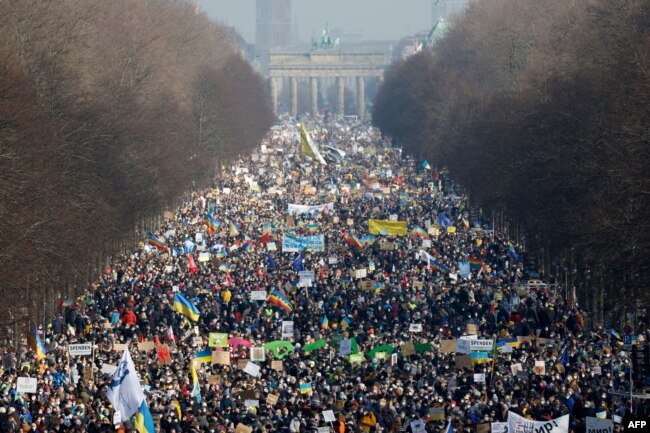

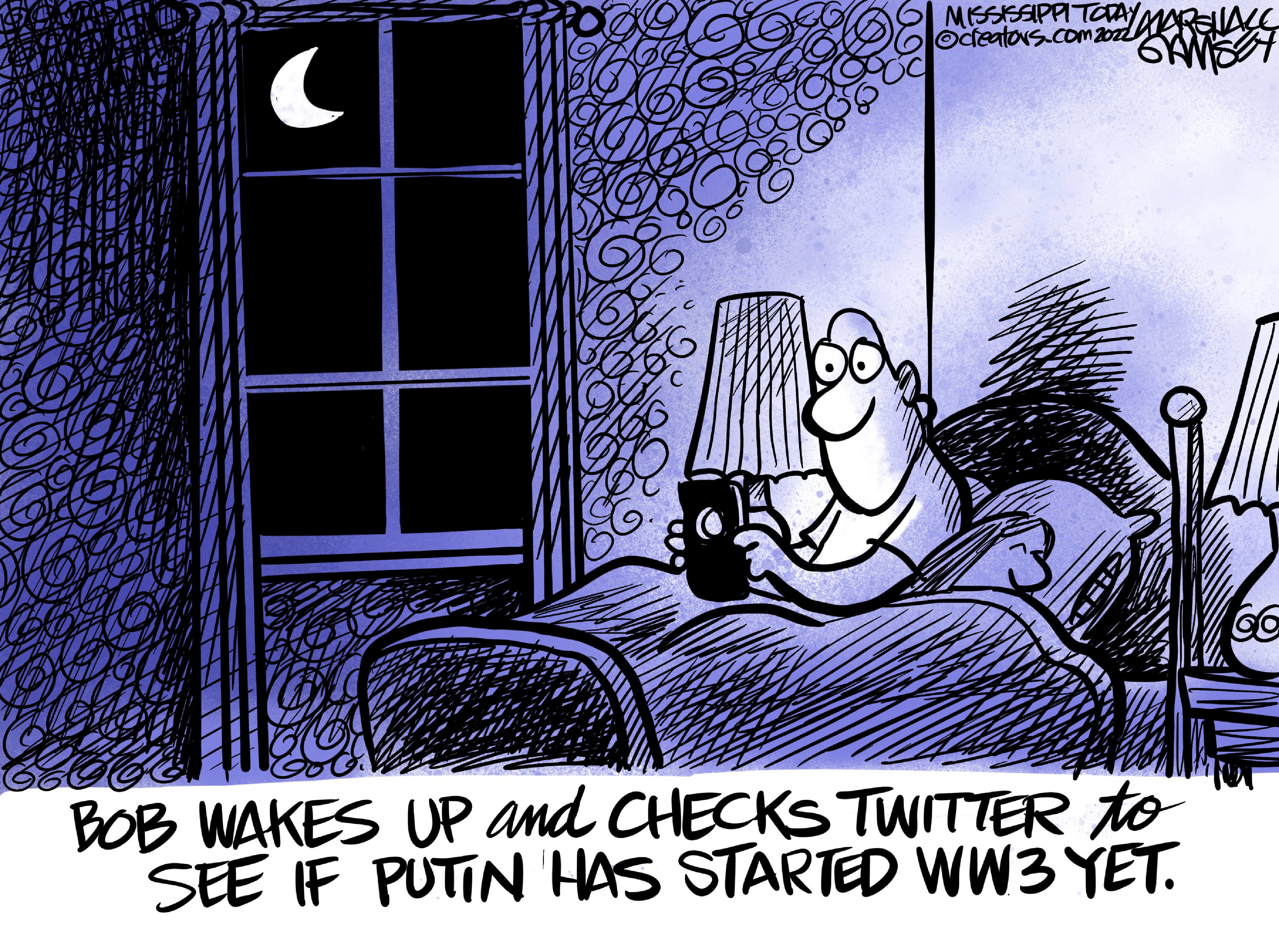

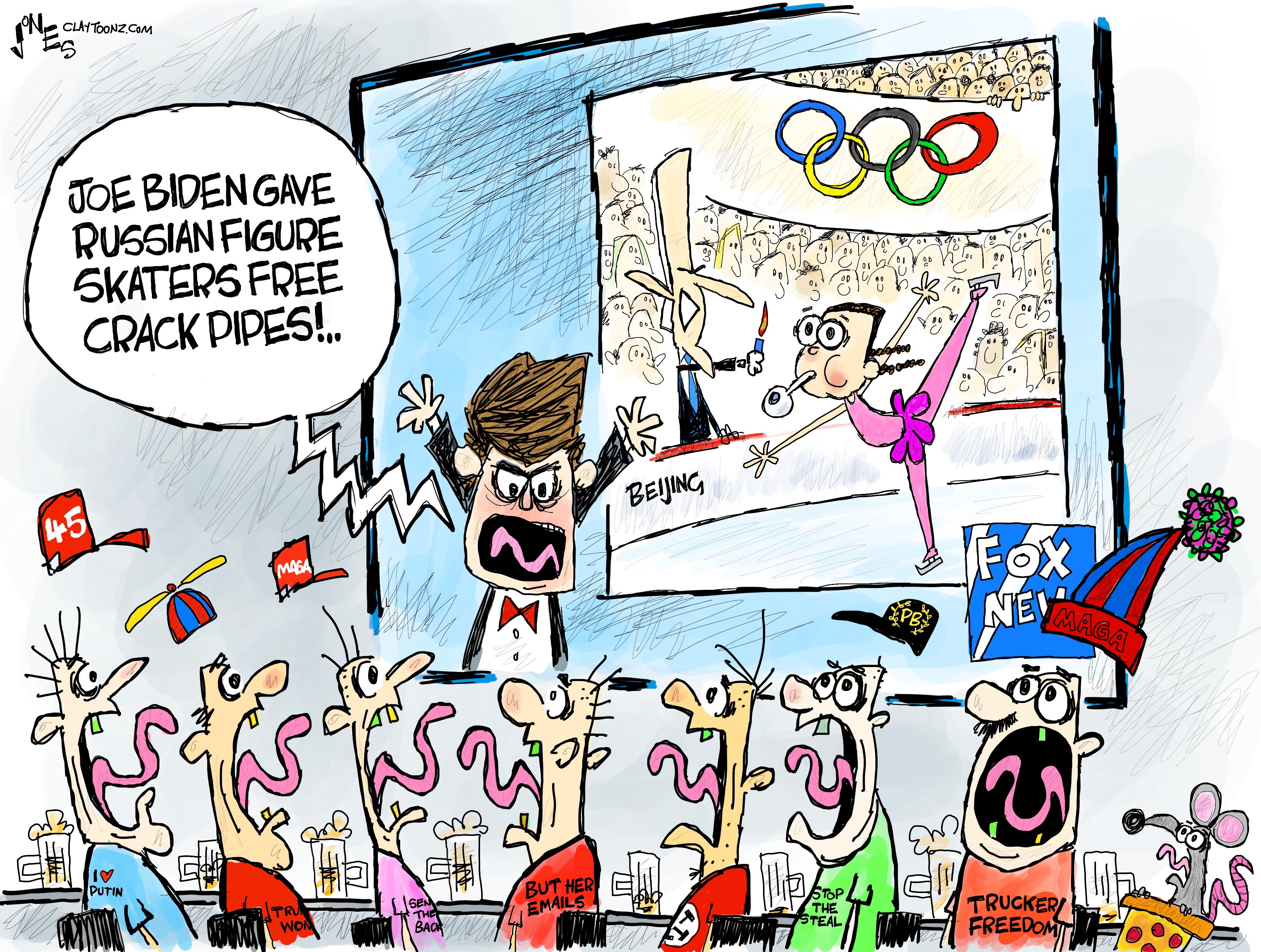





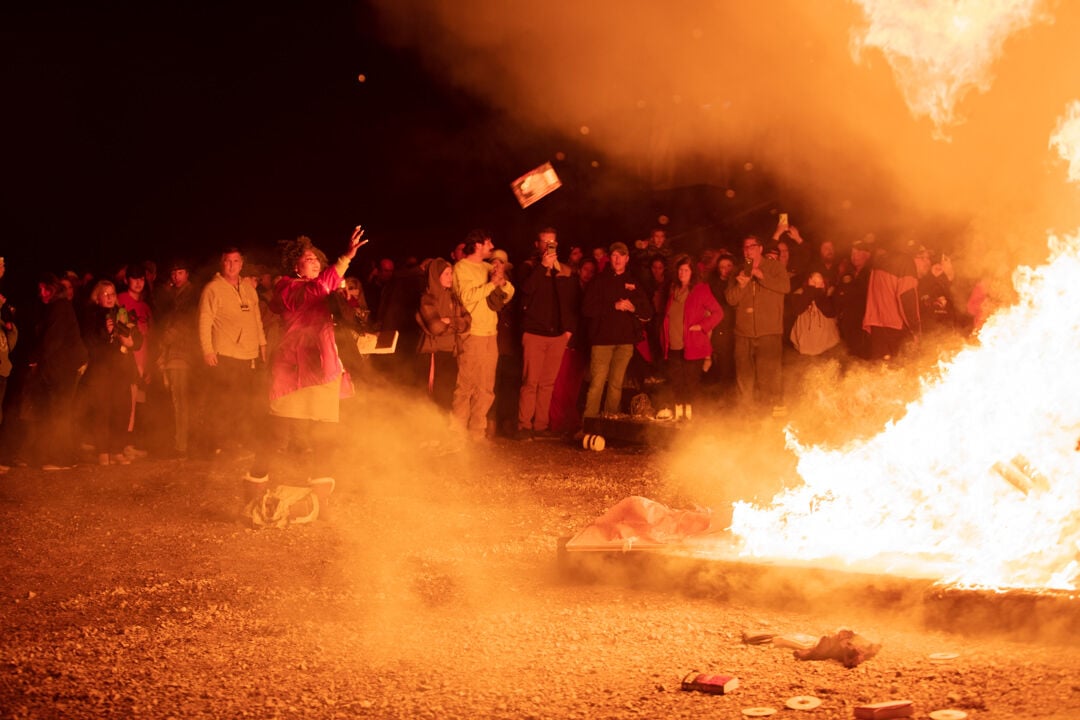
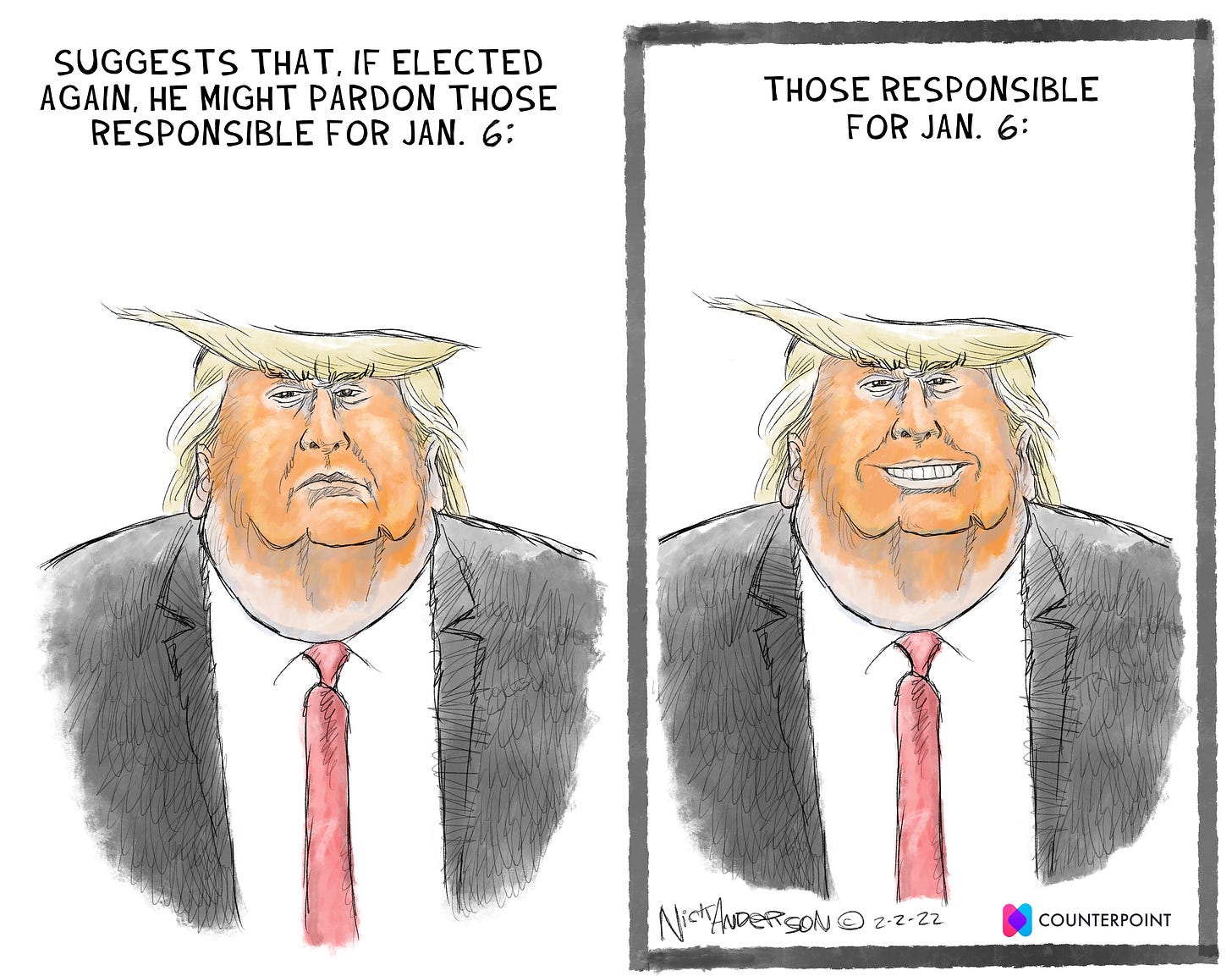
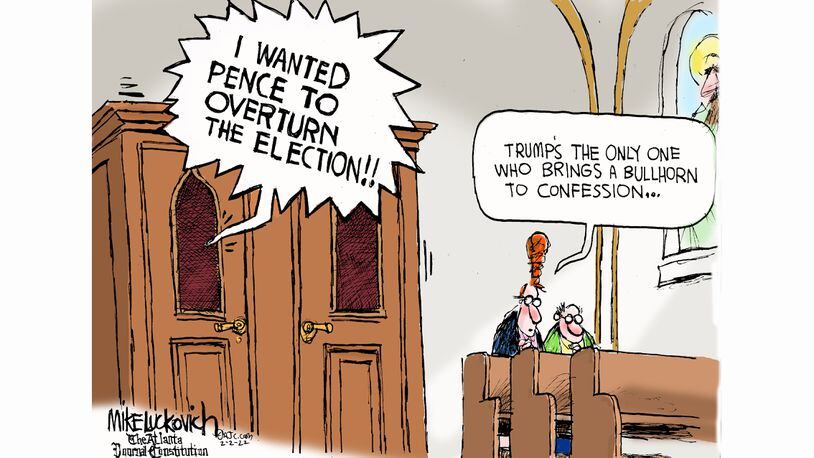


 The Weekly Sift