It’s another week with two featured posts: one I planned and one that just jumped out at the last minute.
The planned post is the obvious one: What’s up with these ridiculous appointments Trump is announcing? That post “Caligula’s Horse and other controversial appointments” should be out before 10 EST.
The other mainly calls your attention to a recent New Yorker article about “the ambience of information”. Trump won largely because voters believed a lot of things that weren’t true — crime is up, immigrants are dangerous, and boys are taking over girls sports, just to name the most significant ones. Harris’ message, on the other hand, never seemed to penetrate. For example, people would go on complaining that she had no policies, no matter how many she had or how she promoted them.
The New Yorker article points out something new in the information environment: voters who make up their minds based on information they “rub against” rather than read or absorb in any traditional fashion. I’ll summarize the point in “Harris lost the war of ambient information”. That should be out shortly.
That leaves a few things for the weekly summary to cover: the Musk “government efficiency” department, the exodus from X to BlueSky, The Onion buying InfoWars, Nazis marching in Columbus, and a few other things. I’ll try to get that out by noon.
Sorrow is better than fear. Fear is a journey, a terrible journey, but sorrow is at least an arrival. When the storm threatens, a man is afraid for his house. But when the house is destroyed, there is something to do. About a storm he can do nothing, but he can rebuild a house.
This week it was hard to think about anything beyond the election
That’s the subject of the featured post. Long as that post is, there’s a lot I didn’t get to.
In general, I am avoiding articles that predict the electorate will now get what it deserves. They’re emotionally satisfying, but I don’t think they lead anywhere good. However, I can’t resist sharing this H. L. Mencken quote:
Democracy is the theory that the common people know what they want, and deserve to get it good and hard.
The stock market seems to be anticipating corruption, as well-connected companies saw their stocks soar after the election. The American Prospect runs through a list of big gainers, including the cryptocurrency exchange Coinbase and installment lender MoneyLion, which the Biden administration has accused of overcharging members of the military.
Another big winner: Elon Musk, whose net worth has now exceeded $300 billion. On the surface this makes no sense, because Trump has been an outspoken critic of electric cars like the ones Musk’s Tesla makes. But if Trump surrounds himself with oligarchs like Putin has, Musk will be one of the most prominent.
BTW, I would be wary of investing in Tesla. If Musk decides to screw the minority shareholders, will the Trump Justice Department protect them? This question illustrates one of the problems of shifting from a rule-of-law government to an authoritarian government: Everything becomes less trustworthy, so the machinery of economics gets creeky and slow.
One of the first things to watch is how quickly Trump’s mass deportation plans come together, and what (if anything) can be done to slow them down. In his first administration, he moved quickly to implement his Muslim ban, which met a lot of resistance and eventually was significantly delayed/altered by the courts.
but there’s still a world out there somewhere
Meanwhile, Germany’s ruling coalition has dissolved, leaving the current chancellor without a majority in the Bundestag. Expect a no-confidence vote in January and elections in March.
Germany’s economy has stagnated since Covid, producing all sorts of internal tensions. (Germany is one of the countries that would love to have the “bad” Biden economy.) In recent years the neo-fascist Alliance for Germany (AfD) Party has been gaining. Whether they can win the March elections is the next political disaster to worry about.
I’m not sure which narrative of the recent violence in Amsterdam to trust. It followed a Netherlands/Israel soccer game. In some accounts the violence was a pure antisemitic eruption. In others, obnoxious fans on both sides exchanged provocations until fighting broke out.
The Saints are having a slow start to the season, and were sitting in fourth, and last, place in the NFC South. A significant number of injuries have struck among wide receivers and the offensive line, and last week head coach Dennis Allen was fired. But there are signs the Pope’s prayers could be working: on Sunday the Saints won for the first time since September, holding on for a narrow win over the Atlanta Falcons.
and let’s close with some monkey business
Wednesday, 43 lab monkeys made a break for it after an employee at Alpha Genesis Primate Research Center in Yemasee, South Carolina left a door open. As of Sunday, 25 of the rhesus macaques had been recovered. Most of the rest seemed to be in the trees surrounding the lab complex, and occasionally jump back over the fence to interact with their caged compatriots. Police have warned people living nearby to keep their doors and windows locked.
News articles have been vague about what experiments the monkeys are part of, saying only that they “hadn’t been tested yet”, and so there was no public health threat. CBS reports:
According to its website, Alpha Gensis breeds monkeys and provides “nonhuman primate products and bio-research services” across the globe. The company’s clinical trials reportedly include research on progressive brain disorders. … The Post and Courier newspaper reported last year that Alpha Genesis won a federal contract to oversee a colony of 3,500 rhesus monkeys on South Carolina’s Morgan Island, known as “Monkey Island.”
Monkeys are uniquely valuable in medical research because they are so similar to humans. But that similarity also makes the cruelty of medical research uniquely horrible.
It’s really like follow-the-leader. You see one go and the others go. It was a group of 50 and 7 stayed behind and 43 bolted out the door.
I find myself rooting for the monkeys to stay free as long as possible. I occasionally vacation down the road on Hilton Head Island. The next time I do I’ll be looking closely up into the trees.
Tuesday was traumatic. How do we recover, as individuals and as a country?
There’s a lot for all of us to process here. About the outside world, the emotions roiling around inside, what we need to be preparing for, and so on. This post is a very quick and incomplete response.
One important thing I’ll say up front: This is a secure-your-own-mask-first situation. We’ve all been knocked off balance, and we need to get our balance back before we go charging out into the world. So do what you need to do and don’t feel guilty about it: gather friends around you, sit in a dark room alone, make art, play solitaire, binge on some silly TV show, whatever. Things are happening deep down, and we need to let those processes do their work. Whatever you decide to do next will benefit if you take care of yourself now.
Me. The hardest thing for me right now is re-envisioning my country. It’s been many years since I have seen America as a “city upon a hill” or the “last best hope of Earth“. But still, I’ve gone on believing that the great majority of Americans aspire to be better and do better. A lot of my commitment to writing has come from my belief that if I work to understand things and explain them clearly, then other people will understand those things too, and most of them will do the right thing, or at least do better than they otherwise would have.
This election demonstrates how naive that belief is. Some Americans were fooled by Trump’s lies about the economy or crime or history or whatever, but many weren’t. They saw exactly what Trump is, and they chose him. Many of the people who believed him weren’t fooled into doing it. They chose to believe, because his lies justified something they wanted to do.
Oddly, though, I am continuing to write, as you can see.
I am reminded of a Zen story: A man meditated in a cave for twenty years, believing that if he could achieve enlightenment, he would rise to a higher state of being and attain mystical powers. One day a great teacher passed through a nearby village, so the man left his cave to seek the sage’s advice. “I wish you had asked me sooner,” the great teacher said sadly, “because there is no higher state of being. There are no mystical powers.”
Crestfallen, the man sat down in the dust and remained there for some while after the sage had continued on his way. As the sun went down, he got up and went back to his cave. Not knowing what else to do with himself, he began his evening meditations. And then he became enlightened.
So far, no enlightenment. But I’ll let you know.
Something similar happens in Elie Wiesel’s recounting of a trial of God he witnessed as a boy in a Nazi concentration camp. (I haven’t recently read either his account or the play it inspired, so I might not have the story exactly right.) After a lengthy and spirited argument, this makeshift Jewish court finds God guilty of violating his covenant and forsaking the Jewish people. And then they move on to their evening prayers.
Election night. Despite everything I’ve said in this blog about avoiding speculation and being prepared for whatever happens, by Election Day I had become fairly optimistic. That all went south very quickly.
I had made myself a list of early indicators, beginning with how Trump Media stock performed that day. (It was way up, a bad sign.) Next came how easily Trump carried Florida. (It was called almost immediately, another bad sign.) Things just got worse from there. I briefly held out some hope for the Blue Wall states (Wisconsin, Michigan, Pennsylvania) until early reports showed Harris underperforming Biden’s 2020 results (when Biden just barely won those states). So I was in bed by 11 and never got up in the night to see if some amazing comeback had started.
I had expected to be deeply depressed if Harris lost, but in fact I haven’t been. I’m disappointed, but I’ve been oddly serene.
No doubt part of my serenity is ignoble. Due to a variety of privileges — I’m White, male, heterosexual, cis, English-speaking, native-born, Christian enough to fake it, and financially secure — I am not in MAGA’s direct line of fire. So whatever trouble I get into will probably come from risks I choose to take rather than brownshirts pounding on my door. Many people are not in my situation, and I am not going to tell them they should be serene.
But there’s also another factor — I hope a larger factor — in how I feel, and I had to search my quote file until I found something that expressed it. In Cry, the Beloved CountryAlan Paton wrote:
Sorrow is better than fear. Fear is a journey, a terrible journey, but sorrow is at least an arrival. When the storm threatens, a man is afraid for his house. But when the house is destroyed, there is something to do. About a storm he can do nothing, but he can rebuild a house.
It’s not a perfect metaphor, because we could in fact vote or contribute or volunteer to influence the election. But the scale of the election dwarfed individual action. The closer it got, the more it seemed like a storm. In spite of my propensity to latch onto hopeful signs, in the days and months leading up to the election, I was filled with a very painful dread.
That dread is gone. The hammer has fallen. My faith in the American people was misplaced, so I can now get on with reconstructing that important piece of my worldview.
What happened. As always, we should start with the undeniable facts before making a case for this or that interpretation.
Trump won. He carried the Electoral College 312-226, and also won the popular vote by around 3 1/2 million votes, which is not quite the margin that Obama had over Romney (5 million), and well below the margin Biden had over Trump (7 million) or Obama had over McCain (9 1/2 million).
So it was not a historic landslide, but it was a clear win. Trump had appeared to be ready to try to steal the election if he didn’t win it, but that turned out not to be necessary. Coincidentally, all online talk of “voter fraud” evaporated as it became clear Trump was winning legitimately. The whole point of the GOP’s “election integrity” issue was to provide an excuse not to certify a Harris victory. But with Trump winning, fraud was no longer a concern.
Republicans also won the Senate. Ted Cruz and Rick Scott retained their seats, and no seats flipped from Republicans to Democrats. Democrats lost Joe Manchin’s West Virginia seat, something everyone expected as soon as Manchin announced he wouldn’t run. In addition, Democratic incumbents Sherrod Brown in Ohio, Bob Casey in Pennsylvania, and Jon Tester in Montana were defeated. The new Senate looks to have a 53-47 Republican majority. (Casey is still holding out hope that uncounted provisional ballots will overcome McCormick’s lead. But few think that’s likely.)
How did it happen? At the simplest level, it happened because too many people voted for Trump and not enough for Harris. Because the US has secret ballots, there’s no way to know for sure who those people were. But we do have exit polls.
It’s important to phrase things correctly here, because it’s way too easy to scapegoat groups of people unfairly. For example, you’ll hear that Trump won because of the Latino vote (which is true in a sense that we’ll get in a minute). But if you look at the news-consortium exit poll, Harris won the Hispanic/Latino vote 52%-46%, while Trump won the White Evangelical/Born-Again vote 82%-17%. So if you’re looking for someone to blame, look at Evangelicals, not Latinos.
However, most analysts are using the 2020 election as a baseline: Harris lost because she didn’t do as well as Biden did in 2020. And that brings a second exit poll into the conversation. Biden won the Hispanic/Latino vote 65%-32% in 2020, and lost the White Evangelical/Born-Again vote 24%-76%. So if you’re looking for Democratic slippage from 2020 to 2024, you’ll find it in both groups, but the Hispanic/Latino vote stands out; the Democratic margin among Latinos dropped from 33% to 6%.
The Latino vote also stands out because it’s puzzling, at least to non-Latinos like me. Trump ran largely on hostility to non-White immigrants and a promise to deport millions of people, many of whom are Latino. Again, it’s important to nuance this correctly: Latino voters are citizens — non-citizen voting was one of Trump’s lies — and Trump’s prospective deportees are not. Many Latino voters are solidly middle class, speak English with an accent that is more regional than foreign-born, and are well along the immigrant path traveled in the 20th century by Italians and Greeks. It shouldn’t be surprising, then, that as Latinos assimilate into America, they begin to vote more and more like other Americans. After all, Polish Americans may still value their Polish heritage, but they typically don’t base their votes on an agenda of Polish issues.
Still, I have a hard time believing that MAGA racism will respect legal, social, or economic boundaries. Puerto Ricans have been citizens since 1917, and they are still fair game for racist insults. Native Americans are sometimes told to “Go back where you came from”, which is probably Siberia many thousands of years ago. When the racial profiling starts, your skin color and family name may matter more than your legal status. Also, I would suspect that Latino citizens are much more likely than Anglos to know somebody at risk of deportation. I don’t understand why that wasn’t a bigger consideration.
There was also slippage — not much, but some — among Blacks. Biden won the Black vote 87%-12%, while Harris won it 85%-13%. Harris actually improved slightly on Biden’s performance among Black women (91% to 90%), but did worse among Black men (77% to 79%). (I assume that round-off errors account for the math anomaly in those numbers.)
Meanwhile, the White vote barely changed: Harris and Biden each got 41%.
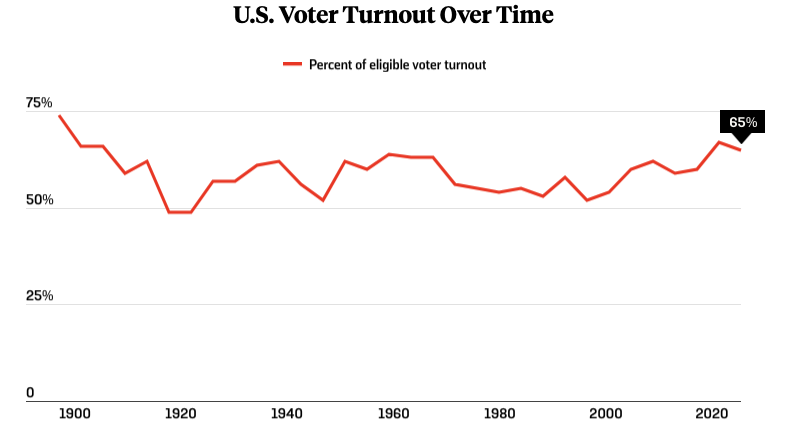
Finally, there’s turnout. Total voter turnout was 65% in 2024 compared to 67% in 2020. However, by American historical standards 65% is high, not low. You have to go back to 1908 (66%) to find another election with turnout this high. The 2020 adjustments to the Covid pandemic made it easier to vote then than at any other time in US history. So it’s unfair to fault the Harris campaign for not matching that turnout.
Why did it happen? I want to urge caution here. After any political disaster, you’ll hear a bunch of voices saying basically the same thing: “This proves I was right all along” or “This wouldn’t have happened if only people had listened to me.”
So Bernie Sanders thinks this election proved Democrats need a more progressive agenda to win back the working class. Joe Manchin says Democrats ignored “the power of the middle”, which implies the party should move right, not left. Others blame the liberal cultural agenda — trans rights, Latinx-like language, defund the police — for turning off working-class voters. Or maybe Harris’ outreach to Nikki Haley conservatives wasn’t convincing enough, and the problem was all the progressive positions she espoused in her 2020 campaign. Josh Barro suggests the problem is that blue states and cities are not being governed well.
The gap between Democrats’ promise of better living through better government and their failure to actually deliver better government has been a national political problem. So when Republicans made a pitch for change from all this (or even burn-it-all-down), it didn’t fall flat.
Basically, whatever you believe, you can find somebody telling you that you are right, and Harris would have won if she had done what you wanted.
I want to encourage you to resist that message — and I’m going to try to resist it myself — because none of us will learn anything if we just insist we’ve been right from Day 1. We should all bear in mind that the US is a very big, very diverse country, and (whoever you are) most voters are not like you. It’s easy for me to imagine positions or messages or candidates that would have made me more enthusiastic about voting Democratic. But we need to be looking for an approach that inspires a broader coalition than showed up for Harris last week. That coalition is going to have to include people you don’t understand, the way I don’t understand the Latinos who voted for mass deportation, the women who voted to give away their own rights, or the young people who voted to make climate change worse.
This is exactly the wrong time for I-was-right-all-along thinking. Back in 1973, Eric Hoffer wrote:
In a time of drastic change it is the learners who inherit the future. The learned usually find themselves equipped to live in a world that no longer exists.
So much of what passes for “obvious” or “common sense” right now only sounds that way because it is well grounded in a worldview that no longer applies. This is a truth that is easy to see in other people, but hard to see in ourselves.
We’re going to be in a weird position for the foreseeable future: Trump is going to try to run over a lot of legal, cultural, and political boundaries, and we need to be prepared to resist. It would be great to be able to resist from a place of rock-solid certainty. But if we’re going to turn this around in the long term, we also need to be humble and flexible in our thinking. Fairly often, we’re going to have to think thoughts like: “I don’t really don’t understand a lot of what’s happening, but I’m pretty sure I need to put my body here.”
Explanations we can eliminate. You don’t have to have the right explanation to recognize wrong ones.
Harris ran a bad campaign.Josh Marshall puts his finger on the statistic that debunks this.
In the seven swing states, the swing to Trump from 2020 to 2024 was 3.1 percentage points. In the other 43 states and Washington, DC the swing was 6.7 points.
Both candidates focused their ads, their messaging, and their personal appearances on the swing states. If the Trump campaign had been running rings around the Harris campaign, this arrow would have pointed in the other direction. In short: If you were a 2020 Biden voter, the more you saw of Harris and Trump, the more likely you were to vote for Harris.
I live in a typically liberal Boston suburb. Massachusetts is about as far from a swing state as you can get, so no national figures ever showed up here. Occasionally we’d see some ads aimed at New Hampshire, but we didn’t get nearly the blitz that Pennsylvanians got. And guess what? Harris slipped behind Biden’s performance here too.
Harris should have picked Josh Shapiro as her VP. This would be a good argument if Harris had won the national popular vote, but failed in the Electoral College because she lost Pennsylvania. But she also lost Wisconsin, where Walz probably helped her.
Also, Harris won the Jewish vote by a wide margin: 78%-22%. So Shapiro’s Judaism probably wouldn’t have helped the ticket.
Harris should have moved further left. We can never say what would have happened if a candidate had delivered a completely different message from the beginning. But I think it’s pretty clear that simply shifting left down the stretch, i.e., emphasizing the more liberal parts of Harris’ message and record, wouldn’t have helped.
The best evidence here comes from comparing Harris to Democratic Senate candidates. Candidates who are perceived as more liberal, like Bernie Sanders and Elizabeth Warren, generally did slightly worse than Harris in their states, while candidates perceived as more conservative (Tim Kaine and Bob Casey, say) did somewhat better.
I’m ignoring a bunch of the Senate races because I don’t see much to be gleaned from them. Jon Tester ran to Harris’ right in Montana and did 7% better, but Harris was never going to be conservative enough to win Montana — and as it turned out, Tester wasn’t either. Maryland’s Angela Alsobrooks ran almost 8% behind Harris (and won anyway), but that’s more a reflection on her opponent, former governor Larry Hogan, one of the few non-MAGA Republican candidates. (It suggests that a moderate Republican could have won a landslide on the scale of Nixon in 1972 or LBJ in 1964.)
If you saw much election advertising, you know that Republicans worked hard to paint Harris as part of the “radical left”. I don’t think they’d have done that if they thought moving left would help her.
Things I think I know. I don’t have a sweeping theory, but I’ll offer a few tentative pieces of a theory.
We lost the information war. The aspect of this campaign I found most personally frustrating was how much of the pro-Trump argument centered on things that simply aren’t true. Our cities are not hellholes. There is no migrant crime wave. Crime in general is not rising. Most of the countries that compete with us would love to have our economy. Inflation is just about beaten. America was far from “great” when Trump left office in 2021. Trump has no magic plan for peace in Ukraine and Gaza. The justice system has favored Trump, not persecuted him.
I hate to say this, but it’s true: Ignorance won. And it will keep winning until we realize that we can’t win by playing politics as usual. This isn’t the same world. Knocking 100 doors is a personal connection that might win a small race — I don’t know that it can change the larger races. Trump’s folks weren’t knocking doors. They were lying to the masses through an extreme right-wing reality that most of us can’t conceive.
This is the year in which it became obvious that the right-wing media has more power than the mainstream media. It’s not just that it’s bigger. It’s that it speaks with one voice, and that voice says Democrats and liberals are treasonous elitists who hate you, and Republicans and conservatives love God and country and are your last line of defense against your son coming home from school your daughter. And that is why Donald Trump won.
It’s hard to know how important the pervasive misperception of facts really was. Did people believe Trump’s nonsense because it was actually convincing? Or did they want to support Trump for some other reason and latched onto whatever pro-Trump “facts” they could find? (Birtherism was like that. People who didn’t want to admit that a Black president scared or angered them instead claimed to be convinced that Obama was born in Kenya, despite clear evidence to the contrary.)
Past presidential campaigns have included some misinformation, but they revolved much more around philosophical disagreements not easily reduced to facts, like the significance of the national debt, or how to balance the public and private sectors.
One of the big questions going forward is whether Democrats want to continue being the reality-based party. I hope we do, just for the sake of my conscience. But if so, how do we make that work in the current information environment?
Harris had a steep hill to climb. Around the world, countries went through a period of inflation as their economies reopened after the pandemic. And around the world, the governments in power got thrown out. Here’s how Matt Yglesias put it just before the election:
The presumption is that Kamala Harris is — or at least might be — blowing it, either by being too liberal or too centrist, too welcoming of the Liz Cheneys of the world or not welcoming enough or that there is something fundamentally off-kilter about the American electorate or American society.
Consider, though, that on Oct. 27, Japan’s long-ruling conservative Liberal Democratic Party suffered one of its worst electoral results. In late September, Austria’s center-right People’s Party saw an 11-percentage-point decline in vote share and lost 20 of its 71 seats in Parliament. Over the summer, after being in power for 14 years, Britain’s Conservative Party collapsed in a landslide defeat, and France’s ruling centrist alliance lost over a third of its parliamentary seats.
… It is not a left-right thing. Examples show that each country has unique circumstances. Center-left governments from Sweden to Finland to New Zealand have lost, but so have center-right governments in Australia and Belgium. This year the center-left governing coalition in Portugal got tossed out. Last year the People’s Party for Freedom and Democracy, the incumbent center-right governing party in the Netherlands, finished third in an election dominated by far-right parties.
I’m reluctant to give this explanation too much credit, because it says this election was a one-off and there’s nothing really to learn, other than to avoid being in power at the end of a pandemic. So in that sense it’s too easy. But it’s also a real thing that is an important part of the picture.
Harris’ outreach to Republican women came up empty. I’m not going to say it was a bad idea, but it didn’t work. I haven’t seen an exit poll that specifically breaks out Republican women, but the overall slippage among women in general makes it unlikely that many Liz Cheney Republicans crossed over.
After Trump’s 2016 win, big-city journalists trying to figure out Trump voters made countless trips to small-town diners. This time, I’d like to see them hang out in upscale suburban coffee shops and talk to women in business suits. Why did so many of them stay loyal to their party’s anti-woman candidate?
Democrats need a utopian vision. If Democrats had complete control and could remake America however we wanted, what would that look like? I honestly don’t know.
It’s not like Democrats don’t stand for anything. I can list a bunch of things an unconstrained Democratic administration would do, like make sure everyone gets the health care they need, raise taxes on billionaires, ban assault weapons, cut fossil fuel emissions, and make states out of D. C. and Puerto Rico. Maybe it would also reform the food system and break up the tech monopolies, though the details on those two are fuzzy.
But a list of policies doesn’t add up to a vision.
Whatever you think of it, libertarianism provided pre-MAGA conservatives with a utopian vision for decades. Republicans didn’t usually run on an explicitly libertarian platform, but libertarian rhetoric and libertarian philosophy was always in the background. (Reagan in his first inaugural address: “Government is not the solution to our problem; government is the problem.”) Trump mostly turned away from that, and slogans like “America First” and “Make America Great Again” may be vague, but they also evoke something sweeping.
I can’t think of anything comparable on the left. The communist vision collapsed with the Soviet Union, and I don’t know anybody who wants to revive it. But in the absence of a political vision, we’re left with a technocracy: Do what the experts think will work best.
This is a problem a new face won’t solve. Gavin Newsom or Gretchen Whitmer or even AOC is not a vision.
What happens next? It’s Trump’s move. We don’t know yet who he’s going to appoint to high office or what the agenda of the new Congress will be. Establishing authoritarian government is work, and he may not have the energy for it. Maybe he’ll get so distracted by seeking his revenge against individuals that he won’t get around to systematically destroying democracy. We’ll see.
I’m reminded of a story Ursula le Guin told decades ago, repeating something from another woman’s novel: A female character discovers her baby eating a manuscript.
The damage was not, in fact, as great as it appeared at first sight to be, for babies, though persistent, are not thorough.
Trump has many babyish traits. We can hope that he won’t be thorough enough to do as much damage as we now fear.
This Adam Gurri article is full of good advice, but I especially appreciate this:
The biggest weakness of The Women’s March was its lack of strategic objective or timing. It simply demonstrated mass dissatisfaction with the Trump administration the day after it began. The best use of mass protest is in response to something specific. It does not even need to be an action, it can be as simple as some specific thing that Trump or a member of his administration says. But it has to have some substance, some specific area of concern. Perhaps it is about prosecuting his enemies. Perhaps it is about mass deportations. No one doubts there will be a steady supply of choices to latch onto. Those seeking to mobilize protests need to make sure they do pick something specific to latch onto, and be disciplined in making opposition to it the loudest rhetoric of the protest.
This time around, I don’t expect protesting against Trump himself to get very far. His followers expect it; they will just roll their eyes and talk about “Trump Derangement Syndrome”. But protesting something Trump does will at least draw attention to that thing. We have to wait for him to do something objectionable. Unfortunately, it probably won’t be a long wait.
In the meantime, prepare. Take care of yourself. Regain your balance.
After Tuesday’s disaster, I’ve mainly been focused on recovery. It’s hard for me to focus on anything but the election and what it means.
So the featured post will be a wide-ranging election reaction, starting with my personal response, followed by an examination of what happened and possible explanations of why. I’m going to discourage one kind of reaction: Don’t jump on some I-was-right-all-along interpretation. It’s easy to do, and it can provide some short-term comfort, but it guarantees that you won’t learn anything from this event. And I think there are things to learn, but I don’t quite have a handle on them yet.
Anyway, that post is almost done and should be out shortly.
Beyond that, I once again will not do justice to the rest of the world. It’s going to take at least another week to regain my curiosity about events unrelated to the election and the new administration. So the weekly summary will probably be short and appear before noon.
Take care of yourselves out there. Some of you need to reach out to friends, while others need to be alone for a while. Do what you need to do.
I haven’t checked, but this may be the shortest Weekly Sift ever. Here’s why: Given how close and how consequential tomorrow’s election looks, it’s hard to think about anything else. And yet, it’s also hard to come up with anything worthwhile to say about it. I could try to predict who’s going to win, but you’d be foolish to believe me, because I don’t know. I could collect a lot of other people’s predictions, but they don’t know either.
We’re down to the point where you can vote, you can encourage your friends to vote, and you can do some election-day volunteering. Beyond that, you can watch the Future arrive at the usual rate of one second per second.
Back in 2008, I started doing election preview posts, predicting how the evening was likely to play out, given poll-closing times and what the opinion polls were saying. The 2008 preview was so accurate that I started thinking I knew something. (I said that California’s outcome would be projected almost immediately after polls closed at 11 EST, putting Obama over the top. That’s exactly what happened.) I got 2016 drastically wrong, but I didn’t learn my lesson and wrote a 2020 preview anyway.
This year has been an ongoing master class in the pointlessness of speculation. Pundits have talked and written endlessly about how the debates would go, whether Biden would or should drop out, what process the Democrats should use to replace him, whether Harris would do any better, who the two VP nominees should be, whether Trump’s endless gaffes would cost him, what the “October surprise” might be, how various voting blocs — women, Blacks, Hispanics, union members — would respond to Harris, and on and on.
If you ignored all of it, you are probably better off than the rest of us, or at least calmer. By tomorrow, we will all have voted, contributed, volunteered — or not. What has mattered is action, not divining the future.
Here’s what I will say: In a typical election, late-deciding voters mostly break the same way. So for better or worse, there’s a good chance we won’t have the kind of photo-finish the polls are predicting.
But as we all know by now, this isn’t a typical election. No one knows what the late-deciders are thinking. We’ll just have to wait and see.
There are any number of other things you could choose to worry about. But there will be plenty of time to start worrying about them after Wednesday or so.
For example: Trump seems to be gearing up once again to claim power even if the voters reject him. He and Speaker Johnson have some “secret plan”. Elie Mystal has a guess about what it might be. And who knows what the Supreme Court will do? Will they let him lose? Every time the Court has had a question put to it, it has ruled for Trump, often in complete opposition to precedent or even written law. How far will it go? I don’t know and neither does anybody else who isn’t on the Court. But unless you’re on the Harris legal team, you can procrastinate on that bit of worrying until the post-election legal battles actually start — which they won’t if Trump wins legitimately (because Democrats respect the voters’ right to reject them).
If Trump wins and begins assembling a fascist administration, that also would be worth worrying about, and even moreso if Republicans get control one or more houses of the new Congress. But worrying about it now won’t give you any special advantage.
As for the next two days: I voted early and I sent Harris a check months ago. I’ve been trying to make the case for her and against him for months. Now all I can do is watch and wait — and try not to obsess about things that may or may not happen.
If you’re trying to convince some last-minute deciders to vote for Harris, here’s some material to work with.
The NYT writes one paragraph that sums up why you shouldn’t vote for Trump, and backs up each statement with a link to a longer article. Matt Yglesias writes a positive case for Harris, which isn’t flashy because it centers on “normal” things like integrity, the rule of law, and taking a pragmatic approach to helping ordinary people solve typical problems like how to afford a house or send their kids to college.
If you’re talking to someone who thinks voting for Trump is the “Christian” position, point them to this guy.
If you’re talking to a progressive who won’t vote for Harris because of Gaza, show them this.
One final thing: As I explained at some length in August, if you think you’re nostalgic for the “Trump economy”, what you’re actually nostalgic for is the pre-Covid economy, when a lot of things were cheaper. But electing Trump won’t bring those days back.
Around the world, governments took very similar actions to keep their economies going while fighting Covid. And around the world, those actions eventually led to inflation; it’s not a Biden/Harris thing. Our inflation happened to show up after Trump left office (because that’s when the new vaccines allowed the economy to reopen) but his actions had as much to do with it as Biden’s. Once you recognize the hit Covid was on the economy — and would have been even if Trump had been reelected in 2020 — you can appreciate how well the Biden/Harris administration has managed the recovery from Covid.
Here’s a metaphor that might help: Think about how you might feel as you leave the hospital after being treated for a heart attack. Do you feel as carefree and vibrant as you did before the heart attack? Probably not. But you also feel a heck of a lot better than you did when you arrived in the ER, and you should appreciate what the doctors did to pull you through.
Trump is selling nostalgia for 2019, before Covid did its damage. But on that day in 2021 when Biden was inaugurated, the “Trump economy” was a mess. It’s much better now.
But to be fragile is not the same as to be perishable, as G.K. Chesterton wrote. Simply do not break a glass, and it will last a thousand years. Smash it, and it will not last an instant. Democracy is like that: fragile, but only if you shatter it.
This week everybody was talking about the campaign
One featured post tries to explain what Trump supporters could possibly be thinking.
I’m still doing my best to ignore polls and pundits’ speculations about who will win. I gather than the race still considered close, which is all I really need to know at this point. For what it’s worth, I will toss in my own speculation: Some last-minute shift will make the result more decisive than it looks now. I can’t say which way the shift will go, but I don’t think we’ll be waiting all week to find out who won.
A Trump campaign spokesman repeated its standard excuse, that the model is a partisan Democrat. After all, she gave $25 to Biden’s 2020 campaign. I’m always amazed anyone takes such claims seriously. I mean, maybe she’s accusing Trump of groping her because she supports his opponents. But isn’t it more likely that she supports his opponents because he groped her?
Trump’s Madison Square Garden rally yesterday is being widely described as a hate-fest. I haven’t had time to digest it all, but apparently warm-up comedian Tony Hinchcliffe thought it would be funny to describe Puerto Rico as “a floating island of garbage in the middle of the ocean“. Several people have pointed out that Hinchcliffe was using a teleprompter, so the Trump campaign had seen what he would say and presumably approved it.
From the same rally, Tim Miller posts an ironic picture of Elon Musk and Melania Trump — both immigrants — with the Stephen Miller quote “America is for Americans, and Americans only.”
The Democrats’ most powerful speaker continues to be Michelle Obama. In Kalamazoo Saturday, she laid out the extensive consequences for women’s health caused by the abortion bans that followed the Dobbs’ decision, and how Trump could extend many of these consequences to the entire country. She also pleaded with “the men who love us” to understand how their own lives could be affected.
If your wife is shivering and bleeding on the operating table during a routine delivery gone bad, her pressure dropping as she loses more and more blood or some unforeseen infection spreads, and her doctors aren’t sure if they can act, you will be the one praying that it’s not too late. You will be the one pleading for somebody, anybody, to do something.
I had planned to do an article collecting all the former Trump allies who have told us he should never wield power again, but the NYT did it for me.
The standard Trump defense (you can see Vance give it here) is that these are all disgruntled people Trump fired. But usually the cause-and-effect ran in the other direction: Attorney General Bill Barr and cybersecurity czar Chris Krebs were fired because they disputed Trump’s stolen-election lies. Mike Pence is out with Trump because he wouldn’t violate the Constitution for him.
The typical order things happen is: Somebody in TrumpWorld can no longer tolerate the illegal or unethical things they’re being asked to do. Then Trump fires them or otherwise forces them out. They’re fired for disloyalty, not incompetence.
Not to be missed is this Jon Stewart rant about the excuses Republicans make for Trump’s fascist rhetoric about “the enemy within”, and how major media lets them get away with it.
Grist analyzes the climate and environmental significance of a vote for either Harris or Trump.
In Georgia Wednesday, talking about his plans for mass deportation, Trump gave us some more insight into the “again” in “Make American Great Again”. He said:
We had to go back to 1798. That’s when we had laws that were effective.
I don’t know if they still teach this in US History classes, but the 1798 laws he’s talking about are the Alien and Sedition Acts, which were a low point in US civil liberties.
As the Adams administration’s relationship with France deteriorated, Federalists became increasingly worried about immigrants who might have French sympathies. So Congress passed a series of laws that together became known as the Alien and Sedition Acts. One of the Acts was the Alien Friends Act, which gave the president power to deport any non-citizen he considered dangerous.
Another, the Sedition Act, made it a crime for American citizens to “print, utter, or publish…any false, scandalous, and malicious writing” about the government.
Adams was pressured to invoke the AFA against Joseph Priestley, the chemist who isolated oxygen and figured out how to make carbonated water. Priestley had been chased out of England for his sympathy with the French Revolution, and then resettled in Pennsylvania. In many ways Priestley was precisely the kind of person the AFA targeted, but Adams resisted invoking it, citing Priestley’s age and fragility.
It’s impossible to say exactly how intimidated Priestley felt, but after Jefferson (a friend of Priestley and an opponent of the Acts) was elected in 1800, Priestley wrote: “It is only now that I can say I see nothing to fear from the hand of power”.
During the Jefferson administration, some the Acts expired and the others were explicitly repealed. Trump may remember those laws fondly, but he can’t legally invoke them.
and newspaper non-endorsements
The billionaire owners of the Washington Post and LA Times stepped in to prevent their papers from endorsing Kamala Harris. One featured post explains why this “obeying in advance” is a disturbing sign for American democracy.
When talking about how the Steward chain of hospitals went bankrupt, I said that the private equity firm Cerberus (who owned the hospitals) created Medical Properties Trust to sell the hospital’s land to.
The sources I link to don’t actually say that. I extrapolated from the degree of collusion the two firms displayed to conclude that they were two tentacles of the same octopus. But it seems not to be true.
In the blog The Big Picture, David Pepper describes how Ohio broke its public school system. Once ranked fifth among the state systems, it’s now somewhere in the 20s and dropping, after money was siphoned off for charter schools and private school vouchers.
The Tennessee Holler writes about the 400 books Wilson County is removing from school libraries, in accordance with a recent state law.
As I study the list, the fantasy section of the high school libraries seems especially hard hit: George Martin, Sarah Maas, Diana Gabaldon, Margaret Atwood …
For those who aren’t old enough, you cannot imagine how little race tension there was in this country before Obama got into power
This sentiment is surprisingly widespread among White conservatives, and it even becomes true with a small substitution: Replace “little race tension there was in this country” with “comfortable White people were in their privilege”. My rewrite:
For those who aren’t old enough, you cannot imagine how comfortable White people were in their privilege before Obama got into power.
In my view, the increased race tension of the current era comes almost entirely from Whites freaking out about a Black man gaining power.
and let’s close with something slimy
When I closed last week with a microscope enlargement of sugar from a Coke, I didn’t realize that Nikon runs an annual Small World contest for similar photos. So this week I learned that slime mold can be unexpectedly interesting if you enlarge it enough.
What the Washington Post and Los Angeles Times aren’t saying speaks volumes.
Newspaper endorsements seldom garner much attention. (The New York Times endorsed Harris almost a month ago. Did you notice?) It’s debatable whether such endorsements move many votes, though I think they used to. As a 12-year-old in 1968, one of my first political actions was to stand near my hometown’s central square, where Lincoln once debated Douglas, and hand out copies of the Times’ editorial endorsing Hubert Humphrey. Clearly the Humphrey campaign thought the newspaper’s voice might have some influence, even a thousand miles from Manhattan.
The problem here isn’t that newspapers are obligated to make endorsements. Whether news organizations should endorse candidates or show a public face of neutrality is a question journalists can debate in good faith. Earlier in their history, both the WaPo and the LAT had periods where they didn’t endorse presidential candidates. Rival news organizations CNN and NPR still don’t. I’m on the editorial committee of the hyperlocal Bedford Citizen, which serves the 14 thousand people of Bedford, Massachusetts. We don’t endorse candidates, or even take positions on controversial local issues (despite the fact that members of the editorial committee are often fairly unified in our opinions).
Changing policies is also not the problem. Individual news organizations should be free to change their endorsement policies (whatever they are) whenever they want, or to decide in some election cycle that neither candidate deserves their support. But both the process and the timing of these particular decisions augur badly for the future of American democracy.
WaPo’s Publisher Lewis put a principled spin on the paper’s non-endorsement, framing it
as a statement in support of our readers’ ability to make up their own minds on this, the most consequential of American decisions — whom to vote for as the next president.
However, both the LAT and the WaPo have endorsed senate candidates this year, so the principle here escapes me. And if readers can make up their own minds, why have an editorial page at all? If you have an editorial department and a decision process for making endorsements, why not trust it? And after your editorial department comes to a decision, what valuable new insight does an owner bring to the table?
That last question is what makes these non-endorsements so disturbing: The owner brings a business point of view. An owner can see how a new administration, particularly a corrupt and vengeful new administration, might use the power of government to attack either the paper itself or the owner’s unrelated businesses. Conversely, such an administration might also rain benefits on a supportive media-company-owner’s businesses, like Bezos’ Blue Origin or Elon Musk’s Starlink. (LAT owner Patrick Soon-Shiong has a variety of business interests in pharmaceuticals, energy, and biotech. I could not easily guess which carrots or sticks a second Trump administration might use to influence him. Compared to Bezos or Musk he is a mere pauper, with a net worth just over $7 billion.)
During the first Trump administration, Bezos (whose much larger business is Amazon) saw what can happen when his newspaper becomes too annoying.
In 2019, Trump found his lever. Amazon was due to receive a $10 billion cloud-computing contract from the Pentagon. The Pentagon suddenly shifted course and denied Amazon the contract. A former speechwriter for Defense Secretary James Mattis reported that Trump had directed Mattis to “screw Amazon.”
This is the context in which the Post’s decision to spike its planned endorsement of Kamala Harris should be considered.
In other words, the owners of one (or maybe two) major American newspapers appear to be giving in to intimidation/bribery. Their actions (or non-actions) are teaching Donald Trump that intimidation/bribery works. So if he is elected next week, they will see more.
The WaPo’s and LAT’s silence illustrates what fascism expert Jason Stanley calls “anticipatory obedience“, a primary pattern in democracies that surrender to autocrats: Don’t wait for the lash to fall. Anticipate what the autocrat will require of you and obey in advance. (Stanley himself makes the connection with the newspaper non-endorsements here.)
Roots are important, of course. As recently as the 1970s, The Post did not endorse a candidate for president. As recently as centuries ago, there was no Post and the country had a king! Go even further back, and the entire continent of North America was totally uninhabitable, and we were all spineless creatures who lived in the ocean, and certainly there were no Post subscribers.
But if I were the paper, I would be a little embarrassed that it has fallen to me, the humor columnist, to make our presidential endorsement. I will spare you the suspense: I am endorsing Kamala Harris for president, because I like elections and want to keep having them.
A friend who works for #WaPo marketing dept says there’s a #WaPoMeltDown in their business unit following the news as digital subscriptions cancellations have hit 60k barely 8 hrs after decision not to endorse. Cancellation rate is unprecedented and we’re barely 24 hours into it.
But as damaging as this might be to the WaPo business model, it’s hard to imagine it having a noticeable impact on Bezos-scale wealth.
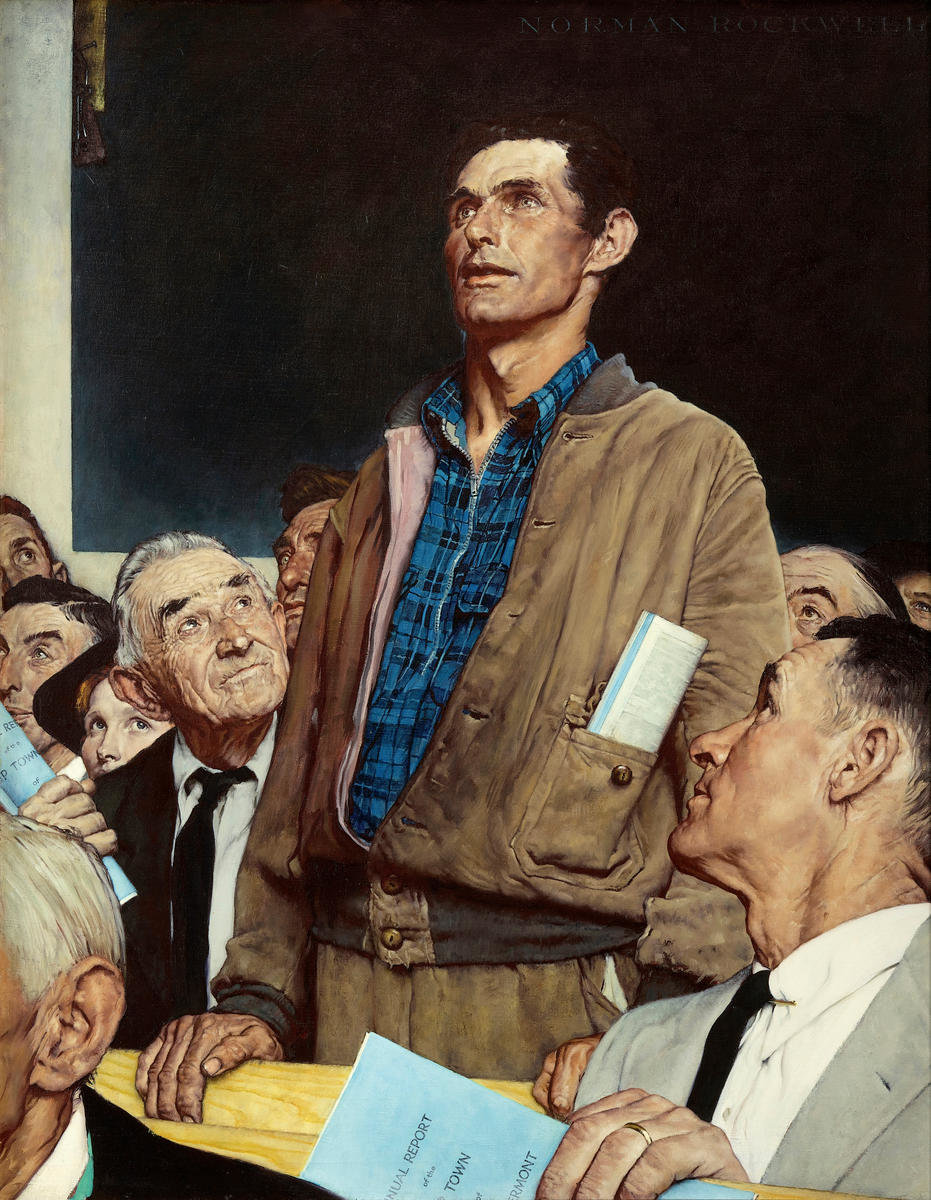
The impact Bezos’ decision is having on American democracy is easier to see. Norman Rockwell famously illustrated Freedom of Speech by painting a man wearing working-class clothes standing up at a public meeting. All eyes are on him, and he seems to be about to speak his mind. His own eyes tilt upward, as if he were being inspired by a high ideal. Maybe he what he says will change minds and convince his fellow citizens to take some worthy action.
But picture, for a moment, a different way that scene might play out: Some rich employer or local political boss might shoot him a dirty look, causing the man to think better of speaking and sit back down. His refusal to speak also would have an influence on fellow citizens, but a less positive one.
That’s what has happened here.
The Post’s slogan is “Democracy Dies in Darkness”. But democracy also dies in silence, particularly if those moments of silence happen when everyone is looking at you and waiting for you to speak.
If you can’t see any sense in the pro-Trump case, you’re looking at the wrong level.
“How can this election be close?”
It’s a cry of frustration I hear almost every day in one way or another, not just from Substack bloggers and TV talking heads, but also on social media and from personal friends.
Sure, there are about as many Republicans as Democrats in the country, and as many conservatives as liberals. But one of the two candidates is Donald Trump. I could easily imagine someone like Nikki Haley winning. But the case against Trump should be both obvious and compelling.
How is this election close? How is it still possible that he could win? Is half the country as far gone as Ruben Bolling’s version of Snoopy?
If you feel this frustration, imagine what it’s like for bloggers like me. Day after day, I motivate myself with this myth: If I could only explain things clearly enough, people would understand; and once they understood, the great majority of them would do the right thing. So the prospect of another Trump presidency doesn’t just make me fear for my country, it undermines my identity.
More and more it becomes apparent that the problem isn’t that half the country doesn’t understand. Many of them actively want a fascist government that will implement the cruelty they feel in their hearts. Many who aren’t openly rooting for that cruelty refuse to understand what Trump is, and no one can make them understand against their will. They will accept any excuse for his behavior, even excuses that shift from month to month and contradict the previous excuses.
Thank you for letting me get that out of my system. Now I can try to go back to being calm and reasonable.
A few weeks ago I took a long, leisurely driving trip from my home in Massachusetts out to west-central Illinois, where I grew up. I led a church service there, and then took a long, leisurely drive back. Along the way, I saw the lawn signs in neighborhoods very different from mine, and I heard campaign ads not just for the national race, but for a variety of close Senate races.
I think I understand something now.
Fantasies of crime. In the northwest neck of Pennsylvania, road closures threw me off of I-90 and sent me through a small town that sits between Cleveland and Buffalo, but is outside the orbit of either city. In a peaceful middle-class neighborhood I saw numerous yard signs that said
Trump safety Kamala crime
I doubt the people who live in those houses are recent victims of crime or live in any realistic state of fear. I also doubt that they have looked very deeply into the crime problem nationally. If they had, they would know that crime has been dropping for decades, and was no better under Trump than under Biden and Harris. Crime briefly blipped upward during both the Trump and Biden years of the Covid pandemic, but in recent years the long-term decline has resumed.
Unlike many of the fantasy problems Trump presents in his speeches, he at least has proposed fantasy solutions to this one: deport all those brown people with criminality in their DNA, and stop making the police follow rules.
The trans “threat”. Trans people figure prominently in several of the ads I saw. One purported to compare the Trump military to the “woke” Harris military. The scenes representing Trump were of a drill sergeant screaming abuse at recruits. The ones representing Harris showed dancers of indeterminate gender. We are supposed to draw the “obvious” conclusions that these images are typical of Trump and Harris military policies, and that the abused recruits will perform better on the battlefield than the gender-fluid recruits.
An attack ad directed at Sherrod Brown said that he voted to allow men to compete in women’s sports. An anti-Harris ad said she supported paying for the sex-change operations of criminals in prison. It concluded “Kamala is for they/them. Trump is for you.” During the Olympics, Trump falsely said that a gold-medal-winning female boxer was a man who had “transitioned”, and implied that women competing against her were in danger. Republicans often attack the inclusion of transwomen in women’s sports by invoking the image of men beating up on women.
Again, these ads seem directed at people whose lives are not affected by the issues being raised. The Algerian boxer Trump attacked was not trans. The actual number of transwomen athletes in school sports is tiny — about 40 out of 500,000 NCAA athletes, according to one report — and no women’s league in any sport in the country is dominated by trans stars. The real stars of women’s sports — Caitlin Clark, for example, or Serena Williams — were identified as female at birth. Transwomen who have taken puberty-blocking drugs have only minor advantages over other high-school or college-age women. The problem of transwomen beating down “real” women is itself not real.
Similarly, the number of trans soldiers in our military or trans inmates in our prisons is tiny. Kicking out the one or making the other pay for their own surgery is not going to perceptibly improve the daily lives of MAGA voters.
Immigrants “destroying our country”. The third major argument, which I hear more from Trump himself than in TV ads, is that immigrants are “destroying our country“. The examples Trump offers are horrifying: In Springfield, Ohio “They’re eating the dogs. They’re eating the cats.” Aurora, Colorado is a “war zone”, occupied by “an army of illegal alien gang members and migrant criminals from the dungeons of the third world”.
But none of that is true, and even local Republican officials push back against Trump’s false claims. Such lies can’t be aimed at winning votes in the communities he’s talking about, because local people can simply open their eyes and see that the world he’s describing isn’t real.
So the target audience must be elsewhere.
Something similar is going on in Trump’s rhetoric about American cities, especially major cities in key swing states: Milwaukee is “horrible”. Philadelphia is “ravaged by bloodshed and crime”. If Harris is elected, he claims, “the whole country will end up being like Detroit.” (Harris and Detroit struck back with this ad, about how the city has rebuilt itself: America will be like Detroit? “He should be so god damn lucky.”)
“These cities,” Trump said in a 2020 town hall. “It’s like living in hell.”
Those comments aren’t intended to earn votes in Milwaukee, Philadelphia, and Detroit — Democratic strongholds where people can simply open their eyes and see that on the whole life is not particularly hellish. Rather, they’re aimed at suburban and rural voters who never go to the cities because they believe terrible things about them.
What’s going on? I set out to explain how this election can be close, and so far I haven’t. If you think of politics as being about problems and solutions, none of the arguments Trump and other MAGA Republicans are making add up. They are offering to solve problems their voters don’t have, and to protect them from people who do them no harm. (Trans people, for example, have issues with their own genders, not yours. Crime in Atlanta hurts Atlantans, not people in Marjorie Taylor Green’s district, where the largest city, Rome, has 37,000 people. If undocumented immigrants affect your life, it’s probably by picking the vegetables you eat or washing the dishes in your favorite restaurant.)
So how do all these arguments work? Why doesn’t it matter that so many of them are easily debunked? And how do they coalesce into a coherent whole? Fortunately, we don’t have to figure this out for ourselves, because we can call in a MAGA expert: Tucker Carlson. Speaking at a Trump rally in Georgia Wednesday, Tucker pulled it all together:
If you allow people to get away with things that are completely over the top and outrageous, if you allow your 2-year-old to smear the contents of his diapers on the wall of your living room and you do nothing about it, if you allow your 14-year-old to light a joint at the breakfast table, if you allow your hormone-addled 15-year-old daughter to, like, slam the door of her bedroom and give you the finger, you’re going to get more of it, and those kids are going to wind up in rehab. It’s not good for you and it’s not good for them.
No. There has to be a point at which Dad comes home. [loud cheering] Yeah, that’s right. Dad comes home, and he’s pissed. Dad is pissed. He’s not vengeful; he loves his children. Disobedient as they may be, he loves them, because they’re his children, they live in his house. But he’s very disappointed in their behavior, and he’s going to have to let them know: “Get to your room right now and think about what you did.”
And when Dad gets home, you know what he says? “You’ve been a bad girl. You’ve been a bad little girl and you’re getting a vigorous spanking, right now. And no, it’s not going to hurt me more than it hurts you. No, it’s not. I’m not going to lie. It’s going to hurt you a lot more than it hurts me. And you earned this. You’re getting a vigorous spanking because you’ve been a bad girl. And it has to be this way. It has to be this way, because it’s true. And you’re only going to get better when you take responsibility for what you did.”
That’s not said in the spirit of hate. It’s not said in the spirit of vengeance or bigotry. Far from it. It’s said in the spirit of justice, which is the purest and best thing there is. And without it, things fall apart. …
Not only do I think Donald Trump’s going to win, I think that the vibe shift has been so profound. … What you smell around you is the return of freedom, it’s the return of the country you grew up in. …
[The Democrats] need to lose. And at the end of all that, when they tell you they’ve won: No! You can look them straight in the face and say, “I’m sorry. Dad’s home. And he’s pissed.” [1]
How does that pull it all together? Most of us don’t parent teen-age girls we wish we could spank, so how does this little vignette capture why we should vote for Trump?
Let me explain: If you’re looking for the problems of ordinary American life, you’re looking in the wrong place. Trump is not talking about how you’re going to pay for college or find a job or afford a house or get healthcare or retire without starving. The problem his campaign is all about is on a different level altogether: You feel dislocated in today’s world.
What we found is that, whether they’re 30 or 70 years old, the typical RNC attendee thinks America was “great” when they were kids. They believe America lost its way coincidentally right at the time they were maturing into adulthood.
For whatever reason, they now find themselves living in a world very different from “the country you grew up in”. Maybe it’s all the people chattering in languages they don’t understand. Maybe it’s being told that it’s racist or sexist to talk the way they’ve always talked. Maybe it’s having to deal with people who don’t look like either men or women to them, and being told that they’re the problem when they can’t keep track of which name or pronoun to use. Maybe it’s not being able to assume that everybody’s Christian or heterosexual, or not knowing what’s funny now, or hearing music that doesn’t sound like music. Maybe it’s not being able to get a real person on the phone, or receiving 100 pieces of junk mail for every letter they actually want, or dealing with women who earn more than men. Maybe it’s not recognizing half the countries on the globe or being reminded about George Washington’s slaves or hearing “land acknowledgements” about the Native Americans who once occupied the property where they live.
The core MAGA message is that all these problems are really one problem: The world feels wrong now, because people don’t know how to behave.
All the apparent problems Trump talks about are just symbols, just ways to get his hands around this larger, more ineffable problem. Illegal immigrants, terrorists, criminals, transsexuals, women who get abortions — they’re all just people who don’t know how to behave. And that’s why it doesn’t matter if he’s making up his facts or that some particular thing never really happened. People don’t know how to behave, and they make the whole world feel weird and scary That’s real.
Similarly, all the solutions he talks about are really just symbols of one solution: We need to put somebody in charge who will be strong enough to make people behave.
That’s what Tucker spelled out: Dad needs to come home, the old-fashioned kind of Dad who yells and judges and punishes. He’ll tell the bad kids they’re bad, and he’ll keep spanking them hard until they learn to be good.
And then America will be great again, like it was when all of us were children.
[1] This clip got a lot of play on social media and elsewhere, but most of the response focused on the spanking-little-girls aspect and ignored the fascist threat at the end: Even if Kamala Harris wins, MAGA will try to install its strongman.
As the day approaches when we start counting votes, my resolve not to be obsessed with the campaign weakens. So once again this week there will be two featured posts, and this time both of them are election-related.
The first is one I tried to get done for last week, and fell short. I’m trying to answer the question of how this election can be close and what Trump voters can possibly be thinking. It turns out to be a good thing I didn’t get it done, because Wednesday Tucker Carlson gave me the image I needed to pull it all together. So the piece is now called “MAGA’s Closing Argument: Dad’s Coming Home”. It should be out shortly.
The second featured article looks at the Washington Post and LA Times, whose billionaire owners overruled the editors who had their papers’ Harris endorsements ready to go. I interpret this in the context of Jason Stanley’s model of how democracies surrender to authoritarians. Both newspapers are illustrating what he calls “obeying in advance”. “Democracy Succumbs in Silence” should be out around 10 EDT.
In the weekly summary, I’ll probably be short-changing the rest of the world. I’ll try to get that out by noon.
This week I refused to pay attention to polls and speculation
I can’t help learning from headlines that the race is still close, and how much more do I need to know? I know who I’m voting for, and I’ve already written my check to the Harris campaign. I could spend all day fretting about whether the likelihood of Harris winning is 55% or 45%, but what’s the point?
Here’s something I learned years and years ago when my wife was being treated for breast cancer: For the first month or two, I combed through all the statistics I could find, trying to find the numbers that fit her exact situation. Eventually, though, it dawned on me that survival and death were both possibilities too likely to ignore. No matter what study I found next, I wasn’t going to be able to tell myself “That’s not going to happen”, and we would also have to keep making long-range plans for our life together. (She lived, and those plans have served us well.)
That was as much as the statistics could tell me, and trying to get a more precise answer out of them was pointless.
Same thing here. On this Election Night “the thrill of victory and the agony of defeat” (to use the old Wide World of Sports tagline) will both be legitimate possibilities. You’re going to have to prepare yourself emotionally to face either one. No poll or expert analysis is going to tell you anything more than that.
but I couldn’t help noticing Trump’s weird week
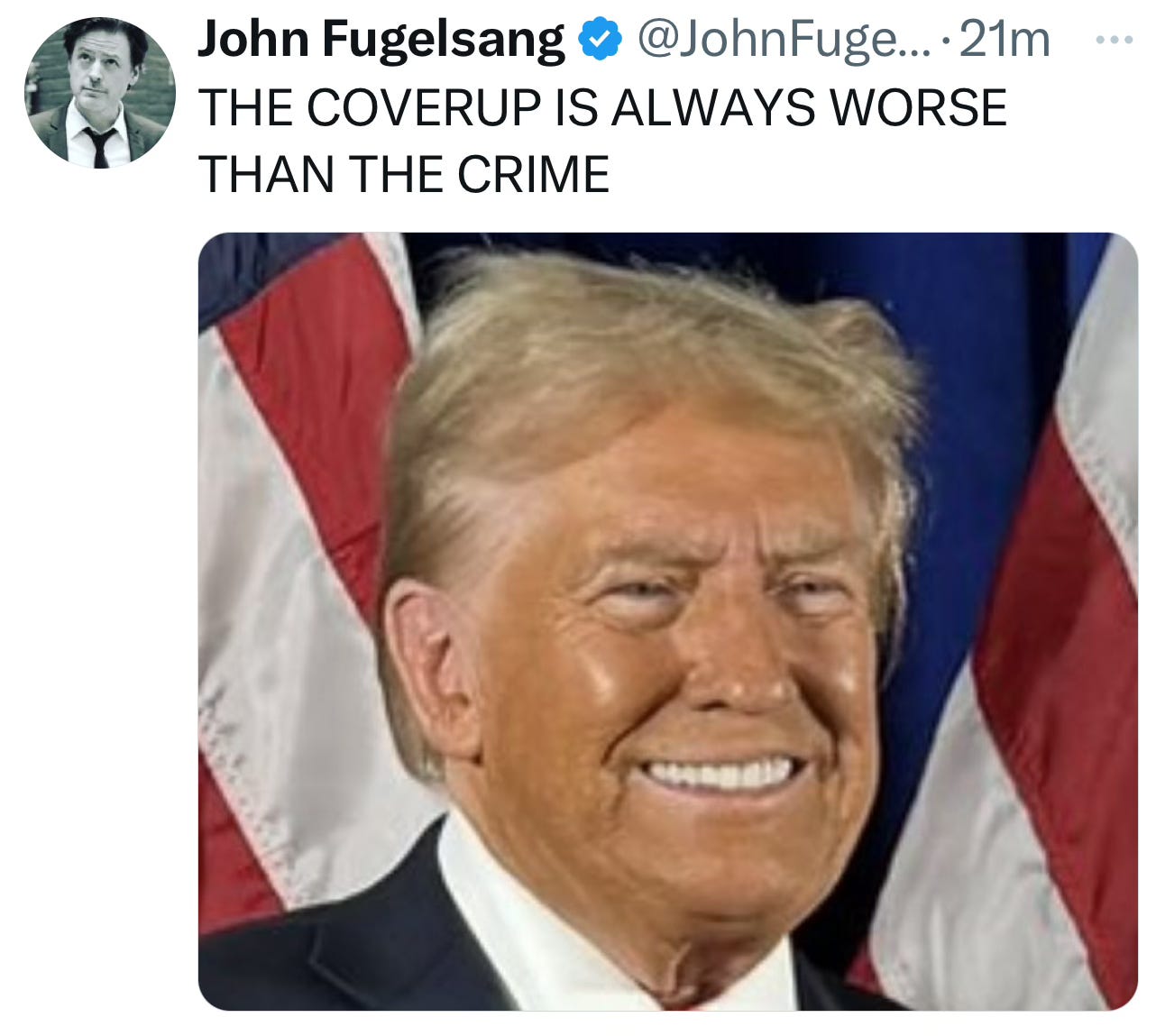
One featured post covers this point, but a few noteworthy odds and ends got left out, like this photo of a Trump makeup fail.
Sure, the photo makes Trump look ridiculous, but that’s not why I call it to your attention. It’s also evidence of a more serious problem: He’s surrounded by people who are afraid to tell him he looks ridiculous. That’s why the prospect of his second term is scarier than his first term was: In his first term, he was hemmed in by people — Don McGahn, John Kelly, Jeff Sessions, etc. — who would tell him that what he wanted to do was illegal. Those people are gone now, and they’ve been replaced by yes-men.
My article also overlooked the fact that the mainstream press (like the NYT, the Boston Globe, and AP) is finally beginning to cover Trump’s deterioration, after obsessing endlessly about Biden’s age issues.
Dave Bautista, former pro wrestler and Marvel’s Drax the Destroyer, gets real about “tough guy” Donald Trump. There’s not a joke in here anywhere, but it’s funny because it’s true.
and Elon’s campaign shenanigans
In the 2020 cycle, Trump and his people told bald-faced lies about Dominion voting machines stealing his votes. The lies were so transparent that Fox News had to pay $787 million to Dominion to settle a defamation suit. (Think about that: Defamation suits are hard to win, especially against news organizations, especially big ones who can afford the best lawyers. Trump threatens to sue news organizations all the time, but he hasn’t collected a dime.)
But why not do it again? Both MTG and Elon were out spreading crap about Dominion this week, and the MAGA sheep are probably swallowing it. You know who’s also doing it: Rasmussen Reports, a supposedly neutral polling organization whose polls always wind up favoring Trump — and get included in many polling averages as if they were legit.
Elon’s money is funding a lot of shady election tactics. Chris Hayes reports on how Muslim voters in Michigan are being micro-targeted with borderline antisemitic ads saying that Harris is all-in for Israel because she is controlled by her Jewish husband, while Jewish voters in Michigan are being micro-targeted with ads saying that Harris “panders to Palestine”. The ads are all from the same group.
They have set up fake sites impersonating the Harris campaign using fake policy positions and then sending out text messages also impersonating the campaign which aim to drive voters to the fake site.
Josh Marshall thinks the fake web site is probably legal, but the texts might not be. Matt Yglesias makes a good point:
It tells you something that they literally made up from scratch a fake version of Kamala Harris to run against.
This should be a bigger story: The richest guy in the world, who could make billions more from the right government contracts, is funding ethically dubious projects to get a fellow billionaire into the White House. Working-class voters who believe Trump is their champion might want to think about that.
and mifepristone, round 2
When the Supreme Court tossed an anti-mifepristone lawsuit on technical grounds, you knew that couldn’t be the end of the story. The other featured post details some of the creepy ideas the new lawsuit raises, like states being upset that their teen birthrate is too low. (When I saw that claim on social media, I didn’t believe it. So I read the 199-page lawsuit and discovered that it’s true.)
and here’s another story that deserves more attention
Capitalism does some things well, but it should be kept far away from other things, like running hospitals.
Thursday, the WaPo published a column summarizing a report Senator Ed Markey put out in September about the collapse of the Steward Health Care hospital chain.
The 34-hospital chain was formed in 2010 by a private equity group, Cerberus, which acquired the hospitals as investments. The WaPo article gives the firm credit for initially having benign intentions: ObamaCare had just passed, so maybe there would be a surge of new patients able to afford health care. Running the hospitals as hospitals looked likely to be a money-maker for Cerberus.
For various reasons that turned out not to be the case. But Cerberus had to produce profits for its investors anyway, so it turned to financial engineering. It formed a real estate investment trust, Medical Properties Trust, which bought the land under Steward hospitals and leased it back to the hospitals. Rather than simply owning the land, the hospitals now had to rent it, increasing annual costs. But the transaction created both a pile of money that Steward could distribute to Cerberus shareholders, as well as a regular income stream Cerberus could collect through MPT.
The downside of this transaction was diminishing the underlying viability of the hospitals, which now struggled to cover their increased costs. In May, the chain declared bankruptcy, and state governments are now spending many millions to keep at-risk communities from losing their hospitals.
In total, Cerberus has said it made roughly $800 million on its investment in Steward, more than tripling its original investment, even as the hospitals themselves were hemorrhaging cash.
As best I can tell, none of this is illegal. It’s just one more example of capitalists taking risks where the profits will be private but the losses can be socialized.
Similar stories can be told about private equity’s role in the destruction of America’s newspapers, especially local ones: Take over a challenged but surviving paper, borrow massively against its assets to pay inflated “management fees” to the investment company, then declare bankruptcy. It’s a slow-motion version of what Tony’s mob does to a local business in the “Bust Out” episode of The Sopranos.
In mythology, Cerberus is the name of Hades’ three-headed dog, who guards the gate to the Land of the Dead. It’s a rather macabre name for a firm that owns hospitals.
and you also might be interested in …
From the UK, The Economist notices something a lot of American media misses: The US economy is “The Envy of the World“.
Israel announced the death of Hamas leader Yahya Sinwar, the likely mastermind behind the October 7 attacks. Under a different administration, Israel might use this event to declare victory and start moving towards peace.
And if you want to understand the related movement of White Christian Nationalism, Kat Abu has an hour-long video explaining it.
Doug Balloon puts aside his satirical NYT Pitchbot persona to opine about WHY the NYT has covered the campaign as badly as it has, and in particular why it has consistently sanewashed Trump. He decides against any cynical argument about financial advantage and instead attributes the Times’ behavior to simple incompetence and laziness: “their system isn’t built to deal with a narcissistic sociopath” and they don’t want to change. The company is run by a “nepo baby” who is the son of a nepo baby, and he has hired high-level people who aren’t very good at their jobs.
Not to say there aren’t lots and lots of great journalists and editors at the Times. It pays well and it’s tough to get good jobs in journalism, so they can certainly hire lots of great people. But I suspect that on the really big decisions, ones where Sulzberger himself or people near him weigh in, the fact neither Sulzberger or the people near him are very smart or competent plays a big role.
A commenter recently pointed me to this Lancet article, claiming that the actual number of deaths caused by the war in Gaza is probably much higher than the official estimate. Wars, the article points out, commonly produce “indirect deaths” well beyond the number of people who directly die by violence. These deaths are from disease, malnutrition, and various other causes, and they may occur even after the violence ends. Looking at past conflicts, the article claims the total death toll could be between 3 and 15 times the official count of around 42,000.
I always come back from a driving trip with a new podcast to recommend. This time I listened to Trevor Noah’s “What Now?”. In particular, Noah’s interview with Ta-Nehisi Coates is amazing. In the final essay in his new book The Message, Coates compared the Israeli occupation of the West Bank to South Africa’s apartheid. Noah grew up in South Africa, and was 10 when apartheid ended. They have a lot of interesting things to say.
and let’s close with something tiny
Ever since Anton van Leeuwenhoek began to popularize the microscope in the early 1600s, people have been amazed by what ordinary objects look like under extreme magnification. In this article Scientist assembles beautiful and surprising images of extremely small things, like this close-up of a sugar found in Coca-Cola.



















 The Weekly Sift