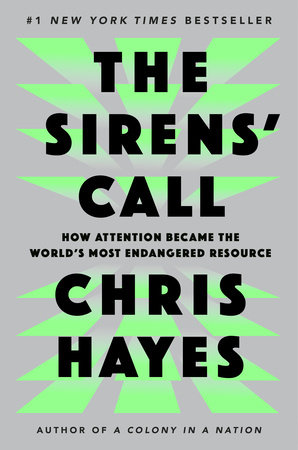
This week’s featured post takes a step back from the immediate news of the week to look at a force shaping the news. Using insights from Chris Hayes’ recent book The Sirens’ Call, I’ll look at how the attention economy has changed politics and governance. That post should be out shortly.
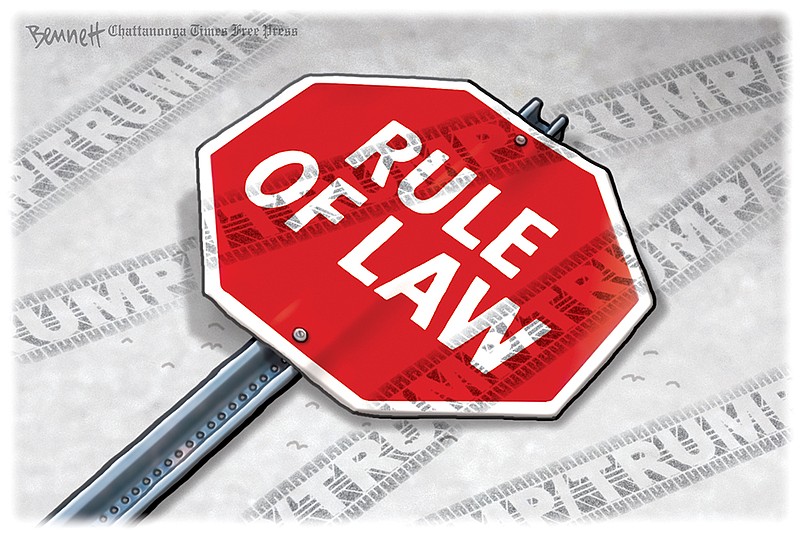
That leaves the news of the week to the summary: the Trump administration’s attacks on the rule of law, Social Security, the US tourism industry, the Education Department, and vaccine research. Also: developments in Ukraine, Gaza, and Turkey. That should be out before noon.
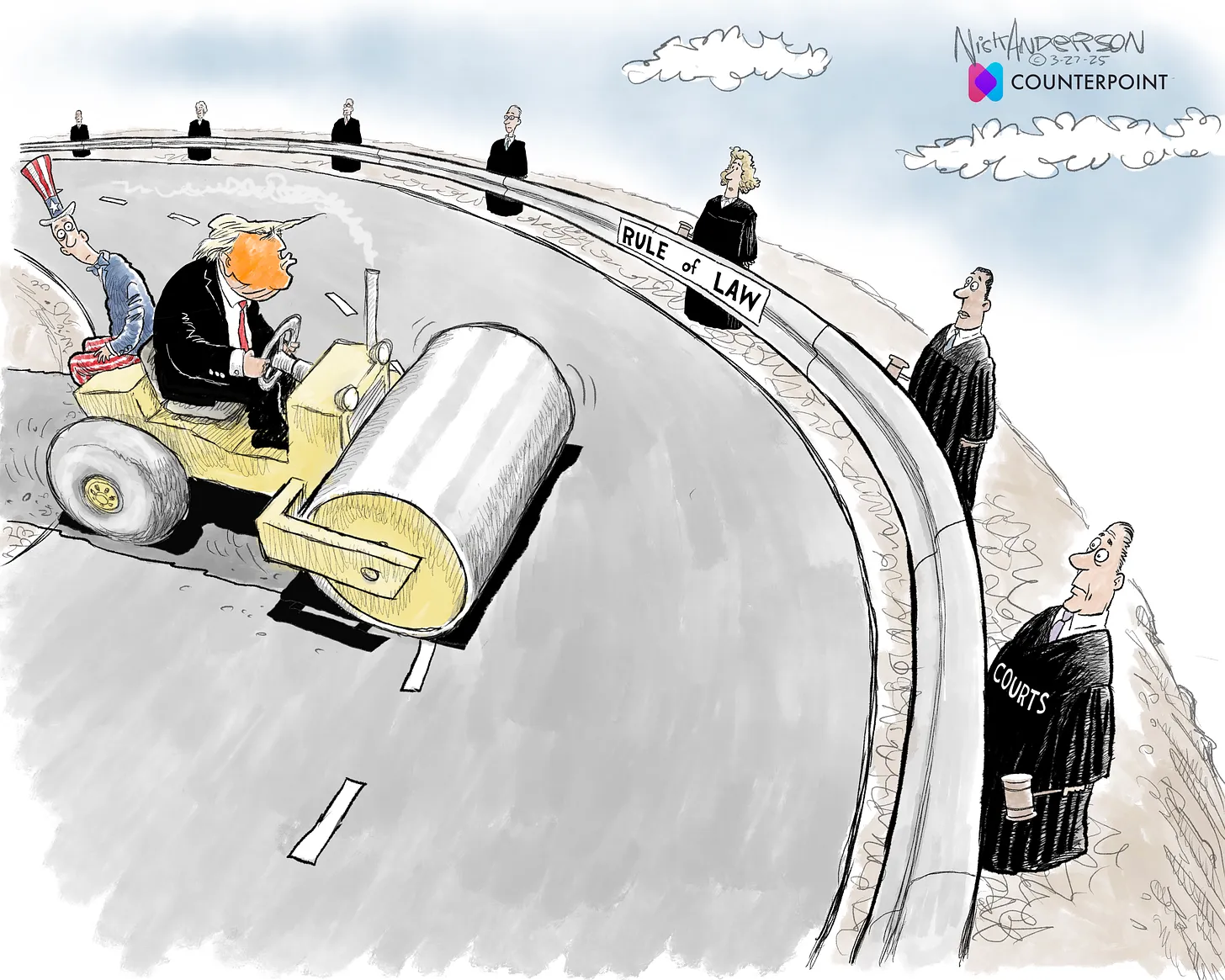
We are inevitably headed, whether it’s in this case or another, to a confrontation between a president who has rejected the rule of law and a judge sworn to enforce it. We are in an exceedingly dangerous moment for democracy.
This week everybody was talking about the shutdown that didn’t happen
Congress passed a continuing resolution keeping the government open for the rest of this fiscal year, i.e. until September 30. I have to own up to some disappointment here. Three weeks ago I wrote this:
The real test happens when the government runs out of money on March 14. It’s easy to be for or against things until somebody puts price tags on them and adds them all up. In order to get the bill he wants, Trump will need support from almost all of the Republicans in the House. If Democrats stay united and only two Republicans vote against a spending deal, it fails.
If that happens, that’s when congressional Democrats begin to have negotiating leverage.
But Speaker Mike Johnson wrote his continuing resolution without any input from Democrats, and he passed it through the House because he lost only one Republican vote. Heather Cox Richardson summarizes what’s in it:
The new measure is not a so-called clean CR that simply extends previous funding. Instead, the Republican majority passed it without input from Democrats and with a number of poison pills added. The measure increases defense spending by about $6 billion from the previous year, cuts about $13 billion from nondefense spending, and cuts $20 billion in funding for the Internal Revenue Service. It forces Washington, D.C., to cut $1 billion from its budget, protects President Donald Trump’s ability to raise or lower tariffs as he wishes, and gives him considerable leeway in deciding where money goes.
When that CR went to the Senate, Democrats could have blocked it if they had hung together. (It takes 60 votes to kill a filibuster, and Republicans only have 53 senators.) For a while it looked like that would happen, with many people speculating about whether 7 Democrats would break ranks.
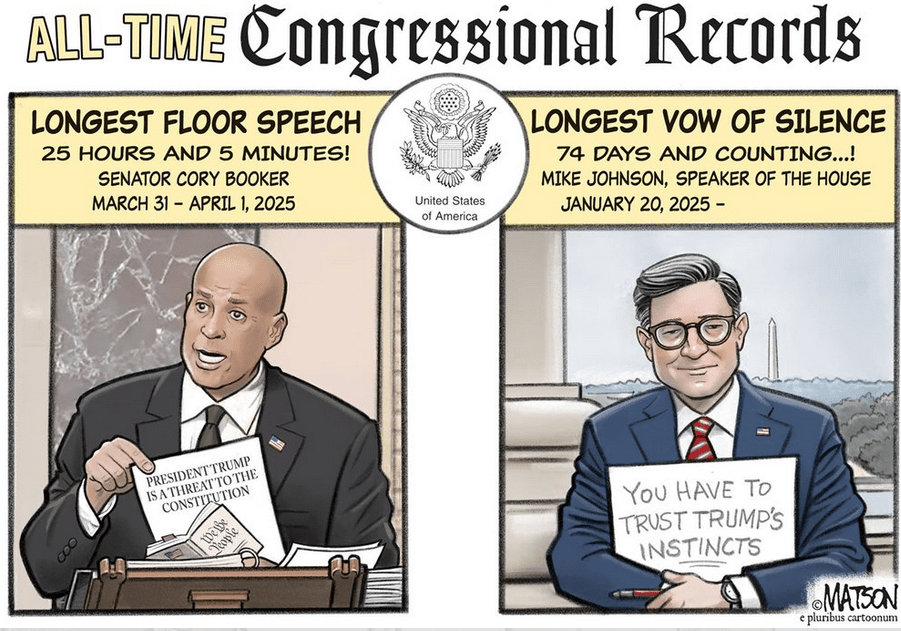
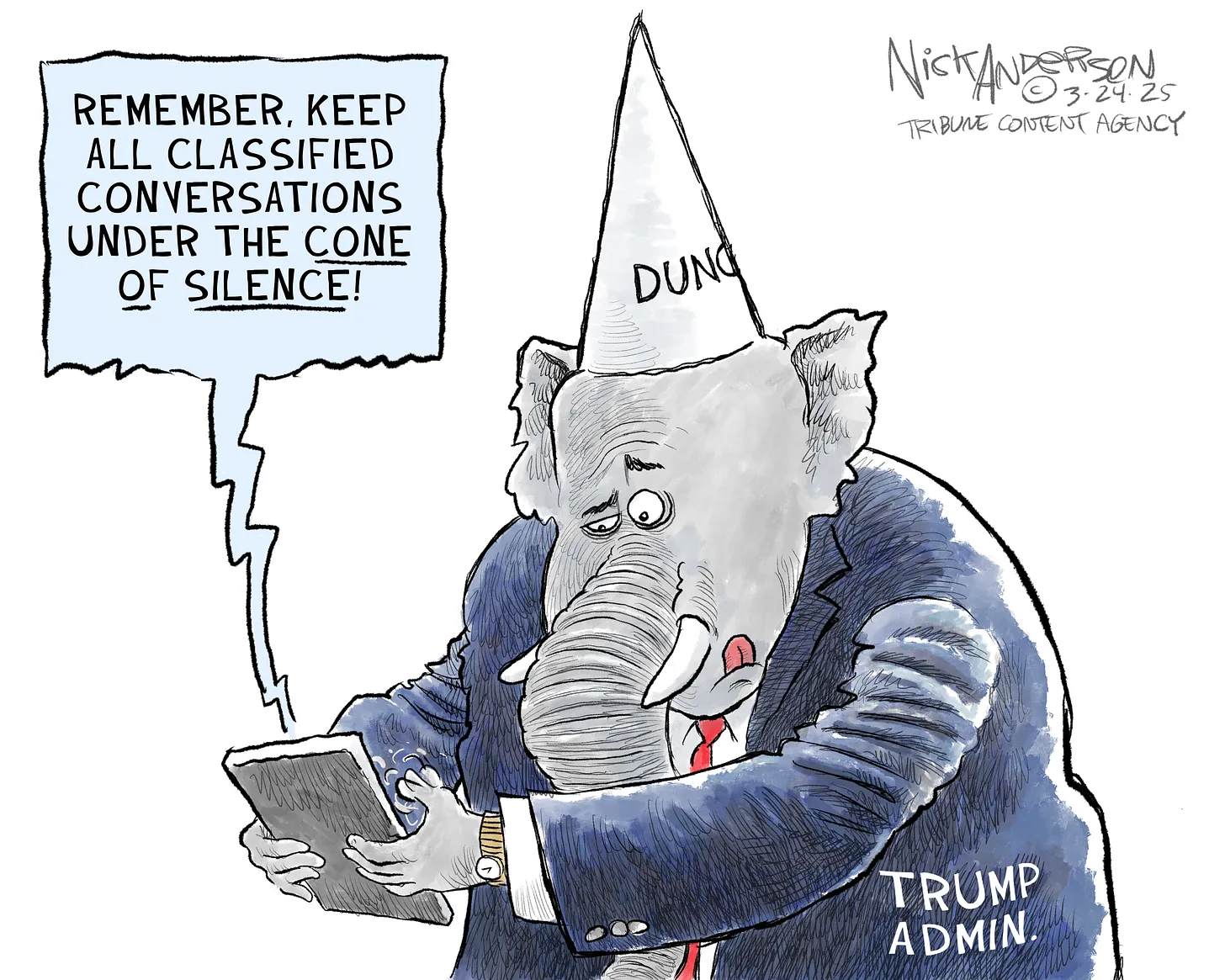
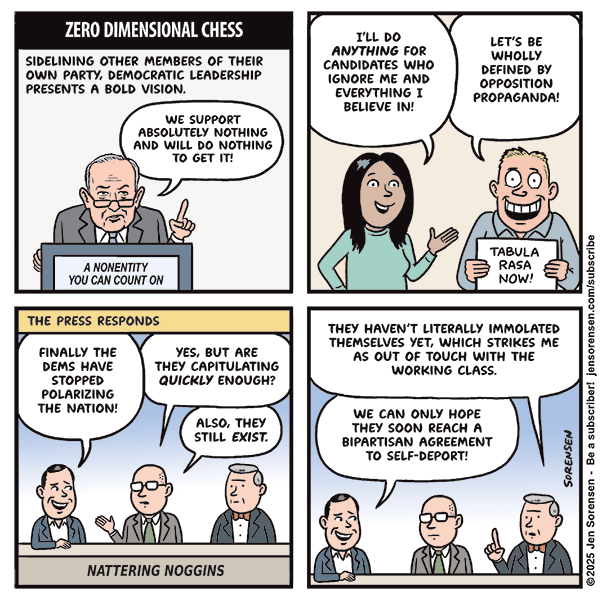
Then Democratic Senate Leader Chuck Schumer flipped to support the CR. This move is very unpopular inside the Democratic base, and was denounced by Democrats from AOC to Nancy Pelosi.
Schumer wrote an op-ed to explain. I’m going to try to express his view more convincingly than he did, not because I agree with it, but because I’m trying to evaluate it.
Ordinarily, a government shutdown is like a labor strike against a company: It hurts both sides, and the conflict is over who can endure the most pain before giving in. In a typical shutdown, both Republicans and Democrats understand that the American people don’t like it. So they maneuver to blame each other while looking for some acceptable compromise that will end it.
But what if Trump likes ruling over a shut down government? What if he’d be content to let the shutdown run until the end of the fiscal year in September? During a shutdown, only “essential” services are provided: the military stays on duty, Social Security checks still get mailed, and so on. But isn’t the whole point of all the DOGE firings and cutbacks to eliminate anything not “essential”?
If that’s the case, then Trump doesn’t feel pain and doesn’t come under more and more pressure to make a deal as the shutdown continues. Eventually the Democrats have to capitulate and get nothing, so why not capitulate and get nothing now?
I admit that I have trouble evaluating whether or not that’s how a shutdown would play out. Maybe it would. But even if I grant Schumer that point, I’m not impressed with his leadership, because he apparently didn’t see this situation coming and had no plan to deal with it when it arrived.
OK, I admit I also didn’t think Speaker Johnson would keep his ducks in a row and get a CR passed without Democrats. But it was always at least a possibility. Somebody on the Democratic side should have gamed out how to respond. There should have been a plan and a message: “We can’t fight Trump this way, so we’re going to fight him that way.” There should have been talking points, and major Democrats should have united in pushing those points.
Instead, Schumer was talking about defeating the CR right up until the moment he turned around. Democrats are presenting no plan for resisting Trump going forward, and they’re bickering among themselves about what they just did. They look weak and Trump looks masterful. Good going, Chuck!
The one saving grace in all this is that a shutdown itself is not in the headlines. Instead we can focus on the ever-weakening Trump economy, the assault on constitutional rights, and the crashing stock market. If only there were an opposition party with a plan to turn everything around.
and Mahmoud Khalil
His deportation case, and what it means for freedom of speech in general, is the subject of the featured post.
A related issue is the Trump administration’s attack on Columbia University, where Khalil was a student. The Harvard Crimson writes “First They Came for Columbia“, charging that “The administration has weaponized the fight against antisemitism as a means to another end: punishing and weakening universities.” It says that no university is in a better position to lead a fight against this than Harvard, which so far is doing nothing.
and the rule of law
With the failure of Congress to check Trump in any way, the full burden falls on the courts. From the beginning, two questions have loomed over all the cases challenging Trump’s illegal actions:
Will the Supreme Court invent new law to justify whatever Trump does?
What happens if the Trump administration doesn’t obey court orders?
We’re getting closer and closer to finding out. This week, hundreds of non-citizens were deported under the aegis of the Alien Enemies Act of 1798. This is one of the notorious Alien and Sedition Acts you may remember from US History class. Heather Cox Richardson summarizes the history:
That law, which applies during wartime or when a foreign government threatens an “invasion” or “predatory incursion,” permits the president to authorize the arrest, imprisonment, or deportation of people older than 14 who come from a foreign enemy country. President James Madison used the law to arrest British nationals during the War of 1812, President Woodrow Wilson invoked it against Germans during World War I, and President Franklin Delano Roosevelt used it against Japanese, Italian, and German noncitizens.
During the 2024 presidential campaign, Trump said he would use the Alien Enemies Act to deport gang members, and in an executive order signed Friday night but released yesterday morning after news of it leaked, Trump claimed that thousands of members of the Tren de Aragua gang have “unlawfully infiltrated the United States and are conducting irregular warfare and undertaking hostile actions against the United States.” In connection with the Venezuelan government, he said, the gang has made incursions into the U.S. with the goal of “destabilizing democratic nations in the Americas, including the United States.”
This is pretty fanciful stuff. Maybe Tren de Aragua is operating in the US, though Trump has a long history of exaggerating immigrant gangs, so I’d be amazed if we’re really talking about “thousands” of members. But the idea that they aren’t just trying to make money the way all gangs do, but are instead “conducting irregular warfare” while conspiring with the Venezuelan government to “destabilize … the United States” — that seems like a fever dream to me. Is there any evidence to back that up?
So this was the justification for deporting 200 supposed gang members to El Salvador. El Salvador is getting paid $20K per man/year to imprison them (prior to any graft), so you can imagine the conditions they’ll be held in.
The ACLU filed suit pointing out that the administration had presented no evidence these actually were gang members, or that Venezuela was using them to wage war against us, so a federal judge issued a temporary restraining order against invoking the AEA in this way. And then things got interesting.
Ryan Goodman of Just Security put together the timeline of what came next. At 5:00 last night, Judge Boasberg asked whether deportations would happen in the next 24–48 hours. The government’s attorney said he didn’t know; the ACLU attorney said the government was moving rapidly. Before 5:22, Boasberg ordered a break so the government attorney could obtain official information before the hearing resumed at 6:00.
At 5:45, Goodman reports, another flight took off.
Before 6:52, Judge Boasberg agreed with the ACLU that the terms of the Alien Enemies Act apply only to “enemy nations,” and blocked deportations under it. Nnamdi Egwuonwu and Gary Grumbach of NBC News reported that the judge ordered the administration to return the planes in flight to the United States. “Any plane containing these folks that is going to take off, or is in the air, needs to be returned to the United States,” the judge said. “Those people need to be returned to the United States.”
The plane did not turn around. Law Dork looks into the details. It appears that the administration’s position is that the judge’s order did not apply once the plane had left American airspace.
Of course that’s absurd — as many others also noted Sunday — because the U.S. government was still in control of the planes, and the Justice Department lawyer before Boasberg on Saturday evening had literally argued, albeit unsuccessfully, that there was no irreparable harm here — a factor in deciding whether to grant a TRO — because the challenge could continue even if individuals had been deported.
One thing you can see across multiple court cases: Trump administration lawyers are not operating in good faith. They say whatever will allow illegal policies to continue. And if they have to say the opposite tomorrow, they don’t care.
Jay Kuo summarizes the week’s other legal news, which was pretty good.
A federal judge ordered the administration to rehire tens of thousands of the probationary workers it fired. Basically, the administration took advantage of a loophole allowing probationary workers to be fired for poor performance, and pretended that all probationary workers had performed poorly. The judge called this scheme “a sham”.
A member of the National Labor Relations Board returned to work after a court found her firing illegal.
Paul Krugman looks at the purely economic cost of Trump trashing America’s image. He starts with Canada cancelling its order for F-35 fighter jets, which makes sense because “sophisticated military equipment requires a lot of technical support, so you don’t want to buy it from a country you don’t trust.” Several European countries are also reconsidering buying new American weapon systems.
I had not appreciated how big US military exports are: $318.7 billion in 2024. That’s 15% of total exports and twice as big as agricultural exports. And then there’s tourism ($100 billion) and education ($50 billion). As the US becomes more suspicious of foreigners and less welcoming (not to mention Trump trashing our universities), those numbers should go down.
One way to think about this is to say that Trump is doing to America what Elon Musk is doing to Tesla, destroying a valuable brand through erratic behavior and repulsive ideology. … Trump’s belief that America holds all the cards, that the rest of the world needs access to our markets but we don’t need them, is all wrong. We are rapidly losing the world’s trust, and part of the cost will be financial.
Krugman recognizes that as an academic economist, he’s not particularly good at predicting short-term business cycles. So he interviews somebody who does that for a living. The upshot is that numbers look decent right now, but it wouldn’t take much to change them. Both hiring and firing have been soft recently, so it wouldn’t take much in the way of layoffs to spike the unemployment rate.
Robert Morris, a Texas megachurch founder with connections to Donald Trump, was indicted in Oklahoma Wednesday for molesting a girl in the 1980s, when he was living with her family. I mention this not out of animus towards either Morris or the branch of Christianity he represents, but to make a point.
Certain cases become the center of movements; laws are named after them. For example, Lakin Riley was a nursing student murdered by an immigrant who had entered the US illegally. That led to the Lakin Riley Act, which requires the government to deport immigrants accused of certain crimes, even if they aren’t convicted.
Whether a case takes on that kind of symbolic value depends on the popularity of the people in question. Undocumented immigrants are unpopular, so crimes they commit are candidates for becoming the center of campaigns, depending not at all on whether the perpetrators are typical of some larger trend.
Drag performers are also unpopular, and various laws restricting them have been pitched based on the threat they pose to children, despite the fact that there seems to be no such threat. But imagine what would happen if a single drag performer raped a single child. That child would become famous, and very likely would end up with a law named after him or her.
Christian ministers, on the other hand, are popular. So of course there will be no Cindy Clemishire Act, (named for Morris’ victim) that puts restrictions on Christian ministers or abridges their rights in some way. It doesn’t matter how many ministers molest children. None of those cases will become the kind of cause célèbre that Lakin Riley’s murder was.
Can a legal permanent resident be deported for expressing views the President disagrees with?
A long-standing debate runs through American history: Does the Bill of Rights enumerate human rights, i.e., something that anyone can claim by virtue of being human, or privileges of citizenship that our government can ignore when it deals with non-citizens?
The Declaration of Independence uses theistic language to promote a human-rights view: Human beings (or at least “all men”) have been “endowed” with rights “by their Creator”. To say that a man lacks rights is tantamount to claiming that he was not created by God. But in the Dred Scott decision of 1857, the Supreme Court took the opposite view: Rights derive from the social contract embodied in the Constitution. Africans residing in the United States, the Court held, were not party to that contract, and thus they “had no rights which the white man was bound to respect”.
Dred Scott has long been in the dustbin of history, and is widely viewed as one of the Court’s worst decisions. Currently binding Supreme Court precedents take an in-between view that leans towards human rights. Basically, the Court interprets the Constitution and the laws to mean exactly what they say: If lawmakers had intended a provision to apply only to citizens, they would have used the word “citizen” rather than some more general term like “person”. For example, the 14th Amendment uses both words:
No State shall make or enforce any law which shall abridge the privileges or immunities of citizens of the United States; nor shall any State deprive any person of life, liberty, or property, without due process of law; nor deny to any person within its jurisdiction the equal protection of the laws.
So there are privileges that apply only to citizens (the right to vote, for example), but due process and equal protection are not among them.
The Trump administration shows every sign of wanting to move that line. Just how far it wants to go is not clear. But the first case in point is Mahmoud Khalil.
Who is Mahmoud Khalil? Two weeks ago, Khalil (an Algerian citizen born in a Palestinian refugee camp in Syria) had the next layer of privileges short of American citizenship: He came here originally on a student visa, but became a legal permanent resident, a “green card holder”. He is married to an American citizen, who is eight months pregnant. If nothing goes wrong, in another month he’ll be the father of an American citizen.
He is also a pro-Palestine activist. Last spring, he participated in demonstrations at Columbia University, where he was a student at the time. (He has since finished his degree.) Wikipedia describes his views like this:
Following the start of the Gaza war in 2023, Khalil became involved in pro-Palestinian activism. He served as a negotiator for students associated with Columbia University Apartheid Divest (CUAD) when they were bargaining with Columbia University officials. In a 2024 interview, Khalil said, “As a Palestinian student, I believe that the liberation of the Palestinian people and the Jewish people are intertwined and go hand by hand, and you cannot achieve one without the other.” He characterized the movement as one “for social justice and freedom and equality for everyone”. Of concerns about antisemitism, Khalil said, “There is, of course, no place for antisemitism. What we are witnessing is anti-Palestinian sentiment that’s taking different forms, and antisemitism, Islamophobia, racism [are] some of these forms.”
The Trump administration describes him differently, claiming that he “led activities aligned to Hamas” and “engaged in pro-terrorist, anti-Semitic, anti-American activity“. But it has produced no specifics to back those claims up, and the language itself is slippery. What does it mean that an activity is “aligned with Hamas”? Aligned in whose view? Similarly, unless Khalil himself endorsed terrorism or attacked Jews or America in so many words — and if he had, I’d expect his critics to have produced specific quotes — “pro-terrorist, anti-Semitic, anti-American” is an opinion, not a fact.
Khalil’s arrest. A week ago yesterday, agents from the Homeland Security department arrested Khalil at his home in New York. Khalil’s wife Noor Abdalla recorded the event on her phone while simultaneously talking to Khalil’s lawyer on his phone. It isn’t exactly a classic police-state arrest — Khalil is not roughed up, for example — but it still has a lot of disturbing aspects. When Khalil’s wife asks for the names of the arresting agents, she is told “We don’t give our names.” They also refuse to say which agency they represent. All they’re willing to tell her is where Khalil is being taken: Immigration Custody at 26 Federal Plaza. They refuse to talk to Khalil’s lawyer, who is on the phone. “They’re literally running away from me,” Noor reports to the lawyer.
When Noor tried to visit Khalil at a detention center in New Jersey, she was told he was no longer there. It took some time for his lawyer to determine that Khalil had been moved to a facility in Louisiana, where at first he was not allowed to consult privately with lawyers. An immigration hearing to have him deported was scheduled for March 27.
Last Monday, a federal judge in New York ordered that Khalil not be removed from the US until a hearing in his court can determine whether deporting him violates constitutional rights.
The Just Security blog analyzes the legalities: No one in the executive branch can unilaterally revoke a green card.
To obtain authority to deport a green card holder, the government must charge (or accuse, as this is not a criminal matter) them with a condition under the immigration laws that in some way makes them “deportable.” “Deportable” is a term of art under the immigration laws. It refers to conduct defined in a set of provisions—most though not all involving criminal activity—codified at 8 U.S.C. 1227(a).
To prove that an [legal permanent resident] is deportable, the government must convene a “removal hearing” before an immigration judge. At that hearing, government attorneys must prove deportability by “clear and convincing” evidence.
Notably, the Trump administration has not accused Khalil of committing crimes, or of committing fraud in his green-card application (another deportability condition). Instead, it points to a condition that has never been used in this way before:
the government has invoked a rarely used “foreign policy” ground of deportation. That provision, located in section 237(a)(4)(C) of the Immigration and Nationality Act, makes deportable any “alien whose presence or activities in the United States the Secretary of State has reasonable ground to believe would have potentially serious adverse foreign policy consequences for the United States” (emphasis added).
The statute contains a (freedom of speech and association) safe harbor, incorporated by reference to the inadmissibility provisions, prohibiting deportation “because of the alien’s past, current, or expected beliefs, statements, or associations, if such beliefs, statements, or associations would be lawful within the United States,” but then contains an exception for the safe harbor: “unless the Secretary of State personally determines that the alien’s [presence] would compromise a compelling United States foreign policy interest” (emphasis added).
It’s worth pointing out that much of what the administration claims about Khalil (even if true) consists of “beliefs, statements, or associations would be lawful within the United States”. The First Amendment would protect an American saying “I support what Hamas did on October 7”, even if most other Americans would find that statement reprehensible. (Again, Khalil seems not to have said anything like that.)
The foreign-policy justification is pretty obviously absurd: Khalil is up for deportation because Trump promised to deport pro-Palestinian campus demonstrators. There is no “compelling US foreign policy interest” involved. What the administration will probably argue, though, is that identifying US foreign policy interests is a judgment call that belongs to the executive branch, not the judiciary.
The case, then, will turn on whether an immigration judge feels empowered to use common sense, which says that the foreign policy interest here is a pretext, not a reason.
Protests calling for Khalil’s release were held in several cities this weekend. The most striking was organized by Jewish Voice for Peace. Thursday, over 100 demonstrators were arrested for occupying Trump Tower in New York.
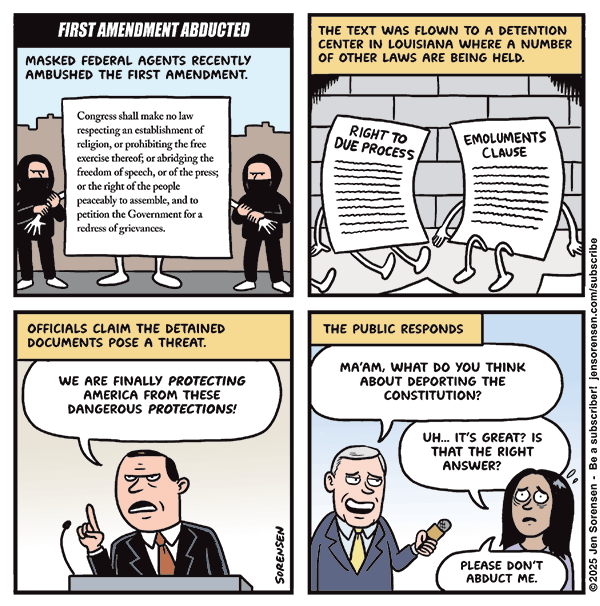
In truth, the administration seems to be fighting freedom of speech, not antisemitism. The Khalil case shows the lengths it will go in order to find legal pretexts to punish people it disagrees with. That should worry all of us, no matter what we think about Palestine or Israel.
To me, two stories stand out above all others this week: Senate Democrats deciding not to shut down the government, and the arrest of Palestinian activist Mahmoud Khalil. I’ll cover the first in the weekly summary and the second in a featured post.
The Khalil case raises two fundamental issues: (1) Is freedom of speech a human right that our government should respect for all people under its jurisdiction? Or is freedom of speech a privilege of citizenship that even legal permanent residents don’t have? (2) Do we still respect the famous quote attributed to Voltaire, that we will defend someone’s freedom to say something we disagree with?
The featured post will discuss those issues, and should appear maybe 10 or so EDT.
Chuck Schumer’s acquiescence with the Republican continuing resolution to keep the government open is partly an issue of strategy (Would Trump give up anything to reopen the government, or would he actually welcome keeping it closed?), but also a question of planning: Even if Schumer didn’t expect House Republicans to hang together enough to pass their continuing resolution, he should have had a plan covering that possibility. As it was, Democrats looked weak and discombobulated.
The week also saw a number of developments in the fight against Trump in the courts. And several writers posted discussions of the secondary effects of Trump trashing America’s image overseas. The summary should be out sometime between noon and 1.
When you see important societal actors — be it university presidents, media outlets, C.E.O.s, mayors, governors — changing their behavior in order to avoid the wrath of the government, that’s a sign that we’ve crossed the line into some form of authoritarianism
Pundits struggled to make sense of the Oval Office meeting between Trump and Zelenskyy on February 28, but nobody nailed it better than Jon Stewart: Trump and the Republicans just like Putin better. Stewart made an extended metaphor about a pro wrestling scene in which apparent good-guy John Cena sneak attacks a fellow good-guy wrestler.
Creating tension with Ukraine in the Oval Office meeting “was a ‘heel turn’ designed to create the alliance Trump always wanted in the first place,” Stewart explained, referring to the pro-wrestling narrative device in which a fan-favorite character changes to become a storyline’s villain.
Another way to understand the meeting is to take “Trump is Putin’s puppet” literally. Trump told Zelenskyy exactly what Putin would have told him had he been there: Surrender or World War III starts.
I have to wonder whether Trump can speak while Putin drinks a glass of water.
After the meeting, Trump withdrew all military aid from Ukraine, including intelligence. Time reports:
The Ukrainians have lost the ability to detect the approach of Russian bombers and other warplanes as they take off inside Russia. As a result, Ukraine has less time to warn civilians and military personnel about the risk of an approaching airstrike or missile.
The result: “hundreds of dead Ukrainians”.
Since the end of World War II, the United States has stood for collective security based on alliances with other democratic nations and resistance to aggression by dictators. We haven’t always applied those principles consistently, but we never explicitly rejected them. Now we do. If dictators want to take over their neighbors, that’s their business.
BTW: Trump’s cocksure assertion that Zelenskyy “doesn’t have the cards” because Ukraine is losing on the battlefield is another example of Putin’s puppetry. The battlefield is not going well for either side. Both countries are facing exhaustion, and while Russian forces are advancing slowly, at this pace it will take many years to conquer Ukraine.
and tariffs
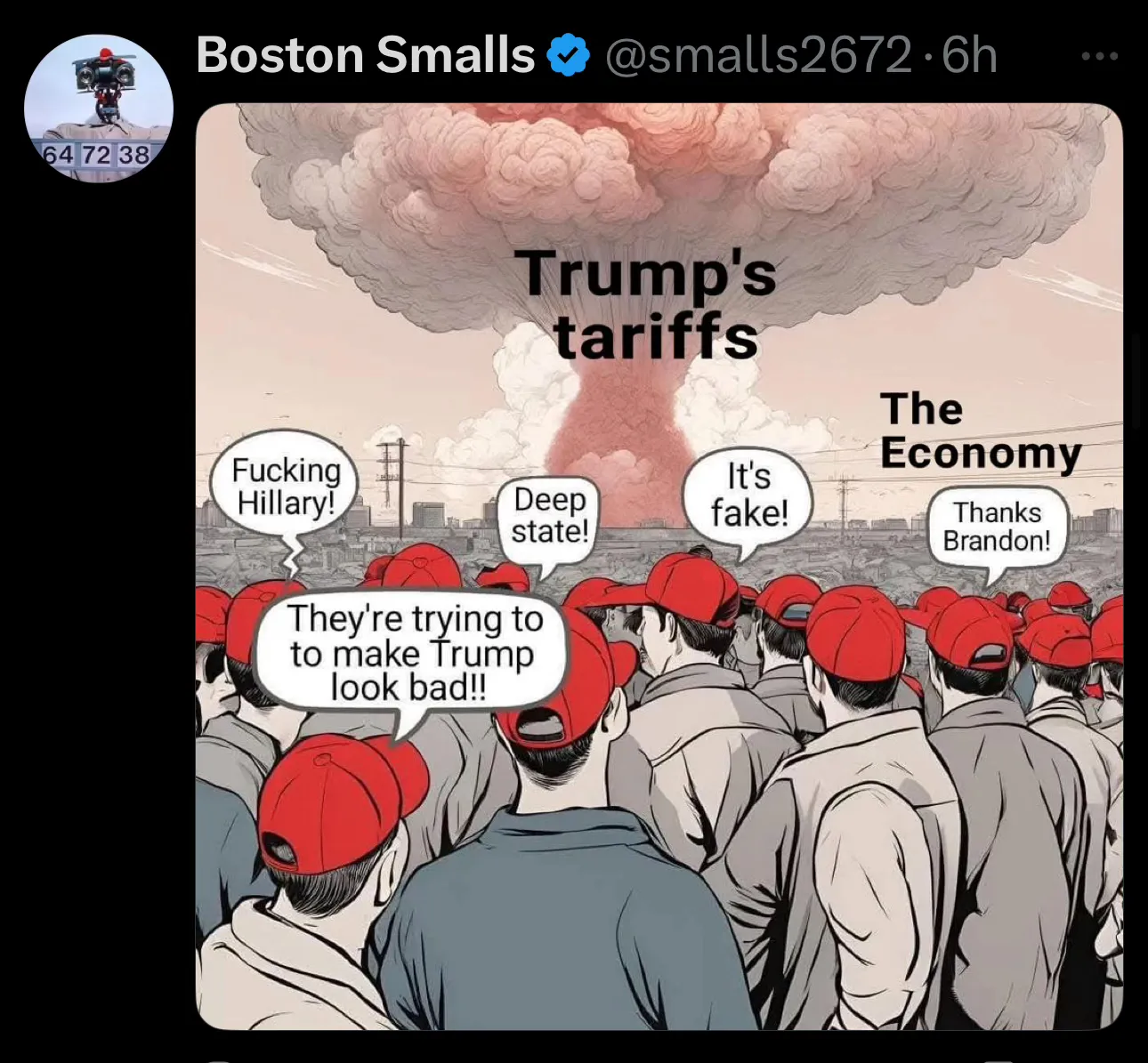
Trump whipsawed the markets these last two weeks with a series of announcements about tariffs being imposed or postponed. That’s the topic of the featured post. But in that post I didn’t get around to making the obvious prediction: Capital spending is going to collapse, and is probably already collapsing, because companies and investors can’t trust their projections of where the economy is headed. Ditto for households, who can’t predict whether the government spending cuts are going to affect their jobs. (Maybe you can build that new bedroom onto your house, or maybe you’re going to need a cushion in case you’ll be unemployed.) So money is going to sit on the sidelines, and that is going to start a recession.
and the budget
Thursday, the nonpartisan Congressional Budget Office confirmed what should have been obvious to everyone: The budget outline that the House passed recently is going to make substantial cuts to Medicaid.
House Republicans last week narrowly passed a budget instructing the energy and commerce committee, which is responsible for federal healthcare, to cut spending under its jurisdiction by $880bn … The independent in-house agency confirmed that it would be impossible to reduce spending by $880bn without cuts to Medicare, Medicaid or the Children’s Health Insurance Program (Chip). That’s because after excluding Medicare, Medicaid and Chip, the committee oversees only $381bn in spending – much less than the $880bn target – the CBO said.
Announce plans to cut those general areas, but deny that the cuts will affect those programs, even if the math doesn’t work without such cuts.
Cut those programs, but claim that only “waste and fraud” will be affected.
Refuse to pay for your kid’s healthcare and/or kick your mother out of her nursing home.
We’re already hearing rhetoric about how deep cuts in federal spending are “necessary”, because the $36-trillion-and-rising federal debt is unsustainable. But no matter how dire a picture Republicans paint of our fiscal situation, taxing rich people is never an option.
House Republicans are committed to not negotiating with Democrats about either the FY 2026 budget or the continuing resolution to fund the rest of FY 2025, which is needed to prevent a government shutdown on Friday. Democrats want a commitment that whatever funding they pass is meaningful, and won’t just get frozen by Musk or Trump. Republicans want to give Trump maximum flexibility, even if it means surrendering Congress’ power of the purse.
In order to do that, they’ll need to hold all their members together, which they’ve never managed before. But maybe this time they can.
and Trump’s speech to Congress
which I didn’t watch (though I did quickly scan a transcript). I don’t see the point, since nothing Trump says can be believed. The Guardian fact checks the speech’s biggest whoppers. Since Trump has been corrected on these fake facts before, they are clearly intentional lies.
The biggest one was his claim that Elon Musk has uncovered “massive fraud”. So far, Musk has said the word “fraud” a lot, but he hasn’t provided any evidence of it. Quite likely, Musk has not uncovered any fraud.
Trump’s speech lasted a record-setting 100 minutes, reminiscent of the hours-long speeches dictators like Cuba’s Fidel Castro used to give.
Like me, James Fallows more or less ignored the speech’s content, focusing instead on its symptomology. He noticed four things:
Trump’s rhetorical range is shrinking. He used some form of his “like nothing ever seen before” cliche 20 times during the speech. By contrast, he said it only once in his first inaugural address, and it rarely appeared in his first-term State of the Union addresses. Similarly, “incredible” has become his dominant positive adjective, appearing six times.
More alarmingly, Fallows notes that all types of Trump speeches — MAGA rallies, presidential addresses, press conferences, televised Oval Office talks — have collapsed into one form. The broader press commented on how rally-like this speech was, but missed the larger point that all Trump speeches are basically the same now.
Recent presidential addresses to Congress have included heckling from the opposing party (going back to Joe Wilson’s “You lie” directed at Obama in 2009). But this was the first time a president has abused members of Congress: Trump called Elizabeth Warren “Pocahontas” from the podium.
Presidents almost always spin or shade the truth in these speeches, and occasionally have even lied outright. But Trump’s lying has reached a completely different level. Lying is no longer an attempt to fool people, because some of Trump’s lies are so transparent — Social Security is paying benefits to people it thinks are 200 years old — that no one will believe them. Instead, lying has become an expression of power. “To me, Trump’s body-language—his bearing, mood, and presentation—suggested that the grossness of the lies was the point of the exercise. Preening in the knowledge that he could get away with it, and that he could make his minions applaud.”
Newly elected Democratic Senator Elissa Slotkin needed only 10 minutes to respond.
We just went through another fraught election season. Americans made it clear that prices are too high and that government needs to be more responsive to their needs. America wants change. But there is a responsible way to make change, and a reckless way. And, we can make that change without forgetting who we are as a country, and as a democracy.
She talked about the economy:
President Trump is trying to deliver an unprecedented giveaway to his billionaire friends. He’s on the hunt to find trillions of dollars to pass along to the wealthiest in America. And to do that, he’s going to make you pay in every part of your life. Grocery and home prices are going up, not down — and he hasn’t laid out a credible plan to deal with either. His tariffs on allies like Canada will raise prices on energy, lumber, cars — and start a trade war that will hurt manufacturing and farmers. Your premiums and prescriptions will cost more because the math on his proposals doesn’t work without going after your health care. Meanwhile, for those keeping score, the national debt is going up, not down. And if he’s not careful, he could walk us right into a recession.
And national security:
[T]hat scene in the Oval Office wasn’t just a bad episode of reality TV. It summed up Trump’s whole approach to the world. He believes in cozying up to dictators like Vladimir Putin and kicking our friends, like Canada, in the teeth. He sees American leadership as merely a series of real estate transactions. …
[O]ur democracy, our very system of government, has been the aspiration of the world. And right now, it’s at risk. It’s at risk when a president decides he can pick and choose what rules he wants to follow, when he ignores court orders or the Constitution itself, or when elected leaders stand idly by and just let it happen. But it’s also at risk when the President pits Americans against each other, when he demonizes those who are different, and tells certain people they shouldn’t be included. Because America is not just a patch of land between two oceans. We are more than that. Generations have fought and died to secure the fundamental rights that define us. Those rights and the fight for them make us who we are.
and Tesla
For years, Elon Musk’s public image worked to Tesla’s benefit. He was Tony Stark. He was to our world what Hank Rearden was to Atlas Shrugged. And Tesla had a technology lead over rival electric-car companies. So Teslas weren’t just good cars, they were cool. Driving a Tesla was a virtue signal; it told the world you were serious about climate change.
His Trump contributions bought him the extra-constitutional power to cut government programs, fire civil-service workers, and shut down agencies created by Congress. (The Atlas Shrugged character he most resembles now is Wesley Mouch, head of the Bureau of Economic Planning and National Resources.) Has medical research ground to a halt in Musk’s America? Are children starving in Africa while food rots in US ports? What a shame.
Suddenly, people who had been willing to pay a virtue premium for a Tesla are instead looking for a vice discount. It isn’t just that competitors have caught up to Tesla (which they have). In many people’s minds, a Tesla would have to be a lot better than the next best EV to make up for the stigma of driving a “Swasticar“.
And in case you hadn’t noticed that stigma, anti-Musk demonstrators are showing up at Tesla showrooms to remind you. Saturday, Tesla Takedowns erupted all over the US, with 350 protesters in Manhattan alone.
In Europe as well, Tesla’s problems are growing: In Germany, sales were down 60% in January and 76% in February.
Maybe you were horrified by Musk’s statement (in a Joe Rogan interview) about empathy.
The fundamental weakness of Western civilization is empathy, the empathy exploit,” Musk said. “There it’s they’re exploiting a bug in Western civilization, which is the empathy response.
Well, you should know that seeing empathy as an exploitable weakness isn’t just a psychological quirk Musk has because he’s on the spectrum. It’s become a thing on the Right. A conservative Christian author has a book out called Toxic Empathy: How progressives exploit Christian compassion.
We are told that empathy is the highest virtue—the key to being a good person. Is that true? Or has “empathy,” like so many other words of our day—“tolerance,” “justice,” “acceptance”—been hijacked by bad actors who exploit compassion for their own political ends?
Yep. If you find yourself feeling sorry for bombed-out communities in Gaza, hungry children in Africa, or working-class families losing their health insurance in the US, it’s a trap. Jesus wouldn’t want you to fall for it. “Love your neighbor” now means something else entirely.
That’s one reason you’ll often see a shocking amount of derision online when anyone starts talking about the human toll of Trump’s decisions. His MAGA evangelicals are broadcasting that you cannot reach them with anything that looks like an appeal to the heart. … It’s also just bizarre to argue that describing the consequences of a policy is somehow emotionally manipulative when avoiding those consequences was the purpose of the program that’s being frozen or cut.
So, yes, you say that children might die without a certain program when the very purpose of the program is to prevent children from dying. That’s not manipulation. It’s confronting individuals with facts. It’s making them understand exactly what they are choosing to do.
and you also might be interested in …
Paul Krugman looks at Trump’s “Strategic Cryptocurrency Reserve” plan and concludes that it’s a gigantic pump-and-dump scheme. Even if you believe it’s somehow on the up-and-up, this observation should trouble you:
What would the U.S. government do with this reserve? Make payoffs to gangsters? Buy favors from rogue governments like North Korea? I guess it could, in a pinch, sell the stuff to raise money if people have lost trust in the U.S. government’s solvency, but surely it would be a better strategy to stay solvent — among other things by not borrowing to buy assets that will probably crash in value if and when America tries try to sell them.
by denying female student athletes in the State of Maine an equal opportunity to participate in, and obtain the benefits of participation, “in any interscholastic, intercollegiate, club or intramural athletics” offered by the state by allowing male athletes to compete against female athletes in current and future athletic events.
The Maine Attorney General’s Office was notified on Feb. 21 that the DHHS Office for Civil Rights started a compliance review of the Maine DOE, including the University of Maine System. A spokesperson for the Maine Attorney General’s Office said federal investigators did not interview anyone in their office.
Whenever we talk about trans issues, especially trans athletes, it’s important to realize just how few cases, and how little impact on cis-women’s rights, we’re talking about. HHS’ letter identifies two cases:
A trans skier finished third and fourth in events at the state Class C championships.
In the 2023 Maine Integrated Youth Health Survey, 4.5% of high school students reported a transgender identity. (That seems high to me, but what do I know?) If we picked some random group comprising 4.5% of students, that group would also probably contain a few successful athletes. So I don’t see evidence that Maine’s policy is distorting girls’ sports in any meaningful way.
As of today, there are more kids infected with measles than there are trans athletes playing in college sports in the U.S.
In general, I disapprove of the Right’s tendency to make policy by anecdote. (Another example is to base immigration policy on anecdotes about misbehaving immigrants. Hitler’s Nazis used to publicize every “Jewish crime” they could find, for similar reasons.) Anecdotal policy lends itself to prejudice, because only the anecdotes that fit the ruling bias are allowed to count. For example, there are countless stories of boys and girls being abused by Christian ministers. Should Christian churches be shut down to prevent this? Of course not, because Christians are much more popular than transfolk.
The upshot of HHS’ letter is a referral to the Department of Justice for enforcement.
Various free-trade agreements have established an Investor-State Dispute Settlement (ISDS) process “to protect foreign businesses from state corruption and theft”, but these days it’s being used by companies whose investments are affected by a nation’s environmental laws. Right now, Greenland is being sued by a mining company because it shut down uranium mining in 2021. The company says it had invested $100 million in the site, but it is suing for $11.5 billion, based on what their mine would be worth had it been successfully developed.
Humpback whales aren’t actually looking for large prey like humans. They typically suck in large quantities of seawater and filter it for krill and other small morsels. But that’s probably hard to remember when you find yourself in one’s mouth.
It’s clear that Trump loves tariffs. It’s not clear why.
LIstening to President Trump talk about tariffs is like listening to a teen-age boy talk about the object of his crush. Tariffs have every conceivable virtue and no drawbacks. The Daily Show runs together a series of Trump tariff quotes:
Tariffs are easy. They’re fast. They’re efficient. And they bring fairness. … We’re going to bring so many things back to our country, and the thing that’s going to get us there is tariffs. … We’ll take in hundreds of billions of dollars in tariffs. And we’re going to make our country so strong and so rich. It will never be so rich. … Tariffs. It’s a beautiful word, isn’t it?
Maria! Say it loud and there’s music playing. Say it soft and it’s almost like praying. Maria! I’ll never stop saying “Maria”.
To hear Trump tell it:
The threat of tariffs will make other countries do what he wants.
Tariffs are essentially free money. They will provide a dependable stream of government revenue that comes from foreigners rather than Americans.
In order to avoid tariffs, corporations will move production facilities from other countries to the United States, creating good jobs here.
What’s not to like? But strangely, most economists don’t like tariffs, and the stock market tanks whenever it looks like Trump is getting serious about imposing them. So what’s going on?
Well, to start with, those justifications contradict each other. If tariffs are going to raise money and cause corporations to change their production patterns and supply chains, they need to be imposed for the long term. (Ford isn’t going to move a Mexican factory back to the US unless they expect a tariff to be in place for years.) But if a tariff is supposed to change a country’s behavior, it has to come off as soon as the behavior changes. (Tariffs won’t make Mexico crack down on fentanyl-smuggling cartels unless the Mexican government expects the tariffs to end when it does.)
So which is it? Does he want long-term tariffs to raise money and move supply chains, or short-term tariffs to threaten other countries with?
And even if you pick one or the other, it doesn’t really work. Using a tariff to change a country’s behavior might (or might not) work once, acting like a threat from a protection racket. (“Nice economy you got there. It’d be a shame if something happened to it.”) But national leaders are smart enough to know that extortionists never go away after they’re paid. If a country gives Trump some concession to avoid a tariff, and then he comes back and threatens it again, they going to figure out that he intends to bleed them dry. Resisting being pushed around by the US is always a good look for a foreign politician, so they’re going to dig in their heels. Some already are.
A tariff can raise money, but that money will come from Americans, not foreigners. The American importer pays the tax, and probably passes it on to its customers. In the end, a big broad-based tariff will act like a national sales tax, which raises money by raising the cost of whatever is sold. Worse, that money tends to come from poorer Americans, who have to spend nearly all the money they get their hands on. (Meanwhile, the rich can pile up savings and pay nothing.) All those working-class Trump voters have essentially voted to shift the tax burden onto themselves.
Tariffs can work to change production and investment decisions — that’s their traditional use. (Typically, a developing country tariffs imported goods to encourage local manufacturers to replace the import. That was how the US used them in the 1800s, and how nations like South Korea used them more recently.) But in order to have that influence, a tariff needs to be predictable. And that’s a problem for Trump:
February 1: Trump orders 25% tariffs on Mexico and Canada.
February 3: He pauses the Mexico and Canada tariffs for a month.
February 27: He announces that the 25% Mexico/Canada tariffs will be back on when the month runs out.
March 4: The 25% tariffs go into effect.
March 5: The tariffs related to the auto industry are paused for a month.
March 6: Tariffs on goods covered by the USMCA (a trade agreement Trump signed in his first term) are paused for a month. (That covers about half of Mexican imports and 38% of Canadian imports.)
So OK, imagine you’re a CEO trying to decide where to invest your company’s capital. How do you plan for that?
Conspiracy theories. When the reasons a leader gives for his actions don’t make sense, inevitably people start trying to imagine what the real reason is. The most prominent conspiracy theories about the tariffs that I’ve heard are
It’s a shakedown. Your tariffs go up until you figure out who to bribe. The Big Picture blog quotes a study describing what happened during the trade war with China in Trump’s first term: “Politically connected companies were far more likely to receive valuable tariff exemptions than those that were not connected to Trump or Republicans. Specifically, the authors found that companies that had invested substantially into the GOP before or at the start of Trump 1.0 were more likely to win exemptions to Trump’s tariffs than those that had not.”
It’s a market manipulation. The market crashes whenever Trump announces a tariff. So if you know when he’ wa’s going to do that, you can make a killing by selling short, and then covering your short after he reverses himself. So Trump jerking the markets around is a way for well-connected insiders to make money.
Trump hates Canada.
The Canada-hating theory requires a little explanation. Trump’s original reason for both the Canada and Mexico tariffs was to defend the border from illegal immigrants and fentanyl smuggling. So in order to avoid the tariffs, Canada would have to address those problems and show real results. But there’s a catch: There is no problem to address in Canada. Take fentanyl, for example. According to the Council on Foreign Relations:
Canada plays virtually no role in the U.S. fentanyl influx, especially compared to the other countries. The country contributes less than 1 percent to its southern neighbor’s street fentanyl supply, as both the Canadian government and data from the DEA report.
[R]emember that Canada can’t concede to U.S. demands, even if it were in a mood to do so (which it very much isn’t) because there aren’t any coherent U.S. demands; Canada has done nothing wrong!
But hey, truth has never been a problem for a Trump administration. Sunday, the White House sent National Economic Council Director Kevin Hassett (and maybe some other people I didn’t notice) out to lie on the talk shows.
I can tell you that in the situation room I’ve seen photographs of fentanyl labs in Canada that the law enforcement folks were leaving alone. Canada’s got a big drug problem.
Yes, Hassett has seen photographs he can’t show you. I haven’t heard such convincing evidence since Bush and Cheney were getting ready to invade Iraq.
They mistake our modesty for meekness, our kindness for consent, our nation for another star on their flag and our love of a hot cheesy poutine with their love of a hot cheesy Putin. … We are not the 51st anything. We are the first to unite in the crisis, the first to build bridges – not walls – and the first to stand on guard for thee.
So whatever Trump is trying to do to Canada, I don’t think it’s working. But what is he trying to do? That question is just as mysterious as the tariffs themselves. Krugman’s theory goes like this:
In any case, efforts to find some kind of economic justification for Trump’s Canada-hatred have the feeling of desperate efforts to avoid the obvious. Canada is a pretty decent place, as nations go. And Trump, whom nobody would describe as a decent person, dislikes and maybe even fears people who are.
Let me put a less psychological spin on this: Trump is building a hellscape, an America where people hate each other, let each other go hungry or die without healthcare, where diseases once eradicated come back, where corrupt oligarchs pillage the government and corporations are free to despoil the environment and treat workers like slaves. And then there’s Canada, right across the border, ready to demonstrate that life doesn’t have to be this way.
Sure, countries like Denmark or New Zealand also prove that point, but they’re far enough away that nobody in Trump’s base needs to notice them. Your cousin from Des Moines probably isn’t going to come home raving about Copenhagen or Christchurch. But Toronto, Vancouver — maybe. So Canada needs to be slandered in advance, painted as an enemy country full of propaganda that can’t be trusted. Say something about Canada and MAGA types will roll their eyes as if you’d just quoted something you heard on MSNBC.
And as for the tariffs, I’ll explain them like this: Tariffs are a power that Congress has yielded almost entirely to the President. So they’re a model for what Trump wants the country to be. He can announce a tariff without anybody wondering whether he has the votes for it. He says “tariffs” and there are tariffs. A day later he can say “no tariffs” and they go away. And every time he does, there are headlines and big moves in the stock market and people getting upset. Trump loves that stuff. He’ll never learn how to use his tariff power constructively, because it’s a toy that is just too tempting to leave on the shelf. For as long as he’s president, he’ll feel compelled to take that toy down and play with it.
It’s another Monday where I may run late, but for an upbeat reason rather than a downbeat one: This weekend I flew back from visiting friends in Hawaii and lost a night’s sleep in the process. I’m still adjusting to east-coast time and moving a little slowly. But I’m explaining, not complaining. What little is left of New England winter should be pretty easy to take now.
Did anything happen these last two weeks? Oh yeah: Trump switched sides in the Ukraine War. On tariffs, he changed directions back and forth like Barry Sanders on a downfield run. He gave an extraordinarily lie-filled speech to Congress, earning wild cheers from Republican lawmakers who appear to be tired of wielding legislative power and eager for the executive branch to take it from them. Elon Musk warned Americans that empathy is an exploitable weakness, while protesters circled Tesla dealerships and the Supreme Court hinted (maybe sorta) that it might rein him in.
Personal note: While in Hawaii, I temporarily joined the impromptu Maui Justice Choir at a demonstration. We sang “Can You Hear the People Sing?” from Les Miz (leaving out the verse about the blood of martyrs; let’s hope that’s not needed). Singing turns out to be different from public speaking in churches: People actually cheer when you’re done rather than express their appreciation more sedately.
So anyway, here’s what I’ve got planned today: The featured article will try to solve the tariff mystery. Nothing Trump says about his tariffs makes any sense, so what’s really going on? That should be out by 10 EDT, maybe. As usual, I’ll aim to get the weekly summary out by noon, but again, I’m not fully recovered yet from travel.
In order to understand the title of this post and its relationship to the quote, you need to know why ancient Greek statues of Nike, the goddess of victory, had wings: During a battle, birdlike Victory might flit back and forth from one side to the other before landing.
This week’s featured post is “How Things Stand“, my evaluation of the current state of Trump’s attempt to overturn American democracy.
This week everybody was talking about Musk’s chaotic attack on the federal workforce
Elon may have reached the limit of his power this weekend, as other players within the Trump administration began to resist his usurpations of their domains. Saturday, Musk tweeted on X that all federal workers would soon receive an email “requesting to understand what they got done last week. Failure to respond will be taken as a resignation.”
Please reply to this email with approx. 5 bullets of what you accomplished last week and cc your manager.
Please do not send any classified information, links, or attachments.
Deadline is this Monday at 11:59pmEST.
A number of Trump-administration cabinet secretaries did not take this well. Picture it: You’re supposed to be in charge of a department, but somebody from outside your chain-of-command contacts your employees asking for progress reports and threatening their jobs. Presumably he thinks that he (and not you) is going to evaluate their performance. And what if you had something more urgent for your people to be doing on Monday?
So several people who are not Trump-administration dissidents (in any way) pushed back.
Newly confirmed FBI Director Kash Patel told his staff in a separate email later on Saturday that they should “pause any responses”. “FBI personnel may have received an email from OPM requesting information,” Patel wrote in a message obtained by CBS News.”The FBI, through the Office of the Director, is in charge of all of our review processes, and will conduct reviews in accordance with the FBI procedures.”
The state department sent a similar message, saying leadership would respond on behalf of the agency. “No employee is obligated to report their activities outside of their Department chain of command,” an email from Tibor Nagy, acting undersecretary [of State] for management, said.
The Pentagon told its staff: “When and if required, the Department will coordinate responses to the email you have received from OPM.”
Federal employees at the Department of Housing and Urban Development (HUD) were greeted this morning by television sets at the agency’s Washington, DC headquarters playing what appears to be an AI-generated video of President Donald Trump kissing the feet of Elon Musk, accompanied by the words: “LONG LIVE THE REAL KING.”
A person at HUD headquarters on Monday morning shared a video with WIRED showing the scene playing out on a loop on a TV screen inside the Robert C. Weaver Federal Building. The source, who was granted anonymity over fears of repercussions, says that workers at the building had to manually turn off each TV in order to stop the video playing.
Just for a moment, and for the sake of argument, Paul Krugman takes seriously the notion that government should run like a business. And then he looks at the list of alleged costs DOGE claims to have saved the taxpayers. It doesn’t add up to anywhere near the “$55 billion” Elon claims, but that’s not the worst of it. At one point it mistakes an $8 million contract for an $8 billion contract.
Now, imagine that a publicly held company were to release a statement about its earnings that was riddled with major errors — with all the errors going in the same direction, making the company’s earnings look better than they are. What would you conclude? The answer, surely, would be to suspect that the company’s business is going very badly, but that top executives are trying desperately to hide the bad news while they sell off their own shares and possibly loot the company through sweetheart deals and so on.
and Ukraine
In case you didn’t think it could get any worse, just this morning the US voted with Russia and against our NATO allies against a UN resolution marking the three-year anniversary of the Ukraine War by condemning Russia’s invasion of Ukraine.
Tuesday night, Trump firmly came down on Vladimir Putin’s side in the Ukraine War. He made a number of false claims that echo Russian propaganda, including implying that Ukraine started the war
“I’m very disappointed, I hear that they’re upset about not having a seat [at the talks],” Trump told reporters at his Mar-a-Lago resort in Florida when asked about the Ukrainian reaction. The US president said a “half baked” negotiator could have secured a settlement years ago “without the loss of much land”.
“Today I heard, ‘oh, well, we weren’t invited.’ Well, you’ve been there for three years … You should have never started it. You could have made a deal,” he said.
and that Zelenskyy (but not Putin) is a dictator. The Kyiv Independent explains the electoral situation: Zelenskyy was elected to a five-year term as president in 2019 with 73% of the vote. After the Russian invasion in 2022, martial law was declared. The elections previously scheduled for 2024 were not held due to the government’s inability to establish safe voting conditions in the whole country. (The UK’s Prime Minister Keir Starmer has pointed out that Britain also suspended elections during World War II.)
The Trump administration has been negotiating with Russia about the Ukraine War, but without Ukraine or Europe at the table. Statements by various people in the administration — J. D. Vance, Pete Hegseth — imply that Trump has already given in to many of Putin’s demands: Russia gains Ukrainian territory, the US commits no peacekeeping troops to Ukraine, Ukraine does not join NATO, etc. Meanwhile, Trump has been demanding Ukraine sign over half its mineral wealth to the US in exchange for past support, with no future American guarantees or responsibilities.
“Putin started this war. Putin committed war crimes. Putin is the dictator who murdered his opponents. The EU nations have contributed more to Ukraine. Zelensky polls over 50%,” Rep. Don Bacon (R-Neb.), a GOP Ukraine supporter, posted on social media, tackling several arguments made by Trump over the past day without naming the president. “Ukraine wants to be part of the West, Putin hates the West. I don’t accept George Orwell’s doublethink.”
and the military firings
Friday, Trump fired two members of the Joint Chiefs — the Black guy and the woman. The JCS will return to being a White men’s club, as God intended. He also fired the top lawyers of all three military services. (These are the people who are supposed to tell military leadership: “You can’t do that, it’s illegal.”)
JCS Chair and four-star General C.Q. Brown (a.k.a. the Black guy) is going to be replaced by a three-star general Trump is bringing out of retirement. Heather Cox Richardson writes:
In place of Brown, Trump has said he will nominate Air Force Lieutenant General John Dan Caine, who goes by the nickname “Razin”—as in “Razin Caine”—to be the next chairman of the Joint Chiefs of Staff. … Caine has held none of the assignments that are required for elevation to this position. His military biography says he was a career F-16 pilot who served on active duty and in the National Guard. Before he retired, he was the associate director for military affairs at the CIA. The law prohibits the elevation of someone at his level to chairman of the Joint Chiefs of Staff unless the president waives the law because “such action is necessary in the national interest.”
But of course it is Brown who is denigrated as a “DEI hire”, not the White man replacing him whose only qualification is his absolute loyalty to Trump.
and the tax/budget negotiations
The Senate has passed a budget plan different from the one the House hopes to vote on tomorrow. A budget outline has no direct effect — no money is appropriated — but it’s necessary to pass one before the reconciliation procedure can become available to circumvent Senate filibusters.
The fact that Republicans haven’t formed a common plan yet — and that the Senate went ahead and voted on its version even though Trump prefers the House plan — indicates that this might be a difficult negotiation.
Republicans got no Democratic votes for their plan, but Rand Paul crossed over to vote against it.
The Republican margin in the House is so narrow that if just two Republicans cross over and Democrats stay united, no bill can pass.
ITEP looked at the Trump proposals as we know them so far, including his stated (but not yet fully implemented) proposals about tariffs. ITEP models tariffs as taxes eventually paid by consumers, which is what most economists expect to happen.
LawDork points out that even cases that look like wins for the Trump administration are actually worth fighting, because the administration is forced to put its position on the record, and may even make commitments to the judge about how it will interpret certain parts of the policy in question. Even if a lawsuit fails, it shows the administration that someone is watching what they do.
Germany’s governing party, the Social Democrats, suffered a crushing defeat Sunday in Germany’s parliamentary elections, winning only 16% of the vote. Its allies, the Green Party, added 12%.
The leading party was the conservative Christian Democrats with 29%, so the next chancellor will likely be the CDU’s Friedrich Merz. This is not a big deal in itself, since the CDU isn’t all that conservative by American standards. Long-time chancellor Angela Merkel was a Christian Democrat, and the party hasn’t changed all that much in the meantime.
The big news, though was the performance of the neo-Nazi Alliance for Germany (AfD), which got 21%, about double its performance in the previous elections in 2021. AfD was endorsed by American fascists J. D. Vance and Elon Musk.
Trump hailed the election’s outcome. “Much like the USA, the people of Germany got tired of the no-common-sense agenda, especially on energy and immigration,” he wrote in a post on Truth Social. “This is a great day for Germany.”
In addition to local German issues, the new government will play a central role in charting a course forward for Europe in the face of a rising Russian threat and an unreliable ally in America.
Merz struck a blunt tone, saying Trump had made it “clear that [his] government is fairly indifferent to Europe’s fate” and that Germany would have to wait to see “whether we will still be able to speak about Nato in its current form” when the alliance meets for its next summit in June.
“For me, the absolute priority will be to strengthen Europe as quickly as possible so that, step by step, we can really achieve independence from the USA” in defense matters.
and let’s close with something that belongs in your vocabulary
Megan Herbert is a cartoonist with a Substack blog. In a recent piece, a wife calls her husband over to the window because he urgently needs to see something whose nature isn’t revealed until the last panel: It’s a beauty emergency.
The struggle to preserve American democracy is still undecided. Neither despair nor complacency is warranted.
I keep having the same conversation with my friends, who are anxious and/or depressed about the Trump/Musk attempt to establish an autocracy, and wonder how I stay so sanguine. There are three reasons, one of which is personal and won’t help anybody else. But the other two might.
The personal reason is that my wife died in December. So from my point of view, nothing worse is going to happen anytime soon. I realize that’s a very self-centered point of view, but it is what it is.
The other two reasons, though, are generalizable and linked:
Nothing about the current struggle should be all that surprising.
The events that will tell us how it plays out haven’t happened yet.
I didn’t read all 900+ pages of Project 2025, but I did see enough of it to realize that the first few months of a second Trump administration would constitute an all-out assault on American democracy. I can’t claim that I foresaw the details of the current mess — Elon’s role in particular surprised me — but the general outline was all there. And I know Trump denied Project 2025 was his plan, but nobody should have taken that denial seriously.
So now we’ve seen Trump’s opening moves: a blizzard of executive orders claiming unprecedented powers that can be found nowhere in the Constitution. That was all predictable.
What wasn’t predictable, and is still unknown, is how the other American power centers would respond. I’m talking about Congress, the courts, the state governments, and the People. That’s all still very hard to predict, because each of those power centers will influence the behavior of the others.
It’s important for us to be neither complacent about all this nor resigned to our fate. Things really are still up in the air. Let’s look at the possible resistance centers one by one.
The People. Let’s start with the People, who elected Trump in November with 49.8% of the vote — hardly the “mandate” he likes to claim. Historically, voters have rewarded election winners with a give-the-guy-a-chance response that pundits sometimes refer to this as a president’s “honeymoon”. So, for example, Barack Obama got 52.9% of the vote in the 2008 election, but his post-inauguration approval rating bounced up to 69% (the highest it ever got).
By contrast, Trump’s post-inauguration approval (as estimated by 538’s polling average) was almost identical to his vote total: 49.7%, with disapproval at 41.5% (indicating that some Americans who voted for Harris or someone else were now neutral. By contrast, Obama’s post-inaugural disapproval was a mere 13%.) Trump’s most recent split is still positive, 48.5%-47.0%, but just barely. Some recent polls have turned sharply negative, like Ipsos, which has gone from a post-inaugural 47%-41% to a recent 44%-51%.
Polls that focus more specifically on what Trump is doing look worse for him. A WaPo/Ipsos poll showed 57% of Americans believe that Trump has overstepped his authority. 54% disapprove of his management of the federal government. Elon Musk’s approval is 15 points underwater with 49% disapproving and only 34% approving.
Short version: As people see what Trump is doing, they’re turning against him. I expect this to continue as more and more Americans notice that Trump’s “temporary” actions aren’t temporary, and aren’t solving any of the problems he campaigned on. (Bought any eggs lately?) I anticipate worse polls for Trump and a lot more demonstrations like the one I participated in February 14 in Boston.
Congress. Republicans hold slim majorities in both houses, so Democratic responses are necessarily limited: Democrats on their own cannot pass legislation, hold hearings, or subpoena witnesses. They can make speeches and create photo ops, but that’s about it. And the press, knowing Democrats can’t do much, don’t pay much attention to them. (I often hear comments like “Why don’t the Democrats say or do X?” Chances are some of them have, but you didn’t hear about it.)
But will they do anything to rein Trump in? The real test happens when the government runs out of money on March 14. It’s easy to be for or against things until somebody puts price tags on them and adds them all up. In order to get the bill he wants, Trump will need support from almost all of the Republicans in the House. If Democrats stay united and only two Republicans vote against a spending deal, it fails.
If that happens, that’s when congressional Democrats begin to have negotiating leverage.
State and local governments. Contrasting with decades of Republican rhetoric idealizing government close to the people and villainizing know-it-alls who meddle from distant Washington, Trump is trying to use federal power to overwhelm the states and cities.
All in all, Democratic officials at the state and local level are standing firm against federal usurpation. Democratic attorneys general are leading a number of the lawsuits against the Trump administration’s overreach. How well they succeed, though, largely depends on the courts.
The courts. Many of the things Trump is doing are illegal or unconstitutional. His attempt to undo birthright citizenship is a blatant contradiction of the 14th Amendment. His refusal to spend money already appropriated by Congress violates both the Constitution’s assignment of spending power to Congress and the Impoundment Act of 1974. He has no authority to disband agencies created by Congress, like USAID or the Consumer Financial Protection Bureau. His treatment of federal employees violates the laws establishing the civil service, as well as union contracts signed by previous administrations.
But laws do not enforce themselves if lawbreakers are determined to ignore them. Victims of the law-breaking have to go to court. Judges have to rule in accordance with the law in spite of executive pressure against them. Court orders can be appealed, so the process can take a long time.
So far, the lower courts are following the law and the Constitution, so Trump is losing most of the cases.
This is all leading up to two questions:
Will the Supreme Court invent new interpretations of our laws to back Trump up, essentially ending the rule of law as we have known it?
If the Court does rule against Trump, will he defy the Court’s orders?
In theory, Supreme Court decisions take place in an abstract world of law. In practice, though, public opinion will play an important role. If Trump’s excesses are popular, the Court will be more likely to jump on the fascist bandwagon. But if his poll numbers keep spiraling down the drain, the Court may not want to go down with him.
Similar considerations apply to the defiance option: If the public is solidly behind Trump and sees the Court as blocking him for no good reason, he will be more likely to ignore the Court’s orders. On the other hand, if the public is turning against him, the thought that even this Supreme Court thinks he’s wrong may increase the slide.
The first of the cases has already reached the Supreme Court, briefly, sort of. Hampton Dellinger was the head of the Office of the Special Counsel, and independent agency established by Congress to do things like protect whistleblowers in the government. He was appointed by President Biden and confirmed by the Senate to a five-year term. The statute establishing the position makes provision for the President to fire the special counsel “only for inefficiency, neglect of duty, or malfeasance.” But on February 7 Trump fired Dellinger without claiming any of those things. A district reinstated Dellinger temporarily, and the Trump administration appealed, losing 2-1 at the appellate level. From there they went to the Supreme Court.
The Court also declined to overturn the district court’s order, but it’s hard to read much into that decision, because essentially it is just giving time for the lower court to complete its work. The restraining order runs out Wednesday, when the district court has a hearing scheduled.
The issues here get to the heart of the separation of powers, because it’s hard to see how the OSC can do its job if the head of it can be fired on a presidential whim. Presidents typically dislike whistleblowers, so the OSC won’t be much of a protector if it has no independence from the President. If it finds for Trump, the Court will be saying that the goal the Congress had in mind can’t be achieved.
The good scenario. Obviously, Trump is going to do a lot of harm no matter what anybody else does. The USAID freeze is already killing people in Africa, and no one knows how much damage American medical research will suffer from having its funding stream interrupted or perhaps cut off altogether. A lot of the near-term impact of the research-funding freeze will depend on unpredictable events like whether some future mutation of bird flu enables human-to-human transmission. Trump’s almost vandal-like approach to Biden’s climate change initiatives is going to make it that much harder to deal with long-term challenges that already threaten catastrophe. In short, the voters made an enormous mistake in November, and that mistake will have consequences.
But in my mind those consequences pale compared to the establishment of a lasting autocracy in the United States — and that outcome is still avoidable. The scenario that avoids it goes like this:
Trump continues losing popularity. He never had much, but his brand becomes politically toxic.
That lack of voter support makes support from congressional Republicans waver. They may not openly defy Trump, but the slim Republican majorities (especially in the House) lose their cohesion, making it impossible to pass legislation without at least some Democratic support. The lack of legislative accomplishments feeds back into public opinion: Maybe Trump isn’t such a strong leader.
The Supreme Court, at least partly influenced by public opinion, refuses to invent new legal principles to justify Trump’s seizures of power.
The refusal of congressional Republicans and Trump’s own appointees on the Supreme Court to go along with his wishes feeds back into public opinion: If even his would-be minions can’t fully support him, maybe his critics are right.
Facing an extreme lack of public support as well as dissension in his own ranks, Trump reluctantly obeys court orders. Or, if he doesn’t, the military refuses orders to crack down on mass public protests.
Republicans get soundly defeated in the November, 2025 Virginia elections, sending Republican elected officials into a panic.
Democrats win back control of the House in 2026, putting them in a position to block future usurpations.
Trump is dissuaded from trying to hang onto power in 2028. The MAGA movement splinters into its component factions — tech bros, racists, burn-it-down nihilists, etc. — none of which is able to win the national election.
That scenario is far from a sure thing, but the way is still open. We’ll learn a lot from future polls, from how Congress handles the possible March 14 government shutdown, and from what the Supreme Court does as cases arrive on its doorstep.
I have errands to run this morning, so the timing of posts will be a little iffy. And there won’t be a Sift next week, but for a good reason rather than a bad one: Friends in Hawaii have invited me to visit.
The featured post this week will examine where we are in the struggle to avoid autocracy. In general, I’ve noticed this last month that I’ve been calmer about the Trump administration than most of my friends, and this post is an attempt to explain why. There are three very different reasons, only one of which relates to optimism.
First, dealing with a personal disaster — my wife’s unexpected death in December — has put the more abstract problem of national autocracy in perspective. I realize this is a very self-centered, maybe even selfish, perspective. But there it is.
Second, I had my political depression after the election. If you took Project 2025 seriously during the campaign (which I did), nothing that has happened these last five weeks has been all that surprising. Of course there was going to be a shock-and-awe campaign to claim power unauthorized by the Constitution. Of course the guardrails of American democracy were going to face a severe test.
But third, we really don’t know yet how that test is going to come out, so defeatism is unwarranted. The scenario for getting through this is still intact. (My definition of “getting through this” is that we have meaningful elections in 2026 and 2028, and restore people to power who believe in the Constitution.) Here’s how it goes: Public opinion shifts against Trump, making his support in Congress waver enough that the slim Republican majorities in the House and Senate can’t stay together well enough to rubber-stamp his actions. Courts rule against his most illegal actions, and the Supreme Court refuses to overrule them. Trump feels the pressure of unpopularity and Republican defections enough that he doesn’t defy those rulings. Republicans get clobbered in the 2025 Virginia elections in November, sending shockwaves through the party. Democrats retake at least one house of Congress in 2026.
That scenario is still possible, but fragile. The Supreme Court might decide democracy has run its course. Trump might defy court orders and rely on a full call-out-the-troops response to put down mass public demonstrations. And the military chain of command might hold, so that American troops slaughter their countrymen and herd them into prison camps. That’s still possible too.
We’re going to find out a lot in the next month or two, as the American people realize that Trump’s “temporary” actions aren’t that temporary and aren’t solving the problems Trump campaigned on; Congress deals with the budget; and cases work their way up to the Supreme Court. Everything could still go south, but it also might not.
As I said, I don’t know when either that or the weekly summary will post.