From my point of view, two things that happened this week are worth paying attention to: Trump and the Supreme Court continued steaming towards a democracy-rattling confrontation, and Republicans in Congress made a few more steps in the direction of passing a disastrous budget for the fiscal year that starts in October. Each one of those developments gets a (fairly short) featured post.
The first, “What’s up with the Supreme Court?” is done and should post soon. The second “The Big Beautiful Bill” should appear by 10 EST.
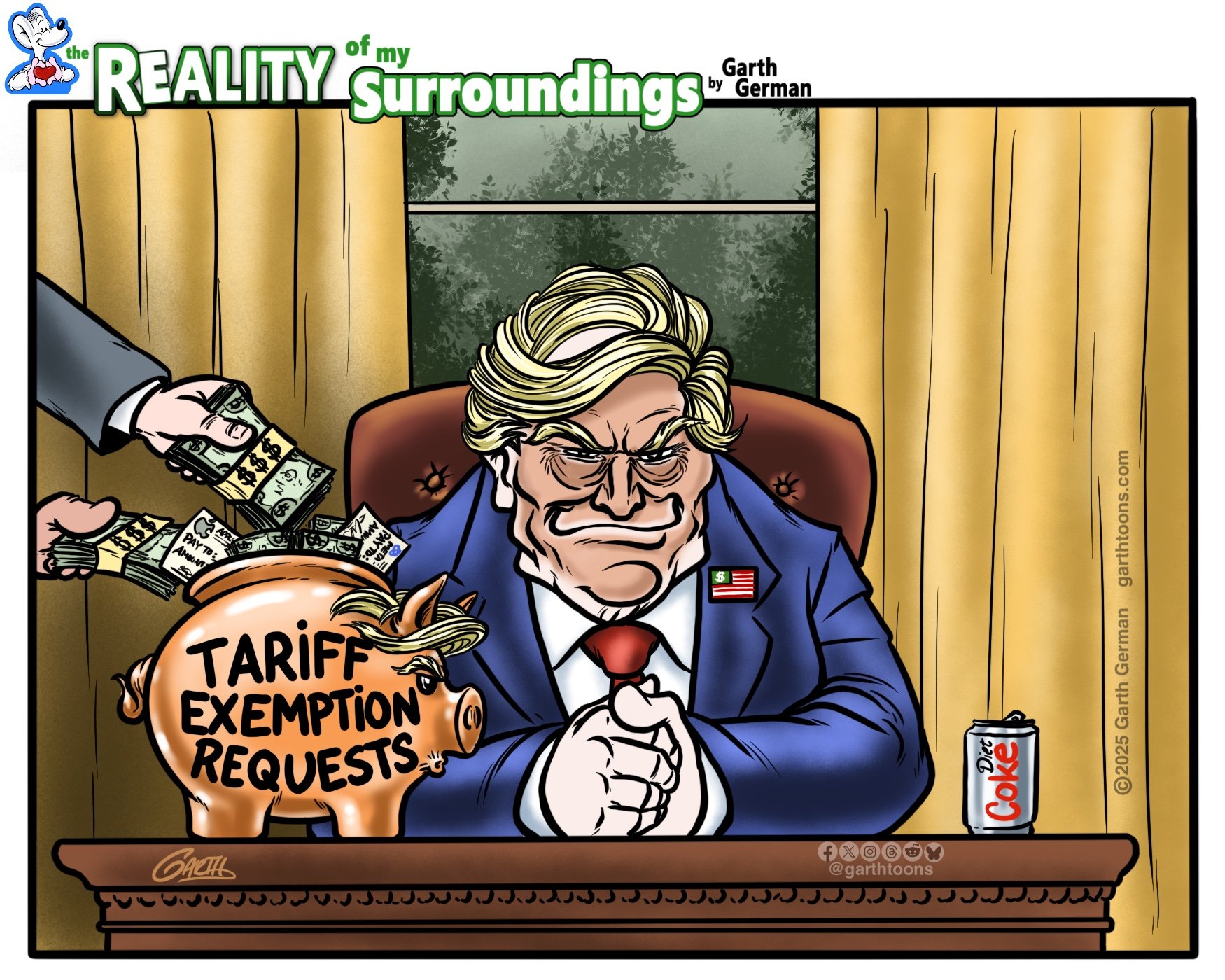
That leaves a few major things for the weekly summary: Trump’s turnaround on tariffs, his corruption-filled trip to the Persian Gulf, the Palm Springs bombing, and a few other things. That should be out by noon or so.
Undoubtedly there will now be a battle for the soul of Catholicism. Will the church continue on the path Francis started down, or will it return to its traditional role as an ally of authoritarians and the privileged classes?
Leo XIV may surprise me, but at first glance it looks like the Francis faction won. The new pope seems more interested in the Sermon on the Mount than in fighting the culture wars.
I think the name he chose is significant: in 1891, Leo XIII wrote the ground-breaking encyclical Rerum Novarum (Of New Things), which has been the foundation of Catholic social justice thinking ever since. The main idea of Rerum Novarum is for the church to take seriously the plight of working people under capitalism. It represented a realization that without a clearly worker-sympathetic position, the church might lose out to some form of Marxism.
By choosing to be another Leo, this pope gestures towards both a sympathy with the lower classes and a willingness to modernize Catholic doctrine.
Much is being made of Leo’s American roots He grew up in Chicago, and his time the Catholic Theological Union in Chicago overlapped my years at the University of Chicago a few blocks away. We probably walked past each other on the sidewalk. Chicago is extremely proud to claim Leo, as the following cartoon illustrates.
To me, the greatest significance of an American pope is that he’ll be much harder for conservative American Catholics to ignore. (I’m looking at you, J. D. Vance and Sam Alito.)
and Trump’s legal losses
Yesterday, a federal judge in Vermont ordered Rümeysa Öztürk released on bail without travel restrictions. She’s the Tufts student who was kidnapped off the street in Somerville, Massachusetts by masked DHS agents and taken to a detention center in Louisiana. The administration obeyed the order, and Özturk is back in Massachusetts walking around free.
[Judge William Sessions concluded] that she has raised “a very substantial First Amendment claim” in her underlying habeas challenge, in addition to a “substantial claim” that the Trump administration violated her due process rights regarding her detention as well.
Prior to being arrested, Öztürk had been a Tufts Ph.D. student legally in the country on a student visa. What appears to have drawn the administration’s ire was an op-ed Öztürk wrote (with co-authors) in Tufts Daily urging the Tufts administration to “acknowledge the Palestinian genocide”. The judge wrote:
“There is absolutely no evidence that she has engaged in violence or advocated violence.” Additionally, he noted, “I do not find that any of the contacts that she has in the community create any danger or risk of flight.”
If you read the First Amendment, you will notice that it says nothing about citizenship. Freedom of speech is a human right, not a privilege of citizenship.
In a similar case, a federal appeals court denied the administration’s motion to stay the release of Columbia student Mohsen Mahdawi. Mahdawi was a green-card holder who was arrested in Vermont when he appeared for an interview related to his application for citizenship. He similarly has no record of violence or criminality, and has only advocated for Gaza.
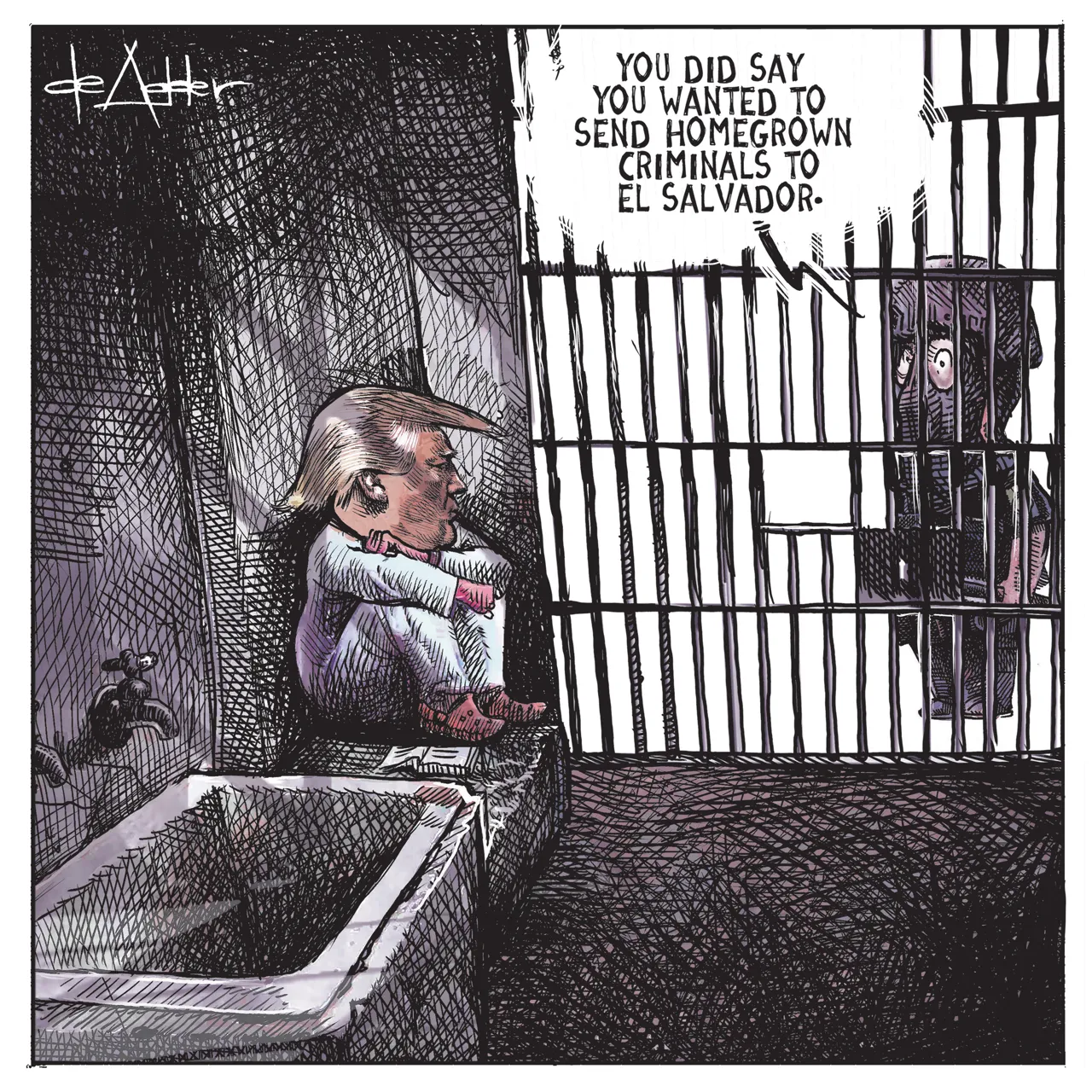
Several federal judges have ruled against the administration on its invocation of the Alien Enemies Act; this is the basis for Trump to send people to prison in El Salvador. (See the same Law Dork link.) The Act allows the president to deport foreign nationals during time of war, predatory incursion, or invasion. Judges in a variety of jurisdictions have been finding that the current situation does not fit into any of those categories. Trump can call mass migration of individuals an “invasion”, but that does not match the way such a term was used in 1798 when the AEA was passed.
Yet another judge issued a restraining order against Trump’s mass firings of federal workers. (Same Law Dork link.)
“It is the prerogative of presidents to pursue new policy priorities and to imprint their stamp on the federal government. But to make large-scale overhauls of federal agencies, any president must enlist the help of his co-equal branch and partner, the Congress,” U.S. District Judge Susan Illston wrote in the decision. “Federal courts should not micromanage the vast federal workforce, but courts must sometimes act to preserve the proper checks and balances between the three branches of government.“
… “Plaintiffs are likely to succeed on their claim that the President’s Executive Order 14210 is ultra vires” — or beyond the president’s legal authority, in other words illegal — “as the President has neither constitutional nor, at this time, statutory authority to reorganize the executive branch,” [Judge Susan] Illston wrote.
In general, I think the media is doing a bad job of explaining why the Trump administration is snatching people off the street, deporting American children, and so on: Trump was elected because he sold voters a dark fantasy about Biden’s America: The nation had been overrun by millions of immigrant criminals whose gangs had taken over our cities. The local police knew who they were, but couldn’t do anything because Biden protected the criminals. But Trump would be able to deport them all quickly. Millions of them.
So now he’s elected and has a real world to deal with: There aren’t millions of immigrant criminals and there is no migrant crime wave. If he just deports people for legitimate reasons, he can’t achieve the numbers his supporters expect.
As for Missouri, it is one of 40 Medicaid expansion states — because our voters wanted it that way. In 2020, the same year Mr. Trump carried the Missouri popular vote by a decisive margin, voters mandated that the state expand Medicaid coverage to working-class individuals unable to afford health care elsewhere. Voters went so far as to inscribe that expansion in our state constitution. Now some 21 percent of Missourians benefit from Medicaid or CHIP, the companion insurance program for lower-income children. And many of our rural hospitals and health providers depend on the funding from these programs to keep their doors open.
All of which means this: If Congress cuts funding for Medicaid benefits, Missouri workers and their children will lose their health care. And hospitals will close. It’s that simple. And that pattern will replicate in states across the country.
A preliminary estimate from the nonpartisan Congressional Budget Office said the proposals would reduce the number of people with health care by 8.6 million over the decade.
They’re clever about it: They aren’t cutting “benefits”, they’re just slashing the federal reimbursement to states. Then most red states will scrap the Medicaid expansion associated with Obama’s Affordable Care Act, providing Congress with deniability: We didn’t do it, the states did it.
The end result, though, is exactly what Hawley says: People (particularly people working for barely more than minimum wage) will lose their health insurance, and rural hospitals will close.
Cuts like this (and to food stamps, which also affects the working poor) are necessary so that billionaires can pay lower taxes. And even then, a huge deficit will remain. I don’t know how Republicans will be able to sell this to their base. And if they can’t, their slim majorities in Congress won’t hold together well enough to push it through.
This is another example of the MAGA fantasy world running into reality. In the fantasy world, government is full of waste and fraud that a smart guy like Elon can point out and eliminate. That way, spending can be slashed without affecting ordinary Americans.
but I want to talk about optimism
That’s the subject of this week’s featured post. My view wouldn’t be optimistic in any other context: I still think we’re facing a crisis of democracy. But we’re facing it in better shape than I thought we’d be in.
and you also might be interested in …
Brought to you by the party that supports family values:
“Within a few months, we will be able to declare that we have won. Gaza will be totally destroyed,” Smotrich said. “In another six months, Hamas won’t exist as a functioning entity.”
He told the listening audience that the population of Gaza, some 2.3 million Palestinians, would be “concentrated” in a narrow strip of land between the Egyptian border and the so-called Morag Corridor, which runs the width of Gaza between Khan Younis and the border city of Rafah.
“They will be totally despairing, understanding that there is no hope and nothing to look for in Gaza, and will be looking for relocation to begin a new life in other places.”
Beauchamp notes that this is “a textbook example of ethnic cleansing”.
Trump has stopped just about all refugee resettlement in the US. But he has finally found a group of refugees he likes: White South Africans.
The Trump administration is bringing a small number of white South Africans to the United States as refugees next week in what it says is the start of a larger relocation effort for a minority group who are being persecuted by their Black-led government because of their race.
But are they persecuted? Not in any way that makes them stand out, and maybe not at all. But they’re White, so they go to the front of the line.
In what may be the most valuable gift ever extended to the United States from a foreign government, the Trump administration is preparing to accept a super luxury Boeing 747-8 jumbo jet from the royal family of Qatar — a gift that is to be available for use by President Donald Trump as the new Air Force One until shortly before he leaves office, at which time ownership of the plane will be transferred to the Trump presidential library foundation, sources familiar with the proposed arrangement told ABC News.
Nothing to see here, just a foreign government giving an extremely valuable gift not to the United States, but for the benefit of one person, who happens to make many decisions the government of Qatar might want to influence.
The Guardian reviews the rules on presidential gifts, which are legally regarded as gifts to the American people. Previous presidents have transferred gifts — none of them nearly this large — to their presidential libraries for public display. But in Trump’s case this appears to be a dodge, as the plane will remain available for Trump’s personal use after ownership transfers. Judd Legum:
Can we please stop staying that, after Trump leaves office, the $400 million plane from Qatar will be given to the “Trump Presidential Library” Libraries do not fly on planes. The plane will be given to Trump.
The measles outbreak continues to spread, and even though it started before RFK Jr. took over as HHS Secretary, he’s coming to own it. The costs of his anti-vaccine crusade are becoming obvious.
A Republican attempt to steal a state supreme court seat in North Carolina was finally thwarted this week, a mere six months after an election that the Democratic candidate won.
[Incumbent Justice Allison] Riggs won the election in November by just 734 votes, but [Republican challenger Jefferson] Griffin mounted a massive legal challenge to overturn the election results and disenfranchise tens of thousands of voters. At the heart of Griffin’s lawsuit was a challenge to 65,000 lawfully cast ballots that he believed should be tossed out, because of errors made by the North Carolina elections board. The board counted some 60,000 ballots cast by voters with allegedly incomplete registration. … In fact, the litigation raised no significant evidence whatsoever that any illegitimate votes were cast.
“This case concerns whether the federal constitution permits a state to alter the rules of an election after the fact and apply those changes retroactively to only a select group of voters, and in so doing treat those voters differently than other similarly situated individuals. This case is also about whether a state may redefine its class of eligible voters but offer no process to those who may have been misclassified as ineligible,” Myers wrote in his opinion. “To this court, the answer to each of those questions is ‘no.’”
Griffin decided not to appeal, so the case is finally over.
The US and China have agreed to reduce the massive tariffs each have imposed on the other, from 145% and 125% to 30% and 10%. The reduction is temporary: 90 days. We’ll see if that’s enough to cause trade to start flowing again. 30% is still a pretty hefty price increase.
and let’s close with something distracting
If you’re on BlueSky and looking for something to brighten up your otherwise depressing news feed, I recommend following Daily Bunnies. You’ll get a reliable stream of cute rabbit pictures. I guarantee that this sleepy bunny is not worrying about whatever is bothering you.
During my two weeks off, I drove cross-country and saw a lot of my old friends plus a few like-minded relatives. I was struck by how depressed so many of them are with the current political situation. Again and again, I had to be the voice of optimism in the room. For the sake of depressed Sift readers I didn’t see during my travels, maybe I should explain why.
Partly, I feel optimistic because I got my pessimism out of the way early. After Trump’s inauguration, I think a lot of people were expecting a second Trump administration a lot like the first. We got through that, they thought, so we’ll probably get through this too.
I was much more negative. Everything and everybody who had restrained Trump’s worst impulses during his first administration was gone now, so it seemed obvious he would make a play to become a dictator. It was also clear how that would play out: He would keep pushing until either Congress or the Supreme Court tried to stop him. Then there would be a crisis and we’d see who won.
We seem to be reaching that crisis point now, as the Supreme Court is going to have to decide whether to call Trump out on his flouting of their Abrego Garcia ruling. (To be clear, the administration is denying that it’s ignoring the Court’s order, but it’s interpreting that order in an absurd way that makes it meaningless.) So now we see whether the Court has the courage to stand up to Trump, whether Trump will decide that the Court has no power over him, and whether (if he does) Congress will just stand by and let him do it.
In addition, courts up-and-down the line have been restraining Trump’s illegal actions. And surprisingly often, Trump officials are obeying. Rümeysa Öztürk, the Turkish Tufts student masked DHS agents snatched off the streets, is now free on bail and walking the streets of Somerville rather than rotting in a Louisiana detention camp. She seems likely to prevail in her attempts to complete her degree in the US. Another detained student, Mohsen Mahdawi, is also free.
This is the point we have been headed towards ever since Trump was elected last November. What I feel good about is that we’re hitting this point in much better shape than I thought we would. For several reasons:
Trump is unpopular. Imagine if he had just taken credit for the good Biden economy rather than starting all this tariff nonsense. Imagine if Musk had focused on actual government waste and could point to real accomplishments.
He has visibly declined. Falling asleep at Pope Francis’ funeral (while wearing an inappropriate blue suit) is just the most obvious example. (Imagine if Biden had done that.) And while he’s always had moments of incoherence, it’s now unusual when he appears coherent.
The administration has multiple competing factions. You can see this in the persistent leaks saying Trump as about to reverse his position on something. That’s an internal faction trying to nudge him to reverse a position backed by a different faction.
His promises are failing. Trump has always been good at declaring victory and making his followers believe him. But he made some very definite promises that are obviously not being fulfilled: Prices did not start dropping “on Day 1”. He didn’t solve the Ukraine War in 24 hours. And so on.
Popular opposition is rising. Early in the administration, I kept hearing anti-Trump people express their sense of isolation. No more.
Congress is wavering. You can see this in the floundering negotiations over the FY 2026 budget. More and more Republican congresspeople are realizing that they can’t get reelected on Trump’s endorsement alone.
All these factors add up to give the Supreme Court a little more spine, and to make Trump and his minions waver about open defiance. If Trump were riding high in the polls, at the peak of his powers, leading a united administration, facing little public protest, and backed by a solid Republican majority in Congress, standing up to him would be far more difficult, even for somebody like John Roberts who has an independent constitutional mandate.
That’s not to say that everything is going to go smoothly. There still might be rough waters ahead, and a Trump dictatorship is not impossible. But trends are going our way, and we’re in better shape than we were on Inauguration Day.
So I’m back. Did anything happen in the last three weeks?
Well, we’ve got a new pope, an American who represents a continuation of Francis’ vision rather than a reversion to Benedict’s harsher culture-war positions.
In US politics, the conflict between Trump and the courts continues to escalate, pushing towards the crisis that has been coming since he took office: The Supreme Court makes a very precise order for Trump to stop doing something he really wants to do, an order he will have to either obey or defy. Then we’ll see if we still have the rule of law in this country. (I know what commenters are preparing to type: They already did that with the order to “facilitate” Albrego Garcia’s release from the concentration camp in El Salvador, an order that Trump defied. But that’s not exactly what happened. They gave an order they assumed the administration would interpret in good faith and instead it was interpreted in egregiously bad faith. The crisis we’re steaming towards is one where the Court stops assuming good faith and instead is very explicit.)
I spent my two weeks off driving from Massachusetts to Illinois and back, stopping to see a number of friends and relatives along the way (if Nashville counts as “along the way”). I wound up in my hometown, Quincy Illinois, to give a sermon about grief — something I’ve seen close-up these last six months — at the local Unitarian church. I’ve posted the text.
Something striking I noticed: Just about all my friends are more pessimistic and depressed about the political situation than I am. I’ll try to explain in the featured post, which should be out by 10 EST or so. The gist: The crisis we’re approaching has been inevitable since Trump was elected, and we’re in better shape to get through it than I had expected.
The weekly summary will cover the new pope, the recent court decisions, prospects for the FY 2026 budget, and a few other things. I’ll try to get it out by noon.
I have never been Catholic, so I view all papacies from the outside. But Francis was the first pope of my adult lifetime that I didn’t instinctively think of as a political and social opponent. Previous popes, from my point of view, allowed Catholicism to be dominated by culture-war issues: anti-abortion, anti-gay, anti-birth-control, pro-patriarchy, and so on.
People closer to the Catholic Church can comment on whatever doctrines he may have changed, which were largely invisible to non-Catholics. The church he leaves behind is still a patriarchal institution that teaches many ideas I view as wrong-headed. But to me, the main thing he did was shift the emphasis: from policing people’s bedrooms to standing up for the downtrodden and those on the fringes of society.
Undoubtedly there will now be a battle for the soul of Catholicism. Will the church continue on the path Francis started down, or will it return to its traditional role as an ally of authoritarians and the privileged classes?
Two of the last things Francis did were to celebrate Easter and meet with J. D. Vance. Call me cynical, but I expect Vance to lie extensively about his papal audience. It is very easy for unscrupulous people to put words into the mouths of the dead.
and Pete Hegseth
Back when the Signal fiasco first surfaced a few weeks ago, many people speculated that this didn’t come out of the blue. Nobody on the chat treated the situation as weird, suggesting they’d done it before.
Defense Secretary Pete Hegseth shared detailed information about forthcoming strikes in Yemen on March 15 in a private Signal group chat that included his wife, brother and personal lawyer, according to four people with knowledge of the chat.
The first Signal chat group was set up by National Security Advisor Mike Waltz, but this one was set up by Hegseth himself.
This administration is filled with unqualified people like Hegseth who are not serious about national security. Showing off for friends, family, and coworkers is more important to them than keeping Americans safe.
Remind me: Why did anybody ever think Pete Hegseth belonged in this job?
and Harvard
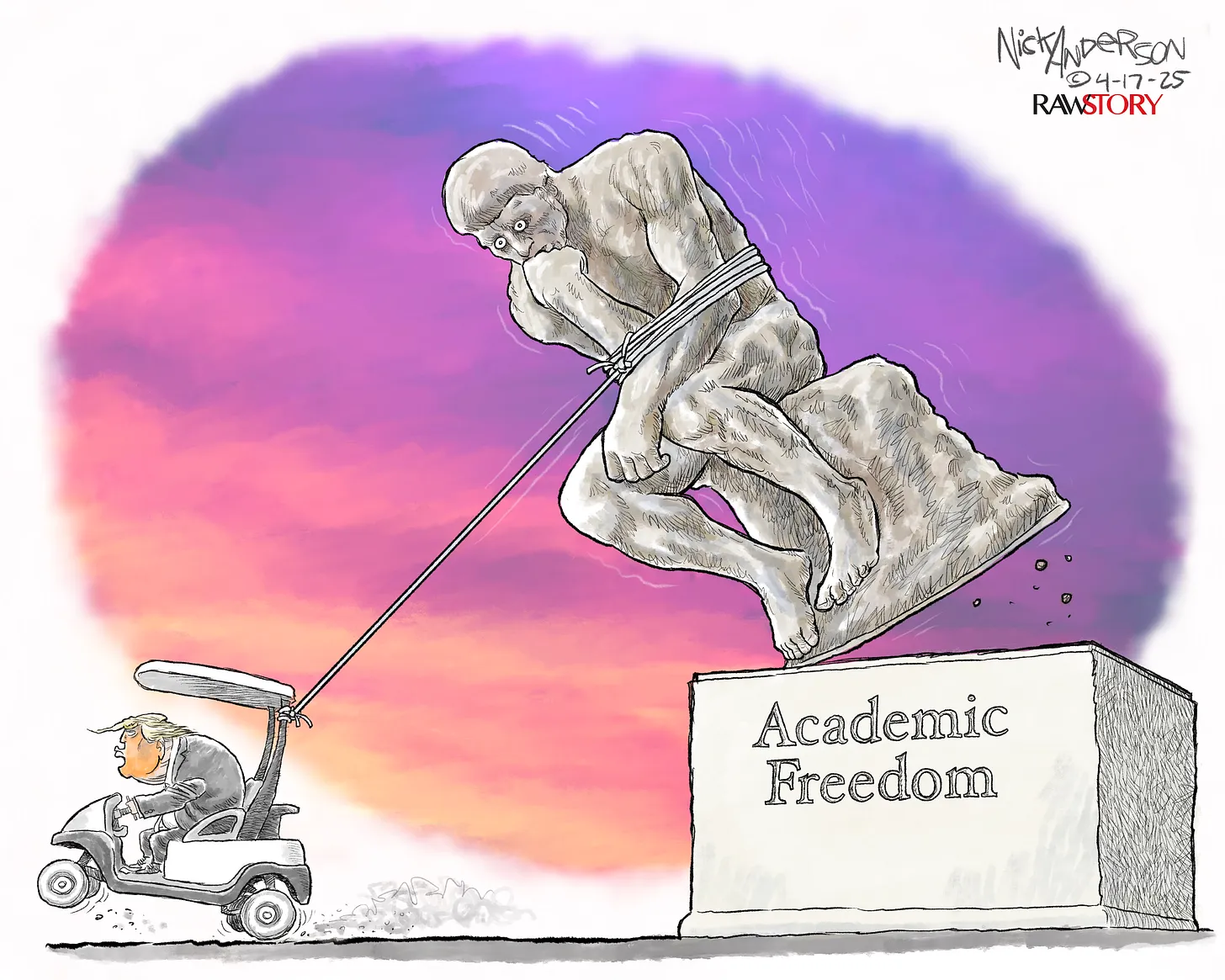
Who expected Harvard to start leading the academic community’s resistance to the Trump autocracy? How did we get here?
On April 11, representatives of the GSA, HHS, and Education Department sent a list of demands to the president of Harvard University and the leading member of the Harvard Corporation. The demands essentially would put in the university in receivership, with “an external party, which shall satisfy the federal government as to its competence and good faith” empowered to audit “the student body, faculty, staff, and leadership for viewpoint diversity”. Departments that failed this audit would required to hire new faculty and admit new students until “viewpoint diversity” was achieved.
In other words: Acceding to the government’s demands would authorize MAGA thought police to roam the campus, searching out dissent and bringing in Trump acolytes to “balance” campus viewpoints. This proposal directly contradicts the government’s demand to eliminate DEI programs in favor of “merit-based” hiring and admissions. “Merit” only matters if you’re Black, not if you’re pro-Trump.
The letter warns that the government’s “investment” in Harvard (i.e., research grants that Harvard wins in competition with other universities) “is not an entitlement”, and depends on Harvard taking steps to prevent “ideological capture” by any ideology other than that of the Trump administration.
So all in all Harvard felt it had little choice in its response:
The university will not surrender its independence or relinquish its constitutional rights. Neither Harvard nor any other private university can allow itself to be taken over by the federal government. Accordingly, Harvard will not accept the government’s terms as an agreement in principle.
The administration’s prescription goes beyond the power of the federal government. It violates Harvard’s First Amendment rights and exceeds the statutory limits of the government’s authority under Title VI. And it threatens our values as a private institution devoted to the pursuit, production, and dissemination of knowledge. No government—regardless of which party is in power—should dictate what private universities can teach, whom they can admit and hire, and which areas of study and inquiry they can pursue.
Various Trump officials then claimed the threatening letter had been sent by mistake. But that didn’t square with the fact that the Trump administration then started carrying out its threats: $2.2 billion in grants are frozen, though they have been slow to announce which ones. The optics of that are going to be really bad for Trump. Cancellations we already know of stop research on tuberculosis and ALS. If you are counting on research like that to produce a miracle cure for yourself or your family, you’re not going to be very happy.
I know no one is shamed by hypocrisy any more, but The Bulwark’s Tim Miller and Sarah Longwell went back to look at the outrage of people like J. D. Vance and Ted Cruz a few years ago when the Right (falsely) thought the Obama administration had instructed the IRS to target Tea Party groups. (In the wake of Citizens United, the IRS did heighten their scrutiny of new tax-exempt groups, which included a bumper crop of new Tea Party groups. But none inappropriately lost their tax-exempt status and no link to the White House was ever found.) Here’s what Vance was saying:
This is about whether we have functional constitutional government in this country. If the IRS can go after you because of what you think or what you believe or what you do, we no longer live in a free country.
The biggest sham of this whole attack on American universities is that it has something to do with antisemitism. Trump cares nothing about antisemitism.
In Charlottesville, Trump was careful to differentiate between actual Nazis and the “very fine people” who marched next to the Nazis. But there is no similar consideration for any “fine people” who participated in campus protests in honest sympathy with the plight of Palestinians, or out of horror at the genocide in Gaza. To Trump, the presence of antisemites in the demonstrations tars everyone involved. The double standard here has an obvious interpretation: Antisemitism is just a club to use against the universities, which he sees as his enemies anyway.
and the courts
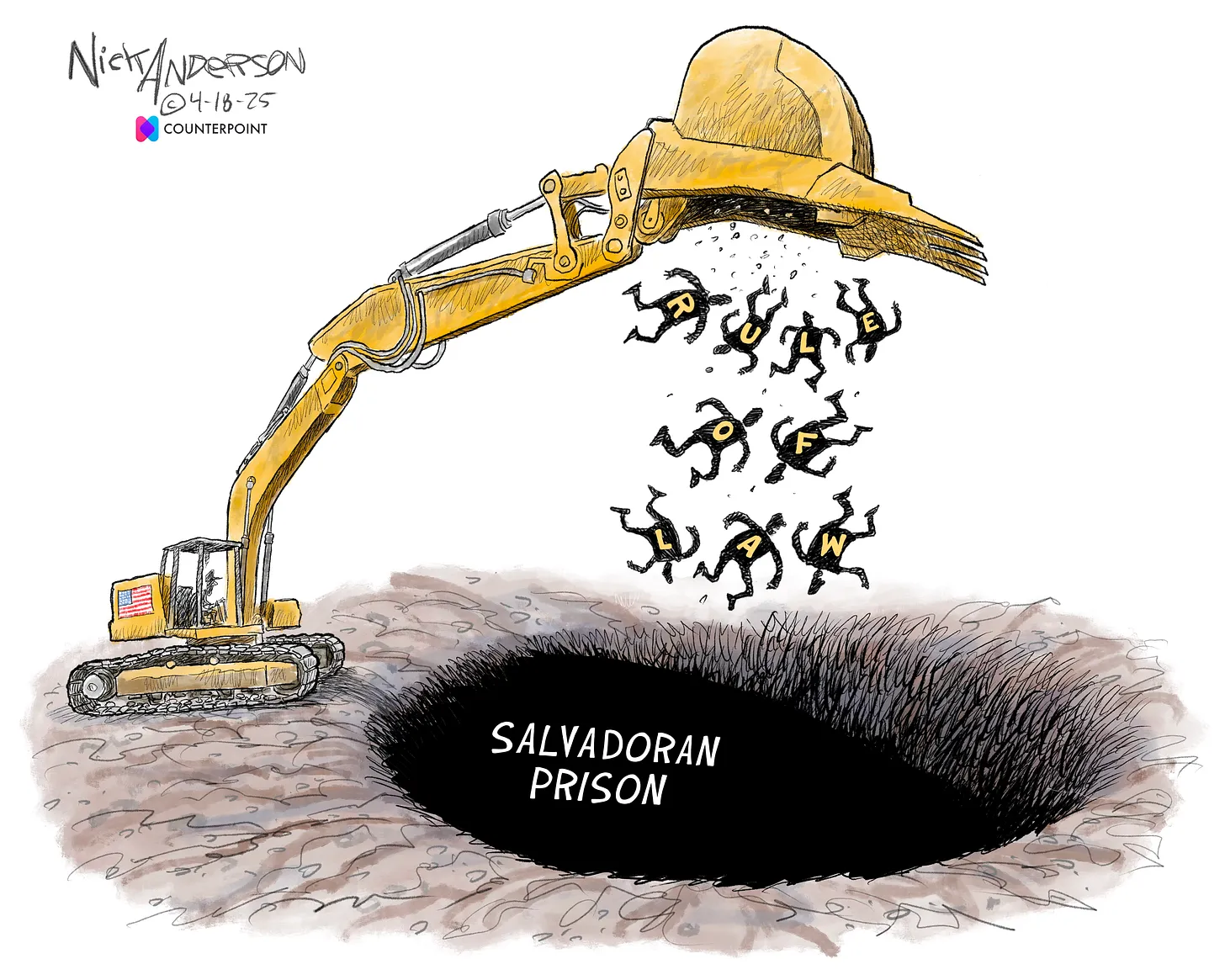
The Trump administration had another bad week in court. First, there’s the case of Kilmar Abrego Garcia, the Maryland man who came to the US illegally in 2011 and was granted withholding-of-removal status by an immigration court in 2019. The Trump administration ignored his legal status and deported him to the CECOT prison in El Salvador on March 15, in what an administration lawyer has since described as “an administrative error”. On April 10, the Supreme Court unanimously ordered the administration to “facilitate” Garcia’s return to the US, where he might then face renewed attempts to deport him within the law. The Court sent the case back to district court Judge Paula Xinis to work out the details of Garcia’s return.
The administration has defied that order while claiming that it is not defying it, by putting a ridiculous spin on “facilitate” that does not require it to do anything at all. Trump had an oval office meeting with Salvadoran dictator Nayib Bukele, where they each professed their powerlessness to do anything for Garcia, essentially making a joke out of the Court’s unanimous order.
Xinis has ordered a two-week inquiry into the case that will include sworn depositions from administration officials, creating a record that could lead to contempt proceedings. Trump’s lawyers tried to put a stay on her order, which an appeals court unanimously rejected on Thursday. More than just the order itself, Judge J. Harvie Wilkinson’s opinion rejected Trump’s arguments in their entirety.
The government is asserting a right to stash away residents of this country in foreign prisons without the semblance of due process that is the foundation of our constitutional order. Further, it claims in essence that because it has rid itself of custody that there is nothing that can be done. This should be shocking not only to judges, but to the intuitive sense of liberty that Americans far removed from courthouses still hold dear.
The government asserts that Abrego Garcia is a terrorist and a member of MS-13. Perhaps, but perhaps not. Regardless, he is still entitled to due process.
As Jay Kuo notes, Wilkinson is a Reagan appointee whose conservative credentials are impeccable. This isn’t about left-and-right, it’s about right-and-wrong.
The entire American media and left wing industrial complex has decided the most important issue today is that the Trump admin deported an MS-13 gang member (and illegal alien)
The problem with that argument should be obvious: Vance assumes what so far has not been proved. If Garcia actually is a gang member who poses a threat to public safety, then by all means deport him. No one argues against that. But so far all we know is that the Trump administration SAYS he’s a gang member who threatens public safety. They could say that about me or you or anybody. If Trump can send someone to his concentration camp in El Salvador just by accusing him of something, then we really are in a totalitarian state.
The Supreme Court also ordered 7-2 that further deportations to CECOT be stopped.
In a brief order released at about 1 a.m. Saturday, the court directed the administration to temporarily halt any plan to deport a group of Venezuelan nationals who have been detained in northern Texas and have been designated as “alien enemies.”
Again, Trump wants to make this about immigrant crime, assuming without proof that all the people he wants to deport are actually dangerous. So far, though, everything we know suggests the administration isn’t being particularly rigorous about establishing guilt.
The essential difference between a legitimate prison and a concentration camp is legal process. If you can be sent there on somebody’s unsupported say-so, you’ll stay there until somebody else says you can leave, and while you’re there you have no way to protest your treatment, then you’re in a concentration camp.
found probable cause Wednesday to hold the Trump administration in criminal contempt for willfully disobeying his order to immediately halt deportations under the rarely used Alien Enemies Act and turn around any airborne planes. … “The Court does not reach such conclusion lightly or hastily; indeed, it has given Defendants ample opportunity to rectify or explain their actions. None of their responses has been satisfactory.”
The gist of all these rulings is that time is running out on the administration’s claims that it isn’t disobeying court orders, based on obviously ridiculous interpretations of those orders. Before long they’re going to have to either obey the orders or openly defy them.
I’m pretty much where Eisen is. When Trump took office, I anticipated a lot of the ways he would assault American democracy. The real question in my mind was how clever he would be and whether anyone would oppose him.
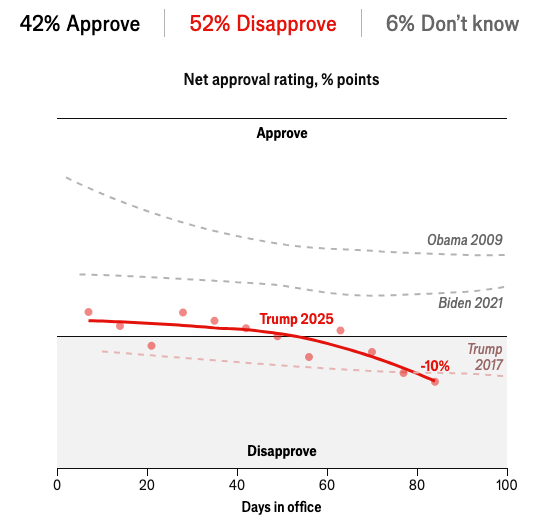
Well, three months into his second administration, we can see that he’s not being very clever at all, and opposition is forming, both in the courts and in public opinion. The Economist shows Trump’s net approval rating crossing below his sorry showing from the same point in his first term.
Congress will be slower to come around, but I think that will happen, at least partially. It will start with Republicans’ inability to unite around an FY 2026 budget proposal. What they have so far
cuts rich people’s taxes
cuts programs that many small-town and rural Trump voters rely on, like Medicaid and food stamps.
still has a huge deficit.
A lot of Trump voters still believe that the spending cuts will all be “waste and fraud” cuts that target illegal aliens and maybe some other dark-skinned people they don’t like. (In MAGAland, spending on non-whites is inherently wasteful.) They’re going to see that it really means kicking Mom out of the nursing home, closing their small-town hospital, and skipping a few meals of their own.
Trump could even sell those White working-class “sacrifices” as necessary to control an out-of-control government debt. But calling for sacrifice and not controlling the debt is going to be a hard case to make.
Alaska’s Republican Senator Lisa Murkowski said out loud what a lot of people have been whispering: Republicans in Congress are afraid to cross Trump. “I’m oftentimes very anxious myself about using my voice because retaliation is real. And that’s not right.”
A transwoman runner in Virginia had to leave the girls cross-country team when the Virginia HIgh School League changed its rules to get into harmony with the Trump administration. So she did what a lot of anti-trans rhetoric suggests she should do: join the boys team.
So now somebody who presents as female is on the male team, presumably raising a new set of locker room issues. Is this better?
RFK Jr. says he will identify the “environmental toxin” that causes autism. People who have spent their lives studying autism don’t believe such a thing exists, but cranks like Kennedy always know better.
Remember when Candidate Trump said that ending the Ukraine War was easy, and that he could do it in 24 hours? Well, now that he’s president, Trump is complaining that the two countries aren’t cooperating, so he’s thinking about taking his Peace and going home.
Average grocery prices were about 2.41% higher in March 2025 than they were in March 2024, Consumer Price Index data shows. This was the highest year-over-year grocery inflation rate since August 2023. And average March 2025 grocery prices were up about 0.49% from February 2025. That was the highest month-to-month grocery inflation rate since October 2022.
And that’s before we see the effect of tariffs on imported foods like coffee and fruit, which should kick in soon.
spared the jobs of US Department of Transportation employees who provide support services for spacecraft launches by Musk’s companies, SpaceX and Starlink … While the administration and Doge have targeted hundreds of thousands of federal employees, critics say the decision shows Musk is willing to allow federal workers to remain employed if their work benefits him.
The myth behind DOGE is that Musk commands a small army of smart nerds who can revolutionize how government works. But wouldn’t you know it? The Pentagon had already thought of that idea back in 2015 and has assembled its own nerds in the Defense Digital Service. Unlike Musk’s minions, these folks have actually done a few things that worked.
One former senior Pentagon official, who asked not to be named because of possible retaliation, described DOGE’s wider incursion into the Defense Department as damaging and unproductive: “They’re not really using AI, they’re not really driving efficiency. What they’re doing is smashing everything,” the former official said. At the DDS, “The best way to put it, I think, is either we die quickly or we die slowly,” Hay said.
In this era where so many institutions are yielding to autocracy without a fight, I’ve been interested to see what Marvel Studios and their Disney overlords have done with the new Daredevil series Daredevil: Born Again.
No one ever refers to Trump during the series, and if the words Republican or Democrat were spoken, I don’t remember them. But it’s hard to imagine a major studio making a stronger anti-MAGA statement.
The story arc of the season is how Daredevil’s nemesis, Wilson Fisk, a.k.a. the Kingpin, escapes accountability for his criminal past and gets elected Mayor of New York on a very MAGA-ish platform: New York is in crisis and only a crusading outsider like Fisk can fix it. Once in power, he uses a combination of legal and illegal power to co-opt the city’s other power centers. He recruits NYPD’s most brutal officers into an elite “anti-crime” squad that operates outside normal rules, then artificially creates a crisis that justifies a near-complete authoritarian takeover. The “resist, rebel, rebuild” quote at the top of the page is from Daredevil’s rallying message to his allies at the end of the season, presumably setting up the fall of Fisk in season 2.
and let’s close with something embarrassing
I explained last week how my town of Bedford often finds itself in the shade of its neighbors Lexington and Concord. So I felt a little schadenfreude when this particular celebration in Lexington didn’t go exactly as planned.
Today’s Sift will be the last one until May 12, three weeks from today. I need the time for two reasons related to my wife’s death in December: On May 4 I’m going to give probably the most difficult talk of my life, at the Unitarian Church of Quincy, Illinois. Back in 2023, I spoke there about my own views on life-after-death. In retrospect, though, that talk had a big hole in it, because I focused on thinking about my own death. This talk will try to fill that hole. I’m calling it “Life After (Somebody Else’s) Death”.
A lot of people (including a few of the voices in my head) have warned me that it’s too soon for me to take on that topic. But having had the idea, I found that I couldn’t not do it. It will be stressful to deliver, but I think it will be very good.
The second reason is how I’m getting there: This is going to be the first long-distance driving trip I’ve done solo for several decades. I’m going to take my time and visit several people along the way.
Anyway, the two weeks off don’t signal any kind of flagging of my commitment to this blog. I’m sure I will miss it and be eager to return to it on May 12.
Today has a bit of reduced schedule as well: There’s no featured post, but the summary be a little extra-long. It should appear around noon.
The bottom line is: If the economy and the government were working the way it should for most Americans, a guy like Donald Trump and a movement like Trumpism would not have been possible.
That’s the subject of one featured post, in which I express the hope that we can have a debate more nuanced than just Trump’s tariffs vs. free trade.
and Abrego Garcia
This much has been established in court: There was a court order that Kilmar Abrego Garcia not be sent back to El Salvador, his country of origin. The Trump administration violated that order due to an “administrative error”, so he is currently in the harsh Cecot prison, which is widely acknowledged to be a hellhole.
In a sane judicial system dealing with a sane administration, the next step would be obvious: You violated a court order, so get back into compliance with it, i.e., bring Abrego Garcia back to the US.
What should happen to him then is a matter for other proceedings to establish. Whatever evidence DoJ may or may not have against him, whether he committed some crime or belongs to a foreign gang or whatever, is just not relevant at this point. Bring him back, and then we can talk about those other issues in a court where he can face his accusers and defend himself.
You know: human rights.
So a federal judge did the common-sense thing: issued an order demanding Abrego Garcia’s return by a date that has already passed. Trump’s lawyers appealed that order and the Supreme Court more-or-less upheld it: It did not demand that Abrego Garcia be returned by a particular date, but instructed the administration to “facilitate” Abrego Garcia’s return. It sent the case back to the district court to work out the details.
Then the district judge did another common-sense thing: held a hearing where he asked the government how it planned to facilitate Abrego Garcia’s return. The government stonewalled the judge, and now says “facilitate” only means that it remove barriers to Abrego Garcia returning, should El Salvador decide (on its own) to release him.
Presumably, the district judge will have to issue another order, which the government will appeal to the Supreme Court. At that point, what should have been obvious the last time will be doubly obvious: the Trump administration is not dealing with the court in good faith. It should have no claim on the “deference” or “respect” a good-faith administration would receive from the Court. Whether this Supreme Court’s partisan-hack majority will see it that way is an open question.
The significance of this case should be obvious to any thinking person: If Trump can send someone to El Salvadoran prison illegally, and then just say “oops” when the “mistake” is pointed out, then he can make anybody disappear.
I assume someone at my level — a blogger with only a few thousand subscribers — is beneath their notice. But I write things Trump wouldn’t like if he bothered to read them. If he threw a tantrum and decided to order my removal to Cecot prison, what would stop him? How would anyone bring me back?
In thinking about Cecot, I encourage you to read the history of Hitler’s first concentration camp: Dachau. Originally, it was a temporary place to put political dissidents. But once a black hole exists, it has many uses that an authoritarian regime can’t help but notice. Why let anyone out, ever? Why not put Jews there, and homosexuals, and Gypsies? Once they are out of public view, why not turn them into slave labor or run medical experiments on them? Why not kill them?
Trump supporters accuse people like me of being hysterical when we make comparisons between Cecot and Dachau. Sure, Cecot is nothing like the final-solution death camp Dachau had become by the time American soldiers liberated it 80 years ago this month. But it bears a striking resemblance to the original Dachau of 1933.
In other legal news, an immigration judge in Louisiana ruled that Mahmoud Khalil, a former Columbia student who participated in the protests against Israel’s war in Gaza (and appears to have done nothing else “wrong”), can be deported on the say-so of Secretary of State Marco Rubio.
There is no indication that Congress contemplated an immigration judge or even the attorney general overruling the secretary of state on matters of foreign policy.
An appeal is expected.
and the spirit of ’75
250 years ago, Americans rebelled against one-man rule. Another featured post expresses the hope that we can do so again.
and Trump vs. the environment
I’m sure it won’t surprise you to learn that Trump administration policy tends to be pro-pollution and anti-environment. This week, however, Trump signed executive orders that slap in the face anyone who cares about the future of the climate.
One order, which uses scare quotes whenever mentioning “climate change”, orders the attorney general to identify and challenge in court
all State and local laws, regulations, causes of action, policies, and practices (collectively, State laws) burdening the identification, development, siting, production, or use of domestic energy resources that are or may be unconstitutional, preempted by Federal law, or otherwise unenforceable. The Attorney General shall prioritize the identification of any such State laws purporting to address “climate change” or involving “environmental, social, and governance” initiatives, “environmental justice,” carbon or “greenhouse gas” emissions, and funds to collect carbon penalties or carbon taxes.
Environmental groups report being “outraged”, but the order strikes me as being more about putting on a show for Trump’s fossil-fuel donors (as well as “owning the libs”) than producing actual change. The order itself takes no action, but only instructs the Justice Department to take action, adding its weight to court challenges that fossil fuel companies have already launched. It will subsidize these lawsuits with tax dollars, but fossil fuel companies don’t lack for money or lawyers.
Grist points to some of the targeted state laws, and provides links to longer explanations:
That directive almost certainly includes the climate superfund laws that New York and Vermont recently passed. The statutes require fossil fuel companies to pay damages for their emissions, a move the executive order deems “extortion.”
attempt to prevent some Biden-era policies from going into effect that would have caused the shuttering of dozens of American coal plants; support policies promoting the continued incorporation of coal and fossil-fuel forms of energy into the grid; and direct the Department of Justice to investigate state policies that may illegally or unconstitutionally “[discriminate] against coal” and “secure sources of energy.”
Again, such orders may win the votes of coal miners, troll environmentalists, and ensure that fossil-fuel money keeps rolling in to Republican coffers, but it should have little long-term effect on the coal industry. Coal isn’t just a victim of government policy, it’s being phased out by the market, because it has become more expensive than not only natural gas, but also sustainable energy sources.
Nearly all U.S. coal-fired power plants are more expensive to run than new, local wind, solar and energy storage resources, according to a January 2023 report from Energy Innovation. … Capstone [a private energy consulting group] doubts any company will seek DOE loan guarantees for new coal-fired power projects. “We are skeptical the private sector will chase funding targeting coal assets beyond potential assistance for coal-to-gas switching,” said the research firm
If you’re wondering what kind of mischief the Trump administration might do with the government databases, here’s an example: The WaPo reports that
the Social Security Administration purposely and falsely labeled 6,100 living immigrants as dead … eliminating their ability to legally earn wages and, officials hoped, spurring them to leave the country. … Greg Pearre, who oversaw a staff of hundreds of technology experts … told [Musk-appointed Chief Information Officer Scott] Coulter that the plan was illegal, cruel and risked declaring the wrong people dead.
Security guards came and escorted Pearre out of the building.
After his removal from his office this week, he was placed on paid leave, possibly severing his 25-year career.
Whoever has control of the SSA database can declare anyone dead.
The White House told The Post that the roughly 6,000 immigrants all have links to either terrorist activity or criminal records. The official did not provide evidence of the alleged crimes or terrorist ties but said some are included on an FBI terror watch list. The immigrants added to the death database include a 13-year-old, a 14-year-old and two 16-year-olds — as well as one person in their 80s and a handful in their 70s, according to records obtained by The Post.
As I pointed out above in the note on the Abrego Garcia case, if they can do this, they can do it to anybody. Social Security says you’re dead, so no one can employ you.
and let’s close with something adorable
The news has been rough this week. If you’ve made it this far, you deserve an otter video.
In its 250th year, New England’s revolutionary history has become relevant again.
Here in Massachusetts, April is the month of patriotism, centering on the April 19 anniversary of the battles of Lexington and Concord.
I live in Bedford, a town that sits between Lexington and Concord, and so has an understandable sense of inferiority (though Bedford’s Minutemen joined several other nearby community militias in mustering to defend Concord Bridge). Longfellow never wrote a poem about us, but we do have our own April revolutionary celebration: Pole Capping Day, on which people dress in colonial-era costumes, Minutemen march and fire muskets, and speeches are given. The center of the ritual is the erection of a pole, which some agile person climbs and adorns with a liberty cap, symbolizing Bedford’s rebellion against King George and the English monarchy.
Saturday, hundreds of people braved drizzle and sleet to celebrate. This year’s pole capping had an extra flavor, as autocratic rule no longer seems like a historical curiosity. For some while, townspeople have been decorating their yards with ambiguously historical/political signs: “No King”, “Resisting Tyranny Since 1775”, and so on. If anyone objects to these “partisan” messages, they have so far stayed quiet for fear of confessing their pro-dictatorial aspirations.
My church’s retired minister John Gibbons is the chaplain of the local Minuteman corps, and annually officiates in his colonial-parson costume. This year’s homily was cribbed from the Declaration of Independence, but seemed like a denunciation of the Trump administration’s current deeds and near-term ambitions. Consider these accusations against King George:
He has excited domestic insurrections amongst us.
He has endeavoured to prevent the population of these States; for that purpose obstructing the Laws for Naturalization of Foreigners; refusing to pass others to encourage their migrations hither
He has combined with others to subject us to a jurisdiction foreign to our constitution, and unacknowledged by our laws; giving his Assent to their Acts of pretended Legislation:
For cutting off our Trade with all parts of the world:
For imposing Taxes on us without our Consent:
For depriving us in many cases, of the benefits of Trial by Jury:
For transporting us beyond Seas to be tried for pretended offences
Back in 2009, conservatives (and various other people upset to find themselves living in a country with a Black president) misappropriated New England’s revolutionary tradition and called themselves the Tea Party. As I pointed out in 2014, in one of the Sift’s most viral posts, they were actually a Confederate party, and drew much more from John Calhoun than John Adams.
Over the next 15 months, a lot of 250th anniversaries are going to roll around. I hope we use them to reclaim the true spirit of American patriotism from the fascist posers who so often usurp that legacy. Let us rededicate “our Lives, our Fortunes and our sacred Honor” to the cause of the inalienable rights of all people, and resist all attempts to impose one-man rule on these hallowed shores.
Trump’s protectionist overreach shouldn’t send Democrats back to neo-liberalism and free trade.
I’m guessing you know the basics of this story, because it’s gotten blanket coverage in the media: Trump announced wild and ridiculous tariffs, global markets crashed, and then he partially backed off, leading to a partial recovery. (If you want a more complete review, it’s in footnote [1].)
Of course Trump never admits a mistake, so the party line is that he meant to do this all along; the whole fiasco is a negotiating tactic straight out of The Art of the Deal. And the Trump-worshiping chorus immediately fell into line: “an absolutely brilliant move“, “brilliantly executed“.
But anybody with their eyes open saw this episode for what it was: a colossal blunder that is far from fixed even now. Jay Kuo summarized: “Trump screwed up bigly on tariffs, and he knows it.” [more critiques, including mine, in footnote 3]
The best such article I found was Ross Douthat’s interview with Oren Cass (author of the “Stop Freaking Out” article). I’m not usually a big Ross Douthat fan, but here he asked the right questions and got significant nuance out of Cass.
Cass begins with a critique of the globalization era, arguing that while GDP has increased just as economic theory says it should, GDP doesn’t tell the full story.
when we’re looking at the actual well-being and flourishing of the typical working family and their ability to achieve middle-class security, we’ve seen real decay. And I think that explains why somebody like Donald Trump has become as successful politically as he has.
The bottom line is: If the economy and the government were working the way it should for most Americans, a guy like Donald Trump and a movement like Trumpism would not have been possible.
Cass notes the bifurcation between types of working people.
When you’re looking at these household income numbers, it’s important to notice how much they rely upon the household having two earners and how much more reliant they find themselves on government programs than in the past. … I think we have a problem, particularly for the right of center that sold this idea of a rising-tide-lifts-all-ships model and we all march forward together into the brave new future. What people are seeing instead is that some people got to march ahead into the brave new future and a lot of folks did not. … Research at very optimistic groups like the American Enterprise Institute shows that young men ages 25 to 29 are earning the same or less than they would’ve been 50 years ago. And I think it’s hard to sell that as a successful economy or one that’s likely to produce a flourishing society.
The conversation shifts to trade, and the corresponding loss of manufacturing jobs. Douthat asks the right question: What’s so special about manufacturing jobs? If the pay is the same, why should we care whether people work in a Ford plant or in a bank?
Cass has a set of answers:
Manufacturing jobs tend to be scattered throughout the country, while service jobs cluster around big financial centers. So loss of manufacturing has impoverished large sections of the country, particularly small towns in otherwise rural areas.
An economy with both manufacturing and service jobs has employment opportunities for a broader talent pool than a pure service economy has.
Our country is more secure militarily if we manufacture the products we need to defend ourselves (rather than depend on, say, Taiwan for our advanced computer chips; depending on a potential enemy like China is even worse). But it’s hard to preserve those industries in isolation, rather than as part of a diverse and robust manufacturing sector. “If you actually want to be an industrial power, you need the actual materials themselves. You need to know how to make the tools that make the materials, things like machine tooling, the actual excellence in engineering that’s going to lead to efficient production.”
His prescription is more nuanced than either Trump’s or the free traders’.
the equilibrium you’re headed toward is not one where we shut off trade. It’s one in which there’s more friction in trade, so that there’s a preference for domestic manufacturing
So he favors the across-the-board 10% tariff. That’s not high enough to bring back low-productivity manufacturing jobs, which is probably not a worthy goal anyway. If a t-shirt made in Indonesia now imports wholesale for $2.20 rather than $2, you’re not going to start making them in Mississippi. And because trade continues, that 10% tariff does raise revenue, but not enough to replace the income tax. It’s friction, not a locked door.
Higher country-specific tariffs might be used as negotiating tools against countries that have truly unfair trading practices. But the mere existence of a trade deficit doesn’t imply unfair practices.
And finally, he sees China as a special case. Because it is our main rival for global power, we can’t let ourselves depend on them for anything really important. So higher tariffs on Chinese imports make sense, but in concert with our allies, rather than fighting a one-on-one trade war.
we want to have a large, U.S.-centered economic and security alliance. We want to have very low tariffs within that group, obviously Mexico and Canada, obviously other core allies.
But unlike in the past, we have some demands. We want to see balanced trade within that group so that we reshore and reindustrialize significantly in this country, and we want to see a common commitment among all these countries to decoupling from China.
That’s the substance of his proposals, but he also makes an important point about how they would be implemented. The purpose of tariffs is to change long-term behavior, not to create short-term shocks to the system that might drive the world economy into recession or worse. It’s more important that corporations, governments, and other key decision-makers know what tariffs will be two and three years down the line than that significant change happen right away.
That means:
gradually phasing in higher tariffs over time
justifying those tariffs as part of a coherent strategy
building a consensus around that strategy — in particular getting them passed into law by Congress — so that decision-makers will know they won’t change every time the political winds shift
What we have instead — sudden tariff shocks based on the whims of one man, who might change his mind tomorrow — is all cost and little benefit.
Cass represents American Compass, a conservative think tank. But the substance of his proposals is not far away from the ideas of the Democratic left. To me, this suggests the possibility of bipartisan consensus on policy — if we could get Trump out of the way.
[1] A somewhat longer version of the story: Trump announced massive tariffs on April 2. World stock markets [2, a footnote to a footnote] spent a week crashing (with a temporary rally on April 8 when it was rumored he would back off), and then on April 9 he announced he would delay enforcing most of the tariffs for 90 days to allow the targeted countries to negotiate. However,
Trump said he would raise the tariff on Chinese imports to 125% from the 104% level that took effect at midnight, further escalating a high-stakes confrontation between the world’s two largest economies. The two countries have traded tit-for-tat tariff hikes repeatedly over the past week.
Trump’s reversal on the country-specific tariffs is not absolute. A 10% blanket duty on almost all U.S. imports will remain in effect, the White House said. The announcement also does not appear to affect duties on autos, steel and aluminum that are already in place.
The 90-day freeze also does not apply to duties paid by Canada and Mexico, because their goods are still subject to 25% fentanyl-related tariffs if they do not comply with the U.S.-Mexico-Canada trade agreement’s rules of origin. Those duties remain in place for the moment, with an indefinite exemption for USMCA-compliant goods.
On Friday night, the US president handed Apple a major victory, exempting many popular consumer electronics. That includes iPhones, iPads, Macs, Apple Watches and AirTags. Another win: The 10% tariff on goods imported from other countries has been dropped for those products.
The partial reversal on tariffs led to a partial stock-market recovery: The S&P 500 was at 5670 when the tariffs were announced, fell to just under 5000 at its low on Tuesday, and bounced back to 5363 by the end of the week, a net fall of about 5.4%
[2] If you want to get into the weeds, apparently the crash in the bond market had more influence on Trump. The Atlantic’s Rogé Karma explains why this was so unnerving:
Yesterday morning, the U.S. economy appeared to be on the verge of catastrophe. The stock market had already shrunk by trillions of dollars in just a few days. Usually, when the stock market falls, investors flock to the safest of all safe assets, U.S. Treasury bonds. This in turn causes interest rates to fall. (When more people want to buy your debt, you don’t have to offer as high a return.) But that didn’t happen this time. Instead, investors started pulling their money out of Treasury bonds en masse, causing interest rates to spike in just a few hours.
Suddenly the entire global financial system appeared to be at risk. If U.S. Treasuries were no longer considered safe—perhaps because the country that issues them had recently shown its willingness to tank its own economy in pursuit of incomprehensible objectives—then no other asset could be considered safe either. The next step might be a rush to liquidate assets, the equivalent of a bank run on the entire global financial system.
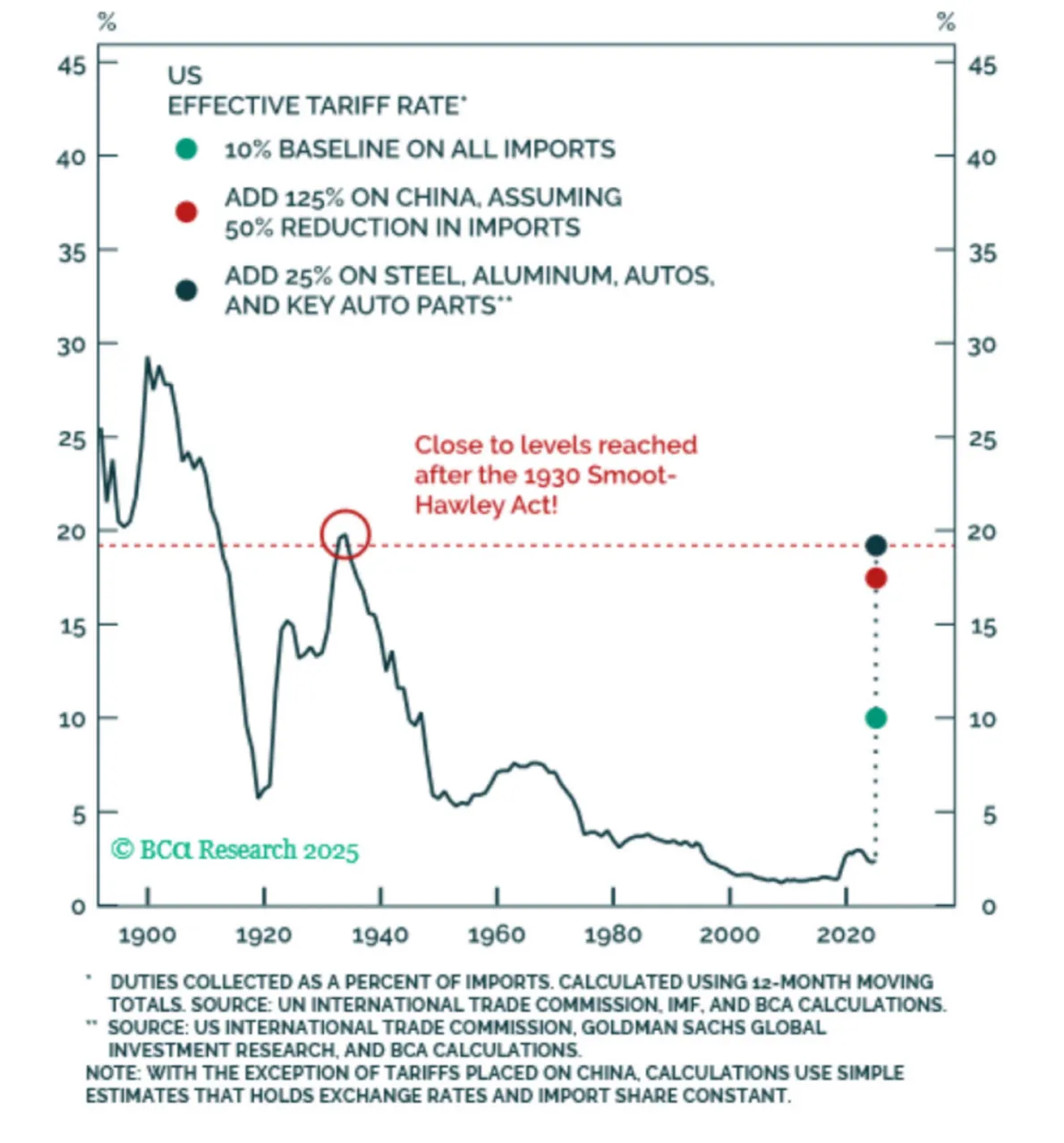
[3] Jay Kuo also provided this chart showing just how high the average tariffs are, even after Wednesday’s walk-back.
I wanted to put up a quick response to yesterday’s sudden move to exempt electronics. What you need to know is that it does not represent a move toward sanity. On the contrary, the Trump tariffs just got even worse.
Import Chinese battery: 145% tariff Import Chinese battery inside Chinese laptop: 20% tariff Import Chinese battery inside Vietnamese laptop: 0% tariff
I’m putting my own critique of Trump’s tariffs in this footnote, because I’ve posted it before and don’t want to get repetitive. Basically, Trump touts his tariffs as accomplishing three contradictory purposes:
To provide a revenue stream that can replace other taxes, the tariffs have to last for years and the US has to continue importing tariffed products. But to the extent that manufactured products and their supply chains move to the US, imports of tariffed products will fall, lowering revenue from the tariff.
In order to move manufacturing and its supply chains back to the US, the tariffs again have to last for years. Corporations will only move their factories if they expect the tariffs to remain in place into the distant future. But if the tariffs are a bargaining chip to be negotiated away, they won’t last. To the extent that corporations expect trade negotiations to succeed, they’ll leave their factories overseas.
Worse, the on-again/off-again nature of Trump’s tariffs, at least so far, discourages businesses from making plans that rely on those tariffs. So even if they last far into the future, they may not bring jobs back to the US. In many ways, the erratic policy we have seen the worst of all worlds.
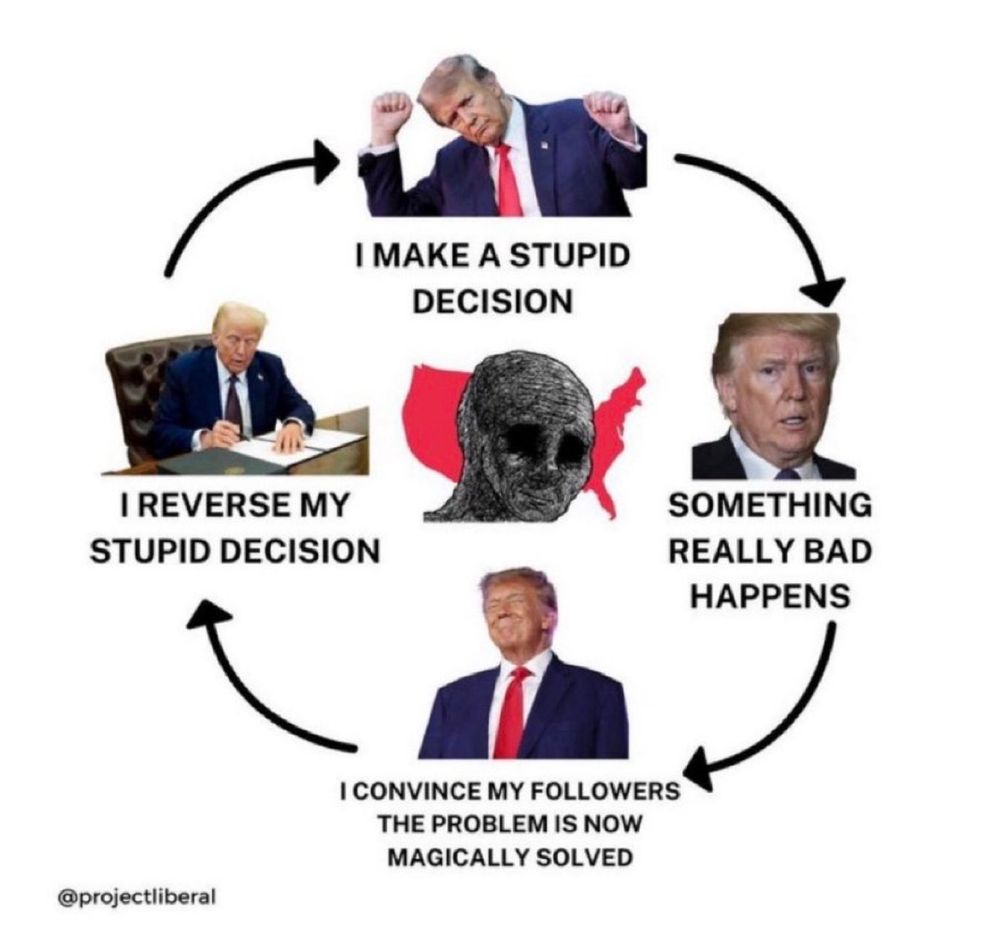
The tariff fiasco continued this week. After swearing that he’d never back down from last week’s tariffs, Trump did indeed back down — and then claimed he’d meant to do that all along.
This week’s featured post focuses on not getting trapped in whatever position is the opposite of Trump’s. In this case, that means being careful in how you oppose Trump’s nonsensical tariff policy. These particular tariffs are crazy, but that shouldn’t push us to critique them from a neo-liberal free-trade stance. Globalization has had its victims, particularly among the non-college White men who make up the core of Trump’s coalition. They’re not wrong to want change.
So tariffs and industrial policy have a role to play in the Democratic worldview. But not this role. It’s a more nuanced and harder-to-communicate position than free trade, but otherwise we’ll get trapped into defending the very flawed pre-Trump status quo.
That post should go out around 10 EST. The weekly summary will cover the approaching clash between Trump and the Supreme Court, some very wrong-headed executive orders concerning the environment, abuse of the Social Security database, and one more thing I may spin off into its own featured post: As we approach the 250th anniversary of the battles of Lexington and Concord, anti-Trump and anti-King-George rhetoric is starting to merge.



















 The Weekly Sift