It started with ICE raids at Home Depots and other places undocumented immigrants might congregate to look for work.
Xochitl, a Guatemalan mother of two, was inside a McDonald’s that shares the parking lot with the Home Depot when she said she saw numerous agents running after men she sees every day but knows only by their nicknames. She said she momentarily froze but then began walking in the opposite direction of agents who were detaining food vendors on sidewalks.
“They were just grabbing people,” she said. “They don’t ask questions. They didn’t know if any of us were in any kind of immigration process.”
Anti-ICE protesters gathered, as they do in towns and cities all over America. (There’s a weekly protest outside a Massachusetts ICE facility one town over from mine. I haven’t attended yet, but I feel like I should.) Increasingly, ICE is targeting not the violent criminals Trump campaigned against (who never existed in the numbers he claimed), but the neighbors, friends, and co-workers of ordinary Americans.
By Friday, the situation had devolved into law enforcement officers using tear gas and protesters shooting fireworks at ICE. Who started the violence? Hard to say. In this video, a man describes an ICE raid causing a traffic jam. When agents began dragging people out of a local business, people stuck in the jam began taking videos on their phones. “We’re not there to protest. We were stuck at the light.” The tear gas, the man claims, was aimed at the people taking videos on their phones. “One of the agents, I hear them: ‘Go for the people with the phones’.”
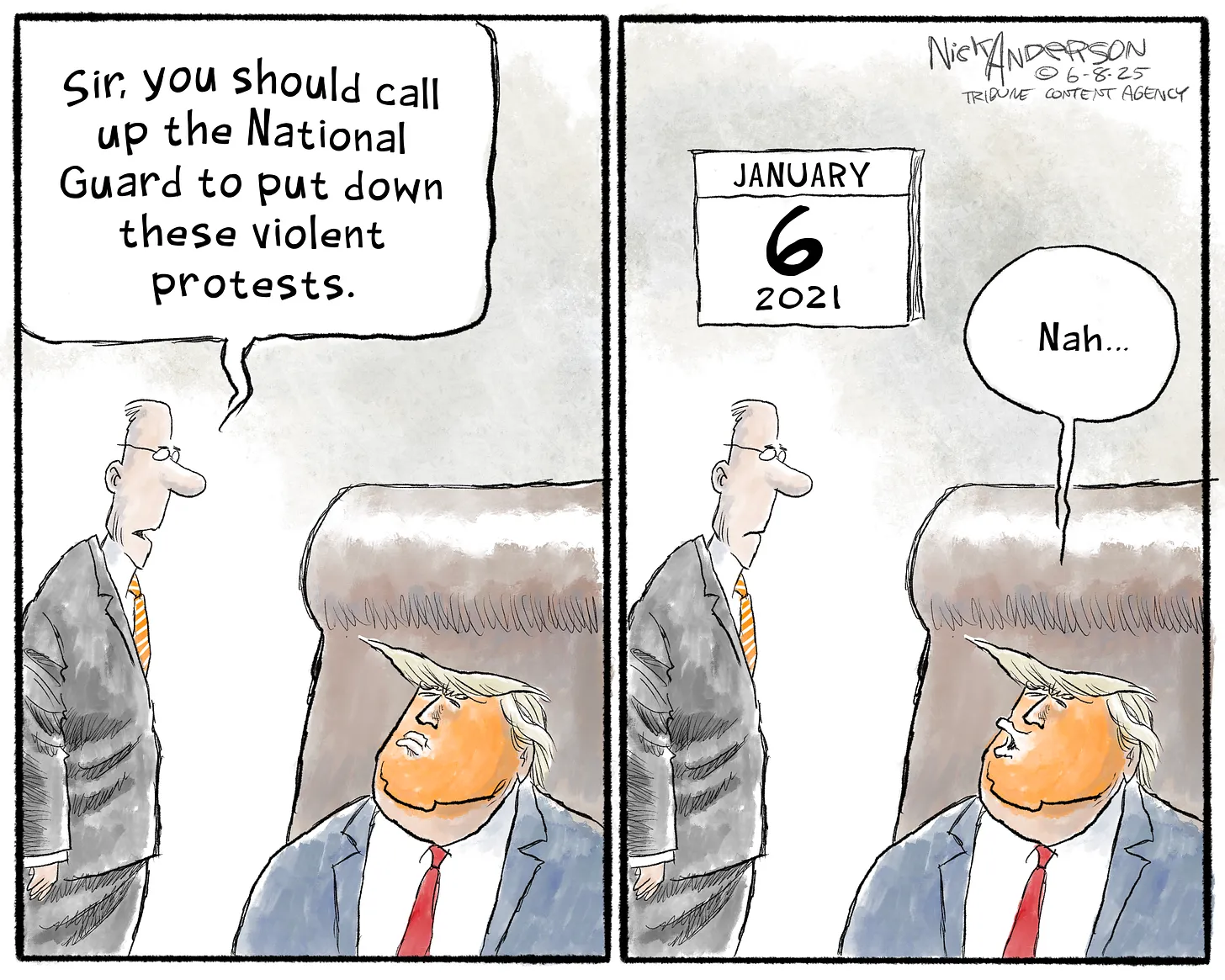
Local officials thought the police response was appropriate to the size of the disturbance, but Trump evidently disagreed. Saturday, he federalized 2000 troops from the California National Guard and placed them under the command of Defense Secretary Pete Hegseth.
Using National Guard troops to control unrest is a well established practice, but usually the troops are requested by the governor. Here, Governor Newsom (and LA Mayor Karen Bass) opposed using the troops, but Trump sent them in anyway — something that hasn’t been done since 1965, when LBJ sent troops to Alabama to protect civil rights workers.
Trump’s over-the-top response has created an additional reason to protest: the appearance of a military takeover as federalized troops are used against the citizens of a major American city. A weekly blog can’t cover breaking news, so I’ll just have to wait and see how this plays out.
The legal authority here is tricky. Jay Kuo breaks it down: Trump is invoking his authority under Title 10, which allows him to use National Guard troops to respond to “a rebellion against the authority of the Government of the United States”. Characterizing spontaneous demonstrations as “rebellion” against the US government is a bit of a stretch, but it’s the kind of stretch the Trump administration has made before, like when it claimed illegal immigration is an “invasion” that justifies invoking the Alien Enemies Act.
But Title 10 doesn’t allow martial law.
So here’s the part that’s a bit hard to grasp at first. Title 10 permits the President to federalize the troops and put them under his command. But what they are permitted to do as military troops operating on domestic soil is still governed by other laws.
And one of those laws is the Posse Comitatus Act.
The PCA doesn’t allow federal troops to play the role of local law enforcement. All they can do is protect federal buildings and federal agents carrying out their duties.
The Insurrection Act makes an exception to the Posse Comitatus Act, and so would be a step towards martial law. But so far Trump has not invoked the Insurrection Act.
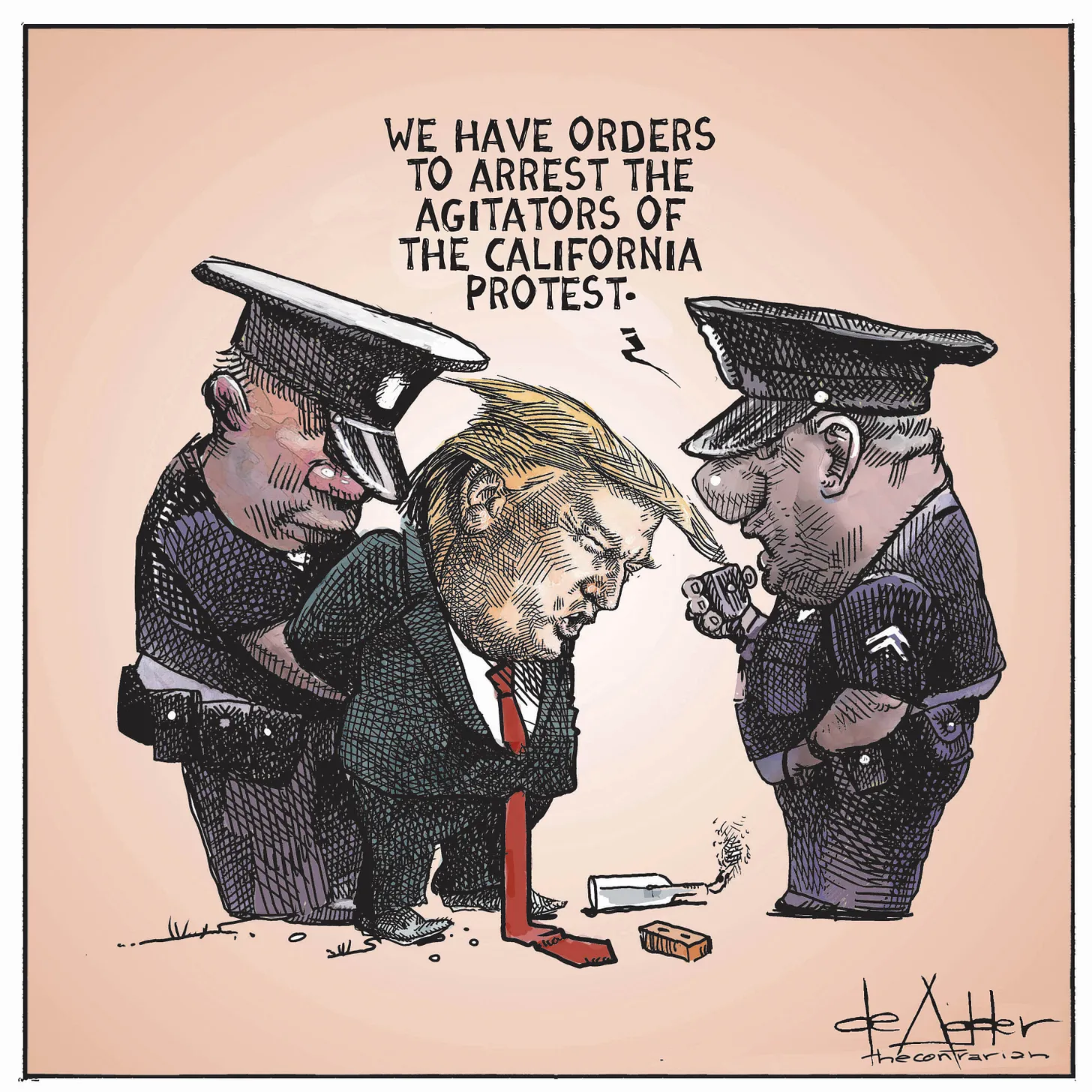
Now I’ll begin to speculate: It looks like Trump wants this confrontation, and is hoping the situation escalates. This will provide lots of violent video to show on Fox News, of blue-state citizens battling US troops. After a few days of that, he can justify invoking the Insurrection Act, turning LA into a military occupation zone.
It’s hard not to connect this directly provoked confrontation with the events scheduled for next Saturday. Trump has planned a North-Korea-style military parade in Washington. Ostensibly, the parade is to celebrate the 250th birthday of the US Army. But coincidentally, Saturday is also Trump’s own birthday.
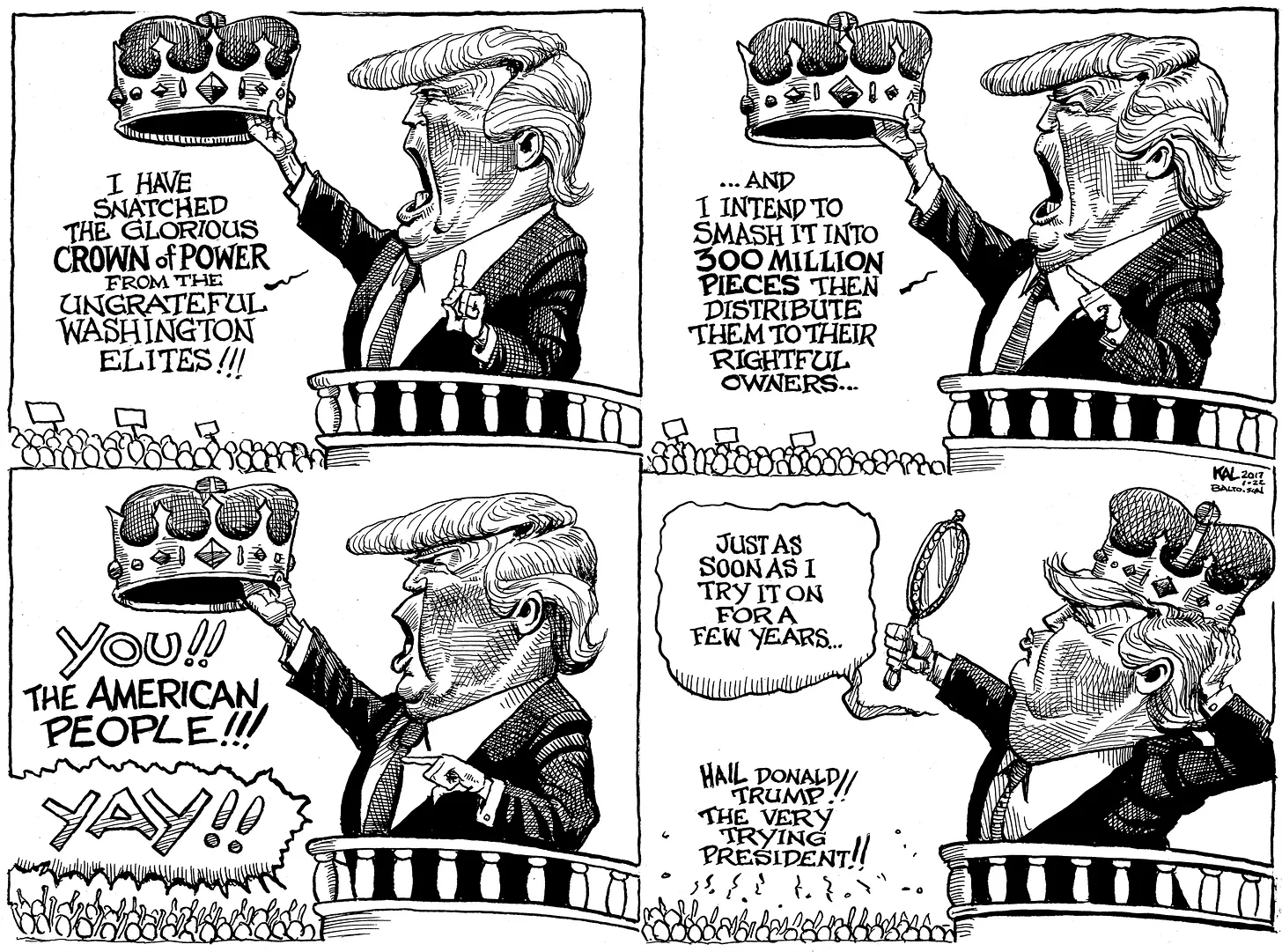
Trump’s $45 million birthday party has incited plans for thousands of counter-protests around the country, under the theme “No Kings“. Whether he intends to meet these protests with state violence remains to be seen.
It’s been one of those weeks where everything seems like a distraction from everything else. Trump and ICE have provoked a showdown with protesters in Los Angeles, and used it to push another overreach of executive power: Any violence that erupts during a protest is now evidence of a “rebellion against the government of the United States”, and justifies taking federal control of state National Guard units.
Meanwhile, Trump and Elon Musk had a major falling out this week, putting passage of Trump’s “big beautiful bill” in jeopardy. And it turns out that the Trump administration can get Kilmar Abrego Garcia back from El Salvador after all — now that they’ve got charges to file against him.
Anyway, the featured post deals with the situation in Los Angeles. As always, I stay away from trying to cover unfolding events. But the legal authority Trump is invoking and its implications are worth paying attention to sooner rather than later. That should be out shortly.
Musk and Garcia are covered in the weekly summary. I’ll mostly avoid the sensational parts of the Trump/Musk spat, but the story implies a bunch of things that the mainstream media is mostly ignoring. Like this: If Trump isn’t corruptly using his power to reward his friends and punish his enemies, why does Tesla’s stock price gyrate based on whether Musk seems like a friend or enemy at the moment?
Also in the summary: Southern Baptists debate whether to try to reverse same-sex marriage. Missouri’s broken public schools are a preview of what the GOP has planned nationally. And a few other things. That should be out by noon EDT.
In so holding, the court does not pass upon the wisdom or likely effectiveness of the President’s use of tariffs as leverage. That use is impermissible not because it is unwise or ineffective, but because [the law] does not allow it.
That’s the subject of the featured post. The decision of the US Court for International Trade revolves around what powers Trump has and how he exercises them. In the conclusion I note that there are legal ways to achieve Trump’s legitimate purposes, but he has chosen illegal ways that put him into conflict with the courts.
You can view that tendency in a sinister way, as Trump seeking conflict as he angles toward dictatorial power. But the Atlantic’s David Graham puts a different spin on it.
Some of Trump’s most notable collisions with the law and courts are less a product of him wanting powers that he doesn’t have than about him wanting things to happen faster than his powers allow. The president has a great deal of leeway to enforce immigration laws, but he is unwilling to wait while people exercise their right to due process, so instead he tries to just erase that right.
Trump could lay off many federal workers using the legally prescribed Reductions in Force procedure; instead, he and Elon Musk have attempted to fire workers abruptly, with the result that judges keep blocking the administration. Similarly, Trump could try to get Congress to close the Education Department or rescind funding for NPR, especially given the sway Trump holds over Republicans in both the House and the Senate. Instead, he has tried to do those things by executive fiat. Last week, a judge blocked his effort to shut down the department, and this week, NPR sued the administration over the attempt to slash funding, arguing that only Congress can claw back funds it has appropriated.
and Elon’s last day
Another SpaceX Starship rocket failed Tuesday. Friday was Elon Musk’s official last day as a “special government employee“, a status which was always supposed to have a 130-days-per-year time limit — pretty close to the time since Trump’s inauguration on January 21.
Trump and Musk marked the occasion with a joint Oval Office press conference. Send-offs are times for reflection, and this one raises a bunch of questions.
Is he really leaving?Trump says no, for what that’s worth.
Elon is really not leaving,” Trump said. “He’s going to be back and forth. I think I have a feeling [DOGE is] his baby, and I think he’s going to be doing a lot of things.
It’s hard to know how seriously to take that. On the one hand, Musk is still the richest man in the world and can single-handedly finance campaigns at multiple levels. He still owns X/Twitter, which is a powerful force for injecting his point of view into the public mind. So if he wants to have influence in politics, he can.
On the other hand, Musk’s time as the face of the (mostly illegal) DOGE firings and budget cuts has probably not been a fun experience for him. He’s been widely vilified. Trump may well see Musk as a used-up shield. He absorbed blame from Trump’s policies, but became so unpopular that Trump may well not want to be linked with him going forward.
It had to hurt when fellow mega-billionaire Bill Gates said:
The picture of the world’s richest man killing the world’s poorest children is not a pretty one. I’d love for him to go in and meet the children that have now been infected with HIV because he cut that money
So Musk may look back on his involvement in government as an unpleasant mistake. Time will tell.
What did he accomplish for the country? For the conservative cut-government-spending movement, not much. He came in promising to find $2 trillion of waste, fraud, and inefficiency. But in spite of all the people he fired or tried to fire, numbers of that size were never on the table. In the end, DOGE claimed it had saved $160 billion, but even that number was inflated. CBS reported an estimate from Partnership for Public Service that balanced that $160 billion with $135 billion in additional costs, resulting in a net savings of $25 billion. Once you factor in lost revenue (like the additional taxes those fired IRS employees might have collected) DOGE may have increased the federal deficit.
In addition, much of what Musk cut had real value, like medical research and the food and medical aid that Gates was talking about. Michelle Goldberg writes:
There is one place, however, where Musk, with the help of his minions, achieved his goals. He did indeed shred the United States Agency for International Development. Though a rump operation is operating inside the State Department, the administration says that it has terminated more than 80 percent of U.S.A.I.D. grants. Brooke Nichols, an associate professor of global health at Boston University, has estimated that these cuts have already resulted in about 300,000 deaths, most of them of children, and will most likely lead to significantly more by the end of the year. That is what Musk’s foray into politics accomplished.
Since the start of the second Trump administration, federal agencies that had scrutinized Musk and his business empire in recent years have begun to look a lot different. At the Department of Agriculture, for example, President Donald Trump fired the person who had been investigating the Musk company Neuralink. At other agencies including the Consumer Financial Protection Bureau, Trump and Musk have tried to slash the number of employees — potentially hobbling those regulators’ ability to enforce the law against companies including Musk’s Tesla and X.
In the past few months, Trump’s Justice Department has dropped a case against Musk’s rocket company, SpaceX, and his Labor Department has canceled a planned civil rights review of his automaker, Tesla. Another regulatory matter against SpaceX has entered settlement talks with the National Labor Relations Board.
And in more than 40 other federal agency matters, regulators have taken no public action on their investigations for several months or more — raising questions about whether those cases may have become dormant, according to an NBC News review of regulatory matters involving Musk’s companies. Those matters range widely, from safety investigations into Tesla’s “self-driving” features to alleged workplace safety violations at SpaceX.
So maybe the $277 million he spent on the Trump campaign was a good investment.
and Ukraine’s well designed raid
Just a few months after Pearl Harbor, American spirits were lifted by a daring bombing raid on Tokyo, which everyone — including the Japanese — had believed was out of range. It became known as the Doolittle Raid, after its leader, Jimmy Doolittle. Doolittle’s team figured out how to launch the ordinarily land-based B-25 bomber from an aircraft carrier, then maneuvered the carrier close enough to make the attempt. All 16 planes were lost, but Doolittle got the Medal of Honor for the propaganda victory.
Sunday, Ukraine launched a similarly audacious attack, as it smuggled 117 drones close enough to Russian air bases deep in Siberia that it could destroy dozens of the Russian bombers that had been hitting Ukraine. The attacks hit three separate air bases. Ukraine claims to have damaged 40 Russian aircraft, and says that all drone operators are now safely out of Russia.
Whenever Trump announces massive tariffs, stock prices plunge. But then something almost always happens, like he puts the tariffs on pause, and then stock prices rebound. If you had known he would do that, you could have “bought the dip” and profited hugely when prices went back up.
Well, among Wall Street traders, this buy-the-tariff-dip strategy became known as “the TACO trade“, where TACO stands for Trump Always Chickens Out. In other words, he’ll talk tough about high tariffs, but will always find some way to back down.
One idea that has been discussed is to transform the [presidential daily briefing] so it mirrors a Fox News broadcast, according to four of the people with direct knowledge of the discussions. Under that concept as it has been discussed, the national intelligence director’s office could hire a Fox News producer to produce it and one of the network’s personalities to present it; Trump, an avid Fox News viewer, could then watch the broadcast PDB whenever he wanted.
A new PDB could include not only graphics and pictures but also maps with animated representations of exploding bombs, similar to a video game, another one of the people with knowledge of the discussions said.
“The problem with Trump is that he doesn’t read,” said another person with direct knowledge of the PDB discussions. “He’s on broadcast all the time.”
One tool of the creeping surveillance state is the automated license plate reader. Put enough of them in enough places, and you can track who drives where. Like all powers, this can be used for good or ill purposes.
This week 404 Media reported that a Texas police officer used Flock to perform a nationwide search of more than 83,000 ALPR cameras while looking for a woman who had had an abortion. Abortion is almost entirely illegal in Texas but law enforcement reportedly looked at cameras in states such as Washington and Illinois, where abortion is legal.
Jay Kuo’s brother Kaiser responds to Secretary of State Rubio’s announcement that the US has started revoking the visas of Chinese students.
The soft power cost is immeasurable. For decades, a degree from a U.S. university was the golden ticket, and not just for the prestige and the improved job prospects back home. It was often the start of a lifelong affinity for America, its values, and its people. Some of China’s best-known reformers and tech founders were educated in the U.S. They returned to China with not just skills and credentials, but admiration for an open society that welcomed them. Those days are ending. We are actively teaching the next generation of global talent that America is hostile, capricious, and unwelcoming.
Sam Stein is an American-raised Jewish Israeli citizen who devoted half a year to being a “protective presence” for Palestinians in the West Bank occupied territories.
For six months, I lived alongside those I’d been relentlessly warned would kill me at first opportunity. The truths I learned there must be shared, especially with others raised on the same fears.
The Real News Network’s Adam Johnson does a takedown of Jake Tapper and his new book “Original Sin”.
So Tapper has found the great scandal of the Biden years, and it is, of course, not one that upsets anyone at the Pentagon, the US Chamber of Commerce, the editorial boards of the New York Times or the Atlantic or AIPAC. The Biden aging story is the perfect pseudo-scandal for corporate media, and thus the perfect Jake Tapper story: vaguely true, but ultimately of peripheral importance, scapegoating a handful of Biden flunkies and, most important of all, it allows Tapper to polish his Speaking Truth to Power brand without speaking truth to anyone in a position of actual power.
Johnson’s candidate for the real Biden scandal is supporting Israel’s genocide in Gaza.
[I]n over 15 months of co-hosting the influential Sunday news show State of the Union during the Gaza genocide under Biden, Tapper never once platformed a single Palestinian guest, while giving ample platform to a revolving door of Biden officials, Israeli spokespeople, and two softball interviews with Israeli Prime Minister—and fugitive from international justice—Benjamin Netanyahu.
Consistent with his yawning through the genocide under Biden, Tapper mostly ignores it under Trump and only chimes in to frame the latest Israeli war crime in terms favorable to Israel. Even worse than never bothering to interview a single Palestinian, his Sunday news show, since Israel recommenced its genocide on March 18, hasn’t brought up Gaza as a topic once.
Anthropologist Anand Pandian has traveled the country speaking to people of all backgrounds and opinions.
In my writing, I try to show how everyday structures of isolation – at home and on the road, for the body and the mind – magnify the social and political divides we lament so often. These interlocking walls of everyday life sharpen the divide between insiders and outsiders, making it hard to take unfamiliar people and perspectives seriously, to acknowledge the needs of others and relate to their struggles.
So much turns on the edges between the familiar and the foreign, these lines we’ve come to live with on a daily basis. Can we learn once again to take these edges as spaces of encounter, rather than hard divides between ourselves and the world beyond?
and let’s close with an intriguing thought
David Farrier considers the possibility that AI might crack animal languages, and what it might do to human consciousness if we learned how other species communicate.
In interspecies translation, sound only takes us so far. Animals communicate via an array of visual, chemical, thermal and mechanical cues, inhabiting worlds of perception very different to ours. Can we really understand what sound means to echolocating animals, for whom sound waves can be translated visually?
The German ecologist Jakob von Uexküll called these impenetrable worlds umwelten. To truly translate animal language, we would need to step into that animal’s umwelt – and then, what of us would be imprinted on her, or her on us? “If a lion could talk,” writes Stephen Budiansky, revising Wittgenstein’s famous aphorism in Philosophical Investigations, “we probably could understand him. He just would not be a lion any more.”
Can Trump decide for himself the extent of his own power?
Many of the Trump administration’s most controversial actions are based on novel (and perhaps far-fetched) interpretations of existing laws. The most objectionable deportations are based on a bizarre reading of the 1798 Alien Enemies Act, and soon the Supreme Court will have to rule on whether it really does give Trump he power he claims. Similarly, many of the tariffs he has declared are based on the International Emergency Economic Powers Act of 1977.
But the same question arises: In the IEEPA, Congress delegated certain powers to the President. But did it delegate these powers, to be used in this situation.
Wednesday, the United States Court of International Trade said no.
The argument. Simplifying somewhat, the Trump administration argues that the IEEPA gives Trump essentially unlimited powers over tariffs. He can invoke the IEEPA by declaring a national emergency of his choosing, and once he does, the emergency powers Congress has delegated to the President allow him to do just about whatever he wants. Courts have no power to intervene, because the existence of an emergency and the measures necessary to deal with it are “political questions” that unelected judges have no business resolving.
The counter-argument is that emergency laws like the IEEPA delegate specific powers with limitations, not dictatorial powers for the President to use however he likes. Even if you could interpret the language of the law to grant unlimited power, that would itself be unconstitutional: Congress can only delegate its power up to a point.
Moreover, the courts have a necessary role in interpreting whether a President’s use of an emergency power is within the limitations of the statute. Otherwise we’re back in the dictatorial situation: The President has as much power as he says he has, and no one can say otherwise.
Ordinary tariffs. Some background: Presidents don’t ordinarily make tariffs. Tariffs are taxes, and the Constitution assigns Congress “Power To lay and collect Taxes, Duties, Imposts and Excises”. Congress is also empowered to “regulate Commerce with foreign Nations”. So that’s typically how tariffs get done: Congress passes a law establishing them, like the ill-fated Smoot-Hawley Tariff Act of 1930.
This Congress has not passed a tariff bill, and Trump has not asked it to. Instead he has invoked the IEEPA, which Wikipedia describes like this:
The IEEPA authorizes the president to declare the existence of an “unusual and extraordinary threat … to the national security, foreign policy, or economy of the United States” that originates “in whole or substantial part outside the United States.” It further authorizes the president, after such a declaration, to block transactions and freeze assets to deal with the threat and requires the president to report to Congress every 6 months on the circumstances, threats and actions taken. In the event of an actual attack on the United States, the president can also confiscate property connected with a country, group, or person that aided in the attack.
IEEPA falls under the provisions of the National Emergencies Act (NEA), which means that an emergency declared under the act must be renewed annually to remain in effect.
A textbook example of the IEEPA in action was what President Bush II did after 9-11: He declared an emergency and blocked the assets of organizations identified as terrorist.
Emergency tariffs. Tariffs come into the picture because President Nixon used a predecessor of IEEPA (the Trading With the Enemy Act of 1917, or TWEA) to raise tariffs across the board. That action was contested in court, and an appeals court reversed a lower-court finding that the tariffs exceeded the power Nixon was delegated under TWEA. In reversing that decision, the higher court emphasized that the President’s power was not unlimited. Nixon had
imposed a limited surcharge, as a temporary measure calculated to help meet a particular national emergency, which is quite different from imposing whatever tariff rates he deems desirable
After that ruling, Congress passed IEEPA to pull back some of the power it had delegated to the President. The TWEA powers were now reserved for wartime, while IEEPA covered “national emergencies” short of war. These powers
may only be exercised to deal with an unusual and extraordinary threat with respect to which a national emergency has been declared for purposes of this chapter and may not be exercised for any other purpose.
Questions related to the balance of trade are dealt with in a separate piece of legislation: Section 122 of the Trade Act, where the President’s powers are still more restricted: Tariff surcharges are limited to 15% and 150 days.
But the Trump administration’s position in court is that the IEEPA’s delegation of power is essentially unlimited: It’s up to the President to decide what a national emergency is and what measures are necessary to “deal with” it. Courts can’t second-guess him, because that’s a “political question” off limits to the unelected judiciary. (So if the President declares that vaping constitutes a national emergency and banning pogo sticks is necessary to deal with it, courts have no power to intervene.)
The court didn’t buy any of that. The language of the statute is not the President’s to interpret.
This language, importantly, does not commit the question of whether IEEPA authority “deal[s] with an unusual and extraordinary threat” to the President’s judgment. It does not grant IEEPA authority to the President simply when he “finds” or “determines” that an unusual and extraordinary threat exists. … Indeed, “[t]he question here is not whether something should be done; it is who has the authority to do it.” [Biden v. Nebraska, 600 U.S. at 501]. The court simply asks whether the President’s action “deal[s] with an unusual and extraordinary threat.” Congress provided the necessary standards for resolving this inquiry when it enacted IEEPA, and the court’s task is to apply them.
Which tariffs are at issue? Trump used IEEPA authority to impose tariffs of three types
worldwide tariffs. The 10% tariff on all imports.
retaliatory tariffs. The country-by-country tariffs Trump announced on “liberation day”.
trafficking tariffs. Tariffs against Canada, Mexico, and China to pressure them to prevent fentanyl smuggling into the US.
The court rejects all of them. There are other tariffs, including tariffs on metals and car parts, that Trump invoked on other authorities. Those were not questioned.
Nondelegation and Major Questions. During the Biden administration, the Supreme Court created new legal principles to restrain executive power. Nondelegation is essentially the idea that certain powers are so central to Congress’ role that they can’t be delegated. So legislation that delegates those powers broadly, rather than in very specifically defined circumstances, is unconstitutional.
The major questions doctrine says that large-scale grants of power to the executive branch must be made explicitly in the authorizing legislation. For example, the Court used this doctrine to knock down President Biden’s cancellation of student debt. The authorizing legislation allowed the executive branch to tinker with student loan repayments. But if Congress had intended to allow the President to cancel over a trillion dollars of debt, it would have said so explicitly.
Findings. The Court of International Trade found that Trump’s worldwide and retaliatory tariffs were balance-of-trade remedies that belonged under the restrictions of Section 122, not the IEEPA. A trade deficit by itself is not an “unusual and extraordinary threat” that invokes IEEPA emergency powers.
The President’s assertion of tariff-making authority in the instant case, unbounded as it is by any limitation in duration or scope, exceeds any tariff authority delegated to the President under IEEPA. The Worldwide and Retaliatory tariffs are thus ultra vires and contrary to law
The trafficking tariffs fail because they do not “deal with” the emergency that the President has declared. Fentanyl smuggling may well be a national emergency, but the connection to tariffs on Mexico, Canada, and China is too indirect and tenuous.
“Deal with” connotes a direct link between an act and the problem it purports to address. A tax deals with a budget deficit by raising revenue. A dam deals with flooding by holding back a river. But there is no such association between the act of imposing a tariff and the “unusual and extraordinary threat[s]” that the Trafficking Orders purport to combat.
Trump argues that the tariffs are necessary to put pressure on the targeted nations, so that they will crack down on fentanyl smuggling.
The Government’s “pressure” argument effectively concedes that the direct effect of the country-specific tariffs is simply to burden the countries they target. It is the prospect of mitigating this burden, the Government explains, that will induce the target countries to crack down on trafficking within their jurisdictions. See Gov’t Resp. to Oregon Mots. at 39. But however sound this might be as a diplomatic strategy, it does not comfortably meet the statutory definition of “deal[ing] with” the cited emergency. It is hard to conceive of any IEEPA power that could not be justified on the same ground of “pressure.”
The Government’s reading would cause the meaning of “deal with an unusual and extraordinary threat” to permit any infliction of a burden on a counterparty to exact concessions, regardless of the relationship between the burden inflicted and the concessions exacted. If “deal with” can mean “impose a burden until someone else deals with,” then everything is permitted. It means a President may use IEEPA to take whatever actions he chooses simply by declaring them “pressure” or “leverage” tactics that will elicit a third party’s response to an unconnected “threat.” Surely this is not what Congress meant when it clarified that IEEPA powers “may not be exercised for any other purpose” than to “deal with” a threat.
The ruling concludes:
In so holding, the court does not pass upon the wisdom or likely effectiveness of the President’s use of tariffs as leverage. That use is impermissible not because it is unwise or ineffective, but because [the law] does not allow it.
What happens now. The International Trade Court is not the final authority, and the administration has already appealed to the appellate court for the Federal Circuit. That court has put a stay on the ITC’s ruling until it has time to consider the case. Ultimately, this is probably headed to the Supreme Court.
That will be an interesting test for this Supreme Court, which expanded its own power to overrule presidential orders during the Biden administration. But do the same limitations apply to Democratic and Republican presidents? Or has the law become partisan, so that what was done matters less than who did it?
The politics. The Trump administration interprets all its losses in court as judges making their own policy decisions and trying to impose them on the executive branch. Stephen Miller, for example, decried how “15 Communist judges” spread through the courts can “block and freeze each executive action”.
That framing allows Trump’s people to describe the issues the way they want, and then say that judges are against what the administration is for. Trump wants to deport dangerous criminals, while judges want to stop him. Trump wants to defend our economy from predatory foreign countries, but judges want to stop him, and so on.
But that framing sidesteps whether the United States will continue to be a country of laws, or whether it will become a Trump dictatorship. The Constitution defines the powers of our government, and assigns them to different branches. When Trump gathers all those powers to himself — and more powers that the Constitution does not assign to anyone — our way of life is endangered.
Whatever legitimate goals Trump may have — deporting criminals or protecting American jobs or whatever — can be accomplished in legal ways. (For example, Trump could ask Congress for a new tariff law. He could deport criminals through the immigration courts.) When he ignores legal pathways in favor of illegal ones, he needs to be stopped.
The US Court of International Trade struck down most of the new tariffs Trump has imposed, while putting major restrictions on the tariffs he can impose in the future.
Ukraine launched an incredible drone strike thousands of miles from its border, destroying bombers on three Russian air bases.
Elon Musk had his last day as a “special government employee”, prompting reflections on what the whole DOGE thing has accomplished.
The featured post will delve into the court ruling on tariffs, leaving Ukraine and Musk for the weekly summary. Expect to see the featured post around 10 EDT, and the summary around noon.
Trump isn’t trying to make our communities safer from migrant crime, which is not a widespread thing. He is trying to divide us, to make us fear and despise other human beings who live in our communities, and to gain power from that division and fear.
This week everybody was talking about the GOP’s budget bill
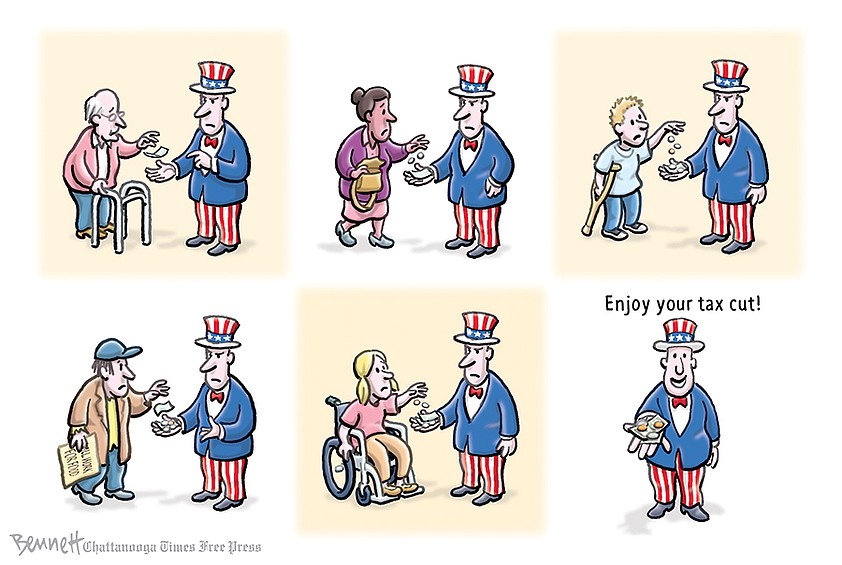
Last week I wrote about what the “Big Beautiful Bill” contains: tax cuts for rich people, cuts to programs like Medicaid and Food Stamps that help the working poor, and a huge deficit.
Trump’s supporters will undoubtedly see hypocrisy my complaints about this bill’s deficits when I was fine with Biden’s deficits. But there’s a big difference: Biden was investing in the future, in infrastructure, and in mitigating the damaging effects of climate change. Trump is just transferring wealth from the bottom of society to the top.
The “Freedom” caucus in the House briefly slowed down the bill’s passage, but enough of them fell into line to pass the bill by one vote. The holdouts got a variety of concessions, but the big one is a further cut in Medicaid: the “work requirement” (that adds bureaucratic hurdles to the program and will cause millions of qualified working people to lose their medical coverage) starts in 2027 rather than 2029.
A handful of Republican senators are still pretending to care about the national debt. They will make lots of favorable headlines for themselves and their serious good intentions — and then quietly cave.
An obscure point about this bill deserves more attention: PAYGO legislation from years ago forces an across-the-board sequestration if deficits go too high. The nonpartisan Congressional Budget Office is projecting that the Big Beautiful Bill might cross that limit and lead to $500 billion in Medicare cuts.
and the ongoing wars
The Ukraine War continues, long after Trump’s promise to end it “in 24 hours” expired. As Putin responds to Trump’s attempts at peace talks with ever-more-deadly attacks, Trump appears to finally be recognizing that Putin is an enemy to peace. But he frames the situation as Putin-has-changed, not Putin-fooled-me.
“I’ve always had a very good relationship with Vladimir Putin of Russia, but something has happened to him. He has gone absolutely CRAZY!” Trump wrote in a social media post, adding, “I’ve always said that he wants ALL of Ukraine, not just a piece of it, and maybe that’s proving to be right, but if he does, it will lead to the downfall of Russia!
Pressed by a reporter to say if he was now seriously considering “putting more sanctions on Russia”, Trump replied: “Absolutely. He’s killing a lot of people. What the hell happened to him?”
The sanctions will never happen, because Putin is the alpha in the Putin-Trump relationship.
Israel’s genocide in Gaza continues and even escalates. I used to hesitate to use that word, but I don’t see how else to characterize the situation. This week, Israel’s former prime minister Ehud Olmert wrote an op-ed in a leading Israeli newspaper:
“What we are doing in Gaza is a war of extermination: indiscriminate, unrestrained, brutal, and criminal killing of civilians,” he said.
“We are doing this not because of an accidental loss of control in a particular sector, not because of a disproportionate outburst of fighters in some unit — but as a result of a policy dictated by the government, knowingly, intentionally, viciously, maliciously, recklessly,” Olmert’s op-ed continued. “Yes, we are committing war crimes.”
I continue to denounce any attempt by Americans of any opinion to bring the Gaza War here. The murder of two Israeli embassy staffers in Washington, D.C. Wednesday helps no one. And there is even less justification for harassing American Jews for the actions of the Netanyahu government.
In America, we can and should argue about issues of all kinds. We have the right to speak out and peacefully demonstrate to make our opinions known. But leave the violence over there. Our goal should be to stop the violence there, not bring it here.
and Joe Biden
Last week we heard that Joe Biden has an advanced form of prostate cancer. I cannot remember bad news about a former president being met with less compassion. Don Jr. tweeted:
What I want to know is how did Dr. Jill Biden miss stage five metastatic cancer or is this yet another cover-up???
When he took flack for that stone-hearted comment, he struck back:
I sometimes forget that part of the mental disorder of leftism is an inability to understand sarcasm.
No, we get the sarcasm. What we can’t understand is posting a sarcastic response to another human being’s death sentence.
Laura Loomer skipped any attempt at humor and went straight for venom.
To all of you praying for Joe Biden, can you pray for the people he killed with his open border policies instead? “Ohhhh boo hoo he’s such a good guy booo hooo he’s such a fighter.” No he’s not. And no, he’s not. He is going down in history as the worst US President EVER.
No, Laura, I think your guy has that title pretty well wrapped up.
In a statement to Axios, an anonymous Biden aide said: “Yes, there were physical changes as he got older, but evidence of aging is not evidence of mental incapacity.”
The spokesperson added: “We are still waiting for someone, anyone, to point out where Joe Biden had to make a presidential decision or make a presidential address where he was unable to do his job because of mental decline.
“In fact, the evidence points to the opposite – he was a very effective president.”
I don’t know how much he did himself and how much he delegated, but everything that happened during the Biden administration was consistent with the man he has always been. The US was well-governed during his four years, and he did an excellent job of cleaning up the mess Trump left behind after his first term.
And whether you liked his politics or not, his career is done now and he’s likely to die soon. It costs you nothing to treat him like a human being.
The measles outbreak in Texas seems to be waning, but the disease is still spreading in New Mexico and Kansas. Officials worry about the outbreak spreading further as more people travel in the summer. Already, 2025 has the second-most cases of any year in this century.
MSNBC host Jen Psaki used to answer questions as Biden’s press secretary. One of the more charming features of her current show is to take questions from current White House press conferences and answer them honestly, something current press secretary Karoline Leavitt will never do.
I always thought Kristi Noem was an opportunist. But now we find out she’s also an idiot.
It’s been five years since a Minneapolis policeman murdered George Floyd, igniting protests around the country. NPR’s Michel Martin spoke to Minnesota Attorney General Keith Ellison, Minneapolis Mayor Jacob Frey and civil rights attorney Benjamin Crump. Activists M Adams and Miski Noor argue that the resulting movement to defund the police accomplished more than you might think. On the other hand, the NYT reports that police killings have risen every year since Floyd’s murder.
If you’re talking about jobs that could relatively easily be replaced with AI, I would suggest, at the top of the list: [mainstream media] political reporter. How trivially easy would it be to program an AI to crank out “Dems in disarray” pieces from now to eternity?
Trump’s notion of national greatness is stuck in the Napoleonic Era. That’s causing him to destroy everything that makes America great today.
Nothing is more central to the positive version of Trump’s image or to the aspirations of his followers than the idea of greatness. Throughout his political career, policies come and go, allies are cast out as enemies and then welcomed back into his good graces, and whether he wants more or less of something may change from the beginning of a speech to the end. But the slogan never changes: Make America Great Again. It’s been so steady that everyone knows it just by its initials, MAGA. You talk about MAGA followers or the MAGA Party, and everyone knows what you mean.
And who can argue with that goal? Don’t all loyal Americans want their country to be greater rather than lesser? The “again” may be controversial — when exactly are we talking about? — but “greatness”, who doesn’t aspire to greatness?
And yet, every day we see Trump tear down the things that have made America great: scientific excellence, the rule of law, trade, alliances, our open society, and the soft power that comes from the attractiveness of our vision. How does that make any sense? Is it just hypocrisy? Is “greatness” just a buzzword to exploit? A false banner for the gullible to flock behind?
I want to propose a different explanation. When we asked what era “again” referred to, we were on the right track, but we didn’t take it far enough. What era does “greatness” refer to?
Look at some of the things Trump thinks will make America “great again” and ask yourself what era they belong to. Invariably, they fit a Napoleonic view of greatness, not a 21st-century view.
Territorial expansion. Great nations gain territory while lesser nations lose territory. Taking over Greenland, regaining the Panama Canal, and annexing Canada, would be a sure sign of our renewed greatness.
Mercantile dominance. A great nation exports more goods than it imports, drawing in gold and silver. This was the dominant theory of economics at least until Adam Smith’s Wealth of Nations came out in 1776 and for some while thereafter. Such mercantilism is the primary motive behind Trump’s tariff policy.
Manliness. In the Napoleonic years, Frenchmen were confident of their ultimate victory over England, because the English were “a nation of shopkeepers” that did not properly center martial valor in their national identity. This attitude resonates with Defense Secretary Pete Hegseth’s prioritization of “restoring the warrior ethos” in our military, and getting rid of efforts to promote diversity and inclusion. “We are leaving wokeness and weakness behind. And refocusing on lethality”. As if armies still relied on glorious cavalry charges rather than drone pilots who might have any sex, sexual preference, or gender identity.
A Great Leader. A primary knock on democracy centuries ago was that it could not produce great leaders like Louis XIV or Peter the Great. Democratic leaders were barely larger than their voters and changed every few years. How could a comparative nonentity like Prime Minister William Pitt compete with a world-bestriding figure like the Emperor Napoleon? Similarly, how could a Kamala Harris or Tim Walz stand up to a contemporary czar like Vladimir Putin? Centuries ago, the pettiness and towering rages of absolute rulers were signs of greatness, while the self-control of a democratic leader seemed weak.
But think for a minute about what has made America great these last hundred years:
Science. Yes, the United States fielded valiant soldiers during World War II. But so did our enemies. Our margin of victory came from developments like radar, code-breaking, and the atomic bomb. As we enter into an era of war-fighting AI, global pandemics, and drones, scientific leadership is more important than ever.
Trustworthy institutions. The primacy of the US in the postwar era has less to do with being a military hegemon than with being at the heart of a global order. The dollar is the global currency. The US banking system is the nerve center of the world economy. US Treasury bills have been the default investment of all other nations’ central banks. Wall Street is the world’s stock market. Other countries tolerate this because (until recently) they have trusted US institutions to be reliable partners.
The rule of law. Why have so many entrepreneurs come to America to found their businesses? Because a fortune made in America was protected by law and safe from predatory rulers like Putin or Viktor Orban. Contracts were enforceable in America, rather than subject to reinterpretation every time an autocrat changed his mind.
Education. Around the world, families aspire to send their most promising children to top American universities like Harvard or Columbia. Much of that talent has stayed in America, and even the graduates who returned home brought with them American ideals and an appreciation of American culture.
Alliances and treaties. US power has been multiplied by the NATO alliance America leads. American support for international law and international standards has enabled global trade that produced much wealth.
Immigration. Immigrants have never been welcomed in America with open arms. But throughout our history, oppressed people around the world have seen America as a refuge, and have hoped their descendants could be fully integrated into our “melting pot”. This influx of energy and talent has kept our society young and vibrant. The freshness and openness of American culture has made the US a place of aspiration.
Moral leadership. No great power has ever been mistaken for a saint, and the US won’t be the first. But when disaster strikes anywhere in the world, the US has been among the first nations to help. This generosity has paid dividends for us, both in terms of influence and in our ability to fight epidemics overseas before they can arrive here.
Freedom. Much of the mystique of America has revolved around freedom: If you come here, you are free. You can say what you want and believe what you want without fear of government retribution.
Now look at what the Trump administration has been doing.
Trump’s attempt to cut America off from the world economy via his ever-shifting tariffs, and his focus on tax cuts in spite of trillion-dollar deficits has prompted a “sell America” response from the rest of the world. “Winnie Cisar, the global head of strategy at CreditSights … adds that investors now share ‘a general perception that the U.S. is perhaps a riskier place to park your cash than it was six months ago’.”
Trump has declared war on Harvard specifically and on US higher education in general. J. D. Vance has gone even further, openly declaring that “universities are the enemy“. Ellen Schrecker, a historian who has studied the McCarthy Era’s effect on academia in the US, finds that the Trump assault is much worse. How long until the world decides US universities are too uncertain and either keeps its future leaders home or sends them somewhere else?
His ambivalence about supporting Ukraine and constant flirting with Putin have convince our allies that America is unreliable. His “America First” vision openly rejects a world governed by treaties and international standards.
Another of DOGE’s first targets was USAID, the agency that feeds starving children overseas and prevents the spread of AIDS and other infectious diseases. Any money related to charity overseas is like to be reclassified as “waste”. Even American religious organizations have been falsely accused of “fraud” and “money laundering“.
So is Trump pursuing national greatness? Yes, but according to a notion of greatness that passed its sell-by date centuries ago. He aspires to a Napoleonic greatness and is oblivious to everything that makes a 21st-century nation great. That’s why his policies have America on its way to the dustbin of history, not to a new “golden age“.
The featured post today is another take-a-step-back post, where I try to make sense out of something that looks mysterious at first glance. The subject this week is greatness, as in “Make America Great Again”. There’s been a lot of debate about what era “again” refers to: the Confederacy? the Gilded Age? Jim Crow? Pre-feminism? When?
But hardly anybody asks what era “great” refers to. Because the meaning of national greatness has changed over the centuries. You can drive yourself nuts trying to figure out how “national greatness” can lead a movement to slash funding for science, destroy higher education, weaken our alliances, or undermine the rule of law. From a 21st-century perspective, everything Trump is doing tears down America’s greatness. So how can his followers be so gullible as to imagine he’s making us “great again”?
I think I know the answer to that one: Trump and his most ardent followers don’t have a 21st-century concept of greatness. They’re stuck in the Napoleonic Era, when “greatness” meant something completely different, like territorial expansion and mercantile dominance.
That’s the topic of the featured post, “The Greatness Paradox”, which should be out before 9 EST.
That leaves a lot for the weekly summary: passage of the “big beautiful” budget bill through the House, the ongoing wars in Ukraine and Gaza, Joe Biden’s cancer diagnosis, and so on. I’ll try to get that out by noon.
It’s hard to avoid the sense that what we’re seeing on tariffs is another version of the sanewashing that Trump has benefited from ever since he entered politics. People just keep wanting to believe that he’s making sense, that he isn’t as ignorant and irresponsible as he seems. But he is.
This week everybody was talking about the FY 2026 budget
Trump’s “big beautiful bill” squeaked through the House Budget Committee yesterday. Details about what the bill is intended to accomplish are in one featured post.
and Trump’s retreat on tariffs
It’s been about six weeks since Trump announced “Liberation Day”, when drastically increased tariffs freed Americans from the tyranny of full shelves and cheap products made overseas. Stephen Miller called it “the most significant action on global trade policy that has taken place in our lifetimes”.
Then it all started to unravel. (Timeline from The Guardian.) The bizarrely determined individual “reciprocal tariffs” imposed on imports from each country came and went in less than a day, even though deals had been announced only with the UK — and that one was still tentative. A week ago, Trump announced that the 145% tariffs on Chinese goods would go down to 30% for 90 days.
So here we are. The Treasury secretary is still threatening that the “reciprocal” tariff levels will be back if countries don’t negotiate “in good faith”, as if the US has been acting in good faith. But the markets have returned to their pre-liberation levels, as investors seem to be pretending the last six weeks were just a bad dream. Maybe Trump has learned his lesson now, as Senator Collins claimed after voting to acquit in his first impeachment.
If you get your picture of what’s happening from “news analyses” rather than experts who actually do the math, you might well think that the Trump trade war is basically over, that we’re back to more or less normal policy.
The reality is that we’ve gone from a completely insane tariff rate on imports from China to a rate that’s merely crazy. And China accounts for only a fraction of our imports. Tariffs on everyone else are still at 10 percent, a level we haven’t seen in generations. And there are still other shoes to drop: Trump has, for example, been promising tariffs on pharmaceuticals.
The trade war is still very much on. … In other words, not much has changed since last week. We may not be looking at the complete economic meltdown that seemed quite possible (and is still a possibility), but we’re still looking at much higher inflation and an economic slowdown at best — i.e., stagflation.
and bribery
Other than going to Vatican City to sleep at Pope Francis’ funeral, the first overseas trip of Trump’s second administration was the tour of the oil-rich kingdoms of the Persian Gulf he completed this week. He took with him friendly tech-company CEOs “including Nvidia’s Jensen Huang, OpenAI’s Sam Altman, Elon Musk, Amazon’s Andy Jassy, Palantir’s Alex Karp and two dozen others”.
While it’s not unusual for presidents to promote US business interests overseas, the trip’s biggest headlines concerned the benefits to Trump himself, including Qatar’s gift of a $400 million “palace in the sky” intended to replace Air Force One, which Trump has long considered shabby and whose replacement is behind schedule. (Technically, the plane is a gift to the US government, but Trump’s plan is for it to go to his presidential library foundation — which he will control — after he leaves office.)
Richard Painter, previously a government ethics lawyer under George W. Bush, commented:
[T]he impression is given that the position of the United States can be swayed and even bought.
and the Guardian reported:
Past administrations would have run from the perceived conflicts of interest being welcomed by Trump. … “The status quo has been saying no, because it’s an actual and apparent conflict of interest, and it could jeopardize our domestic and foreign policies,” said [Scott] Amey [of the non-profit Project On Government Oversight]. ”It certainly doesn’t pass the sniff test for a lot of Americans.”
The lavish gifts and other investments come as Trump is reshaping America’s policy in the Middle East, skipping Israel and turning toward the Gulf states in a flurry of deal-making that could benefit both sides handsomely.
and the Palm Springs bombing
An IVF clinic in California was bombed Saturday morning, in an apparent terrorist attack. My first thought was that this was the work of people who believe in ensoulment at conception, upset that IVF clinics destroy fertilized embryos after they are no longer needed.
But no, it looks like the perpetrator, who also appears to have been the sole fatality, is an antinatalist. I had no idea what that was until NPR explained it: An antinatalist believes it is wrong to have children.
DOGE is still around, and still exceeding any possible authority it might have. It’s been trying to take over agencies that serve Congress, like the Library of Congress and the General Accounting Office.
Since the Republicans took it over in January, one of our three branches of government has been AWOL: Congress. The Executive branch has been all too active, as President Trump has sought to exercise powers the Constitution does not grant him. That has kept the judicial branch busy as well, processing lawsuits that try to block Trump’s illegal actions.
But where has Congress been? Not only has it passed almost no laws, but it has watched mutely as the Trump administration refuses to spend money it appropriated and closes down agencies it established. The Senate shrugged as Trump nominated one absurdly unfit and unqualified character after another to the most important positions in our government. And as one scandal after another unfolded, Congress has not even held any noteworthy investigative hearings.
However, there is one congressional power that neither the President nor the Supreme Court has yet figured out how to usurp in any major way: authorizing the government to collect taxes and spend money.
So we saw Congress act back in March, when the government was about to run out of money. It did just about the minimum possible: passed a continuing resolution that kept fiscal 2025 spending at more-or-less the same level as fiscal 2024. But the money runs out again when FY2026 starts on October 1.
From the beginning, there’s been pressure on Congress’ Republican leadership to put its mark on the new budget. After all, if the government keeps spending the same amounts of money on the same things, what was the point of giving the GOP control? The Party needs a budget it can take back to its voters and say, “See? This is what you sent us to Washington to do.”
Or, to put it another way: Republicans own the FY 2026 budget. They can’t blame Biden or Nancy Pelosi or any of their usual scapegoats. So what are they going to do?
If you’ve ever managed anything — a household, a church, a business, or whatever — you know that budgets are where the rubber meets the road. You can say lofty things about your values, your principles, or who you care about, but it’s all just words until you have to put numbers on paper. When real dollars start coming in and going out, your rhetoric doesn’t matter any more.
That’s a particular problem for MAGA Republicans this year, because much of what they’ve been telling their voters isn’t true. In particular, they’ve been claiming for years that government spending is full of waste and fraud that serves no legitimate public purpose. So spending can be drastically cut without hurting anybody other than the bureaucrats and the fraudsters. They can spend even more on Trump priorities like border security and missile defense, and still find enough waste and fraud to give big tax cuts to the Dear Leader’s wealthy friends — all without increasing the national debt that they claim is destroying the nation.
But then there are those pesky numbers, and disciplines like arithmetic that they still haven’t managed to write out of the national curriculum. So as of yesterday, when the budget bill squeaked through the House Budget Committee on its second try, it can be summed up in three points:
In theory, this combination — transferring wealth from the working poor to the very rich, while worsening the debt problem Republicans claim is an existential threat to the Republic — should repel the White working-class voters who provided Trump’s margin of victory. But we’ll see. Whatever comes out of this process, Trump will claim that it’s wonderful. Perhaps his MAGA base will be loyal enough and gullible enough to believe him, as they so often do.
What Democrats need to do during this process is keep the discussion focused on things that are real, and cut through Republican attempts to cloud the real issues.
Work requirements. The biggest attempt to cloud the reality of the Medicaid and food stamp cuts is the imposition of work requirements on recipients. This sounds great to the typical MAGA voter, who has been fed story after story of able-bodied young men taking advantage of the system. These moochers, Speaker Mike Johnson says, “need to be out working instead of playing videogames all day.”
When Arkansas applied this policy in 2018, it failed disastrously. Even though nearly all enrollees should have met the work requirement or qualified for an exemption, a large share tripped over the red tape and lost their health care coverage anyway. About 1 in 4 people in Arkansas subject to the requirements—about 18,000 people—lost coverage in just the first seven months of the new policy, before a federal judge determined that the policy violated the purpose of the Medicaid program and put a stop to it.
New Hampshire followed Arkansas’ lead in 2019, and similarly found that about 2 out of 3 enrollees subject to the new policy would have lost their health care coverage in the first two months—so the state suspended the program. Shortly after, it was halted permanently by a federal court.
And in Georgia, the only state allowed to continue a work requirement policy, which applied to a narrow eligibility expansion, the administrative costs to run the program were astronomical—nearly $60 million in the first year to cover just 4,200 people.
Think it through: If you’re going to require recipients to work (or engage in some other worthwhile behavior like school), they’re going to have to provide proof that they’re working, and do it on a regular basis. And you’ll have to hire more bureaucrats to check up on that paperwork.
Now picture the life of typical Medicaid or SNAP recipients, who are not playing video games all day. They’re working 30 hours or more a week at something close to minimum wage, dealing with inefficient public transportation or unreliable car pools because they don’t have a car, and probably juggling child care at the same time. Many of them are not well educated, so they have trouble navigating complex systems. Completing a new set of forms (with supporting documentation) every 90 days or so has a way of slipping through the cracks.
Now think about health insurance. If you’re healthy, nothing happens when you lose health insurance, at least not right away. Your kids will complain if you don’t get dinner on the table, and your boss may fire you if you’re late for work, but if your Medicaid paperwork slides a day or two, that doesn’t seem like an emergency. How are you going to allocate your time?
So yes, the government can save money by imposing work requirements. But those savings come from denying care to people who are actually eligible. (The people who are working the most hours are the ones who will have the hardest time keeping their paperwork up to date.) And much of the savings is eaten up by the increased bureaucracy.
The bill includes a range of other cruel Medicaid policies that should also come out. In yet another play to harass people off of their Medicaid coverage, it would roll back a rule finalized by the Biden administration to modernize and simplify how people enroll and stay enrolled in coverage. Repealing this rule will save the government $162 billion over the next 10 years— largely because rolling back the rule reinstates a lot of unnecessary red tape, which reduces the total number of people enrolled.
ObamaCare. For years Republicans tried to repeal ObamaCare, but now they’re taking refuge in it. Specifically, they argue that people who get kicked out of Medicaid can still get subsidized policies on the ObamaCare marketplaces.
Subsidized, but not free. And that brings up a public-policy aspect of healthcare: We don’t want people to gamble with their health insurance.
I know how this works because decades ago I did it myself: In the two or three months between the end of my final school year and the beginning of my first job-with-benefits, I went without health coverage. It would have cost me hundreds of dollars a month to fill the gap, which seemed like a lot of money to me at the time. I was healthy, so why not risk it?
I got away with it. Lots of people do. But the ones who don’t end up costing our healthcare system a lot of money, because emergency rooms are the least efficient way to take care of people.
Again, if you’re healthy, nothing immediately goes wrong when your health insurance lapses. The kids will suffer if you stop buying groceries, and they’ll complain if they have to keep wearing clothes they’ve outgrown. The landlord may throw you out if you stop paying rent. But if you don’t have health insurance for a month or two, maybe you get away with it. Doing without can look like the easiest way to fill the hole in your budget. And then months stretch into years, until something happens.
We don’t want to tempt people to make that trade-off.
Values. Finally, think about what we’re giving away here: health care and food. We’re not giving poor people sports cars and Super Bowl tickets. If someone “takes advantage” of you to get the medicine and treatment they need, or food for themselves or their families, are you really that upset? How many needy people are you willing to cut off to make sure that some handful of young men aren’t playing video games all day?
If your answer to that question isn’t tiny, you might want to take another look at your moral values.