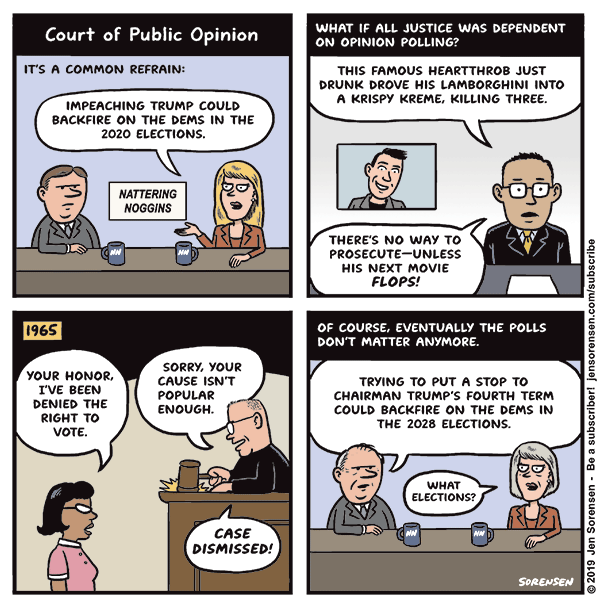
Should the point of liberal programs be to help the poor? Or to change the economy so that people don’t become poor?
In Thursday’s Washington Post, Catherine Rampell pointed out a subtle but important distinction that liberals should never lose sight of: Elizabeth Warren’s free-college and student-debt-relief plans, Rampell claimed, are “liberal but not progressive”, because “they give bigger benefits to higher-income families than to lower-income ones that actually need the help.” Rampell would rather see money targeted more directly at college-eligible low-income students.
This is a longstanding argument in liberal circles. On the one hand we have universal programs like Social Security, and on the other hand are targeted programs like food stamps. In an economic sense, targeted programs are more efficient at helping the poor — doing more with less. But that efficiency comes with some non-economic costs: increased red tape (you have to prove you qualify) and greater stigma for the recipients.
A universal entitlement is conceptually simpler: If you go to college, we’ll help you pay for it. But it costs more, because (as Rampell points out), we’ll be helping Bill Gates’ kids too. And since everything has to be paid for somehow, the universal program is more invasive to the pre-program economy. You have to tax more so that you can spend more.
A related (but not quite identical) distinction applies to our motives for having a program to begin with: Targeted programs have an air of charity about them. They don’t argue with the underlying structure of the economy, they just try to change the results. Do some people not make enough money to eat properly? Very well, then, we’ll give them food. We’ll leave alone whatever it is about the economy that creates unemployment or produces jobs that pay below-subsistence wages. We’ll just fix the food part.
Universal programs tend to be motivated more by notions of social justice: It isn’t just the outcome that’s wrong, it’s the fundamental structure of things. Yes, a targeted program would be a lighter-handed tweak of the underlying economy. But if the underlying economy is fundamentally unjust, why is a lighter hand good?
Rights. The reason it’s important to understand this distinction is that it’s easy for charitable and targeted-program attitudes to sneak their assumptions into a discussion. “Efficiency” always sounds good. But as soon as you start arguing about efficiency, you’ve bought the assumption that smaller changes are better. And often you’ve also bought an additional assumption about the program’s proper goal.
A universal program establishes a basic right, and re-defines the economy to fulfill it. Re-defining the economy is, in large part, the purpose of the program. The point of making public colleges free isn’t just to help the poor pay for education. The point is that public colleges ought to be free. A society in which public colleges are free is a more just society.
The same ideas apply across the board. One failing of our healthcare system is that too many people get priced out it, with corresponding effects on their ability to survive and thrive. ObamaCare targets people in danger of being priced out and subsidizes their health insurance, so it helps resolve that particular failing (or would if it were properly funded and overseen by an administration that believes in its purpose). But ObamaCare does not establish health care as a basic right.
The point of Medicare for All or some other universal-healthcare plan isn’t just to help the people who are being priced out of healthcare. The point is to make healthcare a basic right. That requires more government spending and taxing than even a fully funded ObamaCare. In that sense, it’s a “less efficient” use of the government’s fiscal powers, a heavy-handed reorganization rather than a light-handed tweak. If you believe that the current economy — where many people who work fulltime still can’t afford to take care of themselves or their children — is fundamentally just, then this heavy-handedness must seem outrageous.
But if you believe that the current economy is unjust, then changing it is a virtue, not a vice. There are efficiency/inefficiency arguments to be made at a number of levels, but the more important point is this: A society in which healthcare is a basic right is a more just society than the one we have now. The problem isn’t just that the current economy produces some downtrodden people who need charitable help from the rest of us, which we choose to channel through government. It’s that everyone should have a basic right to healthcare, and right now they don’t.
Vulnerability. Whether a plan gets framed as a basic right or as charity channeled through the government makes a huge difference in the politics. Most voters see charity-justified, means-tested programs as something the government does for “them”, not for “us”. Such generosity is fine as long as “we” are feeling prosperous and “they” seem deserving. But either of those factors can change, or can be changed through political rhetoric.
Means-tested programs are always open to forms of attack that universal programs are immune to: denigration and demonization of the beneficiaries. “Those people” don’t deserve our help because they are lazy or immoral or have made bad life choices. And usually, there’s no obvious place to draw the line: Are the best-off recipients truly in need, or are they just scamming us? Wherever the cut-off is, why shouldn’t it be lower?
If you think about it — and we seldom do — plenty of Social Security recipients fit the same profile as the demonized beneficiaries of means-tested programs: They’re healthy and could get jobs, but don’t want to. The reason conservative politicians don’t rail about their laziness and sense of entitlement is that Social Security is an “us”, not a “them”. They’d be demonizing their own voters, not some isolated scapegoat class.
But if Social Security ever became means-tested — as conservatives and a few efficiency-minded liberals often propose; I mean, what’s the point of sending government checks to Warren Buffett? — we’d soon see the same kinds of rhetoric and tactics: outrage at people who spend their benefits on luxuries, tightening requirements so that fewer and fewer people qualify (“I want to help the truly needy, but …”), and making the experience degrading and dis-spiriting with drug tests, long lines to file your annual re-applications, paternalistic restrictions on how you spend the money, and so on.
The rhetoric just writes itself: Picture all those lazy, able-bodied 60-somethings living on the beach in Florida, spending your tax dollars instead of working. They didn’t save when they were younger, and now they expect the government to make up the difference! Doesn’t that boil your blood?
Local services. You can see the same logic play out locally. In some cities everybody uses public transit. (I’ve taken the BART during rush hour in San Francisco. There were a lot of three-piece suits in the car.) Correspondingly, the service is good in those cities, because transit-riders are an “us”, not a “them”. But in cities (or even neighborhoods within cities) where only the poor use public transit, bus-riders are a “them” and you can forget about rail. In those places, buses are crowded and dirty; schedules are sparse and inconvenient.
Ditto for public schools. In towns where kids of all economic classes go to the same schools, standards are high and it’s not hard to pass a funding increase. But in towns where the public schools are for the poor, and the wealthy all send their kids to private schools, public education is a charity. What do “those people” expect the rest of “us” to provide for them?
Expect worse outcomes yet if Betsy DeVos ever gets her way and public schools are phased out entirely, in favor of private schools that accept government vouchers. The system will quickly devolve into two tiers: Schools that you can pay for solely with a voucher, and schools where the voucher only covers part of the cost. The voucher-only schools will be for the poor, and the vouchers will gradually shrink down to charity levels: Do “those kids” really need music or foreign languages? Are they capable of appreciating literature or higher mathematics? Why should we pay for more than just keeping them under control all day?
Of course, we’d never ask those questions about “our” kids. But “their” kids?
Back to Warren’s proposal. What Senator Warren proposed last week was a program to end tuition-and-fee costs for undergraduates at all public colleges and universities, and to cancel up to $50,000 of student debt. (There are a few means-tested pieces in her program, the biggest being that you’re only eligible for the full $50K if your annual family income is $100K or less, with the benefit phasing out by the time you hit $250K.)
It’s expensive. It costs $1.25 trillion over ten years. She plans to pay for it with an idea that will make plutocrats rage: a wealth tax on households with $50 million or more in assets.
So, no doubt about it, it’s a heavy-handed intervention in the economy. Rampell’s efficiency argument is correct: We could spend and tax a lot less if we carefully targeted the benefits on students who won’t be able to go to college otherwise, and calibrated the size of the benefit to correspond to their precise needs. That would achieve the effect of helping poor kids and working-class kids go to college with minimal changes to the rest of the economy. If you think the rest of the economy is just, that makes perfect sense.
But Warren’s plan does something that no efficiently targeted and calibrated plan can ever do: The option to go to college becomes a basic right. Whose kids are the beneficiaries? Everybody’s. It’s something that we are joining together to do for ourselves, not for some downtrodden “them”. The affected students are not recipients of our charity who constantly have to prove that they come from the deserving poor rather than the undeserving poor.
Socialism? South American Archbishop Dom Helder Camara once said: “When I give food to the poor, they call me a saint. When I ask why the poor have no food, they call me a communist.”
Since the fall of the Soviet Union, hardly anybody is really a communist any more, if they ever were. Our era’s scare-word is socialism, but it means roughly what the archbishop was talking about: building a society where a certain level of dignity and opportunity is a basic right, and does not require that you meet the standards of some paternal benefactor, who can withdraw patronage if you begin to appear undeserving.
I don’t just want to maintain the well-behaved poor at some subsistence level, while the productive power of the Earth and of our complex society accumulates in a few hands. I want our collective inheritance — the planet and the productive legacy of past generations — to work for all of us. If that earns me the title of socialist, well then, so be it.
[If you want to hear more about this point of view, check out a sermon I’ve done at several churches “Who Owns the World?“]
No sooner do I say that removing Trump needs to be the voters responsibility than he starts acting in a way that violates my impeachment standards again: Placing himself and his administration above congressional oversight.
But first, I want to talk about something else: A WaPo columnist’s critique of Senator Warren’s free-college plan, and the question it brings up: Is liberalism fundamentally about helping the poor, or about re-shaping the economy so that people don’t become poor? That’s the subject of “Charity Liberalism and Justice Liberalism”, which should be out shortly.
I still haven’t decided whether to break impeachment talk off into its own post or include it in the weekly summary. The summary will also include the census citizenship-question issue, 2020 Democrats, and a few other things, before closing with a real-life fantasy of having one golden moment in your life. That should be out between noon and 1 EDT.
The President ‘s efforts to influence the investigation were mostly unsuccessful, but that is largely because the persons who surrounded the President declined to carry out orders or accede to his requests.
This week everybody was talking about the Mueller Report
I discussed that in the featured posts. Here I’ll talk about the issues surrounding the report.
First, reading the report makes it clear that Attorney General Barr has been misrepresenting the it, both in his four-page summary and in the press conference [video, transcript] he held just before releasing his redacted version of the Report. The benefit of the doubt I granted him four weeks ago was undeserved.
Barr began his summary of the report (that reporters and the country still had not seen) with an actual partial-sentence quote, that the
investigation did not establish that members of the Trump Campaign conspired or coordinated with the Russian government in its election interference activities.
But the full sentence is a little less favorable to Trump:
Although the investigation established that the Russian government perceived it would benefit from a Trump presidency and worked to secure that outcome, and that the Campaign expected it would benefit electorally from information stolen and released through Russian efforts, the investigation did not establish that members of the Trump Campaign conspired or coordinated with the Russian government in its election interference activities.
Imagine if the AG had selected the other part of this sentence to emphasize: “the investigation established that the Russian government perceived it would benefit from a Trump presidency and worked to secure that outcome, and that the Campaign expected it would benefit electorally from information stolen and released through Russian efforts”.
A bit later, the Report explains what “did not establish” means:
while the investigation identified numerous links between individuals with ties to the Russian government and individuals associated with the Trump Campaign, the evidence was not sufficient to support criminal charges.
But Barr pretended “did not establish” meant that the opposite was established, and he spun “evidence was not sufficient to support criminal charges” into “no evidence”.
But thanks to the Special Counsel’s thorough investigation, we now know that the Russian operatives who perpetrated these schemes did not have the cooperation of President Trump or the Trump campaign – or the knowing assistance of any other Americans for that matter.
He repeated some version of Trump’s “no collusion” mantra four times, in spite of the fact that Mueller rejected that term.
All along (there are numerous examples given in the Report itself), Trump has been complaining that Barr’s predecessor, Jeff Sessions, did not “protect” him. In other words, he expected the attorney general to be his lawyer, not the chief law enforcement officer of the United States. Barr has clearly taken this to heart; his performance would have been appropriate for the President’s personal lawyer.
The basic structure of the press conference was bizarre. Typically, when the Justice Department holds a press conference to announce the release of a report, reporters have gotten advance copies of the report “under embargo”, meaning that they can’t talk about it until the release time. That makes meaningful questions possible. This time, no one could see the report until more than an hour later, so questions could only be shots in the dark.
Also, Justice Department press conferences typically center on the people who did the work. But Bob Mueller was nowhere to be found.
Stephen Colbert summed up what Barr was doing with this analogy: “Officer, before I open the trunk of this car, I’d like to first give a short speech about what you’re about to smell.”
Former FBI counter-intelligence agent Asha Rangappa explains the Russian disinformation tactic of “reflexive control”, and how it relates to Trump’s manipulation of the legally meaningless word collusion.
“collusion” is now the same as “conspiracy,” and without proof beyond a reasonable doubt of the latter, the former doesn’t exist.
He warns that we’re being similarly manipulated now by the word spying, which Trump often says and Barr used in his congressional testimony.
One winner from the Mueller Report: the news media. A lot of those stories that Trump called “fake news” turn out to be true. (Biggest example: Trump asked Don McGahn to fire Mueller. At the time, Trump characterized the newspaper report as “A typical New York Times fake story.”) Those anonymous sources quoted by the New York Times and Washington Post usually turned out to be real people who said the same thing under oath.
What Ross Douthat sees in the Mueller Report is “the same general portrait” as Michael Wolff’s book Fire and Fury:
Donald Trump as an amoral incompetent surrounded by grifters, misfits and his own overpromoted children, who is saved from self-destruction by advisers who sometimes decline to follow orders, and saved from high crimes in part by incompetence and weakness.
If you look at the report, be sure to check out Appendix C, which consists of Trump’s written answers to questions posed by the investigation. The word that best describes this testimony is slippery. Trump offers little information beyond what he knows is available to the Special Counsel from other sources, and makes no claims specific enough to be contradicted by other witnesses. In general, he just doesn’t remember.
If he’s not being slippery, the other possibility is senile dementia. I’d like to ask Mike Pence if he has read Appendix C, and if it made him consider invoking the 25th Amendment.
This is how a 30-year career at the Justice Department ends for Rod Rosenstein, who stood behind Barr unblinking and expressionless. Three weeks ago I wrote:
If Rod Rosenstein really does agree with Barr’s conclusion, I’d like to hear him say so himself, rather than let Barr put words in his mouth.
Thursday, Rosenstein looked like somebody whose daughter is being held in an undisclosed location pending his good behavior. Once again, Barr made claims in his name, but Rosenstein never spoke. Twitter noticed.
Barr’s redactions also drew some humorous comment.
President Donald Trump’s spokeswoman Sarah Sanders pushed back Friday against allegations that special counsel Robert Mueller’s Russia report exposed a culture of lying at the White House.
Sanders says there is no culture of lying at the White House, and why would she lie about that?
She’s under fire because the Mueller Report exposed this blatant lying, which she had to own up to under oath:
In the afternoon of May 10, 2017, deputy press secretary Sarah Sanders spoke to the President about his decision to fire Comey and then spoke to reporters in a televised press conference. Sanders told reporters that the President, the Department of Justice, and bipartisan members of Congress had lost confidence in Comey, ” [a]nd most importantly, the rank and file of the FBI had lost confidence in their director. Accordingly, the President accepted the recommendation of his Deputy Attorney General to remove James Comey from his position.” In response to questions from reporters , Sanders said that Rosenstein decided “on his own” to review Comey’s performance and that Rosenstein decided “on his own” to come to the President on Monday, May 8 to express his concerns about Comey. When a reporter indicated that the “vast majority” of FBI agents supported Comey, Sanders said , “Look, we’ve heard from countless members of the FBI that say very different things.” Following the press conference, Sanders spoke to the President, who told her she did a good job and did not point out any inaccuracies in her comments. Sanders told this Office that her reference to hearing from “countless members of the FBI” was a “slip of the tongue.” She also recalled that her statement in a separate press interview that rank-and-file FBI agents had lost confidence in Comey was a comment she made “in the heat of the moment” that was not founded on anything.
Typically, White House press secretaries correct their honest “slips of the tongue”. (WWCJD?) But that’s too high a standard for this White House.
Mitt Romney was the first major Republican to criticize Trump after reading the Mueller Report, tweeting:
I am sickened at the extent and pervasiveness of dishonesty and misdirection by individuals in the highest office of the land, including the President. I am also appalled that, among other things, fellow citizens working in a campaign for president welcomed help from Russia — including information that had been illegally obtained; that none of them acted to inform American law enforcement; and that the campaign chairman was actively promoting Russian interests in Ukraine.
Republican leaders fall into three basic groups:
gung-ho Trumpers (Mike Huckabee, for example, or Jim Jordan) who shout down any criticism of him, no matter how justified.
cowards (too numerous to name) or corrupt bargainers (Mitch McConnell) who recognize the damage Trump is doing to America, but avert their eyes and keep their heads down in hopes of surviving into the post-Trump era.
hand-wringers who want credit for their high moral principles, even though they are unwilling to take any action on them. (Susan Collins)
Mitt is hand-wringing here. That’s better than keeping his head down or actively collaborating, so it marks progress of a sort. I wish more Republicans would speak out like this, even if they don’t intend to do anything either. But I can’t get too excited about it. If Mitt starts demanding change and either calls for impeachment or supports a primary challenge to Trump, let me know.
and the Sri Lanka Easter bombings
Suicide attacks killed nearly 300 people in Sri Lanka yesterday. Three Christian churches and three major hotels were bombed. An Islamic terrorist group is suspected, and the government has arrested 24 people.
and Notre Dame
The iconic Paris cathedral burned last Monday. The spire fell, but the two towers, with their famous stained glass rose windows, survived.
Tragedies typically bring people together in a sense of loss and grief. So I found it bizarre how many folks tried to make this event divisive. When art, architecture, and historic relics are lost, we are all the poorer for it. OK, maybe there have been other losses that should have evoked a similar response, but didn’t. Maybe rich donors ponied up quickly for this, when they have no money for other worthy projects. I don’t care. Losses like this are emotional, and emotions can’t be weighed and measured like that.
I also have no patience with the folks who want to see some special providence in the fact that the disaster wasn’t worse, or that some particular object was saved. It would have taken only a smidgen of godly power to site somebody with a fire extinguisher in the right place when the whole thing started, but God seems not to work that way. The fact that shit happens, but that humanity survives somehow nonetheless, neither raises nor lowers the odds on the existence of a higher power.
Jon Snow: What kind of God would do something like that?
Melisandre: The one we’ve got.
and you also might be interested in …
Everybody else is running for president, so why not my congressman, Seth Moulton? I just moved to this district in the fall, though, so I can’t claim to have any special insight. Moulton is the 19th Democratic candidate. Joe Biden, the current front-runner in most polls, is expected to become the 20th on Wednesday.
Noah Smith explains in two graphs why you shouldn’t read too much into polls about specific issues: A poll that phrases the issue differently might get a different result, and a large number of people might reject the inevitable consequence of something they support.
For example: whites who think we spend too little on “assistance to the poor” change their minds when you call it “welfare”.
And Americans favor eliminating “health insurance premiums”, but not eliminating “private health insurance companies”.
While we’re talking about redactions …
Two examples of how religion is favored in America, and those who consider themselves non-religious are discriminated against.
House counsel represented to this court that the House interprets its rules to require ‘a religious invocation’.
Atheists, by definition, can’t be religious. (Of course, this interpretation will go out the window the next time it’s convenient to claim that atheism is just another religion.)
Second: Lawsuits that try to enforce the wall between church and state sometimes leave the names of the plaintiffs out of the public record for their own safety. A law that just passed the Missouri House will make this illegal, but just for church-and-state suits. In other words, if you represent a Christian majority that is imposing its will on the public square, you have the right to know exactly who is challenging you, in case you want to threaten or intimidate them. Other defendants in other suits don’t have that right, because they’re not the Christian majority.
The downside of doing something to keep yourself honest is that it might force you to stay honest.
Last June, I anticipated that the Mueller Report would eventually come out, and that we might then have to decide whether to support an impeachment. I also anticipated that partisan pressures would be intense at that point, and that people on both sides would face a strong temptation to shape their ideas about impeachment around the particulars of the evidence Mueller had found: If you were pro-Trump, no amount of wrong-doing would justify impeachment, but if you were anti-Trump, whatever Mueller found would be enough.
Certainly, we have seen enormous flip-flops among politicians who have been around since the Clinton impeachment. (Lindsey Graham is the most egregious example.) But the partisan winds affect all of us, and so I decided I wanted to get my ideas about impeachment written down before I knew precisely what Mueller would find. So I thought things through in the more-or-less abstract and posted “What is impeachment for?” I was trying to come up with an answer that I could stand by whether the target of impeachment would be a Republican or a Democrat. It should be consistent with the Founders’ intentions as expressed in the Constitution, as well as with my intuition about the impeachments in my lifetime. (I thought the Nixon impeachment was justified but the Clinton impeachment wasn’t.)
My standards for impeachment. Here’s what I came up with:
The Founders believed that any legitimate sovereignty had to come from the People, but they understood that the People would make mistakes. It was inevitable that sooner or later the United States would elect a bad president — a demagogue who was unwise, uninformed, and temperamentally unfit for the job.
It’s clear what they saw as the primary remedy for a bad president: Wait for his term to end and elect somebody else. (In the meantime, the other branches of government should use their checks and balances to minimize the harm he could do.) … Impeachment is in the Constitution for those rare cases where the country just can’t wait. … A legitimate impeachment case needs to argue that the Republic is in danger. There must be some reason why waiting for the next election either won’t work or isn’t good enough.
That led me to four situations that merit impeachment:
The president is not loyal to the People of the United States.
The president’s actions threaten the integrity of the election process.
The president’s actions prevent investigations of (1) or (2).
Congress has no other way to protect itself or the judiciary from presidential encroachment.
So if Mueller had found that Trump was conspiring with Putin, that would be a slam-dunk example of (1). But that’s not what he found. Instead, he assembled evidence of obstruction of justice, which I find convincing. So I believe that the President of the United States is a criminal.
However, back in June I anticipated this situation too:
The offense Mueller is most likely to find is obstruction of justice. The question I would have at that point is whether the obstruction succeeded. (Firing Comey, for example, may have been intended to derail the Russia investigation, but it obviously didn’t.) If Mueller’s conclusion is that Trump’s obstruction prevents us from knowing whether he was part of a treasonous conspiracy, then I would want to impeach him for that. But if Mueller did in fact get to the bottom of the Russia affair, then the impeachment decision should be based on the answer to that question.
The only loophole I can picture in that is if you hold Trump responsible for Paul Manafort’s non-cooperation, and believe that a cooperating Manafort would have revealed a treasonous conspiracy. That’s not impossible, but it seems like a stretch at this point.
Is the Republic in danger, and if so, from what? I won’t pretend that I wasn’t frightened by what I read in Mueller’s report. In one example after another, Trump displayed an attitude of lawlessness; he wanted what he wanted, and if someone told him it was illegal, he’d ask someone else to do it. (We’re getting similar reports about his immigration policy. He is already ignoring our laws defining the asylum process, and his rhetoric is preparing his cult of followers for worse abuses — for example, when he refers to laws he doesn’t like as “Democrat laws“, as if that invalidates them.) I don’t think we’ve ever had a president with such a cavalier disregard of his prime constitutional duty: to see that the laws are faithfully executed.
The president’s refusal to be interviewed by Mueller, and the answers he did give to written questions (Appendix C of the report), also show a frightening level of disrespect. If Trump really has so little memory of what he has done and who he has talked to, then the Vice President should invoke the 25th Amendment on the grounds of senile dementia. More likely, though, he just sees “I don’t remember” as a lie no one can catch you in.
In 2016, the 46% of the voters who voted for Trump, and so allowed the Electoral College to install him in office, clearly made precisely the kind of mistake that the Founders foresaw. Elections have consequences, and so our Republic is suffering for that lack of wisdom. We have already lost many of the norms that protect us from authoritarianism; for example: the independence of the Justice Department, the expectation that a president would be shamed if caught in a lie, and the expectation that a president would not profit from dealing from foreign countries (and would show us his finances so that we can check).
If the House doesn’t impeach Trump and the Senate remove him from office, what is the remedy?
In part, we’ve been living it for two years now: checks and balances need to limit the damage Trump does until the voters can repudiate him. Other government officials have repeatedly refused to carry out some of Trump’s illegal orders, and judges have stood in the way of others. Congress has refused to let him pay Putin back by relaxing sanctions. The voters elected a Democratic House that can block many of his worst ideas, and can expose wrongdoing to the public.
In some ways, though, the checks and balances are failing. It is within Congress’ power to enforce the Emoluments Clause of the Constitution more rigorously, but it hasn’t done so. Congress could have defended its own power by overriding Trump’s veto of the resolution rescinding his state of emergency, but it didn’t. But these are failures of the same people who would have to remove Trump from office in impeachment. If you can get two-thirds of the Senate to see the problem and take action, then arguably you don’t need to remove Trump from office.
But that points to the real problem: Congress doesn’t have a supermajority willing to defend the Republic against a bad president. And behind that is another problem: While polls consistently show that Trump is unpopular, the public has not decisively rejected him in the way that, say, they rejected Richard Nixon once the details of the Watergate scandal became clear.
That’s the real source of danger: About 40% of the public doesn’t believe in the American system of government any more. They are fine with a lawless, dishonest president, as long as they believe he’s on their side.
A thought experiment. How would you feel about impeachment if Trump were already a pariah, if Congress routinely overrode his vetoes, and if candidates were lining up to challenge him not just on the Democratic side, but on the Republican side also? If you were confident that he faced a landslide loss in 2020, and that Republicans might anticipate that and not renominate him — would you feel better about waiting for his term to end?
I would. In large part, my urge to impeach is driven by my fear that the electorate can’t be trusted to repudiate Trump.
But of course, as long as that’s true, the Senate will never remove him from office. If the voters won’t defend the Republic, nobody else will either.
Hazards of not impeaching. In large part, Democrats are facing now the kind of problem that Republicans faced during the Clinton/Lewinsky scandal: What can we do with our moral outrage? Republicans read the Starr Report in 1998 (unlike Mueller, Starr timed his report for maximum political effect), were outraged at the thought of extra-marital oral sex in the Oval Office, and felt: “This can’t stand. We have to do something.” [1]
The danger of doing nothing is that it creates the impression that Trump did nothing wrong. “If this were serious,” his supporters will say, “you’d be trying to impeach him.” It also immunizes him against further revelations that may come out of the investigations that Mueller spun off. It encourages him to take even more lawless actions, and may convince his subordinates that it would be no big deal to go along with him.
The politics. Some leading Democrats are taking the position that impeachment should be off the table because it’s not the best political move: Making Trump the center of the 2020 campaign plays into his hand. Instead, 2020 should be about health care, climate change, income inequality, and voting rights.
That’s true up to a point. Many of the voters we need to turn out aren’t concerned about “process issues” like whether the president respects the law. They want to know what each party plans to do for them, and what the Democrats plan has far more appeal than what Trump plans. (Most of those voters don’t really care about stopping migrant caravans either.)
Democrats shouldn’t get so caught up in opposing Trump that they lose sight of all other values. But in addition to pocketbook issues, Democrats need to be the party of honesty and good government. The very idea that Trump is a threat to American democracy, but that we’ll ignore it because that issue isn’t polling well for us right now — it undermines everything else. Some things are too important to calculate over, and this is one of them. The world where principles are just for show, and really everybody does whatever works to their advantage — that’s Trump’s world. If we move there, we lose.
Keeping the pressure on. The trick will be to find a middle way: to continue calling Trump’s lawlessness to public attention, while arguing that political repudiation is the voters’ job, and that indictment after he leaves office is a sufficient legal response. The issues raised by the Mueller report need to stay in the spotlight. For now, congressional hearings should be able to serve that purpose: Mueller and Barr need to testify in public, certainly, and probably a number of the administration officials who were told to break the law, like Don McGahn. Lawlessness in other areas, like border enforcement, needs to be pulled into the theme.
But there’s no reason why these sorts of hearings have to eclipse all other issues. The House has already passed a comprehensive voting-rights bill. It can pass bills to define the rest of a positive agenda.
[1] Our outrage, I think, is far more justified, for two reasons: The obstruction case against Trump is far stronger than the one against Clinton, and it involves misuse of his presidential powers rather than just personal vices.
When I listened to the Senate hearing of the Clinton impeachment, I was amazed by how weak the obstruction case was: Republican prosecutors told a plausible story of obstruction — Clinton induced Monica Lewinsky to lie in a civil deposition by convincing Vernon Jordan to get her a good job at Revlon — but beyond showing that all the people who needed to conspire had opportunity to communicate with each other, they had no evidence. The conspiracy was denied by everyone supposedly involved, including people who had nothing to gain by lying, like Lewinsky (who had immunity) and the folks at Revlon.
Russia interfered in the 2016 presidential campaign for the purpose of electing Donald Trump.
While Trump and his campaign welcomed and at times even encouraged Russian help, the evidence the investigation collected doesn’t support a charge of criminal conspiracy, and the evidence isn’t sufficient to charge any individual connected to the Trump campaign (officially or unofficially) with acting as a Russian agent.
In view of the Justice Department guideline that a sitting president can’t be indicted, Mueller assembled evidence about the instances where Trump may have obstructed justice, but left the ultimate judgment to people in a position to take action: Congress or post-Trump-administration prosecutors (and not Bill Barr).
No judgment about obstruction. The third conclusion is the one most distorted by Barr, so it needs the most explanation. Here’s what the report says in the introduction to Volume II, which discusses Trump’s possible obstructions of justice:
[W]e determined not to apply an approach that could potentially result in a judgment that the President committed crimes. … Fairness concerns counseled against potentially reaching that judgment when no charges can be brought. The ordinary means for an individual to respond to an accusation is through a speedy and public trial, with all the procedural protections that surround a criminal case. An individual who believes he was wrongly accused can use that process to seek to clear his name. In contrast, a prosecutor’s judgment that crimes were committed, but that no charges will be brought, affords no such adversarial opportunity for public name-clearing before an impartial adjudicator.
On the other hand, if the evidence clearly showed that no crime was committed — that would be the “total exoneration” Trump keeps announcing — Mueller had been prepared to say that. Unfortunately, he couldn’t.
[I]f we had confidence after a thorough investigation of the facts that the President clearly did not commit obstruction of justice, we would so state. Based on the facts and the applicable legal standards, however, we are unable to reach that judgment. The evidence we obtained about the President’s actions and intent presents difficult issues that prevent us from conclusively determining that no criminal conduct occurred. Accordingly, while this report does not conclude that the President committed a crime, it also does not exonerate him.
In addition to the facts investigation has assembled, convicting Trump of obstruction of justice would depend on judgments about his intent as well as legal judgments about when the official actions of a president can be considered obstruction. Mueller has opinions about those subjects and expresses them in the report, but is not comfortable drawing all of that into a conclusion that could not be tested in court for the rest of the Trump administration.
Nothing in the report suggests that he is kicking the decision upstairs to the attorney general, as Barr put forward.
Actions that might be considered obstruction. The report examines ten incidents as possible obstruction-of-justice counts. [2] In each case, Mueller analyzes the three factors that would need to be established:
an obstructive action (which need not necessarily succeed),
some connection (“nexus”) to an official proceeding
corrupt intent
Some of the ten, Mueller dismisses as not chargeable. For example, Trump’s effort to keep the content of the Trump Tower meeting from becoming public, including his dictation of a false statement that the meeting concerned Russian adoptions rather than a Russian offer of “dirt” on Hillary Clinton: It’s not obstruction because Trump was hiding the truth from the press and the public, not from an official investigation.
Each of these efforts by the President involved his communications team and was directed at the press. They would amount to obstructive acts only if the President, by taking these actions, sought to withhold information from or mislead congressional investigators or the Special Counsel.
Trump asking Comey to let Flynn go. Mueller’s analysis seems to confirm that each of the three factors is present here, but the case hangs on believing James Comey’s version of his conversations with Trump rather than Trump’s version. However, it’s not a pure he-said/she-said: “substantial evidence corroborates Comey’s account”.
Trump’s reaction to the continuing Russia investigation. This includes pressuring Jeff Sessions not to recuse himself, and pressuring the DNI, CIA director, and NSA director, as well as Comey, to make public statements clearing him of involvement with Russia.
While these actions are “relevant to understanding what motivated the President’s other actions towards the investigation”, they don’t seem chargeable in themselves because “the evidence does not establish that the President asked or directed intelligence agency leaders to stop or interfere with the FBI’s Russia investigation”.
Firing James Comey. While Trump’s “stated rationales for why he fired Comey are not similarly supported by the evidence”, this action also was arguably motivated by Comey’s refusal to tell the public that Trump wasn’t under investigation, rather than by a desire to shut down the investigation. [3]
In fact, Comey’s firing didn’t shut down the investigation, and could not have been expected to. (Steve Bannon had told Trump that he could fire Comey, but he couldn’t fire the FBI.) It would also be obstruction if Trump intended Comey’s firing to intimidate the next FBI director, but that also has not been proved.
Attempts to remove the Special Counsel. Trump denies that he ordered Don McGahn to instruct Rod Rosenstein to fire Robert Mueller (and McGahn ignored him anyway). [4] But “substantial evidence” supports the conclusion that he did.
the attempt to remove the Special Counsel would qualify as an obstructive act if it would naturally obstruct the investigation and any grand jury proceedings that might flow from the inquiry. Even if the removal of the lead prosecutor would not prevent the investigation from continuing under a new appointee, a factfinder would need to consider whether the act had the potential to delay further action in the investigation, chill the actions of any replacement Special Counsel, or otherwise impede the investigation.
That sounds like a yes to me. At this point Trump knew he was under investigation for obstruction of justice, at the very least. So the second box is checked as well, and checked for all subsequent incidents.
Substantial evidence indicates that the President’s attempts to remove the Special Counsel were linked to the Special Counsel’s oversight of investigations that involved the President’s conduct
So this count is a good candidate for an obstruction of justice charge. The fact that McGahn didn’t do what the president told him to do saves McGahn from being guilty of obstruction, but not Trump.
Attempts to curtail the scope of the investigation. Two days after telling McGahn to get Mueller fired, Trump was telling Corey Lewandowski to instruct Jeff Sessions to unrecuse himself and instruct Mueller to limit his investigation to “election meddling for future elections”. (Lewandowski likewise didn’t deliver Trump’s message. Instead he passed it on Rick Dearborn, who didn’t deliver it either.)
The three factors are all present here. This is another good candidate.
Further attempts to get Sessions to unrecuse and take control of the investigation. This count hangs on whether Trump believed Sessions would impede or restrict the investigation if he were back in charge of it.
A reasonable inference from those statements and the President ‘s actions is that the President believed that an unrecused Attorney General would play a protective role and could shield the President from the ongoing Russia investigation .
The charging decision would revolve around whether a “reasonable inference” is strong enough.
Ordering McGahn to deny that Trump told him to fire Mueller. When the New York Times broke the story about McGahn being ordered to get Mueller fired, Trump wanted McGahn to deny it, and to write a letter “for our records” denying it.
The President’s repeated efforts to get McGahn to create a record denying that the President had directed him to remove the Special Counsel would qualify as an obstructive act if it had the natural tendency to constrain McGahn from testifying truthfully or to undermine his credibility as a potential witness if he testified consistently with his memory, rather than with what the record said.
… Substantial evidence indicates that in repeatedly urging McGahn to dispute that he was ordered to have the Special Counsel terminated , the President acted for the purpose of influencing McGahn ‘s account in order to deflect or prevent further scrutiny of the President’s conduct towards the investigation.
The fact that Trump wanted a letter for the files indicates that this wasn’t just a press strategy.
Another good candidate.
Attempting to affect the cooperation or testimony of Michael Flynn, Paul Manafort, and somebody else whose name is redacted. This has to do with the repeated hints that Trump might pardon people who stand by him. His public comments also might have been intended to sway the jury in Paul Manafort’s trial. In Flynn’s case, the broadest hints came primarily through Trump’s lawyers, so it’s not possible to know whether that message came from Trump himself.
Evidence concerning the President’s conduct towards Manafort indicates that the President intended to encourage Manafort to not cooperate with the government.
That would be witness tampering, which is a type of obstruction.
Attempts to influence Michael Cohen. This is similar to the Flynn/Manafort stuff in the last section, but moreso.
We gathered evidence of the President ‘s conduct related to Cohen on two issues: (i) whether the President or others aided or participated in Cohen’s false statements to Congress, and (ii) whether the President took actions that would have the natural tendency to prevent Cohen from providing truthful information to the government.
On (i), Mueller says that the evidence does not establish that Trump “directed or aided” Cohen’s false testimony. On (ii), the logic is similar to Flynn/Manafort, but also included Trump accusing Cohen’s wife and father-in-law of committing crimes.
The evidence concerning this sequence of events could support an inference that the President used inducements in the form of positive messages in an effort to get Cohen not to cooperate, and then turned to attacks and intimidation to deter the provision of information or undermine Cohen’s credibility once Cohen began cooperating. … the President’s suggestion that Cohen ‘s family members committed crimes happened more than once , including just before Cohen was sentenced (at the same time as the President stated that Cohen “should, in my opinion, serve a full and complete sentence”) and again just before Cohen was scheduled to testify before Congress. The timing of the statements supports an inference that they were intended at least in part to discourage Cohen from further cooperation.
In other words, witness tampering.
Summary of obstruction incidents. By my count, six of the ten incidents look like obstruction of justice. The other four may not contain all the elements of obstruction, but they lend themselves to an overall pattern of obstruction.
Although the events we investigated involved discrete acts- e.g., the President’s statement to Comey about the Flynn investigation , his termination of Comey, and his efforts to remove the Special Counsel – it is important to view the President ‘s pattern of conduct as a whole. That pattern sheds light on the nature of the President ‘s acts and the inferences that can be drawn about his intent.
And the pattern is the point. In some of the six obstructions, you might decide that the “substantial evidence” Mueller cites is not beyond reasonable doubt. But when you see the whole list, reasonable doubt vanishes. The President obstructed justice. [5]
[1] ] As Joyce Vance put it: “the President’s lawyer, not the People’s lawyer”. The notes of sadness, disappointment, and puzzlement in her voice are worth listening to. She “looked up to and admired attorneys general” during her 25 years in the Justice Department, which included Barr’s term as AG under the first President Bush. “To hear an attorney general lie from the podium at the Justice Department about the contents of a report that had been done on a serious criminal case is so stupefying.”
Barr raises the same question as John Kelly, Kirstjen Nielsen, and countless other administration officials: You had a respectable career and a solid reputation; why are you lighting it on fire for this unworthy leader?
[2] If you want a more detailed description of each incident, look here, or in the report itself. I’ve chosen to focus on Mueller’s obstruction reasoning.
[3] This was an extraordinarily petty reason for a president to tear down the norms of FBI independence that previous administrations had built up, but norms are not laws.
[4] This is a pattern in many of the incidents Mueller examined: Trump ordered a subordinate to do something illegal, but the subordinate didn’t do it.
The President ‘s efforts to influence the investigation were mostly unsuccessful, but that is largely because the persons who surrounded the President declined to carry out orders or accede to his requests. Comey did not end the investigation of Flynn, which ultimately resulted in Flynn’s prosecution and conviction for lying to the FBI. McGahn did not tell the Acting Attorney General that the Special Counsel must be removed, but was instead prepared to resign over the President’s order. Lewandowski and Dearborn did not deliver the President ‘s message to Sessions that he should confine the Russia investigation to future election meddling only. And McGahn refused to recede from his recollections about events surrounding the President’s direction to have the Special Counsel removed, despite the President’s multiple demands that he do so. Consistent with that pattern, the evidence we obtained would not support potential obstruction charges against the President’s aides and associates beyond those already filed.
This is also a pattern we can see elsewhere in the administration: in immigration policy, for example. Trump wants people who will break the law for him. You have to figure that eventually he’ll find some, if he hasn’t already.
An attempt to obstruct an investigation need not succeed in order to be illegal. And if it does succeed, and the underlying crime is covered up, you run into the opposite argument, which Trump’s people are also making: How can it be obstruction if you don’t know of any crime for the investigation to find? Between the horns of that dilemma, the crime of obstruction disappears completely.
An example of the opposite horn: We’ll never know what crimes Paul Manafort might have revealed if he had actually cooperated.
[5] The next question is: What should be done about it? I’ll take that up in my next post, which should be out in a few hours.
Most weeks I face the same quandary: Do I go for the bright, shiny object and focus entirely on Trump’s latest outrage, or do I put aside that immediate emotional rush and call attention to the broader issues facing the country and the world?
This week, though, I give in. I spent most of the week reading the Mueller Report, and just about the entire Sift this week is either about the report itself, how the report was handled, or reactions to the report. Climate change, income inequality, and health care will have to claim my attention some other week.
The first featured post, which is pretty much done and should be out before 9 EDT, concerns the most disturbing thing we learn in the report, a conclusion Mueller refuses to draw himself, but that we can draw from the information he provides: Trump obstructed justice. In “Yes, Obstruction”, I’ll explain Mueller’s reasons for not drawing the conclusion himself, and then go through the ten incidents he examines — six of which have all components of obstruction.
The question that follows is: What should be done about that? Is it time for impeachment? I foresaw this moment (or something like it) last June, and made sure to write down my ideas about impeachment then, precisely to avoid crafting my opinions around the case we happen to have. In today’s second featured post, I’ll do my best to apply those standards to the present situation. That may take a while, so I’ll guess the post will be out around noon. The weekly summary, which is mostly about other people’s reactions to the report, with a little extra about the Notre Dame fire, the Sri Lanka bombings, and a few other things (culminating with Sesame Street characters trying to teach HBO characters about respect) should be out around 1 or so.
At long last, it is Spring. All around us, the ancient miracle is happening once again. The season of Death is behind us, and new life is springing up. You have an invitation to join that renewal, but the Earth will not wait for you. So don’t delay until the yeast has raised the dough; make your bread without it. Have your walking stick ready; it’s time to go. The stone has been rolled away and the path to the light is open.
Are you coming? It’s too late to wish you could be replanted somewhere else, because it’s time to sprout. Here. Now. It’s Easter.
This week’s featured post is “Buttigieg vs. Pence“. You also might want to look at the church service the quote above is from. I’ve never liked Easter services, but that year I volunteered to lead a service in my hometown without realizing that date was Easter. With some trepidation, I accepted the challenge and did an all-spring-holidays-at-once service. I’m happy with how it came out. If you don’t care for Easter services either, check it out.
This week everybody was wondering whether the administration will obey the law
This was a question that united a number of news stories: the purge at DHS, Mnuchin’s refusal to let the House Ways and Means chair see Trump’s tax returns, the plan to dump detained immigrants in sanctuary cities, and whether Trump offered a pardon to the Custom and Borders Protection Commissioner to induce him to ignore laws about applicants for asylum.
DHS Secretary Kirstjen Nielsen resigned last Monday, just in time for me to mention it in last week’s summary. Tuesday, Acting Deputy Secretary Clare Grady was also forced out, leaving the Department in the hands of the next-in-line, Kevin McAleenan.
Secret Service Director Randolph “Tex” Alles was ousted, and at least two officials have been named as possibly heading out the door: US Citizenship and Immigration Services director Francis Cissna and Office of the General Counsel’s John Mitnick.
Thursday, a Washington Post scoop began to flesh out what a “tougher” head of ICE might do.
The White House believed it could punish Democrats — including Pelosi — by busing ICE detainees into their districts before their release, according to two DHS whistleblowers who independently reported the busing plan to Congress. … Homeland Security officials said the sanctuary city request was unnerving, and it underscores the political pressure Trump and Miller have put on ICE and other DHS agencies at a time when the president is furious about the biggest border surge in more than a decade.
“It was basically an idea that Miller wanted that nobody else wanted to carry out,” said one congressional investigator who has spoken to one of the whistleblowers. “What happened here is that Stephen Miller called people at ICE, said if they’re going to cut funding, you’ve got to make sure you’re releasing people in Pelosi’s district and other congressional districts.”
… “It was retaliation, to show [Democrats in Congress], ‘Your lack of cooperation has impacts,’ ” said one of the DHS officials, summarizing the rationale. “I think they thought it would put pressure on those communities to understand, I guess, a different perspective on why you need more immigration money for detention beds.”
Administration sources initially described this as a “nonstory”, but then Trump himself verified it.
Due to the fact that Democrats are unwilling to change our very dangerous immigration laws, we are indeed, as reported, giving strong considerations to placing Illegal Immigrants in Sanctuary Cities
These are human beings, and treat treat them like a form of plague that you want to impose on your enemies is really grotesque.
This fits into the larger context of the Trump administration breaking down barriers between politics and law enforcement. Little by little, we are losing the democratic ideal that political appointees set priorities and make policy, while the government’s career professionals are mission-driven and carry out their jobs apolitically. Instead, Trump is moving us toward the authoritarian model where everything is political.
Masha Gessen makes a good point: This is one of those stories that is wrong on so many levels that it’s hard to know how to respond. Merely pointing out the illegality of using government resources to punish uncooperative congresspeople yields a point that shouldn’t be yielded: These immigrants are not a plague. They don’t bring crime and drugs and disease as Trump keeps claiming.
Here’s a message to President Trump: Seattle is not afraid of immigrants and refugees. … This president believes that immigrants and refugees burden our country and burden cities like ours. But he could not be more wrong. In Seattle, we know that our immigrant and refugee communities make our city a stronger, more vibrant place. … So if this president wants to send immigrants and refugees to Seattle and other welcoming cities, let me be clear: We will do what we have always done, and we will be stronger for it. And it will only strengthen our commitment to fighting for the dignity of every person. We will not allow any administration to use the power of America to destroy the promise of America.
I think it’s important to keep telling immigrants’ stories, because they’re so antithetical to the image Trump is trying to sell us. Mother Jones tells about Ansly Damus, a Haitian who legally sought asylum in the US, and has been held like a prisoner for two years.
President Trump last week privately urged Kevin McAleenan, the border enforcement official he was about to name as acting secretary of homeland security, to close the southwestern border to migrants despite having just said publicly that he was delaying a decision on the step for a year, according to three people briefed about the conversation.
It was not clear what Mr. Trump meant by his request or his additional comment to Mr. McAleenan that he would pardon him if he encountered any legal problems as a result of taking the action.
House Ways and Means Committee Chair Richard Neal requested six years of Trump’s tax returns last week. The law authorizing him to make this request is clear: It instructs the IRS to deliver the documents.
Treasury Secretary Steve Mnuchin is delaying, while not admitting that he intends to disobey the law. Instead, he pretends that there is some kind of legitimate legal issue here.
Mnuchin, who has consulted with the White House and Department of Justice about Trump’s tax returns, said earlier this week that Neal’s request raised concerns about the scope of the committee’s authority, privacy protections for U.S. taxpayers and the legislative purpose of lawmakers in seeking the documents.
Think about what Mnuchin is putting forward here: that the executive branch has the right to judge the “legislative purpose” of the legislative branch. In other words, Congress is not really an equal branch of government.
Frankly, Chris, I don’t think Congress — particularly not this group of congressmen and women — are smart enough to look through the thousands of pages that I would assume that President Trump’s taxes will be,” Sanders said. “My guess is most of them don’t do their own taxes, and I certainly don’t trust them to look through the decades of success that the president has and determine anything.
It’s laughable that Trump can question the intelligence of Chairman Neal.
Netanyahu will be prime minister for another term. Israel will impose its will on Palestine, and keep pushing until there’s another intifada. I continue to believe that ultimately this situation is headed towards an ethnic cleansing.
and Julian Assange
WikiLeaks founder Julian Assange had been inside the Ecuadoran embassy in London for the last seven years, until Thursday, when British police arrested him after Ecuador stopped granting asylum.
His arrest raises a bunch of issues about freedom of the press that I haven’t unraveled yet — like “What’s the difference between journalism and espionage?” — so for now I’ll just link to a CNN article that points to the complexity.
and Brexit
There’s a new deadline: Halloween. It’s still not clear what will be different then.
Channel 4 commentator Jon Snow (not the Game of Thrones guy) touched off an uproar while he was covering a rally outside the Prime Minister’s residence by angry pro-Brexit protesters. “I’ve never seen so many white people in one place,” he said.
Why, wondered Myriam François in The Guardian, would white people be upset to be identified as white people?
First, white people are not used to being marked out by race. Despite habitually racialising others, we generally don’t take well to being racialised ourselves. Acknowledging our “whiteness” means accepting that our worldview isn’t universal nor objective. It is a white perspective, forged by a particular experience. The “facts of whiteness”, to paraphrase Frantz Fanon, make many white people uncomfortable.
It’s telling that Snow’s remark has sparked more outrage than the fact that a rally held in a city with 40% black and minority-ethnic population was almost entirely white. Far-right extremist Tommy Robinson addressed crowds in Parliament Square and somehow this doesn’t raise questions about race? If we weren’t so intent on ringfencing white people from any introspection, white people themselves might legitimately ask why the leave campaign has attracted so many racists and so few people of colour.
and you also might be interested in …
If Attorney General Barr has been telling the truth, his redacted version of the Mueller report should come out this week. (Thursday, possibly.) Trump has gotten nearly a month to shape a “no collusion, no obstruction” narrative, which his base will probably continue to believe even if the report says something different.
The Trump tweet linking Muslim Congresswoman Ilhan Omar and 9-11 is not worth discussing in itself. The speech Omar’s one line was lifted from was making the point that Muslims are not collectively guilty for 9-11, so attacking their civil liberties was unjustified. Trump’s tweet essentially makes the point that Muslims are collectively guilty for 9-11. I think we all (in one way or another) resemble people who have done bad things, so any support for the idea of collective guilt should threaten all of us.
Trump himself is not threatening to kill Omar, and he is not conspiring with any particular assassin. But he knows full well the kind of people who are out there, and how they might react to what he says.
It took about a month for New Zealand to change its gun laws after the horrific March 15 mosque shootings. The Prime Minister got behind a bill to ban military-style assault weapons, and Parliament passed it 119-1 on Wednesday.
Over the last two weeks I’ve been raising the question of whether Republicans would allow Trump to fill the Federal Reserve Board of Governors with stooges like Stephen Moore and Herman Cain. I mean, it’s one thing to let know-nothings take charge of education or public housing or the environment, but this is money we’re talking about. Billionaires and multinational corporations are counting on money to continue having meaning, so you’d think Republicans in Congress would want to keep the likes of Moore and Cain from screwing around with it.
It turns out they do. Four Republican senators — Cramer, Romeny, Murkowski, and Gardner — have come out against Cain’s nomination, which pretty much dooms it. Stephen Moore still might get the job.
“If [George Washington] was smart, he would’ve put his name on it,” Trump said, according to three sources briefed on the exchange. “You’ve got to put your name on stuff or no one remembers you.”
The tour was for visiting French President Emmanuel Macron, who was more into it than Trump.
The president’s disinterest in Washington made it tough for tour guide Bradburn to sustain Trump’s interest during a deluxe 45-minute tour of the property which he later described to associates as “truly bizarre.” The Macrons, Bradburn has told several people, were far more knowledgeable about the history of the property than the president.
I suspect if you picked a subject at random, Macron would be more knowledgeable about it than Trump.
I’m looking forward to a book that comes out this week: A Lot of People Are Saying by Russell Muirhead and Nancy Rosenblum. It talks about conspiracy theories, and about a subtly different concept: conspiracism.
In an interview with Vox, Rosenblum explains the distinction: Conspiracy theories are attempts to explain something, and often to re-explain randomness by imposing a cause-and-effect structure on it, however unlikely. In my view, Kennedy assassination theories are the archetypes: It seemed inconceivable that a lone loser like Lee Harvey Oswald could bring down a popular president, so bigger explanations were invented.
Conspiracism, though, is “conspiracy without the theory”. There are no dots to connect, just a bald assertion that somebody you don’t like is up to something.
For example, Trump’s claim that elections are rigged to favor Democrats (and hence that he’d have won the popular vote without the millions of illegal Hillary votes) is not an actual conspiracy theory, because he offers no explanation of how this could have happened. It’s not at all like a Kennedy-assassination theory, where the theorists can drown you in detail.
It would be great if white people would listen to black people’s explanations of privilege, but for a lot of whites that’s just never going to happen. So there’s a need for articles like this one by white NBA player Kyle Korver, where a white guy suddenly gets it.
One of the problems with renewable energy sources like wind and solar power is how to regulate the flow: the times when you need the most power may not be the times when the most power is being generated. A lot of work has gone into designing batteries, but a conceptually simpler idea may work better: stacking concrete blocks. When you have more power than you need, you build the tower higher. When you need more power than you have, you let a block fall, generating power as it goes.
Liberals have been yielding the high ground on religion for far too long. Maybe that’s going to stop.
There are two ways to seek people’s political support: You can lay out policy proposals to address the problems that concern them — like Medicare for All or a plan to cancel student debt — or you can show them that you’re on their side by taking on the people that threaten or intimidate them.
It’s not an either/or, of course. Elizabeth Warren, for example, has no trouble taking on the bankers who illegally foreclosed on your house while at the same time laying out policies that would stop them from foreclosing on someone else. Ultimately, a politician’s willingness to fight for you in the public square will come to nothing if he or she doesn’t also enact substantive changes after taking office.
But if you doubt the power of a pure I’ll-stand-up-to-your-enemies message, you need look no farther back than 2016. Candidate Trump’s policy proposals were often an incoherent mess. He said he’d replace ObamaCare something “fantastic” and “wonderful” that would take care of everybody. The government would pay for it, but it would neither raise your taxes or impinge on your freedom. (That’s not a synopsis of his program; that’s the whole program.) His foreign policy was both bellicose and promised an end to the endless wars. He was in favor of both LGBT rights and the religious right. He would simultaneously cut taxes, increase defense spending, and repay the national debt. He promised to build a wall, while his supporters argued among themselves about whether the wall would be literal or metaphorical.
But whatever he might propose, and however he might contradict that proposal the next time he opened his mouth, one part of Trump’s message was clear, and remains clear today: If you feel threatened by immigrants of color, by people who don’t speak English, by scientists who think they’re smarter than you, or by advocates of “political correctness” who tell you that you can’t say this or do that any more, then Trump has your back. If you’re sick of liberals calling you “racist” or “sexist”, well, Trump glories in being called those names, and strikes back at the accusers twice as hard.
A week ago yesterday, in his own soft-spoken way, Pete Buttigieg did something similar: At the annual champagne brunch of the LGBTQ Victory Fund, he took on Vice President Mike Pence by name, and challenged the religious right not just politically, but morally and religiously. When his words got national attention and Pence answered (dishonestly), Buttigieg did not back down.
The message was clear: He’s not intimidated by Mike Pence, so you don’t need to be either. And if the “Mike Pences of this world” think that they own religion or Christianity or words like morality and freedom, then Pete Buttigieg has news for them.
The speech. His 19-minute speech is worth listening to in its entirety, if you have the time. He is talking to a friendly audience of those who fight for LGBTQ rights, so it may not be as immediately courageous as, say, Catholic JFK’s speech to the protestant ministers of Houston. But in an era when everything is recorded, everything gets out, and your words live on forever in hard drives all over the world, it is quite striking.
We often hear the term “gay pride”. Buttigieg’s speech is a clear and simple assertion of gay pride. He’s not claiming to be better than straight people, but he’s also not apologizing for his sexuality or hoping that critics will ignore it. He is proud of his life, proud of his marriage, and proud of the spouse he married. He will not keep Chasten hidden and hope that his opponents will be gracious enough not to bring him up. Instead, Buttigieg talks about meeting Chasten, and adds:
One of the best things about these last couple months has been watching America meet him too, and start to fall for Chasten just like I did.
But he then goes on to talk about his struggle to accept his sexual orientation.
When I was younger, I would have done anything to not be gay. When I began to halfway realize what it meant that I felt the way I did about people I saw in the hallways in school or the dining halls in college, it launched in me something I can only describe as a kind of war. And if that war would have been settled on the terms that I would have wished for when I was 15, or 20, or frankly even 25, I would not be standing here. If you had offered me a pill to make me straight, I would have swallowed it before you had time to give me a sip of water.
It is a hard thing to think about. It’s hard to face the truth that there were times in my life when if you had shown me exactly what it was inside me that made me gay, I would have cut it out with a knife.
The room is completely silent at this point. What he is presenting is the religious right’s fantasy: that homosexuality is curable, and that 15-year-olds like Buttigieg could be offered the chance to sign up for some kind of conversion therapy (which is now illegal in 16 states, partly because it doesn’t work, and partly because forcing a child into such therapy is believed to increase the risk of suicide). The fantasy says that these men will be grateful later, when they look back on a life that includes wives and naturally-conceived children. But Buttigieg represents the polar opposite of that fantasy: Looking back on his life, he is grateful that he didn’t get that choice.
The real reason it’s so hard to think about is that if I had had the chance to do that, I would never have found my way to Chasten. The best thing in my life, my marriage, might not have happened at all. … How dark the thought, that the man that I admire and care about, and love sharing with the rest of the country, and even more importantly, can’t wait to share one day with raising children, might not have been part of my life at all. Thank God there was no pill. Thank God there was no knife.
And “thank God” is not just figure of speech. It segues Buttigieg into religion, and into the moral issue of marriage equality.
It’s a moral issue because being married to Chasten has made me a better human being, because it has made me more compassionate, more understanding, more self-aware, and more decent. My marriage to Chasten has made me a better man. And yes, Mr. Vice President, it has moved me closer to God.
He explains exactly what “closer to God” means to him.
You may be religious and you may not. But if you are, and you are also queer, and you have come through the other side of a period of wishing that you weren’t, then you know that that message, this idea that there’s something wrong with you, is a message that puts you at war not only with yourself, but with your Maker.
And speaking only for myself, I can tell you that if me being gay was a choice, it was a choice that was made far, far above my pay grade. And that’s the thing I wish the Mike Pences of the world would understand: that if you’ve got a problem with who I am, your problem is not with me. Your quarrel, sir, is with my Creator.
The response. This is a story and an argument that many straight Americans have never heard: Accepting your sexual orientation or gender identity or some other aspect of yourself (that you didn’t choose and can’t un-choose) can be part of a journey of coming to terms with God.
The religious right will tell you that accepting homosexuality means rejecting God. (In a Fox News piece responding to Buttigieg, Log Cabin Republican Rob Smith says precisely that: “those on the left … have been very successful at convincing a generation of young gays and lesbians to reject God in favor of their cult of intersectionality and identity politics.”) It will tell you that gays want to tear down Christianity, and that the point of same-sex marriage is to undermine marriage in general. But Buttigieg is saying the exact opposite: Accepting how you were made is part of accepting God’s creation.
Buttigieg is challenging not the politics of the religious right, but its morality and its theology. This isn’t just about the Constitution or the law, it’s about what it means to be in right relation with God.
You can tell how threatening Buttigieg’s message is to the Mike Pences of the world by how hard they try not to hear it, and to pretend that Buttigieg said something else. Pence himself responded with this non sequitur:
I hope that Pete will offer more to the American people than attacks on my Christian faith or attacks on the President as he seeks the highest office in the land. He’d do well to reflect on the importance of respecting the freedom of religion of every American.
But Buttigieg didn’t “attack” anybody’s Christian faith. He challenged Pence’s interpretation of it. In particular, there was no attack on Pence’s “religious freedom”. No one, least of all Buttigieg, is preventing Pence from believing whatever he wants, from trying to convince others to agree with him, or from living his faith. [1]
I don’t have a problem with religion. I’m religious too. I have a problem with religion being used as a justification to harm people. … I’m not interested in feuding with the Vice President. But if he wanted to clear this up, he could come out today and say that he’s changed his mind, that it shouldn’t be legal to discriminate against anybody in this country for who they are.
Some very old arguments. Buttigieg’s challenge brings up several longstanding theological issues that conservative Christians would prefer to sweep under the rug. Though different, they all revolve around the notion that (in spite of the purported changelessness of Christian doctrine) the image of God that was taught centuries ago is something most people just can’t believe in today. [2]
One of those issues is predestination, the idea that God’s omniscience included knowledge of the destiny of the souls He was creating. [3] From the beginning of time, a few souls were predestined for Heaven and the vast majority for Hell. This belief turns God into a monster, because He created most of humanity for no other purpose than to torture them for all eternity.
Current religious-right teachings about gender and sexuality contain echoes of this monstrosity. If LGBTQ people in their many varieties are not choosing a lifestyle, but in fact are discovering an inner nature that has been theirs from birth, and if that nature either damns them to eternal torment or permanently cuts them off from sex, children, and the kind of deep relationship that Buttigieg describes making with Chasten, then something very similar to predestination is happening. [4]
An even larger and older issue goes back to the reformulations of the Axial Age, which never quite completed its mission: Is religion fundamentally about a list of rules and the rewards and punishments that enforce those rules? Or is it about becoming (in Buttigieg’s words) “more compassionate, more understanding, more self-aware, and more decent”. If it is about rules, do those rules have to make sense, or is their very arbitrariness a measure of God’s majesty? [5] In the Christian tradition, this issue is the heart of the New Testament arguments between Jesus and the Pharisees. But the modern religious right has forgotten Jesus and taken the Pharisee side: The rules are the rules, and if we have to be cruel to enforce them, that’s just how it is.
And finally, there is the issue that religion itself can become a kind of idol: Rather than worshiping God, you can find yourself worshiping a scripture or a church or a set or rituals.
It’s not surprising that the religious right doesn’t want to talk about any of this.
We’re not supposed to challenge them. Conservative Christians have gotten used to being able to define the playing field. When they involve themselves in political discussions, we are all supposed to accept as given that they are good, decent people who are just trying to live according to their faith. We are supposed to accept the moral and theological premises they offer, and yield to them all the powerful vocabulary and imagery of Christianity.
But they don’t deserve that kind of consideration. They are offering us a God who is monstrous, and a religion that justifies discrimination and bigotry. They need to be called on that, not just because it’s bad law and bad politics, but because it’s bad religion.
I’m still waiting for a detailed set of policies from Buttigieg, and who knows whether I’ll like it when I see it. But this part of the message he’s gotten right.
[1] I won’t go into this in detail today, because I already have here and here. What masquerades as “religious freedom” for conservative Christians is actually a demand for special rights. They want a special exemption from discrimination laws, because they’re Christians. As the cartoon below demonstrates, it’s laughable to imagine the rights that conservative Christians claim being applied generally, to issues other than their hobby horses of homosexuality, abortion, or birth control.
[2] I mean can’t in a literal sense. If you can picture such a being at all, you will feel revulsion, not awe or wonder. If this is God, then maybe Lucifer was right to rebel.
[3] I’m describing God as “He” here, because in the theologies I’m describing, God is male. That’s not something I do when I describe my own beliefs.
[4] In contrast to Buttigieg’s coming closer to God, Chris Steadman describes (in the book Faitheist) going through a period of rage at a God who created him gay and then condemned gays to Hell.
In Evolving in Monkey Town Rachel Held Evans, whose path of spiritual growth has taken her out of Evangelicalism and into the Episcopal religion that Erickson finds so objectionable, recounts one of the first cracks in her childhood faith: Going on a mission trip to China, looking out a bus window, and realizing that a billion people out there were going to Hell. What kind of God would set the world up like that?
[5] Occasionally you’ll hear the conundrum expressed like this: Do we worship God because He is good, or because He is God? In an earlier era, this question made sense, but today we are more inclined to ask: Why would we worship a God who is not good?
If AG Barr has been telling the truth, his redacted version of the Mueller Report should be out this week. There’s little point in speculating about what it will say or how much of it we’ll get to see, but all the same it was odd how little of the week the news shows spent discussing it. What we saw instead was Trump’s ability to control the narrative by doing and saying outrageous things.
One piece of news he didn’t control was the back-and-forth between Democratic candidate Pete Buttigieg and Vice President Pence, which I’m going to focus on in the featured post. It started eight days ago with Buttigieg’s speech to the LGBTQ Victory fund, in which he pointed out the main theological weakness in the religious right’s anti-gay position: God’s creation includes people born to be gay. If you are one of those people, accepting yourself as gay can be a big piece of making your peace with God.
It has been fascinating to watch Pence (who was mentioned by name in Buttigieg’s speech) and the rest of the religious right wriggle and distort to avoid meeting Buttigieg’s challenge. This is really not a conversation they want to have. My post on this, which includes video of the full 19-minute speech, should be out between 9 and 10 EDT.
The weekly summary will say very little about the Mueller Report, because we still don’t know anything about it. But there’s a lot else to discuss: whether the administration will obey the law on a number of fronts (including the border and Trump’s taxes), Netanyahu’s re-election, Julian Assange, the new Brexit deadline, and a few other things. It should be out between noon and 1.
It is deeply alarming that the Trump administration official who put children in cages is reportedly resigning because she is not extreme enough for the White House’s liking.
There is no featured post this week. This summary is all I’m posting.
This week everybody was talking about the cover up
I’m ready to start describing the slow-walking of the Mueller Report as a cover-up. The Mueller Report has been done for more than two weeks, and all the public or Congress has seen is a four-page summary that we now have reason to believe is inaccurate.
During the investigation the Mueller team was famous for not leaking. They published indictments and made motions in court that became part of the public record. Beyond that, our information came second-hand, from the witnesses they interviewed, from lawyers for potential targets of the investigation, and from watching who came or left the courtroom.
Some of Robert S. Mueller III’s investigators have told associates that Attorney General William P. Barr failed to adequately portray the findings of their inquiry and that they were more troubling for President Trump than Mr. Barr indicated, according to government officials and others familiar with their simmering frustrations.
The Washington Post confirmed via their own sources that the investigators were unhappy with Barr’s conclusion that the President had not obstructed justice.
[M]embers of Mueller’s team have complained to close associates that the evidence they gathered on obstruction was alarming and significant. “It was much more acute than Barr suggested,” said one person, who, like others, spoke on the condition of anonymity because of the subject’s sensitivity.
Barr originally said that his redacted version would be available by mid-April “if not sooner”. That’s in the next week or so. Assuming he follows through, we’ll see then whether the redactions are insubstantial enough to be worth a what-were-you-worried about response, or so extensive as to be one big fuck-you to Congress and the public.
In either case, Congress needs to know what Mueller found out, and not just what Trump’s hand-picked protector deigns to tell them.
In a similar story about Congress’ oversight duty, Democrats are also trying to get Trump’s tax returns.
House Ways and Means Committee Chairman Richard Neal (D-Mass.) Wednesday evening sent IRS Commissioner Charles Rettig a request for six-years worth of Trump’s personal and business tax returns. Neal made the request under a part of section 6103 of the federal tax code that states that the Treasury Secretary “shall furnish” tax returns to the chairmen of Congress’s tax committees upon written request, so long as the documents are viewed in a closed session.
According to Maddowblog’s Steve Benen, section 6103 was put in the tax code in the wake of the Teapot Dome scandal of the 1920s, which centered on President Harding’s Treasury secretary. Up until then, only the President had the power to examine tax returns, but Teapot Dome brought up the possibility that the President might be politically motivated not to investigate his own administration. So the appropriate committee chairs in the House and Senate were also given the power.
Since this is the Trump administration, the fact that the law is clear doesn’t mean it will be followed, at least not without a fight. (Chief of Staff Mulvaney pledges that Democrats will “never” see Trump’s taxes.) Republicans in Congress seem likely, once again, to back Trump in his attempt to subvert Congress’ legal power.
Senate Finance Committee Chairman Chuck Grassley (R-Iowa) said Thursday that courts have ruled that congressional requests for information need to have legitimate legislative purposes, and Democrats have fallen short on that front.
The administration routinely rejects courts looking into whether its own actions have legitimate purposes, arguing instead that the judicial branch owes deference to the executive branch’s judgments. (This came up, for example, in the Muslim ban case, where Trump’s claims about national security were clearly specious. It will likely come up again in the lawsuits of his border-wall national emergency, which is similarly based on nonsense.)
Section 6103 hasn’t been invoked since Watergate, because Trump is the first post-Watergate presidential candidate to keep his tax returns secret. It’s illuminating to watch both sides spin this dearth of examples. Fox News describes this as “the first such demand for a sitting president’s tax information in 45 years” while Benen notes that “no administration has ever denied a lawmaker access to tax returns under this law”.
A subsequent Fox News article links to the first one to back up its clearly false claim that the Democrats have made an “unprecedented demand“. Again, the only unprecedented thing here (at least in the post-Watergate era) is that the President’s tax returns are not already public. The last time a president’s returns weren’t public (i.e., Nixon), Congress received them under Section 6103.
My guess: Not even this Supreme Court can ignore such a clear statement of law. The main question is how long Trump’s legal challenges can delay the matter.
and Joe Biden’s touching problem
Biden still hasn’t announced his candidacy, but it’s looking more and more like a foregone conclusion that he will. This week he put out an I-get-it video to respond to the accusations of inappropriate touching. It wasn’t exactly an apology, but he acknowledged that standards of propriety have changed and promised “I will be more mindful about respecting personal space in the future.” That started an is-that-good-enough debate that got more intense after he joked about having permission to hug a child.
One problem Democrats are having dealing with situations like this is that abuse-of-women is often framed as a where-to-draw-the-line problem. But like many problems, abuse is a continuum that ranges from the annoying to the criminal.
What Biden has been accused of doing is down in the second-lowest row. (Accusations against Trump and Brett Kavanaugh are much higher up.) Biden denies having bad intentions, and so far no one has claimed otherwise. But it’s still not OK. Doing what Biden did creates opportunities for people who want to do worse.
We’re also struggling over how to forgive inappropriate behavior, and how one should seek forgiveness. I think a lot of people in privileged groups — not just men, but also whites, straights, cis-gender, and so forth — share a partly-but-not-entirely-irrational fear of being exiled to Siberia for violating (through obliviousness rather than malice) some norm we’d never heard of before. (That fear hit close to home recently. I’m a contributing editor for UU World magazine. In the current issue, one of the other contributing editors published an article that a number of transgender and gender-nonbinary people found offensive, and for which the magazine has apologized. It was disturbingly easy for me to imagine winding up in a similar situation myself.)
I wasn’t planning to support Biden in the primaries anyway, though I’ll happily vote for him over Trump if he is the nominee, and I’m not inclined to trash him unnecessarily. To me, this flap is not so damaging in itself, but putting a weight on Biden’s negative pan raises the question: What are the positives that we’re counting on to outweigh this?
Biden arrived at the Senate in 1973 as a 30-year-old whiz kid. He came of age politically in an era shaped by Reagan’s annihilation of Carter in 1980 and Mondale in 1984, Dukakis’ landslide loss in 1988, the Gingrich Revolution of 1994, and Bill Clinton’s successful rightward shift in 1996. During that time liberals became timid, and felt that they needed some signature conservative issues and sound bites to prove that they weren’t crazy McGovernites.
All that stuff will return to haunt him in the coming months, making him look inauthentic. He’s not really inauthentic, or at least no more than anybody else. He’s just a politician of his time and place. But this is a different time, and once the campaign gets rolling I think candidates who don’t have to answer for the 1980s and 1990s will have an advantage over him.
and Brexit
Brexit is one of those strange situations where every conceivable outcome is accompanied by a rational and coherent explanation of why it can’t happen. But something will have to happen, at least eventually.
Friday is the latest deadline for that Something, but no one knows what it is yet, so Prime Minister May is seeking an extension to June 30. (What will change by then is unclear.) This would mean that the UK participates in European Parliament elections in May. All 27 of the other EU nations would have to agree to the extension. If not, the disaster of a no-deal Brexit could happen as early as Friday.
The biggest obstacle to implementing any form of Brexit is the Good Friday Agreement that ended the so-called “Troubles” in Northern Ireland. The GFA requires a soft border between Northern Ireland (which is part of the UK) and the Republic of Ireland (which remains in the EU). But control of the border (to keep out immigrants not just from Syria, but also from <gasp> Poland) is what Brexit was all about in the first place. If job-stealing Poles or terrorist Muslims can walk in from Ireland, Brexiteers ask, what was the point? On the other hand, no one wants the Troubles back.
The New Yorker has a clear explanation of all the possible resolutions of Brexit’s Irish-border problem, and why each of them is opposed by some veto-wielding party.
I have a tangential personal connection to the Troubles. In 1985, I attended an IEEE information-theory conference at the Metropole Hotel in the English seaside resort of Brighton. (Claude Shannon spoke, and, though clearly aging, was still dexterous enough to juggle oranges.) The original announcement had sited the conference at the Grand Hotel, but that was before the IRA blew it up. (During a break in the conference, I walked past the rubble.) It was like I had a reservation on the Titanic’s second voyage.
I am told that brexit has become a verb: to announce that you’re leaving and then not go. So you might call your sitter and say: “I thought we’d be home from this party by now, but Bob has been brexiting for nearly an hour.”
and the border
Kirstjen Nielsen resigned as Homeland Security secretary yesterday, just days after Trump withdrew his nominee for head of ICE because he wants someone “tougher”. The NYT news article on her resignation says that Nielsen repeatedly made Trump angry by telling him what the law said. Reportedly, he felt “lectured to”. The partner NYT editorial says:
The president grew impatient with Ms. Nielsen’s insistence that federal law and international obligations limited her actions.
Nielsen’s career should be a lesson for anyone thinking of working in the Trump administration. Her reputation is ruined: For the rest of her life, she will be the woman who put children in cages. And she leaves not with the President’s gratitude and the support of his base, but taking the blame for the failure of his harsh policies to stop migrants from coming to our border.
This is what Trump does: He uses up whatever credibility people can bring to his organization, until the only value they have left is to be sacrificed as scapegoats.
Trump had been making a lot of noise about closing the border with Mexico, and then suddenly backed down. I assume somebody finally explained to him what “closing the border” actually means. (Maybe that was one of the “lectures” that got Nielsen ousted.) It would disrupt trade and tourism in both directions, interrupt supply chains for factories on both sides of the border, and do nothing to stop either those who are trying to cross the border illegally, or those who are planning to turn themselves in and claim asylum.
Before his retreat, Trump had been expected to announce the border closing when he went to the Calexico Friday. He was there to dedicate what an official plaque calls “the first section of President Trump’s border wall.” It actually isn’t.
A fence had existed at the spot for decades. … [T]he Border Patrol had identified this section as a priority for replacement in 2009, during President Barack Obama’s administration.
While at Calexico, Trump repeated a popular bit of white nationalist rhetoric, saying “Our country is full.” SNL’s Michael Che had already answered that last week: “How can America run out of space? We’ve still got two Dakotas.”
The Mexican Wall play/counterplay so far: Congress denied Trump’s budget request for money to build more of the wall, so Trump declared a national emergency that he claims allows him to seize the money from other programs, so Congress passed a bipartisan resolution rescinding the emergency, so Trump vetoed that resolution, so Congress tried to override his veto and failed.
I continue my quest to understand Trump’s base voters, but I’m starting to lose hope. A few weeks ago I told you about Timothy Carney’s Alienated America. The key insight there is that the original Trump supporters, the ones who were with him in the primaries and helped him take the Republican Party away from the Jeb Bushes and Marco Rubios, were people who were doing relatively well in communities that were doing badly. Yes, they were angry, but not so much on their own behalf. They were angry because they saw their towns and their families crumbling around them.
That explained why they might take a flier on an untried candidate who promised to shake things up, but not why they would stick by him while he did nothing to help their communities, choosing instead to enrich himself, increase government corruption, and give big tax breaks to his fellow billionaires. (There’s a reason why he doesn’t want you to see his taxes, people.)
This week I read Robert Wurthnow’s The Left Behind: Decline and Rage in Rural America. Wurthnow is a Princeton sociologist, and believes that when you don’t understand people, you should go out and talk to them.
That makes sense up to the point where you realize that what they’re telling you is bullshit. So, for example, rural Americans claim they were incensed by the deficits that Obama ran up, but they are strangely unmoved by Trump’s large deficits. They claim they have to be anti-abortion and anti-gay because of their religion and how much they value their religious communities. But many of them left the Christian denominations they were born into when those churches got soft on abortion and gays. (It’s like what Bush did in the Iraq War: He always followed the advice of his generals, but he’d fire generals until he got one that gave him the advice he wanted.)
In short, listening to the nonsense they say isn’t helping me understand them.
and you also might be interested in …
If you’re a regular Sift reader, you’ve heard most of these ideas before, but this video from Represent.US puts them together effectively.
Israel has elections tomorrow. Benjamin Netanyahu is going for his fifth term as prime minister, and is promising to unilaterally annex chunks of the occupied territories if he wins. The peace process has been going nowhere for many years now, but such a move pretty announces Israel’s intention to impose its will on the Palestinians.
Josh Marshall raises a good point: Trump often talks to American Jews as if they were expatriate Israelis. Speaking to the Republican Jewish Coalition on Saturday, Trump referred to Netanyahu as “your prime minister”. In October, when Trump visited the Tree of Life synagogue in Pittsburgh (site of the mass shooting), he met the Israeli ambassador at the front gate — as if the synagogue were a piece of Israel inside the US.
This kind of othering is a classic anti-Semitic tactic, and is consistent with the way that many white ethno-nationalists support Israel: as the true home of all Jews, even the ones who think they’ve made a home here.
I know what you’ve all been thinking: “I wish the government would stop doing all those invasive inspections and leave the pork industry alone.” Well, our populist government has heard you and is responding to the public demand for privatized meat inspection.
The Trump administration plans to shift much of the power and responsibility for food safety inspections in hog plants to the pork industry as early as May, cutting the number of federal inspectors by about 40 percent and replacing them with plant employees. Under the proposed new inspection system, the responsibility for identifying diseased and contaminated pork would be shared with plant employees, whose training would be at the discretion of plant owners. There would be no limits on slaughter-line speeds.
Back when Trump started saying “Make America Great Again”, many of us wondered what time period the “again” referred to. Now we know: the era of Upton Sinclair’s The Jungle.
Jill Filipovic wrote in the NYT about age and the female politician:
They are seen as too young and inexperienced right up until they are branded too old and tedious.
I don’t entirely follow her point about Kirsten Gillibrand, who at 52 and in her second Senate term is youngish and newish for a presidential candidate, but not strikingly so. Elizabeth Warren, on the other hand, at 69
finds herself put in the same “old” category as Mr. Sanders and Joe Biden, even though both men are nearly a decade older than she is. Men who are more or less the same age as Ms. Warren — Sherrod Brown (66), John Hickenlooper (67), Jay Inslee (68) — are not lumped in with the white-hairs.
In 2016 I wrote about the stereotypes that portray a man’s deficiencies as virtues: the charming rogue, the wheeler-dealer, and so on. Filipovic points to another one that Pete Buttigieg and Beto O’Rourke are taking advantage of: the fresh face, the new kid on the block. JFK, Jimmy Carter, Barack Obama — there’s a well-established pattern of a man coming from nowhere and jumping the line to the top job. Young Paul Ryan hit Congress as a young gun or a whiz kid; I haven’t heard those phrases used to describe AOC.
My can-you-believe-this story last week was Stephen Moore being nominated to the Federal Reserve Board. This week’s is that Trump is getting ready to nominate Herman Cain. The point isn’t to change the economic philosophy of the Fed, it’s to fill the Board with Trump loyalists who will pump the economy full of cheap money to get him re-elected in 2020. (Cain would also join the fairly large contingent of people in the administration who have been accused of harassing women.)
That’s the pattern with several of the recent Trump appointees: Bill Barr in the Justice Department and Charles Rettig and Michael Desmond at IRS. They’ve been appointed to serve Trump, not to serve the country.
The next time somebody tries to tell you that both parties are the same, remember Thursday’s vote in the House to reauthorize the Violence Against Women Act. It passed 263-158. The No votes were 157 Republicans and 1 Democrat. The bill faces challenges in the Republican-controlled Senate.
Under current federal law, only people convicted of domestic violence offenses against spouses or family members can lose their gun rights. The [new version of the] VAWA would add people convicted of abusing their dating partners, closing the so-called “boyfriend loophole.” It would also prohibit people convicted of misdemeanor stalking offenses from owning or buying firearms, as well as abusers subject to temporary protective orders.
That provision is too much for the NRA, and so for the Republicans the NRA controls. The gun rights of stalkers and abusers should be protected, even if that means more women will die.
A study comparing abused women who survived with those killed by their abuser found that 51 percent of women who were killed had a gun in the house. By contrast, only 16 percent of women who survived lived in homes with guns.
Even if you don’t care about women, there’s still good reason to support adding this provision to the VAWA: When you look at mass shooters and ask “How could we have known what he would do?”, one strong clue is a history of domestic violence. Keeping guns out of the hands of abusers would probably save a lot of men’s lives too.
After some legislative shenanigans on Mitch McConnell’s part, Congress passed a resolution invoking the War Powers Act to end US support for Saudi Arabia’s war in Yemen. Trump is expected to veto it.
Trump’s constant lying got renewed attention Wednesday after he uncorked a slew of them in 24 hours, including a ridiculous one (that the noise from wind turbines causes cancer) and a transparent and pointless one (that his father was born in Germany when he was actually born in New York). Anderson Cooper debunked a bunch of Trump lies in one segment. Social media just had fun with it all.
Sportswriter Rick Reilly claims to have played golf with Trump. This is from his article “Whatever Trump is Playing, it isn’t Golf“, which looks like an abstract of his new book Commander in Cheat: How Golf Explains Trump.
If Trump will cheat to win $20 from his friends, is it that much further to believe he’d cheat to lower his taxes, win an election, sway an investigation?
Upon entering Oodi, an enforced hush does not descend. Nor are there any bookshelves in sight, but on the first floor – a large, fluid space – there is a cinema, a multi-purpose hall and a restaurant. The second floor, called the “attic”, is entirely dedicated to skills development. Here the public can use 3D printers and sewing machines, or borrow musical equipment and rock out in specially modified studios. There is even a kitchen and socialising area, which can be hired for a small fee, where the librarians hope birthday parties will take place, perhaps followed by a spot of karaoke. Staff roam the site ready to help the public use the resources available. …
“We believe,” [Helsinki’s executive director of culture Tommi] Laitio expounds, “that everyone deserves to have free access to not only knowledge, but also our shared culture, spaces that are beautiful, and to dignity.” Central to Oodi’s concept, he explains, is bringing a wide range of people together under one roof. “A lot of emphasis has been put on how we make sure that this building is safe and welcoming to homeless people [or] to CEOs with a couple of hours to spare … We need to make sure that people believe that we can live together, and I don’t think €100m for that feeling is a lot of money.”