This week Trump’s autocratic tendencies reached an almost comical level, evoking a “He did what?” reaction even from people otherwise inclined support him: He responded to bad news in the June jobs report by firing the head of the Bureau of Labor Statistics. Don’t like the numbers? Fire the number-crunchers! That’ll fix it.
That firing resembled the moment in his first term when he suggested that the way to deal with accelerating rates of Covid infection was to stop testing. Fewer tests, fewer positive results — problem solved! Such out-of-the-box thinking is what makes Trump a stable genius.
So anyway, the entire federal data-gathering bureaucracy is now on notice that doing your job honestly can get you fired. We’ll see how the bureaucrats respond.
In the meantime, the jobs report actually is bad, and points to the possibility of stagflation, a combination of increasing unemployment and increasing inflation that was widely believed to be impossible until it started happening in the 1970s.
There’s been a lot else going on: The Smithsonian was caught dropping Trump’s impeachments down the memory hole. The Gaza horror continued. Trump encouraged Texas to help him cheat in the 2026 midterms.
But what caught my eye this week was a column in the NYT: “Thinking is Becoming a Luxury Good”. It raised the possibility that what we’ve been seeing lately is just the beginning of a trend: Maybe our culture is producing people fundamentally incapable of self-rule. What happens to democracy in that situation? That led to this week’s featured post “Shaping Ourselves”. That should be out shortly.
The weekly summary, which covers the aforementioned stories plus a few others, should be out by noon EDT.
It’s alright for you if you run with the pack. It’s alright if you agree with all they do. If fascism is slowly climbing back, It’s not here yet, so what’s it got to do with you?
So close your eyes, stop your ears, Shut your mouth and take it slow. Let others take the lead, and you bring up the rear, And later you can say you didn’t know.
The quote above deserves some curation. Peggy Seeger was Pete Seeger’s half-sister, and wrote many songs with her husband Ewan McColl. I’m a little sketchy on the exact provenance of “Song of Choice”. Some web sites claim McColl was a co-author, and I haven’t seen an exact date for it. It appears in a 1992 collection of Seeger’s songs, which includes songs that go back as far as 1955. One version included the line “In April they took away Greece”, which might refer to a Greek coup in 1967.
I heard the song for the first time Saturday at the Lowell Folk Festival, where it was sung by the Irish band Solas. Its contemporary relevance is obvious.
This week everybody was talking about …
Oh hell, they were talking about Jeffrey Epstein, but I can’t bear to lead with that again.
Let me tell you about a legal victory this week instead: Trump’s attempt to undo the 14th Amendment’s guarantee of birthright citizenship has lost again in court. This time the loss was in the 9th Circuit Court of Appeals, one step below the Supreme Court.
This case has wandered through a legal labyrinth, so let’s review: One of the first things Trump did after getting sworn in for his second term was to sign an executive order denying the citizenship of any child born in the US if the mother’s status within the US was either undocumented or temporary. He was attempting to stretch the one loophole in the 14th Amendment, that birthright citizenship requires that the child be “subject to the jurisdiction” of the United States, i.e., not born to a foreign diplomat or a sovereign Native American tribe.
No court that has heard this argument has found it credible. Two district courts have rejected it, and it was quickly blocked by a nationwide injunction. The administration appealed not the case itself, but the injunction, and got the Supreme Court to put limits on nationwide injunctions without addressing the citizenship issue itself.
A subsequent judge got around that ruling by declaring the children affected by the order to be a class and issuing an injunction in the class-action lawsuit. Another district judge ruled that only a nationwide injunction could provide relief to the states that filed the lawsuit in his court. The appeals court upheld that injunction Wednesday.
The Trump administration had hoped to sow chaos by limiting injunctions to the jurisdictions where cases had been filed and the states willing to file suit. In red states, then, children of undocumented immigrants could be treated as non-citizens at least until a full resolution of the case by the Supreme Court, and the Court could enable that abuse just by stalling a final decision. But so far that plan is not working.
More good news from the courts: One judge has ordered Kilmar Abrego Garcia released on bail pending his criminal case, while another is barring ICE from arresting and deporting him to some random country as soon as he goes free. He’s not out yet, but it could actually happen.
Abrego Garcia is the guy the Trump administration sent to their Salvadoran gulag by mistake. They’ve been trying ever since to avoid admitting that mistake or rectifying it.
and trade deals
Trump’s on-again-off-again tariffs are due to come back on Friday, as the 90-deals-in-90-days he envisioned weren’t happening. But this week the administration announced deals with both Japan (Wednesday) and the EU (yesterday).
The administration made upbeat claims for both deals, but the actual provisions may be disappointing in practice. It’s too soon to grasp what’s in the EU deal, but Paul Krugman has had time to look at the Japan deal and find quite a bit less than Trump has claimed.
But why are U.S. manufacturers so upset with the Japan deal? Because in combination with Trump’s other tariffs this deal actually leaves many U.S. manufacturers worse off than they were before Trump began his trade war.
This is clearest in the case of automobiles and automotive products. Trump has imposed a 25 percent tariff on all automotive imports, supposedly on national security grounds. This includes imports from Canada and Mexico. And here’s the thing: Canadian and Mexican auto products generally have substantial U.S. “content” — that is, they contain parts made in America. Japanese cars generally don’t.
But now cars from Japan will pay only a 15 percent tariff, that is, less than cars from Canada and Mexico.
OK, it’s not quite that straightforward, because imports from Canada and Mexico receive a partial exemption based on the share of their value that comes from the United States. Yes, it’s getting complicated. But we may nonetheless now be in a situation where cars whose production doesn’t create U.S. manufacturing jobs will pay a lower tariff rate than cars whose production does.
OK, this is an algebra problem, but not a very hard one: Any car imported from Canada or Mexico with less than 40% US content will face a higher tariff than a Japanese car with no US content. Example: Suppose a Canadian car is 1/5th US parts. That knocks its tariff down by 1/5th, from 25% to 20%. That’s higher than the 15% tariff on a Japanese car.
Wait, there’s more. Trump has also imposed 50 percent tariffs on steel and aluminum, which are of course important parts of the cost of a car. Japanese manufacturers don’t pay those tariffs.
Overall, the interaction between this Japan deal and Trump’s other tariffs probably tilts the playing field between U.S. and Japanese producers of cars, and perhaps other products, in Japan’s favor.
And remember reports of a $550 billion investment fund where Japan would supply the money but the US would get 90% of the profits? Not exactly.
and I can’t believe the Epstein story still hasn’t died
OK, I do have to mention it.
The individual pieces of this story are still getting plenty of coverage, so I won’t belabor them. But the big news is that the House of Representatives recessed early so that Republicans in Congress won’t have to vote on measures to demand the release of the Justice Department’s Epstein files. Individual Republicans are caught between Trump (who apparently has something to hide) and members of their base who have spent years focused on Epstein conspiracy theories.
The creators of the cartoon South Park appear not to be intimidated by Trump. The opening episode of the new season shows him sleeping with Satan, having a tiny penis, and it visits various other indignities on him. Jesus warns the population of South Park that if they don’t stop protesting against Trump, they’re all going to be cancelled like Colbert.
South Park represents a different comic audience than comedians like Jon Stewart or Seth Meyers. This is more the burn-it-all-down crowd that includes a number of 2024 Trump voters.
The most interesting article I read about the Epstein controversy this week was by Josh Marshall, in a members-only section of TPM. He addressed the question of why pedophilia is special to MAGA. Why do they care so much about bringing Jeffrey Epstein’s pedophile friends to justice, when they care not at all about the women Trump has abused, or just about any other victim of a sex crime? His answer is that it is
MAGA’s hyper-focus on pedophilia and sex trafficking conspiracy theories which needs to be emphasized. Because at a basic level, that obsession has nothing to do with pedophilia as a thing in itself — not as most of us might understand it.
The obsession isn’t about justice for the victims of pedophilia. In MAGA-world the victims figure barely at all. What matters is the perpetrators, who in the various theories are the elite conspirators running the world and indulging their every whim without consequence.
In the MAGA world, pedophilia isn’t a crime or abuse that needs to be stopped. It is more a legitimating tool which provides a license for cleansing acts of retributive violence and revenge. This is what’s at the end of the story in every far-right/MAGA conspiracy: a wave of eliminationist, cleansing violence led by someone like Trump in which the bad guys, the liberals, the Democrats, the globalist elites, etc etc are wiped out.
… Because pedophilia summons a level of disgust, anger and revulsion that makes the perpetrators seem uniquely inhuman, less than human, people against whom total violence is acceptable and necessary. In other words, these conspiracy theories are systems of thought that provide sanction and legitimation for what you want to do to your enemies. They’re about the enemies. The role of pedophilia in these stories is just a means to an end, making what you want to do with your enemies okay.
Malnutrition is on a dangerous trajectory in the Gaza Strip, marked by a spike in deaths in July.
Of 74 malnutrition-related deaths in 2025, 63 occurred in July – including 24 children under five, a child over five, and 38 adults. Most of these people were declared dead on arrival at health facilities or died shortly after, their bodies showing clear signs of severe wasting.
The crisis remains entirely preventable. Deliberate blocking and delay of large-scale food, health, and humanitarian aid has cost many lives.
The Israel Defense Forces (IDF) said it would implement a humanitarian pause in several population centers across the Gaza Strip beginning Sunday morning and repeating each day until further notice. On Saturday night, the Israeli Air Force conducted air drops of food into Gaza. Jordan and the United Arab Emirates began air drops on Sunday, with more expected in the coming days.
100 aid trucks are reported to have entered Gaza Sunday. But CNN describes this as a “trickle” that is not adequate to resolve the food crisis.
I keep seeing arguments that Israel is not committing genocide in Gaza. The NYT’s Bret Stephens quotes the UN Convention on Genocide’s definition, and basically argues that if Israel intended to kill all the Palestinians, they’d be doing a much better job of it.
I want to point this much out to anybody thinking of making a similar case: When you start consulting the exact definition, you’ve lost the moral high ground. Let me make an analogy: Suppose you just got back from a business trip that also included some attractive colleague. Your spouse accuses you of being unfaithful, and you respond “Define unfaithful.”
You’re not helping yourself by making that case.
and you also might be interested in …
How far away does Trump have to go to run away from his troubles? Scotland wasn’t far enough.
Nashville is having its 27th straight day of 90-degree temperatures, with heat index predictions as high as 110 on Tuesday and Wednesday. But carry on; nothing to see here; global warming is a hoax.
The justice department has charged at least 26 people with “assaulting” and “impeding” federal officers and other crimes during the protests over immigration raids. Prosecutors, however, have since been forced to dismiss at least eight of those felonies, many of them which relied on officers’ inaccurate reports, court records show.
The justice department has also dismissed at least three felony assault cases it brought against Angelenos accused of interfering with arrests during recent immigration raids, the documents show.
The problem seems to be that federal officers lied in their official reports.
One DHS agent accused a protester of shoving an officer, when footage appeared to show the opposite: the officer forcefully pushed the protester.
Here’s another example of that. But maybe the point of these arrests isn’t to get convictions.
“It seems this is a way to detain people, hold them in custody, instill fear and discourage people from exercising their first amendment rights,” [former state prosecutor Cristine Soto] DeBerry said.
and let’s close with something satirical
The great satirical songwriter Tom Lehrer died Saturday at the age of 97. Here’s a video of him performing in Norway, probably sometime in the 1960s.
How a conservative legal theory set us on a path to fascism.
If you clear your mind of preconceptions and read the Constitution end to end, I think you’ll see not just a list of rules and procedures, but a vision of the proper governance of a free people. [1] The newly established Government of the United States does not rule over its people in totality. Instead, the People have granted the government a specific list of powers to achieve specific goals.
Alexander Hamilton, for example, thought this structure made an explicit Bill of Rights unnecessary.
For why declare that things shall not be done which there is no power to do? Why, for instance, should it be said that the liberty of the press shall not be restrained, when no power is given by which restrictions may be imposed?
During the ensuing centuries, the power of the US government has grown, largely because social and economic change made the powers granted to it more significant. Interstate and international commerce, for example, was a comparatively small part of the average American’s life in 1787. Today, on the other hand, restricting your purchases to products wholly made within your home state would involve radical lifestyle choices. The power to regulate interstate commerce, consequently, opened the door to a much broader regulatory power.
Similarly, technological progress has opened up unforeseen new worlds of commerce and communication, requiring someone to define new ground rules. America’s ascension to world power likewise extended the powers of our government.
But those enhanced powers did not automatically flow to the President. The Constitution gave those expandable powers to Congress, including what has become known as the Elastic Clause, because it can be stretched in so many ways.
The Congress shall have Power… To make all Laws which shall be necessary and proper for carrying into Execution the foregoing Powers, and all other Powers vested by this Constitution in the Government of the United States, or in any Department or Officer thereof.
Other powers are split between Congress and the President. So, for example, the President can enforce the laws, but cannot make laws. The President is commander-in-chief, but cannot build an army or declare war. [2] The judiciary, in turn, defines what the laws mean.
The 20th century saw the growth of what has become known as the “administrative state”: The kind of detailed and fast-changing regulation that the government’s new powers required couldn’t be managed through a body as cumbersome as Congress. [3] And so Congress empowered a smorgasbord of agencies: FDA, SEC, EPA, Federal Reserve, and so on — each with its own power and purview.
In this manner, some of the spirit of Constitution was preserved, even as the executive branch expanded: Specific powers were granted for specific purposes. Each agency had its own mission, and while the agencies were part of the executive branch and overseen by presidential appointees, the rank-and-file employees belonged to the civil service and maintained a degree of independence. [4]
The norms of the presidency, in turn, required a President to compartmentalize, or at least to maintain the appearance of compartmentalization. So, for example, it was considered scandalous if President Obama was directing the IRS to give conservative organizations a hard time. [5] President Biden and Attorney General Merrick Garland kept their distance from Special Counsel Jack Smith’s investigation and subsequent indictment of Donald Trump.
A President is human and has enemies and resentments, but s/he is not supposed to use the government to exact personal vengeance. The person-with-enemies and the President-with-powers are intended to be kept separate.
But during the Reagan years, conservatives began to float the notion of a “unitary executive”. The theory is based on the first line of Article II of the Constitution, which says:
The executive Power shall be vested in a President of the United States of America.
For a long time this was interpreted loosely: Any grant of executive power had to pass through the President in some way, but did not come from him minute-to-minute. FBI directors, for example, were appointed by a President, but served 10-year terms that stretched well beyond the 4- or 8-year term of the appointing President, and were fired only for cause. [6] Similarly, chairs of the Federal Reserve are appointed by a President, but have never been replaced simply because a new President takes office.
But the Unitary Executive Theory says that any executive power is by definition a presidential power. The various agencies and officials of the executive branch are essentially fingers of the President’s hand. They do the detail work that is beneath the President’s notice, but have no real independence.
For a long time the unitary executive was a crank theory, but under the partisan Roberts Supreme Court it has increasingly become the law of the land. [7] In Trump’s second administration, the Court has allowed the firing of a series of people previously believed to be independent and protected by law.
“By means of such actions, this Court may facilitate the permanent transfer of authority, piece by piece by piece, from one branch of Government to another,” Justice Elena Kagan wrote for herself, as well as Justices Sonia Sotomayor and Ketanji Brown Jackson.
Most recently, Trump has attempted to reshape (and shrink by half) the Department of Education simply by firing its employees. [8]
Proponents of the unitary executive argue — as authoritarians often do — that government power will be wielded more efficiently by a single hand, and that government will be more responsive to the voters when elected officials are better able to implement the programs they ran on.
But the behavior of the Trump administration belies these claims. In a government of largely independent agencies, each wielding its own power to achieve a specific mission, American individuals and institutions have to worry about the laws and agencies as individual entities. So: You worry about the IRS at tax time, and try to make sure that your returns follow their rules. You worry about the Justice Department if you are contemplating some crime of theft or violence. A corporation worries about the SEC in its dealings with the market and their own stockholders, about the EPA when it considers what emissions its factories are putting into the environment, and about OSHA when it designs its work environment. And so on.
But under a unitary executive, when all these agencies are fingers of the same hand, everyone has to worry about being seen as enemies of the government. If we have displeased the executive in some way, any agency of government might be used to punish us or whip us back into line.
Take CBS. Does their news coverage displease Trump? Then the FCC balks at the corporate merger of CBS parent Paramount and cash-rich Skydance. It balks not until a specific public interest is satisfied, as would be the case under another administration’s FCC, but until Paramount has paid Trump $16 million to settle an otherwise baseless lawsuit, until Stephen Colbert’s show is cancelled, and until CBS agrees to have an ombudsman address complaints of anti-Trump “bias” in its news coverage.
Take Columbia University. Complaints that university wasn’t doing enough to protect Jewish students from harassment would ordinarily fall under the civil rights division of the Education Department, which might make a referral to the civil rights division of the Justice Department, with a narrow focus on the experience of the university’s Jewish students. But under a unitary executive, the offense is more general and the consequences far more sweeping: Columbia allowed pro-Palestinian demonstrations that expressed opinions contrary to Trump’s support of Israel’s government.
And so, the State Department revoked the green card and student visa of protest leader Mahmoud Khalil, allowing ICE (which is part of Homeland Security, not the the State Department) to arrest and detain Khalil for three and a half months without filing any criminal charges against him. Columbia’s research grants (primarily from the Health and Human Services Department) were frozen, and all of its federal grants were threatened. [9]
And the result? Not a specific set of adjustments to Columbia’s policies about antisemitism (antisemitism was always just a pretext), but a sweeping agreement to get Columbia right with the Trump administration, “including the re-organisation of its Middle Eastern studies department, and hiring a team of ‘special officers’ empowered to remove students from campus and make arrests”.
A similar administration assault on Harvard resulted in demands to
shift power from “faculty and administrators more committed to activism than scholarship” to “those most devoted to the scholarly mission of the University and committed to the changes indicated in this letter”, i.e., from Trump-hostile faculty to Trump-friendly faculty.
“reform its recruitment, screening, and admissions of international students to prevent admitting students hostile to the American values and institutions inscribed in the U.S. Constitution and Declaration of Independence” and “report to federal authorities … any foreign student … who commits a conduct violation”.
authorize an “external party” satisfactory to the government “to audit the student body, faculty, staff, and leadership for viewpoint diversity, such that each department, field, or teaching unit must be individually viewpoint diverse”. [10]
Again, the administration has mounted pressure by trying to freeze funds from a wide range of government departments. This is happening not at the end of a process in which Harvard has been found guilty of something and refused voluntary reforms, but as cudgel to beat the University into line with the administration. (Harvard is fighting this in court.)
The administration has also gone after law firms, getting concessions in exchange for release from a variety of threats that include
limiting the ability of attorneys to obtain access to government buildings, stopping any consideration for future employment with the government, canceling government contracts, and preventing any company that uses such a firm from obtaining federal contracts.
To sum up: Increasingly, we are in an environment where it is not enough to obey the laws. Instead, you need to maintain a friendly relationship with the government, and particularly not offend Trump himself. Otherwise, the full power of the government might come down on you.
Gleichschaltung is a compound word that comes from the German words gleich (same) and Schaltung (circuit) and was derived from an electrical engineering term meaning that all switches are put on the same circuit allowing them all to be simultaneously activated by throwing a single master switch.
This unitary-executive metaphor goes back to the Nazis, because of course it does.
The Nazi term Gleichschaltung, meaning “synchronization” or “coordination“, was the process of Nazification by which Adolf Hitler—leader of the Nazi Party in Germany—established a system of totalitarian control and coordination over all aspects of German society “from the economy and trade associations to the media, culture and education”.
The unitary executive is precisely the person with his or her hand on that master switch. If American society retains any freedom, it will be due to the restraint of that executive, not to our inherent human rights.
So getting rid of Trump will not be enough to restore American freedom, as long as his successor — whether MAGA or some Democrat — continues to be a unitary executive holding the government’s master switch. Restoring freedom will require a sweeping change in the Supreme Court, as well as in re-establishing cultural expectations of the compartmentalization of presidential power.
[1] Recognizing, of course, that in 1787 not everyone was free. Much of our social progress in the last quarter-millennium has consisted of extending that vision of freedom more and more widely.
[2] The Founders never imagined the US achieving the kinds of world-spanning power it has today, or that it would need to maintain powerful armed forces in peacetime. Nor could they imagine a nuclear war, which could be lost before Congress could be convened.
[3] Imagine having to pass a new law each time a pharmaceutical company marketed a new drug or a food company began using a new preservative.
[4] This is the origin of the notion of a “Deep State”. President after president came into office with ideas for sweeping change, only to discover that the actual government had a great deal of bureaucratic inertia. The career employees of the various agencies had their own vision of their mission, which did not change just because they had a new boss.
You can see this today, for example, in the Justice Department, where many career employees — more than half in some offices — have quit rather than carry out orders that, by their lights, are corrupt. It’s impossible to know how many other civil servants have quietly sabotaged plans that violate what they see as their agency’s mission.
People join the EPA because they want to protect the environment, DoD because they want to defend the country, and so on. If asked to do something counter to those goals, they will do their best not to cooperate.
Properly understood, then, the Deep State is a culture, not a conspiracy.
[5] He wasn’t. IRS targeting of conservative groups for heightened scrutiny was never conclusively established, and no link to the Obama White House was ever found.
But President Trump fired FBI Director James Comey on a pretext in 2017, only four years into his term. During his transition period in 2024, Trump announced Kash Patel as his replacement for his own appointee Christopher Wray, seven years into Wray’s term. Wray might have challenged his apparent dismissal, but chose instead to resign.
[8] I have to wonder how well this would have worked for Biden. Would the Court have allowed him to eliminate student debt by firing all the people tasked with keeping track of it or collecting payments?
[9] Ordinarily, ending federal grants might be the conclusion of an anti-discrimination finding against a recalcitrant institution, not an opening salvo.
[10] “Viewpoint diversity” is a common MAGA euphemism for giving preference to MAGA-friendly students and professors. An economics department with no Marxists can be “viewpoint diverse”, but a biology department with no creationists might not be.
Three weeks ago, who would have thought the Epstein controversy would be dragging on, and perhaps even picking up momentum. And yes, I’ll mention it in the weekly summary, but I’m not going to focus on it.
Instead I want to take a step back and connect two ideas that should be bound together in the public mind: the unitary executive legal theory that gets argued before the Supreme Court, and the Trump administration’s increasing authoritarianism. I want to argue that those are simply different faces of the same fascist tendency: “unitary executive” is a euphemism for “tyrant”. In the modern era, a traditionally American vision of liberty is only possible when government power is divided not only between the three branches of government, but when the power of the executive branch itself is divided among agencies that retain a high degree of independence.
The unitary executive, then, is not some esoteric legal notion. It’s a fundamental assault on American freedom.
That post should be out by 10 EDT. (Yes, I’m back home.) The weekly summary will include the Epstein developments (briefly), what’s been going on in Gaza, the recently announced trade deals with Japan, and the EU, and various other developments, closing with a remembrance of musical satirist Tom Lehrer.
There is a terrifying amount of hate in our country, yes. But there is far more fear. Hate is the end of a conversation. Fear isn’t always. I’ve been on the lookout for moments when an honest and respectful conversation might reach the root of someone else’s fear.
“I’m developing new neural pathways each time I shrug off Trump’s clear violations of the Constitution and his total contempt for our system of checks and balances. You know, I have some friends who didn’t spend time rationalizing Trump’s actions, and they ended up in nursing homes.”
Meanwhile, Some Trump pronouncements are so detached from reality they seem like Onion articles even when they’re legit. Like this Truth Social post:
The Washington “Whatever’s” should IMMEDIATELY change their name back to the Washington Redskins Football Team. There is a big clamoring for this. Likewise, the Cleveland Indians, one of the six original baseball teams, with a storied past. Our great Indian people, in massive numbers, want this to happen. Their heritage and prestige is systematically being taken away from them.
My statement on the Washington Redskins has totally blown up, but only in a very positive way. I may put a restriction on them that if they don’t change the name back to the original “Washington Redskins,” and get rid of the ridiculous moniker, “Washington Commanders,” I won’t make a deal for them to build a Stadium in Washington.
That’s delusional world he lives in: Native Americans were honored by the Redskins and Indians. Those teams should change their names back out of respect.
Oh, and the Indians being “one of the six original baseball teams” is another delusion.
The concept of an “original six” does not exist in baseball, though it does in ice hockey. The Cleveland MLB team currently known as the Guardians began play in the late 1800s in a league with eight teams, before becoming one of the eight charter members of the modern American League in 1901. Like most baseball teams, the franchise has undergone numerous moves and moniker changes. Since arriving in Cleveland in 1900, the team was known as the Lakeshores (for one year), Bluebirds (in 1901), Broncos (in 1902), Naps (from 1903-1914), and Indians (from 1915-2021).
and the rescission vote
Congress passed a rescission package to take back $9 billion it had already appropriated. The bill defunds NPR and the Corporation for Public Broadcasting. It also OKs foreign aid cuts Trump was already making. The bill passed with zero Democratic votes. But with only two Republican defectors in each house, it had enough support to get through.
This bill is bad on two levels: Taken as a unique event, it cuts stuff that ought to be funded. But viewed from a higher perspective, it also creates a precedent that will make the next government shutdown much harder to avoid.
Let’s start with public broadcasting, which loses $1.1 billion. This is another example of congressional Republicans abusing their own voters. People like me, who live near a big blue city like Boston, will barely notice. WGBH and WBUR get a lot of contributions from their listeners as well as grants from local foundations. They’ll be inconvenienced by the loss of federal money, but they’ll get by. Ditto for WNYC in New York, WHYY in Philadelphia, and KQED in San Francisco.
But if you live in Trump Country — rural Kansas, say — you’re going to see a real difference.
Public media advocates say it is these local stations, particularly the ones in rural areas like Smoky Hills PBS, that will bear the brunt of the federal funding cuts. Aside from the potential job losses, they say it would also mean less information distributed to an already-underserved population, less coverage of popular local events such as high school wrestling and less attention to day-to-day life in rural America.
Then there’s foreign aid. The rescission package zeroes out USAID, which had already had its appropriation blocked by DOGE. Politico reports:
Nearly 800,000 mpox vaccine doses the U.S. government had promised to donate to African countries experiencing an outbreak of the rash-causing disease cannot be shipped because they’re expiring in less than six months, according to the Africa Centres for Disease Control and Prevention.
Five months into its unprecedented dismantling of foreign-aid programs, the Trump administration has given the order to incinerate food instead of sending it to people abroad who need it. Nearly 500 metric tons of emergency food—enough to feed about 1.5 million children for a week—are set to expire tomorrow, according to current and former government employees with direct knowledge of the rations. Within weeks, two of those sources told me, the food, meant for children in Afghanistan and Pakistan, will be ash.
The Economist draws the obvious conclusion: These cuts are “a gift for China as it vies with America for soft-power supremacy”.
As you consider all this, remember that the Big Beautiful Bill set aside $170 billion to support Trump’s mass deportation policy, including $45 billion to build concentration camps. Republicans justified their vote for the rescissions by describing the $9 billion of cuts as “a small but important step toward fiscal sanity that we all should be able to agree is long overdue”.
When we’re saving lives or making sure kids can see Sesame Street or competing with China for influence in Africa, we have a spending problem. But there’s always plenty of money for cruelty.
Now we come to the broader perspective. The appropriations being rolled back are part of the bipartisan deal that prevented a government shutdown in March. With majorities in Congress being as narrow as they’ve been in recent years, we have these kinds of deals every year or two.
Now, how can the Democrats ever do a deal like this again? A bipartisan spending bill typically contains some provisions that either party doesn’t like; you allow spending you don’t want here in order to get the spending you do want there. But now imagine that Republicans can take that deal, and then pass a rescission package to roll back every plum Democrats got in exchange for their votes. There is no deal that the minority party can make the majority uphold.
The next fiscal year starts on October 1. Expect to see some chickens come home to roost.
and Stephen Colbert
CBS announced that when Stephen Colbert’s contract ends next May, that will be the end not just of Colbert’s role at CBS, but of The Late Show, which David Letterman established in 1993.
“This is purely a financial decision against a challenging backdrop in late night,” read the statement. “It is not related in any way to the show’s performance, content or other matters happening at Paramount.
No one is buying that. Yes, it’s true that late-night TV in general has seen its ratings decline in recent years. But Colbert’s Late Show still leads the competition by a wide margin. Some kind of reorganization might be warranted, and maybe Colbert’s next contract shouldn’t be as lucrative is the current one. But finances dictated the end of the show? Not believable.
Paramount Global is currently attempting to merge with Skydance Media, and company leadership has been acting as though they are concerned that President Donald Trump might try to block the merger. Earlier this month, CBS and 60 minutes announced a $16 million settlement in its lawsuit with Trump over the editing of a segment about former Democratic presidential nominee Kamala Harris — an extraordinary concession for a media company in a case that experts agree CBS would have likely won in court.
I believe this kind of complicated financial settlement with a sitting government official has a technical name in legal circles: It’s “big fat bribe”.
Two days later, Colbert was told his show was cancelled.
I absolutely love that Colbert’ got fired. His talent was even less than his ratings. I hear Jimmy Kimmel is next. Has even less talent than Colbert! Greg Gutfeld is better than all of them combined, including the Moron on NBC who ruined the once great Tonight Show.
(Greg Gutfeld hosts Fox News’ pathetic attempt at news-related comedy. The “moron on NBC” is Jimmy Fallon. When Trump criticized Kimmel’s hosting of the 2024 Oscars on Truth Social, Kimmel famously read the tweet on-air and responded: “Isn’t it past your jail time?“)
Trump isn’t the only one who sees this event as the first of many. Mother Jones writes:
[T]he end of Colbert signals a dark new chapter in Trump’s authoritarian slide. Though his second term has already produced a string of stunning capitulations by some of the most powerful forces in the country, one could argue that Trump’s attacks had yet to take down our actual culture. I’m talking about the literal content we consume—the television, art, movies, literature, music—no matter how much Trump complained. That it remained protected and free-willed, a rare area of control for a public that otherwise feels powerless to take action. Clearly, that was magical thinking. If this can happen to Colbert and a storied franchise, this can happen to anyone.
but I want to talk about Andrea Gibson
After my wife’s memorial service in January, the comment I heard most often — practically from everybody — was: “I never appreciated what an interesting person she was.” In a self-centered way, I was gratified to hear those words, because I had designed the service to evoke precisely that response. I had recruited speakers from every corner of her life, and not even I knew what all of them would say.
But on the other hand, that comment made me sad. Because it’s such a waste that even our close friends know us so poorly, and often we don’t really meet someone until we gather together to mark their death.
Well, this week I experienced that sorrow from the other side: I had never heard of Andrea Gibson until they died Monday, which started their poems bouncing around social media.
I understand why so many people are sharing what they think we should be feeling right now. Though there is love at the heart of that demand, there is no such thing as a moral emotion. No one owes the world their misery. What we owe is our active participation in finding creative and compassionate paths forward. Every activist I have ever known who believed they owed the world their unhappiness has burned out. If we consciously fuel our joy, if we put our attention on the world’s beauty, we will have far more strength and stamina to show up to the world’s pain.
We need stamina. The 73 million people who voted for Trump appear to be more energized than ever. And it’s clear to me that the narrative that every Trump voter is “ignorant and hateful” is hurting our movements. 95% of our marginalized friends have at least one family member they deeply trust who voted for Trump this year. Most people, regardless of how they are voting, believe they are voting for a better world. There is a terrifying amount of hate in our country, yes. But there is far more fear. Hate is the end of a conversation. Fear isn’t always. I’ve been on the lookout for moments when an honest and respectful conversation might reach the root of someone else’s fear.
I will try to hold that in mind as I run into Trumpists. Maybe trying to figure out what they’re afraid of is a more productive path than meeting anger with anger and hate with hate.
That quote reminded of this one from the Sufi poet Hafiz.
Dear ones, Beware of the tiny gods frightened men Create To bring an anesthetic relief To their sad Days.
Trump is exactly that: a tiny god made from his followers’ fear of the world that is coming to be. The pervasive cruelty of his movement is fear dressed up to deny fear: “We can’t be afraid, because we have made other people fear us.”
The masked ICE agent is the perfect symbol of MAGA: afraid to show his face, but trying to strike fear into others. They have the guns, the body armor, and sometimes the Marines to back them up, but no courage of their own.
“lifespan” is a word I no longer use to measure length––but width. “How wide can my heart open to this life, to this world, and to everyone in it?” feels like a far more important question now than, “How long will I live?”
More than one of my friends is dying right now. I don’t think I can do anything to lengthen their lives, but maybe I can still widen them a little.
and you also might be interested in …
Trump seems to have an uncanny knack for finding the wrong side of every issue.
In Brazil, Jair Bolsonaro used to be president, and was sometimes described as Brazil’s Trump. He had a similar disdain for democracy, and when Brazilians voted him out in 2022 (just as Americans voted Trump out in 2020), his supporters stormed the seat of government, much as Trump supporters did on January 6.
Unlike the US, Brazil is holding Bolsonaro to account. He is currently on trial for his role in the coup attempt.
Writing on X, Rubio said he had ordered visa revocations for the judge leading the investigation into Bolsonaro, Alexandre de Moraes, as well as “his allies on the court” and their family members.
So that’s where we are: We’re trying to interfere in the legal processes of the second-biggest democracy in the Western hemisphere, to the point of threatening sanctions against the family members of judges.
ProPublica analyzed hospital-discharge data from Texas.
After Texas made performing abortions a felony in August 2022, ProPublica found, the number of blood transfusions during emergency room visits for first-trimester miscarriage shot up by 54%. The number of emergency room visits for early miscarriage also rose, by 25%, compared with the three years before the COVID-19 pandemic — a sign that women who didn’t receive D&Cs initially may be returning to hospitals in worse condition, more than a dozen experts told ProPublica.
The problem: A dilation and curettage procedure (D&C) is the safest way to clear the uterus of a woman who has had an early miscarriage. But a miscarriage followed by a D&C looks a lot like an abortion, and doctors don’t want to be exposed to prosecution under the new law.
Blood loss is expected during early miscarriage, which usually ends without complication. Some cases, however, can turn deadly very quickly. [Dr. Elliott] Main [a hemorrhage expert and former medical director for the California Maternal Quality Care Collaborative] said ProPublica’s analysis suggested to him that “physicians are sitting on nonviable pregnancies longer and longer before they’re doing a D&C — until patients are really bleeding.”
ProPublica also examined RFK Jr.’s latest avenue to attack vaccines. Back in the 1980s, Congress established the Vaccine Injury Compensation Program. It’s a no-fault insurance program that covers the rare injuries caused by vaccines, and it’s funded by a 75-cent tax on each disease a shot is supposed to protect against. It compensates victims quickly without going through the ordinary system of lawsuits, and it shields vaccine manufacturers from more costly awards in court.
Kennedy is overhauling the system, and may do so in ways that break it. For example, if he adds autism to the list of automatically covered injuries, the trust fund that pays compensation will quickly go bankrupt. Kennedy keeps saying that vaccines cause autism, despite the fact that this theory has been studied exhaustively and has been refuted every time.
If the fund goes bankrupt and cases go back to the regular tort system, vaccine manufacturers may simply pull out of the US market. That was the problem the VICP was designed to solve.
Democrats have indeed moved a bit to the left on economic issues in recent years. But they’re hardly extremists. They’re basically a lot like a European Social Democratic party. Republicans, however, are extremists. The whole party has raced to the right into what amounts to full-on fascism.
If that last statement has you reaching for the smelling salts, ask yourself, what more evidence do you need? Do we have to wait until a Republican administration creates a masked secret police force that snatches people off the streets and starts building concentration camps? Wait, that has already happened.
and let’s close with a moment of schadenfreude
It’s hard to explain what’s so satisfying about this incident: The CEO and HR manager of the software company Astronomer were cuddling at a Coldplay concert in Boston’s Gillette Stadium when the kiss-cam put them on the big screen. They didn’t notice immediately, but when they did, the HR manager covered her face with her hands and the married-to-somebody-else CEO tried to sink into the ground. As so often happens, the cover-up is worse than the crime: Their horrified reaction to being caught together made the video go viral. Anybody who wasn’t supposed to see it has certainly seen it by now.
Reportedly, Astronomer had a policy against employees dating, which the HR manager should have been familiar with. The CEO has subsequently resigned.
Democrats should avoid the substance of the Epstein controversy and focus on a single point: If his supporters feel Trump is insulting and disrespecting them, they’re right. The best thing that could come from this episode is if they begin to question the other “hoaxes” and “fake news” Trump has sold them on.
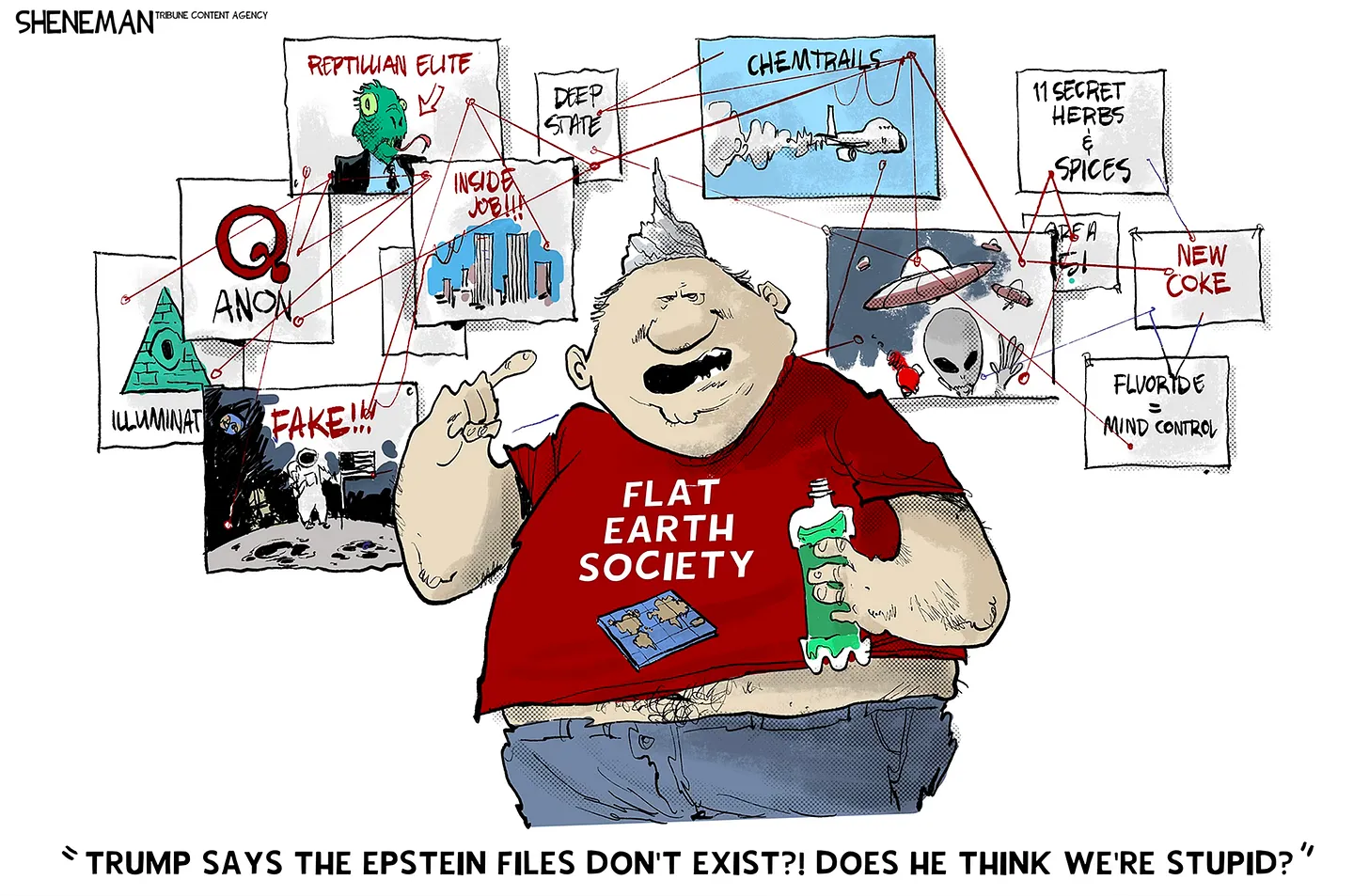
Yes, he does think you’re stupid. He always has.
That’s the only Democratic/liberal message that seems useful to me here. Trump ran on a promise to release the Epstein Files. It was key to promoting his image as the man who would finally stand up to the the Deep State and end the ability of privileged elites to do whatever they want with impunity. His Justice Department repeatedly teased his base with the notion that major revelations were coming soon. The holy grail of the Epstein conspiracy theory — the client list, the names of the powerful men who allegedly abused Epstein’s harem of underage girls — was on Pam Bondi’s desk, awaiting her review.
And then: Never mind. There never was a client list. Epstein’s death in prison was just the suicide that authorities had always claimed. Nothing suspicious about it. Nothing to reveal. Just: Move on everybody. Go back to talking about tax cuts or mass deportation or Joe Biden’s dementia. (A good summary of the contradictions between these official announcements and DOJ’s previous statements is in Senator Durbin’s letter to Attorney General Bondi.)
Trump has seemed surprised, offended, and then angry when his supporters did not do as they were told. The whole Epstein conspiracy theory, he now claims, was concocted by Democrats. It’s a “hoax” that only “stupid” and “foolish” Republicans fall into.
This time, though, the base isn’t falling into line. Two weeks have gone by, and still MAGA World is roiled by the controversy. Trump has tried to placate them by having Pam Bondi ask a judge to release the grand jury files from the Maxwell trial, but that’s unlikely to satisfy anyone: It will take time, the judge will likely say no, and even if he said yes, the information presented to the grand jury was aimed at Epstein and his partner Ghislaine Maxwell, who is currently in jail. If a client list exists, it wouldn’t be there.
The Trump administration has much more extensive information now, and could release it quickly. It just chooses not to.
This MAGA infighting seems like a godsend to Democrats, but it’s a tricky gift to open. Democrats have never bought into the Epstein conspiracy theory, which was rooted in the idea that Epstein’s fabled client list would be full of high-ranking Democrats and the liberal Hollywood elite. (It’s related to the Pizzagate theory that connected Hillary Clinton to a network that trafficked missing children for sexual exploitation.)
One thing Democrats lack these days, at least among the voters who shifted from Biden in 2020 to Trump in 2024, is authenticity. Championing the Epstein theory won’t help, because Democrats can’t do it authentically. (I know I can’t.)
I can’t even authentically call for DOJ to release its files. There’s a reason Merrick Garland never did: DOJ has terrifying investigative power, and a corresponding responsibility not to abuse that power. DOJ policy is to release the information it collects only in indictments and trials. It releases information to prosecute crimes, not to defame people that it can’t prove a case against.
That would be a terrible policy to reverse, especially in the Trump era. DOJ exists to enforce the law, not to keep the public informed.
Congressional investigation, though, is an avenue to inform the public. It would be entirely appropriate for a congressional committee to inquire about the strange contradictions in the administration’s public statements, or for Congress to appoint a commission to inquire.
But that’s as far as I think Democrats should go: Call for investigating the contradictions, not for investigating the conspiracy theory itself. If Republicans are willing to take the lead on a deeper investigation, fine. But that’s not for us to do.
One thing we can do, though, is validate the outrage felt among the MAGA rank-and-file: Yes, he does think you’re stupid. He thinks he can tell you up is down and you’ll start repeating it. He’s been doing it for years. Maybe this is a moment for you to re-evaluate many things.
That’s the point I think Democrats, liberals, and anybody else trying to turn the tide of fascism should emphasize. Not some Epstein conspiracy theory of our own. Not even the demand for DOJ to release the files. It seems obvious Trump has something to hide here, but I wouldn’t even dwell on that.
But Trump has always counted on his ability to influence the thinking of his followers. He has been uncanny in knowing how to wave a red flag, change the subject, or make himself the victim. This time, though, his Jedi mind tricks aren’t working. Even the magic word “hoax” is failing to make his followers go glassy-eyed and get back in line. All over MAGA, people are thinking about the Epstein Files and thinking, “I don’t care what he said. Those are the droids I’m looking for.”
But if members of his cult have briefly stepped outside his mind control, encourage them to stay there. If you don’t believe him when he says the Epstein stuff is a “hoax”, maybe you should re-examine all the other “hoaxes” he has claimed, from climate change to the well-established facts that Biden won the 2020 election and Russia interfered in Trump’s favor in 2016.
Most MAGA folks won’t do this re-examination, because are in fact the sheep Trump believes they are. But a few will. Jess Piper, who lives in Trump country, argues that they will never be converted into Democratic voters, and she’s probably right. But if they just lose their enthusiasm and decide to sit out future elections, that could make a difference.
Everything is going to run late today because I’m on vacation near Denver, two hours behind my usual eastern time zone.
The featured post today is “Yes, he does think you’re stupid”, which outlines how I think Democrats should respond to the continuing strife in MAGA World concerning Jeffrey Epstein. That should be out shortly, maybe by 10 EDT (8 Mountain Daylight).
The weekly summary will then cover Congress’ vote to defund $9 billion of money it had already appropriated, focused on cutting public broadcasting and foreign aid; the cancellation of Stephen Colbert’s late-night TV show; the poet Andrea Gibson, who I had never been aware of before her death this week; Trump’s attempt to rescue a fellow autocrat wannabee, Jair Bolsonaro of Brazil, from his well-deserved legal jeopardy; the harm anti-abortion laws have done to women’s health; and a few other things, culminating in your moment of schadenfreude, the CEO who got caught on the kisscam at a Coldplay concert. That should appear by 11 EDT, or 9 Mountain.
Probably for the first time since he announced his candidacy in 2015, Trump has found himself on The Elites side of the divide against The People. Instead of leveraging the power of conspiratorial thinking, for at least a moment, he is seeing it being used against him.
This week everybody was talking about Jeffrey Epstein
That’s the subject of the featured post. After posting it, I noticed that Matt Stoller had a slightly different take on the same subject.
Trump could have done many things about the Epstein files. He’s a reality show genius, he knows how to keep the plot going. But he just said that the mystery to be revealed, the one driving the whole Trump show – yeah, that doesn’t exist. He chose to do the single worst thing for the MAGA movement, he tried to take away their ability to believe in a moral universe in which they were the heroic army fighting for truth and justice. He also chose to embarrass the podcasting and MAGA influencers who built their businesses on elaborate stories around Jeff Epstein and the Deep State. You can’t just tell them to stop. Too much money and too much belief is riding on it.
and birthright citizenship
In Trump v CASA, the Supreme Court gave the Trump administration a win without ruling on the underlying issues of the case. CASA is a case challenging Trump’s executive order eliminating birthright citizenship. The order is blatantly unconstitutional, since birthright citizenship is clearly stated in the 14th Amendment. If you want to eliminate birthright citizenship, you need to pass a new constitutional amendment repealing that part of the 14th amendment.
But the Trump administration didn’t seek the Court’s opinion on the core issue of the case, but only on the nationwide injunctions that judges had granted that stopped the Trump administration from taking any action on his executive order. And they won: The Court sharply restricted the circumstances under which a judge could issue a nationwide injunction. The immediate impact of the Court’s decision was that the administration could begin denying the benefits of citizenship to people who were born in states that weren’t part of the suit challenging the order.
So if you were born in Missouri to undocumented parents, the administration might refuse to issue you a passport. But it would have to issue one to your brother, who was born in Illinois.
This week, a lower court issued a ruling that avoided that kind of chaos. Slate summarizes:
On Thursday, U.S. District Judge Joseph Laplante blocked Donald Trump’s assault on birthright citizenship in a ruling that applies nationwide. Despite its scope, Laplante’s order is not the kind of “universal injunction” that the Supreme Court prohibited in June’s Trump v. CASA. Rather, the judge certified a class of plaintiffs that includes everyone who would be affected by Trump’s policy and issued an injunction to protect their fundamental rights. This class action seeks to fill the gap that the Supreme Court created when it limited judges’ power to halt unconstitutional executive actions last month.
Slate’s Mark Stern and Dahlia Lithwick discuss the details.
and the trade war
So Trump announced his “liberation day” tariffs on April 2. Global markets crashed, and he backed off, putting a 90-delay on everything, so that countries could negotiate trade deals that got them lower rates.
Sadly, hardly any country did. And can you blame them? What deal can you strike with Donald Trump that he can be counted on to keep?
So the 90 days ran out last week. Since then, Trump has been announcing new tariff rates that go into effect August 1. The markets have barely reacted at all, possibly because they still believe the TACO theory: that Trump will chicken out before the rates actually go into effect.
but this is the best thing I read this week
USA Today columnist Rex Huppke used the Supreme Court’s logic to reach a very different conclusion. In Mahmoud v. Taylor, the Court voted 6-3 along ideological lines to require a Maryland school district to let parents opt their kids out of lessons involving LGBTQ themes. The Court recognized that
parents have a right ‘to direct the religious upbringing of their children’ and that this right can be infringed by laws that pose ‘a very real threat of undermining’ the religious beliefs and practices that parents wish to instill in their children. …
As Justice Samuel Alito wrote in his opinion regarding the use of LGBTQ+ books in schools, some “Americans wish to present a different moral message to their children. And their ability to present that message is undermined when the exact opposite message is positively reinforced in the public school classroom at a very young age.”
Huppke wants to invoke this precedent to protect his own right to present a moral message to his children.
I have a deeply held religious conviction that, by divine precept, lying, bullying and paying $130,000 in hush money to an adult film star are all immoral acts.
He lists many other Trump behaviors that he does not want validated by public schools, and so:
Attempts to teach my children anything about Donald Trump, including the unfortunate fact that he is president of the United States, place an unconstitutional burden on my First Amendment right to freely exercise my religion. … So any attempt to teach my children that Trump exists and is president might suggest such behavior is acceptable, and that would infringe on my right to raise my children under the moral tenets of my faith. (My faith, in this case, has a relatively simple core belief that being a complete jerk virtually all the time is bad.)
Huppke is obviously using humor here, but there is a serious point underneath: The reasoning that judges like Samuel Alito use in their rulings is intended to be applied only by certain people for certain purposes. Some people have a right to opt their children out of lessons that contradict their moral values, and some do not. Left-wing plaintiffs can’t expect to get the same consideration from this Court that right-wing plaintiffs do.
and you also might be interested in …
Another story of Trump administration lawlessness: The border patrol held an 18-year-old American citizen for 23 days. They would not allow him to shower or call his mother, who had the birth certificate proving he was born in Dallas. He lost 26 pounds during his ordeal.
Galicia, his brother and friends were on their way to a soccer scouting event at Ranger College when they were stopped by CBP. He was hoping to earn a scholarship. “We’re supposed to graduate from high school next year, and we wanted to do something to secure our education,” he said.
His brother was born in Mexico, so he signed self-deportation documents to get himself out of the inhumane conditions. Galicia told the Dallas Morning News: “It got to the point where I was ready to sign a deportation paper just to not be suffering there anymore. I just needed to get out of there.”
CIA Director John Ratcliffe is performing for an audience of one: He’s not trying to protect the United States from its foreign enemies, he’s trying to make Donald Trump happy.
In this case, he is making statements about Russian interference in the 2016 election that are simply false, and that are not supported by the CIA report that he says supports them. The facts, which have been found again and again by investigations headed by members of either major party, are that Russia did try to interfere in the 2016 election and that it did so with the intention of helping Trump.
and let’s close with something bookish
Tom Gauld is a cartoonist with a focus on libraries and books. Here, he presents a solution to a common problem. If it only it were that simple.
For years, Democrats have imagined that someday Trump’s dupes might return to reality and turn against him. But what if they could turn against him without returning to reality?
If you were a 2024 Trump voter, the last half-year has given you all kinds of good reasons to reassess your decision.
He didn’t reverse inflation like he said he would.
He didn’t end the Ukraine War “in 24 hours” like he said he would.
His Big Beautiful Bill increases the deficit he said he’d reduce.
He never found the millions of dangerous migrant criminals he said existed, so instead ICE is rounding up gardeners and dishwashers and moms.
Thanks to his Medicaid cuts, your rural hospital might close soon.
His on-again-off-again tariffs make it impossible for you to manage your small business.
Even though you worked hard and thought your office was doing something worthwhile, you lost your government job.
He fired the people you need to process your application for veterans benefits or Social Security.
And so on. As far as we can tell, though, hardly anybody in MAGA World cares about this kind of stuff. To the extent that Trump has lost support, it’s mainly among independents. Against all evidence, his base voters continue to believe he’s on their side, and everything that indicates otherwise is fake news.
What upset them? Last week, Attorney General Pam Bondi released a memo claiming there is nothing to see: The famous Epstein “client list” that she said was “on my desk” a few months ago … well, it never existed. (Does her desk still exist? Was she ever really attorney general?) So there is no “evidence that could predicate an investigation against uncharged third parties”. And Epstein’s death was a jailhouse suicide, just like the official report said at the time.
The DOJ and FBI say in the memo that no “further disclosure” of Epstein-related material “would be appropriate or warranted.”
So: case closed. If you’ve been obsessed with Epstein, find something else to think about.
Worse, Trump himself has backed up Bondi on Truth Social.
What’s going on with my “boys” and, in some cases, “gals?” They’re all going after Attorney General Pam Bondi, who is doing a FANTASTIC JOB! We’re on one Team, MAGA, and I don’t like what’s happening. We have a PERFECT Administration, THE TALK OF THE WORLD, and “selfish people” are trying to hurt it, all over a guy who never dies, Jeffrey Epstein. … Kash Patel, and the FBI, must be focused on investigating Voter Fraud, Political Corruption, ActBlue, The Rigged and Stolen Election of 2020, and arresting Thugs and Criminals, instead of spending month after month looking at nothing but the same old, Radical Left inspired Documents on Jeffrey Epstein. LET PAM BONDI DO HER JOB — SHE’S GREAT! The 2020 Election was Rigged and Stolen, and they tried to do the same thing in 2024 — That’s what she is looking into as AG, and much more. One year ago our Country was DEAD, now it’s the “HOTTEST” Country anywhere in the World. Let’s keep it that way, and not waste Time and Energy on Jeffrey Epstein, somebody that nobody cares about.
I feel silly writing about this, because I have never cared about Jeffrey Epstein or the various conspiracy theories about his activities. Apparently, he was a rich man with a lot of rich and powerful friends. He induced a number of underage girls to have sex with him, and perhaps also with his friends. Some believe that he kept evidence of these statutory rapes to blackmail his one-time “friends”, and that their influence is what kept him out of prison so long. He was arrested in 2005 and convicted in 2008, but served an embarrassingly trivial sentence. He was arrested again in 2019 and died in his jail cell a month later. The official report on his death says that he committed suicide, but rampant speculation says that he was murdered to keep him from implicating the people he procured underage girls for.
Honestly, I’ve never cared. I feel sorry for the girls he abused. I’m glad he was arrested and I’m glad his girl-friend and co-conspirator Ghislaine Maxwell is in jail. If anybody has solid evidence that he had “clients” who also abused the girls, I’d like to see them punished too. If that group includes prominent Democrats or Hollywood bigwigs, so be it. (That’s an attitude I have towards a lot of alleged crimes: If there’s some kind of evidence, have at it.) But there’s a lot of injustice in the world, and for me this case does not stand high above many others. I have no theory about what “really” happened to Epstein, and no interest in forming one.
But not so in the fever swamps of MAGA. For these folks, Epstein was a real-life case that validated the wild and otherwise baseless conspiracy theories of Q-Anon.
Their core belief is that a cabal of Satanic, cannibalistic child molesters in league with the deep state is operating a global child sex trafficking ring and that Donald Trump is secretly leading the fight against them.
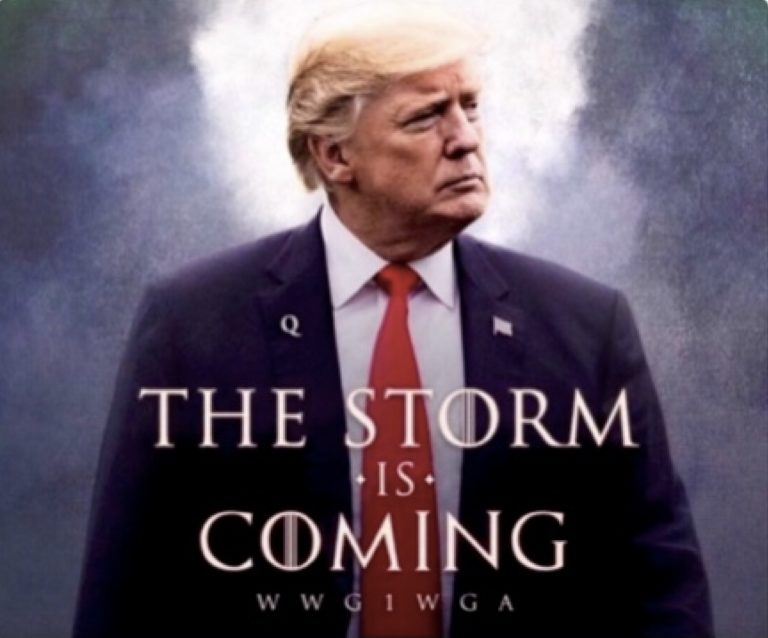
The Satanic cabal supposedly included the Clintons and all sorts of other people. And someday soon, Trump would bring them down by unleashing “the Storm”
when thousands of people will be arrested and possibly sent to Guantanamo Bay prison or face military tribunals. The U.S. military will then take over the country, and the result will be salvation and utopia.
This theory was always nutty, going back to the gun-toting guy in 2016 who showed up at a DC pizza place thinking he was going to liberate the children being held captive in the basement the building didn’t have. And Trump — a known friend of Epstein and a sex offender in his own right — was maybe the least likely person in the world to be cast in the savior role.
But being in a cult means never having to say you’re sorry. Over the years, the repeated failure of Q’s predictions disillusioned a lot of his followers. However, Mike Rothschild, who wrote the book on Q-Anon, says:
QAnon as a movement based around secret codes and clues and riddles doesn’t so much exist anymore. But it doesn’t need to exist anymore because its tenets have become such a major part of mainstream conservatism and such a big part of the base of people that reelected Donald Trump.
For years, Trump has been happy to let these crazies anoint him as their messiah. He “re-truthed” their memes.
More recently, though, the conspiracy theory seemed to be coming back to bite him. Elon Musk claimed to have seen the “Epstein Files” — though what that had to do with the job he was supposedly doing to cut government spending isn’t clear — and said that Trump was in them. “That is the real reason they have not been made public.” Musk deleted that post after Trump threatened his government contracts.
Plus, the MAGA natives were getting increasingly restless. Trump had said he would release whatever files the government had on the Epstein case. His nominees talked about them in their confirmation hearings. So where were they? It was time to produce the evidence that would prove those Q-Anon claims once and for all.
And the answer is … oh, never mind. Nothing to see here. Let’s all go back to some other fantasy, like voter fraud or the migrant crime wave.
Trump has told his base to turn on a dime before, and they have. Appointees like Bill Barr or Jim Mattis are “the best people” until they say something Trump doesn’t like, and then they were always suspect. Elon was a “genius” until he became “crazy”. Deficits are a problem until they aren’t. Any hint of Joe Biden or his family profiting off their government service is “the Swamp”, but Trump and his family making billions from foreigners investing in their crypto schemes is just good business. And so on.
In order to restore peace in MAGA World, Trump will probably have to throw Pam Bondi under the bus, despite the FANTASTIC JOB she’s been doing. It wasn’t him, Trump’s cultists will say to comfort each other, it was her.
But then what? A new AG, one untainted by Bondi’s nothing-to-see-here blunder, does what exactly? Releases something, obviously. But what?
Soviet Premier Nikita Khrushchev is said to have given this advice to then-Vice-President Richard Nixon: If the people believe in an imaginary river, don’t tell them there isn’t one. Promise to build them an imaginary bridge.
It’s time for Trump to deliver his imaginary bridge over the Epstein controversy. How will he do it?
Meanwhile, what should the rest of us do? The worst thing we can do, I think, is get drawn into the argument. The real issues in America today are
the continuing march of fascism, and the complicity of Congress and the Supreme Court in subverting American democracy
the vast economic inequality in our country, and government policies that keep making it worse
climate change
In the face of all that, I have no theory about Epstein and no interest in forming one. Anybody who has evidence of some unprosecuted crime should feel free to pursue their investigation, but I have other stuff to do.
If the MAGA movement wants to tear itself to pieces over this, that’s all to the good. Make popcorn and enjoy the show. But they’ll eventually put their movement back together, and they’ll do it with an explanation that makes as little sense as everything else they do. We can hope that the friction will scrape away a few cultists, who finally realize that Trump has been playing them for fools all along. A few. Probably not that many.
Meanwhile, there are real issues to worry about. I have no time to waste on imaginary rivers or the bridges that might cross them.
Of all the indignities the second Trump administration has put me through, this may be the most annoying: Today I have to write about Jeffrey Epstein.
Epstein is the guy who seduced underage girls into having sex, and allegedly shared them with a long list of rich and powerful men that he then blackmailed to keep himself rich and out of prison. How much of that is true is anybody’s guess, as is the list of those rich and powerful men. Epstein’s apparent jailhouse suicide in 2019 has been a mother lode for conspiracy theories, especially in the fever swamps of the MAGA movement. Hardly anybody claims to be Q-Anon any more, but Q-Anon’s belief in a vast conspiracy of elite pedophiles has taken root in MAGA World, and Epstein is the one real-world hook you can hang that theory on.
This week, Attorney General Pam Bondi tried to remove that hook: Never mind, she says. There is no Epstein “client list”, nobody else needs to be charged with anything, and no further release of Justice Department information is warranted. Move along, people. Nothing to see here.
Now, I moved along years ago. I have no theory about what “really” happened to Epstein, and no interest in forming one. But the controversy itself has become news. There’s a real uprising in MAGA World, and Trump telling everyone to settle down and get back in line doesn’t seem to be working. The Trump faithful have ignored real issue after real issue, but this one seems to be more than they can stand.
Anyway, “Is Epstein the issue that will finally break through?” is this week’s featured post. It should be out shortly. The rest of the week’s news — court rulings about birthright citizenship, response to the Texas floods, and so on — will be in the weekly summary, which will appear around noon.









 The Weekly Sift