
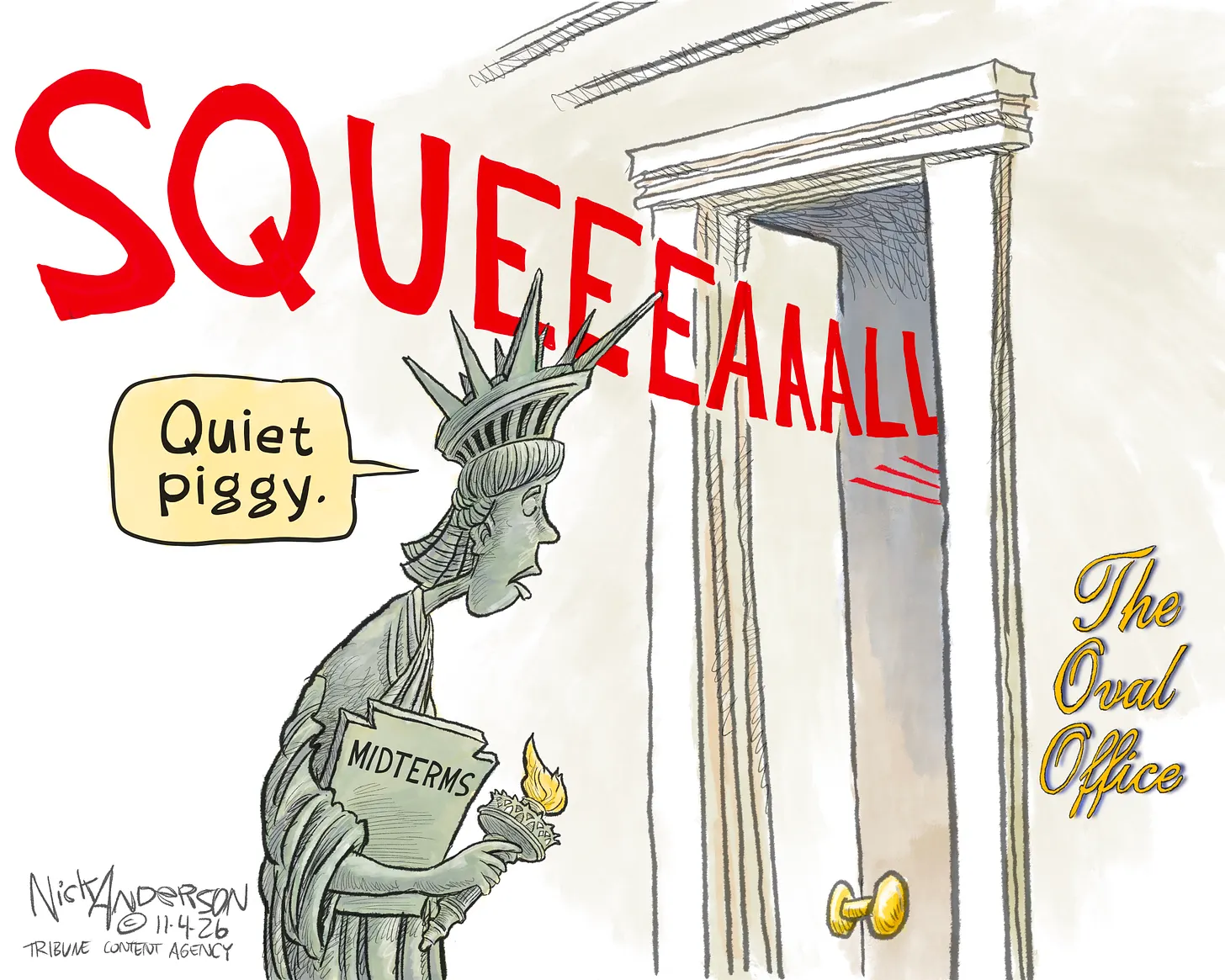
What happened. My main predictions/observations last week were:
- The polls look good for Democrats.
- No pollster can estimate what the last-minute deciders will do, either in terms of who they vote for or whether they vote at all.
- Probably the last-minute deciders will all do the same thing.
That doesn’t make me Nostradamus, but as far as those predictions went, they look pretty good: The late deciders who voted, voted for Democrats, resulting in a victory far larger than the polls had predicted. I thought one party or the other would take at least 6 of the 7 Senate races that Cook Political Report rated as toss-ups. Not only did the Democrats take 6, but the seventh (Alaska) is leaning their way, and seats that were thought to be leaning Republican in South Carolina and (apparently) Mississippi also flipped. (Expect a final vote total in Mississippi tomorrow. Recounts are not a thing in Mississippi unless a court orders one for a specific reason. Tomorrow is also the day for a final first-round Alaska vote, which will lead to a ranked-choice-voting second round, which shouldn’t take long.) So while Democratic optimists were hoping for 54 Senate seats, 56 is now the most likely outcome.
Just about everybody expected the Democrats to come out with a House majority, but the size of it (259 seats out of 438) is big surprise. Democrats now have 29 of the 50 governorships, and flipped a number of state legislative bodies, including the Texas House.
What it means. There has been a surprising amount of post-election consensus about what this means. Everyone left of Ted Cruz understands that the election was a triumph for Democrats and a disaster for Republicans. The exit polls made the message of the voters clear: They were angry about the cost of living, the war, and the corruption of the Trump regime.
The question is how Democrats should respond. One thing missing from the exit polls is any groundswell of support for specific Democratic programs. Americans are worried about the cost and availability of health insurance, and Medicare-for-All is one way to address that concern, but voters were not specifically asking for it. They want the war to end so that gas prices can come down, but there’s not a widespread call for a war-powers resolution or defunding the forces in the field. They’re upset about corruption, but it’s not obvious that another Trump impeachment would be popular.
Some pundits spin this as “Democrats should be cautious and try to work with Trump as much as they can, rather than antagonize him.” On the other hand, Indian sci-writer Shiv Ramdas observes:
nobody gives you a sweeping mandate like this because they want you to work with the people they just ran tf outta office
I think a more precise interpretation is that the sale is not complete yet. If Democrats are going to address voters’ concerns at all, they’re going to have to do specific things. But all those things will have to be backed by strong messaging that connects the proposal-at-hand to what the American people need and want and asked for. And while some bills may get passed just for the sake of staking out a position (on health care or voting rights, for example), knowing either that Republicans in the Senate will filibuster them or that Trump will veto them, the public also needs to see a few clear accomplishments.
The model here, I think, is the Epstein Files Transparency Act. Trump opposed it, but it was so popular with the American people that some Republicans were willing to back it, and Rep. Thomas Massie was even willing to co-sponsor it. Once it became clear that there would be enough Republican defectors to pass the law, the rest of the party caved. It passed nearly unanimously and Trump signed it. (Then his Justice Department blocked implementing it, which is still playing out in court.)
Another model is the bipartisan housing bill that Congress passed during the summer, which became law even though Trump refused to sign it. Democrats shouldn’t restrict themselves to bills Republicans will support, but finding a few proposals too popular for Republicans to oppose would be a good way to start.
In general, an Epstein/housing path might work like this: A few Republican defectors make a bill likely to pass. If it’s going to pass, more Republicans want to be on the right side of it. If it passes with super-majority support, Trump signs it because he doesn’t want to see his veto overridden.
That path might work for things like raising the minimum wage, an ethics bill to stop members of Congress from trading stocks, repealing some of Trump’s least popular tariffs (like the ones aimed at Canada), universal background checks on gun purchases, and a follow-up Epstein bill that insisted on full release. Restoring Medicaid subsidies might get through this way. Voters were not specifically asking to get aid flowing to Ukraine again and to stop favoring Russia, but Ukraine is more popular than Russia, and a number of Republicans in Congress would defect from Trump on this issue.
Trump might veto all this, but those vetoes would be unpopular. Not a week should pass without Democrats sending to his desk a law that would improve the lives of American workers and families. None of these bills should be show ponies; they should all be things that Democrats genuinely believe in and would be happy to see Trump sign.
I find myself in the unusual position of agreeing with the editorial board of the NYT:
Where can a modern national agenda begin? Picture a parent who can afford a child’s medicine without dread. Picture families who can raise young children without drowning in costs. Picture a generation that can once again own a home. Picture an economy in which those who have prospered most, including the titans of artificial intelligence, help build a bountiful future for everyone else. Every idea Democrats advance should pass three simple tests: Will it work? Will it reach as many Americans as possible? Will people feel it?
This focus avoids a trap that Trump will be eager to spring. For many years, discontent has been brewing in the electorate, because many people believe politicians don’t really care about them. This time, that discontent focused on Republicans, because Trump was obsessed with his golden ballroom while they were deciding which bills they could afford to pay this month. But the discontent itself is non-partisan, and Harris paid its price in 2024. It could turn against Democrats again if the public just sees them scoring political point against Trump while continuing to do nothing that helps ordinary people.
Trump is already gearing up to say: “They don’t care about you. They just want to get Trump.”
Investigations. That’s what makes investigations tricky. The public does care about corruption and wants to see people held accountable for it. But it doesn’t want a lot of finger-pointing that leads to nothing. Trump’s pointless persecution of his enemies, where he has repeatedly had his Justice Department investigate and try to indict people on evidence that can’t get past a grand jury, has increased public skepticism.
So investigations, especially at the beginning, need to quickly expose real crimes or shady deals that should be crimes. There should be no equivalent of the James Comey shells-on-the-beach indictment.
There’s already bipartisan support for a Pete Hegseth impeachment. I would focus on the attacks against fishing boats that Hegseth claims were smuggling drugs, because these are basically murders on the high seas. Wikipedia reports:
As of 27 October 2026, at least 243 people had been killed (including 17 who are missing and presumed dead) in at least 80 strikes on over 81 vessels
A simple analogy makes the point: Imagine a bank had been robbed, and a car was seen speeding away from the bank immediately afterward. Police believe the robbers and the money are in the car. No innocent people are known to be in the car. The car is being tracked and police can easily stop it and arrest the people inside. Instead, they blow it up with a bazooka, killing everyone. Is that how American justice should work?
The 243 dead people from these boats were suspects. Even if they would all turn out to be guilty — and nobody was a hostage or just along for the ride — they deserved their day in court and whatever punishments are set out in laws. Instead, Hegseth had them killed.
Other investigations: Why hasn’t anybody been held to account for the murders of Renee Good, Alex Pretti, or Lorenzo Salgado Araujo by ICE agents? How did companies associated with Eric Trump and Don Jr. get so many government contracts? How much taxpayer money got spent on partisan ads like the “public service announcements” lauding President Trump? What are conditions like in those ICE detention camps?
Overreach? A lot of the national-media center-right punditry is wringing its hands over the idea that Democrats might actually try to do something with their new majorities. The same people who thought Trump’s 49.8% vote total in 2024 gave him a mandate to do whatever crazy thing came into his head are now worried that Democrats’ 56%-43% victory will lead to hubris.
But the problem, as I see it, isn’t that Democrats will try to do too much but that they will try to do too little. The New Republic’s Michael Tomasky makes a very good point:
The intra-Democratic debate that I despise above all others is the one that holds that Democrats must either do X or Y but cannot possibly do both X and Y. It has made me insane for years. … Think of it this way. Have you ever, once in your life, heard conservatives and Republicans engage in an argument like: Well, we can cut taxes, or we can prosecute the culture wars, but we surely can’t do both! I hope you’re laughing, because the idea is laughable on its face.
Obama had ten months of filibuster-proof majorities in Congress, and what he got out of it was the Affordable Care Act. That was his top priority, so he thought it eliminated doing anything else. It was a wasted opportunity.
Overreachy things like Medicare-for-All or a Trump impeachment are only a problem if they crowd out achievable smaller things like raising the minimum wage or keeping rural hospitals open.
Trump’s likely response. If you watched the 60 Minutes interview that aired yesterday, you may have been encouraged. Trump sounded conciliatory, and talked about working with Democrats on a number of issues, including immigration. But between the interview itself and its air date, he appointed Stephen Miller his new chief of staff.
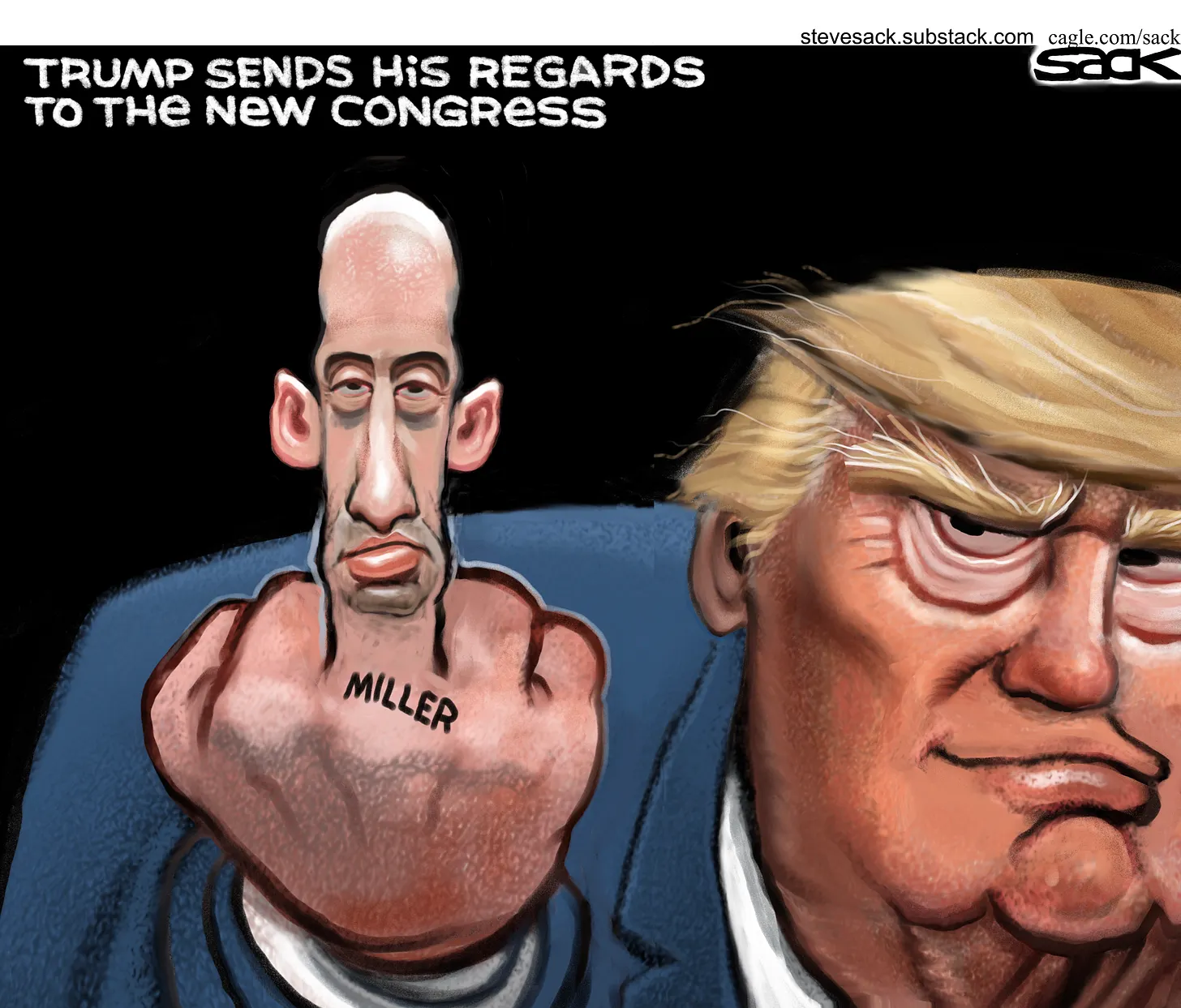
Miller is one of the most polarising figures in the administration and one of Trump’s closest and longest-serving advisers, having joined his 2016 presidential campaign as a speechwriter. He is a former aide to the former senator Jeff Sessions of Alabama, who would go on to serve as Trump’s first attorney general. In Trump’s first term, Miller was the driving force behind policies such as family separation and a travel ban on Muslim-majority countries. More than a hundred Democrats in Congress signed a letter to Trump calling Miller a “documented white nationalist” and demanding his removal.
Chris Hayes commented:
If you were thinking: what could Trump do to push his approval rating down even further and open up the possibility of a 1964/1980/2008 style victory for Dems in 2028? The answer is: put Stephen Miller in charge of everything. And guess what?
My personal reaction: I want Stephen Miller in front of TV cameras as much as possible. His physical presence makes his message sound just as creepy as it actually is.
Here’s the headline in Le Monde, a leading French publication: “Stephen Miller, reactionary ideologue and white supremacist, promoted head of Trump administration“. Contrast that direct truth-telling with this fascist-friendly characterization in the NYT:
Mr. Miller has been the driver of the president’s most muscular actions, including the use of increasingly hostile tactics to capture immigrants across the country and the bombing of small boats in the Caribbean Sea and the eastern Pacific Ocean that he and Mr. Trump declared constituted a foreign invasion.
Apparently “muscular” is a new synonym for “criminal”.
And one more thing. Black turnout was up, particularly in the South. But we should not conclude from that fact that Republican attempts to suppress the Black vote were harmless. Apparently, Black citizens felt so strongly about this election — partly because of the suppression efforts — that they overcame the obstacles that were put in their way. But the obstacles still exist, and in less motivating elections they will make a difference.
“So much of what this administration has done has been to roll back the protections that give us access to the ballot, while simultaneously flooding us with propaganda that tells us that it doesn’t matter,” said Nadine Smith, president and CEO of Color of Change, which worked to mobilize voters across the south before the election. “What you saw was Black voters showing up in the face of an administration that has spent two years attacking our rights, weakening voter protections and redrawing maps specifically to diminish Black political power.
This is just one example of the many ways Trump tried to cheat, but came up short. I haven’t seen a clear what-if-we-had-used-the-old-maps assessment of the US House races, but Trump’s push to gerrymander did not gain all the seats he thought it would, and the redistricting war he started may have been won by the Democrats, whose gerrymanders were fewer but more successful.
The courts blocked Trump’s attempts to set aside ballots that his Justice Department claimed (probably falsely) were being cast by non-citizens. His efforts to turn Alaska’s two-Dan-Sullivans ballot into a criminal case has fallen flat, because no one can name the law it supposedly violates. (I can’t remember who said it, but my favorite assessment is: “If confusing voters is a crime, all politicians should be in jail.”) Trump’s claim that all votes for the “other” Dan Sullivan should be counted for the incumbent senator also goes nowhere, because in Alaska’s ranked-choice-voting system, voters have already said where they want their votes to go if their first candidate can’t win. Trump may claim to know their intentions, but they have already stated their intentions in a legally binding way.
But just because Trump failed to cheat this time doesn’t mean we should ignore the effort. This is part of a general pattern where Trump wants to be treated like a five-year-old, whose cheating attempts can be laughed off because he’s so bad at it. But those politically and racially gerrymandered districts are still standing, waiting for future elections. The myth of non-citizen voters is still widely believed by MAGA cultists. The restrictions on early voting and mail-in voting continue, along with the closing of polling places convenient for non-White voters. The corrupt Justice Department is still in office. The Supreme Court’s dismantling of the Voting Rights Act is a done deal.
It didn’t work this time, but there’s still a lot to clean up before we can have truly fair elections.

