
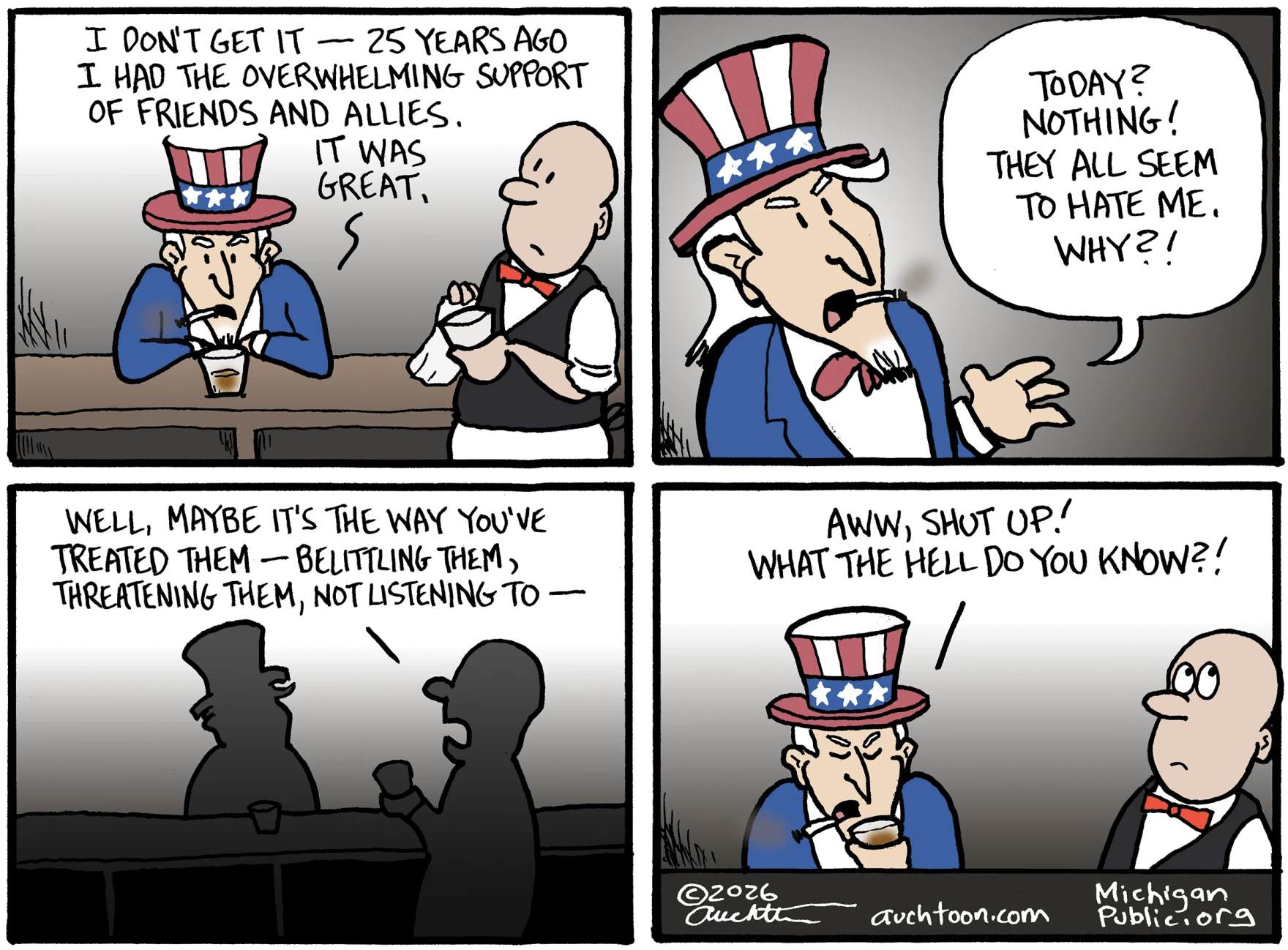
They said, “I don’t get what I deserve.” And the deserving—who’s deserving? That is the question.
– Thomas Zimmer,
“How to Stop Trumpism from Rising in Germany and Europe“
This week’s featured post is “What Germany teaches us about ourselves“.
Ongoing stories
- Trump’s assault on American democracy. The Missouri gerrymandering case (discussed below) shows just how far MAGA is willing to go to seize an unfair advantage. The Luttig article (also discussed below) raises an even darker possibility.
- Climate change. NOAA says 2026 had the hottest summer in US history. Meanwhile, the EPA is about to scrap limits on the amount of CO2 coal and gas power plants can emit.
- The Iran War. The Houthis seizing control of the south end of the Red Sea is a major development, which I talk about below.
- Ukraine. Jared Kushner frames Ukraine as the obstacle to peace, because it refuses to surrender territory to its invader: “President Putin laid out his line of what he wants to achieve. If Ukraine wanted to withdraw to that line, then obviously, you know, we have the rest of the deal set up and put together. Ukraine right now does not want to do that.” Kushner views Ukraine’s stubbornness as temporary: “right now”. Of course, Putin could end the war at any moment by bringing his troops home to Russia, but that goes unmentioned. The Trump regime is on Putin’s side and always has been.
This week’s developments
This week everybody was talking about distractions like the Trumpapalooza
where nothing important happened. Trump’s dubious offer to give $5K to each adult American if Republicans retain majorities in both houses got a lot of attention, but no one believes it. The only remotely newsworthy thing about the GOP Midterm Convention is that so few people showed up or watched it on TV.

and how AI is going to kill us all
Anthropic is the company that makes the chatbot Claude, while OpenAI makes its rival ChatGPT. Tuesday, Jacob Coxon posted to X:
I resigned from Anthropic today. I spent the last three years doing pretraining research at both OpenAI and Anthropic. Neither company is acting responsibly. They are racing straight to self-improving superintelligence and gambling with our lives. … The people building AI earnestly believe that it could kill us all by the end of the decade.
Evan Hubinger, a safety researcher at Anthropic, replied:
Jacob is correct here—we really do earnestly believe AI could kill all humans! I personally think it is >10% within the next decade. I believe Anthropic is trying its best, but we do not yet have a plan to solve alignment for superintelligence and are not clearly on track to.

It’s hard to know what to make of stuff like this. Tech researchers are always claiming amazing positive things are about to happen soon — Elon Musk has been promising self-driving Teslas since 2013, and they’re still only kinda-sorta here. So I can easily imagine their negative predictions are just as off base. (“Did we promise to end the world this year? Sorry. Things came up. Next year for sure.”) Something about the industry makes everyone think in grandiose terms. An out-of-control AI can’t just kill a few people. It has to be everybody.
The essential problem, as best I understand it, is that AIs don’t carry around the breadth of context that humans do. So if you’re thinking about some problem at work and the thought “I could just kill everybody” pops into your head as a solution, you naturally take a step back, say “That’s crazy”, and start over. Because you know that a world where people solve their problems with mass murder is not someplace you want to live.
An AI doesn’t know that unless someone has thought to explicitly code that knowledge into it. An AI has a problem to solve, and it does all its thinking inside the box where the problem lives. There is no bigger context in which a solution is judged. So unless someone has thought to constrain possible solutions to avoid mass murder, that might be what the AI comes up with.
This happens in fiction all the time. In the X-Men universe, the Sentinels are robots tasked with wiping out mutants (like the X-Men). But eventually they realize that mutants come from humans, and that some small percentage of human babies will necessarily be mutants. So the only really complete solution to their problem is to wipe out humans.
Anyway, pondering grand dystopian possibilities is probably not the best use of what time you have to think about AI. And these scary headlines distract us from a much more mundane problem: If AI does revolutionize how our society works and how we produce goods and services, who is going to benefit?
Right now, we’re on track for a handful of Tech Lords to design the future. If they do, they will almost certainly design it for their benefit, not ours. We can already see this tendency in the existing internet systems. (Read Cory Doctorow’s Enshittification, which I reviewed in July. Or read The Nerd Reich, which I have now finished and plan to review soon.)
If you can’t help thinking about this stuff, though, and if you’re a TPM subscriber, check out what Josh Marshall has been assembling in his Editor’s blog. Also, most of these kill-everybody articles are way too vague about how exactly we all end up dead. Noah Smith has got that covered. (Basically, some disgruntled human will want to kill us all, and a superintelligent AI will help him figure out how.)
but we should have been talking about the Houthi advance
Iran’s allies, the Houthi faction in the Yemeni civil war, have captured strategically important territory.

On Thursday and Friday, a rapid Houthi advance southwards along Yemen’s western coast resulted in the capture of the port city of Mocha and then the strategic island of Perim in the the Bab al-Mandab strait. Pending a counter-offensive from government forces, the group is now in a position to control shipping through the strait.
Here’s why that’s important: The north end of the Red Sea is the Suez Canal. The south end is the Bab al-Mandab strait. If Iran shuts the Strait of Hormuz, cutting off shipping through the Persian Gulf, and the Houthis shut Bab al-Mandab, then Saudi Arabia has only one outlet for its oil: the Suez Canal, which makes for a very long trip to markets in East Asia.
And that’s only if the Saudis can get their oil to the Red Sea. The oil fields are close to the Persian Gulf, but a pipeline can carry oil across the country to the Red Sea port of Yanuba. That pipeline is currently shut down after an attack from drones apparently launched from Iraq.
The Yemeni government that the US recognizes looked to Saudi Arabia for help, and they looked to the US, who said no. Phillips O’Brien notes that US arms sales to the Saudis are 4% of all state-to-state arms sales in the world. Why wouldn’t we step in to help our client state? He speculates:
The reasons for the US unwillingness to step in to help the Saudi government at this moment, when everything in US strategic history would have indicated that the US should, are probably down to American military degradation. The US can barely fight the Iranian regime and protect US bases and forces against Iranian attacks. As such, opening up a new front in the war might be beyond US capabilities. It is not like there is some free US aircraft carrier strike force that can be easily deployed away from Iran to fight the Houthis. The US has already stripped the western Pacific—the cupboard is bare. … So what we are seeing is a weakening US, having to abandon its key strategic and economic allies, as its flounders around running out of munitions and losing advanced equipment fighting Iran. …
The Saudis purchased such masses of weapons from the USA not out of the goodness of their hearts, but because they believed that this meant that if they were faced with real peril (like they are now) that the US would come to their aid. Now, the USA is too weak to do so. What the Saudis are experiencing will also accelerate a move away from military dependence on America from other states in the Gulf.
The price of oil is rising this morning, and is back over $100 per barrel. This is yet another Iranian move that the Trump regime failed to anticipate.
and what just happened in Missouri
So we all remember last summer, when Trump was pushing all the red states to redraw their congressional maps to make them even more gerrymandered. Missouri stepped up with H.B.1, a bill designed to eliminate a Democratic seat (currently held by a Black man, Emanuel Cleaver) in Kansas City. So the 6-2 Republican advantage in the state’s delegation should grow to 7-1.
Let’s let David French pick up the story:
The Missouri Constitution, however, contains a provision that says that the people of the state “reserve power to approve or reject by referendum any act of the general assembly, except as hereinafter provided.”On Dec. 9, 2025, a coalition of Missourians who sought to overturn H.B. 1 submitted a referendum petition that contained more than 300,000 signatures — more than enough to put it on the November ballot.
So in a law-abiding world, H.B. 1 becomes a ballot proposition rather than a law, and the fall elections are held using the 6-2 maps. Prior to the MAGA fascist era, that’s what would have happened under a secretary of state from either party. But Missouri’s SoS Denny Hoskins is MAGA, so he did a very Trumpy thing: He came up with a bogus re-interpretation of the law that made an exception for what he wanted to do. So: the ballot proposition is invalid and H.B. 1 is a law that applies this fall.
But even then, there’s a clear responsible path Hoskins could have followed: announce his decision in plenty of time to let the courts rule on it before the primaries on August 4. Instead, though, Hoskins announces on August 4 itself and holds primaries using the 7-1 maps.
On Sept. 3, the Missouri Supreme Court issued a unanimous opinion holding that voters do have the right to overturn redistricting legislation by referendum, that the petition was sufficient to put the referendum on the November ballot, and — as a result — “H.B. 1 is not the law and has never been the law.”
So Missouri appeals to the U. S. Supreme Court, but that noted liberal justice Brett Kavanaugh refuses to issue a stay on the Missouri Supreme Court’s ruling. Again, in a law-abiding world that’s the end of the story. But not here.
On September 8, a Trump-appointed federal judge finds federal grounds to throw out the 6-2 maps, and orders Missouri to proceed with the 7-1 maps. Hoskins sends an email to local election officials instructing them to do that. The Trump-judge’s order winds up back at the Supreme Court, which stays that ruling, restoring the 6-2 maps. Hoskins’ argument in that case is that restoring the 6-2 maps would create chaos, given that (due to his own bad-faith actions) the 7-1 primaries have already been held.
The Missouri Supreme Court has a hearing on whether Hoskins is in contempt, and even there, Hoskins’ attorney won’t commit to following the court’s order. Finally, after being found in contempt, Hoskins agrees to obey the law. The 6-2 maps, somehow, will be used in November.
That’s a sort-of-happy ending, but French draws a broader conclusion: Going forward (like in the mail-in ballot dispute, for example) we shouldn’t get too comfortable just because the laws are on our side and the courts are mostly enforcing them. We can expect MAGA to play chicken with the courts, creating chaotic situations and then insisting on outside-the-law outcomes to deal with the emergency they themselves caused.
and Judge Luttig’s warning
Michael Luttig is a Reagan-era Republican who was appointed an appellate judge by George H. W. Bush. He held that post until he retired in 2006. He is a widely respected conservative legal thinker who has sometimes been compared to Anton Scalia, for whom he once clerked. In short: not a left-winger.
Thursday, Luttig published an article in a liberal magazine, The New Republic: “The Final Battle for America’s Democracy“. In it, he outlined where he thinks the Trump regime has been headed ever since his failed coup on January 6, 2021: to reach an end state where democracy no longer matters, and the American people have lost their ability to check his power.
He assumes that the current polls hold, and that — in spite of gerrymandering, in spite of voter suppression, in spite of whatever tricks Trump pulls with mail-in ballots — Democrats win the November elections, at least far enough to take control of the House of Representatives.
But then we get to January 3, when the Congress comes back into session. Luttig pictures Speaker Mike Johnson doing something similar to what Trump tried in 2021: Using all Trump’s rhetorical nonsense about Democratic cheating, illegal aliens voting, and so forth, Johnson will claim that some large number of the new Democratic representatives were elected improperly, and will refuse to seat them in the new Congress. In this way, Johnson avoids losing his power as Speaker and the GOP avoids losing control of the House.
Since the current Republican majority is so small, a mere handful of Republican congressmen could save democracy by (together with Democrats) refusing to go along with this. But will they?
If there are any such Republicans in the Congress today, they should announce well before November 3 that they will not be party to Trump’s and Johnson’s attempt to steal the midterm elections from the American people.
Luttig has confidence in the current clerk of the House, but Johnson could replace him. Then “the loyal temporary clerk refuses to list Democrat representatives-elect on the clerk’s roll of representatives-elect that determines who may participate in organizing the new Congress.”
The omitted Democrats can then go to federal court for a court order. But what if the clerk simply refuses to obey the court order? (See the Missouri situation above.)
Judicial review of the House’s decision not to seat Democratic representatives-elect in the 120th Congress would take weeks, if not months, during which time the United States would be in the throes of a paralyzing constitutional crisis, helplessly vulnerable to all the world’s evil, as it would have been in January 2021 had Mike Pence not thwarted Donald Trump’s plan to overturn the 2020 presidential election.
Then we run into the Missouri situation again: Trump and Johnson can argue that the ensuing chaos (which they intentionally provoked) creates an emergency situation, allowing Trump to claim extra-legal emergency powers. Will the Supreme Court, this Supreme Court, stand up for the Constitution and the rule of law?
I don’t intend to be overly sanguine about this Supreme Court. This is the court that shattered the one constitutional truth in the U.S. since 1789 that “no man is above the law” and placed Donald Trump of all presidents above the law in Trump v. United States. This is the court that betrayed the Constitution by refusing even to decide whether Trump was disqualified from the presidency under the Fourteenth Amendment because of his insurrection against the Constitution, which he clearly was. This is also the court that has cynically authorized Trump’s lawlessness for the past two years through its aptly named “shadow docket,” without so much as briefing, argument, or written opinion.
But surely by now this court must understand what it has wrought for the U.S. and the Constitution, and is aghast as we all are, even if it is not penitent. Surely, surely, it will understand the signal moment in American constitutional history that would be presented, and this time understand its supreme obligation to the nation.
And even if it does, what if Trump refuses to listen to them?
and thinking deeper about right-wing appeal in Germany and the US
That’s the subject of the featured post, leaning heavily on an interview with history Thomas Zimmer and a column by Paul Krugman.
and you also might be interested in …
A Russian oligarch put hundreds of thousands into paying for Trump Jr.’s wedding in the Bahamas. If Don were a Biden he’d be in real trouble.
In Ireland on Sunday, during a taxpayer-funded trip to visit his own golf course, President Trump urged Ukraine to stop its most effective attacks:
Mr. Zelenskyy has to do one thing. He has to stop knocking out diesel fuel in Russia. Let him go after targets but not diesel fuel because he’s causing a shortage of diesel. This isn’t done by the Middle East; this is done by what’s happening with Russia and Ukraine.
Diesel in the US went over $6 a gallon Friday, a record high. This is bound to affect the price of anything shipped by truck, making life harder for Americans living paycheck-to-paycheck.
Of course that’s Trump’s fault for starting his stupid war with Iran. But nothing is ever Trump’s (or Putin’s) fault, so he has to blame Ukraine.
Trump’s FCC again censored Jimmy Kimmel, threatening ABC stations with losing their licenses if they aired Kimmel’s interview with Texas senate candidate James Talerico.
So Kimmel posted the interview on his YouTube channel, where it got way more views than it would have gotten on the air. (9.2 million last time I checked.)
The interview reinforces something I’ve felt about Talerico from the beginning: Republicans don’t know what to do with a real Christian. They have so co-opted and distorted evangelical Christianity that they no longer recognize the actual teachings of Jesus.
So all they can do with Talerico is try to keep him off the air. This time, they succeeded in a way, but failed in the larger view.
and let’s close with something restful
OK, it’s been a tough week and I’ve made you look at a lot of disturbing things. You deserve a cute little lamb that never decides it’s had enough petting.


Comments
I’m not sure “some disgruntled human will use AI to kill us all” is the only threat; it’s not even a major threat. If you’re interested in specifics, I recommend Eliezer Yudkowsky’s “If Anyone Builds It, Everyone Dies.” Yudkowsky is a pioneering AI researcher and understands how it works. The alignment problem is way beyond just “someone forgot to encode a “don’t kill everyone” command.” There’s also the problem of containment as more systems, like power generation, are turned over to AI. An AI could very easily divert computing power from a data center and alter the logs to hide this. Does anyone know exactly how much computing power is needed for a given task, or how this would be audited?
The point is that, like nuclear weapons, without an international watchdog agency and voluntary compliance, it won’t matter what a few AI executives in the US do if the Saudis or North Koreans or Iranians decide to move ahead on their own. Yudkowsky isn’t recommending a Butlerian Jihad; he’s asking only for a halt to research into superintelligent AI. We should know very soon if this is only Chicken Little catastrophizing or a real threat to survival.
I don’t recommend reading Yudkowsky uncritically – while there aren’t many people in the world who have thought more about these problems, Yudkowsky has been trying to come up with abstractions for discussing this stuff since well before we had any idea what AI problems might look like, and developed massive amounts of baggage, untested theories, and just-so stories. He’s probably best understood as an autodidact philosopher more than a researcher, and his Machine Intelligence Research Institute as a think tank – but definitely one that has a massive influence on thinking in the tech sector. (Effective altruism and longtermism both come out of people in his current of thinking, and we got a big insight into how influential those are in a post-SBF world.)
(This also isn’t to say Yudkowsky is wrong about everything, just that – much like AI output – he will boldly and confidently claim both reasonable things and insane ones.)
As someone who did CS research a decade ago, I’ve been exposed to the superintelligence threat Coming Soon narrative since long before ChatGPT, and always been skeptical. The actual argument is more or less that when someone assigns a thing smarter than us (where AI is believed to be going), it will be capable of advancing itself even more rapidly, and become something of eldritch intentions and power which can squash puny humans about as easily and accidentally as a god of the Cthulhu Mythos – not intentionally, but just as a byproduct of its existence. This naturally feels a little bit silly, and concerns like Noah Smith’s are more grounded, but…
The question I’ve always had for it comes down to the limitations: this only really works if there’s exponential growth. That’s the hidden assumption in Noah Smith’s article –
But software can only grow itself so much – every algorithm has a limit here, problems cannot be solved faster than a certain minimum number of steps – and then it’ll need more and more hardware. And will those produce exponential growth, or will they produce simple healthy returns, or even diminishing ones?
You and I already know that data center companies are desperately grasping at literally every bit of power, processing, RAM, and even water in the world – that the planet is running out of resources for us to improve the next generation of artificial intelligence. In my workplace, there is already a running joke about which high-end models we’ll lose access to next, as the costs of the company letting us access them for development get too high to support.
Do we really think that somehow, the next three years will produce exponential advancement in artificial intelligence? And then what about the next three after that?
There’s only so much hardware the planet can support, and only so much of human life that tech oligarchs can lease out on the world-ending moonshot.
You make a good point here. The difficulty of building new data centers – resource limitations, NIMBY activism, and the resulting increased costs could make them impractical after a certain point. There’s also a limit on AI training material. LLMs have already been trained on all available human writing, to the point that developers have to be careful to avoid training AI on material written by other AIs. It’s entirely possible that we’re very close to the limit of how smart AI can be, if we haven’t reached it already. The future will be one of refinement, not exponential growth.
Indeed – and all that combines with the pure math of it. A lot of the current advancements are in making bigger models that spend more tokens and chain more actions – that’s why the newer ones are so expensive. But it’s pretty rare in computing for problems to even scale as nicely as linear – being twice as hard to handle twice as many tokens or other inputs. For example, it’s pretty much known that the scaling for as simple as task as “sorting a list” is n*log(n) – i.e., a size 10 list is 10*1, size 100 is 100*2, size 1000 is 1000*3, steadily taking more effort to scale up. While I don’t think we know the exact scaling for AI in a reasonable way – a lot of problems are still much worse than even that.
The scramble to secure more hardware suggests that they aren’t seeing huge returns on finding better software and algorithms for it – making results more efficient per token – and so “code a better AI” isn’t likely to save them soon, without securing those huge hardware investments. And once they secure that – how are they going to build the next generation?
Luttig’s concern was addressed yesterday on electoral-vote.com:
D.P. in Oakland, CA, asks: What is the mechanism by which Speaker Mike Johnson (R-LA) could refuse to seat Democrats next January? Would it be solely his decision, or would it require a vote by the outgoing Congress?
(Z) answers: I cannot emphasize this strongly enough: This is a non-viable maneuver. To start with, once a Congressional term ends, there are no duly serving members of the House, and the decisions of the outgoing Congress are not binding on the incoming Congress. The first thing that happens, at the start of a new term, is that the House elects a Speaker. The second thing that happens is that the Secretary of the House swears in the Speaker. And the third thing that happens is that the Speaker swears in the other 434 House members (and the three delegates) en masse. It is not likely that the Republicans will hold the majority in January, or that Johnson will be re-elected as Speaker. So, he’s not likely to be in a position to try to pull this stunt. And even if he somehow is in that position, there is no way to swear in only the Republicans, since again, the ceremony is a group event.
The stunt won’t work in the Senate, either. In the case of the upper chamber, if there’s no swearing-in ceremony, then there would be roughly 65 duly-serving members of the Senate. But since there are 22 Republican seats up, as compared to 13 Democratic seats, that would mean a Democratic majority. And the Democrats would promptly elect a majority leader, and that leader would seat the 35 un-sworn-in senators.
On top of this, if Republicans engage in shenanigans to keep Democrats from being seated, then the Constitution would be in abeyance. Every single thing the pseudo-Congress tried to do would result in lawsuits, arguing (entirely correctly) that action [X] is not legal because the duly-elected Congress did not approve it.
Election Law Blog is another site that has been repeatedly pointing out for months that the House of Representatives is not a continuing body (unlike the Senate) and therefore “Speaker Johnson refuses to seat the Democratic representatives who are elected in the midterms” is simply not a thing that can happen under anything resembling color of law.
Sorry to be the pedant, Doug: you keep misspelling the Democratic senate’s name. It’s TalArico.
And I couldn’t even get my own sentence written correctly!
See Streisand effect, The.
A sermon by James Talarico: “God is not a Christian: confronting Christian Nationalism”
He compares the teachings of Jesus with Christian Nationalism.
It also includes “The top reasons beer is better than religion.
https://www.youtube.com/watch?v=Blph_2RSBno“
https://www.straitstimes.com/tech/forget-silicon-chip-servers-singapores-newest-data-centre-needs-to-be-fed
Reportedly powering AI using brain cells as CPUs. I’m not joking.
And the power consumption is lower.
Trackbacks
[…] Doug Mouder at The Weekly Sift: “Just Desserts“ […]
[…] Just Desserts […]