
Good people, people who go to church, people who love their families, people who believe they’re good have, throughout the history of this country, done deeply, profoundly wrong things to Black Americans, and they told themselves it was about something else. They told themselves that it was about economics, heritage, party, patriotism. It was never about something else. And today it’s not about something else.
– Tennessee State Senator Charlane Oliver
This week’s featured post is a book review: “Phillips O’Brien’s ‘War and Power’“.
Ongoing stories
- Trump’s assault on American democracy. With the Virginia Supreme Court throwing out the result of the state’s redistricting referendum, and various southern states taking advantage of the Supreme Court’s invitation to get rid of majority-minority districts, Republicans have now managed to tilt the playing field in their favor. Democrats will have to win the popular vote decisively in November to get a House majority.
- Climate change. Early signs point to a strong El Nino effect this year, making weather events more extreme.
- Iran. The pattern continues: Trump keeps announcing peace deals that the Iranians never agreed to. Nothing can change until Trump recognizes that he’s going to wind up with a situation worse than the one at the start of the war. Trump can’t admit that, so the Strait stays closed and gas prices keep rising.
- Ukraine. Phillips O’Brien’s weekly update discusses Putin’s (realistic) fears that Ukraine could attack his Victory Day parade in Moscow with a long-range drone. Ukraine now hits Russia with more long-range drones than Russia uses against Ukraine. This must be very demoralizing for the Russian public, which (like Americans and Iran) has to wonder why it’s in this war at all.
This week’s developments
This week everybody was talking about the race to disenfranchise southern Blacks

The Virginia Supreme Court tossed out the results of the recent referendum. It’s a 4-3 decision and highly questionable, but there’s not a federal issue that would invite US Supreme Court intervention, even if we had an honest Supreme Court.
The Virginia redistricting was supposed to pick up four Democratic seats in Congress, and briefly looked like it put Democrats narrowly ahead in the redistricting wars. But not only has that been undone, but southern red states are wasting no time in using the Supreme Court’s Callais decision to eliminate majority-Black districts. Tennessee has already eliminated its last such district by dividing the voters of Memphis among three districts that will now all have White Republican majorities.
The new map points to a 9-0 Republican advantage in the Tennessee delegation in the US House.
In one particularly outrageous moment, Democratic members of the Senate Judiciary Committee were kept out of the room where the redistricting proposal was being voted on, resulting in this soon-to-be-iconic photo of Justin Pearson and the sergeant-at-arms.
Louisiana, Alabama, and South Carolina are expected to follow suit this week with their own proposals to end Black representation in Congress.
and Trump’s ballroom

I would hate to work for The Onion these days, because Trump keeps doing things that already sound like over-the-top parodies. Case in point: the proposed White House ballroom.
Originally, it wasn’t supposed to cost the taxpayers anything (other than the cost of whatever favors Trump does for the private donors who funded it, plus the money lost to the tax deductions from these bribes gifts). That was the go-to response whenever anybody objected to Trump exceeding his authority by tearing down the East Wing without approval of Congress or buy-in from the appropriate DC architectural committees: It’s free; be grateful.
But the ballroom kept getting bigger and glitzier. The price tag kept going up. And now We the People are getting the bill: $1 billion tucked into the omnibus bill Republicans are hoping to pass through reconciliation (i.e., without any Democratic votes).
So rich donors aren’t building Trump’s ballroom any more than Mexico has paid for Trump’s wall. At a time when the government is saving money by kicking Americans off food stamps or refusing to subsidize their health insurance, it seems to have plenty of money to fight an unnecessary war and build a monument to Trump’s vanity.
You and I will never see the inside of this ballroom, if it ever gets built. We’ll just pay for it.
The ballroom issue is putting pressure on congressional Republicans, who face a choice between their constituents and the desires of He Who Must Be Obeyed.
One interesting political strategy: Democrats should make them own this. At some point in the reconciliation process, amendments will be possible. If Democrats propose to strip the ballroom funding out of the bill and then back that amendment, only a handful of Republican votes will be needed to pass it. That would let the vast majority of Republicans tell Trump they did their best, but tell their constituents that their bill doesn’t pay for the ballroom.
But what if Democrats abstain on any anti-ballroom amendment? Then Republicans actually have to choose between voters and Their Lord and Master.
and Ka$h Patel

About a month ago, Atlantic reporter Sarah Fitzpatrick used a large number of anonymous sources within the FBI to verify that Director Kash Patel has a drinking problem — something we all had to suspect after seeing the viral video of his alcohol-fueled celebration with the gold-medal-winning US Olympic hockey team.
On multiple occasions in the past year, members of his security detail had difficulty waking Patel because he was seemingly intoxicated, according to information supplied to Justice Department and White House officials. A request for “breaching equipment”—normally used by SWAT and hostage-rescue teams to quickly gain entry into buildings—was made last year because Patel had been unreachable behind locked doors, according to multiple people familiar with the request.
Patel responded with a $250-million defamation lawsuit, which (to begin with) assumes Patel ever had a reputation worth $250 million. Further, he would need to prove not just that the story is false, but that Atlantic either knew or should have known it was false, but published it anyway out of malice.

Simultaneously, Patel abused his position to open a leak investigation into Fitzpatrick’s sources — contradicting the implication that she didn’t really have sources and just made the story up. (It’s reminiscent of an old joke: A reporter writes that the president is a moron. He is prosecuted and goes to jail — not for defamation, but for revealing a state secret.)
Well, Fitzpatrick and The Atlantic are so intimidated that they followed up:
After my story appeared, I heard from people in Patel’s orbit and people he has met at public functions, who told me that it is not unusual for him to travel with a supply of personalized branded bourbon. The bottles bear the imprint of the Kentucky distillery Woodford Reserve, and are engraved with the words “Kash Patel FBI Director,” as well as a rendering of an FBI shield. Surrounding the shield is a band of text featuring Patel’s director title and his favored spelling of his first name: Ka$h. An eagle holds the shield in its talons, along with the number 9, presumably a reference to Patel’s place in the history of FBI directors. In some cases, the 750-milliliter bottles bear Patel’s signature, with “#9” there as well. One such bottle popped up on an online auction site shortly after my story appeared, and The Atlantic later purchased it.
Why would anyone think that Ka$h has a problem, or that alcohol plays too large a role in his life?
and you also might be interested in …
So far, the hantavirus doesn’t seem worth panicking over. Still, it would be nice to have a trustworthy CDC right now.
So far, the rising price of gas, Trump’s illegal tariffs, and other economic woes have not shown up in the job numbers. The April jobs report showed 115K more jobs and the unemployment rate holding steady at 4.3%.
However, it’s worth pointing out that the government is running a $2 trillion annual debt to get those results. As soon as a Democrat becomes president, the national debt will become an existential emergency again.
On the surface, the results of Trump slashing funding to fight AIDS in Africa doesn’t look bad: People previously diagnosed are continuing to get their drugs and are not dying in large numbers. The forward-looking projections are alarming, though. Funding has collapsed for testing, so new people are getting AIDS and spreading it undetected.
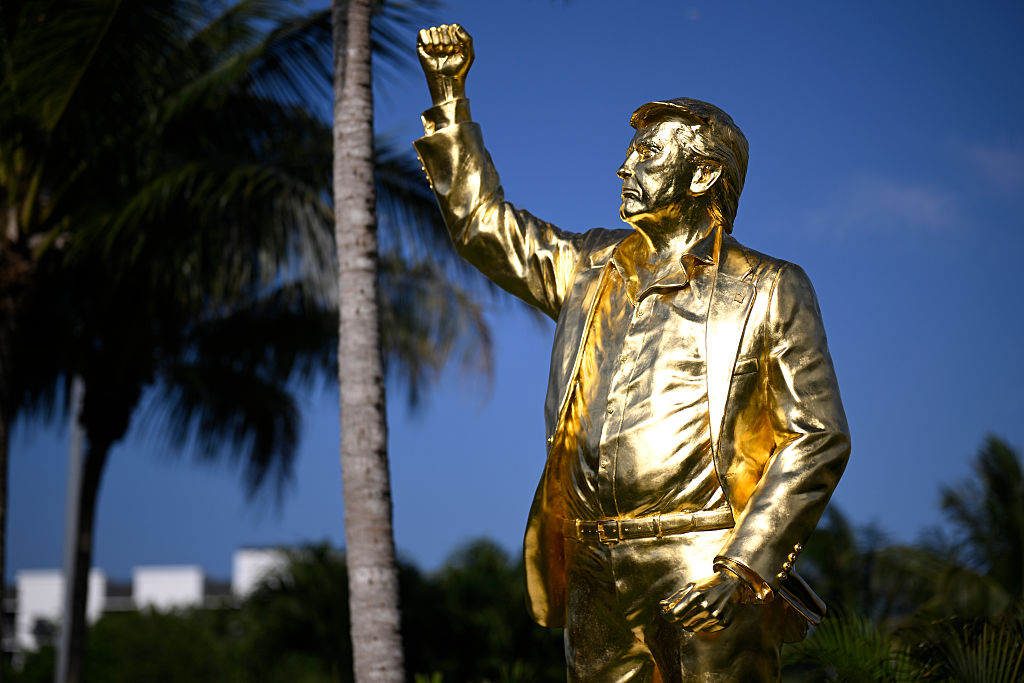
For those former Christians who have chosen to worship Trump instead of Jesus, his Doral golf course now provides an idol they can use: a 17-foot gold-leaf statue sitting on a five-foot pedestal.
It’s yet another case where satire has a hard time staying ahead of the news. In the current (and concluding) season of Amazon Prime’s “The Boys”, the series’ villain (the super-powered Homelander) is declaring himself to be God, challenging the loyalty of his Christian nationalist base.
We can only hope that actual MAGA “Christians” will feel similarly challenged. So far they don’t seem to.
Add Rep. Max Miller (R-OH) to the list of current or former Trump staffers with multiple accusations of domestic abuse.
A. R. Moxon raises an interesting point, related to accepting ex-MAGA folks like Marjorie Taylor Greene or Tucker Carlson: It’s one thing to try to meet people where they are. But it will never work to try to meet people where they think they are, when they’re not really there.
If they will only meet us in a place where we will agree with them that their bigotries have justification, their awareness need no expansion, and their conviction needs no progression, then I would say we can’t meet them where they are, because even if we show up where they are, they won’t be there, and if we go to where they think they are, we won’t be where we need to be.
and let’s close with something hopeful
If you’re looking for some reason not to give up, check out LOLGOP’s “The Case of Earl Warren“.
It begins with a provocative set of questions:
[W]hat if good and evil—as concepts, as actual forces in the world—what if they exist? What if people—regular, flawed, embarrassing, complicated people—can actually be moved beyond the programming of their nervous system or algorithm or the combination of the two? What if it’s possible to change your mind, or someone else’s mind, or the collective mind of a country that has been, let’s say, unwell? And maybe, by making the case now, we can shape history in the coming years by beginning a process that might regenerate something we once called conscience?
After that Twilight Zone intro, I can almost hear Rod Serling say: “Case in point: Earl Warren, an ambitious state attorney general with his eye on the governor’s mansion.” In the 1942 campaign, Warren found his issue: Japanese Americans. They were all potential traitors and needed to be put away. So after he ascended to the governorship of California, he enthusiastically went along with the Japanese internment, one of the most shameful things America had done since slavery. Warren was, in other words, xenophobic, hateful, and willing to scapegoat an entire ethnic group of innocent people to advance his political career.
But somehow, by 1954, he had become chief justice of the Supreme Court that outlawed racial segregation in America’s schools. Between 1953 and 1969, the Warren Court established previously unrecognized rights of minority groups both racial and religious. It expanded our notions of free speech and put limits on the ability of police to railroad defendants.
As someone who remembers the last chunk of that era, I can testify: Warren was not just going with the flow here. The Warren Court wasn’t being pulled along by the trends of its era. In many cases it was leading the parade towards human rights. Far from trying to please the crowd, Warren was making himself unpopular. “Impeach Earl Warren” was the right-wing slogan of the day.
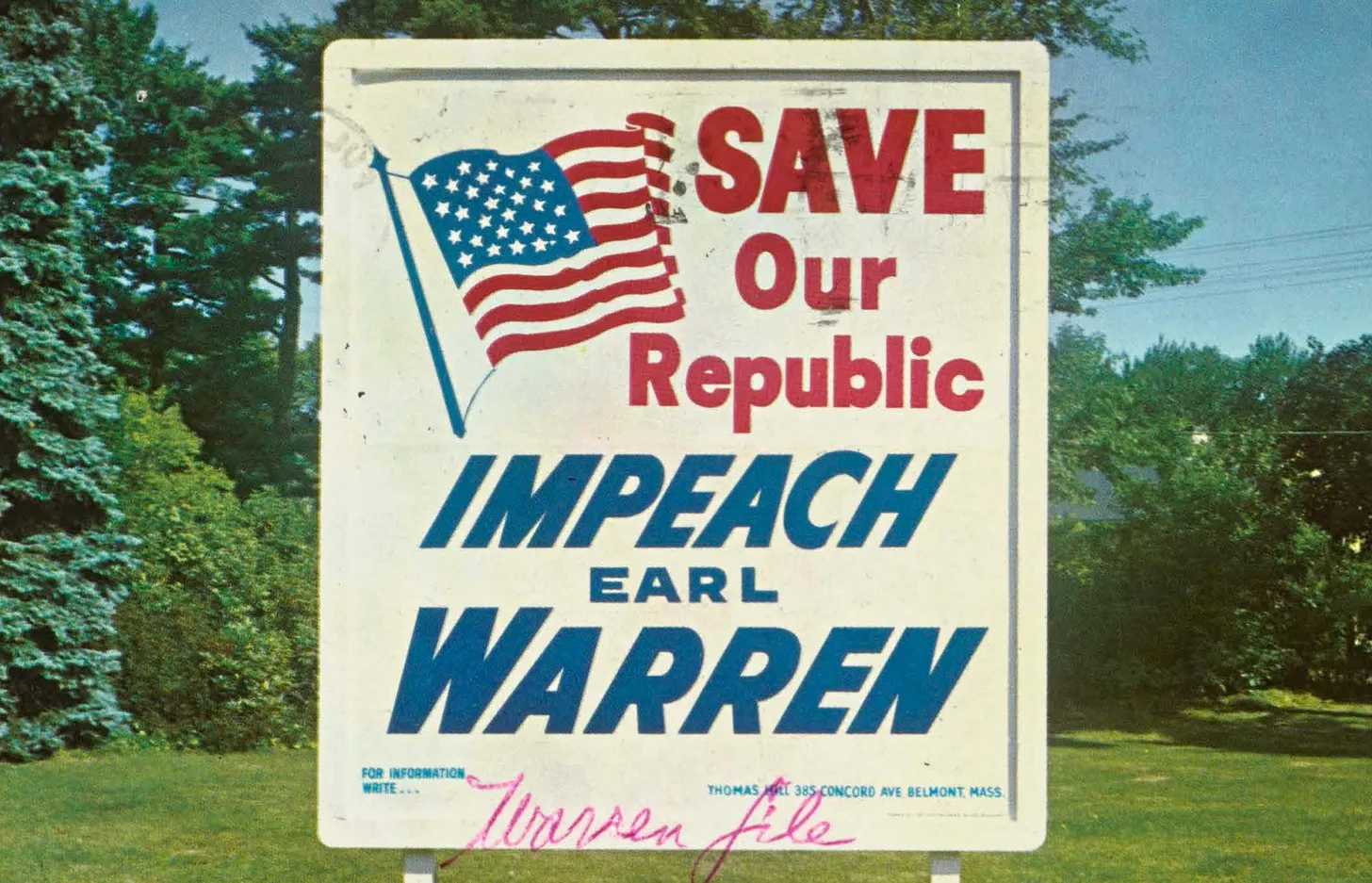
While Warren’s conversion probably didn’t happen overnight on Christmas Eve, and I have no reason to believe ghosts were involved, it was a transformation worthy of Dickens.
He became, by many accounts, a genuinely different person. Under different conditions, with different pressures, with enough exposure to the consequences of what he’d helped create—he changed.
I’m not telling you this to make you feel better. I’m not telling you this because the arc of the moral universe bends toward justice and all of that. I’m telling you because the conditions that produced Earl Warren in 1942—the organized fear, the nativist infrastructure, the information environment that made cruelty feel like common sense—those conditions are not so different in their structure from what’s producing the people who scare and exhaust us today.
Which means: they are not a different species. Which means: some of them can be moved. Which means: the work of figuring out how to move them is not naive.
 The Weekly Sift
Comments
Each month, the employment situation news doesn’t seem too bad. How can that be, when we have less people employed than a year ago?
https://mastodon.social/@mikelabonte/116539272467481210
I’d like to make a small correction to terminology.
Kash Patel doesn’t have “a drinking problem.” He has “an alcohol addiction.”
Thank you.