

Republicans have left an opening. Can Democrats like James Talarico take advantage?
Ever since Jerry Falwell launched the Moral Majority and got credit for electing Ronald Reagan in 1980, conservative Republicans have seemed to own Christianity.
Not really, of course. There was always a Christian Left, going back to Dorothy Day in the 1930s, and even further back to St. Francis or even that ultimate bleeding heart, Jesus. Both the civil rights movement and the anti-Vietnam War movement had strong liberal religious components.
But from the 1980s on, in the media and the public mind, Christianity in politics somehow came to mean conservative politics. “Moral” issues were defined as the issues religious conservatives cared about: abortion, gay rights, and so on. When Supreme Court decisions purport to defend “conscience”, or people’s right to act on their “sincerely held religious beliefs”, you can bet that those beliefs are conservative. Only rarely have treating women like people, fighting oligarchy, refusing to racially discriminate, opposing cruelty towards immigrants, preserving the environment, or allowing LGBTQ people to lead full lives been framed as “moral” issues.
So when OB-GYNs sued to claim a right of conscience to treat pregnant women in violation of South Carolina’s fetal heartbeat bill, it was largely covered as a man-bites-dog story: “Look! People who believe a woman’s life should take precedence over her fetus claim to have consciences too!” Anti-abortion laws at the state level have led to unnecessary deaths of women with complicated pregnancies, but that is rarely presented as a moral issue, much less a Christian one. Bible-belt states not only accept such deaths, they don’t even want to know about them.
Texas has gone as far as to legally prohibit its [mortality review] committee from reviewing deaths that are considered abortion-related. This could include some miscarriage care, health officials told ProPublica.
So it’s not hard to find writers claiming that Christians can no longer vote for Democrats at all.
In times past, the choice between Democrat and Republican wasn’t always so clear, and Christians tended to split down the middle. A shared worldview across the aisle led to more options in the voting booth. As things stand now, no such options remain. The Democratic Party has so situated itself against the God of heaven and against His Word that no Christian can justly, nor obediently cast a vote for anyone who claims the Democratic platform. … For these reasons, Christians cannot vote for any member of the Democratic party while also saying “I believe and follow the teachings of King Jesus.” From Vice President Harris all the way down to local City Councils and school boards.
The “reasons” given are abortion [1], LGBTQI+ rights, and DEI (which doesn’t even rate an explanation).
Democrats, for the most part, have dodged this challenge. Conservative Catholics like J. D. Vance can claim to know better than the Pope, but liberal Catholics like Joe Biden or John Kerry have had to strike nuanced positions (like disapproving personally of abortion while defending a public right to choose it) while trying to change the subject. Barack Obama’s liberal Christian religion was seen as a political problem, not a strength.
Enter Trump. During the Trump era, Republicans have leaned even more heavily on the conservative Christian vote while putting their Christian supporters in an ever-more-difficult position. Trump, after all, represents the virtual antithesis of Christianity.
- He has been unfaithful to all three of his wives, including the current one.
- He has sexually abused women and then bragged about it to other men.
- He has been accused of sexually assaulting a minor. And even if that turns out not to be true, he’s been suppressing the Epstein files to hide something.
- He lies so constantly that he has worn out the fact-checkers. Anything short of an outrage-producing howler gets ignored now.
- He appears to know nothing about the Bible.
- He never admits mistakes and says that he has never asked God for forgiveness.
- He openly accepts bribes from foreign leaders, and his net worth has increased by billions since returning to power.
- His policies go against everything Jesus taught: Don’t feed the poor. Don’t heal the sick. Don’t welcome the stranger.
When you get down to cases, it’s actually harder to see how a Christian can support Trump rather than a typical Democrat.
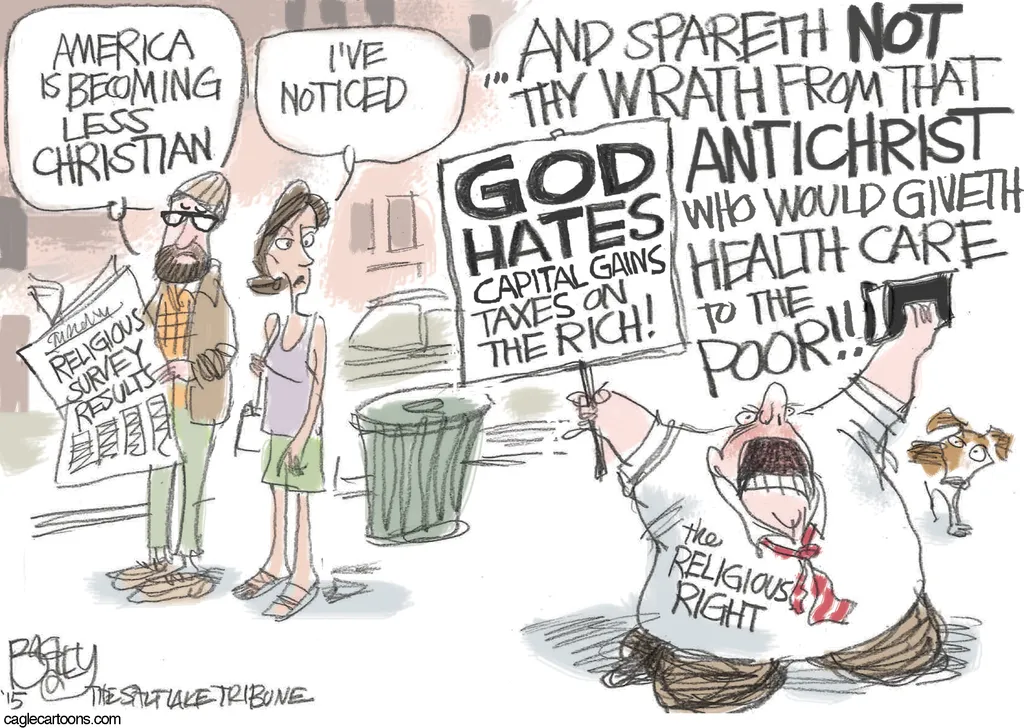
Pastors who are committed to Trump politically have twisted themselves into all kinds of contorted positions. Bible verses get re-interpreted to circumvent what they obviously say. The importance of morality and character in public leaders (something we heard a lot about when Bill Clinton was president) is discounted, because “God uses flawed people“. When Republicans have scandals, we hear about God’s mercy and forgiveness — even if the offender denies the sin and refuses to make things right with the victim. But Democratic sin is unforgivable.
This can’t go on forever. At some point, the gulf between Trump and Christ grows so large as to be unbridgeable. And that raises the question: Can Democrats make an explicitly Christian play for the Christian vote?
Talarico. That’s going to be tested in Texas, where Presbyterian seminarian James Talarico won the Democratic senate primary Tuesday. Guthrie Graves-Fitzsimmons comments:
Talarico’s message is not about moderating progressive commitments to win over religious conservatives. It is about courage. It is about saying plainly that support for LGBTQ+ equality, reproductive freedom, public education and church-state separation can flow directly from Christian faith. He’s openly Christian and firmly pluralistic.
That does more than close a messaging gap: Talarico and those like him can change the terrain. When leaders speak about faith with confidence instead of defensiveness, they show that democracy and devotion are not in conflict.
His Republican opponent — whether it will be the incumbent John Cornyn or challenger Ken Paxton (who presents about as many moral issues as Donald Trump) — is bound to double down on the Christians-can’t-vote-for-Democrats message. Texans can expect to hear a lot about Talarico’s support for reproductive freedom and trans rights. We’ll see whether such attack ads can drown out the voice of an authentic liberal Christian whose worldview is rooted in what Jesus actually said rather than the conservative positions that have attached to him like barnacles.
But what about church-and-state? A second question Talarico raises is whether Democrats should compete explicitly for the Christian vote. One popular liberal viewpoint is an interpretation of church-and-state separation that extends to political argument rather than just government: Our government needs to remain secular and not favor any particular religion, so our candidates should campaign in a purely secular way.
I think this view misses an important point: People come to their political positions through their values, and many people’s values are grounded in their religion. If you can’t use religious language, you end up arguing against opinions already set; you can’t get into the mill where those opinions were forged and might be re-forged.
And finally, purely secular politics runs into a widespread American belief: that religious convictions are more serious and solid than secular ones. One reason Democrats are always under more pressure to compromise than Republicans is that the public sees conservative positions as religion-based and therefore immovable. Democratic positions seem more political than principled, because we so rarely seem to “speak from the heart”.
Many, many liberal positions rise out of deeply held moral values that are as serious as any religion, and many of those values are in fact religious. In the privacy of their own minds, many Democrats think in religious terms. If those terms have to be edited out before we speak in public, we will sound inauthentic.
[1] I’ve said it before, but it’s worth repeating that the anti-abortion position is entirely un-Biblical. Nothing in the Bible indicates that fetuses have souls, and Genesis 2:7 shows the soul entering the body not at conception, but with the first breath (which is a common Jewish belief).
Occasionally someone argues that Jesus or the prophets would have denounced abortion had they known about it, but this is nonsense. Surgical abortion may be a recent development, but from the beginning of time women who didn’t want to be pregnant have tried to induce miscarriages. If you see some spiritual difference between mifepristone and pennyroyal, you are more perceptive than I am.
Jesus and the prophets had to know about this practice, but for some reason they didn’t find it worth commenting on.
This lack of Biblical support is not so important for Catholics who oppose abortion, because the institution of the Catholic Church reserves the right to create new doctrine. But Protestant denominations — especially conservative ones — explicitly reject this view: Churches are not supposed to add or subtract from the message of the Bible.
Anti-abortion has been grafted onto the Bible. It wasn’t there originally.
 The Weekly Sift
Comments
Doug, in the spirit of what you’ve written here, you might find this recent essay from Dr. Liz Bucar interesting: https://lizbucar.substack.com/p/what-if-trevor-noah-is-right-about
I think you have to be very specific here with terminology. Strictly speaking, anyone who is religious supports a theocracy, by definition. That is, a religious person will vote their values, which come from their religion. So they’re voting their religious principles into the law, which forces others to abide by them.
But that’s not what we usually mean by the term theocracy, of course….theocracy is used to define only people who want to vote religious principles into law that we don’t like.
Straight reading of the Biblical text easily supports many terrible things. Pretending that the Liberal interpretation is the “correct” one and that it’s the Conservatives who are mangling definitions in order to fit to their current “principles” seems incorrect to the point of dishonest.
Being a Liberal, I welcome trying to bring many Christians into our party – but being a Liberal I also think we should be truthful about what the Bible teaches.
Talerico is also making the case for christianity at all in american life.
The right wing “christians” have made a clear case through both deed and word that religion, at its base, is about control and abuse. The overwhelming number of pastors (and priests) unmasked as abusers no longer surprises, or even makes the news. It’s not just christianity, of course, but that just reinforces the message, rather than diluting it: those who proclaim their faith are not to be trusted.
I’ve read the gospels and have seen christian threads in liberation movements, so I know it need not be this way, but American christianity has had cruelty at its core, from the puritains through the slaveowners to today. And there has been no reckoning; rather they have been shielded from criticism or contstraint.
As with cleaning up the economy and and other disasters as has been their role for the last century, the Democrats may end up adding to their role the saving of christianity in America. Else it will become another meaningless label applicable to any activity.
On the issue of abortion — people keep talking as if the opposing ends of the argument are anti-abortion versus pro-choice, but that isn’t accurate. Pro-choice is the neutral position — the other end of the spectrum from anti-abortion is compulsory abortion. (I can see the far right eventually espousing compulsory abortion for those they don’t like. “Movements become their opposite.”) But letting each individual decide for themselves is the government being neutral on the issue. Not weighing in. Not imposing any religious belief.
One could, conceivably, make a similar argument about theocracy — that the government not making moral choices is the neutral position, that the government should use “the common good” as criteria for judging what to allow and what to outlaw: for example, murder is clearly against the common good, so should be illegal because of harm, not morals. But I’m not sure that serves us. I think we should be pushing back against the right wing “Christians” who push evil ideas as if they were Jesus’, even though I do not consider myself a Christian (lifelong UU). The reason we should push back is that they are taking an unfair advantage, and they know it. It’s part of the evil. We need to neutralize that advantage. I am quite capable of making arguments in Christian terminology, which I consider metaphorical rather than literal. Most of us can do that — or, we can just keep repeating that Jesus said love your neighbor, love your enemy, and take care of the poor. The idea that a democratic government should take care of The People may not be a Christian idea, but it is perfectly compatible with what Jesus preached. We can say that when addressing someone who thinks they follow Jesus. The Republican idea that the government is meant to support big business and not The People, is not compatible with what Jesus preached.
–Kim Cooper
Not super important, but “Talarico.”
At the very least an insightful choice of topic, and I like the way you presented the arguments, as well.
Trackbacks
[…] This week’s featured post is “Can Democrats compete for Christianity?“ […]
[…] Can Democrats compete for Christianity? […]
[…] Last week, I talked about how the Supreme Court only takes “sincerely held religious beliefs” seriously if they are conservative religious beliefs about topics like abortion or gender. […]