

The No Kings rallies were the most obvious signs of resistance to Trump’s authoritarian rule, but congressional Democrats, Pentagon reporters, major universities, and an appeals court also refused to cave to him.
Saturday I had a choice to make: attend the No Kings rally where I live in Bedford, Mass., or go to the much bigger rally in Boston, which stood a chance of making national news. I opted for the local rally. At one point I counted over 500 people in attendance before I lost count. I would guess there were 600 or more. That’s in a town of about 14,000, at a rally that probably didn’t draw a lot of out-of-town people because all the surrounding towns had their own No Kings rallies.
The independent Strength In Numbers website estimated that 5.2 million people participated nationwide, and possibly as many as 8.2 million.
Our estimate is based on reports from local officials, local organizers, and attendees, and suggests the count from organizers — who report 7 million participants nationwide — may be a bit optimistic (but is not impossible). Still, regardless of whether the precise number is 5, 6, 7, or 8 million, Saturday’s events are very likely the biggest single-day protest event since 1970, surpassing even the 2017 Women’s March demonstrations against Trump.
The largest rallies were in blue states, with 320K in New York City and 225K in Chicago, but 20K came out in Austin, Texas and 10K in Boise, Idaho. No Kings was truly a national event.
The regime’s response. The organizers could hardly have asked for a better response from the Trump administration, because the regime’s disdain and even hatred for these millions of Americans only served to underline everything the rally speakers were saying.
Trump himself posted an AI-generated video on his Truth Social account, in which a crowned Trump flies a fighter jet labeled “King Trump” and drops sewage onto protesters in what appears to be New York. VP Vance posted a video to BlueSky in which Trump dons a crown and a robe, and brandishes a sword while Nancy Pelosi and Chuck Schumer kneel and bow to him. White House spokesman responded to the protests with “Who cares?“
Leaders of democratic countries don’t act like this.
Presidents are, of course, within their rights to put their own spin on events. Trump might legitimately doubt whether these millions of people accurately represent the country, or even postulate a “silent majority” as Richard Nixon did a few years before he had to leave office in disgrace. Even if the majority of the country has turned against Trump — as the polls show — he is not obligated to agree with the People or change his unpopular policies.
But when large numbers of their citizens take to the streets in nonviolent protest — even Fox News had to admit that “there were no reports of violence or arrests at the afternoon rallies” — leaders of democracies don’t respond with a lordly “Who cares?” or publicize their fantasies of dropping shit on the dissenters. But would-be dictators might, because they don’t serve the People; the People are supposed to serve them.
It’s nearly impossible to imagine any Democratic president showing similar hostility to peaceful conservative protesters. (The January 6 protests, recall, included a violent takeover of the Capitol and sending over 100 police to the hospital. The subsequent arrests and trials were basic law enforcement, not persecution.) The moments conservatives point to as evidence of Democratic disdain — Hillary’s “basket of deplorables” and Obama’s “clinging to guns or religion” — don’t really hold up if you look at the full context, which included considerable empathy for Trump voters.
For example, Clinton put “half” of Trump voters in her basket of deplorables.
But the other basket, the other basket, and I know because I see friends from all over America here. I see friends from Florida and Georgia and South Carolina and Texas, as well as you know New York and California. But that other basket of people who are people who feel that government has let them down, nobody cares about them, nobody worries about what happens to their lives and their futures, and they are just desperate for change. It doesn’t really even matter where it comes from. They don’t buy everything he says but he seems to hold out some hope that their lives will be different. They won’t wake up and see their jobs disappear, lose a kid to heroine, feel like they’re in a dead-end. Those are people we have to understand and empathize with as well.
The closest genuine analogy from recent years is the Tea Party protests against President Obama, which were much smaller than No Kings. Paul Waldman has numbers:
The Tea Party’s biggest distributed event was on tax day 2009, with 750 modestly attended protests. No Kings had 2,600. Its biggest single gathering was on 9/12/09 in DC, with somewhere between 75K and a few 100K participants.
Nonetheless, Obama had a delicate response to the Tea Party: The protests represented a “noble” American tradition of “healthy skepticism about government” as well as a noble tradition of “saying that government should pay its way”. But he engaged the ideas of the Tea Party, challenging them to specify how they would close the deficit.
The challenge, I think, for the tea party movement is to identify specifically what would you do. It’s not enough just to say, get control of spending. I think it’s important for you to say, I’m willing to cut veterans’ benefits, or I’m willing to cut Medicare or Social Security benefits, or I’m willing to see these taxes go up.
It is impossible to imagine Trump or Vance or Speaker Johnson or just about any Republican leader showing that level of respect for Americans who disagree with what they’re doing. We are “terrorists” or “pro-Hamas” or some other ridiculous thing. They can’t even admit that Americans don’t like seeing soldiers patrolling their streets, or American citizens being harassed because of their accents or the color of their skin.
In their fascist worldview, Trump IS America, so any dissent against Trump is un-American.

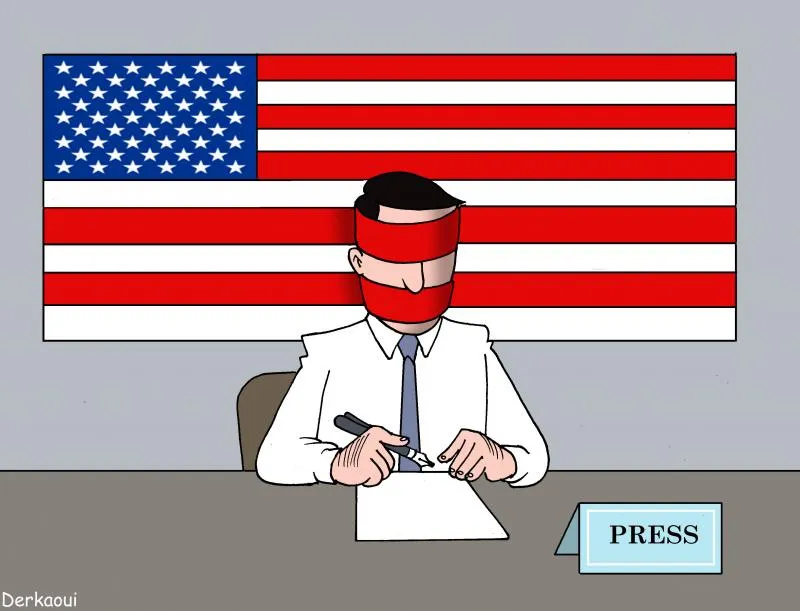
Resistance from the Pentagon press corps. No Kings wasn’t the only example of Americans refusing to bend their knees to the Mad King.
Nearly the entire Pentagon press corps cleaned out their desks and turned in their access passes Wednesday rather than submit to Pete Hegseth’s new attempt to control their coverage of his department.
News outlets were nearly unanimous in rejecting new rules imposed by Defense Secretary Pete Hegseth that would leave journalists vulnerable to expulsion if they sought to report on information — classified or otherwise — that had not been approved by Hegseth for release.
Even several Trump-supporting outlets, like Fox News, Newsmax, and The Wall Street Journal, have given up their Pentagon access.
“What they’re really doing, they want to spoon-feed information to the journalist, and that would be their story. That’s not journalism,” said Jack Keane, a retired U.S. Army general and Fox News analyst, said on Hegseth’s former network.
Yahoo News reported that the “hundreds” of credentialed Pentagon reporters had been reduced to 15. The Washington Post identified who they represent:
The list of signatories included four reporters from right-wing outlets: one from the website the Federalist, one from the Epoch Times newspaper, and two from the cable network One America News.
“The rest,” the WaPo says, “are freelancers, independent or work for media outfits based overseas.”
(Even Epoch Times’ Pentagon reporter resigned after his bosses signed the agreement. “I can no longer reconcile my role with the direction the paper has chosen, including its increasing willingness to promote partisan materials, publish demonstrably false information, & manipulate the reporting of its ground staff to shape the worldview of our readers.”)
Resistance in Congress. The government shutdown is now in entering its fourth week, with no end in sight. Democrats are holding out for a popular concession: They want long-term funding for the subsidies that make policies on the ObamaCare exchanges affordable. If those subsidies lapse on November 1, as they are currently scheduled to do, millions of Americans — many of them represented in Congress by Republicans — will see their health insurance premiums skyrocket.
But Trump’s myth of invincibility will be damaged if he makes any concessions at all, so Republicans are refusing to negotiate. So far the only offer on the table is that the Senate will hold a vote on the ObamaCare subsidies after Democrats vote for a continuing resolution to reopen the government.
This vote, of course, will just be a gesture, a chance for Democrats to vote for something that ultimately fails. It will help no one pay for health insurance.
The House, meanwhile, is still out of session. This has the added plum for Speaker Johnson that he doesn’t have to swear in Adelita Grijalva who won a special election weeks ago. Grijalva would be the 218th signature on the petition to vote on releasing the Epstein files, which Johnson does not want to do. (You have to wonder what in the files could be so bad for Trump that he’s willing to go through this.)
Republicans are predicting Democrats are about to fold, but I see no sign of it. They have a popular position and the public is mostly agreeing with them. Rather than offer Democrats anything substantive, the regime is upping the threat level, as authoritarians are wont to do.
Resistance from universities. Today is the deadline for nine universities to sign a compact with the Trump administration, submitting to regime-dictated policy changes in exchange for favorable decisions on federal funding.
The Compact for Academic Excellence in Higher Education was sent on Oct. 1 to nine colleges — both private and public — and would require schools to bar transgender people from using restrooms or playing in sports that align with their gender identities, freeze tuition for five years, limit international student enrollment, and require standardized tests for admissions, among other things.
Of the original nine schools that received the document, as of Sunday night, six had indicated they are not planning on signing.
MIT was the first to refuse, followed by Brown University, the University of Pennsylvania and the University of Southern California.
On Friday, the White House held a virtual meeting with colleges that hadn’t yet sent rejection notices, including the University of Arizona, the University of Texas at Austin, Vanderbilt University, Dartmouth College and the University of Virginia. Three additional schools were also invited: Arizona State University, Washington University in St. Louis and the University of Kansas, according to The Wall Street Journal.
Subsequent to that meeting, Virginia and Dartmouth announced they wouldn’t be signing. No universities have signed.
Columbia was the first university to try to appease Trump, but although Trump claims every few weeks that Harvard is about to give in, its lawsuit is still in court.
Resistance in court. A three-judge panel from the Seventh Circuit Court of Appeals — including one Trump appointee — unanimously upheld a lower-court order blocking the regime from deploying National Guard troops in Illinois.
The case hinges on whether the regime’s claims of “rebellion” or of being “unable to execute the laws of the United States” are credible. The district court found that they were not credible, and the appeals court found no errors in that assessment that they needed to correct.
Political opposition is not rebellion. A protest does not become a rebellion merely because the protestors advocate for myriad legal or policy changes, are well organized, call for significant changes to the structure of the U.S. government, use civil disobedience as a form of protest, or exercise their Second Amendment right to carry firearms as the law currently allows. Nor does a protest become a rebellion merely because of sporadic and isolated incidents of unlawful activity or even violence committed by rogue participants in the protest.
Trump has appealed to the Supreme Court, which so far has shown itself to be corrupt and partisan in his favor. We’ll see if they’re willing to take this further step down the road to autocracy.
 The Weekly Sift
Comments
This is an excellent overview of the events of the week and the contexts. I disagree only with calling the Supreme Court “corrupt”. “Partisan” for Trump, absolutely, to the point of sustaining his misadventures with no substantive analysis despite the hugely dislocative actions. Although … it may be intellectually “corrupt” for the Court to treat the status quo it preserves — despite considered lower court opinions — AFTER Trump acted, not before … as would normally be the case.
Trump has been gifted with the long summer vacation and being able boldly to proceed after much has evolved. The arguments will be different, greatly different with brand new lustrous conservative history writ very large. it’s up to us to show how unreasonable the Trump coup was from the outset.
Why not both? Justices of the Supreme Court have accepted very valuable gifts, have refused to recuse themselves from key decisions, and have expressed contempt for those who suggest they should be held to standards of behavior. I don’t think calling the Supreme Court “corrupt” is out of line at this, point, and it is certainly rankly partisan.
The SCOTUS is absolutely, certainly, definitely corrupt. There is no basis whatsoever for denying it.
Trackbacks
[…] This week’s featured post is “The Resistance Stiffens“. […]
[…] The Resistance Stiffens […]