
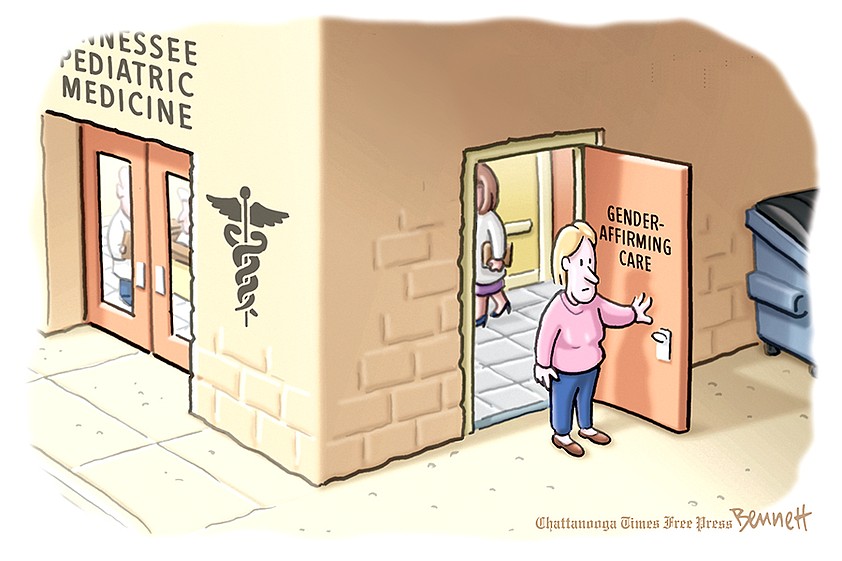
Equal protection of the laws isn’t what it used to be.
After the 13th Amendment freed the slaves, the nation passed a 14th Amendment to make sure the freed slaves would have rights under the law. It promised every person “the equal protection of the laws”.
It didn’t work, at least not at first. The Supreme Court interpreted that Equal Protection Clause narrowly, and so states were able to pass Jim Crow laws that forced Black Americans to live under a different legal regime entirely. Plessy v Ferguson established the principle of “separate but equal” treatment, where “separate” rules and facilities for Blacks and Whites were very real, but “equal” could be winked at.
In the 20th century, though, the Equal Protection Clause was gradually reinterpreted to mean something very important. There are a number of complicated doctrines that implement this idea, but the underlying concept is simple: If the law treats you differently than it treats someone else, there has to be a reason for it. And the reason can’t just be that the people who make the laws don’t like you.
There has seldom been a more obvious violation of this principle than the recent run of state laws that ban gender-affirming care for trans youth. One such law is Tennessee’s “Prohibition on Medical Procedures Performed on Minors Related to Sexual Identity, Senate Bill 1 (SB1)“. Ostensibly, the law intends “to protect the health and welfare of minors”. The law bans a number of treatments that major medical organizations (“American Academy of Pediatrics, American Medical Association, American Psychiatric Association, American Psychological Association, and American Academy of Child Adolescent Psychiatry” according to Justice Sotomayor’s dissent) recommend for young people experiencing gender dysphoria, i.e., the feeling that the sexual characteristics of their physical body are at odds with their inner sense of who they are.
Legislatures typically have wide latitude to permit or ban medical procedures according to their assessment of patient safety. But the smoking gun here is that the procedures are banned only when used to treat trans youth, only
when these medical procedures are performed for the purpose of enabling a minor to identify with, or live as, a purported identity inconsistent with the minor’s sex or treating purported discomfort or distress from a discordance between the minor’s sex and asserted identity.
Using say, puberty-blocking drugs or gender-related hormones like testosterone or estrogen, is perfectly fine and safe for any other purpose parents and physicians might have in mind. But not that one.
Keep in mind here that the affected population — families of trans youth — did not ask for this “protection”. To the best of my knowledge, none of them came to the legislature and said “I want the state to make my child’s medical decisions.” To the contrary, three such families sued to block the law, and countless others are leaving Tennessee (and other states with similar laws) so that they will be free to decide for themselves how to handle what everyone recognizes is a difficult situation.
The push for SB1 came instead from people opposed on principle to the existence of trans people, usually for religious reasons. The purpose is to act on trans youth and their families, not for them. The law itself says:
This state has a legitimate, substantial, and compelling interest in encouraging minors to appreciate their sex, particularly as they undergo puberty.
In other words, Tennessee claims a “compelling interest” in convincing trans youth that they are wrong. Their sex is their sex, and they just need to get used to it.
Anyone who has listened to the public debate over such laws has to realize that the laws are motivated by a desire to make life harder for families of trans youth. If the families choose to remove their children from the state by moving, or the children decide to remove themselves from life by committing suicide, this is not necessarily considered a bad outcome. Obviously, the Tennessee legislature does not intend to offer trans youth “the equal protection of the laws”. SB1’s intention is to bludgeon trans youth, not protect them.
The question for the courts, then, should be how to extend equal protection in a coherent way. Precedents offer clear paths. Typically, these precedents involve the most obvious instances of laws being used against disadvantaged groups: race and sex. Laws that turn on issues of race or sex are given “heightened scrutiny” by the courts, because apparent justifications for the laws have so often turned out to be pretexts for hostile discrimination.
Justice Sotomayor’s dissent in this week’s case (US v Skrmetti, decided Wednesday) outlines how to use the precedents involving sex.
What does [application of SB1] mean in practice? Simply that sex determines access to the covered medication. Physicians in Tennessee can prescribe hormones and puberty blockers to help a male child, but not a female child, look more like a boy; and to help a female child, but not a male child, look more like a girl. Put in the statute’s own terms, doctors can facilitate consistency between an adolescent’s physical appearance and the “normal development” of her sex identified at birth, but they may not use the same medications to facilitate “inconsisten[cy]” with sex . All this, the State openly admits, in service of “encouraging minors to appreciate their sex.”
But the conservative justices (Roberts writing the majority opinion, plus concurrences by Thomas, Alito, and Barrett) resist not just the characterization of this case as hinging on sex, but also the idea that any injustice is occurring at all: There is nothing about discrimination against trans people that makes laws about them suspect, and so the Court has no excuse to go probing into the motives of the legislature. Courts should apply only “rational basis” review of SB1, requiring only that the legislature offer some rational connection between its actions and some legitimate government purpose. Protecting minors from a possibly dangerous medical procedure is a rational purpose, and so the Court need not look more closely at whether that explanation is a pretext for hostile discrimination. (In fact, the conservative justices dare not look closer, because the proffered explanation is obviously a pretext.)
There is a standard argument for justifying this kind of discrimination, and it has been used many times in the past: You examine previous suspect classes and draw your lines so that those issues appear not to apply. So, for example, laws banning interracial marriage were once not seen as racially discriminatory, because neither Blacks nor Whites could marry a person of a different race. Laws against same-sex marriage didn’t discriminate on the basis of sex, because neither men nor women could marry a person of the same sex. And so on. In retrospect, such arguments are transparent rationalizations for hostile discrimination, but that doesn’t stop judges from continuing to use them. Justice Roberts writes for the majority:
Neither of the above classifications [in SB1] turns on sex. Rather, SB1 prohibits healthcare providers from administering puberty blockers and hormones to minors for certain medical uses, regardless of a minor’s sex. … SB1 does not mask sex-based classifications. For reasons we have explained, the law does not prohibit conduct for one sex that it permits for the other. Under SB1, no minor may be administered puberty blockers or hormones to treat gender dysphoria, gender identity disorder, or gender incongruence; minors of any sex may be administered puberty blockers or hormones for other purposes.
So the law doesn’t discriminate against transgender youth, it just separates out the medical conditions that define transgender youth. It protects youth against the risks of such treatments, but only if they seek those treatments for a purpose unique to trans people.
When the Equal Protection Clause was being explained to me years ago, the following example was given: What if a law banned yarmulkes, the skull caps typically worn by Jewish men? You could argue that such a law isn’t religious discrimination, because it applies universally: Neither Jews nor Gentiles can wear yarmulkes. But of course, only Jews want to wear yarmulkes. So a law against yarmulkes is religious discrimination against Jews.
Sotomayor observes:
nearly every discriminatory law is susceptible to a similarly race- or sex- neutral characterization. A prohibition on interracial marriage, for example, allows no person to marry someone outside of her race, while allowing persons of any race to marry within their races.
The religious right is targeting other applications of the Equal Protection Clause, beginning with same-sex marriage. So it seems likely we will be hearing the same rationalizations again soon.
 The Weekly Sift
Comments
For the love of GOD what is happening in this country??? At this point there seems to be no end to what those horrible so-called jurists will allow he-who-shall-not-be-named and his lackeys do to people that they don’t like. 😦
His name is Donald Trump and he isn’t a children’s book villain. To think that saying his name gives him even more power is ridiculous, mostly because all it does is give him power over you, your speech, and your thinking. Say his name and call out his actions. You staying silent about who he is and what he does is a victory only for him.
I agree, it’s best to label Trump with his name — I cringe when I see posters using supposedly insulting nicknames. At the same time, I can’t help but point out the irony that you attempt to denigrate the use of “he-who-shall-not-be-named” as coming from a children’s book, while making the exact same argument characters in the book put forward for insisting on using the villain’s name.
Informative, but just underlines the expanding grip
Trackbacks
[…] week’s featured posts are “The Court fails transgender youth” and “Questions to ask as a war […]
[…] The Court fails transgender youth […]