

It’s clear that Trump loves tariffs. It’s not clear why.
LIstening to President Trump talk about tariffs is like listening to a teen-age boy talk about the object of his crush. Tariffs have every conceivable virtue and no drawbacks. The Daily Show runs together a series of Trump tariff quotes:
Tariffs are easy. They’re fast. They’re efficient. And they bring fairness. … We’re going to bring so many things back to our country, and the thing that’s going to get us there is tariffs. … We’ll take in hundreds of billions of dollars in tariffs. And we’re going to make our country so strong and so rich. It will never be so rich. … Tariffs. It’s a beautiful word, isn’t it?
It’s like listening to Tony sing about Maria.
Maria! Say it loud and there’s music playing.
Say it soft and it’s almost like praying.
Maria! I’ll never stop saying “Maria”.
To hear Trump tell it:
- The threat of tariffs will make other countries do what he wants.
- Tariffs are essentially free money. They will provide a dependable stream of government revenue that comes from foreigners rather than Americans.
- In order to avoid tariffs, corporations will move production facilities from other countries to the United States, creating good jobs here.
What’s not to like? But strangely, most economists don’t like tariffs, and the stock market tanks whenever it looks like Trump is getting serious about imposing them. So what’s going on?
Well, to start with, those justifications contradict each other. If tariffs are going to raise money and cause corporations to change their production patterns and supply chains, they need to be imposed for the long term. (Ford isn’t going to move a Mexican factory back to the US unless they expect a tariff to be in place for years.) But if a tariff is supposed to change a country’s behavior, it has to come off as soon as the behavior changes. (Tariffs won’t make Mexico crack down on fentanyl-smuggling cartels unless the Mexican government expects the tariffs to end when it does.)
So which is it? Does he want long-term tariffs to raise money and move supply chains, or short-term tariffs to threaten other countries with?
And even if you pick one or the other, it doesn’t really work. Using a tariff to change a country’s behavior might (or might not) work once, acting like a threat from a protection racket. (“Nice economy you got there. It’d be a shame if something happened to it.”) But national leaders are smart enough to know that extortionists never go away after they’re paid. If a country gives Trump some concession to avoid a tariff, and then he comes back and threatens it again, they going to figure out that he intends to bleed them dry. Resisting being pushed around by the US is always a good look for a foreign politician, so they’re going to dig in their heels. Some already are.
A tariff can raise money, but that money will come from Americans, not foreigners. The American importer pays the tax, and probably passes it on to its customers. In the end, a big broad-based tariff will act like a national sales tax, which raises money by raising the cost of whatever is sold. Worse, that money tends to come from poorer Americans, who have to spend nearly all the money they get their hands on. (Meanwhile, the rich can pile up savings and pay nothing.) All those working-class Trump voters have essentially voted to shift the tax burden onto themselves.
Tariffs can work to change production and investment decisions — that’s their traditional use. (Typically, a developing country tariffs imported goods to encourage local manufacturers to replace the import. That was how the US used them in the 1800s, and how nations like South Korea used them more recently.) But in order to have that influence, a tariff needs to be predictable. And that’s a problem for Trump:
- February 1: Trump orders 25% tariffs on Mexico and Canada.
- February 3: He pauses the Mexico and Canada tariffs for a month.
- February 27: He announces that the 25% Mexico/Canada tariffs will be back on when the month runs out.
- March 4: The 25% tariffs go into effect.
- March 5: The tariffs related to the auto industry are paused for a month.
- March 6: Tariffs on goods covered by the USMCA (a trade agreement Trump signed in his first term) are paused for a month. (That covers about half of Mexican imports and 38% of Canadian imports.)
- March 7. Trump threatens tariffs on Canadian lumber and dairy products.
So OK, imagine you’re a CEO trying to decide where to invest your company’s capital. How do you plan for that?
Conspiracy theories. When the reasons a leader gives for his actions don’t make sense, inevitably people start trying to imagine what the real reason is. The most prominent conspiracy theories about the tariffs that I’ve heard are
- It’s a shakedown. Your tariffs go up until you figure out who to bribe. The Big Picture blog quotes a study describing what happened during the trade war with China in Trump’s first term: “Politically connected companies were far more likely to receive valuable tariff exemptions than those that were not connected to Trump or Republicans. Specifically, the authors found that companies that had invested substantially into the GOP before or at the start of Trump 1.0 were more likely to win exemptions to Trump’s tariffs than those that had not.”
- It’s a market manipulation. The market crashes whenever Trump announces a tariff. So if you know when he’ wa’s going to do that, you can make a killing by selling short, and then covering your short after he reverses himself. So Trump jerking the markets around is a way for well-connected insiders to make money.
- Trump hates Canada.
The Canada-hating theory requires a little explanation. Trump’s original reason for both the Canada and Mexico tariffs was to defend the border from illegal immigrants and fentanyl smuggling. So in order to avoid the tariffs, Canada would have to address those problems and show real results. But there’s a catch: There is no problem to address in Canada. Take fentanyl, for example. According to the Council on Foreign Relations:
Canada plays virtually no role in the U.S. fentanyl influx, especially compared to the other countries. The country contributes less than 1 percent to its southern neighbor’s street fentanyl supply, as both the Canadian government and data from the DEA report.
Paul Krugman puts it like this:
[R]emember that Canada can’t concede to U.S. demands, even if it were in a mood to do so (which it very much isn’t) because there aren’t any coherent U.S. demands; Canada has done nothing wrong!
But hey, truth has never been a problem for a Trump administration. Sunday, the White House sent National Economic Council Director Kevin Hassett (and maybe some other people I didn’t notice) out to lie on the talk shows.
I can tell you that in the situation room I’ve seen photographs of fentanyl labs in Canada that the law enforcement folks were leaving alone. Canada’s got a big drug problem.
Yes, Hassett has seen photographs he can’t show you. I haven’t heard such convincing evidence since Bush and Cheney were getting ready to invade Iraq.
And here’s a graph no Republican will display: Fentanyl deaths in the US had been plunging for at least a year before Trump took office. Eventually, he’ll declare victory and take credit for everything that has happened since 2023.
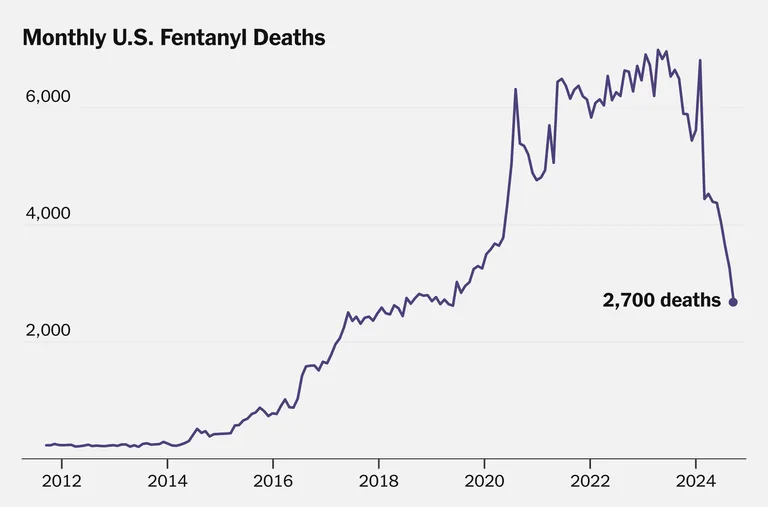
Meanwhile, Trump himself is doing everything he can to piss off Canadians, suggesting they become the 51st state and referring to their former prime minister as “Governor Trudeau“. As a result, the US national anthem is getting booed at hockey games. And the patriotic “Joe Canada” character created by Molson Beer in 2000 has come back to defend his country from US imperialism.
They mistake our modesty for meekness, our kindness for consent, our nation for another star on their flag and our love of a hot cheesy poutine with their love of a hot cheesy Putin. … We are not the 51st anything. We are the first to unite in the crisis, the first to build bridges – not walls – and the first to stand on guard for thee.
So whatever Trump is trying to do to Canada, I don’t think it’s working. But what is he trying to do? That question is just as mysterious as the tariffs themselves. Krugman’s theory goes like this:
In any case, efforts to find some kind of economic justification for Trump’s Canada-hatred have the feeling of desperate efforts to avoid the obvious. Canada is a pretty decent place, as nations go. And Trump, whom nobody would describe as a decent person, dislikes and maybe even fears people who are.
Let me put a less psychological spin on this: Trump is building a hellscape, an America where people hate each other, let each other go hungry or die without healthcare, where diseases once eradicated come back, where corrupt oligarchs pillage the government and corporations are free to despoil the environment and treat workers like slaves. And then there’s Canada, right across the border, ready to demonstrate that life doesn’t have to be this way.
Sure, countries like Denmark or New Zealand also prove that point, but they’re far enough away that nobody in Trump’s base needs to notice them. Your cousin from Des Moines probably isn’t going to come home raving about Copenhagen or Christchurch. But Toronto, Vancouver — maybe. So Canada needs to be slandered in advance, painted as an enemy country full of propaganda that can’t be trusted. Say something about Canada and MAGA types will roll their eyes as if you’d just quoted something you heard on MSNBC.
And as for the tariffs, I’ll explain them like this: Tariffs are a power that Congress has yielded almost entirely to the President. So they’re a model for what Trump wants the country to be. He can announce a tariff without anybody wondering whether he has the votes for it. He says “tariffs” and there are tariffs. A day later he can say “no tariffs” and they go away. And every time he does, there are headlines and big moves in the stock market and people getting upset. Trump loves that stuff. He’ll never learn how to use his tariff power constructively, because it’s a toy that is just too tempting to leave on the shelf. For as long as he’s president, he’ll feel compelled to take that toy down and play with it.
 The Weekly Sift
Comments
“Trump is building … an America … where corrupt oligarchs pillage the government and corporations are free to despoil the environment and treat workers like slaves. And then there’s Canada, right across the border, ready to demonstrate that life doesn’t have to be this way.”
Strangely reminiscent of why Putin can’t stand having a democratic Ukraine right next to Russia.
Hi—Is it possib
perha it coul b poss
I think Trump and his Enablers are motivated by the Law of Limited Good: There’s only so much Good to go around; and if somebody gets some, there’s less for me.
There is a point about tariffs that I haven’t seen mentioned as often as I think it should — it certainly should have been pushed during the campaign. Say everyone else is wrong and Trump is right and the tariffs work to bring manufacturing back to the US. They only do that by making things more expensive. First tariffs directly raise prices by increasing the cost of imported goods and materials. But second, the reason manufacturing was sent overseas in the first place was because it was cheaper to do so. Bring manufacturing back here and prices will be much higher because it’s more expensive to make things here. I have a small business that sells clothing items we have manufactured overseas. We’ve tried, but our costs would triple (at least) if we had them made in the U.S.
Off-shoring was not driven by greedy corporations but by price-focused consumers who demand lower and lower prices.
That’s a great point that I never hear people making.
The Orange Felon is an emotionally crippled mob boss who’s addicted to drama. His motivations for his tariff episodes are what’s been listed, although it’s not “hate” for Canada, but rather the acquisition of territory.
Putin has adroitly played to Trump’s narcissism by selling him on the idea that the great leaders of the world distinguish themselves in history by the territory they add to their empire. Conveniently, this also serves Putin’s interest in his own territorial expansion. Trump agrees that the powerful take whatever they want and the weak just have to suck it up and adjust.
Trump also worships Putin because Putin has made Russia his own personal property, and all economic activity of any consequence must pay tribute to him. That’s how Putin has become the richest person in the world. Trump sees American from this same perspective: as the POTUS, America is his, to do with as he pleases and to personally profit from in all endeavors.
The tariffs against Canada, as well as the standard Trump schoolyard bully rhetoric, are the initial salvos in reshaping the world to one where it’s divided between Putin, Xi, and Trump. Putin gets at least eastern Europe, and maybe even some of Germany. Xi gets SE Asia. And Trump gets North America, with an eye shifting to Mexico and Central America. Putin tells him he’s the American Caesar, and Trump laps it up from his hero and handler.
Career military institutionalists would never dream of obeying an order to seize key border crossings into Canada and press forward to test Canadian resolve and world response. That’s why they’ve all been fired and the DoD turned over to a white Xtian nationalist stooge. He intends to do to Canada what Putin did to Ukraine.
The other two reasons also apply. He slaps blanket tariffs on all imports, and then waits to see who will pay $5 million to dine with him at his temple of corruption for an opportunity to beg for relief from their Don. Tribute and protection money is paid, and when deemed sufficient, relief is granted.
Traders, and especially the “insider” cohort, make money when markets move; stable markets are a drag. Trump announces tariffs, the market drops, insiders load up, Trump rescinds them, insiders sell on the recovery. Rinse and repeat. Undoubtedly, he’s got personal positions in this, just as he does with his rug-pull crypto scams.
All of America is now for sale. All of it. It belongs to Trump, and he’ll expand his empire, guided by his hero and mentor Putin. American government as a Constitutionally legal enterprise generally serving the broad interests of We, The People regardless of which specific party is in power is over.
And anyone who thinks this is just breathless hyperbole would be well-served to take a world history survey course and notice that the essence of American Exceptionalism was that it used to use its power (admittedly quite imperfectly) for the general good rather than royalist empire building, which is what most of world history is about. Trump thinks he’s king, and a real king takes whatever he wants.
A lot of ink spilled on tariffs up here since they were originally and completely randomly announced back in January. The best reporting I’ve seen on it is from an interview with Justin Ling in the Hatchet. https://hatchetmedia.substack.com/p/the-man-behind-trumps-war-on-canada
The gist is that a trade war with Canada is something Peter Navarro became fixated on for some reason. In Trump 1.0 he was drowned out by people who know what they’re talking about, but those people are gone. Not only that, Navarro has the distinction of having never wavered, going so far as to serve 4 months in federal prison for defying a J6 committee subpoena. So even if there are currently people in the administration trying to explain why this is a bad plan, they don’t have that kind of juice.
I would add to this that Americans seem to write off all the 51st state stuff as a joke or typical trolling. The prevailing view up here is that while they are probably not interested in absorbing us, this is a real attack on our sovereignty. It lines up neatly with the expansionist rhetoric about Greenland and the Panama canal, and with the mercantilist foreign policy being employed against Ukraine. The thin fentanyl pretense is already giving way to floaters about renegotiating the location of the border and demands to open up the dairy and softwood lumber markets and to make it easier for US banks to operate in the country. No one is under any illusions that they won’t come after our critical minerals or fresh water once it’s proven that extortion will work.
Just to further underline the intellectual bankruptcy of the administration’s justifications, frequently lost in this discussion is the fact that the US trade deficit with Canada is the second lowest among all its trading partners. Canada is in fact a net importer of services and manufactured goods (including dairy), and there would be a trade surplus except that the US imports so much Canadian oil, natural gas and electricity–products all notably singled out by the administration for lower tariffs.
Trackbacks
[…] This week’s featured post is “Those Mysterious Tariffs“. […]
[…] Those Mysterious Tariffs […]