
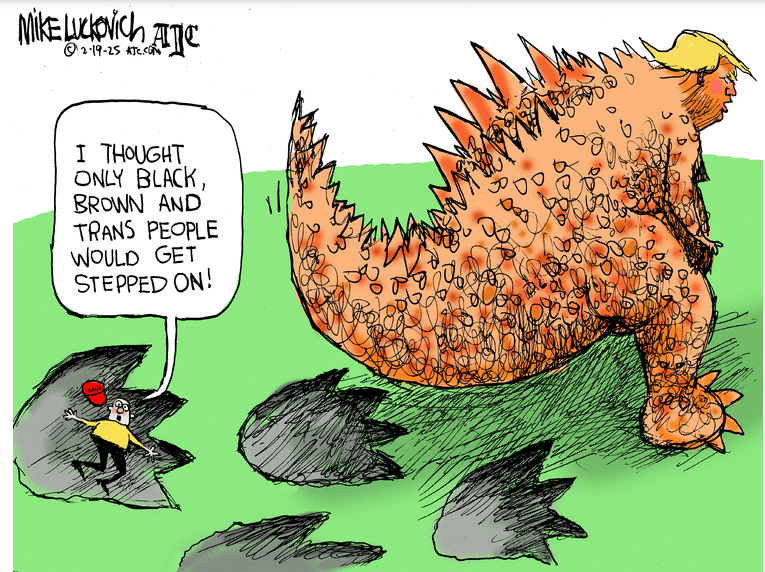
The struggle to preserve American democracy is still undecided.
Neither despair nor complacency is warranted.
I keep having the same conversation with my friends, who are anxious and/or depressed about the Trump/Musk attempt to establish an autocracy, and wonder how I stay so sanguine. There are three reasons, one of which is personal and won’t help anybody else. But the other two might.
The personal reason is that my wife died in December. So from my point of view, nothing worse is going to happen anytime soon. I realize that’s a very self-centered point of view, but it is what it is.
The other two reasons, though, are generalizable and linked:
- Nothing about the current struggle should be all that surprising.
- The events that will tell us how it plays out haven’t happened yet.
I didn’t read all 900+ pages of Project 2025, but I did see enough of it to realize that the first few months of a second Trump administration would constitute an all-out assault on American democracy. I can’t claim that I foresaw the details of the current mess — Elon’s role in particular surprised me — but the general outline was all there. And I know Trump denied Project 2025 was his plan, but nobody should have taken that denial seriously.
So now we’ve seen Trump’s opening moves: a blizzard of executive orders claiming unprecedented powers that can be found nowhere in the Constitution. That was all predictable.
What wasn’t predictable, and is still unknown, is how the other American power centers would respond. I’m talking about Congress, the courts, the state governments, and the People. That’s all still very hard to predict, because each of those power centers will influence the behavior of the others.
It’s important for us to be neither complacent about all this nor resigned to our fate. Things really are still up in the air. Let’s look at the possible resistance centers one by one.
The People. Let’s start with the People, who elected Trump in November with 49.8% of the vote — hardly the “mandate” he likes to claim. Historically, voters have rewarded election winners with a give-the-guy-a-chance response that pundits sometimes refer to this as a president’s “honeymoon”. So, for example, Barack Obama got 52.9% of the vote in the 2008 election, but his post-inauguration approval rating bounced up to 69% (the highest it ever got).
By contrast, Trump’s post-inauguration approval (as estimated by 538’s polling average) was almost identical to his vote total: 49.7%, with disapproval at 41.5% (indicating that some Americans who voted for Harris or someone else were now neutral. By contrast, Obama’s post-inaugural disapproval was a mere 13%.) Trump’s most recent split is still positive, 48.5%-47.0%, but just barely. Some recent polls have turned sharply negative, like Ipsos, which has gone from a post-inaugural 47%-41% to a recent 44%-51%.
Polls that focus more specifically on what Trump is doing look worse for him. A WaPo/Ipsos poll showed 57% of Americans believe that Trump has overstepped his authority. 54% disapprove of his management of the federal government. Elon Musk’s approval is 15 points underwater with 49% disapproving and only 34% approving.
Short version: As people see what Trump is doing, they’re turning against him. I expect this to continue as more and more Americans notice that Trump’s “temporary” actions aren’t temporary, and aren’t solving any of the problems he campaigned on. (Bought any eggs lately?) I anticipate worse polls for Trump and a lot more demonstrations like the one I participated in February 14 in Boston.
Congress. Republicans hold slim majorities in both houses, so Democratic responses are necessarily limited: Democrats on their own cannot pass legislation, hold hearings, or subpoena witnesses. They can make speeches and create photo ops, but that’s about it. And the press, knowing Democrats can’t do much, don’t pay much attention to them. (I often hear comments like “Why don’t the Democrats say or do X?” Chances are some of them have, but you didn’t hear about it.)
Initially, congressional Republicans have been loyal Trump supporters, including confirming obviously unqualified cabinet nominees like Pete Hegseth, RFK Jr., Kash Patel, and Tulsi Gabbard. (No Democrat voted for any of the four.) But Republicans can also read polls, and apparently constituents are burning up their phone lines, so some are beginning to get uneasy about cuts that affect their home districts.
But will they do anything to rein Trump in? The real test happens when the government runs out of money on March 14. It’s easy to be for or against things until somebody puts price tags on them and adds them all up. In order to get the bill he wants, Trump will need support from almost all of the Republicans in the House. If Democrats stay united and only two Republicans vote against a spending deal, it fails.
If that happens, that’s when congressional Democrats begin to have negotiating leverage.
State and local governments. Contrasting with decades of Republican rhetoric idealizing government close to the people and villainizing know-it-alls who meddle from distant Washington, Trump is trying to use federal power to overwhelm the states and cities.
The scandal over Trump’s deal to drop federal corruption charges against New York Mayor Eric Adams is all about Trump trying to make liberal cities dance to his tune, in spite of what their voters want. So is his attempt to cancel in New York City’s congestion pricing. Ditto for border czar Tom Homan’s threat to “bring Hell” to Boston after the Boston police commissioner said he would obey local laws that don’t give him the authority to enforce federal immigration laws. In a White House meeting with governors of both parties, Trump tried to bully Maine Governor Janet Mills into submitting to his executive order banning transwomen from women’s sports. “I’ll see you in court,” Mills replied.
All in all, Democratic officials at the state and local level are standing firm against federal usurpation. Democratic attorneys general are leading a number of the lawsuits against the Trump administration’s overreach. How well they succeed, though, largely depends on the courts.
The courts. Many of the things Trump is doing are illegal or unconstitutional. His attempt to undo birthright citizenship is a blatant contradiction of the 14th Amendment. His refusal to spend money already appropriated by Congress violates both the Constitution’s assignment of spending power to Congress and the Impoundment Act of 1974. He has no authority to disband agencies created by Congress, like USAID or the Consumer Financial Protection Bureau. His treatment of federal employees violates the laws establishing the civil service, as well as union contracts signed by previous administrations.
But laws do not enforce themselves if lawbreakers are determined to ignore them. Victims of the law-breaking have to go to court. Judges have to rule in accordance with the law in spite of executive pressure against them. Court orders can be appealed, so the process can take a long time.
So far, the lower courts are following the law and the Constitution, so Trump is losing most of the cases.

This is all leading up to two questions:
- Will the Supreme Court invent new interpretations of our laws to back Trump up, essentially ending the rule of law as we have known it?
- If the Court does rule against Trump, will he defy the Court’s orders?
In theory, Supreme Court decisions take place in an abstract world of law. In practice, though, public opinion will play an important role. If Trump’s excesses are popular, the Court will be more likely to jump on the fascist bandwagon. But if his poll numbers keep spiraling down the drain, the Court may not want to go down with him.
Similar considerations apply to the defiance option: If the public is solidly behind Trump and sees the Court as blocking him for no good reason, he will be more likely to ignore the Court’s orders. On the other hand, if the public is turning against him, the thought that even this Supreme Court thinks he’s wrong may increase the slide.
The first of the cases has already reached the Supreme Court, briefly, sort of. Hampton Dellinger was the head of the Office of the Special Counsel, and independent agency established by Congress to do things like protect whistleblowers in the government. He was appointed by President Biden and confirmed by the Senate to a five-year term. The statute establishing the position makes provision for the President to fire the special counsel “only for inefficiency, neglect of duty, or malfeasance.” But on February 7 Trump fired Dellinger without claiming any of those things. A district reinstated Dellinger temporarily, and the Trump administration appealed, losing 2-1 at the appellate level. From there they went to the Supreme Court.
The Court also declined to overturn the district court’s order, but it’s hard to read much into that decision, because essentially it is just giving time for the lower court to complete its work. The restraining order runs out Wednesday, when the district court has a hearing scheduled.
The issues here get to the heart of the separation of powers, because it’s hard to see how the OSC can do its job if the head of it can be fired on a presidential whim. Presidents typically dislike whistleblowers, so the OSC won’t be much of a protector if it has no independence from the President. If it finds for Trump, the Court will be saying that the goal the Congress had in mind can’t be achieved.
The good scenario. Obviously, Trump is going to do a lot of harm no matter what anybody else does. The USAID freeze is already killing people in Africa, and no one knows how much damage American medical research will suffer from having its funding stream interrupted or perhaps cut off altogether. A lot of the near-term impact of the research-funding freeze will depend on unpredictable events like whether some future mutation of bird flu enables human-to-human transmission. Trump’s almost vandal-like approach to Biden’s climate change initiatives is going to make it that much harder to deal with long-term challenges that already threaten catastrophe. In short, the voters made an enormous mistake in November, and that mistake will have consequences.
But in my mind those consequences pale compared to the establishment of a lasting autocracy in the United States — and that outcome is still avoidable. The scenario that avoids it goes like this:
- Trump continues losing popularity. He never had much, but his brand becomes politically toxic.
- That lack of voter support makes support from congressional Republicans waver. They may not openly defy Trump, but the slim Republican majorities (especially in the House) lose their cohesion, making it impossible to pass legislation without at least some Democratic support. The lack of legislative accomplishments feeds back into public opinion: Maybe Trump isn’t such a strong leader.
- The Supreme Court, at least partly influenced by public opinion, refuses to invent new legal principles to justify Trump’s seizures of power.
- The refusal of congressional Republicans and Trump’s own appointees on the Supreme Court to go along with his wishes feeds back into public opinion: If even his would-be minions can’t fully support him, maybe his critics are right.
- Facing an extreme lack of public support as well as dissension in his own ranks, Trump reluctantly obeys court orders. Or, if he doesn’t, the military refuses orders to crack down on mass public protests.
- Republicans get soundly defeated in the November, 2025 Virginia elections, sending Republican elected officials into a panic.
- Democrats win back control of the House in 2026, putting them in a position to block future usurpations.
- Trump is dissuaded from trying to hang onto power in 2028. The MAGA movement splinters into its component factions — tech bros, racists, burn-it-down nihilists, etc. — none of which is able to win the national election.
That scenario is far from a sure thing, but the way is still open. We’ll learn a lot from future polls, from how Congress handles the possible March 14 government shutdown, and from what the Supreme Court does as cases arrive on its doorstep.
 The Weekly Sift
Comments
Deeply sorry to learn about the death of your wife. I hope you will be able to find a degree of peace, no matter how limited, and that you will be able to carry on your work with The Weekly Sift. Your insight and knowledge is crucial to the understanding of what is happening in the U.S. and the world.
Doug, so sorry to hear of your wife. My deepest condolences to you. Please know that I’m a faithful reader of your column. I appreciate your talents weekly.
omg… i’m so sorry.
You fail to map the more pessimistic scenarios: the partisan Trump Supreme Court lets us down – as they did on presidential immunity (and as I think they will again). And there are various versions of Trump claiming that things are too broken to fix without setting aside the constitution “temporarily” (so Congress and the courts don’t matter anyway) – which Fox News et al will agree with (and blame Democrats for the problem) and so Trump’s voters nod in agreement even as they squirm a bit. Meanwhile DOJ, the joint chiefs, the JAG corps, etc. have been realigned to be passive supporters of the coup. Then all arguments about Congress having its finger in the wind of voter approval become academic. Let’s not make the mistake of a lack of imagination; after all, recent actions are all but a blueprint to this scenario.
Sincere condolences on the loss of your wife.
thank you for this calm and well spoken missive. It’s necessary for us to remain calm and resist the urge to run into the streets with our muskets and miniballs primed.
In appreciation of your courage to share the news about your wife and your dedication to doing your part, helping to keep the public informed and wise. This resonates with me, as a fellow widower who went to work teaching my college courses the day-after. much warmth and space to you Doug.
-aaron cargile
Maybe I’m too pessimistic, but I feel like to many of the 49.8% who voted for Trump are too committed to the bit to turn on him.
So sorry to hear that your wife passed away. I too lost my wife in December, 4 years ago, and it’s still hard to reflect on that loss. Thank you for all the great writing.
Doug, I am so very sorry to hear of your loss. Thank you for your work – I look forward to your posts every week.
It’s refreshing to see the potential for a positive turn of events, but there is one problem with this most optimistic of scenarios. The Democrats. They have no idea what has happened and continue to fight harder against progressives than they do against Republicans, they have no new ideas, and they cannot hear the majority of Americans because they are most invested in protecting capitalism, world trade, American empire and global military dominance, and free markets. They mistake GDP, unemployment rates, and the stock market for the economy, and believe if bourgeois economic indicators are good that life is good even while thousands upon thousands are sleeping on the streets and under bridges, trailer parks are being bought up by private equity, and the middle class can’t even afford to keep a pet any longer.
I don’t feel very optimistic about the future of the nation, even if everything in your vision falls into place.
My sincere commiserations over the loss of your wife.
My sincerest condolences on your loss. I guess we readers have a parasocial relationship with you, and we grieve for and with you in a very real way. Take care.
Dear Doug,
I’m deeply sorry to hear about your wife. I agree, I can’t imagine anything worse happening.
Thank you so much for continuing to write your excellent articles.
Sending hugs and condolences, Lisa Moses
There are ~260 million American citizens age 18+. Last November, the convicted felon on the ballot received 77.3 million votes. This means that only 29.7% of American citizen adults actually voted in favor of the person directly responsible for the wildly illegal and unconstitutional activities his return has enabled.
He doesn’t have anything that can remotely be characterized as a mandate. As phone calls swamping Congressional offices and angry town halls in red districts are showing, whatever those who decided our country could withstand returning a treasonous criminal to the White House voted for, they did not vote for Elon Musk buying our federal government, subjecting our country to the Heritage Foundation’s massively reactionary Project 2025, or staffing the leadership of federal agencies with a Rogue’s Gallery of stooges, incompetents, and psychologically damaged crackpots.
However, the Silicon Valley tech bros and other assorted oligarchs are making their play for permanent autocratic control, and betting that this is it – their one chance to eliminate government by We, The People, and replace it with elite dictatorial right-wing control. The sooner the masses rise up, the better the odds that it’s not too late. And it may well already be.
It should be noted that the judicial system has NOT ruled that DOGE is legal. What has happened so far is U.S. District Judge Tanya Chutkan has denied a request for a temporary restraining order because, she wrote, there was not “clear evidence of imminent, irreparable harm to these Plaintiffs.”
Only Congress can create and fund a federal agency. That, clearly, hasn’t happened regarding DOGE, what it’s doing, and what it’s spending. Whether there’s “imminent, irreparable harm” to the 14 Democratic states represented by the AGs requesting the restraining order is debatable, but it’s next to impossible to imagine a court worthy of respect eventually deciding that what’s transpired regarding DOGE is legal.
I don’t believe anyone expected Elon Musk to be such a big player in Trump’s plans. I also don’t believe Musk is popular, and the more he does, the less popular he is. When will Trump cut him loose? Musk is another factor in Trump’s unpopularity, I think.
I am so sorry about your wife. Keep up the excellent work & know she will continue to bring you joy each time you think of her…
My deepest condolences, Doug. May comfort be quick to find you.
Trackbacks
[…] week’s featured post is “How Things Stand“, my evaluation of the current state of Trump’s attempt to overturn American […]
[…] Muder at The Weekly Sift: “How Things Stand” (as of 2025 Feb […]
[…] rest of this fiscal year, i.e. until September 30. I have to own up to some disappointment here. Three weeks ago I wrote […]
[…] means Trump is about to fall or even become ineffectual. But the optimistic scenario I laid out six weeks ago is still intact. It is by no means inevitable and may not even be the most likely path into the […]
[…] weeks ago, I posted “How Things Stand“, a summary of how Trump was threatening American democracy and where things might go from […]