
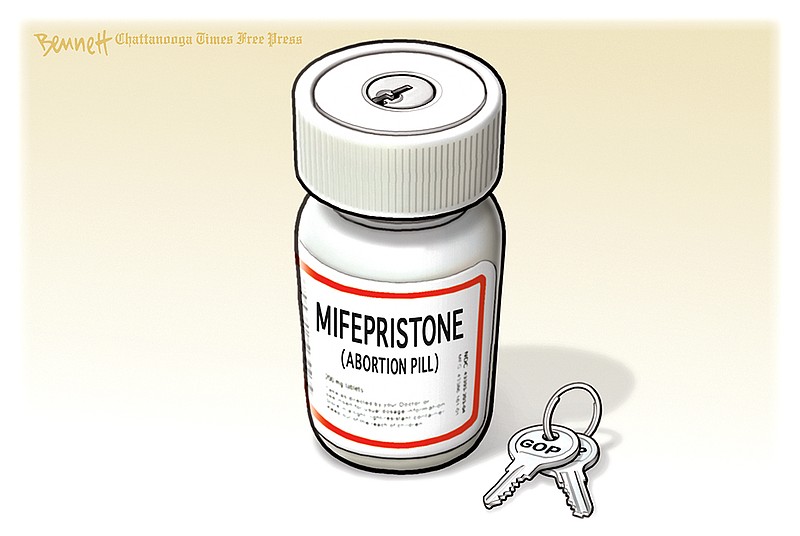
A previous lawsuit to ban the drug used in about half of all US abortions failed at the Supreme Court for technical reasons. But a new suit fixes those problems. It also introduces some truly weird and creepy arguments. Is it really a problem if a state’s teen pregnancy rate gets too low?
Back in June, a lawsuit asking federal courts to ban the abortion drug mifepristone was thrown out unanimously by the Supreme Court on technical grounds: The plaintiffs (mainly physicians who don’t prescribe the drug) were not sufficiently affected by mifepristone’s availability to have standing to sue. So the Court never got to the heart of the case: whether the FDA was right to declare the drug safe to use.
Naturally, that couldn’t be the end of the story, so the anti-abortion forces are back with a new suit. This time three states — Kansas, Missouri, and Idaho — are suing the FDA, attempting to reverse the FDA’s approval of mifepristone for pregnancies of 7-10 weeks. And of course the suit has been filed in Amarillo, Texas (which has no connection to either the FDA or the plaintiff states) because that’s where the plaintiffs can be guaranteed to get the most anti-abortion federal judge: Matthew Kacsmaryk, who somehow failed to see the problems with the first suit. (Anti-abortion radicals Sam Alito and Clarence Thomas could see the standing issue, but not Kacsmaryk.)
The current suit has a much better standing argument: Missouri and Idaho have “almost completely banned” abortion, but their residents sometimes get mifepristone from another state. (Abortion is legal up to 22 weeks in Kansas, so I’m not sure why it joined the suit.) They then return home to use the drug, and if there are complications they may wind up in some home-state emergency room, where Medicaid may wind up paying the bill. This costs the states money, so they have suffered an injury the courts can redress.
But in addition to that reasoning, the lawsuit also includes some weird and creepy stuff, if you read deep enough into it.
Defendants’ [i.e., the FDA’s] actions are causing a loss in potential population or potential population increase. Each abortion represents at least one lost potential or actual birth. … Defendants’ efforts enabling the remote dispensing of abortion drugs has caused abortions for women in Plaintiff States and decreased births in Plaintiff States. This is a sovereign injury to the State in itself [due to] “diminishment of political representation” and “loss of federal funds”.
OK, we get it: Missouri and Idaho have reasons to want to increase their populations, and the FDA is interfering with their power to force unwilling women be their brood mares. How dare the Feds violate states rights like that?

And then it gets even a little creepier: A study has shown that birth rates increase the further that a woman has to drive to get an abortion, and that teen-age women (15-19) should be especially affected by this. (I suspect that’s because the younger ones can’t drive and the older ones probably don’t have their own cars.) But the recent bans are not raising the teen birth rate the way they ought to.
When data is examined in a way that reflects sensitivity to expected birth rates, these estimates strikingly “do not show evidence of an increase in births to teenagers aged 15-19,” even in states with long driving distances despite the fact that “women aged 15-19 … are more responsive to driving distances to abortion facilities than older women.” The study thus concludes that “one explanation may be that younger women are more likely to navigate online abortion finders or websites ordering mail-order medication to self-manage abortions. This study thus suggests that remote dispensing of abortion drugs by mail, common carrier, and interactive computer service is depressing expected birth
rates for teenaged mothers in Plaintiff States, even if other overall birth rates may have been lower than otherwise was projected.
So in particular, the FDA is interfering with the states’ right to make teenage girls be their brood mares. I can’t emphasize this enough: One “injury” Missouri and Idaho complain about is that their teen birth rates are too low.
And there’s one set of girls the suit calls special attention to: those in the foster care system, who might be able to sneak out and get mifepristone somehow or have it mailed to them.
As a result of Defendants’ actions, Plaintiffs have suffered injury to their sovereign interests in enacting and enforcing their laws. Defendants … seek to displace and nullify the States’ state-law parental rights of notice and consent for abortions for teen girls in foster care.
Just picture this for a second: A girl for one reason or another has lost her birth parents. Maybe they died, or maybe they misparented in some way that caused the state to take the girl away. Either way, there’s bound to be some trauma involved.
Traumatized girls sometimes take foolish risks, and it’s also possible they might be sexually abused by a foster parent or by some other adult their foster parents didn’t watch closely enough. So unwanted pregnancies happen, and Missouri’s abortion ban has no rape or statutory rape exception. But the girl is so desperate and so determined to end the pregnancy that she might figure out how to do something about it. Being such a loving parent, however, the state wants to thwart that desire, make her carry a pregnancy for nine months, and then give birth to a child she doesn’t want.
I think if I had gone through something like that, I might be a serial killer.
What lovely, God-fearing states you’ve got there, Missouri and Idaho. (And I still can’t figure out what Kansas is doing.)
 The Weekly Sift
Comments
How long before an argument using injury to the sovereign state’s interest is put forward to remove an under age daughter from the care of her parents, because those parents are allowing their daughter to travel to get an abortion?
unsubscribe
lol
Thanks for bringing attention back to this.
Wyoming gave women the right to vote in 1869 (when it was still a territory), partly to attract more women to move to the state.
If Idaho and Missouri want women to have more children, maybe they should follow Wyoming’s lead, and make it more attractive to do that. How about free prenatal and well-baby care, starting at conception? How about the state covering all hospital costs associated with the birth? How about free childcare?
Or maybe they should generally make the states more attractive so that people want to move there? Raise the minimum wage? Help people buy houses? Offer universal healthcare? Offer free tuition at the state universities?
Yes.
This is horrifying.
Thank you for choosing it as your topic.
The legal argument here is that the power of the state shall be used to control the freedom of women to make their own choices about whether or not to carry a pregnancy to term.
Freedom in these states clearly means the freedom of rich white males to behave however they want to, and everyone else to serve what these rich white males desire.
There is never a good outcome when a woman is prohibited from receiving the medical care she desires. Never. She’s either going to break the law to get it and put herself at needless risk, both medically and legally, or she’s going to resent the way power has been used to control her for the rest of her life. And almost certainly, that state power won’t include support for the child she’s been forced to bear.
People who support this legal argument, including the reactionary Catholic right majority of the SCOTUS, have far more in common with the theocratic mullahs running Iran than they do with the “Give me liberty or give me death!” Founding Fathers of our country. Women are essentially livestock, to be owned and bred for whatever greater good men have decided upon.
It strikes me that this appalling argument is merely an extension of the idea that a baker can’t be forced to bake a cake for a celebration they do not agree with. In effect, restricting the baker from exercising their bigotry is an infringement of their rights, and the right of the customer to have a service provided by a private company is irrelevant.
Here, a State cannot be restricted in its exercise of misogyny and the victim’s rights or needs are irrelevant to the question.
The standing argument you describe is highly speculative and still appears insufficient, and any judge who applies the rule of law and longstanding precedent on standing would so hold. Not holding my breath though.
And when these draconian laws end up increasing the abortion rate (as they always do), how long before women will be required to register their pregnancies with the state? This is already part of Project 2025. And the next step, when the abortion rate still refuses to budge, will be forced impregnation. We will see rapists offering as their defense that they were only doing their part to increase the population.
The most effective way to lower the abortion rate is to provide easy access to contraception.
Trackbacks
[…] week’s featured posts are “Mifepristone, round 2” and “Trump’s Weird […]