Monthly Archives: October 2023

The Weirdness in the House

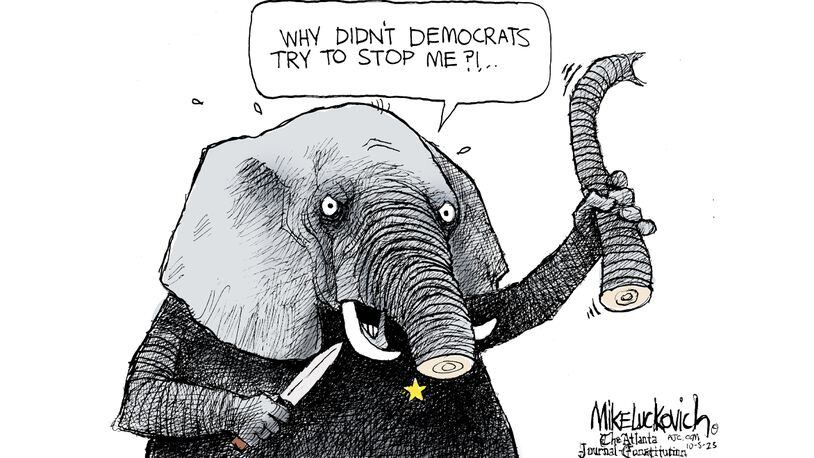
I admit to having been surprised when Speaker McCarthy was voted out by the House Tuesday. Ordinarily, when I see a guy getting ready to jump out of an airplane, I expect him to have a parachute somewhere.

McCarthy had been heading towards this moment since he became speaker in January: He made impossible promises to the MAGA faction, and changed the rules to give them an easy way to get rid of him if he didn’t keep those promises. When they threatened him, he said “Bring it on!“, scheduled the vote as soon as possible, and publicly announced he wouldn’t make a deal with Democrats to save himself.

I thought: “Wow! He must have some great trick up his sleeve.” And then: nothing. Splat!

This crisis wasn’t just predictable, it was predicted. In January, Jonathan Chait envisioned the coming debt-ceiling negotiation, which he framed as a hostage-and-ransom situation [1]:

In the current circumstances, a successful hostage release would be all but impossible. Imagine a Republican Speaker — any Republican Speaker — figuring out a ransom that almost the entire caucus could agree on. The intraparty dynamics virtually guarantee that anything a Republican leader could agree to would immediately be seen on the far right as too little.

And I added:

The procedural concessions McCarthy has made mean that he can be recalled as speaker if he doesn’t negotiate a high enough ransom.

McCarthy had nine months to contemplate this scenario, and did manage to survive the debt ceiling deal in May. But the subsequent swerve to avoid a government shutdown nailed him. If he ever had a plan, he didn’t put it into operation. Even in retrospect, I can’t guess what he thought was going to happen.

This chain of events proves that I can’t be relied on to tell you what will happen next. So instead I’ll focus on what can happen and what should happen.
The Speaker pro tem. Since McCarthy’s ouster, the speaker’s chair has been occupied by a speaker pro tempore — literally “speaker for a time”. The temp is Patrick McHenry of North Carolina, and his name comes from a list that McCarthy had to provide when he became speaker.

My first thought was that McHenry would be like the temporary buildings that got built to house the military during World War II, many of which are still standing: The Republican caucus is too dysfunctional to elect a new speaker, so the temp will wield the gavel until the next Congress is seated in 2025. (With any luck, Democrats will take back the House and we’ll be done with this nonsense.)

But that doesn’t seem like a viable option without a rule change, which might be just as hard as electing a new speaker. Rule I, Clause 8(b)(3) says:

In the case of a vacancy in the Office of Speaker, the next Member on the list described in subdivision (B) shall act as Speaker pro tempore until the election of a Speaker or a Speaker pro tempore. Pending such election the Member acting as Speaker pro tempore may exercise such authorities of the Office of Speaker as may be necessary and appropriate to that end. [my emphasis]

The first version of this I saw omitted “to that end”, which (in my reading) changes everything. McHenry’s authority appears to be limited to whatever is needed to elect a new speaker. [2]

But not so fast, claims Matt Glassman of Georgetown’s Government Affairs Institute. “that end” might be interpreted not as “the election of a Speaker”, but as “act as Speaker pro tempore”. In that case, McHenry might have have broad powers. There’s no precedent for this situation, so whatever the current House allows will become the precedent.

So far, McHenry appears to be taking a narrow view of his powers, with one exception: Tossing Nancy Pelosi out of the courtesy office McCarthy allowed her doesn’t seem to serve the end of electing a new speaker. It’s trivial, but it might be a test. If the House elects a new speaker quickly, McHenry probably won’t test his powers further. If Republicans deadlock, though, the temptation to do something substantive will grow as the November 17 shutdown deadline looms. [3]

Potential speakers. So far two Republican candidates have announced themselves: Jim Jordan and Steve Scalise. Scalise is the current majority leader, and so would be the leadership’s next-man-up after McCarthy. However, Scalise is currently battling blood cancer and may not have the energy. Next up after him would be Majority Whip Tom Emmer, who is supporting Scalise and hopes to become majority leader if Scalise moves up.

Jordan is the “Freedom” Caucus candidate and has been endorsed by Trump. When he was nominated against McCarthy in January (despite claiming to support McCarthy himself), Jordan got at most 20 votes. So I have to see Jordan’s candidacy as a test of Trump’s influence; he’d never be elected on his own.

Putting this as delicately as possible, Jim Jordan is not the sharpest knife in the drawer. The nonpartisan Center for Effective Lawmaking has rated Jordan one of the least effective lawmakers in Congress (202nd out of 205 Republicans examined), based on him sponsoring very few bills and passing hardly any of them. He has a law degree from Capitol University, but has never passed a bar exam. In his memoir of his years as speaker, John Boehner called out the “political terrorists” in the Republican caucus; in a subsequent interview, he named Jordan as an example:

I just never saw a guy who spent more time tearing things apart ― never building anything, never putting anything together.

And then there’s the whole he-ignored-sexual-abuse thing from when he was a wrestling coach at Ohio State.

The Speaker needs to be a master of House procedure, skilled at forming and speaking for a consensus, and an ace vote-counter. Nancy Pelosi had those skills, which is how she managed to get so much done with a majority the same size as McCarthy’s. McCarthy lacked the skills, and Jordan seems like the antithesis of a good speaker.

Scalise has his own issues. He once billed himself as “David Duke without the baggage“. Since “the baggage” was a long history of KKK leadership, that ought to give his supporters pause.

Before he endorsed Jordan, a number of people suggested Trump himself become speaker, since the Constitution does not require the speaker to be a member of the House. However, the rules of the Republican House caucus bar anyone under indictment for serious crimes from serving in leadership, so they’d need to change that. Trump has fanned this speculation, and is still floating the idea that he might take the job temporarily, but I suspect he doesn’t want the headache of having real responsibilities.

Any of these candidates would need near-unanimity in the House GOP to get over the top, and so will probably need to make the same sorts of impossible promises McCarthy made. Presumably they’d have to prove their toughness by shutting down the government in November. But again, what possible ransom could the new speaker get from Biden and Schumer that Gaetz et al would consider enough? So aren’t we right back here by Christmas or so?

In short, I don’t see how House Republicans resolve this on their own.

Fantastic (but possible) solutions. Now we get to what should happen: Republican moderates, especially the 18 representing districts Biden won in 2020, should find their backbones and play the same kind of hardball the MAGA wing plays.

Rep. Mike Lawler of New York, whose district voted for Biden by 10 points in 2020, attacked Minority Leader Hakeem Jeffries for not bailing out McCarthy, as if Democrats should have agreed to an imaginary deal that McCarthy refused to offer. [4] In response, AOC suggested Lawler support Jeffries for speaker, an obviously suicidal move for a Republican who would surely lose a primary challenge afterwards.

But here’s what could and should happen: Lawler (or some similar non-MAGA Republican; Michelle Goldberg suggested Brian Fitzpatrick of Pennsylvania) should announce his own candidacy for speaker together with support from a handful of fellow moderates. He should pledge not to shut down the government, to fulfill the deal McCarthy made with Biden to avoid a debt-ceiling default in May, and to pass rules that would create a more even sharing of power between the two parties. (Not full parity, but closer to it.) Then he should ask for Democratic support. If his handful of Republicans held firm and the Democrats came through, he’d be speaker, and the House could start to function again. Republicans and Democrats could negotiate with each other in good faith, rather than tee up another hostage crisis.

Jeffries appears to be open to such an arrangement:

The details would be subject to negotiation, though the principles are no secret: The House should be restructured to promote governance by consensus and facilitate up-or-down votes on bills that have strong bipartisan support. Under the current procedural landscape, a small handful of extreme members on the Rules Committee or in the House Republican conference can prevent common-sense legislation from ever seeing the light of day. That must change — perhaps in a manner consistent with bipartisan recommendations from the House Select Committee on the Modernization of Congress.

Maybe simply threatening such a thing could get Republicans to unite around somebody like Scalise and not shut down the government. (If Scalise did shut it down, that motion-to-vacate trick would work just as well for Lawler as it did for Gaetz.)

I don’t expect this to happen any time soon, because Republican moderates are invariably spineless. But nothing prevents it.

And if the House’s leadership vacuum stretches into November, and if the government shuts down while Biden and Schumer are still waiting to find out who they should be negotiating with, the boundaries of plausibility might shift.

Sherlock Holmes, a fictional detective looking backward to figure out what did happen, famously observed: “When you have eliminated all which is impossible then whatever remains, however improbable, must be the truth.” Something similar should hold looking forward: When you eliminate all the scenarios that can’t happen, one of the options remaining, however implausible, must be what will happen.


[1] One theory that explains MAGA faction’s inability to formulate coherent goals during the debt-limit and shutdown negotiations is sabotage. In other words, shutting down the government isn’t a threat, it’s a goal. The analogy would be to a kidnapper who wants to kill the hostage, and so makes shifting and impossible demands.

You might wonder why MAGA Republicans would want to cause a shutdown, but the answer is pretty simple: The Biden economy has been remarkably good, especially considering the Covid disruption he inherited from Trump. Unemployment continues to be quite low, and wage increases have begun to outrun inflation. The unemployment rate has been under 4% for 21 of the last 22 months, compared to 20 months for the entire Trump administration. When Biden took office, unemployment was at 6.3%.

The rising-real-wages phenomenon is recent, though, so the public has barely noticed and isn’t giving Biden the credit he deserves. If a lengthy government shutdown starts a recession, he never will get credit.

That explains why Trump has been pounding the drum so hard for a shutdown:

The Republicans lost big on Debt Ceiling, got NOTHING, and now are worried that they will be BLAMED for the Budget Shutdown. Wrong!!! Whoever is President will be blamed. … UNLESS YOU GET EVERYTHING, SHUT IT DOWN!

[2] The rule suggests an in-between possibility: electing a speaker pro tem rather than taking one off a list. The pro-tem’s term might only last until a new speaker is elected, but having been elected might allow him to claim the full powers of a speaker.

[3] Politically, a government shutdown usually hurts the party that seems to be causing it, which is usually the Republicans. But this one would be even worse than the others, because it wouldn’t have any principled justification. Republicans wouldn’t be shutting down the government to cut spending or limit abortions or even hand Ukraine to their buddy Putin; they’d be shutting down the government out of sheer incompetence, because they couldn’t get their act together to elect a speaker. I can’t imagine the public taking that well.

[4] To understand what Democrats were thinking when they let McCarthy go down, here’s a tweetstorm from Democratic staffer Aaron Fritschner.

Fritschner gives McCarthy no credit for the continuing resolution that temporarily resolved the shutdown issue: McCarthy knew he needed Democratic votes to pass the CR, but sprung his proposal on them suddenly with no time to read it. Democrats manipulated the situation to get some time: Majority Leader Jeffries launched a time-wasting speech on the House floor, and Jamaal Bowman even pulled a fire alarm. Fritschner speculates that McCarthy hoped Democrats would vote his resolution down, allowing him to blame Democrats for the ensuing government shutdown.

People want us to give the guy credit for stopping a shutdown but it is still not clear to me right now sitting here writing this that he *intended* to do that.

And now that the House has until November 17, what could Democrats hope for from McCarthy?

And what is McCarthy signaling to us on funding? He’s going to steer us directly back into the crazy cuts and abortion restrictions, the Freedom Caucus setting the agenda, breaking his deal with Biden, and driving us towards a shutdown in November.

Ok we are reasonable people, maybe he’s just telling them what they have to hear and he’ll screw them at the last minute. So what’s he saying to us privately? What reason is he giving us to think any of this is going to turn out well if we help him? None.

The supposed “institutional interest” would have us not only put out Republicans’ many fires for them, it would have us do so based on our specific belief and trust that *McCarthy is lying*. Like, his lying is supposed to be a good thing, and what sells the arrangement for us.

It all called for too much trust in a guy who had (again and again) proven untrustworthy.

The Monday Morning Teaser

A few days ago, it seemed obvious what the week’s big news story was: the leadership vacuum in the House of Representatives. Speaker Kevin McCarthy was ousted Tuesday, and the Republican caucus seems to be back where it was in January: holding a narrow majority on paper, but unable to unite that majority behind any single leader or agenda. McCarthy managed to become speaker by making impossible promises to the party’s MAGA fringe and giving them the power to throw him out if he didn’t deliver. He didn’t deliver, and they threw him out.

While the GOP figures out what to do next, the House is frozen and the clock is ticking on the temporary funding that averted a government shutdown last week. New money needs to get appropriated by November 17 or the government shuts down. Averting that shutdown is what got McCarthy booted, so even if a new speaker gets chosen in time, it’s hard to imagine what he will do to resolve the situation. Anyway, that’s the subject of this week’s featured post, which should be out by 10 EDT.

If you’ve been paying attention to the news the last few days, though, the dysfunction in the House is barely a sidebar: Saturday Hamas launched a shocking attack on Israel. Hundreds or even thousands of people, mostly civilians, have already been killed, and no one knows how the situation will resolve. This isn’t the kind of topic I’m equipped to cover, so I’m not planning to write much about it. You’ll need to follow developments through some other news source.

A much slower-breaking news story got some significant coverage this week: the decline of life expectancy in the US. The WaPo had two enlightening articles on it, and Vox had something interesting to say as well.

And we’ve all got numb to the continuing outrages from Donald Trump. Thursday we found out that he had discussed nuclear secrets with a Mar-a-Lago member from a foreign country. Also, his rhetoric went full Nazi in an interview last week: Migrants crossing our southern border are “poisoning the blood of our country”. And there were the usual batch of developments in his criminal cases and the civil fraud trial currently happening in New York.

That’s all in the weekly summary, which should be out around noon or so.

Simple Propositions

You guys, the UAW — you saved the automobile industry back in 2008 and before. You made a lot of sacrifices. You gave up a lot. And the companies were in trouble. But now they’re doing incredibly well. And guess what? You should be doing incredibly well too. It’s a simple proposition.

President Joe Biden,
on a picket line in Belleville, Michigan on Tuesday

This week’s featured posts are “MAGA and the Swifties” and “When should public officials resign?

This week everybody was talking about the close call on a government shutdown

McCarthy’s sudden reversal made all this week’s cartoons obsolete.

The government did not shut down Sunday morning, and will not shut down until at least November 17.

The shutdown, which had appeared nearly inevitable, was avoided when House Speaker Kevin McCarthy changed his position Saturday morning: He allowed a vote on a short-term continuing resolution. Once the resolution came to the House floor, it passed easily, 335-91. It then went to the Senate, where it passed 88-9. The bill was signed by President Biden Saturday evening with an hour to spare.

The resolution was opposed almost entirely by Republicans: 90 representatives and nine senators. Rep. Mike Quigley of Illinois was the lone Democrat in opposition. Two House Democrats, Rep. Katie Porter of California and Rep. Mary Peltola of Alaska, did not vote. The Republican opposition came mostly from the party’s right wing, the likes of Rep. Matt Gaetz of Florida and Senator Ted Cruz of Texas.

The resolution continues funding government departments at the same levels as fiscal 2023, which ended on September 30. It also added $16 billion for disaster relief, but included no additional aid to Ukraine. (A similar bill in the Senate had $6 billion for Ukraine, but the House bill got through first.)

President Biden believes he has a promise from Speaker McCarthy to allow a separate vote on Ukraine aid soon. However, Biden also believed McCarthy had committed himself to funding the government back when the debt-ceiling deal was reached in June. McCarthy ultimately came through, but not without considerable drama.

It also remains to be seen if McCarthy will continue as speaker. Gaetz and his right-wing allies in the “Freedom” Caucus had threatened to withdraw their support from McCarthy if he made a deal to get Democratic votes, as he did Saturday.

McCarthy has clearly been frustrated by the nihilism of his party’s right wing, which never proposed a government-funding deal it could support. McCarthy told reporters after the vote:

If you have members in your conference that won’t let you vote for appropriation bills, [don’t] want an omnibus and won’t vote for a stopgap measure, so the only answer is to shut down and not pay our troops: I don’t want to be a part of that team.

The next question is whether Gaetz and his allies will carry out their threat to submit a motion to vacate the chair, which would remove McCarthy from the speakership unless Democrats decided to save him. (They say they won’t without getting something in return.) Over the weekend he said he would submit the motion sometime this week. McCarthy responded with bravado: “Bring it on. Let’s get this over with.”

Also: Will anything be different as we approach November 17? McCarthy bought himself (or his successor) some time, but if he has some plan for achieving a less chaotic outcome, he hasn’t revealed it yet.

One final point: The fact that McCarthy’s change-of-mind resolved the issue so quickly is pretty convincing evidence that Republicans were causing the problem.

and the Trump trials

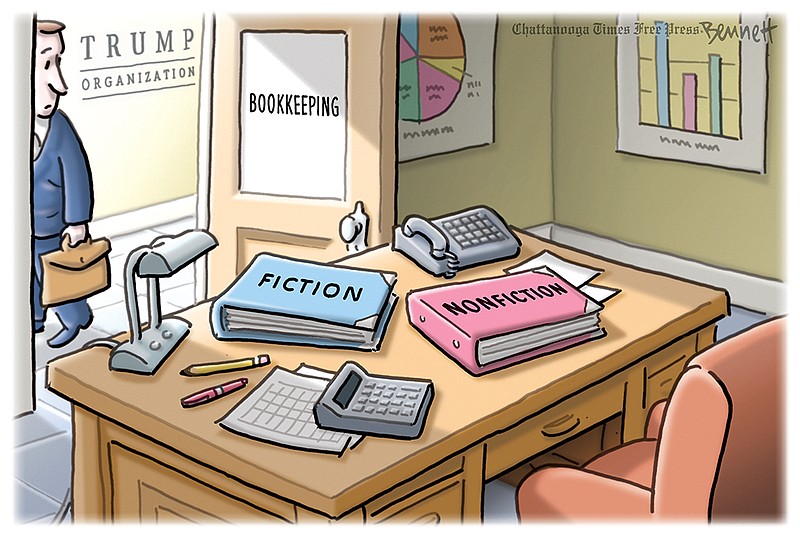
The New York Attorney General’s lawsuit against the Trump Organization won a big victory Tuesday: Judge Arthur F. Engoron issued a partial summary judgment on the case, declaring that Trump had committed fraud by inflating his net worth when applying for bank loans. Because Trump Organization’s fraud is ongoing, the judge

cancelled all of the business licenses for the Trump Organization and its 500 or so subsidiary  companies and partnerships after finding that Trump used them to, along with his older two sons, commit fraud.

His gaudy Trump Tower apartment, his golf courses, his Boeing 757 jet and even Mar-a-Lago could all be disposed of by a court-appointed monitor, leaving Trump with not much more than his pensions as a one term president and a television performer.

Under the New York General Business Law you can only do business in your own name as a sole proprietor or with a business license, which the state calls a “business certificate.”  All of Trump’s businesses were corporations or partnerships that require business certificates.

The judge’s ruling found that a trial was unnecessary to determine fraud, because all the arguments Trump’s lawyers presented in his defense were beside the point.

[The Office of the Attorney General] need only prove: (1) the [statements of financial condition] were false and misleading; and (2) the defendant repeatedly or persistently used the SFCs to transact business.

The instant action is essentially a “documents case”. As detailed [elsewhere in this ruling], the documents here clearly contain fraudulent valuations that defendants used in business, clearly satisfying OAG’s burden.

Trump’s attorneys instead argued a number of legally irrelevant points, like that the banks in fact did not lose money, or that the SFCs contained a clause warning the banks to do their own valuations, or that property valuations are subjective. Their stubbornness in repeating arguments the judge had already rejected as frivolous led the judge to sanction the attorneys $7500 each. (David Cay Johnston notes that this ruling could be cited in some future disbarment hearing.) University of Michigan business law professor Thomas elaborates:

What we’ve seen with Donald Trump over and over again is that often arguments that gain traction with his supporters are flatly inconsistent with the law.

Underlining that point, Trump has continued making the irrelevant arguments rather than addressing the actual ruling.

I’ve heard a number of analogies capturing why the nobody-lost-money argument fails. Here’s my favorite: What if as you were closing up at your job, you stole $100 from the till, then went to the racetrack and bet it on a horse that won? In the morning you could replace the $100, so your employer didn’t lose money. But you’re still a thief.

Probably the most egregious overvaluation was of Trump’s apartment in Trump Tower, which he claimed was three times its actual size and valued accordingly. The judge comments:

In opposition, defendants absurdly suggest that “the calculation of square footage is a subjective process” … A discrepancy of this order of magnitude, by a real estate developer sizing up his own living space of decades, can only be considered fraud.

Of course Trump will appeal, but an appeal is not just a do-over. He’ll have to support an argument that the judge did something wrong. The judge’s reasoning is simple and doesn’t seem to rely on esoteric points of law, so an appeal doesn’t seem to have much to work with.

Meanwhile, a trial on the rest of the state’s charges, including insurance fraud, will begin today. Thursday, the appeals court refused to delay that trial pending a ruling on Trump’s appeal. The trial will also determine the fines Trump will have to pay. The state is asking for $250 million.

Trump has said he’s going to appear in court today, though it’s not clear what he plans to do there, since it’s not time for him to testify, if he intends to do that at all (which I doubt). Trump says a lot of things, so I’ll believe he’s coming when I see him.


In political terms, one consequence of this decision isn’t getting the attention it deserves: Like sexual assault, Trump’s involvement in fraud is no longer just an accusation: It is a finding of a court of law. Trump is no longer just “alleged” to have committed fraud. He committed fraud.


Fani Willis got the first guilty plea from one of her 18 RICO defendants. (It’s kind of amazing this isn’t even the lead story under “Trump trials”.) Scott Hall pleaded guilty to five misdemeanors and was sentenced to five years of probation. He is also committed to testify in future proceedings, and if he doesn’t testify truthfully, the deal is revocable.

Hall’s role in the Georgia election-stealing scheme is both low-level and easily established: When Trump allies were trying to assemble (or invent) evidence of voter fraud in Georgia, they illegally accessed voting machines in Coffee County.

The security breach in the county about 200 miles southeast of Atlanta is among the first known attempts by Trump allies to access voting systems as they sought evidence to back up their unsubstantiated claims that such equipment had been used to manipulate the presidential vote. It was followed a short time later by breaches in three Michigan counties involving some of the same people and again in a western Colorado county that Trump won handily.

… Authorities say Hall and co-defendants conspired to allow others to “unlawfully access secure voting equipment and voter data.” This included ballot images, voting equipment software and personal vote information that was later made available to people in other states, according to the indictment.

In a RICO case, specific crimes like these are used to establish the existence of a corrupt organization that other defendants belong to. Hall’s guilty plea raises the question of whether it will start a stampede to make a deal with Willis before the other defendants do. A defendant’s only leverage in such a deal is if s/he can testify to something Willis can’t already prove.


In other Georgia-election-case news, former Justice Department official Jeffrey Clark and three of Trump’s fake electors lost their bid to move their cases to federal court. Mark Meadows’ similar motion had already been denied, and Trump surprisingly announced he will not try to shift his case to federal court.


Sidney Powell and Kenneth Chesebro are the first of the 18 (now 17) RICO defendants facing trial. They requested a speedy trial, which will begin October 23. CNN has speculated that they will be offered plea deals to avoid this trial, which would preview the state’s evidence to the other defendants.

and the sham impeachment hearing

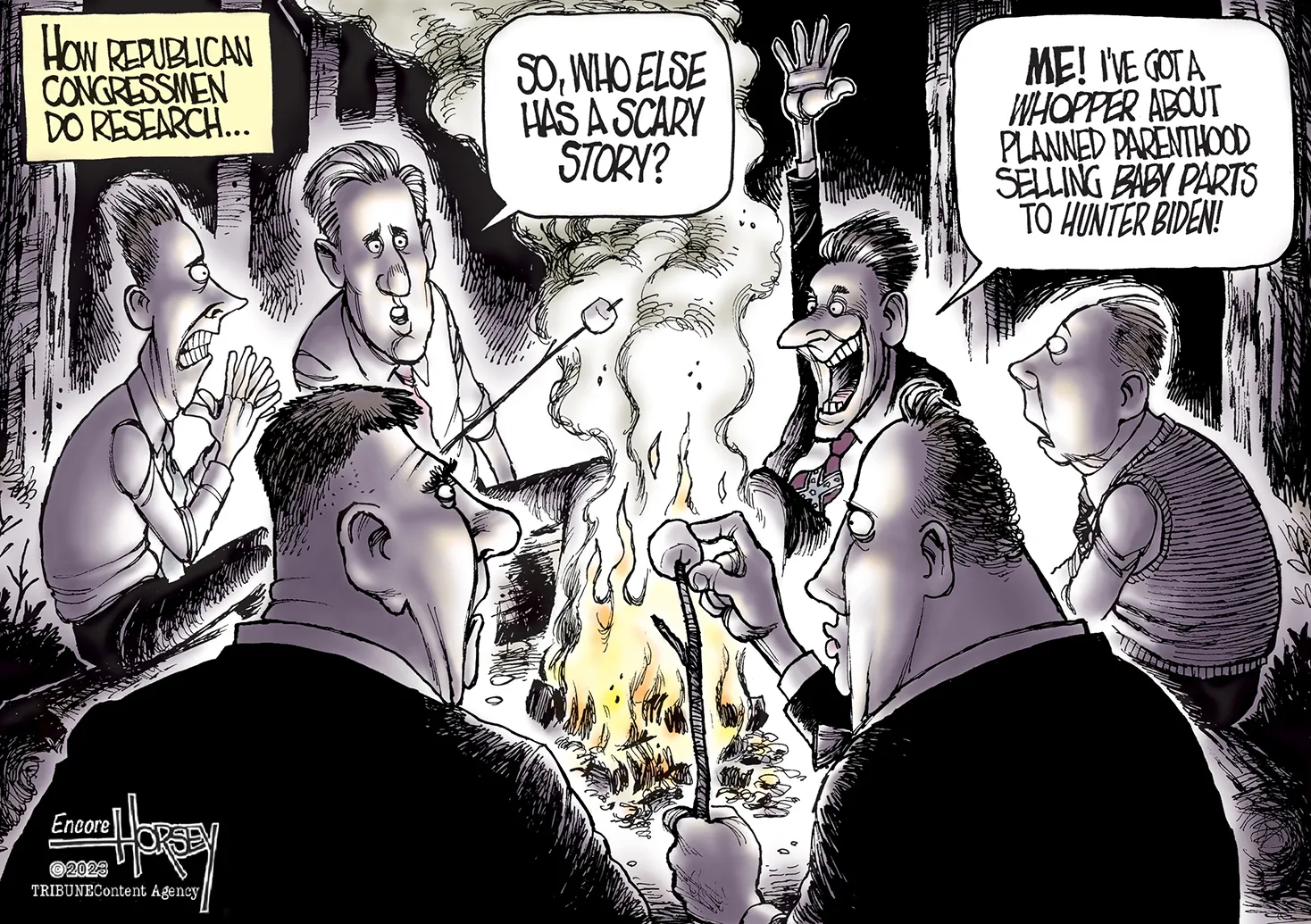
Like the rest of the House Republican investigations of Joe Biden, the opening session of their impeachment inquiry did not live up to its billing. None of the witnesses called were “fact” witnesses, i.e., none of them saw or heard President Biden doing anything impeachable. The witnesses also made much weaker claims than the Republican congressmen did.

Forensic accountant Bruce Dubinsky: “I am not here today to even suggest that there was corruption, fraud or wrongdoing. More information needs to be gathered before I can make such an assessment.”

Law professor Jonathan Turley: “I do not believe that the current evidence would support articles of impeachment. That is something that an inquiry has to establish.”

That’s a far cry from the claim House Oversight Chairman Rep. James Comer made, that the GOP probes have “uncovered a mountain of evidence revealing how Joe Biden abused his public office for his family’s financial gain.”


A rule of thumb: Investigations that are going somewhere get more and more specific. For example, the Manhattan case about Trump’s Stormy Daniels payoff — widely considered the weakest of the four Trump indictments — has come down to this: 34 Trump Organization documents are fraudulent business records.

The longer the Republican investigation of Biden stays at the level of “Hunter did shady things and Joe must have been involved somehow”, the more likely it is to go nowhere.


A tip on interpreting headlines: When a headline attributes some wrong-doing to “the Biden family“, that means the article contains no new information about President Biden himself. If they had anything on Joe, that would be the headline.

and the rain

Climate Change Summer has turned into Climate Change Fall. Friday, as much as 8 inches of rain fell on parts of New York City, shutting down the subways and producing flash floods. The storm was not due to a hurricane or tropical storm. Instead, seemingly innocuous systems came together unexpectedly to produce a hurricane-like rainfall. The NYT explains:

It has been raining a lot in New York, which hasn’t seen a September this wet in over a century. Climate change is very likely stoking more ominous and lengthy downpours because as the atmosphere heats up, it can hold more moisture, said Andrew J. Kruczkiewicz, a senior researcher who specializes in flash floods at Columbia Climate School at Columbia University.

Scientific American gives the larger context:

The 2018 National Climate Assessment (a new version of which is due sometime this year) found that the amount of rain that fell during the heaviest 1 percent of rain events had increased by 55 percent across the Northeast since 1958, with most of the increase happening since 1996. That trend will only get worse as global temperature rise, causing more evaporation from oceans and lakes and giving storms more water to fuel deluges.

and Taylor Swift

The right-wing attacks against Swift are the subject of one of the features posts.

and two speeches aimed at workers

Biden and Trump each talked to auto workers, but in very different ways. Biden went out on the picket line with UAW strikers and addressed them with a bullhorn. In addition to the quote at the top of this post, he said:

Wall Street didn’t build the country. The middle class built the country, and unions built the middle class.

Biden handed the bullhorn to UAW President Shawn Fein, who said:

These CEOs sit in their offices, they sit in meetings, and they make decisions. But we make the product. They think they own the world, but we make it run. 

Whether we’re building cars or trucks or running parts distribution centers; whether we’re writing movies or performing TV shows; whether we’re making coffee at Starbucks; whether it’s nursing people back to health; whether it’s educating students, from preschool to college — we do the heavy lifting. We do the real work. Not the CEOs, not the executives.

The next day, Trump was invited by management to speak at a non-union auto parts shop.

About 400 to 500 Trump supporters were inside a Drake Enterprises facility for the speech. Drake Enterprises employs about 150 people, and the UAW doesn’t represent its workforce. It wasn’t clear how many auto workers were in the crowd for the speech, which was targeted at them.

One individual in the crowd who held a sign that said “union members for Trump,” acknowledged that she wasn’t a union member when approached by a Detroit News reporter after the event. Another person with a sign that read “auto workers for Trump” said he wasn’t an auto worker when asked for an interview. Both people didn’t provide their names.

In other words, Biden lent his support to an event workers started on their own, while Trump staged a event for the cameras, complete with extras playing phony roles. His support for working people is about as authentic as his property valuations or his marriage vows.

and Cassidy Hutchinson’s book

I read Cassidy Hutchinson’s new book Enough. A lot of what’s in it is stuff you already know if you watched her testimony and followed the news about her.

But it does make it easier to understand how she could fall under Trump’s spell: She had a psychologically abusive father whose approval she valued but could never secure. He was a head-of-the-household type who had big plans, but was never wrong. It was up to Cassidy’s mother to make the details of those plans work, and to take the blame if things fell apart. So that role was already in Cassidy’s head, waiting for Trump to slide into it.

Her description of the Trump White House resembles an abusive family in a lot of ways. Hutchinson and her boss Mark Meadows lived in fear of Trump’s temper. And if he did erupt, the explanation that he’s an over-coddled asshole wasn’t available to them. Instead, they believed they should have foreseen and prevented whatever set him off.

The book also underlines a problem in our justice system: It’s expensive, even if you did nothing wrong. When Hutchinson got her first subpoena from the January 6 Committee, everyone told her she needed a lawyer. She was driven to use a TrumpWorld lawyer when an independent lawyer quoted her a six-figure price. Only after she got disgusted with herself and wanted to change her testimony did she ask Liz Cheney for help. Cheney gave her a lead on a firm that took her case for free.

This raised a question in my mind: If you’re a witness and not a target of an investigation, and if you intend to answer all questions truthfully, why do you need a lawyer? All the coverage I’ve seen takes the necessity of counsel for granted, so I asked a lawyer I know to spell it out.

He made three points:

  • You don’t always know for sure that you won’t eventually be a target, even if you’re innocent.
  • A lawyer can negotiate about how you’ll testify, to minimize how much the investigation will disrupt your life.
  • If you’re not familiar with all the relevant laws, you may not realize that you violated one. If you did, you may need to negotiate a plea deal or a cooperation agreement.

With Trump and his allies threatening retribution if they ever get back in power, both sides need to think about this problem. Merely witnessing a suspected crime shouldn’t bankrupt you.

and you also might be interested in …

Senator Dianne Feinstein died at the age of 90. Politico looks back at her career.

Governor Newsom is wasting no time in naming her successor: Laphonza Butler, the president of Emily’s List. The official announcement is expected later today.

Newsom had made two pledges, both of which this appointment fulfills: He said he would appoint a Black woman, and that he would not give any of the candidates already running for this seat in 2024 an advantage by naming them as the interim.


I didn’t watch the second Republican presidential debate. In reading accounts of it, nothing made me feel like I missed out.

Ron DeSantis is a terrible strategist. He was riding high immediately after last fall’s midterm elections for a simple reason: He won his race handily, while Trump’s favorite candidates almost all lost. His potentially winning message against Trump was obvious: I can win and Trump will lose again. (If Trump wanted to respond by claiming he didn’t lose, let him. It makes him sound like a whiner. Ask: “So are you living in the White House now or not?” When that sets off another rant, respond with an eye roll and “Whatever.”)

DeSantis’ policy positions should have sounded conservative while remaining vague, giving a wide range of Republicans room to fantasize about the wonderful things he might do after he won.

Instead, he committed to very specific and not very popular policies, like a six-week abortion ban, taking books out of libraries, and seizing control of universities. It’s been all downhill from there.


and let’s close with something out of this world

In 2024, NASA is planning to launch a probe to study Europa, a moon of Jupiter where scientists hope to find an ocean of salty water under a thick crust of ice. The presence of water, kept in a liquid state by friction-producing tides powered by Jupiter’s gravity, opens up the possibility of finding extra-terrestrial life for the first time.

The probe, which NASA is calling the Europa Clipper, would go into orbit around Jupiter in 2030.

Over several years, it will conduct dozens of flybys of Jupiter’s icy moon Europa, gathering detailed measurements to determine if the moon has conditions suitable for life.

“OK,” I imagine you thinking, “but what’s that got to do with me?”

NASA is offering a variety of ways for you to engage with the mission. Inspired by the thought of Europan life, U.S. Poet Laureate Ada Limón has written a poem for the mission “In Praise of Mystery: a Poem for Europa“. NASA’s “Message in a Bottle” campaign invites you to cosign Limón’s message.

The poem will be engraved on the Clipper, along with participants’ names that will be etched onto microchips mounted on the spacecraft. Together, the poem and participant’s names will travel 1.8 billion miles on Europa Clipper’s voyage to the Jupiter system.

Other suggested activities have a more educational flavor: NASA provides material that might nudge you to write your own space poetry. Or you can download a line-drawing of the Clipper and Europa suitable for coloring. The coloring can get even more interesting if you put textured surfaces under the paper.

When should public officials resign?

When is it reasonable for an official (and his party) to hold on in the face of suspicion?


Last week, Senator Robert Menendez of New Jersey was indicted for bribery. He immediately resigned as chairman of the Foreign Relations Committee, as the bylaws of the Senate Democratic caucus mandate. Almost as quickly, big-name Democrats — like New Jersey Governor Phil Murphy — began calling for him to resign his seat in the Senate, which nothing in the rules requires him to do. Other Democrats, like Rep. Andy Kim, announced they would run against him (if necessary) in 2024.

As I noted last week, though, senators were slower to comment. John Fetterman of Pennsylvania appears to have been the first senator to call for Menendez’ resignation. But since then the floodgates have opened. At least 30 senators — all Democrats, including New Jersey’s other senator, Cory Booker — are asking him to resign.

The Constitution’s Article I, Section 5 allows the Senate to expel a member, but that requires a 2/3rds vote. And even if Democratic senators were willing to go that far, Republicans are unlikely to cooperate, because they would have to recognize that indictments — like Donald Trump’s indictments, say — are serious matters. So Menendez is not going to be expelled.

New Jersey’s constitution allows for the recall of federal officials, but no senator has ever been recalled, and it’s not even clear such laws are consistent with the US constitution. But 25% of New Jersey’s registered voters would have to sign a recall petition, and even if that Herculean goal could be achieved, it’s not obvious how much sooner the special election would be than the 2024 election when Menendez’s seat comes up anyway.

In practical terms, then, nobody is going to force Menendez to leave office early if he doesn’t want to go. So we’re left with the more abstract question: When should a public official resign or be removed?

The fundamental tug-of-war is between two principles: First, that an indictment is not a conviction. US law says that accused people are innocent until proven guilty beyond a reasonable doubt. If the question is whether he will go to jail, Menendez deserves his day in court just like anybody else.

But whether he should stay in the Senate is a different question. Public office is a privilege, not a right. If we’re debating whether someone should hold a position of power, maybe very-credible-suspicion is a high enough standard. Julius Caesar famously divorced his wife Pompeia after a scandal, even though he also held that she was innocent, saying “Caesar’s wife must be above suspicion.”

Maybe that’s the right principle here, too: If the citizens of New Jersey have good reason to doubt that their senator is serving their interests rather than the interests of whoever can bribe him, maybe he shouldn’t be a senator any more. Maybe they shouldn’t have to wait for a jury verdict or for his term to end naturally.

If you believe that, then someone like Menendez should resign. Arguably, so should Supreme Court Justice Clarence Thomas, who appears to have a long history of accepting expensive gifts from rich men who may or may not have specific cases before the Court, but who clearly want to influence the general direction the Court takes. And while Donald Trump currently holds no office (except in the imagination of the Qanon faithful), he also should step aside and let the GOP nominate someone not facing multiple felony indictments.

Obviously, Menendez, Thomas, Trump, and many others in recent history don’t see it that way. And while Democrats would like to be free of Menendez’ baggage, the great majority of Republicans are unwilling to ask their tainted leaders to step aside.

So why don’t more people do that? And to what extent is their reasoning justifiable?

The big reason to step aside, or to hope someone from your party steps aside, is that otherwise the individual’s battles take center stage and distract attention from the issues that person is supposed to be dealing with on behalf of the People.

To me, the only justifiable reason not to step aside is that you have already become individually important. That’s the case, for example, if your resignation means that you will be replaced by someone of the opposite party — possibly flipping control of some house of Congress or changing the partisan make-up of the Supreme Court. Such partisan considerations shouldn’t be absolute — at some point, people just have to go, whatever the consequences — but a change in the government’s partisan balance does raise the bar.

A second possible reason is if the charges against you really are the kind of “witch hunt” Trump is always talking about. If the same partisan machinery can target your replacement just as easily as it targets you, then you might as well stand and fight.

This is how I think these considerations apply to current cases: If Menendez leaves office, his replacement will be named by New Jersey’s Democratic Governor Murphy. So the seat will stay in the Democratic column. Further, I don’t know of anything that makes Menendez unique among Democrats. If, say, he were the lone crusader on some issue, I could see him wanting to stay on. But none of that is true, so he should go.

Clarence Thomas’ case is trickier, because President Biden would want to appoint someone far more liberal. At some point, though, even Republicans should want him gone, because defending his corruption taints their whole party. In a better-functioning political system, Mitch McConnell would go to President Biden and say, “We could support removing Thomas if you’d pledge to replace him with someone on this list.” Biden would push back with his own list, and eventually they’d come to an agreement.

What makes Donald Trump’s case special is that the Republican Party is dominated by his personality cult. So he is already personally unique. For many in the MAGA movement, politics amounts to Trump or not Trump, and is only tangentially connected to the issues that used to motivate the GOP, like taxes, abortion, national defense, or protecting businesses from government regulation. Agreeing to let Trump go is defeat in itself, not a strategic move that lets them fight on better ground.

So we can expect Trump to fight on until he is either decisively defeated or dies by natural causes. His cult will fight alongside him, independent of what crimes he has committed or what evidence is revealed. Individual Republicans need to decide whether they are part of that cult or not.

And finally, I’ll consider Joe Biden, who is facing an impeachment inquiry in the House. So far, though, that inquiry has revealed nothing of substance, and looks like a pure fishing expedition. It is not hard to imagine a similar quantity of Nothing being raised against Kamala Harris not long after Biden resigned.

So pending any substantive evidence of wrongdoing, Democrats should stick by Biden. In the unlikely event that something really convincing is found against him, though, I’d ask him to step aside, because Biden is not unique. Unlike the GOP, the Democratic Party is not a personality cult, and should respond to evidence.

MAGA and the Swifties

Attacks on Swift demonstrate a more general truth:
Conservatives actually don’t admire people who succeed
through talent and hard work.


I barely follow contemporary music, so I know little about Taylor Swift, beyond recognizing her picture and appreciating that she has a lot of fans. [1] During the summer, though, she was hard to ignore: Along with the Barbie movie, Swift’s Eras Tour was the big cultural event. Both were identity-affirming experiences for women that, as a man, I could only envy. [2]

Recently, though, she really caught my attention when MAGA-world decided to take on her fans, the Swifties. God knows what they were thinking. I always thought politics was about connecting with popular movements, not daring them to run over you.

The backstory is that early in her career Swift was resolutely non-partisan, to the point that many people speculated that she was a Republican. But in 2018 she decided to come out against Republican Senate candidate Marsha Blackburn. In this video (I think from a documentary about Swift) she’s telling her reluctant Dad why she needs to do this:

She votes against fair pay for women. She votes against the reauthorization of the Violence Against Women Act, which is just basically protecting us from domestic abuse and stalking. [Points to herself] — stalking! She thinks that if you’re a gay couple, or even if you look like a gay couple, you should be allowed to be kicked out of a restaurant. It’s really basic human rights, and it’s right and wrong at this point. And I can’t see another commercial and see her disguising these policies behind the words “Tennessee Christian values”. Those aren’t Tennessee Christian values. I live in Tennessee. I am a Christian. That’s not what we stand for.

Her father doesn’t argue with any of those points, but he worries that violent right-wingers will target her.

But recently Swift did something the ticked off MAGA-world even worse: She encouraged people to register to vote. And it worked.

On Tuesday morning, the singer posted a short message on Instagram encouraging her 272 million followers to register to vote. Afterward, the website she directed her fans to — the nonpartisan nonprofit Vote.org — recorded more than 35,000 registrations, according to the organization.

Not so long ago, encouraging people to vote was non-partisan, but that was before one major party turned against democracy. [3] Now Swift (and her new boyfriend, football star Travis Kelce) are being roundly denounced online. The august Federalist magazine took time from its regular projects of corrupting the Supreme Court and inciting panic about transfolk to label Swift’s popularity as “a sign of societal decline“. One of the magazine’s founders then got to the heart of the matter in a tweet:

Taylor Swift is dumb and her music sucks.

Here, I’d say: Go back and read her reasons for opposing Marsha Blackburn. Rather than dumb, she sounds pretty well informed. But “dumb” wasn’t insulting enough, so American Greatness writer Roger Kimball took it a step farther.

Also, she is homely.

As if none of the rest of us have eyes, and women like Swift should care whether Kimball finds them attractive. (Did I mention she’s dating a football star?) And famous “alpha male” Nick Adams retweeted what he thought was an apt comparison. [4]

Raise your daughters to be classy like Lauren Boebert, not trashy like Taylor Swift.

Salon’s Olivia Luppino pointed out what a pointless exercise this is:

This next-level success she has today she accomplished after navigating a polarized political climate. When she speaks up, people listen.

More importantly, there’s nothing the right could do that could meaningfully affect Swift. She has an incredibly devoted fanbase, a sold-out tour that lasts until November 2024, which again, is going to make her a billionaire, and maybe even has a hot new boyfriend. You can’t convince a Taylor Swift fan that she’s ugly or untalented, and these days, they seem to run the world.

And another Salon writer, Amanda Marcotte, hit back, claiming the anti-Swift venom comes from incels whose worship of established-in-court-sexual-assaulter Donald Trump has made them even less appealing to women.

GOP propagandists have learned that a great way to get their mostly male audiences fired up is to indulge their grievances about women these days. Modern chicks, the gripe goes, have been spoiled by feminism, and that’s why it’s so damn hard for a Trump voter to get a date. … Indeed, the irony of all this is that, in appealing to young men through grievance, the right is only making men’s problems worse. If you’re having trouble with the ladies, going MAGA intensifies your unlikeability. But isn’t that what cults always do? Sell their members “solutions” that actually compound their existing problems. 

Those are the kinds of points that other people are much bettered positioned to make than I am. But I do have one thing to add that I don’t think is getting enough attention: American conservatives often praise capitalism as a system where anybody who has talent and works hard can rise to the top. So in theory, they should love people who make that climb. In fact, though, they hate those people, especially the ones who remember where they came from and try to help other people rise too.

The heroes of conservatism are almost invariably folks who were born rich: Donald Trump, the Koch brothers, Elon Musk.

Have you ever wondered why conservatives demonstrate such hatred for “the Hollywood elite” and athletes who get political like Colin Kaepernick? That’s because entertainment and athletics are industries where poor and working class people can hit it big if they work hard and have talent. People like Stephen King or Ben Affleck or Eminem are villains, even though they are White men who have lived genuine Horatio Alger stories. And if you’re Black like LeBron James or female like Barbra Streisand, forget about it. You’ll never have the right to an opinion of your own.

Swift is not the best example here, because she was raised in the professional class and never had to wonder if she’d be able to afford college. But her parents didn’t have yacht-and-mansion money, like she does now. She had talent and worked hard, and it paid off for her. But she doesn’t support the billionaire class politically, so she should “stay in her lane“, just like LeBron should “shut up and dribble”.

The point of the Horatio Alger myth is to keep the masses content: We may not have much now, but we could someday. We should admire the billionaires because maybe, just maybe, we’ll be one ourselves someday.

But that fantasy is never supposed to come true. Conservatism is all about keeping the rich on top, not opening their ranks to admit climbers.


[1] This isn’t unusual for me. Back in the 70s, I remember being amazed that so many songs I recognized from the radio were all by the same artist — some guy named Elton John.

[2] Male identity is a tricky thing to affirm these days, and people who try are usually more embarrassing than inspiring.

[3] When I was reading the Washington Monthly article in that link before citing it, I unexpectedly discovered that it quotes me.

But the most prescient analysis of what has recently become more obvious came from Doug Muder back in 2014 in an article titled, “Not a Tea Party, a Confederate Party.”

[4] I have to insert a caution: There is a raging and unsettled debate over whether Nick Adams is a parody, based on the optimistic theory that no one can be that consistently clueless. But he has fans who appear to take him seriously, including Trump.

The Monday Morning Teaser

In a week full of big news events, probably the biggest is the one that didn’t happen: The government didn’t shut down yesterday, and will stay open for at least another six weeks. There’s a lot to say about how that transpired and what comes next, as the MAGA wing of the House Republican caucus comes after Kevin McCarthy’s speakership.

But the government-that-didn’t-shut-down had a lot of competition for our attention: A New York judge issued summary judgment on one part of the state attorney general’s civil suit against Trump. He ruled that Trump committed fraud by inflating the value of his properties to get bank loans, and he cancelled the Trump Organization’s licenses to do business. Also, one of Trump’s co-defendants in the Georgia RICO trial pleaded guilty, New York flooded after massive rains, Joe Biden walked a picket line, and House Republicans opened their impeachment investigation against Biden.

So of course I’m going to write about Taylor Swift. This week I couldn’t help being amused by right-wingers’ ridiculous attempts to go after her online: She’s dumb, her music sucks, she’s homely, and so on. Other people know far more about Swift, her fans, and her music than I do, but this story is a hook for making a point that’s been on my mind for a while: Conservative rhetoric lauds Horatio Alger types, whom the capitalist system allows to rise to the top through talent and hard work. But in practice, right-wingers actually hate those people. How dare they have opinions of their own, or remember where they came from?

I’ll put more detail into that point in “MAGA and the Swifties”, which should by out around 9 EDT.

I’ll also contrast Democrats asking for Bob Menendez to resign from the Senate with Republicans who stay loyal to their own corrupt leaders like Donald Trump and Clarence Thomas. That piece, “When should public officials resign?” should be out a little after 10. And I’m shooting to get the weekly summary out by 11 this week.