
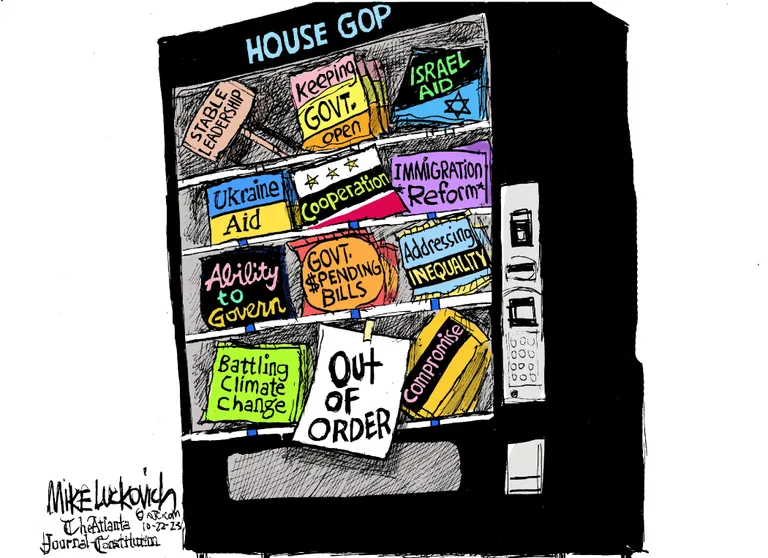
With several looming crises demanding Congress’ immediate attention,
the House of Representatives has been frozen for three weeks,
with no end in sight.
Quick review. Matt Gaetz moved to kick Kevin McCarthy out of the speaker’s chair three weeks ago. Eight Republicans and all the Democrats voted yes, so McCarthy was out. Then Steve Scalise tried to unify the Republican conference around his bid to be speaker, but he saw that wasn’t working and dropped his candidacy before a vote was held.
Next up was Jim Jordan, who had Trump’s endorsement and kept saying he could get the votes, but didn’t. Twenty Republicans voted against him on the first ballot, 22 on the second, and 25 on the third. Then the Republican conference held a secret ballot on whether he should continue, and the majority said no. So Jordan has also withdrawn. [1]
In between Jordan’s second and third attempts, the idea of empowering Speaker Pro Tempore Patrick McHenry came up. His exact powers under the current rules are vague, but are being interpreted narrowly, so that he can only preside over votes to elect a new speaker. The House could allow him to act more like a speaker himself, so that bills could come to the floor and the House could function again. [2] But that idea went nowhere within the Republican conference and never came to a vote on the floor.
Jordan’s third failed vote happened Friday, after which the Republican conference asked him not to continue. He withdrew, an ever-increasing number of obscure Republicans have thrown their names out as speaker candidates, and the Republicans took the weekend off, as if they had all the time in the world. They’ll reconvene tonight to try to find a new candidate, and maybe the whole House will vote sometime.
Meanwhile, the world is not waiting for House Republicans to either get their act together or ask Democrats for help. The Ukrainians and Israelis are undoubtedly running out of certain key munitions, and a government shutdown is looming in less than four weeks.
The Democrats. Meanwhile, House Democrats have stayed united behind Minority Leader Hakeem Jeffries, and Republicans have not sought their cooperation.
On their own, without getting any concessions whatever, Democrats could have helped Republicans save McCarthy or elect Jordan — the only options that made it to the floor where they were allowed to vote. But other than maybe Gaetz or Marjorie Taylor Greene, Jordan is the last person Democrats want to see as speaker, so that was never going to happen. And McCarthy had crossed and double-crossed everybody during his nine months as speaker, so in the absence of a public deal, Democrats had no motive to bail him out of his well-earned troubles. (As one member put it: “It’s not our circus and he’s not our clown.”)
Democrats have been pretty clear about what they want in exchange for getting the Republicans out of this mess. [3] They want a power-sharing deal similar to what the Senate did last term when it was split 50/50: equal numbers from each party on committees (with Republicans as chairs, because the GOP still holds a majority), and some mechanism that would allow either party’s leadership to bring a bill to the floor.
They would probably settle for this much: A speaker who admits Joe Biden won the 2020 election, together with guarantees that the new speaker will
- abide by the spending-levels deal McCarthy made with Biden in May to resolve the debt-ceiling crisis,
- not shut down the government when funding runs out on November 17,
- bring the next Ukraine-aid package to the floor for a vote.
So far, though, Democrats have been offered exactly nothing. Republicans have insisted that they will elect a speaker on their own, which they have been unable to do.
Why are House Republicans doing this? It’s a great question. If you’re pressed for time, you can settle on “because they’re incompetent jerks” and not be wrong.
But I found two essays that offer a deeper understanding: Josh Marshall’s “The Inside Story of How Jim Jordan Broke the Model, Didn’t Become Speaker and Decided That was Fine“, which is behind TPM’s member paywall, and “The game theory of the Republican speakership crisis“, which is on Nate Silver’s Substack blog. [4]
Marshall describes the “stable and functional system” that House Republicans have operated under since the 2010 Tea Party wave election. This system is designed to deal with a particular problem: The mythology of the far Right says that they represent “the American people” [5], but their actual policies — ban abortion, promote fossil fuel use, cut Social Security, abandon Ukraine, expel the Dreamers, ban books about gender or race from schools and libraries, make voting as hard as possible, cut rich people’s taxes — are unpopular outside a few dozen deep-red districts. So the Party needs to have one message for its true believers and another for the general public.
The congressional party is controlled and run by the hard right minority variously called the Tea Party or Freedom Caucus. But they are a bit too hot for national public consumption. They also rely on the idea that their far right policy agenda has broad public support but is held back by a corrupt/bureaucratic establishment. For both of these reasons a system was developed in which this far right group runs the caucus, but from the background, while it is nominally run by a mainstreamish Republican leader. Under John Boehner, Paul Ryan or Kevin McCarthy this basic dynamic remained more or less the same. It works for everybody because the Freedom Party calls the shots while the party maintains broad electoral viability via figureheadish leadership.
Meanwhile the stresses created by the gap between party goals and electoral viability is played out in psychodrama between a cluster of self-styled rebels and the beleaguered leader of the moment. This feature is more important than it looks. The big Freedom Caucus beef with McCarthy was that he couldn’t take the far right legislation they jammed through the House and magically force the Senate to pass it and Biden to sign it. The true believers are thus in a perpetual state of being betrayed by a menagerie of RINOs and other softies who make up the ever-shifting definition of ‘the establishment,’ a fact that keeps the conservative media fundraising water wheel chugging forward.
Making Jim Jordan speaker would have broken this model, which is probably why it didn’t happen. Going into the 2024 congressional elections with Speaker Jordan would be suicide for Republicans in swing districts, and they know it. Meanwhile, members from pro-fascist districts can’t go back to their voters and say they elected a speaker who won’t impose his will on Biden by shutting down the government. So there are really only two possible outcomes:
- A speaker so obscure that both the “Freedom” Caucus and swing-district Republicans can claim they got what they wanted (and express shock if the new speaker does something unpopular in their district).
- A deal with Democrats that “Freedom” Caucus members can cite as a new betrayal by “the establishment”.
Glassman’s take. On Silver’s blog, Nate lets Matt Glassman explain how the House really works: A speaker’s power isn’t primarily located in his or her office, but comes from leading a procedural coalition.
In the modern House, the Speaker almost always has a partisan majority that gives him this deferential backing to create a procedural coalition. That is, backbench members vote in lockstep on procedural matters such as what bills to consider and what rules to consider them under, even if they are opposed to the actual legislation. They do this because the benefits they receive from the party, such as committee assignments, electoral support, and the help of other party members on bills they do like, outweigh the small costs of occasionally having bills on the floor they oppose. Bucking the party on procedural votes is a serious transgression.
In turn, the empowered leadership supports the backbenchers, by raising massive sums of money and spreading it around to campaigns, by protecting the Members from tough votes from coming up on the floor, and by developing a party program and negotiating deals between party factions, as well as with the Senate and president.
McCarthy’s problem during the 118th Congress was that he never had a stable procedural coalition.
So McCarthy was a Speaker In Name Only.
To Glassman, then, the question is bigger than just the one-day problem of electing a speaker: Going forward, does the majority that elects the new speaker represent a new coalition that the speaker can call on day after day to govern the House? If not, the chamber will soon be back in the same soup.
This is why it never made any sense for McCarthy to seek Democratic votes to bail him out when his partisan procedural coalition was failing. If Democrats had helped McCarthy win the Speakership in January—perhaps by voting present, as many observers suggested they could do in exchange for some goodies—it might have won him the office, but it would have left him in the exact same bind on the very next vote (the vote on the rules package). Unless he was willing to create a permanent procedural majority coalition with the Democrats, there was no point in getting their help that one time. His only choice was to try to make peace with the GOP rebels. Ditto on the resolution to vacate the Speakership.
Likewise, unless Democrats were ready to form a lasting coalition with McCarthy, it made no sense to save him.
McCarthy didn’t need one vote, one time. He needed an ongoing procedural coalition. Unless the Democrats were going to form a permanent alliance with him, saving him on the vacate vote wouldn’t have done any good.
Glassman notes the same far-right dynamic Marshall pointed out: Unlike the GOP moderates, the “Freedom” Caucus has a narrative that works either way:
In fact, the core brand of the Freedom Caucus is their opposition to the GOP House leadership. It’s almost impossible for the party leadership to discipline HFC members and induce party loyalty, because they prefer to be at odds with the leadership; defeating their policy proposals, cutting them out of negotiations, or calling them out publicly as disloyal to the party only serves to reinforce their brand among their constituents and allies in conservative media. …
And so the story of the 118th Congress has largely been one of the Freedom Caucus holding the GOP leadership hostage, forcing leadership to either sign on to their extreme conservative populist agenda—one that has no chance of policy success in the Senate or with President Biden—or see their procedural majority fall apart. There’s no compromise. You either do what they want, or you go work with the Democrats after they abandon you. It’s a win/win for them, in any case. They either get their policies, or they get their betrayal narrative.

Hardball competition. Most of the time, the competing wings of the GOP resemble the two women who came to Solomon claiming the same baby: When Solomon announced his decision to cut the baby in two, one woman was satisfied and the other withdrew her claim so that the baby might live. [6]
In my analogy (which Glassman doesn’t make), the baby is the country, the “Freedom” Caucus is the first woman, and the GOP establishment is the second. Again and again — the debt ceiling crisis is the most recent example — the far Right has shown itself willing to let the country come to harm if that’s what’s necessary to get their way.
They thought their tactics would work here: In the medium-to-long term, the country faces disaster with no speaker and a frozen Congress, and the Republican Party faces electoral disaster if its dysfunction keeps bringing this level of chaos while the whole world watches. So obviously the establishment Republicans would have to give in and let Jim Jordan take the gavel. With no Solomon in the picture to reward those who actually care about America, how could Jordan lose? Scalise played his assigned role as Solomon’s second woman and withdrew his claim, leaving Jordan as the only choice.
And that’s where the narrative changed. Such a blatant display of independence-for-me, party-loyalty-for-you was too much for a small group of moderates and Republicans interested in governing (like Appropriations Committee Chair Kay Granger, who is the point person on the issue of keeping the government open).
And this is the upshot to the first roll call vote on Jordan’s Speakership candidacy: a group in the GOP besides the Freedom Caucus decided to play hardball. The longstanding asymmetry and Freedom Caucus monopoly on hardball behavior may be coming to end.
Glassman has no idea how this resolves. He lays out four possibilities, one of which (Jordan grinding out an eventual victory the way McCarthy did in January) has already failed. The other three are:
- Republicans come up with a candidate so obscure that all factions can spin his/her speakership as a victory. There’s a certain beer-goggles effect needed to bring this about: It’s getting late and they’ve got to go home with somebody. [7]
- Moderates make a deal with Democrats.
- There’s a bipartisan deal to empower McHenry, so the House can do business without a permanent speaker.
Glassman leans towards the third option, while recognizing that (like the other two) it’s just a band-aid: There’s still no governing coalition that can keep the House functioning.
[1] Tim Miller comments:
Is there a better encapsulation of the GOP elected officials during the Trump years than Jim Jordan winning 194-25 GOP votes in the public ballot and then losing the majority by secret ballot?
Miller is referring to the level of intimidation the GOP’s far right wields against the rest of the Republican caucus. At times this goes as far as physical threats, like those Don Bacon, Mariannette Miller-Meeks, Carlos Gimenez, and others complained about after opposing Jordan.
I want to sympathize with Bacon et al, but did they really not know until now that their party’s base is full of violent fascists? Wasn’t the attack on Nancy Pelosi’s husband a clue? Clearly, they just never thought the leopards would eat their faces.
For the record, Jordan has denounced threats against his opponents. But I’m not impressed. Back in the heyday of lynchings and the KKK, Southern states would send distinguished gentlemen to Congress, who of course would express horror about what the ruffians back home were doing. It meant nothing then and it means nothing now. Jordan plays to and postures for the violent Right, just as the Southern gentlemen did then.
[2] Article I Section 5 of the Constitution says, “Each House may determine the Rules of its Proceedings.” So the House can do whatever a majority of its members want, assuming a majority can be found to want something.
[3] Of course they’d be thrilled if a handful of Republicans would join them to make Jeffries speaker, but I don’t think even the Democrats who make that suggestion consider it a serious possibility.
[4] Substack will ask you to pay to subscribe to Silver’s blog, but it will let you click through without subscribing. BTW, I’m developing a policy on Substack subscriptions: I’m shameless about clicking through once or twice, but the fourth or fifth time I consult the same blog I usually subscribe.
[5] As Rep. Russell Fry said of Jim Jordan: “The American people trust him.” Clearly, Rep. Fry does not consider me an American.
[6] For those who don’t recall the rest of the story, Solomon’s first judgment was just a test. After he saw the women’s responses, he concluded that the woman who was willing to lose her case to save the baby’s life was the real mother.
[7] Matt Ygelsias jokes about the current list of nine candidates:
At least four of these people aren’t real, they’re just making up names.
 The Weekly Sift
Comments
The comparison with Solomon is priceless!
Re: “Is there a better encapsulation of the GOP elected officials during the Trump years than Jim Jordan winning 194-25 GOP votes in the public ballot and then losing the majority by secret ballot”:
To be fair, there’s not necessarily any hypocrisy in voting for Jordan in a ballot to choose the speaker because you want him as speaker but voting against him as the candidate to put on the ballot for speaker because you know he won’t win.
Doug, your gift for metaphor and analogy is one of my favorite aspects of your work. I agree with the commenter above: that Solomon analogy is fantastic!
And so an obscure, reactionary politician, with beliefs and views abhorrent to most Americans, is now second in line to the presidency. I didn’t have that on my Bingo card.
Jim Jordan, but with a more pleasant personality
Will Mike Johnson have a stable procedural coalition? Can one rep. still force a vote to oust him?
I don’t think they haven’t changed the original rules they made in January. So the answer is YES to if one member can force a vote to dump Johnson.
Trackbacks
[…] This week’s featured post is “The House, still divided“. […]
[…] there’s more to think about here than just Johnson. Last week I may have raised your hope that non-MAGA Republicans had found their backbones. I apologize. After […]