On many Mondays, I complain in the teaser about how much news there is to cover. This week, though, I have a sense that we’re all waiting for something to happen.
Georgia is widely expected to indict Trump for tampering with its 2020 election, but not until next month. Jack Smith is looking at the same set of facts, but his timetable is unknowable. The standing indictments against Trump in New York and Florida won’t come to trial anytime soon. Meanwhile, the GOP presidential campaign is on, but the first debate won’t happen until late next month, and the first actual votes are half a year away.
Congress is about to come back into session, with lots to get done if it’s going to avoid a government shutdown in October. The Ukraine summer offensive is underway, but there have been no major swings on the battlefield yet. Climate change continues its inexorable grind, with record heat and flooding, but no city-destroying hurricanes at the moment. There are new stories of Clarence Thomas living the high life at the expense of rich “friends”, but when aren’t there?
It’s tempting to take the week off.
Instead, I’m going to write another article about judicial rulings. Last week, the Supreme Court gave me a lot to comment on. But while they’re out of session now, other courts continue to make news. Two rulings stand out, one positively and the other negatively.
The positive news is a remarkable protest against last year’s pro-gun Bruen ruling and the Supreme Court’s originalism in general, written by District Judge Carlton Reeves of Mississippi. Reeves protests the gun-rights ruling by applying it. The subtext of his ruling (dismissing a case against a former felon who owned a gun, in violation of a 1938 federal law) virtually screams “this is stupid, but it’s what I have to do to follow the precedent”. He ends with a plea for the Supremes to apply the same expansive standards to other constitutional rights (like voting) that they’ve applied to gun ownership.
The negative legal news is a Trump-appointed judge’s injunction ordering large swathes of the federal government to have no contact with social media companies. The ruling repeats a litany of alleged examples of the government suppressing conservative speech, with no fact-checking. It takes seriously various conspiracy theories about malign Biden administration intentions, and completely ignores the interest of the government in minimizing the spread of dangerous misinformation.
I’ll cover both in one article, which should be out between 10 and 11 EDT.
The weekly summary will cover the hottest week on record, some things I learned from last week’s Moms For Liberty convention (which I didn’t attend), what a flap in Oklahoma points out about anti-CRT laws, Marjorie Taylor Greene’s exit from the Freedom Caucus, and a few other things. It should appear around 1.
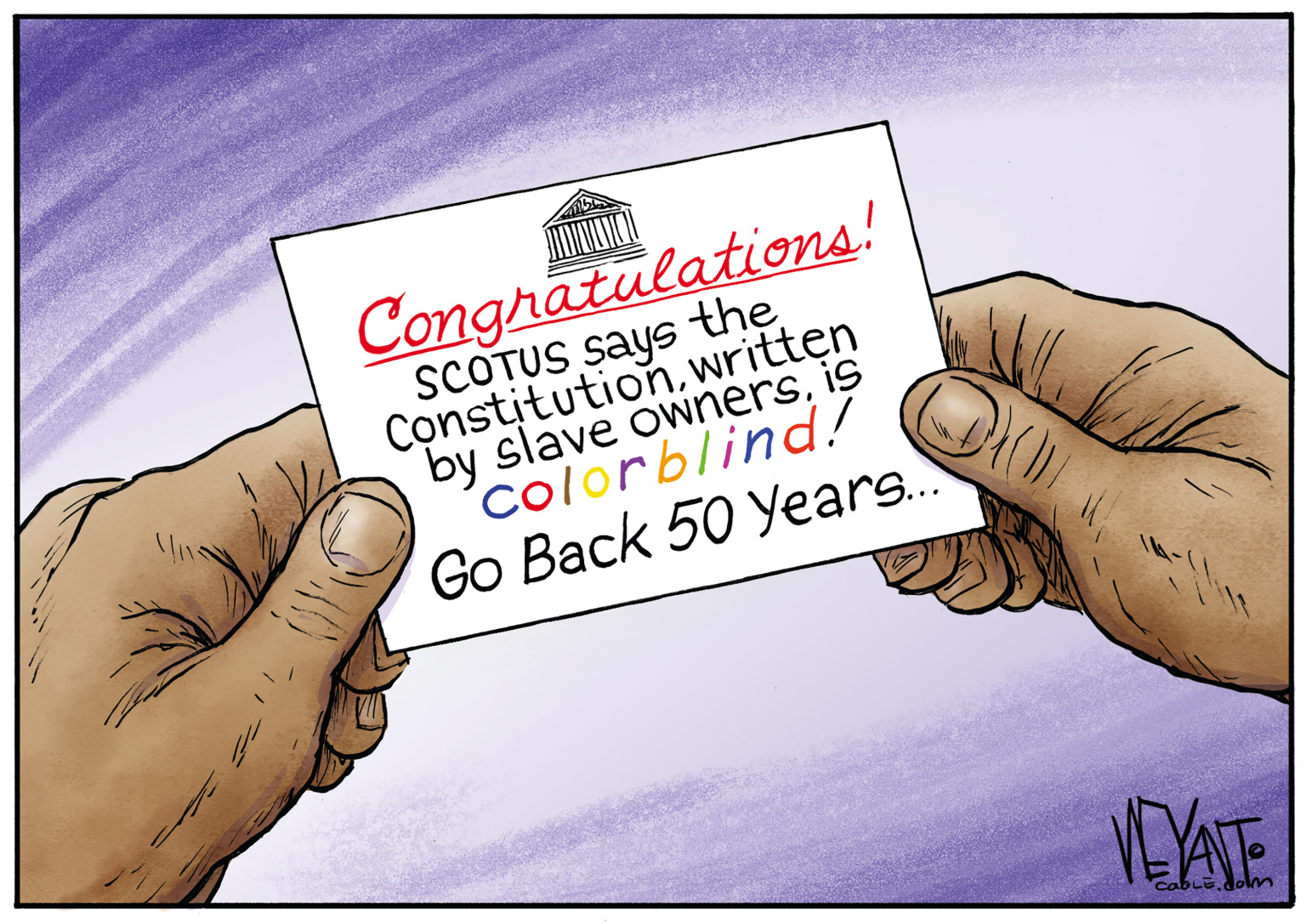
Ignoring race will not equalize a society that is racially unequal. What was true in the 1860s, and again in 1954, is true today: Equality requires acknowledgment of inequality.
This week everybody was talking about the Supreme Court
As usual, and as I predicted last week, the Court saved its most controversial decisions for last. In the featured post, I examined how the Court is throwing off any restraint on its power. For a case-by-case analysis, I’ll refer you to a series of articles by Vox’ Ian Millhiser.
Another angle not covered in the featured post is what happens next. On student loan relief, President Biden has not given up. His Department of Education is working on a new approach based on a different law.
On LGBTQ rights, the ball is in the bigots’ court. As I explained in the featured post, the 303 Creative case was vaporous, so there are no immediate consequences: Maybe Lorie Smith will start her wedding website business and maybe it will discriminate, but who really cares? Her case was a stalking horse for future discrimination, and we’ll have to wait and see what that discrimination entails.
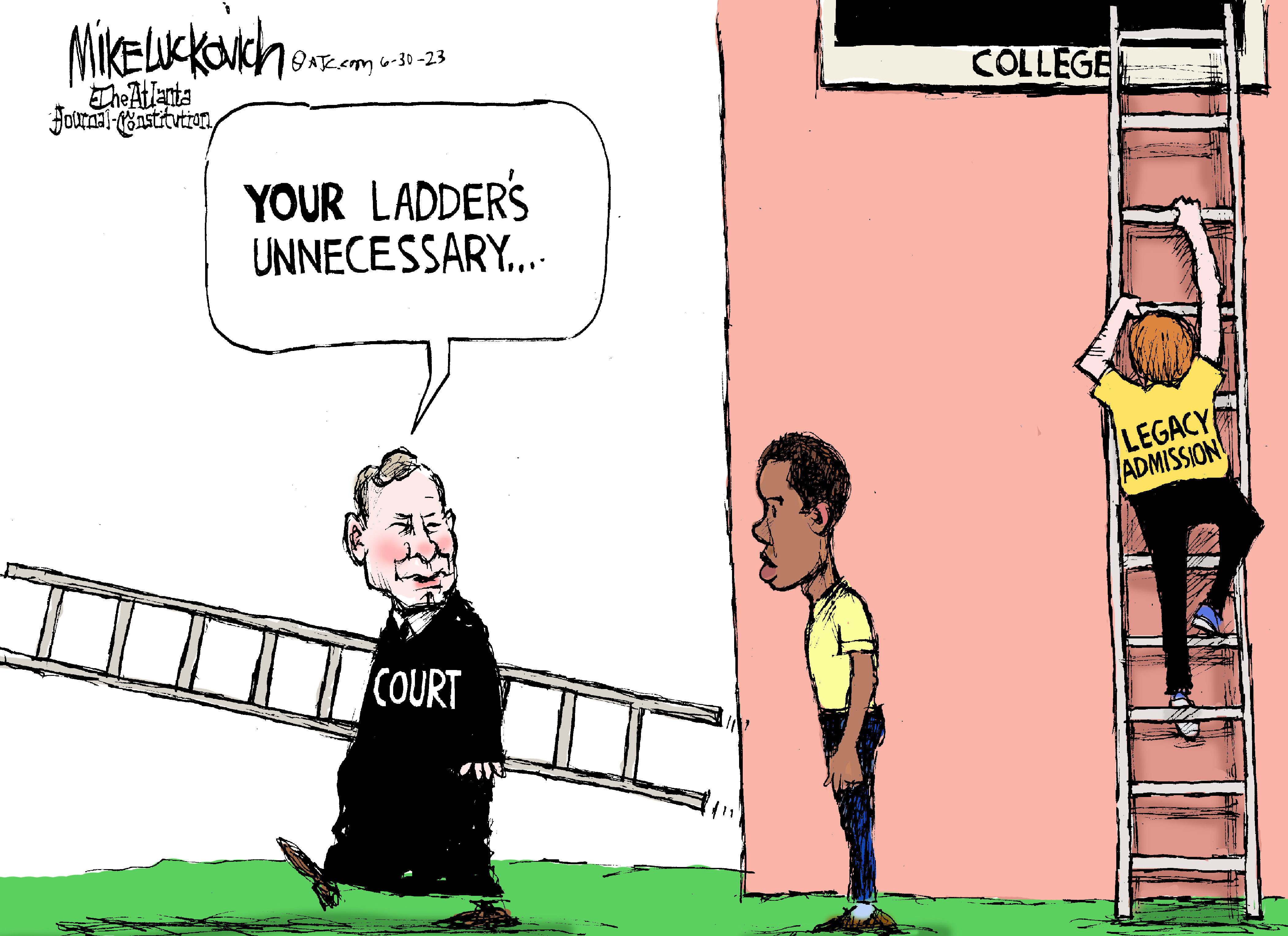
The affirmative action case is immediately consequential if you hope to attend a university in the coming years. The first thing to look for is what each institution’s new admission policy is, and whether they try to achieve the goal of a diverse student body in some other way — say by focusing on class rather than race, or recruiting a more diverse applicant poll, or something else.
Whatever they do, it seems likely that Black and Hispanic enrollment in elite universities and professional schools will drop, at least in the near term.
A few people on my social media feed have suggested an intriguing idea: What if some religion-affiliated university claims that its religious mission requires a diverse student body? How would the Court handle a religious-freedom defense of an affirmative-action admission policy?
“Georgetown, the oldest Catholic and Jesuit university in the nation, was founded on the principle that engagement between people of different faiths, cultures and beliefs promotes intellectual development, an understanding of service and solidarity, and a commitment to the common good,” says Georgetown President John J. DeGioia. “Our Jesuit tradition of education recognizes the value of diversity as necessary to education and in our work to shape future leaders who will make invaluable contributions to our national and global communities.”
At Notre Dame, our Catholic mission compels us to build a class reflecting the diversity of experiences and gifts of the human family. We undertake a comprehensive assessment of applicants, admit talented students with interests and aspirations consonant with our mission, and provide opportunities for a wide range of young people. These commitments are as meaningful today at Notre Dame as they were yesterday. We will study the Supreme Court’s decision and consider any implications for our admissions process as we strive to fulfill our distinctive mission.
In the background of the affirmative action debate is a national sense of disappointment. In the 1960s, it was easy to imagine that our racial caste system needed a legal framework. Once Jim Crow and various other legally enforced discrimination ended, many of us expected things to equalize. In a generation or two, race truly would not matter.
By now it’s obvious that didn’t happen. So we’re seeing a number of possible responses:
Pretend it did happen. This seems to be Chief Justice Roberts’ approach: It’s been such a long time, racism must be over by now.
Blame Black people: We really did level the playing field, so anybody who can’t climb the meritocracy must just lack merit.
Blame White people: Prejudice is so strongly ingrained in Whites that we can’t let Blacks succeed.
Look for structural inertia. Once a caste system takes root, it manifests in more places than just the law. It was naive to think that ending blatant legal discrimination would fix everything.
Personally, I’m a structuralist. White prejudice still persists and still matters; I can see it in myself, for example. But I don’t think the personal prejudices of individual Whites are the main force keeping Black people down.
Some of the best short-form political satire comes from the NYT Pitchbot, which suggests articles for the New York Times to pursue:
Opinion | Without the burden of affirmative action, Harvard can finally become a true meritocracy by Jared Kushner and Robert F. Kennedy Jr.
and Bidenomics
It goes without saying that the Biden administration doesn’t hype itself as often or as well as the Trump administration did. Trump is a natural braggart and showman, while Biden has consistently focused more on governing than on taking credit.
In part, not taking credit is part of Biden’s governing strategy: He has gotten a surprising amount of Republican cooperation on stuff like infrastructure and technology precisely because he leaves the focus on infrastructure and technology rather than making it all about himself. Trump, on the other hand, consistently failed to get programs through Congress, even when his party controlled both houses.
The result is that Biden consistently runs behind Trump in polls about managing the economy, in spite of the fact that Biden’s record is pretty darn good: Trump handed him a terrible economy in 2021, and yet the predicted recession never comes and jobs continue to be created at record rates. Trump’s economic record can be summed up in two lines: Obama left him a growing economy with room to run, and Mitch McConnell let him run big deficits that he would have rejected under a Democratic president. Nothing else about the Trump administration made much economic difference.
But it’s nearly impossible to get reelected without claiming credit for things, so Biden has begun to lay claim to a term Republicans have been using as an insult: Bidenomics.
Bidenomics isn’t just a slogan and a set of graphs. It actually means something that should be popular if people hear its message. Ever since Reagan, the economy has been run under a trickle-down theory: Make sure rich people have lots of money and hope they invest it in things that create jobs. That was the logic of Trump’s tax cut, which went almost entirely to corporations and the rich.
Biden’s vision is to build the economy “from the middle out and the bottom up“. The three legs Bidenomics stands on are: public investment in infrastructure and future oriented industries like sustainable energy; empowering the workforce through training and unionization; and promoting competition through antitrust enforcement.
Pro-science podcaster Skepchick (Rebecca Watson) lines up on the don’t-debate-kooks side of the Peter Hotez/Joe Rogan/RFK Jr. controversy that I discussed last week. In case you imagine RFK Jr. can’t really be that bad, Rebecca summarizes what he said on Rogan’s show (“to which Joe Rogan responded with a pathetic, open-mouthed gape”).
vaccines cause autism, vaccines contain mercury, ivermectin cures COVID, “Big Pharma” “had to destroy” ivermectin to get emergency use authorization for vaccines, all the studies showing no benefit to ivermectin are fake, taking the COVID vaccine makes you “21 percent more likely to die of all causes,” he’s being silenced by “Big Pharma,” and oh yeah, wifi “radiation” ALSO causes autism plus food allergies, asthma, and eczema while “degrad(ing) your mitochondria and (opening) your blood-brain barrier.”
I can understand Democrats worrying about Biden’s age, or wishing the liberal worldview had a more charismatic advocate. But seriously, is that what you want in a president?
and let’s close with something pop cultural
As the Oppenheimer movie opens, let’s flash back to Oppy’s previous pop-culture appearance: his rap battle with Thanos.
You may or may not care about affirmative action, LGBTQ rights, or student debt. But this week’s Supreme Court rulings should disturb you anyway.
Until this week, the final week of its annual term, the Supreme Court seemed to be backing away from the rogue behavior of last year, in which it had repeatedly ignored precedent, invented fanciful readings of history, and generally found excuses to go wherever its right-wing ideology might lead.
Recall that last year, the Court didn’t merely eliminate abortion rights, its logic in Dobbs rejected the doctrine of substantive due process, potentially setting up the elimination of all rights that rely on that doctrine: same-sex marriage, access to birth control, the right of consenting adults to choose their own expressions of sexuality, and many others. In Bruen, it not only threw out a century-old New York State gun control law, it cast doubt on all gun-control laws that are not “consistent with the Nation’s historical tradition of firearm regulation” as Justice Thomas interprets that history. The direct impact of Carson might have been small — a religious school in Maine will get a small amount of state money — but the decision blew a huge hole in the wall between Church and State. Who can say what rude beast will slouch through that hole in the future?
Until this week, the Court seemed to be charting a more moderate course this year. Perhaps, some speculated, it had been stung by the backlash to last year’s rulings. (Dobbs in particular became a major issue in the 2022 midterms, and probably prevented Republicans from regaining control of the Senate. Supreme Court justices are supposed to be above caring about such partisan outcomes, but Chief Justice Roberts clearly does care.) Or perhaps the conservative majority was sensitive to the damage the Court’s reputation has suffered from the exposure of the blatant (and unpunished) corruption of Justices Thomas and Alito.
Maybe, it seemed, this Court wasn’t as bad as we had thought.
I will give myself credit for remaining suspicious. Last week I wrote:
My guess is that Roberts has manipulated the calendar so that the Court’s most controversial decisions will come last. The cases decided recently have been divided between liberal and conservative wins, building up Roberts’ “centrist” credibility.
Unlike last year’s Dobbs decision, though, none of these cases strikes a live wire of American politics. The direct victims of these decisions — Black students hoping to get into a good college (or go to college at all), young people drowning under student debt, and LGBTQ people wanting not to be second-class citizens — are probably not going to swing the 2024 elections the way that previously Republican suburban women swung the 2022 elections by staying home or supporting Democrats. Blacks, the young, and LGBTQ voters are already Democratic constituencies that partisan Republicans (like John Roberts) probably don’t mind pissing off.
So while it’s tempting to dive into the details of each case, point out the dubious logic the majority employs, and quote extensively from the ringing dissents by Justices Sotomayor, Jackson, and Kagan, I think that approach misses the larger story and would probably make many readers’ eyes glaze over. But looking at these three rulings as a whole, and setting them in the context of last year’s decisions, reveals a larger pattern that should disturb everyone: This Court is increasingly untethering itself from all traditional restraints on judicial power.
What limits the Supreme Court? A quick reading of the Constitution might leave you with a modest view of the powers of the Court. The Constitution establishes Congress in Article I, the presidency in Article II, and the judiciary in Article III, giving a hint that the Founders saw it as the least important and least powerful of the three branches of government. While the powers of Congress and the President are spelled out at length, Article III is much shorter, and about half of that space is taken up guaranteeing trial by jury and defining treason.
However, the Constitution left one important power unassigned: Congress writes the laws and the President enforces them, but who says what the law is? When statutes seem to contradict each other or the Constitution, who sorts things out?
The unique property of judicial review is that this power is virtually unchecked by the other branches or by the People. If Congress can muster a supermajority, it can remove justices by impeachment, or it can start the constitutional amendment process. But otherwise, there’s not much anyone can do about the Court’s ruling that some act is unconstitutional. The Court is literally supreme; there is no further appeal.
And in some situations that’s obviously a good thing. Like me, you may think the Court got Bush v Gore wrong. But even I have to admit that somebody has to have the last word on a disputed election. Otherwise we’ll end up fighting in the streets.
In the absence of the usual checks and balances, the Court is restrained by a number of its own traditions:
precedent. The doctrine of stare decisis (literally, “let the decision stand”) requires that in the absence of a clear error, courts are obliged to view each new case through the lens of past decisions. The interpretation of the laws should not change from case to case or judge to judge.
standing. The Court cannot insert itself into every issue on which its majority has an opinion. The Court has to wait until someone brings it a case, and the party bringing the case can’t just be a convenient busybody; the case must be brought by someone who has a direct interest in its outcome.
rules of interpretation. The Court’s rulings cannot be based purely on its own opinions and intuitions. Rulings have to be tied to specific laws, and the way legal terms and phrases are interpreted is also subject to stare decisis.
respect for lower courts. In the absence of clear error, the Court should respect the findings of lower courts. In particular, when lower courts have held extensive hearings on the facts of a case, the Court should not ignore those findings and collect its own facts.
What we’ve seen these last two years, and saw particularly this last week, is an increasing disregard of these constraints. Even Americans who don’t care about this week’s cases (or agree with their outcomes) should find that disturbing. Without these constraints, the Supreme Court comes to resemble the Supreme Leader of Iran — an unelected and unaccountable authority with lifetime tenure that has the power to weigh in wherever it chooses.
Standing. Two of this week’s major cases had standing issues that made them almost laughable. The Court had no business hearing either one.
In the student-loan-forgiveness case, the HEROES Act of 2003 gives the Secretary of Education the power to “waive or modify” the terms of student loans for borrowers affected by a national emergency. The Biden administration proposed to use this law and the declared emergency of the Covid pandemic to forgive up to $20,000 of loans for borrowers making less that $150K a year.
If you don’t owe student loans yourself, or you make more than $150K, you may not care about this policy. You may even think it’s a bad idea; many people do. But how did this issue make it to the Supreme Court? Because the Biden administration was sued by the Republican attorneys general of six states.
But wait: Why are the states anything more than busybodies? They don’t make the loans or collect the payments. What injury do they suffer if the federal government forgives student loans? (And notably, none of the six — or any other state — sued when the Trump administration used the same law and the same emergency to suspend loan repayments in 2020. Their interest is not to redress some injury they’ve suffered, but to thwart the Biden administration.)
In his majority opinion, Chief Justice Roberts accepts a ridiculous argument that Justice Kagan completely demolishes in her dissent: One of the six states, Missouri, had created an independent public corporation, the Missouri Higher Education Loan Authority (MOHELA), to administer student loans. MOHELA contracts with the Department of Education to service loans, and its fees might decrease by $44 million next year if the loan forgiveness goes through. So MOHELA potentially suffers an injury and has standing to sue.
However, as Justice Kagan points out, Missouri is not MOHELA. Missouri created MOHELA to be financially independent, and gave MOHELA its own power to sue, which MOHELA has chosen not to do. MOHELA has not even submitted an amicus brief; it has shown no interest in this case whatsoever.
Is there a person in America who thinks Missouri is here because it is worried about MOHELA’s loss of loan-servicing fees? I would like to meet him. Missouri is here because it thinks the Secretary’s loan cancellation plan makes for terrible, inequitable, wasteful policy. And so too for Arkansas, Iowa, Kansas, Nebraska, and South Carolina. And maybe all of them are right. But that question is not what this Court sits to decide.
In short, the State of Missouri and its conservative attorney general are convenient busybodies that the Court used to insert itself into a public-policy debate that was none of its business. (The justification of its decision was also specious, but we’ll get to that later.)
The challenge to Colorado’s anti-discrimination law was even flimsier: A graphic designer in Colorado (Lorie Smith) has a one-woman corporation (303 Creative) that creates websites for products and events. She wants to start offering wedding-announcement websites, but claims that her “Christian” beliefs will not allow her to work with same-sex couples. This religion-based bigotry, she fears, will put her in violation of Colorado’s anti-discrimination law, so she is seeking an injunction to prevent Colorado from enforcing the law against her.
Picture the situation: Smith currently has no wedding-website-design business, and we don’t know that she ever will. That prospective business has no clients yet, and no same-sex couples are seeking to become its clients. So she has not rejected any same-sex clients, and the State of Colorado has had no occasion to cite her with any violation.
So what’s this case about?
For comparison, it’s as if the Scopes Monkey Trial had taken place after John Scopes merely thought about teaching evolution, or Plessy v Ferguson had gone to the Supreme Court without Homer Plessy ever trying to board the whites-only train car. Maybe Jane Roe could have challenged Texas’ abortion laws as soon as she and her husband started thinking about having sex.
You might also wonder how such a small operator gets such a weak lawsuit all the way to the Supreme Court. (Could you do that if you were imagining starting a business?) It’s simple: Smith’s suit was taken up by the Alliance Defending “Freedom”, which is part of the network of right-wing legal organizations clustered around Leonard Leo, the matchmaker who introduced Justices Thomas and Alito to their billionaire sugar daddies, and spent millions of dark money on ads to block the appointment of Merrick Garland to the Court while pushing for the approval of Justices Gorsuch, Kavanaugh, and Barrett.
From ADF’s Christian-nationalist point of view, the vaporous nature of the case is in fact an advantage. If Smith had actually violated the anti-discrimination law, some same-sex couple would be her victims. They might appear on TV shows and garner sympathy from the general public, which overwhelmingly disapproves of bigotry and discrimination. But instead, ADF can cast Smith as a victim of the state, albeit in a purely theoretical sense.
And since the case has no actual facts, the Court’s majority can frame its hypothetical facts however it wants.
In this case, Colorado seeks to force an individual to speak in ways that align with its views but defy her conscience about a matter of major significance.
Kagan’s dissent disputes that characterization, but who can say? Colorado has not taken any real-world action at all, so whatever it might be “seeking” in some future timeline is open to any conjecture.
In this reality, though, Smith has suffered no injury and has no standing to sue anybody. But none of that matters, because this Court will rule on whatever issues it wants, whether anyone has brought it a legitimate case or not.
Precedent. Other than its direct effect on the lives of millions of American women, including endangering the lives of a not-inconsiderable number of them, the most striking thing about last year’s Dobbs decision was that nothing of significance in the external world had changed since the last time the Court had reviewed abortion rights. But the Court had new justices, so there was a new outcome.
That’s exactly what stare decisis is supposed to prevent.
But OK, you could imagine that was a one-off: Maybe Roe was just an unusually poorly decided case that needed to be reversed. It happens. As Justice Kavanaugh reminded us during the oral arguments in Dobbs, some of the Court’s proudest decisions are reversals of mistakes, like when Brown reversed Plessy’s separate-but-equal ruling.
But the longer we watch this Court, the more obvious it becomes that precedent has lost its power. When precedents can be used to support a desired conclusion, (like Justice Harlan’s reference to a “colorblind constitution”) they are quoted with great respect, though not always in proper context. (Harlan was objecting to race-based rules that maintain the power of the dominant caste, not ones that undermine that power.) But inconvenient precedents are just mistakes to be rectified.
In the affirmative action case, for example, little of legal significance has changed since the Grutter decision of 2003.
In a majority opinion joined by four other justices, Justice Sandra Day O’Connor held that the Constitution “does not prohibit the law school’s narrowly tailored use of race in admissions decisions to further a compelling interest in obtaining the educational benefits that flow from a diverse student body.”
But the composition of the Court has changed since 2003, so O’Connor’s conclusion no longer holds. The benefits of a diverse student body are the same as they were 20 years ago — if anything, they are becoming more significant as the US becomes less white and the world economy more globalized — but today those benefits are, in Chief Justice Roberts’ words “not sufficiently coherent for purposes of strict scrutiny”. Roberts instead constructs a Catch-22: If the needed amount of diversity can be quantified, then it is a quota, which is illegal. But if it can’t, then the concept is too incoherent to constitute a compelling interest.
Roberts won’t say it, but Justice Thomas will:
The Court’s opinion rightly makes clear that Grutter is, for all intents and purposes, overruled.
Respect for lower courts. The affirmative action decision is a daunting read: 237 pages long. One reason it has to be so long is that Roberts’ majority opinion ignores the inconvenient factual findings of the district court, which were upheld by the appellate court. Instead, he pulls facts from the plaintiff’s (SFFA’s) filings and other sympathetic sources, which the dissents then need to refute by compiling their own facts. Sotomayor’s dissent cites examples like this one:
The Court ignores these careful [district court] findings and concludes that Harvard engages in racial balancing because its “focus on numbers is obvious.” Because SFFA failed to offer an expert and to prove its claim below, the majority is forced to reconstruct the record and conduct its own factual analysis. It thus relies on a single chart from SFFA’s brief that truncates relevant data in the record. That chart cannot displace the careful factfinding by the District Court, which the First Circuit upheld on appeal under clear error review.
Roberts never explains why the district court’s findings are unreliable. He just doesn’t like them, so he doesn’t mention them.
Rules of interpretation. The rhetoric of conservative legal scholars is all about strictly constructing the exact text of the laws. Conservative Supreme Court justices often refer to their interpretative technique as “textualism” or “originalism” — the notion that phrases in the laws and the Constitution should be interpreted as they would have been commonly understood at the time the words were written.
You might expect that this responsibility to read the text closely would limit the power of judges to insert their own views into the law, but as practiced by the current justices, it does the exact opposite. Understanding how words were commonly understood at some point in the past is a job for historians, and the justices are not historians. Nor do they typically respect the consensus of the people who are historians.
Instead, we are treated to excursions into history that — voila! — always reach the desired result. If you’ve ever delved deeply into history yourself, you should understand how unlikely this is. History, researched honestly, frequently jars your preconceived notions. But the conservative justices are never jarred off their favored course.
Two of last year’s cases model how this works: Justice Alito justified his Dobbs decision with examples going back to the Middle Ages (because of course we should be guided by medieval views of women’s rights). But when Justice Thomas (writing for Alito as well as himself) overturned a New York gun-control law in Bruen, gun-control history from the 1600s was too early to matter and Wild West gun control too late. Inconvenient laws and rulings from the era Thomas focused on were “outliers” or “clearly erroneous”. And so Thomas also found historical backing for his interpretations.
This week’s student-loan decision presented an example of another “doctrine” that the Court has invented out of whole cloth to increase its own power: the major questions doctrine. The major questions doctrine is violated whenever an executive agency makes a ruling that seems to the Court to be too big for the provision in the law it cites. Congress, the justices decide, couldn’t have intended to put so much power into such a small package.
In other words, major-questions is a way for the Court to second-guess both executive agencies and the text of the laws.
In the student-loan case (which, as I noted above, the Court had no business considering at all), Congress passed the HEROES Act in 2003 to give the Secretary of Education special powers over student loans during a national emergency. It was a sequel to laws passed in 1991 and 2002 that responded to specific emergencies (the Gulf War and 9-11).
Self-evidently, it is the nature of emergencies to be unforeseen, and bigger emergencies will require bigger responses. Congress surely knew this in 2003.
The Covid pandemic was an emergency affecting the entire country, and it justified trillions of dollars in relief spending. But Chief Justice Roberts applies the major-questions doctrine to Covid-related debt cancellation and finds that it is too big. Congress could not have intended to delegate that much power.
He bases this conclusion on nothing in the law itself. Congress could have put a cap on emergency responses or limited them in some other way, but it didn’t.
As Justice Kagan points out in her dissent, Congress may have been unwise to delegate so much power, and the Biden administration’s attempt to use that power could also turn out to be unwise. Voters might have come to that conclusion and disciplined the politicians responsible in future elections.
But voters won’t have to make that judgment, because the Court — based on nothing — has inserted itself into the debate and made that judgment for them.
Conclusion. In short, the text of the law matters — unless it can be explained away with historical hocus-pocus, or unless the Court’s retrospective mind-reading reveals that Congress could not have intended some particular use of the law it wrote. Precedent matters if it can be construed to support what the conservative majority wants to do, but otherwise it is a mistake to be fixed. Standing doesn’t matter at all any more; if the Court wants to weigh in on a topic, it will find a way to do so. And facts? Well, the best cases are ones that have no facts, because they provide the most open fields for judgment.
These are the principles the current Court operates under. If that doesn’t bother you, you haven’t been paying attention. Or maybe you envy the way Iran has structured its government.
The last week in June always has an obvious news theme: It’s the final week of the Supreme Court’s term, so the news is dominated by a flurry of controversial decisions. Last year the Court went out with a bang, eliminating abortion rights, striking down a century-old gun control law, and blowing a big hole in the wall between Church and State. In each case, the boundaries of the decision were unclear; the logic of the majority invited future cases that could be even more consequential.
This year the Court also went out with a bang, but none of the decisions are likely to strike as live a wire as last year’s anti-abortion ruling. The targets of this year’s attacks — LGBTQ people, Blacks hoping to go to college, and young people drowning under student debt — may be outraged, but the vast mass of the electorate will probably shrug and move on. Most of the Court’s victims probably weren’t going to vote Republican anyway, so politically, what difference will it make?
So I decided to shift my coverage in a more abstract direction. Even if you are unaffected by the specific cases decided this week, the Court’s behavior should bother you, because it is systematically blowing through all the traditional restraints on its power. Aspects of the law that the general public considers arcane (like standing and precedent) are being cast aside. And new interpretative principles (like the major questions doctrine) are being instituted. The result is to give the Court’s conservative majority the power to intervene anywhere it wants and come to any conclusion it desires.
That’s a problem, and I’ll try to explain why in “The Court Unleashed”, which should be out between 9 and 10 EDT.
Reading the nearly 400 pages of the week’s three major decisions took up an inordinate amount of my time this week, so the weekly summary should be short. I’ll try to get it out by noon.


 The Weekly Sift