
The United States shall guarantee to every State in this Union a Republican Form of Government
– US Constitution, Article IV, Section 4
This week’s featured post is “Democracy Returns to Michigan“.
This week everybody was talking about the Omicron surge
The vertical ascent in the case-count continued this week, reaching record levels. New cases are averaging over 400K per day, a record, more than tripling in the past two weeks. Hospitalizations are at 93K, up 35%. Deaths remain relatively flat, averaging 1254 per day, down 3%.
Bad as the case numbers are, the surge is still primarily restricted to the big cities east of the Mississippi. (Miami-Dade County in Florida is leading the pack with 525 new cases per day per 100K people. NYC isn’t far behind at 442.) You know it won’t stay there.
Hospitalizations and deaths always lag increases in new cases by 2-3 weeks, but the case-count started upwards around Thanksgiving, more than a month ago. So maybe Omicron is a less deadly variant. Maybe hospitalizations won’t skyrocket and deaths will flatten out.
That optimistic take is still speculative, but a theory I mentioned last week got some confirmation this week from animal studies: Omicron isn’t as likely as previous Covid variants to go deep into the lungs. That would explain the lower death toll. But animals aren’t people, so that opinion should still be held lightly.
Putting aside the possibility of death, the other nightmare outcome is long Covid. It’s way too soon to tell whether Omicron leads to more or less of that.
Friday, Dr. Adrienne Taren tweeted:
There are no ICU beds in all of Oklahoma, Kansas, Missouri, or Arkansas. Ask me how I know. Important clarification, no STAFFED icu beds that they will allow me to put a patient in.
Another interesting tweetstorm by a doctor: A medical team made up of “a Jewish physician, a Black nurse, and an Asian respiratory therapist” fight to save the life of a Covid patient with Nazi tattoos. The doctor realizes that this is getting harder for him as the pandemic wears him down, and thinks “Maybe I’m not OK.”
Conservative WaPo columnist Michael Gerson points out that the religious exemptions from vaccine and mask mandates that Evangelicals want have no basis in actual Christianity.
Most evangelical posturing on covid mandates is really syncretism, a merging of unrelated beliefs — in this case, the substitution of libertarianism for Christian ethics. In this distorted form of faith, evangelical Christians are generally known as people who loudly defend their own rights. They show not radical generosity but discreditable selfishness. There is no version of the Golden Rule that would recommend Christian resistance to basic public health measures during a pandemic. This is heresy compounded by lunacy.
Harvard Professor of Public Health Joseph Allen gives a primer on masks and mask-wearing.

and one year ago
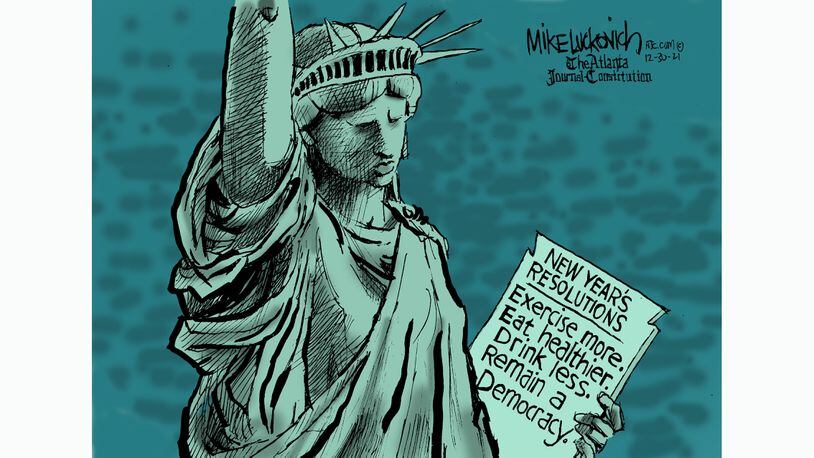
Thursday is the one-year anniversary of the climactic event in Trump’s attempted coup: the invasion of the US Capitol that temporarily stopped Congress from counting the certified electoral votes that made Joe Biden president. I expect to see a number of summary articles about what we know now that we didn’t know then, which I’ll link to next week.
The NYT’s editorial board kicked that process off with a reminder that “Every Day is January 6 Now”, begging the country to face the reality that Trump’s (and his party’s) attempt to subvert democracy continues.
Countless times over the past six years, up to and including the events of Jan. 6, Mr. Trump and his allies openly projected their intent to do something outrageous or illegal or destructive. Every time, the common response was that they weren’t serious or that they would never succeed. How many times will we have to be proved wrong before we take it seriously?
On Sunday talk shows, members of the January 6 Committee indicated that they have “first-hand testimony” of what was going on inside the White House during the invasion of the Capitol by Trumpist rioters. CNN noted the significance in the Committee penetrating “Donald Trump’s wall of obstruction about what was going on inside the White House and his own family while he refused to stop the mob attack on the US Capitol”.
One thing should be obvious and can’t be repeated often enough: If Trump were proud of his actions, he wouldn’t be trying so hard to keep the American people from finding out about them.
Strangely, there appears to be almost no documentation of the investigation Republicans in the Wisconsin legislature did of the 2020 election.
The Washington Post and University of Maryland ran a very weird poll related to January 6.
A few of the questions were interesting, like “How proud are you of the way democracy works in America?” In 1996, very/somewhat garnered 79% compared to not-too/not-at-all’s 16%. Then there was a post-9/11 surge of pride that got that margin up to 96%-3%. Now it’s at 54%-46%.
Another interesting question was “How much responsibility do you think Donald Trump bears for the attack on the US Capitol?” 60% said a “great deal” or “good amount”, while 38% said “just some” or “none at all”. Among Republicans, though, the split was 27%/72%, with 48% choosing “none at all”.
But it starts getting odd when the poll asks about the Capitol invaders: Were they mostly violent or mostly peaceful? (violent 54%, peaceful 19%.)
So why exactly does that matter? What if “most” of the 1200 Capitol invaders were just opportunistic trespassers who came in nonviolently after the doors and/or windows were already broken, while only 400 or so intended to harm members of Congress and hang Mike Pence. Would that make the incident OK?
Apparently WaPo/UM asked the question that way so that they could compare it to a parallel question in a June poll about the George Floyd demonstrators — where, bizarrely, the result was 46%-46%. (My small town had a series of BLM demonstrations that were 100% non-violent, as did towns all over the country. Some protesters in some cities got violent, and in some cases the police were the ones who initiated violence. I can’t quite grasp the level of propaganda necessary to convince 46% of Americans that the demonstrators were “mostly violent”.)
But postulating some kind of equivalence between the Floyd demonstrations and January 6 is a right-wing trope, so asking parallel questions about them is already biased. (The events were different in kind. Whatever violence spilled out of a few of the BLM demonstrations was no threat to the Constitution; January 6 was such a threat.)
Question 7 asks whether Joe Biden’s election was “legitimate”. (Yes 69%, No 29%.) That’s a fine question to ask, but then the result is compared to a similar question about Trump in 2016. (Yes 57%, No 42%.) But circumstances make those two questions completely different in spite of their similar wording: In 2020, “illegitimate” meant legal illegitimacy based on imaginary election fraud. (In a separate question, 30% express a belief in “widespread voter fraud”.) In 2016, it was moral illegitimacy based on the Electoral College anointing the loser of the popular vote — which actually happened.
And most bizarre of all, the WaPo chose to headline a question about whether it is EVER justified for citizens to “take violent action against the government”. (34% Yes, 62% No.) I mean, seriously, the amazing thing to me is why the Yes number is so low. So, the people who tried to assassinate Hitler were unjustified? The 1776 revolutionaries were unjustified?
and the new year
It’s usually a mistake to assume that my particular acquaintances are typical of the world, but I can’t help noticing an overall sense of pessimism about 2022. People who let themselves feel hopeful about 2021 don’t want to get burned again.
But one lesson all the investing books teach is contrarianism: When everybody seems to be in the same mood, you can get an advantage by acting out of the opposite mood. So if you invest confidently when everyone else is panicking, or show caution when everyone else is taking chances, most of the time you’ll do well.
Consider the possibility that the same thing works on a larger scale. What if the current widespread pessimism means that there are opportunities lying around waiting to be seized? You would need to choose them carefully and judge them wisely, but there’s time to do that, because the optimists who would ordinarily beat you to them are temporarily sidelined.
I’ve got to agree with Amanda Marcotte:
Last night [i.e. New Year’s Eve], the subject of what year was worse — 2020 or 2021? — came up. And the very fact that we could talk about this with friends we were welcoming the new year in with answered that question. 2021 sucked, but don’t let recency bias fool you. It wasn’t as bad.

Unlike most prognosticators, Vox grades itself at the end of the year. They did pretty well in 2021.
If you’re experiencing blockages in your humor supply chain, check out McSweeney’s 21 most-read articles of 2021.
and you also might be interested in …
Betty White died just weeks away from her planned 100th birthday party. People magazine celebrated prematurely.
Several news sites picked out one moment in 1954 as her finest hour: She ignored demands not to host African-American tap dancer Arthur Duncan on her TV variety show.
“And all through the South, there was this whole ruckus,” White remembered in the [2018 documentary “Betty White: First Lady of Television”]. “They were going to take our show off the air if we didn’t get rid of Arthur, because he was Black.”
… Duncan appeared on the show at least three times. On another episode, White interviewed a Black child during the kids’ segment.
It’s unclear if her decision to keep Duncan affected the show’s fate, but it was repeatedly rescheduled for different time slots before quietly being taken off the air that same year.
Other people prefer to remember moments like this.
For a couple days, Harry Reid’s death dominated the news on Democratic-leaning outlets like MSNBC. I found myself changing the channel a lot.
Reid, like Chuck Schumer after him, led Democratic senators through an era during which Mitch McConnell was destroying the institution, producing our current dysfunctional Senate. Today, when the Senate avoids blowing up the world economy with a debt-ceiling crisis, it’s considered an accomplishment. The Senate was designed to be the nation’s center of debate, but in the current era the most important issues never even come to the floor.
In general, institutions based on good faith are hard to defend against determined bad-faith actors, so I’m not sure what Reid, Schumer, or any other Democratic leader should have done differently. But I also have a hard time celebrating their achievements.
Trump just endorsed his fellow fascist, Hungarian strongman Viktor Orban, who is facing a more unified opposition in an upcoming election.
Meanwhile, the EU is trying to find tools to discipline member countries that abandon democratic principles.
Rep. Eric Swalwell got a text message saying he should be hung or shot. He responded, and talked the guy down.
Department of Phony Outrage: First Kamala Harris spent money on cookware, and now National Review calls out AOC for eating outside in a restaurant in Florida.
Perfectly ordinary things become horrible when Democratic women of color do them. Remember when Michele Obama wore a sleeveless dress? That was in the days before it became OK for first ladies to have nude photos on the Internet. (Though a Black first lady still shouldn’t try it, I suspect.)
President Biden is White and male, but he also has been behaving outrageously. @GOP tweeted:
Joe Biden has now been to Delaware 31 times since he took office. Americans are struggling to make ends meet and he is on vacation.
That led Aaron Ruper to reply:
At this point in Donald Trump’s term he had gone golfing 91 times
Of course, Trump was more motivated to take golf vacations to his clubs in Mar-a-Lago and Bedminster, because he made money off the government every time he did.
Twitter just deplatformed Marjorie Taylor Greene for violating their Covid disinformation policy. Essay question: Is limiting the public’s exposure to Greene’s insanity good or bad for Republicans in general?
Matt Yglesias makes an interesting observation:
US oil production in 2021 is going to come out well ahead of the average figure from the Trump years, and I feel like neither party is going to want to say that.
and let’s close with something philosophical
Gingerbread Land is not just an eat-or-be-eaten society. Gingerbread people face ethical conundrums too.



 The Weekly Sift
