The big story this week was the series of revelations that came out about Trump’s interactions with the Justice Department prior to January 6. After Rudy Giuliani’s dripping hair dye and the clown show at Four Seasons Total Landscaping, a lot of us began thinking of Trump’s attempt to hang on to power as a dark comedy. But it now looks like his coup attempt got further than we thought. With just a little more corruption in DOJ, he might have pulled it off.
Those discoveries, together with Republican attempts to make a coup easier next time, are the subject of this week’s featured post “The Once and Future Coup”. It should be out shortly.
The weekly summary will cover the infrastructure bill creeping towards passage in the Senate, the endgame of Governor Cuomo’s harassment scandal, the continuing surge of Covid cases, Tucker’s homage to the EU’s most authoritarian government, the end of an odd Olympics, Rudy’s resemblance to an Underdog villain, and a few other things. I’m still looking for a closing. That should be out before noon, EDT.
If it was such a God-damned fine, beautiful time, why did it turn into this time which is not so damned fine and beautiful if there wasn’t something in that time which wasn’t fine and beautiful?
– Robert Penn Warren, All the King’s Men (1946)
The wealthy business elite never took to Obama, even though he didn’t castigate or prosecute those who had caused the financial crisis. The military and foreign policy establishment never fully took to Obama, even though he refrained from exorcising all of the demons (and people) who led us into Iraq or participated in the use of torture. America’s oil-rich allies in the Gulf never took to Obama, even though he continued to sell them weapons. The Republican Party relentlessly attacked and sought to undermine Obama, even though he came into office determined to work with them. Eight years later we got Trump, a reality star playing a billionaire, committed to cutting taxes for the wealthy, wrapping himself in the trappings of the military, rewarding the oil-rich allies, and tapping the darkest veins of the Republican Party’s racism and jingoism through his brand of white identity politics. Don’t tell me Trump isn’t the establishment.
This week everybody was talking about the 1-6 Committee
Tuesday four police officers, two from the Capitol Police and two from DC Police, testified to the 1-6 Select Committee about their experiences fighting the rioters. It was a moving kick-off to the hearings, and served as an antidote to the gaslighting Republicans have been doing these last six months.
The officers said the rioters they fought against were terrorists. Woven into the stories about how they and their colleagues were attacked — and in some cases badly injured — the officers expressed outrage that the violence launched by pro-Trump supporters was being ignored by the very lawmakers they protected that day.
They were ushered in by the police. I mean, in all fairness — the Capitol Police were ushering people in. The Capitol Police were very friendly. You know, they were hugging and kissing.
The four policemen reintroduced reality into the discussion. They were verbally assaulted with racial slurs. They were beaten and badly injured. They feared for their lives. Capitol Police Officer Harry Dunn urged the committee to find the real cause of the riot.
If a hit man is hired and he kills somebody, the hitman goes to jail. But not only does the hitman go to jail, but the person who hired them does. It was an attack carried out on Jan. 6 and a hitman sent them. I want you to get to the bottom of that.
Predictably, conservative media decided “Back the Blue” didn’t apply here. Based on nothing but the inconvenience of his testimony, Tucker Carlson all but denied that Dunn was a cop.
Dunn has very little in common with your average cop. Dunn is an angry left-wing political activist.
If that were true, it should have been easy to find a Capitol policeman to say so. But, of course, Carlson produced no such witness. Laura Ingraham said the officers deserved “acting awards”, but likewise did no journalism to contradict their testimony.
Before the hearings started, I had wondered what role the two Republicans, Liz Cheney and Adam Kinzinger, both of whom were appointed to the committee by Speaker Pelosi, would play. Would they just be window dressing that allowed the committee to claim to be bipartisan? Or would they be more active?
America is great because we preserve our democratic institutions at all costs. Until January 6th, we were proof positive for the world that a nation conceived in liberty could long endure. But now, January 6th threatens our most sacred legacy. The question for every one of us who serves in Congress, for every elected official across this great nation, indeed, for every American is this: Will we adhere to the rule of law? Will we respect the rulings of our courts? Will we preserve the peaceful transition of power? Or will we be so blinded by partisanship that we throw away the miracle of America? Do we hate our political adversaries more than we love our country and revere our Constitution? I pray that that is not the case.
It would not surprise me if Cheney becomes the star of these proceedings. She clearly wants the role and Democrats seem happy to let her have it.
The next order of business seems to be sending out subpoenas. The Department of Justice has formally waived executive privilege claims, instructing former officials “to provide information you learned” while serving under the former president.
The department reasoned that congressional investigators were examining potential wrongdoing by a sitting president, an extraordinary circumstance, according to letters sent to the former officials. Because executive privilege is meant to benefit the country, rather than the president as an individual, invoking it over Mr. Trump’s efforts to push his personal agenda would be inappropriate, the department concluded.
But the committee may have a harder time securing testimony from Trump and aides such as former White House chief of staff Mark Meadows, as well as House Minority Leader Kevin McCarthy and GOP Reps. Jim Jordan of Ohio and Mo Brooks of Alabama. Even if the Biden administration doesn’t intervene, Trump could still try to go to court to stop the select committee from obtaining documents and testimony from the Trump White House by attempting to assert privilege, an effort that could delay the probe.
I have to think that will be a bad look for them, and delaying the investigation just pushes it closer to the 2022 elections.
The Justice Department also released handwritten notes from an aide to Trump’s Acting Attorney General Jeffrey Rosen, detailing one of many phone conversations in which Trump tried to enlist the Justice Department in his attempt to stay in power after losing the election. Deputy AG Richard Donoghue noted that Trump pushed election-fraud theories at himself and Rosen, but that Donohue pushed back.
“Much of the info you’re getting is false,” Mr. Donoghue said, adding that the department had conducted “dozens of investigations, hundreds of interviews” and had not found evidence to support his claims. “We look at allegations but they don’t pan out,” the officials told Mr. Trump, according to the notes.
When told the DOJ had no power to change the outcome of the election, Trump replied that they should “Just say that the election was corrupt and leave the rest to me and Republicans in Congress.”
I doubt Trump himself will ever consent or be forced to testify. (He’s not Hillary Clinton, after all. There’s no way he could give coherent answers for 11 hours, much less avoid perjury.) But if he ever faces questioning, I would like to see him confronted with a list of all the people who investigated and told him his fraud theories were bunk: Rosen and Donohue, Bill Barr, Brad Raffensperger, and probably many others. He either knew he lost the election or he is completely insane.
and infrastructure
The long-anticipated bipartisan infrastructure bill finally exists. The Senate could vote on it as early as this week, and at the moment it looks likely to pass. What happens next is anybody’s guess. Ideally, Senate Democrats go on to pass their larger infrastructure package via reconciliation, and the House passes both bills simultaneously. If the Senate is slow, or if the reconciliation bill fails because either Joe Manchin or Kyrsten Sinema (and all Republicans) vote against it, then we’ll see whether House progressives go through with their threat to torpedo this bill. That would be a bold move, and could mean that nothing gets passed.
and the pandemic
Things continued to get worse, and the CDC changed its guidance to say that even vaccinated people should wear masks indoors if they are in an area with substantial or high levels of transmission. New studies of the Delta variant show that vaccinated people can spread the disease, which previously seemed unlikely.
The Delta variant seems to flourish in the nose, the main port of entry for the virus. The vaccines are injected into muscle, and the antibodies produced in response mostly remain in the blood. Some antibodies may make their way to the nose but not enough to block it.
“The vaccines — they’re beautiful, they work, they’re amazing,” said Frances Lund, a viral immunologist at the University of Alabama at Birmingham. “But they’re not going to give you that local immunity.”
When the virus tries to snake down into the lungs, immune cells in vaccinated people ramp up and rapidly clear the infection before it wreaks much havoc. That means vaccinated people should be infected and contagious for a much shorter period of time than unvaccinated people, Dr. Lund said.
“But that doesn’t mean that in those first couple of days, when they’re infected, they can’t transmit it to somebody else,” she added.
As for the numbers, new cases per day in the US is approaching 80K, up from around 50K a week ago. Deaths are averaging 350 per day, up from 269 a week ago, but still well below the 3,300 we were seeing in mid-January.
The center of the new wave is moving to Florida, where new cases per day is just under 16K, or right about where it was at the January peak. Louisiana has over 4K new cases per day, a new high. Deaths in each state are at about 1/4th their January high.
As the country contemplates the possibility of new mask mandates or even a return to shutting down theaters and restaurants, the public mood is turning against the unvaccinated. In the beginning, just about all the talking heads advocated patience: Give the unvaccinated time, address their concerns, and don’t be judgmental.
Occasionally I channel-scan through Tucker Carlson’s show and find him “asking questions” about the safety or effectiveness of Covid vaccines. Like Wednesday, when he quoted Dr. Fauci explaining about vaccinated people carrying the virus in their nasal passages (see above), and said “What? What does that even mean? We’re not even going to speculate as to what that means.”
OK, everybody understands that Tucker’s show isn’t news, it’s entertainment for red-hatters. But even so, he’s on an effing news channel. When he has questions, he could interview somebody who knows answers. Why doesn’t he? That’s the question I want to raise.
Why would you raise questions and stop there, when you have the resources to get answers?
The “forensic audit” of the 2020 presidential election in Maricopa County has now finished its work, but it’s still not clear when the report will come out. The audit was started with $150,000 from the Arizona Senate, but was obviously costing more than that. We now know they raised $5.7 million from “political groups run by prominent Trump supporters including Michael Flynn, Sidney Powell, Patrick Byrne and correspondents from One America News Network”.
Trump complained on election night that the ballots were taking too long to count, but his “auditors” have been working since April 22. I have little doubt they will come up with some reason to claim that Trump really won Arizona. That was their mission, and no other outcome would be acceptable to their sponsors. The reason this has taken so long, in my opinion, is that the ballots themselves don’t support that conclusion. If there were clear evidence of election-stealing fraud, they’d have reported it months ago.
Along the same lines, the My Pillow guy is planning a three-day event August 10-12 in Sioux Falls, where he will present in detail the “cyberforensics” that prove Trump won.
Last January—on the 9th, he says carefully, placing the date after the 6th—a group of still-unidentified concerned citizens brought him some computer data. These were, allegedly, packet captures, intercepted data proving that the Chinese Communist Party altered electoral results … in all 50 states. This is a conspiracy theory more elaborate than the purported Venezuelan manipulation of voting machines, more improbable than the allegation that millions of supposedly fake ballots were mailed in, more baroque than the belief that thousands of dead people voted. This one has potentially profound geopolitical implications.
That’s why Lindell has spent money—a lot of it, “tens of millions,” he told me—“validating” the packets, and it’s why he is planning to spend a lot more.
He claims that after his evidence is made public, the Supreme Court will vote 9-0 to reinstate Trump. (Where exactly does the Constitution make provision for such a thing?)
It’s hard to tell whether Lindell himself is grifting, or if he’s a victim of the grifters who are “validating” the packets.
He will not, on August 10, find that “the experts” agree with him. Some have already provided careful explanations as to why the “packet captures” can’t be what he says they are. Others think that the whole discussion is pointless. When I called Chris Krebs, the Trump administration’s director of the Cybersecurity and Infrastructure Security Agency, he refused even to get into the question of whether Lindell has authentic data, because the whole proposal is absurd. The heavy use of paper ballots, plus all of the postelection audits and recounts, mean that any issues with mechanized voting systems would have been quickly revealed. “It’s all part of the grift,” Krebs told me. “They’re exploiting the aggrieved audience’s confirmation bias and using scary yet unintelligible imagery to keep the Big Lie alive, despite the absence of any legitimate evidence.”
One of the most ominous parts of Georgia’s new election law was that it created a process by which the Republican legislature could take over the management of local elections. In essence, a non-partisan process would be taken over by a partisan group.
Now the legislature has taken the first move in that process: It has requested a performance review of election officials in heavily Democratic Fulton County, which includes Atlanta. Republicans blame their loss of the presidential election in Georgia and both of Georgia’s senate seats on the fact that a lot of Black people voted in Fulton County. Now they’re moving into a position to do something about that.
The moratorium, put in place by the Centers for Disease Control and Prevention (CDC) in September, helped keep 2 million people in their homes as the pandemic battered the economy, according to the Princeton University’s Eviction Lab.
Eviction moratoriums will remain in place in New York, New Jersey, Maryland, Illinois, California and Washington DC, until they expire later this year.
Elsewhere, evictions could begin on Monday, leading to a years’ worth of evictions over several weeks and ushering in the worst housing crisis since the last major recession, in 2008.
The expiration is the result of a multi-player screw-up. After the CDC established the moratorium, the Covid relief packages passed in December and March together allocated $45 billion to rental assistance. But only $3 billion has been distributed, for a number of reasons.
Confusion at the federal level about how to distribute that amount of money, and which of numerous programs would handle distribution, has also slowed getting the aid out. As Vox’s Jerusalem Demsas has reported, many renters in need of aid simply did not know that they were eligible for rent relief, and if they did, some were unable to provide the necessary paperwork because of their turbulent living circumstances, lack of formal documentation of their work, or nontraditional rental agreements.
The Biden administration would have liked to extend the ban on evictions at least until the relief money gets distributed. (It would suck to be thrown out on the street when Congress had already appropriated money to keep you in your home.) But although the Supreme Court refused to order an end to the moratorium in June, one of the five votes in the 5-4 majority was Brett Kavanaugh, who made it clear in his concurring opinion that he only let the moratorium continue because it was scheduled to expire soon. He felt that waiting for the intended expiration would result a “more orderly” process than just cutting it off.
From that, the administration concluded that the Court would throw out any attempt at an extension by executive order, so Congress had to act. But for reasons that aren’t entirely clear, it didn’t make this announcement and ask for Congress to address the issue until this week.
Congress has been unable to respond in time. No one knows whether the Senate could have overcome a filibuster, because a moratorium-extending bill has not made it through the House. Progressive and moderate Democrats in the House weren’t able to come to agreement, and of course they got no help from Republicans. A last-ditch attempt to extend the ban just until October required (for reasons I don’t understand) unanimous consent, but Republican Congressman Patrick McHenry objected.
The House is now in recess, but members have been warned of a possible 24-hour recall if an infrastructure bill gets through the Senate. Possibly something might be done then.
Two weeks ago I pointed to Congress’ inability to resolve the Dreamers’ immigration status as an example of broken democracy. This is another example. Hardly anyone thinks it’s a good idea to evict large numbers of people from their homes right now, but that seems to be what’s going to happen.
and you also might be interested in …
I try not to do too many a-Republican-said-something-outrageous notes, because (1) I could fill the whole Sift with them every week, and (2) it’s not good for me to spend so much of my time being outraged. But this one takes the cake: Elise Stefanik, you might remember, became the third-ranking Republican in the House after Liz Cheney was ousted for being insufficiently subservient to Donald Trump. Friday she tweeted:
Today’s Anniversary of Medicare & Medicaid reminds us to reflect on the critical role these programs have played to protect the healthcare of millions of families. To safeguard our future, we must reject Socialist healthcare schemes.
But Medicare and Medicaid are socialist healthcare schemes. Republicans have been telling us that for more than half a century. In 1961, Ronald Reagan recorded an entire LP making the case that Medicare would lead first to a complete government takeover of healthcare, and then to a socialist dictatorship. If Medicare passed, Reagan warned,
you and I are going to spend our sunset years telling our children, and our children’s children, what it once was like in America when men were free.
So if you believe that Medicare and Medicaid play a “critical role” in protecting “the healthcare of millions of families”, the obvious conclusion to draw is that socialist healthcare schemes work.
Totally agree. In fact, to further protect Medicare from socialism, let’s strengthen it to include dental, vision, hearing, & mental healthcare and then allow all Americans to enjoy its benefits. Trust me, Medicare for All is the #1 thing you can do to own the socialists.
You can get a virtual zoo membership. Check out what’s going on in the zoo habitats whenever you want. Participate in Zoom meetings with animal experts.
and let’s close with something hyperbolic
If you’ve never read the book Hyperbole and a Half by Allie Brosh, you’ve missed out. Using a combination of text and fairly artless cartoons, Brosh tells the kinds of stories you shouldn’t tell about your childhood, or maybe anybody’s childhood.
Fortunately, you don’t have to buy a book to decide what you think. Brosh publishes similar cartoons (and sometimes whole book chapters) on her blog.
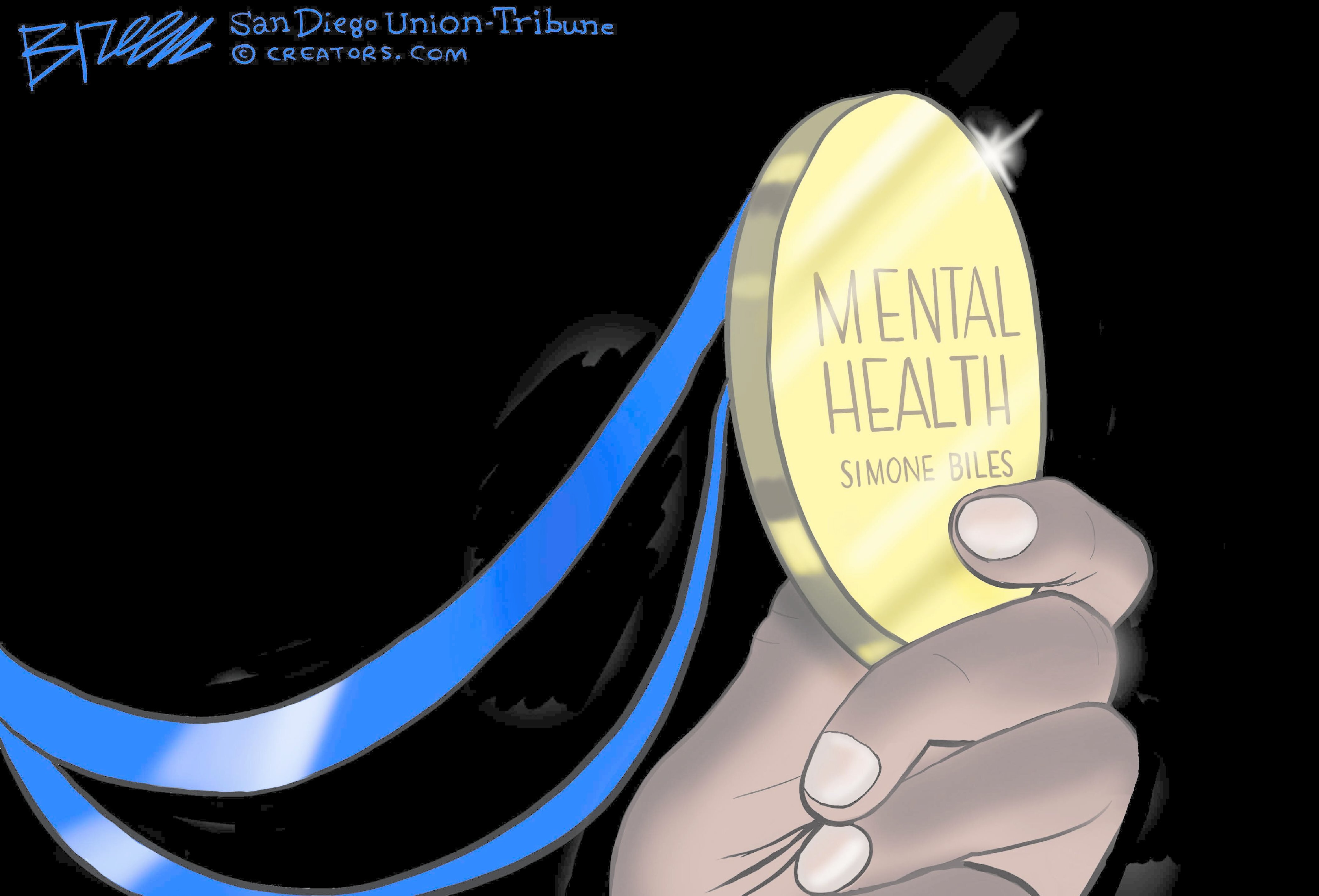
Real athletes aren’t supposed to have mental blocks, or yield to physical injuries. They’re also supposed to be men.
Simone Biles is widely acknowledged as the greatest female gymnast in the world, maybe the greatest ever. She entered the Olympics as the favorite to win gold medals in several different events, to go along with the Olympic medals she already has. Instead, she pulled out of the team competition on Tuesday, and then from subsequent events as they became imminent.
Biles has explained that she is suffering from what gymnasts call “the twisties”, an unpredictable (and usually temporary) loss of “air sense”.
The twisties are a mysterious phenomenon — suddenly a gymnast is no longer able to do a twisting skill she’s done thousands of times before. Your body just won’t cooperate, your brain loses track of where you are in the air. You find out where the ground is when you slam into it.
Nobody knows whether the twisties are physical, psychological, or some combination of the two. All the gymnast knows is that some unconscious process she had relied on has stopped functioning.
Similar mind/brain failures happen in other sports, and not just to world-class athletes. Several years ago, I was playing a pick-up basketball game when the unconscious fine-tuning process that usually targets my jump shot went poof. I would leap, twist in the air to sight the basket, and then wonder “What am I doing up here?” as if I had never shot a basketball before. The next time I played, the unconscious process was back. Was it a mini-stroke? Something I ate? An emotional issue? I never figured it out.
In golf, this is known as “the yips“. One famous baseball case is the pitcher Rick Ankiel, who had started a promising career when suddenly he lost the ability to target his pitches. It never came back (but he did work his way back up to the major leagues as a hitter).
In most sports, the main risk of continuing on in spite the yips (or whatever you call them) is the embarrassment of failure. Golfer Ernie Els once six-putted from three feet out. I ended up flinging the ball at the basket with my conscious mind and hoping it would go in. The result was pretty much what you would expect from someone who had not spent hours and hours practicing shooting until it became unconscious.
But I can barely imagine the terror of a gymnast, upside down in the middle of a flip, when the unconscious process fails and she thinks “What am I doing up here?” That’s a life-threatening situation.
So Biles was absolutely right to pull out of the competition and face all the resulting disappointment and criticism. In some ways, that took more courage than just going out and hurting herself. I wonder how many other gymnasts would have invented some invisible physical injury — a groin pull, say — rather than be honest and deal with what Biles has been subjected to this week.
Conservatives do love to attack Black athletes — going after LeBron James, Steph Curry, Colin Kaepernick, etc. was a go-to move whenever Trump wanted to rally his base — and they also have problems with strong women. (There’s a reason why Kamala Harris gets targeted more viciously than Joe Biden.) But I think this particular case is less about racism and sexism than hyper-masculinity, which holds that will-power and “character” are supposed to blast through mental difficulties and even physical injuries. (See Curt Schilling’s “bloody sock game“.)
The idea that you’re supposed to play hurt and risk more serious injury is one important piece of football’s concussion problem.
Unfortunately, due to [toxic masculinity], many concussions go unreported, or mishandled as a result of the athlete playing it down, pretending it didn’t happen, or simply not knowing that they actually have a concussion.
For the last four years or so, I’ve been in this cycle of injury, pain, rehab, injury, pain, rehab, and it’s been unceasing, unrelenting, both in-season and offseason. And I felt stuck in it, and the only way I see out is to no longer play football. It’s taken my joy of this game away.
Lacking a race or gender stereotype to beat Luck up with, Fox Sports’ Doug Gottlieb chose a generational smear:
Retiring cause rehabbing is “too hard” is the most millennial thing ever #AndrewLuck
Toxic masculinity is not a purely conservative problem, but there is a high correlation. (One much-admired Trump trait is his “strength”, which mainly manifests as a stubborn refusal to admit any mistakes.)
Biles’ decision was more-or-less the opposite of toxic masculinity. She faced reality, and admitted that she is not always as she would like to be. In the world of sports, that was a heresy of high order.
So like any heretic, she had to be denounced. If you happened to be conservative, the opportunity to dis a strong Black woman was just a bonus.
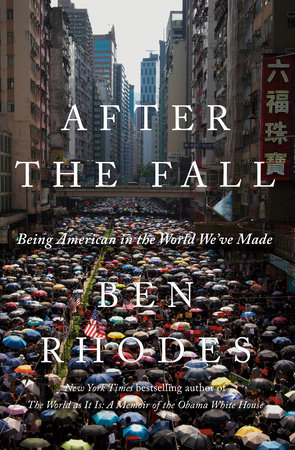
Ben Rhodes raises a hard question: How did America get from the pinnacle of our Cold War victory to this sorry place?
The Berlin Wall fell on November 9, 1989, five days before Ben Rhodes‘ 12th birthday. The wall’s demise was the culmination of a series of large and (mostly) bloodless revolutions that brought down nearly all the Soviet-imposed governments of Eastern Europe. The Soviet Union itself was looking shaky, and would officially dissolve into its constituent republics in 1991.
Rhodes’ teen years were a period of undisputed American triumph. Not only were we the sole surviving superpower, but our political vision (representative democracy with constitutionally protected human rights) and economic vision (market economies gradually merging into a global free-trade zone) had also triumphed to such an extent that a US-style political economy was seriously put forward as the end-point of history.
The distant origins of the present volume lie in an article entitled “The End of History?” which I wrote for the journal The National Interest in the summer of 1989. In it, I argued that a remarkable consensus concerning the legitimacy of liberal democracy as a system of government had emerged throughout the world over the past few years, as it conquered rival ideologies like hereditary monarchy, fascism, and most recently communism. More than that, however, I argued that liberal democracy may constitute the “end point of mankind’s ideological evolution” and the “final form of human government,” and as such constituted the “end of history.”
… The most remarkable development of the last quarter of the twentieth century has been the revelation of enormous weaknesses at the core of the world’s seemingly strong dictatorships, whether they be of the military-authoritarian Right, or the communist-totalitarian Left. From Latin America to Eastern Europe, from the Soviet Union to the Middle East and Asia, strong governments have been failing over the last two decades. And while they have not given way in all cases to stable liberal democracies, liberal democracy remains the only coherent political aspiration that spans different regions and cultures around the globe. In addition, liberal principles in economics – the “free market” – have spread, and have succeeded in producing unprecedented levels of material prosperity, both in industrially developed countries and in countries that had been, at the close of World War II, part of the impoverished Third World. A liberal revolution in economic thinking has sometimes preceded, sometimes followed, the move toward political freedom around the globe.
Today, though, liberal democracy seems to be in retreat around the world, to the point that America itself has a flourishing fascist movement. Last winter, Donald Trump attempted to stay in power after losing the election, and even instigated a riot in an attempt to intimidate Congress away from recognizing Joe Biden’s victory. For a moment it appeared that he had finally gone too far, and that his own party would now turn against him. But within weeks, he had reasserted control of the GOP, which is now working to craft tools for a better coup against democracy in 2024.
But it’s not just us. Russia appeared to be democratizing in the 1990s, only to become the model of the new fascism under Vladimir Putin. Similar nativist authoritarians have since taken power in Hungary, India, Brazil, and several other countries.
China’s communist leaders once looked like dead-enders. By suppressing their own democracy movement at Tiananmen Square in 1989, China appeared to have staked out a position on the wrong side of history. Both Bill Clinton and the two Presidents Bush believed that opening up trade with China would increase the pressure on its leaders to democratize. A growing Chinese middle class, Americans of both parties agreed, would soon insist on political rights commensurate with its prosperity. Hong Kong, which Britain yielded to China in 1997, looked like a Trojan Horse. Surely the freedom and prosperity of Hong Kong would change China more than China changed Hong Kong.
Today, President Xi has more power than any Chinese leader since Mao, hundreds of thousands of Uyghurs are held in camps that could be a model for a new dystopia, Hong Kong is being brought to heel, and Chinese influence is spreading not just in Asia, but in Africa as well. Worse, numerous studies indicate that the Chinese middle class fears political change that might rock the boat of Chinese prosperity.
After the Fall. In his new book After the Fall: Being American in the World We’ve Made, Rhodes discusses the state of democracy around the world, and how we got here. He recounts his conversations with democracy activists in places where authoritarianism is ascendant: Hungary, Russia, and Hong Kong. Always in the background is the ghost of his younger self, who visited these places in happier times, and proudly imagined that his own democratic America was the model all other countries aspired to imitate.
Another ghost is the idealistic Rhodes who wrote speeches for Obama and believed that the 2008 landslide marked a sea change in US politics and governance. Present-day Rhodes is constantly confronted with how his work has been undone, turned around, or made meaningless.
In the final section, Rhodes humbly comes back to the US to analyze where we went wrong and what those foreign activists might have to teach us about democracy.
One thing Rhodes does well is to look past the bright shiny object that is Donald Trump. He has no illusions about what Trump represents or what a disaster his administration was for democracy and for America’s place in the world. But the anti-democracy movement in the US is part of a global anti-democracy trend that Trump did not start.
From our post-Cold-War apex, when democracy seemed to be a lesson the whole world wanted to learn, how did we get to a point where a Trump presidency was even possible?
First mistake: failing the fledgling post-Soviet democracies. Vladimir Putin did not come out of nowhere. He rose to power because the Yeltsin government in Russia was inept and corrupt. Privatizing the Soviet government’s assets and creating a capitalist economy was supposed to bring prosperity. Instead, it created a class of billionaire oligarchs and impoverished the general population. Democracy was supposed to give the people a voice in government, but instead the oligarchs bought the major media and spent lavishly to re-elect Boris Yeltsin in 1996. The legitimacy of Russia’s 1996 election was widely doubted.
These events produced a cynicism about democracy, markets, and America that is now deeply embedded in the Russian consciousness. The Yeltsin disaster didn’t just happen, it had American fingerprints all over it. American economists were everywhere in Russia in the 1990s, pushing privatization. American political consultants helped shape Yeltsin’s 1996 campaign, and President Clinton was clearly rooting for Yeltsin to prevail. At the same time, when the world price of oil collapsed and took Russia’s economy with it, the US and other Western democracies were stingy with aid.
US government and non-government advisors were so entranced by the vision of Russia joining the global market economy that we didn’t pay much attention to how it happened, or whether it was good for the Russian people.
We set the stage for Putin to raise Russian identity politics and restore national pride. And if he also turned out to be corrupt, his message that all governments are corrupt is very plausible. His elections are unfair, but no democracy plays fair. He provides order and protects Russia from foreign dominance. What more could the people expect?
Russia and the other post-Soviet republics were part of a larger pattern: Again and again, the vision of a borderless world economy trumped democratic ideals. China in particular did not have to raise its human-rights standards to get into the world economic club. There was money to be made from China’s billion-person market and its bottomless well of cheap labor, so we could overlook a few transgressions against human rights. Surely that would all get fixed after China became prosperous.
Second mistake: abandoning our principles after 9-11. America’s message abroad has always been two-sided. On the one hand, we promote democracy and human rights as universal values. On the other, we have often supported cruel dictators like the Shah of Iran or Saddam Hussein (until he invaded Kuwait).
But after 9-11, the Bush administration took the attitude that national security justified anything. We could invade any country we wanted, and launch attacks anywhere we believed the terrorists were hiding. We could ignore the Geneva Conventions and hold prisoners in legal limbo in Guantanamo, where they were protected by neither the laws of war nor American jurisprudence. American citizens could be declared “enemy combatants” and vanish into military prisons. Intelligence services could scoop up Americans’ private communications and sift them for terror-related keywords. We could even torture people if we thought they could tell us about terrorist plots.
In its post-9-11 zeal, the Bush administration created a rhetorical template for authoritarian governments around the world. If their opponents could be labeled “terrorists”, then any action against them was justifiable. Is China herding Uyghurs into concentration camps? Doesn’t matter, they’re terrorists.
Third mistake: the 2008 banking collapse and its aftermath. From the beginning, globalization had winners and losers. Opening a national economy to foreign trade both created jobs and destroyed them. Immigration simultaneously added vigor to an economy and increased competition for low-level jobs. Financial deregulation both created wealth and increased risk. The argument was that the gain outweighed the pain.
That argument was always a tough sell among working-class people, who benefited little from a rising stock market, but saw their once-secure jobs move overseas. They could buy cheap manufactured goods at Wal-Mart, but could never hope to be employed making them.
2008 underlined a problem: The gain-over-pain argument held in theory if everyone followed the same rules. But if there was one set of rules for the rich and another for everyone else, the wealth at the top would never trickle down. If bankers can profit when risky investments succeed, but get bailed out by the government when they fail, then the whole system is rigged.
Outside America, 2008 showed that globalization made local economies vulnerable to mistakes and corruption abroad, particularly in the US.
No one was ever brought to justice for the corruption behind the banking collapse. That never sat right with working-class people both in America and abroad. “I lost my job and my home,” people told each other. “What did Bank of America lose?”
Fourth mistake: Trump. The election of Donald Trump was both a cause in its own right and an effect of the previous three causes. He followed the Putin model of combining cynicism with nationalism and nativism: He was a liar and a conman, but (in his view) so was everyone else. If the system was already rigged, why not elect someone who promised to rig it in your favor?
Within the US, Trump dismantled the rules and traditions that protect democracy against authoritarianism and government corruption. He ignored the Constitution’s emoluments clause by running businesses and dues-collecting clubs that anyone seeking a favor could patronize. He bulldozed the barriers that kept the Justice Department from becoming a political weapon. His emergency declarations usurped Congress’ power of the purse. He pardoned his co-conspirators in exchange for their silence. His failure to stay in power after losing the 2020 election was more frightening than reassuring, and his supporters in state legislatures have been paving the road to make a 2024 coup proceed more smoothly.
Outside the US, Trump destroyed the idea that America is a reliable ally or a champion of democracy. He undermined NATO. He invented reasons to impose tariffs on Canada. He put the world on notice that the US would not cooperate to fight climate change. He praised dictators and denigrated democratically elected leaders. Human rights played no part in his foreign policy. If China wanted his favor, it should buy more soybeans, not allow Hong Kong the independence promised in China’s treaty with the United Kingdom.
Worse, he raised the fear (both here and abroad) that America might simply go crazy. However reasonable Joe Biden might sound today, who knows what some future president might do? Foreign leaders would be foolish to follow America’s lead or put much stock in American promises.
We’re not alone. None of the activists Rhodes talked to has yet succeeded: Putin and Orlov are still in power, and Hong Kong continues to lose its freedom. So he doesn’t conclude with a five-steps-to-restore-democracy chapter. Perhaps the central thing Rhodes learns is that the struggle against autocracy is so similar in such disparate places.
He ends up thinking we need to internationalize that struggle: Hong Kongers, for example, are not protesting for their rights; they’re protesting for human rights. We in American should take inspiration from the fact that they’re not giving up, in spite of facing oppression far beyond what we currently have to deal with. I’m reminded of an idea I’ve seen attributed to Jesse Jackson (but can’t quote from memory): You shouldn’t be fighting just to make sure that your people aren’t forced to the back of the bus. You should fight to make sure that nobody is forced to the back of the bus.
Rhodes wants to rehabilitate the notion (debased by hollow post-9-11 rhetoric) that democracy and human rights are universal values. It’s fine that Hungarians want to achieve Hungarian democracy and Americans want American democracy. But it would be so much better if, as human beings, we wanted democracy for everyone.
He closes with the idea that America might still have a key role to play. In spite of Trumpist rhetoric, there are no “real Americans”. We are a collection of peoples gathered from all corners of the Earth. If we can overcome nativism and white supremacy here, we might finally become the beacon of hope we used to believe we were.
This is a tough week to cover, because so much of what happened requires an explanation. The House select committee investigating the Capitol insurrection kicked off its hearings with moving accounts from four police officers, and there are also tea leaves to read in Liz Cheney’s behavior and the Republican response to the police testimony. (Hint: Blue lives don’t matter any more.) The Delta variant looks even scarier than we had thought, and mask mandates may be coming back. A chain of screw-ups has made millions of American renters vulnerable to eviction. The long-awaited bipartisan Senate infrastructure bill actually has a text now, and could be voted on soon. Georgia’s Republican legislature is laying the groundwork to take authority over elections in the state’s most Democratic county. The Simone Biles controversy erupted. (What are “the twisties” anyway?)
None of that is stuff where I feel comfortable just saying “this happened” and providing a link.
But I also want to take a longer view than just this week. I recently read Ben Rhodes new book After the Fall, which raises a provocative question: What happened to America, and to democracy in general, these last 30 years? After the Soviet Union fell, the United States seemed all-powerful, and progress towards democracy around the world seemed inevitable. How did we screw that up?
So one featured post will be my commentary on After the Fall. That should be out around 10 EDT. I may or may not split off my Simone Biles commentary as its own post a bit later. If not, it will be part of the weekly summary that should show up around 1.



 The Weekly Sift