Monthly Archives: July 2021

The Trump/Weisselberg Tax Evasion Scheme

https://theweek.com/political-satire/1002234/crime-scene

It wasn’t just dishonest. It was dumb.


I thought I was immune to the myth of Trump the Great Businessman. But reading the indictment of the Trump Organization and its CFO Allen Weisselberg left me shocked and appalled. For some reason, I had expected their tax-evasion scheme to be clever and sophisticated. Maybe it would push the law’s ambiguous boundaries. Maybe it would involve a complex web of shell companies and offshore accounts. Whatever it was, I was sure it was something the guy who owns your local bagel shop could never pull off.

I was wrong.

The Trump Organization paid Weisselberg (and unnamed other executives) partly in cash and partly by covering his personal expenses. Then they lied to the IRS and claimed that the cash payments were his full compensation. They kept two sets of books, one false set for the tax people, and another internal set where they recorded everything.

The scheme wasn’t just dishonest, it was stupid. It would only work if nobody looked at it. But the Manhattan District Attorney looked, and so they’re caught.

Your local bagel-shop owner would know better.

The company and Weisselberg both pleaded not guilty to the 15 felony counts in the indictment. But the public statements Trump and his people are making don’t even deny the charges. David Frum comments on the Trump Organization’s official statement:

Here is what is missing from that statement: “I’m 100 percent confident that every investigation will always end up in the same conclusion, which is that I follow all rules, procedures, and, most importantly, the law.” That’s the language used by former Trump Interior Secretary Ryan Zinke when he was facing ethics charges in 2018. Likewise, when Virginia Governor Terry McAuliffe was accused of violating campaign-finance laws in 2016, he too was “very confident” that “there was no wrongdoing.” Plug the phrases very confident and no wrongdoing into a search engine and you will pull up statement after statement by politicians and business leaders under fire. For some, their matter worked out favorably; for others, not so much. Either way, everybody expects you to say that you’re confident you didn’t do anything wrong. It’s the thing an innocent person would want to say. So it’s kind of a tell when it goes unsaid.

Speaking at a rally in Sarasota Saturday, Trump — the same guy who in 2016 said “I know our complex tax laws better than anyone who has ever run for president and am the only one who can fix them” — pleaded ignorance.

They go after good, hard-working people for not paying taxes on a company car. You didn’t pay tax on the car or a company apartment. You used an apartment because you need an apartment because you have to travel too far where your house is. You didn’t pay tax. Or education for your grandchildren. I don’t even know. Do you have to? Does anybody know the answer to that stuff?

Yes, people know. They’re called accountants, and the Trump Organization probably employs a lot of them.

Like their father, the Trump sons have been claiming that this is a “fringe benefits” case, the kind of thing that is occasionally pursued as a civil complaint, but hardly ever prosecuted as a criminal matter. Don Jr. said on Fox News Primetime:

After … 3 million documents, countless witnesses and hours of grand jury testimony, outside forensic auditors, this is what they come up with: they’re going to charge a guy who’s 75 years old on crimes of avoiding paying taxes on a fringe benefit.

Prior to the indictment becoming public, Trump Sr. said investigators were focusing on “things that are standard practice throughout the U.S. business community, and in no way a crime.”

Just Security debunks that claim. There actually are tricky fringe benefit tax issues that business owners will recognize: If your company provides you with something like a car or a laptop computer that you use for work, but also for personal matters, it can sometimes be difficult to determine exactly what part of the cost is a corporate business expense, and what part is personal income. Some companies and their executives push those boundaries a little, and it’s true that they are almost never charged with a crime.

That’s not what’s happening here.

A great deal of what Weisselberg received had no conceivable business use. OK, his car, maybe. But his wife’s car? His son’s apartment? His grandchildren’s tuition? Those aren’t Trump Organization business expenses, not even in part.

Calling bundles of cash and the provision of flat screen televisions in employees’ vacation homes “fringe benefits” – especially when they are not extra pay, but replace ordinary paycheck salary, dollar for dollar – would appear to leave no employee compensation outside the term’s potential scope.

If this stands, in other words, there’s no reason why businesses should pay any of their employees taxable salaries. If you make, say, $50,000 a year, your company could just give you a corporate credit card with a $50,000 annual limit as a tax-free “fringe benefit”.

That’s not “standard business practice”, that’s tax fraud.

Just Security’s dollar-for-dollar claim brings us to the stupidest part of the scheme: They wrote it all down.

During the time of the scheme, Weisselberg was making a fixed salary in the neighborhood of $900K per year. Instead of paying all that in cash, the company rented a New York City apartment for Weisselberg, rented cars for him and his wife, paid private school tuition for their grandchildren, and covered a bunch of other personal expenses. And the company kept a spreadsheet deducting all that from his salary, but not adding it to the W-2 forms reported to the IRS and New York state, as if Weisselberg’s personal expenses were Trump Organization business expenses. (The Trump Organization should also have been paying payroll taxes on this money, but didn’t.)

All in all, the company helped Weisselberg hide about $1.7 million of income and avoid more than $900K of federal, state, and local taxes. That’s not fudging a little on your taxes. That’s grand larceny. The Washington Post quotes law professor Dan Hemel: “If you pay your employees under the table, a good rule of thumb is not to write it down.”

On The Wire, Stringer Bell made the same point more forcefully: “Is you taking notes on a criminal fucking conspiracy? What the fuck is you thinking, man?”

The deeper into the indictment you read, the stupider the scheme gets. The rental agreement on Weisselberg apartment lists him and his wife as the sole occupants, and says it’s their primary residence. But Weisselberg didn’t tell New York City he lived there, and so skipped out on NYC income tax. Just Security explains that NYC residency is not just a personal choice:

It is a widely-known fact among New York-area taxpayers – and not just those with specific tax and accounting knowledge, like Weisselberg himself – that, if one has an apartment in New York City (as he did) and is in the City for at least a part of more than 183 days in a given year, then one counts for that year as a City resident. This is not an issue that turns on any broader (or other) facts and circumstances. Under the indictment’s stated facts, therefore, Weisselberg unambiguously was a New York City resident for all of the years from 2005 through 2013, based on an objective black-letter rule that is hardly arcane or obscure.

And then we get to the penny-ante stuff, the kind of scam you only try if you’re already in the habit of cheating:

It was a further part of the scheme to defraud that Weisselberg received unreported cash that he could use to pay personal holiday gratuities. Specifically, Weisselberg caused the Trump Corporation to issue corporate checks made payable to a Trump Organization employee who cashed the checks and received cash. The cash was given to Weisselberg for his personal use. The Trump Corporation booked this cash as “Holiday Entertainment,” but maintained internal spreadsheets showing the cash to be part of Weisselberg’s employee compensation.

Is that a “common business practice” in your experience? Did your boss ever make out a check to you, and then tell you to cash it and bring the money back to him? In any job I ever held, I would have found that a bit odd.

Finally, at least one part of the scheme seems to have broader implications: About $400K of Weisselberg’s annual income is an end-of-the-year bonus, which comes from a different Trump company as a consulting fee. This allowed Weisselberg to claim he’s self-employed — so he started a Keogh plan (a more-generous IRA for the self-employed) to avoid more taxes.

This resembles the consulting fees the NYT traced to Ivanka Trump — who likewise is simultaneously a well-paid executive and a consultant for Trump companies. This has led numerous observers to speculate that maybe this whole scheme wasn’t devised for Allen Weisselberg’s benefit. Maybe he was just piggybacking on a scheme created to benefit the Trump children.

There’s precedent for such schemes, as the NYT outlined in a 2018 article exposing the source of Trump’s wealth

Much of this money came to Mr. Trump because he helped his parents dodge taxes. He and his siblings set up a sham corporation to disguise millions of dollars in gifts from their parents, records and interviews show. Records indicate that Mr. Trump helped his father take improper tax deductions worth millions more. He also helped formulate a strategy to undervalue his parents’ real estate holdings by hundreds of millions of dollars on tax returns, sharply reducing the tax bill when those properties were transferred to him and his siblings.

These maneuvers met with little resistance from the Internal Revenue Service, The Times found. The president’s parents, Fred and Mary Trump, transferred well over $1 billion in wealth to their children, which could have produced a tax bill of at least $550 million under the 55 percent tax rate then imposed on gifts and inheritances.

The Trumps paid a total of $52.2 million, or about 5 percent, tax records show.

This suggests that Don Jr.’s is-that-all-they-have ploy might just be whistling in the dark. This indictment is the Manhattan DA’s first shot. The second one might be aimed at him and his siblings.

Apart from the legal considerations, and whatever effect these charges might have on whether Weisselberg or some other executive flips on Trump, I have to wonder what this is doing to the Trump image.

To his fans, Trump above all is a smart businessman, and this scheme is not at all smart. In addition to working-class people, who have no choice about what appears on their W-2s, small businessmen are also a key part of the Trump base. If they look at this indictment at all, they have to be thinking “Even I would know better than to try that.”

Climate Change is Here

https://theweek.com/science/1002139/melting-space-needle

When it’s 116 in Portland and 108 in Seattle, something is wrong.


For a long time, you could only see global warming if you knew what you were looking for. It wasn’t something that announced itself in your everyday experience.

Wherever you might live, it continued to be warmer in the day and cooler at night, hotter in summer and colder in winter — the same as it ever was. Whether summers had been hotter or winters colder years ago was a topic for old people’s boring stories about the Blizzard of ’78 or the Drought of ’54.

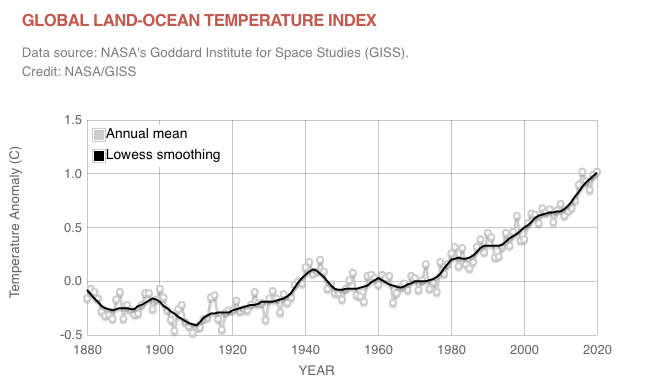
You had to be a statistician — or trust statisticians whose work you couldn’t check — to get any coherent view of the trends in global temperature. Think of the millions of measurements, and thousands of adjustments to those measurements, necessary to produce a graph like the one below. Who made those measurements? Who compiled those statistics? Why should you trust them? If you had the resources and the will, you could find your own way to parse the data so that it said something different. Why shouldn’t you do that, or decide to trust somebody who did, rather than trust NASA or NOAA or some international consortium of scientists?

The situation was even worse if you tried to look to the future, because then you were dealing with computer models. What were they assuming? Who did the programming? Again, the graphs looked very impressive and scary. But if you didn’t want to believe them — and who did, really? — nobody could make you.

And without predictions decades into the future, climate change was no big deal. Maybe it was already a degree or two hotter than in your grandparents’ day, but so what? Life went on, people adjusted. The climate was always changing.

What it came down to, for a lot of Americans, was one more example of people with advanced degrees telling them what to do. And that might be fine if they were telling you to do something you want to do — like get a good night’s sleep, or spend more time in the sunlight. And it’s even OK if their advice is unpleasant, but matches your common sense — compound interest means you should start saving for retirement when you’re young, smoking isn’t good for you. But here the eggheads were telling you to stop driving and flying and running the air conditioner, or even to close down the mines your town depended on, the one that had employed your family for generations. And the evidence was all stuff you couldn’t touch: Look at this graph and don’t ask too many questions about how I made it, or else the world will be a hellscape after we’re all dead.

Americans already had religions based on things they couldn’t see that made threats and promises after death. They didn’t need another one.

And then visible things started to happen, maybe, sort of.

Right around the time Hurricane Katrina mauled New Orleans in 2005, you might think you were starting to see climate change in anomalous weather events. But what is “anomalous”, really? When Superstorm Sandy hit New York City in 2012, we all had a gut feeling that hurricanes aren’t supposed to go that far north. But weird weather events have been happening forever. What about the Great New England Hurricane of 1938?

The Midwestern floods of 2019 were so intense, and so close to previous major floods, that they drove the phrase “hundred-year flood” out of our vocabulary. Nobody knows what a hundred-year flood is any more. And sure, that’s strange, but is it proof? Maybe we’re just in some kind of weird flood cycle.

We got used to these kinds of arguments, to the point that they became almost ritualized: The weather would do something incredible — a big wildfire, an intense hurricane season, or a heat wave in Siberia — and somebody would immediately say: “See? Climate change.” But then somebody else would say, “You can’t really say that about one event. It could just be bad luck.” Then either people would start yelling at each other, or the conversation would bog down in the technicalities of probability — neither of which accomplished anything. Everybody continued to believe whatever they had started out believing.

The series of weird weather events should have chipped away at climate-change-deniers’ skepticism, but in fact it did the opposite. Once you’ve explained away Katrina and Sandy, it gets easier, not harder, to shrug off Harvey and Irma and Maria all happening the same year. The weather gets weird sometimes; that doesn’t mean the world is ending.

Even so, last year’s western wildfires were a little hard to account for. Not only were they record-breaking in terms of acreage and cost, but Portland suburbs had to be evacuated, Seattle had an air-quality emergency, and the smoke gave me colorful sunsets all the way out here in Massachusetts. And only a few months before, Australia had record-breaking fires of its own.

For decades, climate-change deniers have derided activists as “scare mongers” who made “apocalyptic” predictions. But you know what? Those fires in Australia looked pretty apocalyptic.

Smoke-choked Sydney in December, 2019

Still, people pointed to multiple possible causes for wildfires: over-development, say, or power lines. President Trump blamed bad forest management, echoing absurd suggestions he had made about raking in 2018.

Wade Crowfoot, California’s secretary for natural resources, pressed Mr. Trump more bluntly. “If we ignore that science and sort of put our head in the sand and think it’s all about vegetation management, we’re not going to succeed together protecting Californians,” he told the president.

This time, Mr. Trump rejected the premise. “It’ll start getting cooler,” he insisted. “You just watch.”

“I wish science agreed with you,” Mr. Crowfoot replied.

“Well, I don’t think science knows, actually,” Mr. Trump retorted, maintaining a tense grin.

Well, it’s a year later now, and guess what? It’s not getting cooler.

Monday, it was 116 in Portland, Oregon, beating the previous all-time record (set in 1965 and 1981) by nine degrees. The heat wave covered the entire Northwest: 108 in Seattle, 109 in Spokane, 116 in Walla Walla, and 117 in Pendleton. Strangest of all was the small town of Lytton, British Columbia, where the heat wave peaked at 121 degrees, an all-time record for the nation of Canada.

121 in Canada. That’s not right.

Heat and drought have set the stage for another bad wildfire season, and it’s already starting in Canada and Washington and Oregon and Idaho and California. On the other side of the country, the Atlantic is already up to its fifth named storm of the season, Elsa. We’ve never gotten to E this fast before, and the previous record was set last year.

It’s happening. Global warming is here. It’s not just statistics and computer models any more. You can see it. You have to work not to see it.

That doesn’t mean things go straight to hell from here. The western heat wave finally broke. Today’s predicted high in Portland is 86. Next winter, it will get cold in lots of places, and if some oil-financed politician wants to bring a snowball to the floor of the Senate, he’ll be able to find one. “Damn,” one cold person will say to another, “we could use a little of that global warming about now.”

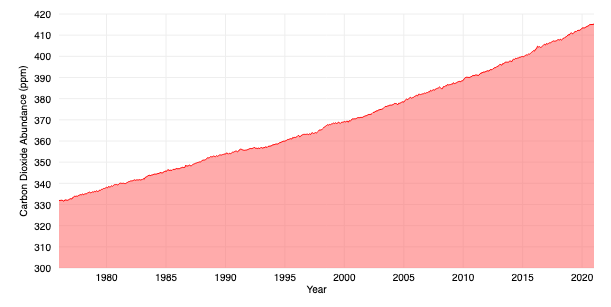
And while the quantity of carbon dioxide in the atmosphere will continue to go up every single year, not every year will be hotter than the previous one. 2016 and 2020 were the hottest years on record, but so far 2021 isn’t quite so bad, at least not globally. Fossil fuel spokesmen, including the politicians the oil companies pay for, will tell you that means it’s all over. Global warming ended in 2020, they’ll say, just like they said it ended in 1998.

https://www.climate.gov/news-features/understanding-climate/climate-change-atmospheric-carbon-dioxide

Don’t believe them. Believe what you can see.

For a long time, believing what the scientists said about the climate required trusting in the invisible, and the future horrors they predicted seemed too far away to take seriously.

Not any more. Global warming is here. It’s visible. It was 116 in Portland Monday.

That’s not right.

The Monday Morning Teaser

So I’m back from the Berkshires, where people were complaining because the temperature got into the 90s. Meanwhile, it was 116 in Portland.

And that’s where the first featured post starts. I think we’re entering a new phase in the national conversation about climate change. For a long time, climate change was either some invisible thing scientists teased out of the statistics, or horrifying projections made by mysterious computer models. Then we got into a debatable period, where you could point to anomalous weather events like Superstorm Sandy as signs of climate change, or you could just say that weird things happen from time to time.

But 116 in Portland, at the same time that the hurricane season is setting records in the Atlantic — it’s too much to explain away. People are feeling in their guts now that something’s not right.

So the first featured post this week is the kind of argument I think we need to be making. Not “Hey you idiots, we were right and you were wrong.” But something more like “I get why you haven’t wanted to believe this, but things are different now.” We need to invite people to switch sides, not herd them into reeducation camps.

Anyway, that’s the point of “Climate Change is Here”, which should be out shortly. I intend it to be the kind of thing you can send to your skeptical cousin. (Let me know if it works.)

The second post covers the Trump Organization indictment that came out Thursday. You’ve probably heard a lot of the details already, so I’ll talk mainly about what I think it means more broadly. Personally, I was surprised by how simple and obvious — and downright stupid — the tax-evasion scheme was. I thought I was immune to the Trump-the-great-businessman myth, but I had expected something much more clever than this. It makes me wonder how honest, or at least semi-honest, business owners are taking this. Maybe you fudge the numbers a little on how much personal use you get out of your company’s car, but your wife’s car? your kid’s apartment? your grandchildren’s tuition? It probably never occurred to you to claim them as business expenses, but the Trump Organization did. And they got caught.

Let’s say that post gets out before 11 EDT.

What does that leave for the weekly summary? The January 6 committee, Covid case numbers turning up again, the June jobs report, some Supreme Court decisions, and a few other things. And then we’ll end with what happens when a female singing duo takes a conservative boyfriend’s advice on songwriting. I’ll predict that for maybe 1.