Monthly Archives: November 2013

Carrot and Stick

I’m concerned about the fact there seems to be a war on the poor. That if you’re poor, somehow you’re shiftless and lazy. You know what? The very people who complain ought to ask their grandparents if they worked at the W.P.A.

— John Kasich, Republican Governor of Ohio
The New York Times, 10-28-2013

The dual process of cutting both taxes and social programs involved, however, a striking difference in the assumptions of the motivations governing the behavior of the affluent and of the poor. For those in the upper brackets, and for those managing corporate decision-making processes, the underlying assumption of the tax cuts was that the creation of new tax incentives would encourage more work, more investment, and more savings, that the best way to achieve sought-after behavior is to reward it, in this case with lowered tax rates on corporations, savings, executive stock options, and estates. At the bottom of the scale, the dominant assumption behind social program cuts was precisely the opposite: the best way to achieve increased work is by making life tougher.

— Thomas Byrne Edsall
The New Politics of Inequality (1984)

A shorter summary of the policy-set Edsall is describing: Carrots for the rich. Sticks for the poor.

This week’s featured post: “The Filibuster and the War on Women

This week everybody was talking about ObamaCare

The focus of Republican attacks shifted from HealthCare.gov to people whose policies got cancelled.

A lot of the media is reporting these cases without examining them. The few who do invariably notice the same things. Either

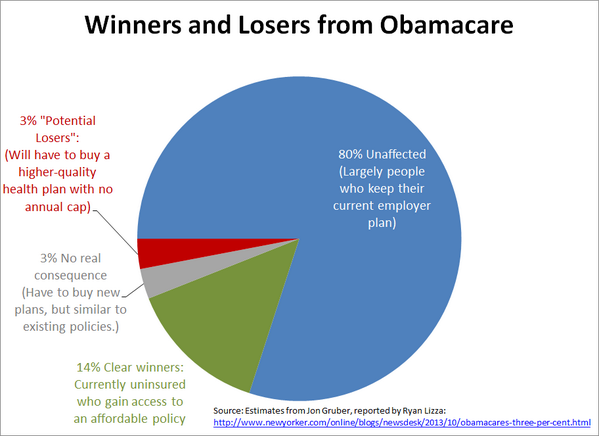
  • the cancelled policy is what Consumer Reports has called “junk insurance”. A low annual cap or the insurance company’s option to cancel if you actually get sick means that the policy really just provides the illusion of health insurance. In addition to the 50-million-or-so uninsured Americans pre-ObamaCare, about 25 million had insurance that would not have saved them from bankruptcy if they had a major health problem.
  • or, a better policy (typically, but not always) for less money is available on the ObamaCare exchanges.

There are exceptions, but here’s the overall picture:
Nicholas Kristof reminds us of the real victims of our healthcare system: People who will die because they couldn’t get affordable health insurance. They’re not just abstract public-health statistics. They have names and stories. As Margaret Talbot writes in The New Yorker:

when it comes to evaluating the worth of Obamacare we may not remember the Web-site hiccups all that well. What we will remember, and what ultimately matters, is whether, in the next year, the A.C.A. fulfills its promise: to provide affordable health insurance to people who did not have it through an employer, could not afford it on their own, were denied it on the basis of preëxisting conditions, paid more for it than they should have because they were, say, women of child-bearing age, or could no longer get by because their insurance benefits had been capped.


A new poll shows why the “replace” part of the Republican slogan to “repeal and replace ObamaCare” will never happen: Republicans don’t want a replacement. Among Republicans, repeal-and-don’t-replace beats repeal-and-replace 42%-29%.

and the LAX shooting

Notice how closely the coverage tracks Juan Cole’s 2012 “Top Ten Differences Between White Terrorists and Others“. I don’t want to make too much of the early hints that this guy is a right-wing wacko, but if he were a dark-skinned Muslim with similar hints of radical Islamist views, that would be the whole story.

and food stamp cuts

The Food Stamp program became less generous on November 1, when a benefit increase that was part of the 2009 stimulus program expired. Eligibility standards don’t change, but families will get about 5% less help.

I have trouble getting excited about the expiration of a temporary program, but further food stamp cuts are on the docket. The current budget negotiations are supposed to reconcile the Senate’s $4-billion-over-ten-years cut with the House’s $40-billion-over-ten-years cut. About $76 billion was spent on food stamps this year.


The problem of scale: “Lawmakers could save millions by targeting food stamp fraud — will they?” says the Fox News headline. Millions? Those who keep reading will find this acknowledgement: “The amount appears relatively small considering the government pays out roughly $70 billion in annual food stamps benefits.”

Hmmm. I wonder if those “millions” are net savings, after accounting for the cost of implementing and enforcing whatever safeguards would prevent that relatively small amount of fraud. Fox doesn’t link to the report the number comes from — I think it’s this one, although an automatic text search fails to find the $3.7 million figure in it — but it looks like they’re talking about gross savings, estimated by a suspiciously simplistic method.

The projected potential savings from fraud-cutting is detailed in the inspector general report, which found $3.7 million in questionable monthly payouts across 10 states. … The $222 million figure was reached by multiplying the number by 12 to get an annual amount, then by five to get an estimate for all 50 states.

So on the bottom line, the headline “millions” in savings are probably considerably less than the article claims, and may even be negative.

and the NSA

Strangely, people who are OK with the NSA spying on you and me hit their limit when it was revealed that the NSA is spying on our allies.

and the Republican Civil War

The opening quote from Governor Kasich is a Republican-on-Republican attack, as Kasich struggles to govern in spite of his Republican legislature. Anybody who thinks President Obama could get along with the Right if he were only nicer to them should study Kasich, who was a Fox News host for six years.

People you never would have thought could be challenged from the Right are in danger of being challenged from the Right. The latest is Senator John Cornyn of Texas. A poll of Texas Republicans found that “a Tea Party candidate” beats Cornyn 46%-33%, though several specific challengers are less popular. (Cornyn beats Rep. Louis Gohmert 45%-20%.) You have to wonder about the poll, because the wording of some  questions seems biased, like “Do you support amnesty for illegal aliens?” But the horse-race questions look legit.

The craziest name suggested as a Cornyn challenger is fake historian David Barton. Barton’s latest book, The Jefferson Lies, was withdrawn by the publisher, because “There were historical details — matters of fact, not matters of opinion, that were not supported at all.” Barton’s misrepresentations of American history figure prominently in Chris Rodda’s debunking book Liars for Jesus.

And here’s a future civil-war battleground:

and the filibuster and court rulings about abortion and contraception

I covered this in “The Filibuster and the War on Women“.

and you also might be interested in …

Nature giveth and nature taketh away.


You know who couldn’t get a Texas voter ID on his first try? Former Speaker of the House Jim Wright. His driver’s license had expired (which is probably a good thing, given that he’s 90) and his faculty ID from TCU isn’t one of the forms of ID accepted. (If he’d had a gun license, though, he’d have been fine. Let’s hope that’s expired too.) Fortunately, he could go home and find his birth certificate, which not all 90-year-olds can do.

The point of the law isn’t to verify who you are — Wright did that the first time — it’s to make it harder to vote. There’s no evidence of a voter-impersonation problem in Texas or anywhere else. And there’s really no evidence for a forged-ID-to-enable-voter-impersonation problem.


The Organisation for the Prohibition of Chemical Weapons (OPCW) announced Thursday that Syria

has completed the functional destruction of critical equipment for all of its declared chemical weapons production facilities and mixing/filling plants, rendering them inoperable.

… The next milestone for the mission will be 15 November, by which time the Executive Council must approve a detailed plan of destruction submitted by Syria to eliminate its chemical weapons stockpile.


I still can’t decide whether I want to see the Ender’s Game movie. But there’s no denying how far Orson Scott Card has gone off the rails. It’s not just the gay-marriage-justifies-revolution screed (“when government is the enemy of marriage, then the people who are actually creating successful marriages have no choice but to change governments, by whatever means is made possible or necessary. … Biological imperatives trump laws.”), it’s this “plausible” scenario for Obama making himself dictator-for-life.

Interesting re-interpretation of the novel on Salon: It’s not really about war or genocide, it’s “an imaginative portrait of the inner life of an abused child, a fledgling psyche trying to reconcile the unbearable contradiction in receiving both love and gratuitous pain from the same source.”


Abstract ideas have consequences. According to Scientific American, believing in Satan and the existence of pure evil affects views on a number of political issues.

BPE [belief in pure evil] predicts such effects as: harsher punishments for crimes (e.g. murder, assault, theft), stronger reported support for the death penalty, and decreased support for criminal rehabilitation. Follow-up studies corroborate these findings, showing that BPE also predicts the degree to which participants perceive the world to be dangerous and vile, the perceived need for preemptive military aggression to solve conflicts, and reported support for torture.

I’d love to see research on my hypothesis connecting BPE to conspiracy theories. This is from the 2010 Weekly Sift article “Propaganda Lessons from the Religious Right“:

The Devil is the ultimate sinister conspirator, motivated by pure evil. Once you have a Devil, it follows without evidence that there is a conspiracy against anything true and good and right. How could there not be? The Devil is against it, and unless he has suddenly lost his innate cleverness and his characteristic ability to lie and tempt and cajole, he will have followers.

So if you are arguing in front of a Devil-postulating audience, you don’t have prove that there is a conspiracy against the Good — of course there is — you only have to identify that conspiracy. The Manichean frame (God/Devil, Good/Evil) is sitting there, waiting for you to connect yourself with Light and your opponent with Darkness.


This is the kind of thing that gives Congress a bad image: Part of the deal to end the shutdown/debt-ceiling standoff was to have a later vote on a “resolution to disapprove” of the debt-ceiling hike. That resolution was voted on in the Senate Tuesday, and lost on a party-line vote.

Here’s the ridiculous part: 27 Republican senators who voted to “disapprove” also voted for the deal they’re disapproving of. So, did the Devil make them cast that vote?


In five years, copyrights from the 1920s will start expiring, as they would have long ago if Disney and other copyright-owning corporations didn’t keep lobbying for extensions.

Extending copyrights on existing works is a pure corruption issue: There’s no public interest whatsoever in preventing Mickey Mouse and Batman from entering the public domain the way older cultural icons like Sherlock Holmes and Scrooge did long ago. Copyrights are supposed to be incentives for creators, but as Lawrence Lessig puts it: “No matter what the US Congress does with current law, George Gershwin is not going to produce anything more.”

The big money is already gearing up to buy another act of Congress. But there’s an internet and a blogosphere this time around, so they’ll have to buy their legislation in full public view.


American neighborhoods are getting more economically stratified.

Using U.S. Census data from 1970-2000 and American Community Survey data from 2005-2011, Cornell’s Kendra Bischoff and Stanford’s Sean F. Reardon found that more people are living in extremely high income areas or low income areas, while fewer are living in areas characterized as middle-income.

Kevin Drum annotates the chart:

This is yet another sign of the collapse of the American middle class, and it’s a bad omen for the American political system. We increasingly lack a shared culture or shared experiences, and that makes democracy a tough act to pull off. The well-off have less and less interaction with the poor outside of the market economy, and less and less empathy for how they live their lives. For too many of us, the “general welfare” these days is just an academic abstraction, not a lived experience.

and finally, something too good not to use

Miley Cyrus and Robin Thicke get Attenborrowed.

The Filibuster and the War on Women

The abuse of the filibuster is a hard issue to get people excited about. It’s one of those technical political things that takes too long to explain and is hard to connect to problems voters care about.

This week, making those connections was a little easier. If you care about a woman’s right to decide whether she gets pregnant or has a baby, the connection to the filibuster was all too clear. Here are three of this week’s big stories:

  • Senator John Cornyn threatened to filibuster anyone President Obama nominates to the D. C. federal appeals court. He’s not making objections to the specific judges Obama has picked, he’s arguing that Obama shouldn’t be allowed to make any picks at all. The court’s current 4-4 conservative/liberal balance should be locked in, no matter how many elections Democrats win.
  • That same court issued a temporary injunction to suspend ObamaCare’s contraception mandate for certain firms, in anticipation of a permanent ruling that employers’ religious freedom gives them power over employees’ health decisions. The judge who wrote the majority opinion is a radical conservative that Democrats tried to block when President Bush nominated her, but they had to back down when Republicans threatened the “nuclear option” to eliminate the filibuster permanently.
  • Another judge from that same batch of Bush appointees lifted a lower-court injunction against a Texas anti-abortion law that (among other restrictions) instantly closes about 1/3 of Texas abortion clinics, leaving large areas of the state without abortion services, again in anticipation of the law’s ultimate approval.

Let’s take those one at a time.

Filibuster abuse and the D. C. court. Wikipedia describes the federal appeals court for the District of Columbia circuit like this:

While it has the smallest geographic jurisdiction of any of the United States courts of appeals, the D.C. Circuit, with eleven active judgeships, is arguably the most important inferior appellate court. The court is given the responsibility of directly reviewing the decisions and rulemaking of many federal independent agencies of the United States government based in the national capital, often without prior hearing by a district court. Aside from the agencies whose statutes explicitly direct review by the D.C. Circuit, the court typically hears cases from other agencies under the more general jurisdiction granted to the Courts of Appeals under the Administrative Procedure Act. Given the broad areas over which federal agencies have power, this often gives the judges of the D.C. Circuit a central role in affecting national U.S. policy and law.

A judgeship on the D.C. Circuit is often thought of as a stepping-stone for appointment to the Supreme Court.

The court has 11 active judgeSHIPs, but only 8 active judges. (It had only 7 — and a 4-3 conservative majority — until Obama finally got his first pick approved in May. It also has six semi-retired senior judges. If you count them, the court has a 9-5 conservative majority.) That’s because there are three vacancies. The Constitution (Article II, Section 2) specifies how those vacancies should be filled:

The President … shall nominate, and by and with the Advice and Consent of the Senate, shall appoint Ambassadors, other public Ministers and Consuls, Judges of the supreme Court, and all other Officers of the United States, whose Appointments are not herein otherwise provided for

The filibuster is a historical accident. The Founders didn’t envision it, and although an 1806 rule change made filibusters possible, the first one didn’t happen until 1837. They were rare until the 1970s, and truly skyrocketed when the Republicans became the Senate minority after the 2006 election.

Filibusters of presidential nominations were rare until the Clinton administration, and then Democrats retaliated during the Bush years. But even then, the justification for a filibuster was always some alleged problem with the individual nominee. (Bush nominee Janice Rogers Brown, for example, was filibustered for a history of inflammatory decisions, having once written of Social Security: “Today’s senior citizens blithely cannibalize their grandchildren because they have the right to get as much ‘free’ stuff as the political system will permit them to extract.”)

What’s new in the Obama years is the use of the filibuster to nullify a federal office by refusing to approve anyone to head it, regardless of character or qualifications. Until Senate Democrats threatened to invoke the so-called nuclear option in July, Republicans were on track to invalidate the entire National Labor Relations Board, essentially nullifying all laws protecting workers’ rights to organize unions and bargain collectively in good faith.

Cornyn proposes an extension of this unprecedented tactic: using the filibuster to nullify the three vacancies on the D. C. court, ostensibly because the court’s case load doesn’t require 11 judges. (He wasn’t bothered by an even lower case load when Bush appointed Rogers.)

If over-staffing of the D.C. court is indeed a problem (and not just a pretext to stave off a liberal majority), the Constitution provides a way to solve it in Article I, Section 8:

The Congress shall have Power … To constitute Tribunals inferior to the supreme Court

In other words, Congress could pass a law shrinking the D. C. court, if that were really a problem. But legislation requires a majority vote in both houses and the signature of the President, which Cornyn can’t get because his party can’t win national elections.

This is what the filibuster has become: not just a way to block new laws or objectionable appointments, but a way for a minority to repeal legislation already passed or to achieve its goals without passing laws at all.

Who needs to win elections?

The contraception mandate. Thursday, the previously mentioned Janice Rogers Brown (of Social-Security-is-cannibalism fame) was the deciding vote in a 2-1 decision by the D. C. appeals court to grant an injunction blocking enforcement of ObamaCare’s contraception mandate on a business owned by two Catholic brothers. The ruling isn’t a final decision in the case, but it reads like one, because one key consideration in granting such an injunction is a belief that the injunction-seeking side is likely to prevail.

Fortunately, Rogers stopped short of declaring that corporations are protected by the First Amendment’s free-exercise-of-religion clause, which would have produced true chaos. But the 400-employee company is owned by two brothers who claim to operate according to Catholic principles (i.e., having pro-life bumper stickers on their trucks), so the brothers’ religious freedom is violated by the requirement that they provide contraception coverage to their female employees.

I’ve stated my position on this issue at length before: I believe these claims of “religious freedom” are actually passive aggression, stretching claims of one’s own moral purity to ridiculous lengths in order to control the behavior of others. I was pleased to see many of my own favorite arguments show up in the dissenting opinion of  Senior Judge Harry Edwards (the only Democratic appointee among the senior judges) (I’m not claiming Edwards reads the Sift or that the arguments are original to me):

It has been well understood since the founding of our nation that legislative restrictions may trump religious exercise. Braunfeld v. Brown, 366 U.S. 599, 603 (1961). Were it otherwise, “professed doctrines of religious belief [would be] superior to the law of the land, and in effect permit every citizen to become a law unto himself.”

and illustrates the point with an example Sift readers will recognize:

A Christian Scientist, whose religion has historically opposed conventional medical treatment, might claim that his corporation is entitled to a religious exemption from covering all medical care except healers who treat medical ailments with prayer.

Edwards sees the conflict between the owners’ religious beliefs and the mandate, but does not find that it meets the legal standard of a “substantial burden”, using another analogy I’ve used here.

The Supreme Court has never applied the Free Exercise Clause to find a substantial burden on a plaintiff’s religious exercise where the plaintiff is not himself required to take or forgo action that violates his religious beliefs, but is merely required to take action that might enable other people to do things that are at odds with the plaintiff’s religious beliefs.

… The Gilardis do not contend that their religious exercise is violated when Freshway pays wages that employees might use to purchase contraception, and the Mandate does not require the Gilardis to facilitate the use of contraception any more directly than they already do by authorizing Freshway to pay wages.

Edwards quotes a 1982 Supreme Court decision:

Congress and the courts have been sensitive to the needs flowing from the Free Exercise Clause, but every person cannot be shielded from all the burdens incident to exercising every aspect of the right to practice religious beliefs. When followers of a particular sect enter into commercial activity as a matter of choice, the limits they accept on their own conduct as a matter of conscience and faith are not to be superimposed on the statutory schemes which are binding on others in that activity.

If not for the filibuster, that might be the majority opinion.

Texas abortion law. One of the other Bush judicial appointees who made it through the Senate under threat of the nuclear option was Priscilla Owen, whose appointment the Houston Chronicle opposed with these words:

The problem is not that Owen is “too conservative,” as some of her critics complain, but that she too often contorts rulings to conform to her particular conservative outlook. It’s saying something that Owen is a regular dissenter on a Texas Supreme Court made up mostly of other conservative Republicans.

No less a conservative than Alberto Gonzales once characterized Owen’s opinion in a Texas abortion case as “an unconscionable act of judicial activism”. In other words, even among conservative judges, she stood out as particularly radical.

The stipulation in the recent Texas abortion law (the one Wendy Davis delayed for a session with her famous state-legislature filibuster) that doctors who perform abortions have admitting privileges in local hospitals is one of a number of regulations designed to close clinics, and is largely devoid of any legitimate purpose. The lower-court judge found that the law was “without a rational basis and places a substantial obstacle in the path of a woman seeking an abortion.” Similar laws in Wisconsin and other states have been blocked by federal judges.

But thanks to Judge Owen, this one is allowed to take effect. Abortion clinics are already closing, and it is estimated the 1/3 of all abortion clinics in Texas — already not that common — will be unable to meet the requirement.

End the filibuster. Right now, conservatives are benefitting from the fact that Senate Republicans have been more willing to play hardball than Democrats. Democrats under Bush attempted to block only the most outrageous nominees, and for the most part they failed. Those judges are on the bench now, fighting the war on women.

That’s just one front of the struggle, the one whose dots were most easily connected this week. Ultra-conservative judges have brought us Citizens United, came close to constructing an entirely novel interpretation of the Commerce Clause specifically to torpedo ObamaCare, and across-the-board have extended the rights of corporations and the rich over workers, consumers, and the general public.

President Bush did not try to be “reasonable” in his appointments or seek uncontroversial nominees. He nominated the most activist conservative judges he could find, and Senate Republicans refused to let the Democrats filibuster even the worst of them.

Now that the tables have turned, the filibuster has been expanded into a general tool of minority rule. It’s time to end it, once and for all.

The Monday Morning Teaser

The featured article this week, “The Filibuster and the War on Women”, will connect the dots between the blockade Senate Republicans have put around D. C. Court of Appeals (pledging to filibuster anybody President Obama might nominate to fill its three vacancies) and the effects of the radically conservative decisions that court produces (an injunction upholding a employer’s right to impose his moral code on his employees’ health insurance).

This week’s two most important legal decisions (the injunction I just mentioned, and removing an injunction that blocked Texas’ new anti-abortion bill, instantly closing 1/3 of the state’s abortion clinics) both were written by Bush-appointed judges that Democrats tried to block, but let through when Republicans threatened the “nuclear option” to end filibusters altogether. Will Harry Reid go there?

The weekly summary has a lot to cover: What’s up with all those policies canceled under ObamaCare? The LAX shooting. The food stamp cuts that took effect Thursday, and the ones looming in Congress’ budget negotiations. NSA spying hits home for the Germans. Science studies the political impact of believing in the Devil. The copyright wars restart. Syria keeps chugging along towards destroying its chemical weapons. Middle class neighborhoods are shrinking. And the Miley Cyrus/Robin Thicke video is much more amusing with a David Attenborough soundtrack.

No predictions about timing this morning. I’ll get stuff posted as soon as I can.