The Monday Morning Teaser

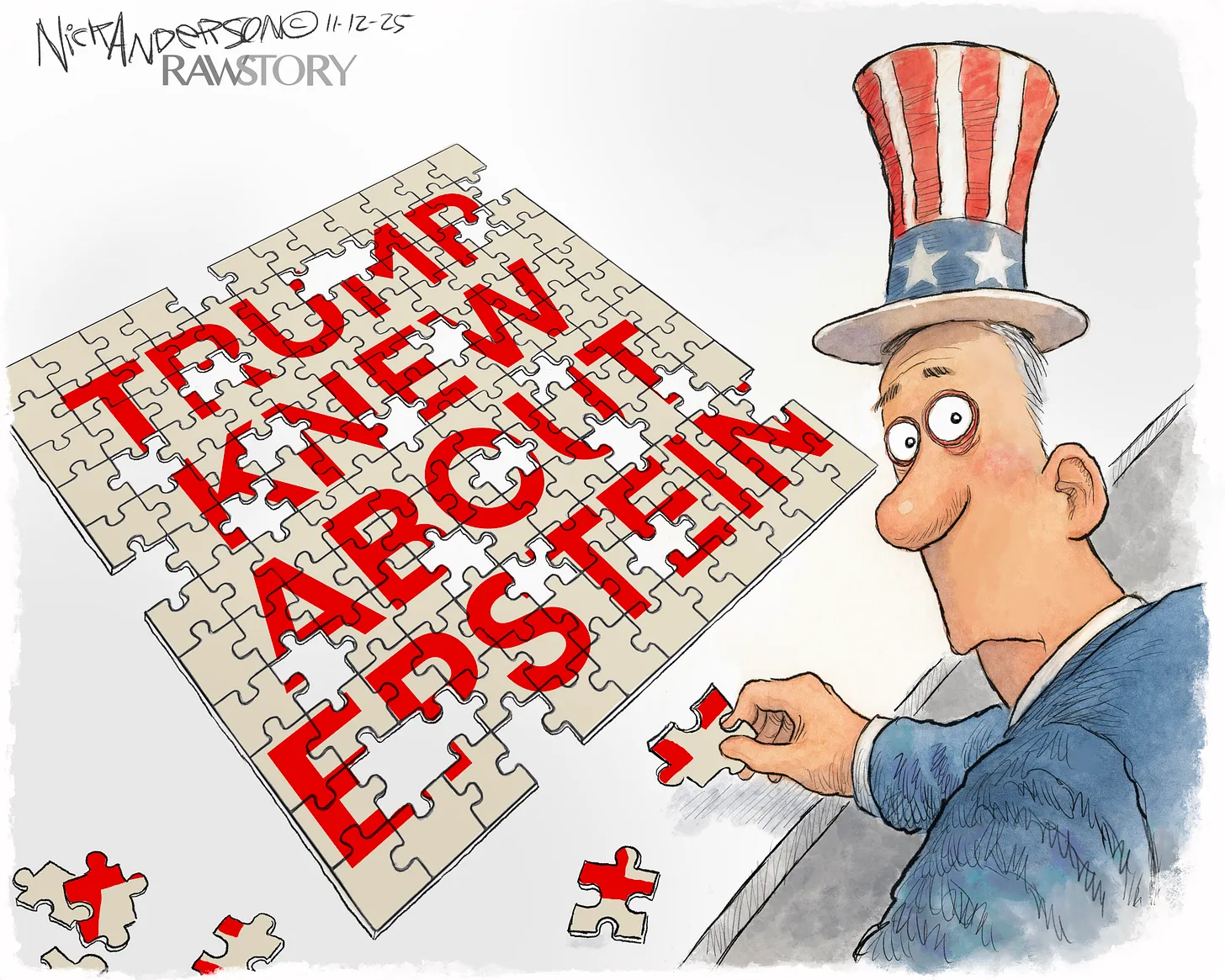
It’s been one of those weeks where I have to wonder which news stories are supposed to distract me from which other news stories, and whether I’ve taken the bait. But OK, I largely fell down the Epstein rabbit hole this week, watching the twists and turns that last night finally caused Trump himself to urge House Republicans to vote to release the files.

To balance that, I was also reading a book of long-term significance: Paper Girl by Beth Macy. Macy returned to her small Ohio hometown asking how easy it would be for a present-day Beth Macy to escape small-town poverty and build a professional-class life for herself. Along the way, she uncovered a lot about the roots of MAGA in the White working class and the sources of our present polarization.

The featured post will go into the lessons I learned from Macy’s book. It should be out between 10 and 11 EST.

The weekly summary will go into this week’s Epstein developments, with an eye to whether they show Trump’s bid for autocracy faltering. I’ll also discuss the aftermath of the government shutdown, what’s been going on in Chicago and Charlotte, the week’s legal news, and a few other things. I hope to get that out about noon or slightly after.

Law and Order

Our residents have been attacked by a lawless entity, and we can’t just stand by and pretend this is acceptable.

Mayor Daniel Biss of Evanston,
commenting on Border Patrol attacks on Evanston residents

This week’s featured post is “What would a Republican healthcare plan look like?” I feel good about this post. Even if you usually skip the longer articles, you might want to read this one.

Ongoing stories

  • Trump’s assault on American democracy. Tuesday’s elections show that the clock is ticking on Trump’s bid for autocracy. If he allows fair elections in 2026, he’s going to lose control of Congress. Meanwhile, his thugs continue to abuse the citizens of Chicago.
  • Climate change. The COP30 summit is meeting in Brazil this week, with no US participation.
  • Gaza. The next step in the Gaza peace plan is to assemble a “stabilization force” of peace-keeping troops from other Muslim countries. The UAE has opted out. Turkey wants in, but Israel is dubious. Meanwhile, Netanyahu pledges to enforce the ceasefire “with an iron fist“.
  • Ukraine. The Russian advance continues, but it’s very slow and costly.

This week’s developments

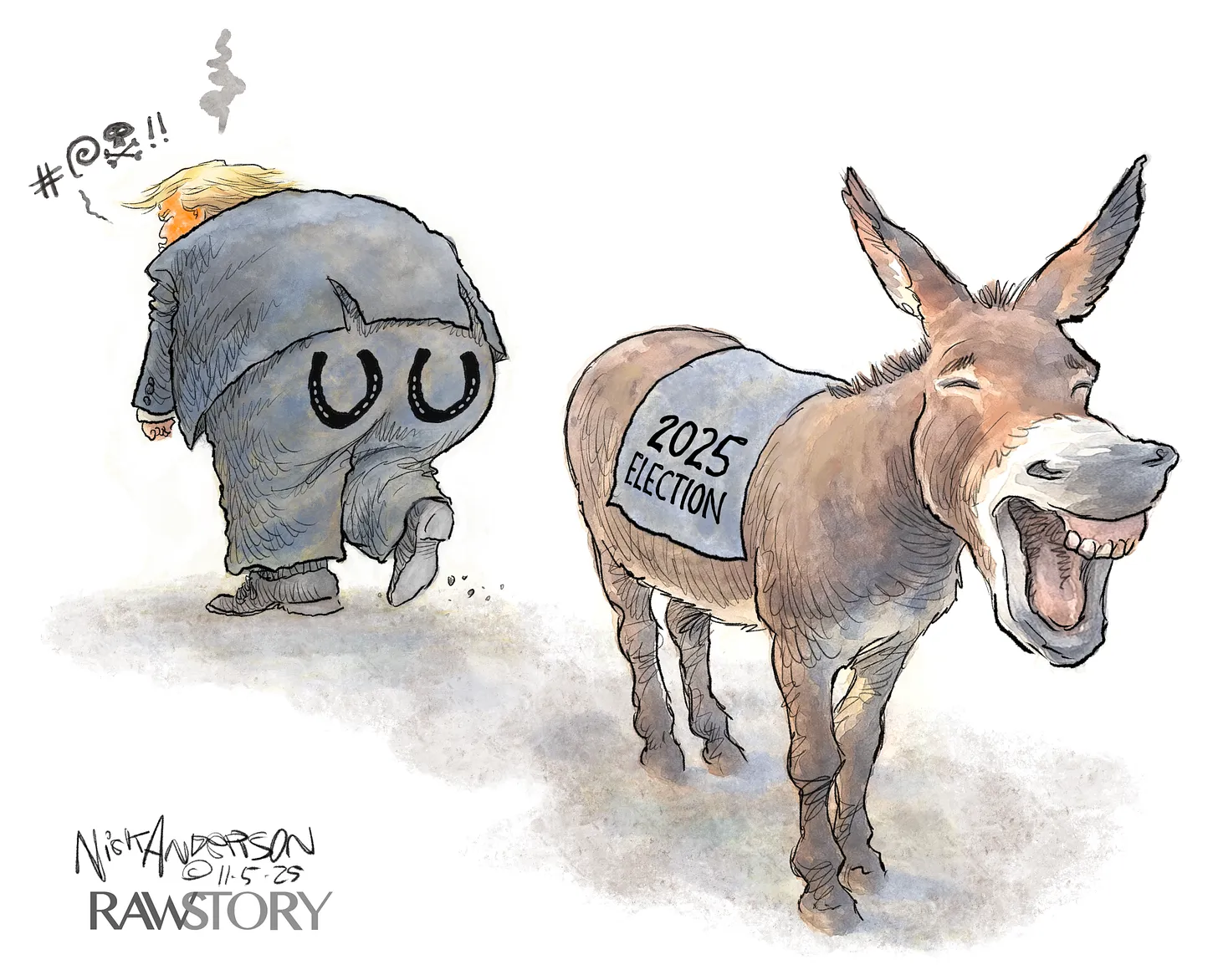
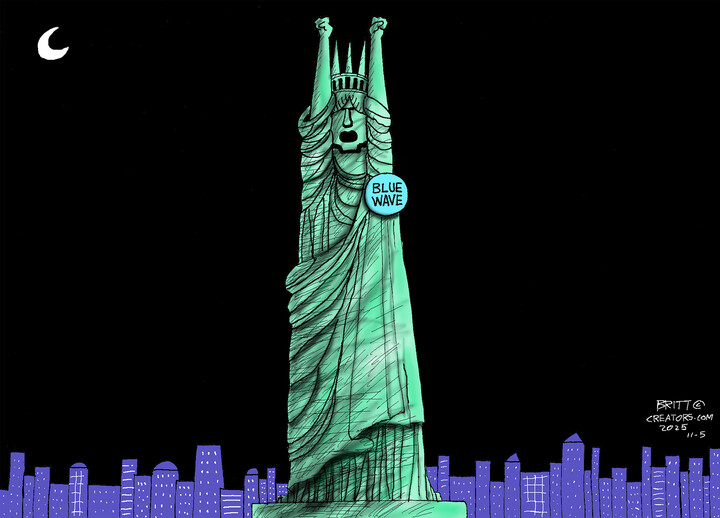
This week everybody was talking about the Democrats’ sweeping election victory

Every major contested race — Virginia’s and New Jersey’s governors and other statewide offices, NYC’s mayor, the California’s Prop 50 — went the Democrats’ way, usually with high turnout and by unexpectedly large margins.

Many words have been written and spoken about what this means. To me, it comes down to this: In the rosy scenarios where the Trump autocracy fails and American democracy survives, winning big in 2025 was a key step. An autocrat’s biggest strength is the myth of his invincibility. You go along with what he wants because there seems to be no other choice.

Certainly that has been the case inside the Republican Party. For 10 months, Congress has virtually ceased to be a factor in American government, because the Republican majorities are so cowed by Trump. The Senate approved cabinet nominees (like Pete Hegseth, Tulsi Gabbard, and RFK Jr.) that everyone knew were unqualified and probably dangerous. Both houses have sat mutely while Trump usurps Congress’ power of the purse and its war powers. Trump’s Big Beautiful Bill needed near-unanimous Republican support to pass, and got it — despite the fact that it will take Medicaid coverage away from millions of Republican voters. The House has simply gone home for six weeks rather than vote on subpoenaing the Epstein files.

After Tuesday, Republicans in elected offices have to wonder if they’re committing political suicide by following Trump so blindly.

The big message comes from New Jersey, where Trump’s 2024 gains among Hispanic and Asian voters vanished. Passaic County is 43% Hispanic, according to the 2020 census. But it went for Trump by 7% in 2024. Tuesday, it went Democratic by 26%.

Statewide, Trump lost New Jersey by less than 6%, but Mikie Sherill won by more than double that margin. A similar 6% swing in 2026 elections could flip a lot of Republican seats to the Democrats.

Of course, there is a downside to these results as well: Now that’s it’s obvious that MAGA candidates won’t hold control of Congress in free and fair 2026 elections, the pressure to steal those elections grows.


I think it’s important not to get caught up in the Democratic polarization narrative the mainstream media is pushing. Yes, Mamdani won as a Democratic Socialist, while Sherill and Spanberger won as moderate Democrats. I don’t see this as a problem.

The unifying principles are to be authentic, to recognize that a large percentage of the electorate feels poorly served by our economic system and left out of our politics, and to say to those people: “I see you, and I want to do specific things to help you.”

The specific policies, and whether they are leftist or centrist, are far less important.

Above all, don’t get caught up in the Socialism vs Capitalism argument, as if these were two Manichean forces inevitably at each other’s throats. We are all socialists and we are all capitalists. Do you support your town having a public fire department? To that extent, you’re a socialist. Do you want your town’s restaurants to compete on price and quality, letting the local market decide which ones thrive? To that extent, you’re a capitalist.

The issue is where to draw the line between the public and private sectors. That’s a serious and important question, but it has many viable answers and many opportunities for compromise that you’ll miss if you see nothing but capitalist/socialist polarization.


A lot of people are angsting over the conflicting poll results: Trump’s approval continues to sink, but the public’s opinion of the Democratic Party hasn’t improved. I don’t think it’s that mysterious: In most of the country, you can’t win just by being a generic Democrat. People don’t connect the Democrats with any particular message, so you have to bring your own message. You also have to be an individual and project a personality people identify with.

We might go into next November with the polls still close on whether people want Republicans or Democrats to control Congress. But if Democrats do their job right, people will look at the Democrat running in their district and find something they like or are even excited by.


Too much fun to pass up: A kindergarten teacher responds to Trump’s tantrum after losing Tuesday.

and the shutdown

Which will probably end in a few days as the longest in history, breaking the record from Trump’s first term. Senate Republicans got the exact number of Democrats they needed to pass their “compromise”, which amounts to Democrats surrendering without getting anything meaningful in return.

The deal:

  • funds the full government through January 30
  • funds the Departments of Agriculture and Veterans Affairs for the full fiscal year (i.e., until October 1)
  • funds SNAP (i.e. food stamps) for the full fiscal year
  • gives federal workers fired during the shutdown their jobs back and prevents further layoffs through January 30
  • grants backpay to all federal workers furloughed or working without pay during the shutdown

What it doesn’t do: anything to help the tens of millions of Americans whose ObamaCare premiums are going to skyrocket for 2026. Majority Leader Thune has promised a vote on a bill to preserve the subsidies that kept those plans affordable, but that’s a political concession rather than anything real. Even if the Senate passes that measure, Speaker Johnson has said it won’t get a vote in the House. So basically, the Senate vote will frame the issue, positioning Democrats as the ones who voted for it and Republicans as the ones who blocked it. But it won’t actually help anyone pay for health insurance.

Senator Jeanne Shaheen of New Hampshire, one of the eight Democrats who voted for the bill, exemplified the defeatist attitude Democrats so often bring to negotiations: “This was the only deal on the table.” The Republican position is what it is, and Democrats just have to adjust to it.

The Democrats’ surrender came in spite of all indications that they were winning the political battle of the shutdown: Polls showed Trump and the Republicans were taking more of the blame, and Democrats overwhelmingly won Tuesday’s elections.

Josh Marshall recognizes all that, but finds this silver lining:

When the time came Democrats fought. They held out for 40 days, the longest shutdown standoff in history. They put health care at the center of the national political conversation and inflicted a lot of damage on Trump. At 40 days they could no longer hold their caucus together. And we got this.

That’s a sea change in how the congressional party functions. And that’s a big deal. Many people see it as some kind of epic disaster and are making all the standard threats about not voting or not contributing or whatever. That’s just not what I see. It’s a big change in the direction of the fight we need in the years to come that just didn’t go far enough. Yet.

… Meanwhile, keep purging all the folks who can’t get with the new program. If a senator is from a comfortably Blue State and wasn’t vocally in favor of fighting this out, primary them — toss them overboard. After March, Dick Durbin realized he needed to retire. Let’s see some more retirements. But don’t tell me nothing has changed or that this is some cataclysmic disaster. It’s not. This accomplished a lot. It demonstrated that Democrats can go to the mat when the public is behind them and not pay a political price. It dramatically damaged Donald Trump. It cued up the central arguments of the 2026 campaign. It just didn’t go far enough.

Meanwhile, passing the House is not a done deal yet. It’ll be interesting to see how many Democrats hold out, and how many Republicans think even this victory isn’t big enough.

And the House will have to come back into session to end the shutdown. Will Johnson find some new excuse not to seat Adelita Grijalva? Will he violate House rules to avoid a vote on subpoenaing the Epstein files? Expect a lot of soap opera in the next few weeks.

and Trump’s violent thugs

Don’t miss this interview, where Evanston Mayor Daniel Biss talks to a woman who was victimized by Border Patrol agents in an Evanston incident that has gone viral. “They’re more afraid of us than we are of them,” she says.

What they — ICE and the Border Patrol — are afraid of is not violence, but people following their vehicles, blowing whistles around their agents, and making videos of what they do. Biss was also interviewed by Democracy Now (the link at the top of the page) in a segment that included video of major ICE abuses in Evanston.

Well, on Friday, which was, by the way, Halloween, ICE and CBP were all over Evanston. It was a terrifying day. I couldn’t go two minutes without a notification coming up on my phone: They’re at this corner; they’re at this corner; they’re grabbing this landscaper, and so forth. And they were doing what they usually do these days, which is drive around town looking for someone working on a lawn whose skin is not white, and grab that person and abduct them. And so, the rapid responders were out in force, and there was a lot of activity, and I was driving around trying to do what I could.

And then, in the early afternoon, the following thing happened. The vehicle, which was driven by a CBP agent, for whatever that’s worth, that had been driving around the region and was being followed by residents — which is what happens all the time because our community is rising up against this invasion — they decided they don’t want scrutiny, they don’t want to be followed, they don’t want to be observed, they don’t want to be videotaped, and, most of all, they don’t want to be criticized. They appear to have acted deliberately to cause an accident. They jammed on the brakes right after going through an intersection and to force the car following them to rear end them, which, of course, created a scene. And there were people who gathered, who were watching and who were yelling at them and blowing their whistles and screaming. And then they appear to have just started beating people up for no reason. And folks may have seen these videos, that have gotten a lot of attention, including one where they’ve got this young man on the ground, and his head is on the asphalt, and they’re literally punching him in the head. And then, after a while of this, they jammed three people into their vehicle, abducted them, drove them around, and eventually, later on, released them.

If you’re not familiar with the Chicago area, you may not realize how incredible this whole scene is. Evanston is the lakefront suburb just north of Chicago. It is the home of Northwestern University, and in general is very upscale. It’s not a place where ICE or CBP should be looking for “the worst of the worst”, as Trump promised during the 2024 campaign. So if you look at what Trump’s thugs are doing and say, “That would never happen here, in my town”, think again.

and the Supreme Court’s tariff hearing

I have been deeply skeptical of this Supreme Court’s ability to defend the Constitution against Trump. In particular, I’ve doubted they will apply the same standards to Trump that they did to Biden. They invented the “major questions doctrine” and greatly expanded the “non-delegation doctrine” precisely to limit Biden’s executive authority. Now, those same standards clearly apply to Trump’s sweeping tariffs, but I’ve doubted the Court will bother to notice.

I’m less sure about that skepticism now. Wednesday’s oral arguments showed some of the conservative justices — especially Gorsuch — worrying about major questions and non-delegation. The issue in a nutshell is that tariffs are taxes, and the taxing power belongs so intrinsically to Congress that it can’t be delegated to the President.

Gorsuch raised the question of whether Congress could also delegate its power to declare war, and later wondered what a more liberal president could do with the tariff power: Suppose a Democratic president declared a climate emergency and tariffed the importation of internal combustion engines?

You can’t always deduce justices’ final opinion from the questions they ask, but I expected the conservative justices to be creating room for themselves to give Trump what he wants, as they so often do. I didn’t see that.


The Court also won’t be reversing its same-sex marriage decision this term.

and you also might be interested in …

Nancy Pelosi announced her retirement from Congress when her current term ends in January.

By any standard, Pelosi is a giant in congressional history. She was the first female speaker, and the most effective speaker of either party in my lifetime. She took criticism from the left because of her broadly centrist policies, but I can’t remember her blocking any liberal proposal if the votes were there to pass it.

Retirement, like death, is one of those moments that calls for a magnanimous response. But of course, Trump doesn’t have a magnanimous bone in his body. He responded to the news by calling Pelosi an “evil woman” and saying that “she did the country a great service by retiring”.


I’m going to display my own lack of a magnanimous response by commenting on the death of Dick Cheney. I won’t rehash all the things I fault him for, but I regret that now he will never stand trial at the ICC in The Hague.


When 60 Minutes asked Trump about pardoning crypto billionaire Changpeng Zhao, he claimed not to know who Zhao is. The company Zhao founded has made deals with the Trump family’s crypto venture, but that couldn’t have anything to do with the pardon, could it?

I’d like to ask Speaker Johnson which option is worse: that Trump is lying about a corrupt pardon, that he signs pardons without knowing who the people are, or that his dementia has progressed to the point that he can’t remember the decisions he makes.


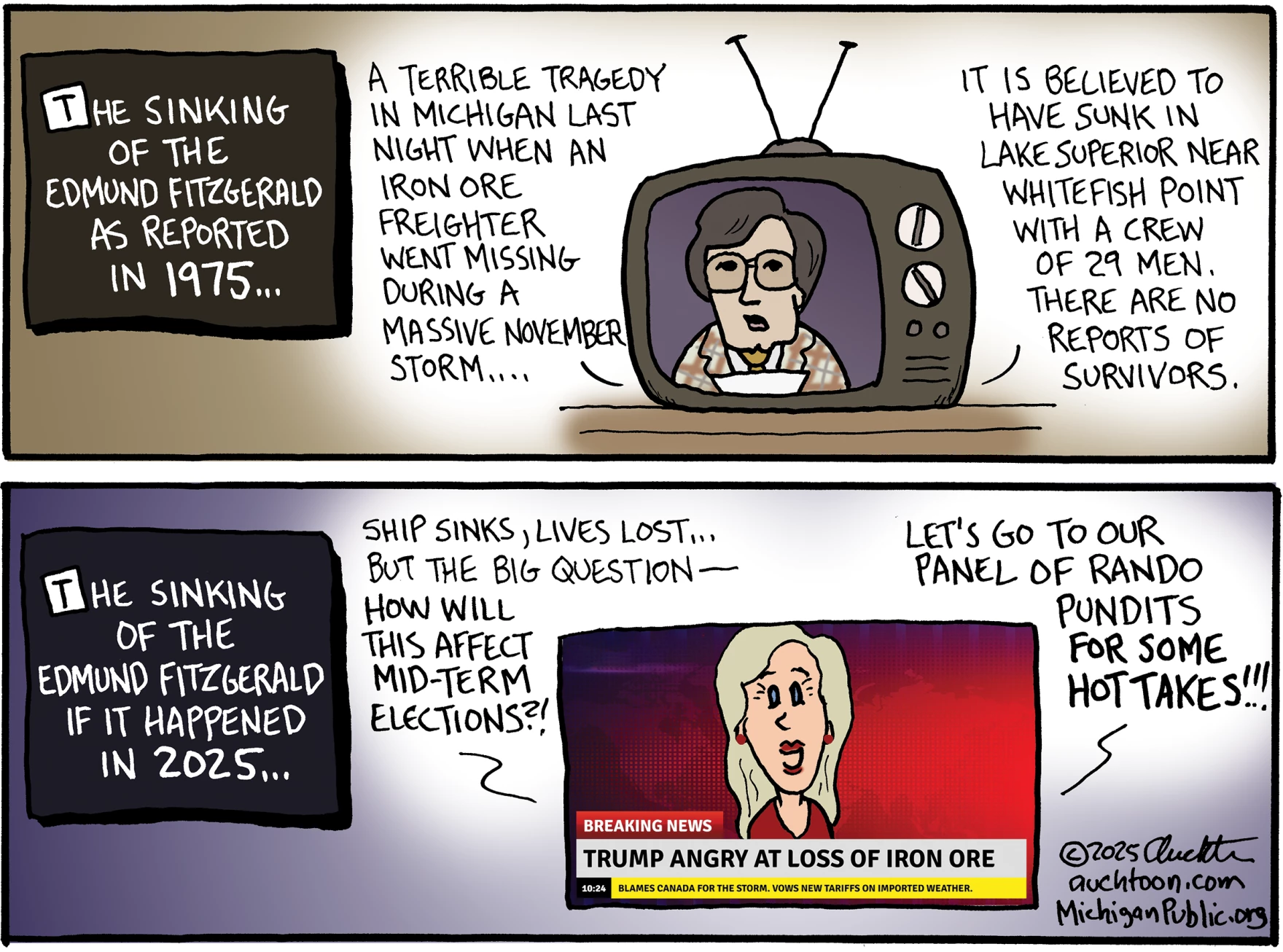
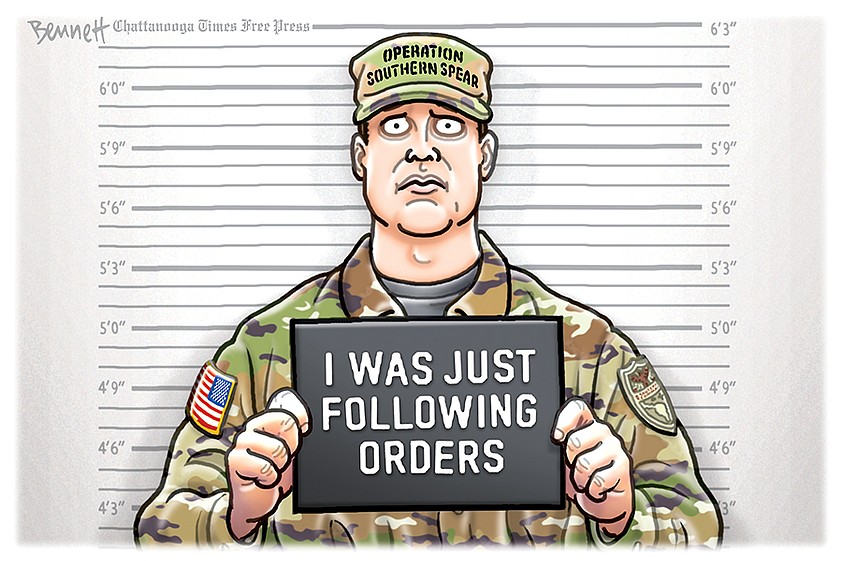
Here’s a cartoonist’s take on how media coverage has changed in the last 50 years:

and let’s close with something natural

The Guardian has a spectacular gallery of nature photography.

What would a Republican healthcare plan look like?

The government can cut healthcare spending if it tempts people into gambling with their lives.


The longest government shutdown in American history came down to one issue: healthcare. Republicans have been persistent about dismantling the ObamaCare model, claiming that they have a different approach that will yield better care for less cost. And so the subsidies that kept policies on the ObamaCare marketplace affordable have been allowed to lapse for 2026 policies. Democrats tried to reverse that as a condition of reopening the government, but appear to have failed.

Of course, Trump has been promising to spell out a “beautiful” healthcare plan since 2015, and we’ve still seen nothing. Critics say Republicans don’t really have a plan, which is true in the sense that they don’t have a written piece of legislation that can be compared to the Affordable Care Act, apples to apples. (They also have nothing that could take effect in time to replace the 2026 ObamaCare policies they have now made unaffordable for millions of Americans.) Rep. Marjorie Taylor Greene makes an even stronger claim, that even within the Republican House conference, Mike Johnson has not yet presented “a single policy idea”. Speaker Johnson counters that Republicans have “pages and pages and pages of ideas of how to reform healthcare”, and has pointed to a report the Republican Study Committee wrote in 2019.

It’s natural and probably appropriate to be cynical about that claim, but for a few minutes let’s take Speaker Johnson seriously. What’s in that report? It’s 58 pages, most of which are spent criticizing ObamaCare. But it does get around to presenting some ideas on pages 32-50: things like health savings accounts, allowing a wider range of choices in insurance, changes to the way employer-paid premiums are taxed, and so on — enough individual notions to get you confused about the overall picture. But basically it comes down to this: They want you to gamble with your life and health.

In order to understand their proposals, let’s lay out the context: starting with the pre-ObamaCare situation, then what ObamaCare did, and then the ways Republicans have broken ObamaCare since.

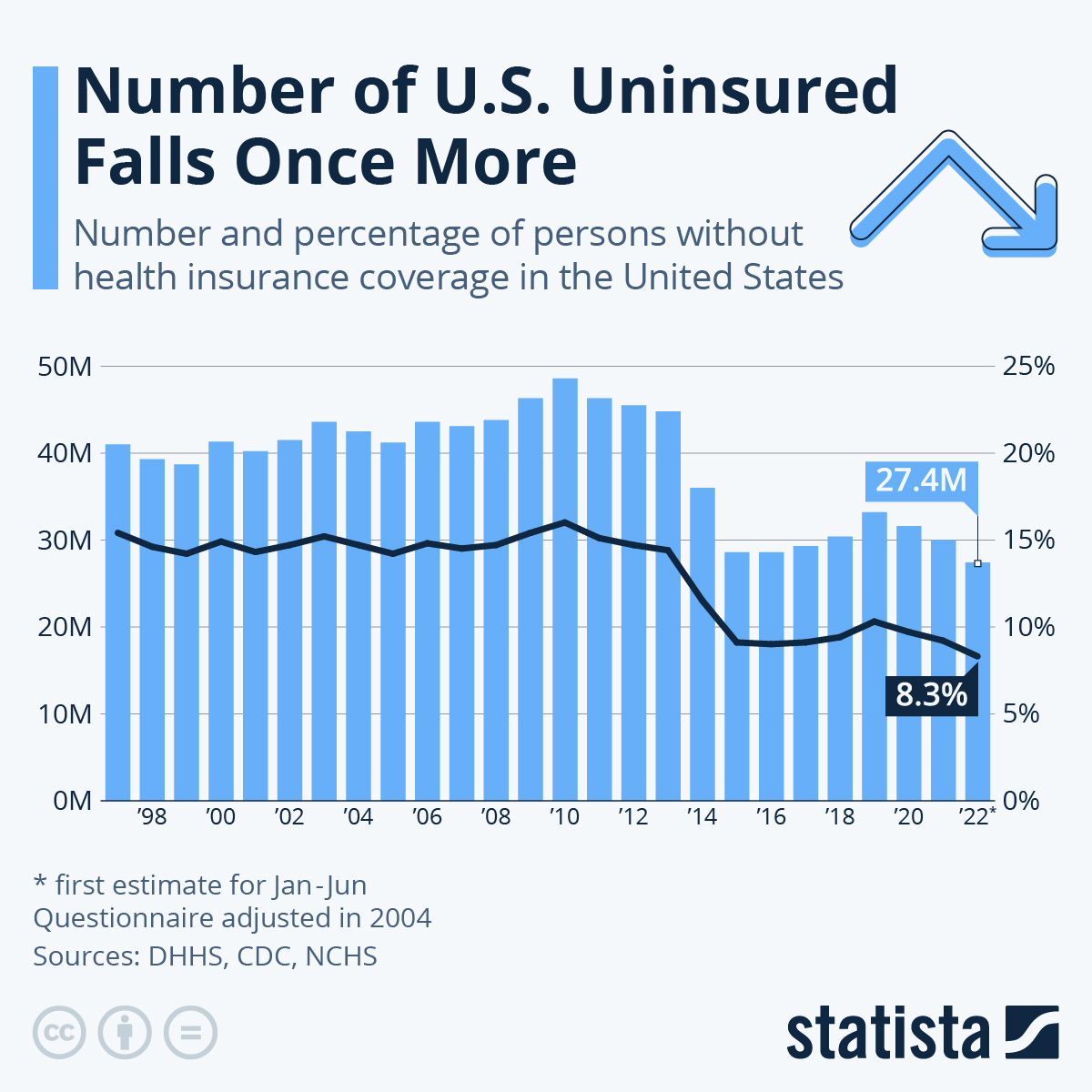
Before ObamaCare. When the Affordable Care Act was passed in 2010, about 16% of Americans — 48 million in all — did not have health insurance, and the number was growing every year. Tens of millions of others (the exact number depends on your definitions) had some form of “junk insurance” — a policy that worked just fine for relatively minor things like a broken arm, but would leave you in a lurch if you developed some really expensive condition.

People were uninsured for a variety of reasons: Some couldn’t get insurance because they had pre-existing conditions like cancer or heart disease that made them bad risks. Others were young and healthy and saw no reason to pay significant amounts of money for care they believed they would never use. (I did this myself at age 21 in the summer between my undergraduate and graduate-school coverage. Looking back, I feel foolish about that gamble, but I got away with it.) For others, health insurance had to compete with rent and food for their limited resources. Or perhaps their health was not so bad as to make them uninsurable, but bad enough that the rates they were offered were astronomical.

Junk insurance came in a variety of forms. Maybe, if you had survived some expensive illness like cancer, it would specifically exempt any condition related to a return of that illness. Maybe it would have an annual or a lifetime cap on what it would pay out. (If you had a debilitating disease like MS, or a child born with significant birth defects — as my college roommate did — you might go over that lifetime cap in just a few years. Then you’d be uninsurable.) Maybe it would have to be renewed every year or two, giving the insurance company a chance to drop you if it wasn’t making money on your policy.

In short, somewhere between 1/4 and 1/3 of Americans lived with the worry that if they needed significant medical care, they wouldn’t be able to pay for it.

The roots of ObamaCare. This healthcare anxiety is a uniquely American problem, because other rich countries don’t regard medical expense as a personal responsibility, and instead pay for it through some national system. Statistics argue in favor of that approach: Among wealthy nations, the US stands out both for its per capita spending on health care, and for its low life expectancy. So we pay more, but get worse results.

But national healthcare is “socialism”, which is anathema to American conservatives. So in an attempt to stop the US from opting for a European-style national health system, the conservative Heritage Foundation created a different model in a 1989 report. The basic idea was that you achieve 100% coverage through a private-insurance system by

  • mandating that individuals have insurance
  • forcing insurance companies to cover everybody who wants their coverage
  • subsidizing insurance for those who can’t afford it

That model was the basis for the RomneyCare plan that Massachusetts adopted in 2006 under Republican Governor Mitt Romney. RomneyCare in turn begat ObamaCare in 2010.

So this is an important thing to understand about the politics of healthcare: Republicans have had a hard time coming up with a healthcare plan because Obama stole their plan. He left them with a difficult choice: They could have declared victory, but that would have meant joining forces with the Black guy in the White House, which was unimaginable.

I have occasionally wondered how Mitt Romney would have fared in 2012 if he could have run on his record as the Father of ObamaCare and general solver-of-impossible-problems. But this was not to be.

What Obama did. In addition to the Heritage Foundation’s mandate-and-subsidize idea, Obama and Romney recognized the patchwork way that most Americans were already covered: If you were old, you had Medicare; if you were poor, you had Medicaid; children got covered under CHIP; veterans had the VA; people with good jobs got coverage through their employers. American healthcare was like a big bed with a lot of small blankets that covered most people, but not everybody.

So a second fundamental idea of ObamaCare was to make the blankets bigger: Insist that companies employing more than 50 people full time had to offer health insurance, expand Medicaid so that it covered the working poor as well as the destitute, and so on.

Even the bigger blankets wouldn’t stretch to cover everybody, so the ObamaCare exchanges were created: marketplaces where individuals could buy their own policies, without regard to their previous health record, and with a sliding scale of subsidies depending on income.

The mandate-and-subsidize system only works if the term “insurance” actually means something, so ObamaCare also defined what private insurance had to cover. In particular, this made junk insurance illegal. Annual and lifetime caps were gone, as were provisions not to cover certain common problems. Many people who had junk insurance didn’t realize the risks they were taking, and resented the fact that their cheap policies were now illegal. This is how Obama’s claim that “If you like your plan you can keep” got picked out as the Lie of the Year for 2013. (Personally, I liked my employer-provided insurance, and I kept it.)

And it all sort of worked. As you can see in the graph above, the number of uninsured began to drop after 2010, dropped more when the exchanges came online in 2014, and didn’t start rising again until Republicans began breaking the system during the first Trump administration. And these numbers don’t give the ACA credit for the number of people whose junk insurance was replaced by real insurance.

John McCain turns thumbs-down on repealing the ACA with no replacement.

How Republicans have sabotaged ObamaCare. Republicans have tried to repeal the Affordable Care Act again and again ever since it was passed — at least 63 times in all. Their effort always foundered on the same point: Repealing the ACA would instantly create about 20 million uninsured Americans, and the Republicans had no plan for dealing with them. The closest they came was in 2017, with the slogan “Repeal and Replace”, where the “replace” half was always left vague. That vote came down to John McCain’s famous thumbs-down moment.

But failing to repeal didn’t mean failing to sabotage. The most obvious bit of sabotage was the ultimately successful attempt to end the individual insurance mandate, which assessed a penalty on people who went uninsured. At first they tried to undo it through the courts, and nearly succeeded. The Supreme Court overturned decades worth of interpretation of the Constitution’s Commerce Clause to find that it didn’t allow the penalty. But John Roberts saved the individual mandate by reinterpreting its penalty as a tax.

But Roberts also sabotaged the system by not allowing the federal government to withdraw all Medicaid funding from states that refused to expand Medicaid. This created a two-tier system where some states expanded Medicaid and others didn’t. Gradually, even red states like Oklahoma and Missouri expanded their programs, but 10 states are still holding out.

Republicans finished killing off the individual mandate in the Trump tax cut of 2017, which didn’t eliminate the penalty, but set it to zero. This created a hole in the system: If you’re healthy right now, you can save money by going uninsured, remaining confident that you can get insurance after you develop some health problem.

The RSC’s 2019 report castigates ObamaCare for this hole in the system, which the Republicans created themselves.

Unfortunately, because the ACA created a perverse incentive for people to forgo insurance until they developed an illness, costs across the board rose dramatically, which required higher premiums on the existing plans in the individual market exchanges. Not surprisingly, the premium spikes further repelled healthy individuals.

How Republicans want to “fix” ObamaCare. If you don’t think ObamaCare is working, the obvious way to fix it continues to be a universal single-payer healthcare system, like Bernie Sanders’ Medicare for All. Countries with such systems continue to spend less on healthcare than Americans do, while getting better results in terms of life expectancy.

But Medicare for All is still socialism, which is still anathema. So what can be done?

The report is full of wonderful-sounding words like “choice” and “freedom”, but the essence of it comes down to this: The healthcare system can save enormous amounts of money if it exposes people to more risk.

I’ll give a personal example here: In 2023 I had a scary incident where I lost vision in my right eye for about five minutes. It was like looking at a gray screen. Afterwards, I returned to normal, as if nothing had happened. I’ve had no recurrences in the two years since.

All indications point to this incident being just one of those annoying brain things without long-term significance, like migraine headaches. But it could have been a stroke or a blood clot or a tumor. Medicare spent an huge amount of money checking all that stuff out. I didn’t keep track, but I’m sure it’s well into the tens of thousands.

And it all could have been saved if someone had said, “It’s probably nothing. Let’s ignore it and see if it happens again.”

Now, if some government or insurance bureaucrat says that, it’s horrible. They’re telling me to gamble with my life. But (from the Republican point of view) if I say it, that’s great. So that’s the heart of the Republican program: incentivize people to gamble with their lives.

They do this in a lot of different ways. For one, junk insurance is back.

[I]n order to provide Americans with health insurance options that fit their individualized needs and do not add unnecessary expenses, the RSC plan would undo the ACA’s regulations on essential health benefits, annual and lifetime limits, preventive care cost-sharing, dependent coverage, and actuarial value. … The cumulative effect of these changes would result in Americans being provided with more insurance choices that are personalized to their needs and available at affordable rates.

(“Actuarial value” is essentially a limit on the insurance company’s profit margin.) So if you have a strained budget, a cheaper plan that risks your future if you wind up with some expensive condition is “personalized” for you. It “fits your individualized needs”.

Several provisions are designed to promote individual plans that can be “personalized” in this way. The biggest is to change the tax laws that allow employers to deduct what they spend on employees’ health insurance. With ObamaCare’s employer mandate also gone, this will have the effect of ending a lot of employer-supplied health insurance, pushing all those people into the individual market.

The other big “personalization” tactic is to emphasize Health Savings Accounts. Lots of people have those now for medical incidentals like glasses. But under the Republican proposal, HSAs are cut loose.

Under current law, health savings accounts plans cannot be used in conjunction with plans that are not a “qualified high-deductible health plan.” This unnecessarily hamstrings the ability for millions of Americans to access this important savings tool. Accordingly, the RSC would eliminate this requirement to allow health savings accounts to be utilized even if a person does not have a health insurance plan.

So you can go without insurance and pay your own health expenses out of an HSA. This is the ultimate individualization: Imagine me with an HSA instead of Medicare. My vision blanks out for five minutes, and I’m left with a choice: Do I want to drain my HSA checking out things that probably are OK? Or do I want to just risk it?

The limits of freedom. The unexamined issue in the Republican plan is class. Yes, you have “choices”, but only if you can afford to pay for them. The poorer I am, the more likely I am to risk a junk policy to save money, and the more likely I am to forego testing or treatment if I think it probably works out for me. Those are “choices”, in the same way that poor people “choose” to save money on rent by living in their cars.

Of course, when you’re talking about 350 million people, “probably” leads to many, many cases where the improbable happens. So these personalized decisions will lead to large numbers of medical bankruptcies, and some non-trivial number of unnecessary deaths.

The other thing “freedom” doesn’t take into account is the burden of making good decisions, especially decisions about big issues that involve many details that only experts in the field really understand. As we saw in the real-estate crash of 2008, “freedom” in the mortgage market led to people signing documents they didn’t really understand and losing their homes. More recently, “freedom” from vaccine mandates is allowing diseases like measles and polio to come back.

And if we are all making these decisions as individuals, the success of insurance or healthcare-providing companies depends on their ability to influence those decisions. Think about all the ads you see this time of year boosting “Medicare Advantage” programs (which provide enormous advantages to the companies offering them). That kind of marketing could be round-the-clock for every kind of medical decision. Just as the system forced us to make more decisions, all the corporate powers of persuasion would be focused on manipulating us into choosing badly.

All that marketing would cost an enormous amount of money, which ultimately would have to be reflected in the prices we pay. Would it eat up all the “savings” that result from taking bigger risks with your life? Maybe.

The Monday Morning Teaser

The two big stories of this week are difficult to reconcile: Democrats won handily in nearly all of Tuesday’s elections, and so Senate Democrats surrendered Sunday night in the shutdown battle.

One thing the 40-something-day shutdown did accomplish was to frame healthcare as the major difference between the parties. Democrats either want to keep patching up ObamaCare or push for a more complete national healthcare system, while Republicans want to junk ObamaCare in favor of some “cheaper, better” care system that somehow never quite comes together into a proposal that could be voted on and implemented.

This week’s featured post takes seriously Speaker Johnson’s claim the Republicans have “pages and pages” of healthcare ideas, which were contained in a 2019 report by the Republican Study Committee in the House. I read that report and I’ll be abstracting what I see as the underlying principles: (1) You can save money on healthcare if you gamble with people’s lives, and (2) that gamble is OK if you incentivize people to place the bets themselves.

In order to make sense of the RSC report’s proposals, I’ll have to summarize a lot of context, including the pre-ObamaCare problems and how ObamaCare tried to solve them. It’s going to be a long read, but I hope you’ll find in illuminating. That post should be out between 10 and 11 EST.

The weekly summary will of course cover the elections and the shutdown. I’ll also look at what’s been happening in Chicago, the Supreme Court’s discussion of Trump’s tariffs, and a few other things. It should be out before 1.

Despotic Encroachment

It is important, likewise, that the habits of thinking in a free country should inspire caution in those entrusted with its administration, to confine themselves within their respective constitutional spheres, avoiding in the exercise of the powers of one department to encroach upon another. The spirit of encroachment tends to consolidate the powers of all the departments in one and thus to create, whatever the form of government, a real despotism.

– George Washington, The Farewell Address (1796)

This week’s featured posts are “The Shutdown Gets Serious” and “Could a Third Term Happen?“.

Ongoing stories

  • Trump’s assault on American democracy. The most important article to read this week came from the NYT’s Editorial Board: “Are We Losing Our Democracy?“. It lists 12 traits of an autocratic regime, and details how Trump has achieved some and is making inroads on the others. Articles like this one make it clear that words like “autocrat”, “fascist”, etc. or not just insults or evidence of Trump derangement. They are clear assessments of where we are.
  • Climate change. I’m late to notice, but the rhetoric of climate denial has changed.
  • Gaza. Nominally there is still a ceasefire, but the killing continues: “On Tuesday, Israeli airstrikes killed more than 100 Palestinians, at least 66 of them women and children, in the deadliest day since Donald Trump declared the war was over. Israel said the bombings were in response to an attack in Rafah city that killed a soldier carrying out demolitions there.”
  • Ukraine. Russia continues a slow and costly advance in the Donetsk region, while Ukrainian drones get increasingly effective inside Russia.

This week’s developments

This week everybody was talking about the shutdown

A lapse in SNAP benefits and higher premiums on ObamaCare policies both kicked in on Saturday. That’s the topic of one of the featured posts.

This week Trump floated his solution to the shutdown, which is the one I predicted two weeks ago: The Senate should do away with the filibuster so that he wouldn’t have to negotiate with Democrats. So far, Senate Republicans don’t seem interested.

and tariffs

The Senate voted three times this week to revoke the national emergencies Trump declared to raise tariffs on Canada, Brazil, and the broad range of countries in his “liberation day” tariffs. The votes will have no practical effect because the House will not concur and Trump would veto the resolution if they did, but they do mark the first stirrings of resistance in the Senate, at least among Lisa Murkowski, Susan Collins, Rand Paul, and Mitch McConnell.

Friday the Supreme Court will hear arguments about whether the  International Emergency Economic Powers Act of 1977 really works the way Trump says it does, and gives him the power to do whatever he wants with tariffs. Lower courts have said no, but that’s because they were doing law; the Supreme Court may be doing something else.

The Brazil and Canada tariffs should be the biggest piece of evidence against Trump having the power he claims. Both seem to have less to do with national security and more with Trump’s personal rages.

He imposed 50% tariffs on Brazil because that country prosecuted, convicted, and imprisoned its former president, Jair Bolsonaro, for doing essentially the same thing Trump did on January 6. He recently raised tariffs on Canada because the province of Ontario produced an ad he didn’t like.

and tomorrow’s elections

Odd-numbered years are usually slow for elections, but there are a few: Tomorrow New York City will elect a new mayor, and Virginia and New Jersey will elect new governors.

Democrats are favored in the Virginia and New Jersey races.

In NYC, Zohran Mamdani won the Democratic primary, but the party establishment has not united around him. Former Democratic Governor Andrew Cuomo is running as an independent. Mamdani is ahead in the polls.

Mamdani is a charismatic candidate who appeals to young voters. He is also Muslim, has been critical of Israel, and is part of the Democratic Socialist wing of the party. Big money is being spent to take him down, but it doesn’t seem to be working.

and the White House

Three stories of Trump’s abuses of power got attention these last two weeks:

  • tearing down the East Wing of the White House to build a massive gilded ballroom
  • filing claims against his own Justice Department asking for $230 million
  • hinting at a run for a third term

The third term, which he later backed away from, at least for now, is covered in one of the featured posts. As for the $230 million,

The president insisted on Tuesday that the government owes him “a lot of money” for previous justice department investigations into his conduct, while at the same time asserting his personal authority over any potential payout.“

It’s interesting, ’cause I’m the one that makes the decision, right?” Trump said at the White House, responding to questions about administrative claims he filed seeking roughly $230m related to the FBI’s search of Mar-a-Lago and the investigation into Russian interference in the 2016 election. The New York Times had reported the claims on Tuesday.

Trump’s comment lays out a circular situation: Trump as president would in effect decide whether Trump as claimant receives taxpayer money for investigations into Trump as defendant.

The circularity is the only reason these claims might be paid. Both the Mar-a-Lago search and the Russia investigation were totally justified, and his claims otherwise would be laughed out of court. Trump says he would give the money to charity, but he’s said things like that before.

You might wonder how Trump can spend $300 million on a ballroom without consulting Congress, but he says he’s raising the money privately, from a list of individuals and corporations all of whom will likely want government favors at some point. In the long run, taxpayers would probably be better off paying for the ballroom themselves.

He also hasn’t consulted the National Capital Planning Commission. Hillary Clinton made the key point: “It’s not his house.”

and you also might be interested in …


Here’s a typical story about how the Trump administration responds to corruption: Last Sunday, FBI Director Kash Patel began taking heat on social media for going to State College, PA on an FBI jet so that he could watch his girlfriend sing the national anthem at a wrestling match. The plane then went on to Nashville, where she lives.

Clearly somebody should be fired for this, and somebody was: the guy who oversees the FBI’s jet fleet. Patel appears to blame him for the story getting out, despite the fact that his flights were trackable by the general public.


The Center for Countering Digital Hate (CCDH) also considers disinformation to be part of its mission, which is how they got interested in climate change. They put out a report about how climate denialists have changed their tactics in 2024. (But I just noticed it this week). They distinguish “old denial” (which says climate change either isn’t happening or isn’t caused by humans burning fossil fuels) from “new denial” (which creates doubt about what can or should be done).

They had an AI algorithm produce and examine transcripts from more than 12K YouTube videos posted by climate denialists between 2018 and 2023. This graphic explains what they found.

It’s worth noting that President Trump mixes old and new denial. In September he said this to the UN General Assembly:

This “climate change,” it’s the greatest con job ever perpetrated on the world, in my opinion. All of these predictions made by the United Nations and many others, often for bad reasons, were wrong. They were made by stupid people that have cost their countries fortunes and given those same countries no chance for success. If you don’t get away from this green scam, your country is going to fail.

The PBS article I quoted this from debunks many of Trump’s claims.


One big step towards the MAGA takeover of American media is faux-independent Bari Weiss becoming editor-in-chief of CBS News. How this happened is an instructive lesson in media consolidation: CBS was taken over by Viacom in 2000, spun off in 2005, then reacquired in 2019. Viacom took the name of its subsidiary Paramount, reflecting its entertainment-media focus.

Paramount then merged with Skydance. The merger was announced in 2024, but needed Justice Department approval to avoid antitrust issues. That approval came in August, after Paramount paid Trump $16 million to settle a his meritless lawsuit against CBS’ 60 Minutes, and then cancelled Stephen Colbert’s show after the comedian called the settlement what it was: “a big fat bribe”.

Paramount-Skydance is now controlled by the Ellison family, who are Trump supporters. Larry Ellison, who co-founded Oracle, is #2 on Forbes list of the richest people in the US. He was briefly the richest man in the world in September with a net worth over $300 billion. His son David Ellison is the CEO of Paramount Skydance. David is the one who picked Weiss to head CBS News.

The best intro to Bari Weiss comes from John Oliver, who focused on her three weeks ago.

Now Bari Weiss is choosing the next anchor of CBS Evening News, which was the most important job in news back when Walter Cronkite had it. Most of the names being kicked around are from Fox News.


You might wonder why Texas AG Ken Paxton would do this:

Attorney General Ken Paxton sued Johnson & Johnson and Kenvue for deceptively marketing Tylenol to pregnant mothers despite knowing that early exposure to acetaminophen, Tylenol’s only active ingredient, leads to a significantly increased risk of autism and other disorders.

I mean, it’s not like anyone but RFK Jr. actually believes Tylenol significantly increases autism risk. So how can Paxton hope to win a suit claiming that Tylenol’s makers “knew” something none of the experts in the field know today?

Amanda Marcotte explains: Paxton has lost his lead over incumbent Senator John Cornyn for the GOP senate nomination in Texas. He desperately needs Trump’s endorsement, so he is demonstrating to the Mad King that he is willing to act on whatever nonsense the regime spits out.

and let’s close with a song parody

The Marsh Family adapts a Paul Simon tune to the RFK Jr. era: “Measles and Polio Down in the Schoolyard.”

The Shutdown Gets Serious

If you’re poor in America, food and healthcare just got way more expensive.


Up until Saturday, most Americans had been able ignore the government shutdown. If you didn’t work for the federal government, weren’t visiting the national parks, and weren’t waiting for a government office to process your application for some kind of benefit, the shutdown seemed like one of those inside-the-beltway issues. Politicians were arguing with other politicians about the kinds of things politicians argue about. Trump wanted you to blame Democrats for something. Democrats wanted you to blame Trump. Blah, blah, blah.

Then on November 1, two things happened:

  • SNAP (food stamp) payments ended for 42 million Americans.
  • The ObamaCare open enrollment period began without the subsidies that have kept premiums affordable for 22 million Americans.

Both of these are important, but the loss of SNAP benefits is more immediate. The ObamaCare plans are for 2026, so we’re still a couple months away from people skipping needed medical care. But the SNAP lapse is already causing suffering: Americans who otherwise might have used their SNAP cards to buy food for their families Saturday were unable to do so. State and local governments, as well as private charities, are trying to step into the breach, but many people are still falling through the cracks.

The mind-boggling thing about the SNAP snafu is how avoidable it was: The Department of Agriculture has $6 billion in contingency funds that it could use, but it initially refused to do so. Friday, a federal judge ordered USDA to allocate the funds “as soon as possible”, and to report back by noon today. A second federal judge stopped short of issuing an order, but explained why such an order might come soon.

At core, [the Trump administration’s] conclusion that USDA is statutorily prohibited from funding SNAP because Congress has not enacted new appropriations for the current fiscal year is erroneous. To the contrary, Defendants are statutorily mandated to use the previously appropriated SNAP contingency reserve when necessary and also have discretion to use other previously appropriated funds as detailed below.

Other funds would clearly be necessary to pay full benefits, because SNAP costs $8.6 billion every month.

As of this morning, it was not clear what the Trump regime would do: Trump himself claims to be confused about what the government can do, is asking for more specific guidance from the judges, and warned that payments would be “delayed” in any case. Up until now, Trump has been cavalier about spending any money that isn’t nailed down; but now suddenly he is worried about the legal details.

All in all, his Truth Social post seemed more concerned with scoring political points than with human suffering.

I do NOT want Americans to go hungry just because the Radical Democrats refuse to do the right thing and REOPEN THE GOVERNMENT. … The Democrats should quit this charade where they hurt people for their own political reasons, and immediately REOPEN THE GOVERNMENT. If you use SNAP benefits, call the Senate Democrats, and tell them to reopen the Government, NOW! Here is Cryin’ Chuck Schumer’s Office Number: (202) 224-6542

We should know more this afternoon.


Unlike the lapse in SNAP benefits, the ObamaCare premium subsidies are not a consequence of the shutdown. They are, instead, what the shutdown has come to be about: The “clean” continuing resolution that Republicans want has no money to fund them; Senate Democrats are withholding their votes until an extension happens.

In other words: If Democrats cave, the government will open but the ObamaCare policies will still cost much more.

Republicans claim to be concerned about the price increase — which probably affects more of their constituents than Democrats’ — but they have no plan for dealing with it. Similarly, the Big Beautiful Bill they passed will cause millions of Americans to lose health coverage under Medicaid. Senator Hawley is so concerned about this that he has introduced legislation to reverse the Medicaid cuts he voted for.

Majority Leader Thune has offered Democrats a vote on extending the ObamaCare subsidies, if they first pass his resolution to open the government. But forcing a vote is only a way to score political points; it doesn’t help anyone pay for their health insurance.

Speaker Johnson continues to call ObamaCare unworkable, but again, Republicans have no alternative plan. We have been waiting for Trump’s healthcare plan since 2015.


To me, Trump’s finger-pointing raises an explanation for this mess: He believes his own propaganda, and believes the American people believe his propaganda.

If it were true that the American people broadly blame Democrats for the shutdown, then every new example of suffering caused by the shutdown would put more pressure on them to cave. So it would make political sense for the regime to engineer as much suffering as possible.

That seems to be what it has done.

But the public hasn’t been blaming the Democrats for the shutdown, and these two issues — hunger and health care — are where Democrats have their most credibility. So it doesn’t help Trump’s cause that a judge has to order him to feed the hungry. And since extending ObamaCare subsidies is exactly what Democrats have been demanding, letting them lapse is clearly Trump’s fault.

Finally, we get to Mike Johnson’s posturing: He has kept the House in recess since September 19. He claims there is no need to meet, because the House did its job then by passing a continuing resolution. By keeping the House in recess, he has made an excuse not to seat Democrat Adelita Grijalva of Arizona, who won a special election September 23. Grijalva would be the 218th signature on the discharge petition to force a vote on subpoenaing the Epstein files.

Johnson denies that protecting Trump from Epstein revelations is his motive. But all his rationalizations are starting to run thin. The continuing resolution the House passed only funds the government until November 21, which probably isn’t enough time to pass the appropriation bills needed to fund the government for all of FY 2026. So the House will be needed again soon, one way or another.

Could a Third Term Happen?

It’s far-fetched but not impossible.


For months Trump has alternately encouraged and then tamped down speculation that he might seek a third term. Wednesday, he acknowledged the constitutional reality that “it’s pretty clear I’m not allowed to run”. But since it’s always a mistake to assume that any Trump statement is his final word, the third term idea will likely surface again at some point.

So how seriously should we take this? My conclusion: moderately seriously. Pay attention, but don’t lose your mind about it. That’s an attitude I’m trying to model this post.

The main reason to take it somewhat seriously is this: If Trump floated an idea like this and nobody pushed back, before long he’d be doing it. As you may remember from junior high, that’s how bullies operate. Every abuse, from pulling your pony tail to rape, starts as a joke. “Why do you have to be like that? I was just kidding around.” But if your response to the joke indicates that he might get away with it, it’s game on.

The main reason not to take it seriously is the 22nd Amendment, which seems pretty clear:

No person shall be elected to the office of the President more than twice, and no person who has held the office of President, or acted as President, for more than two years of a term to which some other person was elected President shall be elected to the office of the President more than once.

And yet, Steve Bannon believes he has a way to get around that prohibition.

“There’s many different alternatives,” Bannon said when asked about the 22nd Amendment. “At the appropriate time, we’ll lay out what the plan is.”

And Trump himself said back in March “There are methods which you could do it.”

So let’s think about what those methods might be.

Is there a loophole? Sort of. In a New Yorker conversation with Michael Luo, Ruth Marcus explains:

Note that it says “elected . . . more than twice,” not “serve as President for more than two terms.” The way—maybe—to get around that would be to have Trump elected Vice-President, and then to have whoever is the incumbent President resign to make way for a third Trump term. (Trump himself, by the way, said that this approach was “too cute,” and that “the people wouldn’t like that.”)

Alternatively, and even more fancifully, Trump could be elected Speaker of the House (you don’t have to be a House member to be Speaker), putting him in line for the Presidency, and both the elected President and Vice-President would clear the decks for him.

Marcus’ “maybe” depends on how the Supreme Court interprets the 12th Amendment, which says:

But no person constitutionally ineligible to the office of President shall be eligible to that of Vice-President of the United States.

Again, though, Trump could argue that he’s not ineligible to be president, he’s just ineligible to be elected president. So maybe the same loophole covers the 12th Amendment too. An honest Supreme Court — especially one that puts so much emphasis on the original intent of the laws — would not allow this, but we don’t have an honest Supreme Court. So maybe it flies.

Could it work? Not if the 2028 election has anything to do with the will of the American people. Remember a few things:

Not to mention the fact that Trump is right: The plan to run a stooge (or two stooges) who then resign is too cute for the public to back. And then there’s the execution problem: Would you trust J. D. Vance to resign once he had been sworn in as President? Trump doesn’t seem like the trusting type.

Summing up: In any free and fair election, a Stooge/Trump or Stooge/Stooge ticket would lose in a landslide. Anybody who seriously proposes the plan, i.e., Steve Bannon, must also be planning to rig the election in a significant way. A small amount of corner-cutting wouldn’t do the job.

Whether that can happen or not is a different topic.

Does Trump understand that it won’t work? Hard to say. He seemed to understand it Wednesday, but I have long subscribed to the theory of Trump’s mind that David Roberts enunciated in 2016:

When he utters words, his primary intent is not to say something, to describe a set of facts in the world; his primary intent is to do something, i.e., to position himself in a social hierarchy. … Even to call him dishonest, to say he “lies,” doesn’t quite seem to capture it. The whole notion of lying presumes beliefs — to lie is to say something that one believes to be false, to knowingly assert something that does not correspond to the facts.

It’s not that Trump is saying things he believes to be false. It’s that he doesn’t seem to have beliefs at all, not in the way people typically talk about beliefs — as mental constructs stable across time and context. Rather, his opinions dissolve and coalesce fluidly, as he’s talking, like oil on shallow water. That’s why he gives every indication of conviction, even when, say, denying that he has said something that is still posted on his Twitter feed.

Wednesday, Trump found it useful to agree with people like Mike Johnson that he can’t run. (Of course, he also said this was “sad”, because “I have my highest numbers that I’ve ever had”, which is completely delusional. So Wednesday’s comment did not come at some moment of peak lucidity.) Tomorrow, he may find it useful to agree with Steve Bannon.

What makes this problematic for Republicans in general, even the fascist ones, is the Mad King problem: No one can tell Trump he is wrong. So if he starts asserting that one of the third-term scheme works, and in fact works easily because he’s so popular, who’s going to tell him that some serious election-rigging is needed?

Meanwhile, no Republican legally entitled to compete for the presidency can start organizing a campaign, for fear of antagonizing the Mad King. Typically, the primary field starts to assemble in earnest after the midterm elections, so there’s still time. But Democrats like Governors Newsom and Pritzker are already starting to position themselves. Republican candidates would too if the field were clear.

What does the third-term talk accomplish for Trump? At least for his followers (or for Republicans intimidated by his followers), talk of a third term pushes back the moment when he becomes a lame duck. No one is going to risk breaking the law for him if they anticipate someone else holding the presidency soon. But the fantasy of Trump remaining in office indefinitely keeps that realization at bay.

The Monday Morning Teaser

Saturday, the government shutdown started to bite in a much more serious way: SNAP benefits for 42 million Americans failed to appear as scheduled, and the open enrollment period for 2026 ObamaCare policies started without the federal subsidies that made those policies affordable for 22 million Americans. Suddenly, it’s not just politicians finger-pointing at other politicians; it’s millions of households wondering how they’re going to afford necessities.

One featured post will describe what’s going on there, and with the shutdown in general. That still needs some work, and probably won’t be out until 10 EST or later. But I already have a second post written about Trump’s possible plans for a third term. Right now, his latest word is that a third term isn’t possible; but the idea has risen and fallen so many times that I’m sure it will be back at some point. So I thought I’d address how it might or might not work. That should be out shortly.

That still leaves the weekly summary a lot to cover: the destruction of the White House to make room for the Epstein Ballroom; tomorrow’s elections in New York City, Virginia, and New Jersey; Trump’s demand that his own Justice Department pay him $230 million; the Senate’s attempt to end Trump’s tariffs just as the Supreme Court is set to hear arguments about their legality; the NYT laying out the case for calling the Trump regime autocratic; and a few other things. That should be out by maybe noon or 1.

In Free Countries

For as in absolute governments the King is law, so in free countries the law ought to be king; and there ought to be no other.

– Thomas Paine, Common Sense (1776)

No Sift next week. The next new posts will appear on November 3.

This week’s featured post is “The Resistance Stiffens“.

Ongoing stories

  • Trump’s assault on American democracy. The American People pushed back a little this week. That’s the subject of the featured post.
  • Climate change. Lots of statistics get thrown around about climate change, but the most important one is the quantity of CO2 in the atmosphere. In 2024, atmospheric CO2 jumped by a record 3.5 parts per million, to reach a record 424 ppm.
  • Gaza. The ceasefire didn’t last long.
  • Ukraine. Over the last few weeks, Trump did what he does so often: floated an idea to support Ukraine (by supplying it with long-range Tomahawk missiles), got a lot of positive headlines for it, but then backed down after talking to Vladimir Putin. Now he’s planning to meet Putin in Budapest, a move that supports not just Putin, but Hungary’s authoritarian leader Viktor Orbán, Putin’s only ally in the EU. Trump likes to appear independent of Putin, but remains incapable of standing up to him.

This week’s developments

This week’s theme: resisting the regime

That’s the topic of the featured post, which covers the No Kings rallies, the revolt of the Pentagon press corps, universities refusing to sign Trump’s compact, Democrats standing firm on the budget, and an appeals court ruling keeping troops out of Chicago.

One minor bit of resistance: Juries are refusing to convict people the regime should never have charged.


Yesterday the NYT published the most clueless article I’ve seen in some while: “It’s 2025, and Democrats Are Still Running Against Trump“. Apparently, we’re supposed to ignore the fascist takeover that’s happening and talk about more normal political issues.

I also love the idea that we should take advice from “a veteran Republican admaker and political strategist” who says “If I were running a Democratic campaign, I would be attempting to broaden my coalition beyond a visceral hatred of Trump”.

Maybe seeing democracy collapsing before their very eyes can change the minds of previously uncommitted voters. Anti-Trump might become a very broad coalition indeed.

and voting rights

John Roberts has been chipping away at the Voting Rights Act for years, enabling a great many voter suppression laws in red states. Now he seems ready to finish the job.

Basically, Roberts wants every government action to be color-blind. That sounds good if you don’t think about it too hard. But when generations of racism has created a problem, how do you address that problem without mentioning race?

Wednesday, the Court heard arguments in Louisiana v Callais, and the issue in question is whether states can engage in racial gerrymandering — the only kind of gerrymandering that current interpretations of the law bans.

Not only is this the kind of thing Roberts has wanted to do his whole career, it might have the side benefit of making it virtually impossible for Democrats to recapture the House in 2026, or maybe ever. An analysis in the NYT says that in some scenarios, Democrats would have to win the national popular vote by 5% or more in order to get a majority of House seats.

and the shutdown

Republicans are claiming that Democrats just didn’t want to fold before the No Kings rallies, but that they will now that the rallies are over. I’m not seeing it.

At stake here is the narrative of Trump’s invincibility: If he has to offer a concession, even a popular one, then resistance is productive. If Democrats cave without getting anything, then they’re useless.

A local TV station suggests five dates that are pressure points for the shutdown: three paycheck dates, the open-enrollment starting date for the ObamaCare exchanges (November 1), and Thanksgiving, when millions of Americans will try to travel and air-traffic controllers would still be working without pay.

I hear a lot of speculation of the form: “They’ll have to resolve this by X, because otherwise this painful thing will happen.” But which side does the pain move? Either Trump makes a concession or he doesn’t, so there’s no obvious compromise on that.

The only way out I see is for Republicans to nuke the filibuster in the Senate. Then they can run over Democrats without giving up anything.

and the Navy murdering Venezuelan fishermen

From the beginning, I’ve been appalled by the policy of blowing up boats in the Caribbean because someone suspects they might be carrying drugs. Appalled, but also puzzled: What’s the point here? Even if the suspicions are true, drug smuggling is not a capital offense, and the people on the boats have been denied due process, or any kind of process at all. The boats could have been stopped by the Coast Guard and the drugs confiscated. And boats from Venezuela are not the main avenue for drug smuggling anyway. So who is better off because the boats are destroyed and the people on it dead?

Well, it seems like the officer in charge has some of the same doubts. Admiral Alvin Holsey, the head of the U.S. Southern Command that oversees operations in the Caribbean, quit his job one year into a three-year assignment, and will retire after a 37-year career.

Thursday was the sixth such attack, and the first one to leave survivors, who have been captured.

The strike, which President Donald Trump confirmed Friday, was the sixth known strike on a boat allegedly involved in drug trafficking. But it appeared to mark the first time an attack had not killed everyone on board.

The detention marks the first time that the Trump administration’s military campaign targeting drug traffickers has resulted in the US holding prisoners, and it sets up a complicated legal and policy situation for the administration. … The men held by the US Navy could hypothetically petition the courts to rule on the legality of their detention in what’s known as a habeas corpus claim, Finucane noted — a pathway followed by a number of detainees in the past that could reveal more information about the Trump administration’s secretive legal rationale for the strikes.

We may also finally find out what evidence the regime has that these boats are smuggling drugs. It’s a serious question whether these are actually drug smugglers, or just fishermen in the wrong place.

and you also might be interested in …

Montana has come up with a creative proposal to get corporate money out of politics. Prior to the Supreme Court’s Citizens United decision in 2010, governments controlled corporate contributions directly, by passing campaign-finance laws. Jay Kuo:

The High Court’s decision rested on the notion that corporations, long defined as “legal persons,” are entitled to First Amendment protections just like actual people. Therefore, they held, it is a violation of their “freedom of speech” to put restrictions on what their money can say and do, even in politics.

We know what happened next. Big corporations, through super PACs and outside groups, flooded the system, drowning out individuals’ voices. And there seemed no way to stop it, short of a constitutional amendment that would allow limits on corporate political spending.

Just this summer, a federal court citing Citizens United struck down a Maine law that limited contributions to political action committees to $5,000 per donor, whether that donor was an individual or a corporation.

Critics of Citizens United like to talk about “corporate personhood”, the idea that a corporation has the rights of a human being. A constitutional amendment eliminating corporate personhood (a right invented by the Supreme Court itself) seemed to be the only way out.

But a new idea is being pushed in Montana: Even if corporations are people, they are still defined by the state that incorporates them, and only have the powers their charters give them. Organizers hope to have a ballot initiative in 2026 that revises Montana’s corporate code to take away corporations’ power to contribute to political campaigns. Further, it would allow corporations incorporated in other states to have only the same powers as Montana corporations when they operate in Montana.

Unless the Supreme Court comes up with some new oligarchic doctrine knocking this down, other states could imitate it.


Vox’ Ian Milhiser lists the five safeguards we used to have against rogue government agencies like ICE, and how the Supreme Court has blocked them.


Is anyone really surprised to discover that when Young Republicans chat among themselves, the conversation turns racist and fascist?


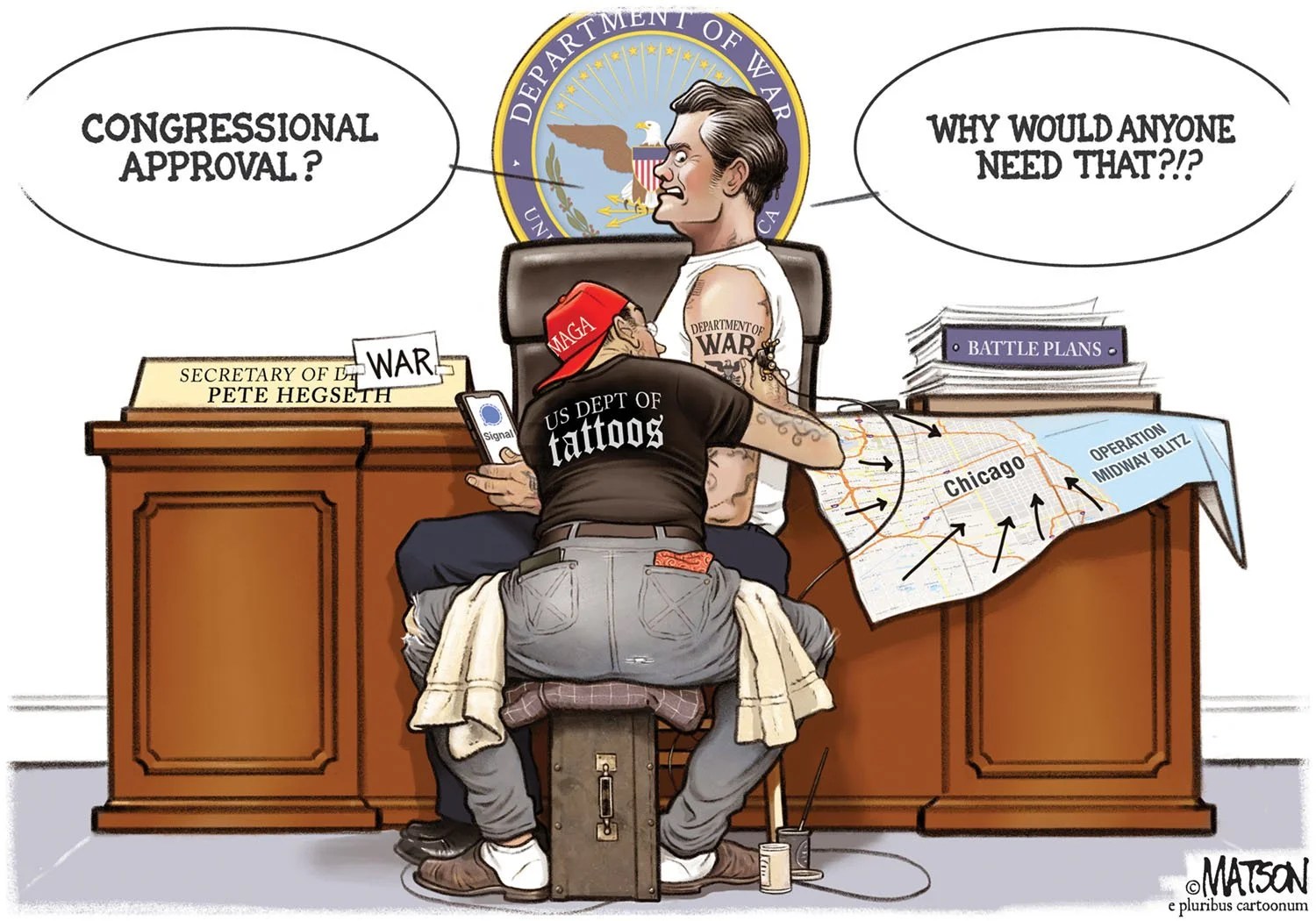
One more reason why Pete Hegseth should never have been allowed anywhere near the SecDef office: He OK’d a plan to celebrate the birthday of the Marine Corps by firing live artillery shells over Interstate 5 in California.

Governor Newsom ordered I-5 closed, and the administration widely criticized him for doing so. But then a shell misfired, and shrapnel rained down on J. D. Vance’s security detail.


Trump commuted the 7-year prison sentence of former congressman George Santos. There has never been any question about Santos’ guilt, so I can only surmise two justifications: (1) Trump doesn’t think Trump supporters should be punished for committing crimes. (2) Being a fraudster himself, Trump identifies with fraudsters.


Vox’ Bryan Walsh writes an optimistic piece about cities becoming more bike-able. Grist has an article on the same topic.

and let’s close with something unique

I don’t normally do much sports coverage, but it’s worth noting that in Game 4 of the National League Championship Series, Shohei Ohtani produced what is probably the greatest single-game performance in the history of baseball. Ohtani pitched six scoreless innings and hit three home runs in a 5-1 victory that sent the LA Dodgers to the World Series.

The only player comparable to Ohtani, Babe Ruth, had two 3-homer games in his career and also had scoreless pitching starts in the post-season, but never both in the same game.

The Resistance Stiffens

Chicago on Saturday.

The No Kings rallies were the most obvious signs of resistance to Trump’s authoritarian rule, but congressional Democrats, Pentagon reporters, major universities, and an appeals court also refused to cave to him.


Saturday I had a choice to make: attend the No Kings rally where I live in Bedford, Mass., or go to the much bigger rally in Boston, which stood a chance of making national news. I opted for the local rally. At one point I counted over 500 people in attendance before I lost count. I would guess there were 600 or more. That’s in a town of about 14,000, at a rally that probably didn’t draw a lot of out-of-town people because all the surrounding towns had their own No Kings rallies.

The independent Strength In Numbers website estimated that 5.2 million people participated nationwide, and possibly as many as 8.2 million.

Our estimate is based on reports from local officials, local organizers, and attendees, and suggests the count from organizers — who report 7 million participants nationwide — may be a bit optimistic (but is not impossible). Still, regardless of whether the precise number is 5, 6, 7, or 8 million, Saturday’s events are very likely the biggest single-day protest event since 1970, surpassing even the 2017 Women’s March demonstrations against Trump.

The largest rallies were in blue states, with 320K in New York City and 225K in Chicago, but 20K came out in Austin, Texas and 10K in Boise, Idaho. No Kings was truly a national event.

The regime’s response. The organizers could hardly have asked for a better response from the Trump administration, because the regime’s disdain and even hatred for these millions of Americans only served to underline everything the rally speakers were saying.

Trump himself posted an AI-generated video on his Truth Social account, in which a crowned Trump flies a fighter jet labeled “King Trump” and drops sewage onto protesters in what appears to be New York. VP Vance posted a video to BlueSky in which Trump dons a crown and a robe, and brandishes a sword while Nancy Pelosi and Chuck Schumer kneel and bow to him. White House spokesman responded to the protests with “Who cares?

Leaders of democratic countries don’t act like this.

Presidents are, of course, within their rights to put their own spin on events. Trump might legitimately doubt whether these millions of people accurately represent the country, or even postulate a “silent majority” as Richard Nixon did a few years before he had to leave office in disgrace. Even if the majority of the country has turned against Trump — as the polls show — he is not obligated to agree with the People or change his unpopular policies.

But when large numbers of their citizens take to the streets in nonviolent protest — even Fox News had to admit that “there were no reports of violence or arrests at the afternoon rallies” — leaders of democracies don’t respond with a lordly “Who cares?” or publicize their fantasies of dropping shit on the dissenters. But would-be dictators might, because they don’t serve the People; the People are supposed to serve them.

It’s nearly impossible to imagine any Democratic president showing similar hostility to peaceful conservative protesters. (The January 6 protests, recall, included a violent takeover of the Capitol and sending over 100 police to the hospital. The subsequent arrests and trials were basic law enforcement, not persecution.) The moments conservatives point to as evidence of Democratic disdain — Hillary’s “basket of deplorables” and Obama’s “clinging to guns or religion” — don’t really hold up if you look at the full context, which included considerable empathy for Trump voters.

For example, Clinton put “half” of Trump voters in her basket of deplorables.

But the other basket, the other basket, and I know because I see friends from all over America here. I see friends from Florida and Georgia and South Carolina and Texas, as well as you know New York and California. But that other basket of people who are people who feel that government has let them down, nobody cares about them, nobody worries about what happens to their lives and their futures, and they are just desperate for change. It doesn’t really even matter where it comes from. They don’t buy everything he says but he seems to hold out some hope that their lives will be different. They won’t wake up and see their jobs disappear, lose a kid to heroine, feel like they’re in a dead-end. Those are people we have to understand and empathize with as well.

The closest genuine analogy from recent years is the Tea Party protests against President Obama, which were much smaller than No Kings. Paul Waldman has numbers:

The Tea Party’s biggest distributed event was on tax day 2009, with 750 modestly attended protests. No Kings had 2,600. Its biggest single gathering was on 9/12/09 in DC, with somewhere between 75K and a few 100K participants.

Nonetheless, Obama had a delicate response to the Tea Party: The protests represented a “noble” American tradition of “healthy skepticism about government” as well as a noble tradition of “saying that government should pay its way”. But he engaged the ideas of the Tea Party, challenging them to specify how they would close the deficit.

The challenge, I think, for the tea party movement is to identify specifically what would you do. It’s not enough just to say, get control of spending. I think it’s important for you to say, I’m willing to cut veterans’ benefits, or I’m willing to cut Medicare or Social Security benefits, or I’m willing to see these taxes go up.

It is impossible to imagine Trump or Vance or Speaker Johnson or just about any Republican leader showing that level of respect for Americans who disagree with what they’re doing. We are “terrorists” or “pro-Hamas” or some other ridiculous thing. They can’t even admit that Americans don’t like seeing soldiers patrolling their streets, or American citizens being harassed because of their accents or the color of their skin.

In their fascist worldview, Trump IS America, so any dissent against Trump is un-American.

Resistance from the Pentagon press corps. No Kings wasn’t the only example of Americans refusing to bend their knees to the Mad King.

Nearly the entire Pentagon press corps cleaned out their desks and turned in their access passes Wednesday rather than submit to Pete Hegseth’s new attempt to control their coverage of his department.

News outlets were nearly unanimous in rejecting new rules imposed by Defense Secretary Pete Hegseth that would leave journalists vulnerable to expulsion if they sought to report on information — classified or otherwise — that had not been approved by Hegseth for release.

Even several Trump-supporting outlets, like Fox News, Newsmax, and The Wall Street Journal, have given up their Pentagon access.

“What they’re really doing, they want to spoon-feed information to the journalist, and that would be their story. That’s not journalism,” said Jack Keane, a retired U.S. Army general and Fox News analyst, said on Hegseth’s former network.

Yahoo News reported that the “hundreds” of credentialed Pentagon reporters had been reduced to 15. The Washington Post identified who they represent:

The list of signatories included four reporters from right-wing outlets: one from the website the Federalist, one from the Epoch Times newspaper, and two from the cable network One America News.

“The rest,” the WaPo says, “are freelancers, independent or work for media outfits based overseas.”

(Even Epoch Times’ Pentagon reporter resigned after his bosses signed the agreement. “I can no longer reconcile my role with the direction the paper has chosen, including its increasing willingness to promote partisan materials, publish demonstrably false information, & manipulate the reporting of its ground staff to shape the worldview of our readers.”)

Resistance in Congress. The government shutdown is now in entering its fourth week, with no end in sight. Democrats are holding out for a popular concession: They want long-term funding for the subsidies that make policies on the ObamaCare exchanges affordable. If those subsidies lapse on November 1, as they are currently scheduled to do, millions of Americans — many of them represented in Congress by Republicans — will see their health insurance premiums skyrocket.

But Trump’s myth of invincibility will be damaged if he makes any concessions at all, so Republicans are refusing to negotiate. So far the only offer on the table is that the Senate will hold a vote on the ObamaCare subsidies after Democrats vote for a continuing resolution to reopen the government.

This vote, of course, will just be a gesture, a chance for Democrats to vote for something that ultimately fails. It will help no one pay for health insurance.

The House, meanwhile, is still out of session. This has the added plum for Speaker Johnson that he doesn’t have to swear in Adelita Grijalva who won a special election weeks ago. Grijalva would be the 218th signature on the petition to vote on releasing the Epstein files, which Johnson does not want to do. (You have to wonder what in the files could be so bad for Trump that he’s willing to go through this.)

Republicans are predicting Democrats are about to fold, but I see no sign of it. They have a popular position and the public is mostly agreeing with them. Rather than offer Democrats anything substantive, the regime is upping the threat level, as authoritarians are wont to do.

Resistance from universities. Today is the deadline for nine universities to sign a compact with the Trump administration, submitting to regime-dictated policy changes in exchange for favorable decisions on federal funding.

The Compact for Academic Excellence in Higher Education was sent on Oct. 1 to nine colleges — both private and public — and would require schools to bar transgender people from using restrooms or playing in sports that align with their gender identities, freeze tuition for five years, limit international student enrollment, and require standardized tests for admissions, among other things.

Of the original nine schools that received the document, as of Sunday night, six had indicated they are not planning on signing.

MIT was the first to refuse, followed by Brown University, the University of Pennsylvania and the University of Southern California.

On Friday, the White House held a virtual meeting with colleges that hadn’t yet sent rejection notices, including the University of Arizona, the University of Texas at Austin, Vanderbilt University, Dartmouth College and the University of Virginia. Three additional schools were also invited: Arizona State University, Washington University in St. Louis and the University of Kansas, according to The Wall Street Journal.

Subsequent to that meeting, Virginia and Dartmouth announced they wouldn’t be signing. No universities have signed.

Columbia was the first university to try to appease Trump, but although Trump claims every few weeks that Harvard is about to give in, its lawsuit is still in court.

Resistance in court. A three-judge panel from the Seventh Circuit Court of Appeals — including one Trump appointee — unanimously upheld a lower-court order blocking the regime from deploying National Guard troops in Illinois.

The case hinges on whether the regime’s claims of “rebellion” or of being “unable to execute the laws of the United States” are credible. The district court found that they were not credible, and the appeals court found no errors in that assessment that they needed to correct.

Political opposition is not rebellion. A protest does not become a rebellion merely because the protestors advocate for myriad legal or policy changes, are well organized, call for significant changes to the structure of the U.S. government, use civil disobedience as a form of protest, or exercise their Second Amendment right to carry firearms as the law currently allows. Nor does a protest become a rebellion merely because of sporadic and isolated incidents of unlawful activity or even violence committed by rogue participants in the protest.

Trump has appealed to the Supreme Court, which so far has shown itself to be corrupt and partisan in his favor. We’ll see if they’re willing to take this further step down the road to autocracy.