Tag Archives: kamala-harris

My Way-Too-Soon Election Response

Tuesday was traumatic. How do we recover, as individuals and as a country?


There’s a lot for all of us to process here. About the outside world, the emotions roiling around inside, what we need to be preparing for, and so on. This post is a very quick and incomplete response.

One important thing I’ll say up front: This is a secure-your-own-mask-first situation. We’ve all been knocked off balance, and we need to get our balance back before we go charging out into the world. So do what you need to do and don’t feel guilty about it: gather friends around you, sit in a dark room alone, make art, play solitaire, binge on some silly TV show, whatever. Things are happening deep down, and we need to let those processes do their work. Whatever you decide to do next will benefit if you take care of yourself now.

Me. The hardest thing for me right now is re-envisioning my country. It’s been many years since I have seen America as a “city upon a hill” or the “last best hope of Earth“. But still, I’ve gone on believing that the great majority of Americans aspire to be better and do better. A lot of my commitment to writing has come from my belief that if I work to understand things and explain them clearly, then other people will understand those things too, and most of them will do the right thing, or at least do better than they otherwise would have.

This election demonstrates how naive that belief is. Some Americans were fooled by Trump’s lies about the economy or crime or history or whatever, but many weren’t. They saw exactly what Trump is, and they chose him. Many of the people who believed him weren’t fooled into doing it. They chose to believe, because his lies justified something they wanted to do.

Oddly, though, I am continuing to write, as you can see.

I am reminded of a Zen story: A man meditated in a cave for twenty years, believing that if he could achieve enlightenment, he would rise to a higher state of being and attain mystical powers. One day a great teacher passed through a nearby village, so the man left his cave to seek the sage’s advice. “I wish you had asked me sooner,” the great teacher said sadly, “because there is no higher state of being. There are no mystical powers.”

Crestfallen, the man sat down in the dust and remained there for some while after the sage had continued on his way. As the sun went down, he got up and went back to his cave. Not knowing what else to do with himself, he began his evening meditations. And then he became enlightened.

So far, no enlightenment. But I’ll let you know.

Something similar happens in Elie Wiesel’s recounting of a trial of God he witnessed as a boy in a Nazi concentration camp. (I haven’t recently read either his account or the play it inspired, so I might not have the story exactly right.) After a lengthy and spirited argument, this makeshift Jewish court finds God guilty of violating his covenant and forsaking the Jewish people. And then they move on to their evening prayers.

Election night. Despite everything I’ve said in this blog about avoiding speculation and being prepared for whatever happens, by Election Day I had become fairly optimistic. That all went south very quickly.

I had made myself a list of early indicators, beginning with how Trump Media stock performed that day. (It was way up, a bad sign.) Next came how easily Trump carried Florida. (It was called almost immediately, another bad sign.) Things just got worse from there. I briefly held out some hope for the Blue Wall states (Wisconsin, Michigan, Pennsylvania) until early reports showed Harris underperforming Biden’s 2020 results (when Biden just barely won those states). So I was in bed by 11 and never got up in the night to see if some amazing comeback had started.

I had expected to be deeply depressed if Harris lost, but in fact I haven’t been. I’m disappointed, but I’ve been oddly serene.

No doubt part of my serenity is ignoble. Due to a variety of privileges — I’m White, male, heterosexual, cis, English-speaking, native-born, Christian enough to fake it, and financially secure — I am not in MAGA’s direct line of fire. So whatever trouble I get into will probably come from risks I choose to take rather than brownshirts pounding on my door. Many people are not in my situation, and I am not going to tell them they should be serene.

But there’s also another factor — I hope a larger factor — in how I feel, and I had to search my quote file until I found something that expressed it. In Cry, the Beloved Country Alan Paton wrote:

Sorrow is better than fear. Fear is a journey, a terrible journey, but sorrow is at least an arrival. When the storm threatens, a man is afraid for his house. But when the house is destroyed, there is something to do. About a storm he can do nothing, but he can rebuild a house.

It’s not a perfect metaphor, because we could in fact vote or contribute or volunteer to influence the election. But the scale of the election dwarfed individual action. The closer it got, the more it seemed like a storm. In spite of my propensity to latch onto hopeful signs, in the days and months leading up to the election, I was filled with a very painful dread.

That dread is gone. The hammer has fallen. My faith in the American people was misplaced, so I can now get on with reconstructing that important piece of my worldview.

What happened. As always, we should start with the undeniable facts before making a case for this or that interpretation.

Trump won. He carried the Electoral College 312-226, and also won the popular vote by around 3 1/2 million votes, which is not quite the margin that Obama had over Romney (5 million), and well below the margin Biden had over Trump (7 million) or Obama had over McCain (9 1/2 million).

So it was not a historic landslide, but it was a clear win. Trump had appeared to be ready to try to steal the election if he didn’t win it, but that turned out not to be necessary. Coincidentally, all online talk of “voter fraud” evaporated as it became clear Trump was winning legitimately. The whole point of the GOP’s “election integrity” issue was to provide an excuse not to certify a Harris victory. But with Trump winning, fraud was no longer a concern.

Republicans also won the Senate. Ted Cruz and Rick Scott retained their seats, and no seats flipped from Republicans to Democrats. Democrats lost Joe Manchin’s West Virginia seat, something everyone expected as soon as Manchin announced he wouldn’t run. In addition, Democratic incumbents Sherrod Brown in Ohio, Bob Casey in Pennsylvania, and Jon Tester in Montana were defeated. The new Senate looks to have a 53-47 Republican majority. (Casey is still holding out hope that uncounted provisional ballots will overcome McCormick’s lead. But few think that’s likely.)

The final result in the House is taking longer to emerge, but Republicans look likely to retain their majority there as well.

How did it happen? At the simplest level, it happened because too many people voted for Trump and not enough for Harris. Because the US has secret ballots, there’s no way to know for sure who those people were. But we do have exit polls.

It’s important to phrase things correctly here, because it’s way too easy to scapegoat groups of people unfairly. For example, you’ll hear that Trump won because of the Latino vote (which is true in a sense that we’ll get in a minute). But if you look at the news-consortium exit poll, Harris won the Hispanic/Latino vote 52%-46%, while Trump won the White Evangelical/Born-Again vote 82%-17%. So if you’re looking for someone to blame, look at Evangelicals, not Latinos.

However, most analysts are using the 2020 election as a baseline: Harris lost because she didn’t do as well as Biden did in 2020. And that brings a second exit poll into the conversation. Biden won the Hispanic/Latino vote 65%-32% in 2020, and lost the White Evangelical/Born-Again vote 24%-76%. So if you’re looking for Democratic slippage from 2020 to 2024, you’ll find it in both groups, but the Hispanic/Latino vote stands out; the Democratic margin among Latinos dropped from 33% to 6%.

The Latino vote also stands out because it’s puzzling, at least to non-Latinos like me. Trump ran largely on hostility to non-White immigrants and a promise to deport millions of people, many of whom are Latino. Again, it’s important to nuance this correctly: Latino voters are citizensnon-citizen voting was one of Trump’s lies — and Trump’s prospective deportees are not. Many Latino voters are solidly middle class, speak English with an accent that is more regional than foreign-born, and are well along the immigrant path traveled in the 20th century by Italians and Greeks. It shouldn’t be surprising, then, that as Latinos assimilate into America, they begin to vote more and more like other Americans. After all, Polish Americans may still value their Polish heritage, but they typically don’t base their votes on an agenda of Polish issues.
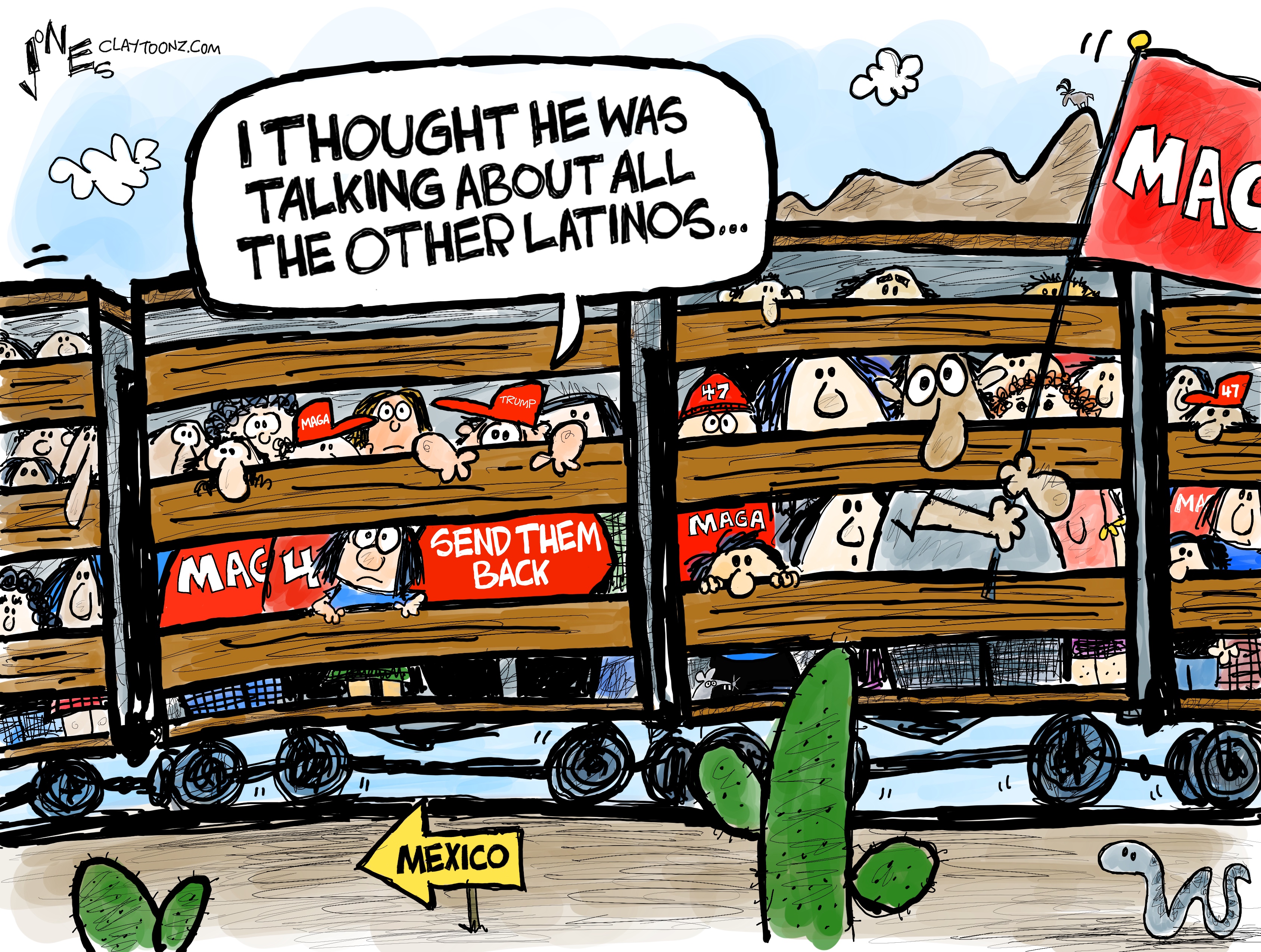
Still, I have a hard time believing that MAGA racism will respect legal, social, or economic boundaries. Puerto Ricans have been citizens since 1917, and they are still fair game for racist insults. Native Americans are sometimes told to “Go back where you came from”, which is probably Siberia many thousands of years ago. When the racial profiling starts, your skin color and family name may matter more than your legal status. Also, I would suspect that Latino citizens are much more likely than Anglos to know somebody at risk of deportation. I don’t understand why that wasn’t a bigger consideration.

The other example of surprising slippage is women. Biden won the female vote 57%-42%, and Harris won it 53%-45%. This, in spite of not just Harris’ gender, but Trump’s responsibility for the Dobbs decision, a jury affirming that he sexually assaulted E. Jean Carroll, and a series of creepy anti-woman statements.

There was also slippage — not much, but some — among Blacks. Biden won the Black vote 87%-12%, while Harris won it 85%-13%. Harris actually improved slightly on Biden’s performance among Black women (91% to 90%), but did worse among Black men (77% to 79%). (I assume that round-off errors account for the math anomaly in those numbers.)

Meanwhile, the White vote barely changed: Harris and Biden each got 41%.

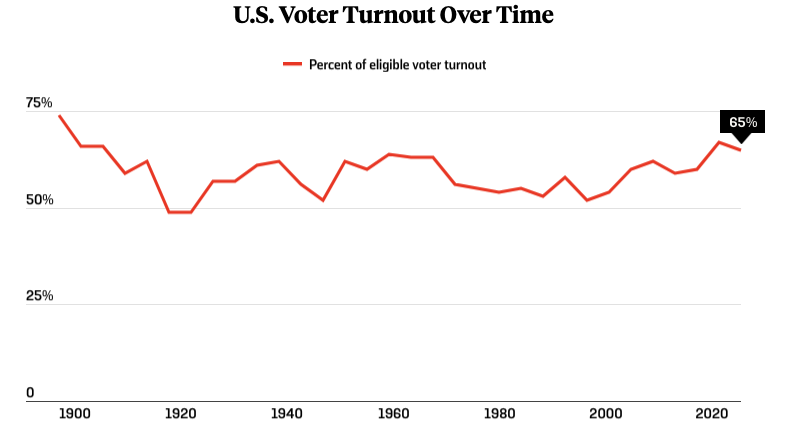
Finally, there’s turnout. Total voter turnout was 65% in 2024 compared to 67% in 2020. However, by American historical standards 65% is high, not low. You have to go back to 1908 (66%) to find another election with turnout this high. The 2020 adjustments to the Covid pandemic made it easier to vote then than at any other time in US history. So it’s unfair to fault the Harris campaign for not matching that turnout.
Why did it happen? I want to urge caution here. After any political disaster, you’ll hear a bunch of voices saying basically the same thing: “This proves I was right all along” or “This wouldn’t have happened if only people had listened to me.”

So Bernie Sanders thinks this election proved Democrats need a more progressive agenda to win back the working class. Joe Manchin says Democrats ignored “the power of the middle”, which implies the party should move right, not left. Others blame the liberal cultural agenda — trans rights, Latinx-like language, defund the police — for turning off working-class voters. Or maybe Harris’ outreach to Nikki Haley conservatives wasn’t convincing enough, and the problem was all the progressive positions she espoused in her 2020 campaign. Josh Barro suggests the problem is that blue states and cities are not being governed well.

The gap between Democrats’ promise of better living through better government and their failure to actually deliver better government has been a national political problem. So when Republicans made a pitch for change from all this (or even burn-it-all-down), it didn’t fall flat.

Basically, whatever you believe, you can find somebody telling you that you are right, and Harris would have won if she had done what you wanted.

I want to encourage you to resist that message — and I’m going to try to resist it myself — because none of us will learn anything if we just insist we’ve been right from Day 1. We should all bear in mind that the US is a very big, very diverse country, and (whoever you are) most voters are not like you. It’s easy for me to imagine positions or messages or candidates that would have made me more enthusiastic about voting Democratic. But we need to be looking for an approach that inspires a broader coalition than showed up for Harris last week. That coalition is going to have to include people you don’t understand, the way I don’t understand the Latinos who voted for mass deportation, the women who voted to give away their own rights, or the young people who voted to make climate change worse.

This is exactly the wrong time for I-was-right-all-along thinking. Back in 1973, Eric Hoffer wrote:

In a time of drastic change it is the learners who inherit the future. The learned usually find themselves equipped to live in a world that no longer exists.

So much of what passes for “obvious” or “common sense” right now only sounds that way because it is well grounded in a worldview that no longer applies. This is a truth that is easy to see in other people, but hard to see in ourselves.

We’re going to be in a weird position for the foreseeable future: Trump is going to try to run over a lot of legal, cultural, and political boundaries, and we need to be prepared to resist. It would be great to be able to resist from a place of rock-solid certainty. But if we’re going to turn this around in the long term, we also need to be humble and flexible in our thinking. Fairly often, we’re going to have to think thoughts like: “I don’t really don’t understand a lot of what’s happening, but I’m pretty sure I need to put my body here.”

Explanations we can eliminate. You don’t have to have the right explanation to recognize wrong ones.

Harris ran a bad campaign. Josh Marshall puts his finger on the statistic that debunks this.

In the seven swing states, the swing to Trump from 2020 to 2024 was 3.1 percentage points. In the other 43 states and Washington, DC the swing was 6.7 points.

Both candidates focused their ads, their messaging, and their personal appearances on the swing states. If the Trump campaign had been running rings around the Harris campaign, this arrow would have pointed in the other direction. In short: If you were a 2020 Biden voter, the more you saw of Harris and Trump, the more likely you were to vote for Harris.

I live in a typically liberal Boston suburb. Massachusetts is about as far from a swing state as you can get, so no national figures ever showed up here. Occasionally we’d see some ads aimed at New Hampshire, but we didn’t get nearly the blitz that Pennsylvanians got. And guess what? Harris slipped behind Biden’s performance here too.

Harris should have picked Josh Shapiro as her VP. This would be a good argument if Harris had won the national popular vote, but failed in the Electoral College because she lost Pennsylvania. But she also lost Wisconsin, where Walz probably helped her.

Also, Harris won the Jewish vote by a wide margin: 78%-22%. So Shapiro’s Judaism probably wouldn’t have helped the ticket.

Harris should have moved further left. We can never say what would have happened if a candidate had delivered a completely different message from the beginning. But I think it’s pretty clear that simply shifting left down the stretch, i.e., emphasizing the more liberal parts of Harris’ message and record, wouldn’t have helped.

The best evidence here comes from comparing Harris to Democratic Senate candidates. Candidates who are perceived as more liberal, like Bernie Sanders and Elizabeth Warren, generally did slightly worse than Harris in their states, while candidates perceived as more conservative (Tim Kaine and Bob Casey, say) did somewhat better.

I’m ignoring a bunch of the Senate races because I don’t see much to be gleaned from them. Jon Tester ran to Harris’ right in Montana and did 7% better, but Harris was never going to be conservative enough to win Montana — and as it turned out, Tester wasn’t either. Maryland’s Angela Alsobrooks ran almost 8% behind Harris (and won anyway), but that’s more a reflection on her opponent, former governor Larry Hogan, one of the few non-MAGA Republican candidates. (It suggests that a moderate Republican could have won a landslide on the scale of Nixon in 1972 or LBJ in 1964.)

If you saw much election advertising, you know that Republicans worked hard to paint Harris as part of the “radical left”. I don’t think they’d have done that if they thought moving left would help her.

Things I think I know. I don’t have a sweeping theory, but I’ll offer a few tentative pieces of a theory.

We lost the information war. The aspect of this campaign I found most personally frustrating was how much of the pro-Trump argument centered on things that simply aren’t true. Our cities are not hellholes. There is no migrant crime wave. Crime in general is not rising. Most of the countries that compete with us would love to have our economy. Inflation is just about beaten. America was far from “great” when Trump left office in 2021. Trump has no magic plan for peace in Ukraine and Gaza. The justice system has favored Trump, not persecuted him.

Jess Piper writes:

I hate to say this, but it’s true: Ignorance won. And it will keep winning until we realize that we can’t win by playing politics as usual. This isn’t the same world. Knocking 100 doors is a personal connection that might win a small race — I don’t know that it can change the larger races. Trump’s folks weren’t knocking doors. They were lying to the masses through an extreme right-wing reality that most of us can’t conceive.

And Michael Tomasky elaborates:

This is the year in which it became obvious that the right-wing media has more power than the mainstream media. It’s not just that it’s bigger. It’s that it speaks with one voice, and that voice says Democrats and liberals are treasonous elitists who hate you, and Republicans and conservatives love God and country and are your last line of defense against your son coming home from school your daughter. And that is why Donald Trump won.

It’s hard to know how important the pervasive misperception of facts really was. Did people believe Trump’s nonsense because it was actually convincing? Or did they want to support Trump for some other reason and latched onto whatever pro-Trump “facts” they could find? (Birtherism was like that. People who didn’t want to admit that a Black president scared or angered them instead claimed to be convinced that Obama was born in Kenya, despite clear evidence to the contrary.)

Past presidential campaigns have included some misinformation, but they revolved much more around philosophical disagreements not easily reduced to facts, like the significance of the national debt, or how to balance the public and private sectors.

One of the big questions going forward is whether Democrats want to continue being the reality-based party. I hope we do, just for the sake of my conscience. But if so, how do we make that work in the current information environment?

Harris had a steep hill to climb. Around the world, countries went through a period of inflation as their economies reopened after the pandemic. And around the world, the governments in power got thrown out. Here’s how Matt Yglesias put it just before the election:

The presumption is that Kamala Harris is — or at least might be — blowing it, either by being too liberal or too centrist, too welcoming of the Liz Cheneys of the world or not welcoming enough or that there is something fundamentally off-kilter about the American electorate or American society.

Consider, though, that on Oct. 27, Japan’s long-ruling conservative Liberal Democratic Party suffered one of its worst electoral results. In late September, Austria’s center-right People’s Party saw an 11-percentage-point decline in vote share and lost 20 of its 71 seats in Parliament. Over the summer, after being in power for 14 years, Britain’s Conservative Party collapsed in a landslide defeat, and France’s ruling centrist alliance lost over a third of its parliamentary seats.

… It is not a left-right thing. Examples show that each country has unique circumstances. Center-left governments from Sweden to Finland to New Zealand have lost, but so have center-right governments in Australia and Belgium. This year the center-left governing coalition in Portugal got tossed out. Last year the People’s Party for Freedom and Democracy, the incumbent center-right governing party in the Netherlands, finished third in an election dominated by far-right parties.

Not long after Yglesias wrote that, Germany’s governing coalition collapsed.

I’m reluctant to give this explanation too much credit, because it says this election was a one-off and there’s nothing really to learn, other than to avoid being in power at the end of a pandemic. So in that sense it’s too easy. But it’s also a real thing that is an important part of the picture.

Harris’ outreach to Republican women came up empty. I’m not going to say it was a bad idea, but it didn’t work. I haven’t seen an exit poll that specifically breaks out Republican women, but the overall slippage among women in general makes it unlikely that many Liz Cheney Republicans crossed over.

After Trump’s 2016 win, big-city journalists trying to figure out Trump voters made countless trips to small-town diners. This time, I’d like to see them hang out in upscale suburban coffee shops and talk to women in business suits. Why did so many of them stay loyal to their party’s anti-woman candidate?

Democrats need a utopian vision. If Democrats had complete control and could remake America however we wanted, what would that look like? I honestly don’t know.

It’s not like Democrats don’t stand for anything. I can list a bunch of things an unconstrained Democratic administration would do, like make sure everyone gets the health care they need, raise taxes on billionaires, ban assault weapons, cut fossil fuel emissions, and make states out of D. C. and Puerto Rico. Maybe it would also reform the food system and break up the tech monopolies, though the details on those two are fuzzy.

But a list of policies doesn’t add up to a vision.

Whatever you think of it, libertarianism provided pre-MAGA conservatives with a utopian vision for decades. Republicans didn’t usually run on an explicitly libertarian platform, but libertarian rhetoric and libertarian philosophy was always in the background. (Reagan in his first inaugural address: “Government is not the solution to our problem; government is the problem.”) Trump mostly turned away from that, and slogans like “America First” and “Make America Great Again” may be vague, but they also evoke something sweeping.

I can’t think of anything comparable on the left. The communist vision collapsed with the Soviet Union, and I don’t know anybody who wants to revive it. But in the absence of a political vision, we’re left with a technocracy: Do what the experts think will work best.

This is a problem a new face won’t solve. Gavin Newsom or Gretchen Whitmer or even AOC is not a vision.

What happens next? It’s Trump’s move. We don’t know yet who he’s going to appoint to high office or what the agenda of the new Congress will be. Establishing authoritarian government is work, and he may not have the energy for it. Maybe he’ll get so distracted by seeking his revenge against individuals that he won’t get around to systematically destroying democracy. We’ll see.

I’m reminded of a story Ursula le Guin told decades ago, repeating something from another woman’s novel: A female character discovers her baby eating a manuscript.

The damage was not, in fact, as great as it appeared at first sight to be, for babies, though persistent, are not thorough.

Trump has many babyish traits. We can hope that he won’t be thorough enough to do as much damage as we now fear.

This Adam Gurri article is full of good advice, but I especially appreciate this:

The biggest weakness of The Women’s March was its lack of strategic objective or timing. It simply demonstrated mass dissatisfaction with the Trump administration the day after it began. The best use of mass protest is in response to something specific. It does not even need to be an action, it can be as simple as some specific thing that Trump or a member of his administration says. But it has to have some substance, some specific area of concern. Perhaps it is about prosecuting his enemies. Perhaps it is about mass deportations. No one doubts there will be a steady supply of choices to latch onto. Those seeking to mobilize protests need to make sure they do pick something specific to latch onto, and be disciplined in making opposition to it the loudest rhetoric of the protest.

This time around, I don’t expect protesting against Trump himself to get very far. His followers expect it; they will just roll their eyes and talk about “Trump Derangement Syndrome”. But protesting something Trump does will at least draw attention to that thing. We have to wait for him to do something objectionable. Unfortunately, it probably won’t be a long wait.

In the meantime, prepare. Take care of yourself. Regain your balance.

MAGA’s Closing Argument: Dad’s Coming Home

If you can’t see any sense in the pro-Trump case, you’re looking at the wrong level.


“How can this election be close?”

It’s a cry of frustration I hear almost every day in one way or another, not just from Substack bloggers and TV talking heads, but also on social media and from personal friends.

Sure, there are about as many Republicans as Democrats in the country, and as many conservatives as liberals. But one of the two candidates is Donald Trump. I could easily imagine someone like Nikki Haley winning. But the case against Trump should be both obvious and compelling.

We all saw him raise a mob and send it to attack the Capitol in an attempt to overturn an election his own people told him he lost fair and square. We lived through his mismanagement of Covid, which led to hundreds of thousands of unnecessary American deaths. We see him day after day, rambling incoherently through interviews and unable to answer questions about the few policies he has proposed. We see key members of his first administration — like Chief of Staff John Kelly and JCS Chair Mark Milley — warn us that he is a fascist and should never again hold an office of public trust. We hear him repeat the words of past fascist leaders, telling us that his chosen scapegoats — immigrants, in preference to Hitler’s Jews (most of the time) — are “poisoning the blood of our country” and need to be rounded up by the millions. We hear him recite the eternal tropes of racism, claiming that immigrants have “bad genes” that make them criminals, but that he himself has “great genes” that make him smart. We hear him lie, virtually with every breath, about a bad economy, soaring crime, and an immigrant crime wave — none of which exist anywhere outside his imagination.

How is this election close? How is it still possible that he could win? Is half the country as far gone as Ruben Bolling’s version of Snoopy?

If you feel this frustration, imagine what it’s like for bloggers like me. Day after day, I motivate myself with this myth: If I could only explain things clearly enough, people would understand; and once they understood, the great majority of them would do the right thing. So the prospect of another Trump presidency doesn’t just make me fear for my country, it undermines my identity.

More and more it becomes apparent that the problem isn’t that half the country doesn’t understand. Many of them actively want a fascist government that will implement the cruelty they feel in their hearts. Many who aren’t openly rooting for that cruelty refuse to understand what Trump is, and no one can make them understand against their will. They will accept any excuse for his behavior, even excuses that shift from month to month and contradict the previous excuses.

Thank you for letting me get that out of my system. Now I can try to go back to being calm and reasonable.

A few weeks ago I took a long, leisurely driving trip from my home in Massachusetts out to west-central Illinois, where I grew up. I led a church service there, and then took a long, leisurely drive back. Along the way, I saw the lawn signs in neighborhoods very different from mine, and I heard campaign ads not just for the national race, but for a variety of close Senate races.

I think I understand something now.

Fantasies of crime. In the northwest neck of Pennsylvania, road closures threw me off of I-90 and sent me through a small town that sits between Cleveland and Buffalo, but is outside the orbit of either city. In a peaceful middle-class neighborhood I saw numerous yard signs that said

Trump safety
Kamala crime

I doubt the people who live in those houses are recent victims of crime or live in any realistic state of fear. I also doubt that they have looked very deeply into the crime problem nationally. If they had, they would know that crime has been dropping for decades, and was no better under Trump than under Biden and Harris. Crime briefly blipped upward during both the Trump and Biden years of the Covid pandemic, but in recent years the long-term decline has resumed.

Unlike many of the fantasy problems Trump presents in his speeches, he at least has proposed fantasy solutions to this one: deport all those brown people with criminality in their DNA, and stop making the police follow rules.

The trans “threat”. Trans people figure prominently in several of the ads I saw. One purported to compare the Trump military to the “woke” Harris military. The scenes representing Trump were of a drill sergeant screaming abuse at recruits. The ones representing Harris showed dancers of indeterminate gender. We are supposed to draw the “obvious” conclusions that these images are typical of Trump and Harris military policies, and that the abused recruits will perform better on the battlefield than the gender-fluid recruits.

An attack ad directed at Sherrod Brown said that he voted to allow men to compete in women’s sports. An anti-Harris ad said she supported paying for the sex-change operations of criminals in prison. It concluded “Kamala is for they/them. Trump is for you.” During the Olympics, Trump falsely said that a gold-medal-winning female boxer was a man who had “transitioned”, and implied that women competing against her were in danger. Republicans often attack the inclusion of transwomen in women’s sports by invoking the image of men beating up on women.

Again, these ads seem directed at people whose lives are not affected by the issues being raised. The Algerian boxer Trump attacked was not trans. The actual number of transwomen athletes in school sports is tiny — about 40 out of 500,000 NCAA athletes, according to one report — and no women’s league in any sport in the country is dominated by trans stars. The real stars of women’s sports — Caitlin Clark, for example, or Serena Williams — were identified as female at birth. Transwomen who have taken puberty-blocking drugs have only minor advantages over other high-school or college-age women. The problem of transwomen beating down “real” women is itself not real.

Of course, there is a real men-beating-women problem in our society, but Republicans do not seem concerned about it. Whenever proposed legislation would protect women — say, by closing the “boyfriend loophole” in laws the prevent domestic abusers from owning guns — the opposition will be almost entirely Republican.

Similarly, the number of trans soldiers in our military or trans inmates in our prisons is tiny. Kicking out the one or making the other pay for their own surgery is not going to perceptibly improve the daily lives of MAGA voters.

Immigrants “destroying our country”. The third major argument, which I hear more from Trump himself than in TV ads, is that immigrants are “destroying our country“. The examples Trump offers are horrifying: In Springfield, Ohio “They’re eating the dogs. They’re eating the cats.” Aurora, Colorado is a “war zone”, occupied by “an army of illegal alien gang members and migrant criminals from the dungeons of the third world”.

But none of that is true, and even local Republican officials push back against Trump’s false claims. Such lies can’t be aimed at winning votes in the communities he’s talking about, because local people can simply open their eyes and see that the world he’s describing isn’t real.

So the target audience must be elsewhere.

Something similar is going on in Trump’s rhetoric about American cities, especially major cities in key swing states: Milwaukee is “horrible”. Philadelphia is “ravaged by bloodshed and crime”. If Harris is elected, he claims, “the whole country will end up being like Detroit.” (Harris and Detroit struck back with this ad, about how the city has rebuilt itself: America will be like Detroit? “He should be so god damn lucky.”)

“These cities,” Trump said in a 2020 town hall. “It’s like living in hell.”

Those comments aren’t intended to earn votes in Milwaukee, Philadelphia, and Detroit — Democratic strongholds where people can simply open their eyes and see that on the whole life is not particularly hellish. Rather, they’re aimed at suburban and rural voters who never go to the cities because they believe terrible things about them.

What’s going on? I set out to explain how this election can be close, and so far I haven’t. If you think of politics as being about problems and solutions, none of the arguments Trump and other MAGA Republicans are making add up. They are offering to solve problems their voters don’t have, and to protect them from people who do them no harm. (Trans people, for example, have issues with their own genders, not yours. Crime in Atlanta hurts Atlantans, not people in Marjorie Taylor Green’s district, where the largest city, Rome, has 37,000 people. If undocumented immigrants affect your life, it’s probably by picking the vegetables you eat or washing the dishes in your favorite restaurant.)

So how do all these arguments work? Why doesn’t it matter that so many of them are easily debunked? And how do they coalesce into a coherent whole? Fortunately, we don’t have to figure this out for ourselves, because we can call in a MAGA expert: Tucker Carlson. Speaking at a Trump rally in Georgia Wednesday, Tucker pulled it all together:

If you allow people to get away with things that are completely over the top and outrageous, if you allow your 2-year-old to smear the contents of his diapers on the wall of your living room and you do nothing about it, if you allow your 14-year-old to light a joint at the breakfast table, if you allow your hormone-addled 15-year-old daughter to, like, slam the door of her bedroom and give you the finger, you’re going to get more of it, and those kids are going to wind up in rehab. It’s not good for you and it’s not good for them.

No. There has to be a point at which Dad comes home. [loud cheering] Yeah, that’s right. Dad comes home, and he’s pissed. Dad is pissed. He’s not vengeful; he loves his children. Disobedient as they may be, he loves them, because they’re his children, they live in his house. But he’s very disappointed in their behavior, and he’s going to have to let them know: “Get to your room right now and think about what you did.”

And when Dad gets home, you know what he says? “You’ve been a bad girl. You’ve been a bad little girl and you’re getting a vigorous spanking, right now. And no, it’s not going to hurt me more than it hurts you. No, it’s not. I’m not going to lie. It’s going to hurt you a lot more than it hurts me. And you earned this. You’re getting a vigorous spanking because you’ve been a bad girl. And it has to be this way. It has to be this way, because it’s true. And you’re only going to get better when you take responsibility for what you did.”

That’s not said in the spirit of hate. It’s not said in the spirit of vengeance or bigotry. Far from it. It’s said in the spirit of justice, which is the purest and best thing there is. And without it, things fall apart. …

Not only do I think Donald Trump’s going to win, I think that the vibe shift has been so profound. … What you smell around you is the return of freedom, it’s the return of the country you grew up in. …

[The Democrats] need to lose. And at the end of all that, when they tell you they’ve won: No! You can look them straight in the face and say, “I’m sorry. Dad’s home. And he’s pissed.” [1]

How does that pull it all together? Most of us don’t parent teen-age girls we wish we could spank, so how does this little vignette capture why we should vote for Trump?

Let me explain: If you’re looking for the problems of ordinary American life, you’re looking in the wrong place. Trump is not talking about how you’re going to pay for college or find a job or afford a house or get healthcare or retire without starving. The problem his campaign is all about is on a different level altogether: You feel dislocated in today’s world.

That’s why his slogan is backward-looking: Make America Great Again. When is “again”? Back in July, the folks at Salon posed that question to people at the Republican Convention:

What we found is that, whether they’re 30 or 70 years old, the typical RNC attendee thinks America was “great” when they were kids. They believe America lost its way coincidentally right at the time they were maturing into adulthood.

For whatever reason, they now find themselves living in a world very different from “the country you grew up in”. Maybe it’s all the people chattering in languages they don’t understand. Maybe it’s being told that it’s racist or sexist to talk the way they’ve always talked. Maybe it’s having to deal with people who don’t look like either men or women to them, and being told that they’re the problem when they can’t keep track of which name or pronoun to use. Maybe it’s not being able to assume that everybody’s Christian or heterosexual, or not knowing what’s funny now, or hearing music that doesn’t sound like music. Maybe it’s not being able to get a real person on the phone, or receiving 100 pieces of junk mail for every letter they actually want, or dealing with women who earn more than men. Maybe it’s not recognizing half the countries on the globe or being reminded about George Washington’s slaves or hearing “land acknowledgements” about the Native Americans who once occupied the property where they live.

The core MAGA message is that all these problems are really one problem: The world feels wrong now, because people don’t know how to behave.

All the apparent problems Trump talks about are just symbols, just ways to get his hands around this larger, more ineffable problem. Illegal immigrants, terrorists, criminals, transsexuals, women who get abortions — they’re all just people who don’t know how to behave. And that’s why it doesn’t matter if he’s making up his facts or that some particular thing never really happened. People don’t know how to behave, and they make the whole world feel weird and scary That’s real.

Similarly, all the solutions he talks about are really just symbols of one solution: We need to put somebody in charge who will be strong enough to make people behave.

That’s what Tucker spelled out: Dad needs to come home, the old-fashioned kind of Dad who yells and judges and punishes. He’ll tell the bad kids they’re bad, and he’ll keep spanking them hard until they learn to be good.

And then America will be great again, like it was when all of us were children.


[1] This clip got a lot of play on social media and elsewhere, but most of the response focused on the spanking-little-girls aspect and ignored the fascist threat at the end: Even if Kamala Harris wins, MAGA will try to install its strongman.

Questions for Donald Trump

The press often complains that Kamala Harris doesn’t answer enough questions.
Here are some unanswered questions for Donald Trump.


Kamala Harris faces frequent criticism from from news media sites like The New York Times and CNN for not doing more interviews or providing more details about the plans she would pursue if she becomes president. This week, she released a 82-page economic plan and gave a 24-minute interview to MSNBC’s Stephanie Ruhle, but her critics were not satisfied.

The NYT’s Reid Epstein, for example, dismissed Ruhle (the host of MSNBC’s nightly The 11th Hour) as a “friendly interviewer” and compared the interview to Trump talking to Fox News’ Sean Hannity. [1] He wrote that Ruhle

avoided posing tricky questions about positions Ms. Harris supported during her 2020 presidential campaign or what, if anything, she knew about Mr. Biden’s physical condition or mental acuity as his own campaign deteriorated. [2]

and said that “A hard-hitting interview is yet to come.” [3]

Most of the specific questions Epstein accused Harris of “evading” are questions no politician ever answers, like why her opponent out-polls her on certain issues, or how she will pursue her plans if Democrats lose the Senate. (When was the last time you heard a candidate give a forthright answer to “What if your party loses?”) And as for the more general criticism, how are voters served by “tricky” questions that aim to “hit hard” rather than elicit information?

Yesterday the NYT pounded again on its Harris-needs-to-answer-questions theme by publishing Ashley Etienne’s essay. Etienne asserted that Harris needs to explain why she wants to be president (as if every previous campaign had communicated some unique and memorable reason). In general, people run for president because they think they can do a good job for the country. Why does Harris need a better reason?

I have written before about how the corporate media’s approach to this campaign fails to serve voters. CNN’s Jake Tapper often equates doing press interviews with “answer[ing] some of the questions that voters have about her policies”, but such questions are plainly not what interviewers ask. Dana Bash’s interview with Harris and Walz mostly confronted them with Trump-campaign talking points. In June, while he was still a candidate, Joe Biden sat with ABC’s George Stephanopoulos for 22 minutes, most of which Stephanopoulos spent trying to get Biden to describe the circumstances under which he would withdraw from the race (another question no politician has ever answered). I sincerely doubt that an undecided voter would have wasted the President’s time like that.

It seems clear to me that the demand for “hard-hitting interviews” is not about getting voters the information they need. Instead, critics seek the theater of an interviewer fencing with Harris and trying to trap her with “tricky questions”.

With that distinction in mind, I pose a challenge for the talking heads complaining that Harris isn’t sitting down with them: Tell us what questions you think Harris still needs to answer. If the point is to get voters the information they need, why does it matter that you (or someone from your organization) be in the room when it happens?

The double standard. I have also often complained that the press wants to hold Harris (like Biden before her) to a standard that they don’t apply to Trump. For example, whenever Biden would say the wrong word or call someone by the wrong name, the press would largely ignore whatever he had been trying to say (even if it was perfectly clear) and instead write a story highlighting the mistake and using it to question the President’s mental capacity. But Trump often makes similar mistakes, and regularly goes off on incoherent rambles that are arguably insane. Subsequent press reports do not highlight these moments, and Trump’s mental acuity is rarely questioned. Instead, reporters do their best to read sense into Trump’s words and report what they divine he meant rather than what he said.

Trump also gets credit for being more accessible to the press than Harris, even if he does not actually answer their questions, or answers with a transparent lie. Often, Trump responds to a “hard-hitting” or “tricky” question — or even just a question he has no good answer for — by calling the questioner “nasty” or accusing him or her of representing “fake news“. This vitriol has trained many reporters not to ask Trump difficult questions.

How well do you think that tactic would work for Harris?

Taking my own advice. So what I’m going to do below is follow the advice I’ve just given: I’m going to list the questions that I believe Trump still needs to answer. In my opinion, these are all questions voters might wonder about, and nothing in them is the least bit “tricky”. I have not tried to frame them in a hostile manner. Whenever possible, I have quoted Trump directly rather than put my own interpretation on his words. I have provided references for any facts that I claim, and in several of them I ask him to point to sources he considers more trustworthy. I have tried to focus my questions on positions he holds now, without comparison to differing positions he may have taken many years ago.

I believe that Trump has not given adequate answers to any of these questions. (If you know that he has, please leave a comment with a link referencing his answer.) Further, I don’t care how Trump provides this information, as long as it results in actual answers. To satisfy me, he doesn’t have to sit down with an interviewer I like or trust. If he wants to work his answers into speeches without being interviewed at all, or even without acknowledging that anyone has asked, that would be fine too.

Unlike The New York Times, I am looking for information, not theater.

Questions about the economy. Trump’s economic proposals can be summed up as tariffs, tax cuts, and increased fossil fuel production. Since energy is an input into almost every other product, Trump is counting on increased oil production from his “drill baby drill” policy to drive down prices across the board. Meanwhile tariffs are supposed to simultaneously protect American industries from foreign competition while generating “trillions” in revenue that will bring down the deficit and pay for income tax cuts as well as some undetermined number of additional programs (like childcare, apparently). But he has provided very few specifics that can be tested and analyzed.

So here are my questions:

You have described tariffs as “a tax on another country“, even though the money is actually collected from the American importer, not the foreign exporter. What convinces you that the tax will ultimately be paid by foreign exporters (who would have to compensate by cutting their prices) rather than American consumers (who would have to pay higher prices)? Can you point to an economic analysis that supports your view?

If tariffs result in American companies facing less price competition from imports, won’t they just raise their prices? Does anything in your plan prevent this?

In some speeches you have suggested across-the-board tariffs of 10%, but in others it’s 20%, with rates up to 200% on specific products like electric cars. Can you be more specific about your tariff rates and how much revenue you expect to collect?

Many American industries depend on exports. What will you do if other countries retaliate with tariffs against American products?

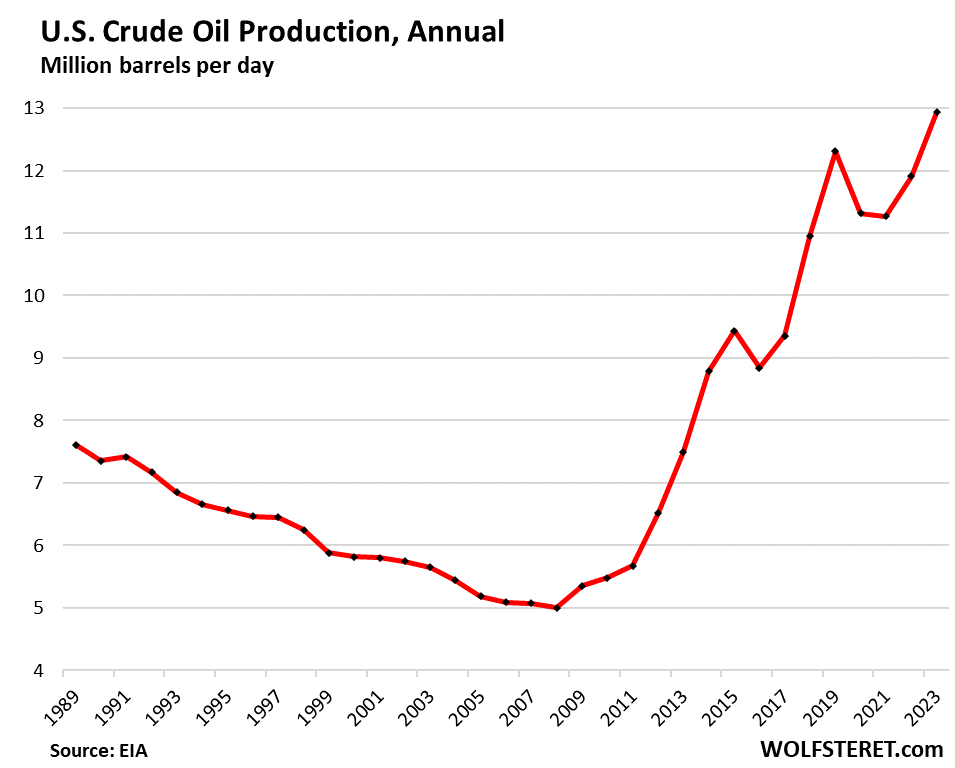
Oil production in the US has been rising steadily since 2008, and is now higher than in any other nation. The price of oil is currently lower than at any time since 2021, and at $68 per barrel is below the estimated break-even price of new wells in the Permian Basin. How much more production do you think we can get, and how low do you think the price of oil can go?

Questions about the environment. During his four years in office, Trump rolled back regulations designed to protect the environment, pulled out of the Paris Accords , and repeatedly minimized the effects of climate change.

You have said the climate change will increase sea level “one-eighth of an inch over the next 400 years“. Where did you get this information? Why do you find that source’s estimate more reliable than the EPA’s estimate that sea level is rising about an eighth of an inch every year?

Do you believe that warmer ocean temperatures contribute to destructive storms like Hurricane Helene?

Should the federal government be doing anything to decrease the use of fossil fuels in the US?

Questions about foreign policy. Trump’s first answer to questions about almost any foreign policy problem is that the problem wouldn’t exist if he were still president: Putin wouldn’t have invaded Ukraine, Hamas wouldn’t have attack Israel on October 7, and so on. Whatever you think of those claims, such answers are not adequate. The 47th president will have to deal with the situations that currently exist, independent of what might have happened in some alternate timeline.

In 2020, you proposed a modified two-state peace plan for Israel and Palestine, in which the Palestinian state would be fragmented and considerably smaller than territory Israel acquired in the 1967 war. But this year, you said that achieving two-state solution of any sort would be “very, very tough“. Do you currently have a vision of a future peace in that region? What long-term goals should US policy be working toward?

You have said you could end the Ukraine War in one day by talking to Presidents Putin and Zelenskyy, but you haven’t said what you would try to get them to agree to. J. D. Vance has described the process like this:

Trump sits down, says to the Russians, Ukrainians, and Europeans: ‘You guys need to figure out what does a peaceful settlement look like.’ And what it probably looks like is something like the current line of demarcation between Russia and Ukraine. That becomes like a demilitarized zone. It is heavily fortified so that Russians don’t invade again. Ukraine retains its independent sovereignty. Russia gets a guarantee of neutrality from Ukraine. It doesn’t join NATO. It doesn’t join some of these allied institutions.

Is that accurate?

Should the United States try to promote democracy in other countries?

You have said that Russia can do “whatever the hell they want” to NATO countries that don’t spend enough on their own defense. Which NATO nations does that currently leave vulnerable?

Questions about immigration. The issue Trump talks about most often and most passionately is immigration. But there is still much he hasn’t told us.

Earlier this year, Republican Senator James Lankford negotiated a bill to increase border security. Mitch McConnell said it didn’t pass because “our nominee for president didn’t seem to want us to do anything at all”. Is that an accurate description of what happened? Why did you oppose the bill?

You have proposed “mass deportation” of all undocumented immigrants, and have estimated that 20 million or more such people are currently in the United States. Could you describe in detail how that deportation operation would be carried out? How long do you expect this operation to take, and how much do you expect it to cost?

Given that many American citizens and legal residents have brown skin, common Hispanic names, and speak Spanish as their first language how will you protect them from being swept up in the mass deportation operation by mistake?

The US Chamber of Commerce claims we already have a labor shortage, with 8.2 million job openings but only 7.2 million job seekers. If we deport millions of workers, how will the US economy replace them? In particular, won’t deporting low-wage workers increase inflation?

Should the United States continue to honor its treaty obligations to offer asylum to refugees who face persecution in their home countries?

Is Christianity just one religion among many in America, or should the government treat Christians differently? For example, should Christian immigrants be favored over immigrants who practice Islam or some other religion?

Questions about social issues.

You have said that crime is “rampant and out of control“, and that the FBI statistics that show crime falling are “fake numbers“. Why do you base these claims on? Why is your source (whatever it is) more credible than the FBI?

You have said you would not sign a national abortion ban, and that you want the issue left to the states. But some abortion issues necessarily are made at the federal level. The drug mifepristone, used in about half of all abortions, is subject to FDA approval, which it currently has. You said in June that your FDA would not revoke access to the drug, but a subsequent comment in August was less clear. [4] Can you state a definite position on mifepristone?

In February, you told the NRA that “nothing happened” on gun control during your administration, and emphasized “We did nothing.” Can you offer any hope to Americans who worry about mass shootings?

Questions about his indictments. In the summer of 2022, Trump complained that the January 6 Committee hearings were “one-sided“. But with regard to the claims made in the indictments against him, we don’t know Trump’s side of the story because he has never told it. Instead, he has refused to let himself be pinned down to any one account, and has thrown up multiple contradictory defenses, or simply claimed “I did nothing wrong” with no further details.

Sometimes, for example, he blames Antifa for the January 6 violence, sometimes he denies or minimizes the violence, and at other times he valorizes the violence by claiming that the convicted rioters are “warriors“, “hostages“, or “patriots“. Similarly, he has never explained exactly why he took classified documents to Mar-a-Lago or what he intended to do with them.

The press has simply accepted that he’s not going to provide these answers and has stopped asking the questions. That’s wrong. Voters deserve to know this information. Trump’s legal maneuvers have prevented the answers from coming out in court, but not even the Supreme Court can grant him immunity from the press or the voters. He should be asked the following questions, and criticized if he evades them.

When you asked the crowd to go to the Capitol on January 6, what did you expect them to do there? If you had gone to the Capitol yourself, as you told the crowd you would do, what did you intend to do?

The people who fought with police (and injured more than a hundred of them) on January 6 — were they your supporters?

At what point (if any) do you think the January 6th march to the Capitol started to go wrong? When did you become aware that the marchers had turned violent? Why didn’t you ask the crowd to go home at that point?

When people from your own campaign (like Bill Stepian) or your own administration (like Attorney General Bill Barr and CISA Director Chris Krebs) told you that you had lost the 2020 election and there was no significant fraud, why didn’t you believe them?

If you still believe the 2020 election was decided by fraud, how do you think the fraud was carried out? Please be specific.

Were any of the documents you brought to Mar-a-Lago after your presidency still classified? If not, when and how were they declassified?

On many occasions you have said that the Presidential Records Act gave you the right to possess the classified documents. I have looked for a legal expert who shares your interpretation of the PRA and I have not found one. Who is advising you on this? Is there a particular section in the law that you think gives you this right?

Did you understand that Mar-a-Lago had not been approved as a secure site for storing classified documents, and that you no longer had a security clearance?

Why were you interested in keeping those particular documents? What did you intend to do with them?

Why didn’t you return the documents when the National Archives asked for them?

When your lawyers told the government that all classified documents had been returned, were they carrying out your instructions? Did you believe that claim to be true?

When the FBI’s search discovered classified documents at Mar-a-Lago, were you surprised, or did you already know the documents were there? Some of your supporters believe the FBI planted the documents. Do you?

Were you aware that your employees at Mar-a-Lago were moving boxes of documents from room to room? Did you instruct them to do so? Was the purpose to hide the documents from someone?

Conclusion. The New York Times and corporate media in general are fond of “both sides” framing, a tendency the Pitchbot often parodies:

Whether it’s Kamala Harris celebrating Diwali or Donald Trump celebrating one really rough and nasty day of police violence, both candidates have embraced controversial holidays.

But on the unanswered-questions theme, coverage has been bizarrely one-sided: Only Harris needs to answer more questions or provide more information, and only Harris is criticized for “evasion” if her answers are unsatisfactory.

I hope the list above has made obvious that Trump also has a lot of questions to answer. The fact that the press has stopped asking does not mean that he has answered.


[1] The Ruhle/Hannity comparison is a false equivalence.

After the 2020 election, Hannity (like several other Fox News hosts) said one thing to his viewers about Trump’s allegations of voting-machine fraud, but said something quite different to colleagues in text messages. He was not the whole problem, but he certainly played a role in Fox needing to pay $787 million to settle Dominion’s defamation lawsuit. Ruhle has not been associated with any comparable journalistic wrongdoing. Hannity has repeatedly participated in Republican fund-raising, including for Trump’s 2020 campaign. Such partisan activity is a firing offense at MSNBC — and virtually any news organization other than Fox.

James Fallows commented:

We know how [Stephanie Ruhle is] going to vote—she has told us, and explained why. But she is not like Sean Hannity—nor Fox’s Jesse Watters or the now-exiled Tucker Carlson. She differs in that she respects the boundaries of established fact and won’t lie or pander to help “her side.” (If you disagree: Please send me an example of her doing so.)

[2] Harris has made it clear that she believes President Biden retains the physical and mental capacity to do his job, so there is no further question for her to answer. Prior to Biden withdrawing his candidacy, worries within the Democratic Party centered on whether Biden could turn the presidential race around and govern effectively until January, 2029 — not whether he could govern effectively until January, 2025.

[3] It’s striking how perfectly the satirical New York Times Pitchbot anticipated Epstein’s commentary:

Kamala Harris gave an interview, but not the right kind of interview.

[4] “Less clear” is kind. TNR described Trump’s answer as “gibberish“.