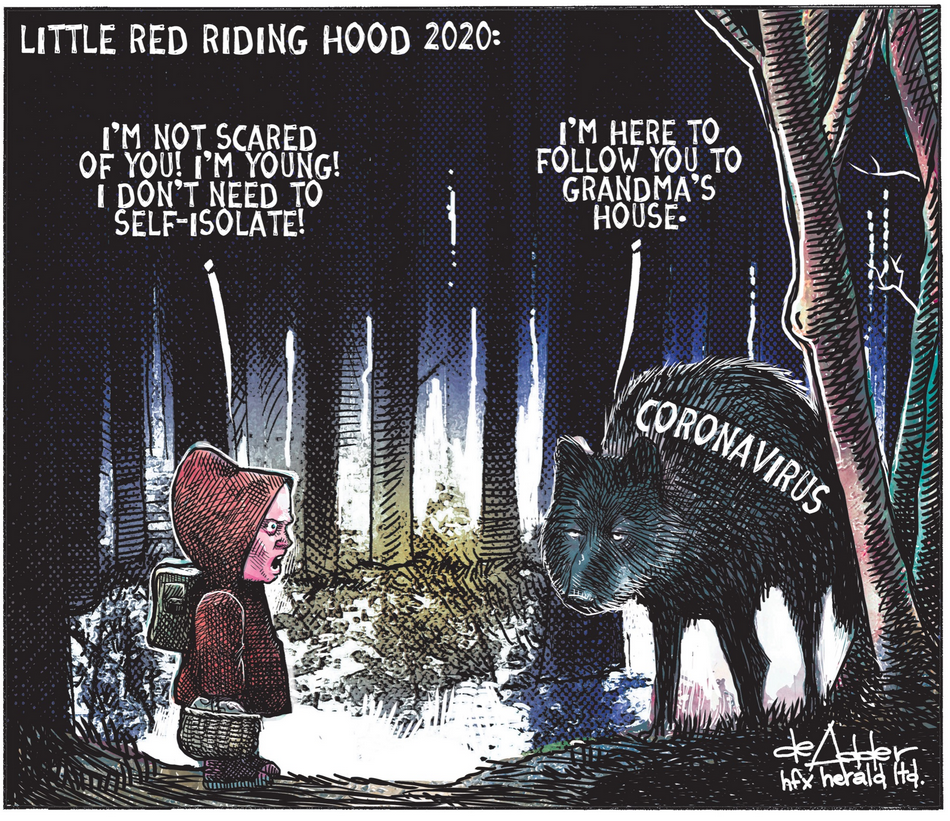
Tag Archives: covid health pandemic

Where Did Inflation Come From?

Worldwide inflation has been a lingering symptom of the Covid pandemic. Trump and Biden share blame for the US inflation, and reelecting Trump won’t fix it.


Polls show that voters trust Trump more than Biden (and probably Harris) on economic issues, and the main reason for that is the inflation we’ve seen since Biden took office. The Republican platform and Trump’s convention speech both appealed to that issue, claiming that Trump will “end inflation … very quickly”.

A few things get lost in this promise, like:

  • Inflation is already ending, just as the Great Recession had already ended when Trump took office in 2017. So all a reelected President Trump will have to do to “end inflation” is to announce that it’s over. That can happen “very quickly”.
  • The low gas prices Trump’s supporters point to weren’t due to his energy policy. They came from the fact that the economy was shut down for Covid and nobody was driving.
  • Post-Covid inflation has been a worldwide phenomenon. Any explanation that pins the blame on Biden alone is simplistic.
  • Many of Trump’s policy proposals will increase prices, not lower them.

But rather than point fingers about inflation, let’s see if we can tell its story in a way that makes sense.

The roots of the recent inflation stretch back to the Covid pandemic, which reached the US in 2020, the final year of Trump’s term. That seems like a weird claim to make, because in 2020 itself, the threat was deflation. Gas prices, for example, dropped to an average of $1.84 in April, 2020, because the economy was largely shut down. If you had gas to sell, few people were buying. As the economy contracted and more and more people lost their jobs, the economic threat was a Depression-style cascade of bankruptcies: My business is closed, so I can’t pay my suppliers or landlord, so they go bankrupt and can’t pay the people who were counting on them. And so on.

But let’s tell the story from the beginning. Today, after a vaccine and treatments like Paxlovid have been developed, and after the virus itself has evolved into less lethal forms, many of us have repressed our memories of just how terrifying the early months of the Covid crisis were. At the time, the only treatment to speak of was to keep patients’ blood oxygen up in any way possible, and hope that if they didn’t die their immune systems would eventually win out.

In the early places where the infection got loose, such as Italy and New York City, it overwhelmed the health-care system. Sick people languished on cots in hallways, and refrigerator trucks supplemented the morgues. A lack of good data made it hard to determine just how lethal the virus was. Nobody knew how many asymptomatic cases hadn’t been noticed, and the number of Covid deaths might be either higher or lower than death certificates indicated. But the early estimates of lethality were around 3%; about 3% of infected people died. (That later got revised downward to 1.4%.)

So governments faced a lose/lose choice: If the virus were allowed to run wild, probably everyone would get it eventually, so about 3% of the population would die. In the US, that would mean over 10 million people. (The 1.4% rate implies around 5 million American deaths.) The alternative was to shut down non-essential activities where crowds of people might gather and spread the infection: sports events, political rallies, churches, concerts, and so on. Additionally, bars and restaurants, schools, movie theaters, factories, and offices were likely to spread the virus. When social interactions were unavoidable, governments could encourage masking and social distancing.

The point of all this wasn’t to defeat the virus, but to slow it down. The hope was that a slower-spreading virus wouldn’t overwhelm the healthcare system (“flatten the curve”, we were told), and that extra time might allow discovery of better treatments or a vaccine. That more-or-less worked out: In the US, “only” 1.2 million died, rather than 5-10 million. (If we had handled the virus as well as Canada, perhaps fewer than half a million Americans would have died.)

But there was a cost. The unemployment rate went over 14%, and that was an undercount. Millions of other Americans continued to receive a paycheck, but weren’t really working. (A government loan program allowed small-business loans to be forgiven if a business maintained its payroll.) What was going to happen to those unemployed through no fault of their own? What good did it do to keep them from getting sick if they were going to lose their homes and starve?

Again, a lose/lose choice: In order to avoid mass poverty, cascading bankruptcies, and economic destruction that might take years to recover from, governments propped up people’s incomes. In the US, I already mentioned the loan program. Unemployment benefits were repeatedly extended beyond their ordinary expiration dates. State and local governments got federal money that allowed them not to fire their employees. Landlords weren’t allowed to evict non-paying tenants. Occasionally, the government would just send everyone a check, whether they were covered by some income-protection program or not. Other countries took similar steps.

Because tax revenues were collapsing at the same time that governments were taking on these additional expenses, deficits skyrocketed. The largest US federal budget deficit ever came in FY2020 (October 2019 through September 2020), the last year of the Trump administration: $3.13 trillion. The next year (1/3 Trump, 2/3 Biden) was nearly as bad: $2.78 trillion.

What that money was doing was even more inflationary than the deficit itself: People were being paid not to produce anything. So: more money, but fewer goods and services to spend it on. This was inevitably going to increase prices.

But inflation didn’t hit right away, because people confined to their homes didn’t spend much. There was no point buying a new car, for example, when your current car was sitting unused in the garage. The cruise lines and theme parks were shut down, and no one wanted to risk spending hours sitting elbow-to-elbow in an airliner, so vacation spending collapsed. You had to keep buying food, but beyond that, the richer half of households worked from home, cashed their government checks, and let their money sit in the bank.

But when the economy opened up again, all that money was bound to come out and drive prices upward. In addition, not everything restarted at the same rate, so the economy developed bottlenecks that increased prices further. The Ukraine War disrupted the world’s grain and oil markets, adding additional inflationary pressure.

Post-Covid inflation was a worldwide phenomenon that peaked in 2022, when US inflation was 8%. Bad as that was, things were even worse in comparable economies like the UK (9.1%) and European Union (8.8%), while some smaller countries saw catastrophic levels, like Turkey at 72.3% and Argentina at 72.4%.

The final lose/lose choice was how fast to restart the economy. Unemployment was still over 6% when Joe Biden became president, and he had learned a hard lesson from the aftermath of the Great Recession. The stimulus spending President Obama had managed to secure during the two years when he had congressional majorities wasn’t sufficient, and after 2010 he battled Republican leaders in Congress for every penny. The result was an economic recovery so slow that many Americans barely noticed it. Not until 2016 did economic indicators return to the normal range. They continued upward from there, allowing Trump to take credit for “the greatest economy ever” when the trends Obama established continued into his term. (Look at the GDP and unemployment graphs below and see if you can pick out when the “Trump boom” started.)
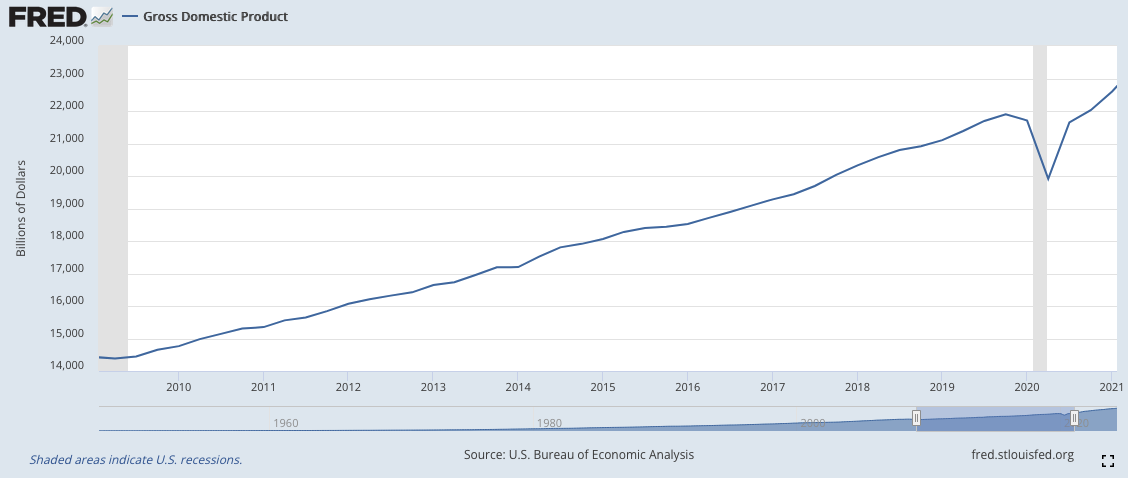
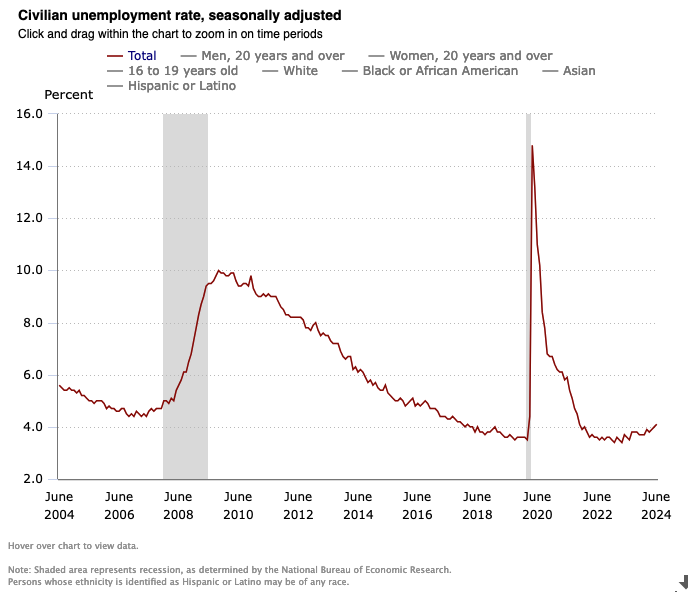
Given Obama’s experience, Biden opted for a faster restart. To his credit, he invested the stimulus money wisely: building infrastructure and laying the groundwork for a post-fossil-fuel economy.

But the main thing he bought with that spending was job creation. By early 2022, the unemployment rate was back at pre-Covid (“greatest economy ever”) lows, and went slightly lower still. But Biden’s stimulus exacerbated the inflation that was already due to arrive.

The Federal Reserve responded to that inflation by increasing interest rates, which has brought its own hardships. The US economy has been surprisingly resilient under those interest rates, but it remains to be seen whether inflation can be beaten without starting a recession. (As I write, data from a slowing economy is sending the stock market plunging.)

So the impact of the Covid pandemic continues to be felt.

Conclusions. Nostalgia for the pre-Covid 2019 economy is understandable, but thinking of it as “the Trump economy” is a seductive illusion. Trump’s main economic achievement was that he didn’t screw up the recovery that began under Obama.

When Covid hit, the effect was going to be felt somewhere: as millions of deaths, as depression, or as inflation. Trump and Biden made similar policy choices, taking on massive deficits to lessen deaths and avoid depression. The bill for those choices was inflation, which in many ways was the lesser evil. Even in retrospect, I can’t wish the US government had taken a different path.

That bill came due under Biden, but the responsibility for it falls on Trump and Biden alike. That’s not because either of them performed badly, but because the pandemic’s toll had to be paid somehow. Governments got to choose the form of payment (and most made similar choices), but not paying wasn’t an option.

Trump’s primary talent is salesmanship, so he excels at taking credit for anything good that happens and avoiding blame for anything bad. His 2024 campaign has done an impressive job of selling 2019 as the typical “Trump economy”; if things got drastically worse in 2020, that wasn’t his fault. So if we just reelect him, he often implies, it will be as if Covid never happened. 2019 will magically return.

It won’t. Presidents do not wave magic wands, or move economies with their personal charisma. Presidents affect economies through their policies of taxing, spending, and regulation. So far, the policies Trump has put forward are vague and his numbers don’t add up. (The Republican platform promises to cut taxes, increase defense spending, rebuild our cities, maintain Social Security and Medicare at current levels, and yet reduce deficits by cutting “wasteful spending” that it never identifies. We’ve heard such promises before, and they never work out.) Some of his proposals, like a 10% across-the-board tariff on imports or deporting millions of low-wage workers, would increase inflation, not decrease it.

Whoever we elect in November, I can promise you one thing: 2025 will be its own year. It won’t be 2019 again.
The Emotional Roots of Political Polarization

Some deeper introspection into how I got trolled.


At first I couldn’t figure out what was so annoying about the article.

Maybe you saw it; for a few days this week it was the most-read post on The Atlantic’s site: “Where I Live, No One Cares About COVID“.

The author, Matthew Walther, lives in rural southwestern Michigan and usually writes for Catholic and conservative outlets. The gist of his article is summed up well by the title: In Walther’s world, people already live as if the pandemic is over.

This was not news to me. This week my wife and I have been (very carefully) making our way down the East Coast to re-establish the decades-long Christmas-with-friends-who-now-live-in-Florida tradition that lapsed last year. We’ve seen the mostly unmasked travelers at the rest stops. (My college roommate and his wife caught Covid in 2020 after their own very careful road trip; they blame the rest stops.)

In North Carolina, we were the only diners who chose to sit on the restaurant’s outdoor patio. A Florida lunch spot had only one outdoor table, which no one else wanted. In South Carolina, we bought the instant Covid tests that no CVS back in Massachusetts could keep in stock. When we asked about a limit on how many we could buy, the clerk looked at us strangely, as if we didn’t understand that the whole point of retail is to sell as much as you can.

Believe me, the number of people living as if Covid isn’t happening any more has not escaped my attention.

So why do I feel trolled by Walther’s article? He isn’t denying evident reality, as so many Covid minimizers do. He acknowledges that the virus is still spreading, and that hospitalizations are high, though they “are always high this time of year without attracting much notice”. He backhandedly acknowledges the existence of variants, but claims not to be paying much attention.

COVID is invisible to me except when I am reading the news, in which case it strikes me with all the force of reports about distant coups in Myanmar.

He says (without much concern) that 136 people in his rural county have died of Covid, undermining the whole everybody-knows-everybody image urbanites have of the countryside. (He isn’t saying “Aunt Josie died, but I never liked her anyway.” 136 is just a number to him, like the “statistic” famously attributed to Stalin. I wonder how his Catholic sanctity-of-life sensibilities would react to hearing about 136 local abortions.)

His point isn’t that none of this is happening, but rather that trying to avoid catching and spreading the virus yourself is too bothersome.

What I wish to convey is that the virus simply does not factor into my calculations or those of my neighbors, who have been forgoing masks, tests (unless work imposes them, in which case they are shrugged off as the usual BS from human resources), and other tangible markers of COVID-19’s existence for months—perhaps even longer.

He reports that “from almost the very beginning” he has been attending weddings, taking vacations, and regularly going to indoor bars and restaurants unmasked. His kids belong to a homeschooling group, which they also attend unmasked. They regularly visit (and hug) their grandparents, and did even before vaccination was possible. And while Walther doesn’t disparage the vaccines directly, “The CDC recommends that all adults get a booster shot; I do not know a single person who has received one.”

Well, OK. The people he knows live differently than the people I know. That can’t be what got me roiled.

It also isn’t that his excellent arguments leave me without a coherent response. (We all know how annoying that can be.) Several quick retorts immediately pop to mind.

  • 800,000 of our countrymen are dead. If we’d seen that many deaths in a war, most Americans would be ashamed to admit they had opted out of the war effort, as Walther and his community apparently have.
  • Risk-takers often have long runs of good luck, but that doesn’t prove that the risk isn’t real. Back in the days before they became a personality cult, conservatives understood this.
  • From the beginning of the pandemic, a steady stream of voices have scolded the rest of us for overreacting. And every few days, I hear about another one of those scolders dying.

So no, my annoyance isn’t covering up my embarrassment at finding myself speechless in the face of Walther’s unanswerable logic.

And yet, it was hard to let it go and move on. Why?

I had to do a careful second and third reading, watching my emotions closely, to figure it out: I’ve been reacting not to the content of Walther’s article, but to his tone of personal animus. He doesn’t just think that people like me are being foolish; fools are typically pitied. No, he harbors a deep resentment of us. What I can’t shake is a sense of “What did I ever do to him?”

His resentment expresses itself from the early paragraphs, when Walther’s wife responds to an article explaining how to have a Covid-safe Thanksgiving with an exasperated “These people.” [His italics.]

What people? A few lines later he makes that clear:

the professional and managerial classes in a handful of major metropolitan areas

Nailed me there, didn’t he? I have a graduate degree and live just beyond Boston’s Route 128 beltway. Outside my insulated world, he writes, “Americans are leading their lives as if COVID is over.”

So it isn’t just that the people I know are living differently than the people he knows. Walther’s people are “Americans”, while mine are an elite class isolated in our privileged enclaves.

This conservative culture-war version of the Marxist class struggle appears to be a regular part of Walther’s shtick, also demonstrated here and here.

Never mind the CNN poll released this week showing that a majority of Americans report “still taking extra precautions in your everyday life”. That’s just data, and what’s data compared to the deep intuition of a salt-of-the-Earth, real American literary-magazine editor like Walther?

I wager that I am now closer to most of my fellow Americans than the people, almost absurdly overrepresented in media and elite institutions, who are still genuinely concerned about this virus. And in some senses my situation has always been more in line with the typical American’s pandemic experience than that of someone in New York or Washington, D.C., or Los Angeles.

Put aside for a moment that the people being “absurdly overrepresented in the media” are primarily doctors, epidemiologists, and other people who know what they’re talking about. Even ignoring expertise, Walther is strongly implying that there is something illegitimate about the views of people who live in or near a city. (More than one American in seven lives in the three metro areas Walther calls out. Adding in the similarly elite Chicago, Philadelphia, Boston, and San Francisco metro areas gets you up to one in four. That’s a lot of illegitimate opinions.) No urbanite (or even suburbanite like me) can possibly be a “typical American”. We city folk who lower our masks to let acquaintances recognize us when we pass on the sidewalk are “like Edwardian gentlemen doffing their top hats”.

I can see how that kind of lordly behavior might set off a mere peasant like this contributing editor of American Conservative, who is so underrepresented in the media that I am reading his words in The Atlantic.

But you know the worst thing about people like me? It’s not what we’ve done or are doing, but what Walther is sure we will do.

I am afraid that the future, at least in major metropolitan areas, is one in which sooner or later elites will acknowledge their folly while continuing to impose it on others.

Because people like me are like that. No doubt the next time I drive down the coast, I’ll grab the last seat at the bar and insist that some working-class shlub sit out on the patio where it’s safer. Because by then I’ll have realized the folly of trying to avoid a disease that has killed more of my fellow citizens than World War II, but I’ll impose restrictions on the subordinate classes just to lord it over them.

And while I can’t remember ever having done anything like that before, it’s inevitable that I will. Because Walther really has my number.

That’s the kind of argument I have no answer for. It just leaves me wondering what I ever did to him.


It’s tempting to leave the topic there, but I think there’s a deeper lesson to be drawn. What makes culture-war arguments so frustrating generally is that they typically aren’t rooted in facts and logic, but in resentment. Fact-checking has proven to be impotent against Trumpism, for example, and right-wing cultists are never convinced when the absurdity of their logic is pointed out. Because no matter what is true or makes sense, their emotional resentment — wherever it comes from — endures.

That’s why culture warriors who have seen their arguments debunked will just shift to another one rather than change their conclusions. Do hand-recounts prove that Trump’s landslide wasn’t stolen by corrupted voting machines? Well then, it must have been stolen by fraudulent mail-in ballots, or by votes from dead people, or ballots smuggled in from China, or illegal alien votes, or something else.

And if you refute all that, chances are that the argument will circle back around to voting machines — Mike Lindell is still pushing that long-debunked lie — because the elite urban professional class (and their poorer dark-skinned minions) must have stolen the election somehow. There are too many “real Americans” for Trump to have lost, and if the ballots don’t show that, it’s because too many of them came from illegitimate places like Philadelphia or Detroit or Atlanta. How could Trump have lost, when all the White Catholics in rural southwestern Michigan voted for him?

Similarly, QAnoners aren’t bothered when their predictions fail. And even if they were, they could jump to other conspiracy theories that support the same narrative motif: You are part of the red-pilled vanguard party, who are ordinary people’s only hope against the powerful liberal cabal that manipulates the world. Your friends and relatives may not grasp the reality of the conspiracy yet, but someday they too will acknowledge their folly.

The Storm is one way to fantasize mass executions of know-it-all liberals like Dr. Fauci or uppity females like Hillary Clinton, but there are many others.

On Fox News, the lead story shifts from week to week, from critical race theory making White children ashamed of their heritage, to Biden wanting to raise your taxes or take your guns, to vaccine or mask mandates usurping your sacred freedom to die any way you want, to trans women menacing your daughters in bathrooms, to the War on Christmas desecrating your most revered traditions.

Whatever the specifics might be this week, and whether any particular story is true or not, the drumbeat is always the same: Liberals want to take something away from you. That deep resentment you feel against them is justified, because at this very moment they are plotting to destroy your way of life.

So it doesn’t matter whether any particular liberal plot checks out or not, because we must be hatching one. They know what we’re like.


I have to confess that I don’t know what to do about this.

As ridiculous as I find conservative attempts to liken themselves to Jews facing Nazi oppression, there is one particular way in which the current liberal situation resembles pre-Krystallnacht Judaism: When the details of particular plots are allowed to fluidly reshape themselves from day to day, and when you can be held responsible for misdeeds other people believe you are bound to commit, given the kind of person they are sure you must be, then it’s nearly impossible to prove that you are not part of a conspiratorial elite.

That’s where we seem to be.

I am 100% certain that I am not conspiring to destroy the way of life of White Catholics in rural southwestern Michigan. But if some of them want to believe that I am, I have no idea what I can say or do to change their minds.

Pandemics are beaten by communities, not individuals

https://www.gocomics.com/claybennett

We win by changing the statistics, not through an iron-clad personal defense.


Here’s what frustrates me most about the US struggle against Covid-19: the widespread attitude that rejects any partial solution, and instead demands a rock-solid personal guarantee. “If I do this and this and this, I’ll be OK.” And if that kind of assurance isn’t possible, then what’s the point?

Masks can’t offer that guarantee, unless you’re willing to walk around in a full hazmat suit. Distancing won’t do it unless you become a complete hermit. Vaccines allow breakthrough cases. Even the just-announced Merck treatment pill isn’t a complete cure: It claims to cut your risk of hospitalization in half, not eliminate it completely.

So what’s the point? No matter what I do, I’ll either catch the virus or I won’t. I’ll live or I’ll die.

The flip side of this binary attitude is a deep gullibility about snake-oil “cures”: I’m not worried about Covid, because I’ll just take hydroxychloroquine or ivermectin. Or maybe I’ll prevent it by gargling iodine or something. Some guy on YouTube claims that always works.

Or maybe I’ll deny the problem completely: There is no virus. The panics at ICUs in states with low vaccination rates are all staged by “crisis actors”. Really, it’s all about government forcing us to wear masks and get shots. If they can do that, the global dictatorship is at hand.

All of this makes me despair about my former profession. I used to be a mathematician. Apparently we’ve done a really bad job teaching people how to think statistically.

You see, fundamentally an epidemic is a numbers game.


Maybe you’ve seen TV episodes where a deadly disease gets loose until a heroic scientist intuits a miracle cure: Some chemical everybody has in the garage or under the sink turns out to be a perfect antidote to whatever-it-is. You swallow a teaspoon of baking soda or something, and you’ll be fine.

The reason TV writers go for a that kind of scenario is that they need to wrap things up by the end of the hour. But it’s hardly ever how things actually work.

Maybe you’ve noticed that there’s an outbreak of Ebola in Africa every few years. One spilled over into the US briefly during the Obama administration, but they happen every now and then. The latest one was in Guinea, and it was declared over in June.

There’s still no reliable cure for Ebola. [1] And there wasn’t a vaccine until 2019. But they beat back the outbreaks — including the 2014-2016 outbreak that made it to the US — anyway. Plagues of all sorts get controlled somehow, usually without a cure.

It’s a numbers game.


So let’s talk about numbers.

During a surge in new cases, you’ll hear a lot about exponential growth, where the number of new infections doubles every so-many days: I get sick. I infect two other people. Each of them infects two other people, and so on. Before long, the ICUs are full and bodies are stacking up in the morgues.

Fortunately, though, the same dynamics can also get you exponential decay, where the number of new cases gets cut in half every so-many days.

The difference between the two scenarios can be subtle. If every 10 infected people give the virus to 11 more, you’re on an exponential growth path. But if they only give it to 9, you’re in exponential decay. [2]

That’s how a community can beat a virus without a rock-solid method of prevention or cure. So sure, masks and distancing don’t guarantee you won’t pick up an infection. Vaccination doesn’t guarantee you’ll shake it off, or even that you won’t pass it on. But if those tactics just change the odds a little bit — get those 11 new infections down to 9 — the community will beat the pandemic rather than lose to it.

That’s how we win.


Now we run into the second problem: It isn’t just that people don’t understand how to think statistically, often they don’t want to. We don’t like to think of ourselves as drops in a statistical ocean, because we are individuals. [3] The evil of modern society was summed up more than half a century ago in “Secret Agent Man“:

They’ve given you a number and taken away your name.

Conservative rhetoric in particular is tuned for me-thinking rather than we-thinking. [4] But pandemics are fundamentally statistical — they’re waves that pass through an ocean — and we beat them by acting for the common good, even if we can’t get an individual guarantee.

It’s not that you aren’t an individual, but the individualism/collectivism thing is kind of like wave/particle duality in physics. You are an individual, while simultaneously being a drop in the ocean. Whether your individuality or your membership in the community is more important depends on what question is being asked.

Pandemics are ocean-level challenges: You can’t create one by yourself, and you can’t solve one either.


We also have a bias towards all-or-nothing thinking about risk. Instinctively, we don’t want to manage risk, we want to nuke it. [5] We want to tell ourselves “Bad things can’t happen because I’m doing this” rather than “I’ve shifted the odds in my favor.”

While that kind of thinking is natural, it’s also something to be overcome, because it either incapacitates us or pushes us into denial. Every time I get into my car I risk dying in a traffic accident. I could just refuse to go anywhere, or I could deny the risk via some kind of magical thinking about my exceptional driving ability or the power of my St. Christopher medal.

Instead, I do what I can to turn the odds in my favor: I wear a seat belt. I drive carefully, and avoid getting on the highway when I’m tired or influenced by drugs.

Probably you do something similar. We know how to manage risk. We just need to do it. And if enough of us do it well enough, exponential growth turns into exponential decay.


[1] The FDA approved its first Ebola treatment in 2020. In the trial, only 33% of the people who got the drug died, compared to 51% in the control group. That’s what success looks like.

[2] I know that 11/10 isn’t 2 and 9/10 isn’t 1/2. But the weird thing about exponentials is that all the curves you get from exponents over 1 look one way, and all the curves from exponents under 1 look another way. All that changes is the scale on the time axis. In other words, the value of “so-many” in “every so-many days” changes.

[3] Except for that one guy in Life of Brian.

[4] Perversely, though, it’s often the do-your-own-research crowd that is most influenced by group-think.

Today, being pro- or anti-vaccine has become essential to many people’s social identity during the pandemic. William Bernstein, a neurologist and author of The Delusions of Crowds, pointed me to the “moral foundations” theory, which attempts to understand what motivates the decision-making of people on the right and left ends of the political spectrum.

That theory holds that, within the American right, the concepts of loyalty and betrayal are more influential to their worldview than on the American left. Staying true to your group is a powerful pull for conservatives.

“For these folks, facts mean nothing; membership and identity, everything,” Bernstein said over email. “Groupishness, in-/out-group differentiation … is much stronger on the right.”

That’s why not-getting-vaccinated or not-wearing-a-mask can become such a point of principle that people will lose their jobs or even get violent rather than comply: It’s not just the inconvenience or the relatively minor risk; it’s betraying the group they feel loyal to.

[5] The scholarly name for this is “zero-risk bias“. If you ask people what they’d be willing to pay to eliminate some low-probability high-impact risk (like toxic waste contamination in their neighborhood or a radiation leak in a nearby nuclear power plant), you’ll get one number. But if you ask what they’d be willing to pay to cut that risk in half, you’ll get a number close to zero.

People don’t want risks to shrink. They want them to go away.

Vaccines versus Variants

https://theweek.com/political-satire/1002377/5-cartoons-about-the-rise-of-the-delta-variant

Ever since the Delta variant of Covid-19 emerged as the most virulent strain yet, public health officials have been talking about a race between the vaccines and the virus. In the US, the vaccines have been winning that race since the post-holiday-season peak in mid-January, which, conveniently for President Biden, coincided almost exactly with his inauguration.

But then the tide started to turn again. Cases began trending upward. New cases per day hit a low around 11,000 in mid-June, but now are back up to 19,000.

The usual pattern in Covid surges has been that hospitalizations and deaths lag a little, but eventually follow the case-number trends. (That makes intuitive sense when you think about how a Covid death plays out: First you get sick, then you are hospitalized, then you die.) Now hospitalizations have turned (up 11% in the past two weeks), though deaths are still (for now) trending downward. As treatments improve, we might hope to see a less solid link between hospitalizations and deaths, but we won’t know for another week or two which way the death trend will go.

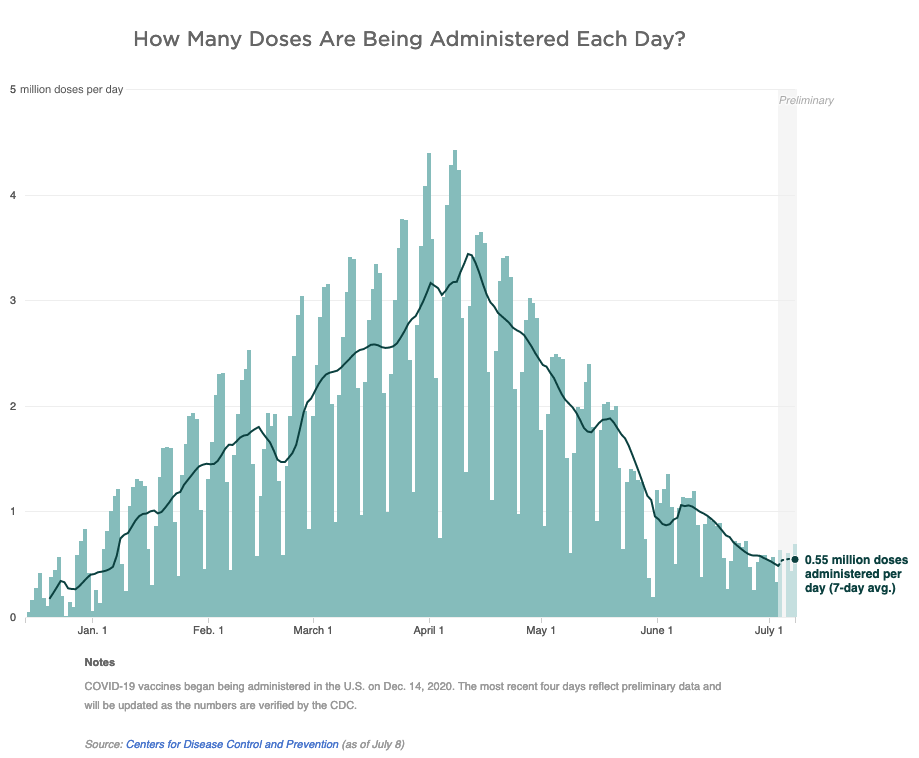
It’s not hard to see why the graphs turned. Initially, vaccination was a logistics problem. Large numbers of people, like me, were eager to get vaccinated, and it was just a matter of producing and distributing enough doses. I would happily have taken my first shot in January, but (being just below the age-65 cutoff) I ended up waiting until April. Vaccinations increased as the logistics problems were handled, and peaked at over four million doses per day in early April.

But then they started to fall, as the number of eager unvaccinated people dwindled. Around half a million shots are still being given every day, but the Biden administration fell just short of its 70%-by-July-4 goal, and it’s not clear how much above 70% we’ll ever get.

https://www.npr.org/sections/health-shots/2021/01/28/960901166/how-is-the-covid-19-vaccination-campaign-going-in-your-state

Politics and risk. Like masks and other public health measures that would have been nonpartisan in previous eras, vaccines have become political. Former President Trump himself may be vaccinated, and may even mildly encourage his followers to get vaccinated, but Trump Country has become the center of vaccine resistance, which Trump Media actively promotes. The result is a wide divergence of vaccinations by state. Blue states like Vermont (66%) and Massachusetts (62%) have the largest percentages of their populations fully vaccinated, while red states like Alabama (33%) and Mississippi (33%) the least. (These numbers are not directly comparable to Biden’s 70% goal, which was a percentage of adults getting at least one shot, not the percentage of the whole population fully vaccinated.)

Unvaccinated people are like dry tinder to the virus: The fire doesn’t start until a spark comes, and the exact spot where that will happen is unpredictable. The center of the current outbreak is along the Arkansas/Missouri border.

the rise in cases seemed to be caused by three factors: the area’s low vaccination rate, the arrival of the Delta variant and Springfield [Missouri]’s recent decision to lift its mask mandate. Ninety percent of Covid patients at Cox Medical Center South in Springfield have the Delta variant, and they are trending younger

https://twitter.com/deAdder

Taney County, Missouri is the site of the Branson tourist-resort area. It currently has 26% of its people fully vaccinated and only 30% with at least one dose. It is averaging 84 new cases per day per 100,000 people, compared to the national average of 6.

Over the last 16 months, we’ve seen numerous news reports about hospitals overwhelmed by Covid patients. The current ones are coming from Springfield — the first city up US 65 from Branson.

Many other counties are just as vulnerable, but have lesser outbreaks. The list of states where cases have doubled in the past two weeks is: Tennessee, Arkansas, Alabama, Kansas, Louisiana, South Carolina, Florida, and Mississippi. All are Trump states with low vaccination rates. (In fairness, Florida is just slightly below average: 47% fully vaccinated compared to 48% nationally.)

Delta and the vaccines. One part of the story of the recent surge is that the virulent Delta variant has become the dominant strain of Covid in the US. That has started people wondering how effective the vaccines are against Delta. Data from Israel is mildly discouraging: The Pfizer vaccine Israel used (the same one I got) is effective against Delta, but less so than against earlier strains.

Vaccine effectiveness in preventing both infection and symptomatic disease fell to 64% since June 6, the Health Ministry said. At the same time the vaccine was 93% effective in preventing hospitalizations and serious illness from the coronavirus.

The ministry in its statement did not say what the previous level was or provide any further details. However ministry officials published a report in May that two doses of Pfizer’s vaccine provided more than 95% protection against infection, hospitalization and severe illness.

But other studies report higher numbers:

In Britain, researchers reported in May that two doses of the Pfizer-BioNTech vaccine had an effectiveness of 88 percent protecting against symptomatic disease from Delta. A June study from Scotland concluded that the vaccine was 79 percent effective against the variant. On Saturday, a team of researchers in Canada pegged its effectiveness at 87 percent.

The article goes on to note that assessing effectiveness in the field is harder than in a controlled study. (That’s why medical researchers use two different terms: Controlled trials measure “efficacy”, while field data measures “effectiveness”.) One key difference: In real life, vaccinated people know they are vaccinated, so they may behave differently.

One speculation is that the different results might reflect how long ago someone got vaccinated.

The Israeli data also raise an important question that it may be too early to ask: Does the declining effectiveness rate have to do with waning protection among the vaccinated given how early Israelis began receiving their shots?

Pfizer is now collecting data on booster shots that would be given six months after the initial vaccination. Experts are conflicted over whether to recommend that the single-dose Johnson & Johnson vaccine be followed by a booster. It seems like a good idea, but hasn’t been tested thoroughly yet. Getting a Pfizer or Moderna shot on top of a J&J vaccine is likewise untested.

Not as much data is publicly available about the Moderna vaccine (which my wife got) and Delta. Like the Pfizer, it seems to be effective, but less so.

My conclusion: If you’re vaccinated, don’t fret, but don’t get cocky. You’re like a soldier with a good helmet and armored vest; protected, but not invulnerable.

South Dakota and Vermont. One red state that isn’t seeing an outbreak right now is South Dakota. Ashish Jha, Dean of the Brown University School of Public Health, explains how two states, Vermont and South Dakota, took very different paths to arrive at the same result: the lowest-risk (green) category for Covid infections.

The two states are similar in some demographic ways: small states, mostly rural, older population, similar median incomes. But they achieved high levels of Covid immunity in different ways: Vermont vaccinated three-fourths of its people compared to South Dakota’s half. But South Dakota acquired immunity the old-fashioned way: by getting a large percentage of its people infected. 40 out of every 100,000 Vermonters have died of Covid, compared to 230 out of every 100,000 South Dakotans.

Governor Noem appears to be proud of that record of getting her constituents killed unnecessarily. She bragged about her Covid response at CPAC Sunday, and questioned the “grit” of Republican governors who enacted mask mandates and closed businesses.

Here’s a rule of thumb: Whenever Republicans pat themselves on the back for having the “courage” to “make the tough decisions”, you can be pretty sure that someone is about to die.

Rhode Island and Mississippi. Looking at the long-term state data shows other interesting patterns. Early in the pandemic, before anybody really knew what they were doing, Covid ravaged the Northeast. So if you looked at death totals per capita a year ago, New Jersey, New York, Massachusetts, and Rhode Island were at the top of the list by a wide margin.

They still are, but Mississippi, Arizona, and Alabama are catching up. (They’ve already passed Connecticut.) Mississippi (2500 deaths per million) may soon edge out Rhode Island (2577) for fourth place. Rhode Island still hasn’t reported a death in July, while Mississippi is averaging 3 per day, a number which is likely to increase.

In terms of total cases per million, Rhode Island is the only northeastern state still in the top ten, which otherwise is entirely made up of red and purple states like the Dakotas, Utah, Iowa, and Arizona. New Jersey is down at 13, New York 17, and Massachusetts 31. (The Northeast had its cases early, when treatment was much less advanced. Hence: more deaths per case. Also, Covid tests were hard to get early on, so it’s possible that the number of cases in the Northeast was underestimated.)

My assessment: The Northeast learned from its experience, and has been more rigorous about shutdowns, mask mandates, distancing, etc. Red states in the South and West refused to learn from the example of the Northeast, so they have had to repeat the experience.

Northeasterners died because they were surprised by something new. Red staters are dying of stubbornness.

Kill your audience. One reason red states are slow to learn is that conservative leaders in politics and the media seem to be actively trying to get their followers killed.

Up until now, the primary mode outside the true fever-swamp precincts has been Just Asking Questions—or, in Tucker Carlson’s case, Just Asking Questions about why no one is allowed to ask questions, which in turn leaves the viewer believing there are not just questions to be asked but answers that are bad, even though we’re still actually dealing in questions about questions.

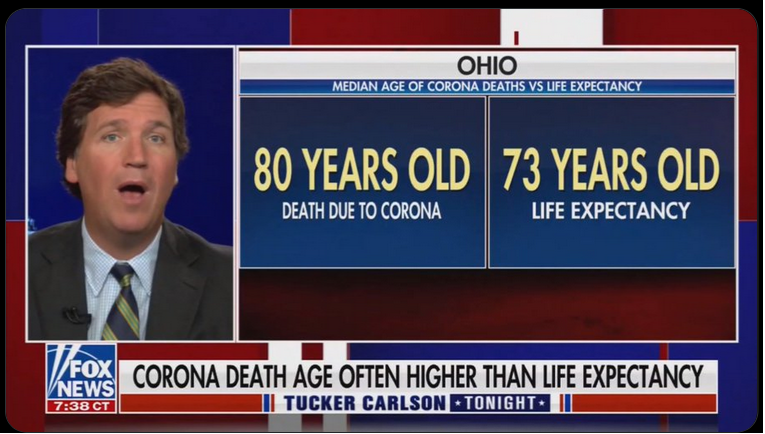
But the rhetoric keeps escalating, as these things tend to do. This week, in a particularly egregious exploitation of his audience’s presumed stupidity, Carlson observed that most people dying of Covid in Ohio had already outlived their life expectancy, so the pandemic itself (which has killed more Americans than combat in World War II) is “overhyped“. I have to wonder how many of Tucker’s viewers looked at the graphic below and concluded that Covid might help them live longer.

“This is the — I think, I honestly think is the greatest scandal of my lifetime by far,” he said with all of the expected breathlessness. “I thought the Iraq War was; this seems much bigger than that.”

The “this” at issue? That the government would “force people to take medicine they don’t want or need” — something that the government is not doing. That President Biden said a few hours earlier that public health professionals might go into communities to offer the coronavirus vaccine to those limited by time or mobility from seeking it out themselves was misinterpreted by commentators like Carlson to suggest that government patrols would soon be seizing people off the streets to inoculate them.

And if “they” can go door-to-door offering vaccines that you can refuse, but which might save your life, why couldn’t they go door-to-door to impose all kinds of tyranny? Here’s Rep. Madison Cawthorn of North Carolina.

Think about the mechanisms they would have to build to be able to actually execute that massive of a thing. And then think about what those mechanisms could be used for. They could then go door to door and take your guns. They could go door to door and take your Bibles.

Of course, the DC mayor’s office is already sending volunteers door-to-door, without any complaints of Bible or gun seizures.

During a CNN interview, Illinois Republican Congressman Adam Kinzinger (who already burned his bridges in January by voting for Trump’s second impeachment) denounced this kind of rhetoric as “insanity”.

What President Biden said is: We’re willing to come to your house to give you the vaccine. At no point was anybody saying they’re going to break down your door and jam a vaccine into your arm despite your protests. This is outrage politics that is being played by my party, and it’s going to get Americans killed.

But outrage politics works in certain circles, which is reason for conservatives to celebrate it. At CPAC this weekend, vaccine refusal was an applause line:

“Clearly, they were hoping — the government was hoping — that they could sort of sucker 90% of the population into getting vaccinated,” Berenson said. “And it isn’t happening,” he said as the crowd applauded people rejecting the safe, effective, and free vaccines.

Nobody is saying this part out loud, but I see a pretty cold calculus at work: If conservatives can get another Covid wave started, not only would that make Biden look bad, but it might spark another round of mask mandates and business closures. Then in 2022 Republican candidates can run against the “tyranny” that they themselves made necessary.

That plan may be evil, but it shows grit, and the courage to make the tough decisions.