The government runs out of money again on October 1. That gives the Democratic minorities in Congress some rare leverage. What should they do with it?
The 2026 fiscal year starts in less than a month, and nobody yet knows what the FY2026 federal budget will have in it.
In the House, Republicans currently hold a 219-212 majority, so they can pass whatever budget they want if they have fewer than four defectors. In the Senate they have a 53-47 majority, but they need 60 votes to overcome a filibuster. So Democrats have leverage in the House only if the Republicans can’t stay unified, but Republicans need seven Democratic votes in the Senate unless they’re willing to nuke the filibuster. (Don’t count that out. Trump will almost certainly ask for it before conceding anything he cares about.)
This raises two questions: Are Democrats willing to shut down the government if Republicans don’t negotiate with them in good faith? And if they are willing to take such a stand, what concessions should they ask for?
Ezra Klein discussed the first question in yesterday’s NYT. He notes that Democrats faced a similar decision in March when the previous continuing resolution ran out. Hakeem Jeffries in the House wanted to go for a shutdown, but Chuck Schumer in the Senate didn’t. Schumer won out, and Democrats got nothing for their cooperation.
This looked really bad at the time, and demoralized Democrats around the country. But Klein notes that in the moment it actually was a close call. Schumer argued:
The courts were already reining in Trump’s excesses.
Markets were reeling from Trump’s tariff announcements; a shutdown would just give him a chance to blame Democrats for the economic chaos.
A shutdown would help DOGE eliminate government jobs and departments.
In addition, Klein notes that the Democrats weren’t ready for that battle. They hadn’t agreed on a message worth shutting down the government for.
But now, he claims, none of those arguments hold. The Supreme Court hasn’t held the line, markets have stabilized without a tariff-fueled economic catastrophe, and Elon Musk is gone.
Even more, Trump’s autocratic project is up and running now.
I want to be very clear about what I am saying here. Donald Trump is corrupting the government — he is using it to hound his enemies, to line his pockets and to entrench his own power. He is corrupting it the way the Mafia would corrupt the industries it controlled. You could still, under Mafia rule, get the trash picked up or buy construction materials. But the point of those industries had become the preservation and expansion of the Mafia’s power and wealth. This is what Trump is doing to the government. This is what Democrats cannot fund. This is what they have to try to stop.
… The case for a shutdown is this: A shutdown is an attentional event. It’s an effort to turn the diffuse crisis of Trump’s corrupting of the government into an acute crisis that the media, that the public, will actually pay attention to.
So when they get public attention, what exactly should Democrats demand? Jen Rubin makes these five suggestions:
Defend Congress’ power of the purse by undoing FY2025’s rescissions.
Reverse the Medicaid cuts that take effect after the 2026 elections.
Restrictions on DHS’ most outrageous practices: No rendition to third countries. No masks. Reports on how many people without criminal records are being rounded up.
New sanctions to pressure Russia into peace talks.
Ban stock trading for members of Congress, as well as the president and vice president.
The key test for demands is that Republicans should sound ridiculous defending what the Democrats want to put a stop to. (This is a lesson taught by the Epstein files.) Do Republicans want to shut the government down to defend Trump’s right to trade stocks? They should go right ahead.
If I had to sum up in one word the reason Democrats should give for their stand, it would be “corruption”. I think both Rubin and Klein would agree with that, and it’s also in line with what the Epstein phenomenon should be teaching Democrats.
President Donald Trump said Friday that the U.S. will host next year’s Group of 20 summit at his golf club in Doral, Florida, arguing it was “the best location” for the high-stakes international gathering but insisting his family’s business “will not make any money on it.”
Of course it won’t. Trump would never lie about something like that, and no doubt his independent Justice Department would watch like a hawk to make sure nothing corrupt happened.
This week seven federal prosecutors resigned rather than follow unethical orders from their bosses in Trump administration. This case raises a more general question: Given Trump’s disrespect for ethical norms intended to insulate certain key government functions from inappropriate political interference, will there be space in the Trump administration for ethical government employees to do their work?
The Guardian provides the shortest possible summary of the current situation:
[S]even prosecutors – including the acting US attorney in southern district of New York, the head of the criminal division and the head of the public integrity section – resigned in protest rather than dismiss the case [against New York Mayor Eric Adams] for political reasons.
Now let’s back up and review this story from the beginning, following a timeline compiled by ABC News: After an investigation that had been going on for at least a year, last September federal prosecutors at the Southern District of New York (SDNY) sought and received a grand jury indictment of Mayor Adams.
At the time, the Adams indictment was used in arguments that the Biden Justice Department had not been politicized or “weaponized”, as Trump frequently claimed. Yes, a special prosecutor appointed by Attorney General Merrick Garland had indicted Trump, but that was because Trump had broken numerous laws. DoJ also went after Democratic lawbreakers like Adams and New Jersey Senator Robert Menendez.
The indictment, which is unsealed the next day, alleges Adams accepted illegal gifts, including plane upgrades and hotel stays, from Turkish businessmen and officials in exchange for preferential treatment when he was Brooklyn borough president and later as mayor. The indictment also alleges Adams received illegal campaign straw donations from Turkish nationals.
Adams denied the charges, refused to resign, and pleaded not guilty. [1] A trial was scheduled to begin in April. During the transition period after Trump’s election win in November, Adams met with Trump at Mar-a-Lago and with Trump’s border czar Tom Homan. Adams attended Trump’s inauguration. The next day, Adams began claiming that his indictment was retribution for criticizing President Biden’s immigration policies (even though the timeline on that doesn’t work). On February 10, after additional meetings between Adams, his attorneys, and Trump officials, Deputy Attorney General Emil Bove sent a letter instructing SDNY to dismiss charges against Adams “without prejudice”, meaning that the charges could be refiled in the future.
Danielle Sassoon. Dismissing a federal indictment is not an automatic thing. The prosecutor’s office has to file a motion with the court asking for the dismissal. The motion typically contains some justification for the dismissal, which the judge then must rule on. And that brings Danielle Sassoon, the acting U.S. Attorney for SDNY, into the picture.
Sassoon is not anybody’s idea of a liberal Democrat. She clerked for the late Supreme Court Justice Anton Scalia, a legendary figure in conservative legal circles. Trump had appointed her as acting US attorney just three weeks before. Sassoon responded to Bove’s instructions by writing an eight-page letter to his boss, Attorney General Pam Bondi. [2]
Mr. Bove rightly has never called into question that the case team conducted this investigation with integrity and that the charges against Adams are serious and supported by fact and law. Mr. Bove’s memo, however, which directs me to dismiss an indictment returned by a duly constituted grand jury for reasons having nothing to do with the strength of the case, raises serious concerns that render the contemplated dismissal inconsistent with my ability and duty to prosecute federal crimes without fear or favor and to advance good-faith arguments before the courts. … I cannot fulfill my obligations, effectively lead my office in carrying out the Department’s priorities, or credibly represent the Government before the courts, if I seek to dismiss the Adams case on this record.
Sassoon went on to recount the Bove’s justifications for dismissing charges, the first of which she finds unethical
First, Mr. Bove proposes dismissing the charges against Adams in return for his assistance in enforcing the federal immigration laws, analogizing to the prisoner exchange in which the United States freed notorious Russian arms dealer Victor Bout in return for an American prisoner in Russia. … Adams has argued in substance and Mr. Bove appears prepared to concede that Adams should receive leniency for federal crimes solely because he occupies an important public position and can use that position to assist in the Administration’s policy priorities.
and the second unbelievable.
Second, Mr. Bove states that dismissal is warranted because of the conduct ofthis office’s former U.S. Attorney, Damian Williams, which, according to Mr. Bove’s memo, constituted weaponization of government as defined by the relevant orders of the President and the Department. The generalized concerns expressed by Mr. Bove are not a basis to dismiss an indictment returned by a duly constituted grand jury, at least where, as here, the Government has no doubt in its evidence or the integrity of its investigation. … In short, because there is in fact nothing about this prosecution that meaningfully differs from other cases that generate substantial pretrial publicity, a court is likely to view the weaponization rationale as pretextual. [3]
The first consideration is the disturbing one, because it suggests a truly dystopian role for the Department of Justice: If elected officials refuse to play ball with the Trump administration, Trump could use a Justice Department investigation to get something on them, then hold that potential prosecution over their heads until they do what he wants.
In a footnote, Sassoon lays it out:
I attended a meeting on January 31, 2025, with Mr. Bove, Adams’s counsel, and members of my office. Adams’s attorneys repeatedly urged what amounted to a quid pro quo, indicating that Adams would be in a position to assist with the Department’s enforcement priorities only if the indictment were dismissed. Mr. Bove admonished a member of my team who took notes during that meeting and directed the collection of those notes at the meeting’s conclusion. [4]
In her letter, Sassoon asked AG Bondi for a meeting, and offered her resignation if Bondi did not want to further justify or reconsider DoJ’s position. Her resignation was accepted.
Public Integrity. The obvious next option for Bove would have been to ask SDNY’s second-in-command to file the motion to dismiss the charges, but (perhaps seeing Sassoon’s resistance as an SDNY independence issue), he pulled the case back to DoJ’s aptly named Public Integrity Section in Washington, which often handles political corruption cases. ABC reports:
However, as soon the Public Integrity Section was informed it would be taking over, John Keller, the acting head of the unit, and his boss, Kevin Driscoll, the most senior career official in the criminal division, resigned along with three other members of the unit, according to multiple sources.
The case soon claimed a seventh scalp, SDNY’s Assistant US Attorney Hagan Scotten, another prosecutor with impeccable conservative credentials, having clerked for Brett Kavanaugh and John Roberts. He expressed no hostility to the policy goals of the Trump administration, but strongly implied that someone needs to explain legal ethics to the President.
There is a tradition in public service of resigning in a last-ditch effort to head off a serious mistake. Some will view the mistake you are committing here in the light of their generally negative views of the new Administration. I do not share those views. I can even understand how a Chief Executive whose background is in business and politics might see the contemplated dismissal-with-leverage as a good, if distasteful, deal. But any assistant U.S. attorney would know that our laws and traditions do not allow using the prosecutorial power to influence other citizens, much less elected officials, in this way. If no lawyer within earshot of the President is willing to give him that advice, then I expect you will eventually find someone who is enough of a fool, or enough of a coward, to file your motion. But it was never going to be me.
The roughly hour-long meeting, where the public integrity section weighed whether to resign en masse after agreeing that the dismissal of the Adams case was improper, culminated with [Edward] Sullivan, a veteran career prosecutor, agreeing to take the fall for his colleagues, according to two people familiar with the matter.
The judge. The judge in the case, Biden appointee Dale Ho, appears to have little choice but to ultimately accept a motion to dismiss. After all, a judge can’t also prosecute the case if the government is unwilling to do so.
However, Ho would be within his rights to hold a hearing into the circumstances of the dismissal motion. Sassoon had warned about this in her resignation letter:
Seeking leave of court to dismiss a properly returned indictment based on Mr. Bove’s stated rationales is also likely to backfire by inviting skepticism and scrutiny from the court that will ultimately hinder the Department of Justice’s interests. In particular, the court is unlikely to acquiesce in using the criminal process to control the behavior of a political figure.
One option I can imagine (though I don’t fully understand the law here) is that Ho could give DoJ a choice: proceed with the prosecution or accept a motion to dismiss with prejudice, meaning that DoJ would lose the option to refile the charges if Adams wasn’t cooperating completely enough with Trump’s political goals. That change would take away Trump’s leverage over Adams going forward.
Larger considerations.Benjamin Wittes (founder of the Lawfare web site) takes a step back to
describe the inherent conflict between the way politicians behave as a matter of course (horse-trading, partisan maneuvering) and the ethical behavior we expect from prosecutors,
discuss the Justice Department norms intended to insulate prosecutors from politics,
explain how Trump has undone those norms.
Then he concludes:
There is a deep problem here and it goes way beyond the Adams case: Having ripped apart the only system that allows prosecutors to function ethically, we no longer have a mechanism by which federal prosecutors can function ethically. We have a rule in which the president can reach down to the assistant U.S. attorney level and order political favors for his friends in exchange for other remunerations. And we have ethical expectations of prosecutors that they will not entertain such demands.
The result? We have resignations. And we’re going to have more. Because if the president or his minions care about the case you’re working on, there is no place in government for an ethical prosecutor any more. …
As long as a prosecutor can do good work, my plea is to stay in place. But at this point, all federal prosecutors need to be prepared to resign. They are all one phone call away from being put in the position of facing a demand to behave unethically, one phone call away from a demand that is fundamentally political in character, not about justice. And when that call comes, it is imperative that prosecutors do as these ones did—resign publicly, showing their work along the way.
Wittes is talking specifically about prosecutors, but similar considerations apply throughout the government. Every profession within the government has its own ethical standards that protect against inappropriate political interference, and it’s not hard to imagine situations where Trump might circumvent those standards to pursue his goals. (Paul Krugman warns against buying inflation-protected TIPS bonds, precisely because Trump might make himself look good by pressuring government statisticians to minimize the rate of inflation.)
So the admonition Wittes gives to prosecutors needs to apply to federal employees across the board: As long as you can do your job ethically, keep doing it. Don’t resign and give Trump an opportunity to appoint someone more loyal to him than to the nation or to the mission of your agency. But if at some point you’re faced with a choice between your job and your soul, defend your soul and resign.
And if you can make a lot of noise on your way out the door, so much the better.
[1] New York’s state constitution gives Governor Hochul the power to remove Adams. While his case was playing out in court, it made some sense for Hochul to keep her distance. But now that the fix is in, her lack of action is mysterious.
[2] It’s worth pointing out that both Bondi and Bove had been defense lawyers for Trump before being appointed to head DoJ. They are literally Trump’s lawyers, not lawyers for the United States.
[3] A similar statement could be made about dismissing the classified-documents indictment against Trump.
[4] Not wanting anyone to take notes indicates what lawyers call “consciousness of guilt“.
When is it reasonable for an official (and his party) to hold on in the face of suspicion?
Last week, Senator Robert Menendez of New Jersey was indicted for bribery. He immediately resigned as chairman of the Foreign Relations Committee, as the bylaws of the Senate Democratic caucus mandate. Almost as quickly, big-name Democrats — like New Jersey Governor Phil Murphy — began calling for him to resign his seat in the Senate, which nothing in the rules requires him to do. Other Democrats, like Rep. Andy Kim, announced they would run against him (if necessary) in 2024.
As I noted last week, though, senators were slower to comment. John Fetterman of Pennsylvania appears to have been the first senator to call for Menendez’ resignation. But since then the floodgates have opened. At least 30 senators — all Democrats, including New Jersey’s other senator, Cory Booker — are asking him to resign.
The Constitution’s Article I, Section 5 allows the Senate to expel a member, but that requires a 2/3rds vote. And even if Democratic senators were willing to go that far, Republicans are unlikely to cooperate, because they would have to recognize that indictments — like Donald Trump’s indictments, say — are serious matters. So Menendez is not going to be expelled.
New Jersey’s constitution allows for the recall of federal officials, but no senator has ever been recalled, and it’s not even clear such laws are consistent with the US constitution. But 25% of New Jersey’s registered voters would have to sign a recall petition, and even if that Herculean goal could be achieved, it’s not obvious how much sooner the special election would be than the 2024 election when Menendez’s seat comes up anyway.
In practical terms, then, nobody is going to force Menendez to leave office early if he doesn’t want to go. So we’re left with the more abstract question: When should a public official resign or be removed?
The fundamental tug-of-war is between two principles: First, that an indictment is not a conviction. US law says that accused people are innocent until proven guilty beyond a reasonable doubt. If the question is whether he will go to jail, Menendez deserves his day in court just like anybody else.
But whether he should stay in the Senate is a different question. Public office is a privilege, not a right. If we’re debating whether someone should hold a position of power, maybe very-credible-suspicion is a high enough standard. Julius Caesar famously divorced his wife Pompeia after a scandal, even though he also held that she was innocent, saying “Caesar’s wife must be above suspicion.”
Maybe that’s the right principle here, too: If the citizens of New Jersey have good reason to doubt that their senator is serving their interests rather than the interests of whoever can bribe him, maybe he shouldn’t be a senator any more. Maybe they shouldn’t have to wait for a jury verdict or for his term to end naturally.
If you believe that, then someone like Menendez should resign. Arguably, so should Supreme Court Justice Clarence Thomas, who appears to have a long history of accepting expensive gifts from rich men who may or may not have specific cases before the Court, but who clearly want to influence the general direction the Court takes. And while Donald Trump currently holds no office (except in the imagination of the Qanon faithful), he also should step aside and let the GOP nominate someone not facing multiple felony indictments.
Obviously, Menendez, Thomas, Trump, and many others in recent history don’t see it that way. And while Democrats would like to be free of Menendez’ baggage, the great majority of Republicans are unwilling to ask their tainted leaders to step aside.
So why don’t more people do that? And to what extent is their reasoning justifiable?
The big reason to step aside, or to hope someone from your party steps aside, is that otherwise the individual’s battles take center stage and distract attention from the issues that person is supposed to be dealing with on behalf of the People.
To me, the only justifiable reason not to step aside is that you have already become individually important. That’s the case, for example, if your resignation means that you will be replaced by someone of the opposite party — possibly flipping control of some house of Congress or changing the partisan make-up of the Supreme Court. Such partisan considerations shouldn’t be absolute — at some point, people just have to go, whatever the consequences — but a change in the government’s partisan balance does raise the bar.
A second possible reason is if the charges against you really are the kind of “witch hunt” Trump is always talking about. If the same partisan machinery can target your replacement just as easily as it targets you, then you might as well stand and fight.
This is how I think these considerations apply to current cases: If Menendez leaves office, his replacement will be named by New Jersey’s Democratic Governor Murphy. So the seat will stay in the Democratic column. Further, I don’t know of anything that makes Menendez unique among Democrats. If, say, he were the lone crusader on some issue, I could see him wanting to stay on. But none of that is true, so he should go.
Clarence Thomas’ case is trickier, because President Biden would want to appoint someone far more liberal. At some point, though, even Republicans should want him gone, because defending his corruption taints their whole party. In a better-functioning political system, Mitch McConnell would go to President Biden and say, “We could support removing Thomas if you’d pledge to replace him with someone on this list.” Biden would push back with his own list, and eventually they’d come to an agreement.
What makes Donald Trump’s case special is that the Republican Party is dominated by his personality cult. So he is already personally unique. For many in the MAGA movement, politics amounts to Trump or not Trump, and is only tangentially connected to the issues that used to motivate the GOP, like taxes, abortion, national defense, or protecting businesses from government regulation. Agreeing to let Trump go is defeat in itself, not a strategic move that lets them fight on better ground.
So we can expect Trump to fight on until he is either decisively defeated or dies by natural causes. His cult will fight alongside him, independent of what crimes he has committed or what evidence is revealed. Individual Republicans need to decide whether they are part of that cult or not.
And finally, I’ll consider Joe Biden, who is facing an impeachment inquiry in the House. So far, though, that inquiry has revealed nothing of substance, and looks like a pure fishing expedition. It is not hard to imagine a similar quantity of Nothing being raised against Kamala Harris not long after Biden resigned.
So pending any substantive evidence of wrongdoing, Democrats should stick by Biden. In the unlikely event that something really convincing is found against him, though, I’d ask him to step aside, because Biden is not unique. Unlike the GOP, the Democratic Party is not a personality cult, and should respond to evidence.
This week, Pro Publica reported that Justice Samuel Alito accepted a flight on billionaire Paul Singer’s private jet, so that the two of them could go on an outing at a thousand-dollar-a-day Alaskan fishing lodge. (Another rich conservative donor covered the cost of the lodge. Since he owned the lodge, this was — arguably, but also debatably — “personal hospitality”, which is allowed.) The outing was organized by the Federalist Society’s Leonard Leo, who also suggested Singer provide Alito’s transportation.
Alito did not report the trip as a gift, and later voted with a 7-1 Supreme Court majority that ruled in Singer’s favor in a dispute with the government of Argentina. Singer’s hedge fund made billions as a result.
Pro Publica says it would have cost $100K for Alito to charter a similar jet himself, though it’s hard to say what that number means. If he had been forced to find his own transportation, Alito would undoubtedly have found something cheaper, so it’s hard to estimate the value of the ride to him. (Imagine that a rich friend drives me to the airport in his Rolls Royce. It might cost me thousands to duplicate that experience on my own. But if he hadn’t offered, I’d probably have just spent $100 on a cab. Would I have spent $300 on a Rolls Royce cab, were such a deal available? Probably not.)
Anyway, ProPublica quotes law professor Charles Geyh, who gets to the heart of the matter:
If you were good friends, what were you doing ruling on his case? And if you weren’t good friends, what were you doing accepting this?
The Wall Street Journal printed Alito’s response to the article before the article itself came out, which strikes me as a blight on the reputation of the WSJ. ProPublica’s editor commented: “We’re curious to know whether the Journal fact-checked the essay before publication.” (Several observers wonder if this level of access is payback for Alito leaking secret court information to the WSJ. Or, as the Above the Law blog comments: “Sam Alito just went out of his way to confirm for everyone that he’s talking directly to the WSJ editors — who were as deep in the Dobbs leak as any publication except Politico.”)
Alito’s defense is a technical (and self-serving) reading of the rules on recusal and disclosure. The recusal rules say “There is an appearance of impropriety when an unbiased and reasonable person who is aware of all relevant facts would doubt that the Justice could fairly discharge his or her duties.” Alito boldly declares:
No such person would think that my relationship with Mr. Singer meets that standard.
[C]an anyone say with a straight face that no “unbiased and reasonable person” would question the justice’s impartiality when he votes for someone who gave him a valuable gift? Isn’t there at least the appearance that something other than the strict application of the rule of law is at work?
I’m reminded of a quote often attributed to Jesse Unruh, a mid-20th-century California legislator of somewhat dubious reputation: “If you can’t take their money, drink their liquor, fuck their women, and then come in here the next day and vote against them, you don’t belong here.”
However, even discussing the technical legality of Alito’s actions and disclosures misses the point: If the rules say that it’s OK for justices to receive expensive gifts and favors from billionaires and then rule in their favor, then the rules are wrong.
The WaPo’s Ruth Marcus applies some common sense to Alito’s self-justification:
The game here isn’t — at least it shouldn’t be — to figure out how much you can take in the way of freebies and keep that hidden. It should be to behave in a way that is above reproach and comply with the spirit of the ethics rules. Justices scouring the code for loopholes that seem to shield their bad behavior is not a good look.
Defenses of the current Supreme Court ethics policy rely on a very narrow definition of corruption: quid pro quo. In other words, we make an explicit agreement that you’ll pay me money and I’ll rule in your favor. TPM’s David Kurtz admits we’re not seeing that kind of deal-making:
The reporting so far isn’t revealing sketchy quid pro quos. The justices aren’t for sale. They’re not crafting opinions based on these freebies.
What’s actually going on is a much more subtle and insidious: The Right, under the guidance of Leonard Leo, has created an environment in which conservative justices can live the high life of free yacht cruises and luxury resort vacations, as long as they remain conservatives in good standing. If, however, they should follow the path of former Republican appointees like David Souter and John Paul Stevens and stray into liberalism, all those invitations from billionaires would dry up.
Of course Alito and Thomas know that. And it can’t help but influence their thinking. They’re in a position similar to a mega-church pastor who can’t let himself examine his doubts about God too closely. There may not be any quid-pro-quos here, but it’s corruption all the same.
It’s hardly a new observation that the Right engages in projection: What they accuse the Left of doing is usually little more than a confession of what they’re doing themselves. But even knowing how common the pattern is, this Leonard Leo statement is striking:
We all should wonder whether this recent rash of Pro Publica stories questioning the integrity of only conservative Supreme Court Justices is bait for reeling in more dark money from woke billionaires who want to damage this Supreme Court and remake it into one that will disregard the law by rubber stamping their disordered and highly unpopular cultural preferences.
Legally, Jack Smith has Trump dead to rights. Now we get to see whether facts and the law still matter.
Thursday night, we heard (at first via Trump himself) that a Florida grand jury convened by Special Counsel Jack Smith had returned an indictment in the Mar-a-Lago documents case. At first, most observers expected that we wouldn’t see the indictment itself until tomorrow, when Trump will be officially processed. But Friday the indictment was unsealed. In all there are 37 charges against Trump:
31 counts of “willful retention of national security information”. This is one fundamental crime applied to 31 documents, some classified at the very highest levels.
one count of “conspiracy to obstruct justice”
one count of “withholding a document or record”
one count of “corruptly concealing a document or record”
one count of “concealing a document in a federal investigation”
one count of “scheme to conceal”
one count of “false statements and representations”
Trump’s valet Walt Nauta is also named as a co-conspirator in counts 32-36, plus has his own count of “false statements and representations”.
If you add up the maximum sentences of all the charges, Trump could theoretically be sentenced to hundreds of years. By that’s a pointless exercise, because sentencing seldom works that way. It’s enough to point out that (if convicted and jailed) Trump, who will turn 77 on Wednesday, faces a strong likelihood of dying in prison.
Special Counsel Jack Smith made his first public appearance Friday. His statement was short and made a few simple points:
Trump was indicted “by a grand jury of citizens in the Southern District of Florida”. In other words, while Trump may rail against Smith himself or Merrick Garland or President Biden, the ultimate decision was made by ordinary American citizens with no political ax to grind. Given that Trump carried Florida in 2016 and 2020, and that Republicans swept the state in 2022, it’s quite likely that many of the jurors are Republicans who have voted for Trump in the past. [1]
If you want to “understand the scope and the gravity of the crimes charged”, you should read the indictment.
“Our laws that protect national defense information are critical to the safety and security of the United States and they must be enforced. Violations of those laws put our country at risk.”
“Adherence to the rule of law is a bedrock principle of the Department of Justice. And our nation’s commitment to the rule of law sets an example for the world. We have one set of laws in this country, and they apply to everyone.”
The narrative. Smith has written an indictment that is more revealing and readable than the 34-count indictment Manhattan DA Alvin Bragg produced for the hush-money case in April. It tells the following story:
While he was president, Trump collected souvenirs (“newspapers, press clippings, letters, notes, cards, photographs, official documents, and other materials”) that he jumbled together in cardboard bankers’ boxes (like the ones in my storage space). When he left the presidency, he had “scores” of those boxes transported from the White House to Mar-a-Lago.
Beginning in May, 2021, the National Archives and Records Administration (NARA) made a series of fruitless requests that Trump turn over the official documents, which belong to the US government. [2]
Meanwhile, stacks of Trump’s boxes were being shuttled from place to place inside Mar-a-Lago. In addition to being Trump’s residence, Mar-a-Lago was a club which (during the period in question) had more than 100 employees and tens of thousands of guests who were not cleared to see classified documents. Many of these locations (a ballroom, a bathroom) were highly insecure. On one occasion a stack of boxes tipped over, spilling the contents — including classified documents — onto the floor of a storage area.
In January of 2022, 15 boxes were shipped to NARA. These boxes included 197 classified documents, including 30 top secret documents, some of which had the additional markings of SCI (special compartmented information) and SAP (special access program), indicating that they were particularly sensitive, even compared to other top-secret documents. [3]
The indictment notes two occasions when Trump showed classified documents to someone without clearance to see them. In one conversation, which was taped, Trump showed a plan to invade “Country A” to an author, saying “When I was president I could have declassified it. … Now I can’t.”
NARA told the Department of Justice about these documents in February, 2022, and a criminal investigation was opened in March. A federal grand jury began investigating in April. On May 11, the grand jury subpoenaed “all documents with classification markings in the possession, custody, or control of TRUMP or The Office of Donald J. Trump”.
In conversations with two of his lawyers (one of whom appears to be Evan Corcoran), Trump suggested a variety of illegal strategies: simply not responding to the subpoena, saying there were no documents, or getting rid of the documents. He hinted that Corcoran should dispose of the documents for him, so that he could deny doing it. (These conversations are reminiscent of Michael Cohen’s descriptions of his conversations as Trump’s lawyer. “He doesn’t give you orders. He speaks in a code … much like a mobster would do.”)
When it became clear that Corcoran would not commit one of the crimes Trump was suggesting, Trump schemed with Nauta to circumvent Corcoran: He knew when and where Corcoran would search for documents subject to the subpoena, and he had Nauta move boxes around so that Corcoran wouldn’t find them.
After Corcoran found 35 classified documents, Trump made a nonverbal suggestion that Corcoran not turn them all over to the government.
He made a funny motion as though – well okay why don’t you take them with you to your hotel room and if there’s anything really bad in there, like, you know, pluck it out. And that was the motion that he made. He didn’t say that.
Corcoran had the 35 documents turned over, and drafted a certification (which he had another lawyer sign) saying that a diligent search had been done and these were all the documents the subpoena sought.
In July, the FBI acquired Mar-a-Lago surveillance video showing the boxes being moved. In August, they returned with a search warrant and found 102 classified documents Corcoran had missed — 27 from Trump’s office and 75 from the storage room Corcoran had searched. 17 of the documents were top secret.
The 31 documents in the indictment. In his public statements, Trump has made fanciful claims that he could declassify documents by thinking about them, or that there was a standing order declassifying any documents he took up to the White House residence. [4] As anyone who has ever had a security clearance should understand, these claims are not just false, they are absurd; the system couldn’t work that way. [5]
The indictment faces a problem that shows up whenever someone is prosecuted under the Espionage Act: It can’t just tell us what information the defendant revealed or risked, because then the indictment itself would reveal that information. (It’s a problem similar to one in the stoning scene from Life of Brian, where the priest can’t specify the accused’s blasphemy without himself saying the forbidden name of God.)
This problem will only get worse when the case goes to trial: The judge will need access to the 31 documents, and large parts of them (possibly redacted, with the judge’s approval) will have to be made available to Trump’s lawyers.
But the indictment includes only terse summaries. Document 17, for example, is top secret with something about its special markings redacted. (I’d guess the markings included a code word.) The summary says only: “Document dated January, 2020 concerning military capabilities of a foreign country.”
The indictment also lists the intelligence services that classified the documents, which includes all the major ones: CIA, NSA, DoD, NRO, and several others.
From the list, and the fact that the totals in the indictment indicate that not all the top-secret documents are listed, we can make two deductions:
The most sensitive documents Trump compromised are not listed at all. So whatever you think after reading the listed summaries, the real security breach is worse than that.
All the intelligence agencies would have liked to leave their documents off the list and out of the trial, but they must have gotten together and agreed that they would each pony up something.
Assessing the damage. From the early days of the Trump administration, it was clear that Mar-a-Lago posed a security problem. He had not even been in office for a month when North Korea launched a missile test while Trump was entertaining Japanese Prime Minister Shinzo Abe at Mar-a-Lago (and making a profit off the entourages of both leaders).
In previous administrations, the leaders would be ushered away into the White House situation room or the nearest secure location by their aides. The documents and advice they receive at such moments are often some of the nation’s most closely guarded secrets. … As CNN reported and the Facebook photos later illustrated, Abe, Trump and their parties stayed at their tables as their aides passed them bits of paper, lighting them up with their mobile phones so they could be read, while the keyboard vocalist hired for the night sang on and Mar-a-Lago guests huddled around to get a better view.
So foreign intelligence services have had years to place agents at the club, as members, guests, employees, or even gate-crashers. It seems likely that some have succeeded. (Picture this cover story for a spy: Some foreign friend or business associate of Jared Kushner has a nephew who just flunked out of Florida Atlantic and needs a job.)
WAGNER: Republicans in Congress have sort of been hiding behind the fact that the intelligence community assessment regarding the implications, the fallout from the retention of these documents — that assessment is not complete. And they’re saying “We don’t know yet what damage, if any, has been done to national security.” You’re suggesting that that assessment is quite complicated. Is your outside guess that this is going to take quite some time longer? …
BRENNAN: Quite frankly, I don’t think that the intelligence community will ever be able to determine conclusively what might have been compromised.
In addition to whatever our enemies may have found out, Trump has done incalculable damage to our relationships with our allies. Allied intelligence services (say, Israel’s Mossad or the UK’s GCHQ) risk revealing their own spies and capabilities when they share secrets with the US. What might they start holding back, now that they have seen how badly the US protects such information?
Likely defenses. Normally, when we talk about an indicted person’s possible defenses, we mean legal defenses — arguments or testimony or evidence that can be presented in court to undermine the prosecution’s case and convince either the judge or the jury to let the defendant off.
That’s not what we’re going to see from Trump, though, because he’s just guilty. Smith has him dead to rights. If this were an ordinary trial, any competent lawyer would be negotiating a deal to minimize his jail time.
But Trump’s hopes lie outside the courtroom. If he can stall long enough, the 2024 election might happen before he’s convicted. And if the economy is in bad enough shape — say, because Trump’s friends in Russia and Saudi Arabia engineer a huge run-up in gas prices — he could win it. Then he could fire Smith and pull the plug on any federal prosecution. And if New York or Georgia find him guilty of something, he can hole up in the White House and dare them to come get him.
Trump’s previous run-ins with the legal system have proceeded on two tracks: an in-court track where his lawyers present theories that are bizarre but are at least coherent, and an in-public track where Trump presents wild, baseless, contradictory arguments that are persuasive to his followers, but would get his lawyers sanctioned if they brought them into court.
That split was clearest in the 55 lawsuits he filed (and lost all but one inconsequential one) to overturn his defeat in the 2020 election. In public, Trump and his lawyer Rudy Giuliani were alleging all kinds of fraud for which they had no evidence. In front of judges, however, Trump’s lawyers said nothing of the kind, instead arguing that technical details about how small numbers of ballots were handled should invalidate elections in entire states.
We are already seeing the same kind of split in this case. Trump and his followers howled with rage after the indictment came out, but none of what they’ve said challenges the evidence in the indictment or the laws he is accused of violating. Instead, Trump issues blanket denials (“I am an innocent man“), attacks Jack Smith (“deranged”, “lunatic”, and most bizarrely suggesting that Jack Smith is not his real name, whatever that is supposed to imply), engages in whataboutism regarding the Bidens or the Clintons, and says that indicting a leading presidential contender makes the US a “banana republic“. [6]
None of that can be brought into court, where his lawyers will have to stick to this case and the evidence against him.
Worst of all, Trump and many of his allies are broadly hinting at violence. On stage at Trump’s Saturday rally in Georgia, election-denier Kari Lake said:
I have a message tonight for Merrick Garland and Jack Smith and Joe Biden — and the guys back there in the fake news media, you should listen up as well, this one is for you. If you want to get to President Trump, you are going to have go through me, and you are going to have to go through 75 million Americans just like me. And I’m going to tell you, most of us are card-carrying members of the N.R.A. [7]
Needless to say, Trump’s lawyers would be disbarred if they went into court and threatened violence. They probably also will not mention obviously false interpretations of law, like the notion that the Presidential Records Act gives Trump the right to do “whatever I want” with highly classified documents [see endnote 2 again], or that he could declassify documents with his mind.
Trump also will not testify in his own defense, because Donald Trump is a terrible witness. He can lie proficiently when he monologues to a sympathetic crowd or is interviewed by a journalist he can talk over. But when he faces cross-examination, the penalty of perjury, and a judge with authority to hold him in contempt, he is unconvincing and likely to reveal (or even brag about) facts that hurt his defense.
A recent case in point is his deposition in the E. Jean Carroll lawsuit. (There is no Fifth Amendment right in civil lawsuits, so he had to submit to an interview.) Trump’s lawyers did not put him on the stand in his own defense, and his taped deposition was cited by Carroll’s lawyers, not Trump’s.
That will leave Trump’s legal team without much to argue, which is what happens when the evidence clearly says that a defendant is guilty.
The judge. Given that Trump’s main hope is to stall and hope that he (or some sympathetic Republican) wins the presidency in 2025, it was very disturbing to hear the case assigned to Judge Aileen Cannon, who was clearly in the tank for Trump when she oversaw his lawsuit challenging the FBI’s search of Mar-a-Lago and trying to get the seized documents back.
In issuing a series of rulings favorable to him, Judge Cannon, a Trump appointee, effectively disrupted the investigation until a conservative appeals court ruled she never had legitimate legal authority to intervene.
Her rulings were not just bad, they were outrageous. A three-judge panel of appeals court judges (two appointed by Trump) reversed her decisions unanimously.
The NYT went on to explain that the choice of Cannon was random, but weighted by various factors that made her a more likely choice than any of the six other eligible judges.
Cannon may be shy about showing such blatant favoritism again, but she doesn’t have to. She can just slow-walk the trial until after the 2024 election. If Republicans win, the case will likely go away.
People who are not worried about this possibility give two reasons for their calm:
The same appeals court that reversed Cannon the first time might keep Cannon in line or sympathize with a DoJ motion to assign the case to a different judge.
Jack Smith had to know Cannon was a possibility when he sought the indictment in Florida rather than DC. He must have had some reason to accept that risk.
We’ll see. The first hints will come tomorrow.
Endgame. But assume for a minute that a trial (either here or somewhere else) actually takes place and results in a prison sentence. Several people have remarked on the logistical difficulties of imprisoning an ex-president — like, does his secret service detail go to prison too?
But I don’t see Trump voluntarily submitting to demeaning restrictions, even if it’s just long-term house arrest. My opinion, based on very little, is that he’ll wind up in either Russia or Saudi Arabia.
People I’ve raised this possibility to are way too confident in the government’s ability to prevent it. “Take away his passport,” they say. But suppose Trump sees the writing on the wall while he’s still campaigning. He schedules a rally in Alaska, but his campaign plane passes the airport and just keeps flying towards Russia. What’s the government going to do, shoot it down?
[1] I wasn’t able to find the number of jurors on this specific grand jury, but by law a federal grand jury has 16-23 members, and 12 votes are required to approve an indictment. The exact number of votes for the Trump indictment is unknown, which is typical.
[2] Trump has tried to muddy up people’s understanding of the PRA, but it’s actually quite clear.
Upon the conclusion of a President’s term of office, or if a President serves consecutive terms upon the conclusion of the last term, the Archivist of the United States shall assume responsibility for the custody, control, and preservation of, and access to, the Presidential records of that President.
While he is still in office, a president can go back-and-forth with the Archives over what is a presidential or a personal record. But that negotiation ends when he leaves office. And much as I hate to agree with Bill Barr, he’s right about this:
Battle plans for an attack on another country or Defense Department documents about our capabilities are in no universe Donald J. Trump’s personal documents.
[3] I used to have a top-secret clearance, but never saw an SCI or SAP document. I know someone who was additionally cleared into at least one SCI compartment, but never saw an SAP document. I am personally appalled by the idea of such documents sitting in cardboard boxes in a Mar-a-Lago bathroom, and being moved about by Mar-a-Lago employees with no clearances whatsoever.
People with clearances — there are millions of us — routinely endure all sorts of hassles to secure their documents. For example, I used to have a safe in my office where the classified documents in my possession were supposed to be kept whenever I wasn’t using them. If I was reading a classified document, I couldn’t go to the bathroom without either taking a document with me, finding some other cleared person to babysit it, or putting it back in the safe. And I couldn’t write down the safe’s combination, because if I did, that note would become a classified document and belong inside the safe.
If you’ve jumped through such hoops for years, it is deeply offensive to read about Trump’s cavalier treatment of documents far more sensitive than anything I came into contact with.
[4] These defense are not just absurd (see next note), but they’re also largely irrelevant, because the Espionage Act is older than the classification system.
The World War One era law predates classification of documents but makes it a crime to willfully retain national defense information that could be useful to foreign adversaries.
A document’s classification is an indication of how useful it could be to foreign adversaries. But under the Espionage Act, the utility is the legal standard, not the classification.
[5] Trump talks as if pieces of paper are classified, and so their status can be changed by moving them from here to there. Actually, information is classified. So if a document is classified or declassified, all copies of it share the same status.
Suppose that a dozen people have copies of the same top-secret document. When Trump (while still president) looks at his copy and thinks “declassified” or takes it up to the White House residence, invoking his fantasized automatic declassification order, the other 11 copies would be instantaneously declassified as well, without their possessors being notified in any way. If any of them should happen to choose that moment to send a copy to The New York Times or the Russian embassy, that presumably would be OK.
It’s appalling that Trump would even imagine such a system. Documents are classified for reasons, which might include sources (i.e., protecting the lives of spies) or methods (i.e., not letting our enemies know how much our surveillance systems can see or what our analysts can deduce from that information). It would be ridiculously irresponsible to declassify a document without knowing those reasons and weighing the costs and benefits.
So the idea that anyone would declassify a document purely for personal convenience — because I want to read it here rather than there — should strike horror into the heart of any loyal American citizen.
[6] Apparently Scotland is a banana republic too, since Nicola Sturgeon, who was First Minister as recently as March, was arrested for questioning in a corruption investigation Sunday.
Current or former political leaders facing legal troubles is not not uncommon in countries that bear no resemblance to the stereotypical “banana republic” — a term which Latin Americans understandably find offensive. Israeli Prime Minister Netanyahu has been charged. Former Italian Prime Minister Silvio Berlusconi (who died this morning at 86) was convicted of several crimes. Former French Presidents Nicolas Sarkozy and Jacques Chirac have been convicted. Former German President Christian Wulff faced trial for corruption, but was acquitted.
Healthy democracies recognize that their laws apply even to leaders and former leaders.
[7] Lake’s numbers don’t work. The NRA has only 4.3 million members, so they can’t constitute “most” of the 74.2 million who voted for Trump in 2020.
Last week, a vast trove of documents called the Pandora Papers became available to the public, and stories based on these documents started appearing in newspapers around the world. The documents reveal much about the wealth that the global elite keep hidden.
If that story sounds familiar, it should. This is the third round of such revelations from the International Consortium of Investigative Journalists (ICIJ), following the Panama Papers in 2016 and the Paradise Papers in 2017. That’s why The Wall Street Journal’s Joseph Sternberg responded with “Everyone already knows this stuff.“
In other words: Yeah, the world is corrupt and here’s more of it. But so what? The super-rich play by a different set of rules — always have, always will. What’s the point of looking into how it all works?
It’s hard to imagine a more corrosive take on this story. It’s one thing if a few masterminds are so clever that their crimes escape detection. But if no one cares when hidden crimes are exposed — or if a few scapegoats are punished, but the system rolls on unchanged — then the world is very sick indeed. As The Washington Post’s editorial board observed:
[T]he big picture — of a vast, no-questions-asked-zone, open to legitimate and illegitimate transactions alike — is concerning. Corruption and cronyism can undermine political stability and legitimacy as surely as violence can, albeit more insidiously. To the extent the world’s offshore havens are facilitating official malfeasance, they are contributing to the global decline of democracy.
So while I could spend my time exploring how the offshore systems works, or raising outrage about extreme cases, or reacting in some other way, I think the most valuable thing I can do is try to answer that basic so-what question: Why should you care about all this?
After looking at what a variety of other people are saying and talking to a few insightful friends, I think the answers boil down to these:
The importance of corruption as a central issue connecting all other issues.
The accomplishments of previous rounds of revelations.
The momentum of ever-larger exposures of secrets.
America’s role in building and maintaining the corrupt system has to end.
Corruption. It’s not an exaggeration to say that corruption is the most important issue of our time. Money buys power, and power gathers more money. No matter what issue you care about, progress is impeded (or maybe blocked completely) by wealthy special interests that can influence the course of events in ways that go well beyond you and your vote and your voice in the public square.
“[T]ax havens” aren’t really for avoiding taxes: They exist to help elites avoid the rule of law that they impose on the rest of us. The offshore financial industry is generating much of the economic and political inequality destabilizing the world.
It’s one thing when money works its influence openly. If some giant corporation runs ads telling us all how wonderful it is, if it puts out press releases telling us what public policies it wants, and if it endorses and supports candidates who promise to implement those policies, then the People can judge. Climate-denying Senator James Inhofe, for example, is widely known as “the Senator from Exxon-Mobil”. But if the voters of Oklahoma know that and elect him anyway, that’s democracy.
What’s really destructive, though, is secret money in all its forms: lobbyists who work behind the scenes, writing laws that legislators attach their names to; candidates supported by political action committees with benign names, whose donors are not known; “academic” research whose conclusions are dictated by invisible donors, and so on.
The ultimate form of secret money is wealth whose owners can’t be identified at all, and which can be transferred from one person to another without any traceable transaction. Such wealth allows dictators to siphon their nation’s wealth away, and to hang onto it even after they lose power. It allows bribes of any size to go to officials in any country.
The existence of secret wealth and a system for transferring it from one malefactor to another is more than just a tax on the legitimate economy, it corrodes the public trust that is necessary for collective action. Conspiracy theories of all sorts seem more plausible, given the extent of what we know we don’t know. The vague awareness of an untouchable global elite can motivate authoritarian populism, the desire for a man-on-horseback who can sweep it all away without being caught in the tangle of corrupt laws and contracts.
There they go again. Another year, another breathless media uproar over “revelations” of the financial comings and goings of the world’s super-rich. Reporters spend many months combing through documents extracted—we’re never told how—from various law firms and other service providers presumably because the reporters think exposing this information will accomplish . . . well, we’re never sure what.
He notes that only one world leader — the prime minister of Iceland, if you call that a world leader — had to resign. But Pakistani Prime Minister Nawaz Sharif’s 10-year prison sentence should count for something, even if he was already out of office. And that’s not the only kind of impact. For example, by 2019, the Panama Papers had led to governments recovering $1.2 billion in taxes.
Brooke Harrington observes that impacts on the reputations of the rich and powerful are also important. Subjects of ICIJ revelations may stave off legal consequences, but the embarrassment stings.
And focusing on what the people exposed by the Panama and Paradise Papers got away with is not the full story: The whistleblowers also got away with it. The ICIJ succeeded in shielding their sources from exposure.
Five years on, we still do not know the identity of “John Doe,” who leaked the Panama Papers, nor of the person or people who leaked the Paradise Papers four years ago.
And that’s one reason why the troves of leaked documents are getting bigger: The Pandora Papers come from 14 different financial services companies, where the Panama Papers all came from one.
As I found in talking with wealth managers all over the world, a significant number understand that their work has contributed to dangerous levels of economic and political inequality; they want to do something, and many understand that one of the most effective uses of their insider position would be to pull back the veil of secrecy that makes so much of offshore corruption possible.
As whistleblowers are emboldened, potential clients of the offshore industry may be discouraged: The firm that promises you secrecy may not be able to fulfill that pledge.
Momentum. So the right metaphor for the various “papers” is hammer blows against a wall. The first blow didn’t bring it down, and neither did the second — though each left a mark. The third probably won’t bring it down either, though we can hope for a bigger mark, or maybe even a few chips flying.
But it’s not going to stop.
What the ICIJ has done during these five years is construct an infrastructure for attacking financial secrecy. And that makes these revelations fundamentally different from past Pulitzer-winning exposé from the point of view of one crusading newspaper like The New York Times or The Washington Post. ICIJ has constructed a searchable database that allows each local news outlet to research the story most relevant to its audience.
So while the national papers tell us about the King of Jordan‘s secretly purchased $106 million mansions in Malibu, Georgetown, and London, or the Czech prime minister‘s $22 million chateau in France, The Miami Herald writes about the local mansion secretly owned by empoverished Haiti’s richest man. (The Czech opposition parties gained enough seats in this weekend’s election that they may be able to unseat the prime minister, who has a nice chateau to retire to.)
In Florida, the Bigios have lived behind protective gates in the most exclusive of zones, Indian Creek Island. They’ve enjoyed protection from local police officers who around the clock staff the entrance gate to the private island community. Property records show their home is held in the name of two corporations: Agro Products and Services, registered in Florida, and Porpoise Investments Ltd., a shell company registered in the Isle of Man, a self-governing low-tax British Crown dependency in the Irish Sea.
In other words, there’s not just a mechanism for protecting people who reveal the secrets of the super-rich, there’s a path for getting that information to the people who will care most about it.
The ultimate point of these hammer blows is not to send some scapegoat to prison or embarrass another one into retiring from politics. The point is to change public opinion in ways that change the landscape of what is politically and legally possible. Changing public opinion always seems impossible until it happens. (Same-sex marriage is a good example.) But once it starts happening, it can move quickly.
Change starts at home. We’re used to thinking of offshore tax havens as tiny island nations like the Bermuda, or places with a long tradition of secrecy like Switzerland. But perhaps the most shocking thing I learned from the Pandora Papers articles I read was that South Dakota now rivals Zurich, the Cayman Islands, and other famous wealth-hiding havens. One Dominican family’s money came from exploiting poor workers in the sugar cane fields; it now sits in trusts in Sioux Falls, where it should be safe against worker lawsuits.
Other states competing to lure wealth include Alaska, Delaware, Nevada and New Hampshire.
Think about how you felt a few paragraphs ago, when you read about “the world’s offshore havens … facilitating official malfeasance [and] contributing to the global decline of democracy” or “help[ing] the elite avoid the rule of law”. Maybe you got angry at some imagined remote island paradise, where corporations are headquartered in post office boxes.
Nope. It’s the United States (and the UK). The people undermining the rule of law and contributing to the global decline in democracy? It’s us.
It’s got to stop.
This isn’t somebody else’s problem that we can feel superior about or shake our fists helplessly at. If public opinion is going to turn against secret money anywhere, and if popular resolve is going to force the system to change, it’s got to start here.
So sure, the overall story of the Fill-In-the-Blank Papers is hard to get a handle on. The topic is intentionally confusing, the examples are too diverse to sum up easily, and the time scale is longer than stories we usually think about. But don’t lose track of this, because it’s important, things are happening, and it’s your problem too.
Throughout his administration, Donald Trump has tested the limits of presidential power. On his way out the door, he is testing the limits of the pardon power.
So of course the White House had not a word to say about any of that. Instead, the President’s attention was absorbed by more pressing problems: the continuing failure of his attempts to overturn the election he lost by seven million votes, and the criminal exposure he and various members of his family and his administration might face come January 21, when he no longer has the power to restrain the career investigators and prosecutors in the Department of Justice.
All of that may yet come to nothing; Trump frequently is said to be thinking about some action that never happens (like releasing a healthcare plan). But given the approaching deadline, it’s worth considering what he can actually do.
Article II. The President’s power to pardon is established in Article II, Section 2 of the Constitution:
The President … shall have Power to grant Reprieves and Pardons for Offenses against the United States, except in Cases of Impeachment.
That sounds pretty sweeping, but as so often is the case in constitutional law, nearly every word inspires entire articles of analysis. That said, there is one clear limit that just about everyone agrees on: “Offenses against the United States” means federal crimes only. So a presidential pardon won’t protect against prosecutions for violating state laws, or against civil lawsuits.
Self-pardons. But that brings up the issue of a self-pardon, which is untested in American law because no previous president has ever tried such a thing. Examined naively, the Article II text would seem to support the idea; it just says “power to grant pardons” with no exceptions other than impeachment.
But North Carolina Law Professor Eric Muller has an interesting interpretation, which ought to appeal to the conservatives on the Supreme Court who claim [3] to believe in Originalism: He can’t find 18th-century usages of grant as a reflexive verb. In other words, one party “grants” something to another; but nobody ever “grants” something to himself.
in the time period from 1750 to 1800 … [t]ransitive uses of the verb—“grant me,” “grant him,” “grant her,” “grant us,” “grant you,” and the like, where the person receiving the grant is different from the person doing the granting—are all common. But reflexive uses, where the person doing the granting is also the person on the receiving end? All but nonexistent.
Leading to the conclusion:
Can Donald Trump pardon himself? Perhaps, but that’s not the question the Constitution requires us to ask. Can Donald Trump grant himself a pardon? The evidence, at least according to the text of the Constitution and its original meaning, says no.
Harvard Law Professor Lawrence Tribe made a similar point to MSNBC’s Lawrence O’Donnell, and added that Article II also stipulates that the President “shall take care that the laws be faithfully executed”. If presidents could pardon themselves, they would instead be exempt from all federal laws — something the Framers clearly did not intend. The King of England might be above the law, but the President of the United States should not be.
We know that the Framers did not bother saying that the president cannot grant himself a pardon, because no one in their right mind would have imagined otherwise.
Specificity. Another problem of constitutional interpretation involves the word pardon itself. What did the Framers think it meant? University of California Law Professor Alan Rappaport argues that the Framers would have seen a pardon as a very specific reprieve from a specific violation of the law.
Most importantly, the Framers would have understood that pardons must be issued for specific crimes. They were not intended to be broad grants of immunity, get-out-of-jail-free cards bestowed by presidential grace.
This would call into question the Flynn pardon, which mentions the specific crime he pled guilty to (lying to the FBI), but also claims to cover
any and all possible offenses arising out of facts and circumstances known to, identified by, or in any manner related to the investigation of the Special Counsel, including, but not limited to, any grand jury proceedings in the United States District Court for the District of Columbia or the United States District Court for the Eastern District of Virginia.
Can such a “broad grant of immunity” really be valid, when President Trump himself may not know exactly what crimes he has put beyond the reach of legal accountability?
a full, free, and absolute pardon unto Richard Nixon for all offenses against the United States which he, Richard Nixon, has committed or may have committed or taken part in during the period from January 20, 1969 through August 9,1974.
Well OK, then: If Nixon’s pardon is valid, then Flynn’s should be also. But is Nixon’s pardon valid? It was respected, in the sense that nobody put Nixon on trial. But precisely because Nixon’s pardon was never challenged, no judge has ever ruled on its validity.
So if Flynn has committed some crime “related to the investigation of the Special Counsel”, but not specifically identified in his pardon, the next Attorney General will have the option to indict him for it. During the subsequent trial, Flynn could ask the judge to throw out the indictment, because he had already been pardoned. But that motion would have to make its way up to the Supreme Court, because there is no compelling legal precedent for a lower-court judge to cite.
Trump family members might find themselves involved in some similar proceeding. If, say, Don Jr. gets a pardon vaguely immunizing him from anything he may or may not have done, what happens if he is prosecuted for lying to the Senate Intelligence Committee?
If vague, sweeping pardons aren’t valid, Trump’s other option is to list the crimes his children and close associates might be prosecuted for. While this would quite likely be legally valid, it would essentially be an admission of guilt. Such pardons would start to resemble the truth-and-reconciliation model, where crimes committed by an outgoing regime are excused in exchange for a full accounting of them.
Can a pardon itself be a crime? Yes. In his Senate confirmation hearing, Bill Barr admitted that offering a pardon in exchange for false testimony, or for refusing to testify, would be obstruction of justice.
So while the pardon itself might be valid, the President might commit a new crime by granting it.
In his recent book Where Law Ends, Mueller investigation veteran Andrew Weissmann says that Trump’s public praise of Paul Manafort (in particular for refusing to “break” by cooperating with the Mueller investigation, in contrast to Michael Cohen, whom Trump characterized as a “rat“) amounted to dangling a pardon in exchange for his silence. George Packer’s review of Weissman’s book summarizes:
[Manafort’s] lies were encouraged by the president, who made sympathetic noises about Manafort with the suggestion that stonewalling might earn him a pardon. Trump’s pardon power was an obstacle that the prosecutors didn’t anticipate and could never overcome. It kept them from being able to push uncooperative targets as hard as in an ordinary criminal case.
Similarly, the Flynn pardon and the commutation of Roger Stone’s sentence could be interpreted as obstruction.
Side-effects of pardons. Even if Trump’s family and associates have valid pardons, Congress may decide that it wants to know what happened during the various events they might have been prosecuted for. (What exactly was Rudy doing in Ukraine, anyway? When Flynn talked to the Russian ambassador, what instructions, if any, had Trump given him?) So the pardon recipients might be called to testify before congressional committees.
If they are called, they will have no Fifth-Amendment rights to invoke, because they can’t be prosecuted for crimes that have already been pardoned. If they refuse to testify without invoking a valid privilege, they can be cited for contempt of Congress (which a Biden-appointed US attorney might see fit to prosecute). If they testify and lie, that would be a new crime not covered by their pardons.
Not the end of the story. Ordinarily, a pardon is the end of the story: You did something; you were accused and possibly convicted of it; but a pardon wiped the slate clean and the credits roll.
The pardons Trump is considering, on the other hand, might just be another link in the chain of events. Depending on what Biden’s appointments at the Department of Justice decide [4], investigations and prosecutions could still happen, and the Supreme Court would have some important decisions to make.
And whatever the courts decide, Congress could still investigate, and Trump’s various obstructions of justice could still unravel.
[1] Combined with the previous commutation of Roger Stone’s sentence, the Flynn pardon ties up one of the few remaining loose ends in Trump’s obstruction of the Mueller investigation. The only remaining loose end is Paul Manafort, who quite likely will get his own pardon soon. The 2016 Trump campaign connected to Russia in three main ways, and the Mueller investigation ran aground when it couldn’t get the cooperation of Manafort, Stone, and Flynn.
The emails that Russia hacked from the Democratic National Committee were given to WikiLeaks. Trump associate Roger Stone appeared to have advance knowledge of what was in them and when they would be released. How the Russia-WikiLeaks-Stone-Trump pipeline worked has never been explained.
Michael Flynn was convicted of lying to the FBI about his conversations with the Russian ambassador during the Obama-to-Trump transition. Flynn and Jared Kushner reportedly were trying to set up a “back channel” to Russia that would circumvent US intelligence agencies. What that was for and what Trump knew about it has never been explained.
[2] Just a suggestion: Don’t forget Melania, Don. You do not want her flipping on you.
[3] I think Originalism is a rhetorical device they use when it’s convenient, not set of principles they actually believe. One key example: There is no way the Framers intended the Bill of Rights to apply to corporations.
[4] So far, Biden and Harris have been saying exactly the right things: Whether or not to prosecute Trump-administration crimes will be decided by the Justice Department, which will regain its independence from political meddling.
Our Justice Department is going to operate independently on those issues, how to respond to any of that. I am not going to be telling them what they have to do and don’t have to do. I am not going to be saying, go prosecute, A, B, or C.
This week, though, at least three serious corruption stories were current at the same time:
The Justice Department dropped its prosecution of former national security adviser Michael Flynn, who had pleaded guilty to lying to the FBI.
The recently-deposed director of BARDA (Biomedical Advanced Research and Development Authority) filed a whistleblower complaint alleging “cronyism” and political pressure to ignore the scientific merit of proposals — including (but not exclusively) proposals related to the current pandemic.
Tomorrow the Supreme Court will hear Trump’s claim of “temporary absolute immunity” that shields him and his business empire and business associates from any form of investigation.
But at the same time we can’t lose sight of the constant low-level corruption we’ve gotten used to. Like this tweet, in which Trump uses the same Twitter account in which he sometimes announces major government policy changes or personnel moves to promote the re-opening of his Los Angeles golf club. Or putting a crony in charge of the Post Office, which he has long been trying to pressure into raising rates on Amazon, as a way to strike back at Jeff Bezos for owning the Washington Post, which Trump feels mistreats him. Stuff like that happens almost every week.
Flynn. For months we’ve been expecting Trump to pardon Michael Flynn, his first National Security Adviser, who lasted only two weeks in the job before resigning; he had lied to Vice President Pence and to the FBI’s counter-intelligence investigation about his conversations with the Russian ambassador. Flynn pleaded guilty to the charge, and also acknowledged being an unregistered foreign agent while he was working as an adviser to Trump’s 2016 campaign. (Flynn famously led a chant of “Lock her up!” at the Republican Convention.) He later sought to withdraw his guilty plea and attack the Mueller investigation that indicted him. The judge had not yet ruled on that motion.
The Justice Department’s new position isn’t that Mr. Flynn didn’t lie — that couldn’t be its position, because he did lie, and he admitted in federal court that he lied. Instead, the new filing argues that it was wrong for the F.B.I. to interview him in the first place. Look carefully at who the villain becomes in that narrative: not Mr. Flynn for lying, but the F.B.I. for asking the questions to which he lied in response.
Barr’s move is worse than a pardon, as Jeffrey Toobin explains in the New Yorker:
A pardon would have been outrageous but within Presidential prerogative. Instead, the Justice Department manufactured a phony pretext to pretend that Flynn’s guilty plea was illegitimate.
The pretext is based on the recently released documents concerning the FBI’s preparation for the interview in which Flynn lied, which it claims shows the agents planning to entrap Flynn. Further, it claims that the investigation under which Flynn was interviewed — the FBI’s counter-intelligence investigation into possible collusion between the Russian government and the Trump campaign — had already concluded. The closing communication had been written, but not yet approved.
Consequently, the Justice Department motion holds
Mr. Flynn pleaded guilty to making false statements that were not “material” to any investigation.
This contention was disputed in the NYT Sunday by Mary McCord, who had been acting assistant attorney general for national security at the time. The Justice Department’s motion is in part based on an interview with her. She claims it has “twisted my words”.
But the report of my interview is no support for Mr. Barr’s dismissal of the Flynn case. It does not suggest that the F.B.I. had no counterintelligence reason for investigating Mr. Flynn. It does not suggest that the F.B.I.’s interview of Mr. Flynn — which led to the false-statements charge — was unlawful or unjustified. It does not support that Mr. Flynn’s false statements were not material. And it does not support the Justice Department’s assertion that the continued prosecution of the case against Mr. Flynn, who pleaded guilty to knowingly making material false statements to the FBI, “would not serve the interests of justice.”
Trying to dismiss the Flynn indictment echoes Barr’s previous corrupt move: his interference a few months ago in the sentencing of another obstruction-of-justice loose end, Roger Stone. (Interim US attorney for D.C. Timothy Shea signed off on both.)
The case was thrown into disarray last week when Attorney General William P. Barr overruled a sentencing recommendation by four career prosecutors, who then quit the case in protest. Mr. Barr said he decided on his own that the prosecutors’ request for a prison term of seven to nine years was too harsh. But his move coincided with Mr. Trump’s public complaints about the prosecutors’ recommendation and elicited widespread criticism that he had bent to the president’s will.
Similarly here, lead prosecutor Brandon Van Grack withdrew from the case Thursday, apparently so that he would not have to submit the request to withdraw Flynn’s indictment.
What happens next in the Flynn case is not clear. It’s up to the judge whether or not to accept Barr’s motion to dismiss, but ultimately what else can he do? If he allows Flynn to withdraw his guilty plea, then there would have to be a trial. But he can’t force the Justice Department to mount a prosecution.
The judge could hold a hearing on the dismissal motion, including asking Van Grack why he withdrew rather than present it. That might embarrass the government, but wouldn’t convict Flynn. He could dismiss the indictment “without prejudice”, which could allow a Biden Justice Department to pursue the case next year. Barr is asking for a dismissal “with prejudice”, which would prevent any future Justice Department from restarting the case.
Meanwhile, both Trump and Barr are hinting that reprisals are coming against the people who investigated the Trump/Russia connection. Barr said:
I mean, it’s not going to be the end of it. We’re going to get to the bottom of what happened. … We also are seeing if there are people who violated the law and should be brought to justice, and that’s what we have our eye on
and Trump said:
I wouldn’t be surprised if you see a lot of things happen over the next number of weeks. This is just one piece of a very dishonest puzzle. … [Flynn] was targeted in order to try and take down a president. I hope a big price is going to be paid. A big price should be paid. … It’s treason.
Now, Trump says a lot of things that never go anywhere, they just sound good to him in the moment. But he could also be planning some kind of show trial against someone like James Comey.
I’ll give the last word to Steven Hall, the retired CIA Chief of Russian Operations:
I’m no lawyer, so I won’t comment on Flynn from that perspective. But I was an intel officer, and I can tell you there are serious counterintelligence issues. Flynn should never have a clearance again.
And another thing: I’ve met with many foreign intel chiefs, most of whom at one point or another expressed admiration for American rule of law. Some begrudgingly. It’s going to be much harder now to make the case for that, and as a result, the US has been weakened.
Dr. Bright’s complaint. The part of Dr. Rick Bright’s whistleblower complaint that got headlines was the conflict over hydroxychloroquine that seems to have been the immediate cause of Bright losing his directorship. But the complaint is worth reading in full as a horror story. The part that I found most agonizing happened in January, as Bright tried to get his superiors (Trump political appointees) interested in procuring more N-95 masks.
Secretary Azar and Dr. Kadlec responded with surprise at Dr. Bright’s dire predictions and urgency, and asserted that the United States would be able to contain the virus and keep it out of the United States. Secretary Azar further indicated that the CDC would look at the issue of travel bans to keep the virus contained. Dr. Bright responded that virus “might already be here. We just don’t have the tests to know one way or the other.” Dr. Bright’s comments were met with skepticism and were clearly not welcome. … As a result of the critical concerns raised by Dr. Bright in the January 23, 2020, meeting with Secretary Azar, HHS leadership excluded him from the next COVID-19 meeting, even though the agenda listed Dr. Bright as a participant.
He had similar frustrations over Covid-19 tests, swabs, reagents, syringes, and just about everything else that we now wish the government had prepared better. But the administration had bet all its chips on keeping the virus out of the country, and didn’t want to draw attention to the possibility that it might get in.
There is, of course, nothing inherently corrupt about lack of foresight and bad decisions, even if those bad decisions get many people killed or infect healthcare workers with a deadly virus. But Bright also tells a series of stories in which some drug company employs John Cherici as a consultant, and then Clerici deals directly with Assistant Secretary for Preparedness and Response Kadlec, who puts pressure on BARDA to ignore the recommendations of its scientists.
from approximately the spring of 2017 through the date of his involuntary removal as Director of BARDA, HHS leadership pressured Dr. Bright and BARDA to ignore expert recommendations and instead to award lucrative contracts based on political connections and cronyism. Dr. Bright repeatedly clashed with Dr. Kadlec and other HHS leaders about the outsized role played by John Clerici, an industry consultant to pharmaceutical companies with a longstanding connection to Dr. Kadlec, in the award of government contracts.
Bright’s complaint does not explain exactly what the deal with hydroxychloroquine was: Did somebody stand to make a lot of money, or was Trump’s prestige the thing at stake? (Bright may not know.) But for whatever reason, Bright was under pressure to sign off on a protocol that would make hydroxychloroquine “available for the treatment of COVID-19 outside a hospital setting and without close physician supervision” — despite the lack of scientific evidence of the drug’s effectiveness and concerns about its safety.
Absolute immunity. Remember Stormy Daniels? That whole scandal seems almost quaint now, being about nothing more serious than illicit sex and campaign finance laws. No deaths, no undermining of US foreign policy or the rule of law, no hundreds of millions of dollars, no Russians choosing our president for us. But Michael Cohen is in jail, in part because his pay-off of Daniels on Trump’s behalf constituted an illegal campaign contribution.
An issue that was never resolved in Cohen’s trial is whether the Trump Organization reimbursed Cohen for those illegal campaign contributions, and how it reported those expenses on its tax filings. The Manhattan District Attorney Cyrus Vance Jr., a county official, appears to be investigating whether any New York state laws were violated. In the course of his investigation, he subpoenaed eight years of Trump’s personal and corporate tax returns. The subpoena was issued not to Trump, but to his accountants.
Trump has sued to block that subpoena, arguing not only that he is personally immune from indictment under state as well as federal laws, but that he cannot be investigated either. Law professors Claire O. Finkelstein and Richard W. Painter explain in the New York Times:
Mr. Trump claims that a president has “temporary absolute immunity,” meaning he cannot be criminally investigated while in office. Indeed, in oral argument before the U.S. Court of Appeals for the Second Circuit in New York, his lawyers said that if the president were to shoot someone on Fifth Avenue, he could not be investigated or indicted until after he left office.
Apparently, this immunity also extends to any underlings at the Trump Organization who might have fudged the business records, as well as to his accountants.
Finkelstein and Painter do a pretty good job laying out how Trump’s claims contradict what the Supreme Court held in the Nixon tapes case and in the Paul Jones case. George Conway (Kellyanne’s husband) wrote of the briefs in the Paula Jones case. He explains that while a President may have a variety of immunities when he is acting in his official capacity, what he does as a private individual — like pay off troublesome porn stars before taking office — is not protected.
The law seems clear, so the corruption question moves to the Supreme Court, which begins hearing the case tomorrow: Will its five partisan Republican justices enforce the law against a Republican president? Or will they find some way to twist the law to give him what he wants? If they do, Finkelstein and Painter warn, the Republic is in real trouble.
If the justices endorse this extreme view, they will make it impossible to hold this president, and all future presidents, answerable in courts for their actions.
Conway seems confident that the Court will “teach the lesson” that the President is not above the law. But even if it doesn’t, I’m not that worried about future presidents, at least not if they’re Democrats. The five Republican justices are perfectly capable of reversing themselves once a Democrat takes office.
No, the really scary thing about the inject-disinfectant story is what happened next. DHS Undersecretary William Bryan (who had just talked about the effectiveness of sunlight and bleach in killing coronavirus on surfaces — not inside the body) was still standing near the podium, and Dr. Deborah Birx was sitting a few feet away, and neither jumped in to protect public health by telling people not to do what the President just suggested.
Within a minute or two, Bryan was asked a question by a reporter, and he didn’t backtrack to tell people not to inject themselves with bleach. Even later, when a reporter specifically asked “But I — just, can I ask about — the President mentioned the idea of cleaners, like bleach and isopropyl alcohol you mentioned. There’s no scenario that that could be injected into a person, is there? I mean —”, Bryan said “no” in a deflecting way, not calling it out.
No, I’m here to talk about the findings that we had in the study. We won’t do that within that lab and our lab.
In other words: “No, that’s not my department”, not “No, that’s a really bad idea.” Later, on Fox News, Birx did this bit of spin.
When [President Trump] gets new information, he likes to talk that through out loud and really have that dialogue and so that’s what dialogue he was having. I think he just saw the information at the time immediately just before the press conference and he was still digesting that information
Assume that’s true for a second: It’s still political malpractice. Imagine any previous president “digesting information” about a crisis on national TV in real time. Picture George W. Bush — not my favorite president — digesting what his generals are saying about Iraq and spitballing whatever crosses his mind. “Couldn’t we just nuke them? We’re going to wargame that, right?”
I can only assume that both Bryan and Birx have made the same calculation: Protecting public health is less important than protecting the President’s fragile ego. Admitting that Trump said something stupid is a good way to get fired — and then maybe no one in the administration would care about public health.
And so Bryan and Birx have been corrupted by the soul-eating process James Comey described a year ago: First you don’t interrupt when Trump lies about trivial things like his inauguration crowd. Then you give in to peer pressure and flatter him in public.
Next comes Mr. Trump attacking institutions and values you hold dear — things you have always said must be protected and which you criticized past leaders for not supporting strongly enough. …
It bothers you, at least to some extent. But his outrageous conduct convinces you that you simply must stay, to preserve and protect the people and institutions and values you hold dear. Along with Republican members of Congress, you tell yourself you are too important for this nation to lose, especially now. … Of course, to stay, you must be seen as on his team, so you make further compromises. You use his language, praise his leadership, tout his commitment to values.
As of this morning, Republicans and Democrats in Congress still hadn’t agreed on a stimulus/bailout package for the economy. (Global markets are once again plunging this morning.) The parties agree on the need for extra government money, and even seem to agree on the size ($1.8 trillion). The remaining issues are who gets the money and what kinds of strings should be attached to it.
It’s far too easy to jump straight into the partisan back-and-forth of the issue — and we’ll get to that — but first I’d like to review why government intervention is needed in the first place.
It starts with a simple truth: Modern capitalist economies are supposed to be perpetual-motion machines. They’re never supposed to stop, and so there is no obvious way to restart them.
Right now, though, we’re in a situation where much of the US (and global) economy needs to stop. To prevent (or perhaps just slow) the spread of the COVID-19 virus, people need to stay home and stay away from all but a handful of other people. So industries that depend on gathering people together (sports, bars and restaurants, live entertainment, conventions, schools, retail malls) need to come to a halt. Industries that depend on travel (airlines, hotels, tourism) need to stop as well. If a factory employs a large number of people at the same location and and has them touch a lot of the same objects, it has to stop. Services in which practitioners touch their clients (barber shops, beauty salons, massage therapists) or enter people’s homes (cleaners, dog-walkers) or invite people to enter their homes (music teachers) have to stop.
How long? We’re not sure. Probably until summer. Maybe longer.
Then what?
There are basically two problems, or rather one problem relating to two kinds of entities: people and businesses. How do they survive until things start up again?
Our models for thinking about economic dislocations like this are natural disasters like hurricanes, floods, or earthquakes. But none of those models quite fit, because the economic infrastructure hasn’t been damaged. There are still plenty of places to live in America and plenty of foods to eat. The fields, mines and factories are still there. Nothing needs rebuilding, we just need to survive until the virus is gone and then restart. But how?
People. Long before COVID-19 got started, studies had revealed that about half of American households live paycheck-to-paycheck. Around 40% would have had trouble coming up with $400 to cover some surprise expense. Now that the economy is pulling back to just food and healthcare, large numbers of those people will be without paychecks until summer (or maybe fall).
They don’t make it without some kind of help. Some of them could rely on family or friends, but many couldn’t. And what if those families and friends are financially stressed at the same time? After all, American society is economically stratified: Rich people tend to know rich people, and people on the edge tend to know people on the edge.
The problem, as I said above, isn’t a shortage of stuff. It’s that people can’t earn money to pay for the stuff they need. Somebody needs to collect or create enough money to get them through and figure out a way to distribute it. The federal government is really the only institution set up to do that.
Businesses. If you’re a minimum-wage worker, the business that employs you — whether it’s a corner restaurant or a giant manufacturer like Boeing — seems incredibly rich. And it probably is, as long as the perpetual-motion machine of the economy keeps running. But American business, large and small, runs on debt. Debt requires interest, but in normal times a successful business generates plenty of revenue to cover that interest.
Very few businesses, though, are set up to survive without revenue for even a fairly short amount of time. Nobody has a plan for that, because it wasn’t supposed to happen. Economies don’t just stop.
But now large chunks of the economy are stopping. The problem shows up first in businesses that have a lot of debt and are supposed to generate a lot of revenue. Airlines, for example, borrow to buy their planes. (And banks or bond investors are happy to lend them the money, because an airliner is good collateral — as long as airlines go bankrupt one at a time and aren’t all looking to sell off their planes simultaneously.) On a smaller scale, restaurants rent their space, and may rent their fixtures as well.
Both Delta and Joe’s Diner have employees — pilots and cooks, respectively — they really can’t afford to lose. Restarting will be tricky if they have to go out and find new ones quickly. So even if you don’t have anything for them to do in the meantime, you really want to maintain their employment somehow.
So this crisis may have started as a health crisis, but it quickly turns into a financial crisis. And we know from 2008 how hard those are to solve.
Preserving business preserves inequality. Imagine that we get to October and COVID-19 is gone — there’s a treatment of some sort, or maybe the infection has just run its course. The government has pumped out enough money to keep everybody eating and living somewhere, so the 99% of the population that survives is ready to go back to work.
But where do they go? A few companies — Amazon, maybe, and possibly the big grocery chains and internet providers — have actually prospered. Others (Apple, for example) had big cash hoards that kept them going. But the majority of business have gone belly-up. Eventually, the market would probably sort that out. New businesses would arise to fill the demand for air travel or hotel rooms or meals out or whatever. But it could be a long painful process.
The alternative is that the government could keep businesses going the same way that it kept people going. It could float big low-interest loans or buy stock or just write checks. So all the businesses survive, and are ready to rehire people at the same time that people are ready to go back to work.
There are two problems with that scenario. First, it’s an awesome amount of money, and (since we don’t know when the pandemic ends) nobody has a good estimate how much we’re talking about. And second, the government would not just be preserving the workplaces of workers, it might also be preserving the fortunes of rich people. There’s good reason to want the economy to be in a position to restart, but why does it have to restart in the same place?
That was what was so unpopular about the bailouts of 2008-2009. Government money didn’t just save the financial system, it saved the banks and the bankers who arguably had crashed everything to begin with.
This time around, you can already see the problem with the first bailout candidates: the airlines and Boeing. The airlines go into the crisis short of cash because they spent it all on stock buybacks. Robert Reich isn’t having it:
The biggest U.S. airlines spent 96% of free cash flow over the last decade to buy back shares of their own stock in order to boost executive bonuses and please wealthy investors. Now, they expect taxpayers to bail them out to the tune of $50 billion. It’s the same old story.
Boeing entered the crisis in a weakened state because of safety problems with the 737 Max. The company cut corners and airplanes crashed. If they’d won that gamble, the profits would have stayed with the company and its shareholders. But they lost it, and now they need to be bailed out with public money.
And those are just the companies that need help right away. Once we establish the pattern of bailing out big companies hurt by the virus, how do we say no to the companies that run out of money in June or August? How much will that take?
We have no idea what sort of landscape we will return to when this is all over. Will we come back to 90% of our previous business if this ends in two months? If this goes on for four months, will 50% of our clients be laid off themselves and unable to rehire us? If this goes for a year, will we have any clients or employees left? Will we have to start from scratch with nothing but our reputation?
Two weeks ago, a bank would not underwrite a loan without a clear business plan. Right now, none of us can do any sort of business forecasting for what our revenue is going to look after this Covid-19 pandemic recedes, but we’re being told to take out loans. That is not sound business advice. It’s the government passing the buck to the very job creators that employ millions of Americans.
But a major employer like Boeing will probably get free money, not just a loan.
The corruptionproblem. The most efficient way to distribute whatever cash the government sets aside for bailouts is to have a simple process overseen by a single person. In the current proposal, that person would be Treasury Secretary Steve Mnuchin.
The problem, though, is that a streamlined process is open to corruption. Maybe WalMart gets bailout money because its owners support conservative causes, and Amazon doesn’t because Jeff Bezos owns the Washington Post. Or maybe Amazon does get money, but not until after the Post starts covering the Trump more favorably. (That’s a bad example, because neither WalMart nor Amazon is likely to need bailing out, but you see the point.)
That would be a disturbing possibility in the best of times, but it’s particularly troublesome with the current administration and its history of self-dealing. The gist of the Ukraine scandal was that Trump is willing to use the powers of his office to gain unfair political advantages. How can he (or a Treasury Secretary who has shown no ability to say no to him) be trusted to dole out large sums of money?
And while we’re at it: If the hotel industry ultimately gets a bailout, won’t a chunk of that money go straight to the Trump Organization? How can we trust the Trump administration to judge fairly the amount of public subsidy the President’s business needs?
The Warren principles. That’s why Senator Warren has put forward eight principles that would control bailouts:
Companies must maintain payrolls and use federal funds to keep people working.
Businesses must provide $15 an hour minimum wage quickly but no later than a year from the end
Companies would be permanently banned from engaging in stock buybacks.
Companies would be barred from paying out dividends or executive bonuses while they receive federal funds and the ban would be in place for three years.
Businesses would have to provide at least one seat to workers on their board of directors, though it could be more depending on size of the rescue package.
Collective bargaining agreements must remain in place.
Corporate boards must get shareholder approval for all political spending.
CEOs must certify their companies are complying with the rules and face criminal penalties for violating them.
The legislation Majority Leader McConnell is trying to push through the Senate doesn’t fulfill those conditions. In particular, it includes $500 billion for Secretary Mnuchin to distribute with very few strings attached. Paul Krugman had already criticized such a proposal in advance:
as Congress allocates money to reduce the economic pain from Covid-19, it shouldn’t give Trump any discretion over how the money is spent. For example, while it may be necessary to provide funds for some business bailouts, Congress must specify the rules for who gets those funds and under what conditions. Otherwise you know what will happen: Trump will abuse any discretion to reward his friends and punish his enemies. That’s just who he is.
the language drafted by Senate Republicans also allows Mnuchin to withhold the names of the companies that receive federal money and how much they get for up to six months if he so decides.
So if he were to simply hand a few billion to the Trump Organization in mid-May, no one need hear about it until after the election.



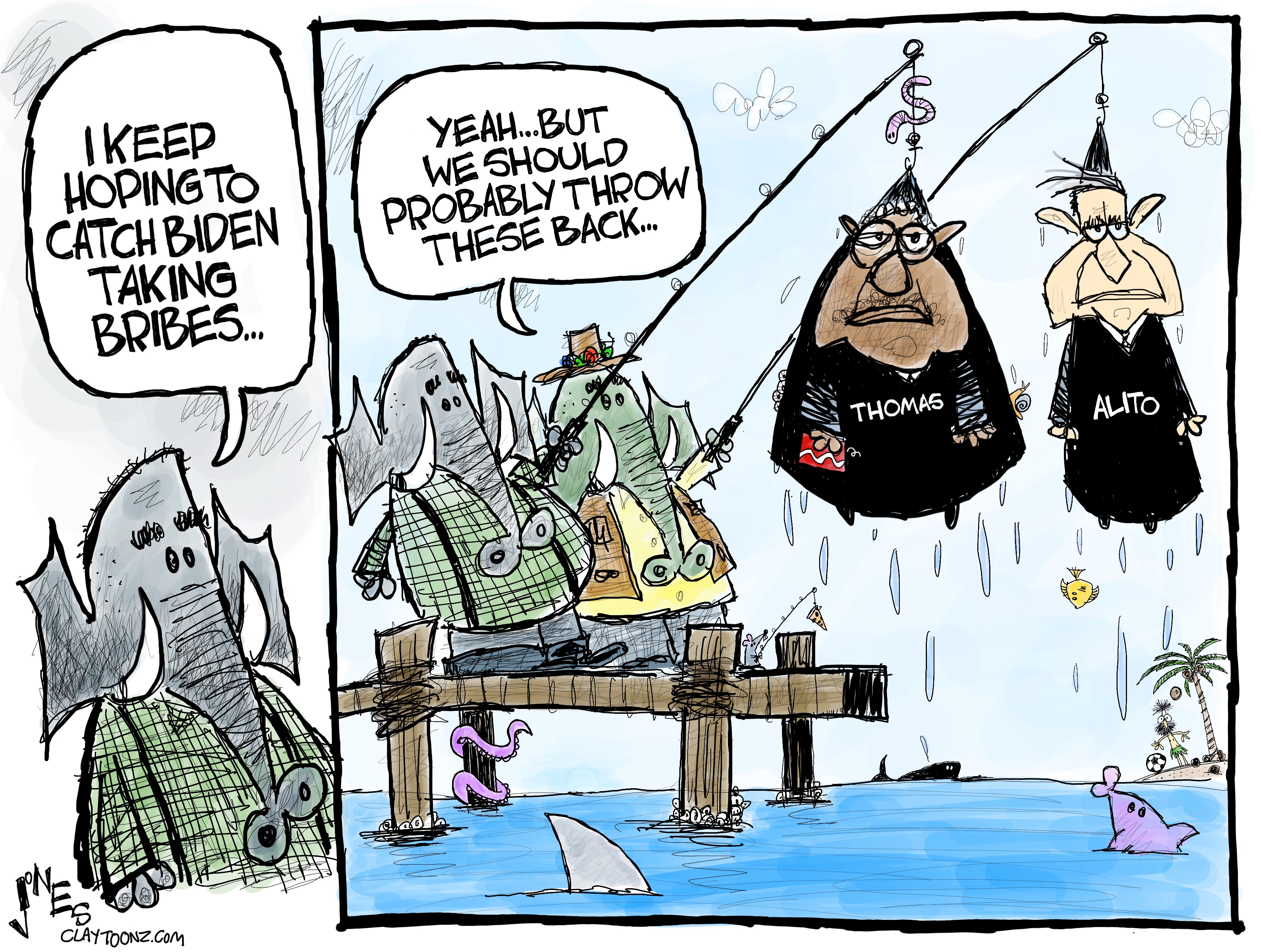
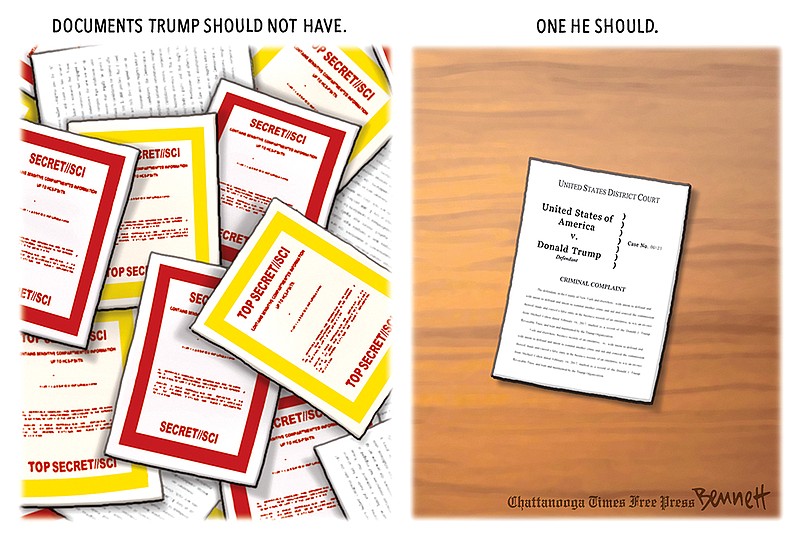
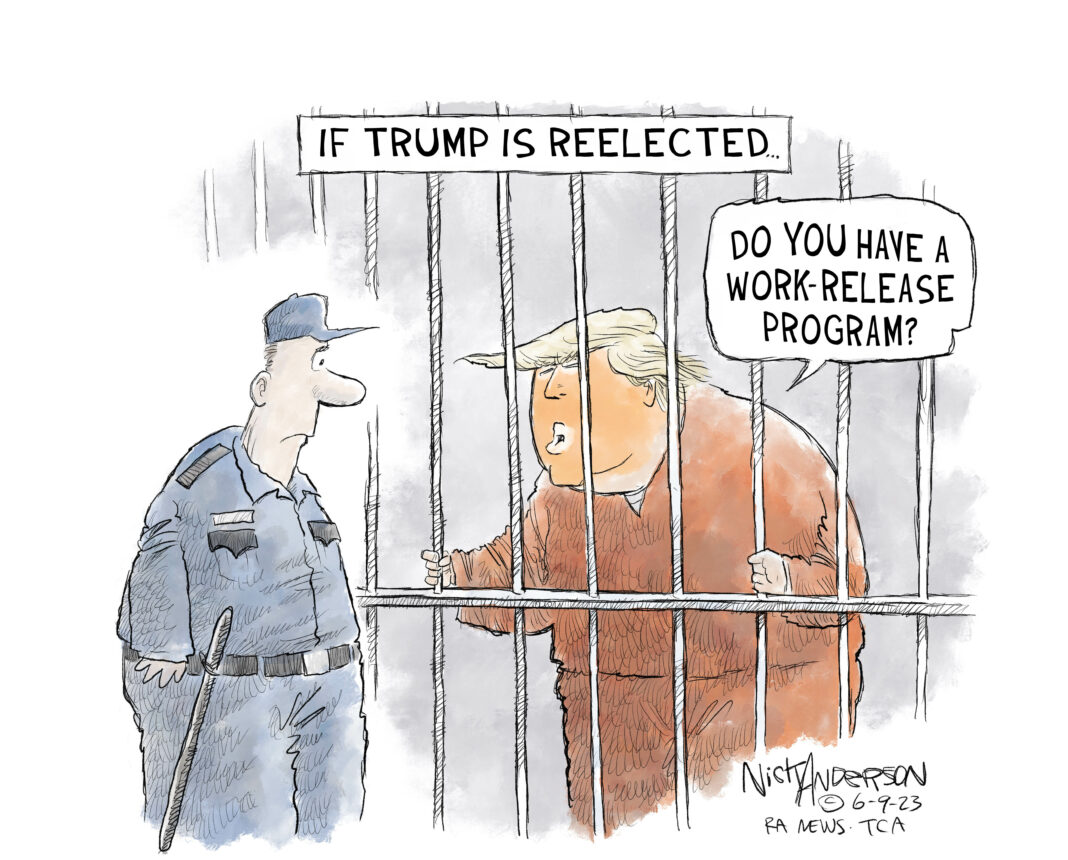


 The Weekly Sift