
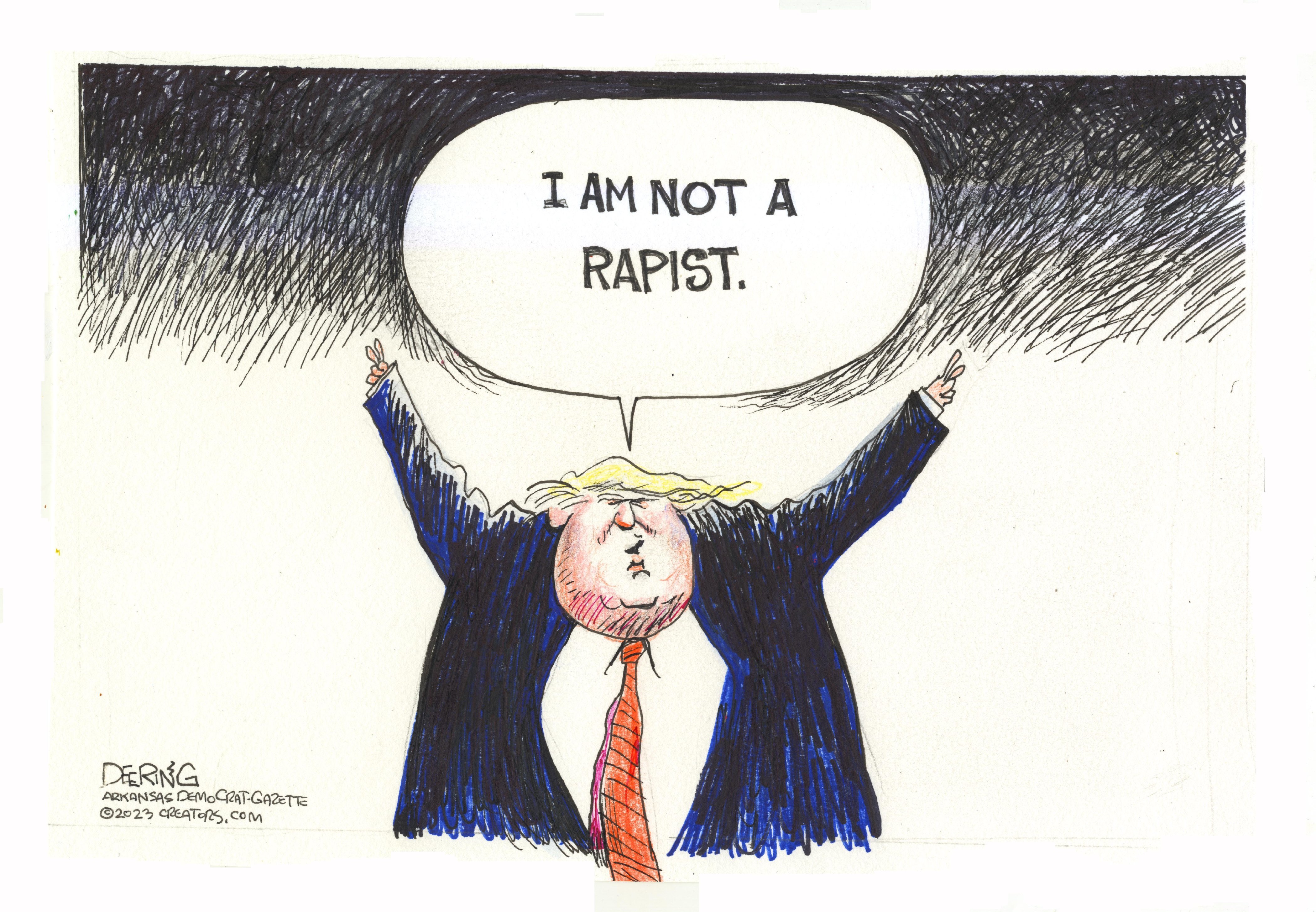
Immediately after a jury in a New York federal court found that Donald Trump had sexually assaulted and then defamed E. Jean Carroll, two reactions popped up everywhere:
- The verdict constitutes personal vindication for Carroll and vicarious vindication for any woman who has ever felt powerless after being mistreated by a man. While there’s still a long way to go, men — even powerful men — no longer have complete impunity.
- Politically, it will mean nothing. Members of Trump’s personality cult will double- and triple-down on his “witch hunt” and “persecution by the Deep State” narratives.
That first response seems obviously true to me. But I want to call the second into question. Politically, this might matter, even to people deep inside the right-wing echo chamber. But you’ll only see the effects if you know where to look.
A jury verdict is different. First, let’s talk about why the verdict should matter: As of now, the conclusion that Trump sexually assaulted Carroll and then aggressively lied about it “with actual malice” isn’t just an accusation liberals toss around on Facebook or discuss on left-leaning MSNBC shows. It’s not coming from a blue-state prosecutor looking for votes. It’s the verdict of a jury.
Think about what that means: If you sit nine ordinary people down, impress on them that they have a serious job to do, and then make them consider the evidence in detail, they will unanimously conclude that Carroll’s accusations against Trump are true.
That’s something that never happens on social media or within the information bubbles of either side. In those settings, you can’t make people listen to anything they don’t want to hear. You can’t put together a detailed argument without being pulled down the what-about-Hunter-Biden or it’s-all-a-witch-hunt rabbit holes. If someone answers an accusation with a biting-but-vacuous remark, a Trump-favoring host can end the discussion there, as if there were no conceivable counter-response.
But that’s not how things work in court. In court, the jury had to focus on this case, rather than something Bill Clinton did or didn’t get away with. Both sides had a chance to produce evidence and arguments at whatever length they felt necessary. Jurors had to evaluate witnesses as individual people — not with a general brush-off like “women lie all the time”, but here are Carroll, the two friends she told about the attack, and two other women who say Trump attacked them in similar ways. Listen to their voices, look them in the eye — is this particular woman lying to you right now?
The jury — all six men and three women of them — decided those women were telling the truth, and that Trump (who could have testified in person but didn’t, and was present only through a taped deposition) was lying.
That’s hard to brush off. It should matter. But will it?
Digging in deeper. People who think it won’t point to two reactions: First, Trump’s rivals for the 2024 Republican nomination aren’t jumping on it. Asa Hutchinson said “The jury verdict should be treated with seriousness and is another example of the indefensible behavior of Donald Trump.” But he was the exception. Mike Pence (who styles himself as a defender of Christian moral values) characterized Trump’s sexual assault as “just one more story focusing on my former running mate that I know is a great fascination to members of the national media, but I just don’t think is where the American people are focused.”
In other words: Sure, Trump violently attacked a woman — probably several women — and then lied about it, but shit happens. No big deal. Do you know what eggs cost these days?
And second, consider Trump’s indictment in Manhattan for falsifying business records, which caused his most ardent supporters to dig in deeper. Trump voters from Sarah Longwell’s focus groups said things like this:
When I convened a group of GOP voters the day after Trump’s indictment, their assessment was nearly unanimous: “It’s a complete distraction and it’s a waste of time.” “It’s being blown out of proportion.” “Just ridiculous and a terrible direction for us to go.”
We asked one group whether they had donated to Trump before the indictment. Only three out of nine had, but after the indictment, all nine said they would. None said another indictment or arrest would change their minds. And none thought Trump should drop out.
“As far as a mug shot goes, he’s going to market the hell out of that,” said Chris, a two-time Trump voter from Illinois, imagining a future arrest. “Every one of us is going to buy one of those shirts.” Most hands went up when I asked who would buy one.
How conservatives change their minds. I know what Democrats and Lincoln-Project Republicans would like to see: former Trump voters being confronted by the Carroll verdict and announcing that it has changed their minds. “I used to believe X about Trump, but now that I’ve heard this I have to believe Y.”
Almost no one is saying that, so commentators think the verdict makes no difference.
But that’s not how conservatives change their minds. On the Right, humility is a sign of weakness. (Jesus must have been misquoted about the meek.) So you never admit you were wrong and you never apologize.
And yet, conservative opinions do change occasionally. Sometimes they even reverse.
Think about George W. Bush. In the early days of the Iraq invasion, conservatives were ready to put him on Mount Rushmore. But by 2010 they were complaining that he had never really been a conservative at all. Or Ronald Reagan. For decades after he left office, Reagan was the defining Republican, and his core principles — including an expansive view of American power and free trade — were the core principles of the party. Now, “globalism” and “free trade” are dirty words, and Reagan hardly ever comes up as an example to emulate.
And yet, there was never a come-to-Jesus moment when conservatives repented their previous views and pledged to go a different way. Instead, a conservative sea change happens like this: People who used to be zealots for a particular view go silent for a while. And when they start talking again, they have the opposite view, which they put forward as if they had always believed it.
Segregation. That’s what happened with Jim Crow. From the 1950s through the 1970s, White Evangelicals were staunch opponents of civil rights. Jerry Falwell, for example, responded to the Supreme Court’s decision to integrate public schools like this:
If Chief Justice Warren and his associates had known God’s word and had desired to do the Lord’s will, I am quite confident that the 1954 decision would never have been made. … The facilities should be separate. When God has drawn a line of distinction, we should not attempt to cross that line.
In the 1960s, he railed against Martin Luther King:
In a 1964 sermon, “Ministers and Marchers,” Falwell attacked King as a Communist subversive. After questioning “the sincerity and intentions of some civil rights leaders such as Dr. Martin Luther King Jr., Mr. James Farmer, and others, who are known to have left-wing associations,” Falwell declared, “It is very obvious that the Communists, as they do in all parts of the world, are taking advantage of a tense situation in our land, and are exploiting every incident to bring about violence and bloodshed.”
The true origin of the Religious Right as a political force was not Roe v Wade, as they will tell you now, but the government’s denial of tax-exempt status to the segregated religious schools that had sprung up to offer White parents an all-White option for their children’s education.
Today, however, you will hear none of that from the vast majority of Evangelical preachers. Falwell’s pro-segregation sermons have vanished from his online archives. MLK is revered as an advocate of color-blindness. No one talks about segregated academies any more.
But you will search in vain to find a turning point. There never was a Jeremiah who called out White Evangelical segregationism and convinced the movement to change its ways. Do you know when the Southern Baptist Convention repented for its support of slavery? Not 1866, but 1995, long after all the slave-owners and slave-traders were dead.
Where to look. So if you’re expecting the scales to fall from right-wing eyes, for MAGA followers to suddenly start looking at the evidence and say, “Hey, I was wrong about Trump”, you’re expecting something that never happens. That’s not how conservatives change their minds.
What could happen, though, is that people who have been loud Trump supporters might start talking about other things. Maybe people who have been traveling the country to attend Trump rallies (as if they were Grateful Dead concerts) will realize they have other things to do. Without much fanfare, their Trump flags might come down. (Not because anyone changed their minds about him, of course, but because they got some other flag that they need to find a place for.) And then, some months hence, they will never have been Trump supporters — just as they were never George W. Bush supporters, their fathers never yelled obscenities at Black children integrating the schools, their grandfathers never participated in lynchings, and their more distant ancestors never owned slaves.
“I always knew there was something off about that guy,” they will tell you.
I’m not guaranteeing that such things are happening, but they could be. It is true that Trump’s crowds are shrinking (and have been for a while). Despite all the hoopla, ratings on his CNN town hall were high (3.3 million viewers), but not off the charts. (Joe Biden’s CNN town hall in 2020 had 3.4 million.)
So if you’re wondering about whether your MAGA cousin is reevaluating Trump, don’t ask him. Just listen for the silence.


 The Weekly Sift