The story that caught my attention this week is actually something I didn’t cover last week: the national freak-out over three university presidents testifying to a congressional committee about their schools’ policies related to antisemitism. The clip that the media noticed is a three-and-a-half minute grilling the presidents got from Elise Stefanik, but it sits in the middle of a five-and-a-half-hour hearing. It turns out that there’s quite a bit to know that didn’t make most of the network coverage.
I had suspected last week that there was something to think about here, but didn’t come to that conclusion until it was too late to do the research. Worried that whatever I said would turn out to be wrong, I left the story to this week. So anyway, “Those University Presidents” should appear around 10 or so EST.
The weekly summary also has a lot to cover: the COP28 climate agreement, Rudy Giuliani’s $148 million loss in court, Kate Cox’s abortion story, and a few other things, leading up to a quantum explanation of Santa Claus. I’m hoping to get that out by noon.
And I should tell you one more thing: I’ve decided not to put out a Sift on the next two Mondays, which are Christmas and New Years. It’s been a long time since I’ve taken more than one week off, but I’ve noticed myself wearing down lately, and I anticipate 2024 requiring me to be at my best.
This week’s featured post is “More Questions than Answers“, a collection of opinions I’m holding tentatively. The opening quote above is in honor of all the people who just don’t feel like they can watch the news any more. I feel your pain.
This week everybody was talking about Gaza
The war is back on, and no one seems to have any idea how it ends. Friday, the US vetoed a resolution in the UN Security Council calling for a cease fire.
and Trump’s dictator remark
As I’ve been chronicling the last few weeks, major media outlets are beginning to call attention to the alarming authoritarian rhetoric of the Trump campaign and its plans for a second Trump presidency. This week, The Atlantic devoted a whole issue to “If Trump Wins“. David Frum writes:
In his first term, Trump’s corruption and brutality were mitigated by his ignorance and laziness. In a second, Trump would arrive with a much better understanding of the system’s vulnerabilities, more willing enablers in tow, and a much more focused agenda of retaliation against his adversaries and impunity for himself. When people wonder what another Trump term might hold, their minds underestimate the chaos that would lie ahead.
Apparently Sean Hannity thought it would be a good idea to calm down such talk, so in his town-hall interview with Trump, he laid a red carpet down an off-ramp: “They want to call you a dictator. To be clear, do you in any way have any plans whatsoever, if reelected president, to abuse power, to break the law, to use the government to go after people?”
At first Trump gave a whatabout answer: “You mean like they’re using right now.” But Hannity circled back: “Under no circumstances — you are promising America tonight. You would never abuse power as retribution against anybody?”
“Except day one. … I love this guy, he says, ‘You’re not going to be a dictator are you?’ I said no, no, no, other than day one. We’re closing the border and we’re drilling, drilling, drilling. After that, I’m not a dictator.”
As we all know from history, leaders who achieve dictatorial power for even a day almost never lay it down voluntarily. So like an alcoholic’s “I’ll quit after one drink”, Trump’s “no, no, no” isn’t a credible denial. He gave this answer as if it were a joke, but that’s how bullies always talk: It’s a joke until it isn’t.
So what does that answer mean?
Hannity was clearly hoping for Trump to say something reassuring, like: “This dictator talk is silly, and is just evidence of how desperate the Deep State and its media allies have gotten. They’ll say anything.”
But Trump steadfastly refused to reassure anybody. What should we make of that?
Mainly this: Trump likes the dictator talk and doesn’t want to shut it down. His cultists love the idea that he’ll be dictator, so he wants to feed that fantasy. Conversely, his enemies and potential rivals are frightened, and he wants them to stay frightened. Don’t fight back too hard against Trump, because what if he becomes dictator?
and Taylor Swift
Time named Taylor as 2023’s Person of the Year, which surprised a lot of people, but in retrospect makes a certain amount of sense. Remember how Time defines the PotY: “the individual who most shaped the headlines over the previous 12 months, for better or for worse”. The PotY list includes “fourteen U.S. Presidents, five leaders of Russia or the Soviet Union, and three Popes”
Swift is none of that, but Time’s explanation portrays her as a ray of light in a year that was otherwise full of darkness. If not Swift, then the news focus of the year is either people arguing about whether Trump belongs in jail, or Israel and Hamas killing each other’s civilians. Or maybe it’s all the weather disasters as climate change really started to take hold. Taylor Swift may not be the Person of the Year we deserve, but she’s definitely the one we need.
Personally, I’m not a Swifty — not because I dislike her or her music, but because I mainly hear current music when I’m in a shopping mall. I intend to sit down and listen to a few of her biggest hits someday, and I’m sure I’ll recognize some when I do. But at the moment nothing is labeled in my mind as a Taylor Swift song.
Anyway, the Time article makes a good case for her: her fame, her wealth, her larger-scale cultural and economic impact, and so on. One thing that surprised and impressed me is her regimen:
In the past, Swift jokes, she toured “like a frat guy.” This time, she began training six months ahead of the first show. “Every day I would run on the treadmill, singing the entire set list out loud,” she said. “Fast for fast songs, and a jog or a fast walk for slow songs.” Her gym, Dogpound, created a program for her, incorporating strength, conditioning, and weights. “Then I had three months of dance training, because I wanted to get it in my bones,” she says. “I wanted to be so over-rehearsed that I could be silly with the fans, and not lose my train of thought.”
I’m reminded of the professionalism of athletes like Tom Brady or LeBron James. There was a time when athletes were just guys blessed with talent, who would gain weight in the off-season and get back in shape during training camp. After 30, they’d develop a Babe-Ruth-style paunch, and then they were old-timers by 35. But in this era, being an athlete is a full-time job. Apparently, being a pop star is too.
I feel like Time made too little of her political impact, which USA Today described like this:
What’s happening with Taylor Swift is not organic.
Here’s what cracks me up most: The party likely to make a reality-TV star its presidential nominee for the third straight time is now horrified that media celebrities have political influence. Trump co-conspirator Jeff Clarke tweets:
If we reach the point where Dwayne The Rock Johnson and Taylor Swift run for office together we will have truly reached full-on Idiocracy
I’ve got some bad news for you, Jeff. Your party has been there since 2016.
but we need to talk a little about crime
Crime as a political issue operates in a weird way: Obviously, if you feel less safe in your neighborhood — or worse, if you’ve been the victim of a crime — that’s a huge issue to you, as it should be. But a great deal of the political impact of the crime issue consists of people’s impressions about crime in general, or even crime in places totally unlike the places they live.
Media plays a huge role in creating those impressions. In particular, if you live in rural or small-town America, but you watch Fox News, you’ve seen countless stories about how crime is spiking in those big Democrat-run cities. Joe Biden’s America, you may think, is a lawless place that needs a new sheriff. And if you believe that visiting any big city means taking your life in your hands, of course you won’t do it. So you won’t have the experience of walking down Michigan Avenue in Chicago — as I did a few weeks ago — and feeling perfectly safe.
Friday, the NYT debunked a big piece of that panic: the supposed “shoplifting epidemic” that allegedly was lowering retail profits and causing companies like Walgreens to close some high-crime stores. The National Retail Federation got a lot of coverage for its claim that “organized retail crime” was responsible for half of all the “shrink” in the industry. (“Shrink” is the industry term that covers all forms of lost inventory, including stuff that gets misplaced or stolen by employees.) Heads of big retail chains testified before Congress, demanding action.
The claims have been fueled by widely shared videos of a few instances of brazen shoplifters, including images of masked groups smashing windows and grabbing high-end purses and cellphones. But the data show this impression of rampant criminality was a mirage.
In fact, shrink has been fairly flat over the last eight years, bouncing between 1.3% and 1.6% of sales. External theft of all sorts is only about 1/3 of that number. And organized retail theft, it turns out, is a tiny fraction of that: around .07% of sales.
The NTF has since backed off its claim, and so has Walgreens. The NYT continues:
In fact, retail theft has been lower this year in most of the country than it was a few years ago, according to police data. Some exceptions, including New York City, exist. But in most major cities, shoplifting incidents have fallen 7 percent since 2019.
So do you think Fox will retract its stories, or that your uncle out in the farm country will notice if they do? Probably not.
and you also might be interested in …
Senator Tuberville’s blockade on military promotions has ended. In terms of policy, he got exactly nothing for dropping his opposition. But he did get a lot of attention and raised a lot of money, so maybe he feels good about the whole episode.
Republican-dominated states are pushing out young professionals by enacting extremist conservative policies. Abortion restrictions are the most sweeping example, but state laws restricting everything from academic tenure to transgender health care to the teaching of “divisive concepts” about race are making these states uncongenial to knowledge workers.
The precise effect of all this on the brain drain is hard to tease out from migration statistics because the Dobbs decision is still fairly new, and because red states were bleeding college graduates even before the culture war heated up. The only red state that brings in more college graduates than it sends elsewhere is Texas. But the evidence is everywhere that hard-right social policies in red states are making this dynamic worse.
Well, maybe not. EV sales doubled from 2020 to 2021, and doubled again from 2021 to 2022. So up 25% looks like a loss of momentum. Maybe it’s a glitch, caused by Elon Musk’s image problems bleeding into Tesla, or people waiting for the new models promised for 2024, or some other passing problem. Or maybe there’s a more serious problem.
BTW: It doesn’t look like the industry can count on Tesla’s new cybertruck to turn things around.
With anti-Muslim and anti-Jewish hate speech rising online, you might expect to find it’s a tit-for-tat situation: Jews abuse Muslims because they’re sick of Muslims abusing Jews, and round and round forever.
But no. Actually a better explanation is “Haters gonna hate”. Right-wing extremists abuse either group, depending on what the current headlines are. The rise in hate speech of all kinds actually tracks the rise in right-wing extremism, rather than any escalation of Muslim/Jew conflicts.
Contemporary discourse often pits Muslims and Jews against one another. But our research demonstrates that a large amount of seemingly disconnected hateful rhetoric about both—at least in 2017—originated from the same far-right extremist communities.
Speaking of far-right extremist communities, Alex Jones is back on X/Twitter.
Norman Lear died Tuesday at the age of 101. If you weren’t alive during the run of the hits he created, especially All in the Family (1971-1979), it’s hard to grasp his impact.
Before All in the Family, TV sitcoms were escapist entertainment, centering on either absurd characters (like the Clampetts from Beverly Hillbillies) or ideal families dealing with a series of homespun problems that were easily solved. Children (like Opie Taylor of The Andy Griffith Show, the role that made Ron Howard famous) never ran into a problem that was too big for their parents to sort out by the end of an episode. Authority figures were good, systems worked, and adults always had children’s best interests at heart.
Lear’s shows changed all that. AitF centered on a young liberal couple forced by economic stress to live with the wife’s conservative parents. Episodes dealt with racism, war, and even rape.
That much you can understand by streaming AitF now (if you can find it). What you can’t grasp is the influence AitF had on the national conversation. At the time there were three major networks, no streaming, and no way to record a show: You either watched a show at the same time everybody else did or you missed it.
Picture what that meant: If you watched some popular show, you could go to work or school the next morning expecting that maybe a third to a half of the people you met had seen it too. So whatever argument Archie Bunker and his son-in-law had been having might well continue among your friends or coworkers.
Nothing fills that role today.
and let’s close with something to pass the time
Roadtrips — I’ve been on a couple lately — are a chance to try out new podcasts. I’ve recently found two you might want to try.
How God Works by David DeSteno examines the intersection of science and spirituality. A meditation teacher, for example, might tell you to focus on your breath, or breathe in a different pattern. Physiologically, what does that do? Or what do various spiritual traditions from around the world tell us about gender diversity?
If you’re looking more for entertainment than information, check out “Welcome to Night Vale“. Night Vale is a small desert town that either has an exceptional level of weirdness, or is being covered by a very weird local radio reporter.
A lot of the posts on this blog are motivated, in one way or another, by questions people ask me, or by worries I hear my friends express. They have concerns that they don’t have the time to research in detail, so I do that and report back.
My typical post is an expression of confidence: You may be wondering about this topic, but I think I’ve got it figured out, at least up to a point.
Lately, though, I’ve been hearing questions either from friends or via social media and thinking, “Those are good questions.” I usually have a few worthwhile thoughts on the topic, but nothing I can tie up with a bright red bow.
So this week I’m trying out a Q&A format as a way of lowering the bar a little. I don’t necessarily have the answers, but this is what I think.
Will Donald Trump ever be held accountable for the things he’s done?
I believe he will, but I can understand the frustration of all the people who ask this question. The justice system takes far too long under ordinary circumstances, and when a powerful man’s entire strategy is based on delay, the time lapse between crime and punishment can become enormous. Plus, I think the government lost about a year because Merrick Garland really didn’t want to start his term by pursuing charges against the former president. Trump keeps saying the charges are politically motivated, but I think what’s really political is that one-year delay. (This, I will add, is a theme in my thinking about the Trump trials: He believes — or says, it’s always hard to know if Trump believes what he’s saying — that he’s being persecuted for political reasons. But in fact he’s benefiting from favoritism.)
However, the mills of justice continue to grind. Trump is facing four separate indictments: federal indictments in D. C. and Florida, plus state indictments in New York and Georgia.
I can imagine the New York case failing for technical reasons. This is the case the comes out of the Stormy Daniels payoff, which Michael Cohen has already done jail time for. The charge against him is falsifying business records, and the 34 counts are 34 false documents. No one is even claiming the documents aren’t false, so he’s clearly guilty of the thing he’s been charged with. But it’s possible to argue that he should have been charged under the misdemeanor version of the law rather than the felony version, and if that’s true then the statute of limitations has run out.
The other three prosecutions look very solid to me, though, and if they get to a jury he’ll be found guilty. In his public comments, Trump doesn’t even address the evidence against him, because he can’t: He’s guilty and the government has the goods on him. (He talks about the prosecutions all the time, but mainly makes false ad hominem arguments: Jack Smith is a deranged thug, Fani Willis had an affair with a gang member, and so on.)
The big question is whether he can be tried before the election. His only hope of escape is to delay past the election, retake the presidency, and use the powers of his office to obstruct justice.
Unfortunately, the most open-and-shut case is the one that drew a judge biased in Trump’s favor: the classified documents case. After leaving office, he had no right to keep those documents, he said he had given them all back, he had them moved to avoid detection, and then a search found them in his possession. There’s really no defending that set of facts. (His only attempt to do so is a flight of fantasy: Trump’s claim that the Presidential Records Act gives him a right to keep classified documents at all, much less store them in cardboard boxes in his bathroom or show them to people he wants to impress, is legally absurd.)
The judge can’t change the facts, and probably would be reversed on appeal if she threw the case out for some bogus reason, but she can collaborate with Trump to delay past the election. The other judges won’t do that, so I’m pretty sure we’ll see a guilty verdict before the election in at least the federal election-interference trial. That’s the most important case anyway.
Undoubtedly Trump will find some excuse to appeal, so he won’t actually be in jail on election day. But to see him squirming out of accountability requires that the public witness a trial proving his guilt, that his guilt on a very serious charge be validated by a jury, and that he win the election anyway. That scenario seems unlikely to me.
Meanwhile, there are the civil cases. He’s already lost a multi-million-dollar settlement to E. Jean Carroll, and has been judged guilty of fraud in a New York case that could take down the whole Trump Organization. He hasn’t had to pay the money yet, though.
The New York civil case should end in a week or so, and the judge’s decision about damages should follow (in the NYT’s estimate) within a few weeks.
One final consideration: Can Trump count on higher courts (like maybe the Supremes) to save him? Probably not. We saw an example this week when an appeals court upheld nearly all of Judge Chutkan’s gag order on what Trump can say about the D. C. case. The Supreme Court had no appetite for getting involved in Trump’s lawsuits to overturn the 2020 election, and I doubt they feel much different now.
What’s going on with Ukraine aid?
In theory, nearly all Democrats and about half of the Republicans in Congress support continuing aid to Ukraine as it resists the Russian invasion. But somehow the aid doesn’t pass.
Currently, the aid package Biden proposed is tied to a border-security bill, which Republicans want to use to restore Trump border policies.
This is a tactic that I can’t remember Democrats using: claiming to support X, but refusing to vote for it unless they can also get Y. (Suggest an example in the comments if you have one.) But it’s a standard tactic for Republicans, and gets trotted out whenever there’s a budget impasse: We don’t want to shut down the government, but you have to give us something to keep us from doing it. Trump used to claim to want to give the Dreamers legal status, but no bargain the Democrats offered ever contained a big enough payoff to get him to agree to it.
Democratic Senator Chris Murphy suggests (but doesn’t get behind) a stronger spin: “If I were a cynic, I would say that Republicans have decided to tie support for Ukraine to immigration reform, because they want Ukraine aid to fail. But I’m not a cynic.”
Maybe I am that cynical: It’s credible to me that MAGA Republicans are doing the bidding of Vladimir Putin, who helped put Donald Trump in the White House and is a hero of the global white-Christian-supremacist authoritarian movement. According to The Guardian, unnamed Republicans in Congress are meeting with representatives of Hungarian authoritarian leader Viktor Orbán “to push for an end to US military support for Ukraine”. The Hungarians are in town for a two-day conference sponsored by the Heritage Foundation.
Are liberal media outlets giving Liz Cheney too much good publicity? Didn’t she used to be evil?
Politically and philosophically, Liz is a clone of her father, who was the dark heart of the Bush II administration. So it’s not hard to imagine a Princess-of-Darkness role somewhere in her future.
However …
During Bush II, just before the public began turning against the Cheney-inspired Iraq War, I heard Michael Moore speak to a crowd in Manchester. He predicted that people would soon start turning against the war, but told us that we needed to make it easy for them to do that. When people joined us, he said, we needed to welcome them.
At the moment I’m about half-way through her recent book. While making serious claims about Trump and his Republican allies, it’s impressively down-to-Earth: I saw this. I did that. I talked to this person. She’s managed to sound the alarm without sounding alarmist.
Is she convincing anybody who wasn’t already convinced? I have no idea. But I don’t see how we save the Republic without more people like her.
If everything works out, maybe I’ll have the luxury of demonizing Liz Cheney again someday. That would be nice.
What should we make of the whole Hunter Biden thing?
Hunter received a new batch of indictments this week, all having to do with tax charges. For Hunter himself, this is a big deal. If found guilty, he could serve years in prison.
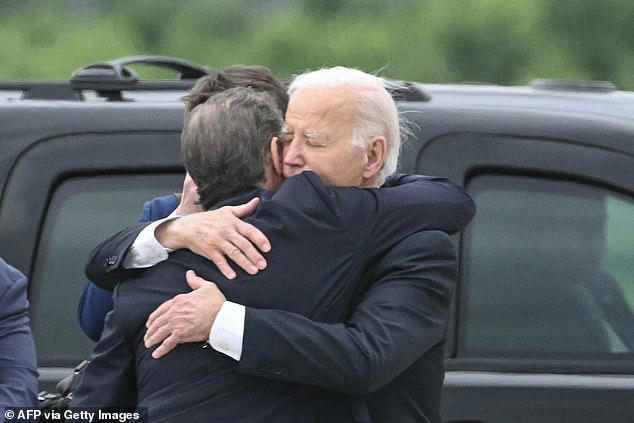
This is also a big deal for Joe Biden the person, a father who loves his only surviving son despite all the ways Hunter has screwed up his own life and made trouble for his family.
Republicans love to claim that Hunter’s troubles implicate Joe Biden, the president. But so far they’ve shown no connection. We know that Hunter took advantage of his name to do business with foreign companies, a practice which is unethical but not necessarily illegal, and which implicates the Trumps far more than the Bidens. Hunter may have told people that he had pull with his Dad and could get them special favors, or maybe he just didn’t correct them when they assumed he could. That, again, is unsavory.
But here’s what I would need to see to say that President Joe has been implicated: evidence that he knew Hunter was making promises in his name, together with instances where Hunter’s associates arguably got some kind of special treatment from the Biden or Obama-Biden administrations. I’d also be impressed by evidence that some of the money Hunter was making found it’s way back to his Dad. (If you read the tax indictment, it looks like Hunter blew all the money on himself.)
If that kind of evidence exists, then by all means impeach President Biden. (Feel free to bookmark this page and quote that line back to me sometime in the future.) But while Republicans keep making wild claims that they will produce such evidence any day now, they still haven’t.
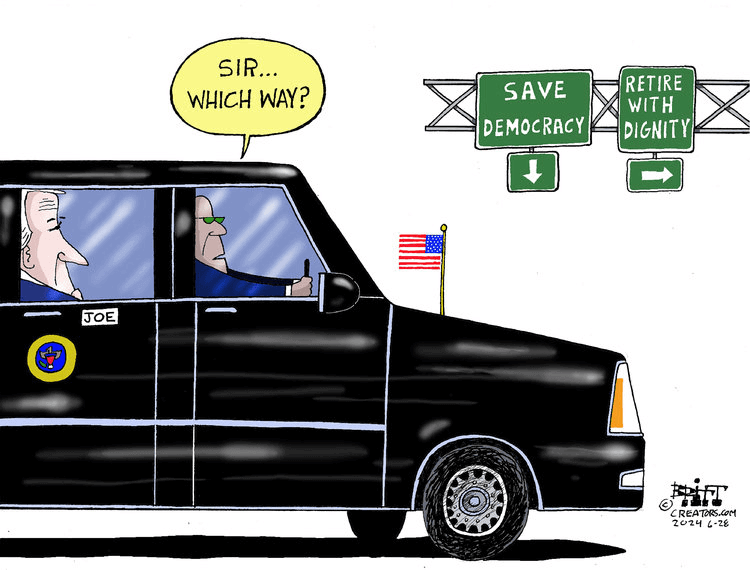
Should President Biden be running for reelection?
I hate to even raise this question, because in some sense the controversy is self-sustaining: People are talking about it because people are talking about it.
Here’s what I think: President Biden has done an amazing job and deserves to be reelected, but so far the public is not hearing that story.
He has dealt with the post-pandemic economic upheaval extremely well: We have full employment again, and inflation is returning to pre-pandemic levels. (I’m currently in South Carolina, where gas is back under $3 a gallon.) He pulled NATO back together after Trump tore it apart, and engineered a Ukraine aid pipeline that has kept Putin from conquering the country. He got us out of Afghanistan. He kept the promise Trump repeatedly broke, and got a bipartisan infrastructure bill passed to rebuild America. Working with tiny majorities in both houses of Congress, he got the first serious anti-climate-change bill passed.
It’s a fine body of work, making him one of the best presidents of my lifetime. He absolutely deserves another term, and ought to be leading Trump in the polls by a wide margin.
But he isn’t. Why is something of a mystery. “Generic Democrat” is leading Trump in the polls, though no specific Democrat is doing much better than Biden.
You can read that two ways: Nate Silver claims that other Democrats suffer from lack of name recognition, and that if they were nominated, they’d run closer to Generic Democrat. The alternate view is that the full force of right-wing propaganda is aimed at Biden, and would train itself on any alternative candidate as soon as Biden stepped aside.
I tend to lean the second way, but I’m not sure about it. Again and again, we’ve seen people claim that they’d like to vote for a Democrat, but there’s something wrong with this Democrat: Biden’s age, Hillary’s emails, Obama’s birth certificate, and so on.
When you have the kind of resources conservatives command, and the willingness to use those resources without any scruples or standards, you can create an issue about anybody. So if you can find me a Democrat mud won’t stick to, I’ll support that candidate in a heartbeat. Otherwise, I think I’ll stay with the old guy.
For the second week in a row, I didn’t get into any single issue deeply enough to write a featured post. So I’m doing something different this week in a post I’m calling “More Questions than Answers”.
In my mind, a featured post is an expression of confidence: I’ve researched something well enough that I believe I have something to tell you that you may not see elsewhere. Also, I see this blog in part as a protest against the repetitive nature of the news media. So while regular readers will (over time) see me hit certain themes over and over, this week’s post should be substantially different from last week’s.
The recent run of news is defeating that vision. There are major events (like the war in Gaza) whose details are mostly hidden from us, and whose stories tend to repeat. (Israeli families are still worried about their relatives held hostage by Hamas. Civilians in Gaza are still suffering from a combination of privation and bombardment from Israel.) Here at home, there’s the looming Trump/Biden rematch, and the increasing need to sound the alarm about what a second Trump presidency would entail. In related news: the legal system keeps closing in on Trump little by little.
So I feel an enormous temptation either to write the same stories every week, or to speculate beyond my knowledge about what’s going on in Gaza or Ukraine — or inside the minds of people I don’t understand, like Trump supporters and Evangelical Christians.
So anyway, “More Questions than Answers” represents me backing off some of my usual standards: Its segments are covered in less detail than a typical featured post, and I give myself more room than usual to discuss what I think is happening, even if I don’t know. I’ll talk about whether Trump will ever be held accountable, what I think is going on with Ukraine aid, how I feel about Liz Cheney, how seriously to take the Hunter Biden situation, and a few other things. It should be out around 11 EST.
The weekly summary is relatively normal by comparison. It will talk about Gaza, Trump’s “dictator” remark, Taylor Swift, how crime gets covered, the importance of Norman Lear, and a few other things. I’ll aim to have that out before 1.
Defendant’s four-year service as Commander in Chief did not bestow on him the divine right of kings to evade the criminal accountability that governs his fellow citizens.
During the seven-day ceasefire, Hamas agreed to release 110 people from Gaza, including 78 Israeli women and children. As part of the deal, 240 Palestinians were also released from Israeli jails. They had been accused of a range of offences, from throwing stones to incitement and attempted murder. … It is estimated that about 140 Israeli hostages remain in captivity in Gaza.
The document circulated widely among Israeli military and intelligence leaders, but experts determined that an attack of that scale and ambition was beyond Hamas’s capabilities, according to documents and officials.
Very recently, ground-level analysts monitoring video surveillance of activity in Gaza saw evidence that Hamas was war-gaming and running drills for attacks that looked like components of Jericho Wall. One analyst repeatedly pressed the issue with higher-ups, but her effort to raise the alarm was again disregarded.
His column doesn’t identify a source for that information.
Politically in the US, the Gaza War has been bad for Biden, but not for the reason a lot of people think. He is undoubtedly losing votes on the left for being too pro-Israel, but he would probably lose more votes if he were more critical of Israel. (“Biden is siding with the terrorists!”)
Biden will lose votes whatever he does, because Israel/Palestine is a wedge issue that splits Democrats, but not Republicans. Republicans would probably be happy with anything Israel did, even to the point of an actual genocide. (Aside: Whatever you think of Israel’s treatment of Palestinians, it’s not genocide. Genocide is too important a word to ruin through misuse.)
Similarly, the Ukraine War is a wedge issue that splits Republicans, but not Democrats. Democrats are united behind Ukraine. Meanwhile Putin remains a hero to many MAGA Republicans, even as establishment Republicans agree with Democrats in supporting Ukraine.
I know it’s too much to expect that people will take a step back and think rationally about an issue, but if they did, they’d see that the Gaza War validates a liberal rather than conservative view of how to maintain peace. In its simplest form, the conservative idea is peace-through-strength: If we’re strong enough and tough enough, no one will attack us because they’ll know they will suffer more than we will.
The liberal vision is peace-through-justice: If everyone is getting a square deal, they won’t want to risk it by going to war.
In their purest forms, both visions are naive; real peace requires both strength and justice. But I think liberals understand that, while I don’t think conservatives do. The Hamas attack exposed the folly of the Netanyahu peace-through-strength policy. If people feel aggrieved enough, they won’t care that a war will hurt them more than you. They’ll risk their lives to bite your ankle.
Nothing in the Constitution explicitly immunizes a current or former president from legal processes. However, certain kinds of immunity have been recognized by the courts: Presidents are immune from lawsuits against the consequences of carrying out their duties. And longstanding DoJ policy, based on a memo by its Office of Legal Counsel, says that a sitting president can’t be indicted. (That doctrine has never been tested in court.) And courts have recognized a vague principle that at some point, legal harassment of a president might reach the point that it violates the separation of powers between the executive and judicial branches of government.
In his motions, Trump was asking the courts to expand that immunity to vast proportions. His arguments were slapped down in both cases.
Both motions were for dismissing the cases without a trial. Dismissal motions have to clear a very high bar, because they’re claiming that a trial can’t possibly reveal anything that would matter. So the judge has to assume that the claims made by the prosecutors or plaintiffs are true, and conclude that no penalty would apply anyway.
The appeals court ruled that the civil case against Trump needs to go forward, because it’s not obvious that Trump’s actions related to the January 6 riot were part of his job.
The President, though, does not spend every minute of every day exercising official responsibilities. And when he acts outside the functions of his office, he does not continue to enjoy immunity from damages liability just because he happens to be the President.
This kind of compartmentalization has never registered with Trump. In his mind, there was no separation between his person and his presidency. If the president had some power, then he had that power, to wield as he saw fit, independent of whether he was carrying out some official duty.
Judge Chutkan ruled similarly: Committing crimes is not part of a president’s job, so crimes allegedly committed while in office can be prosecuted. (Whether those crimes were or were not committed should be decided at trial.) And she need not settle the presidential-indictment question here, because Trump is not president.
Whatever immunities a sitting President may enjoy, the United States has only one Chief Executive at a time, and that position does not confer a lifelong “get-out-of-jail-free” pass. Former Presidents enjoy no special conditions on their federal criminal liability. Defendant may be subject to federal investigation, indictment, prosecution, conviction, and punishment for any criminal acts undertaken while in office
Chutkan also denied a motion claiming that the Smith indictment should be dismissed because it criminalizes speech protected by the First Amendment.
[I]t is well established that the First Amendment does not protect speech that is used as an instrument of a crime, and consequently the Indictment—which charges Defendant with, among other things, making statements in furtherance of a crime—does not violate Defendant’s First Amendment rights.
The question of whether Trump’s false claims about the 2020 election were part of a criminal plot has to be decided at trial.
While Defendant challenges that allegation in his Motion, and may do so at trial, his claim that his belief was reasonable does not implicate the First Amendment. If the Government cannot prove beyond a reasonable doubt at trial that Defendant knowingly made false statements, he will not be convicted; that would not mean the Indictment violated the First Amendment.
Meanwhile, there are the gag orders. WaPo keeps track of which ones are active: Judge Chutkan’s order preventing Trump from disparaging prosecutors, witnesses and court personnel involved in his trial is suspended while the appellate court considers it. They might rule any day now.
Judge Engoron’s order preventing Trump from attacking court personnel is currently in force as an appeals court evaluates it.
Today’s NYT has an article “Why a Second Trump Presidency May Be More Radical than His First“. The authors note that Trump has always had “autocratic impulses”, dating back to his praise of the Chinese massacre of the Tiananmen Square demonstrators, and reflected in his admiration for autocrats like Saddam Hussein or the Philippines’ Rodrigo Duterte, not to mention Vladimir Putin and Xi Jinping.
What would be different in a second Trump administration is not so much his character as his surroundings. Forces that somewhat contained his autocratic tendencies in his first term — staff members who saw their job as sometimes restraining him, a few congressional Republicans episodically willing to criticize or oppose him, a partisan balance on the Supreme Court that occasionally ruled against him — would all be weaker.
Princeton Professor Jan-Werner Müller has a similar article in The Guardian. He observes that establishment-Republican institutions like the Heritage Foundation are now on board with a Trump autocracy.
Trump is not hiding anything; nor does a figure like the Heritage president, who considers Hungary “not just a model for conservative statecraft, but the model”.
Liz Cheney’s book Oath and Honor comes out this week. Early reports portray it as an insider’s view of how the Republican Party officials caved in to Trump, even as they criticized and even laughed at him privately.
and Elon’s breakdown
Elon Musk is further gone than I thought. In an interview Wednesday at the NYT DealBook summit, he told companies who have responded to his antisemitic tweets by pulling their ads from X to “Go fuck yourself.”
If someone is going to try to blackmail me with advertising, blackmail me with money, go fuck yourself. GO. FUCK. YOUR. SELF.
You can watch the video. He clearly expected the audience to applaud his courageous stance, but instead there was a stunned silence. The interviewer (Andrew Ross Sorkin) then asked about “the economics of X”, which relies on advertising revenue to survive. And Elon responded:
What this advertising boycott is going to do, it’s going to kill the company. … And the whole world will know that those advertisers killed the company. We’ll document it in great detail.
When Sorkin explained how the advertisers would justify themselves, Musk countered:
Tell it to Earth. … Let’s see how Earth responds to that.
Elon seems convinced that he is the hero of this story, and that the People of Earth will frame events the way he does. How dare companies like Disney choose to spend their advertising dollars somewhere else? How dare they decide that displaying a trailer for “Wish” next to some white supremacist rant doesn’t serve their purposes? The People of Earth are so attached to the X platform and so enamored of Elon himself that they will make Disney pay for such arrogance.
Three things are worth pointing out here: First, Musk’s attempt to turn this into a free-speech issue falls flat. Sure: Antisemites, racists, misogynists, and even outright swastika-waving Nazis have a right to speak their minds and try to make converts. But they are not entitled to have someone else sponsor a platform for them.
And second, I see Elon’s stewardship of X as part of what Cory Doctorow calls “the Great Enshittening” of the internet. I would gladly spend my X-time elsewhere if some alternative platform achieved a critical mass of users, and I welcome X’s looming demise because it might create space for something better to emerge.
As for Musk himself, I see him as the kind of tragic figure Aeschylus would have found fascinating. Like the Trump saga, Elon’s story demonstrates that being worshiped is bad for mortals. Almost no humans have enough strength of character to stay sane once they’ve been surrounded by a cadre of worshipers the way Elon has.
One of the things I admire most about Barack Obama is that he has shown the good sense to keep our admiration at arm’s length.
The continuing good economic news contrasts with the public view that the economy is in bad shape. David Roberts refers to this as the “vibes” problem, which Democrats have to get better at addressing.
Substantive accomplishments — even the ones the public says on polls they want/like — are not enough, in & of themselves, to win political approval. They don’t advertise themselves or tell their own story. The channels through which the public has traditionally been informed about political accomplishments have become fragmented, polluted, and dominated by lavishly funded right wingers. They can’t be relied on. … In other words, Dems are winning the war of substance but losing the vibes war, largely because they don’t seem to realize that those two fights have drifted almost entirely apart.
It is frequently claimed the character was based on Henry Kissinger, but Kubrick and Sellers denied this; Sellers said: “Strangelove was never modeled after Kissinger—that’s a popular misconception. It was always Wernher von Braun.” Furthermore, Henry Kissinger points out in his memoirs that at the time of the writing of Dr. Strangelove, he was a little-known academic.
Sandra Day O’Connor also died. The first woman to serve on the Supreme Court, she lived to be 93. Appointed by Ronald Reagan, she was the kind of conservative justice that today’s conservatives abhor. She wasn’t driven by ideology. Instead, the facts of the case mattered to her, and you couldn’t predict her vote without examining them. Politico summarizes:
[H]er decisions and her reasoning demonstrated a constant attention to the proper role of the Supreme Court as a nonpartisan arbiter of hot-button issues in American life, to the actual facts about the actual parties, and to the way in which the bench’s rulings would be experienced by the American public. … The strategy of the Roberts Court, however, has been strikingly different.
Republicans have begun talking about having a health care plan again. I say “again” not because they have had a health care plan in the past, but because they talk about having a plan every now and then.
Back in 2015 Trump promised a “terrific”, “phenomenal”, and “fantastic” system to replace ObamaCare. But once in office, he left the details to Republicans in Congress, who never united around any particular proposal. Their slogan of “repeal and replace” was always light on the “replace” side. When John McCain delivered the final vote needed to save ObamaCare in 2017, his office’s statement said:
While the amendment would have repealed some of Obamacare’s most burdensome regulations, it offered no replacement to actually reform our health care system and deliver affordable, quality health care to our citizens.
Trump’s campaign is drawing up a health care proposal, although it is unclear when that will be released or if it will propose a full replacement plan (Republicans have struggled to put one together for years).
Not to be outdone, Ron DeSantis is also talking about a health care plan.
We need to have a health care plan that works,” he said when asked whether he will repeal and replace ObamaCare. “ObamaCare hasn’t worked. We are going to replace and supersede with a better — better plan.”
DeSantis said details of the plan will likely be worked out in the spring and that his campaign would “roll out a big proposal.”
By spring, of course, DeSantis will be an ex-candidate and whatever proposal he might have come out with will be moot.
The basic conservative health-care problem is that market competition will never deliver a good health insurance system. There’s a simple reason for that: The way to make money in health insurance isn’t to deliver quality care at an affordable price. Instead, the path to high profits is to insure people who don’t get sick, and to encourage people who likely will get sick to insure with somebody else. The less government regulation a system has, the more this market imperative will assert itself.
Almost no other market works this way. For example, if you’re a car company, there’s no group of consumers that you hope doesn’t buy your car.
Sports Illustrated got nailed for apparently letting AI write articles and then crediting them to fake reporters with AI-generated photos.
What’s weird to me is the deception. I mean, why not be up-front about it? There’s nothing inherently immoral about letting ChatGPT write an article if you then fact-check, edit, and take responsibility for it. I have no plans to produce Sift articles that way, but if I did, I wouldn’t be ashamed to admit it. (I’m trying to inform people and promote my point of view rather than validate some claim about my abilities.)
In high school I worked for my local newspaper, and occasionally my job involved writing intro paragraphs for box scores of minor sporting events we hadn’t sent a reporter to: “Joe Blow scored 23 points to lead West Nowhere High to a 79-53 rout of its crosstown rival East Nowhere.” I was essentially doing the work of an AI: not reporting anything new, but applying common narrative templates to information already in the box score.
In the WaPo, Josh Tyrangiel takes a similar view: He used to work at Bloomberg, which quickly processed company earnings reports to produce headlines that its subscribers would trade on. But rapidly searching through numbers to find the most significant ones is something computers do better than humans.
Bloomberg shifted to automated earnings headlines in 2013 and has used AI to create its earnings summaries since 2018. It also employs more journalists and analysts now than it did back then — some 2,700, all of whom get to do more interesting work than writing earnings headlines and summaries.
As expected, George Santos was expelled from the House of Representatives. What’s surprising is the 114 votes not to expel him.
More evidence how out-of-it I am: The word of the year is “rizz”, which I had never heard of until I read the article. Reportedly, it is Gen Z slang for “a person’s ability to attract a romantic partner through style, charm or attractiveness”.
If you’re one of those people who does the bulk of your charity giving at the end of the year, consider the Wikimedia Foundation, which supports the Wikipedia. It doesn’t have any poster children or sad animals to show you, but Wikipedia has become central to our basic information infrastructure. I rely on it constantly for historical information, and it actually isn’t a bad way to keep track of evolving news stories, like natural disasters and mass shootings. Typically, the first reports in the media aren’t terribly accurate, and over a period of days it can be hard to sort out what was rumor and what is still considered reliable. Wikipedia collects and curates that stuff.
and let’s close with a visual pun
The artist Gustav Klimt had a very distinctive style, as you can see from one of his most famous works: The Woman in Gold.
The similarity in names inspired Carl Tétreault to produce this image of The Man With No Name: “Klimt Eastwood“.
Nothing in particular captured my imagination this week, so there won’t be a featured post.
The weekly summary will cover the resumption of the Gaza War, rulings in the Trump trials, Elon Musk’s bizarre interview, George Santos’ expulsion from Congress, more good economic news, the deaths of Henry Kissinger and Sandra Day O’Connor, and a few other things. It should be out by 11.
The great tactical disadvantage for all those of us who will fight for democracy is that you have one tool to do it: democracy. You must use democratic means to defeat anti-democratic forces. And that can feel like fighting with one hand tied behind your back. But you’re either a democrat or you’re not.
This week everybody was talking about the hostage release in Gaza
The long-rumored ceasefire-with-prisoner-exchange deal between Israel and Hamas took effect Friday. The ceasefire started then and was supposed to last four days. Talks are underway to extend that period and perhaps free more hostages. Otherwise, fighting will resume tomorrow.
Any agreement that results in real actions is a good sign: The two sides have ways to talk to each other, and are building trust that agreements made can be carried out. But there’s still a long, long way to go. (Late-breaking reports say the truce will last another two days.)
and the Dutch election
Anti-Islam and anti-EU politician Geert Wilders led his Party for Freedom to a surprisingly good showing in the parliamentary elections Wednesday. Still far from a majority, his 35 seats is the most by any individual party in the 150-seat parliament. He will get the first chance to put together a majority coalition.
but we should talk more about how Trump gets covered
Major media still seems to be having a hard time figuring out how to cover Trump. In 2015, he was a man-bites-dog story who clearly was never going to be president anyway, so he got millions and millions of dollars worth of free media coverage. Entire Trump speeches were broadcast live on CNN, and quotes the media determined to be “gaffes” got repeated again and again.
Eventually, outlets noticed that they had become vehicles for disinformation. Unlike the typical presidential candidate, Trump was not embarrassed to be caught in a lie, and would keep repeating the lie long after fact-checkers had debunked it. In fact, he had more persistence than the fact-checkers, so he would keep lying, while fact-checkers found it pointless to keep repeating the same debunking columns. This led WaPo’s Glenn Kessler to invent the “bottomless Pinocchio”:
The bar for the Bottomless Pinocchio is high: The claims must have received three or four Pinocchios from The Fact Checker, and they must have been repeated at least 20 times. Twenty is a sufficiently robust number that there can be no question the politician is aware that his or her facts are wrong.
Similarly, Trump’s “gaffes” were not the usual sort of political misstatements: slips of the tongue or half-truths that got stretched to the point of hyperbole, like Hillary Clinton’s harrowing tale of landing in Bosnia under sniper fire. Trump wasn’t misspeaking, he was intentionally trolling; he said outrageous things strategically, to get attention and change the direction of the national conversation. (You can see that happening now with his trials. Are the news headlines about the damning and unanswerable evidence of his criminality? Of course not. They’re about some attack on a court official or witness or prosecutor that is likely to get somebody killed eventually.)
What many outlets came down to was a non-amplification policy: Let Trump say whatever he wants, and if it’s too outrageous we just won’t pay attention. At a surface level that made sense: If he is saying these things to manipulate our attention, ignore him.
Now, though, we’re seeing the downside of that policy as well: For years, right-wing politicians have used “dog whistles”, turns of phrase that may sound innocuous to the average voter, but communicate a more sinister message to the politician’s extremist base. So, for example, you didn’t need to say openly racist things about Black people; if you simply talked about “the inner city”, your racist supporters would get your message.
Non-amplification, though, lets Trump get all the benefits of a dog whistle while opening saying what he means. For example, when he called his political enemies “vermin” a couple weeks ago, the major news outlets didn’t cover it right away. So his followers on Truth Social got the message, but the people he was implicitly threatening to exterminate didn’t. Likewise, his sharing of a fan’s fantasy of performing a “citizen’s arrest” on NY AG Letitia James and Judge Arthur Engoron escaped immediate national attention.
I don’t know why this is so hard: You don’t give Trump a live microphone to pass on disinformation. You never quote him without an immediate fact-check. But you do cover the fact of him making racist, violent, or authoritarian remarks.
Five co-authors at Columbia Journalism Review researched similar issues, and found that almost none of the major-outlet coverage of politics informed readers/viewers about the policy issues at stake.
Instead, articles speculated about candidates and discussed where voter bases were leaning.
The authors also found a major difference between the choices made on the front pages of The New York Times as opposed to The Washington Post: In the lead-up to the 2022 elections, The Times consistently emphasized issues that favored Republican narratives, while the Post was more balanced.
Exit polls indicated that Democrats cared most about abortion and gun policy; crime, inflation, and immigration were top of mind for Republicans. In the Times, Republican-favored topics accounted for thirty-seven articles, while Democratic topics accounted for just seven. In the Post, Republican topics were the focus of twenty articles and Democratic topics accounted for fifteen—a much more balanced showing. In the final days before the election, we noticed that the Times, in particular, hit a drumbeat of fear about the economy—the worries of voters, exploitation by companies, and anxieties related to the Federal Reserve—as well as crime. Data buried within articles occasionally refuted the fear-based premise of a piece. Still, by discussing how much people were concerned about inflation and crime—and reporting in those stories that Republicans benefited from a sense of alarm—the Times suggested that inflation and crime were historically bad (they were not) and that Republicans had solutions to offer (they did not).
and you also might be interested in …
Heather Cox Richardson reminds us of the true origin of Thanksgiving: The mythic “first Thanksgiving” of Native Americans and Pilgrims had been long forgotten when it resurfaced in 1841, and inspired a nation torn by the slavery question to imagine reconciliation. A Thanksgiving holiday did not become official until President Lincoln began proclaiming days of thanksgiving during the Civil War.
Cory Doctorow is one of the most interesting voices to listen to about technology and its influence on society. In this article, he talks about why the internet keeps getting less useful and more annoying, which he labels “the Great Enshittening”. X/Twitter is an obvious case in point, but it’s far from the only example.
The problem, he says, is structural change, not that tech people suddenly became villains.
Tech has also always included people who wanted to enshittify the internet – to transfer value from the internet’s users to themselves. The wide-open internet, defined by open standards and open protocols, confounded those people. Any gains they stood to make from making a service you loved worse had to be offset against the losses they’d suffer when users went elsewhere.
It follows, then, that as it got harder for users to leave these services, it got easier to abuse users.
In other words, inside tech companies there have always been arguments between people who want to extract more value from their users and people who want to give their users better service. But the argument against exploiting users was “if we do that, they’ll leave”.
In today’s internet, though, it gets harder and harder to leave an abusive platform for a less abusive one. (I’m still using X, for example, even as I experiment with alternatives.) So “if we do that, users will leave” isn’t as persuasive an argument as it used to be.
HuffPost has an article about the work Speaker Mike Johnson used to do as an attorney for the Alliance Defense Fund, a group trying to get the courts to recognize special rights for Christians. The article quotes Johnson making a point he still makes, claiming that “separation of church and state” is not only a “misunderstood” concept, but that when Thomas Jefferson originally used the phrase, he didn’t really mean what we think.
What he was explaining is they did not want the government to encroach upon the church, not that they didn’t want principles of faith to have influence on our public life.
Believing with you that religion is a matter which lies solely between Man & his God, that he owes account to none other for his faith or his worship, that the legitimate powers of government reach actions only, & not opinions, I contemplate with sovereign reverence that act of the whole American people which declared that their legislature should “make no law respecting an establishment of religion, or prohibiting the free exercise thereof,” thus building a wall of separation between Church & State. Adhering to this expression of the supreme will of the nation in behalf of the rights of conscience, I shall see with sincere satisfaction the progress of those sentiments which tend to restore to man all his natural rights, convinced he has no natural right in opposition to his social duties. [italics added]
The obvious corollary to Jefferson’s letter is that government can restrict actions, even if you justify your actions with some religious belief. So it’s fine if you want to believe that gays or transfolk are immoral, but if you want to turn same-sex couples away from your wedding-cake shop, that’s an action, not an opinion.
This week in When Bad Things Happen to Bad People: Derek Chauvin, the police officer convicted of murdering George Floyd, got stabbed in prison. And Kyle Rittenhouse, who became a right-wing hero after killing two people and shooting a third during the unrest following a police shooting in Kenosha, Wisconsin, is now broke, according to his lawyer.
He is working, he is trying to support himself. Everybody thinks that Kyle got so much money from this. Whatever money he did get is gone.
Not to worry, though, Rittenhouse has a book coming out. Crime may pay yet.
and let’s close with some holiday self-defense
Perhaps you’ve been lucky so far, and a few of your local retailers didn’t start playing “Jingle Bell Rock” until Black Friday. But for the next month or so all restraint is off, so you won’t be able to leave the house without hearing “Santa Baby” coming from somewhere.
I mean, some Christmas music is fine, and I’d probably miss it if I went a full season without any. But December is a whole month, and the Christmas playlist just isn’t that long. Even “O Holy Night” gets old if you hear it night after night after night.
So what you’ll need by December 25 is some off-beat Christmas music no one else is going to play, or maybe even some anti-Christmas music to channel your building resentment before it blows. Here are some of my favorites.
If you dread getting together with your dysfunctional extended family, the Dropkick Murphys have it worse than you do, and sing about it (with a very catchy tune) in “The Season’s Upon Us“.
You know that face you make when you were hoping for one kind of present and get something else entirely? Garfunkel and Oates have a song about it: “Present Face“.
It seems like every kind of place has a song explaining why Christmas so wonderful there. It’s become a formula and you can do it for anywhere, as Weird Al proved by collecting Cold War nostalgia in “Christmas at Ground Zero“. Similarly, the makers of South Park cranked out “Christmastime in Hell“.
South Park, it turns out, has an entire page of Christmas songs. Or if you want offbeat or unusual Christmas songs no one else knows about, there are entire playlists available on the web. You’re welcome.
Feel free to share your own rebellious seasonal music in the comments.
Under Biden, the US has faced the post-Covid challenges better than just about any other country in the world.
The polls. Most readers of this blog, I imagine, are worried about the polls. A string of polls have shown Trump with a lead over President Biden, and the current RCP poll average has Trump up by 2.3%.
Now, 2.3% isn’t much, and polls a year ahead of the election are not that meaningful, particularly when the media focus is on the opposing party’s primary campaign. A number of Republican candidates are touring the country and putting their commercials on television, and those ads start from the premise that the Democratic president is doing a terrible job and deserves to lose. President Obama had a small lead (less than 1%) over Mitt Romney at this point 12 years ago, and the RCP had Romney ahead at several points in October of 2012. Obama wound up winning by 3.9%.
The betting markets — whose predictive record is probably even worse than the early polls — are mixed. One has Trump-to-win at 40 cents on the dollar and Biden-to-win at 37 cents. But Democrat-to-win-the-presidency is at 55 cents.
I have explained in a past post why I think Biden will still win. But what the polls do tell us is that three important parts of the Biden message have not gotten through yet to most voters:
A second Trump term will mean the end of American constitutional democracy. In his response to losing the 2020 election, Trump showed us just how little he respects the will of the voters and how much he is willing to do to hang onto power. His recent rhetoric and his announced plans for a second term are openly authoritarian, and can be fairly described as fascist.
Biden has been an excellent president, particularly in his stewardship of the economy. The issue on which the polls give Trump his biggest advantage over Biden is the economy. But this is a complete misperception. The Covid pandemic disrupted the economy of every nation on the globe, and recovery has been difficult everywhere. But under Biden, the US economy is doing as well or better than just about any country in the world: GDP is rising, jobs are plentiful, and wages-after-inflation are rising. Post-pandemic inflation was a worldwide phenomenon, but the US has handled it better than most.
Biden will continue fighting climate change. Trump will reverse the progress Biden has made. Getting from a fossil-fuel-based economy to a sustainable-energy economy will require a lot of government investment, because the advantages of a more temperate planet are hard for private-sector corporations to capture. Biden began making those investments in the American Rescue Plan, and more emphatically in the Inflation Reduction Act. The Republican Party is still in the pocket of the oil companies, though, so any Republican victory will not just stop that progress, but actively undo it.
I covered the first point last week. In this post I want to look at the second. I hope to get to the third before long.
The state of the country on Inauguration Day. One similarity between the Biden and Obama administrations is that both presidents were handed an economy in terrible shape, a fact that the opposing party was very good at getting the public to forget. The month Obama took office, the economy lost nearly 600,000 jobs, the unemployment rate was 7.6%, and many worried that we were headed into a second Great Depression. The bad trends continued for several months, but by January, 2017, Obama was able to hand off to Trump an economy in very good shape: 4.8% unemployment, consistent job growth that would lower it further, and low inflation.
Four years later, the economy Trump handed off to Biden was doing very badly indeed: unemployment at 6.3%, GDP at virtually the same level it had been at the start of the pandemic, and a federal budget deficit of around $150 billion per month.
Trump tends to get a mulligan for that poor overall performance, because we usually think of the pandemic like a hurricane or other natural disaster: It’s an unfortunate thing that (mostly) wasn’t his fault, and that screwed up his plans as much as it did ours.
For some reason, though, Biden doesn’t get the same mulligan: Not only didn’t Covid magically end on Inauguration Day, but the disruptive policies that world leaders (including Trump) implemented to fight Covid have had longer-term effects. So Biden has had to sail through choppy economic waters since Day One, and has done so remarkably well.
The inevitability of post-pandemic inflation. Compounding the economic problems of the Covid shutdown was an overhang of savings: Like most other countries, the US (under Trump, remember) had shut down much of its economy intentionally, in order to save lives. To a large extent, this had meant paying people not to work: The government subsidized shut-down businesses that kept people on their payrolls, and even sent money to people directly.
For many people, these payments were life-savers. Otherwise, they would have been homeless during a deadly pandemic. (Recall, even with these mitigation efforts, Covid deaths peaked in January, 2021, with over 100K deaths in the US that month.) Those personal bankruptcies could easily have cascaded into business bankruptcies, Great-Depression style.
For others, though, the government checks went straight into the bank, because most of what they had been spending money on was shut down. No one was driving, for example, both because travel seemed unsafe and because there was nowhere to go. (The collapse of demand sent average gas prices down to $1.82 per gallon. This number is sometimes used today as a things-were-better-under-Trump argument, but in fact it is a measure of just how bad things got. If we have another pandemic that kills thousands of people every day, gas prices will sink again.) No one bought new cars, because their current car was rusting in the garage. Cruise ships and airliners looked like death traps.
At a macro level, the effect of this policy was to preserve purchasing power even as production dropped. Basic supply-and-demand thinking makes the outcome obvious: As soon as people started buying again, inflation was going to cut loose.
That’s what happened around the world.
Biden’s dilemma. By January, 2021, the US economy had begun to reopen, but it was still 9.9 million jobs short of where it had been when the nation first felt the effects of the pandemic in February, 2020. So the twin threats of inflation and recession were both looming. Too much government stimulus would exacerbate inflation, but too little might repeat the mistake both the US and Europe made in response to the Great Recession of 2008, when a focus on austerity slowed growth so much that it took years for the economy to fully recover.
Economic performance. Under Biden, the unemployment rate fell from 6.3% to under 4% by February, 2022, and has stayed below 4% ever since. During the period Trump describes as “the greatest economy ever”, unemployment got as low as 3.5%. But it was 3.4% in both January and March of this year.
The price of that impressive jobs performance has been inflation, which peaked in the summer and has declined considerably since: 3.2% year-over-year rather than 9% in the summer.
But US inflation is not purely Biden’s responsibility. Our inflation performance parallels (and in fact is somewhat better than) inflation rates around the world, which (according to Statista) peaked at 8.7% in 2022 and fell to 6.9% this year.
That inflation is unfortunate, but American wages have largely kept up. Average real hourly earnings (i.e., adjusted for inflation) were at $11.03 (in constant dollars from 1982) in February, 2020, rose considerably early in the pandemic (to $11.72 in April, 2020, probably because workers able to keep working from home made more money to begin with), fell to a low of $10.92 in June, and have risen back to $11.05 by October.
So average real wages are back at pre-pandemic, best-economy-ever levels, and are rising.
What’s more, Biden actually got some important things done with that money the government needed to spend to stimulate the economy back to full employment: He financed a vaccine program that has saved countless American lives, began making good on Trump’s failed promises to rebuild our infrastructure, and started the US transition to a sustainable-energy economy.
What’s the Trump anti-inflation plan? It is an article of faith on the right that inflation would not have happened under Trump — the post-pandemic overhang of savings would have dissipated with no effect, and jobs would have bounced back without additional stimulus. Going forward, we’d be back to the full-employment low-inflation days of February, 2020.
What policies would bring this about? That’s where things get murky. Republicans in Congress talk about cutting spending, but that didn’t work so well, either here or in Europe, in the aftermath of the Great Recession. What’s more, Trump has never cut spending. Federal spending increased every year under Trump (even before the pandemic). And who’s going to pay for the ten futuristic cities he has promised to build?
In short, if you’re counting on Trump to beat inflation, you’re betting on the magic of the Trump name, because he hasn’t offered us anything else.
Why doesn’t Biden get credit for his good economic record? Trump has one talent that Biden lacks: He is very good at claiming credit when things go right and at blaming others when things go wrong. So, for example, his administration’s pre-Covid economic record mainly consisted of keeping going the trends that Obama had established. (Look at that job-creation graph above. The slope in Trump pre-pandemic performance is exactly the same as the trend in Obama’s second term.) But in retrospect it’s the Trump economy, not the Obama economy.
Ditto for the Covid mulligans: Trump gets one, but Biden doesn’t. Matt Yglesias summarizes:
It’s like how we don’t hold the disastrous state of the economy in 2020 against Trump because the pandemic interceded, but somehow Joe Biden is personally culpable for the fact that restoring full employment and real output couldn’t be achieved at zero cost.
But a discussion between NYT business writers Binyamin Applebaum and Peter Coy pinpoints a second reason: People aren’t reacting to the current state of the economy at all, but to their long-term pessimism about the future.
In an NBC News poll released last weekend, only 19 percent of respondents said that they were confident the next generation would have better lives than their own generation. NBC said it was the smallest share of optimists dating back to the question’s introduction in 1990. …
I think what we’re experiencing is a crisis of faith in the narrative of capitalism — at least as practiced in the United States in 2023 — as an engine of shared prosperity. Americans are dying sooner. They can’t afford to own a home. The cost of college is crushing. Global warming looms. And the world seems a lot less safe and stable than it did a few years ago.
As for what we do about that …
In 2024, Biden and Trump will represent two options for dealing with that pessimism: With Biden, we can continue taking small steps in the right direction that may or may not be adequate to the scale of the problems. With Trump, we can distract ourselves chasing “enemies within”, punishing scapegoats, and imagining that our leader has some messianic power to make us all great again.
I’m blaming the holidays for how little advance preparation I got done on this week’s Sift. So everything will probably run a little late today.
Everyone’s fretting about the polls showing Trump slightly ahead of Biden, but to me the important information from those polls is where Democrats are losing messaging battles they ought to win: in particular on the economy. That’s the subject of this week’s featured post, “The Remarkable Biden Economy”, which should be out around 10 EST or so.
The weekly summary will link to articles about the Israel/Hamas prisoner exchange and the possibilities for a longer ceasefire, which seem to change hourly. Also, a right-wing party had a surprising victory in Holland, sparking discussion about the momentum of right-wing politics in Europe. I’ll discuss a few other things, like the mainstream media’s failure to cover Trump accurately, the origin of the wall between church and state, and a few other things, before closing with some music to play if the onslaught of Christmas songs starts getting to you. I’ll try to get that out before one.
The initial, personal cause of his grievance against the universe can only be guessed at; but at any rate the grievance is here. He is the martyr, the victim, Prometheus chained to the rock, the self-sacrificing hero who fights single-handed against impossible odds. If he were killing a mouse he would know how to make it seem like a dragon.
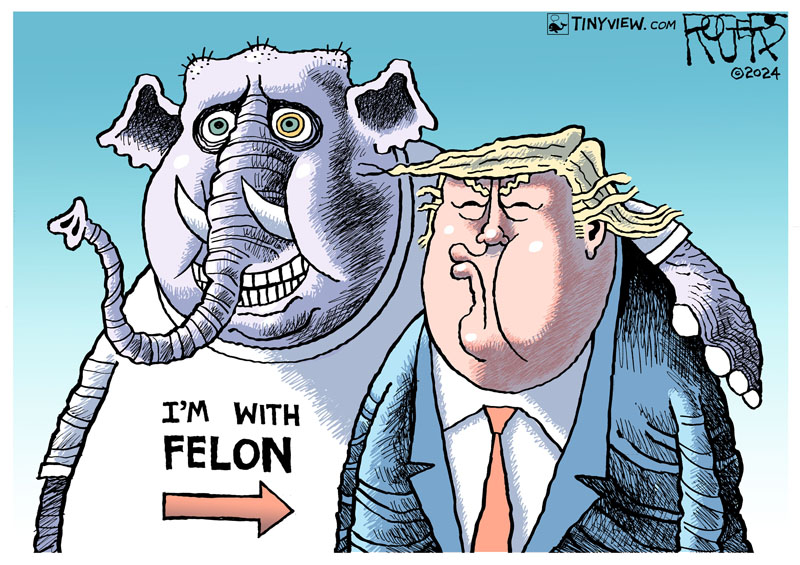
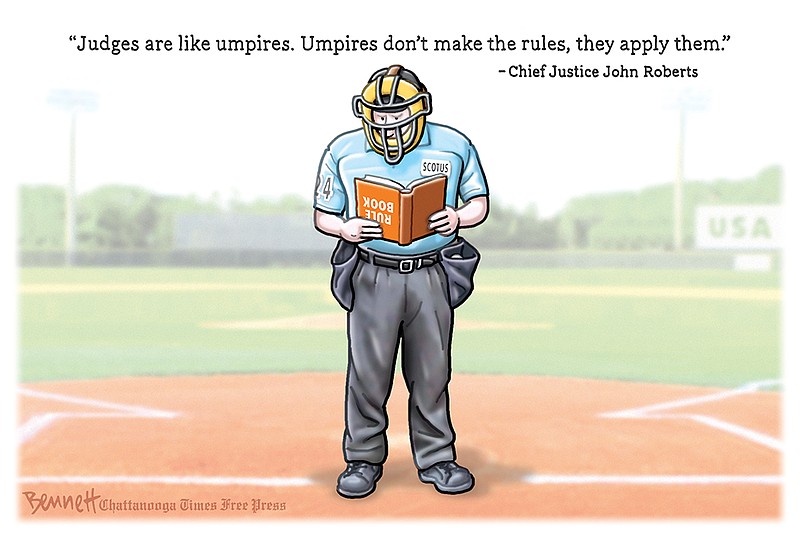
This week’s featured post is “Revisiting the fascism question“. I didn’t notice this cartoon until after that article posted.
If you wondered what I was doing with my week off last week, I was in a church speculating about death.
This week everybody was talking about Gaza
A frequently rumored deal where Hamas would release some number of hostages in exchange for a ceasefire of a certain number of days keeps not quite happening.
The war news this week centered on the Al Shifa Hospital in Gaza, which Israel has claimed sits over a Hamas command-and-control center. Meanwhile, though, it was a hospital, and conditions there became horrific while Israel searched it for Hamas fighters and their hostages. Saturday, a deal was reached to evacuate the patients that could be moved and leave the hospital with a skeleton crew to take care of the rest.
Israel turned up a collection of weapons from the hospital and a shaft that presumably goes down into deeper tunnels. But so far this evidence has fallen short of a command-and-control center, so not everyone was impressed.
It’s hard to feel good about any news coming out of Gaza. My interpretation of the October 7 attacks is that Hamas designed them to offend Israel as deeply as possible, giving Israelis the maximum motivation to come to Gaza and root them out. Simultaneously, Hamas had embedded itself in Gaza so tightly that Israel would have to do ugly, horrible things to succeed in rooting them out. For its part, Israel is now doing those ugly, horrible things, and Palestinian civilians are dying in large numbers.
Watching from the outside, I have a hard time coming up with some alternative path Israel ought to be taking, and yet I also have a hard time rooting for them to succeed in their current path. I find myself agreeing with this Nicholas Kristof column, especially this line:
Unless you believe in human rights for Jews and for Palestinians, you don’t actually believe in human rights.
There’s been a lot written — maybe appropriately so — about antisemitism on college campuses, and from the left in general. But this week we got a reminder that antisemitism on the right is far more pervasive and virulent.
Matt Yglesias wrote a fairly long column about left and right antisemitism, which I’ll oversimplify down to this: Leftists sympathize with Palestinians, and sometimes end up overshooting into hating Jews. Rightists hate Jews, and so invent conspiracy theories to justify that hatred. Neither position is good, but they’re not exactly mirror images of each other.
Cases in point are these statements by Tucker Carlson and Charlie Kirk, which blame Jews for financing “white genocide” and “anti-white causes”. Elon Musk responded to a tweet expressing a similar view with “You have said the actual truth.”
The borders of the homeland of the Jews are the Euphrates in the east and the Nile in the southwest.
That’s the land promised to Abraham’s descendants in Genesis 15. It includes big chunks of Egypt, Syria, Lebanon, and Iraq.
If someone decides to invent a new religion today, who will decide the rules? The first nation that got the word from God, the promise from God—the first nation is the one who has the right to it. The others that follow—Christianity and Islam, with their demands, with their perceptions—they’re imitating what existed already. So, why in Israel? They could be anywhere in the world. They came after us, in the double sense of the world.
She’s fine with non-Jews continuing to live in these lands, as long as they accept that
We the Jews are the sovereigns in the state of Israel and in the Land of Israel.
That means accepting that “they are not going to have the right to vote for the Knesset. No, no, no.”
and averting a government shutdown
I give Speaker Johnson credit for not waiting until the absolute last minute to recognize reality: Any plan to keep the government funded has to rely on Democratic votes, so loading a continuing resolution up with right-wing culture-war riders can’t work. The House got a relatively clean CR done Tuesday (supported by 209 Democrats and only 127 Republicans), the Senate passed it Wednesday, and President Biden signed it Thursday, with a day to spare. The ordinary business of government shouldn’t be dramatic. Things that need to get done should get done without watching some clock tick down to zero.
Johnson accomplished this by pulling the same trick Kevin McCarthy did just before the House sacked him: He avoided putting the bill through the Rules Committee (where all bills usually go, so that rules can be established for amendments, debate limits, etc., and which McCarthy had stacked with “Freedom” Caucus members as part of the deal that made him speaker). That meant it needed a 2/3rds supermajority to pass, which it only got via overwhelming Democratic support.
Predictably, passing a realistic CR with mostly Democratic votes angered the “Freedom” Caucus, which has no interest in the kind of compromise democracy always entails. So far no one is proposing another vacate-the-chair resolution. But it’s hard to see how Johnson gets past the next set of funding deadlines without a revolt.
About those deadlines: The one weird thing about the Johnson-designed CR is that it has two. The bill would extend funding until January 19 for military construction, veterans’ affairs, transportation, housing and the Energy Department. The rest of the government – anything not covered by the first step – would be funded until February 2.
It’s not clear what kind of game Johnson has in mind. Maybe he wants to get full-year appropriation bills approved for the January 19 departments approved first, then have a showdown over big cuts to the February 2 departments. Or maybe he wants to be able to have a shutdown over the January 19 departments while the others are still funded. We’ll see how Democrats maneuver in response.
In general, it’s hard to disagree with one part of Johnson’s rhetoric: Congress ought to debate individual programs on their merits, rather than vote the whole government up or down. However, such a plan requires repeated compromises with Democrats, and recognizing that the small and fractious Republican House majority can’t get its way on everything. As long as the House loads every bill with things Democrats will never support, nothing will pass and we’ll keep coming down to deadlines with the government unfunded.
The CR does not include additional aid for Israel or Ukraine. Meanwhile, Johnson’s previous bill that coupled aid to Israel with a deficit-increasing IRS cut is dead in the Senate. If Israel (not to mention Ukraine) is going to get more aid, the House is going to have to try again.
The fact that the IRS cut increases the deficit (by making it easier for rich taxpayers to cheat; I’ve heard the cut described as “defund the tax police”) is routinely left out of conservative-media articles. Conservative media frames the situation as Democrats wanting to protect IRS bureaucrats, not Democrats wanting rich people to pay the taxes they legally owe.
Basically, there are two kinds of legislators. When something needs to get done, one kind thinks “What am I willing to give up to make this happen?” and the other thinks “What can I get people to give me to stop blocking this?”
and the China summit
President Biden met President Xi on Wednesday, and accomplished a small number of important but not flashy things: They restored communications between Chinese and American military leaders, which is how minor incidents are settled without escalating into war. And China agreed to reduce precursor chemicals for making fentanyl, which is a key point in the China-to-Mexico-to-America drug trade. The two leaders disagreed about a number of other issues, like Taiwan.
Back in 2018, John Oliver publicized the banned-in-China anti-Xi memes styling him as Winnie the Pooh, and now I can’t see him without noting the resemblance.
and the Tuberville drama
Senator Tuberville’s blockade on military promotions continued this week, and we found out that he has at least one ally: Mike Lee of Utah.
Several Republicans have publicly expressed frustration with Tuberville on the floor of the Senate, to no avail. Democrats are going to propose a temporary rule change to circumvent the blockade, but it needs 60 votes to pass. If all 51 Democrats show up to support the change, nine Republicans will be needed. No one knows whether the anti-Tuberville faction has that many Republicans.
and Trump’s “insurrection”
A Colorado judge weighed in Friday on whether the 14th Amendment’s insurrection clause makes Donald Trump ineligible to be president again. The ruling is a mixed bag: She finds that Trump did engage in insurrection, in the sense intended by the Amendment, but denies that the phrase “officer of the United States” was intended to include presidents. As a result, Trump’s name should appear on Colorado primary ballots.
That sounds like a victory for Trump, but Harry Litman isn’t so sure. The engaged-in-insurrection part is a finding of fact (based on extensive examination of evidence) which the appellate courts would be inclined to defer to, while the not-an-officer part is a matter of law that the higher courts will want to decide for themselves. So this Trump “victory” may set up a less victorious outcome on appeal.
The judge’s opinion is a good summary of what happened on January 6. A key point is that Trump’s words can’t be taken at face value because
Trump developed and employed a coded language based in doublespeak that was understood between himself and far-right extremists, while maintaining a claim to ambiguity among a wider audience.
When Republicans and a few Democrats voted against a resolution to expel George Santos from the House of Representatives a few weeks ago, they claimed it was because he had not yet gotten the due process that an Ethics Committee investigation would provide.
The most glaring defect of the new code is its complete lack of any enforcement power. Its 15 pages are littered with weak verbs like “should,” “should not” and “endeavor to,” which, as any college student on a pre-exam bender will tell you, is a reliable way to sound serious without actually doing the work. … Whatever the justices do, they must know there will be no professional repercussions. Appointed for life and removable only by impeachment, they are effectively untouchable.
Baseball’s A’s will move from Oakland to Las Vegas by 2028, leaving Oakland without any sports franchises. The A’s are baseball’s most traveled franchise, beginning as the Philadelphia Athletics, then moving to Kansas City, Oakland, and now Las Vegas.
My annual exercise in humility — reading various publications’ best-books-of-the-year lists and admitting how few of them I’ve even noticed — begins with the Washington Post. And Vox reviews the 25 nominees for a National Book Award.
and let’s close with an interesting question
WaPo columnist Michael Dirda raises the idea of books you come back to again and again, and refines it a little: Books you may have read only once, but you want to come back to. What’s interesting in his column isn’t his list of 22 books, but the question itself.
I’ll offer All the King’s Men as a novel I re-read every five years or so, and Gravity’s Rainbow as one I don’t re-read cover to cover, but keep coming back to for specific scenes and descriptions. (If you write, you need to keep exposing yourself to authors whose grasp of language is deeper than your own.) As for a set of books I want to come back to someday: Neal Stephenson’s Baroque Cycle and Nick Harkaway’s Gnommon, which I almost understood the second time through.