Religious Liberty and Marriage Equality

Are the principles that protect religious liberty secure, or are recent court decisions steps on a slippery slope?


One of this week’s big stories was Arizona Governor Jan Brewer’s veto of S.B. 1062, “An Act … Relating to the Free Exercise of Religion“. Proponents claim that this law (and similar proposed laws around the country) is necessary to protect Christians from being forced to participate in same-sex marriage celebrations, in violation of their freedoms of conscience and religious liberty.

There’s one important thing you need to understand about this controversy: It’s symbolic. I went looking for cases where businesses were forced to deal with same-sex weddings and I found exactly five in the entire country.

  • In New Mexico, a photography business was successfully sued by a lesbian couple whose commitment ceremony (same-sex marriage being illegal in New Mexico) it refused to photograph. (I covered the ruling in a weekly summary last August.)
  • The Oregon Bureau of Labor and Industries ruled that a bakery had violated state law when it refused to make a wedding cake for another lesbian couple.
  • A judge in Colorado similarly ruled against a bakery.
  • A Vermont inn was sued for refusing to host a wedding reception for a same-sex couple, which the owners claim was a misunderstanding. The case was settled out of court, so we don’t know what a judge would have said.
  • A suit is pending against a florist in Washington.

Some writers make it sound like these are representative examples out of many, but they may well be the only instances to date.

Last June, the Pew Research Center estimated that over 70,000 same-sex marriages had been performed in the United States, plus an uncounted number of civil unions and legally unrecognized commitment ceremonies like the one in New Mexico. In all but a handful of them, people seem to have worked out whatever differences they had. Wedding planners, photographers, bakers, dress-makers, tuxedo-rental places, florists, celebrants, meeting halls, church sanctuaries … either they approved or they swallowed their disapproval or the couples took the hint and looked for service-with-a-smile elsewhere. Or maybe they found compromises they could all live with. (“I’ll sell you the cake, but you’ll have to put the two brides on top yourself.”)

In short, S.B. 1062 does not address a practical issue. Across the country, people are behaving like adults and working things out without involving the government. Governor Brewer recognized as much in her veto statement:

Senate Bill 1062 does not address a specific or present concern related to religious liberty in Arizona. I have not heard one example in Arizona where a business owner’s religious liberty has been violated.

The uproar is also symbolic on the other side. Critics of S.B. 1062 warned about “gay Jim Crow” laws, but just as there is no flood of suits against fundamentalist Christian florists, neither are large numbers of businesses waiting for the state’s permission to display “No Gays Allowed” signs. As The Christian Post pointed out, Arizona (like many other states) has no state law protecting gays from discrimination. (New Mexico does, which is why the lesbian couple won their suit against the photographers.) So outside a few cities that have local anti-discrimination ordinances, Arizona businesses are already free to put out “No Gays Allowed” signs without S.B. 1062. If any have done so, nobody is making a big deal out of it.

What this all resembles more than anything is the argument over the constitutional amendment to ban flag-burning. Actual flag-burnings are so rare that most of the amendment’s backers couldn’t cite a particular case, but they felt very strongly about it all the same. The few cases that actually exist are merely chips in a poker game; they are symbols of some deeper philosophical conflict, but mean little in themselves.

That’s not to say that philosophical conflicts are unimportant, but they are also not urgent. Because major injustices against one side or the other are not happening every day — and depending on your definition of “major injustice” may not be happening at all — we can afford to take some time to think this through calmly: What principles of religious liberty should we be trying to protect, and are any of those principles implicated in the cases that have been decided?

In my view, one basic principle is: No one should be forced to participate in a religious ritual. That’s why I don’t want teachers leading prayers in public school classrooms, especially when the children are too young to make a meaningful choice about opting out. For the same reason, it would be wrong to sue a priest who refused to perform a Catholic marriage ritual for a marriage his church did not sanction.

Some supporters of laws like S.B. 1062 (and the pending H.B. 2481) are citing this principle, but I think we need to be careful not to stretch the definition of a religious ritual. For example, civil marriage is not a religious ritual, so neither an officiating judge nor the clerk who issues a license is participating in religion. (If they were, that would seriously violate the separation of church and state.) Requiring that they do their jobs is not a violation of their religious liberty. The fact that you don’t make the laws and may disagree with them is a normal hardship of working for the government, not a First Amendment issue.

Similarly, a wedding reception is not a religious ritual; it’s a party that happens to take place after a religious ritual. Baking the cake or DJing the music or manning the bar are not sacramental roles, and do not deserve that kind of protection.

A second principle is: No one should be compelled to make a statement against his or her conscience. This was used as a defense in the Colorado bakery case. Administrative Law Judge Robert Spencer rejected it like this:

There is no doubt that decorating a wedding cake involves considerable skill and artistry. However, the finished product does not necessarily qualify as “speech,” as would saluting a flag, marching in a parade, or displaying a motto. The undisputed evidence is that [the baker] categorically refused to prepare a cake for Complainants’ same-sex wedding before there was any discussion about what that cake would look like. [The baker] was not asked to apply any message or symbol to the cake, or to construct the cake in any fashion that could be reasonably understood as advocating same-sex marriage.

So if a wedding-reception singer refused to sing some special gay-rights anthem, I would support him under this principle. But if he refused to perform at all, or refused to perform more-or-less the same collection of songs he does for everyone else who hires him, then I wouldn’t. Leading the friends and families of a same-sex couple in “The Hokey Pokey” is not a religious or political statement that should challenge anyone’s conscience.

Weighing against these exceptions is a public-accommodation principle that got established during the Civil Rights movement: If a business serves the public, then it should serve the whole public. The point of Jim Crow laws wasn’t to protect the consciences of white business owners, it was to exclude black people from the general public. If excluding gay and lesbian couples from the general public is the purpose behind refusing to serve them, that shouldn’t be allowed.

People try to fudge this principle by creating me-or-him situations. I grew up reading Ann Landers’ advice column in the newspaper. Ann used to regularly get questions like: “My good friend says she can’t come to my wedding if my other good friend is going to be there. What should I do?” As best I remember, her answer was always something like: “Invite everyone who you want to see there. If your friend doesn’t want to come, that’s her decision.” The same idea works here: Everyone should be invited to the marketplace. If you feel that the presence of gays and lesbians in the marketplace means you can’t be there, that’s your decision. No one has forced you out. (This is my answer to the U.S. Council of Catholic Bishops, who claim “Catholic Charities of Boston was forced to shut down its adoption services.”)

The other frequently raised issue has to do with venues: Will the law force my church sanctuary to be available for same-sex marriages? The idea that a sanctified site will be used for some unholy purpose strikes many people very deeply.

The case that is always cited — often not very precisely — involves a Methodist group, the Ocean Grove Camp Meeting Association in New Jersey. The OGCMA owned a boardwalk pavilion, which the judge described as “open-air wood-framed seating area along the boardwalk facing the Atlantic Ocean.” The Methodist group used the facility “primarily for religious programming”, but had received a tax exemption for the property the pavilion was on. One condition of the exemption was that the facility be open to the public. The OGCMA had a web page advertising “An Ocean Grove Wedding”, which cost $250 in rent. The OGCMA did not conduct or plan the weddings, and the page said nothing about Methodist doctrines concerning marriage.

Until the OGCMA turned down a lesbian couple that wanted to celebrate a civil union in 2007, no one could recall a wedding being refused for any reason other than scheduling. After the couple sued, OGCMA re-organized its use of the pavilion. It stopped advertising it to the public and sought a different kind of tax exemption available to it as a religious organization. The judge found:

[The OGCMA] can rearrange Pavilion operations, as it has done, to avoid this clash with the [New Jersey Law Against Discrimination]. It was not, however, free to promise equal access, to rent wedding space to heterosexual couples irrespective of their tradition, and then except these petitioners.

Recognizing that the couple mainly sought “the finding that they were wronged” and that the OGCMA had not “acted with ill motive”, the judge assessed no damages.

In other words, this example is not particularly scary when you know the details. The principle here is pretty simple: If you worry about the sanctity of your holy space, don’t rent it out to the public — which is good advice in general, irrespective of same-sex marriage. If you do rent it out, then we’re back to the public-accommodation principle.

In conclusion, I’m not seeing anything particularly alarming in the five cases (six, if you add the boardwalk pavilion case) that are motivating people to support S.B. 1062 or similar laws. Reasonable principles are prevailing, and I do not see a slippery slope.

So if you’re worried about your minister being forced to bless a same-sex wedding in your sanctuary or go to jail, don’t be. It’s not happening and nobody is advocating for it to happen. Nothing in the cases that have been decided leads in that direction.

The Monday Morning Teaser

The first article to come out today will start with Gov. Brewer’s veto of Arizona’s anti-gay “religious liberty” law, and then pull back to the larger question: What religious liberties are people worried about, and are the more specific principles that protect those liberties in danger?

In the whole country, I could only find four cases in which businesses have faced legal action because they didn’t want to be involved in same-sex wedding celebrations, and I believe one of them hasn’t been decided yet. I read all three decisions, plus a decision concerning a religious venue for a civil-union ceremony. The judges seemed well aware of the principles of religious liberty, and I don’t see any reason to fear that their decisions are steps on a slippery slope.

I’m still working on the title, but the article should be out in an hour or so.

In the weekly summary, the most compelling issue is the way the Ukraine situation has turned into a big-power confrontation. I decided to link to the insightful stuff I’ve read rather than pull together an article of my own. The interesting sidebar on the story is the history of Crimea’s Tatar minority, which came west with Genghis Khan.

Also in the summary: the Army might get smaller, bitcoin, the Republicans (sort of) have a tax plan, and after all those loud claims that the cold winter proved global warming wasn’t happening, this January turns out to have been the fourth warmest January globally since 1880.

Worth and Respectability

It may be well and proper, that a man of worth, honesty, industry, and respectability, should have the rank of a white man, while a vagabond of the same degree of [negro] blood should be confined to the inferior caste.

— Justice William Harper of the South Carolina Supreme Court
State v. Cantey (1835)

This week’s featured post is “Are You Sure You’re White?“, a review of Daniel Sharfstein’s The Invisible Line: a secret history of race in America.

This week everybody was talking about the Ukraine

As I’ve said before, a one-man blog is not the ideal operation for covering breaking news, so I mostly don’t try. But the wall of fire during the Kiev protests was impossible to ignore.

And when Olympic skier Bogdana Matsotska left Sochi intending to join the protests, she raised even more attention.

By Saturday, President Viktor Yanukovych had been voted out of office and left the capital. New elections are planned for May. For the moment it looks like the good guys have won, but as we saw with the Arab Spring demonstrations in Egypt, it’s hard to turn street protests into a functioning democracy. Best of luck to the Ukrainians.

ThinkProgress provides background on what this was all about.


BuzzFeed reports that the Yanukovych government had been trying to buy favorable coverage from right-wing blogs. This fits the pattern I discussed in “Keeping the Con in Conservatism“.

For the record, I received no money to mention Ukraine in this post.

and (oddly) not Venezuela

A new reader pinged me with his hope that I’ll explain what’s going on in Venezuela, which left me too embarrassed to say “Is something going on in Venezuela?” It weird how little coverage this is getting.

As in Kiev, there are massive street protests in Caracas. Here’s some background from BuzzFeed. And the latest from Reuters.

The current president, Nicolás Maduro, has been in office ten months after succeeding the late Hugo Chavez.

and Ted Nugent

I try to stay away from the outrage-of-the-week, but this week I failed. The front-runner for the Republican nomination for governor in Texas campaigned with Ted Nugent, who recently called President Obama a “subhuman mongrel“, a phrase that had more zing in the original German. (Subhuman is untermenschen and mongrel is mischling.)

Nugent is a clown who doesn’t deserve my attention or yours, but a state attorney general and potential governor of Texas is another matter. Wolf Blitzer (who is Jewish and knows how the phrase translates to German) reacted with as much reserve as he could muster:

Shockingly, Abbott’s campaign brushed aside the criticism, saying they value Nugent’s commitment to the second amendment issuing a statement, “Ted Nugent is a forceful advocate for individual liberty and constitutional rights, especially the second amendment rights cherished by Texans. While he may sometimes say things or use language that Greg Abbott would not endorse or agree with, we appreciate the support of everyone who supports protecting our constitution.”

The incident raised the question of whether there is any criticism of Obama that conservatives will denounce, or any right-wing personality who is too hateful to associate with. Fortunately, Rand Paul and John McCain decided the line had been crossed. But it was sad to watch Rick Perry, Ted Cruz, and other Republicans dance around a clear condemnation.

If anybody wants to do a liberals-do-it-too comment, start with who the Ted Nugent equivalent is and what they said that equals “subhuman mongrel”. Then find me a Democrat as highly placed as Greg Abbott who campaigned with them.

and a raft of discrimination-against-gays-is-OK bills

A bunch of states are passing laws to meet the “religious freedom” needs of people whose God demands that they treat gays badly. The most extreme is Arizona, where Governor Brewer is weighing whether or not to sign the bill. (The business community is against it, perhaps fearing another boycott similar to what happened after Arizona passed its anti-immigrant law.) But similar bills are being debated in Ohio, Mississippi, Idaho, South Dakota, Tennessee, Kansas and Oklahoma.

The text is here. It’s short and sweeping, and does not directly mention gays at all. The key section is:

A person that asserts a violation of this section must establish all of the following:

1. That the person’s action or refusal to act is motivated by a religious belief.

2. That the person’s religious belief is sincerely held.

3. That the state action substantially burdens the exercise of the person’s religious belief.

“State action” has been expanded to mean a court’s enforcement a civil rights claim. Proponents are trying to fix what they see as the injustice of a New Mexico case, in which a photographer was sued and lost after refusing to deal with a gay couple.

Reading the Arizona law, I fail to see why it wouldn’t apply to a restaurant owner who wanted to turn away black people, if his white supremacism were religiously based. (There are certainly churches you can join if you want to claim that right.) And even if I’m missing some legal distinction, I don’t see the moral distinction. The only justification I can see for separating the anti-gay bigot from the anti-black bigot is to argue that religious white supremacism is wrong, but religious rejection of homosexuality isn’t. And I don’t think the government should be empowered to decide whose religion is true.

In the larger view, I’ve stated my opinion before: I think this is all passive aggression. No one sincerely believes that his or her immortal soul is imperiled by taking pictures of gay couples or putting two grooms on the top of a wedding cake. It’s an exaggerated sensitivity invented to control the actions of others and justify acts of bigotry.

and looked back at the stimulus

It’s been five years since the American Recovery and Reinvestment Act was signed into law, so it was time to restart the argument about what it accomplished.

The point hardly anybody appreciates is that when you combine state and federal spending, there was no stimulus. Federal spending just replaced state cutbacks. The graph below shows the number of employees at all levels of government. (The blip in 2010 is temporary workers for the census. You can find a similar blip during the previous census in 2000.)

Overall, federal employment has been down slightly during the Obama years. State and local employment dropped drastically when the recession hit, and would have fallen much further if not for money in the stimulus that went to the states. People ask: “Where are the jobs from the stimulus?” A lot of them are the teachers, police, firefighters, and nurses who didn’t get laid off.

So the main thing the stimulus did was prevent a massive deflationary cut in government, like what happened so disastrously in Europe.

but I’m still thinking about racism

What Should ‘Racism’ Mean?” became the fifth post in Weekly Sift history to go over 10,000 page views. Last I checked, it had over 19,000, which made it the fourth-most-popular Sift post ever.

It’s been drawing a number of comments, including objections, which I’ve been trying to answer as best I can.

Here’s the thing that has struck me in the negative comments. It would be entirely possible to look at the examples I gave (of President Obama and his family being denounced for things previous presidents have done without incident) and say: “Yeah, there is a small group of racially motivated folks who claim to be conservatives so that they can attack the black president, but that’s not really who we are. Real conservatives have plenty of legitimate objections to Obama and don’t have to stoop to this stuff.”

Instead, many commenters identify with anyone criticizing Obama for whatever reason and circle the wagons around them. As a result, it becomes easier to paint all conservatives as racists, which is not at all what I claimed.

This week I continued to focus on race in Are You Sure You’re White?, a review of Daniel Sharfstein’s The Invisible Line. I also ran across this great video illustrating the implicit bias I talked about last week.

In a hidden-camera experiment, three young people try to steal a bicycle in a well-traveled public park. The young white man draws a few questions but no one makes a serious effort to stop him or call the police. The young black man draws a crowd and the police are called. But most hilarious is what happens to the young white woman: Men stop to help her. That poor girl, she’ll never saw through that chain on her own.

Here’s a similar hidden-camera test where black and white men try to steal a car in broad daylight.

and you also might be interested in …

This 99-year-old Bulgarian spends every day on the street begging, but not for himself.


I love Rachel Maddow, but I have to agree with Bill Maher in this conversation when Rachel was a guest on his show: MSNBC is over-covering the Chris Christie scandal. Like Bill, I think BridgeGate is a legitimate scandal and I want to get to the bottom of it, but there’s not a whole segment (or more) worth of new developments every night.

I regularly tune in to Rachel’s show or Chris Hayes’ or Steve Kornacki’s , but these days I often think “Jesus, not this again.” Partly it’s the generic cable-news tendency to over-hype stories and try to get us hooked on every new detail. And I’m willing to be convinced that Rachel is accurate when she says that she covered Democratic governor Rob Blagojevich’s scandal just as intensely. But I found Blago’s villainy more amusing, and even so, I remember getting sick of that story too.

If you are similarly ignoring MSNBC and/or Bridgegate these days, I’ll let you know when something important happens.


Salon’s Brian Beutler blows up another ObamaCare horror story, and then suggests the obvious question:

I know the right is heavily invested not just in ignoring Obamacare success stories, but in cultivating the very horror stories they then use to attack the law. This, at least, doesn’t appear to be a case of the latter. I’m perfectly willing to believe that the Affordable Care Act has really left some people in categorically horrible situations. Given the numbers involved, I’d be pretty surprised if such people didn’t exist. But at some point it’s worth asking whether the apparent difficulty conservatives have finding them suggests that maybe the law isn’t wreaking all the devastation they want you to believe it is.


Wonder why other countries have faster, cheaper internet? Big cable companies like the proposed Comcast/Time-Warner monolith, and an FCC that caters to them.


Michael Sam won’t be the first openly gay player in a major American professional sport after all. The Brooklyn Nets picked up Jason Collins’ contract, and he played briefly Sunday. ESPN New York reports how strangely normal it all was.

Sure there was applause, and a few folks who stood up to recognize the magnitude of the moment, but if you didn’t know what was happening, you really would’ve had no idea something historic had just happened.


Economist Jared Bernstein challenges the idea that jobs are going unfilled because Americans aren’t trained for them.

When you hear employers complaining about how they can’t find the skilled workers they need, remember to plug in the unstated second part of the sentence, “…at the wage I’m willing to pay.”


Atlantic’s Garrett Epps points out that the Hobby Lobby case is open-and-shut if the Supreme Court follows its own precedents:

If so, Hobby Lobby and the other challengers don’t even get out of the starting gate. The Burger, Rehnquist, and Roberts Courts have all been clear: These plaintiffs have not suffered any injury worthy of redress under the Constitution.

However, that’s not how this Court’s conservative majority behaves. Witness the ObamaCare decision of 2012. In prior cases, the Commerce Clause clearly allowed such laws; constitutionality was not even seriously discussed when the law was being passed. But magically, a new legal theory appeared just in time to disallow the individual mandate under the Commerce Clause, and five Supreme Court justices signed on to that brand new interpretation. Chief Justice Roberts had to find a different justification to avoid invalidating the law completely.

Maybe the same thing will happen here. Law isn’t supposed to be suspenseful like this.

and let’s end with something fun

I never knew NBC’s Brian Williams did a cover of “Rapper’s Delight”. (Compare to the original.)

Are You Sure You’re White?

Daniel Sharfstein tells the story of three families who crossed the color line, and their descendents who forgot.


One of Dave Chappelle’s most memorable bits is his portrayal of Clayton Bigsby, a blind white supremacist who doesn’t know he’s black. Bigsby writes racist books whose readers also think he’s white. He lives in a remote area with few neighbors, and only appears in public in his KKK hood. A few white supremacist friends know the truth, but they keep the secret because “He’s too important to the movement.”

Bigsby is an exaggerated version of Mr. Oreo, a character created as a thought experiment by philosopher Charles W. Mills of Northwestern. Mr. Oreo was born to parents who identified as black and he appears black himself, but he has always thought of himself and described himself as white. At some point he goes through a medical process that alters his features, hair, and skin color so that he becomes indistinguishable from whites. Is he white? Or is there an unalterable underlying reality to his blackness?

According to professors who have discussed Mr. Oreo in class, students almost unanimously judge Mr. Oreo to be black. As David Livingston Smith explains in Less Than Human (his fascinating book on dehumanization, which devotes a lot of time to the belief that certain races are subhuman), our culture commonly believes that some personal traits are changeable (a weak man can go through a muscle-building process to become a strong man) while others, like race, are not.

We tend to think — perhaps in spite of ourselves — that black people constitute a natural kind, whereas weak people don’t. … We say a person has large muscles, but we say they are of a certain race. … A person can gain or lose muscle while remaining the same person, but we tend to think that if they were to change their race, it would amount to becoming an entirely different person.

Real life provides its own examples, some even more compelling than Mr. Oreo. In her 1949 autobiographical essay collection Killers of the Dream, Lillian Smith recalls Janie, a white-skinned little girl taken from a poor black family newly arrived in the colored part of town. (They “must have kidnapped her”, the local whites decided.) Janie was brought to live with the Smiths, and Lillian fell into a big-sister role.

It was easy for one more to fit into our ample household and Janie was soon at home there. She roomed with me, sat next to me at the table; I found Bible verses for her to say at breakfast; she wore my clothes, played with my dolls, and followed me around from morning to night.

But in a few weeks, word came from a distant colored orphanage: Janie only appeared to be white; she was “really” black and had to return to the black family who had adopted her. At first, Lillian could not see the sense in this, but eventually she yielded to superior adult wisdom.

I was overcome with guilt. For three weeks I had done things that white children are not supposed to do. And now I knew these things had been wrong.

In The Invisible Line: a secret history of race in America, Daniel J. Sharfstein tells a more elaborate and challenging story, one that “has been hiding in plain sight” for centuries. He describes it as a “hidden migration”:

African Americans began to migrate from black to white as soon as slaves arrived on the American shore. This centuries-long migration fundamentally challenges how Americans have understood and experienced race, yet it is a history that is largely forgotten.

In earlier eras historians have acknowledged the passing-for-white phenomenon, but considered it virtually untraceable. After all, anyone motivated to pass for white was even more motivated to hide the evidence. But the genealogy boom (empowered by easy access to records over the internet and the possibility of analyzing your DNA for information about your ancestors) has unleashed thousands of amateur investigators and turned up many new cases. Lots of Americans are not as white as they think they are, and some are starting to find out.

Sharfstein traces three families who crossed the color line at different points in American history.

The Gibsons. Prior to Bacon’s Rebellion of 1676, race was not nearly as significant in Virginia as it later became. White indentured servants had more in common with the black slaves than with their upper-class masters, and mixed-race children were not unusual. The law classed a child as belonging to the same race as its mother. Gibby and Hubbard Gibson were mixed-race children of a white mother, and so were free. They moved inland, cleared land, and intermarried with the other frontier property-owning families.

As racial standards tightened generation-by-generation, the Gibsons stayed just on the favored side of the color line, and just far enough away from the race-conscious coastal cities that few cared enough to make an issue of their darker-than-average skin. They moved to North Carolina, and then to the wild western side of South Carolina. By the time they reached Kentucky and Louisiana in the 1800s, no one remembered that the family’s race had ever been an issue.

Gibson boys became officers in the Confederate Army, and Yale-educated Senator Randall Gibson of Louisiana played a key role in the negotiations that resolved the contested 1876 presidential election by trading Southern electoral votes for President Hayes’ promise to end Reconstruction. Randall also was a major player in the founding of Tulane University, convincing Paul Tulane to revise his bequest from “serve young men in the City of New Orleans” to “serve young white men in the City of New Orleans”.

A later generation married into the Marshall Field family of Chicago. As curator of the Field Museum of Natural History, Henry Field commissioned a series of sculptures illustrating over a hundred separate “races” for the Hall of Races of Mankind that opened in 1933. He had no clue he was anything but 100% European.

If anyone out there has media connections, I think The Gibsons would make a fabulous miniseries.

The Walls. Stephen Wall was a North Carolina plantation owner who never married, but fathered several children with his female slaves. In the 1830s he appeared to be selling his children to a plantation in Alabama, but in fact this was a ruse. Instead, a family friend delivered the Wall children to a Quaker settlement in Indiana, where Stephen provided resources for them to be raised and educated.

One of those children, O.S.B. Wall, was instrumental in convincing the Ohio governor to field a black regiment in the Civil War. He recruited black soldiers across the state and became a captain, though he arrived at the front too late to see combat. After the war, Wall moved to Washington, D.C., where he became part of a budding freedman aristocracy and held several positions in the local political machine.

But D. C. became one of the first places to disenfranchise blacks after the war. When the city ran into financial difficulties in the Panic of 1873, the federal government took direct authority over local affairs, shunting local elected officials aside for decades. When Democrats (who at the time openly identified themselves as “the white man’s party”) came to power with Grover Cleveland in 1884, white supremacy followed.

Captain Wall married a light-skinned woman, and his children found that they were frequently mistaken for white. His son Stephen married a white woman, but continued to identify as the son of a prominent leader in the black community, for all the good it did him. He was repeatedly let go from his job in the government printing office without cause, only to be rehired later. The final straw came when his indistinguishable-from-white daughter was barred from the public school in his suburban neighborhood, and he lost a series of court cases to have her reinstated, despite being legally in the right. (By prevailing definitions, Isabel’s black ancestry was sufficiently diluted that she should have been considered white. But whatever the text said, the spirit of the law was to protect white families from “falling” into the black community due to the discovery of an unexpected dark ancestor, not to allow a Negro man to marry a white woman and launch his children into white society.)

The family moved, changed its name to Gates, and began passing for white. Two generations later, Thomas Murphy (a “white” Georgian with considerable prejudice against blacks) got a nasty shock from his genealogy research. “You can’t call me a racist because I is one of you,” he told his black co-workers at the Atlanta airport.

The Spencers. Freed slaves had a hard time finding a place for themselves. Slave-owners viewed freedom as a contagious notion, so they didn’t want the freedmen around, and no state wanted to advertise itself as a destination for other states’ former slaves. For many, the solution was to go someplace without a lot of neighbors.

George Freeman and Jordan Spencer (who might been his son) were mixed-race freed slaves (of the white Spencer family) who settled in the hill country of eastern Kentucky in the early 1800s. They married sisters from a white family that passed through and left their daughters behind. When they ran into legal trouble from the local whites, Freeman stayed and hired a lawyer, but Spencer moved deeper into the wilderness. After he arrived in Johnson County, Kentucky, he didn’t exactly proclaim himself a white man, but he just started acting like one. White men, for example, were required to muster with the local militia and drill, while black men were forbidden to have weapons. Spencer showed up for drills, and nobody took it on themselves to tell him he shouldn’t.

At the time, even the South Carolina Supreme Court was recognizing the extent to which race was socially constructed. In an 1835 case, Justice William Harper wrote:

The condition of the individual is not to be determined solely by the distinct and visible mixture of negro blood, but by reputation, by his reception into society, and his having commonly exercised the privileges of a white man. But his admission to these privileges, regulated by the public opinion of the community in which he lives, will very much depend on his own character and conduct; and it may be well and proper, that a man of worth, honesty, industry, and respectability, should have the rank of a white man, while a vagabond of the same degree of blood should be confined to the inferior caste.

The hill country was more focused on clans than on races, and over time the Spencers became just another clan, darker than most, but respectable in their way. Jordan’s children intermarried with other clans — some of whom were not too clear about their own ancestry — who then found it convenient to describe the Spencers as white, if they were forced to describe them at all.

Two generations later, slavery was gone and Jim Crow had begun. Suddenly, one provable drop of “black blood” might be all it took to find yourself on the wrong side of the color line. George Spencer had moved across the border to the hill country of western Virginia, where he was doing fine until a feud started with a wealthier family, who started spreading rumors that the Spencers were “God damned negroes”. A slander trial ensued, with detectives going back to Kentucky to interview old people about where Jordan Spencer might have come from and whether he anyone had ever suggested he might not be white. A jury found against the Spencers, but the Virginia Supreme Court threw the verdict out and the case was never retried. That was enough for the locals to go on treating the Spencers as white, maybe with an occasional wink or nod.

Summing up. We look back on American history and say that people (including our own ancestors) were “white” or “black” as if those words had some natural meaning that remained constant through time and space. But in fact, the lines between the races have fluctuated, and even the apparent rules have applied differently to one family than to another. Sometimes all you had to do to cross the color line was move somewhere new and let people make assumptions about you.

At all times in American history, being considered white has brought certain advantages, and in every generation there have been light-skinned people who didn’t see why they or their children shouldn’t have those advantages. Both sides of the racial divide have had reason to minimize this phenomenon. For whites, the fact that the color line was fluid and permeable undermined the whole concept of white superiority. For blacks, those who forsook their black heritage lent credence to the notion that African ancestry was something to be ashamed of. And those who crossed over had reason to hope no one would ever find out, including, perhaps, their own children.

But reclaiming the “hidden migration” has a role to play in ending racism and healing the racial divide. Not only is racial purity an unworthy goal, it is a myth. We have never had racial purity in America. We are a lot closer to being one big family than most of us ever suspected.


BTW, I thought I’d head off an obvious comment: I realize that this post’s title assumes the reader is white (or thinks s/he is). I ask the indulgence and forgiveness of the Sift’s non-white readers. No inclusive title I could think of brought the issue to a head quite so sharply.

The Monday Morning Teaser

It’s been a busy week on the Sift.

Last Monday’s “What Should ‘Racism’ Mean?” is close to 19,000 page views and is still running. It has moved into 4th place on the Sift’s greatest hits list, passing one of my favorites “One Word Turns the Tea Party Around” at 18K. At this rate it should run past “Why I am Not a Libertarian” at 24K. But “Six True Things Politicians Can’t Say” at 69K and “The Distress of the Privileged” at 316K are still a long way out there. (I wonder if other blogs’ hit distributions look like that, with such extreme outliers. A typical featured post gets a few hundred hits, not counting the people who subscribe.)

Anyway, I’ve spent a bunch of this week responding to comments, which is why the Link of the Day hasn’t been even close to daily.

This week I’m going to take a different angle on the race theme with a review of Daniel Sharfstein’s book The Invisible Line: a secret history of race in America. It’s a generation-by-generation look at three American families who crossed the color line from black to white, eventually forgetting their black ancestors. It is both an amazing perspective on what it has meant to be white or black at various points in American history, and a meditation on just how socially constructed the whole notion of “race” is. (Spoiler: One of the families joins the Confederate aristocracy and includes a senator who played a role in ending Reconstruction.)

I called the article “Are You Sure You’re White?”. I realize that title implicitly leaves out my non-white readers, who I hope will forgive me and read the article anyway. (I think you’ll like it.) I couldn’t think of any more inclusive titles that would be nearly so clickable.

Beyond that, the weekly summary will try to catch up with what’s going on in Ukraine and Venezuela. The 5-year anniversary of the Stimulus brought a lot of retrospective debate. A series of state legislatures are considering bills that would redefine “religious freedom” as “freedom to discriminate against gays”. And I’ll end with NBC’s Brian Williams performing “Rapper’s Delight”.

Déjà vu

If I had ever been here before
I would probably know just what to do.
Don’t you?

— David Crosby, “Déjà vu” (1970)

This week’s featured posts are “Sam We Am” and “What Should ‘Racism’ Mean?

This week everybody was talking about Michael Sam and the NFL

I cover this in detail in “Sam We Am“. It’s part of this week’s déjà vu theme: The arguments we’re hearing against Sam joining the NFL are the same ones that get trotted out — and usually defeated — whenever some new group wants to be included somewhere. And they’re almost exactly the ones that the public just rejected in 2011 when Don’t Ask Don’t Tell was being repealed. As a result, public discussions that used to take months to play out are happening in days.

Friday we got a better view of what Sam might be walking into with the release of the independent report the NFL commissioned on the locker-room culture of the Miami Dolphins. The Dolphins bullying story broke in November, when Jonathan Martin left the team and Richie Incognito was suspended.

After a thorough examination of the facts, we conclude that three starters on the Dolphins offensive line, Richie Incognito, John Jerry and Mike Pouncey, engaged in a pattern of harassment directed at not only Martin, but also another young Dolphins offensive lineman, whom we refer to as Player A for confidentiality reasons, and a member of the training staff, whom we refer to as the Assistant Trainer. We find that the Assistant Trainer repeatedly was targeted with racial slurs and other racially derogatory language. Player A frequently was subjected to homophobic name-calling and improper physical touching. Martin was taunted on a persistent basis with sexually explicit remarks about his sister and his mother and at times ridiculed with racial insults and other offensive comments.

and more advances for same-sex marriage

In another example of déjà vu, you can add Virginia to the list of states (Utah, Oklahoma, …) where federal judges have thrown out the state constitution’s same-sex-marriage ban after last summer’s Windsor decision. And Kentucky now has to recognize marriages performed in other states.

Like the debate over Michael Sam, these cases have a same-old-same-old quality. No matter how many times judges shoot down their arguments, traditional-marriage-only advocates offer nothing new. In her Virginia decision, Judge Allen repeated what all the other judges have been saying:

The legitimate purposes proffered by the Proponents for the challenged laws — to promote conformity to the traditions and heritage of a majority of Virginia’s citizens, to perpetuate a generally-recognized deference to the state’s will pertaining to domestic relations laws, and, finally, to endorse “responsible procreation” — share no rational link with Virginia Marriage Laws being challenged.

These arguments have become batting-practice pitches, not serious attempts to strike the same-sex couples out. The obvious implication is that the Religious Right’s quiver is empty, and that (while there’s still considerable mopping up to do) the national debate is over, at least as far as the law goes.

and — surprise! — a clean debt ceiling extension

President Obama signed it Saturday. The Tea Party can’t hold the world economy hostage again until March 15, 2015.

John Boehner allowed this vote in the House (and was one of only 28 Republicans to vote yes) and Mitch McConnell voted to kill Ted Cruz’ filibuster. You’ve got to figure they looked at the political fallout of the October crisis and said, “We’re not doing that again.”

It probably also means that Mitch McConnell is more afraid of Democrat Alison Lundergan Grimes than of his Tea Party challenger in the Republican primary. Still, outside-group ads like this one from the Senate Conservatives Fund can’t be doing McConnell any good.

There’s a rude justice to lines like: “Mitch McConnell is trying to bully conservatives just like the IRS is.” The GOP leadership helped create this fantasy world. Now they have to live in it.

and the Republican Civil War starting to get real

The NYT reported:

“I’ve been told by a number of donors to our ‘super PAC’ that they’ve received calls from senior Republican senators,” said Matt Kibbe, president of FreedomWorks, which is supporting challengers to Republican incumbents across the country. The message from these donors was blunt: “I can’t give to you because I’ve been told I won’t have access to Republican leadership,” Mr. Kibbe said. “So they’re playing hardball.”

Interfering with the donor base really is hardball. TPM commented: “It’s hard to overstate the animosity that House GOP leaders feel for outside tea party groups these days.”

and the Michael Dunn verdict

Guilty, but not of murder. It’s hard not to see this as another racial statement by a Florida jury. If a black adult had sprayed bullets around a car of white boys, I find it hard to imagine a jury taking his I-thought-I-saw-a-gun defense seriously.

Sunday on MSNBC’s “Disrupt with Karen Finney“, Faith Jenkins reacted like this:

Every racial stereotype you could possibly advance about a young black teen, Dunn used it: thug, gangster, rap music. … We see from the Zimmerman trial and now with this trial, some sort of perfect defense emerging when you kill a young black kid. All you have to do is say, “I was in fear for my life.” “They were reaching for my gun.” or “They had a gun.” … and then “They said they were going to kill me.” … That seems to be the perfect defense now.

and Comcast’s bid to take over Time Warner Cable

The deal valued at $45 billion says a lot about the way antitrust law has been interpreted since the Reagan administration. Comcast argues that the two cable companies don’t compete in many markets (and it’s willing to spin off the TWC franchises in those areas), so consumers shouldn’t see any difference.

But the full impact of the merger hits in two ways: It limits the number of companies who might come up with a new model entirely; but more important, it gives the new Comcast an even larger bulk it can throw between producers and consumers. I talked about this phenomenon in 2012 in “Monopoly’s Role in Inequality“. In that piece I argued for transparent markets that would make common carriers out of middlemen like the cable companies. Instead, we have opaque markets, where giant media conglomerates duke it out with giant distribution networks.

In an opaque market, the way to get rich is not to produce things, but to build middleman power that allows you to dictate terms up and down the supply chain.

At the time, I used a skuffle between Viacom and DirectTV to illustrate.

Maybe you couldn’t watch Jon Stewart for a week, but the problem had nothing to do with either you or Jon Stewart. He wasn’t asking for a raise; you weren’t balking at the price of watching the Daily Show. But both you and Jon were irrelevant when two giant middlemen had a power struggle. … These middlemen outweigh both you and Jon Stewart. If Jon doesn’t work for one of the six big media companies, he can’t reach a major audience. If you don’t deal with either DirectTV or a cable monopoly, your TV choices shrink considerably.

That’s the threat. Not that you’ll have fewer companies to deal with in your town, but that the industry will continue to re-configure for the benefit of middlemen rather than producers or consumers.

I hope The Week and Quartz are right when they predict the merger won’t go through.

and you also might be interested in …


Robert Draper’s profile of Wendy Davis in the NYT Magazine puts her in a good light, but its title — “Can Wendy Davis Have it All?” — exemplifies the gender double-standard he criticizes. Nobody ever asks whether a male candidate can “have it all”.


The WSJ’s Valentine’s Day advice to women comes from Susan Patton.

Think about it: If you spend the first 10 years out of college focused entirely on building your career, when you finally get around to looking for a husband you’ll be in your 30s, competing with women in their 20s. That’s not a competition in which you’re likely to fare well.

I think your first mistake was looking for relationship advice in The Wall Street Journal.


I know you’re all just dying to know what connection religion might have to porn addiction, so here it is:

There was no connection between the religious devotion of the participants and how much porn they actually viewed, the studies showed. However, stronger religious faith was linked with more negative moral attitudes about pornography, which in turn was associated with greater perceived addiction.


Three Republican senators have outlined a plan to replace ObamaCare — years after Republicans floated the “repeal and replace” slogan. We’ll see if the GOP leadership actually gets behind the plan, or if it’s just a we-have-a-plan-too puff of smoke.

The WaPo suggests several reasons the plan would be worse than ObamaCare, but in some sense that misses the point. ObamaCare, after all, is based on the Republican alternative to HillaryCare in the 1990s. That Republican “plan” evaporated as soon as HillaryCare was off the table, and when Republicans controlled both Congress and the White House during the Bush administration, they did not pursue it. When Obama gave them a serious opportunity to implement the ideas they had said they supported, they denounced it as “socialism” and claimed it was unconstitutional.

Voters need to ask themselves whether the same thing would happen here. I think it would: The day Republicans successfully repeal ObamaCare, their “alternative” will be history … until a future Democratic president revives it in 2030 and it becomes socialism too.


Republicans in the Missouri legislature have a new plan for pushing schools to “teach the controversy” about evolution.


I keep thinking that someday, as the 1% accumulate more and more power, workers are going to rediscover unions. Well, it didn’t happen this week in Chattanooga: The UAW failed to organize the VW plant, in spite of VW’s neutrality in the matter.

You know who wasn’t neutral? Tennessee’s Republican Senator Bob Corker, who claimed that unionization would send production of a new VW SUV to Mexico — even though VW management had claimed otherwise. Also Republican State Senator Bo Watson, who threatened a loss of state incentives if the plant went union.

Whether those threats swayed the election or not, it hard to argue with Business Week: “If the UAW couldn’t win this one, what could they win?”

What Should “Racism” Mean?

There’s a type of faux scandal that’s been happening … well, I haven’t exactly kept track, but it seems like there’s a new one every month or two. They all fit this pattern: President Obama does something that symbolically asserts his status as president, and the right-wing press gets outraged by how he’s “disrespecting” something-or-other related to the presidency.

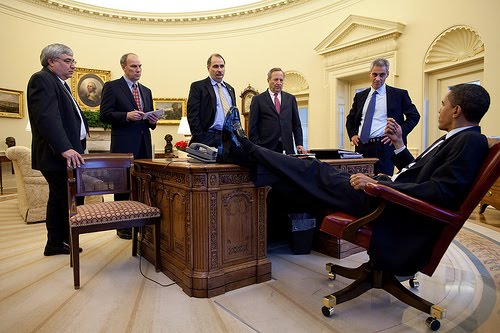
So, for example, in January, 2010 this photo caused FoxNation.com to ask whether Obama was “disrespecting the Oval Office” by putting his feet up on the antique desk.

Of course, it didn’t take long to uncover similar photos of previous presidents, none of which had raised any particular outrage at the time. But everybody forgot again, and so we had an almost identical flap last September. “This just makes me furious,” one woman tweeted. “He was raised so badly.”

Or remember last May when marines held umbrellas over President Obama and visiting Turkish Prime Minister Recep Erdogan. Horrors! He’s treating our revered warriors like servants! How dare he! It was front-page news.

Once again, it wasn’t too hard to find similar photos of previous presidents, which weren’t front-page news — or any kind of outrage at all.
Other such “scandals” involve the First Lady: Did you know that Michelle had the audacity to wear an expensive gown to a recent state dinner, like first ladies have been doing, well, forever? Compare to this 2005 WaPo column in which Laura Bush is said to look “regal” — and that’s a compliment. Until 2009, the First Lady was supposed to look regal. Remember Jackie Kennedy? But when Michelle dresses up, she’s Marie Antoinette.

The Obama’s vacations are another issue, and how much taxpayers spend to protect them outside the White House. But of course when the Bush twins celebrated their 25th birthdays in Buenos Aires, nobody cared what it cost the Secret Service to keep them safe in an exotic locale. They were the president’s daughters, so of course we protected them.

The entire White House lifestyle is an issue: The Obamas are “living large” claimed National Review (and mentioned Marie Antoinette again). The Washington Post fact-checker investigated and concluded: “there appears to be no appreciable difference between Obama’s expenses and Bush’s.” If you read the NR article carefully — and most of the other articles raising this faux issue — you’ll realize they never said there was. It’s just that the Bushes living large never bothered anybody.

Town Hall criticized the extravagance of having Beyonce perform at the Obama White House. But when Frank Sinatra performed for the Reagans, nobody looked at it that way. Why would they?

Even the Obamas’ Christmas cards became an issue. This one, from 2011, disrespects the Christian holiday because it is secular and features the president’s dog:

But this one, from the Bushes in 2005, is fine.

I could go on and on. Whenever President Obama acts like the President of the United States, or the Obamas act like the First Family, it just looks wrong to a lot of people.

So here’s the $64,000 question: Is that racist?

It depends on what you think racist means. Conservatives will not only answer the question “No”, they’ll be insulted that you even raised it (and will probably launch into their canned everybody-who-disagrees-with-Obama-is-a-racist-to-you-people riff). That’s because conservatives have adopted a very restricted definition of racism: Racism is conscious hatred towards people of another race.

So, those white folks who didn’t even notice when Reagan’s or JFK’s feet were on the desk, but who see Obama’s and think “He was raised so badly.” — are they also secretly thinking “Who does that uppity nigger think he is, acting like he’s a real president or something?” Maybe a few here or there, but mostly no. They aren’t consciously hating Obama because he’s black. But they can’t look at a black president the same way they looked at the 43 white presidents. Things just look different when Obama does them.

What do you call that?

I’m asking that question seriously, not rhetorically. I sympathize with people who want to reserve racism for Adolf Hitler ordering the Final Solution to the Jewish problem or George Wallace standing in the door to block black students from enrolling at the University of Alabama. The men who lynched Emmett Till or the grand jury that refused to indict them — those people were racists. I get that it doesn’t seem right to put them in the same category with the people who only just realized in 2009 that life in the White House is pretty sweet.

But all the same, lots of whites look at Obama and can’t think “president” without thinking “black president” — and they go on to judge his actions more harshly than those of white presidents. They go on to treat him with less respect than white presidents have always received — like interrupting the State of the Union to yell “You lie!” or questioning his birth certificate when there was never any reason to do so. (This satire, which applies the same standards to Ronald Reagan’s birth certificate, is hilarious precisely because it would never have been taken seriously.)

Congressmen saying it would be “a dream come true” to impeach the President (while admitting they have no evidence of an impeachable offense), or listening patiently while constituents publicly say the President “should be executed as an enemy combatant” — that would have been unthinkable during the 43 white administrations. But today it’s considered acceptable behavior.

If you don’t want to call it racism, fine. But it’s a real phenomenon; it needs a name. What do you call it?

I’ve narrowed my focus to President Obama, but really the phenomenon is much broader. For example, read Tim Wise’s “What if the Tea Party Were Black?” or just about anything about Trayvon Martin. If Michael Dunn had been a black man shooting up a car full of white boys, I doubt jurors would have bought his I-thought-I-saw-a-gun argument.

For a lot of whites who don’t harbor any conscious racial malice, things just look different when blacks do them. What do you call that?

Teasing out the different stances that might be called “racism” is at least half the value of Ian Haney Lopez’ recent book Dog Whistle Politics. Lopez notes that racism changes from one era to the next, and somebody changes it. “Racism is not disappearing,” he says, “it’s adapting.”

Lopez uses the word “racism” for most of the possible meanings, and differentiates with adjectives. Here are some of the ones he finds:

  • racism-as-hate. The most restrictive definition, and the most comforting for whites. “For the public at large, racism-as-hate provides self-protecting clarity: if racists are like those in the 1950s who screamed at black school children and burned crosses, then most everyone can safely conclude that they, at least, are not racists. … Since conservatives on the Supreme Court adopted a malice conception of racism in 1979, when using this approach the Court has rejected every claim of discrimination against nonwhites brought before it.”
  • structural or institutional racism. This is racial injustice that seems to be the fault of nobody in particular, because it’s embedded in the way society works. Vicious cycles (like poverty leading to dysfunctional behavior which leads back to poverty) may trace back to past sins like slavery or Jim Crow, but now they are self-replicating. “Structural racism is racism without racists. All that said, precisely because institutional racism implies a need to change society, it was rejected long ago by conservatives, including those on the Supreme Court who repudiated this understanding of racism in the early 1970s.”
  • implicit bias. This is the it-just-looks-different response I have been describing, or the kind that shows up in Implicit Association Test you can take online.
  • commonsense racism. “The social world through which we move reflects centuries of racism that extends right up to the present. But this is hard to grasp in its particulars. Instead, we see clearly only the results, and with the underlying causes hidden, we tend to accept the extant world as a testament to the implacable truth of racial stereotypes.” The commonsense racists “are not hate-filled bigots but decent folks who see racial injustice as a normal feature of society. … For many, it simply seems ‘true,’ an unquestioned matter of commonsense, that blacks prefer welfare to work, that undocumented immigrants breed crime, and that Islam spawns violence.”
  • strategic racism. New appeals to racial prejudice and new rationalizations for racial injustice don’t create themselves. When the old racial manipulations stop working, somebody figures out new ones. “Strategic racism refers to purposeful efforts to use racial animus as leverage to gain material wealth, political power, or heightened social standing. … [B]ecause strategic racism is strategic, it is not fundamentally about race. … [S]trategic racists act out of avarice rather than animus.”

Lopez retells a lot of American history to illustrate how when one avenue for racial injustice was blocked, another was usually found in short order. (His discussion of how in the Reconstruction Era convict leasing developed into a new form of forced black labor to replace slavery, and continued in that form well into the 20th century, was new and eye-opening to me.) He sees this not as blind evolution, but as clever people working out the new arrangements and constructing ways to rationalize them to the masses.

Lopez also describes the usual course of racial conversation these days: If you introduce any of the above ideas into a conversation, conservatives will interpret it as an explicit or veiled accusation of racism-as-hate; you are saying they are like the white supremacists who yelled obscenities at the black little girls trying to integrate public schools. They will experience this as an injustice, and then see themselves as the victims rather than the people whose suffering you were trying to point out.

Strategic racists have turned this into

the rhetorical punch, parry, and kick of dog whistle racial jujitsu. Here are the basic moves: (1) punch racism into the conversation through references to culture, behavior, and class; (2) parry claims of race-baiting by insisting that absent a direct reference to biology or the use of a racial epithet, there can be no racism; (3) kick up the racial attack by calling any critics the real racists for mentioning race and thereby “playing the race card.”

“Most racists,” Lopez recognizes, like the South African whites Lopez met during the apartheid era “are good people. This is not a book about bad people. It is about all of us.” Most whites — even the most conservative whites — are not haters. But so many on the Right have been trained in the recast-yourself-as-the-victim reflex that it has become hard to have any kind of discussion at all about the more subtle and pervasive forms of racism. And until we get to the bottom of that, our democracy will always be vulnerable to the manipulations of the strategic racists.

Sam We Am

We’ve seen this movie before, we know the lines, and we know what role we’re going to wish we had played.


Last week, All-American defensive tackle Michael Sam let the world know that whichever NFL team drafts him will have the first openly gay player in American major league sports.*

This week the sports world responded, and the discussion had a quality I didn’t expect: It was old. As ESPN said when they broke the story:

In 2014, “Gay Man to Enter Workforce” has the everyday-occurrence sound of a headline in The Onion.

The objections to Sam joining the NFL rehash the ones the public just rejected in the debate over ending Don’t-Ask-Don’t-Tell and letting gays serve openly in the military. If you look further back in history, those arguments are a rehash of what Truman heard when he let blacks into the military, or Branch Rickey heard when he brought Jackie Robinson to the Dodgers. (And they’re not that different from the arguments against letting women into businessmen’s clubs or blacks into white schools.)

By now, we’ve got this conversation’s number. It’s 42.

We’re told NFL teams will avoid drafting Sam so as not to screw up their “locker room culture”. In 2011 and in 1948, people worried about military “unit cohesion” and “morale”. It was code for: “We already have bigots, and they’ll be upset.”

That code doesn’t fool anybody anymore. If bigots cause a problem, it’s on them.

We’re told players will feel oogy, because, you know … showers. We’ve heard that before: about gays in the military, and about blacks, too, if you go back that far. It’s hard to reconstruct the argument now — I guess something about blacks was supposed to contaminate whites in some way — but in 1948 it was a big deal: Young white men from Jim Crow states couldn’t even use the same urinals as black men, so how could the Army expect them to shower together?

We’re told the NFL isn’t “ready” for gay players, as if baseball had been ready for Jackie Robinson or racing for Danica Patrick. Decades ago that seemed like a good point — maybe if we prepare for a few more years everything will go smoothly — but today it’s a fat pitch, a batting-practice lob. Ta-Nehisi Coates hit it over the fence like this:

The NFL has no moral right to be “ready” for a gay player, which is to say it has no right to discriminate against gay men at its leisure

In 2014 we know how this movie comes out, and we know the lines. That’s how people you never would have picked out as gay rights advocates are able to be so forceful and eloquent. Like Dale Hansen, the sports anchor at ABC’s Channel 8 in Dallas:

Since you know the lines, you get to pick your role. We can all be Atticus Finch this time, if we want to. Former NFL receiver Donte Stallworth had the strong-but-reasonable thing down pat when he wrote this for ThinkProgress on Friday:

Michael Sam will only be a distraction if his organization, head coach, and teammates let him become one because of their own biases and lack of leadership. … In my experience with Bill Belichick, the head coach of the New England Patriots, I feel he would handle this by not making it a big deal to begin with. Bill would walk in on day one, as he does every year, and tell his players that he expected them to treat everyone in this organization with respect and a professional attitude. Anything less in that organization is intolerable.

What about the other Super Bowl coach Stallworth played for?

John Harbaugh, the head coach of the Baltimore Ravens, … [would] tell players to handle their problems in the locker room as a family would. If they had something to say, they should discuss it with each other, man to man, brother to brother, as a family. Harbaugh would tell us that if there were any issues among the team that we should hash it out in the locker room or a team meeting. If that failed, he’d tell us to come see him in his office or to go see general manager Ozzie Newsome, who has an open door policy and is always there for players to have an honest talk. Those guys would help players figure out their options or other ways to address whatever problems they had.

Those are separate ways to handle it, but they’re both effective because they both address the fundamental point: that this isn’t something that should distract players from doing the job they’re being paid to do. When you have strong leadership from your head coach and other players in the locker room, that’s an easy message to send. When you don’t, it means your problems are much bigger than a gay football player.

Usually, people give inordinate credit to the fig-leaf arguments of the status quo, and it takes a long time to see through them. But because we’ve been through this before and recently, this story has moved really fast. In just a few days, the question has flipped from “Will Michael Sam be a problem?” to “Is your team professional enough for Michael Sam?” After all, Sam’s college teammates at Missouri could handle having a gay teammate. They went 12-2 and finished the year ranked #5 in the country.** If your NFL team can’t deal with the situation as well as a bunch of amateur college kids, what’s the matter with you?

Overnight, the “manly” reaction flipped from being homophobic to having the maturity to respect your teammates, even if they’re different from you.

Before his announcement, the consensus judgment on Michael Sam was: He won’t be a superstar in the NFL, but he can play. He can help a team win games. At some point in the middle rounds of the draft, he’ll be the best player on the board.

Sam didn’t change any of that by telling us he’s gay.

So when he’s at the top of the board, the onus won’t be on him, it will be on the general managers of the teams. What are you saying, GMs, if you let him go by and draft somebody less talented? You’re saying that you think your players (who you signed) are immature and unprofessional, and that your coaches (who you hired) don’t have what it takes to handle them. You’re saying that you care more about making your job easy than about winning.

When you reach that point, NFL general manager, I’ve only got two words for you: Man up.


* Jason Collins would have had that distinction if any NBA team had signed him this year. But he was a journeyman veteran whose career might have over anyway.


** Missouri students deserve some credit too. When 14 members of the Westboro Baptist Church hate group came to campus to demonstrate against Sam, hundreds of students wearing “Stand with Sam” buttons and “We are all CoMo Sexuals” shirts formed a human wall. (Googling “como sexual” didn’t get me anything enlightening. I assume it means Missouri (MO) students together (co) to support people of all sexual preferences.)

The Monday Morning Teaser

As I channel-scanned the Sunday talk shows, they all seemed to be discussing Michael Sam and the NFL. But I didn’t scan through anybody having my reaction to the story: Didn’t we just do this? The issues — group morale, taking showers, and so on — are the same ones we just hashed through in ending don’t-ask-don’t-tell in the military. And if you look back far enough, the same arguments showed up when the issue was blacks in the military or in sports.

I think that’s why so many people-you-wouldn’t-have-expected have jumped into this argument with so much force and eloquence: It’s all still fresh in our heads. We’ve seen this movie, we already know the lines, and we know what role we’re going to wish we had played.

So the first article to come out today will be about that. There’s a longer article about the many ways to define racism that I’ve been working on for a while and might get done today. Not sure about that.

The weekly summary continues the football theme by looking at the new report on the Miami Dolphins bullying incident, and it continues the déjà vu theme by looking at the Kentucky and Virginia same-sex marriage cases: The Religious Right keeps making the same arguments, no matter how many times judges knock them down. So all these rulings look the same.

Then we get to the dog that didn’t bark this week: the completely non-dramatic extension of the debt ceiling. That’s one of many signs that the Republican Civil War is getting serious. Other news this week: the Michael Dunn verdict, the UAW’s defeat in Chattanooga, Comcast’s attempt to buy Time Warner Cable, and a bunch of other stuff.

The Michael Sam article should come out soon, and the rest may run late (as I try to figure out whether the racism article is ready).

Good Intentions

Be humble about the limitations of your good intention. If someone is hurt or triggered by your words, it isn’t because they failed to understand your intentions. It is because your intentions don’t have the power to shape the meaning of your words in the larger social world.

— Feminist Hulk, “How to Like Woody Allen on Facebook

This week’s featured posts are: “9 Things I Think About Education and the Common Core” and “What the CBO Really Said about ObamaCare and the Economy“.

This week everybody was talking about ObamaCare’s effect on jobs

I cover this in detail in “What the CBO Really Said about ObamaCare and the Economy“.

Deep in an appendix of a new CBO report is a projection that, for a variety of reasons, workers will choose to work 2% fewer hours under ObamaCare than they would if they were desperate for health insurance. Over the whole economy, that totals up to 2.3 million full-time jobs. That got covered as if the CBO had said “ObamaCare will get 2.3 million workers fired.”

Eventually the fact-checkers weighed in and got the story right (raising the question of why the original reporters couldn’t be bothered to check facts). But the damage is done. For years, we’ll be hearing that “the CBO says ObamaCare will kill jobs”, the same way that we keep hearing “the IRS targeted conservative groups” and “Obama left people to die in Benghazi” long after both claims have proven false.

and Philip Seymour Hoffman

I’ve seen Hoffman in a few movies and appreciated that he was a very good actor, but I wasn’t prepared for the number of people who felt personally devastated by his death by heroin overdose at 46.

It’s well known that opinions change when an issue affects someone you know and care about. (Dick Cheney and Rob Portman on same-sex marriage, for example.) Celebrities are people we all feel we know and care about. So now maybe we’ll start paying attention to the growing heroin problem.

and Woody Allen

Last week I linked to Dylan Farrow’s account of being molested at age 7 by Woody Allen. Sunday Allen published his response. (In my mind I can hear Allen’s publicist pleading, “Don’t, Woody. Don’t. … At least let me rewrite it. You’re not doing yourself any favors here. Even people who believe you aren’t going to like you.” But you can’t convince a writer he needs somebody else to write for him.) Dylan then countered.

Allen repeated the defense he made at the time: Dylan was coached by her furious mother Mia Farrow, who was divorcing Allen after discovering his affair with Farrow’s 21-year-old adopted daughter Soon-Yi Previn (whom he subsequently married).

Not that I doubt Dylan hasn’t come to believe she’s been molested, but if from the age of 7 a vulnerable child is taught by a strong mother to hate her father because he is a monster who abused her, is it so inconceivable that after many years of this indoctrination the image of me Mia wanted to establish had taken root?

Zoe Zolbrod had already addressed that possibility two days before (in a generally insightful Salon article discussing how the Allen/Farrow controversy interacts with the public’s pre-existing misconceptions about child abuse).

None of that is impossible, but it’s far less likely than people seem to believe. … [R]esearch shows that it is not more common for accusations made during custody battles to be proved false than it is for any other sex abuse accusation, which is to say that it’s not very common at all. … Research also shows that children are not nearly so suggestible on the topic of sex abuse as previously believed, especially school-aged children.

Kids make unimpressive witnesses because the details of their stories tend to shift depending on who’s questioning them and how the questions are phrased. So they often look like they’re making it all up when they’re not. But inducing false traumatic memories that persist into adulthood … that’s pretty difficult. If Mia Farrow has figured it out, I’m sure there are totalitarian governments that would like to speak with her.

and you also might be interested in …

Chescaleigh gives a lesson in a basic life skill: How to apologize when you offend people you didn’t mean to offend.


Here’s something you might look at if you’re interested in ethical investing: Hannon Armstrong Sustainable Infrastructre (HASI). (Bear in mind that nothing in my training or background qualifies me to give investment advice, so you should make your own judgment rather than trust mine. Also, since I’ve already bought some shares, I have a conflict of interest. Conceivably, if all my readers invested their life savings in HASI, it might drive the price up and make me a profit. Buying obscure stocks and then selling them after you’ve convinced other people to drive up the price is a con known as pump-and-dump.)

The idea is that there are many situations where sustainable energy investments would make long-term sense, if only you could raise the capital without paying too much interest. And even if you could, the increased debt might make your finances look shaky or involve you in market risks that are tangential to your business or public mission. So lots of economically sensible sustainable-energy investments don’t get made.

HASI specializes in finding those situations and providing the capital. For example, HASI owns the rooftop solar array on a Coast Guard base in Puerto Rico, and sells the electricity back to the Coast Guard. You can find other examples on the HASI web site.

It’s structured as a real estate investment trust, so it focuses on yield rather than growth (and may complicate your tax return). Current yield — which, as they say, is no guarantee of future yields — is 6.7%.


The Bill Nye vs. a creationist debate happened.

I tuned out about halfway through, but my impression is that the creationist championed such an extreme version of the theory that he probably did his cause a disservice. A lot of people who might support a God-had-something-to-do-with-it position are not going to buy that the fossils were all laid down by a global flood 4,000 years ago, or that language diversity is due to a literal Tower of Babel sometime after that.


A new front in the war on women: Right-wing groups are boycotting Girl Scout cookies. It sounds like satire, but it isn’t.


Now that an All-American college football player has announced that he’s gay, the NFL is likely to have its first openly gay player next season.


When someone at Oklahoma Rep. Jim Bridenstine‘s town hall meeting says President Obama “should be executed as an enemy combatant” and the next questioner says we should “impeach the SOB”, the congressman does nothing to rein them in or cool them down. Instead, he finds other parts of their statements that he can agree with.


Pay attention to John Sarbanes proposed law, the Government By the People Act. It parallels proposals in Lawrence Lessig’s Republic, Lost. Without a new Supreme Court or a constitutional amendment, you can’t limit the amount rich donors can spend on political campaigns. But you can encourage and subsidize small donors to create a path to Congress that doesn’t go through the rich donors.


Ta-Nehisi Coates interviews the mother of a stand-your-ground victim. .


Ezra Klein’s diagnosis of what’s wrong with journalism sounds a lot like my diagnosis in Confessions of a Blogger in 2006. But Ezra has youth, energy, talent, and big-money backing. I eagerly wait to see what he’ll do with it.

and let’s end with something amusing

I’m sure parents will appreciate (and may contribute to) the Reasons My Son is Crying blog. Here’s one: