Category Archives: Weekly summaries

Each week, a short post that links to the other posts of the week.

Repetition

They say the next big thing is here
That the revolution’s near
But to me it seems quite clear
That it’s all just little bits of history repeating.

— “History Repeating” by Alex Gifford
performed by The Propellerheads/Shirley Bassey (1997)

Understanding today’s right-wing insurgency as a new phenomenon only weakens our attempts to defeat it. Grasping it instead as the product of a slow, steady evolution is our only hope of stopping the cycle before it repeats itself anew.

— Rick Perlstein “The Grand Old Tea Party” (2013)

This week’s featured post: The ObamaCare Panic.

This week everybody was panicking about ObamaCare

The discouraging thing wasn’t that conservatives were pushing bogus horror stories, or even that the mainstream media wasn’t debunking them. It’s that Democrats began wilting under the pressure, just like they did before the Iraq invasion or when the fraudulent ACORN-pimp-video came out.

It sucks to have to defend people too spineless to defend themselves, but here goes: The ObamaCare Panic.

and talking about journalists who ought to be fired

As I mentioned last week, Laura Logan of CBS’ 60 Minutes has apologized on-the-air for her Benghazi report on October 27. But it was content-free apology that made no attempt to undo the damage. I agree with Josh Marshall’s assessment:

In a narrow sense, Lara Logan did say she was “sorry.” But the entire 90 seconds was aimed at obfuscating what happened.

Logan said 60 Minutes had found out Thursday that they had been “misled and it was a mistake to include him in our report.”

Include him in their report? He was the report. And even in conceding that her team had been “misled”, Logan tiptoed around the real news, which is that it seems clear that Davies’ entire story was a fabrication. He wasn’t there. So none of the stuff he [claimed to have done] could have happened and he cannot have witnessed any of what he claimed to describe.

So if you’re a 60 Minutes viewer, you saw a full segment on Benghazi that re-ignited a bunch of Fox News talking points. (Fox certainly saw it that way, mentioning the report on 13 segments totaling 47 minutes.) Then two weeks later — after you and your buddies at work had plenty of time to hash that out over the water cooler — you saw 90 seconds at the end of the hour indicating that not everything in that segment was completely correct.

A lot of people have compared this episode to the Bush National Guard report that ended Dan Rather’s career at CBS and got a few other people fired. But Rather outraged conservatives, not liberals, so the cases are completely different.


Another person who should maybe retire early is Washington Post columnist Richard Cohen. He landed in a kettle of hot water by pointing out last Monday that the Republican Iowa-caucus or South-Carolina-primary voters Chris Christie might need to impress are a little different than the New Jersey general electorate that gave him a landslide victory. Such folks are “not racist”, Cohen assures us, they’re just different from East-Coasters:

People with conventional views must repress a gag reflex when considering the mayor-elect of New York — a white man married to a black woman and with two biracial children.

I can’t improve on Ta-Nehisi Coates’ response:

The problem here isn’t that we think Richard Cohen gags at the sight of an interracial couple and their children. The problem is that Richard Cohen thinks being repulsed isn’t actually racist, but “conventional” or “culturally conservative.” Obstructing the right of black humans and white humans to form families is a central feature of American racism. If retching at the thought of that right being exercised isn’t racism, then there is no racism.

In deciding whether or not it’s time for Cohen to go, I hope the Post looks at the broader sweep of his columns. In addition to the column in question, here are the last month’s worth:

On November 4, Cohen discussed how watching 12 Years a Slave was an “unlearning” experience for him. Turns out, Gone With the Wind wasn’t a documentary and slavery was really bad! Who knew?

October 28, he connected the problems of HealthCare.gov to the administration’s “inept” and “incoherent” Syria policy (which appears to be getting rid of Assad’s chemical-weapon arsenal without war), the bugging of the German chancellor’s phone, and the souring of U.S.-Saudi relations, and concluded that President Obama’s may not be as competent as Cohen had thought. It took a whole column to say that, and if you can find any more content than I just put into one sentence, please tell me.

October 21, he realized (four months late) that maybe his original assessment that Edward Snowden “expose[d] programs that were known to our elected officials and could have been deduced by anyone who has ever Googled anything” wasn’t quite right. Ah, the shifting winds of conventional wisdom!

That’s a month’s worth of work in one of the most prestigious jobs in American journalism. I’m reminded of a Rodney Dangerfield joke: When a woman wants to break up with him, Rodney asks her, “Is there someone else?” And she replies, “There must be.”

and 2016

I’m going to break my moratorium on 2016 speculation for The New Republic‘s “Hillary’s Nightmare? A Democratic Party That Realizes Its Soul Lies With Elizabeth Warren“. Noam Scheiber is making an analogy between Hillary Clinton’s front-runner status now and her similar position in the 2008 cycle. Then, a successful insurgency was possible because she was on the wrong side of the Iraq issue. Now she’s too aligned with the 1% and Wall Street, which makes her vulnerable to a challenge from somebody on the progressive side of that issue, like Elizabeth Warren.

I agree with Scheiber’s scenario this far:

  • I love Elizabeth Warren. If the gods let me appoint the president, she’d be high on my list.
  • Along with his continuation of Bush’s war on terror. Obama’s Wall-Street-friendly policies have been the most disappointing part of his presidency. No Democrat is chummier with Wall Street than the Clintons, and nobody is in a better position than Warren to press that issue.
  • A lot of Democratic women (especially older women) felt robbed when Hillary was denied the 2008 nomination by a man. If that happens again I think we’ll have a problem. So (as much as I also like Sherrod Brown) the 2016 not-Clinton Democrat ought to be a woman.

So yeah, there’s logic behind the Warren-excites-the-base-and-beats-Clinton scenario. But I’m not buying it for these reasons:

  • Obama barely beat Clinton in 2008. There’s no room for error.
  • Warren is not the campaigner Obama was. As good as her policies would be for the working class, her professorial style is not going to inspire WalMart Democrats.
  • Obama didn’t just rally the progressive base, he excited new voters among blacks, Hispanics, and the young. Clinton might be vulnerable among younger voters and the Occupy-types love Warren, but I don’t see Warren inheriting the non-ideological parts of the Obama coalition.
  • In 2008 Clinton was pinned down by her undeniable vote to authorize the Iraq invasion. But in the 2016 primaries she has lots of room to slide left on economic issues. Like Romney’s rightward slide in 2012, Clinton’s leftward shift won’t be entirely believable. But it should be enough to fend off a progressive challenge.

At some point in the cycle the press will be hungry for a Clinton-is-not-inevitable story, so somebody (maybe Warren) will be cast as the progressive savior. But I expect that boomlet to fade.

you also might be interested in …

The most insightful article I saw this week was Michael Kimmel’s “America’s angriest white men: Up close with racism, rage and Southern supremacy” on Salon. He studies white supremacists and finds that they are literally disinherited: They are the “& Son” from the business that went under, or the would-have-been heir to the bankrupt family farm.

They wind up with a worldview full of contradictions: Pro-capitalist but anti-corporate, rabidly patriotic  but “the America they love doesn’t happen to be the America in which they live.”

For ordinary white conservatives, class is a proxy for race. (“Welfare queens”, the “inner city poor” … we know who they are, right?) But among the white supremacists, race is a proxy for class. “Whites” are the people who actually make stuff (that the government collects and gives away to non-whites), not the bankers and lawyers and bureaucrats and intellectuals (even though most of those people are actually white).

So, who are they really, these hundred thousand white supremacists? They’re every white guy who believed that this land was his land, was made for you and me. … But instead of becoming Tom Joad, a left-leaning populist, they take a hard right turn, ultimately supporting the very people who have dispossessed them.

Eventually I’ll probably write something about all the Weimar Republic stuff I’ve been reading lately, but for now I’ll just say that the parallels are striking. In Germany of the 1920s, the “rich Jew” and “Jewish banker” stereotypes channeled class resentment into anti-semitism. It wasn’t “real” Germans who were oppressing the working class, it was “Jews”.


Ever feel like you need an expert panel to determine what’s racist and what isn’t? The Daily Show assembled one.


Ted Cruz’s Dad turns out to be a minister who is way wackier than Jeremiah Wright. If Cruz runs for president, will he face the same kind of pressure to disassociate that President Obama did? Somehow I doubt it.


Slate’s Fred Kaplan explains why he now believes the Warren Commission conclusion that Lee Harvey Oswald acted alone.

As the 50th anniversary of JFK’s assassination approaches, you can expect more conservative efforts to claim that Kennedy was really one of theirs. But here’s what conservatives thought about him at the time. The following flier was being posted in Dallas prior to the President’s fateful visit:

The parallels to President Obama are obvious, right down to attempts to expand health care. Let’s hope things turn out differently this time.


The revolving door keeps spinning: Ex-Treasury Secretary Tim Geithner becomes president of a Wall Street buy-out firm. I have no reason to believe this is anything other than perfectly legal and above-board, i.e., no quid pro quo for favors granted. But how could the pipeline from Washington to Wall Street not be a corrupting influence?

And let’s end with something amazing

What a spider looks like when you get really, really close.

Governing

Sometimes I feel like our party cares more about winning the argument than they care about winning elections. And if you don’t win elections, you can’t govern. And if you can’t govern, you can’t change the direction of a state, like we’ve done in New Jersey.

— Chris Christie, 11-5-2013

This week’s featured articles: “Nobody’s a Moderate in the Republican Civil War” and “Bullies, Victims, and Masculinity“.

This week everybody was talking about election results

After decades of rule by Republican/Independents like Mike Bloomberg and Rudy Guiliani, New York elected a Democratic mayor by a landslide. Bill de Blasio didn’t just wear the Democratic label, he put forward a genuinely progressive agenda.

In New Jersey, conservative (not moderate) Chris Christie was the landslide winner.

Here’s what stands out for me about the Virginia governor’s race: not that the Democrat won or that the final vote was closer than expected, but that the Democrat won a low-turnout election.

Conventional wisdom says that high turnout favors Democrats, low turnout Republicans. (That’s why Republicans work so hard to suppress the vote.) And it plays out in Virginia: When Obama took Virginia in 2008 and 2012, he did it by pulling in people who don’t usually vote. About 3.7 million Virginians voted each time, compared to 3.1 million when Bush beat Kerry by 270,000 votes in 2004. In 2010, when there was no top-of-the-ticket election and Republican House candidates outpolled Democrats by 275,000 votes, only 2.2 million voted.

Again Tuesday, about 2.2 million Virginians voted. They elected Democrats governor and lieutenant governor, and the attorney general race is still too close to call.

If I were a Republican, that would worry me.

and Typhoon Haiyan

As many as 10,000 may be dead in the Philippines in “one of the most powerful typhoons ever recorded”. Haiyan proceeded on to make landfall in Vietnam. I know there’s some famous quote about the number of deaths a disaster needs to make headlines being inversely proportional to its distance, but my Google skills failed me. (If you know, write a comment.)

Here’s Haiyan as seen from space:

and Iran

Negotiations about Iran’s nuclear program ended without a deal. It’s not clear how seriously to take claims of “significant progress”.

and the NFL, race, and masculinity

The Richie Incognito/Jonathan Martin bullying story jumped off the sports pages and became a discussion about race and masculinity. I discuss it in more detail in “Bullies, Victims, and Masculinity“.

and you also might be interested in …

CBS has pulled  the 60 Minutes segment on Benghazi off its web site, saying:

60 Minutes has learned of new information that undercuts the account told to us by Morgan Jones of his actions on the night of the attack on the Benghazi compound.

We are currently looking into this serious matter to determine if he misled us, and if so, we will make a correction.

It apologized on the air last night.

Apparently, their key witness had previously told the FBI a completely different story. Apologizing is fine, but that’s not going to correct all the misinformation that CBS’ report put into people’s heads.


Jonathan Chait notes that the limit of the Senate’s power to “advise and consent” on presidential nominees is limited by custom, not settled law. And then he raises an important question:

We may assume that another Supreme Court vacancy would result in the confirmation of a mainstream judge in the president’s broad ideological mold. But if one of the five Republican-appointed justices were to fall ill or suddenly retire, would Republicans really allow Obama to replace him with another Elena Kagan or Sonia Sotomayor? We believe that the Senate would yield because that’s simply the way things have always been done. But in the Obama era, the way things have always been done has not turned out to be a reliable guide.


The Rand Paul plagiarism scandal keeps growing. It started with Rachel Maddow spotting unattributed paragraphs from Wikipedia in Paul’s speeches. Then BuzzFeed’s Andrew Kaczynski noticed pieces of an article from The Week showing up in Paul’s Washington Times column. And then he found that a chunk of Paul’s latest book was cribbed from a Forbes article. Politico found “borrowed language” in Paul’s Howard University speech and his 2013 response to President Obama’s State of the Union address.

Tuesday, The Washington Times ended Paul’s weekly column, saying: “We expect our columnists to submit original work and to properly attribute material”.

It’s kind of a weird scandal, because (in all the examples I’ve seen) quoting the source material properly would not have detracted from the point Paul was making. The issue seems to be more about sloppiness and low intellectual standards than about honesty.

There’s also character component now, because of the way Paul initially tried to bluster his way through rather than just own up to the mistakes.

if dueling were legal in Kentucky, if they keep it up, you know, it would be a duel challenge. But I can’t do that, because I can’t hold office in Kentucky then.

That sounds big and tough until you realize that he’s fantasizing about dueling a girl, Rachel Maddow. (I don’t think they ever did that in Kentucky. Or anywhere.) By the time CNN called him to account, he was slightly more contrite: He blamed his staff, and then whined about “the standard I’m being held to”.

They’re now going back and reading every book from cover to cover and looking for places where we footnoted correctly and don’t have quotation marks in the right places or we didn’t indent correctly.

This all backs up my initial impression of Paul, which is that the champion-of-libertarian-philosophy mantle he inherited from his Dad doesn’t really fit. (How well it fit Ron Paul is a different discussion.) He appears to be an empty suit who doesn’t write, vet, or even understand very well the words he says or signs his name to.

That’s why he looked so silly when Rachel interviewed him in 2010: Rachel knows her stuff, and Rand only knows his talking points. Or why he seemed surprised that black students at Howard University know basic facts about American history (like that Lincoln was a Republican). (Jon Stewart described the Howard talk here, and then discussed it with Larry Wilmore.) His talking points say blacks are all Democrats because they don’t know that kind of stuff. How was he to know Howard students really do?


Young adults aren’t buying cars or houses at the usual rate. Are they just over-extended from student debt and poor job prospects? Or are they developing a different relationship with ownership?

and let’s end with something awesome

like the moon.

Carrot and Stick

I’m concerned about the fact there seems to be a war on the poor. That if you’re poor, somehow you’re shiftless and lazy. You know what? The very people who complain ought to ask their grandparents if they worked at the W.P.A.

— John Kasich, Republican Governor of Ohio
The New York Times, 10-28-2013

The dual process of cutting both taxes and social programs involved, however, a striking difference in the assumptions of the motivations governing the behavior of the affluent and of the poor. For those in the upper brackets, and for those managing corporate decision-making processes, the underlying assumption of the tax cuts was that the creation of new tax incentives would encourage more work, more investment, and more savings, that the best way to achieve sought-after behavior is to reward it, in this case with lowered tax rates on corporations, savings, executive stock options, and estates. At the bottom of the scale, the dominant assumption behind social program cuts was precisely the opposite: the best way to achieve increased work is by making life tougher.

— Thomas Byrne Edsall
The New Politics of Inequality (1984)

A shorter summary of the policy-set Edsall is describing: Carrots for the rich. Sticks for the poor.

This week’s featured post: “The Filibuster and the War on Women

This week everybody was talking about ObamaCare

The focus of Republican attacks shifted from HealthCare.gov to people whose policies got cancelled.

A lot of the media is reporting these cases without examining them. The few who do invariably notice the same things. Either

  • the cancelled policy is what Consumer Reports has called “junk insurance”. A low annual cap or the insurance company’s option to cancel if you actually get sick means that the policy really just provides the illusion of health insurance. In addition to the 50-million-or-so uninsured Americans pre-ObamaCare, about 25 million had insurance that would not have saved them from bankruptcy if they had a major health problem.
  • or, a better policy (typically, but not always) for less money is available on the ObamaCare exchanges.

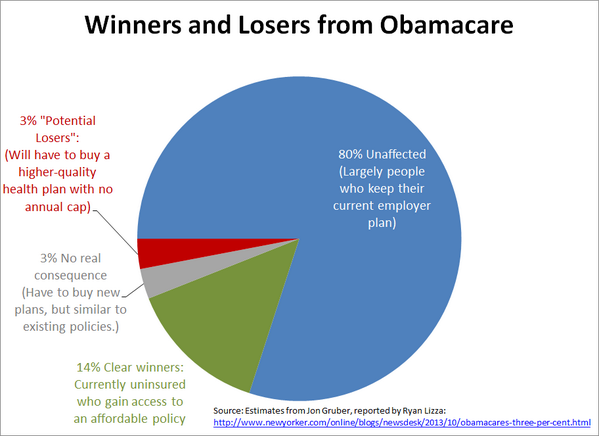
There are exceptions, but here’s the overall picture:

Nicholas Kristof reminds us of the real victims of our healthcare system: People who will die because they couldn’t get affordable health insurance. They’re not just abstract public-health statistics. They have names and stories. As Margaret Talbot writes in The New Yorker:

when it comes to evaluating the worth of Obamacare we may not remember the Web-site hiccups all that well. What we will remember, and what ultimately matters, is whether, in the next year, the A.C.A. fulfills its promise: to provide affordable health insurance to people who did not have it through an employer, could not afford it on their own, were denied it on the basis of preëxisting conditions, paid more for it than they should have because they were, say, women of child-bearing age, or could no longer get by because their insurance benefits had been capped.


A new poll shows why the “replace” part of the Republican slogan to “repeal and replace ObamaCare” will never happen: Republicans don’t want a replacement. Among Republicans, repeal-and-don’t-replace beats repeal-and-replace 42%-29%.

and the LAX shooting

Notice how closely the coverage tracks Juan Cole’s 2012 “Top Ten Differences Between White Terrorists and Others“. I don’t want to make too much of the early hints that this guy is a right-wing wacko, but if he were a dark-skinned Muslim with similar hints of radical Islamist views, that would be the whole story.

and food stamp cuts

The Food Stamp program became less generous on November 1, when a benefit increase that was part of the 2009 stimulus program expired. Eligibility standards don’t change, but families will get about 5% less help.

I have trouble getting excited about the expiration of a temporary program, but further food stamp cuts are on the docket. The current budget negotiations are supposed to reconcile the Senate’s $4-billion-over-ten-years cut with the House’s $40-billion-over-ten-years cut. About $76 billion was spent on food stamps this year.


The problem of scale: “Lawmakers could save millions by targeting food stamp fraud — will they?” says the Fox News headline. Millions? Those who keep reading will find this acknowledgement: “The amount appears relatively small considering the government pays out roughly $70 billion in annual food stamps benefits.”

Hmmm. I wonder if those “millions” are net savings, after accounting for the cost of implementing and enforcing whatever safeguards would prevent that relatively small amount of fraud. Fox doesn’t link to the report the number comes from — I think it’s this one, although an automatic text search fails to find the $3.7 million figure in it — but it looks like they’re talking about gross savings, estimated by a suspiciously simplistic method.

The projected potential savings from fraud-cutting is detailed in the inspector general report, which found $3.7 million in questionable monthly payouts across 10 states. … The $222 million figure was reached by multiplying the number by 12 to get an annual amount, then by five to get an estimate for all 50 states.

So on the bottom line, the headline “millions” in savings are probably considerably less than the article claims, and may even be negative.

and the NSA

Strangely, people who are OK with the NSA spying on you and me hit their limit when it was revealed that the NSA is spying on our allies.

and the Republican Civil War

The opening quote from Governor Kasich is a Republican-on-Republican attack, as Kasich struggles to govern in spite of his Republican legislature. Anybody who thinks President Obama could get along with the Right if he were only nicer to them should study Kasich, who was a Fox News host for six years.

People you never would have thought could be challenged from the Right are in danger of being challenged from the Right. The latest is Senator John Cornyn of Texas. A poll of Texas Republicans found that “a Tea Party candidate” beats Cornyn 46%-33%, though several specific challengers are less popular. (Cornyn beats Rep. Louis Gohmert 45%-20%.) You have to wonder about the poll, because the wording of some  questions seems biased, like “Do you support amnesty for illegal aliens?” But the horse-race questions look legit.

The craziest name suggested as a Cornyn challenger is fake historian David Barton. Barton’s latest book, The Jefferson Lies, was withdrawn by the publisher, because “There were historical details — matters of fact, not matters of opinion, that were not supported at all.” Barton’s misrepresentations of American history figure prominently in Chris Rodda’s debunking book Liars for Jesus.

And here’s a future civil-war battleground:

and the filibuster and court rulings about abortion and contraception

I covered this in “The Filibuster and the War on Women“.

and you also might be interested in …

Nature giveth and nature taketh away.


You know who couldn’t get a Texas voter ID on his first try? Former Speaker of the House Jim Wright. His driver’s license had expired (which is probably a good thing, given that he’s 90) and his faculty ID from TCU isn’t one of the forms of ID accepted. (If he’d had a gun license, though, he’d have been fine. Let’s hope that’s expired too.) Fortunately, he could go home and find his birth certificate, which not all 90-year-olds can do.

The point of the law isn’t to verify who you are — Wright did that the first time — it’s to make it harder to vote. There’s no evidence of a voter-impersonation problem in Texas or anywhere else. And there’s really no evidence for a forged-ID-to-enable-voter-impersonation problem.


The Organisation for the Prohibition of Chemical Weapons (OPCW) announced Thursday that Syria

has completed the functional destruction of critical equipment for all of its declared chemical weapons production facilities and mixing/filling plants, rendering them inoperable.

… The next milestone for the mission will be 15 November, by which time the Executive Council must approve a detailed plan of destruction submitted by Syria to eliminate its chemical weapons stockpile.


I still can’t decide whether I want to see the Ender’s Game movie. But there’s no denying how far Orson Scott Card has gone off the rails. It’s not just the gay-marriage-justifies-revolution screed (“when government is the enemy of marriage, then the people who are actually creating successful marriages have no choice but to change governments, by whatever means is made possible or necessary. … Biological imperatives trump laws.”), it’s this “plausible” scenario for Obama making himself dictator-for-life.

Interesting re-interpretation of the novel on Salon: It’s not really about war or genocide, it’s “an imaginative portrait of the inner life of an abused child, a fledgling psyche trying to reconcile the unbearable contradiction in receiving both love and gratuitous pain from the same source.”


Abstract ideas have consequences. According to Scientific American, believing in Satan and the existence of pure evil affects views on a number of political issues.

BPE [belief in pure evil] predicts such effects as: harsher punishments for crimes (e.g. murder, assault, theft), stronger reported support for the death penalty, and decreased support for criminal rehabilitation. Follow-up studies corroborate these findings, showing that BPE also predicts the degree to which participants perceive the world to be dangerous and vile, the perceived need for preemptive military aggression to solve conflicts, and reported support for torture.

I’d love to see research on my hypothesis connecting BPE to conspiracy theories. This is from the 2010 Weekly Sift article “Propaganda Lessons from the Religious Right“:

The Devil is the ultimate sinister conspirator, motivated by pure evil. Once you have a Devil, it follows without evidence that there is a conspiracy against anything true and good and right. How could there not be? The Devil is against it, and unless he has suddenly lost his innate cleverness and his characteristic ability to lie and tempt and cajole, he will have followers.

So if you are arguing in front of a Devil-postulating audience, you don’t have prove that there is a conspiracy against the Good — of course there is — you only have to identify that conspiracy. The Manichean frame (God/Devil, Good/Evil) is sitting there, waiting for you to connect yourself with Light and your opponent with Darkness.


This is the kind of thing that gives Congress a bad image: Part of the deal to end the shutdown/debt-ceiling standoff was to have a later vote on a “resolution to disapprove” of the debt-ceiling hike. That resolution was voted on in the Senate Tuesday, and lost on a party-line vote.

Here’s the ridiculous part: 27 Republican senators who voted to “disapprove” also voted for the deal they’re disapproving of. So, did the Devil make them cast that vote?


In five years, copyrights from the 1920s will start expiring, as they would have long ago if Disney and other copyright-owning corporations didn’t keep lobbying for extensions.

Extending copyrights on existing works is a pure corruption issue: There’s no public interest whatsoever in preventing Mickey Mouse and Batman from entering the public domain the way older cultural icons like Sherlock Holmes and Scrooge did long ago. Copyrights are supposed to be incentives for creators, but as Lawrence Lessig puts it: “No matter what the US Congress does with current law, George Gershwin is not going to produce anything more.”

The big money is already gearing up to buy another act of Congress. But there’s an internet and a blogosphere this time around, so they’ll have to buy their legislation in full public view.


American neighborhoods are getting more economically stratified.

Using U.S. Census data from 1970-2000 and American Community Survey data from 2005-2011, Cornell’s Kendra Bischoff and Stanford’s Sean F. Reardon found that more people are living in extremely high income areas or low income areas, while fewer are living in areas characterized as middle-income.

Kevin Drum annotates the chart:

This is yet another sign of the collapse of the American middle class, and it’s a bad omen for the American political system. We increasingly lack a shared culture or shared experiences, and that makes democracy a tough act to pull off. The well-off have less and less interaction with the poor outside of the market economy, and less and less empathy for how they live their lives. For too many of us, the “general welfare” these days is just an academic abstraction, not a lived experience.

and finally, something too good not to use

Miley Cyrus and Robin Thicke get Attenborrowed.

Quacks

Ultimately it was hoped to make articulate speech issue from the larynx without involving the higher brain centers at all. This aim was frankly admitted in the Newspeak word duckspeak, meaning ‘to quack like a duck’. Like various other words in the B vocabulary, duckspeak was ambivalent in meaning. Provided that the opinions which were quacked out were orthodox ones, it implied nothing but praise, and when The Times referred to one of the orators of the Party as a doubleplusgood duckspeaker it was paying a warm and valued compliment.

— George Orwell, “The Principles of Newspeak

This week’s featured posts: “A State-by-State Update on Voter Suppression” and “The Method of Madness“.

Everybody has been talking about the shutdown aftermath

There’s no question that President Obama won this showdown, though it was mainly a defensive victory: Republicans failed to destroy his main achievement, the Affordable Care Act. (More about this in “The Method of Madness“.)

Along the way, Republicans also trashed their public image and tanked their poll numbers. Control of the House may be up for grabs in 2014.

So why did they do it? Everyone — even conservatives like Charles Krauthammer — told the Tea Party radicals exactly what would happen, so it couldn’t have been a surprise or a miscalculation. Why, then?

Part of the answer is the usual right-wing hucksterism. The shutdown was a great fund-raising tactic in general, and Ted Cruz specifically vaulted himself into being the early front-runner for the GOP presidential nomination in 2016.

But the deeper reason may have been to complete the radicalization of the Republican Party. Erick Erickson explained this clearly:

those of us who were in this fight against Obamacare, have been quite open that we knew there were side benefits. This fight would expose conservative activists to the frauds they have funded.

Men like Mitch McConnell, John Cornyn, Eric Cantor, Kevin McCarthy, and others have preached a great sermon against Obamacare, but now conservatives who supported them see that these men have refused to actually practice what they’ve been preaching. They’ve refused to stand and fight with the rest of us.

… So we must advance. Two Republicans in the Senate caused this fight that their colleagues would have surrendered on more quickly but for them. Imagine a Senate filled with more. We have an opportunity to replace Mitch McConnell in Kentucky with a better conservative. We should do that. We have the opportunity to send a strong conservative from North Carolina and we should do that. Same in ColoradoKansas looks to be in play. Chris McDaniel will declare his candidacy for the Senate in Mississippi. Conservatives will rally to him quickly. Tennessee could be in play too.

Imagine a Senate where far-right Republicans like Mississippi’s Thad Cochran were replaced — not by people who are more conservative philosophically, that’s barely possible — but by Republicans willing to take the government hostage and blow up the economy if they don’t get what they want. Most of the senators on Erickson’s hit list — McConnell, Cochran, Tennessee’s Lamar Alexander, and Kansas’ Pat Roberts — are Republicans whose conservativism was not in question only a few years ago.

The game here appears to be longer than 2014 or even 2016. And increasingly, it looks to me like the point is not to win a majority. It’s to make the country ungovernable, so that some kind of right-wing minority rule starts to seem like a reasonable alternative.

The real question, as we look forward to the extended deadline for a budget/debt-ceiling deal, is what non-Tea-Party Republicans learned from this last crisis. Until now, most of the Republican establishment has been trying to appease the Tea Party revolutionaries; just don’t set them off, and hope they go after somebody else. I hope they’ve learned now that appeasement is impossible if you retain any loyalty to democracy and the government of the United States of America.

You will be targeted. You will have to fight. Better you should fight sooner than later.


About that guy waving a confederate flag in front of the White House during that bizarre Cruz/Palin rally protesting their own government shutdown. The Atlantic’s Ta-Nehisi Coates has it exactly right: The problem isn’t that one guy. “Lone idiots are often drawn to protest actions.”

The problem is the crowd that treated him like a normal person. The problem is when leaders like Ted Cruz get hold of the microphone and don’t say something like, “You need to put that away; you’re not helping us.”

That’s the Tea Party/racism problem in a nutshell. Tea Partiers get apoplectic when they’re accused of racism. But since the Goldwater/Nixon years, the Republican Party has made itself a place where racists can be comfortable. You don’t have to be racist to be a Republican. But if you are, that’s OK.

and HealthCare.gov

There’s been a lot of spin and sloppy coverage here: What’s being presented as “problems with ObamaCare” are usually just problems with HealthCare.gov, the web site that is one of the ways you can sign up for some of the new health-insurance options created by the Affordable Care Act. (An exception is Ezra Klein, who explains how problems with HealthCare.gov could eventually create problems with the insurance risk pool if they persist.)

An analogy might help put this in perspective: If something went wrong with the ticket-selling page on Denver Broncos’ web site, that would be a nuisance for ticket-seeking Broncos fans, who might have to call the box office or show up in person. But the Broncos’ season-ticket holders would be completely unaffected by the online difficulties, just as people who already have health insurance through their employers or Medicare or some other government program are unaffected by the problems at HealthCare.gov.

None of that would constitute “problems with the Denver Broncos”. Peyton Manning is doing fine.

ObamaCare is not just the health-insurance exchanges, and the exchanges are not just HealthCare.gov. ObamaCare is a system for achieving near-universal healthcare coverage. It works like this:

  • The majority of Americans already had adequate coverage through their employers, or through the government via Medicare, Medicaid, or the Veterans Administration. They would keep their coverage, with the additional security that they couldn’t lose coverage through pre-existing conditions or exceeding some lifetime cap.
  • Lower-income working people who aren’t covered some other way and previously made too much money to qualify for Medicaid would be covered by expanded Medicaid. (This is the part the Supreme Court messed up by allowing states to opt out. States like Texas are opting out so that their governors can win Republican primaries. The Corpus Christi Caller writes: “According to one esteemed estimate, the annual unnecessary death toll for continuing to leave a fourth of Texans uninsured is 9,000.”)
  • Middle-class people who aren’t covered some other way and don’t qualify for expanded Medicaid could buy health insurance from private insurance companies (not the government) through their state’s health-insurance exchange. The law encouraged states to set up and run their own exchanges, which most states controlled by Democrats have done. (Many of those seem to be working fine.) But in states that refused to set up their own exchanges (i.e., red states) the federal government would do so. Depending on your income, your insurance premiums might be partially subsidized by the federal government through a tax credit. (Unless another Republican court challenge gets rid of the subsidies for states that didn’t open their own exchanges.)
  • Rich people can do whatever, as always. No “government takeover of healthcare” or “death panels” prevent them from buying whatever services they want.

So if your job doesn’t already provide health insurance, and if you want to purchase it through your state health insurance exchange, and if your state didn’t set up its own program with its own web site, then you are inconvenienced by the problems at HealthCare.gov. If the federal government can’t fix the site, you might have to apply for health insurance over the phone or by showing up in person somewhere.

As for what kind of health insurance you will get if you do and what it will cost you, that’s looking pretty good. It’s looking so good that when Sean Hannity wanted to show his audience real-life examples of people harmed by ObamaCare, he had to deceive them. Salon’s Eric Stern fact-checked Hannity by tracking down the people he showcased, and discovered that none of them had actually been harmed by anything other than their own stubbornness.

Had they shopped on the exchange yet, I asked? No, Tina said, nor would they. They oppose Obamacare and want nothing to do with it. Fair enough, but they should know that I found a plan for them for, at most, $3,700 a year, 63 percent less than their current bill.

One of the ways you might buy tickets isn’t working very well, but the team is winning on the field.


The HealthCare.gov problem is yet another episode in the endless Republican search for “Obama’s Katrina”. The BP oil spill was supposed to be Obama’s Katrina, Hurricane Sandy was supposed to be Obama’s Katrina, and in general the phrase has been bandied about so much that 29% of Louisiana Republicans believe Katrina was Obama’s Katrina.

Esquire’s Charles Pierce points out why this is an over-the-top comparison:

Almost 2,000 people died so that, eight years later, Rich Lowry could have a cheap punchline.

HealthCare.gov still hasn’t killed anybody.


You may have heard that the government spent $600 million building the HealthCare.gov web site, with Fox News claiming the ultimate cost could go over $1 billion.

Media Matters explains where the first number came from. (Fox hasn’t said where they got the second one.) As so often happens inside the conservative media bubble, the figure $600 million appeared in a story about the web site — it’s the total value of all healthcare-related contracts the software company has received — and became the cost of the web site by daisy-chaining references.


Single-payer advocates have been passing around variations on this joke: The Canadian version of HealthCare.gov just says: “This is Canada. You have health care.”

and voter suppression

If you’re the minority party and you don’t want to change your policies to become more popular, you can still win if your voters are very motivated and you make it hard for the majority party’s voters to vote. The Supreme Court’s recent ruling on the Voting Rights Act might as well have been an announcement of open season on voting rights at the state level. I review what’s been happening lately in “A State-by-state Update on Voter Suppression“.

Even if you don’t click through to read that link, you really should see The Daily Show’s Aasif Mandvi interviewing North Carolina Republican official Don Yelton.

and you also might be interested in …

Don’t miss the dialog about journalism between the NYT’s Bill Keller and Glenn Greenwald.

In general, I’m Greenwald’s side in this debate. (Though I have criticisms of him as well: I like that he is open about the worldview that shapes his reporting, rather than hiding behind a pretense of objectivity. But too much of his personality makes it into his writing, and I find his personality abrasive and thin-skinned.) I think Keller comes into the discussion determined to fit Greenwald into a box, with the result that he never really listens to what Greenwald says.

Keller never acknowledges Greenwald’s criticism that the Times’ desire to maintain an appearance of impartiality conflicts with a deeper objectivity. Greenwald mentions how the Times changed its usage of the word torture when the Bush administration began claiming (against all prior usage) that waterboarding was not torture. A truly objective newspaper would apply definitions of controversial words impartially, regardless of whether powerful interests object.

To understand what Greenwald means when he describes NYT-like journalism as “nationalistic”, look at Joshua Keating’s “If It Happened There … the Government Shutdown“. How would the American press cover the shutdown if it were happening in another country?


If you think conservatives believe in small government and personal freedom, you must be male. Consider the bizarre case of Alicia Beltran, a 28-year-old woman who has the misfortune to be pregnant in Wisconsin, where “pro-family” fetal-protection laws give the government Orwellian powers over pregnant women.

Because of a prescription-drug problem that she had already overcome (and that no one would have known about if she hadn’t mentioned it to doctors herself), Beltran was prescribed an anti-addiction drug that she couldn’t afford. When she refused, she was arrested and forced to stay in an in-patient facility. During that involuntary absence, she lost her job.

The baby is due in January. You’re welcome, kid.


Birtherism is so hilarious. Funny, I don’t recall Democratic officials making years and years worth of 9-11 Truther jokes about W (rather than jokes about Truthers). Is that just my bad memory?


Even if you’re not usually a football fan, you should watch ESPN’s “The Book of Manning“, which may still be available on demand on some cable systems and is out on DVD. The story of Archie, Peyton, and Eli turns out to be more about family than about football. The Mannings totally cooperated, and Archie made his extensive (and, at times, incredibly cute) home videos available to the film-makers.


Two retired Canadian tourists decide to see the Alamo, and blunder into a protest rally of people carrying loaded assault rifles. “This is totally beyond our comprehension,” Mabel says.


Finally, if you’re wondering what I was doing that kept me from putting a Sift out last week, I was working on this talk.

Apocalyptic Methods

WILLARD: They told me that you had gone totally insane, and that your methods were unsound.
KURTZ: Are my methods unsound?
WILLARD: I don’t see any method at all, sir.

Apocalypse Now (1979)
quoted Saturday by Ross Douthat, “The Kurtz Republicans

This week’s featured post: “Don’t Means-Test Medicare“. Because the first step in gutting a program is to get the rich people out of it.

This week everybody was talking about a possible end to the shutdown/debt-ceiling crisis

Little by little, the Republicans are realizing that the shutdown battle isn’t Mr. Smith Goes to Washington, it’s “The Ransom of Red Chief“. The longer this hostage crisis goes on, the more painful it is for them.

Wednesday Gallup showed the Republican Party with a 28% approval rating, down ten points from the previous month, and even lower than the 31% nadir they hit during the Clinton impeachment. Thursday, an NBC/WSJ poll said that the public blames them for the shutdown (53%-31%), while both President Obama and the Affordable Care Act have become more popular. The public says (47%-39%) that it wants to see a Democratic Congress in 2014.  To me, the most damaging result was Question 16. Asked whether President Obama was being a strong leader or putting politics ahead of what’s good for the country, the public was mildly negative (46%-51%). But the same question about congressional Republicans produced a landslide: 70% said Republicans were putting politics first.

The business community has also been weighing in against them. On shutdown eve, a coalition of 251 trade associations (including big Republican donor, the U.S. Chamber of Commerce) sent a letter to Congress:

It is not in the best interest of the employers, employees or the American people to risk a government shutdown that will be economically disruptive and create even more uncertainties for the U.S. economy.

Likewise, we respectfully urge the Congress to raise the debt ceiling in a timely manner and remove any threat to the full faith and credit of the United States government.

Thursday, the head of the American Bankers Association (former Republican governor Frank Keating) framed the debt ceiling issue the way Democrats do:

Failing to raise the debt ceiling in time would be an unprecedented mistake. … To use a credit card analogy, the decision about what to buy on credit tomorrow must take into account the debt we already owe, but that is never an excuse for not paying the current bill on time and in full.

Even the Koch brothers started pulling back (after spending an estimated quarter-billion dollars on groups that promoted this crisis). Wednesday Koch Industries sent a letter to all senators denying that they had a position on the shutdown.

The stock market never did crash, exactly, but the Dow slid from a mid-September high of 15709 to 14727 Wednesday morning. That’s when rumors started that the Republicans were going lower their ransom demands (as Red Chief’s captors did shortly before realizing how bad a situation they were in). Sure enough, defunding ObamaCare wasn’t in the demand list any more. (Aside: Doing the research on this topic is frustrating, because news articles often leave out the most important details, like what was actually proposed.)

But the idea of ransom wasn’t gone. In exchange for a six-week extension on the debt ceiling (and not re-opening the government), Ryan wanted to replace the sequester cuts (which originally were designed to be equally offensive to both parties, but which the Republicans are happier about than the Democrats) with cuts to Social Security and Medicare. So: we’ll let the hostages live another six weeks if you give us something.

President Obama wasn’t interested. Then over the weekend the Senate tried to work something out, again with smaller ransom demands. Senator Susan Collins (R-Maine) proposed to extend the debt ceiling through January and fund the government through March. In exchange she wants some lesser changes to ObamaCare (repealing or delaying the medical device tax, plus making some changes to eligibility which I can’t find spelled out anywhere).

The problem here is that that new sequester cuts go into effect in January. What the Democrats hoped to accomplish in budget negotiations was to avoid some of those cuts. That’s why the continuing resolutions they supported accepted Republican-supported spending levels, but ended before January 1. Senate Democrats view a CR that lasts until March as a concession. And what they get in exchange for that concession is to let the Republicans out of the box they voluntarily got into.

So Senate Democrats rejected that deal and proposed a clean debt-ceiling extension until after the 2014 elections, which the Republicans filibustered. Since then, stuff has been happening behind closed doors and who knows what it means. In general, the Democrats are united while the Republicans are fragmented. That makes the Republicans hard to negotiate with, because who knows what any particular leader can deliver? (The weirdest story I’ve heard is that when Senate Republicans came to the White House, they had to ask Obama what the House Republicans had proposed.)

The stock market seems edgy (down 75 when I last checked) but not panicking. Debt-ceiling disaster is scheduled for Thursday. Conservatives are still telling each other than “Obama will blink” if they push this to the edge.

As has been true from the beginning, the pundits keep telling us something will work out, but they’re not sure what the deal will be and they have no scenario in mind for how it happens. I’m making no predictions. When you push important stuff off to the last minute, sometimes it doesn’t get done, even if you really intended to do it.


The funniest commentary on the shutdown came from The Daily Show’s Jason Jones. He decided to take the ransom metaphor literally and seek advice from a professional hostage negotiator. Why do people take hostages? Jones asks.

Negotiator: In their world, they’ve tried a lot of other things, and everything they’ve tried up to that point has failed. They view themselves as extremely significant people, so they’re mystified that they’re not being followed more. And they’re hurt by it and they feel very abandoned by it.

Jones: You know, I thought calling in a hostage negotiator would kind of be funny, a funny joke, but it’s kind of incredible how this metaphor is lining up.

Negotiator: Even batshit insane has its own rules.

and trying to understand Republicans

Fascinating look at the Republican rank-and-file (summaryfull 30-page report — which is worth reading if you’ve got the time). A liberal group, Democracy Corps, ran focus groups of like-minded Republicans of three types: Evangelicals, Tea Partiers, and moderates. (I find this interesting in view of my post The Four Flavors of Republican from January, 2012. Democracy Corps’ groups seem to correspond to my theocrats, libertarians, and corporatists. The NeoCons are nowhere to be found. I wonder whether they are a beltway phenomenon with little grass-roots support, or if DC just didn’t raise foreign-policy issues.)

My takeaways: Tea Partiers and Evangelicals together make a majority of Republicans, and while they disagree on the importance of social issues, they share an apocalyptic feeling that the country may slip away from them for good unless they take drastic action now. They’re scary that way.

The role of race is interesting. The point of like-minded focus groups was to get people saying things they wouldn’t say in mixed circles. So DC expected the occasional racist remark or slur, which didn’t happen; there was no explicit racial hostility. But the America Republicans are nostalgic for and feel in danger of losing is clearly a white America. As an Evangelical man from Roanoke put it:

It’s a little bubble. So everybody – it’s like a Lake Wobegon. Everybody is above average. Everybody is happy. Everybody is white. Everybody is middle class, whether or not they really are. Everybody looks that way. Everybody goes to the same pool. Everybody goes – there’s one library, one post office. Very homogenous.

In many of the comments, blacks and Hispanics are not villains so much as pawns in the liberal plot to create pliable voting majorities by extending dependence on government. As Bloomberg’s Francis Wilkinson summarized:

Obama has extended a new entitlement to create a class of lazy, poor voters whose well-being is dependent upon the Democratic Party.

Moderates are about a quarter of Republicans. They know they don’t fit any more but can’t see themselves as Democrats. They’re pro-business and anti-regulation, but they’re also open to gay rights, admiring of science, and convinced that government only works if everyone compromises for the greater good. The current Tea/Evangelical Republican Party embarrasses them. They might well agree with Ross Douthat:

there is still something well-nigh-unprecedented about how Republicans have conducted themselves of late. It’s not the scale of their mistake, or the kind of damage that it’s caused, but the fact that their strategy was such self-evident folly, so transparently devoid of any method whatsoever.


A Methodist pastor examines the Dominionist theology that justifies tactics like the shutdown.


Political historian Rick Perlstein has been doing an eye-opening series “Thinking Like a Conservative”. Parts 1, 2, 3, and 4.

Whenever an exasperated liberal points out that the basic architecture of the Affordable Care Act matches a plan drawn up by the Heritage Foundation in the 1990s, I feel a stab of exasperation myself—with my side. Theirs is not a clinching argument, or even a good argument. It means nothing to point out to conservatives that Heritage once proposed something like Obamacare. The Heritage plan was a tactic of a moment—a moment that required something to fill in the space to the right of President Clinton’s healthcare plan, an increment toward the real strategic goal of getting the government out of the healthcare business altogether… someday.

and you also might be interested in …

The Ride for the U. S. Constitution was a vision that would put the fear of God into those corrupt left-wing politicians: ten thousand truckers shutting down the Washington beltway for the whole Columbus Day weekend, then delivering their list of demands to a sympathetic congressman, Louis Gohmert of Texas. Or maybe it would be “hundreds of thousands of truckers and millions of citizens“.

They’d convene a citizens’ grand jury (a.k.a. a lynch mob) to indict and arrest “everyone in government who has violated their oath of office” — Obama, certainly, but also Nancy Pelosi and Dianne Feinstein, among others.

They wouldn’t rely on the lamestream media to spread the word (well, except for Fox News, where Megan Kelly gave them five minutes of air time; independent media magnate Glenn Beck also pushed their cause). They’d do their own viral messaging through Facebook, Twitter, and plain old fliers posted at truck stops. The People would speak so loudly that no one could ignore them!

Of course, in America we have this other way for the People to speak: elections. We just had one last year, and President Obama was re-elected by almost five million votes. It’s not a perfect institution — Republicans retained control of the House of Representatives in spite of getting 1.3  million fewer votes than the Democrats (spreadsheet) — but it’s been working reasonably well ever since it was established in … well, it’s in that Constitution they’re riding for, isn’t it?

But if the People want to speak some other way too, that’s fine with me. (Well, other than that lynch mob thing.) So how many truckers turned out? About 30. I haven’t heard how the arrest of Nancy Pelosi went.


But you can see why We the (dozens of) People would be upset: Government spending is out of control, as this chart clearly shows:

Sorry, wrong chart. Let’s try this one:

Crap! I don’t know what’s wrong with these charts. What if we measure the size of government in employees? Then we’ll really see how out of control the octopus is.

(The peak in 2010 was for temporary census workers.) OK, but the deficit — we know that’s going through the roof. That’s what justifies the Tea Party’s hostage-taking tactics: If we don’t get control of the deficit now, our children will be debt slaves of the Chinese!

Ah, screw the data. We’re just mad as hell and we’re not going to take it any more, whatever it is.


As Congress move towards actual budget negotiations, we can expect to hear a lot of hysteria about the national debt. An opening shot was Niall Ferguson’s WSJ op-ed. Economist Brad DeLong explains why Ferguson is peddling complete nonsense.


Voter suppression: The conservative appellate judge who sustained Indiana’s voter-ID law has changed his mind:

the problem is that there hadn’t been that much activity with voter identification. Maybe we should have been more imaginative….We weren’t really given strong indications that requiring additional voter identification would actually disfranchise people entitled to vote. … I don’t think we had enough information.

Unfortunately, the Supreme Court followed him down that path 6-3.

Meanwhile, Kansas and Arizona are planning a new tactic: second-class voters. A Supreme Court ruling against an Arizona law requiring voters to show proof of citizenship apparently applies only to federal elections. So if states split elections into a federal ballot and a state/local ballot, maybe they could give only the federal ballot to voters who haven’t shown proof of citizenship. At least the Supremes haven’t said otherwise yet, so it’s worth a try.

I explained my take on voter suppression two weeks ago: The Republicans have given up on convincing a majority of the American people to agree with them, and are now focused on tactics that allow them to govern from the minority. Voter suppression, gerrymandering, the filibuster, the Hastert Rule, blocking a path to citizenship in any immigration reform, the congressional hostage-crisis we’re in the middle of now … it’s all part of the larger plan for minority rule.


The history of the Republican Party in three buttons:

Along the same lines: Listening to NPR’s interview with Bill Minutaglio, author of the new book Dallas, 1963, I was struck by how the extreme Right remains the same from one era to the next. Minutaglio says:

For some reason out in the heartland in the middle of Texas, really powerful people coalesced around this notion that Kennedy was a traitor and in fact was guilty of treason. And these weren’t just folks who were idly thinking these thoughts; they were acting on them and forming organizations and movements to essentially overthrow Kennedy. … He was perceived to be a traitor. He was a socialist, he was on bended knee to so many different entities — communism, socialism and even the pope.

We look back at that now and say, “Those people were crazy.” Today, not even the Tea Party (at least not most of it) claims that JFK was a traitor or a Communist, or that we can’t have a Catholic president because he’ll take orders from the Pope. But they don’t see the connection between that craziness and what they are saying about Obama today.


The L.A. Times has decided it’s only willing to tolerate climate-denier letters up to a point:

I do my best to keep errors of fact off the letters page; when one does run, a correction is published. Saying “there’s no sign humans have caused climate change” is not stating an opinion, it’s asserting a factual inaccuracy.


Hey, interns: Now you can be sexually harassed while you work for no pay. Is this a great country or what?

Burning Down the House

No visible means of support and you have not seen nothin’ yet.
Everything’s stuck together.
I don’t know what you expect staring into the TV set,
fighting fire with fire,
burning down the house.

Talking Heads

This week’s featured posts both have something to do with the shutdown/debt-ceiling crisis. “Countdown to Augustus” takes the long view, while “7 Key Points About the Shutdown” is more immediate.

This week everybody was talking about (what else?) the shutdown

Usually I try to be the calm voice in the room, and to balance the over-hyped Big Issue that the news networks fixate on by pointing out that other things are happening in the world.

This week, though, I’m probably more obsessed with the government-shutdown/debt-ceiling-default than my readers are, and I keep wondering why everybody isn’t more freaked out. Like, why is the stock market drifting gently downward rather than crashing?

I continue not to see an end to this that doesn’t involve some market-crash or riots-in-the-streets type of disaster. I don’t think the Democrats can give in without setting up more hostage crises down the road. So the only way out is for the Republicans to back down without extorting anything in return. And I don’t think they can do that, because their whole mindset says that re-assessing your position in the face of reality is weakness.

So something external has to force this. It doesn’t end any other way.


Jon Stewart has been amazing through this whole mess. It’s hard to pick a favorite, but I think I go with his Rockin’ Shutdown Eve last Monday.

and raids against al Qaeda

The U.S. launched two raids in Africa this weekend. The Libya raid successfully captured Abu Anas al Libi, allegedly a high-ranking al Qaeda guy. And the Sudan raid ran into heavy resistance, but may have killed a guy who may have been connected to last week’s mall shooting in Kenya. So far all we know is what the government is telling us, so wait and see before you draw any conclusions.

and ObamaCare

The web site had problems, as often happens as things roll out. Keep in mind that ObamaCare is fundamentally about health insurance, not about the web. So a problem about the web site is not necessarily a problem with ObamaCare.

Last week I linked to part one of Kurt Eichenwald’s Vanity Fair series on ObamaCare. It covered the lies conservatives have been telling about ObamaCare, and so had a polemic tone. It’s hard to discuss blatant lies calmly and dispassionately.

Part two is much drier: It focuses on the logic of ObamaCare, the problem it’s trying to solve, and what’s in it for you even if you already have insurance. It is full of facts about the uninsured, the cost of providing emergency care for them through our current system, why they die sooner than they should, and the uncomfortable reality that

the vast, vast majority of them are hard-working Americans who simply do not have the same salary and benefit opportunities that others might. And again, no, there are not tens of millions of higher-paying jobs with benefits sitting out there unfilled.

and you also might be interested in

Michele Bachmann claims that her decision not to seek re-election has nothing to do with the ethics charges against her 2012 presidential campaign. But AP reports this about the guy on the other side of the transaction:

Iowa state Sen. Kent Sorenson … resigned from office Wednesday after investigator Mark Weinhardt concluded Sorenson likely broke ethics rules in receiving $7,500 in monthly income from Bachmann’s political action committee and presidential campaign in exchange for being Bachmann’s state chair in 2011.

The Ron Paul campaign is also implicated. Sorenson switched his allegiance to Paul, allegedly after receiving $75,000 in what AP calls “suspicious payments that may be linked to Paul’s campaign”.


Here’s a consequence of the shutdown that is going to hit people where they live: Notre Dame might have to drop two games out of its football schedule. It’s scheduled to play the Air Force academy on October 26 and Navy on November 2. The academies are currently shut down with the rest of the government. [Tuesday update: Not really. See the comments for a correction.]


A Pro Publica investigation shows that Tylenol is not as harmless as you probably think.


Some straight talk about rape prevention:

If your advice to a woman to avoid rape is to be the most modestly dressed, soberest and first to go home, you may as well add “so the rapist will choose someone else”.


About that IRS scandal … never mind.

Plagues

A second flood, a simple famine, plagues of locusts everywhere,
or a cataclysmic earthquake I’d accept with some despair.
But no — You sent us Congress.
Good God, Sir, was that fair?

— John Adams, 1776

This week everybody was talking about government shutdown

I covered that in a separate article, “Tea Trek: Into Darkness“. The gist is that the current government-shutdown and debt-ceiling confrontation represents something bigger than a fight over ObamaCare. It’s about the Republicans giving up on democracy and seeking to rule from the minority.

and lots and lots of nonsense about ObamaCare

Critics exaggerate the unpopularity of ObamaCare, usually by lumping together the people who want the government to do nothing to help the uninsured (i.e., most Republicans, as Ross Douthat more-or-less acknowledges) with the people who want universal insurance through a single-payer system (i.e., me).

But even to the extent ObamaCare is actually unpopular, you have to take into account that it is the most lied-about program in the history of government. If some guy wants ObamaCare repealed because Rick Santorum convinced him his special-needs child will be euthanized — well, how much weight does that opinion deserve? How much consideration should you give to people who are against ObamaCare but support the Affordable Care Act?

Vanity Fair’s Kurt Eichenwald refutes some of the most outrageous anti-ObamaCare claims, but he opens with a level of vitriol that your conservative friends will never wade through. (So send them excerpts rather than a link.) The NYT’s Philip Boffey addresses the ObamaCare-is-killing-jobs argument. Gannett’s Fact-Checker column gave a 0-out-of-10 rating to the truthfulness of the Congress-exempted-itself-from-ObamaCare claim.

As for various implementation glitches as the exchanges roll out on Tuesday: All large government programs have them. The difference with ObamaCare is that Republicans in Congress have refused to cooperate in the post-passage/pre-implementation process of legal fine-tuning that is usually bipartisan and uncontroversial. Any Republicans who genuinely wanted to improve the program rather than sabotage it would find Democrats more than willing to work with them.


Matt Yglesias points out the irony of Senator Cruz reading Green Eggs and Ham during his anti-ObamaCare pseudo-filibuster Tuesday: The Dr. Seuss classic is about irrational resistance to something you’ve never tried. If anyone is Sam I Am in this analogy it’s President Obama, who knows the country will like ObamaCare if it ever gets to try it.


Posts by Middle Class Political Economist explain why two pillars of Republican health-care reform won’t work.

We know selling insurance across state lines is a bad idea because we’ve seen this movie before with interstate banking: Rather than increase competition, banks just moved their credit-card operations to the states with the weakest consumer protections, South Dakota and Delaware. The framing of this idea is also weird, particularly for a party that claims to limit federal power: “Allowing” interstate competition is the same as “banning” states from regulating their health-insurance markets, i.e., the federal government will be the only effective health insurance regulator.

We know medical-malpractice reform won’t cut costs, because 39 states have tried this kind of reform with no significant effect. Texas is the prime example.

I’ll add a personal reflection on malpractice reform: The claim is that “defensive medicine” (doctors doing unnecessary tests or treatments to avoid malpractice lawsuits) drives up costs, and so legal reform can lower them. But my wife and I both believe that defensive medicine saved her life. In 1996 she had a mildly suspicious mammogram, and the radiologist recommended rescanning her in six months. But the doctor who had just changed her birth control to something riskier breast-cancer-wise (in other words, the one on the hook for malpractice) insisted on a biopsy. She had stage-2 breast cancer, which could have been stage 3 or 4 six months later.

and promising foreign-policy developments

Just a few weeks ago, I’d have said this was impossible: Friday the UN Security Council voted unanimously — that means Russia and China too — to make Syria give up its chemical weapons. Today, the international team that is supposed to oversee the destruction of Syria’s chemical weapons is leaving from The Hague. They should arrive in Damascus tomorrow.

Now, there’s a lot that can still go wrong. But so far nobody seems to be slow-rolling this process, which is what you’d expect if the critics are right and it’s all some elaborate ruse to help Assad keep his weapons rather than get rid of them.

In other news, President Obama and new Iranian President Hassan Rouhani talked on the phone. That may not sound like much, but nothing similar has happened since the days of the Shah. They said nice things to each other. Will that conversation go somewhere? Unclear, but it’s the first optimistic turn in US/Iranian relations in a long, long time.

and the new IPCC report on climate change

The United Nations’ Intergovernmental Panel on Climate Change (IPCC) released the first part of its Fifth Assessment report, updating the Fourth Assessment in 2007. The report itself, even just the 36-page summary for policy-makers, is dense reading for the non-scientist. Grist’s John Upton , ThinkProgress’ Ryan Koronowski and Quartz’ Eric Holthaus summarize.

If you’ve been paying attention to the climate-change issue, there are no big shockers. Between 2007 and 2013, models get better, levels of certainty increase, and the story remains the same: By burning fossil fuels, humans are raising the level of CO2 in the atmosphere, which causes the Earth to reflect less of the Sun’s energy back into space. That’s causing atmospheric temperatures to increase, the ocean to get more acidic, sea levels to rise, glaciers to recede, and so on.

Holthaus calls attention to one process detail worth noting:

What makes the IPCC so important is simple: They are required to agree. Last night, the group pulled an all-nighter to ensure that representatives from all 195 member countries agreed on every single word of the 36-page “summary for policymakers” (pdf).

in a saner world, that process by itself would lay to rest the idea that there is some kind of scientific “controversy” about global warming. There are disagreements about levels of certainty, or how fast things are changing, but the scientists who spend their lives studying this stuff agree on the general outlook.

Predictably but sadly, the release of any major new scientific report about climate change is matched by climate-change deniers turning up the volume on their disinformation campaign. Debunking climate-denier disinformation soaks up a lot of scientific effort that could be better spent elsewhere, but it has to be done: here, here, here, and elsewhere.


In a move you will understand if you read the comments on any major-news-service article on the IPCC report, Popular Science announced Tuesday that its web site will no longer allow readers to comment on news stories. The reason is kind of sad: The trolls won. PopSci realized that its comment threads were promoting more ignorance than knowledge.

A politically motivated, decades-long war on expertise has eroded the popular consensus on a wide variety of scientifically validated topics. Everything, from evolution to the origins of climate change, is mistakenly up for grabs again. Scientific certainty is just another thing for two people to “debate” on television. And because comments sections tend to be a grotesque reflection of the media culture surrounding them, the cynical work of undermining bedrock scientific doctrine is now being done beneath our own stories, within a website devoted to championing science.

and you also might be interested in

When I’m not writing about politics, I write about religion. Here’s my latest column for UU World.


The NSA revelations keep dribbling out. Now, the NSA is mapping social connections between Americans. In theory, the NSA is only supposed to spy on foreigners and Americans who have some connection to terrorism investigations. But more and more it looks like that’s just about everybody. It’s a six-degrees-of-Bin-Laden game.

In other NSA news, NSA head General Keith Alexander refused to give a straight answer to Senator Wyden’s question of whether the NSA uses GPS data from American cell phones to track people. The larger theme of Senator Wyden’s tenure on the Senate Intelligence Committee has to do with his frustration about knowing secrets that he can’t tell the public, even though the public ought to know. So probably this interaction is about Wyden trying and failing to get something into the public record that he already knows is true.


New laws in Texas really are keeping people from voting. ThinkProgress tells the story of 84-year-old Dorothy Card, whose legal-aide daughter is making a fourth attempt to get Dorothy a voter-ID card.


Remember how for several years the economy would seem to be coming back in the winter only to sputter in the summer? Turns out that was a glitch. The 2008-2009 crash happened in the winter, so for three years after that the seasonal-adjustment algorithm tried to seasonally adjust to another crash. When the economy didn’t re-crash in the subsequent winters, the seasonal adjustment made it look like it was doing great. The algorithm would then smooth things out by making the summer look bad.

I know, I know: The reporting system can’t be that stupid, can it? Looks like it could. Major policy decisions were based on recoveries and set-backs that never really happened.


The early skirmishes of 2016 are taking place in image-making feature articles.

Liberal Democrats (i.e., people like me) are torn: As in the 2008 cycle, Hillary Clinton is the early favorite. In terms of name recognition and public respect, she looks like the Democrats’ strongest candidate to keep the White House, particularly if she can sail through the primaries without a serious challenge. She’d also rally the women’s vote, which has to be an important part of any Democratic strategy.

OTOH, Clinton would carry forward everything I (and folks like Jonathan Chait) dislike about Obama: the surveillance state, kowtowing to Wall Street, and so on. The presidency of her husband, Bill (The-Era-of-Big-Government-is-Over) Clinton, was a time of peace and relative prosperity, but it left us with a low-expectations liberalism that was content to watch the 1% capture all the economic growth.

That ambivalence is playing out in feature articles. Without discussing 2016 directly or putting forward somebody to run against her, what if we remind everyone of the downside of Clintonism and see if that story takes off? So New Republic has an article about sleazy Clintonista Doug Band, while New York Magazine runs a more positive Hillary profile.

and let’s end with something to make you smile

The New York Times Magazine has a wonderful article about a 103-year-old New Yorker who still enjoys fine restaurants.

“Maybe because I’m eating alone at my age, people at other tables start conversations,” he said. Yes, he tells them, he lives alone, in a modest studio apartment on West 57th Street in Manhattan, and he always eats dinner out, always orders the fish. “They always ask my age, and I often lie and tell them I’m 90,” he said. “If I tell them my real age, it becomes the whole subject of conversation and makes it look like I’m looking for attention, which I’m not.”

Moral Masquerades

There is nothing so bad but it can masquerade as moral.

— Walter Lippman, A Preface to Politics (1920)

This week’s featured articles: “Hunger Games: Who’s Right About Food Stamps?” and “Pots, Kettles, and Projections from the Religious Right“.

This week everybody was talking about government shutdown

On Sunday’s interview shows, Republicans and Democrats alike were predicting the government would avoid shutdown, which will happen a week from tomorrow unless Congress passes something. But nobody was presenting a plausible scenario for how that is going to happen.

Friday the House has passed a continuing resolution to fund the government at sequester levels until December 15, except for anything having to do with ObamaCare. The Senate will probably remove the ObamaCare provisions and send it back to the House. Nobody seems to know what will happen then.

and ObamaCare

The reason Republicans are so desperate to get ObamaCare derailed right now is that the exchanges start up October 1. When Americans start dealing with the reality of ObamaCare rather than the monsters-under-the-bed conjured up by right-wing propaganda, they’re going to like it. And that might be good for America, but it will be bad for the Republican Party.

This week, Republicans finally got around to offering the “replace” part of their plan to repeal-and-replace ObamaCare. As Bloomberg’s editorial notes, it doesn’t really replace anything: ObamaCare lowers the number of uninsured Americans by about 25 million (more if red states would implement Medicaid expansion) and the Republican plan doesn’t.

The Republican plan is basically the same hodge-podge of proposals they floated in 2009. The CBO looked at them back then and …

CBO begins with the baseline estimate that 17 percent of legal, non-elderly residents won’t have health-care insurance in 2010. In 2019, after 10 years of the Republican plan, CBO estimates that …17 percent of legal, non-elderly residents won’t have health-care insurance.

So President Obama has passed into law a plan to cut in half the number of uninsured Americans. Republicans counter with a plan that does not address that problem at all.

The most outrageous piece of the ObamaCare debate right now are the ads being run to get young people to “opt out” — in other words, to stay uninsured. These ads are being funded by the richest men in America, the Koch brothers, who have a combined net worth equal to Bill Gates.

If those young people who opt out have a major health problem, will the Koch brothers be there to help them? Don’t be silly. I tend to shy away from using the word evil, but this is evil. Rich people are trying to achieve their political goals by encouraging poorer people to do something that could ruin their lives.

and the Navy Yard shooting (i.e. guns)

It’s hard to argue with Dr. Janis Orlowski’s response:

There’s something evil in our society that we as Americans have to work to try and eradicate. … I would like you to put my trauma center out of business. I really would. I would like to not be an expert on gunshots and not to be an expert on this.

The gun issue seems to epitomize the entire liberal/conservative debate these days. On the one hand, you have liberals advocating a policy (gun control) that might or might not work. It seems to work in other countries (like Australia), but maybe America is different somehow. On the other hand you’ve got conservatives, who offer nothing.


Meanwhile, in as polite a way as possible, Starbucks asks people not to bring guns into their shops. And pro-gun commenters go ballistic.

and Food Stamps (but I wish we were having a more factual discussion)

Fox News would have you believe that Food Stamp recipients are freeloading surfing bums. MSNBC wants you to think they’re hungry kids. I decided to look at what the House’s proposed $39 billion in cuts actually are in “Hunger Games: Who’s Right About Food Stamps?

and Syria

The weirdest thing about Syria is the disconnect between the American people and the pundit class. The people think it’s great that we might get rid of Syria’s chemical weapons without entering another messy war. The pundits find this solution weak.

Meanwhile, the plan is puttering along. Syria submitted its chemical-weapon inventory to international organization in charge of destroying chemical weapons.

and you also might be interested in

It looks like it must be an Onion news parody, but it isn’t: An op-ed in Fortune says it’s time for the 99% to “give back” to the 1%.

All proper human interactions are win-win; that’s why the parties decide to engage in them. … For their enormous contributions to our standard of living, the high-earners should be thanked and publicly honored. We are in their debt.

Here’s a modest proposal. Anyone who earns a million dollars or more should be exempt from all income taxes. Yes, it’s too little. And the real issue is not financial, but moral. So to augment the tax-exemption, in an annual public ceremony, the year’s top earner should be awarded the Congressional Medal of Honor.

As I recall, the original “modest proposal” was also pitched as a win-win interaction.

If you like the Fortune piece, this WSJ op-ed is right up your alley: A hedge-fund manager expresses his moral superiority over his son, who’s feeding the homeless.


Peter Beinart argues that the formative political/economic experiences of 20-somethings will place them outside the Reagan/Clinton boundaries that have defined the last few decades of politics.

and let’s end with something fun

I remember being a grad student: At certain points, any kind of time-consuming project seemed more interesting than finishing my thesis. So rewriting and re-performing “Bohemian Rhapsody” to explain string theory makes perfect sense.

I think this will be hard to beat for Gonzo Labs’ 2013 “Dance Your Thesis” competition. (Only one more week to get your video in.) Watch the 2012 winners here.

Without Fighting

To fight and conquer in all your battles is not supreme excellence; supreme excellence consists in breaking the enemy’s resistance without fighting. Thus the highest form of generalship is to balk the enemy’s plans; the next best is to prevent the junction of the enemy’s forces; the next in order is to attack the enemy’s army in the field; and the worst policy of all is to besiege walled cities.

— Sun Tzu, The Art of War

This week’s featured articles: The Summer of Snowden I: language of denial and A brief meditation on white twerking.

This week everybody was talking about eliminating Syria’s chemical weapons without war

Saturday, the Syrian government agreed to the Chemical Weapons Convention, and the US and Russia agreed on a plan to eliminate Syria’s chemical stockpile. If the plan works, then the Obama administration will achieve one of its main goals in Syria without using force.

As I wrote last week, though, American motivations in Syria have been muddled. So you should be happy if what you mainly wanted was to uphold international norms against chemical weapons. If, on the other hand, you wanted Assad overthrown, this plan won’t do that. The civil war in Syria, with all its civilian casualties and displaced people, will go on. If you just wanted America to stay out of a situation that doesn’t seem to have any clear solutions, you should be ecstatic.


Meanwhile, the UN inspectors are presenting their findings today. So far they seem in line with what the Obama administration has said: Sarin was used. According to a summary by The Guardian, the Secretary General “did not mention the Assad regime by name but the findings implicated forces linked to Assad.”


On the issue of threatening war and then stopping short of it: WaPo’s Dylan Matthews collects historians’ work on how important it is for a world leader to follow through on his threats. Not very, it turns out.

Paul Huth (now at Maryland) and Bruce Russett (Yale) analyzed 54 historical cases and concluded, “deterrence success is not systematically associated…with the defender’s firmness or lack of it in previous crises.” … The University of Washington’s Jonathan Mercer’s book, Reputation and International Politics, finds that there is no predictable effect of backing down in crisis.

Summarizing and over-simplifying a little: The usual reason leaders don’t follow through is that their threat turns out to be stupid. Your opponents understand this, and if it wouldn’t be stupid to carry out your next threat, they will take it seriously. Dartmouth’s Daryl Press imagines how our failure to attack Syria might be viewed in Iran:

When Iran’s leaders are trying to figure out if we’ll really mess with them if they interfere with tanker traffic in the Strait of Hormuz, they’ll ask, “Does the U.S. really care about global oil flows?” and “Can the US Navy really keep those sea lanes open?”, and the answers are “Yes, we care deeply,” and “Yes, the Navy can,” It would be foolish in the extreme to think that our willingness to intervene in a civil war in which we have no allies and no friends is a good indication to how we’d respond to attacks on genuine national interests.


The weirdest part of this whole story has been the reaction of American conservatives, who somehow see Putin getting an advantage over Obama. Whose ally is giving something up? I guarantee you, if Putin had threatened war unless Israel gave up some kind of weapon, and Obama pressured Israel into promising to do it, conservatives would not be saying Obama had gotten the better of the deal. Steven Benen summarizes in “Revenge is a dish best served coherent“.

and inequality

New numbers from economists Saez and Piketty show what you probably already suspected: The vast majority of the income gains from the post-2008 economic recovery have gone to the wealthy.

The WaPo’s Wonkblog has a great set of graphs explaining “how everyone’s been doing since the financial crisis”. The short version: bankers, corporations, and the rich are doing fine; workers and families not nearly so well.

and whether the government will shut down on October 1 or two weeks later

The fiscal year ends on September 30, and the House Republicans still seem not to have decided on a negotiating position. Most recent estimates say the government will hit the debt ceiling by mid-October. President Obama is refusing to negotiate over that issue. (I agree with that position, BTW. You negotiate over issues where you want to do one thing and your opponents want to do another. But the debt ceiling is more like a hostage crisis. Nobody wants the US to default on its debts or promises; Republicans are just counting on Democrats not wanting it more than they do.)

but I wrote about the NSA

This week begins a series I call The Summer of Snowden. Part I of the series examines what the NSA’s words really mean.

Just an aside: Foreign Policy reports that the NSA’s “Information Dominance Center” was

designed by a Hollywood set designer to mimic the bridge of the starship Enterprise from Star Trek, complete with chrome panels, computer stations, a huge TV monitor on the forward wall, and doors that made a “whoosh” sound when they slid open and closed.

Well, at least it’s not the Death Star.

and you also might be interested in …

America makes the best TV shows because our dysfunctional systems produce more drama. (Could The Wire have been set in a clean, prosperous, well-managed city? Hats off to Baltimore!) Cartoonist Christopher Keelty observes:

One thing that really interests me about [Breaking Bad] is how it juxtaposes two of America’s most catastrophic policy failures: The for-profit health care industry and the failed War on Drugs


The next Fed chair won’t be Larry Summers. As Treasury Secretary under Clinton, he championed the financial deregulation that prepared the ground for the Crash of 2008. And as President Obama’s first Director of the National Economic Council he was one of the architects of the save-Wall-Street-first strategy. So I’m not sorry to see him shuffle off the stage.


I’ve had a policy of avoiding outrage-of-the-day articles, so I’ve barely mentioned Pat Robertson or Glenn Beck at all lately. AlterNet’s Amanda Marcotte makes the case for covering them more closely, because otherwise they get to maintain one image for the general public and another for their followers.

There’s a widespread and concentrated effort on the right to keep the crazy talk as far out of sight of the opposition as possible, while simultaneously disseminating their ideas among the true believers. This reality doesn’t comport with the claim that they benefit from mainstream media attention, but the opposite.

Applying Pressure

What I’d like is if news accounts on pressure to intervene in Syria made it clear that the “growing calls … for forceful action” aren’t coming from the people, or Congressional majorities, or an expert consensus. The pressure is being applied by a tiny, insular elite that mostly lives in Washington, D.C., and isn’t bothered by the idea of committing America to military action that most Americans oppose.

— Conor Friedersdorf, “How an Insular Beltway Elite Makes Wars of Choice More Likely
The Atlantic, August 28, 2013

This week everybody was talking about Syria

and so am I. This is one of those rare times when making yourself heard could change history, so say something, and try to get it right. I lay out my own thought process as methodically as I can in Congress Is Listening. What Should You Say?

Some of this week’s Syria talk was amusing, like the Onion’s Poll: Majority Of Americans Approve Of Sending Congress To Syria and Assad Unable To Convince Putin That He Used Chemical Weapons On Syrians.

and the hits just keep coming at the NSA

If you think that little lock icon in your browser is keeping them from watching you, think again. Also, they’re building back doors into software security. Even if you trust the NSA, what if somebody else finds those doors?

and you also might be interested in

All over the world, people tie sneakers together and throw them over wires. And all over the world, people have explanations of what it means.


A couple links to remind you that we’re not anywhere near a “post-racial America” yet. In Charlotte, a church tries to put its best foot forward by making sure that “only white people” greet newcomers at the front door. Meanwhile, a private school in Tulsa sends a little girl home for having dreadlocks.


Have you ever wondered whether those sponsor-a-child programs make any difference? It turns out they do.


50 years after Michael Harrington’s The Other America launched the War on Poverty, poverty is still holding its own.


Grist examines the is-global-warming-slowing-down question. Conclusion: Heat cycles in the Pacific Ocean are slowing the increase in air temperatures, but the planet as a whole is continuing to get hotter.